TASFAA High School Counselor Financial Aid Training 20202021



- Slides: 78
TASFAA High School Counselor Financial Aid Training - 2020/2021 Presented by: TASFAA EARLY AWARENESS COMMITTEE 1
WHAT YOU NEED TO KNOW Presented by: TASFAA EARLY AWARENESS COMMITTEE 2
What you need to know • • What is financial aid? General eligibility requirements Understanding important terminology Categories, types, and sources of financial aid 3
What is financial Aid Financial aid consists of funds provided to students and families to help pay for postsecondary educational expenses. 4
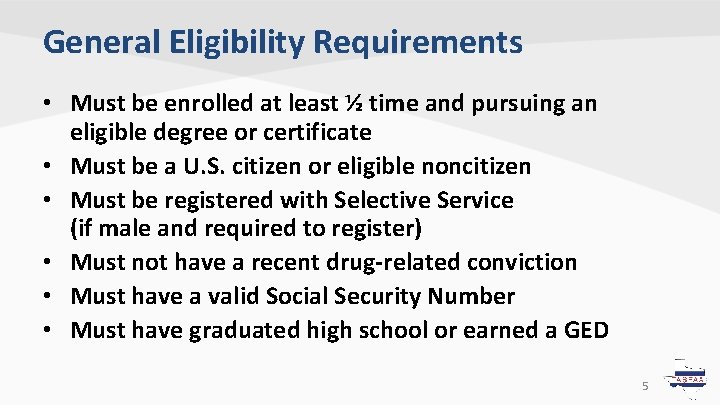
General Eligibility Requirements • Must be enrolled at least ½ time and pursuing an eligible degree or certificate • Must be a U. S. citizen or eligible noncitizen • Must be registered with Selective Service (if male and required to register) • Must not have a recent drug-related conviction • Must have a valid Social Security Number • Must have graduated high school or earned a GED 5
General Requirements Continued • Once in school, continuing requirements: – Must not be in default on a federal student loan or owe repayment of a federal grant – Must be making satisfactory academic progress (SAP) as defined by the school 6
Terminology • The Department of Education uses information from the Free Application for Federal Student Aid (FAFSA) to calculate aid eligibility using a formula established by Congress. • To understand how the formula works, it helps to understand some of the terminology. 7
Expected Family Contribution • Is a measure of your family’s financial strength and is calculated according to a formula established by law • Uses the information you reported on your Free Application for Federal Student Aid (FAFSA). • Stays the same regardless of college. *The EFC is more accurately an “index” number that helps schools determine what types of aid the student is eligible for. Families do not actually pay this amount out-of-pocket 8
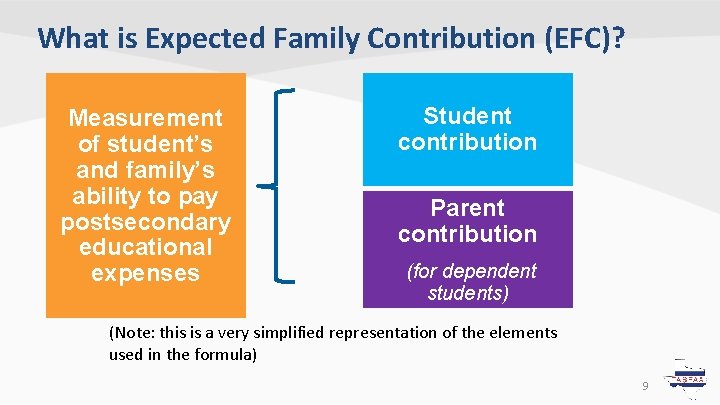
What is Expected Family Contribution (EFC)? Measurement of student’s and family’s ability to pay postsecondary educational expenses Student contribution Parent contribution (for dependent students) (Note: this is a very simplified representation of the elements used in the formula) 9
Cost of Attendance (COA) • Estimate of a student’s costs for a specified period • Includes direct and indirect costs • Major component of determining a student’s financial need – Tuition and Fees – Room and board – Books and supplies – Transportation – Miscellaneous personal expenses 10
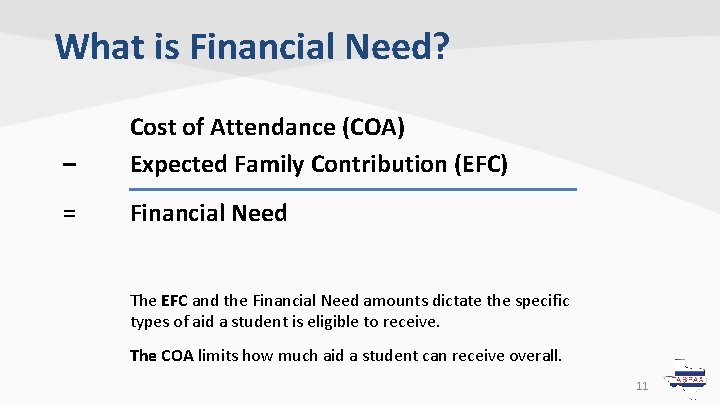
What is Financial Need? – Cost of Attendance (COA) Expected Family Contribution (EFC) = Financial Need The EFC and the Financial Need amounts dictate the specific types of aid a student is eligible to receive. The COA limits how much aid a student can receive overall. 11
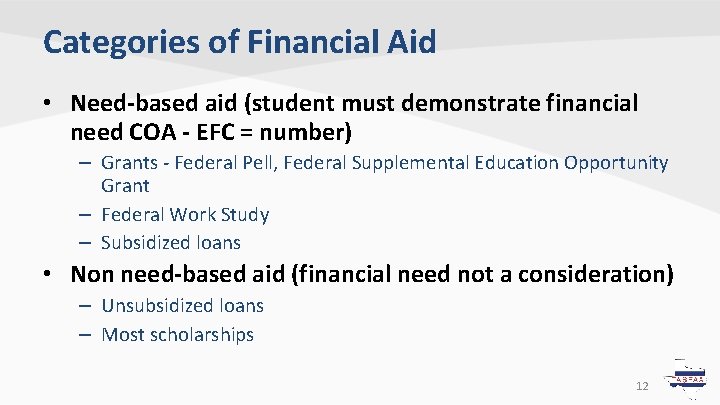
Categories of Financial Aid • Need-based aid (student must demonstrate financial need COA - EFC = number) – Grants - Federal Pell, Federal Supplemental Education Opportunity Grant – Federal Work Study – Subsidized loans • Non need-based aid (financial need not a consideration) – Unsubsidized loans – Most scholarships 12
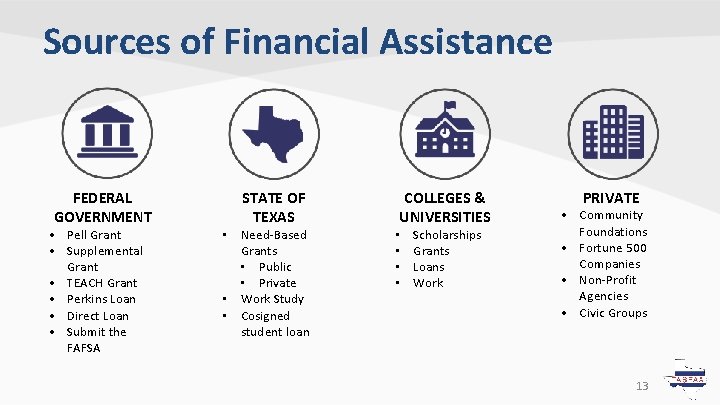
Sources of Financial Assistance FEDERAL GOVERNMENT • Pell Grant • Supplemental Grant • TEACH Grant • Perkins Loan • Direct Loan • Submit the FAFSA STATE OF TEXAS • Need-Based Grants • Public • Private • Work Study • Cosigned student loan COLLEGES & UNIVERSITIES • • Scholarships Grants Loans Work PRIVATE • Community Foundations • Fortune 500 Companies • Non-Profit Agencies • Civic Groups 13
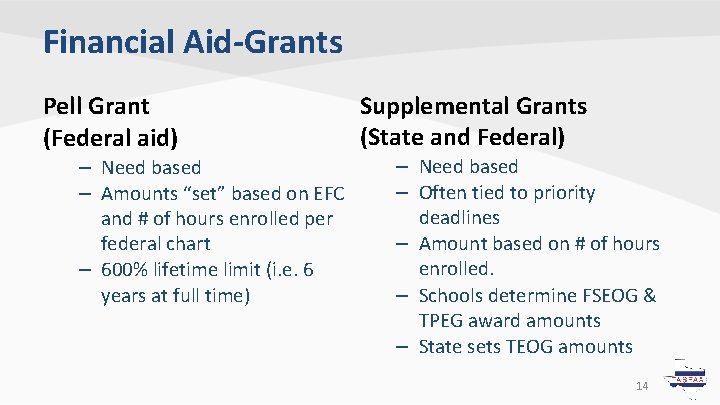
Financial Aid-Grants Pell Grant (Federal aid) – Need based – Amounts “set” based on EFC and # of hours enrolled per federal chart – 600% lifetime limit (i. e. 6 years at full time) Supplemental Grants (State and Federal) – Need based – Often tied to priority deadlines – Amount based on # of hours enrolled. – Schools determine FSEOG & TPEG award amounts – State sets TEOG amounts 14
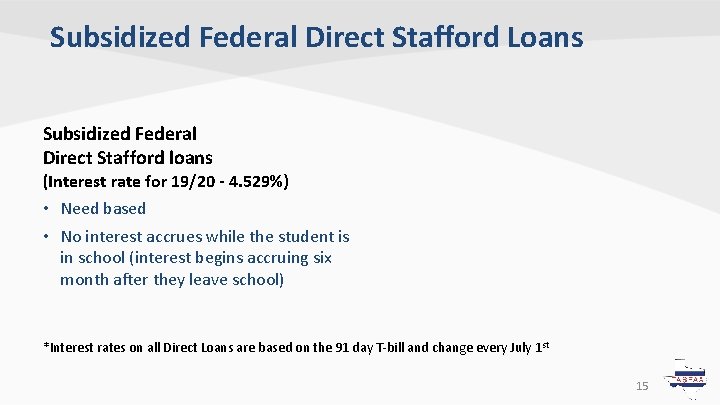
Subsidized Federal Direct Stafford Loans Subsidized Federal Direct Stafford loans (Interest rate for 19/20 - 4. 529%) • Need based • No interest accrues while the student is in school (interest begins accruing six month after they leave school) *Interest rates on all Direct Loans are based on the 91 day T-bill and change every July 1 st 15
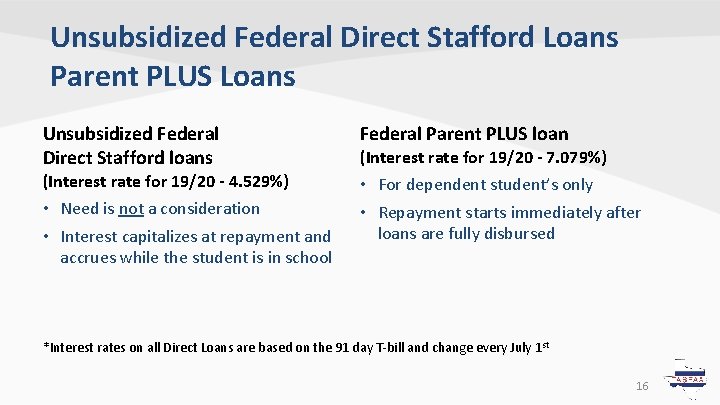
Unsubsidized Federal Direct Stafford Loans Parent PLUS Loans Unsubsidized Federal Direct Stafford loans (Interest rate for 19/20 - 4. 529%) • Need is not a consideration • Interest capitalizes at repayment and accrues while the student is in school Federal Parent PLUS loan (Interest rate for 19/20 - 7. 079%) • For dependent student’s only • Repayment starts immediately after loans are fully disbursed *Interest rates on all Direct Loans are based on the 91 day T-bill and change every July 1 st 16
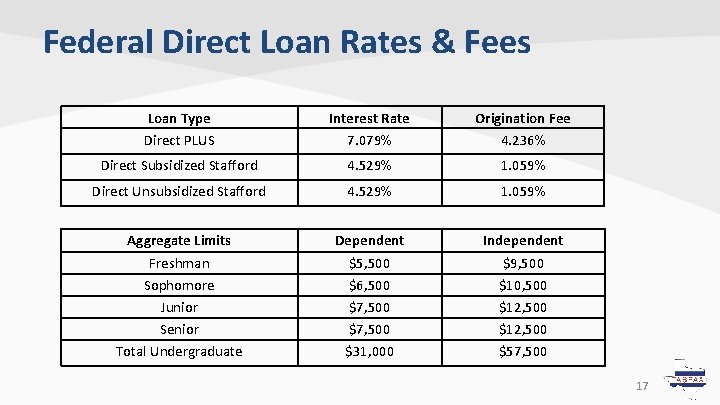
Federal Direct Loan Rates & Fees Loan Type Direct PLUS Interest Rate 7. 079% Origination Fee 4. 236% Direct Subsidized Stafford 4. 529% 1. 059% Direct Unsubsidized Stafford 4. 529% 1. 059% Aggregate Limits Dependent Independent Freshman Sophomore Junior Senior Total Undergraduate $5, 500 $6, 500 $7, 500 $31, 000 $9, 500 $10, 500 $12, 500 $57, 500 17
APPLYING FOR FEDERAL STUDENT AID Presented by: TASFAA EARLY AWARENESS COMMITTEE 18
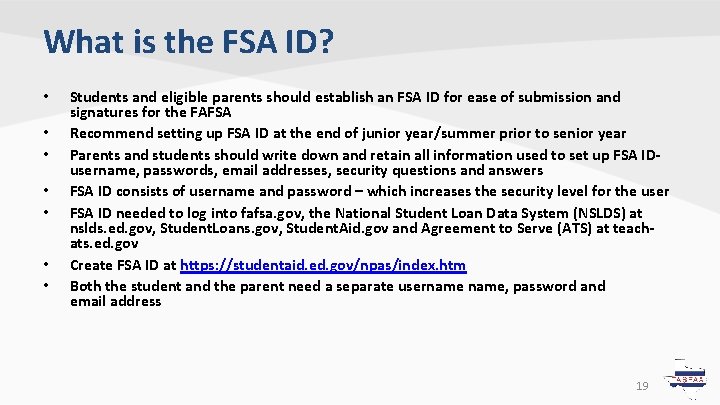
What is the FSA ID? • • Students and eligible parents should establish an FSA ID for ease of submission and signatures for the FAFSA Recommend setting up FSA ID at the end of junior year/summer prior to senior year Parents and students should write down and retain all information used to set up FSA IDusername, passwords, email addresses, security questions and answers FSA ID consists of username and password – which increases the security level for the user FSA ID needed to log into fafsa. gov, the National Student Loan Data System (NSLDS) at nslds. ed. gov, Student. Loans. gov, Student. Aid. gov and Agreement to Serve (ATS) at teach- ats. ed. gov Create FSA ID at https: //studentaid. ed. gov/npas/index. htm Both the student and the parent need a separate username, password and email address 19
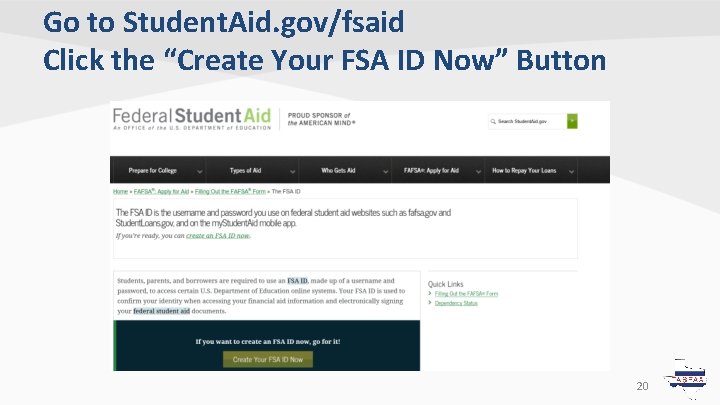
Go to Student. Aid. gov/fsaid Click the “Create Your FSA ID Now” Button 20
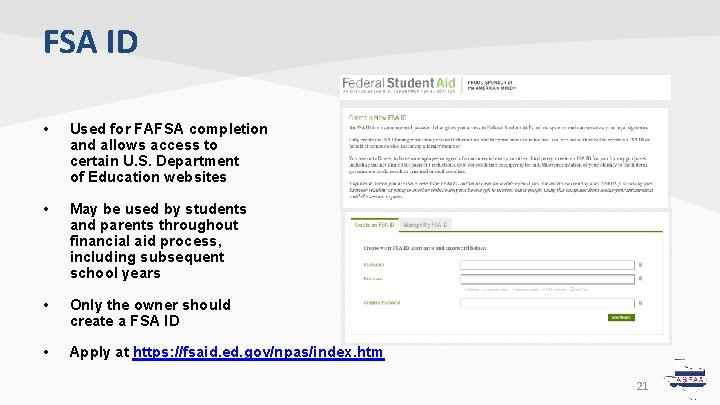
FSA ID • Used for FAFSA completion and allows access to certain U. S. Department of Education websites • May be used by students and parents throughout financial aid process, including subsequent school years • Only the owner should create a FSA ID • Apply at https: //fsaid. ed. gov/npas/index. htm 21
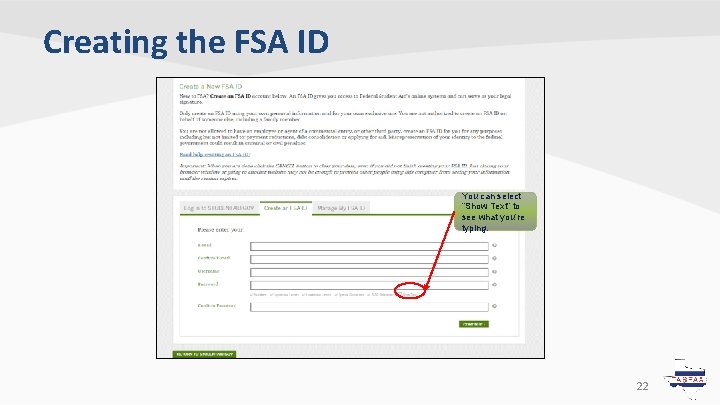
Creating the FSA ID You can select “Show Text” to see what you’re typing. 22
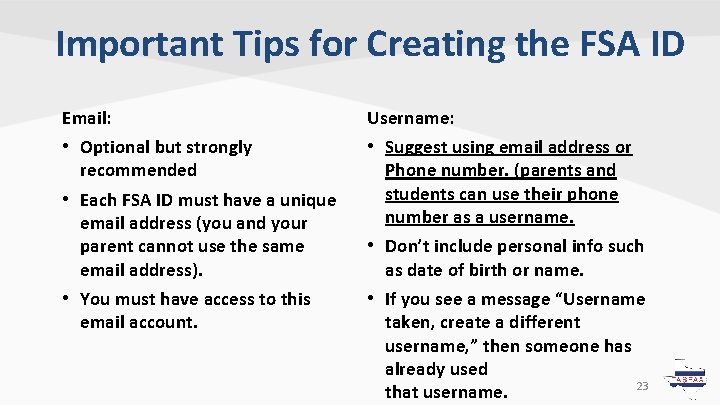
Important Tips for Creating the FSA ID Email: Username: • Optional but strongly recommended • Each FSA ID must have a unique email address (you and your parent cannot use the same email address). • You must have access to this email account. • Suggest using email address or Phone number. (parents and students can use their phone number as a username. • Don’t include personal info such as date of birth or name. • If you see a message “Username taken, create a different username, ” then someone has already used 23 that username.
FAFSA • Produced by the U. S. Department of Education • Collects family’s personal and financial information used to calculate student’s EFC (expected Family Contribution) • Required to receive any Federal Aid including grants and loans (and some scholarships) • Available in English and Spanish 24
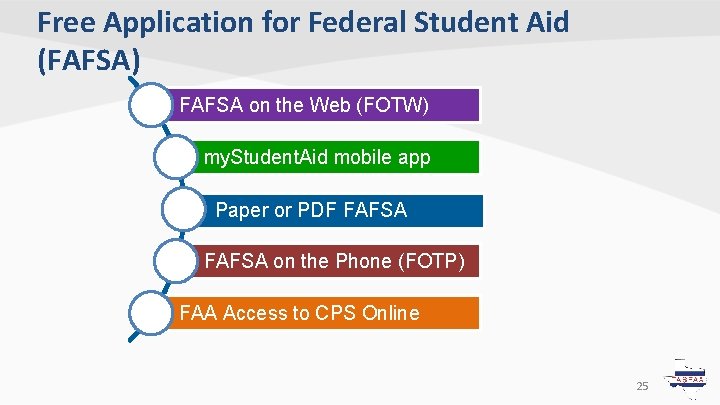
Free Application for Federal Student Aid (FAFSA) FAFSA on the Web (FOTW) my. Student. Aid mobile app Paper or PDF FAFSA on the Phone (FOTP) FAA Access to CPS Online 25
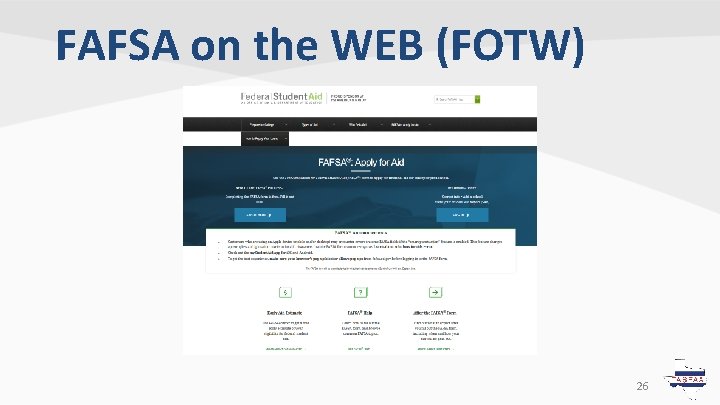
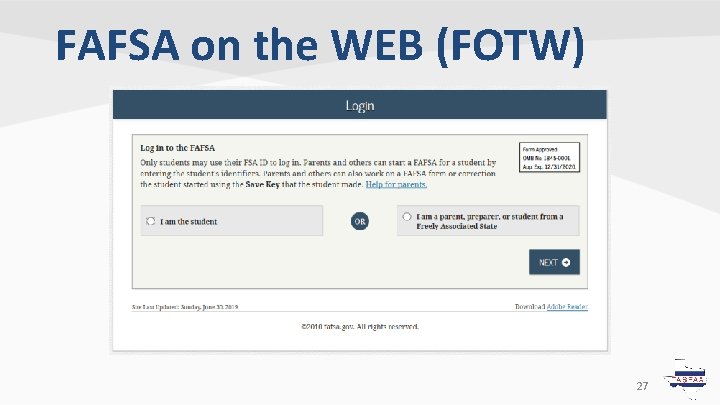
FAFSA on the WEB (FOTW) 26
FAFSA on the WEB (FOTW) 27
Benefits of Using FOTW or my. Student. Aid • Built-in edits to prevent costly errors • Skip-logic allows student and/or parent to skip unnecessary questions • Option to use Internal Revenue Service (IRS) Data Retrieval Tool to import tax data
Benefits of Using FOTW or my. Student. Aid • More timely submission of original application and any necessary corrections • More detailed instructions and “help” for common questions • Ability to check application status online • Simplified application process in the future
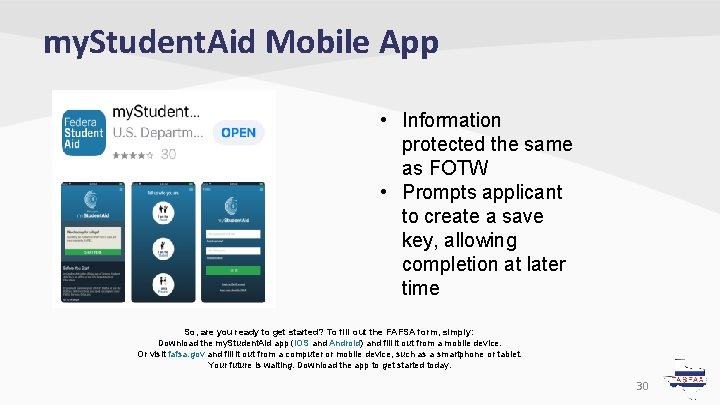
my. Student. Aid Mobile App • Information protected the same as FOTW • Prompts applicant to create a save key, allowing completion at later time So, are you ready to get started? To fill out the FAFSA form, simply: Download the my. Student. Aid app (i. OS and Android) and fill it out from a mobile device. Or visit fafsa. gov and fill it out from a computer or mobile device, such as a smartphone or tablet. Your future is waiting. Download the app to get started today. 30
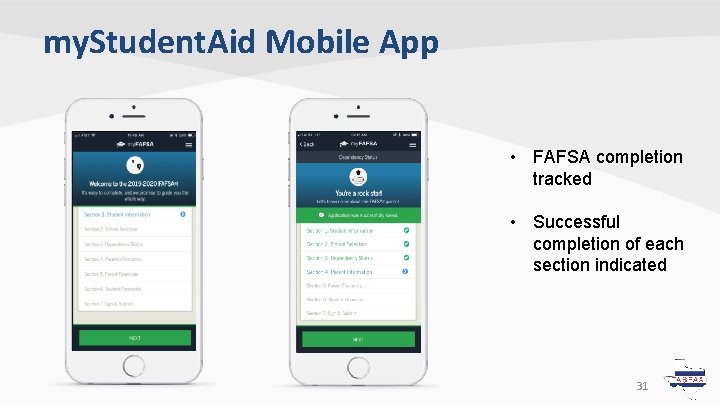
my. Student. Aid Mobile App • FAFSA completion tracked • Successful completion of each section indicated 31
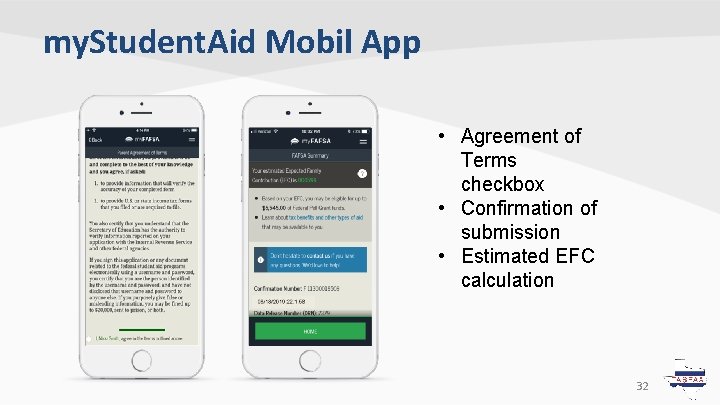
my. Student. Aid Mobil App • Agreement of Terms checkbox • Confirmation of submission • Estimated EFC calculation 32
my. Student. Aid Mobile App • Download from the App. Store or Google Play • Within the mobile app there are links to a number of different federal websites • The main function within the mobile app is My FAFSA and it will allow you to complete the 20202021 FAFSA on your device 33
How is the Mobile App different from the web app? • The user indicates their role in the process and the filing experience is customized to them • The website is mobile responsive • It has a view progress option that will allow you to access the checklist page to see what sections are completed • The questions are broken down into manageable bites • Keyboards match questions and for dates it uses a datepicker • Errors are displayed one at a time for correction and are hyperlinked 34
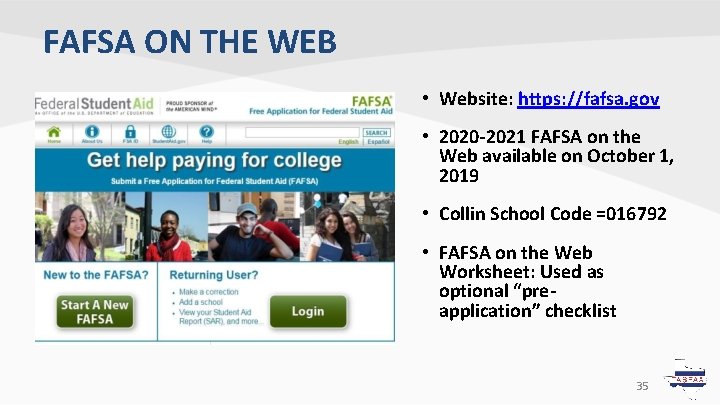
FAFSA ON THE WEB • Website: https: //fafsa. gov • 2020 -2021 FAFSA on the Web available on October 1, 2019 • Collin School Code =016792 • FAFSA on the Web Worksheet: Used as optional “preapplication” checklist 35
FAFSA ON THE WEB Cont……. • Good reasons to file electronically: – Built-in edits to help prevent costly errors – Simplification: Skip-logic allows student and/or parent to skip – Unnecessary questions – Immediate submission of original application and any necessary corrections – – More detailed instructions than space allows on the pdf version of the FAFSA Help & Live Chat Assistance Options Ability to check application status on-line Simplified application process in subsequent years 36
FAFSA on the Web Worksheet • Helpful tool that includes questions that may be applicable to all students • Smart Logic means all students will not see same number and sets of questions on FOTW • Available in English & Spanish • Has four sections – – Student General Info Dependency Status Questions Parental Information (Including financial) Student Information (Including financial) 37
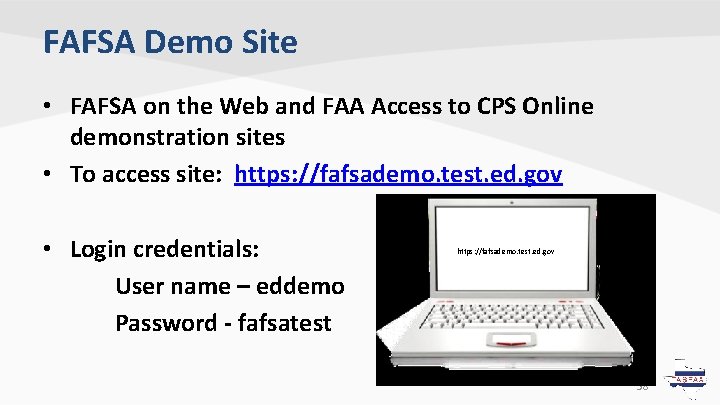
FAFSA Demo Site • FAFSA on the Web and FAA Access to CPS Online demonstration sites • To access site: https: //fafsademo. test. ed. gov • Login credentials: User name – eddemo Password - fafsatest https: //fafsademo. test. ed. gov 38
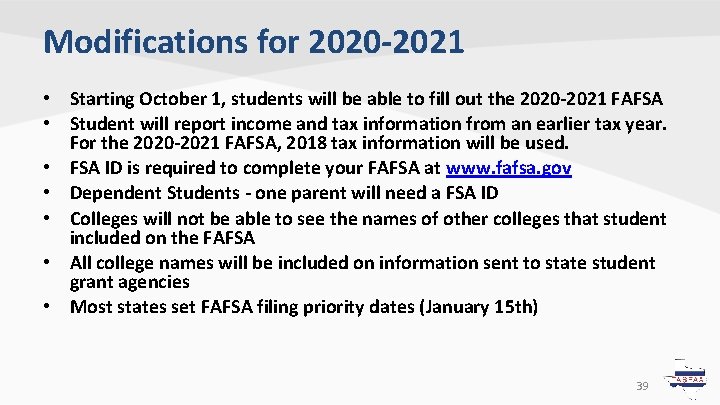
Modifications for 2020 -2021 • Starting October 1, students will be able to fill out the 2020 -2021 FAFSA • Student will report income and tax information from an earlier tax year. For the 2020 -2021 FAFSA, 2018 tax information will be used. • FSA ID is required to complete your FAFSA at www. fafsa. gov • Dependent Students - one parent will need a FSA ID • Colleges will not be able to see the names of other colleges that student included on the FAFSA • All college names will be included on information sent to state student grant agencies • Most states set FAFSA filing priority dates (January 15 th) 39
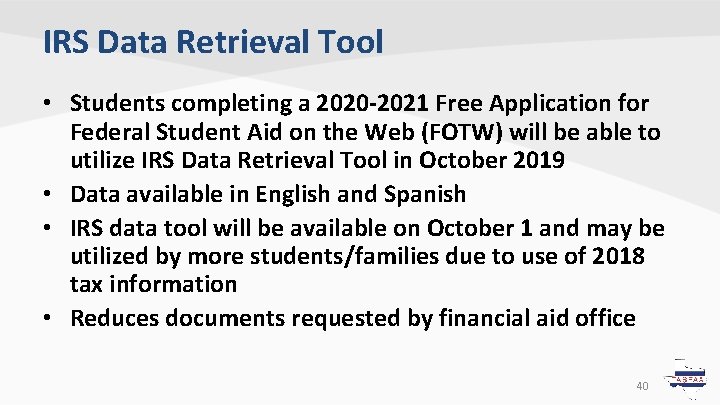
IRS Data Retrieval Tool • Students completing a 2020 -2021 Free Application for Federal Student Aid on the Web (FOTW) will be able to utilize IRS Data Retrieval Tool in October 2019 • Data available in English and Spanish • IRS data tool will be available on October 1 and may be utilized by more students/families due to use of 2018 tax information • Reduces documents requested by financial aid office 40
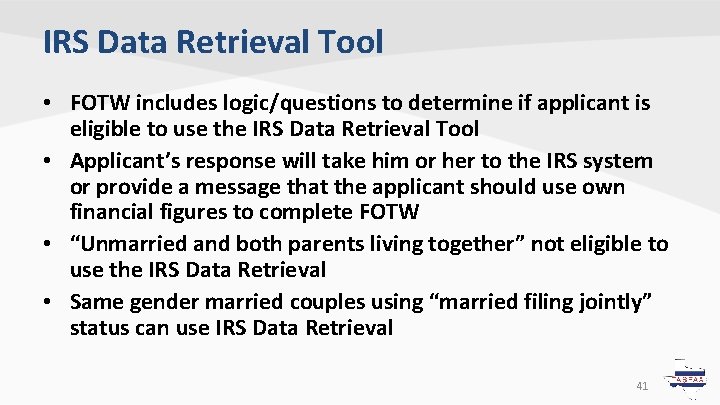
IRS Data Retrieval Tool • FOTW includes logic/questions to determine if applicant is eligible to use the IRS Data Retrieval Tool • Applicant’s response will take him or her to the IRS system or provide a message that the applicant should use own financial figures to complete FOTW • “Unmarried and both parents living together” not eligible to use the IRS Data Retrieval • Same gender married couples using “married filing jointly” status can use IRS Data Retrieval 41
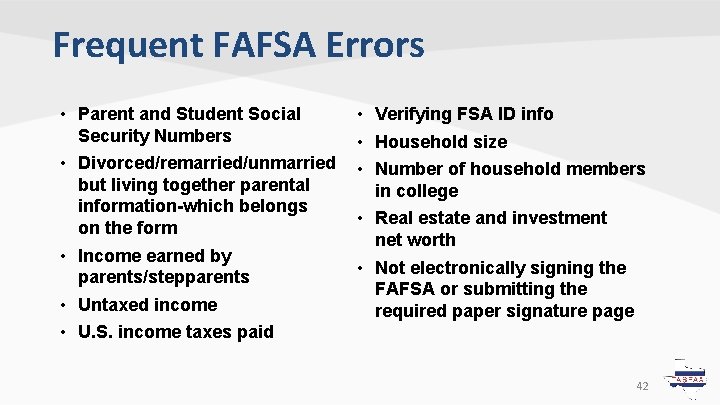
Frequent FAFSA Errors • Parent and Student Social Security Numbers • Divorced/remarried/unmarried but living together parental information-which belongs on the form • Income earned by parents/stepparents • Untaxed income • U. S. income taxes paid • Verifying FSA ID info • Household size • Number of household members in college • Real estate and investment net worth • Not electronically signing the FAFSA or submitting the required paper signature page 42
AFTER THE FAFSA Presented by: TASFAA EARLY AWARENESS COMMITTEE 43
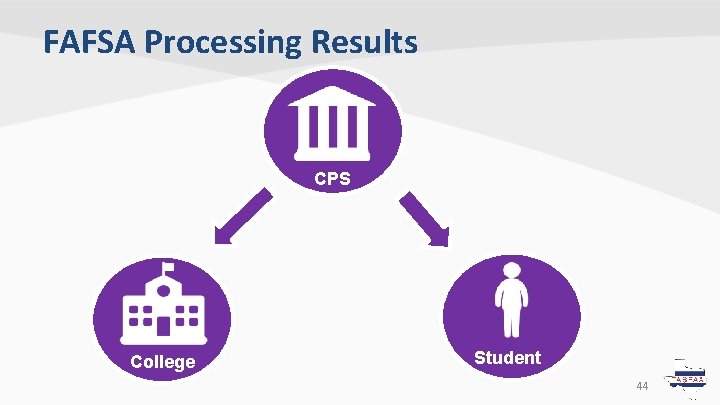
FAFSA Processing Results CPS College Student 44
FAFSA Processing Results • Central Processing System (CPS) notifies student of FASFA results by: • Paper Student Aid Report (SAR) if paper FAFSA was filed and student’s e-mail address was not provided • SAR Acknowledgement if filed electronically via FAFSA on the Web and student’s e-mail address was not provided 45
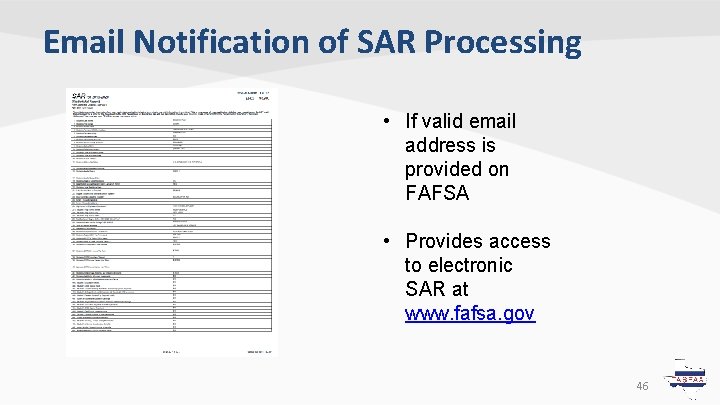
Email Notification of SAR Processing • If valid email address is provided on FAFSA • Provides access to electronic SAR at www. fafsa. gov 46
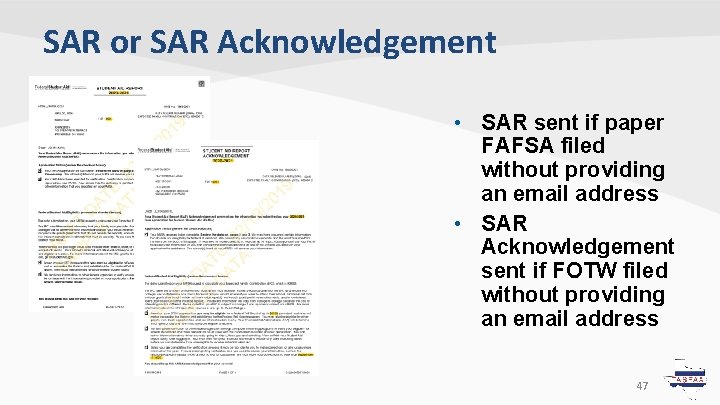
SAR or SAR Acknowledgement • SAR sent if paper FAFSA filed without providing an email address • SAR Acknowledgement sent if FOTW filed without providing an email address 47
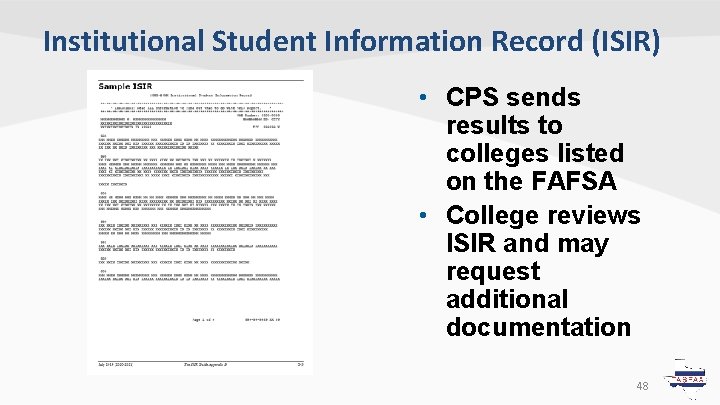
Institutional Student Information Record (ISIR) • CPS sends results to colleges listed on the FAFSA • College reviews ISIR and may request additional documentation 48
Determining Dependency Status Special Circumstances Dependency Status 49
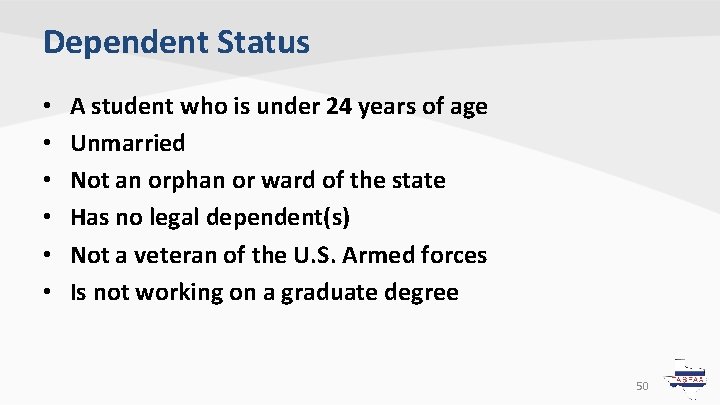
Dependent Status • • • A student who is under 24 years of age Unmarried Not an orphan or ward of the state Has no legal dependent(s) Not a veteran of the U. S. Armed forces Is not working on a graduate degree 50
Independent Status • If a student answers yes to any of the questions in Step Three of the FAFSA – Questions 46 -58 then they are considered independent and do not have to provide parent information • The following circumstances can also make a student independent: – – Is emancipated Is in a legal guardianship Is homeless or at risk of being homeless Was in foster care any time AFTER turning 13 years old 51
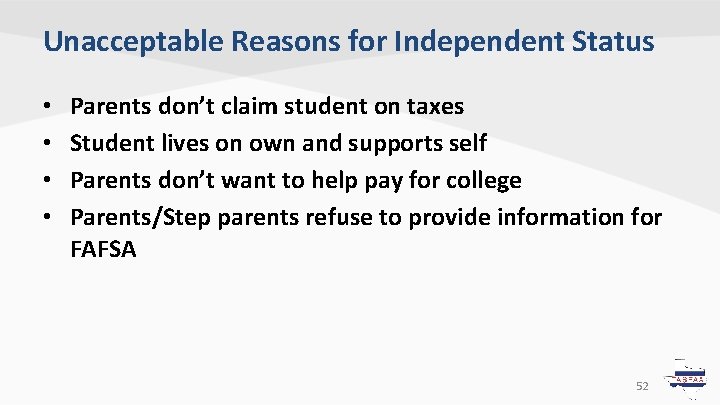
Unacceptable Reasons for Independent Status • • Parents don’t claim student on taxes Student lives on own and supports self Parents don’t want to help pay for college Parents/Step parents refuse to provide information for FAFSA 52
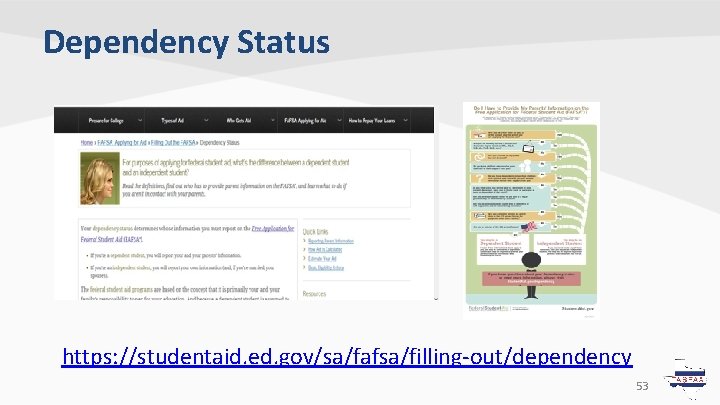
Dependency Status https: //studentaid. ed. gov/sa/fafsa/filling-out/dependency 53
Dependency Overrides • Financial Aid Office has authority to change the filing status from dependent to independent • Student must present documentation of situation • Special circumstances include: – Abuse at home – Abandonment by parents 54
Dependency Overrides • • • Documentation from third party: Teacher Social worker Member of clergy Court system Law enforcement 55
Who is parent? • Biological parents • Adoptive parents • Stepparents, if they are married to the student’s biological or adoptive parent 56
Who is not a parent? • Foster parents • Legal guardians who have not adopted the student • Any relatives (including grandparents) who have not adopted the student • Widowed stepparents who have not adopted the student 57
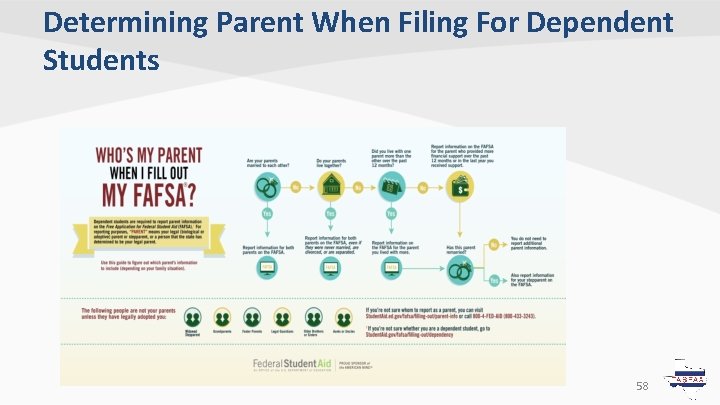
Determining Parent When Filing For Dependent Students 58
Frequently Asked Questions • • Divorced parents Parents overseas Parent incarcerated 1 parent deceased/1 out of picture 59
Determining and Reporting Number in Household • Parents cannot claim child in HH and claim child support paid • Do not consider who claimed child on tax return • “Other dependents” • Dependent student cannot claim sibling as dependent 60
After the FAFSA • • Use of the FAFSA Completion Tool Reviewing the Student Aid Report (SAR) Corrections Verification Professional judgment Reviewing and comparing budgets and award letters Establishing a relationship with the financial aid office 61
FAFSA Processing Results • Central Processing System (CPS) notifies student of FASFA results by: • Paper Student Aid Report (SAR) if paper FAFSA was filed and student’s e-mail address was not provided • SAR Acknowledgement if filed electronically via FAFSA on the Web and student’s e-mail address was not provided 62
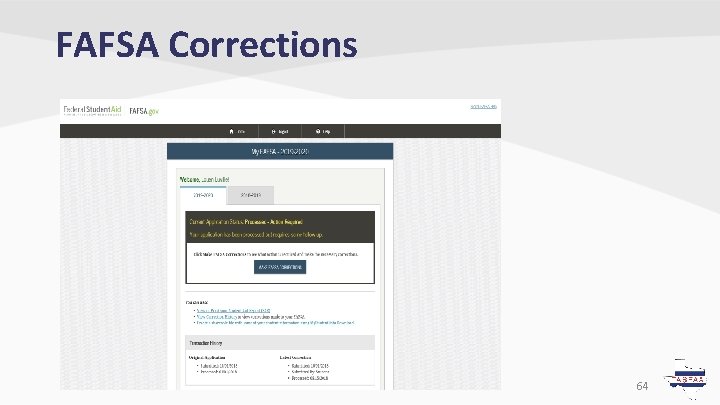
Making Corrections • Corrections to FAFSA data may be made by: – – Using FAFSA on the Web (www. fafsa. gov) if student has a FSA ID Updating and mailing paper SAR Submitting documentation to school’s financial aid office Consistent messaging sent to use IRS Data Retrieval Tool if data is not transferred during initial submission Make sure the student only corrects the information that was reported incorrectly when they created the FASFA 63
FAFSA Corrections 64
Verification • Process by which the U. S. Department of Education (ED) through the financial aid office confirms accuracy of the information provided by students and families on the FAFSA. • Students can be selected for verification by the Department of Education or their college • Items required to be verified will vary – IRS tax return transcript – letter of non-filing • Verification process is completed by the college 65
Professional Judgement • Purpose-Financial Aid Officers have the authority to make some changes to the status of aid based on special circumstances. • Appropriate use • Process 66
Establishing a Relationship with the Financial Aid Office • Importance • Questions to ask • Benefits 67
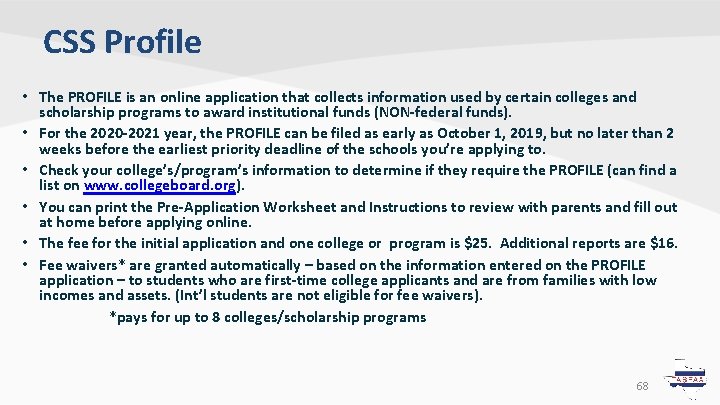
CSS Profile • The PROFILE is an online application that collects information used by certain colleges and scholarship programs to award institutional funds (NON-federal funds). • For the 2020 -2021 year, the PROFILE can be filed as early as October 1, 2019, but no later than 2 weeks before the earliest priority deadline of the schools you’re applying to. • Check your college’s/program’s information to determine if they require the PROFILE (can find a list on www. collegeboard. org). • You can print the Pre-Application Worksheet and Instructions to review with parents and fill out at home before applying online. • The fee for the initial application and one college or program is $25. Additional reports are $16. • Fee waivers* are granted automatically – based on the information entered on the PROFILE application – to students who are first-time college applicants and are from families with low incomes and assets. (Int’l students are not eligible for fee waivers). *pays for up to 8 colleges/scholarship programs 68
COUNCELING UNDOCUMENTED STUDENTS Presented by: TASFAA EARLY AWARENESS COMMITTEE 69
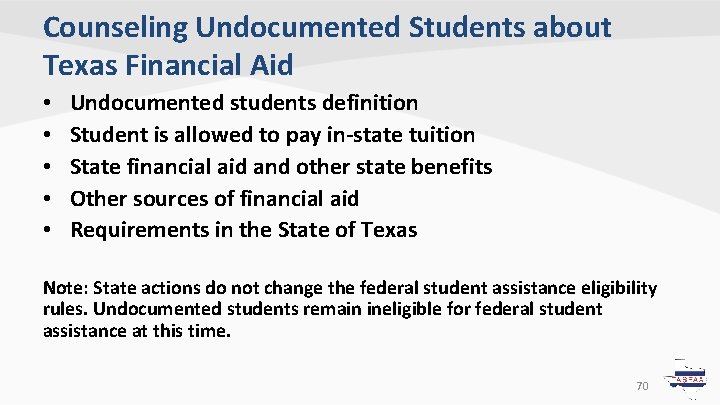
Counseling Undocumented Students about Texas Financial Aid • • • Undocumented students definition Student is allowed to pay in-state tuition State financial aid and other state benefits Other sources of financial aid Requirements in the State of Texas Note: State actions do not change the federal student assistance eligibility rules. Undocumented students remain ineligible for federal student assistance at this time. 70
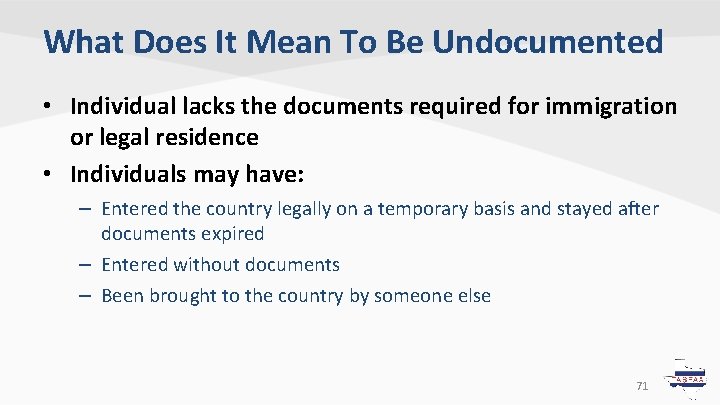
What Does It Mean To Be Undocumented • Individual lacks the documents required for immigration or legal residence • Individuals may have: – Entered the country legally on a temporary basis and stayed after documents expired – Entered without documents – Been brought to the country by someone else 71
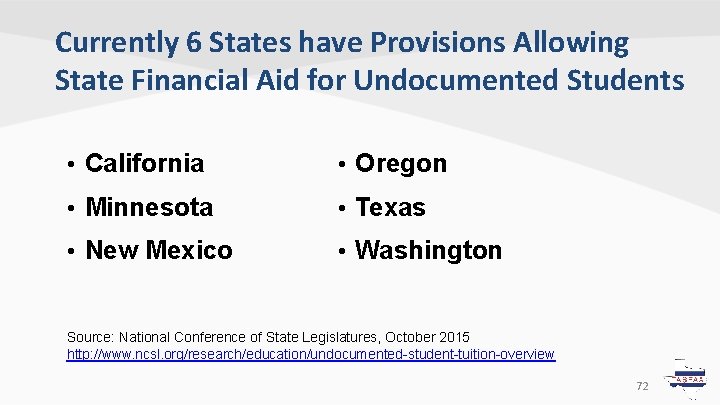
Currently 6 States have Provisions Allowing State Financial Aid for Undocumented Students • California • Oregon • Minnesota • Texas • New Mexico • Washington Source: National Conference of State Legislatures, October 2015 http: //www. ncsl. org/research/education/undocumented-student-tuition-overview 72
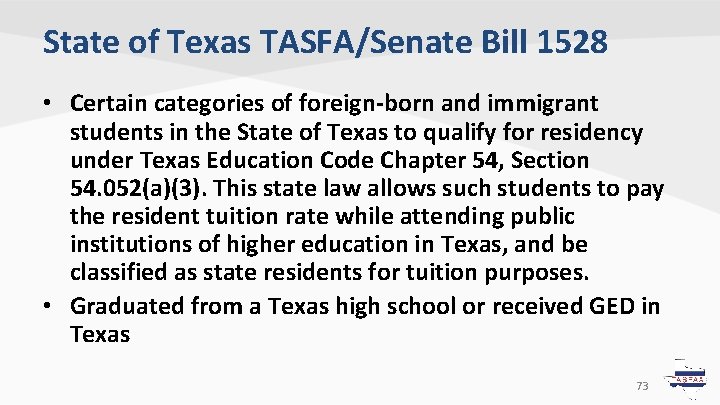
State of Texas TASFA/Senate Bill 1528 • Certain categories of foreign-born and immigrant students in the State of Texas to qualify for residency under Texas Education Code Chapter 54, Section 54. 052(a)(3). This state law allows such students to pay the resident tuition rate while attending public institutions of higher education in Texas, and be classified as state residents for tuition purposes. • Graduated from a Texas high school or received GED in Texas 73
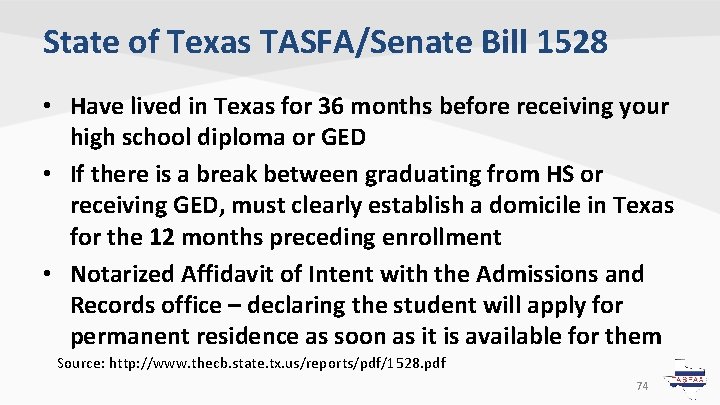
State of Texas TASFA/Senate Bill 1528 • Have lived in Texas for 36 months before receiving your high school diploma or GED • If there is a break between graduating from HS or receiving GED, must clearly establish a domicile in Texas for the 12 months preceding enrollment • Notarized Affidavit of Intent with the Admissions and Records office – declaring the student will apply for permanent residence as soon as it is available for them Source: http: //www. thecb. state. tx. us/reports/pdf/1528. pdf 74
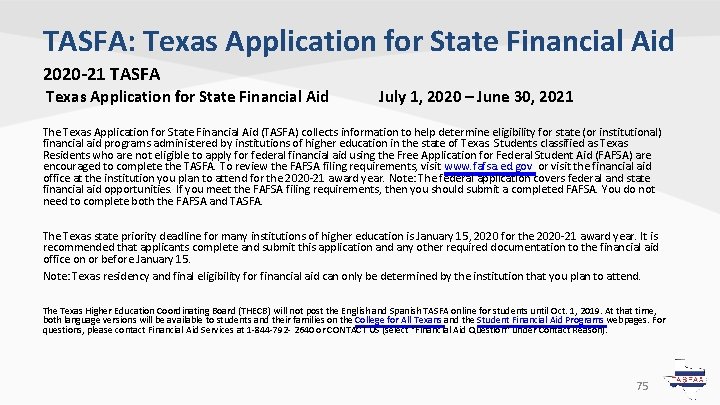
TASFA: Texas Application for State Financial Aid 2020 -21 TASFA Texas Application for State Financial Aid July 1, 2020 – June 30, 2021 The Texas Application for State Financial Aid (TASFA) collects information to help determine eligibility for state (or institutional) financial aid programs administered by institutions of higher education in the state of Texas. Students classified as Texas Residents who are not eligible to apply for federal financial aid using the Free Application for Federal Student Aid (FAFSA) are encouraged to complete the TASFA. To review the FAFSA filing requirements, visit www. fafsa. ed. gov or visit the financial aid office at the institution you plan to attend for the 2020 -21 award year. Note: The federal application covers federal and state financial aid opportunities. If you meet the FAFSA filing requirements, then you should submit a completed FAFSA. You do not need to complete both the FAFSA and TASFA. The Texas state priority deadline for many institutions of higher education is January 15, 2020 for the 2020 -21 award year. It is recommended that applicants complete and submit this application and any other required documentation to the financial aid office on or before January 15. Note: Texas residency and final eligibility for financial aid can only be determined by the institution that you plan to attend. The Texas Higher Education Coordinating Board (THECB) will not post the English and Spanish TASFA online for students until Oct. 1, 2019. At that time, both language versions will be available to students and their families on the College for All Texans and the Student Financial Aid Programs webpages. For questions, please contact Financial Aid Services at 1 -844 -792 - 2640 or CONTACT US (select “Financial Aid Question” under Contact Reason). 75
TASFA • Requirements needed in addition to the TASFA application: • Parent’s income tax return transcript, verification of nonfiling letter, W 2 s, or statement of income • Student’s income tax return transcript, verification of nonfiling letter, W 2 s, or statement of income • Males between the ages of 18 and 25 have to register for selective service, either online (www. sss. gov) or by mail 76
FAQ Does my parents’ citizenship status affect my eligibility for federal student aid? In order for me to complete the FAFSA, do my parents need Social Security numbers? No. Your parents’ citizenship status does not affect No; since your parents’ citizenship does not affect your ability to complete the FAFSA, they do not need your eligibility for federal student aid. In fact, the FAFSA doesn’t even ask about your parents’ status. Social Security numbers. If your parents do not have Social Security numbers, you must enter 000 -00 -0000 when the FAFSA asks for parents’ Social Security numbers. If your parents do not have Social Security numbers, you must print out the signature page from the online FAFSA so that your parents can sign it and send it in. 77
Questions and Discussion Contact Info: financialaid@Collin. edu 78