
Financial Aid For 2018 2019 1321 Butte St

Financial Aid For 2018 -2019 1321 Butte St. Suite 101 Redding, CA 96001 CALL (530) 244 -4022 for an appointment FAX 530 -244 -4029 WWW. COLLEGEOPTIONS. ORG Ø Serving students and families in the North State since 2003 Ø A non-profit organization securing grant funding to be able to provide free services and resources to our region. Ø Serving a 5 county region – Modoc, Siskiyou, Shasta, Tehama, Trinity Ø Financial aid appointments available

How Need Based Financial Aid Works Handout
Goals and Objectives for Today: Realization that there is a plan for you Basic understanding of how financial aid works… and how to maximize opportunities How to make informed “family” decisions regarding education choices Know where to go for resources and help College is not a dream…it is a plan.
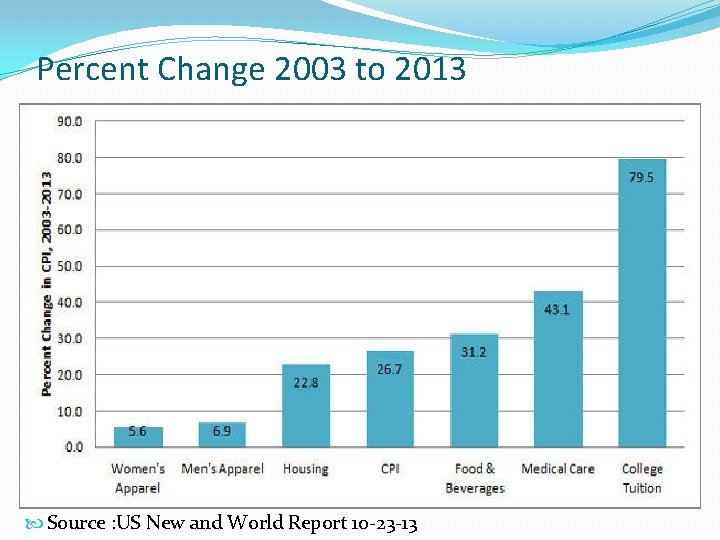
Percent Change 2003 to 2013 Source : US New and World Report 10 -23 -13
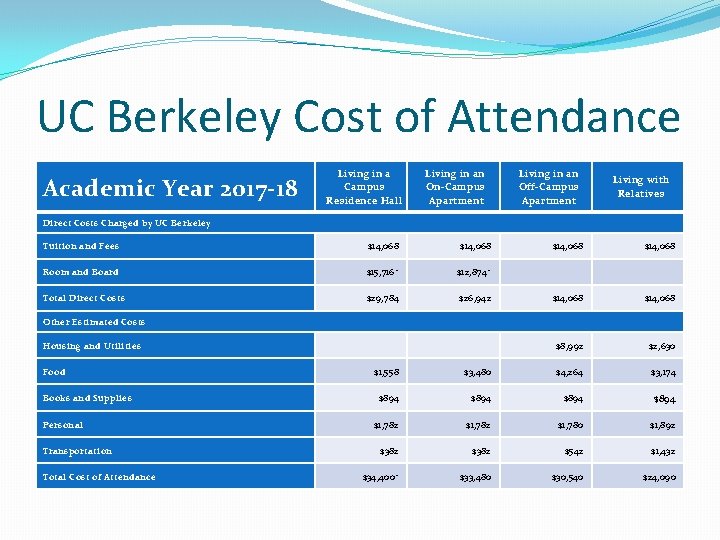
UC Berkeley Cost of Attendance Academic Year 2017 -18 Living in a Campus Residence Hall Living in an On-Campus Apartment Living in an Off-Campus Apartment Living with Relatives Direct Costs Charged by UC Berkeley Tuition and Fees $14, 068 Room and Board $15, 716* $12, 874* Total Direct Costs $29, 784 $26, 942 $14, 068 $8, 992 $2, 630 $1, 558 $3, 480 $4, 264 $3, 174 $894 $1, 782 $1, 780 $1, 892 $382 $542 $1, 432 $34, 400* $33, 480 $30, 540 $24, 090 Other Estimated Costs Housing and Utilities Food Books and Supplies Personal Transportation Total Cost of Attendance
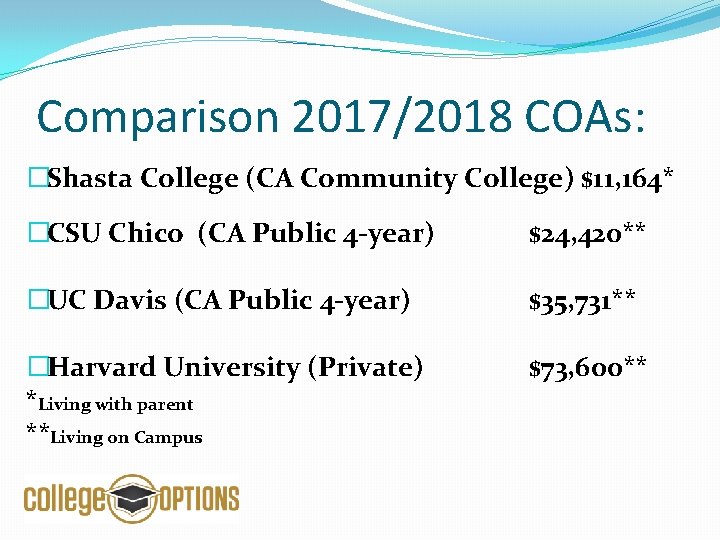
Comparison 2017/2018 COAs: �Shasta College (CA Community College) $11, 164* �CSU Chico (CA Public 4 -year) $24, 420** �UC Davis (CA Public 4 -year) $35, 731** �Harvard University (Private) *Living with parent **Living on Campus $73, 600**
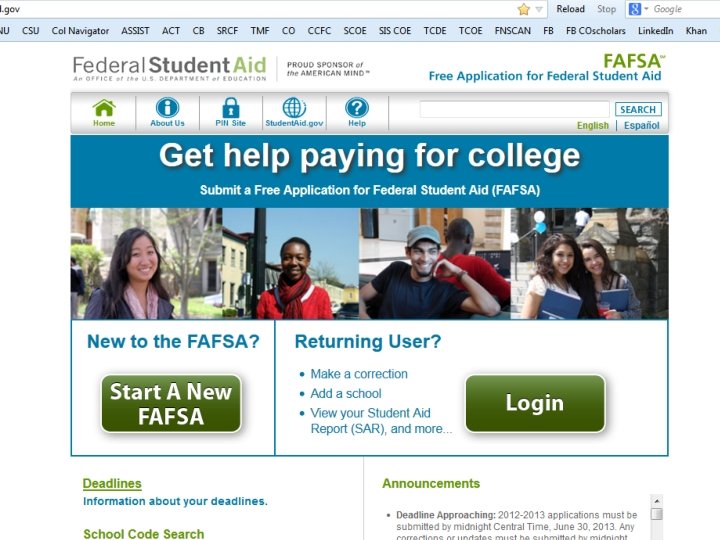
What is the FAFSA? FREE Application for Federal Student Aid Universal “measuring tool” to determine family’s financial strength Must be completed every year of college Gateway to financial aid (Grants, Loans, Scholarships and Work Study)
FAFSA Process www. fafsa. ed. gov Available October 1, 2017. Submit with 2016 tax return information See you at the Cash for College Night If needed, make corrections after SAR is received Submit FASFA online prior to California Deadline (March 2, 2018) or college deadline if earlier Submit any other state requirements by State Deadline as well Must submit FAFSA every year in college
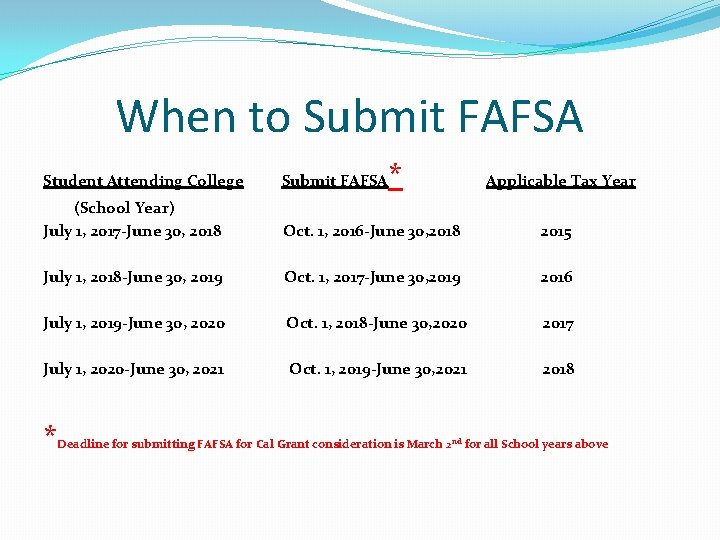
When to Submit FAFSA * Student Attending College Submit FAFSA Applicable Tax Year (School Year) July 1, 2017 -June 30, 2018 Oct. 1, 2016 -June 30, 2018 2015 July 1, 2018 -June 30, 2019 Oct. 1, 2017 -June 30, 2019 2016 July 1, 2019 -June 30, 2020 Oct. 1, 2018 -June 30, 2020 2017 July 1, 2020 -June 30, 2021 Oct. 1, 2019 -June 30, 2021 2018 * Deadline for submitting FAFSA for Cal Grant consideration is March 2 nd for all School years above
Types of Financial Aid Grants Scholarship Loans Work Study
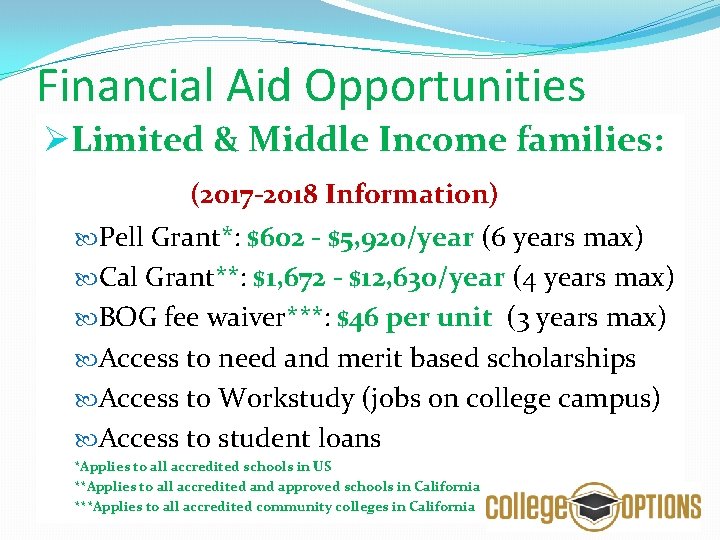
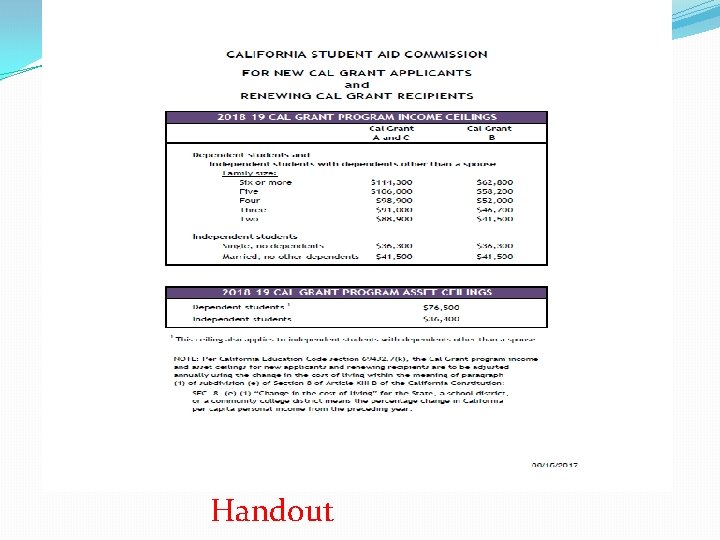
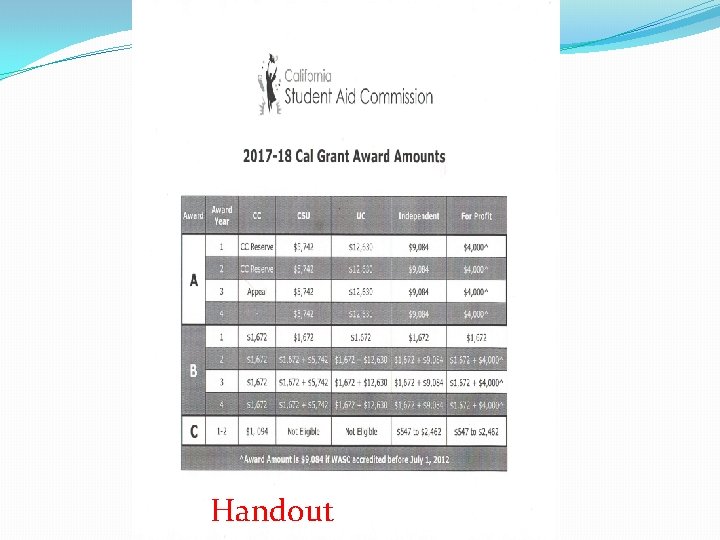
Financial Aid Opportunities ØLimited & Middle Income families: (2017 -2018 Information) Pell Grant*: $602 - $5, 920/year (6 years max) Cal Grant**: $1, 672 - $12, 630/year (4 years max) BOG fee waiver***: $46 per unit (3 years max) Access to need and merit based scholarships Access to Workstudy (jobs on college campus) Access to student loans *Applies to all accredited schools in US **Applies to all accredited and approved schools in California ***Applies to all accredited community colleges in California
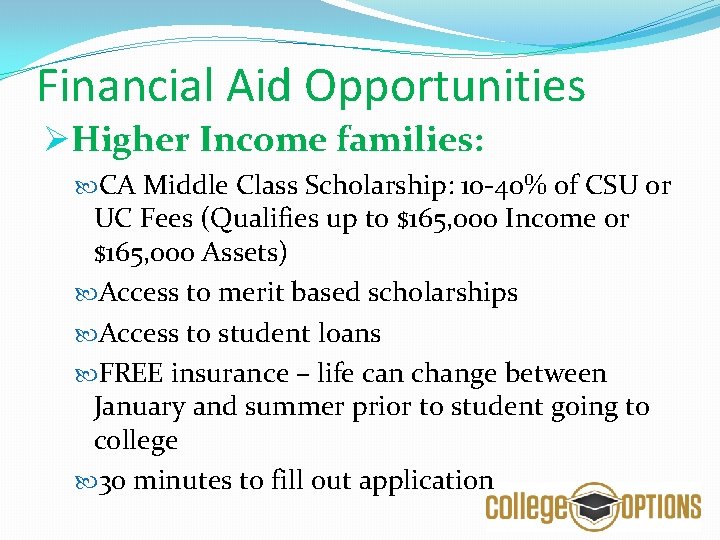
Financial Aid Opportunities ØHigher Income families: CA Middle Class Scholarship: 10 -40% of CSU or UC Fees (Qualifies up to $165, 000 Income or $165, 000 Assets) Access to merit based scholarships Access to student loans FREE insurance – life can change between January and summer prior to student going to college 30 minutes to fill out application
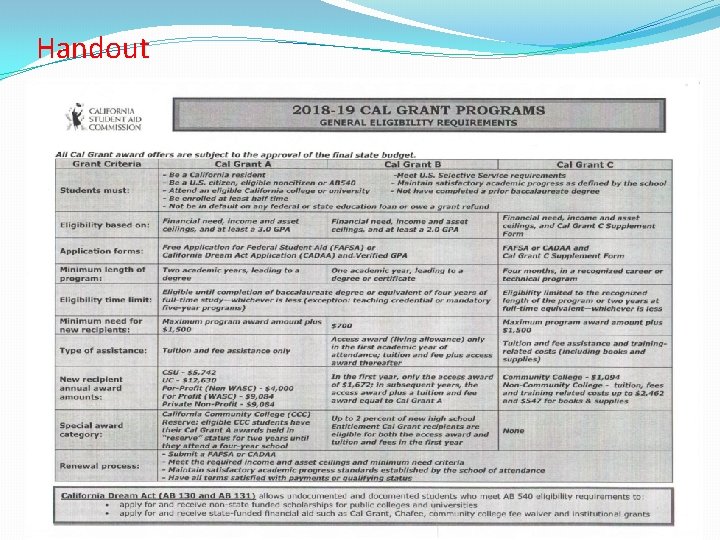
Handout ØHigher Income families: CA Middle Class Scholarship: 10 -40% of CSU or UC Fees (Up to $165, 000 Family Income or Assets) Access to merit based scholarships Access to student loans FREE insurance – life can change between January and summer prior to student going to college 30 minutes to fill out application

Handout
Handout
Handout

Handout
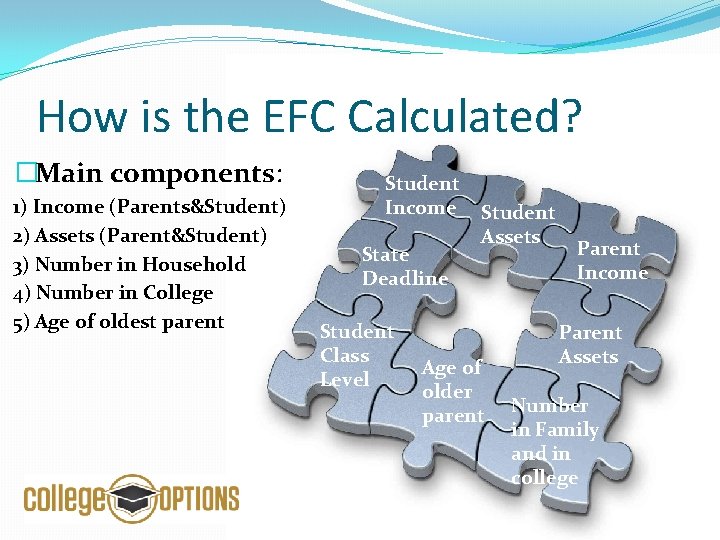
How is the EFC Calculated? �Main components: 1) Income (Parents&Student) 2) Assets (Parent&Student) 3) Number in Household 4) Number in College 5) Age of oldest parent Student Income Student Assets Parent State Income Deadline Student Class Level Age of older parent Parent Assets Number in Family and in college
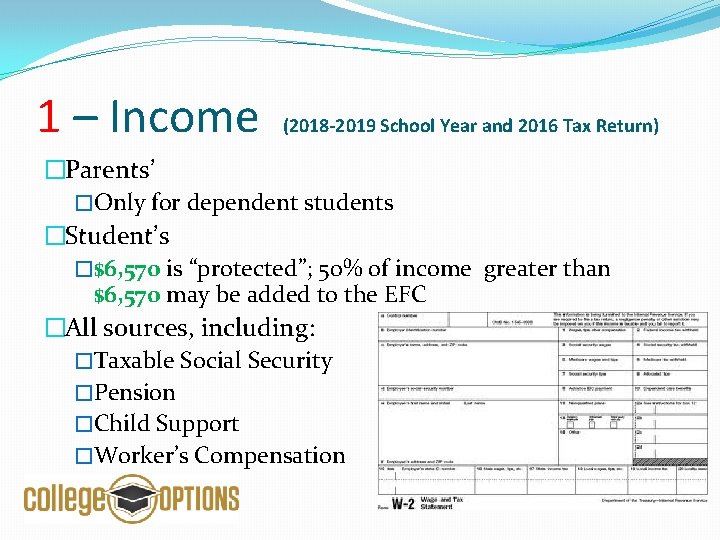
1 – Income (2018 -2019 School Year and 2016 Tax Return) �Parents’ �Only for dependent students �Student’s �$6, 570 is “protected”; 50% of income greater than $6, 570 may be added to the EFC �All sources, including: �Taxable Social Security �Pension �Child Support �Worker’s Compensation
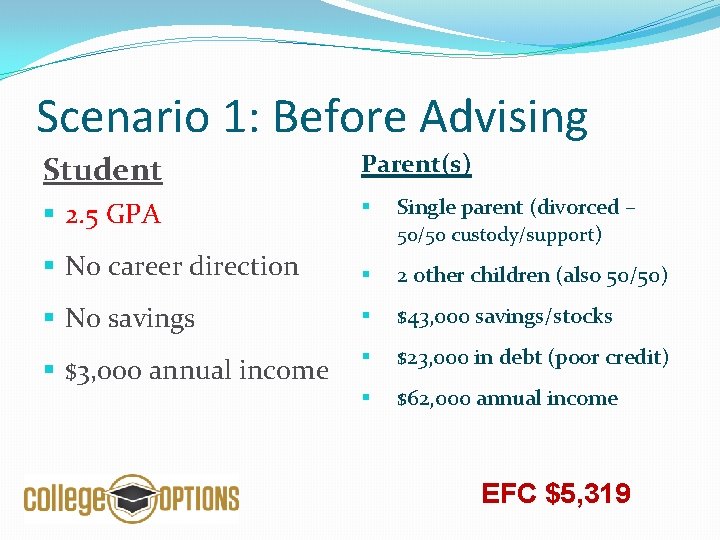
Scenario 1: Before Advising Student Parent(s) § 2. 5 GPA § Single parent (divorced – 50/50 custody/support) § No career direction § 2 other children (also 50/50) § No savings § $43, 000 savings/stocks § $3, 000 annual income § $23, 000 in debt (poor credit) § $62, 000 annual income EFC $5, 319
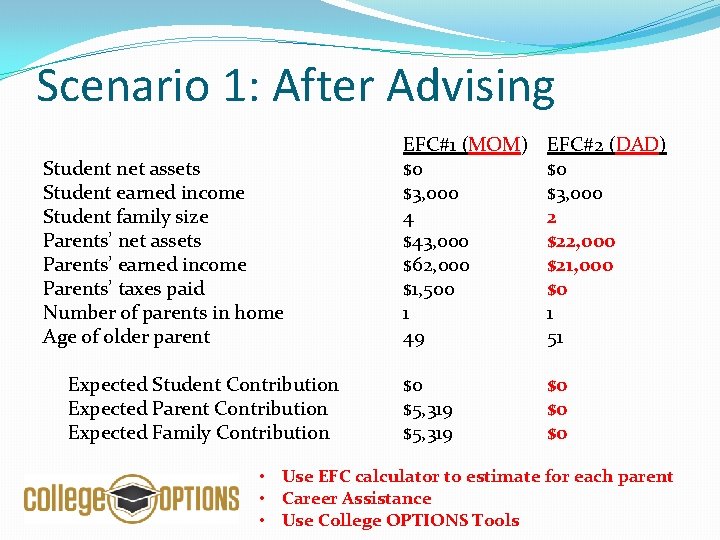
Scenario 1: After Advising Student net assets Student earned income Student family size Parents’ net assets Parents’ earned income Parents’ taxes paid Number of parents in home Age of older parent Expected Student Contribution Expected Parent Contribution Expected Family Contribution EFC#1 (MOM) $0 $3, 000 4 $43, 000 $62, 000 $1, 500 1 49 EFC#2 (DAD) $0 $3, 000 2 $22, 000 $21, 000 $0 1 51 $0 $5, 319 $0 $0 $0 • Use EFC calculator to estimate for each parent • Career Assistance • Use College OPTIONS Tools
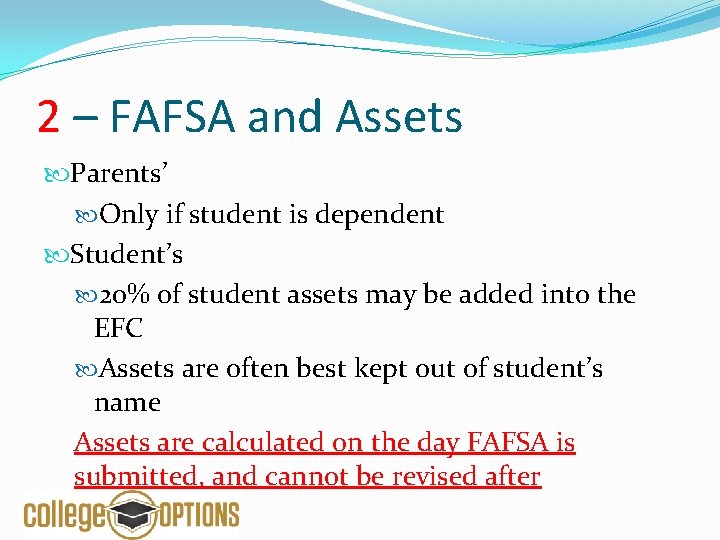
2 – FAFSA and Assets Parents’ Only if student is dependent Student’s 20% of student assets may be added into the EFC Assets are often best kept out of student’s name Assets are calculated on the day FAFSA is submitted, and cannot be revised after submission.

For FAFSA, Assets Do NOT Include: Home equity Retirement accounts (IRA, 401 k, 403 b, Roth, etc. ) Life insurance & annuities Assets entitled to a business or ranch/farm, if you own/operate at least 50% and have 100 or fewer employees. Examples of assets to declare: -Stocks, cash in bank, other realestate/investments etc. Examples of assets not to declare: -Personal vehicles, boats, firearms, household goods, jewelry, tools etc.
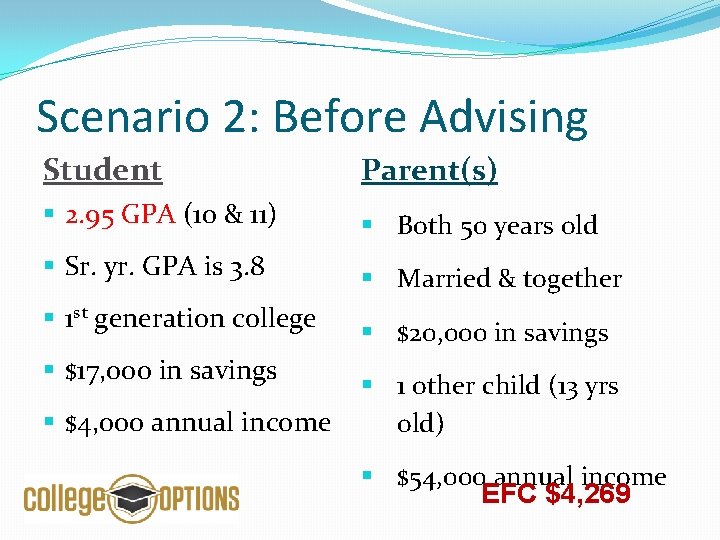
Scenario 2: Before Advising Student Parent(s) § 2. 95 GPA (10 & 11) § Both 50 years old § Sr. yr. GPA is 3. 8 § Married & together § 1 st generation college § $17, 000 in savings § $4, 000 annual income § $20, 000 in savings § 1 other child (13 yrs old) § $54, 000 annual income EFC $4, 269
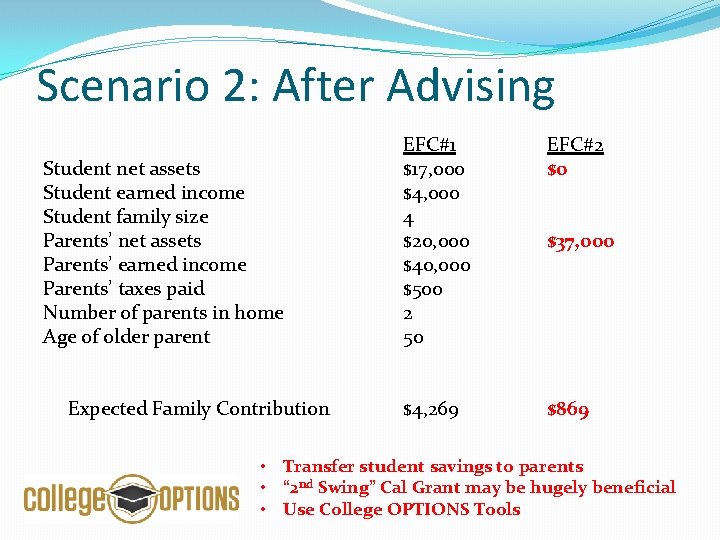
Scenario 2: After Advising Student net assets Student earned income Student family size Parents’ net assets Parents’ earned income Parents’ taxes paid Number of parents in home Age of older parent Expected Family Contribution EFC#1 $17, 000 $4, 000 4 $20, 000 $40, 000 $500 2 50 EFC#2 $0 $4, 269 $869 $37, 000 • Transfer student savings to parents • “ 2 nd Swing” Cal Grant may be hugely beneficial • Use College OPTIONS Tools
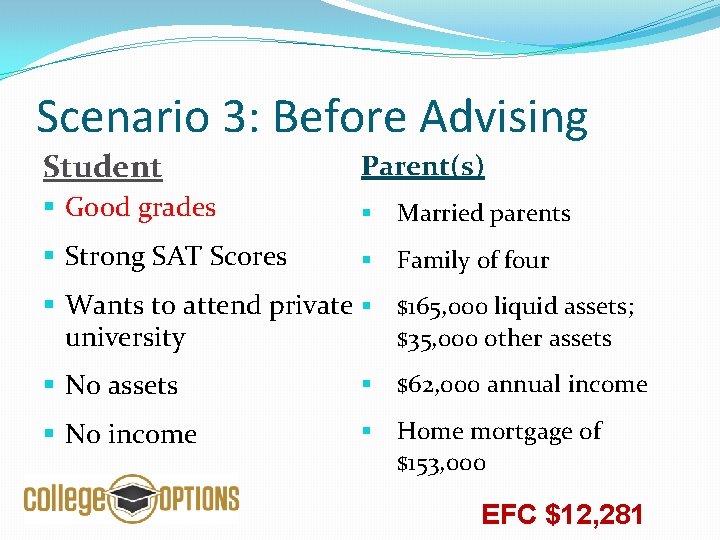
Scenario 3: Before Advising Student Parent(s) § Good grades § Married parents § Strong SAT Scores § Family of four § Wants to attend private § $165, 000 liquid assets; university $35, 000 other assets § No assets § $62, 000 annual income § No income § Home mortgage of $153, 000 EFC $12, 281
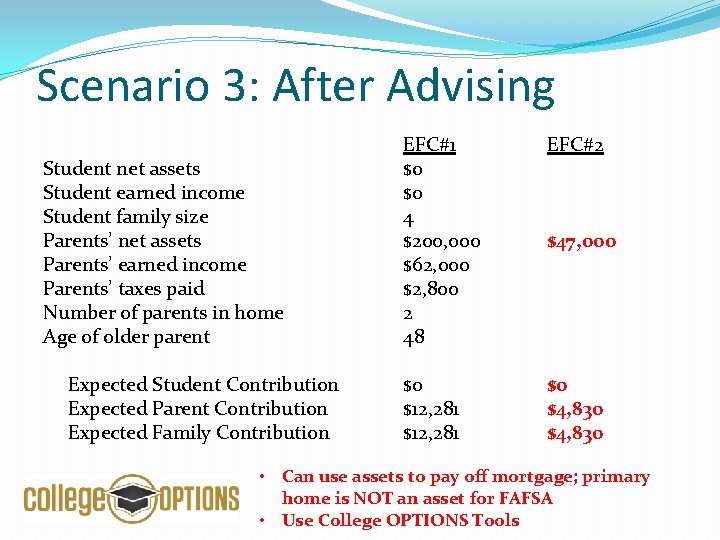
Scenario 3: After Advising Student net assets Student earned income Student family size Parents’ net assets Parents’ earned income Parents’ taxes paid Number of parents in home Age of older parent Expected Student Contribution Expected Parent Contribution Expected Family Contribution EFC#1 $o $0 4 $200, 000 $62, 000 $2, 800 2 48 EFC#2 $0 $12, 281 $0 $4, 830 $47, 000 • Can use assets to pay off mortgage; primary home is NOT an asset for FAFSA • Use College OPTIONS Tools
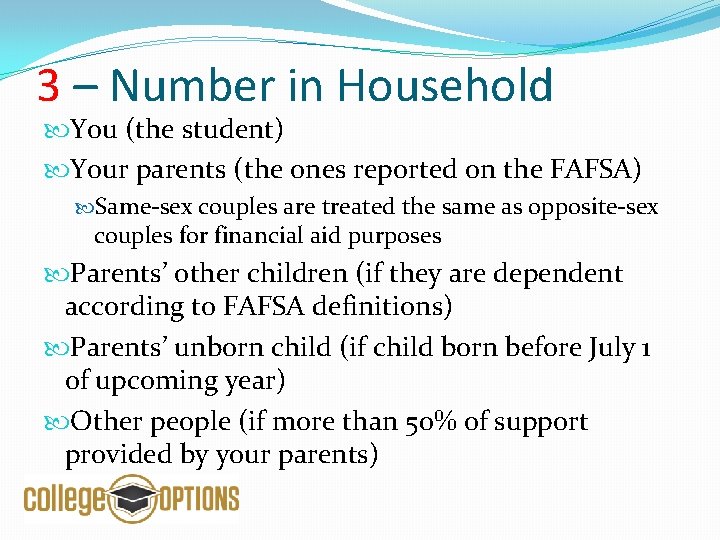
3 – Number in Household You (the student) Your parents (the ones reported on the FAFSA) Same-sex couples are treated the same as opposite-sex couples for financial aid purposes Parents’ other children (if they are dependent according to FAFSA definitions) Parents’ unborn child (if child born before July 1 of upcoming year) Other people (if more than 50% of support provided by your parents)
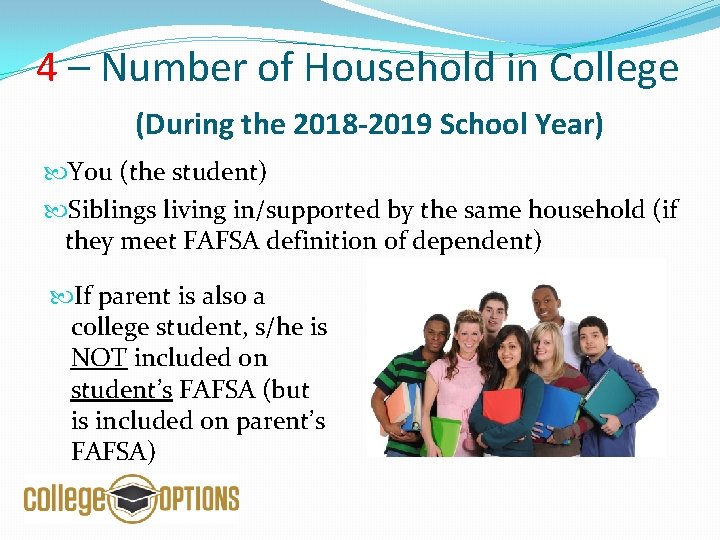
4 – Number of Household in College (During the 2018 -2019 School Year) You (the student) Siblings living in/supported by the same household (if they meet FAFSA definition of dependent) If parent is also a college student, s/he is NOT included on student’s FAFSA (but is included on parent’s FAFSA)
5 – Age of Older Parent The closer a parent is to retirement the more assets they can have before EFC is affected
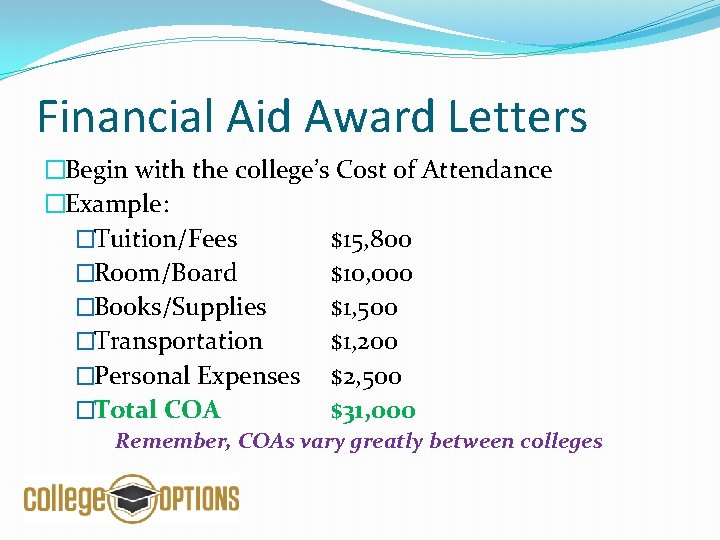
Financial Aid Award Letters �Begin with the college’s Cost of Attendance �Example: �Tuition/Fees $15, 800 �Room/Board $10, 000 �Books/Supplies $1, 500 �Transportation $1, 200 �Personal Expenses $2, 500 �Total COA $31, 000 Remember, COAs vary greatly between colleges
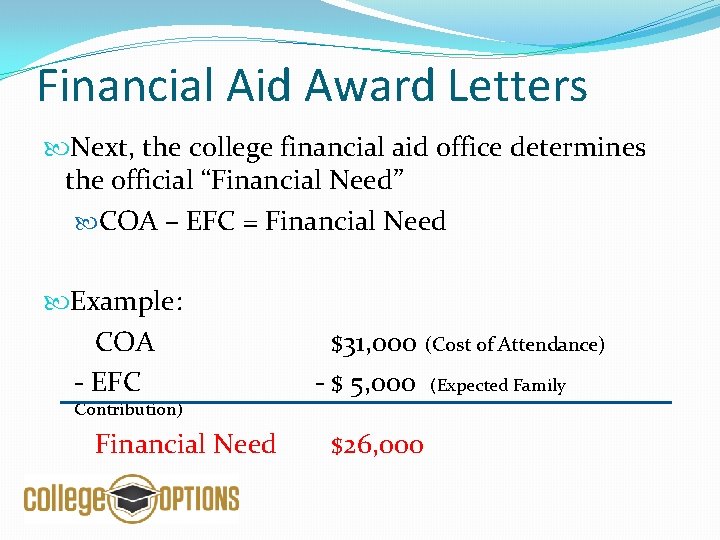
Financial Aid Award Letters Next, the college financial aid office determines the official “Financial Need” COA – EFC = Financial Need Example: COA - EFC Contribution) $31, 000 (Cost of Attendance) - $ 5, 000 (Expected Family Financial Need $26, 000

Financial Aid Award Letters �College’s Financial Aid Office creates a “package” of types of financial aid to attempt to meet the Financial Need �Example: �State Grant $12, 000 �Local Scholarship $1, 500 �Federal Direct Loan $3, 500 �Federal Work Study $2, 000 TOTAL AWARD: $19, 000
Financial Aid Award Letters Wait, wasn’t the financial need $26, 000? Financial Need ($26, 000) - Award package ($19, 000) = UNMET NEED of $7, 000 Don’t forget the original EFC of $5, 000 to add back Total funds for which the family is responsible: $7, 000 Unmet Need + $5, 000 EFC = $12, 000
Addressing Unmet Need and EFC: � Student job: Work study program or off-campus job � Budgeting: Food, gas, insurance savings while student is in college � Family resources: Savings, selling of assets, second mortgages, credit cards etc. � Additional government student loans (PLUS) � Private direct-to-consumer loans: � � Could adversely affect your financial aid Always discuss with your school’s financial aid department � Education tax credits � Current Income
Special Circumstances/Professional Judgment (Could apply to 2017 or 2018 tax years) �Colleges’ Financial Aid offices have the ability to recalculate an EFC based on significant hardships or new information �Examples: �Significant reduction of income/loss of job �Death �Abuse �Divorce/Separation �One-time settlement income �Student marriage
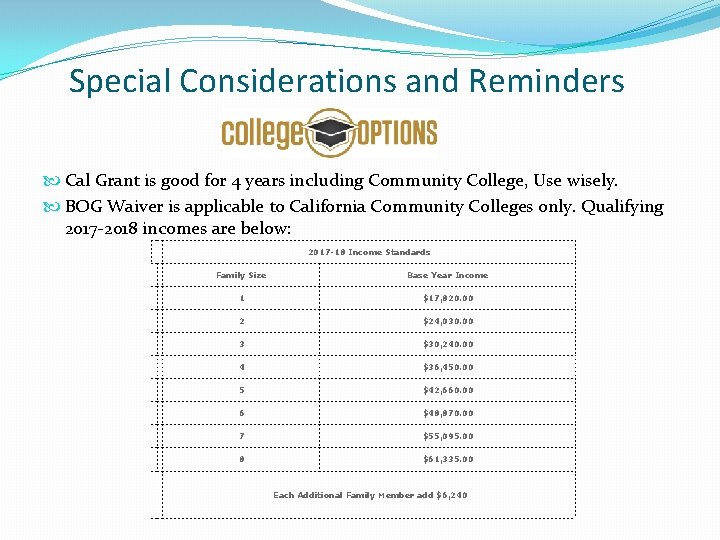
Special Considerations and Reminders Cal Grant is good for 4 years including Community College, Use wisely. BOG Waiver is applicable to California Community Colleges only. Qualifying 2017 -2018 incomes are below: 2017 -18 Income Standards Family Size Base Year Income 1 $17, 820. 00 2 $24, 030. 00 3 $30, 240. 00 4 $36, 450. 00 5 $42, 660. 00 6 $48, 870. 00 7 $55, 095. 00 8 $61, 335. 00 Each Additional Family Member add $6, 240
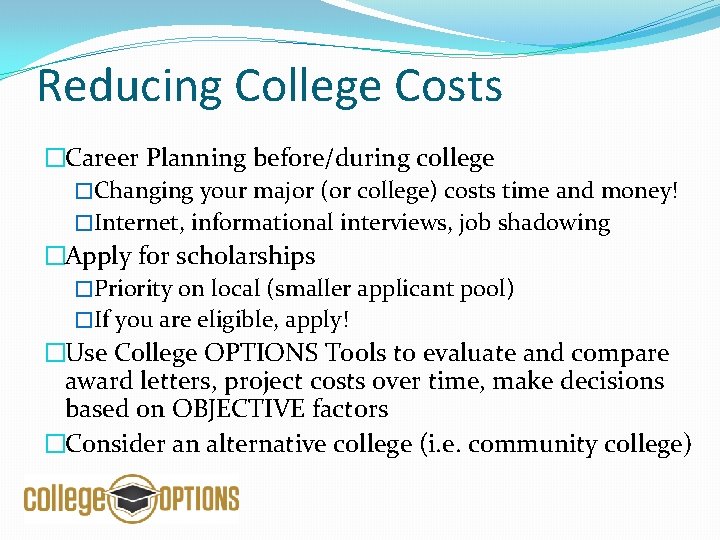
Reducing College Costs �Career Planning before/during college �Changing your major (or college) costs time and money! �Internet, informational interviews, job shadowing �Apply for scholarships �Priority on local (smaller applicant pool) �If you are eligible, apply! �Use College OPTIONS Tools to evaluate and compare award letters, project costs over time, make decisions based on OBJECTIVE factors �Consider an alternative college (i. e. community college)
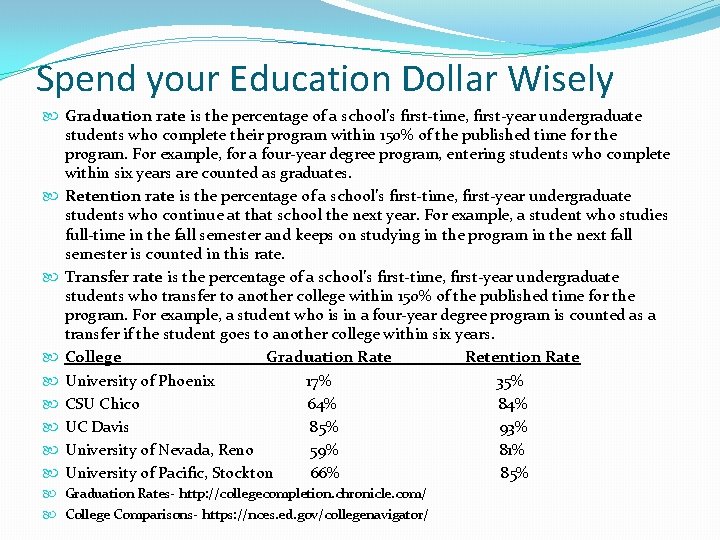
Spend your Education Dollar Wisely Graduation rate is the percentage of a school’s first-time, first-year undergraduate students who complete their program within 150% of the published time for the program. For example, for a four-year degree program, entering students who complete within six years are counted as graduates. Retention rate is the percentage of a school’s first-time, first-year undergraduate students who continue at that school the next year. For example, a student who studies full-time in the fall semester and keeps on studying in the program in the next fall semester is counted in this rate. Transfer rate is the percentage of a school’s first-time, first-year undergraduate students who transfer to another college within 150% of the published time for the program. For example, a student who is in a four-year degree program is counted as a transfer if the student goes to another college within six years. College Graduation Rate Retention Rate University of Phoenix 17% 35% CSU Chico 64% 84% UC Davis 85% 93% University of Nevada, Reno 59% 81% University of Pacific, Stockton 66% 85% Graduation Rates- http: //collegecompletion. chronicle. com/ College Comparisons- https: //nces. ed. gov/collegenavigator/

College OPTIONS Tools www. collegeoptions. org Click on “Financial Aid”
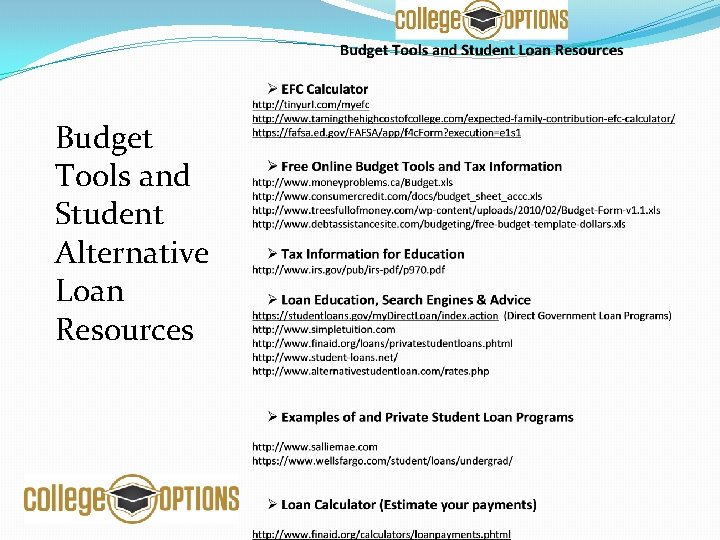
Budget Tools and Student Alternative Loan Resources

Handout
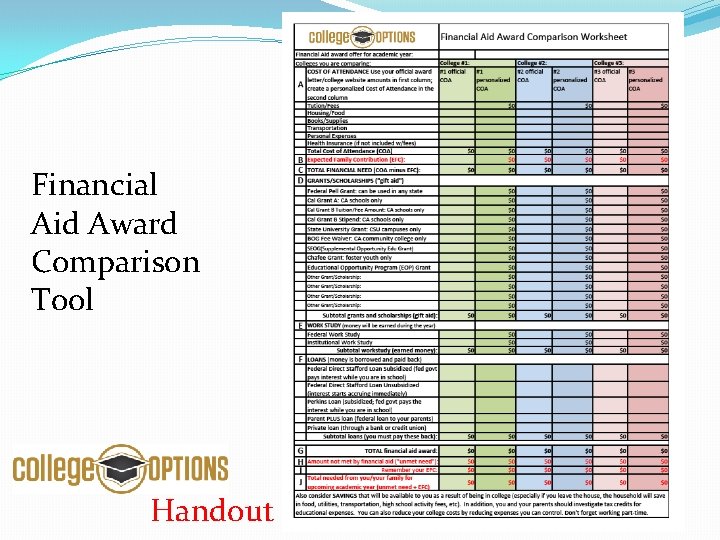
Financial Aid Award Comparison Tool Handout
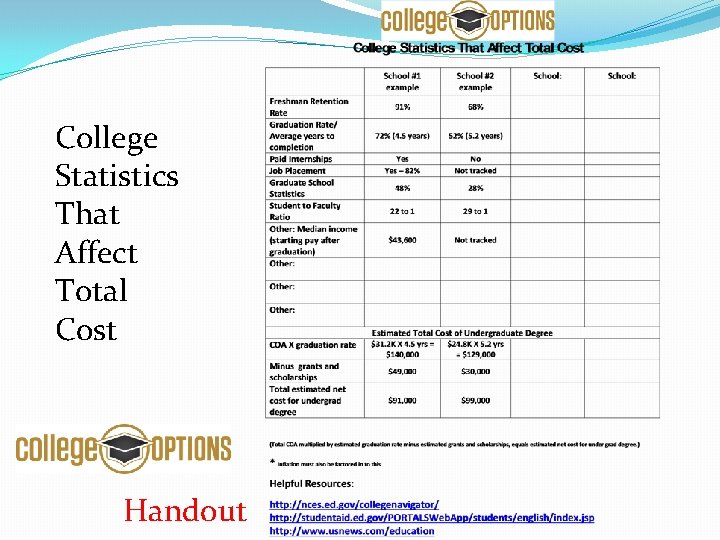
College Statistics That Affect Total Cost Handout
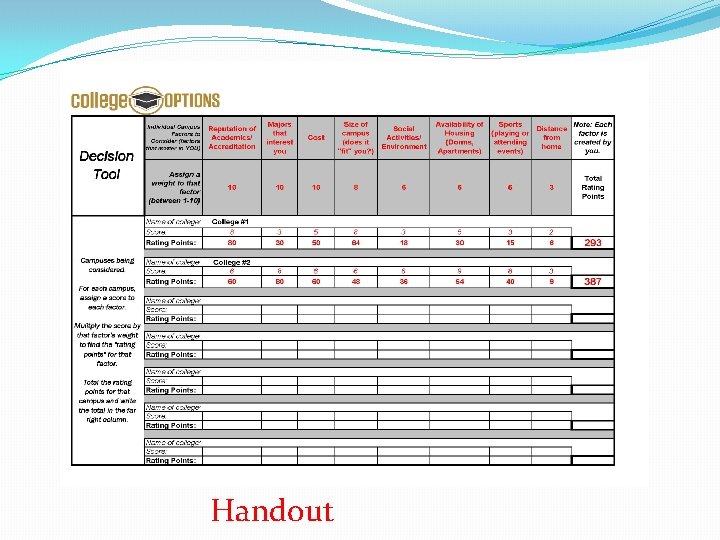
College OPTIONS Decision Tool Handout
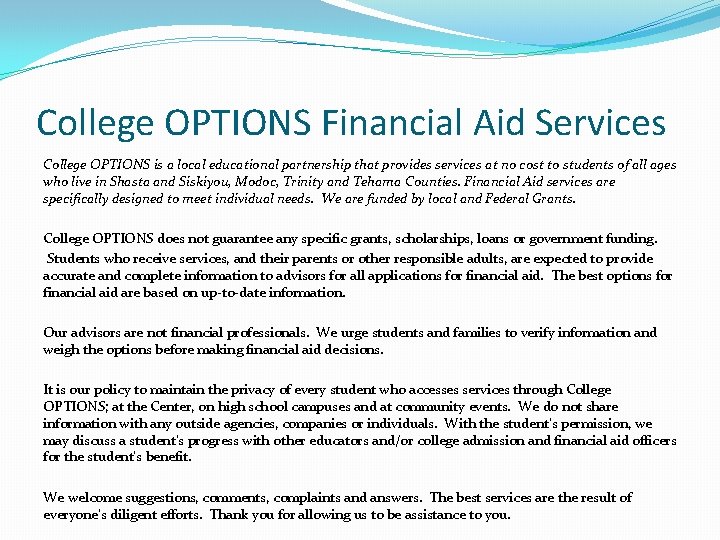
College OPTIONS Financial Aid Services College OPTIONS is a local educational partnership that provides services at no cost to students of all ages who live in Shasta and Siskiyou, Modoc, Trinity and Tehama Counties. Financial Aid services are specifically designed to meet individual needs. We are funded by local and Federal Grants. College OPTIONS does not guarantee any specific grants, scholarships, loans or government funding. Students who receive services, and their parents or other responsible adults, are expected to provide accurate and complete information to advisors for all applications for financial aid. The best options for financial aid are based on up-to-date information. Our advisors are not financial professionals. We urge students and families to verify information and weigh the options before making financial aid decisions. It is our policy to maintain the privacy of every student who accesses services through College OPTIONS; at the Center, on high school campuses and at community events. We do not share information with any outside agencies, companies or individuals. With the student’s permission, we may discuss a student’s progress with other educators and/or college admission and financial aid officers for the student’s benefit. We welcome suggestions, comments, complaints and answers. The best services are the result of everyone’s diligent efforts. Thank you for allowing us to be assistance to you.

Thank you and please fill out the evaluation (last page of packet) �Questions? �Talk to your counselor or College OPTIONS �Ask your counselor when your school’s Cash for College Night will occur, and be sure to attend. College is not a dream…It is a PLAN!

Handout
- Slides: 49