Study of fundamental Laws with Antimatter at CERN
- Slides: 66
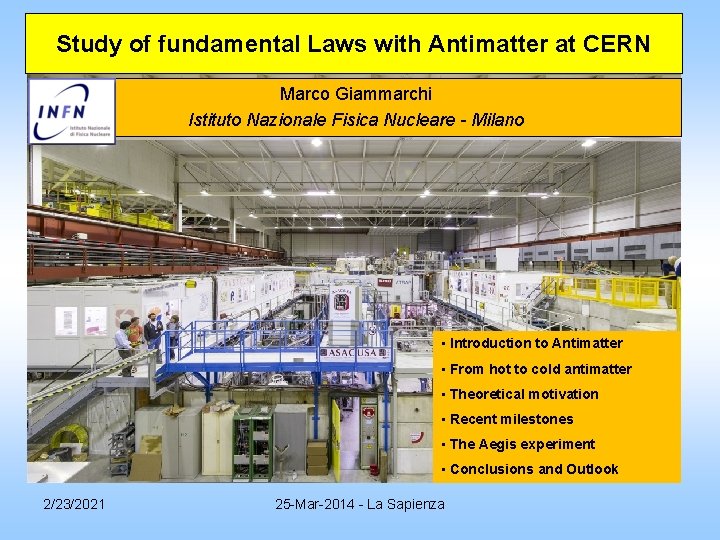
Study of fundamental Laws with Antimatter at CERN Marco Giammarchi Istituto Nazionale Fisica Nucleare - Milano • Introduction to Antimatter • From hot to cold antimatter • Theoretical motivation • Recent milestones • The Aegis experiment • Conclusions and Outlook 2/23/2021 25 -Mar-2014 - La Sapienza
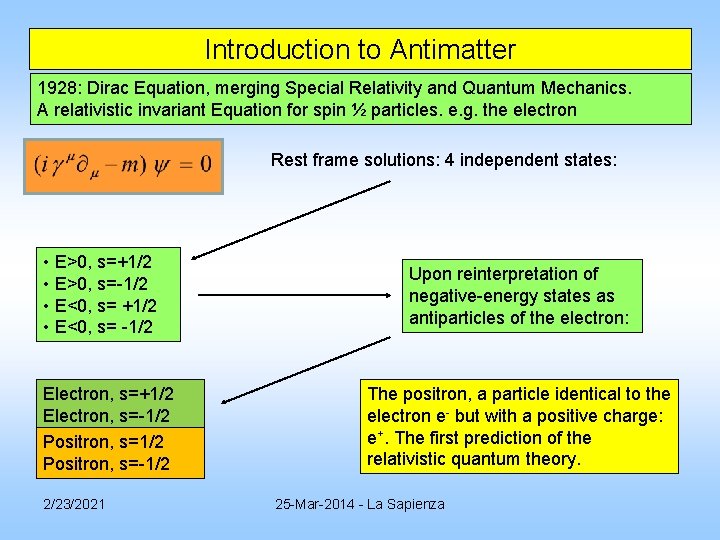
Introduction to Antimatter 1928: Dirac Equation, merging Special Relativity and Quantum Mechanics. A relativistic invariant Equation for spin ½ particles. e. g. the electron Rest frame solutions: 4 independent states: • E>0, s=+1/2 • E>0, s=-1/2 • E<0, s= +1/2 • E<0, s= -1/2 Electron, s=+1/2 Electron, s=-1/2 Positron, s=-1/2 2/23/2021 Upon reinterpretation of negative-energy states as antiparticles of the electron: The positron, a particle identical to the electron e- but with a positive charge: e+. The first prediction of the relativistic quantum theory. 25 -Mar-2014 - La Sapienza
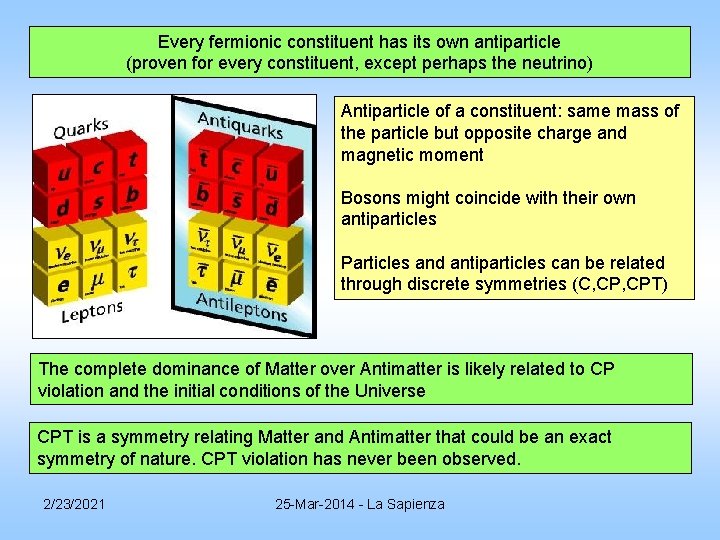
Every fermionic constituent has its own antiparticle (proven for every constituent, except perhaps the neutrino) Antiparticle of a constituent: same mass of the particle but opposite charge and magnetic moment Bosons might coincide with their own antiparticles Particles and antiparticles can be related through discrete symmetries (C, CPT) The complete dominance of Matter over Antimatter is likely related to CP violation and the initial conditions of the Universe CPT is a symmetry relating Matter and Antimatter that could be an exact symmetry of nature. CPT violation has never been observed. 2/23/2021 25 -Mar-2014 - La Sapienza
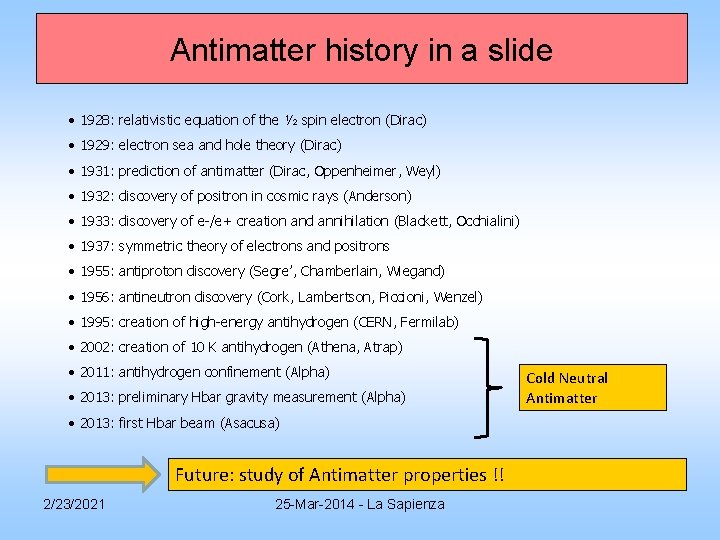
Antimatter history in a slide • 1928: relativistic equation of the ½ spin electron (Dirac) • 1929: electron sea and hole theory (Dirac) • 1931: prediction of antimatter (Dirac, Oppenheimer, Weyl) • 1932: discovery of positron in cosmic rays (Anderson) • 1933: discovery of e-/e+ creation and annihilation (Blackett, Occhialini) • 1937: symmetric theory of electrons and positrons • 1955: antiproton discovery (Segre’, Chamberlain, Wiegand) • 1956: antineutron discovery (Cork, Lambertson, Piccioni, Wenzel) • 1995: creation of high-energy antihydrogen (CERN, Fermilab) • 2002: creation of 10 K antihydrogen (Athena, Atrap) • 2011: antihydrogen confinement (Alpha) • 2013: preliminary Hbar gravity measurement (Alpha) • 2013: first Hbar beam (Asacusa) Future: study of Antimatter properties !! 2/23/2021 25 -Mar-2014 - La Sapienza Cold Neutral Antimatter
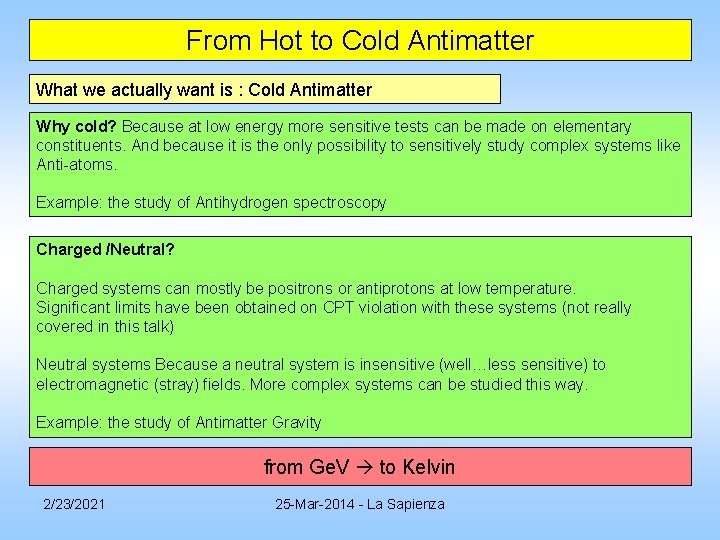
From Hot to Cold Antimatter What we actually want is : Cold Antimatter Why cold? Because at low energy more sensitive tests can be made on elementary constituents. And because it is the only possibility to sensitively study complex systems like Anti-atoms. Example: the study of Antihydrogen spectroscopy Charged /Neutral? Charged systems can mostly be positrons or antiprotons at low temperature. Significant limits have been obtained on CPT violation with these systems (not really covered in this talk) Neutral systems Because a neutral system is insensitive (well…less sensitive) to electromagnetic (stray) fields. More complex systems can be studied this way. Example: the study of Antimatter Gravity from Ge. V to Kelvin 2/23/2021 25 -Mar-2014 - La Sapienza
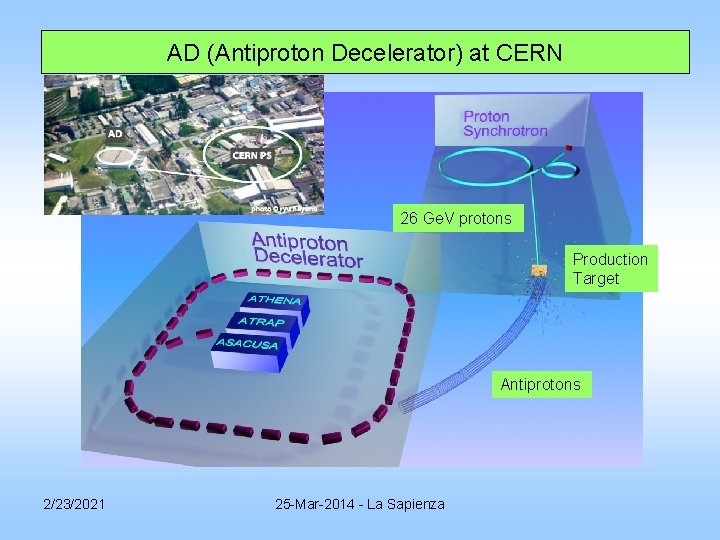
AD (Antiproton Decelerator) at CERN 26 Ge. V protons Production Target Antiprotons 2/23/2021 25 -Mar-2014 - La Sapienza
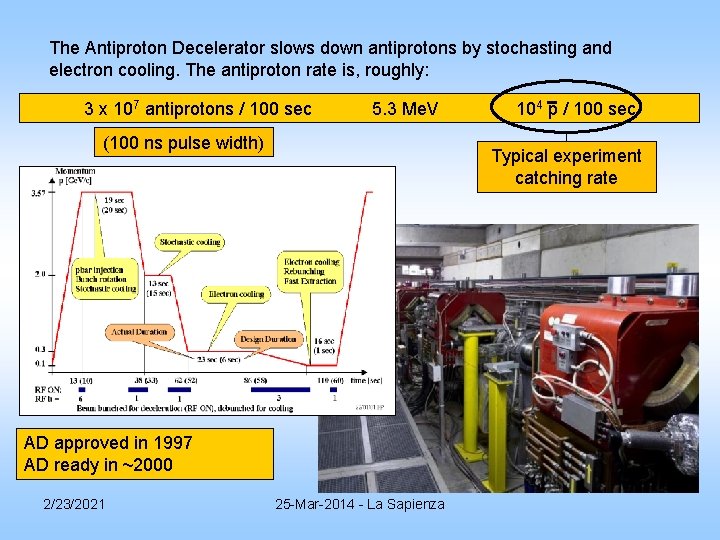
The Antiproton Decelerator slows down antiprotons by stochasting and electron cooling. The antiproton rate is, roughly: 3 x 10⁷ antiprotons / 100 sec 5. 3 Me. V (100 ns pulse width) Typical experiment catching rate AD approved in 1997 AD ready in ~2000 2/23/2021 104 p / 100 sec 25 -Mar-2014 - La Sapienza
Theoretical motivation Physics with Antimatter is at the very foundation of Modern Physics: CPT Physics (related to Lorentz Invariance) WEP (Weak Equivalence Principle) These conservation laws are relevant to modern gauge field theories and to the classical theory of General Relativity Guideline for this research: minuscule apparent violations of Lorentz and CPT invariance and the WEP might be observable in nature. The idea is that the violations would arise as suppressed effects from a more fundamental theory Curved spacetime effects on CPT, quantum gravity effects on the WEP Early Baryogenesis suggests that our understanding of antimatter is incomplete 2/23/2021 25 -Mar-2014 - La Sapienza
CPT Theorem Charge conjugation (C) : reversing electric charge and all internal quantum numbers Parity (P): space inversion; reversal of space coordinates Time reversal (T): replacing t by –t. Reverses time derivatives Any local, Lorentz invariant Lagrangian is CPT symmetric (Lüders, Pauli 1959). CPT is proven in axiomatic Quantum Field Theory. Consequences: Particles and antiparticles have identical masses and lifetimes All internal quantum numbers of antiparticles are opposite to those of particles CPT conserved to the best of our knowledge. So why look for violations? 1) A test of CPT is not only a test of a discrete symmetry. It is a test of the validity of Quantum Field Theory 2) CPT could break down in a Quantum Theory of Gravity Experiments show to exceptionally high precision that all the basic laws of nature seem to have both Lorentz and CPT symmetry 2/23/2021 25 -Mar-2014 - La Sapienza
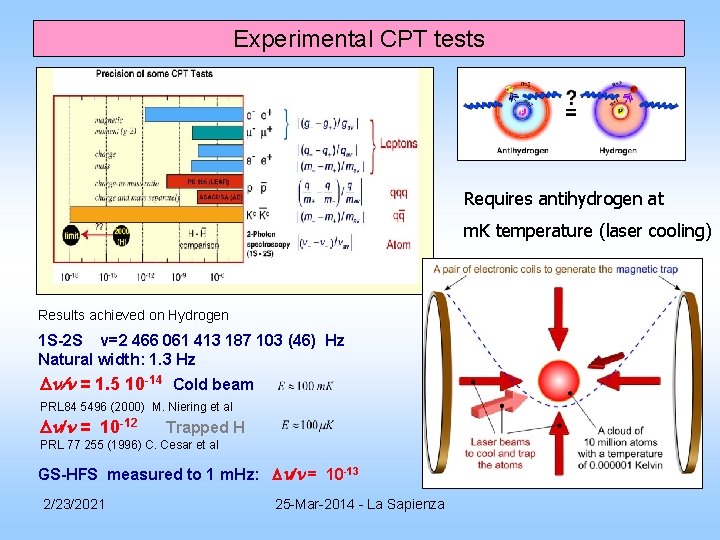
Experimental CPT tests Requires antihydrogen at m. K temperature (laser cooling) Results achieved on Hydrogen 1 S-2 S v=2 466 061 413 187 103 (46) Hz Natural width: 1. 3 Hz Dn/n = 1. 5 10 -14 Cold beam PRL 84 5496 (2000) M. Niering et al Dn/n = 10 -12 Trapped H PRL 77 255 (1996) C. Cesar et al GS-HFS measured to 1 m. Hz: Dn/n = 10 -13 2/23/2021 25 -Mar-2014 - La Sapienza
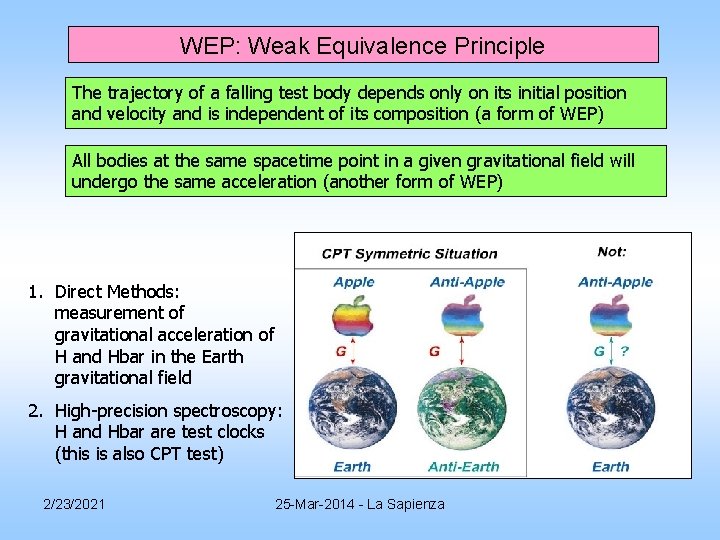
WEP: Weak Equivalence Principle The trajectory of a falling test body depends only on its initial position composition (a form of WEP) and velocity and is independent of its All bodies at the same spacetime point in a given gravitational field will undergo the same acceleration (another form of WEP) 1. Direct Methods: measurement of gravitational acceleration of H and Hbar in the Earth gravitational field 2. High-precision spectroscopy: H and Hbar are test clocks (this is also CPT test) 2/23/2021 25 -Mar-2014 - La Sapienza
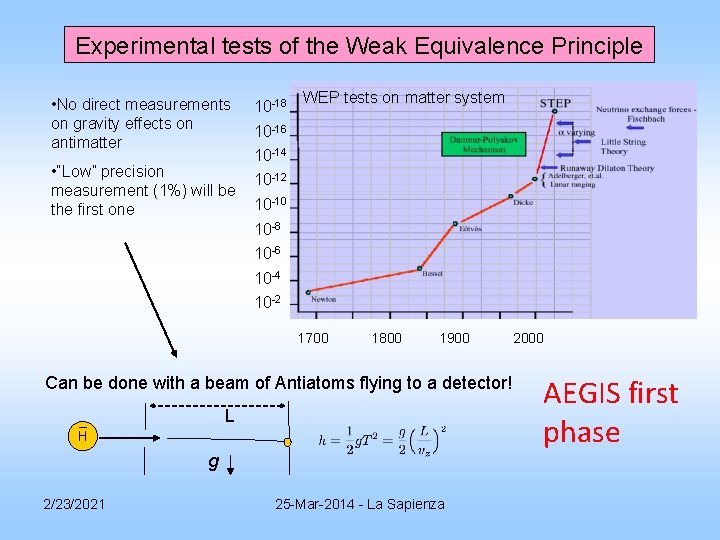
Experimental tests of the Weak Equivalence Principle • No direct measurements on gravity effects on antimatter 10 -18 WEP tests on matter system 10 -16 10 -14 • “Low” precision 10 -12 measurement (1%) will be 10 -10 the first one 10 -8 10 -6 10 -4 10 -2 1700 1800 1900 Can be done with a beam of Antiatoms flying to a detector! L H g 2/23/2021 25 -Mar-2014 - La Sapienza 2000 AEGIS first phase
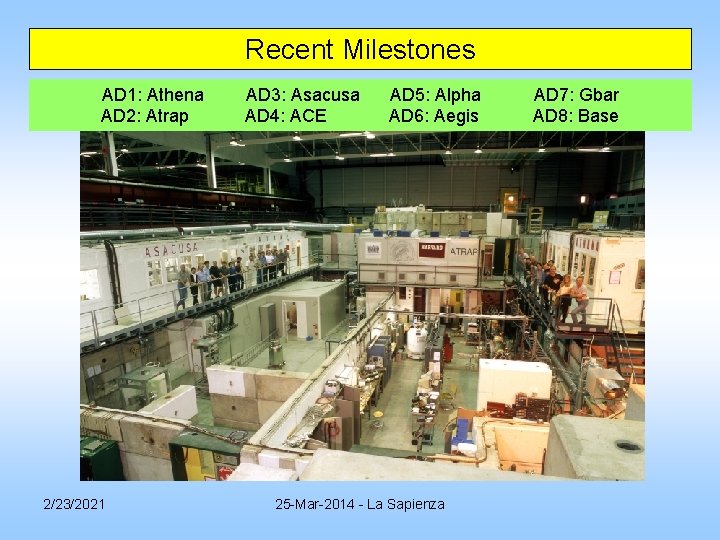
Recent Milestones AD 1: Athena AD 2: Atrap 2/23/2021 AD 3: Asacusa AD 4: ACE AD 5: Alpha AD 6: Aegis 25 -Mar-2014 - La Sapienza AD 7: Gbar AD 8: Base
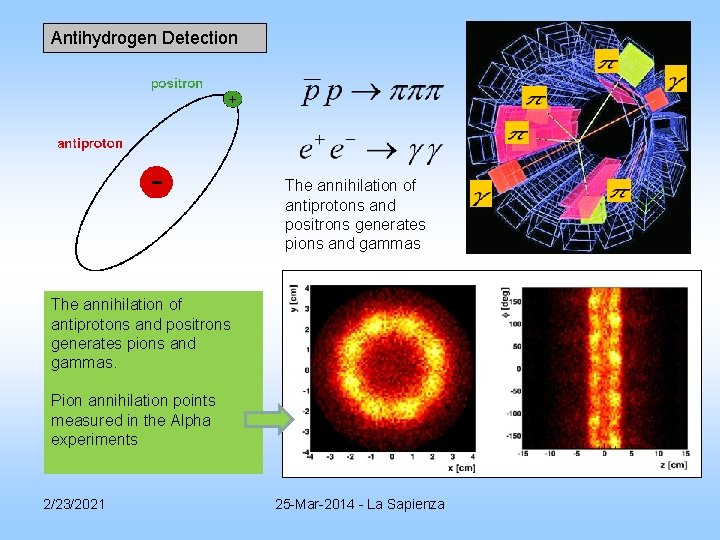
Antihydrogen Detection The annihilation of antiprotons and positrons generates pions and gammas. Pion annihilation points measured in the Alpha experiments 2/23/2021 25 -Mar-2014 - La Sapienza
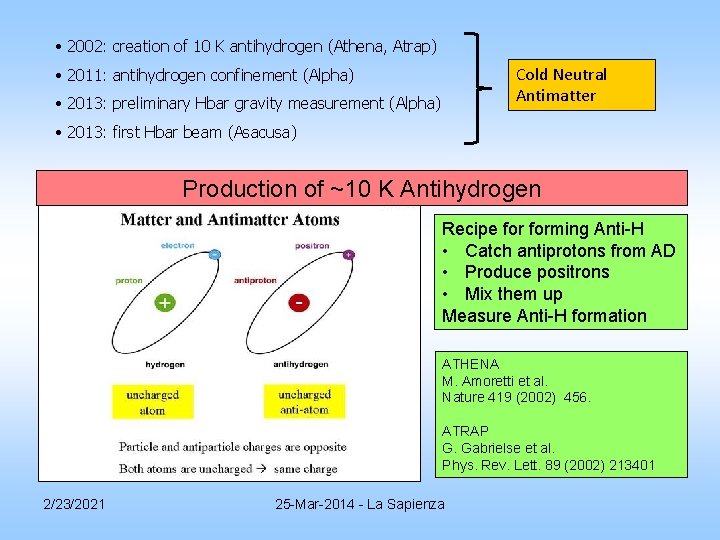
• 2002: creation of 10 K antihydrogen (Athena, Atrap) Cold Neutral Antimatter • 2011: antihydrogen confinement (Alpha) • 2013: preliminary Hbar gravity measurement (Alpha) • 2013: first Hbar beam (Asacusa) Production of ~10 K Antihydrogen Recipe forming Anti-H • Catch antiprotons from AD • Produce positrons • Mix them up Measure Anti-H formation ATHENA M. Amoretti et al. Nature 419 (2002) 456. ATRAP G. Gabrielse et al. Phys. Rev. Lett. 89 (2002) 213401 2/23/2021 25 -Mar-2014 - La Sapienza
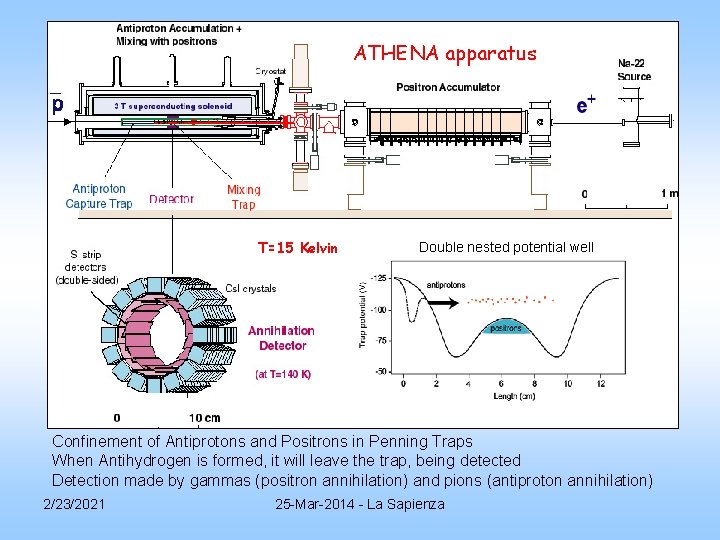
ATHENA apparatus T=15 Kelvin Double nested potential well Confinement of Antiprotons and Positrons in Penning Traps When Antihydrogen is formed, it will leave the trap, being detected Detection made by gammas (positron annihilation) and pions (antiproton annihilation) 2/23/2021 25 -Mar-2014 - La Sapienza
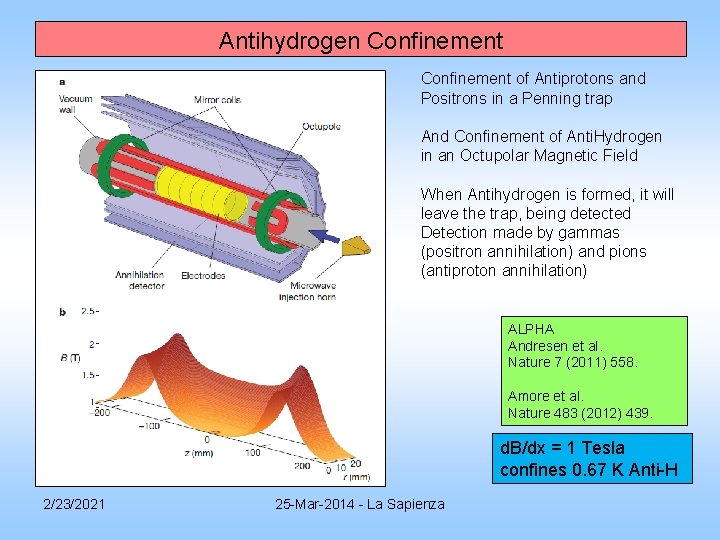
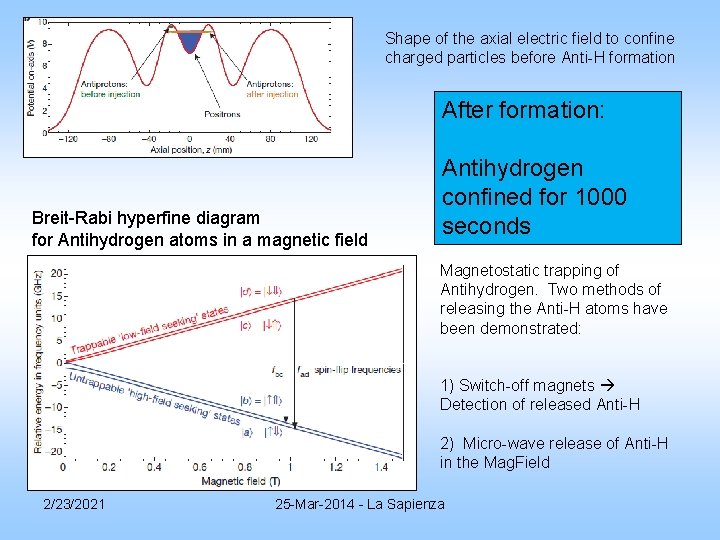
Antihydrogen Confinement of Antiprotons and Positrons in a Penning trap And Confinement of Anti. Hydrogen in an Octupolar Magnetic Field When Antihydrogen is formed, it will leave the trap, being detected Detection made by gammas (positron annihilation) and pions (antiproton annihilation) ALPHA Andresen et al. Nature 7 (2011) 558. Amore et al. Nature 483 (2012) 439. d. B/dx = 1 Tesla confines 0. 67 K Anti-H 2/23/2021 25 -Mar-2014 - La Sapienza
Shape of the axial electric field to confine charged particles before Anti-H formation After formation: Breit-Rabi hyperfine diagram for Antihydrogen atoms in a magnetic field Antihydrogen confined for 1000 seconds Magnetostatic trapping of Antihydrogen. Two methods of releasing the Anti-H atoms have been demonstrated: 1) Switch-off magnets Detection of released Anti-H 2) Micro-wave release of Anti-H in the Mag. Field 2/23/2021 25 -Mar-2014 - La Sapienza
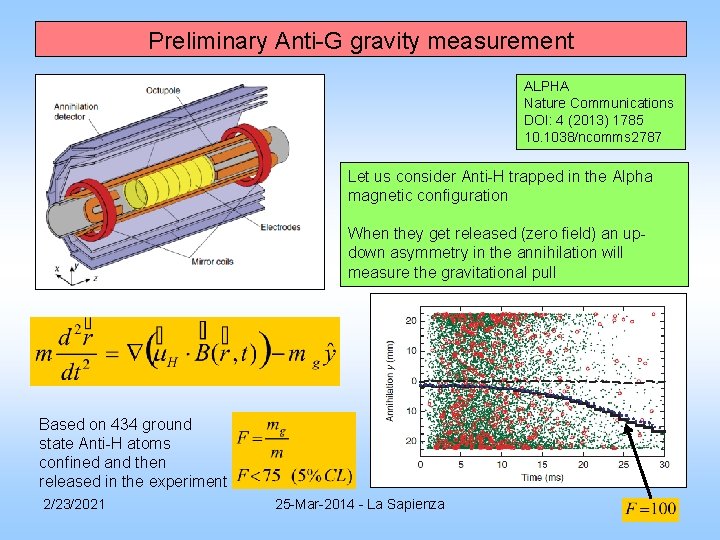
Preliminary Anti-G gravity measurement ALPHA Nature Communications DOI: 4 (2013) 1785 10. 1038/ncomms 2787 Let us consider Anti-H trapped in the Alpha magnetic configuration When they get released (zero field) an updown asymmetry in the annihilation will measure the gravitational pull Based on 434 ground state Anti-H atoms confined and then released in the experiment 2/23/2021 25 -Mar-2014 - La Sapienza
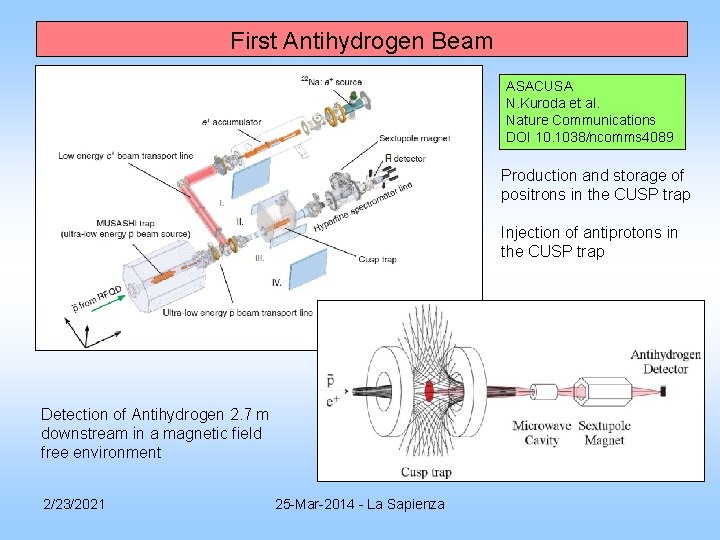
First Antihydrogen Beam ASACUSA N. Kuroda et al. Nature Communications DOI 10. 1038/ncomms 4089 Production and storage of positrons in the CUSP trap Injection of antiprotons in the CUSP trap Detection of Antihydrogen 2. 7 m downstream in a magnetic field free environment 2/23/2021 25 -Mar-2014 - La Sapienza
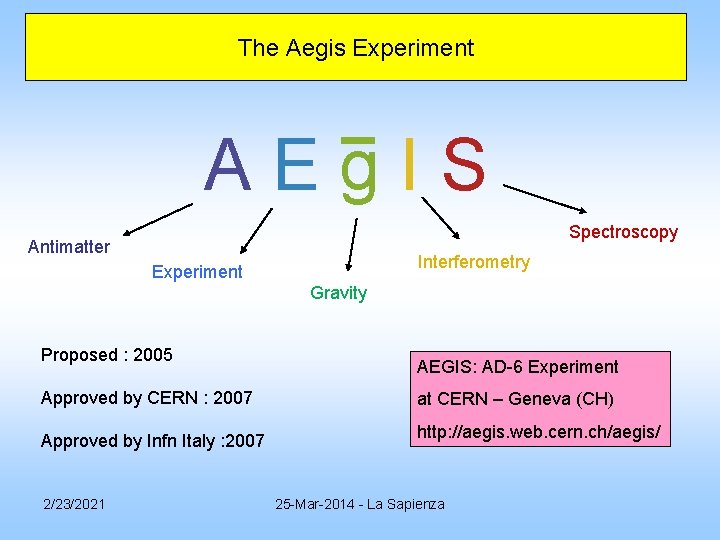
The Aegis Experiment A E g I S Spectroscopy Antimatter Interferometry Experiment Gravity Proposed : 2005 Approved by CERN : 2007 Approved by Infn Italy : 2007 2/23/2021 AEGIS: AD-6 Experiment at CERN – Geneva (CH) http: //aegis. web. cern. ch/aegis/ 25 -Mar-2014 - La Sapienza
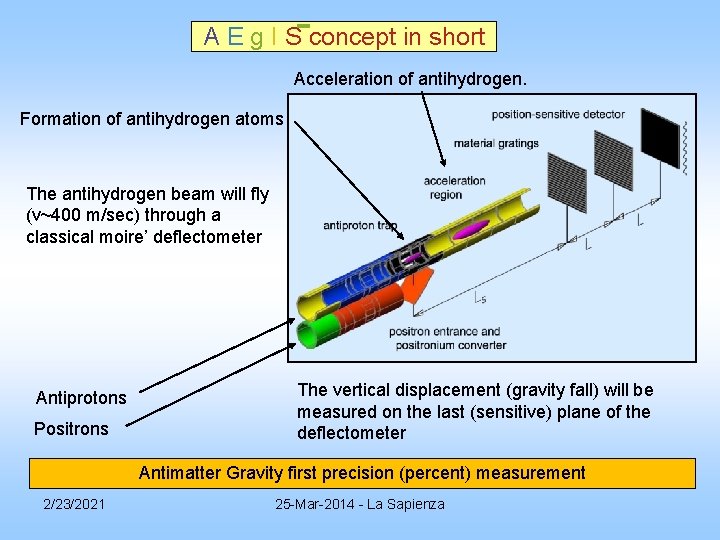
A E g I S concept in short Acceleration of antihydrogen. Formation of antihydrogen atoms The antihydrogen beam will fly (v~400 m/sec) through a classical moire’ deflectometer Antiprotons Positrons The vertical displacement (gravity fall) will be measured on the last (sensitive) plane of the deflectometer Antimatter Gravity first precision (percent) measurement 2/23/2021 25 -Mar-2014 - La Sapienza
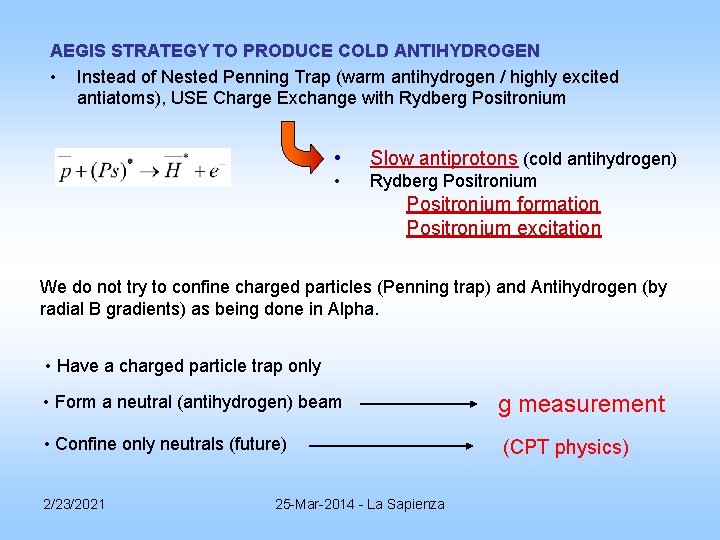
AEGIS STRATEGY TO PRODUCE COLD ANTIHYDROGEN • Instead of Nested Penning Trap (warm antihydrogen / highly excited antiatoms), USE Charge Exchange with Rydberg Positronium • Slow antiprotons (cold antihydrogen) • Rydberg Positronium formation Positronium excitation We do not try to confine charged particles (Penning trap) and Antihydrogen (by radial B gradients) as being done in Alpha. • Have a charged particle trap only • Form a neutral (antihydrogen) beam g measurement • Confine only neutrals (future) (CPT physics) 2/23/2021 25 -Mar-2014 - La Sapienza
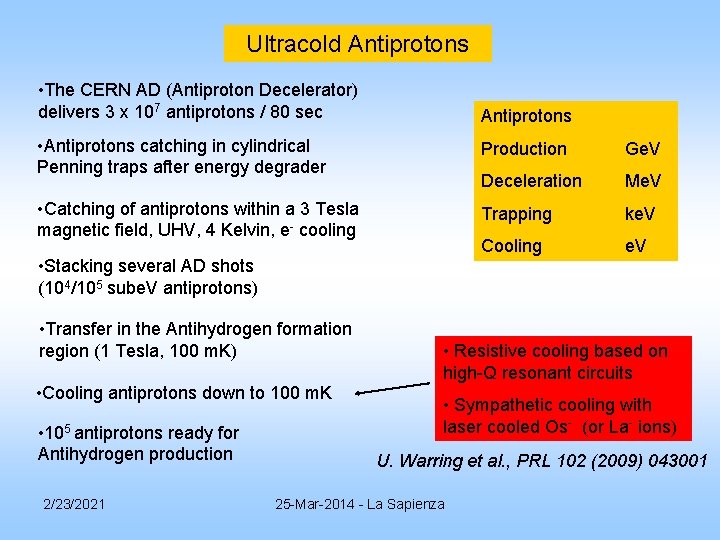
Ultracold Antiprotons • The CERN AD (Antiproton Decelerator) delivers 3 x 10⁷ antiprotons / 80 sec Antiprotons • Antiprotons catching in cylindrical Penning traps after energy degrader Production Ge. V Deceleration Me. V • Catching of antiprotons within a 3 Tesla magnetic field, UHV, 4 Kelvin, e- cooling Trapping ke. V Cooling e. V • Stacking several AD shots (104/105 sube. V antiprotons) • Transfer in the Antihydrogen formation region (1 Tesla, 100 m. K) • Cooling antiprotons down to 100 m. K • 105 antiprotons ready for Antihydrogen production 2/23/2021 • Resistive cooling based on high-Q resonant circuits • Sympathetic cooling with laser cooled Os- (or La- ions) U. Warring et al. , PRL 102 (2009) 043001 25 -Mar-2014 - La Sapienza
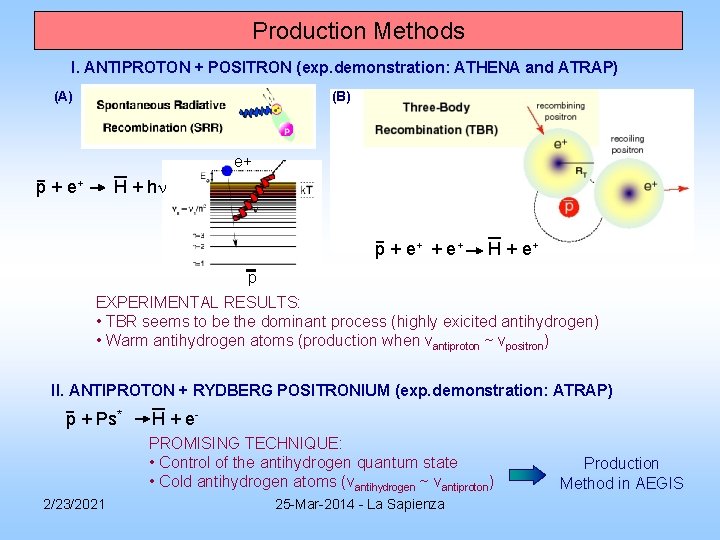
Production Methods I. ANTIPROTON + POSITRON (exp. demonstration: ATHENA and ATRAP) (B) (A) e+ p + e+ H + hn p + e+ H + e+ p EXPERIMENTAL RESULTS: • TBR seems to be the dominant process (highly exicited antihydrogen) • Warm antihydrogen atoms (production when vantiproton ~ vpositron) II. ANTIPROTON + RYDBERG POSITRONIUM (exp. demonstration: ATRAP) p + Ps* H + e. PROMISING TECHNIQUE: • Control of the antihydrogen quantum state • Cold antihydrogen atoms (vantihydrogen ~ vantiproton) 2/23/2021 25 -Mar-2014 - La Sapienza Production Method in AEGIS
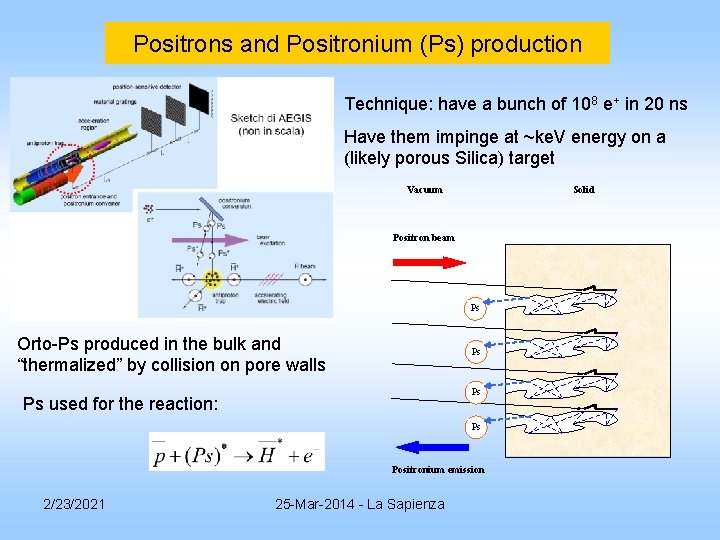
Positrons and Positronium (Ps) production Technique: have a bunch of 108 e+ in 20 ns Have them impinge at ~ke. V energy on a (likely porous Silica) target Vacuum Solid Positron beam Ps Orto-Ps produced in the bulk and “thermalized” by collision on pore walls Ps Ps Ps used for the reaction: Ps Positronium emission 2/23/2021 25 -Mar-2014 - La Sapienza
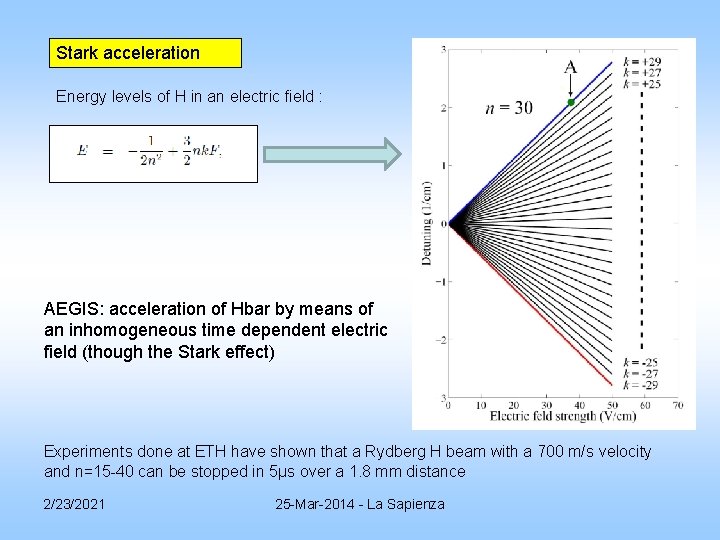
Stark acceleration Energy levels of H in an electric field : AEGIS: acceleration of Hbar by means of an inhomogeneous time dependent electric field (though the Stark effect) Experiments done at ETH have shown that a Rydberg H beam with a 700 m/s velocity and n=15 -40 can be stopped in 5μs over a 1. 8 mm distance 2/23/2021 25 -Mar-2014 - La Sapienza
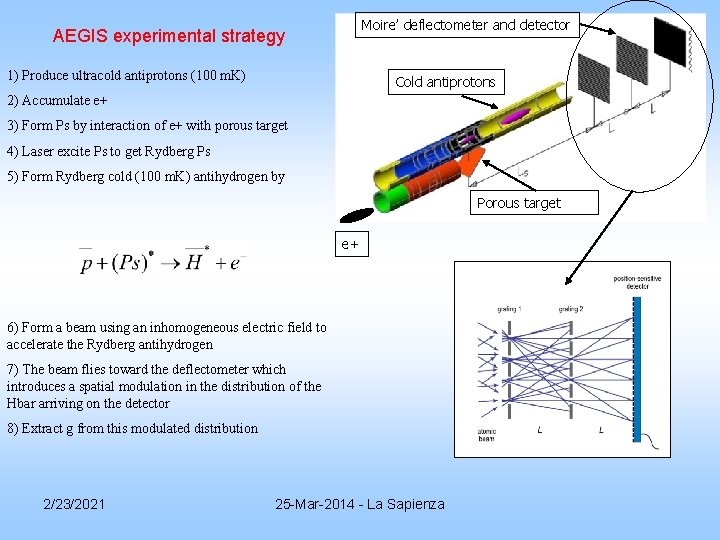
Moire’ deflectometer and detector AEGIS experimental strategy 1) Produce ultracold antiprotons (100 m. K) Cold antiprotons 2) Accumulate e+ 3) Form Ps by interaction of e+ with porous target 4) Laser excite Ps to get Rydberg Ps 5) Form Rydberg cold (100 m. K) antihydrogen by Porous target e+ 6) Form a beam using an inhomogeneous electric field to accelerate the Rydberg antihydrogen 7) The beam flies toward the deflectometer which introduces a spatial modulation in the distribution of the Hbar arriving on the detector 8) Extract g from this modulated distribution 2/23/2021 25 -Mar-2014 - La Sapienza
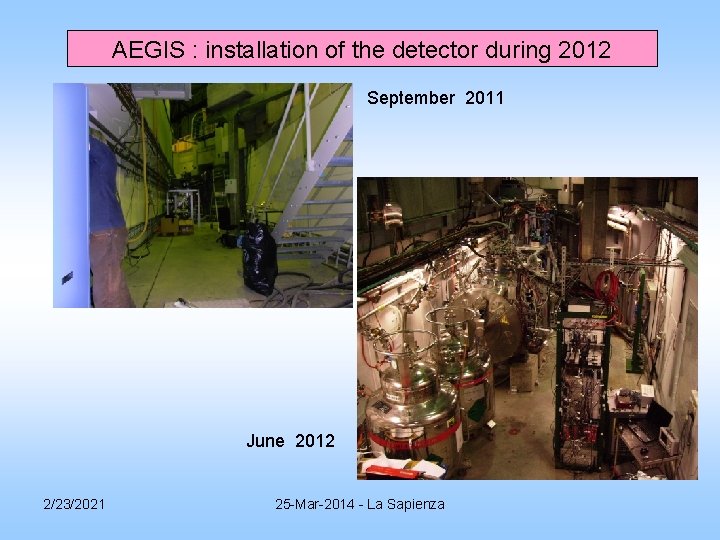
AEGIS : installation of the detector during 2012 September 2011 June 2012 2/23/2021 25 -Mar-2014 - La Sapienza
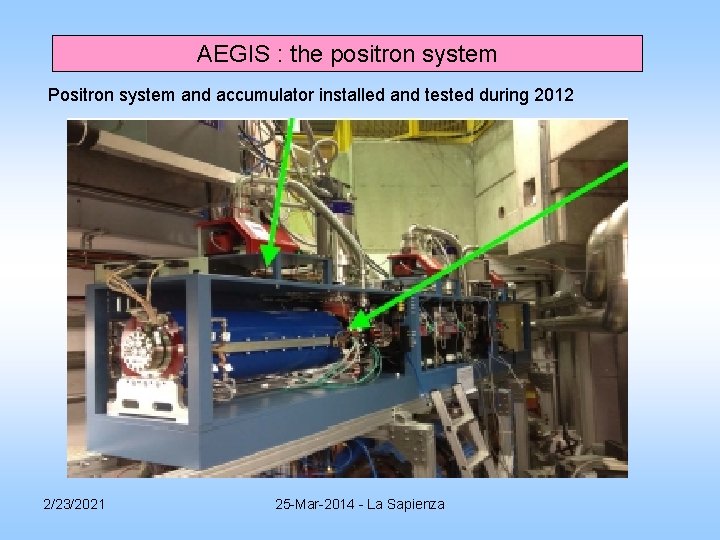
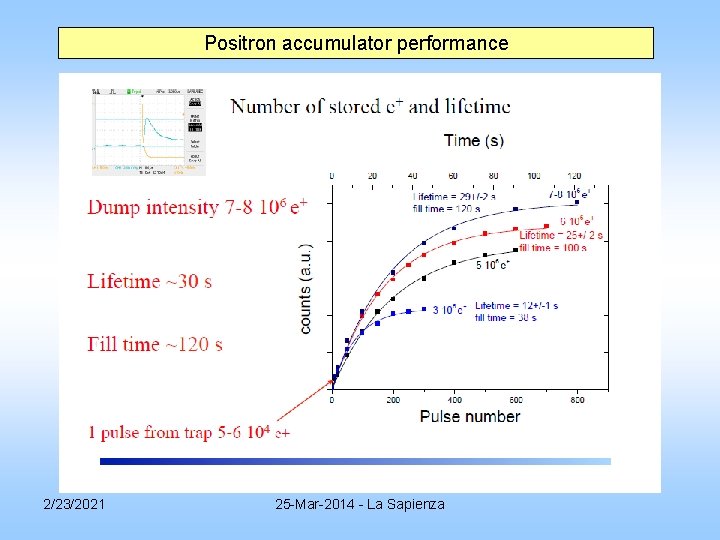
AEGIS : the positron system Positron system and accumulator installed and tested during 2012 2/23/2021 25 -Mar-2014 - La Sapienza
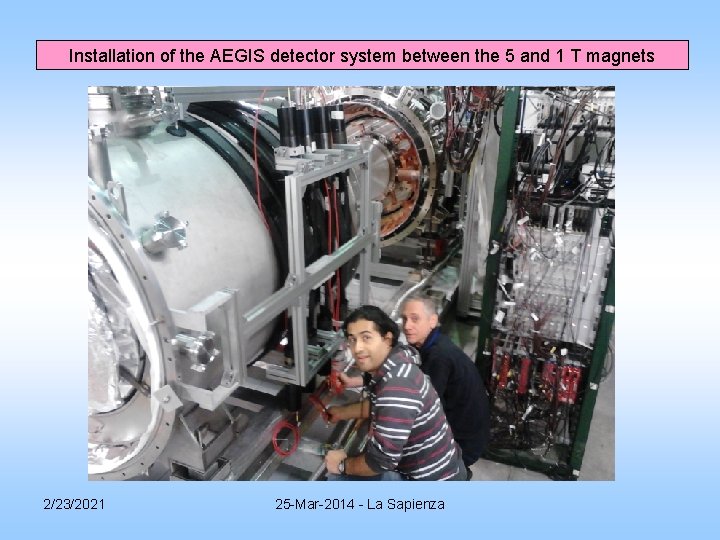
Installation of the AEGIS detector system between the 5 and 1 T magnets 2/23/2021 25 -Mar-2014 - La Sapienza
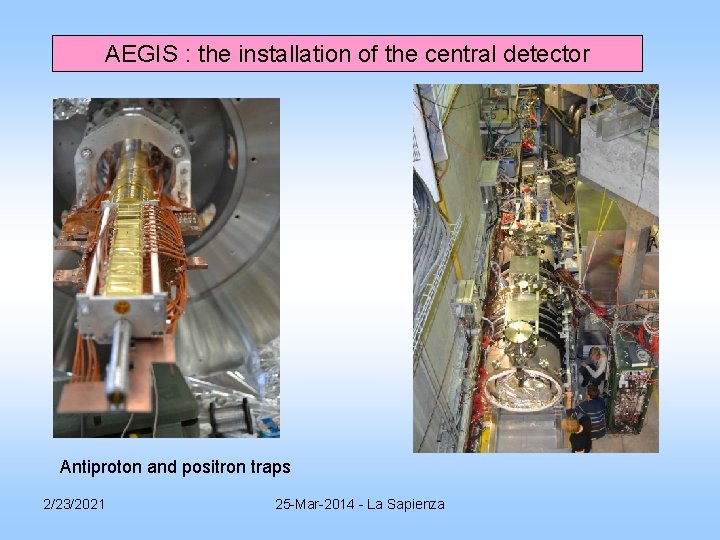
AEGIS : the installation of the central detector Antiproton and positron traps 2/23/2021 25 -Mar-2014 - La Sapienza
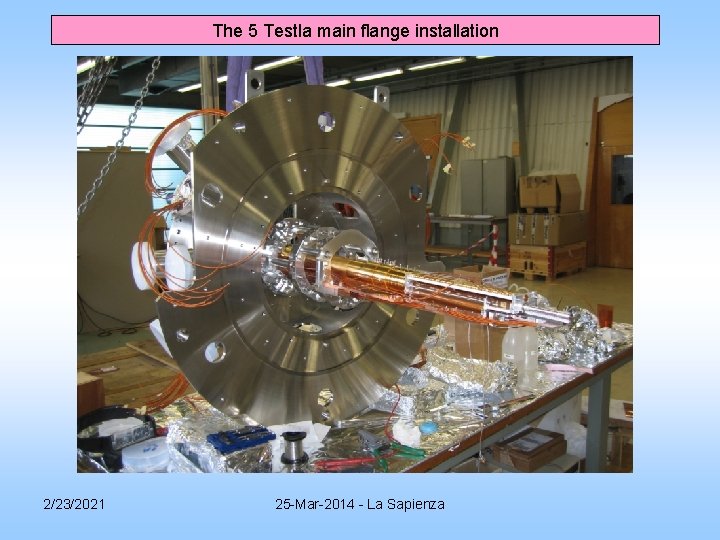
The 5 Testla main flange installation 2/23/2021 25 -Mar-2014 - La Sapienza
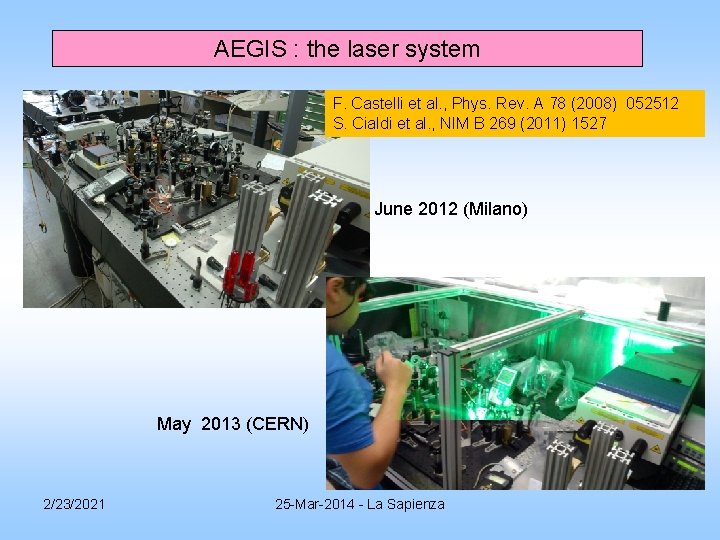
AEGIS : the laser system F. Castelli et al. , Phys. Rev. A 78 (2008) 052512 S. Cialdi et al. , NIM B 269 (2011) 1527 June 2012 (Milano) May 2013 (CERN) 2/23/2021 25 -Mar-2014 - La Sapienza
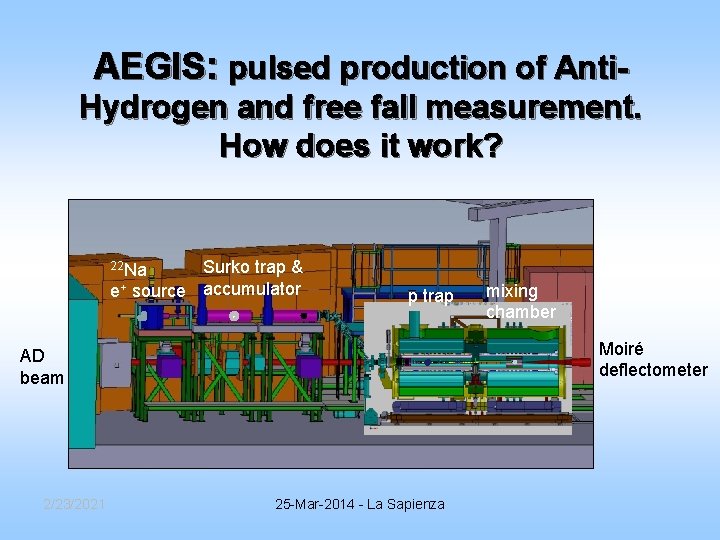
AEGIS: pulsed production of Anti. Hydrogen and free fall measurement. How does it work? Surko trap & e+ source accumulator 22 Na p trap Moiré deflectometer AD beam 2/23/2021 mixing chamber 25 -Mar-2014 - La Sapienza
AEGIS Collaboration S. Aghiona, b, O. Ahlénc, C. Amslerd, A. Arigad, T. Arigad, A. S. Belove, G. Bonomif, g, P. Bräunigh, J. Bremerc, R. S. Brusai, G. Burghartc, L. Cabaretj, M. Cacciab, C. Canalik, R. Caravital, b, F. Castellil, G. Cerchiaril, b, S. Cialdil, D. Comparatj, G. Consolatim, b, L. Dassaf, J. H. Derkingc, S. Di Domizion, L. Di Notoi, M. Doserc, A. Dudarevc, A. Ereditatod, R. Ferraguta, b, A. Fontanag, P. Genovag, M. Giammarchib, A. Gligorovao, S. N. Gninenkoe, S. Haiderc, S. D. Hoganp, T. Huseq, E. Jordanr, L. V. Jørgensenc, T. Kaltenbacherc, J. Kawadad, A. Kellerbauerr, M. Kimurad, A. Knechtc, D. Krasnickýn, s, V. Lagomarsinos, S. Mariazzii, V. A. Matveeve, t, F. Merktu, F. Moiaa, b, G. Nebbiav, P. Nédélecw, M. K. Oberthalerh, N. Pacificoo, V. Petrácekx, C. Pistillod, F. Prelzb, M. Prevedelliy, C. Regenfusk, C. Riccardig, z, O. Røhneq, A. Rotondig, z, H. Sandakero, P. Scampolid, aa, J. Storeyd, M. A. Subieta Vasquezf, g, M. Špacekx, G. Testeran, D. Trezzib, R. Vaccaronen, F. Villal and S. Zavatarellin. a. Politecnico di Milano, LNESS and Dept of Physics o. University College London, Dept of Physics and Astronomy b. Istituto Nazionale di Fisica Nucleare, Sez. di Milano p. University of Bergen, Dep. Of Physics, Norway c. European Organisation for Nuclear Research q. University of Oslo, Dept of Physics, Norway d. Albert Einstein Center , University of Bern r. Max Planck Institute for Nuclear Physics, Heidelberg e. INResearch of the Russian Academy of Sciences, Moscow s. University of Genoa, Dept of Physics f. University of Brescia, Dept of Mech. and Indust. Engineering t. Joint Institute for Nuclear Research, 141980 Dubna, Russia g. Istituto Nazionale di Fisica Nucleare, Sez. di Pavia u. ETH Zurich, Laboratory for Physical Chemistry h. University of Heidelberg, Kirchhoff Institute for Physics v. Istituto Nazionale di Fisica Nucleare, Sez. di Padova i. Dipartimento di Fisica, Università di Trento and INFN Padova w. Claude Bernard University Lyon 1, Institut de Physique Nucléaire de Lyon j. Laboratoire Aimé Cotton, CNRS, Université Paris Sud x. Czech Technical University in Prague k. University of Zurich, Physics Institute y. University of Bologna, Dept of Physics l. University of Milano, Dept of Physics z. University of Pavia, Dept of Nuclear and Theoretical Physics, Via Bassi 6, m. Politecnico di Milano, Dept of Aerospace Sci. and Tech 27100 Pavia, Italy aa. University of Napoli Federico II, Dept. of Physics n. Istituto Nazionale di Fisica Nucleare, Sez. di Genova, Via Dodecaneso 33, 16146 Genova, Italy 2/23/2021 25 -Mar-2014 - La Sapienza
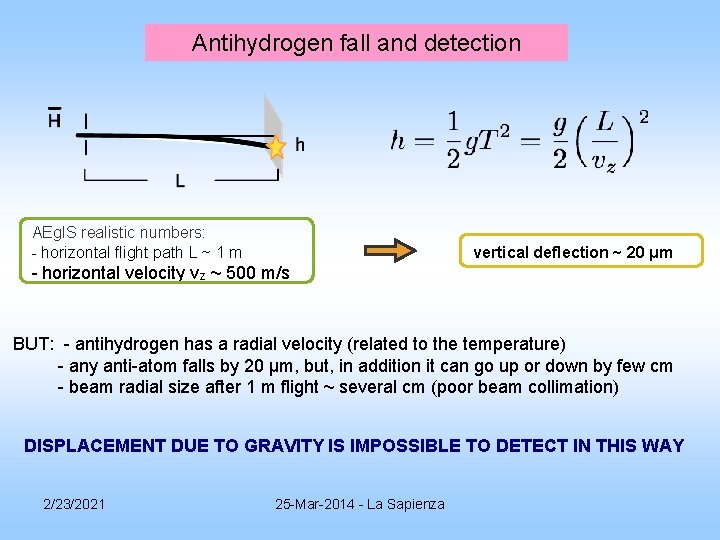
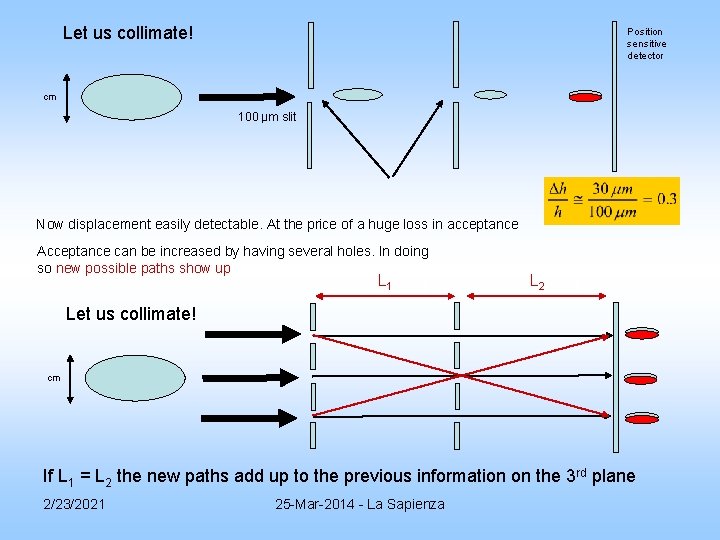
Antihydrogen fall and detection AEg. IS realistic numbers: - horizontal flight path L ~ 1 m vertical deflection ~ 20 μm - horizontal velocity vz ~ 500 m/s BUT: - antihydrogen has a radial velocity (related to the temperature) - any anti-atom falls by 20 μm, but, in addition it can go up or down by few cm - beam radial size after 1 m flight ~ several cm (poor beam collimation) DISPLACEMENT DUE TO GRAVITY IS IMPOSSIBLE TO DETECT IN THIS WAY 2/23/2021 25 -Mar-2014 - La Sapienza
Let us collimate! Position sensitive detector cm 100 μm slit Now displacement easily detectable. At the price of a huge loss in acceptance Acceptance can be increased by having several holes. In doing so new possible paths show up L 1 L 2 Let us collimate! cm If L 1 = L 2 the new paths add up to the previous information on the 3 rd plane 2/23/2021 25 -Mar-2014 - La Sapienza
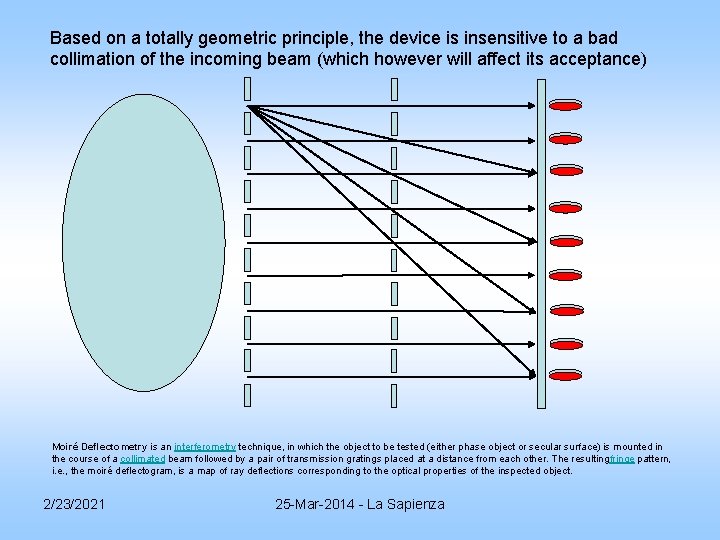
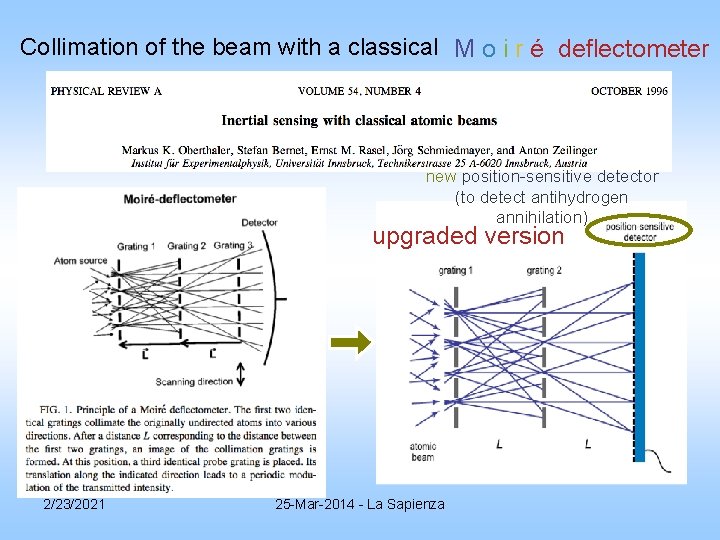
Based on a totally geometric principle, the device is insensitive to a bad collimation of the incoming beam (which however will affect its acceptance) Moiré Deflectometry is an interferometry technique, in which the object to be tested (either phase object or secular surface) is mounted in the course of a collimated beam followed by a pair of transmission gratings placed at a distance from each other. The resulting fringe pattern, i. e. , the moiré deflectogram, is a map of ray deflections corresponding to the optical properties of the inspected object. 2/23/2021 25 -Mar-2014 - La Sapienza
Collimation of the beam with a classical M o i r é deflectometer new position-sensitive detector (to detect antihydrogen annihilation) upgraded version 2/23/2021 25 -Mar-2014 - La Sapienza
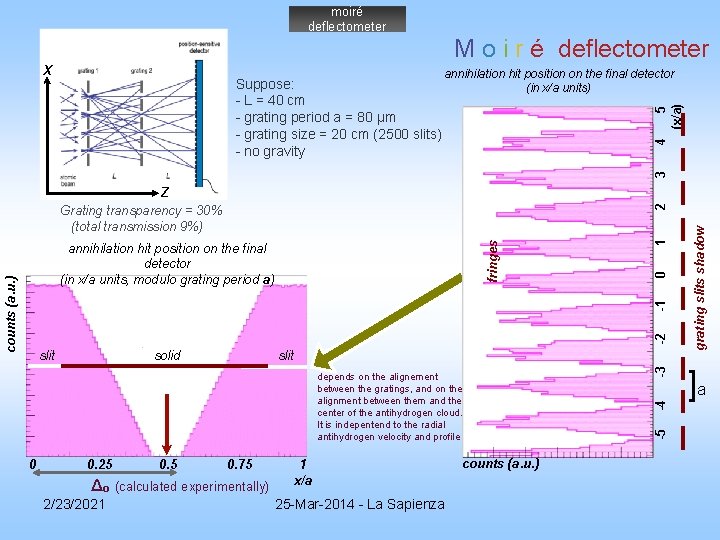
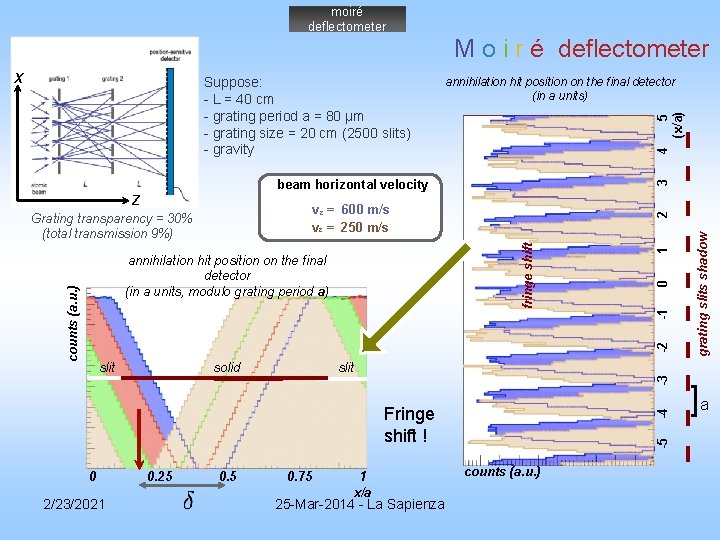
moiré deflectometer M o i r é deflectometer 5 (x/a) annihilation hit position on the final detector (in x/a units) 3 Suppose: - L = 40 cm - grating period a = 80 μm - grating size = 20 cm (2500 slits) - no gravity 4 X depends on the alignement between the gratings, and on the alignment between them and the center of the antihydrogen cloud. It is indepentend to the radial antihydrogen velocity and profile 0 0. 25 0. 75 Δo (calculated experimentally) 2/23/2021 1 x/a 25 -Mar-2014 - La Sapienza counts (a. u. ) -3 slit -4 solid -5 slit grating slits shadow 1 -2 -1 counts (a. u. ) annihilation hit position on the final detector (in x/a units, modulo grating period a) 0 fringes 2 Z Grating transparency = 30% (total transmission 9%) ]a
moiré deflectometer M o i r é deflectometer 4 5 (x/a) annihilation hit position on the final detector (in a units) -2 solid slit -3 slit 2/23/2021 0. 25 0. 75 1 x/a 25 -Mar-2014 - La Sapienza -5 -4 Fringe shift ! 0 grating slits shadow fringe shift annihilation hit position on the final detector (in a units, modulo grating period a) counts (a. u. ) 2 vz = 600 m/s vz = 250 m/s 1 Z Grating transparency = 30% (total transmission 9%) 3 beam horizontal velocity 0 Suppose: - L = 40 cm - grating period a = 80 μm - grating size = 20 cm (2500 slits) - gravity -1 X counts (a. u. ) ]a
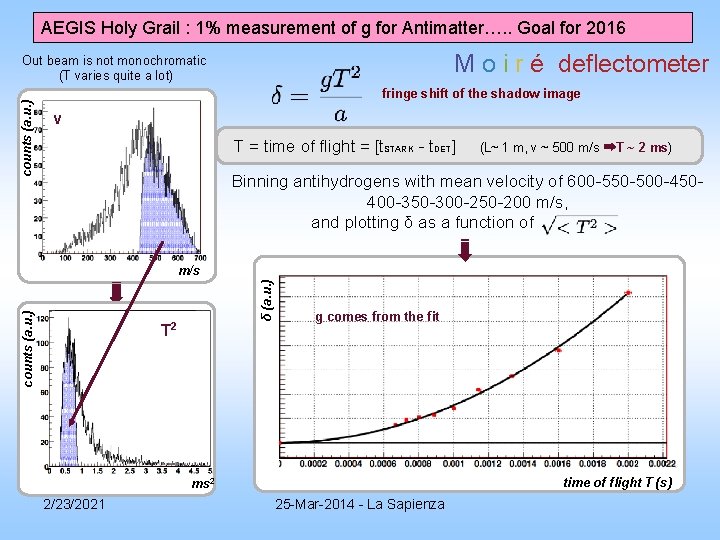
AEGIS Holy Grail : 1% measurement of g for Antimatter…. . Goal for 2016 M o i r é deflectometer counts (a. u. ) Out beam is not monochromatic (T varies quite a lot) fringe shift of the shadow image v T = time of flight = [t. STARK - t. DET] (L~ 1 m, v ~ 500 m/s ➠T ~ 2 ms) Binning antihydrogens with mean velocity of 600 -550 -500 -450400 -350 -300 -250 -200 m/s, and plotting δ as a function of ➠ counts (a. u. ) ➠ δ (a. u. ) m/s T 2 g comes from the fit time of flight T (s) ms 2 2/23/2021 25 -Mar-2014 - La Sapienza
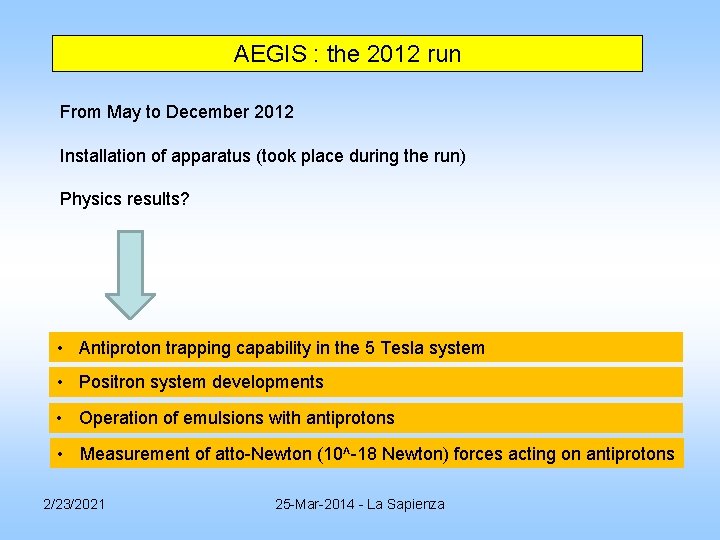
AEGIS : the 2012 run From May to December 2012 Installation of apparatus (took place during the run) Physics results? • Antiproton trapping capability in the 5 Tesla system • Positron system developments • Operation of emulsions with antiprotons • Measurement of atto-Newton (10^-18 Newton) forces acting on antiprotons 2/23/2021 25 -Mar-2014 - La Sapienza
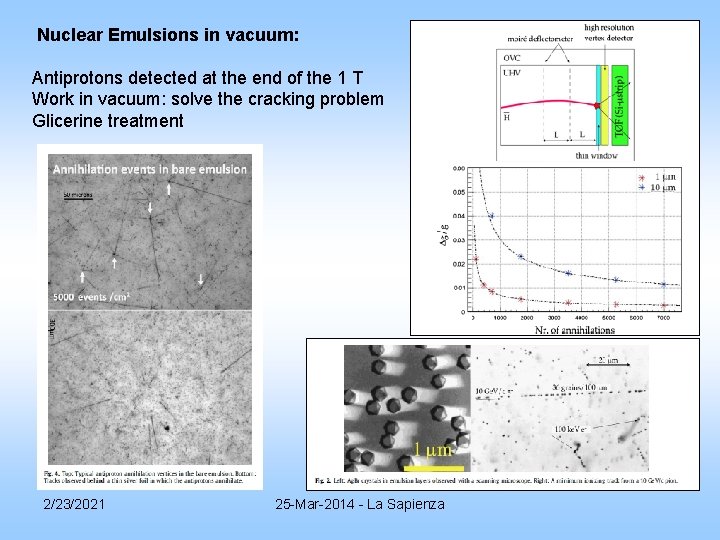
Nuclear Emulsions in vacuum: Antiprotons detected at the end of the 1 T Work in vacuum: solve the cracking problem Glicerine treatment 2/23/2021 25 -Mar-2014 - La Sapienza
Detection of atto. Newton forces (in preparation): AEGIS Antiproton beam Mini-moirè deflectometer Nuclear Emusion detector Recent selected bibliography: • M. Doser et al. Exploring the WEP with a pulsed beam of antihydrogen. Classical and Quantum Gravity 29 (2012) 184009. • AEg. IS Experiment Commissioning at CERN, AIP Conf. Proc. 1521, 144 (2013) • M. Kimura et al. , Development of nuclear emulsions with 1 μm spatial resolution for the AEg. IS experiment doi: 10. 1016/j. nima. 2013. 04. 082 • S. Aghion et al. , Detection of attonewton forces acting on antiprotons. To be submitted. AEGIS 2014 program : H-bar formation (charge exchange), Positronium physics 2/23/2021 25 -Mar-2014 - La Sapienza
Conclusiond and Outlook Physics at the Antiproton Decelerator will make it possible to study Antiatoms in a variety of ways. Testing of physical laws with Antimatter. Current experiments are limited by antiproton statistics, which will be increased by a factor 100 by the installation of ELENA (2016). ELENA: Extra Low Energy Antiproton Ring Will cool and accumulate Antiprotons after the AD : 5. 3 Me. V 0. 1 Me. V Expect news from properties of Antiatoms from: ALPHA ATRAP 2/23/2021 ASACUSA AEGIS GBAR BASE 25 -Mar-2014 - La Sapienza Thank you for your attention
Backup slides 2/23/2021 25 -Mar-2014 - La Sapienza
AEGIS Collaboration CERN, Geneva, Switzerland M. Doser, J. Bremer, G. Burkhart, A. Dudarev, T. Eisel, S. Haider, L. Dassa LAPP, Annecy, France. P. Nédélec, D. Sillou Queen’s U Belfast, UK G. Gribakin, H. R. J. Walters INFN Firenze, Italy G. Ferrari, M. Prevedelli, G. M. Tino INFN Genova, University of Genova, Italy C. Carraro, V. Lagomarsino, G. Manuzio, G. Testera, S. Zavatarelli INFN Milano, University of Milano, Italy F. Castelli, S. Cialdi, M. G. Giammarchi, D. Trezzi , F. Villa INFN Padova/Trento, Univ. Padova, Univ. Trento, Italy R. S. Brusa, D. Fabris, M. Lunardon, S. Mariazzi, S. Moretto, G. Nebbia, S. Pesente, G. Viesti INFN Pavia – Italy University of Brescia, University of Pavia G. Bonomi, A. Fontana, A. Rotondi, M. Subieta MPI- K, Heidelberg, Germany C. Canali, R. Heyne, A. Kellerbauer, C. Morhard, U. Warring Kirchhoff Institute of Physics U of Heidelberg, Germany M. K. Oberthaler INFN Milano, Politecnico di Milano, Italy G. Consolati, A. Dupasquier, R. Ferragut, F. Quasso INR, Moscow, Russia A. S. Belov, S. N. Gninenko, V. A. Matveev, A. V. Turbabin ITHEP, Moscow, Russia. V. M. Byakov, S. V. Stepanov, D. S. Zvezhinskij Laboratoire Aimé Cotton, Orsay, France. L. Cabaret, D. Comparat University of Oslo, Norway O. Rohne, S. Stapnes CEA Saclay, France M. Chappellier, M. de Combarieu, P. Forget, P. Pari INRNE, Sofia, Bulgaria N. Djourelov Czech Technical University, Prague, Czech Republic V. Petráček ETH Zurich, Switzerland S. D. Hogan, F. Merkt Institute for Nuclear Problems of the Belarus State. University, Belarus G. Drobychev 2/23/2021 25 -Mar-2014 - La Sapienza
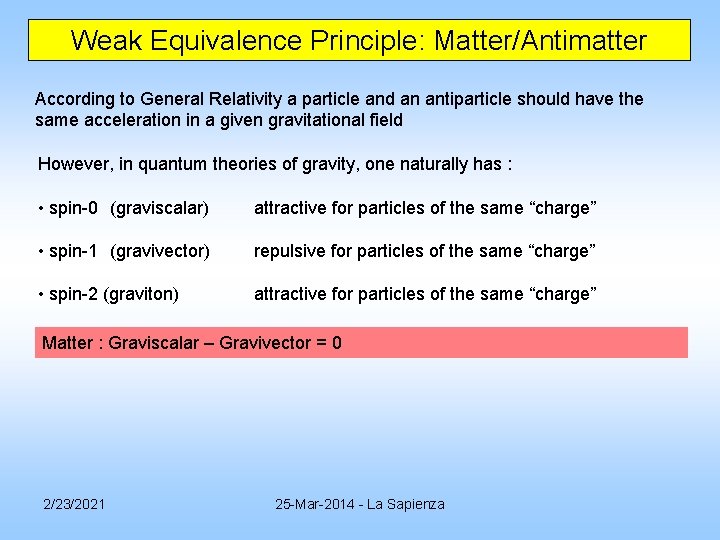
Weak Equivalence Principle: Matter/Antimatter According to General Relativity a particle and an antiparticle should have the same acceleration in a given gravitational field However, in quantum theories of gravity, one naturally has : • spin-0 (graviscalar) attractive for particles of the same “charge” • spin-1 (gravivector) repulsive for particles of the same “charge” • spin-2 (graviton) attractive for particles of the same “charge” Matter : Graviscalar – Gravivector = 0 2/23/2021 25 -Mar-2014 - La Sapienza
On the CPT Theorem Proof by Luders (1957): • • Spin 0, ½, 1 quantum fields Local interactions Lorentz group invariance Spin-Statistics (Pauli) Theorem More general proof by Pauli : • Fields of the same general character (? ) • Includes higher spin fields • Makes use of the finite representations of the proper Lorentz group 2/23/2021 25 -Mar-2014 - La Sapienza
Antihydrogen program at CERN A low-energy Antimatter research program based on the Antiproton Decelerator PHASE I: Production of “cold” antihydrogen atoms (2000 -2004) ATHENA (Appara. Tus for High precision Experiment on Neutral Antimatter, or shortly An. Ti. Hydrog. EN Apparatus) ATRAP (Antihydrogen TRAP) PHASE II: Cold-Antihydrogen Physics (2006…. ) ATRAP ALPHA (Antihydrogen Laser PHysics Apparatus) ASACUSA AEGIS (Antimatter Experiment: Gravity, Interferometry, Spectroscopy) 2/23/2021 25 -Mar-2014 - La Sapienza
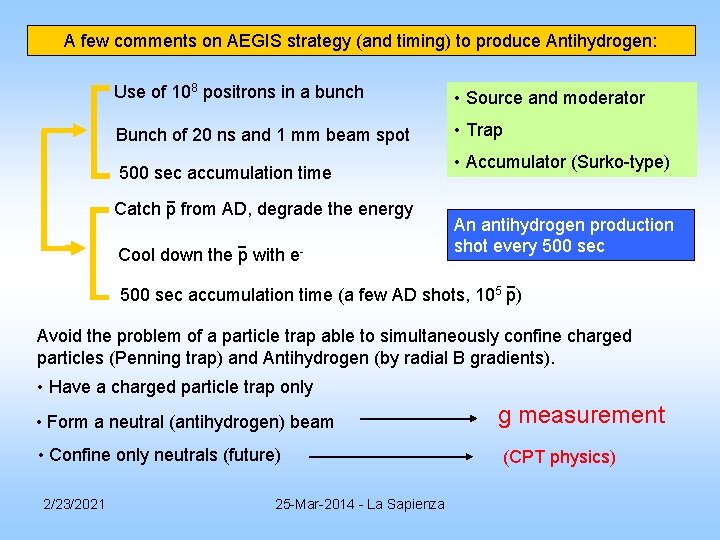
A few comments on AEGIS strategy (and timing) to produce Antihydrogen: Use of 108 positrons in a bunch • Source and moderator Bunch of 20 ns and 1 mm beam spot • Trap 500 sec accumulation time Catch p from AD, degrade the energy Cool down the p with e- • Accumulator (Surko-type) An antihydrogen production shot every 500 sec accumulation time (a few AD shots, 105 p) Avoid the problem of a particle trap able to simultaneously confine charged particles (Penning trap) and Antihydrogen (by radial B gradients). • Have a charged particle trap only • Form a neutral (antihydrogen) beam g measurement • Confine only neutrals (future) (CPT physics) 2/23/2021 25 -Mar-2014 - La Sapienza
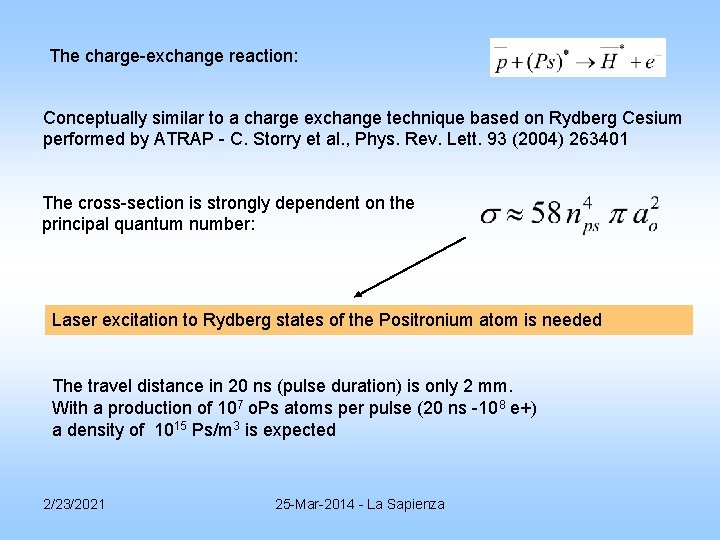
The charge-exchange reaction: Conceptually similar to a charge exchange technique based on Rydberg Cesium performed by ATRAP - C. Storry et al. , Phys. Rev. Lett. 93 (2004) 263401 The cross-section is strongly dependent on the principal quantum number: Laser excitation to Rydberg states of the Positronium atom is needed The travel distance in 20 ns (pulse duration) is only 2 mm. With a production of 107 o. Ps atoms per pulse (20 ns -108 e+) a density of 1015 Ps/m 3 is expected 2/23/2021 25 -Mar-2014 - La Sapienza
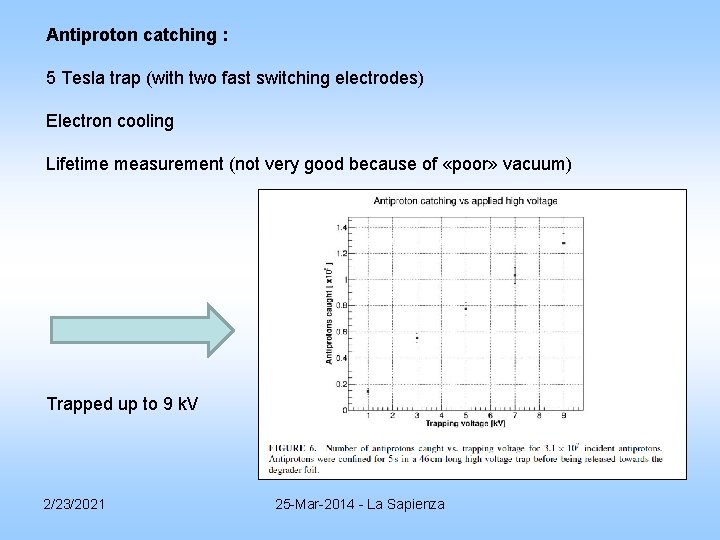
Antiproton catching : 5 Tesla trap (with two fast switching electrodes) Electron cooling Lifetime measurement (not very good because of «poor» vacuum) Trapped up to 9 k. V 2/23/2021 25 -Mar-2014 - La Sapienza
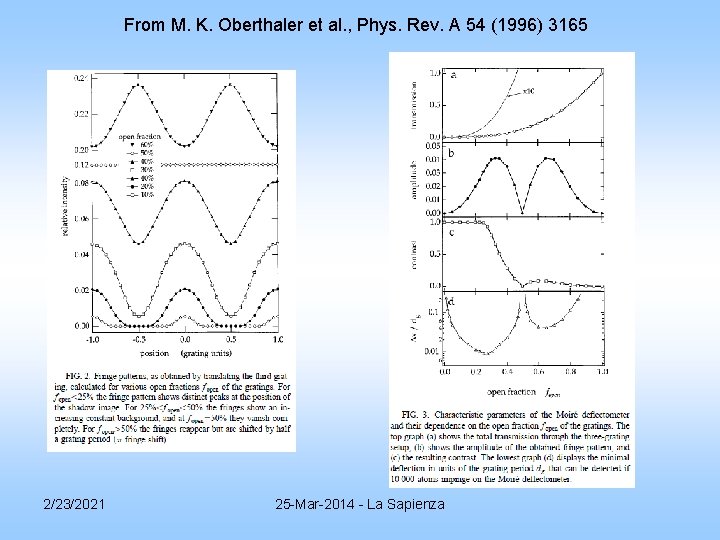
From M. K. Oberthaler et al. , Phys. Rev. A 54 (1996) 3165 2/23/2021 25 -Mar-2014 - La Sapienza
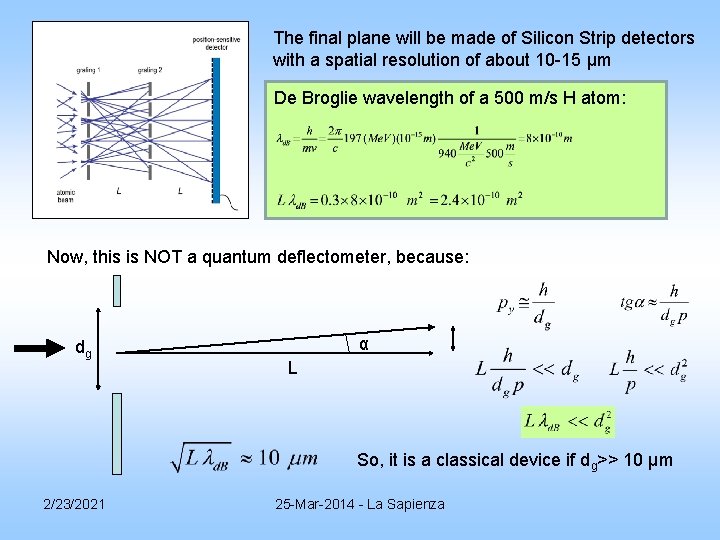
The final plane will be made of Silicon Strip detectors with a spatial resolution of about 10 -15 μm De Broglie wavelength of a 500 m/s H atom: Now, this is NOT a quantum deflectometer, because: dg α L So, it is a classical device if dg>> 10 μm 2/23/2021 25 -Mar-2014 - La Sapienza
2/23/2021 25 -Mar-2014 - La Sapienza
Positronium Physics 2/23/2021 25 -Mar-2014 - La Sapienza
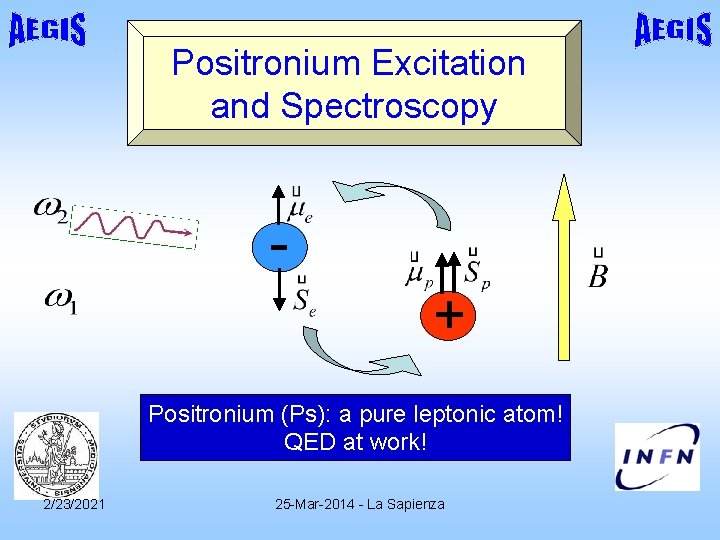
Positronium Excitation and Spectroscopy + Positronium (Ps): a pure leptonic atom! QED at work! 2/23/2021 25 -Mar-2014 - La Sapienza
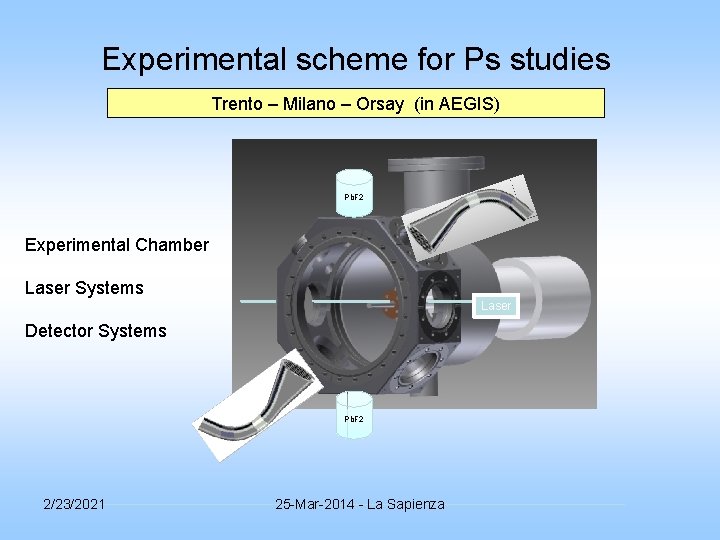
Experimental scheme for Ps studies Trento – Milano – Orsay (in AEGIS) Pb. F 2 Experimental Chamber Laser Systems Laser Detector Systems Pb. F 2 2/23/2021 25 -Mar-2014 - La Sapienza
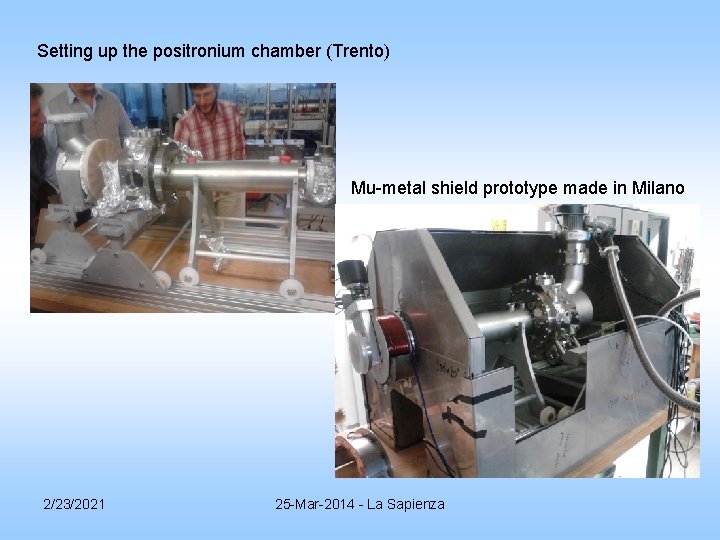
Setting up the positronium chamber (Trento) Mu-metal shield prototype made in Milano 2/23/2021 25 -Mar-2014 - La Sapienza
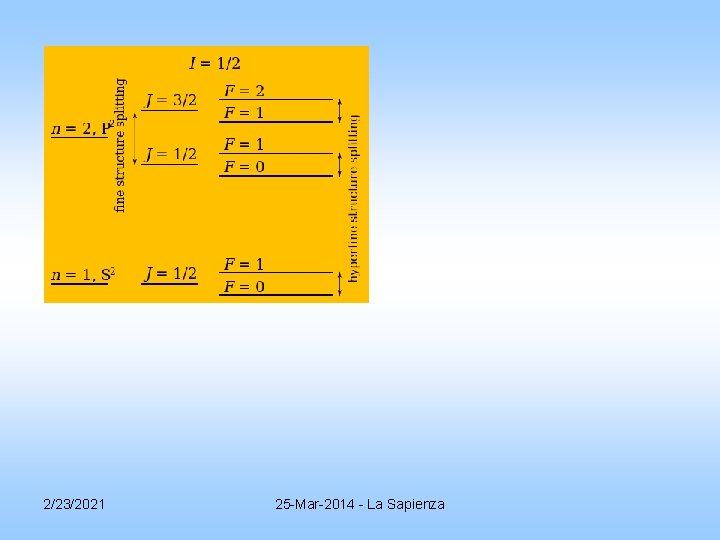
Ps spectroscopy: proposals in AEGIS General idea: ♪ Produce a positron bunch as foreseen for antihydrogen production ♪ Send the bunch to the dedicated Ps-table ♪ Use same converters as for antihydrogen ♪ Excite with the same laser system as for antihydrogen production ♪ Study the effect of magnetic field (useful for antihydrogen!) ♪ UV Excitation of the n=3 level (+ microwave) ♪ IR Spectroscopy of Rydberg levels ♪ Future topics (Rydberg spectroscopy, Doppler free, laser cooling) 2/23/2021 25 -Mar-2014 - La Sapienza
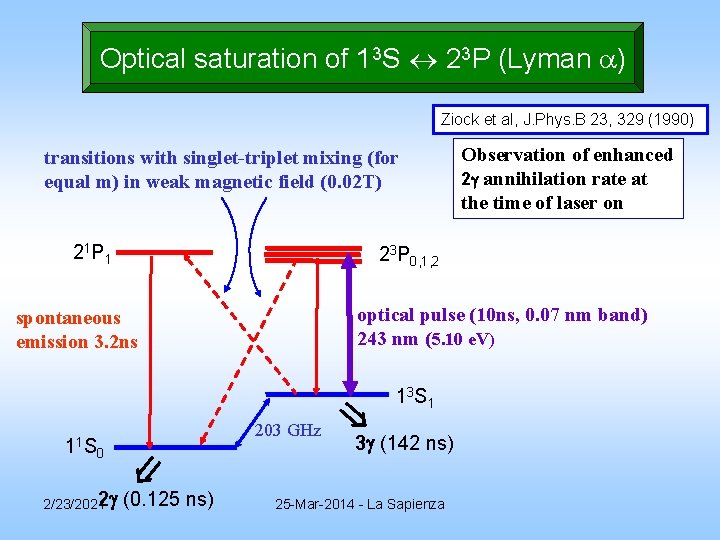
Optical saturation of 13 S 23 P (Lyman ) Ziock et al, J. Phys. B 23, 329 (1990) transitions with singlet-triplet mixing (for equal m) in weak magnetic field (0. 02 T) 21 P 1 23 P 0, 1, 2 optical pulse (10 ns, 0. 07 nm band) 243 nm (5. 10 e. V) spontaneous emission 3. 2 ns 203 GHz 0 11 S Observation of enhanced 2 annihilation rate at the time of laser on 2/23/20212 (0. 125 ns) 13 S 1 3 (142 ns) 25 -Mar-2014 - La Sapienza
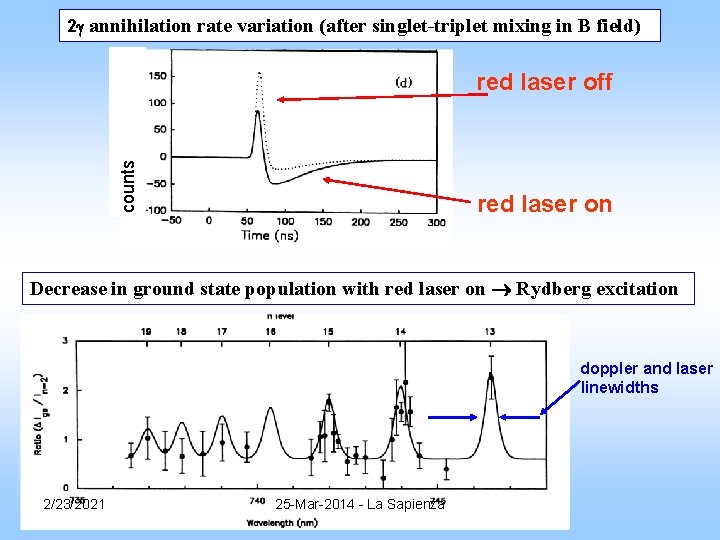
2 annihilation rate variation (after singlet-triplet mixing in B field) counts red laser off red laser on Decrease in ground state population with red laser on Rydberg excitation doppler and laser linewidths 2/23/2021 25 -Mar-2014 - La Sapienza
Positron accumulator performance 2/23/2021 25 -Mar-2014 - La Sapienza