
Lecture 4 The Violation of Symmetry between Matter
Lecture 4 The Violation of Symmetry between Matter and Antimatter Andreas Höcker CERN Summer Student Lectures, August 5 – 8, 2008 CERN Summer Student Lectures 2008 A. Höcker: The Violation of Symmetry between Matter and Antimatter (4) M. C. Escher 1
Lecture Themes I. Introduction Antimatter Discrete Symmetries II. The Phenomena of CP Violation Electric and weak dipole moments The strong CP problem The discovery of CP violation in the kaon system III. CP Violation in the Standard Model The CKM matrix and the Unitarity Triangle B Factories CP violation in the B-meson system and a global CKM fit The Future at the LHC IV. CP Violation and the Genesis of a Matter World Baryogenesis and CP violation Models for Baryogenesis CERN Summer Student Lectures 2008 A. Höcker: The Violation of Symmetry between Matter and Antimatter (4) 2
CP Violation and the Genesis of a Matter World astronomical units: 1. Has Antimatter Really Disappeared ? 2. Baryogenesis in the Early Universe 3. Baryogenesis through Electroweak Phase Transitions 4. Baryogenesis through Leptogenesis CERN Summer Student Lectures 2008 A. Höcker: The Violation of Symmetry between Matter and Antimatter (4) 3
Prerequisites Antimatter Matter-antimatter asymmetry Expansion of the universe Equilibrium thermodynamics Higgs mechanism CP violation in the quark sector: CKM matrix CERN Summer Student Lectures 2008 A. Höcker: The Violation of Symmetry between Matter and Antimatter (4) 4

Matter-Antimatter Asymmetry q q 1 Early universe ? Current universe CERN Summer Student Lectures 2008 A. Höcker: The Violation of Symmetry between Matter and Antimatter (4) 5
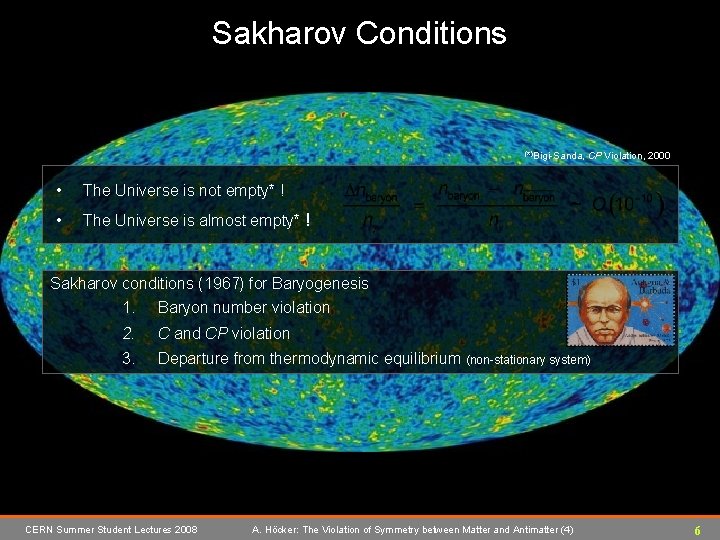
Sakharov Conditions (*)Bigi-Sanda, • The Universe is not empty* ! • The Universe is almost empty* ! CP Violation, 2000 Sakharov conditions (1967) for Baryogenesis 1. Baryon number violation 2. C and CP violation 3. Departure from thermodynamic equilibrium (non-stationary system) CERN Summer Student Lectures 2008 A. Höcker: The Violation of Symmetry between Matter and Antimatter (4) 6
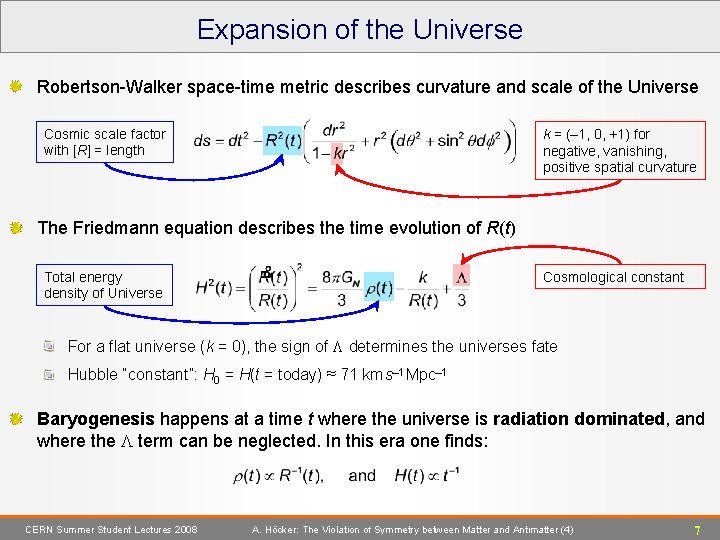
Expansion of the Universe Robertson-Walker space-time metric describes curvature and scale of the Universe Cosmic scale factor with [R] = length k = (– 1, 0, +1) for negative, vanishing, positive spatial curvature The Friedmann equation describes the time evolution of R(t) Total energy density of Universe Cosmological constant For a flat universe (k = 0), the sign of determines the universes fate Hubble “constant”: H 0 = H(t = today) ≈ 71 km s– 1 Mpc– 1 Baryogenesis happens at a time t where the universe is radiation dominated, and where the term can be neglected. In this era one finds: CERN Summer Student Lectures 2008 A. Höcker: The Violation of Symmetry between Matter and Antimatter (4) 7
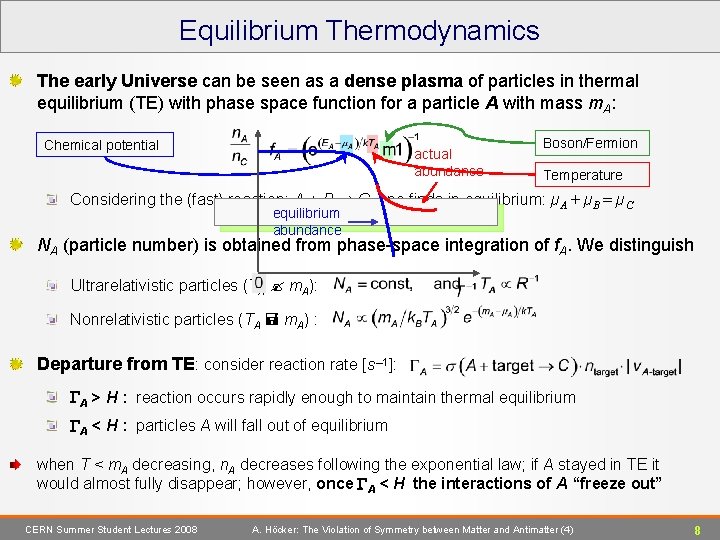
Equilibrium Thermodynamics The early Universe can be seen as a dense plasma of particles in thermal equilibrium (TE) with phase space function for a particle A with mass m. A: Chemical potential actual abundance Boson/Fermion Temperature Considering the (fast) reaction: A + B C, one finds in equilibrium: µA + µB = µC equilibrium abundance NA (particle number) is obtained from phase-space integration of f. A. We distinguish Ultrarelativistic particles (TA m. A): Nonrelativistic particles (TA m. A) : Departure from TE: consider reaction rate [s – 1]: A > H : reaction occurs rapidly enough to maintain thermal equilibrium A < H : particles A will fall out of equilibrium when T < m. A decreasing, n. A decreases following the exponential law; if A stayed in TE it would almost fully disappear; however, once A < H the interactions of A “freeze out” CERN Summer Student Lectures 2008 A. Höcker: The Violation of Symmetry between Matter and Antimatter (4) 8
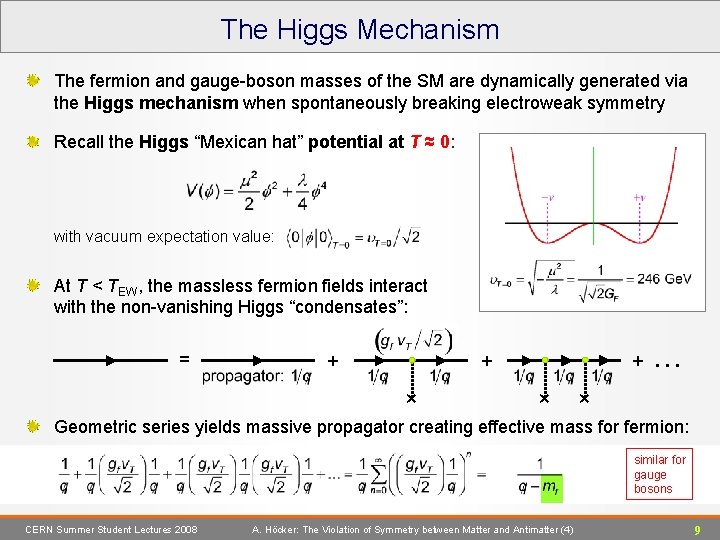
The Higgs Mechanism The fermion and gauge-boson masses of the SM are dynamically generated via the Higgs mechanism when spontaneously breaking electroweak symmetry Recall the Higgs “Mexican hat” potential at T ≈ 0: with vacuum expectation value: At T < TEW, the massless fermion fields interact with the non-vanishing Higgs “condensates”: = + + × … × Geometric series yields massive propagator creating effective mass for fermion: similar for gauge bosons CERN Summer Student Lectures 2008 A. Höcker: The Violation of Symmetry between Matter and Antimatter (4) 9
Baryogenesis CERN Summer Student Lectures 2008 A. Höcker: The Violation of Symmetry between Matter and Antimatter (4) 10
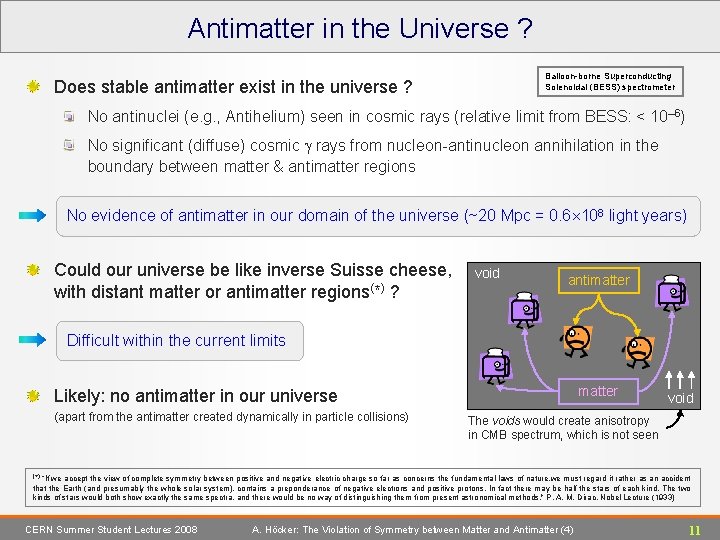
Antimatter in the Universe ? Balloon-borne Superconducting Solenoidal (BESS) spectrometer Does stable antimatter exist in the universe ? No antinuclei (e. g. , Antihelium) seen in cosmic rays (relative limit from BESS: < 10 – 6) No significant (diffuse) cosmic rays from nucleon-antinucleon annihilation in the boundary between matter & antimatter regions No evidence of antimatter in our domain of the universe (~20 Mpc = 0. 6 108 light years) Could our universe be like inverse Suisse cheese, with distant matter or antimatter regions(*) ? void antimatter Difficult within the current limits matter Likely: no antimatter in our universe (apart from the antimatter created dynamically in particle collisions) void The voids would create anisotropy in CMB spectrum, which is not seen (*) “If we accept the view of complete symmetry between positive and negative electric charge so far as concerns the fundamental laws of nature, we must regard it rather as an accident that the Earth (and presumably the whole solar system), contains a preponderance of negative electrons and positive protons. In fact there may be half the stars of each kind. The two kinds of stars would both show exactly the same spectra, and there would be no way of distinguishing them from present astronomical methods. " P. A. M. Dirac, Nobel Lecture (1933) CERN Summer Student Lectures 2008 A. Höcker: The Violation of Symmetry between Matter and Antimatter (4) 11
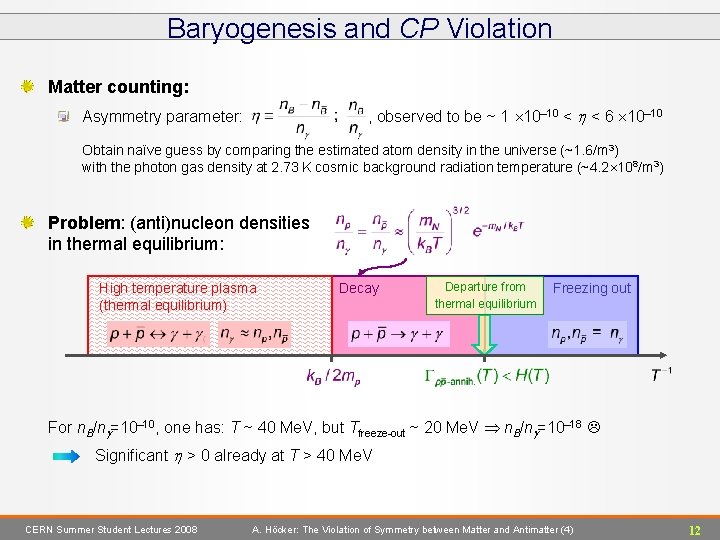
Baryogenesis and CP Violation Matter counting: , observed to be ~ 1 10– 10 < < 6 10– 10 Asymmetry parameter: Obtain naïve guess by comparing the estimated atom density in the universe (~1. 6/m 3) with the photon gas density at 2. 73 K cosmic background radiation temperature (~4. 2 108/m 3) Problem: (anti)nucleon densities in thermal equilibrium: High temperature plasma (thermal equilibrium) Decay Departure from thermal equilibrium Freezing out For n. B/n =10– 10, one has: T ~ 40 Me. V, but Tfreeze-out ~ 20 Me. V n. B/n =10– 18 Significant > 0 already at T > 40 Me. V CERN Summer Student Lectures 2008 A. Höcker: The Violation of Symmetry between Matter and Antimatter (4) 12
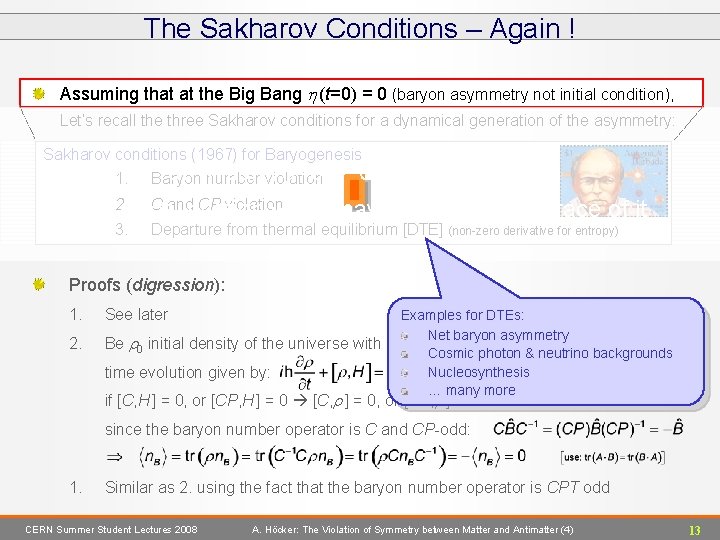
The Sakharov Conditions – Again ! Assuming that at the Big Bang (t=0) = 0 (baryon asymmetry not initial condition), Let’s recall the three Sakharov conditions for a dynamical generation of the asymmetry: Sakharov conditions (1967) for Baryogenesis However: an initial (t=0) > 0 would be futile, 1. Baryon number violation 2. C and CP violation since inflation would 3. have wiped out the trace of it Departure from thermal equilibrium [DTE] (non-zero derivative for entropy) Proofs (digression): 1. See later 2. Be 0 initial density of the universe with time evolution given by: Examples for DTEs: Net baryon asymmetry Cosmic photon & neutrino backgrounds Nucleosynthesis … many more if [C, H ] = 0, or [CP, H ] = 0 [C, ] = 0, or [CP, ] = 0 since the baryon number operator is C and CP-odd: 1. Similar as 2. using the fact that the baryon number operator is CPT odd CERN Summer Student Lectures 2008 A. Höcker: The Violation of Symmetry between Matter and Antimatter (4) 13

(I) Baryogenesis in the Early Universe (much simplified!) Grand unification (GUT) of the forces at ~1016 Ge. V Simplest GUT model, SU(5), has 52– 1=24 gauge fields, of which 12 belong to SM 12 New heavy leptoquark fields, X, Y, carrying charge and color, allow transitions between baryons and leptons; also: X < H(T) for T TEW (out of equilibrium decays) Toy example for X decays (note that quark (antiquark) has baryon+ number B=+1/3 (– 1/3), and lepton has B=0) 0 Discovery of proton decay, e. g. , p e , would If direct CP violation support the hypothesis of GUT-type baryogenesis Current upper limit: p > 1. 6 1033 years (90% CL, Super-Kamiokande, 1998) (At T > m. X : B = 0 TE due to “wash-out”, e. g. , X-exchange reactions (CPT) CPT invariance holds: total decay rates are equal At T < m. X Boltzmann-suppressed; at X < H(T) out-of-equilibrium excess develops Only tiny CP asymmetry, O(10– 8), is needed to obtain ~ 10– 10 this way Pitfall: SU(5) is B – L conserving problem (see later) at least SO(10) required CERN Summer Student Lectures 2008 A. Höcker: The Violation of Symmetry between Matter and Antimatter (4) 14

(II) Baryogenesis through EW Phase Transition Within a picosecond, at the electroweak (EW) scale (100 Ge. V ~ 1015 K), where EW forces are still unified, EW phase transition (1 st order) can occur Non-abelian theories (like weak interaction SU(2)L) have a non-trivial vacuum structure with an infinite number of ground states (“topological charges”). Periodic vacuum structure of EW theory: for Ng=3 generations, the distance between two ground states is ΔB = ΔL = 3 (e. g. , conversion of baryons into antileptons) height of potential barrier sphalerons no proton decay always: Δ(B – L) = 0 ! (B L is conserved in the SM) exp. suppr. tunneling: (ΔB+L 0)~10– 164 ! (non-abelian gauge fields) Small perturbative changes in fields around zero charge will not change B and L Sphaleron transition rate: ~ exp(–Esphal(T)/k. BT) for T < TEW (barrier), and ~ T 4 for T > TEW (B L conserving sphaleron processes for 102~1012 Ge. V any B+L violating asymmetry in this energy range will be washed out requires B L violation) CERN Summer Student Lectures 2008 A. Höcker: The Violation of Symmetry between Matter and Antimatter (4) 15
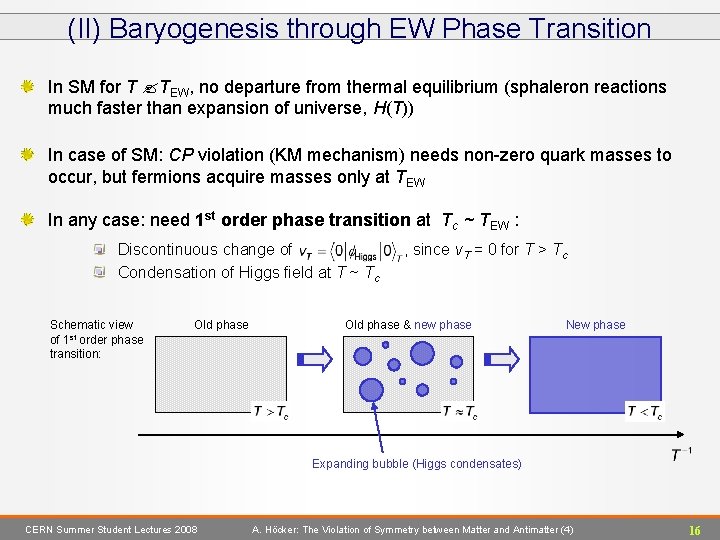
(II) Baryogenesis through EW Phase Transition In SM for T TEW, no departure from thermal equilibrium (sphaleron reactions much faster than expansion of universe, H(T)) In case of SM: CP violation (KM mechanism) needs non-zero quark masses to occur, but fermions acquire masses only at TEW In any case: need 1 st order phase transition at Tc ~ TEW : Discontinuous change of Condensation of Higgs field at T ~ Tc Schematic view of 1 st order phase transition: Old phase , since v. T = 0 for T > Tc Old phase & new phase New phase Expanding bubble (Higgs condensates) CERN Summer Student Lectures 2008 A. Höcker: The Violation of Symmetry between Matter and Antimatter (4) 16
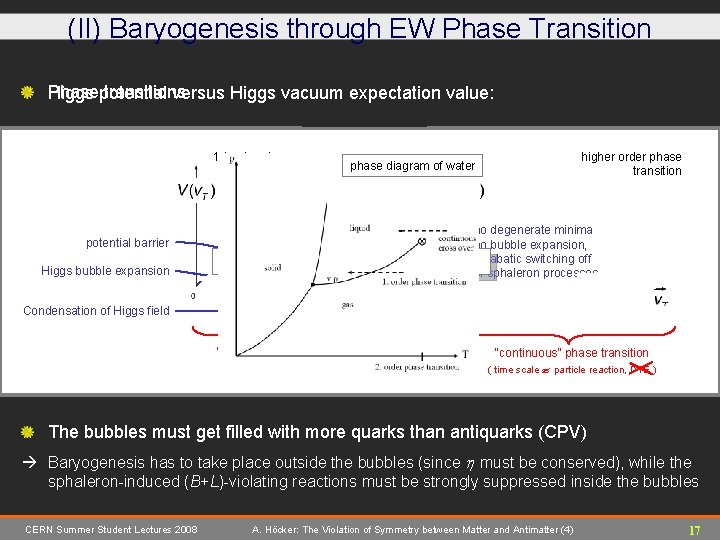
(II) Baryogenesis through EW Phase Transition Phasepotential transitions Higgs versus Higgs vacuum expectation value: 1 st order phase transition higher order phase transition phase diagram of water no degenerate minima no bubble expansion, adiabatic switching off of sphaleron processes potential barrier Higgs bubble expansion Condensation of Higgs field “spontaneous” phase transition “continuous” phase transition ( time scale ~ particle reaction, DTE ) ( time scale particle reaction, DTE ) The bubbles must get filled with more quarks than antiquarks (CPV) Baryogenesis has to take place outside the bubbles (since must be conserved), while the sphaleron-induced (B+L)-violating reactions must be strongly suppressed inside the bubbles CERN Summer Student Lectures 2008 A. Höcker: The Violation of Symmetry between Matter and Antimatter (4) 17
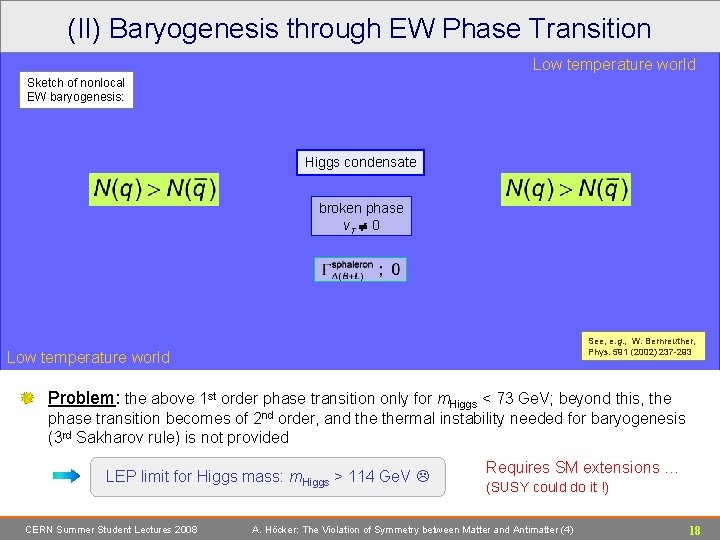
(II) Baryogenesis through EW Phase Transition High temperature Low temperature world plasma Sketch of nonlocal EW baryogenesis: expanding v bubble wall Higgs condensate Symmetric phase v. T = 0 CP broken phase v. T 0 Symmetric phase v. T = 0 CP See, e. g. , W. Bernreuther, Phys. 591 (2002) 237 -293 Low High temperature world plasma Problem: the above 1 st order phase transition only for m. Higgs < 73 Ge. V; beyond this, the phase transition becomes of 2 nd order, and thermal instability needed for baryogenesis (3 rd Sakharov rule) is not provided LEP limit for Higgs mass: m. Higgs > 114 Ge. V CERN Summer Student Lectures 2008 Requires SM extensions … (SUSY could do it !) A. Höcker: The Violation of Symmetry between Matter and Antimatter (4) 18
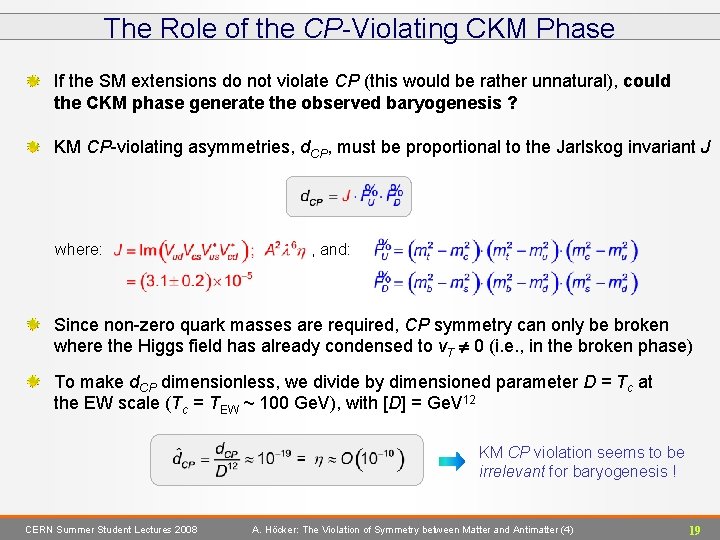
The Role of the CP-Violating CKM Phase If the SM extensions do not violate CP (this would be rather unnatural), could the CKM phase generate the observed baryogenesis ? KM CP-violating asymmetries, d. CP, must be proportional to the Jarlskog invariant J where: , and: Since non-zero quark masses are required, CP symmetry can only be broken where the Higgs field has already condensed to v. T 0 (i. e. , in the broken phase) To make d. CP dimensionless, we divide by dimensioned parameter D = Tc at the EW scale (Tc = TEW ~ 100 Ge. V), with [D] = Ge. V 12 KM CP violation seems to be irrelevant for baryogenesis ! CERN Summer Student Lectures 2008 A. Höcker: The Violation of Symmetry between Matter and Antimatter (4) 19
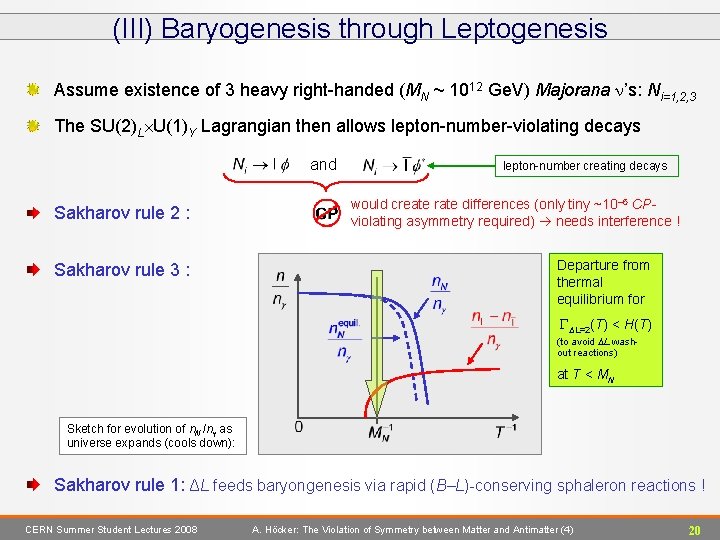
(III) Baryogenesis through Leptogenesis Assume existence of 3 heavy right-handed (MN ~ 1012 Ge. V) Majorana ’s: Ni=1, 2, 3 The SU(2)L U(1)Y Lagrangian then allows lepton-number-violating decays and Sakharov rule 2 : Sakharov rule 3 : lepton-number creating decays would create rate differences (only tiny ~10– 6 CPviolating asymmetry required) needs interference ! Departure from thermal equilibrium for L=2(T) < H(T) (to avoid L washout reactions) at T < MN Sketch for evolution of n. N /n as universe expands (cools down): Sakharov rule 1: ΔL feeds baryongenesis via rapid (B–L)-conserving sphaleron reactions ! CERN Summer Student Lectures 2008 A. Höcker: The Violation of Symmetry between Matter and Antimatter (4) 20
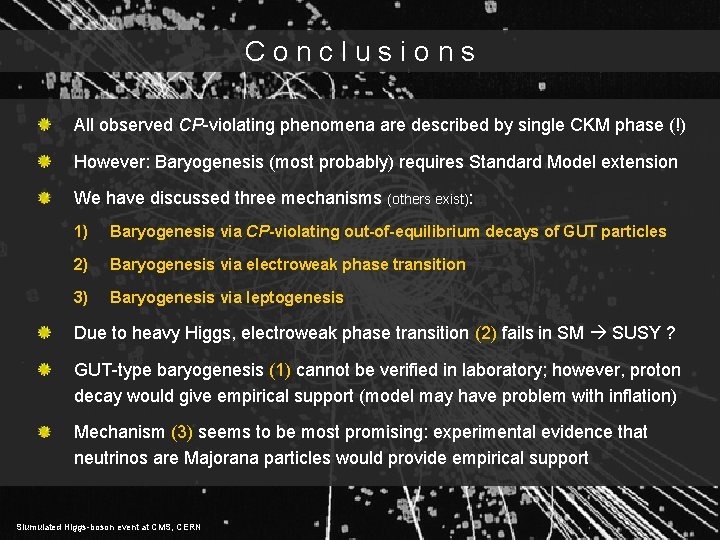
Conclusions All observed CP-violating phenomena are described by single CKM phase (!) However: Baryogenesis (most probably) requires Standard Model extension We have discussed three mechanisms (others exist): 1) Baryogenesis via CP-violating out-of-equilibrium decays of GUT particles 2) Baryogenesis via electroweak phase transition 3) Baryogenesis via leptogenesis Due to heavy Higgs, electroweak phase transition (2) fails in SM SUSY ? GUT-type baryogenesis (1) cannot be verified in laboratory; however, proton decay would give empirical support (model may have problem with inflation) Mechanism (3) seems to be most promising: experimental evidence that neutrinos are Majorana particles would provide empirical support Siumulated Higgs-boson event at CMS, 2008 CERN Summer Student Lectures A. Höcker: The Violation of Symmetry between Matter and Antimatter (4) 21
- Slides: 21