
Sensors Specs Update CERN Market Survey Y Unno
- Slides: 14
Sensors Specs Update, CERN Market Survey Y. Unno, C. Lacasta, V. Fadeyev 2014 -07 -23 Specs Update, MS Survey 1
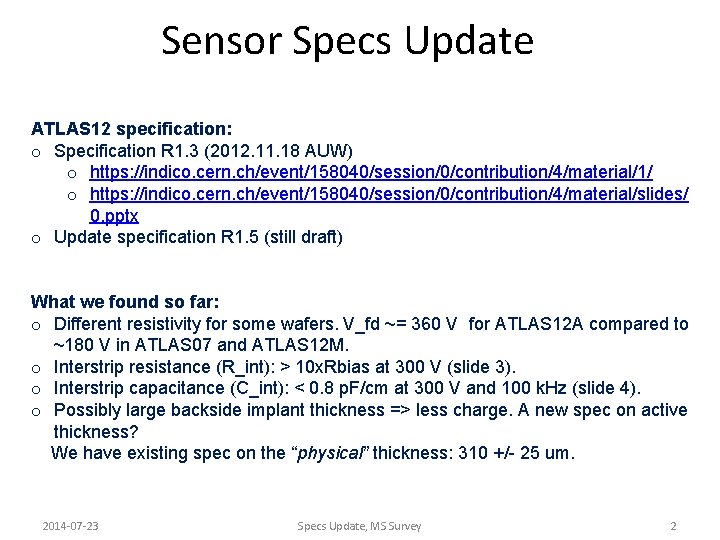
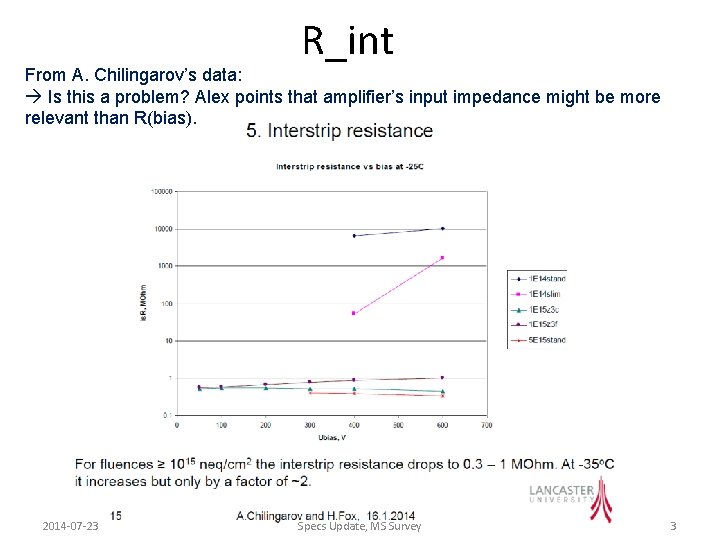
Sensor Specs Update ATLAS 12 specification: o Specification R 1. 3 (2012. 11. 18 AUW) o https: //indico. cern. ch/event/158040/session/0/contribution/4/material/1/ o https: //indico. cern. ch/event/158040/session/0/contribution/4/material/slides/ 0. pptx o Update specification R 1. 5 (still draft) What we found so far: o Different resistivity for some wafers. V_fd ~= 360 V for ATLAS 12 A compared to ~180 V in ATLAS 07 and ATLAS 12 M. o Interstrip resistance (R_int): > 10 x. Rbias at 300 V (slide 3). o Interstrip capacitance (C_int): < 0. 8 p. F/cm at 300 V and 100 k. Hz (slide 4). o Possibly large backside implant thickness => less charge. A new spec on active thickness? We have existing spec on the “physical” thickness: 310 +/- 25 um. 2014 -07 -23 Specs Update, MS Survey 2
R_int From A. Chilingarov’s data: Is this a problem? Alex points that amplifier’s input impedance might be more relevant than R(bias). 2014 -07 -23 Specs Update, MS Survey 3
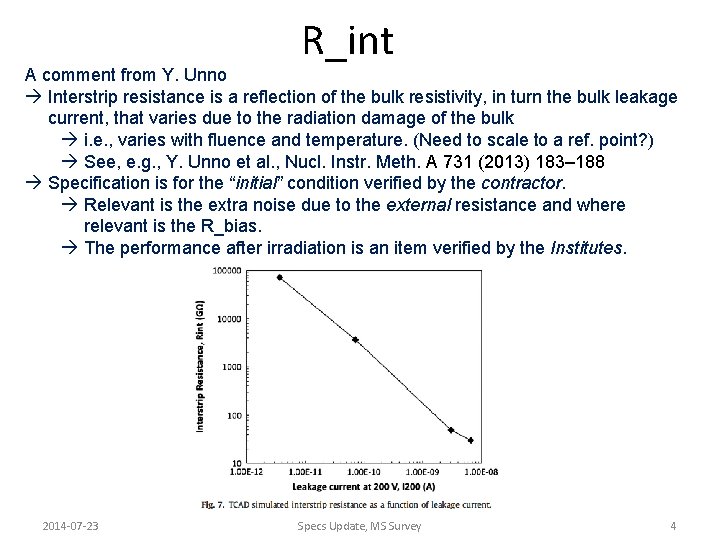
R_int A comment from Y. Unno Interstrip resistance is a reflection of the bulk resistivity, in turn the bulk leakage current, that varies due to the radiation damage of the bulk i. e. , varies with fluence and temperature. (Need to scale to a ref. point? ) See, e. g. , Y. Unno et al. , Nucl. Instr. Meth. A 731 (2013) 183– 188 Specification is for the “initial” condition verified by the contractor. Relevant is the extra noise due to the external resistance and where relevant is the R_bias. The performance after irradiation is an item verified by the Institutes. 2014 -07 -23 Specs Update, MS Survey 4
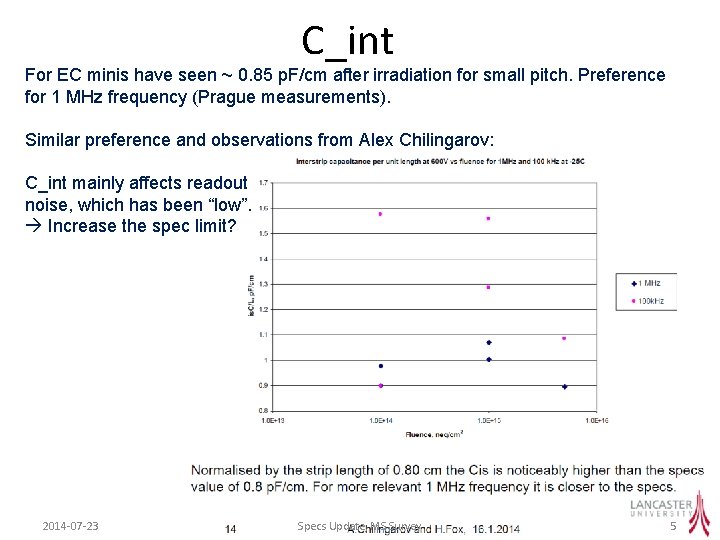
C_int For EC minis have seen ~ 0. 85 p. F/cm after irradiation for small pitch. Preference for 1 MHz frequency (Prague measurements). Similar preference and observations from Alex Chilingarov: C_int mainly affects readout noise, which has been “low”. Increase the spec limit? 2014 -07 -23 Specs Update, MS Survey 5
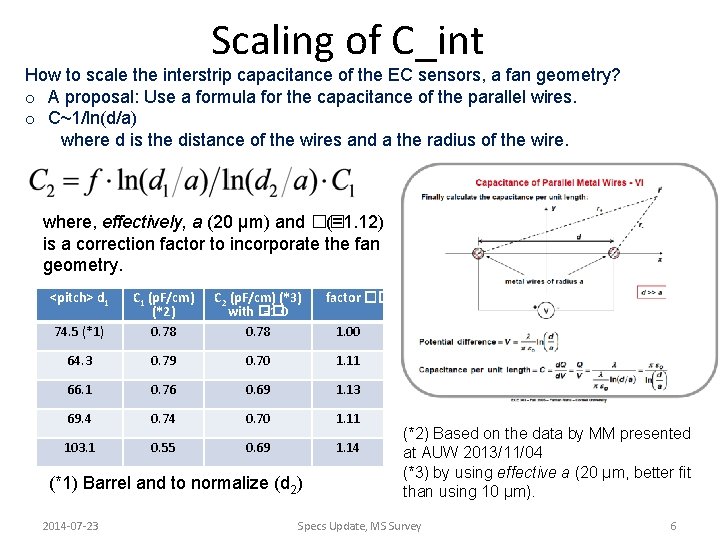
Scaling of C_int How to scale the interstrip capacitance of the EC sensors, a fan geometry? o A proposal: Use a formula for the capacitance of the parallel wires. o C~1/ln(d/a) where d is the distance of the wires and a the radius of the wire. where, effectively, a (20 µm) and �� (=1. 12) is a correction factor to incorporate the fan geometry. <pitch> d 1 74. 5 (*1) C 1 (p. F/cm) (*2) 0. 78 C 2 (p. F/cm) (*3) with �� =1. 0 0. 78 64. 3 0. 79 0. 70 1. 11 66. 1 0. 76 0. 69 1. 13 69. 4 0. 70 1. 11 103. 1 0. 55 0. 69 1. 14 (*1) Barrel and to normalize (d 2) 2014 -07 -23 factor �� 1. 00 (*2) Based on the data by MM presented at AUW 2013/11/04 (*3) by using effective a (20 µm, better fit than using 10 µm). Specs Update, MS Survey 6
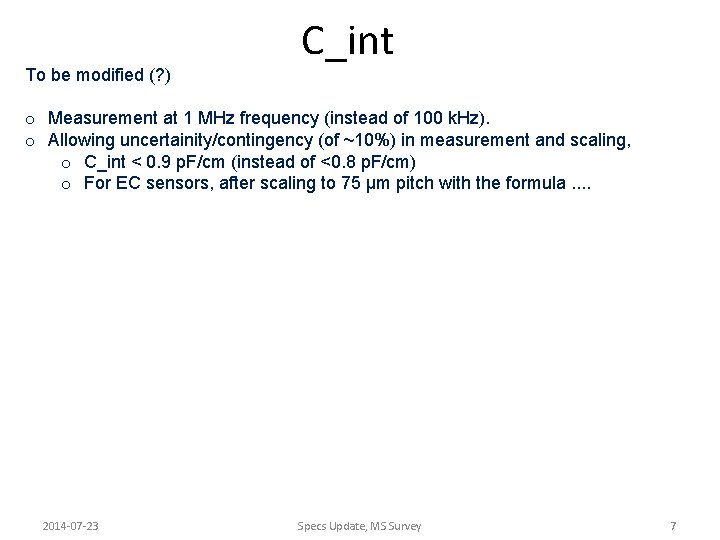
To be modified (? ) C_int o Measurement at 1 MHz frequency (instead of 100 k. Hz). o Allowing uncertainity/contingency (of ~10%) in measurement and scaling, o C_int < 0. 9 p. F/cm (instead of <0. 8 p. F/cm) o For EC sensors, after scaling to 75 µm pitch with the formula. . 2014 -07 -23 Specs Update, MS Survey 7
V_fd Collect the relevant consequences after irradiation first and access them. o till we finalize the technical specification for the Market Survey. Cost is an another factor to weigh. o Get an official quote by including two(? ) flavours in the Market Survey. 2014 -07 -23 Specs Update, MS Survey 8
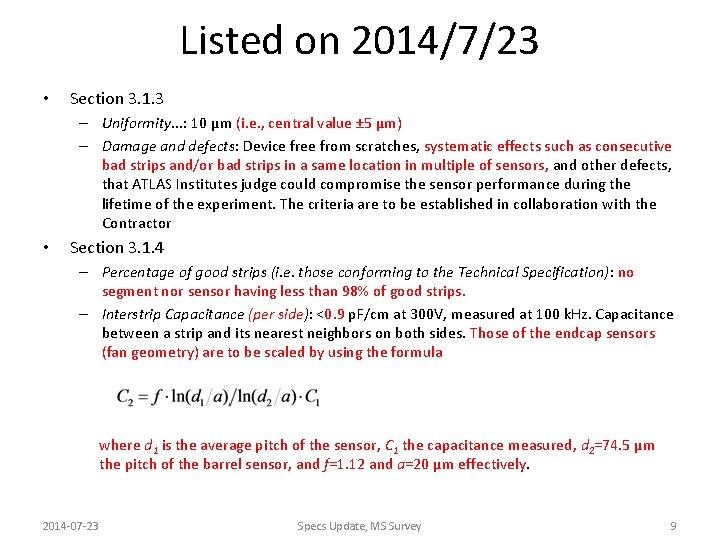
Listed on 2014/7/23 • Section 3. 1. 3 – Uniformity. . . : 10 µm (i. e. , central value ± 5 µm) – Damage and defects: Device free from scratches, systematic effects such as consecutive bad strips and/or bad strips in a same location in multiple of sensors, and other defects, that ATLAS Institutes judge could compromise the sensor performance during the lifetime of the experiment. The criteria are to be established in collaboration with the Contractor • Section 3. 1. 4 – Percentage of good strips (i. e. those conforming to the Technical Specification): no segment nor sensor having less than 98% of good strips. – Interstrip Capacitance (per side): <0. 9 p. F/cm at 300 V, measured at 100 k. Hz. Capacitance between a strip and its nearest neighbors on both sides. Those of the endcap sensors (fan geometry) are to be scaled by using the formula where d 1 is the average pitch of the sensor, C 1 the capacitance measured, d 2=74. 5 μm the pitch of the barrel sensor, and f=1. 12 and a=20 μm effectively. 2014 -07 -23 Specs Update, MS Survey 9
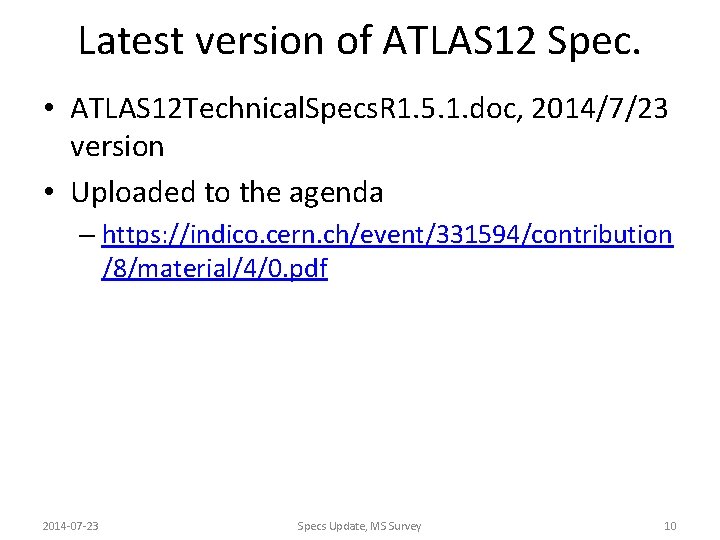
Latest version of ATLAS 12 Spec. • ATLAS 12 Technical. Specs. R 1. 5. 1. doc, 2014/7/23 version • Uploaded to the agenda – https: //indico. cern. ch/event/331594/contribution /8/material/4/0. pdf 2014 -07 -23 Specs Update, MS Survey 10
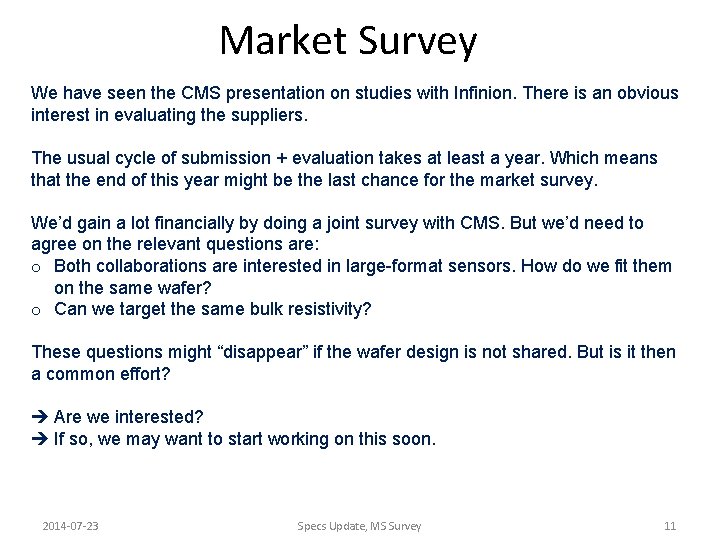
Market Survey We have seen the CMS presentation on studies with Infinion. There is an obvious interest in evaluating the suppliers. The usual cycle of submission + evaluation takes at least a year. Which means that the end of this year might be the last chance for the market survey. We’d gain a lot financially by doing a joint survey with CMS. But we’d need to agree on the relevant questions are: o Both collaborations are interested in large-format sensors. How do we fit them on the same wafer? o Can we target the same bulk resistivity? These questions might “disappear” if the wafer design is not shared. But is it then a common effort? è Are we interested? è If so, we may want to start working on this soon. 2014 -07 -23 Specs Update, MS Survey 11
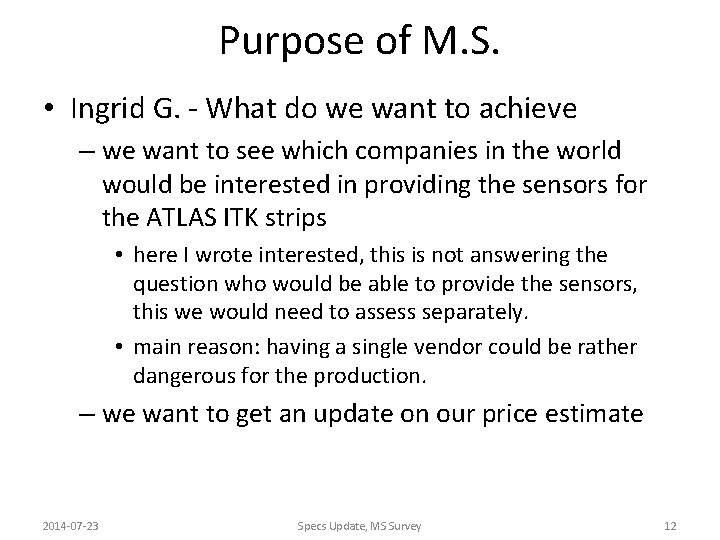
Purpose of M. S. • Ingrid G. - What do we want to achieve – we want to see which companies in the world would be interested in providing the sensors for the ATLAS ITK strips • here I wrote interested, this is not answering the question who would be able to provide the sensors, this we would need to assess separately. • main reason: having a single vendor could be rather dangerous for the production. – we want to get an update on our price estimate 2014 -07 -23 Specs Update, MS Survey 12
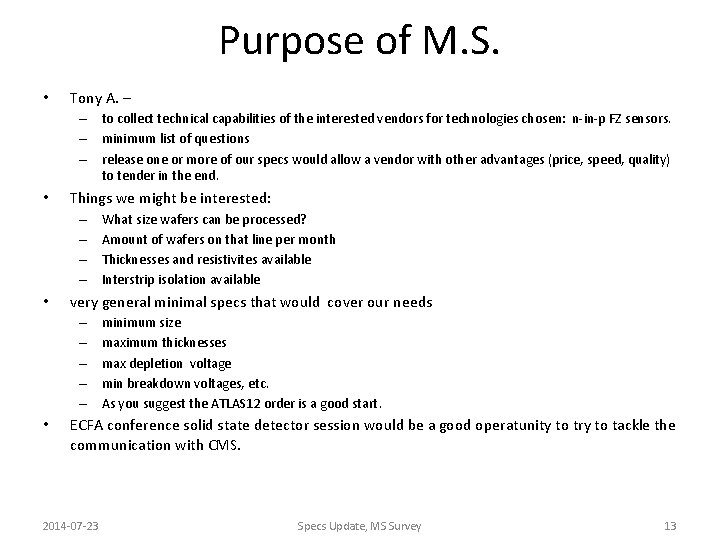
Purpose of M. S. • Tony A. – – to collect technical capabilities of the interested vendors for technologies chosen: n-in-p FZ sensors. – minimum list of questions – release one or more of our specs would allow a vendor with other advantages (price, speed, quality) to tender in the end. • Things we might be interested: – – • very general minimal specs that would cover our needs – – – • What size wafers can be processed? Amount of wafers on that line per month Thicknesses and resistivites available Interstrip isolation available minimum size maximum thicknesses max depletion voltage min breakdown voltages, etc. As you suggest the ATLAS 12 order is a good start. ECFA conference solid state detector session would be a good operatunity to try to tackle the communication with CMS. 2014 -07 -23 Specs Update, MS Survey 13
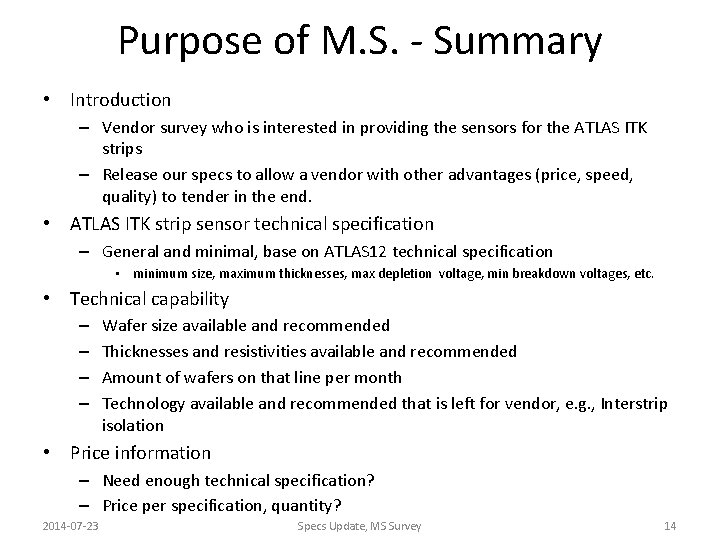
Purpose of M. S. - Summary • Introduction – Vendor survey who is interested in providing the sensors for the ATLAS ITK strips – Release our specs to allow a vendor with other advantages (price, speed, quality) to tender in the end. • ATLAS ITK strip sensor technical specification – General and minimal, base on ATLAS 12 technical specification • minimum size, maximum thicknesses, max depletion voltage, min breakdown voltages, etc. • Technical capability – – Wafer size available and recommended Thicknesses and resistivities available and recommended Amount of wafers on that line per month Technology available and recommended that is left for vendor, e. g. , Interstrip isolation • Price information – Need enough technical specification? – Price per specification, quantity? 2014 -07 -23 Specs Update, MS Survey 14