
Stalking Identification and Response www Stalking Awareness org
![Point When Stalking Occurs [CATEGORY NAME] [CATEGORY [PERCENTAG NAME] E] [PERCENTAG [CATEGORY E] NAME]](https://slidetodoc.com/presentation_image_h/d03de192e7933949ed145383a71dd38c/image-40.jpg "Point When Stalking Occurs [CATEGORY NAME] [CATEGORY [PERCENTAG NAME] E] [PERCENTAG [CATEGORY E] NAME]")
- Slides: 61
Stalking Identification and Response www. Stalking. Awareness. org
Renee Sue O’Neal: Victim Statement “ “Over and over again, for months, his goal was to terrorize me, and my whole family was victimized and fearful as a result… …I had no idea what his next move would be or when – not if – he would return. ” https: //www. sacbee. com/news/local/crime/article 155772139. html
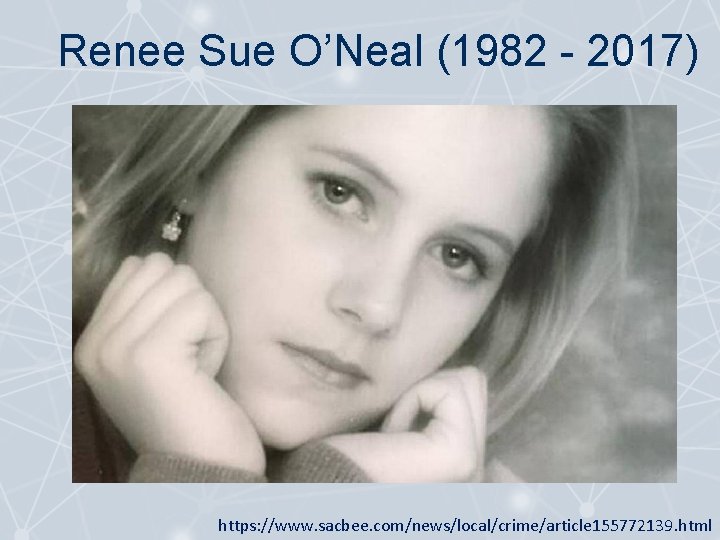
Renee Sue O’Neal (1982 - 2017) https: //www. sacbee. com/news/local/crime/article 155772139. html
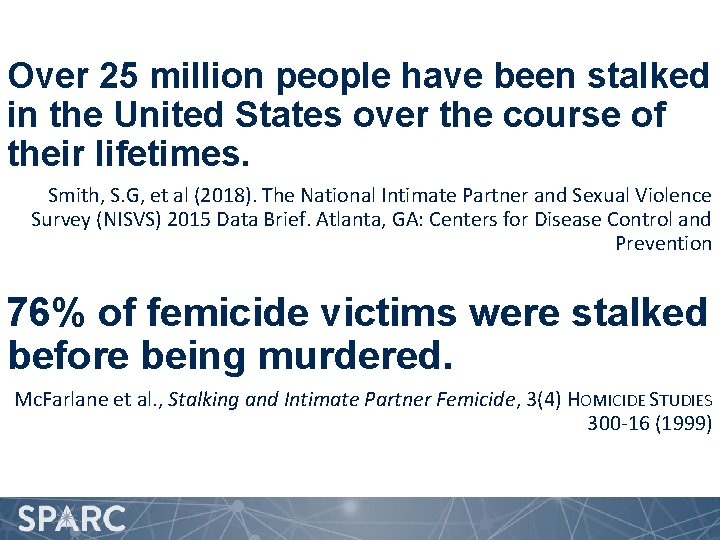
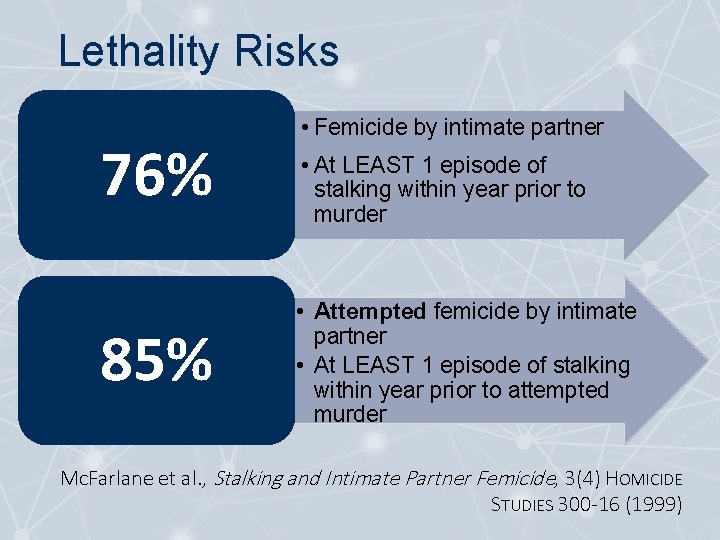
Over 25 million people have been stalked in the United States over the course of their lifetimes. Smith, S. G, et al (2018). The National Intimate Partner and Sexual Violence Survey (NISVS) 2015 Data Brief. Atlanta, GA: Centers for Disease Control and Prevention 76% of femicide victims were stalked before being murdered. Mc. Farlane et al. , Stalking and Intimate Partner Femicide, 3(4) HOMICIDE STUDIES 300 -16 (1999)
Today’s Objectives By the end of today’s workshop, participants will be able to: * Identify stalking behaviors and dynamics * Recognize the intersection of stalking with other crimes * Apply strategies for working with victims of stalking
Session Overview * Defining Stalking * Identifying a Pattern of Behavior * Prevalence, Dynamics and Behaviors * Co-occurrence with Other Crimes
Defining Stalking
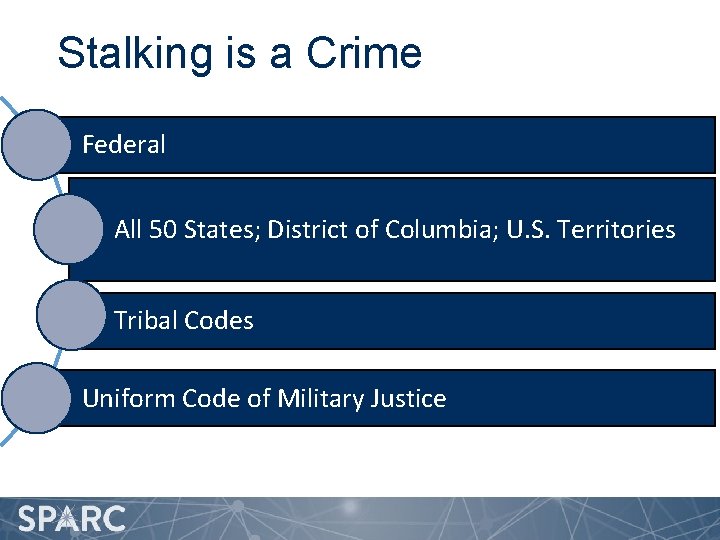
Stalking is a Crime Federal All 50 States; District of Columbia; U. S. Territories Tribal Codes Uniform Code of Military Justice
Behavioral Definition Stalking: A pattern of behavior directed at a specific person that would cause a reasonable person to feel fear.
Behavioral Definition Stalking: A pattern of behavior directed at a specific person that would cause a reasonable person to feel fear.
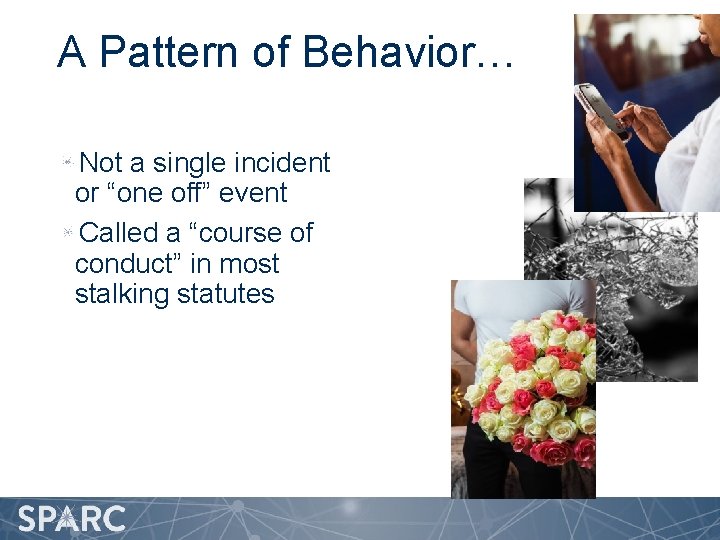
A Pattern of Behavior… Not a single incident or “one off” event Called a “course of conduct” in most stalking statutes
…Directed at a Specific Person…
…That would cause a Reasonable Person to Feel Fear.
What’s so Scary?
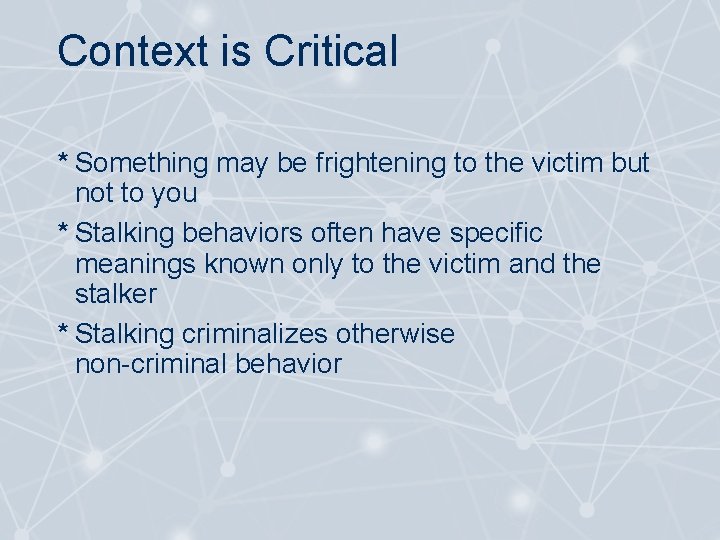
Context is Critical * Something may be frightening to the victim but not to you * Stalking behaviors often have specific meanings known only to the victim and the stalker * Stalking criminalizes otherwise non-criminal behavior
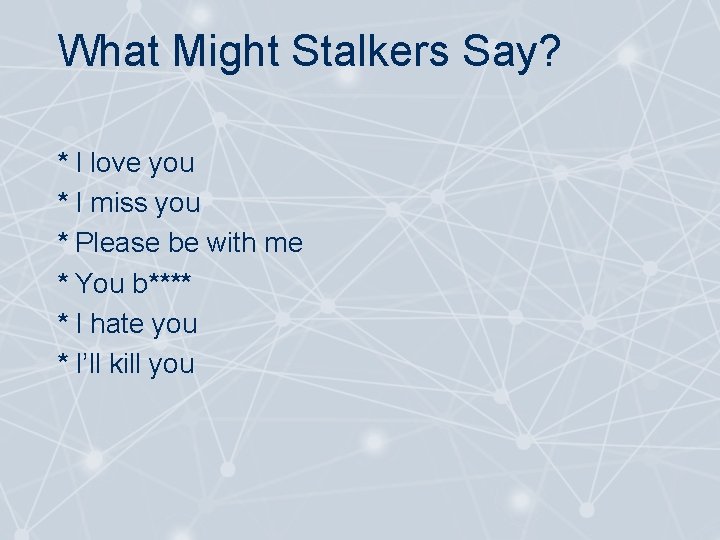
What Might Stalkers Say? * I love you * I miss you * Please be with me * You b**** * I hate you * I’ll kill you
Victim Responses: Is it Fear?
“ Going to work, attending your kids activities, going out for the evening… these things seem routine. For me, they’re terrifying because I never know what he will do or when he will show up.
Identifying a Course of Conduct Stalking Behaviors
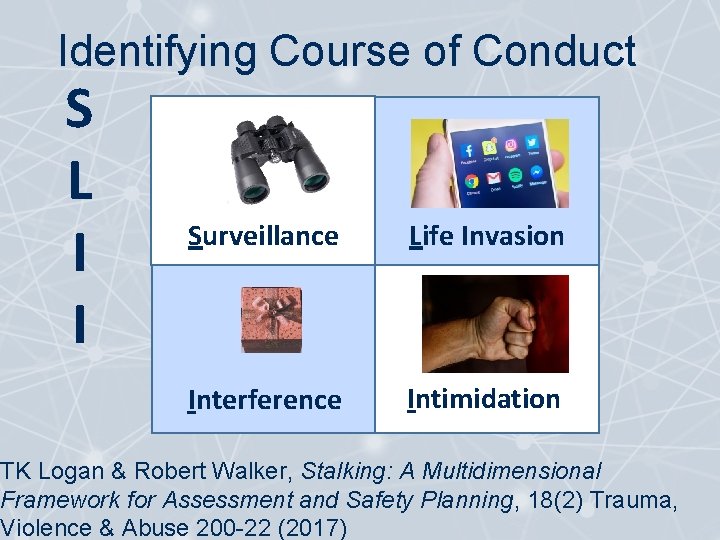
Identifying Course of Conduct S L I I Surveillance Life Invasion Interference Intimidation TK Logan & Robert Walker, Stalking: A Multidimensional Framework for Assessment and Safety Planning, 18(2) Trauma, Violence & Abuse 200 -22 (2017)
Group Activity SLII Brainstorm
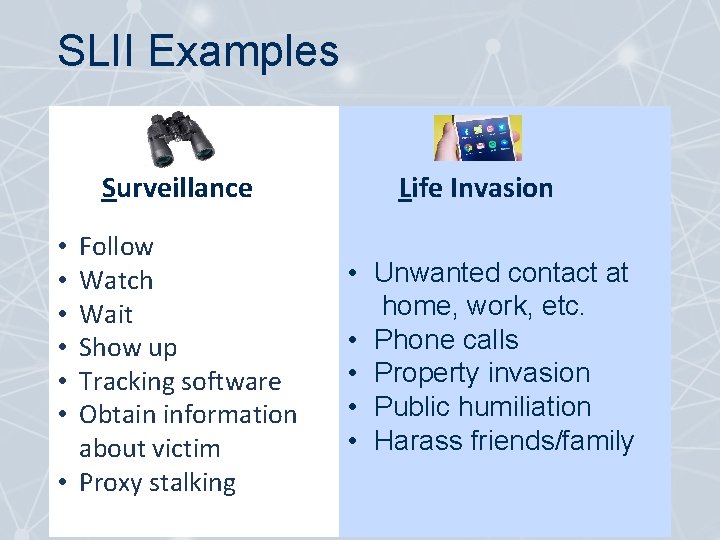
SLII Examples Surveillance Follow Watch Wait Show up Tracking software Obtain information about victim • Proxy stalking • • • Life Invasion • Unwanted contact at home, work, etc. • Phone calls • Property invasion • Public humiliation • Harass friends/family
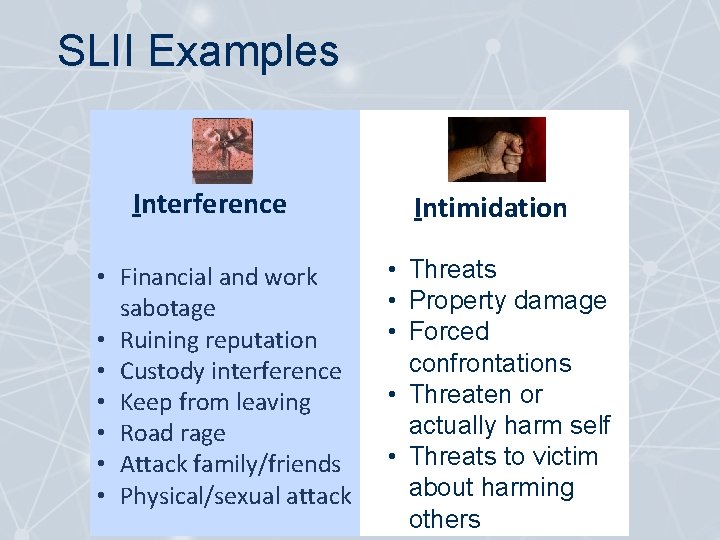
SLII Examples Interference • Financial and work sabotage • Ruining reputation • Custody interference • Keep from leaving • Road rage • Attack family/friends • Physical/sexual attack Intimidation • Threats • Property damage • Forced confrontations • Threaten or actually harm self • Threats to victim about harming others
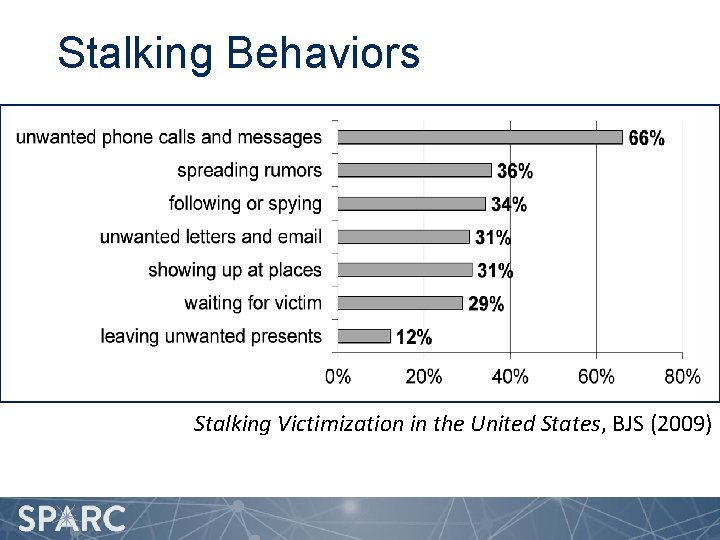
Stalking Behaviors Stalking Victimization in the United States, BJS (2009)
Stalking behaviors often change over time.
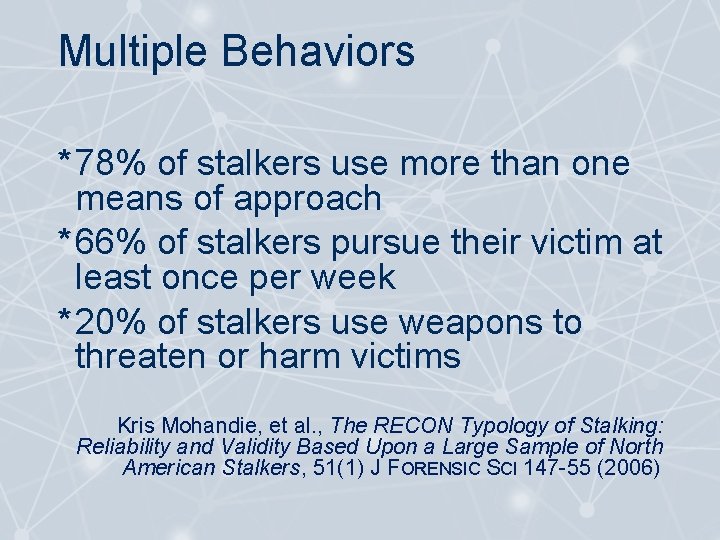
Multiple Behaviors * 78% of stalkers use more than one means of approach * 66% of stalkers pursue their victim at least once per week * 20% of stalkers use weapons to threaten or harm victims Kris Mohandie, et al. , The RECON Typology of Stalking: Reliability and Validity Based Upon a Large Sample of North American Stalkers, 51(1) J FORENSIC SCI 147 -55 (2006)
Prevalence and Perpetrators
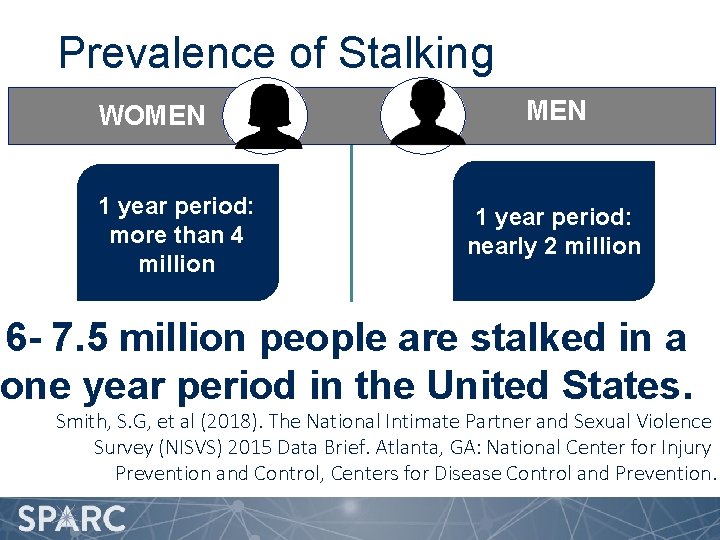
Prevalence of Stalking WOMEN 1 year period: more than 4 million MEN 1 year period: nearly 2 million 6 - 7. 5 million people are stalked in a one year period in the United States. Smith, S. G, et al (2018). The National Intimate Partner and Sexual Violence Survey (NISVS) 2015 Data Brief. Atlanta, GA: National Center for Injury Prevention and Control, Centers for Disease Control and Prevention.
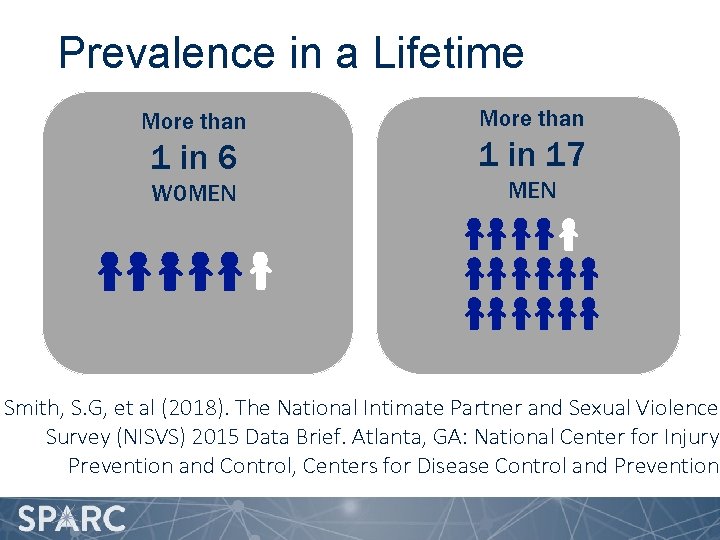
Prevalence in a Lifetime More than 1 in 6 WOMEN More than 1 in 17 MEN Smith, S. G, et al (2018). The National Intimate Partner and Sexual Violence Survey (NISVS) 2015 Data Brief. Atlanta, GA: National Center for Injury Prevention and Control, Centers for Disease Control and Prevention.
Victims Women are more likely than men to experience stalking. The National Intimate Partner and Sexual Violence Survey (NISVS): 2010 Summary Report, CENTER FOR DISEASE CONTROL (2011)
Stalking Risk 18 -24 year olds experience the highest rates of stalking The National Intimate Partner and Sexual Violence Survey (NISVS): 2010 Summary Report, CENTER FOR DISEASE CONTROL (2011)
Perpetrators Most stalkers are male. The National Intimate Partner and Sexual Violence Survey (NISVS): 2010 Summary Report, CENTER FOR DISEASE CONTROL (2011)
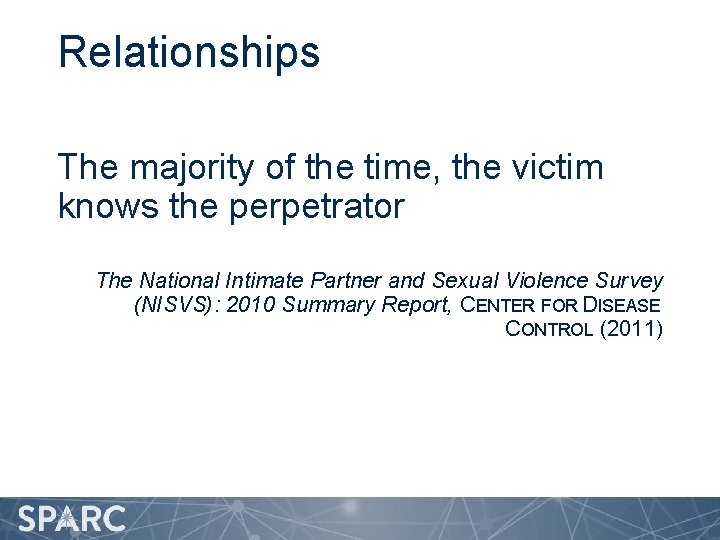
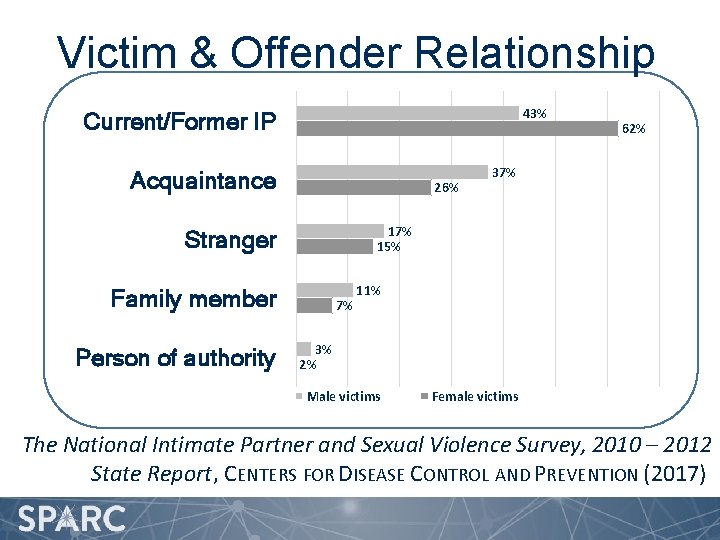
Relationships The majority of the time, the victim knows the perpetrator The National Intimate Partner and Sexual Violence Survey (NISVS): 2010 Summary Report, CENTER FOR DISEASE CONTROL (2011)
Victim & Offender Relationship 43% Current/Former IP Acquaintance 26% 37% 15% Stranger Family member Person of authority 62% 7% 11% 3% 2% Male victims Female victims The National Intimate Partner and Sexual Violence Survey, 2010 – 2012 State Report, CENTERS FOR DISEASE CONTROL AND PREVENTION (2017)
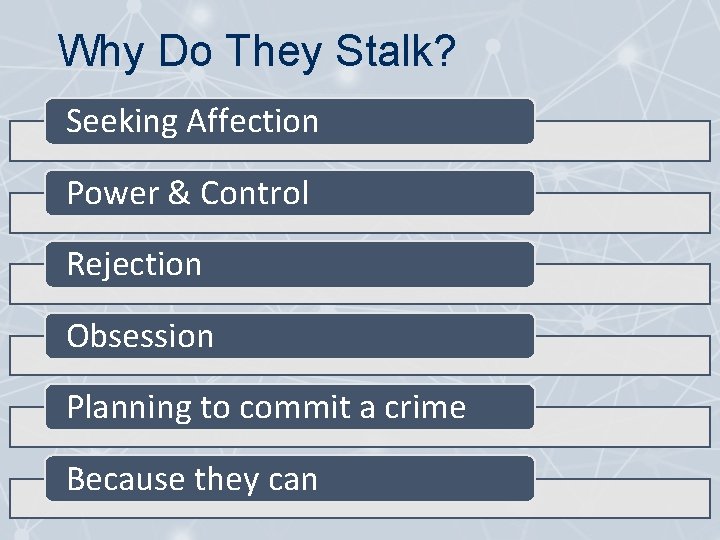
Why Do They Stalk? Seeking Affection Power & Control Rejection Obsession Planning to commit a crime Because they can
Co-Occurring Crimes
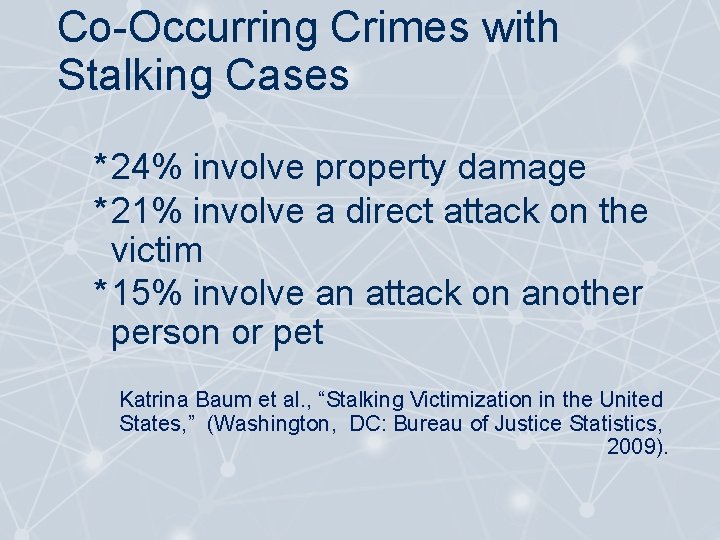
Co-Occurring Crimes with Stalking Cases * 24% involve property damage * 21% involve a direct attack on the victim * 15% involve an attack on another person or pet Katrina Baum et al. , “Stalking Victimization in the United States, ” (Washington, DC: Bureau of Justice Statistics, 2009).
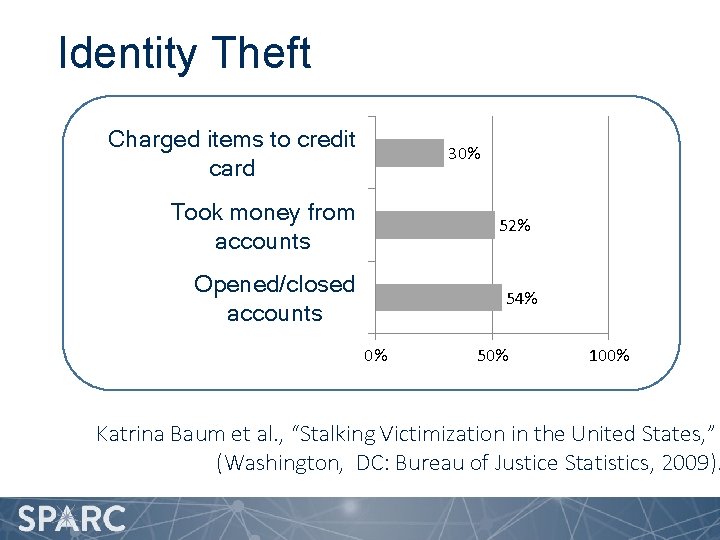
Identity Theft Charged items to credit card 30% Took money from accounts 52% Opened/closed accounts 54% 0% 50% 100% Katrina Baum et al. , “Stalking Victimization in the United States, ” (Washington, DC: Bureau of Justice Statistics, 2009).
Stalking and Domestic Violence
Point When Stalking Occurs [CATEGORY NAME] [CATEGORY [PERCENTAG NAME] E] [PERCENTAG [CATEGORY E] NAME] [PERCENTAG E] During Relationship During & After relationship ends Tjaden, P. , & Theonnes, N. (1998). Stalking in American: Findings from the national violence against women survey. Washington, D. C. : U. S. Department of Justice. NCJ Report No. NCJ 169592.
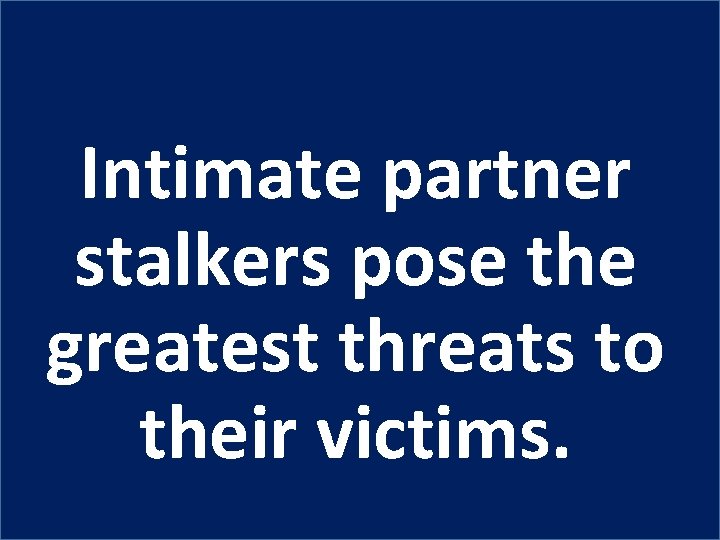
Intimate partner stalkers pose the greatest threats to their victims.
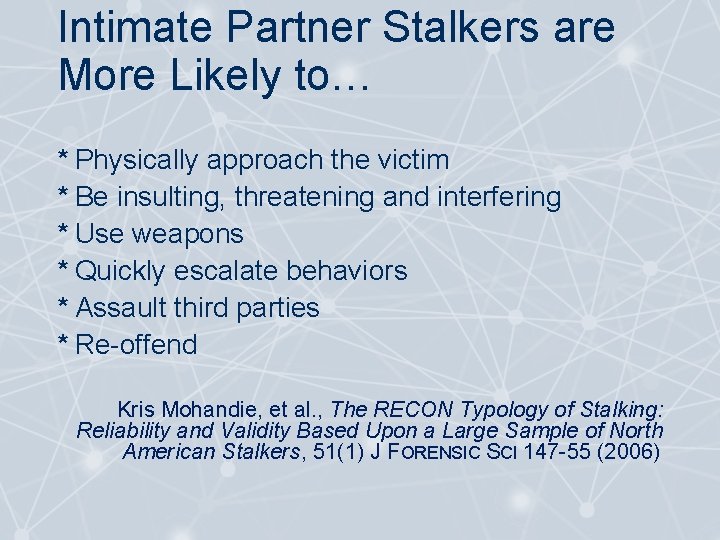
Intimate Partner Stalkers are More Likely to… * Physically approach the victim * Be insulting, threatening and interfering * Use weapons * Quickly escalate behaviors * Assault third parties * Re-offend Kris Mohandie, et al. , The RECON Typology of Stalking: Reliability and Validity Based Upon a Large Sample of North American Stalkers, 51(1) J FORENSIC SCI 147 -55 (2006)
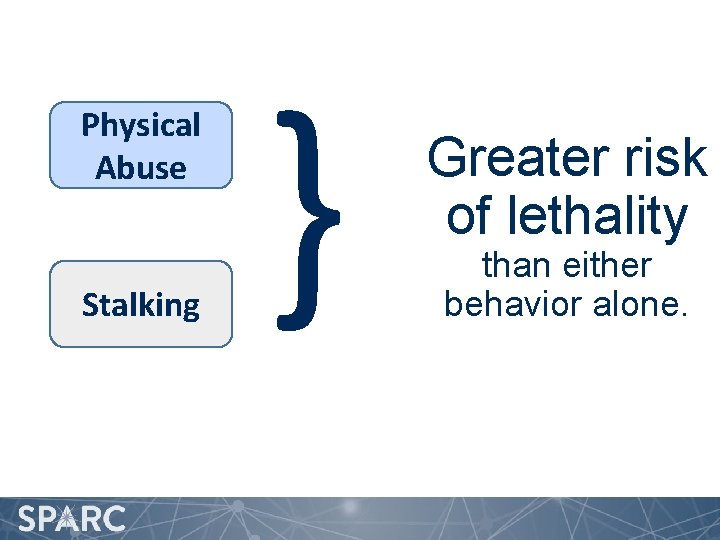
Physical Abuse Stalking } Greater risk of lethality than either behavior alone.
Lethality Risks 76% 85% • Femicide by intimate partner • At LEAST 1 episode of stalking within year prior to murder • Attempted femicide by intimate partner • At LEAST 1 episode of stalking within year prior to attempted murder Mc. Farlane et al. , Stalking and Intimate Partner Femicide, 3(4) HOMICIDE STUDIES 300 -16 (1999)
Stalking and Sexual Violence
Intersections of Sexual Violence and Stalking A stalker may: • Threaten to sexually assault the victim • Sexually assault the victim • Attempt to get someone else to sexually assault the victim
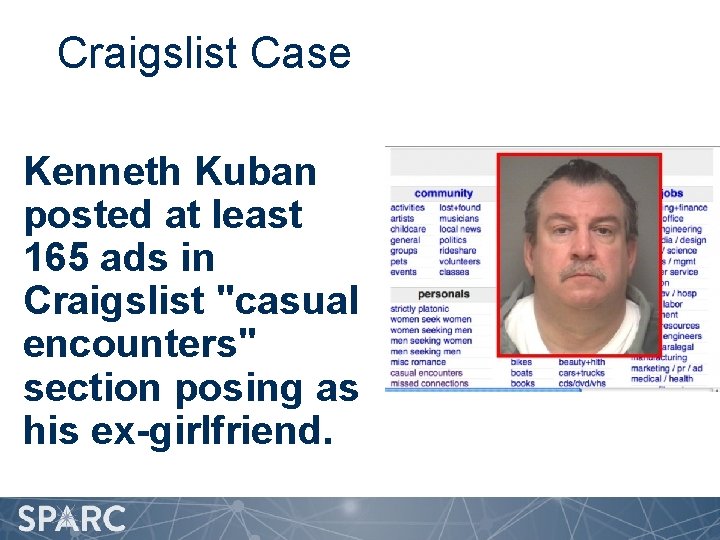
Craigslist Case Kenneth Kuban posted at least 165 ads in Craigslist "casual encounters" section posing as his ex-girlfriend.
Grooming for Sexual Assault as Stalking * 6% of the 1882 college men surveyed met the criteria for attempted or completed rape * These were repeat perpetrators who averaged about 6 rapes person David Lisak, Repeat Rape and Multiple Offending Among Undetected Rapists, 17(1) Violence and Victims 73 -84 (2002)
Repeat Campus Sexual Assault Perpetrators Often Premeditated Rape * Chose targets intentionally. Identified vulnerable young women, often focusing on Freshmen * Contacted multiple times: invited them to parties, messaged through social media, texting and call. * Plied with alcohol: served drinks, controlled alcohol, made strong drinks * Isolated victims: many had rooms set up at their parties for the purpose of committing rape * Contacted after: texted, messaged and/or called to either threaten and/or invite to another party David Lisak, Repeat Rape and Multiple Offending Among Undetected Rapists, 17(1) Violence and Victims 73 -84 (2002)
Addressing Stalking
Documentation
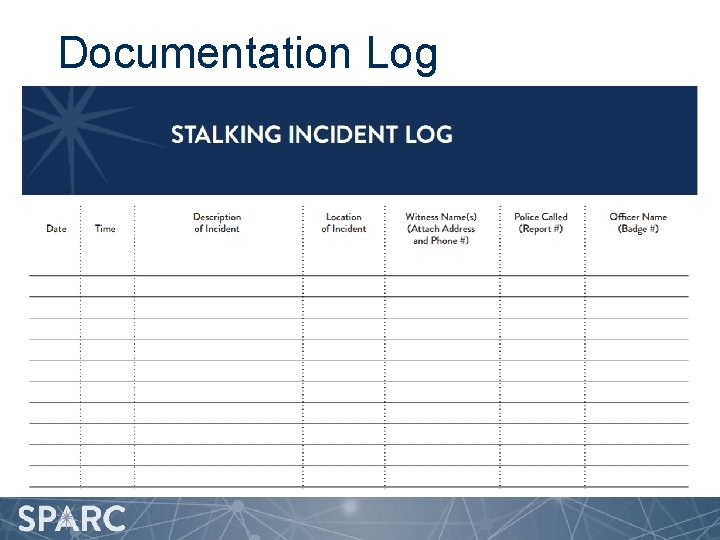
Documentation Log
Safety Planning Consider: * The possibility of escalation * The variety of behaviors a stalker may engage in * Maintaining contact may be a part of a safety plan
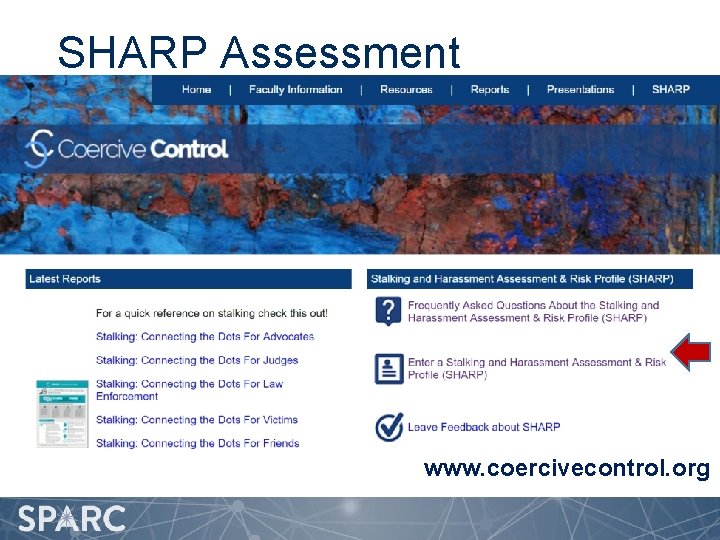
SHARP Assessment www. coercivecontrol. org
The threat level is never fixed. Risks change over time and must be constantly assessed.
Conclusion
Conclusion Stalking is defined as a course of conduct directed at a specific person that would cause a reasonable person to feel fear Context is critical in stalking cases Stalking behaviors include Surveillance, Life Invasion, Interference and Intimidation (SLII) The majority of stalkers and victims know each other. Stalking intersects with other crimes including domestic and sexual violence There are tools you can use to improve your response to stalking
More Lessons Coming Soon! www. stalkingawareness. org * Stalking and Domestic Violence * Stalking and Sexual Assault * Crisis Intervention and Advocacy for Stalking Victims
Office of Violence Against Women This project was supported by Grant No. 2017 TA-AX-K 074 awarded by the U. S. Department of Justice, Office on Violence Against Women (OVW). The opinions, findings, conclusions, and recommendations expressed in this program are those of the authors and do not necessarily reflect the views of OVW.
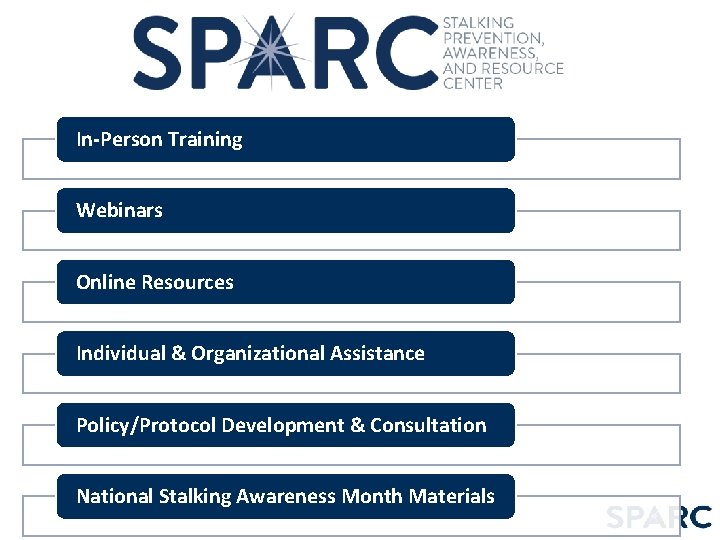
In-Person Training Webinars Online Resources Individual & Organizational Assistance Policy/Protocol Development & Consultation National Stalking Awareness Month Materials
For Additional Resources www. stalkingawareness. org Follow us on Twitter SPARC @followuslegally