RSPT 1060 MODULE C Applied Physics Lesson 1



- Slides: 58
RSPT 1060 MODULE C – Applied Physics Lesson #1 - Mechanics
OBJECTIVES • At the end of this module, the student should be able to… • define the terms and abbreviations used in the module. • draw & explain the equation of motion. • list the forces that oppose lung inflation & cause the work of breathing. • list the different types of compliance, their normal values & equations.
OBJECTIVES • At the end of this module, the student should be able to… • differentiate between compliance & elastance. • list some pulmonary disorders that could change compliance. • explain the relationship between pressure, surface tension & radius. • explain how La. Place’s Law relates to surface tension.
OBJECTIVES • At the end of this module, the student should be able to… • explain the purpose of surfactant. • list the different types of resistance, their normal values and equations. • explain how Poiseuille’s Law relates to resistance. • list some pulmonary diseases that will alters resistance. • explain what the equal pressure point is.
Ventilation vs. Respiration • Ventilation: The bulk movement of gas in and out of the lung. • Respiration: The exchange of gas (specifically oxygen and carbon dioxide) at the cellular level. • Internal Respiration: The exchange of gas between a peripheral capillary and a cell of the body. • External Respiration: the exchange of gas across the alveolar-capillary membrane.
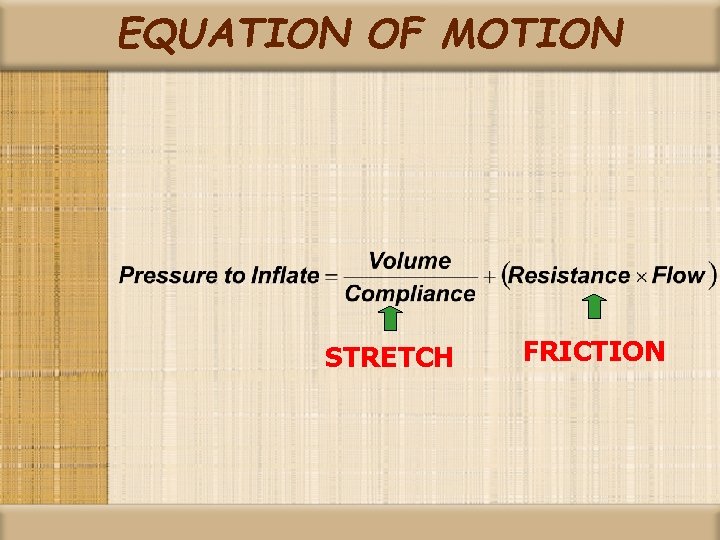
EQUATION OF MOTION STRETCH FRICTION
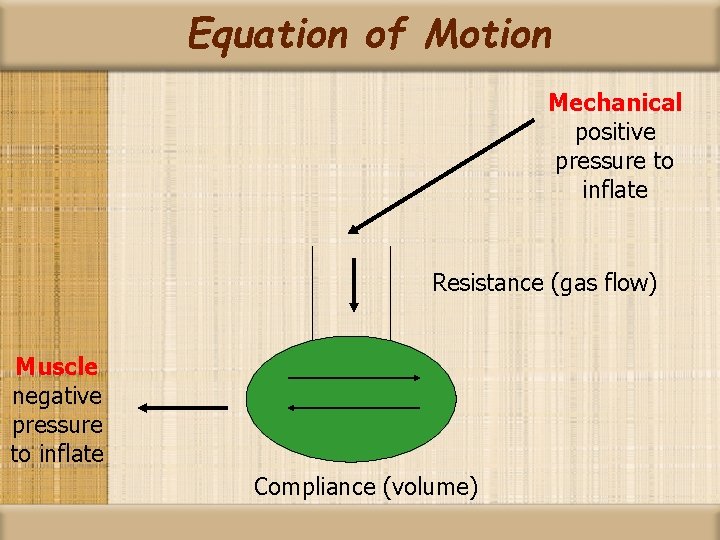
Equation of Motion Mechanical positive pressure to inflate Resistance (gas flow) Muscle negative pressure to inflate Compliance (volume)
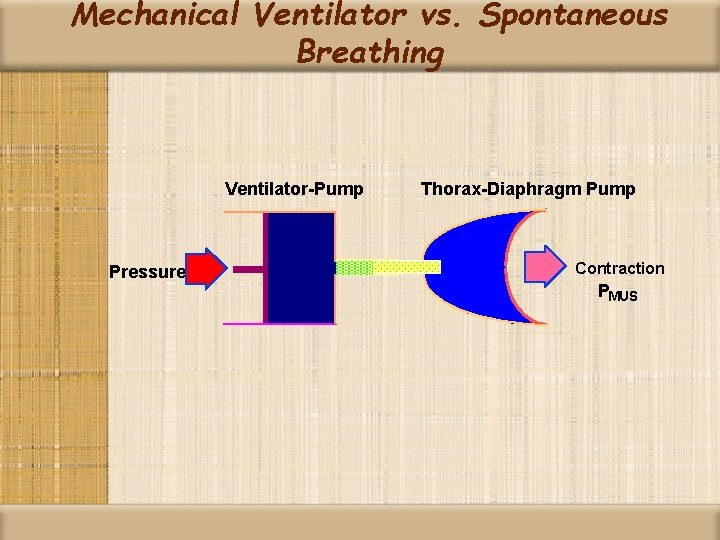
Mechanical Ventilator vs. Spontaneous Breathing Ventilator-Pump Pressure Thorax-Diaphragm Pump Contraction PMUS
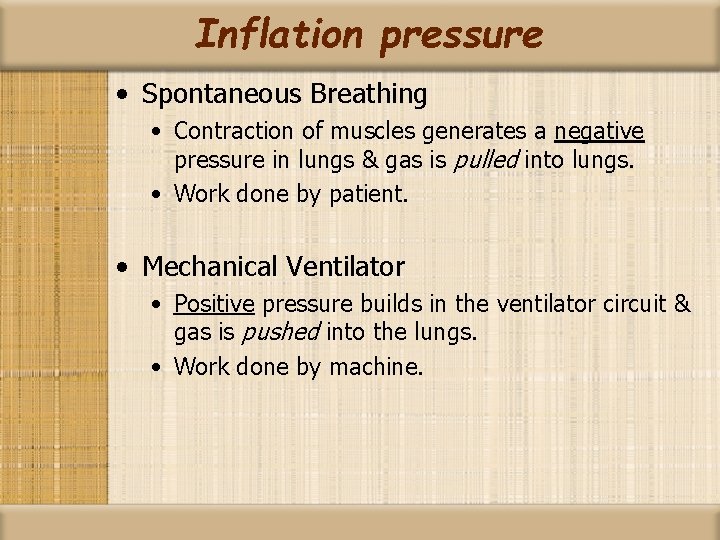
Inflation pressure • Spontaneous Breathing • Contraction of muscles generates a negative pressure in lungs & gas is pulled into lungs. • Work done by patient. • Mechanical Ventilator • Positive pressure builds in the ventilator circuit & gas is pushed into the lungs. • Work done by machine.
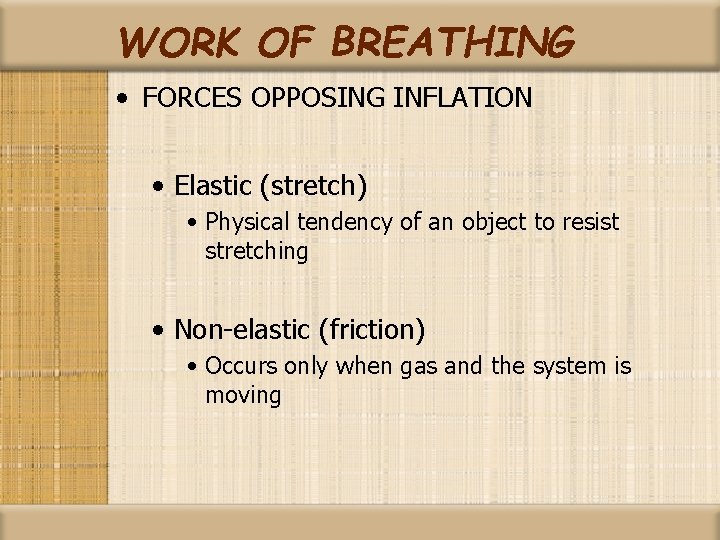
WORK OF BREATHING • FORCES OPPOSING INFLATION • Elastic (stretch) • Physical tendency of an object to resist stretching • Non-elastic (friction) • Occurs only when gas and the system is moving
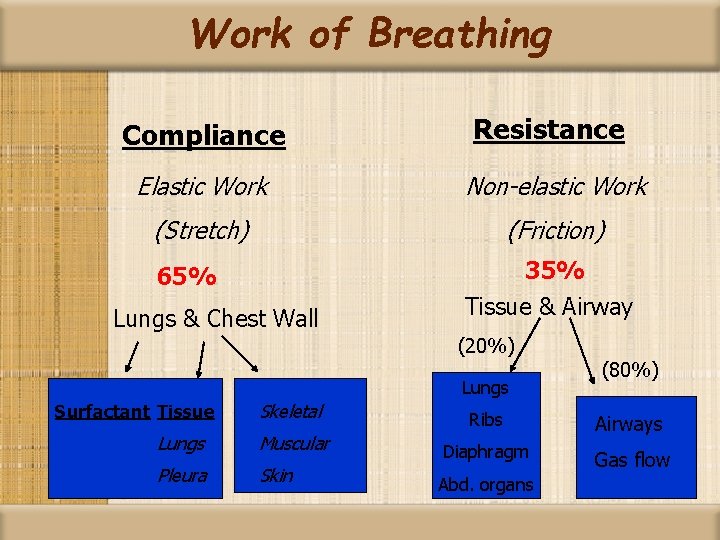
Work of Breathing Compliance Resistance Elastic Work Non-elastic Work (Stretch) (Friction) 65% Lungs & Chest Wall 35% Tissue & Airway (20%) Lungs (80%) Skeletal Ribs Lungs Muscular Airways Diaphragm Pleura Skin Gas flow Abd. organs Surfactant Tissue
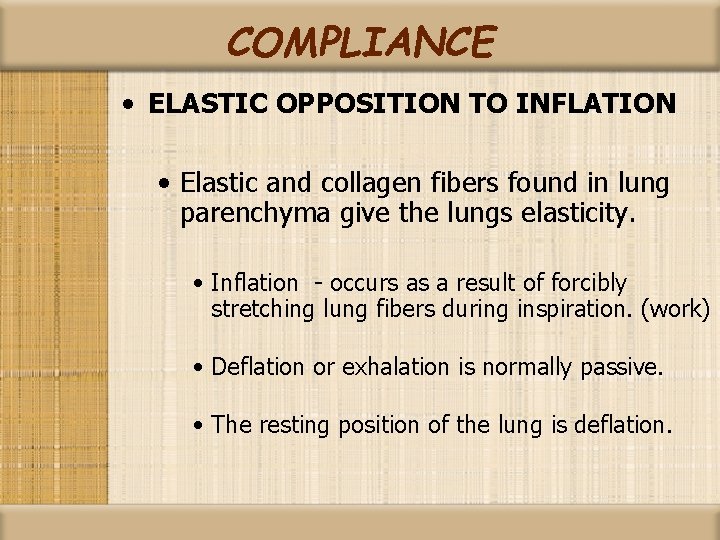
COMPLIANCE • ELASTIC OPPOSITION TO INFLATION • Elastic and collagen fibers found in lung parenchyma give the lungs elasticity. • Inflation - occurs as a result of forcibly stretching lung fibers during inspiration. (work) • Deflation or exhalation is normally passive. • The resting position of the lung is deflation.
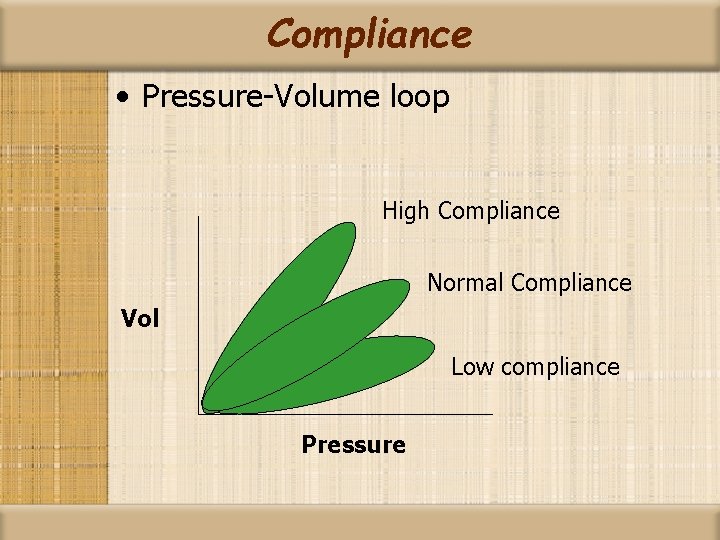
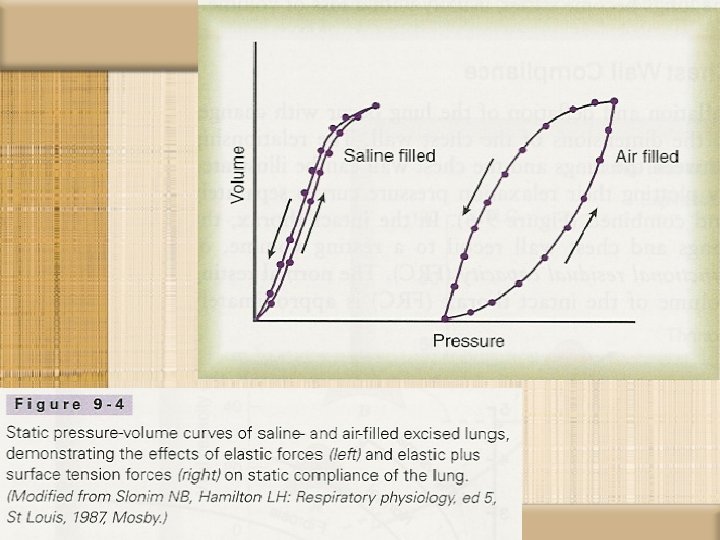
Compliance • Pressure-Volume loop High Compliance Normal Compliance Vol Low compliance Pressure
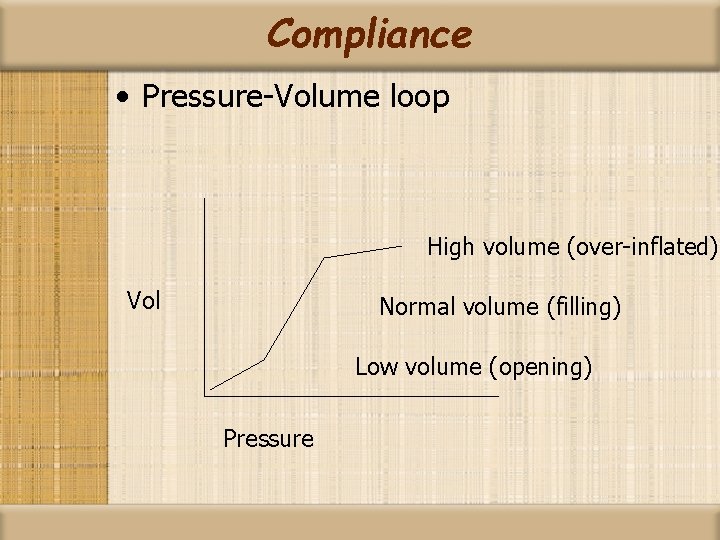
Compliance • Pressure-Volume loop High volume (over-inflated) Vol Normal volume (filling) Low volume (opening) Pressure
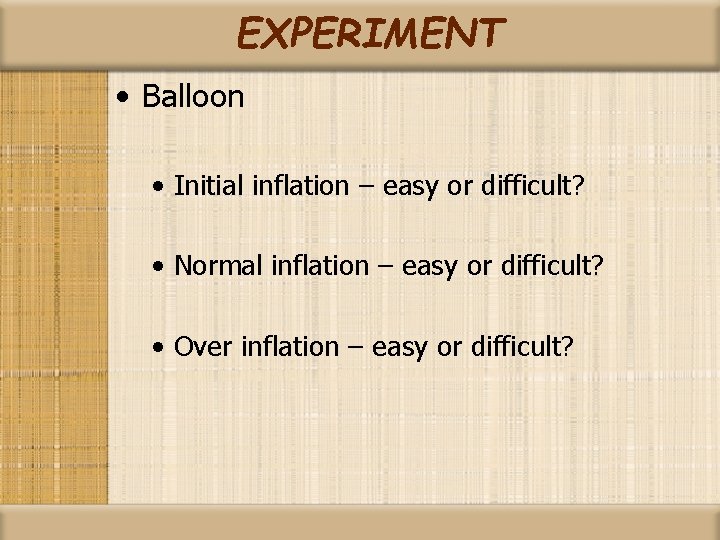
EXPERIMENT • Balloon • Initial inflation – easy or difficult? • Normal inflation – easy or difficult? • Over inflation – easy or difficult?
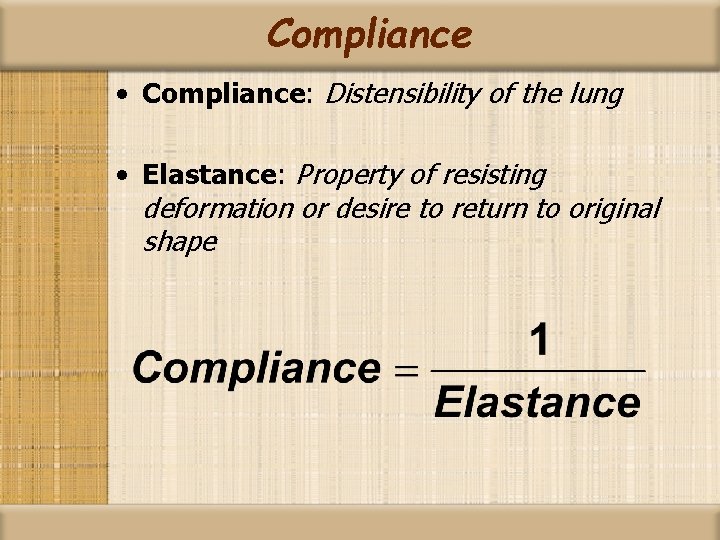
Compliance • Compliance: Distensibility of the lung • Elastance: Property of resisting deformation or desire to return to original shape
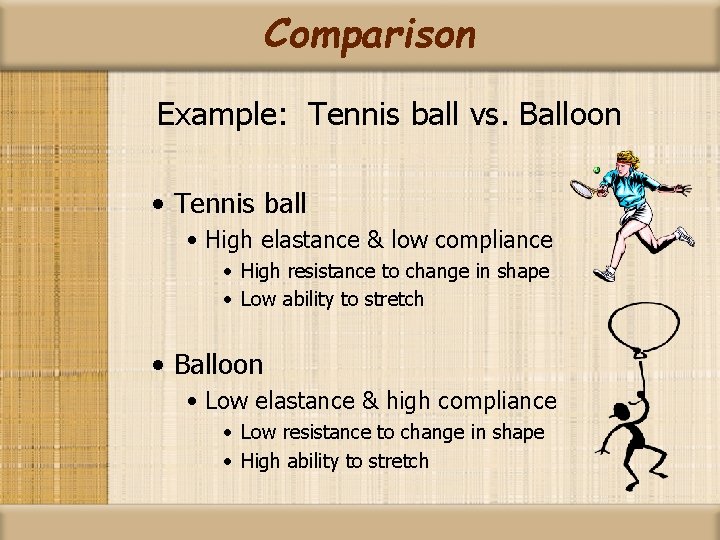
Comparison Example: Tennis ball vs. Balloon • Tennis ball • High elastance & low compliance • High resistance to change in shape • Low ability to stretch • Balloon • Low elastance & high compliance • Low resistance to change in shape • High ability to stretch
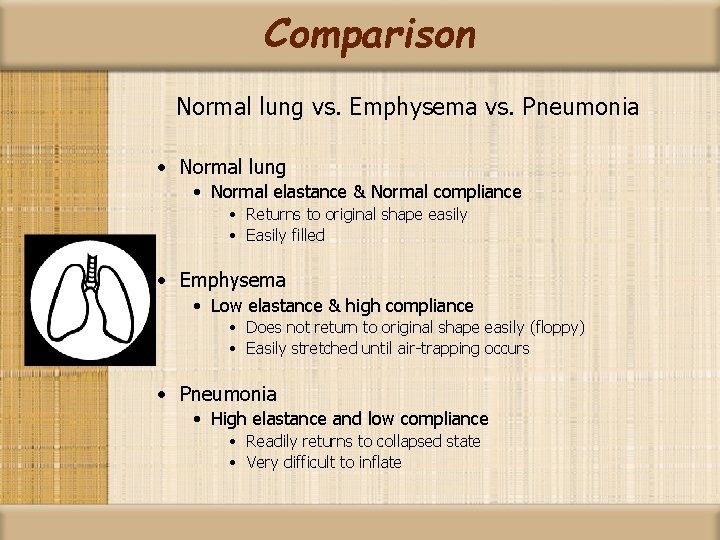
Comparison Normal lung vs. Emphysema vs. Pneumonia • Normal lung • Normal elastance & Normal compliance • Returns to original shape easily • Easily filled • Emphysema • Low elastance & high compliance • Does not return to original shape easily (floppy) • Easily stretched until air-trapping occurs • Pneumonia • High elastance and low compliance • Readily returns to collapsed state • Very difficult to inflate
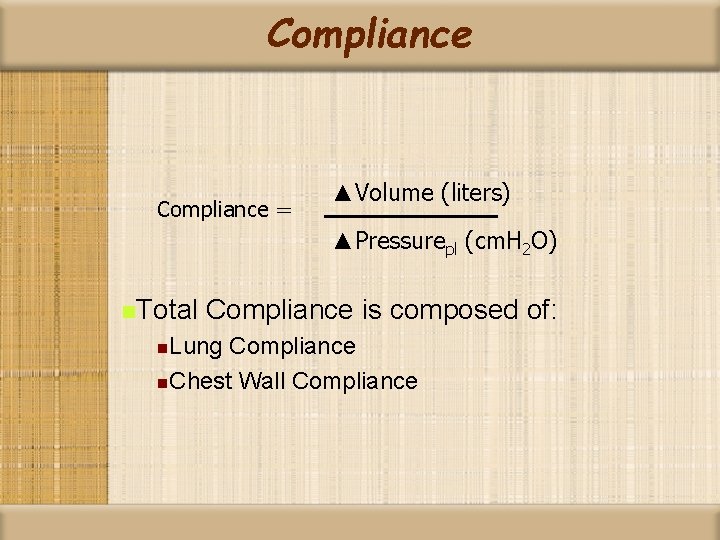
Compliance = ▲Volume (liters) ▲Pressurepl (cm. H 2 O) n. Total Compliance is composed of: n. Lung Compliance n. Chest Wall Compliance
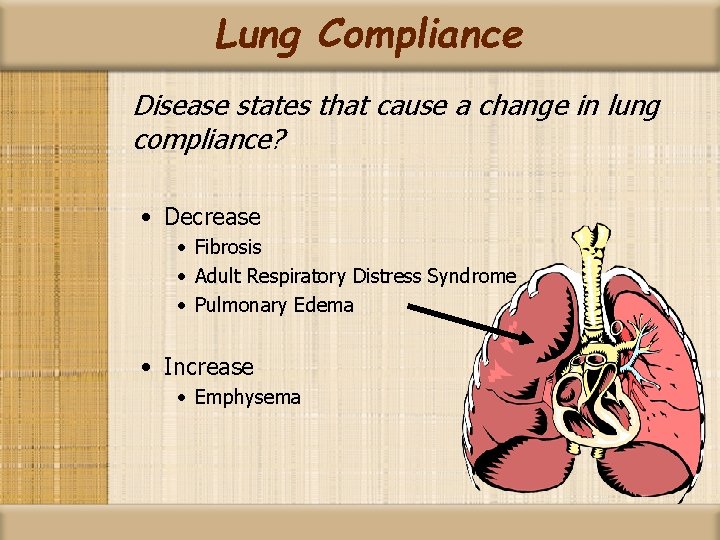
Lung Compliance Disease states that cause a change in lung compliance? • Decrease • Fibrosis • Adult Respiratory Distress Syndrome • Pulmonary Edema • Increase • Emphysema
Lung Compliance • How will a patient with decreased lung compliance breathe? • Rapid • Shallow
Experiment • Wrap belt tightly around chest. • Breathe slow & deep • Breath rapid & shallow • Which feels better?
Chest Wall Compliance • “Stiffness” of chest wall • When thorax is intact, its resting level is FRC • With disruption to chest wall – lung collapse and chest wall expands (open pneumothorax) • Force of movement of chest wall is opposite that of lung • Chest Wall has tendency to expand (pull out) • Lung has tendency to collapse (pull in) • At rest – they balance (FRC)
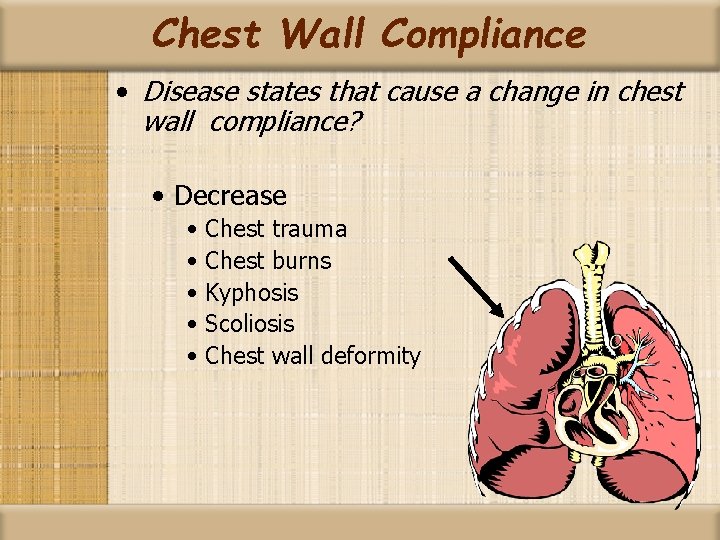
Chest Wall Compliance • Disease states that cause a change in chest wall compliance? • Decrease • Chest trauma • Chest burns • Kyphosis • Scoliosis • Chest wall deformity
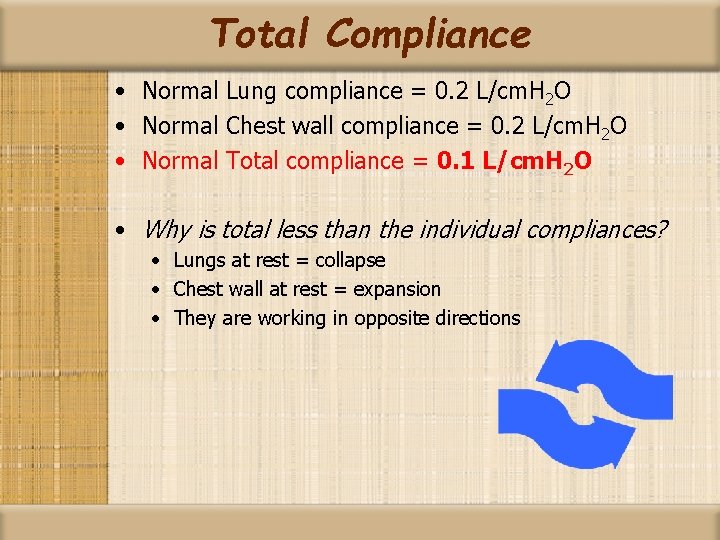
Total Compliance • Normal Lung compliance = 0. 2 L/cm. H 2 O • Normal Chest wall compliance = 0. 2 L/cm. H 2 O • Normal Total compliance = 0. 1 L/cm. H 2 O • Why is total less than the individual compliances? • Lungs at rest = collapse • Chest wall at rest = expansion • They are working in opposite directions
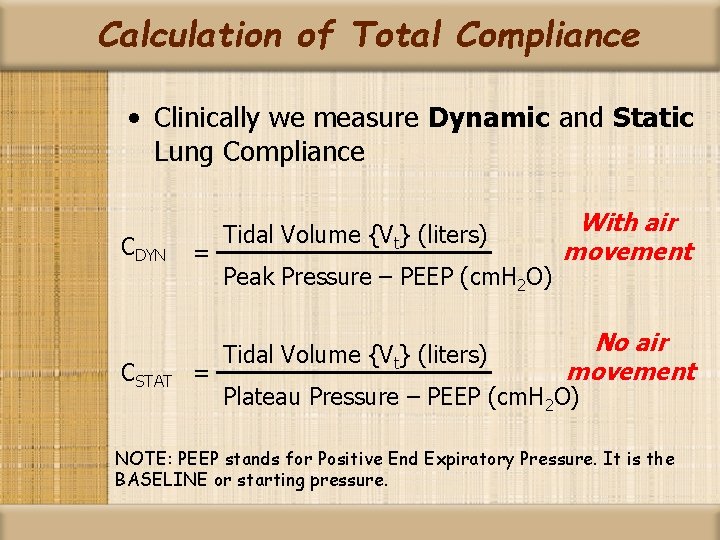
Calculation of Total Compliance • Clinically we measure Dynamic and Static Lung Compliance CDYN = CSTAT = Tidal Volume {Vt} (liters) Peak Pressure – PEEP (cm. H 2 O) Tidal Volume {Vt} (liters) With air movement No air movement Plateau Pressure – PEEP (cm. H 2 O) NOTE: PEEP stands for Positive End Expiratory Pressure. It is the BASELINE or starting pressure.
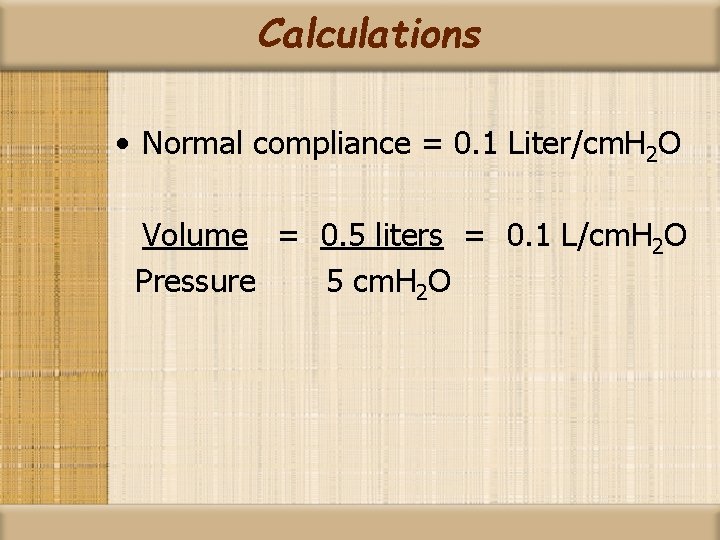
Calculations • Normal compliance = 0. 1 Liter/cm. H 2 O Volume = 0. 5 liters = 0. 1 L/cm. H 2 O Pressure 5 cm. H 2 O
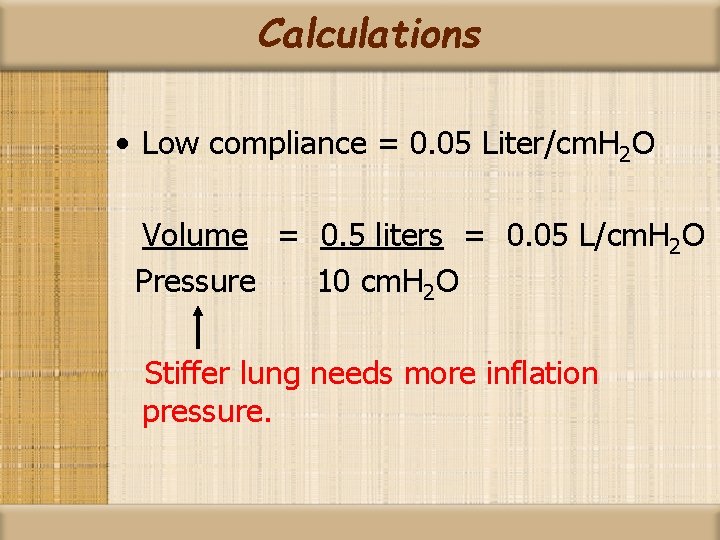
Calculations • Low compliance = 0. 05 Liter/cm. H 2 O Volume = 0. 5 liters = 0. 05 L/cm. H 2 O Pressure 10 cm. H 2 O Stiffer lung needs more inflation pressure.
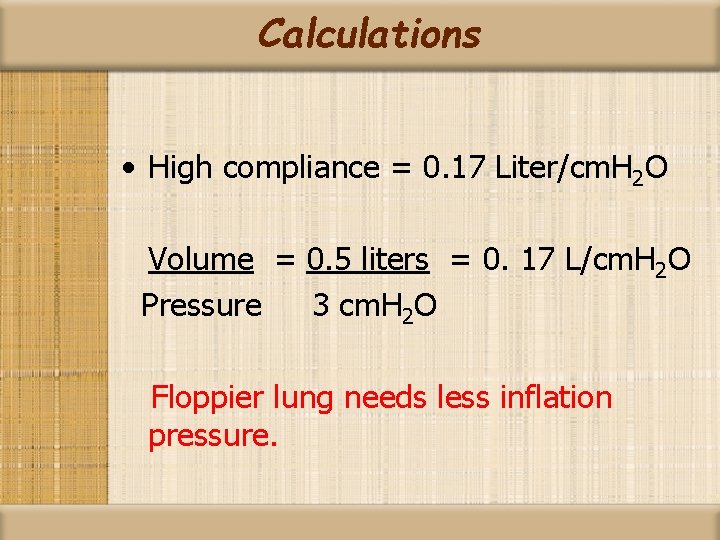
Calculations • High compliance = 0. 17 Liter/cm. H 2 O Volume = 0. 5 liters = 0. 17 L/cm. H 2 O Pressure 3 cm. H 2 O Floppier lung needs less inflation pressure.
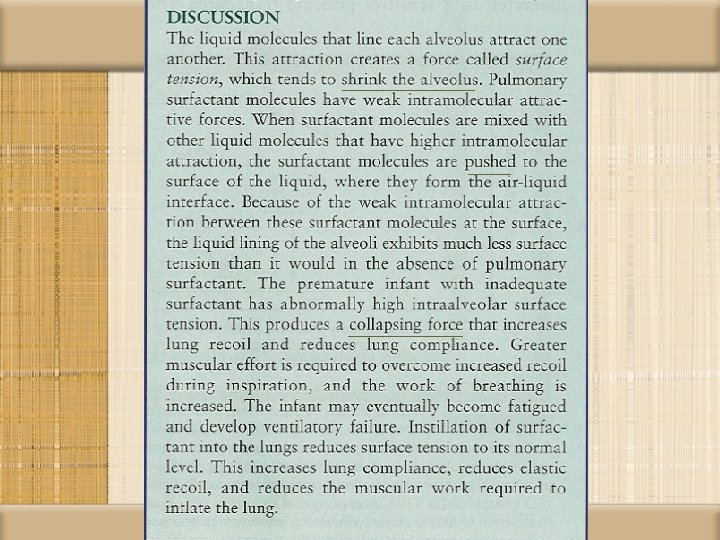
SURFACE TENSION • The alveoli are like bubbles lined with fluid and filled with air. • Surface tension is the attractive force exerted by like molecules at the liquid’s surface. • Surface tension forces cause the bubble to collapse.
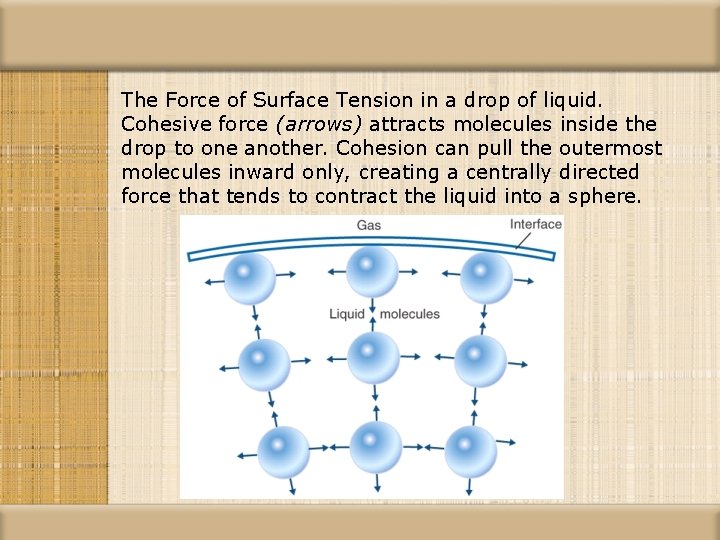
The Force of Surface Tension in a drop of liquid. Cohesive force (arrows) attracts molecules inside the drop to one another. Cohesion can pull the outermost molecules inward only, creating a centrally directed force that tends to contract the liquid into a sphere.
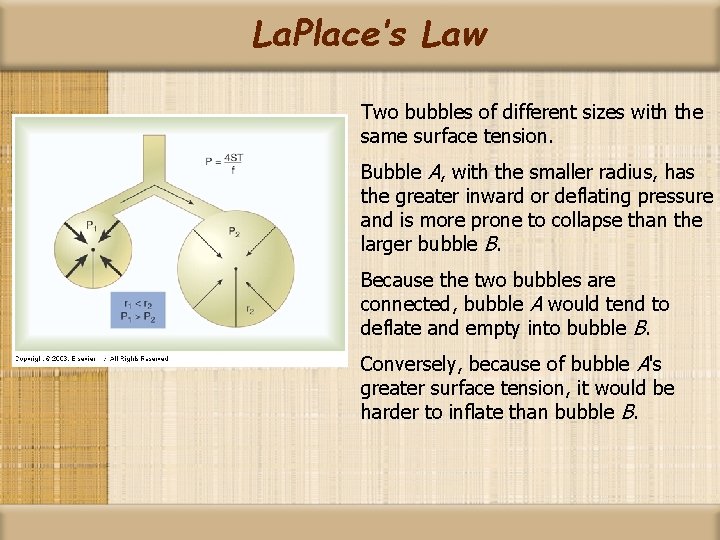
La. Place’s Law Two bubbles of different sizes with the same surface tension. Bubble A, with the smaller radius, has the greater inward or deflating pressure and is more prone to collapse than the larger bubble B. Because the two bubbles are connected, bubble A would tend to deflate and empty into bubble B. Conversely, because of bubble A's greater surface tension, it would be harder to inflate than bubble B.
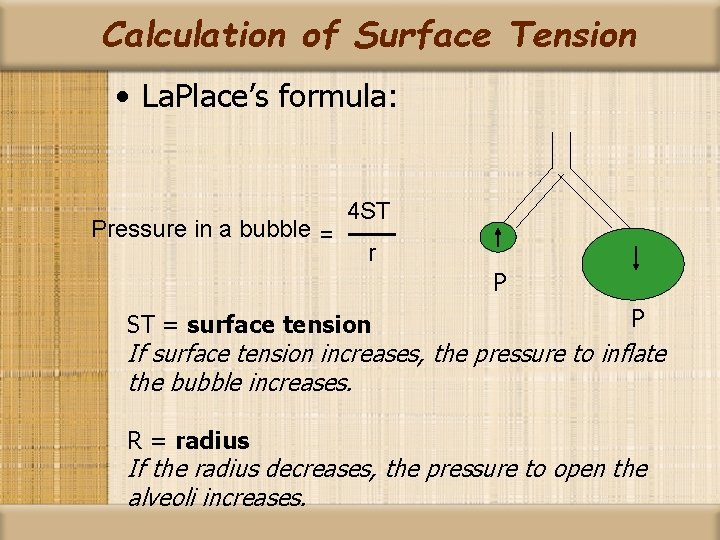
Calculation of Surface Tension • La. Place’s formula: Pressure in a bubble = 4 ST r P ST = surface tension P If surface tension increases, the pressure to inflate the bubble increases. R = radius If the radius decreases, the pressure to open the alveoli increases.
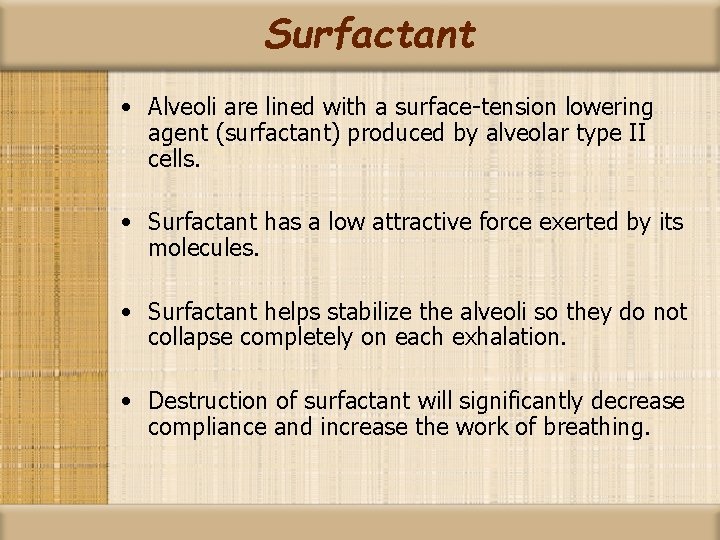
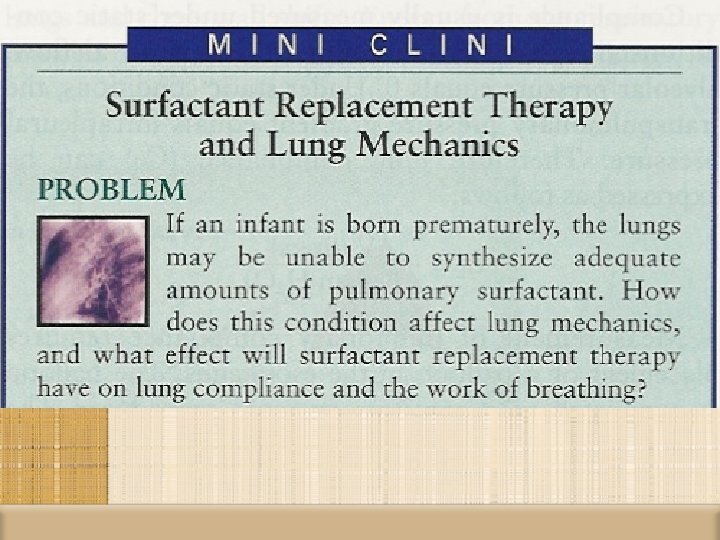
Surfactant • Alveoli are lined with a surface-tension lowering agent (surfactant) produced by alveolar type II cells. • Surfactant has a low attractive force exerted by its molecules. • Surfactant helps stabilize the alveoli so they do not collapse completely on each exhalation. • Destruction of surfactant will significantly decrease compliance and increase the work of breathing.
Surface Tension • Disorders altering or destroying surfactant: • Prematurity • Adult respiratory Distress Syndrome • Oxygen toxicity
RESISTANCE • INELASTIC OPPOSITION TO INFLATION • Occurs only when the system is in motion and air is moving. (friction) • Tissue Viscous Resistance • Airway Resistance
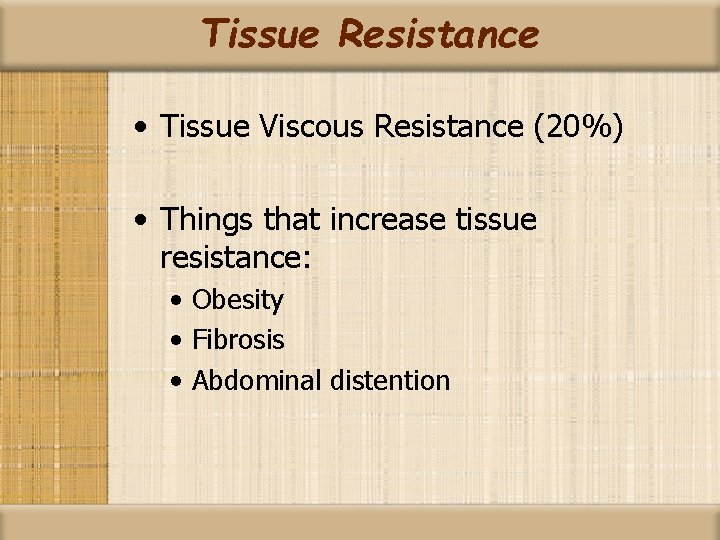
Tissue Resistance • Tissue Viscous Resistance (20%) • Things that increase tissue resistance: • Obesity • Fibrosis • Abdominal distention
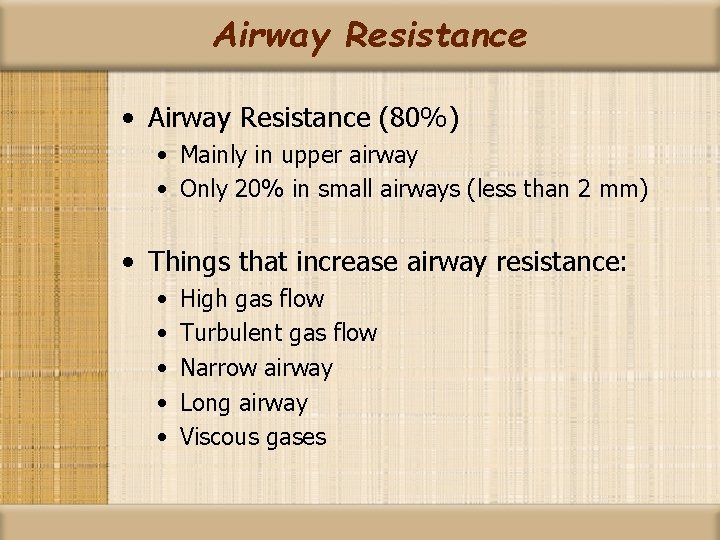
Airway Resistance • Airway Resistance (80%) • Mainly in upper airway • Only 20% in small airways (less than 2 mm) • Things that increase airway resistance: • • • High gas flow Turbulent gas flow Narrow airway Long airway Viscous gases
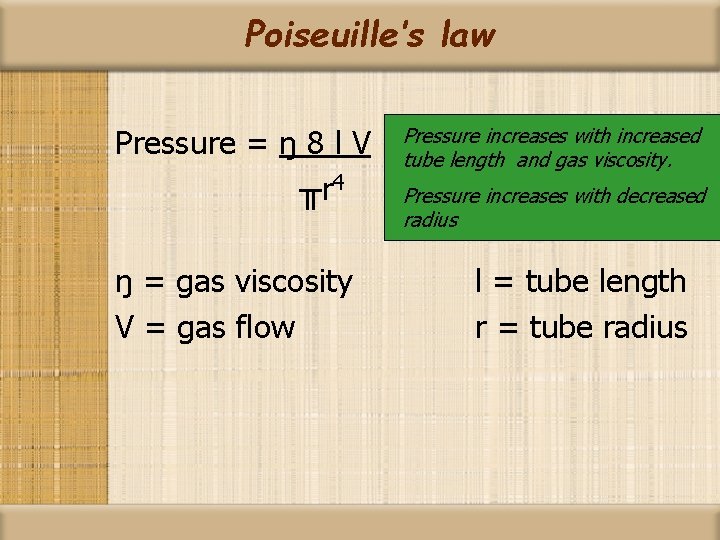
Poiseuille’s law Pressure = ŋ 8 l V ╥r 4 ŋ = gas viscosity V = gas flow Pressure increases with increased tube length and gas viscosity. Pressure increases with decreased radius l = tube length r = tube radius
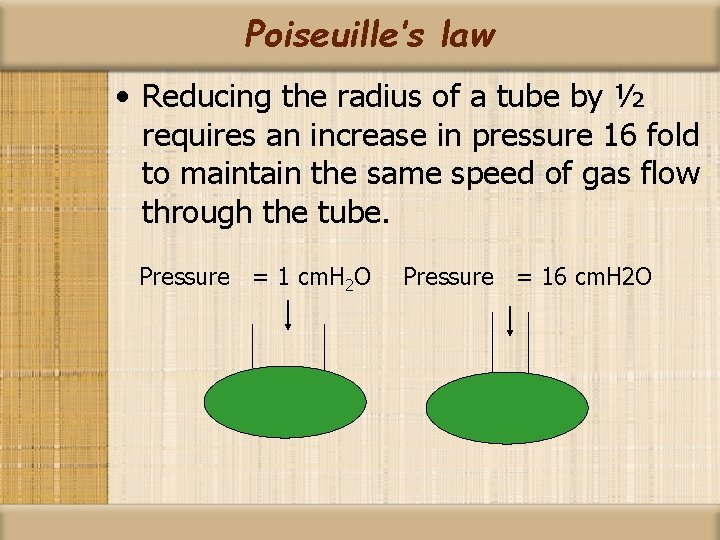
Poiseuille’s law • Reducing the radius of a tube by ½ requires an increase in pressure 16 fold to maintain the same speed of gas flow through the tube. Pressure = 1 cm. H 2 O Pressure = 16 cm. H 2 O
Poiseuille’s law • Egan: • Rule of Thumb – page 215 • Mini Clini – page 215
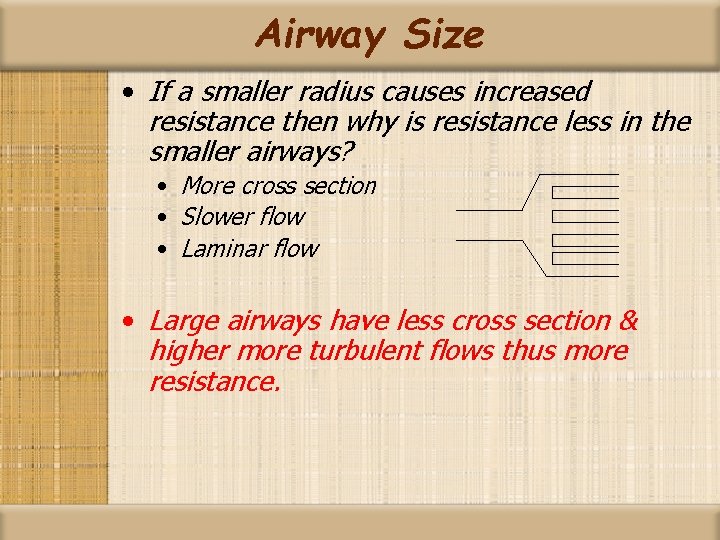
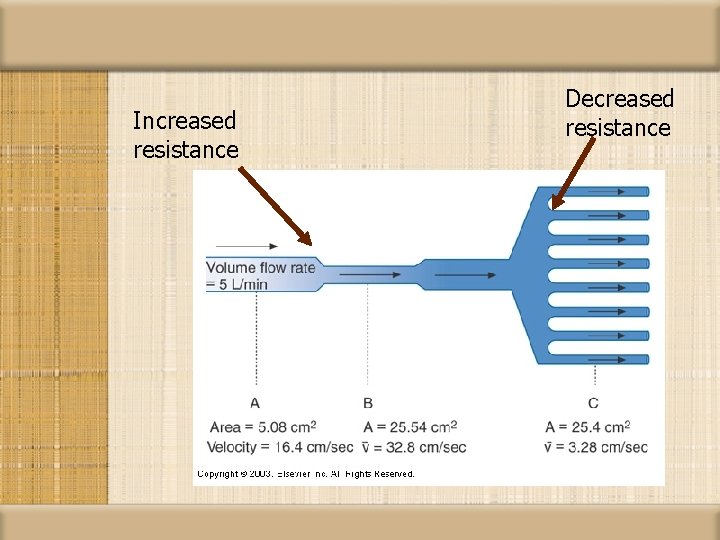
Airway Size • If a smaller radius causes increased resistance then why is resistance less in the smaller airways? • More cross section • Slower flow • Laminar flow • Large airways have less cross section & higher more turbulent flows thus more resistance.
Increased resistance Decreased resistance
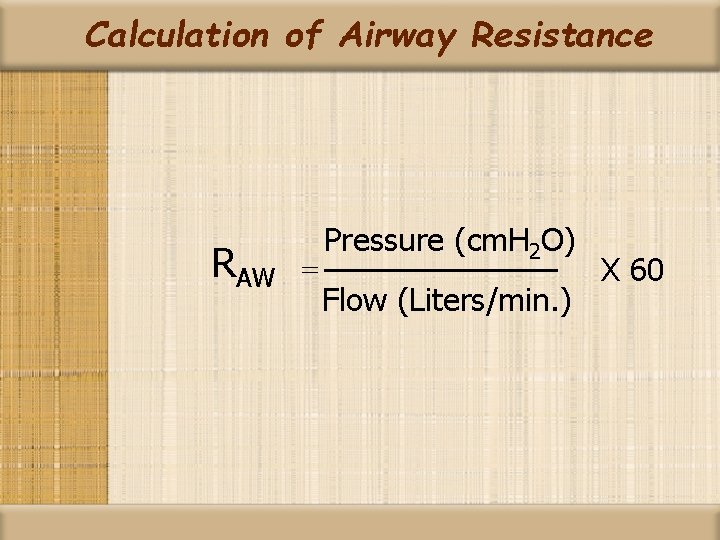
Calculation of Airway Resistance RAW = Pressure (cm. H 2 O) Flow (Liters/min. ) X 60
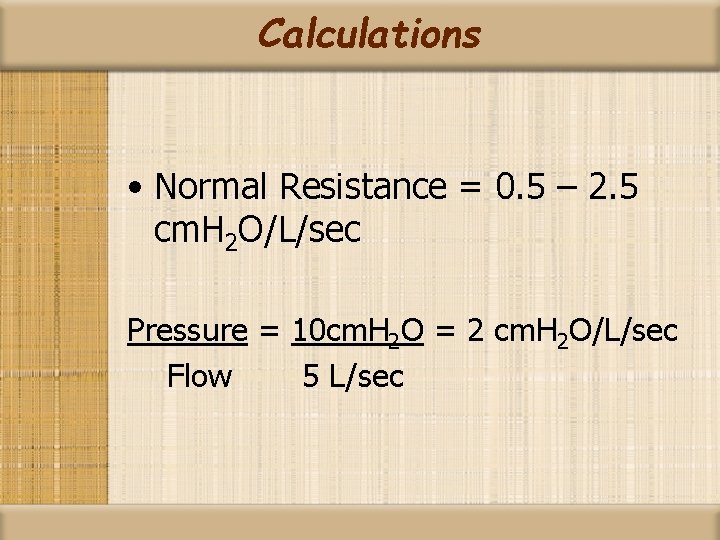
Calculations • Normal Resistance = 0. 5 – 2. 5 cm. H 2 O/L/sec Pressure = 10 cm. H 2 O = 2 cm. H 2 O/L/sec Flow 5 L/sec
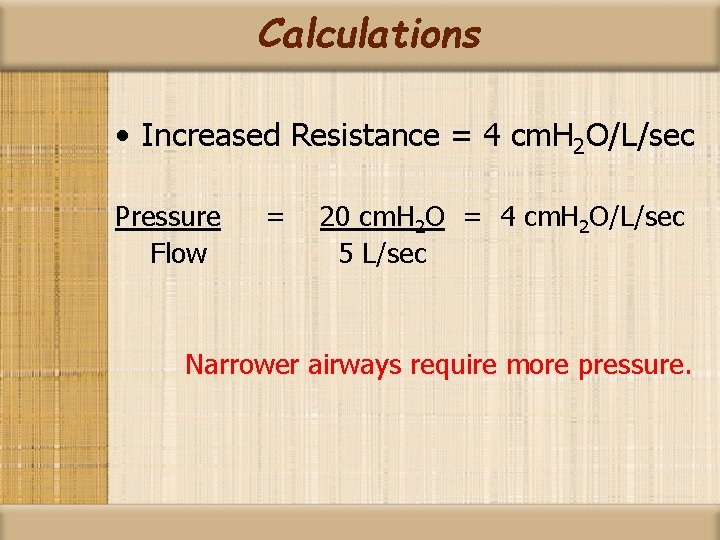
Calculations • Increased Resistance = 4 cm. H 2 O/L/sec Pressure Flow = 20 cm. H 2 O = 4 cm. H 2 O/L/sec 5 L/sec Narrower airways require more pressure.
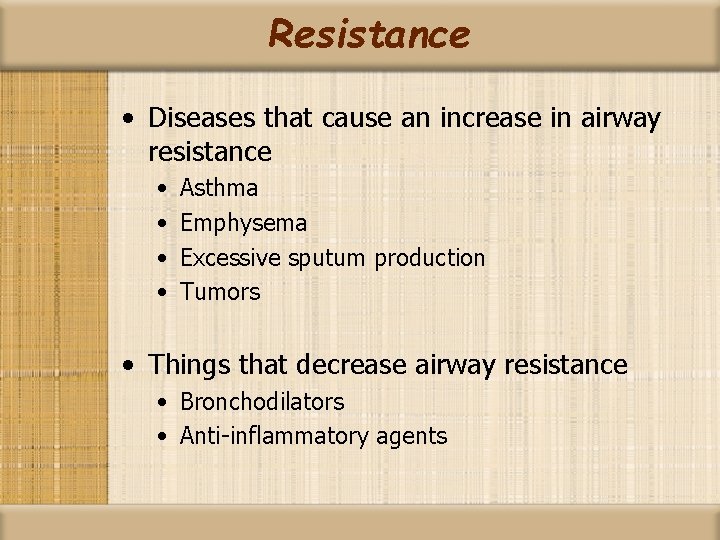
Resistance • Diseases that cause an increase in airway resistance • • Asthma Emphysema Excessive sputum production Tumors • Things that decrease airway resistance • Bronchodilators • Anti-inflammatory agents
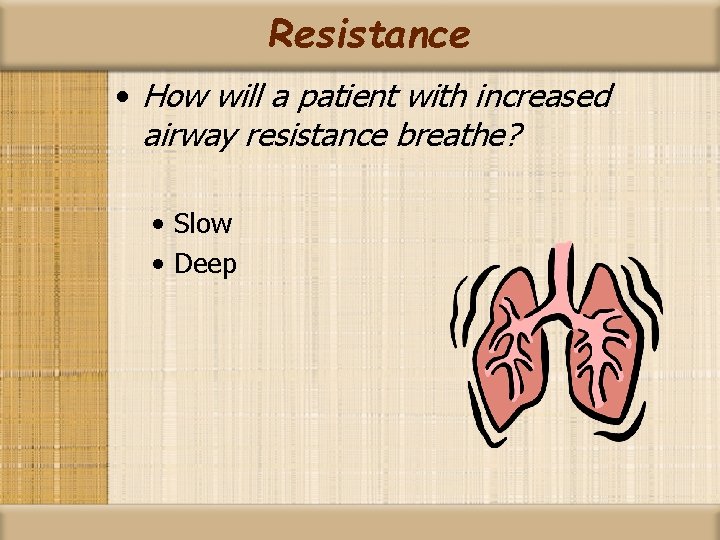
Resistance • How will a patient with increased airway resistance breathe? • Slow • Deep
Experiment • Breathe through a straw or coffee stirrer • Breathe slow & deep • Breath rapid & shallow • Which feels better?
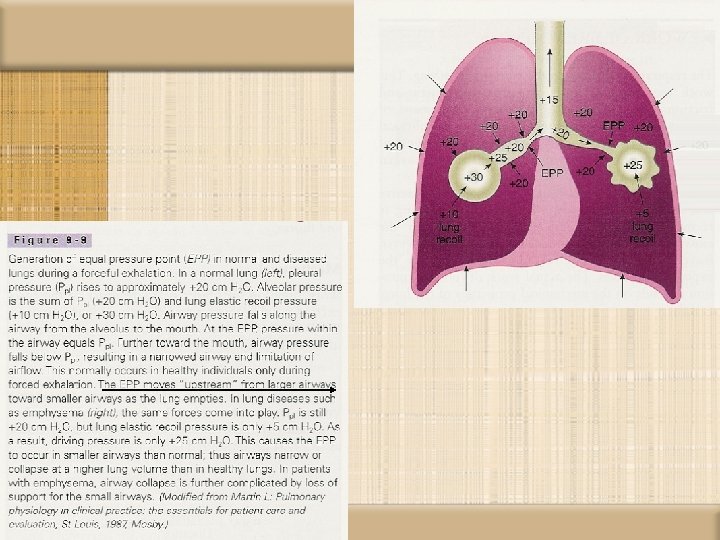
EQUAL PRESSURE POINT • See Egan page 217 – Figure 9 -9 • Point where the pressure within the airway is equal to the pressure outside the airway. • The airway will collapse downstream from the EPP.
EPP • Airway caliber is determined by: • Anatomical support from cartilage and traction by tissues • Pressure differences across their walls • Inside pressure > outside = open • Inside pressure < outside = collapse • During forced exhalation, outside pleural pressure can become higher than inside airway pressure and airways collapses.
EPP & Emphysema • Low compliance found in emphysema results in less recoil pressure and less pressure inside the airway. • Airways collapse sooner and more gas is trapped as EPP moves upstream toward smaller airways. (increased resistance) • Encourage slow deep inspiration and slow exhalation through pursed lips.
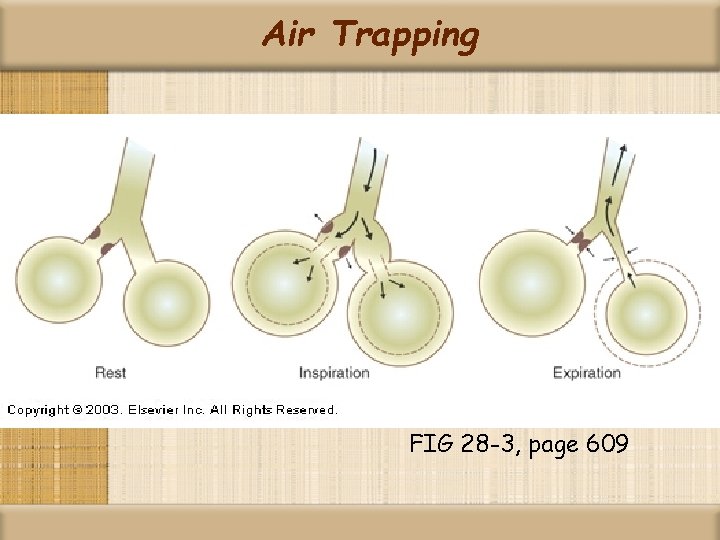
Air Trapping FIG 28 -3, page 609
Assignments • READ: Egan • Chapter 6 Surface tension - pgs. 99 -100 • Chapter 10 Mechanics of Ventilation pgs. 216 -224 • Do Sibberson Math Book Chapter 13 • First – Third sample sets • Practice exercises pgs. 160 – 171 • Look to objectives