Departments of Physics and Applied Physics Yale University

- Slides: 22
Departments of Physics and Applied Physics, Yale University Chalmers University of Technology, Feb. 2009 Meet the transmon and his friends Jens Koch
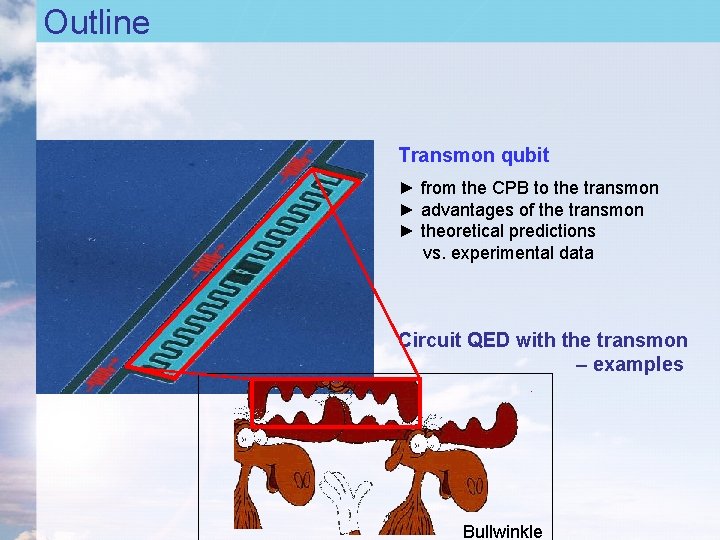
Outline Transmon qubit ► from the CPB to the transmon ► advantages of the transmon ► theoretical predictions vs. experimental data Circuit QED with the transmon – examples Bullwinkle
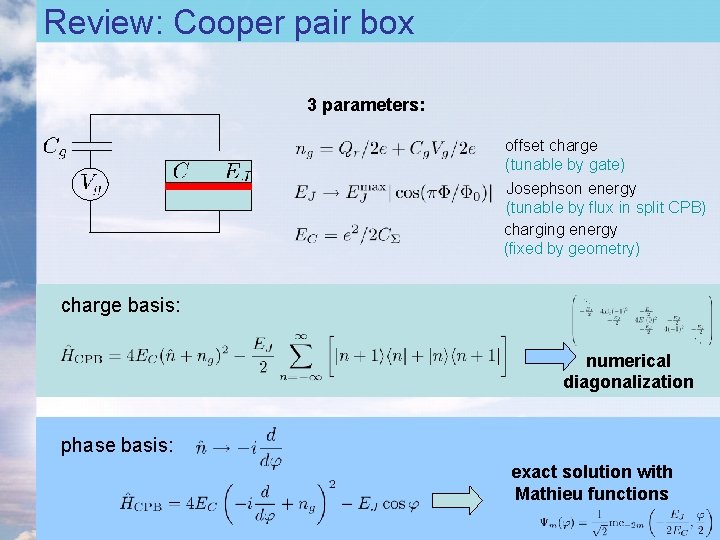
Review: Cooper pair box 3 parameters: offset charge (tunable by gate) Josephson energy (tunable by flux in split CPB) charging energy (fixed by geometry) charge basis: numerical diagonalization phase basis: exact solution with Mathieu functions
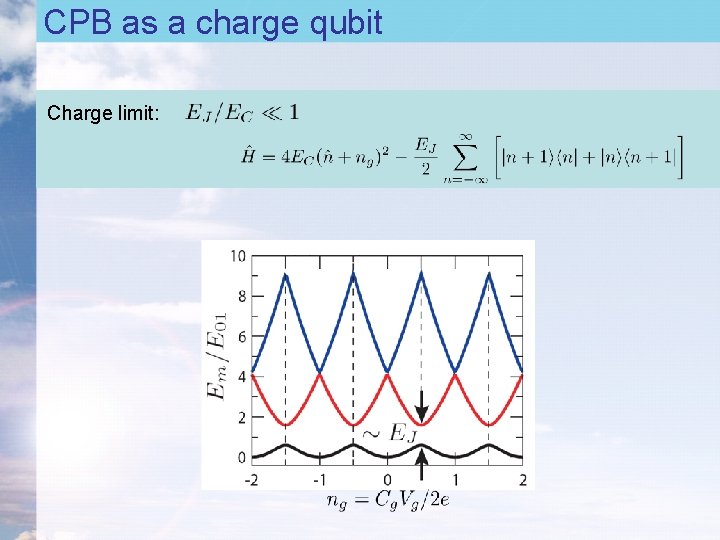
CPB as a charge qubit Charge limit:
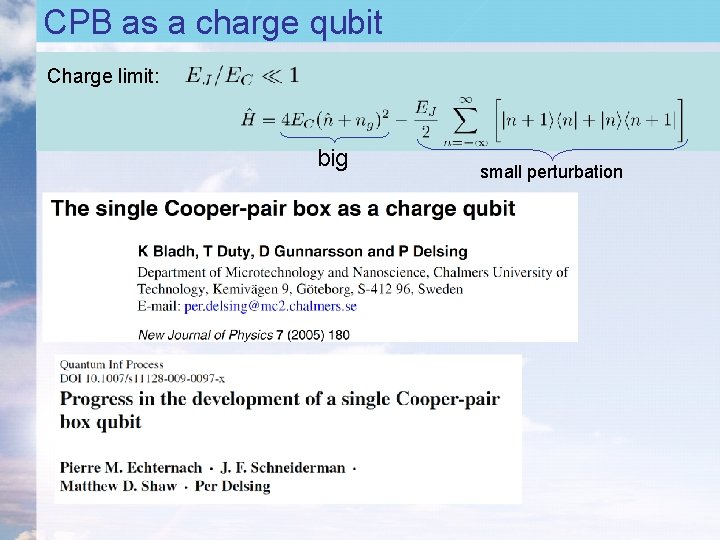
CPB as a charge qubit Charge limit: big small perturbation
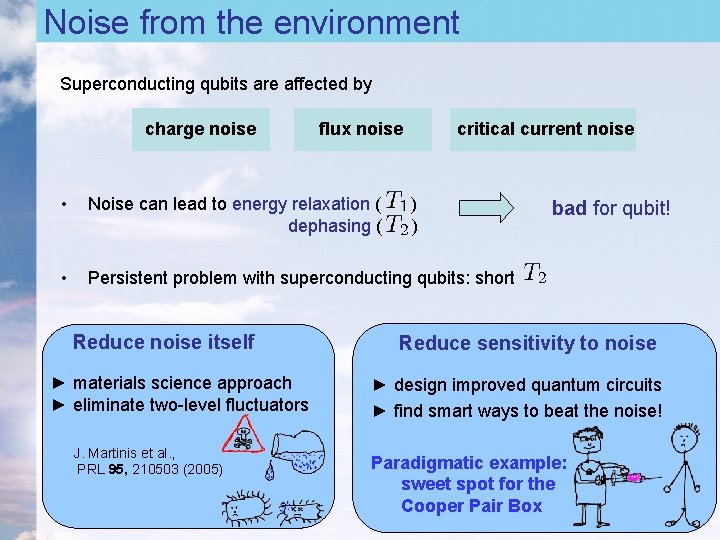
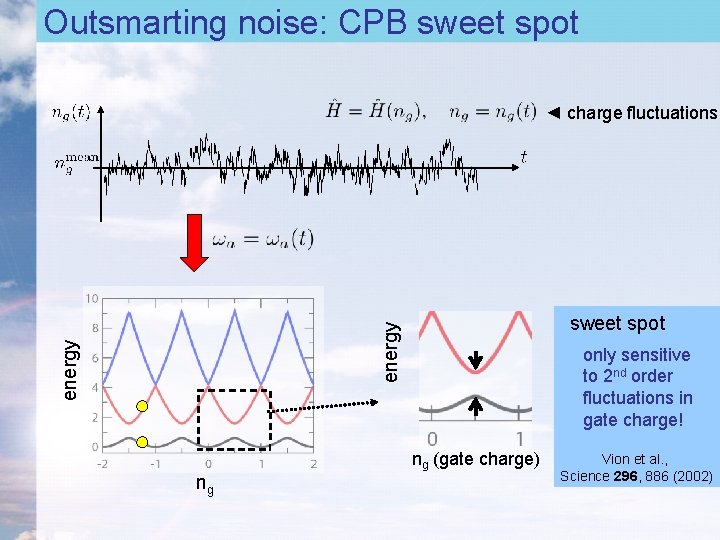
Noise from the environment Superconducting qubits are affected by charge noise flux noise critical current noise • Noise can lead to energy relaxation ( dephasing ( • Persistent problem with superconducting qubits: short Reduce noise itself ► materials science approach ► eliminate two-level fluctuators J. Martinis et al. , PRL 95, 210503 (2005) ) ) bad for qubit! Reduce sensitivity to noise ► design improved quantum circuits ► find smart ways to beat the noise! Paradigmatic example: sweet spot for the Cooper Pair Box
Outsmarting noise: CPB sweet spot ◄ charge fluctuations energy sweet spot ng only sensitive to 2 nd order fluctuations in gate charge! ng (gate charge) Vion et al. , Science 296, 886 (2002)
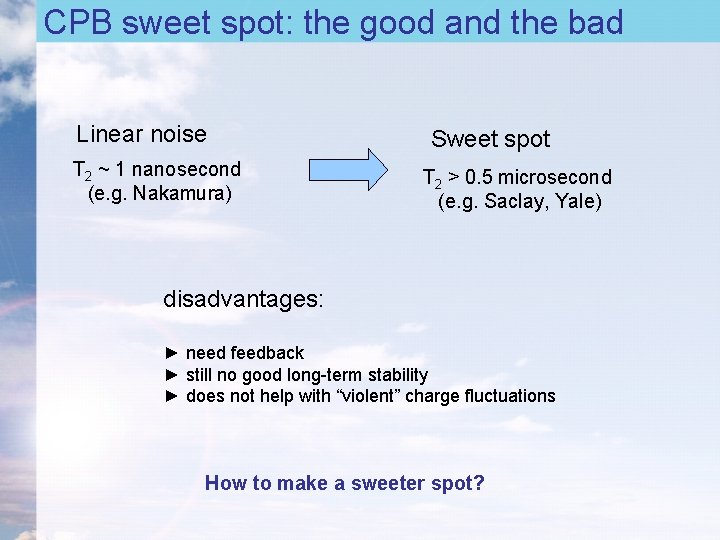
CPB sweet spot: the good and the bad Linear noise T 2 ~ 1 nanosecond (e. g. Nakamura) Sweet spot T 2 > 0. 5 microsecond (e. g. Saclay, Yale) disadvantages: ► need feedback ► still no good long-term stability ► does not help with “violent” charge fluctuations How to make a sweeter spot?
Towards the transmon: increasing EJ/EC ► charge dispersion becomes flat (peak to peak) sweet spot everywhere! ► anharmonicity decreases
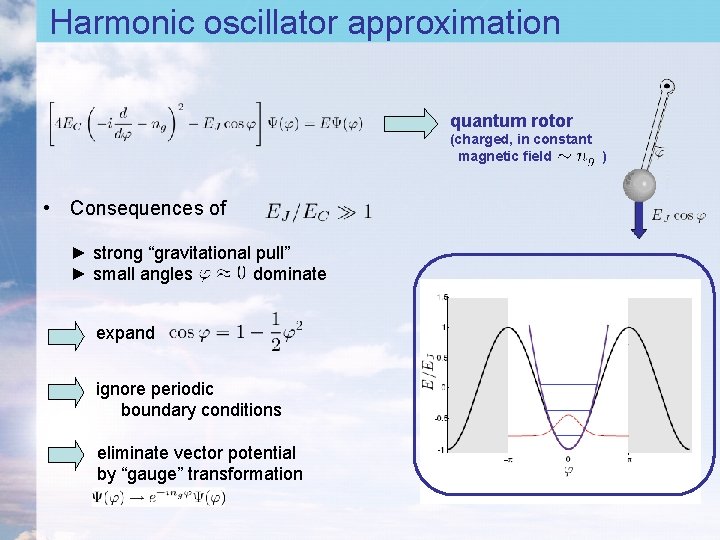
Harmonic oscillator approximation quantum rotor (charged, in constant magnetic field ) • Consequences of ► strong “gravitational pull” ► small angles dominate expand ignore periodic boundary conditions eliminate vector potential by “gauge” transformation
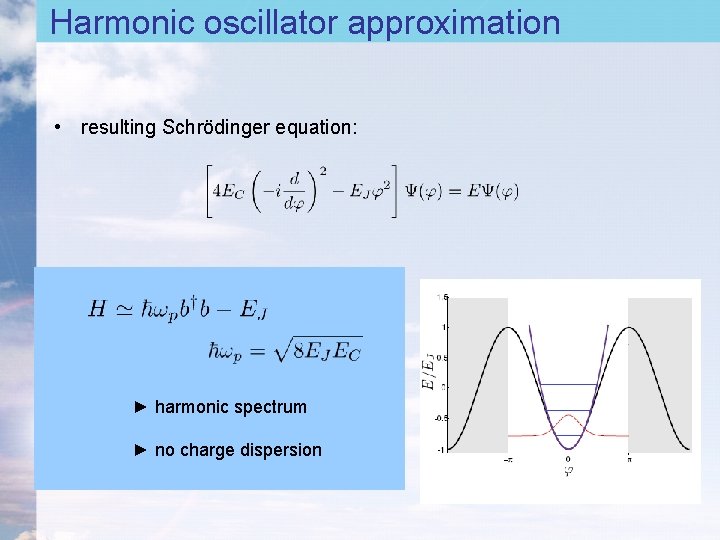
Harmonic oscillator approximation • resulting Schrödinger equation: ► harmonic spectrum ► no charge dispersion
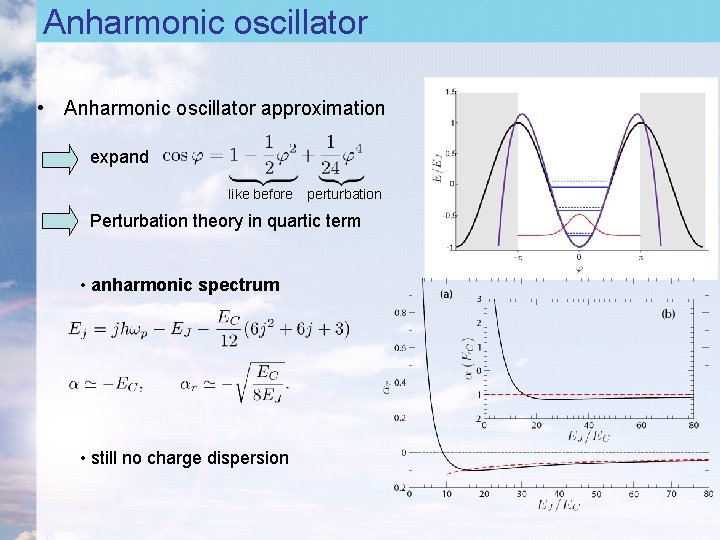
Anharmonic oscillator • Anharmonic oscillator approximation expand like before perturbation Perturbation theory in quartic term • anharmonic spectrum • still no charge dispersion
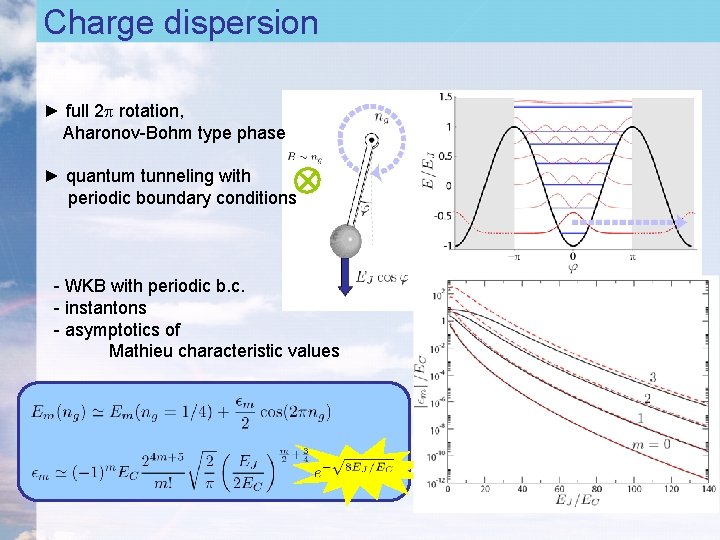
Charge dispersion ► full 2 p rotation, Aharonov-Bohm type phase ► quantum tunneling with periodic boundary conditions - WKB with periodic b. c. - instantons - asymptotics of Mathieu characteristic values
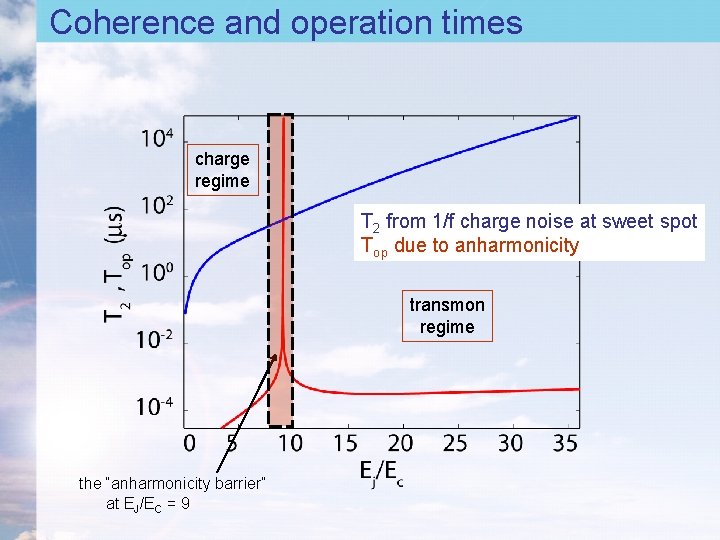
Coherence and operation times charge regime T 2 from 1/f charge noise at sweet spot Top due to anharmonicity transmon regime the “anharmonicity barrier” at EJ/EC = 9
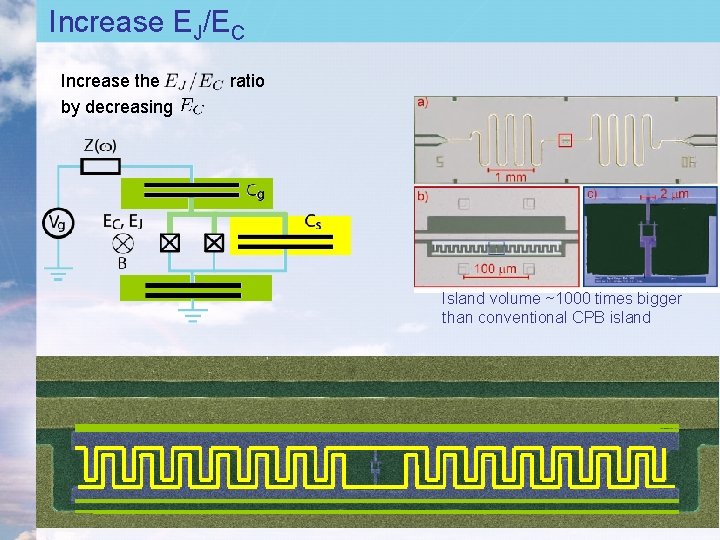
Increase EJ/EC Increase the by decreasing ratio Island volume ~1000 times bigger than conventional CPB island
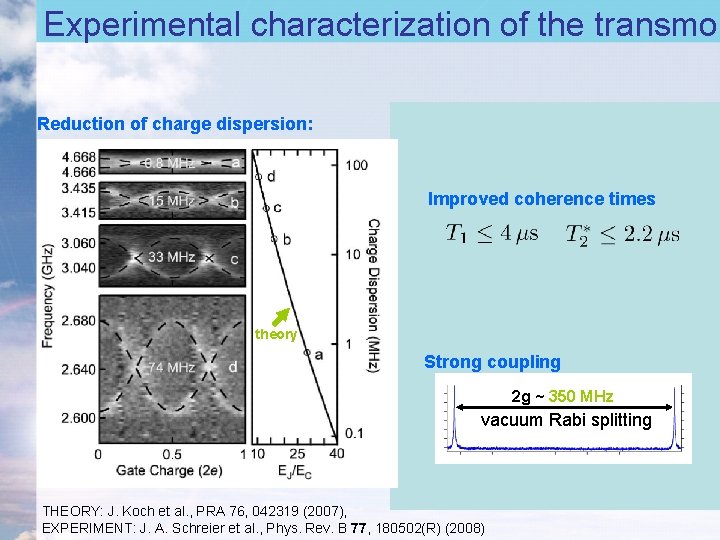
Experimental characterization of the transmon Reduction of charge dispersion: Improved coherence times theory Strong coupling 2 g ~ 350 MHz vacuum Rabi splitting THEORY: J. Koch et al. , PRA 76, 042319 (2007), EXPERIMENT: J. A. Schreier et al. , Phys. Rev. B 77, 180502(R) (2008)
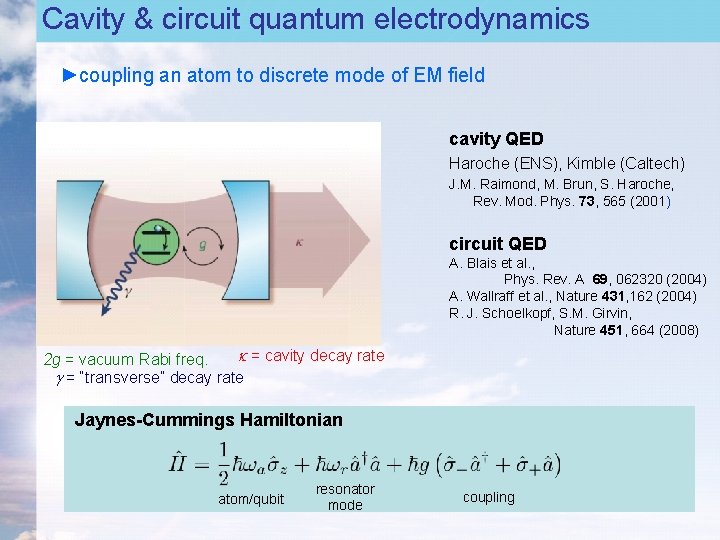
Cavity & circuit quantum electrodynamics ►coupling an atom to discrete mode of EM field cavity QED Haroche (ENS), Kimble (Caltech) J. M. Raimond, M. Brun, S. Haroche, Rev. Mod. Phys. 73, 565 (2001) circuit QED A. Blais et al. , Phys. Rev. A 69, 062320 (2004) A. Wallraff et al. , Nature 431, 162 (2004) R. J. Schoelkopf, S. M. Girvin, Nature 451, 664 (2008) k = cavity decay rate 2 g = vacuum Rabi freq. g = “transverse” decay rate Jaynes-Cummings Hamiltonian atom/qubit resonator mode coupling
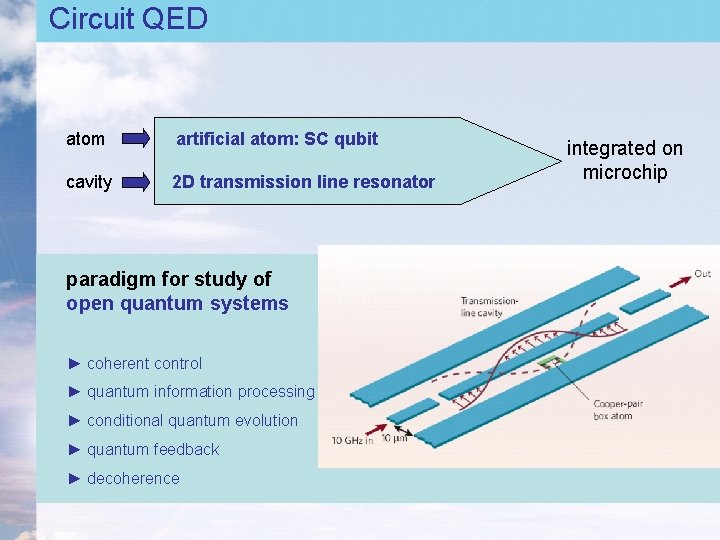
Circuit QED atom artificial atom: SC qubit cavity 2 D transmission line resonator paradigm for study of open quantum systems ► coherent control ► quantum information processing ► conditional quantum evolution ► quantum feedback ► decoherence integrated on microchip
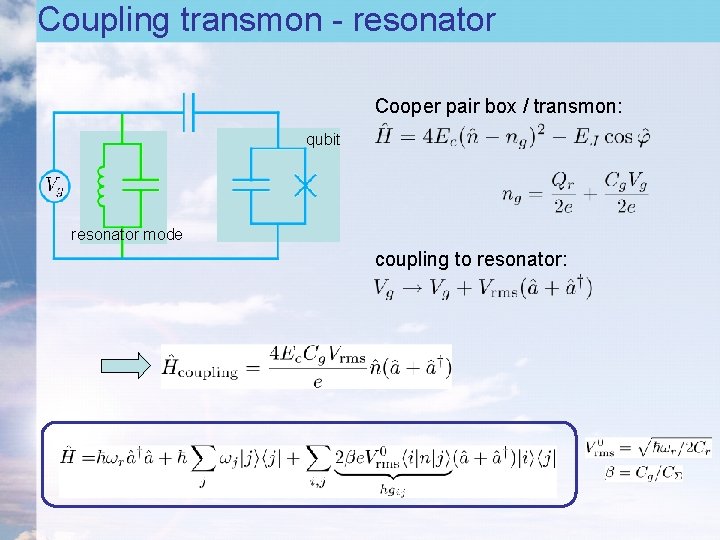
Coupling transmon - resonator Cooper pair box / transmon: qubit resonator mode coupling to resonator:
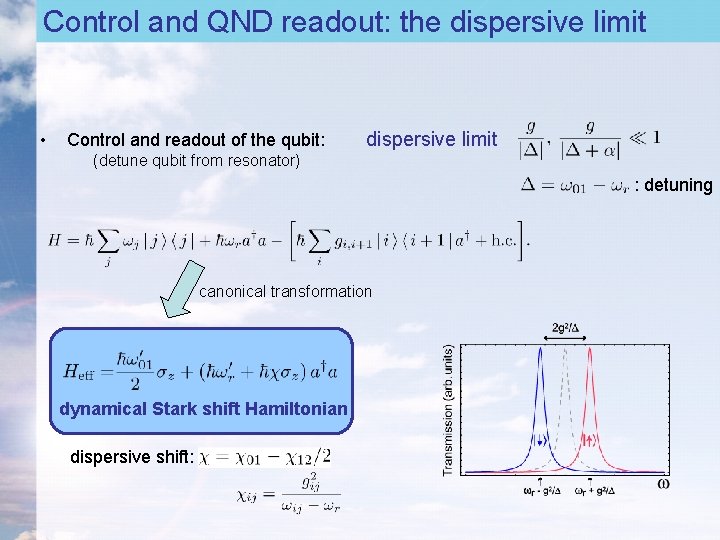
Control and QND readout: the dispersive limit • Control and readout of the qubit: dispersive limit (detune qubit from resonator) : detuning canonical transformation dynamical Stark shift Hamiltonian dispersive shift:
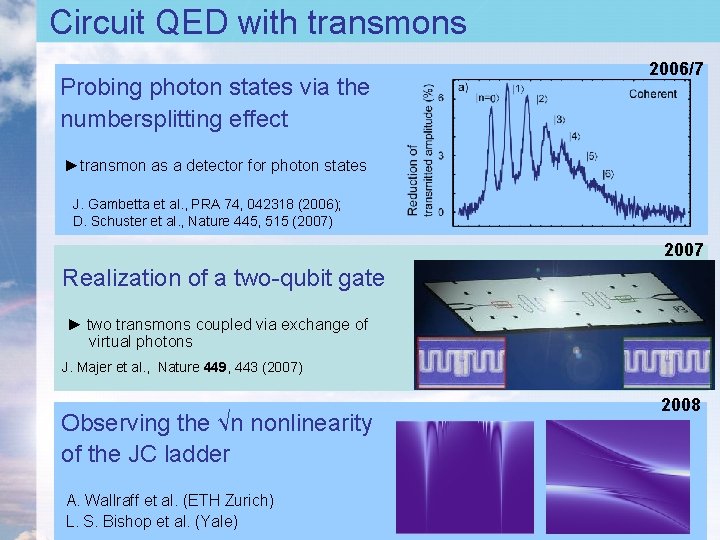
Circuit QED with transmons Probing photon states via the numbersplitting effect 2006/7 ►transmon as a detector for photon states J. Gambetta et al. , PRA 74, 042318 (2006); D. Schuster et al. , Nature 445, 515 (2007) 2007 Realization of a two-qubit gate ► two transmons coupled via exchange of virtual photons J. Majer et al. , Nature 449, 443 (2007) Observing the √n nonlinearity of the JC ladder A. Wallraff et al. (ETH Zurich) L. S. Bishop et al. (Yale) 2008
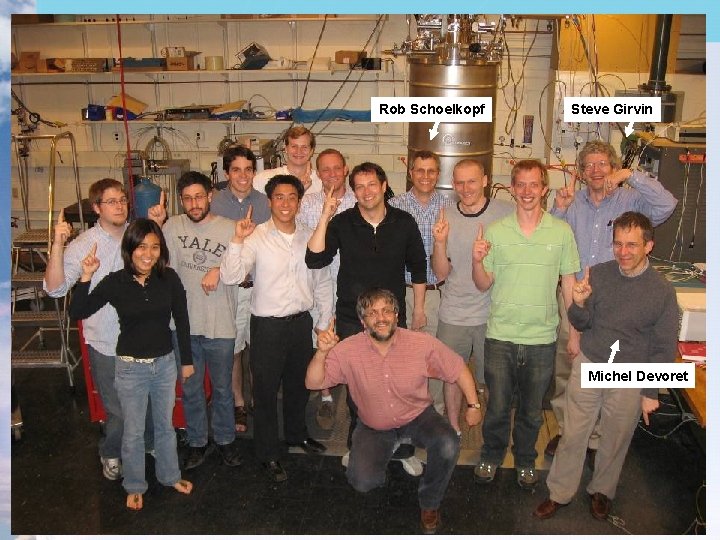
Rob Schoelkopf Steve Girvin Michel Devoret