
Debre Markos University Department of Public Health For
Debre Markos University Department of Public Health For post graduate Students Health service management By: Nurilign Abebe (Asst Prof of public health) 1
Chapter II management functions 2

Four Tasks of Management Planning Choose appropriate organizational goals and courses of action to best achieve those goals Controlling Establish accurate measuring and monitoring systems to evaluate how well the organization has achieved its goals. Organizing Establish task and authority relationships that allow people to work together to achieve organization goals. Leading Motivate, coordinate, and energize individuals and groups to work together to achieve organizational goals 3
Management functions… • In addition to these, three broad sequential functions (PIE), • Two continuous functions of management are • Communication & • Decision- Making. 4
What is Planning? ØPlanning is the process of establishing goals and a suitable course of action for achieving those goals. ØMaking implementation decision before implementation. ØDeciding prospectively what to do charting a course of action for the future 5
THE RATIONALE FOR PLANNING Planning helps : v Copping with future uncertainty & changes v Focus attention on objectives v For economical operation v Provides performance standards & facilitate control v Helps foreseeing & identifying potential risks 6
FEATURES OF PLANNING Ø Is an intellectual activity Ø Is a continuous Process (cyclic /spiral) Ø Is flexible as it is based on future conditions, which are always dynamic Ø Must be systematic & action oriented § is collective undertaking requiring the participation of; Professionals ( health & other sectors) , Community/ NGOs and Government bodies § is needed & practiced at all managerial levels regardless of the size (small or complex) & type (non–profit or profit making ) of organization 7
What is Planning? . . . • The important components of this and other similar definitions are concepts of: - v. Where are we going (objectives) v. With what (Resources) v. How (efficient and appropriate implementation) v. When (future)? 8
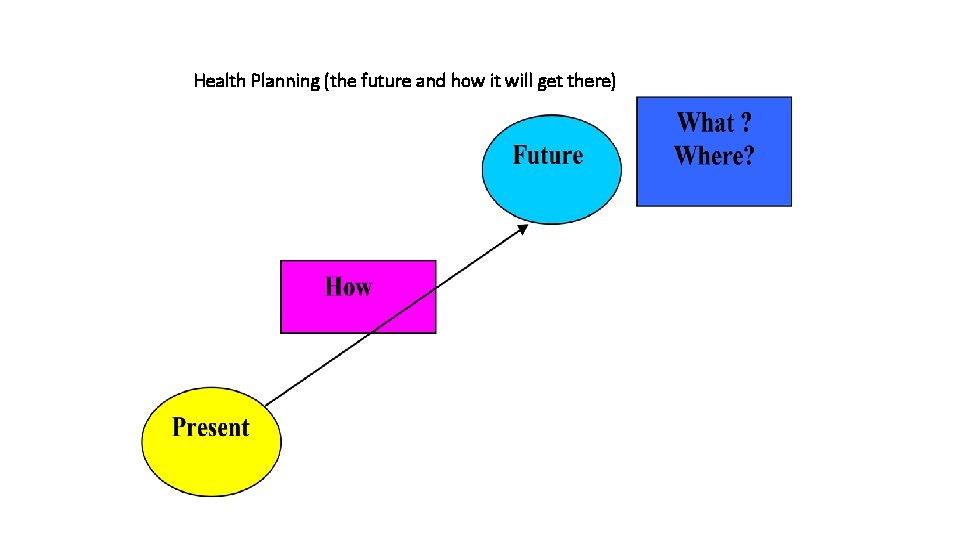
Health Planning (the future and how it will get there) 9
What is Health Planning? • Health Planning is the process of defining community health problems, identifying needs and resources, establishing priority goals and setting out the administrative action needed to reach those goals. • Types of planning • Strategic plan • Tactical plan/Operational plan 10
Strategic plan Is plans designed to meet an organizations broad goals. Is planned for five years or more Is planned by top level manager Strategic plan is the process of determining what organization intends to be in future and how it gets there. Strategic planning is the process of formulating and implementing decisions about an organization’s future direction. 11
SWOT Analysis �SWOT (strengths and weakness, opportunities and threats) is a strategic planning tool that matches internal organizational strengths and weakness with external opportunities and threats. �By reviewing strengths, weaknesses, opportunities and threats a useful strategy for achieving objectives will become evident. �In the health sector, strengths may be considered availability of resources and trained human power. �Weaknesses include lack of managerial talent and obsolete facilities. And threats include adverse cultural believes towards modern medical practice and growing cost of essential drugs. �Examples of opportunities are clear and supportive government policies and presence of a functional health committee in the communities. 12
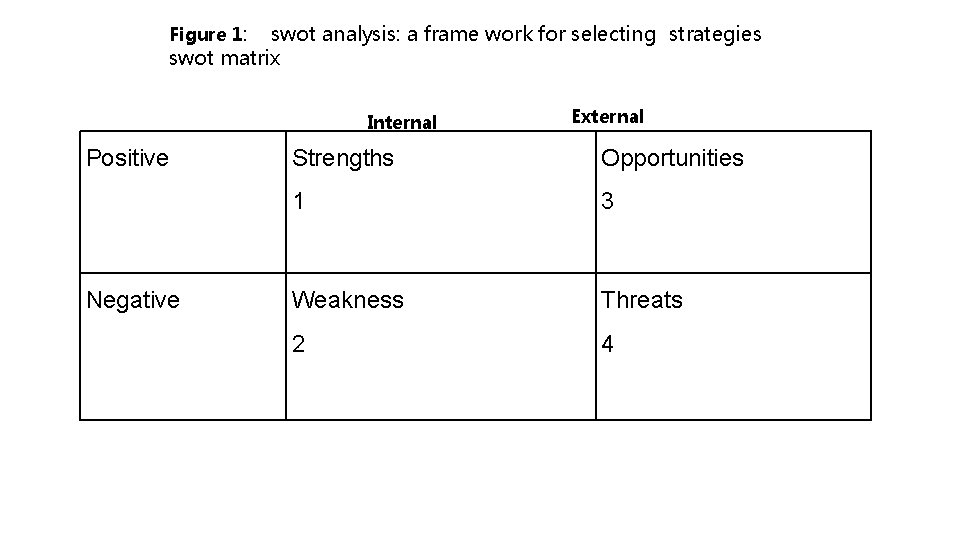
Figure 1: swot analysis: a frame work for selecting strategies swot matrix Internal Positive Negative External Strengths Opportunities 1 3 Weakness Threats 2 4 13
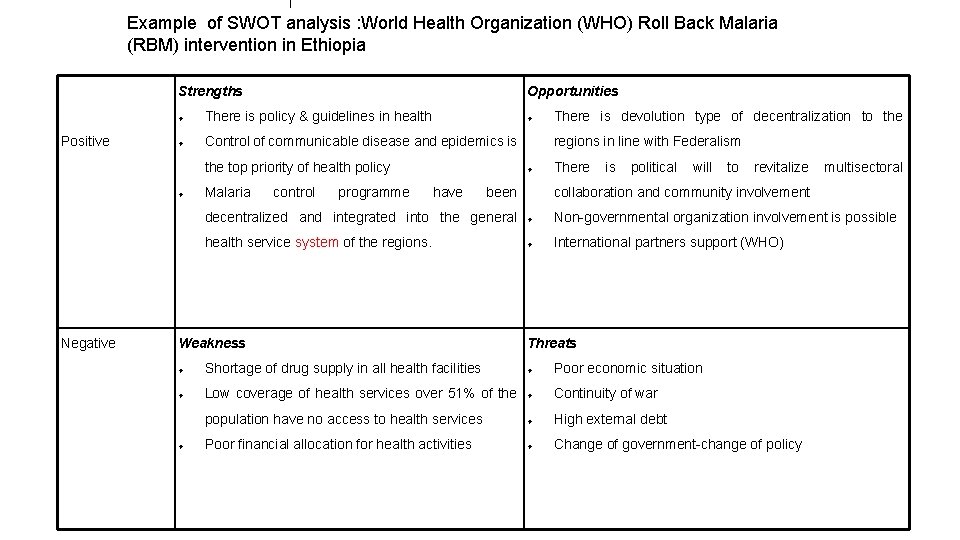
Example of SWOT analysis : World Health Organization (WHO) Roll Back Malaria (RBM) intervention in Ethiopia Strengths Positive Opportunities There is policy & guidelines in health Control of communicable disease and epidemics is the top priority of health policy Negative Malaria control programme regions in line with Federalism have There is devolution type of decentralization to the been There is political will to revitalize collaboration and community involvement decentralized and integrated into the general Non-governmental organization involvement is possible health service system of the regions. International partners support (WHO) Weakness Threats Shortage of drug supply in all health facilities Poor economic situation Low coverage of health services over 51% of the Continuity of war population have no access to health services High external debt Poor financial allocation for health activities Change of government-change of policy multisectoral 14
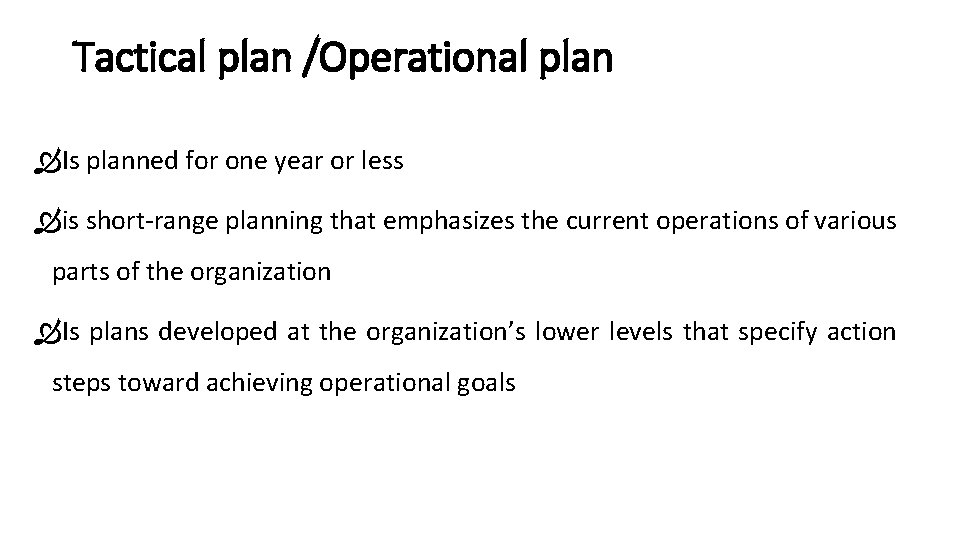
Tactical plan /Operational plan Is planned for one year or less is short-range planning that emphasizes the current operations of various parts of the organization Is plans developed at the organization’s lower levels that specify action steps toward achieving operational goals 15
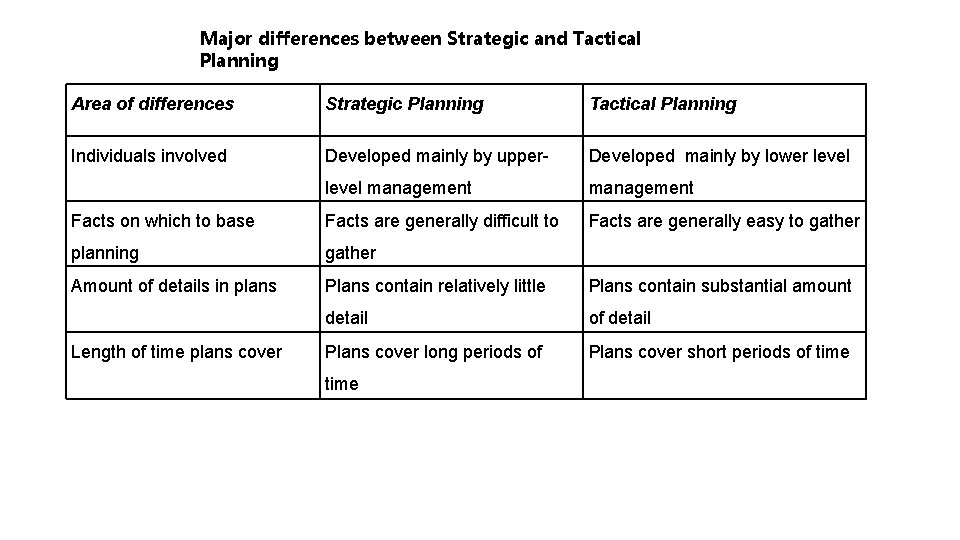
Major differences between Strategic and Tactical Planning Area of differences Strategic Planning Tactical Planning Individuals involved Developed mainly by upper- Developed mainly by lower level management Facts on which to base Facts are generally difficult to Facts are generally easy to gather planning gather Amount of details in plans Plans contain relatively little Plans contain substantial amount detail of detail Plans cover long periods of Plans cover short periods of time Length of time plans cover time 16
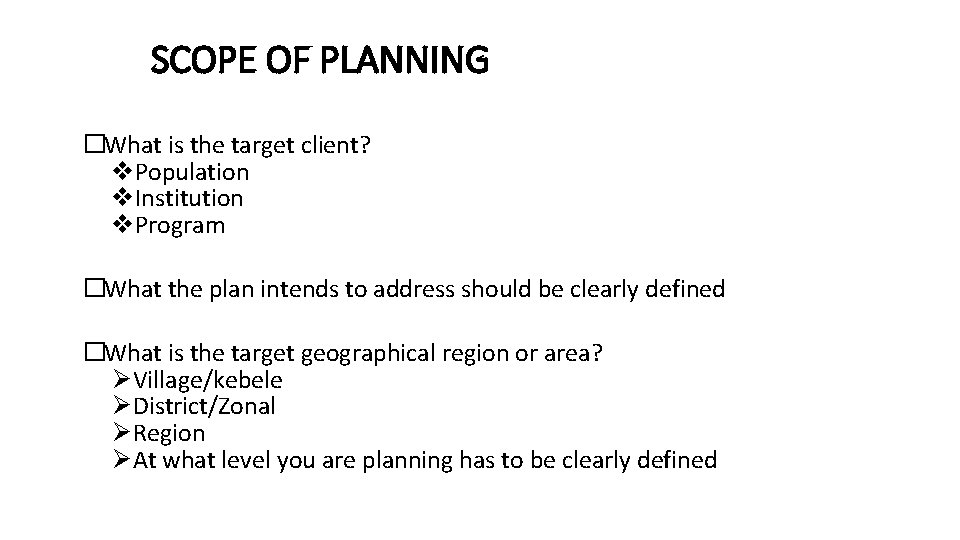
SCOPE OF PLANNING �What is the target client? v. Population v. Institution v. Program �What the plan intends to address should be clearly defined �What is the target geographical region or area? ØVillage/kebele ØDistrict/Zonal ØRegion ØAt what level you are planning has to be clearly defined 17
FEATURES OF PLANING i. A Good Plan Should Give ØClear vision/mission, goal and objectives ØA clear picture of the tasks to be accomplished ØA clear picture of resources needed to accomplish the task. In terms of human, material, financial and time resources. ii. Planning Takes Place at All Levels v. Planning takes place at any level in health system v. Planning takes place continually, it is cyclic process Planning methods can be applied to : - v. A large programme at national level v. Example –Malaria control programme v. Small one - at village level v. Example –construction of community health post 18
FEATURES OF PLANING. . . iii. Planning must be Collective • It requires the participation of: - v. Professionals (from health and other sectors) v. Community (NGO) v. Government 19
Steps in planning v. There are six steps for planning in health activities 1. 2. 3. 4. 5. 6. Situational analysis Selecting priority problems Setting objectives and targets Reviewing /Identifying obstacles and limitations Designing the strategies Prepare the plan 20
1. Situational analysis �Situational analysis is the first step in the development of a plan. �It deals with looking at the whole situation of the community with regard to health and health related problems, analyze the cause of the problems, understanding the community, study the resources and record and tabulate the results. �The purpose of situational analysis is to provide abroad basis of understanding. �This is for two reasons v. It provides a common reference point for the rest of the planning process v. It allows the selection of priority areas of concern for planning content of situational analysis. 21
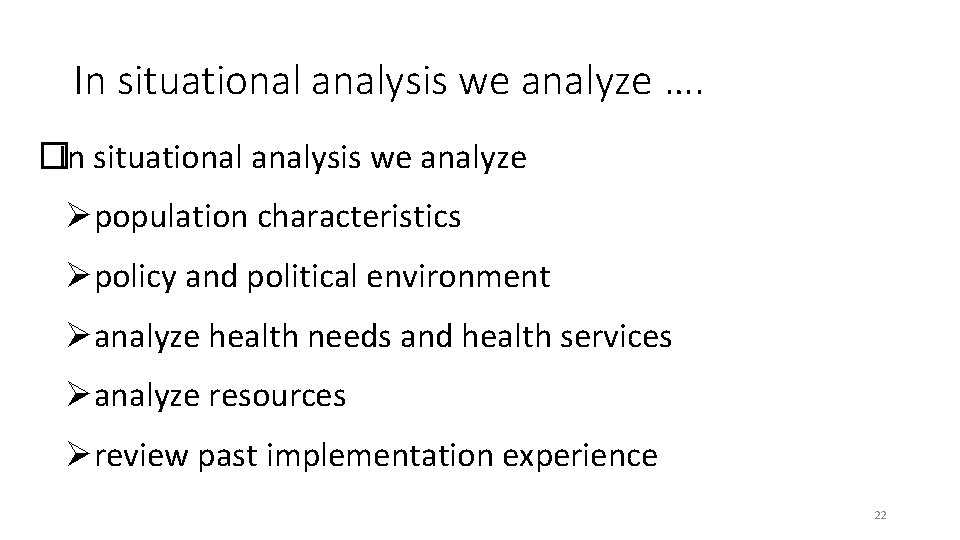
In situational analysis we analyze …. �In situational analysis we analyze Øpopulation characteristics Øpolicy and political environment Øanalyze health needs and health services Øanalyze resources Øreview past implementation experience 22
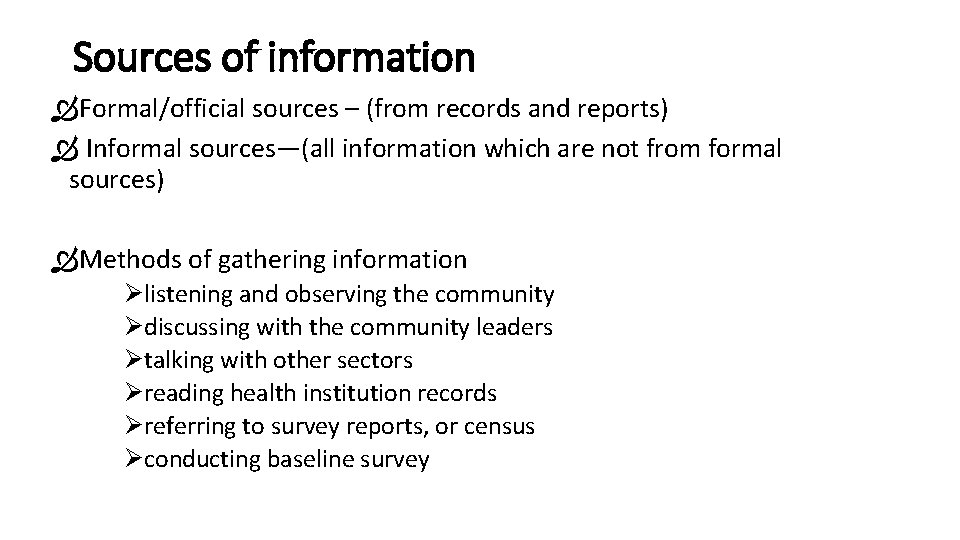
Sources of information Formal/official sources – (from records and reports) Informal sources—(all information which are not from formal sources) Methods of gathering information Ølistening and observing the community Ødiscussing with the community leaders Øtalking with other sectors Øreading health institution records Øreferring to survey reports, or census Øconducting baseline survey 23
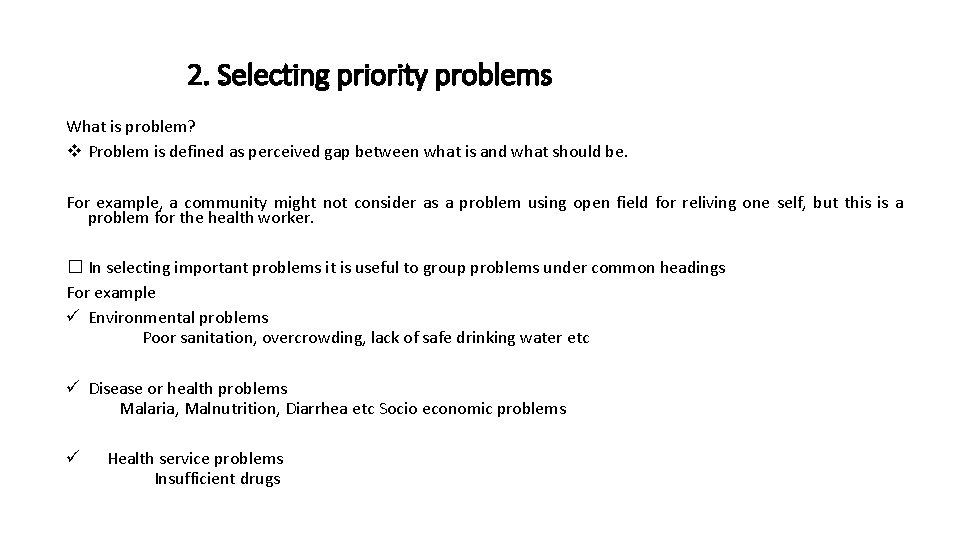
2. Selecting priority problems What is problem? v Problem is defined as perceived gap between what is and what should be. For example, a community might not consider as a problem using open field for reliving one self, but this is a problem for the health worker. � In selecting important problems it is useful to group problems under common headings For example ü Environmental problems Poor sanitation, overcrowding, lack of safe drinking water etc ü Disease or health problems Malaria, Malnutrition, Diarrhea etc Socio economic problems ü Health service problems Insufficient drugs 24
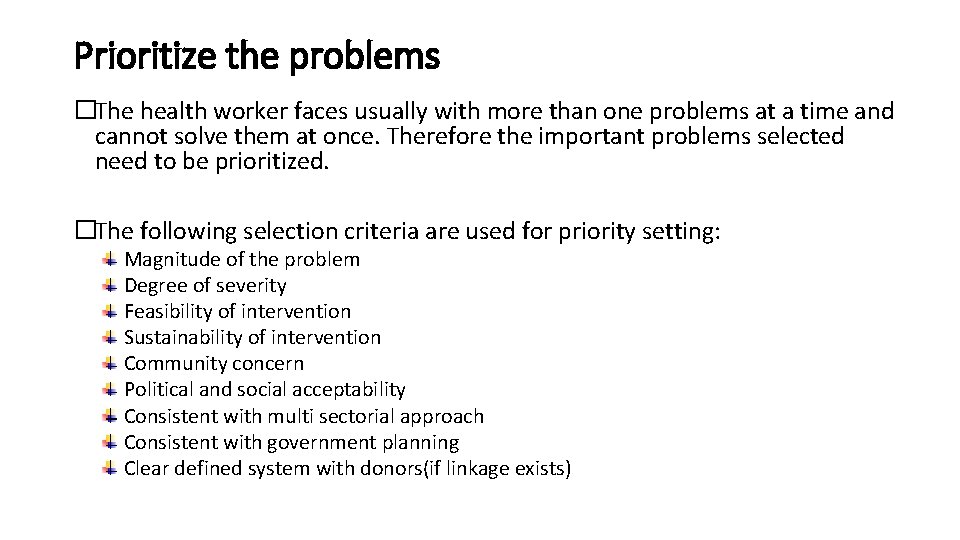
Prioritize the problems �The health worker faces usually with more than one problems at a time and cannot solve them at once. Therefore the important problems selected need to be prioritized. �The following selection criteria are used for priority setting: Magnitude of the problem Degree of severity Feasibility of intervention Sustainability of intervention Community concern Political and social acceptability Consistent with multi sectorial approach Consistent with government planning Clear defined system with donors(if linkage exists) 25
3. Setting objectives and targets Setting a clear objective is important for two reasons v. It is important for definite plan v. Enables results to be evaluated Example: we will improve health (wrong way of setting objectives) We will extend health care for total population by 2015(right way of setting) 26
Characteristics of good objective Generally, a good objective must be “SMART” S specific (put in clear way that addresses a problem) M measurable (when the result can be put in numbers) A achievable/feasible (possible to achieve) R relevant (pertinent to the problem to be solved) T time bound (it should have time limit when the desired achievement obtained) 27
Setting objectives and targets … ØObjectives may be stated in different ways at different level of the health system For example v at regional level” at the end of five years malnourished children (<3 years) will be reduced less than 4%) v At district or woreda level “to identify children of 0 -3 years of age with malnutrition according to the stated nutritional criteria. At kebel/village level “identify among the child population of 0 -3 years of age all children with malnutrition, according to the specified criteria. 28
4. Identifying obstacles and limitations q. The limitations/obstacles may be qresources (people, equipment, money etc) q. Environmental (geographical, climate, Technical difficulties , Social factors, etc) § The analysis of obstacles would help the planner to know which Obstacle can be removed Obstacles can be reduced or modified Obstacles cannot removed 29
5. DESIGNING THE STRATEGIES Once objectives and targets are set, the planner assesses the different ways (strategies) for achieving them. Choosing the best strategy again entails analysing resources available and needed for each strategy. The potential strategies often include technology to be applied, procedures to be used and defining the role of communities and other sectors. 30
5. DESIGNING THE STRATEGIES. . . For each chosen strategy, the corresponding activities to be undertaken and the resources needed should be detailed, including who will do the activities (job description of all involved personnel) which things would be needed (equipment, materials and money), where the work will be done and the methods of controlling. 31
6. Writing the plan The purposes of writing the plan are: To request funds or resources from the government or funding agencies For monitoring and evaluating the implementation process by all concerned bodies q. Before planning activities it is necessary to: q. Look at different possible ways of achieving the objectives q. Balance resources and needs q. Choose the best action plan then q. Write detailed activities based on the chosen plan of action 32
Writing the plan … A plan can be written in several ways. Some organizations may require plans to be written on specific way. Some donors or governmental bodies might have a certain guidelines. In the absence of such circumstance, the following headings are helpful to write action plan v. The problem statement v. Objective and targets v. Strategy and activities v. Resources needed and how they are going to be utilized v. Monitoring and evaluation 33
Class exercise • Instruction • Be in five a group • Choose one organization • Construct the Mission Statement of an institution. • Construct the Vision Statement of an institution. • Choose one objective and follow planning steps 34
Mission and vision statement Mission • An organization’s mission is: - its purpose, - its reason for being, - provides orientation, consistency, and meaning to the organization’s decisions and activities at all levels. • The Mission Statement describes clearly and concisely why the organization exists. • It should be re-examined periodically by current staff. 35
Why does an organization need a Mission? • The Mission is what allows members of an organization to clearly understand why they are doing the work. • Only when health workers are aware of the organizational mission or ultimate purpose, will they fully understand the meaning and the value of their efforts. 36
CONSTRUCTING THE MISSION STATEMENT • To construct or revise a Mission Statement, the Board of Directors and Managers and their Teams must carefully scan the internal and external environments before answering four basic questions: A. What do we do? B. Whom do we serve? C. How do we do it? and D. Why do we do it? • Finalize and disseminate the Mission Statement to staff, and board members, those who are served by the organization, and the general public. 37
Identify (what, whom, how and why) Our mission is to contribute to reducing the number of unwanted pregnancies by providing uninterrupted access to high-quality, modern methods of contraception, through which we can reduce the rate of mortality among reproductive age mothers. 38
Where are we going? - Create a Vision, - You are now ready to take on the challenge of constructing the desired future, - It is the moment to dream, to decide, what your organization wants to be in the future, and - How it wants to be viewed by the outside world. - The vision is like a guiding star. - The vision guides and focuses the organization’s efforts and helps to align, inspire, motivate, and secure the commitment of each working group and individual within the organization. 39
CREATING A SHARED VISION - A vision is more powerful when a large number of people from various organizational levels develop it together than comes from the organization’s upper levels. 40
What Experts say about Vision: • According to Karl Albrecht (1994), the vision is the shared image of what we want our organization to be or to become. • For Jay Conger (2000), the vision is a mental image that represents a desirable future state, ideal, or dream with a vast scope. 41
CONSTRUCTING THE VISION STEP-BY-STEP - In constructing the vision, you and your planning team should follow four steps. Step 1. Keep the big picture in mind. Refer to your organization’s mission and the population you are supposed to serve so that the vision aligns with the mission. 42
Step 2. Answer the following questions: • What will our organization look like in three to five years? • What aspects of mission will we have achieved and in what areas will be excel? • What will make us most proud? (e. g. quality of our services, commitment, creativity, financial stability, etc. ) • What values do we uphold, and how will they be reflected in our services and the way we run our organization? v Write down the answers to each of the questions and come to consensus within your team. 43
Step 3. Look at your organization through the eyes of your target population, beneficiaries, donors, partners, collaborators, competitors, and society in general. For each of these groups, ask: • How do we want these groups to see our organization in three to five years? • What will they say about our services? • What will they say about our staff? • What will they say about our reputation in their communities? v. Write down the answers to each of the questions and come to consensus within your team. 44
Step 4. Translate these ideas into a few sentences that describe the desired future in the future in a concrete manner; E. g. Stop TB Partnership: Our vision is a TB-free world: the first children born this millennium will see TB eliminated in their lifetimes. 45
2. Organizing focuses attention on the structure and process of allocating jobs so that common objectives can be achieved. The most important elements of organization structure are • Division of labor • Decentralization • Delegation and • Coordination to secure unity • Authority 46
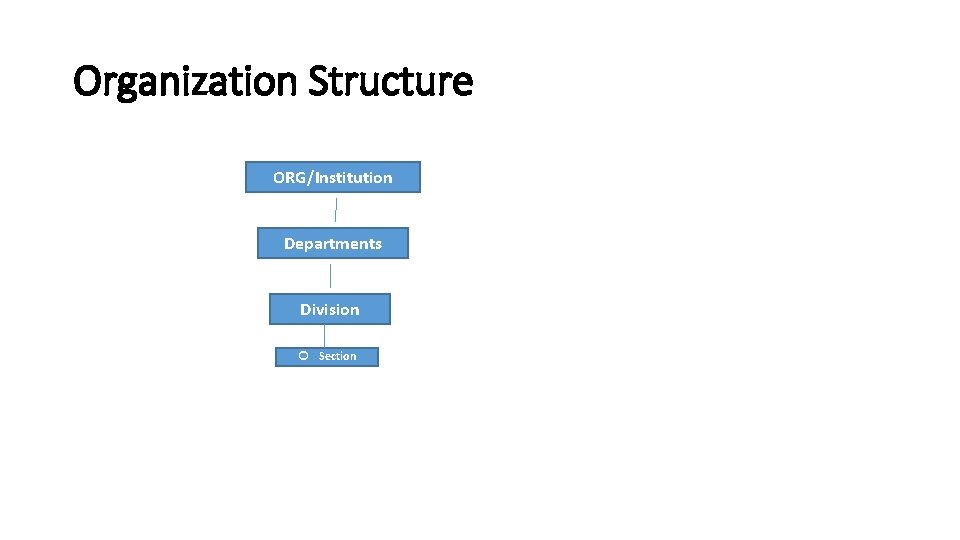
Organization Structure ORG/Institution Departments Division Section 47
3. Leading/Directing Leadership is a process of directing and influencing the task-related activities of group members. The core concepts embedded in leadership are: • Leadership is a process. • It manifests itself in the doing; it is a performing art. • The focus of leadership is in a person. • The focus of leadership is other individuals and groups. 48
Leading/Directing. . . • Leadership entails influencing. • Influence is leadership’s center of gravity and most critical element. • The objective of leadership is good accomplishment. • Leadership is instrumental; it is done for a purpose. • leadership is intentional; it is not accidental. 49
Leading/Directing. . . Implications: • Involves other people • Is unequal distribution of power (leaders/members) • Is to influence behaviors of employee • Is about values 50
4. CONTROLLING • Controlling is establish accurate measuring and monitoring systems to evaluate how well the organization has achieved its goals. • Controlling is the measurement and correction of performance in order to ensure the objectives and the plans of the organization are being accomplished. • In other words, controlling is the process by which management sees what did happen. • If the accomplishments are not needed adjustments are made. 51
CONTROLLING… • Without systematic control, a manager has no assurance that all elements of the origination will work toward meeting the goals. • Controlling is closely related to planning, organizing & leading. • It helps managers monitor the effectiveness of planning, organizing, leading, and take corrective actions as needed. • It is essentially a managerial function & the establishment of control systems is usually the concept of top and senior managers. • Although, some form of control is needed at all levels of the managerial hierarchy, it is mostly exercised at lower points in the managerial hierarchy. 52
CONTROLLING… • Control is not an end in itself rather the primary aim of control is to improve performance by ensuring that resources are more effectively deployed, and that mistakes are rectified. • Therefore, an essential part of the control process is taking corrective actions as needed. 53
Pre-requisites of control systems v. Controls require plans • The clearer, more complete and more integrated plans are, the more effective controls can be. v. Controls require clear organizational structure • The clearer, more complete, and more integrated the existences of organizational structure, the more effective control action can be. 54
Types of Management Control There are two types of controls • Organizational controls E. g. Standards of measurement such as profitability. • Operational controls E. g. Meeting quality standards during the production process, ensuring enough supply of raw materials. 55
Operational controls… Three types of operational controls: 1. Predictive controls • They anticipate problems before they actually occur. 2. Concurrent controls • They help us take timely action before large damage takes place. 3. In Historical controls • They measure results after the happening of events. 56
Components of control The important components of control are: Østandards Ø measurement Øcomparison Øappraisal and Ø intervention or change 57
Steps in the control process • There are essentially four steps in the control process 1. Establishing standards and methods for measuring performance. • The control process begins when standards are set. • Standards are units of measurement established by management to serve as benchmarks for comparing performance levels. 58
1. Establishing standards…. • Three different methods are used for establishing standards: • Judgment • statistical or historical data & • observation • A manager arrives at judgmental standards through personal knowledge, experience, and intuition. • For statistical or historical data, past performance is used as a benchmark or goal for future performance. • Workers are observed in action, and standards are set accordingly. 59
Types of standards There are three types of standards • Performance standards - deal with quantity, quality, cost and time. • Corollary standards - support a given level of performance. These include minimum personnel requirements and adequate physical resources. • Standards of conduct - are moral and ethical criteria that shape the behavioural climate of the workplace. • They originate from law, custom, and religious beliefs. 60
2. Measuring Actual Performance • Like all aspects of control, measurement is an ongoing, repetitive process, the frequency of measurement dependant on the type of activity being measured. • Measurement involves comparison between what is accomplished and what was intended to be accomplished. The unit or the gauge thus chosen should be clear, well defined and easily identified, and should be uniform and homogenous through out the measurement process. 61
Measuring Actual Performance… To make sure that any standard, managers measure performance levels accurately and correctly should pay close attention to: 1. Timeliness of Information • Control information is useful only if it is timely. • Managers must have accurate information during each working day so that they have an adequate basis for taking correcting action. To maintain work standards, control measures must be taken at the right time. 62
Measuring Actual Performance… 2. Appropriate Units of Measurement • Organizations use several different measurement units to ensure that performance is being gauged adequately. Measures of performance rely on a manager's past experiences and value system. 3. Reliability of Information • Accurate information has consistent data and measures all aspects of the situation. 63
Measuring Actual Performance… 4. Validity of Information • Even though information may be reliable, it may be invalid if it does not reflect what it is intended to measure. The best approach to measuring performance is to review all performance. 5. Channeling Information to the proper authority • Control information should be channeled to the person who is accountable for the operation and who has authority to take corrective action. 64
Measuring Actual Performance… 6. Simple • Control measures must be simple, otherwise they may take too long to apply and produce the intended effect. • Minimal • Controls should be as few as possible, i. e. as few as needed to ensure that the work is done and standards are maintained. • Flexible • Controls that are rigid may be self-defeating: staff will try to evade them. 65
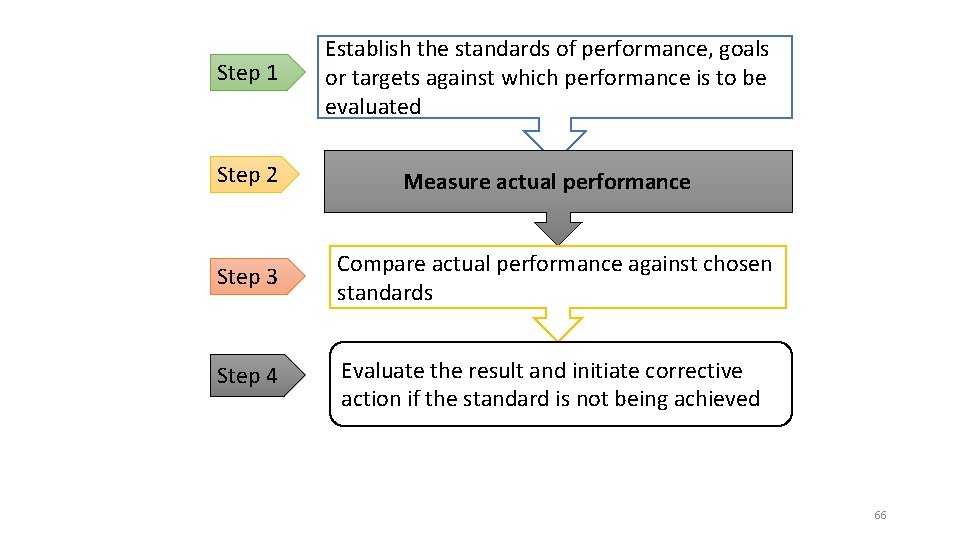
Step 1 Establish the standards of performance, goals or targets against which performance is to be evaluated Step 2 Measure actual performance Step 3 Compare actual performance against chosen standards Step 4 Evaluate the result and initiate corrective action if the standard is not being achieved 66
Feedback in the Control Process An essential element in the control process is feedback. Any feedback system must have a number of characteristics such as: Timely The information generated by the control process must be fed back in time for remedial action to be taken. Reliable Precise - should focus on those aspects of performance, which need to be addressed. Right – recipient 67
Implementation • means translating plan into action. • Plan is only useful when it ends up in implementable action. • Without implementation plans remain theoretical Techniques for improving implementation 1. The health worker(manger) should • Reviews the plan • Write detailed activities for each objective • Make the time table • Assign responsibility to staffs • Discus with community how they can participate in the implementation 2. Obtaining the necessary resources on time For example securing fund 68
Implemen… 3. Involving service managers during the planning process • Failure to involve them might lead to rejection of the plan or poor performance • Involving them would create commitment to the plan 4. Documentation • Recording and maintaining the program activities would help as a checklist for monitoring and evaluation 5. Clear plan for how to use budget for each activity 6. Developing time table for implementation of each activities The time table should state when an activity must begin and end, who is responsible and it should include column for remarks. 7. Coordinating the work of the health team To coordinate work of health team the health worker in charge must: a. Coordinate the members of health team b. Coordinate the activity c. Communicate the decision 69
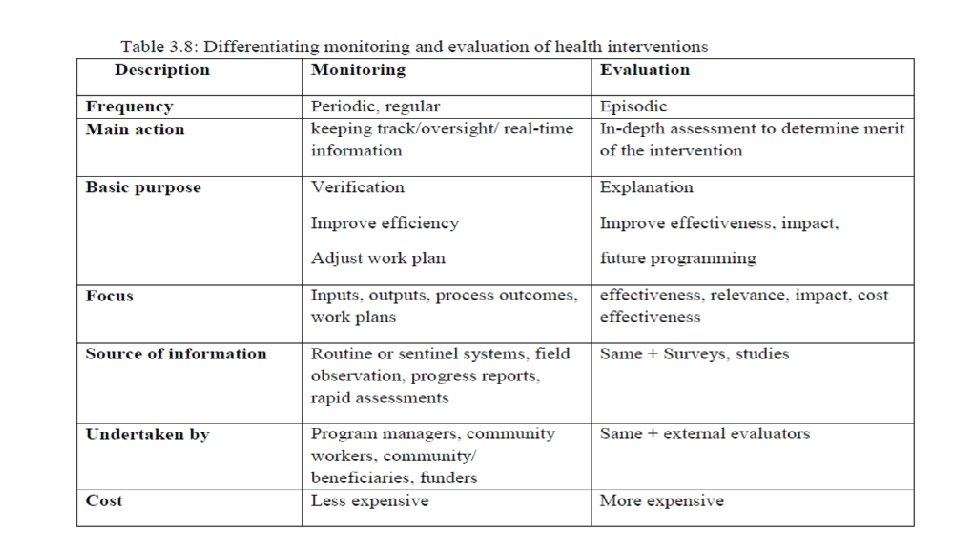
Implemen… 8. Monitoring and redirecting of activities • Monitoring is the systematic and continual collection, analysis, interpretation and use of data on key aspects of an intervention and/ or its expected results. • Monitoring is a more frequent activity and usually undertaken at operational level. 8. 1. Supervision • • It can be considered as part of monitoring It helps to ensure that personnel carry out their activities effectively and become more competent. There are three main supervision styles; • Autocratic(do what I say) • Anarchic(do what you like) • Democratic(let’s agree on what to do) The three important things of supervision • Making supervisory schedule • Planning supervisory visit • Conducting supervisory visit 70
Implemen… Poor implementation • Non implementation of inputs • Unsuccessful implementation What is the causes of poor implementation? v. Lack of relevant resources vpoor timing of inputs vresistance to change vneglect of institutional or legal requirement vpoor coordination vpoor planning 71
Monitoring and evaluating health programs The importance of monitoring and evaluation üMonitoring and evaluation are fundamental stages of good quality program management at all levels. (local, regional, national, and international) üIt provides information on the program and its effectiveness üImprove program management and the decision making process üAllows for accounting to stakeholders including donors and users of a program üProvides information for planning future resource demands üProvides useful information for elaborating policies and for advocacy Monitoring helps to check • • • If activities are completed as planned If conducted as scheduled If budgets spent as planed If any change is needed in management and in implementation If work plans need modification If work standard is maintained 72
Maintaining work standard A health worker or supervisor must be able to: ØUse checklists to observe performance and identify deficiencies ØTrace the cause of work deficiencies ØDistinguishes whether personal, technical or administrative or organizational reasons attributed to the work deficiencies ØTake corrective actions to maintain the work standard 73
Monitoring … Methods of monitoring § Continually observing § Checking supplies against inventories and stock lists § Examining records and reports § Discussing with staffs and community Steps in developing monitoring system i. Define purpose of monitoring ii. Design indicators iii. Develop monitoring plan iv. Develop monitoring format v. Develop data collection and sampling technique vi. Design how to organize and analyze vii. Plan the system of presentation and how to use the results to improve implementation 74
Evaluation • Evaluation is a systematic process of data collection and analysis about activities and/or effects of a program, looking to answer an evaluation questions. • It determines the merit or the value of the program and explains the relationship between the program and its effect. • “Evaluation is not to prove, it is to improve” (Kelloge foundation, 1998) 75
Evaluation can be divided as • summative and formative evaluation • Or it can be process, outcome and impact evaluation Evaluation is needed to answer different evaluation questions. Some of the questions are: § Was the activity worth(by doing summative evaluation) § Should the activity be continued(by doing formative evaluation) § Is the objective achieved? (by doing objective oriented evaluation) § Should the program adopted elsewhere? (by doing either summative or formative evaluation) 76
Evaluation terminology Input –resources used in the program. They include financial, human and material resources. Activity—program procedures that are implemented to obtain the desired effect. Output—are the immediate consequence of the inputs utilized and the program conducted. Outcomes--- effects upon target population that can lead to the intended ultimate goal of a program. The effects include several types and may focus on awareness, attitude, behavior, utilization, etc. Impact ---are related to long term accumulative effects of a program. It is rarely attributed to a single program or intervention. Indicators--Quantitative or qualitative factor or variable that provides a simple and reliable basis for assessing achievement, change or performance 77
78
- Slides: 78