
Kamran Shamaei Yale University Mechanical Engineering SubjectSpecific Predictive
Kamran Shamaei Yale University Mechanical Engineering Subject-Specific Predictive Models of Lower-limb Joint Quasi-Stiffness and Applications in Exoskeleton Design Kamran Shamaei Prof. Gregory S. Sawicki Prof. Aaron M. Dollar
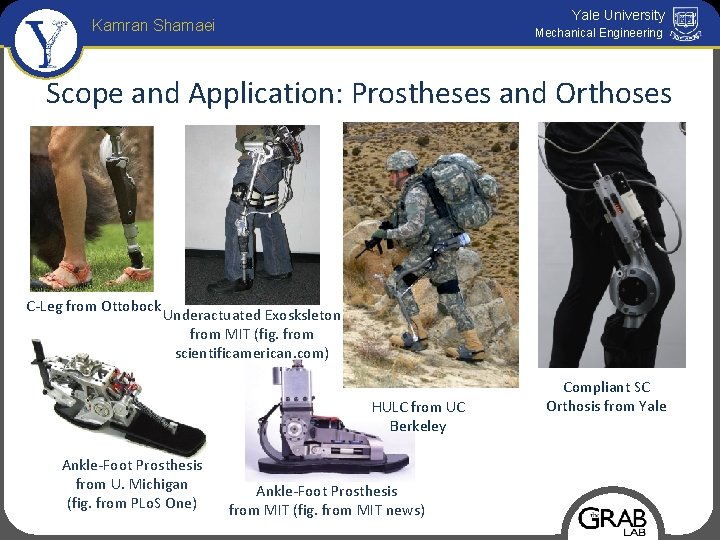
Yale University Kamran Shamaei Mechanical Engineering Scope and Application: Prostheses and Orthoses C-Leg from Ottobock Underactuated Exosksleton from MIT (fig. from scientificamerican. com) HULC from UC Berkeley Ankle-Foot Prosthesis from U. Michigan (fig. from PLo. S One) Ankle-Foot Prosthesis from MIT (fig. from MIT news) Compliant SC Orthosis from Yale
Kamran Shamaei Yale University Mechanical Engineering Challenge: How to size the components of these devices for a specific user size and gait speed?
Kamran Shamaei Yale University Mechanical Engineering Common Approach: Use average values for joint stiffnesses obtained from gait lab data for a randomized sample population
Yale University Kamran Shamaei Mechanical Engineering Drawbacks • Sample population body stature is not necessarily representative of the user’s • Costly and time-consuming • Design centers usually do not have a gait lab
Yale University Kamran Shamaei Mechanical Engineering Drawbacks • Sample population body stature is not necessarily representative of the user’s • Costly and time-consuming • Design centers usually do not have a gait lab
Yale University Kamran Shamaei Mechanical Engineering Drawbacks • Sample population body stature is not necessarily representative of the user’s • Costly and time-consuming • Design centers usually do not have a gait lab

Kamran Shamaei Yale University Mechanical Engineering Alternative Framework
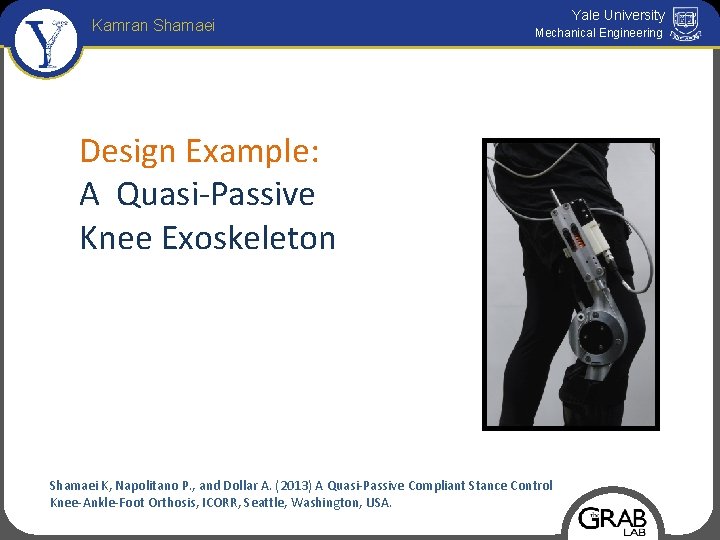
Kamran Shamaei Yale University Mechanical Engineering Design Example: A Quasi-Passive Knee Exoskeleton Shamaei K, Napolitano P. , and Dollar A. (2013) A Quasi-Passive Compliant Stance Control Knee-Ankle-Foot Orthosis, ICORR, Seattle, Washington, USA.
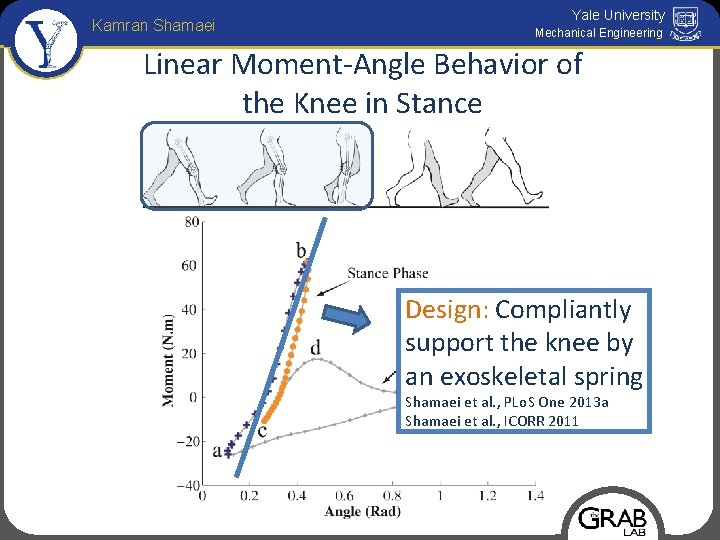
Kamran Shamaei Yale University Mechanical Engineering Linear Moment-Angle Behavior of the Knee in Stance Design: Compliantly support the knee by an exoskeletal spring Shamaei et al. , PLo. S One 2013 a Shamaei et al. , ICORR 2011
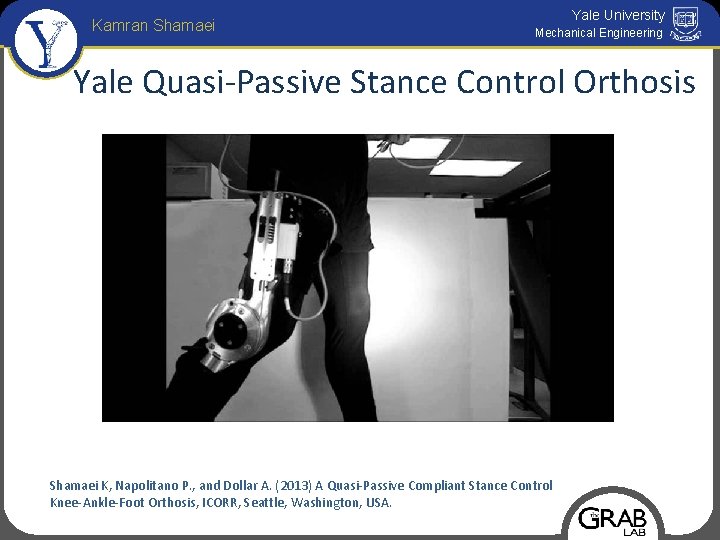
Kamran Shamaei Yale University Mechanical Engineering Yale Quasi-Passive Stance Control Orthosis Shamaei K, Napolitano P. , and Dollar A. (2013) A Quasi-Passive Compliant Stance Control Knee-Ankle-Foot Orthosis, ICORR, Seattle, Washington, USA.
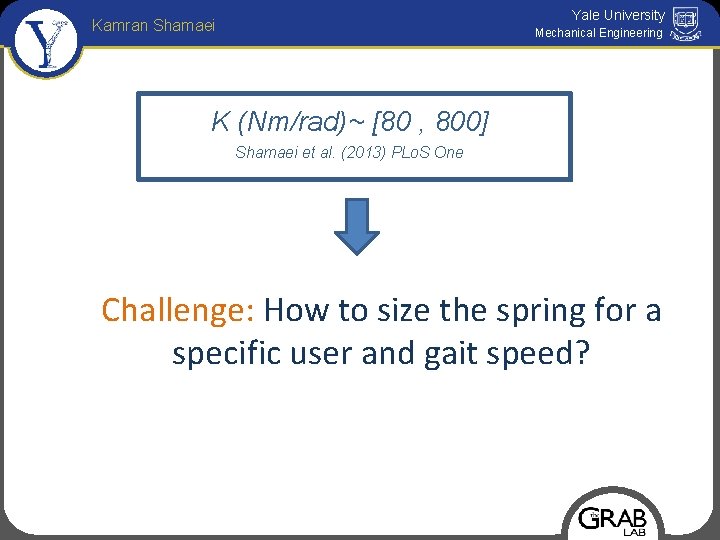
Yale University Kamran Shamaei Mechanical Engineering K (Nm/rad)~ [80 , 800] Shamaei et al. (2013) PLo. S One Challenge: How to size the spring for a specific user and gait speed?
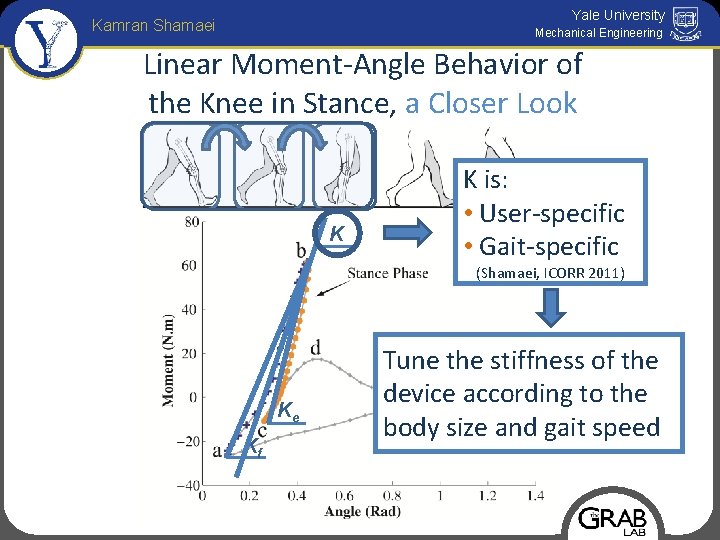
Yale University Kamran Shamaei Mechanical Engineering Linear Moment-Angle Behavior of the Knee in Stance, a Closer Look K K is: • User-specific • Gait-specific (Shamaei, ICORR 2011) Ke Kf Tune the stiffness of the device according to the body size and gait speed
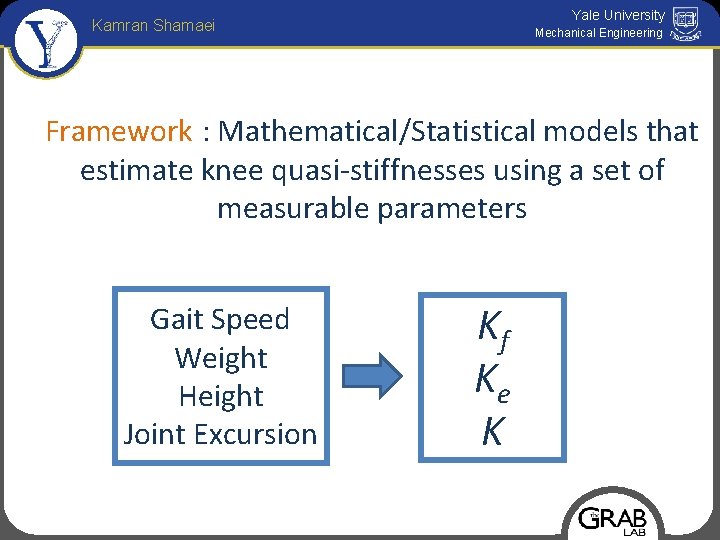
Yale University Kamran Shamaei Mechanical Engineering Framework : Mathematical/Statistical models that estimate knee quasi-stiffnesses using a set of measurable parameters Gait Speed Weight Height Joint Excursion Kf Ke K
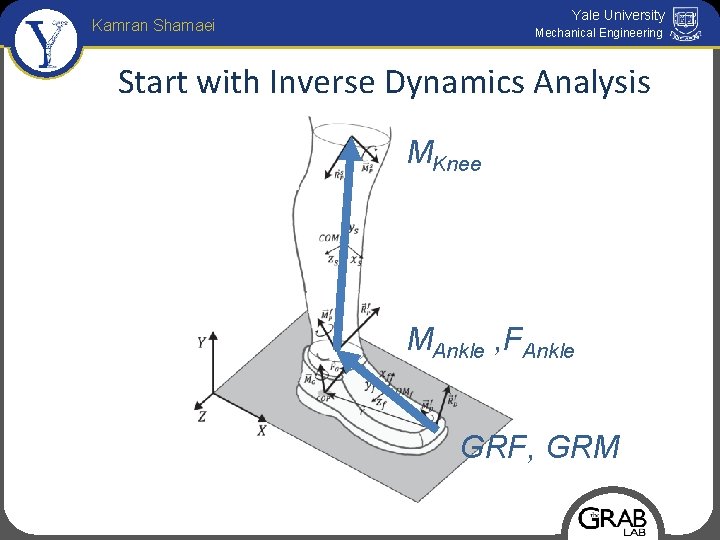
Yale University Kamran Shamaei Mechanical Engineering Start with Inverse Dynamics Analysis MKnee MAnkle , FAnkle GRF, GRM
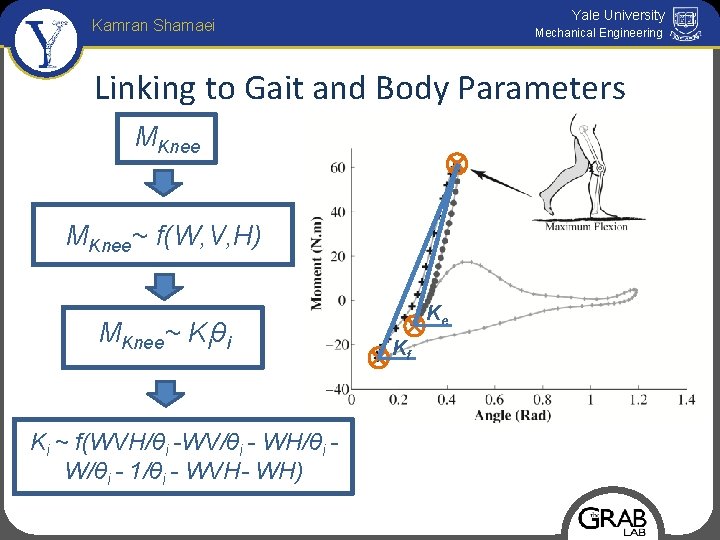
Yale University Kamran Shamaei Mechanical Engineering Linking to Gait and Body Parameters MKnee~ f(W, V, H) MKnee~ Kiθi Ki ~ f(WVH/θi -WV/θi - WH/θi W/θi - 1/θi - WVH- WH) Ke Kf
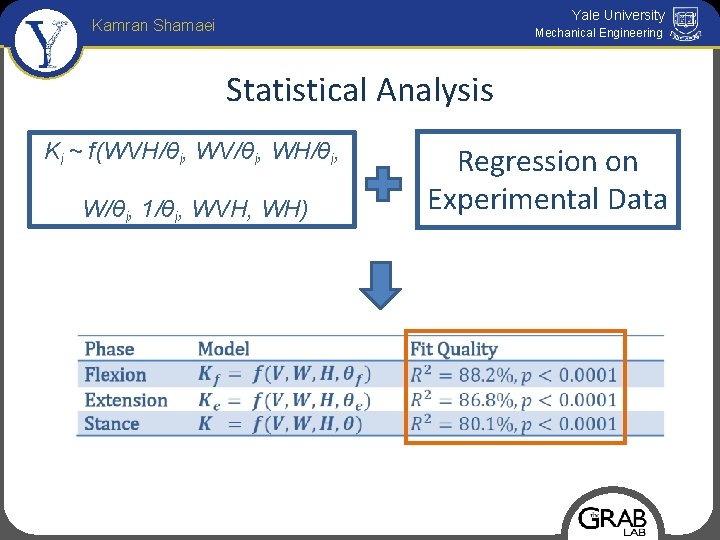
Yale University Kamran Shamaei Mechanical Engineering Statistical Analysis Ki ~ f(WVH/θi, WV/θi, WH/θi, W/θi, 1/θi, WVH, WH) Regression on Experimental Data
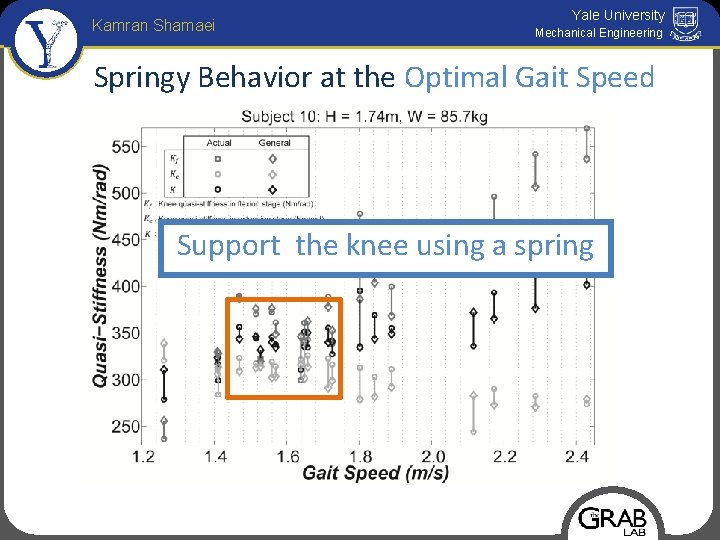
Kamran Shamaei Yale University Mechanical Engineering Springy Behavior at the Optimal Gait Speed Support the knee using a spring
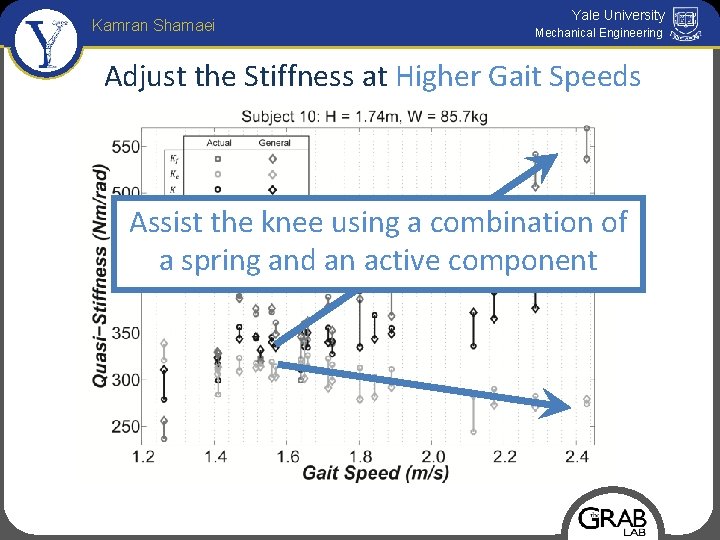
Kamran Shamaei Yale University Mechanical Engineering Adjust the Stiffness at Higher Gait Speeds Assist the knee using a combination of a spring and an active component
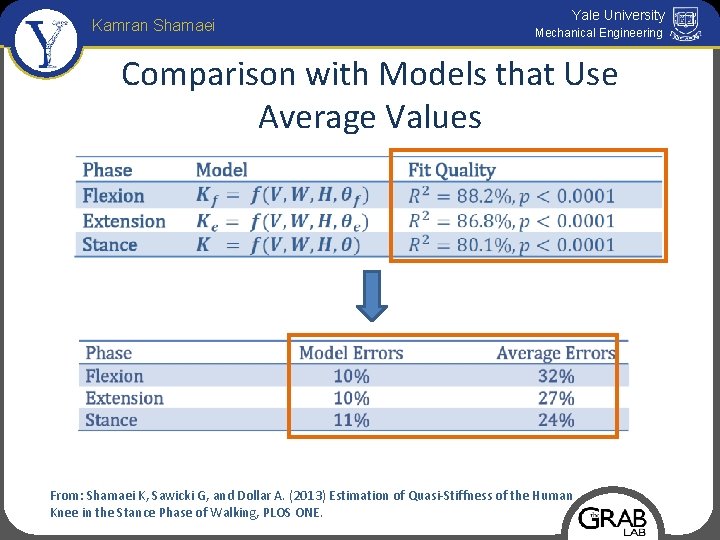
Kamran Shamaei Yale University Mechanical Engineering Comparison with Models that Use Average Values From: Shamaei K, Sawicki G, and Dollar A. (2013) Estimation of Quasi-Stiffness of the Human Knee in the Stance Phase of Walking, PLOS ONE.
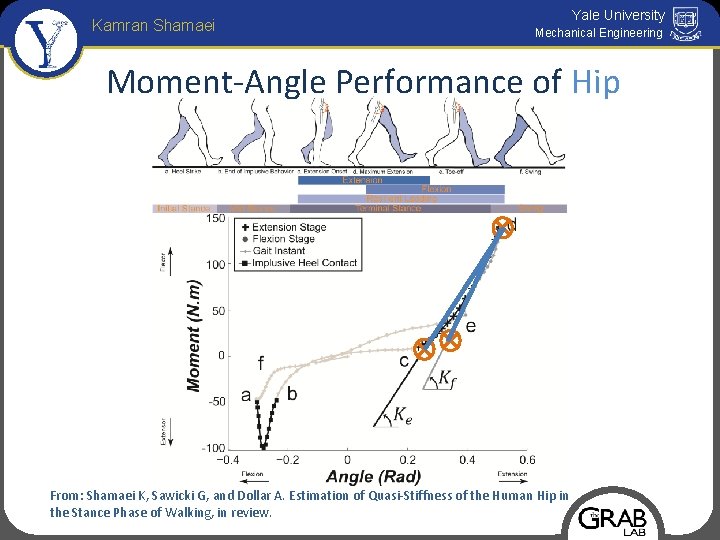
Kamran Shamaei Yale University Mechanical Engineering Moment-Angle Performance of Hip From: Shamaei K, Sawicki G, and Dollar A. Estimation of Quasi-Stiffness of the Human Hip in the Stance Phase of Walking, in review.
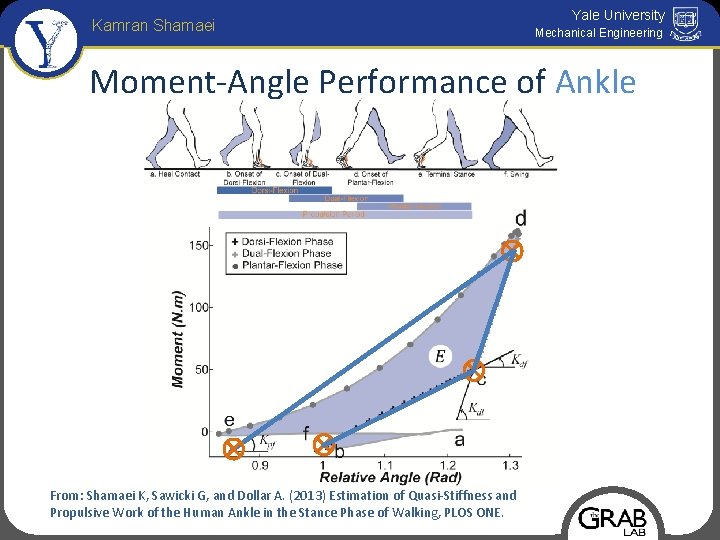
Kamran Shamaei Yale University Mechanical Engineering Moment-Angle Performance of Ankle From: Shamaei K, Sawicki G, and Dollar A. (2013) Estimation of Quasi-Stiffness and Propulsive Work of the Human Ankle in the Stance Phase of Walking, PLOS ONE.
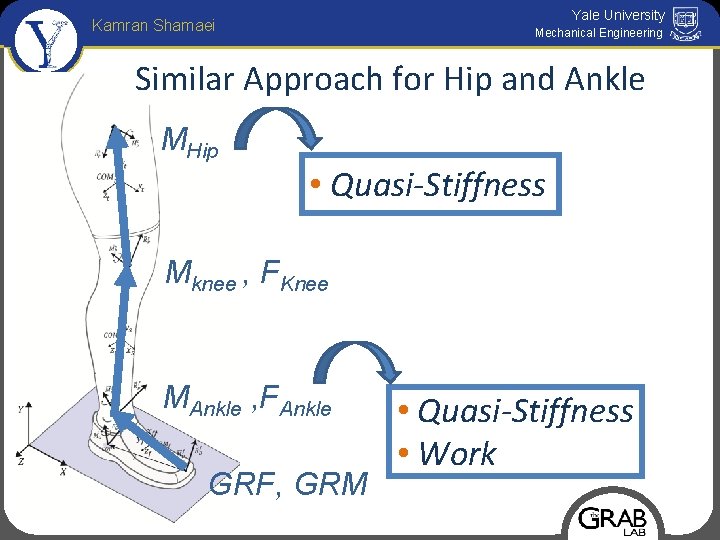
Yale University Kamran Shamaei Mechanical Engineering Similar Approach for Hip and Ankle MHip • Quasi-Stiffness Mknee , FKnee MAnkle , FAnkle GRF, GRM • Quasi-Stiffness • Work
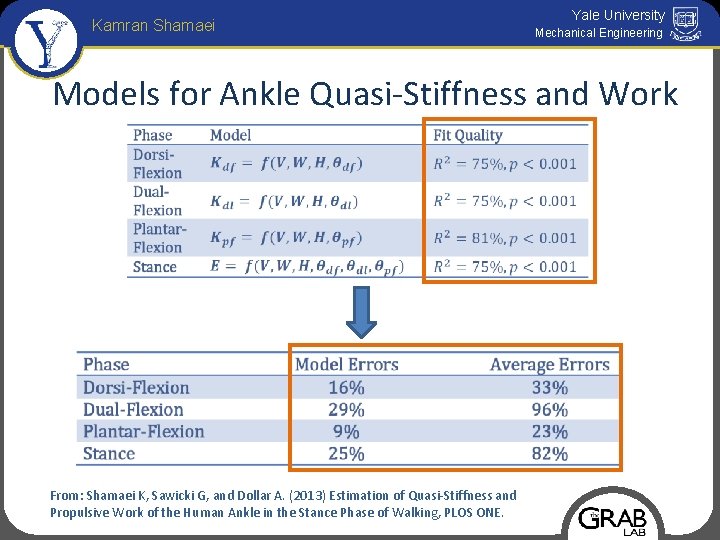
Kamran Shamaei Yale University Mechanical Engineering Models for Ankle Quasi-Stiffness and Work From: Shamaei K, Sawicki G, and Dollar A. (2013) Estimation of Quasi-Stiffness and Propulsive Work of the Human Ankle in the Stance Phase of Walking, PLOS ONE.
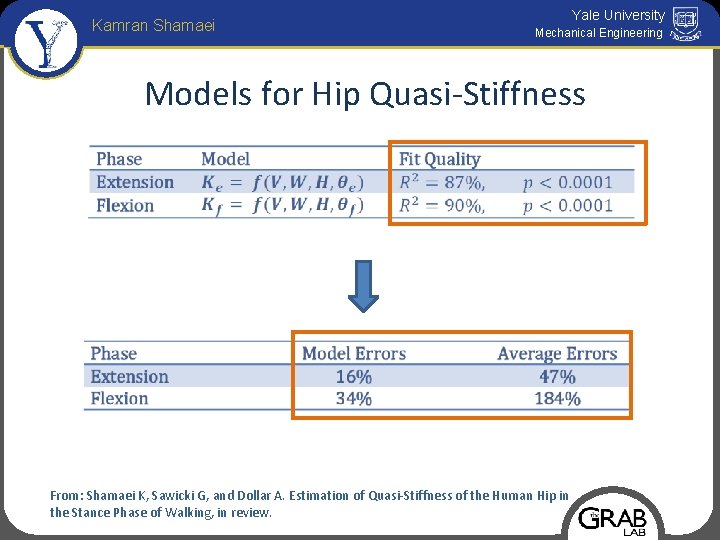
Kamran Shamaei Yale University Mechanical Engineering Models for Hip Quasi-Stiffness From: Shamaei K, Sawicki G, and Dollar A. Estimation of Quasi-Stiffness of the Human Hip in the Stance Phase of Walking, in review.
Yale University Kamran Shamaei Mechanical Engineering Conclusions • Models accurately predict the stiffnesses compared with average values • Utilize these equations in design of exoskeletons and prostheses • Ideally adjust the stiffness of the device according to the gait speed
Yale University Kamran Shamaei Mechanical Engineering Conclusions • Models accurately predict the stiffnesses compared with average values • Utilize these equations in design of exoskeletons and prostheses • Ideally adjust the stiffness of the device according to the gait speed
Yale University Kamran Shamaei Mechanical Engineering Conclusions • Models accurately predict the stiffnesses compared with average values • Utilize these equations in design of exoskeletons and prostheses • Ideally adjust the stiffness of the device according to the gait speed
Kamran Shamaei Yale University Mechanical Engineering Thanks for Your Attention • Experimental data: • 26 subjects • 216 gait cycles • Gait speed (m/s): [0. 75 , 2. 63] • Height (m): [1. 45 , 1. 86] • Weight (kg): [57. 7 , 94. 0] • Data granted by: Prof. De. Vita, Prof. Sawicki, and Prof. Frigo • Funding: US Defense Medical Research and Development Program, grant #W 81 XWH-11 -2 -0054
- Slides: 29