Pushdown Automata Part I PDAs Chapter 12 1






- Slides: 38
Pushdown Automata Part I: PDAs Chapter 12 1
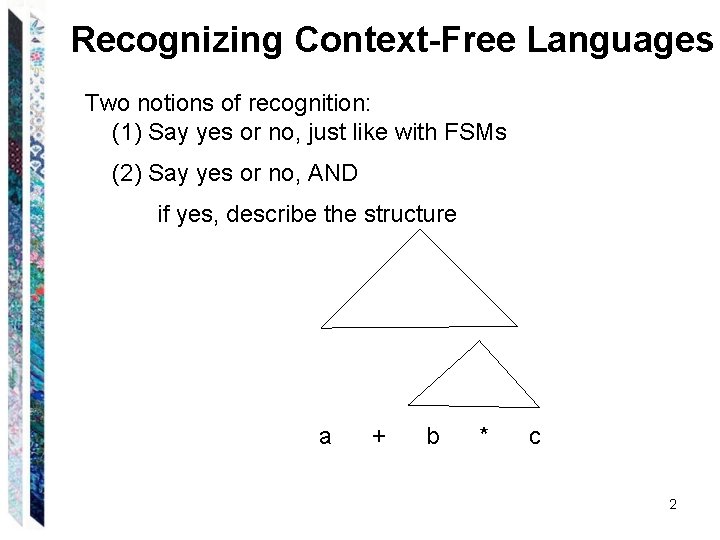
Recognizing Context-Free Languages Two notions of recognition: (1) Say yes or no, just like with FSMs (2) Say yes or no, AND if yes, describe the structure a + b * c 2
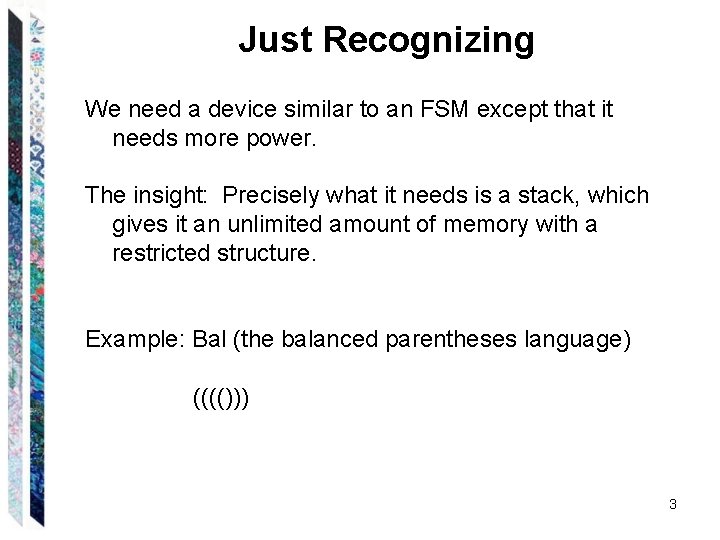
Just Recognizing We need a device similar to an FSM except that it needs more power. The insight: Precisely what it needs is a stack, which gives it an unlimited amount of memory with a restricted structure. Example: Bal (the balanced parentheses language) (((())) 3
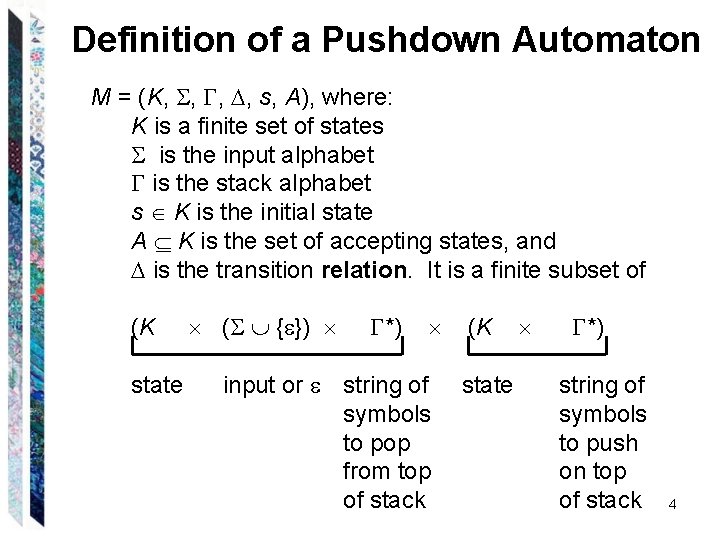
Definition of a Pushdown Automaton M = (K, , s, A), where: K is a finite set of states is the input alphabet is the stack alphabet s K is the initial state A K is the set of accepting states, and is the transition relation. It is a finite subset of (K state ( { }) *) input or string of symbols to pop from top of stack (K state *) string of symbols to push on top of stack 4
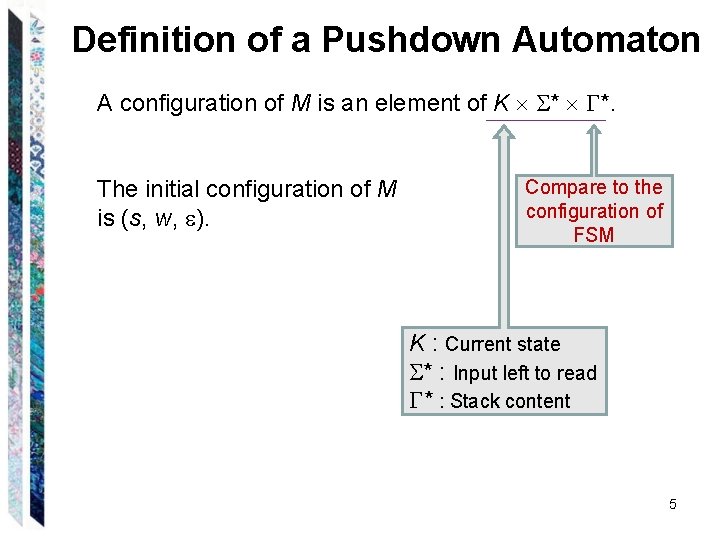
Definition of a Pushdown Automaton A configuration of M is an element of K * *. The initial configuration of M is (s, w, ). Compare to the configuration of FSM K : Current state * : Input left to read * : Stack content 5
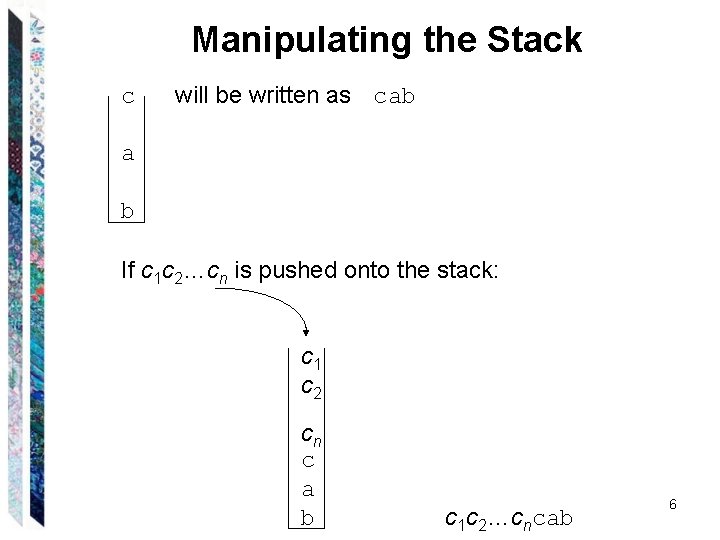
Manipulating the Stack c will be written as cab a b If c 1 c 2…cn is pushed onto the stack: c 1 c 2 cn c a b c 1 c 2…cncab 6
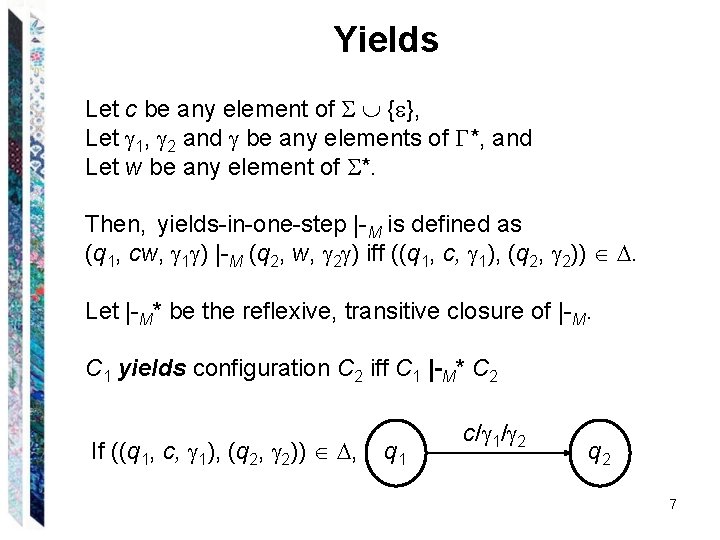
Yields Let c be any element of { }, Let 1, 2 and be any elements of *, and Let w be any element of *. Then, yields-in-one-step |-M is defined as (q 1, cw, 1 ) |-M (q 2, w, 2 ) iff ((q 1, c, 1), (q 2, 2)) . Let |-M* be the reflexive, transitive closure of |-M. C 1 yields configuration C 2 iff C 1 |-M* C 2 If ((q 1, c, 1), (q 2, 2)) , q 1 c/ 1/ 2 q 2 7
Computations A computation by M is a finite sequence of configurations C 0, C 1, …, Cn for some n 0 such that: ● C 0 is an initial configuration, is of the form (q, , ), for some state q KM and some string in *, and ● Cn ● C 0 |-M C 1 |-M C 2 |-M … |-M Cn. 8
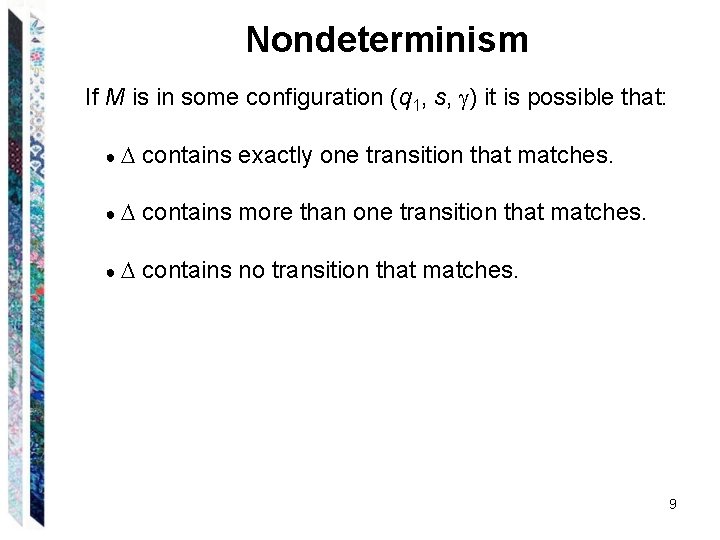
Nondeterminism If M is in some configuration (q 1, s, ) it is possible that: ● contains exactly one transition that matches. ● contains more than one transition that matches. ● contains no transition that matches. 9
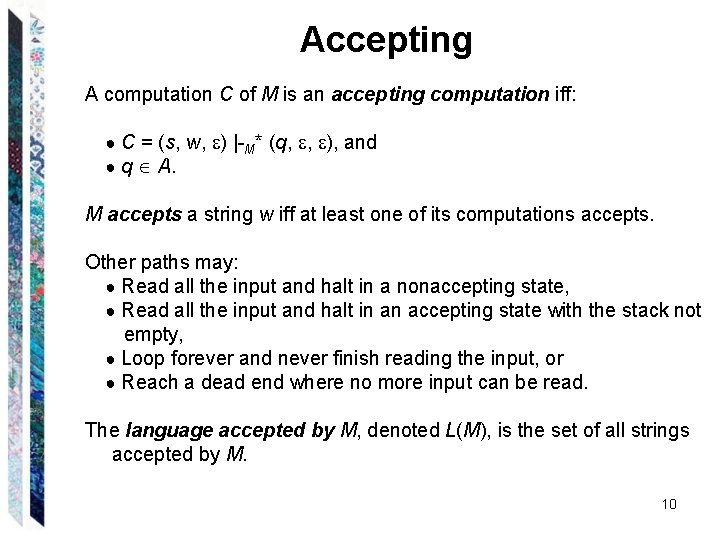
Accepting A computation C of M is an accepting computation iff: ● C = (s, w, ) |-M* (q, , ), and ● q A. M accepts a string w iff at least one of its computations accepts. Other paths may: ● Read all the input and halt in a nonaccepting state, ● Read all the input and halt in an accepting state with the stack not empty, ● Loop forever and never finish reading the input, or ● Reach a dead end where no more input can be read. The language accepted by M, denoted L(M), is the set of all strings accepted by M. 10
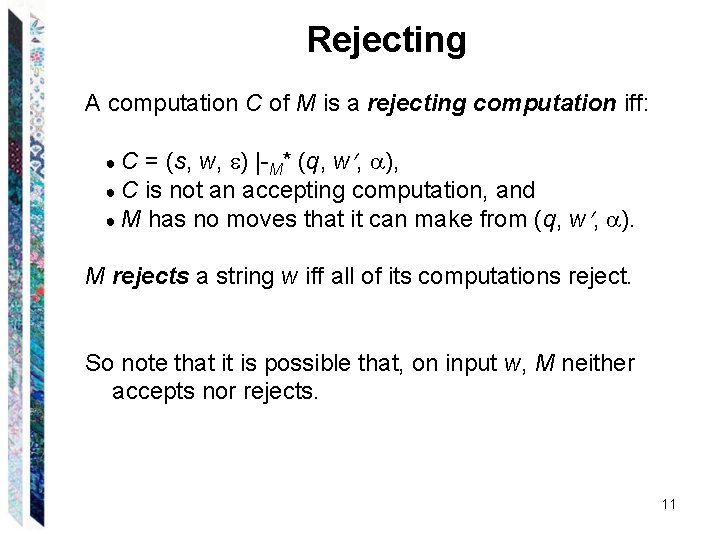
Rejecting A computation C of M is a rejecting computation iff: = (s, w, ) |-M* (q, w , ), ● C is not an accepting computation, and ● M has no moves that it can make from (q, w , ). ●C M rejects a string w iff all of its computations reject. So note that it is possible that, on input w, M neither accepts nor rejects. 11
A PDA for Balanced Parentheses 12
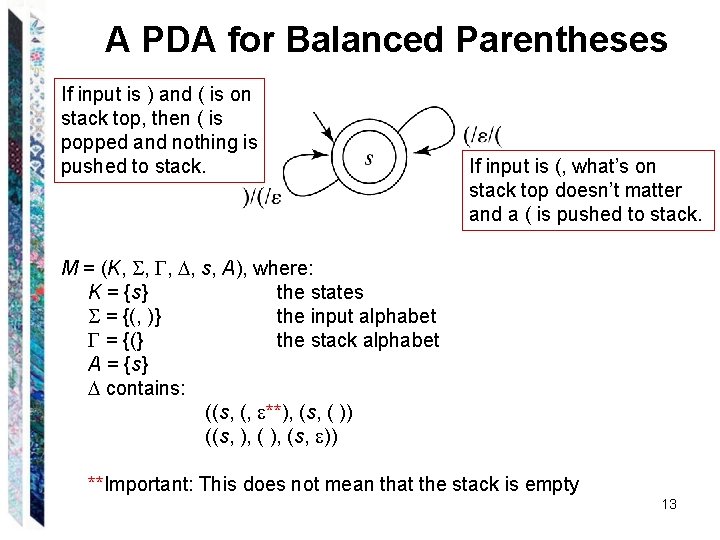
A PDA for Balanced Parentheses If input is ) and ( is on stack top, then ( is popped and nothing is pushed to stack. If input is (, what’s on stack top doesn’t matter and a ( is pushed to stack. M = (K, , s, A), where: K = {s} the states = {(, )} the input alphabet = {(} the stack alphabet A = {s} contains: ((s, (, **), (s, ( )) ((s, ), (s, )) **Important: This does not mean that the stack is empty 13
A PDA for An. Bn = {anbn: n 0} 14
A PDA for An. Bn = {anbn: n 0} M = (K, , s, A), where: K = {s, f} the states = {a, b} the input alphabet = {a} the stack alphabet A = {f} the accepting states contains: ((s, a, ), (s, a)) ((s, b, a), (f, )) ((f, b, a), (f, )) 15
A PDA for {wcw. R: w {a, b}*} 16
A PDA for {wcw. R: w {a, b}*} M = (K, , s, A), where: K = {s, f} the states = {a, b, c} the input alphabet = {a, b} the stack alphabet A = {f} the accepting states contains: ((s, a, ), (s, a)) ((s, b, ), (s, b)) ((s, c, ), (f, )) ((f, a, a), (f, )) ((f, b, b), (f, )) 17
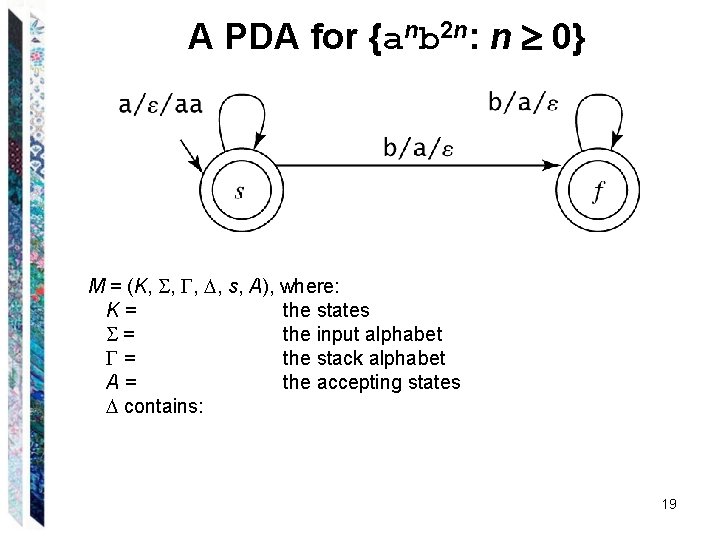
A PDA for {anb 2 n: n 0} 18
A PDA for {anb 2 n: n 0} M = (K, , s, A), where: K= the states = the input alphabet = the stack alphabet A= the accepting states contains: 19
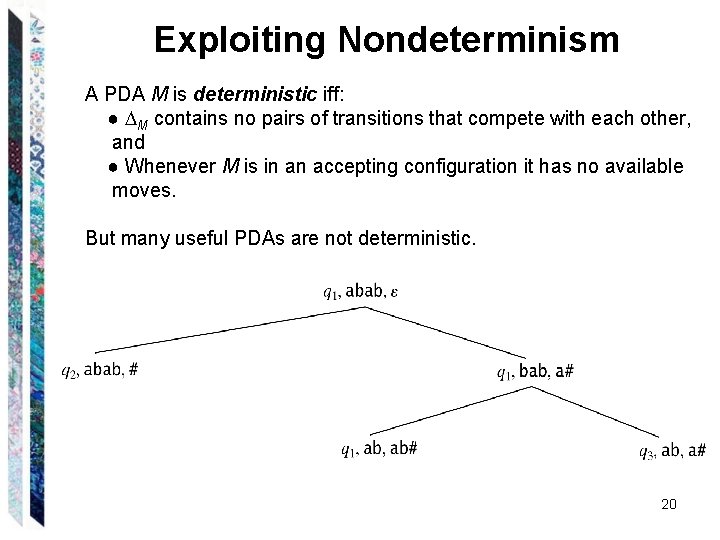
Exploiting Nondeterminism A PDA M is deterministic iff: ● M contains no pairs of transitions that compete with each other, and ● Whenever M is in an accepting configuration it has no available moves. But many useful PDAs are not deterministic. 20
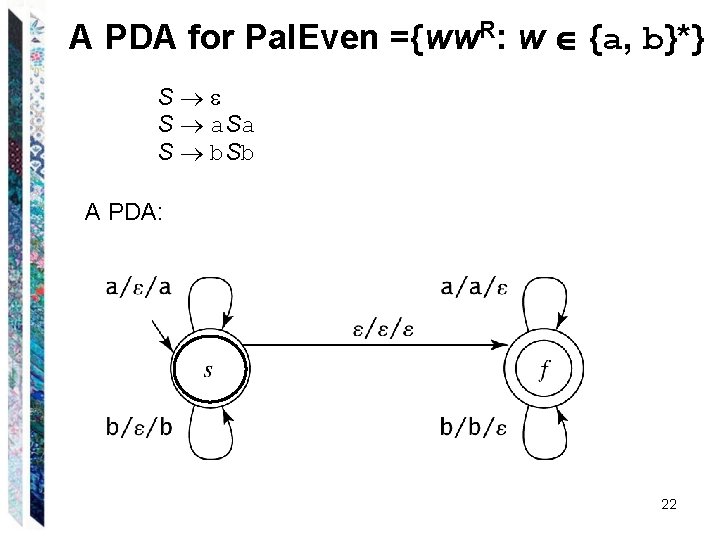
A PDA for Pal. Even ={ww. R: w {a, b}*} S S a. Sa S b. Sb A PDA: 21
A PDA for Pal. Even ={ww. R: w {a, b}*} S S a. Sa S b. Sb A PDA: 22
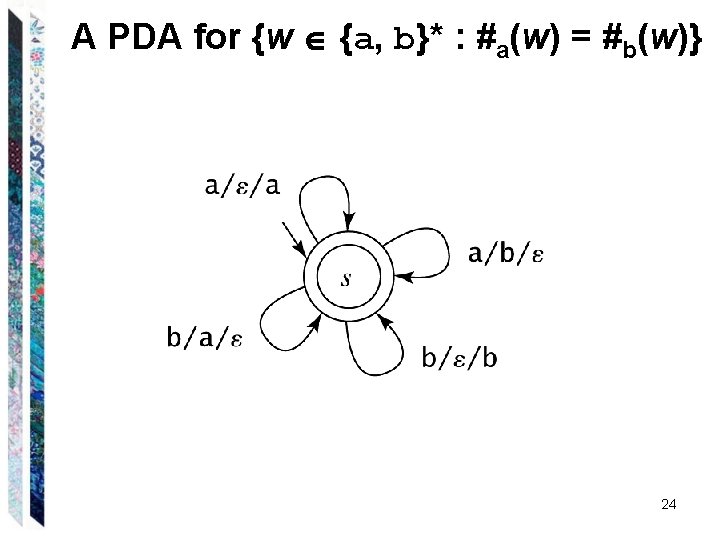
A PDA for {w {a, b}* : #a(w) = #b(w)} 23
A PDA for {w {a, b}* : #a(w) = #b(w)} 24
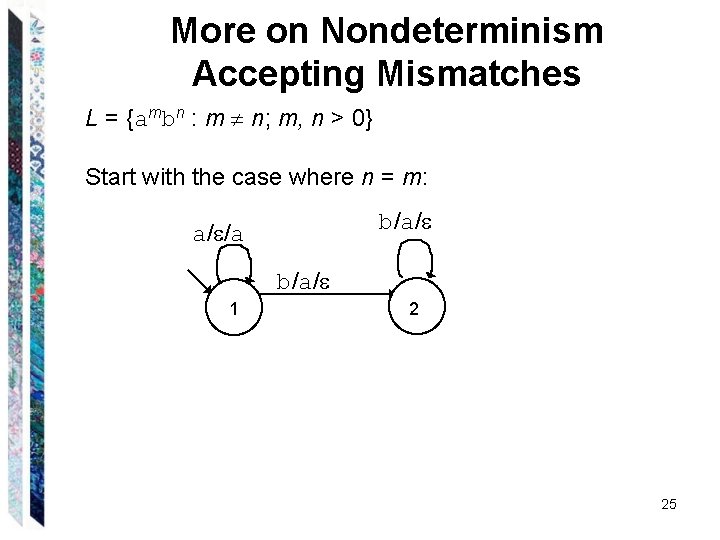
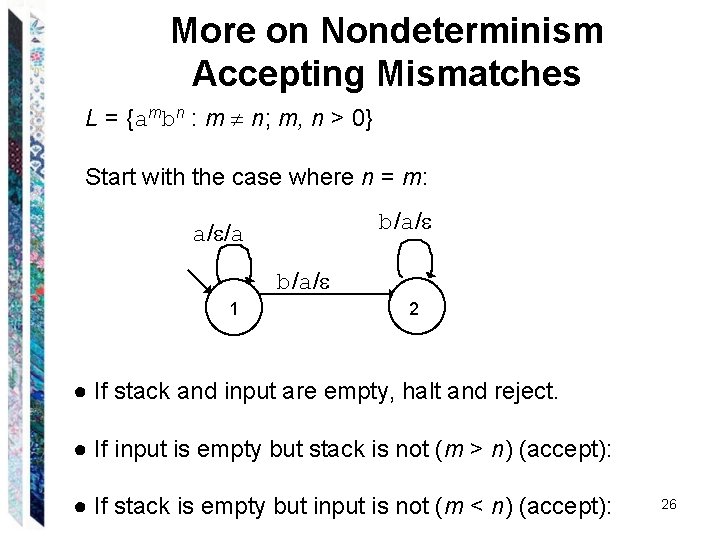
More on Nondeterminism Accepting Mismatches L = {ambn : m n; m, n > 0} Start with the case where n = m: b/a/ a/ /a b/a/ 1 2 25
More on Nondeterminism Accepting Mismatches L = {ambn : m n; m, n > 0} Start with the case where n = m: b/a/ a/ /a b/a/ 1 2 ● If stack and input are empty, halt and reject. ● If input is empty but stack is not (m > n) (accept): ● If stack is empty but input is not (m < n) (accept): 26
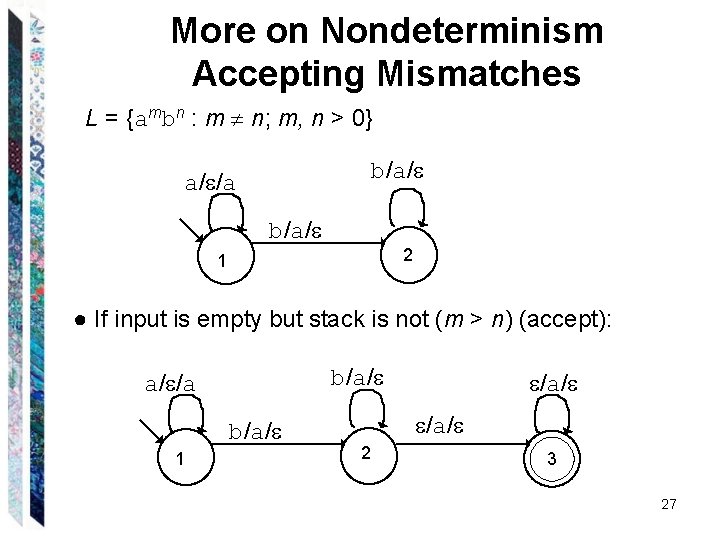
More on Nondeterminism Accepting Mismatches L = {ambn : m n; m, n > 0} b/a/ a/ /a b/a/ 2 1 ● If input is empty but stack is not (m > n) (accept): b/a/ a/ /a b/a/ 1 /a/ 2 3 27
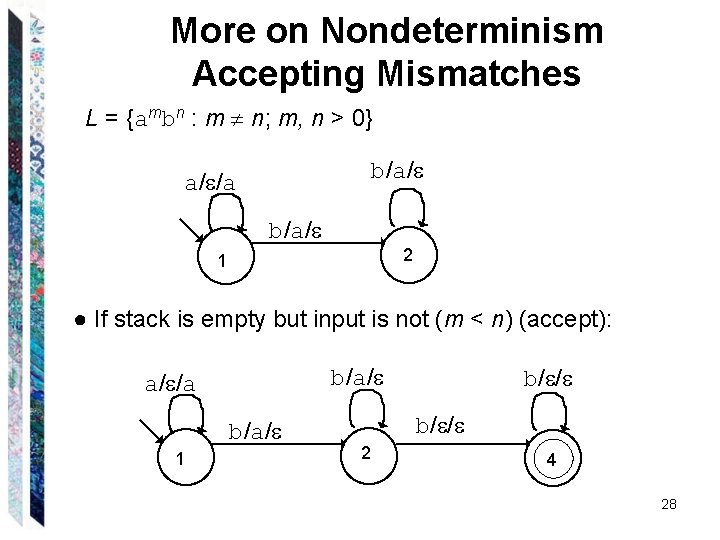
More on Nondeterminism Accepting Mismatches L = {ambn : m n; m, n > 0} b/a/ a/ /a b/a/ 2 1 ● If stack is empty but input is not (m < n) (accept): b/a/ a/ /a b/a/ 1 b/ / 2 4 28
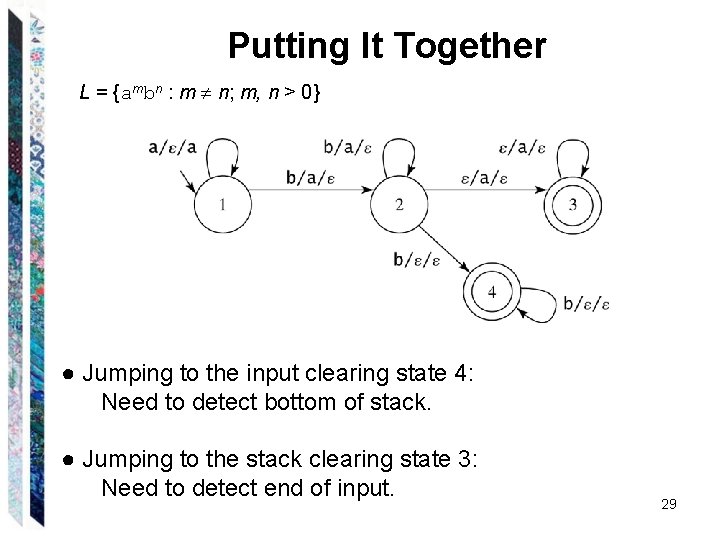
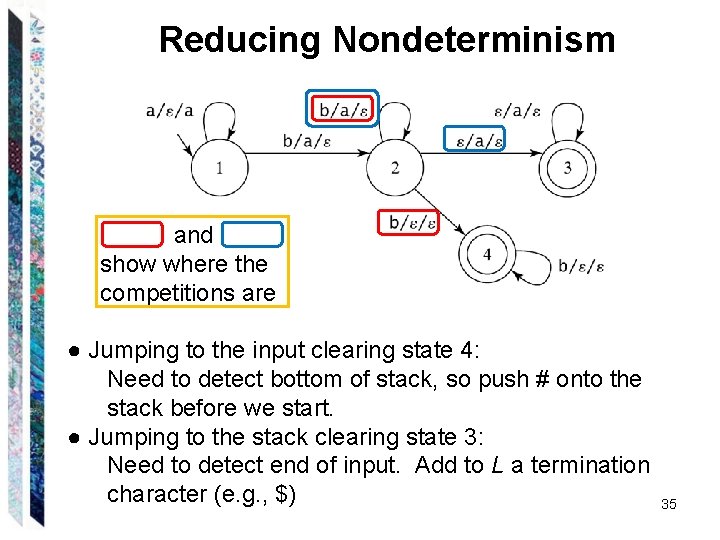
Putting It Together L = {ambn : m n; m, n > 0} ● Jumping to the input clearing state 4: Need to detect bottom of stack. ● Jumping to the stack clearing state 3: Need to detect end of input. 29
The Power of Nondeterminism Consider An. Bn. Cn = {anbncn: n 0}. PDA for it? 30
The Power of Nondeterminism Consider An. Bn. Cn = {anbncn: n 0}. Now consider L = An. Bn. Cn. L is the union of two languages: 1. {w {a, b, c}* : the letters are out of order}, and 2. {aibjck: i, j, k 0 and (i j or j k)} (in other words, unequal numbers of a’s, b’s, and c’s). 31
A PDA for L = An. Bn. Cn What is it? 32
Are the Context-Free Languages Closed Under Complement? An. Bn. Cn is context free. If the CF languages were closed under complement, then An. Bn. Cn = An. Bn. Cn would also be context-free. But we will prove that it is not. 33
L = {anbmcp: n, m, p 0 and n m or m p} S NC S QP N A N B A a A a. Ab B Bb B a. Bb C | c. C P B' P C' B' b. B'c C' c | C'c C' b. C'c Q | a. Q /* n m, then arbitrary c's /* arbitrary a's, then p m /* more a's than b's /* more b's than a's /* add any number of c's /* more b's than c's /* more c's than b's /* prefix with any number of a's 34
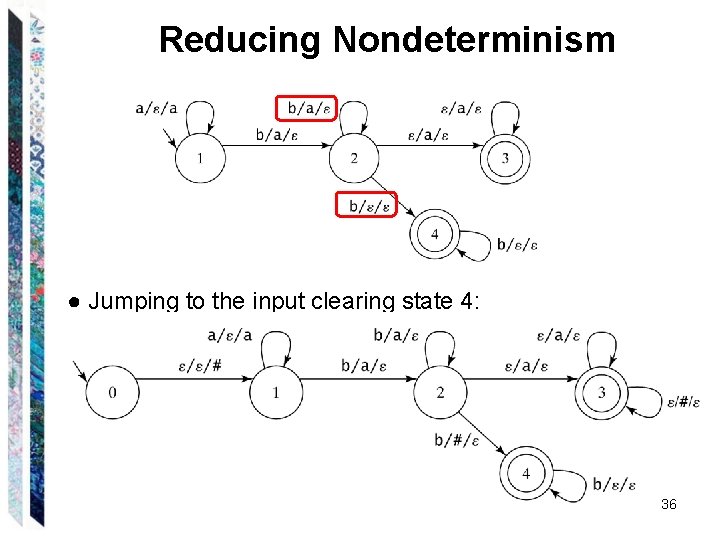
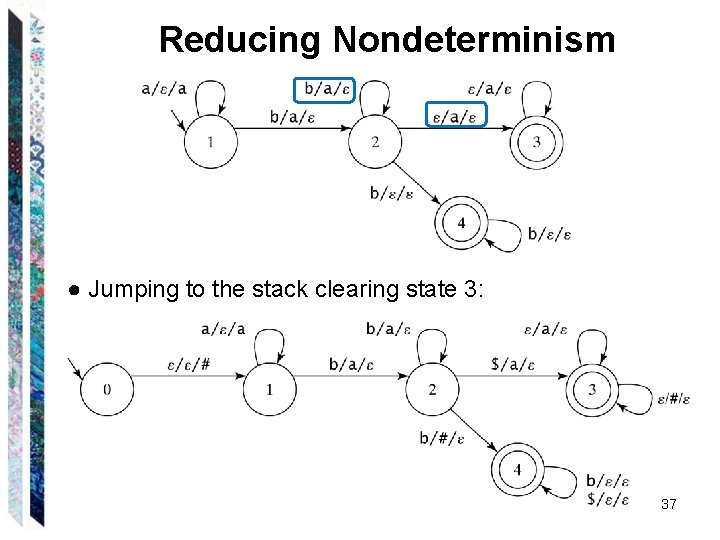
Reducing Nondeterminism and show where the competitions are ● Jumping to the input clearing state 4: Need to detect bottom of stack, so push # onto the stack before we start. ● Jumping to the stack clearing state 3: Need to detect end of input. Add to L a termination character (e. g. , $) 35
Reducing Nondeterminism ● Jumping to the input clearing state 4: 36
Reducing Nondeterminism ● Jumping to the stack clearing state 3: 37
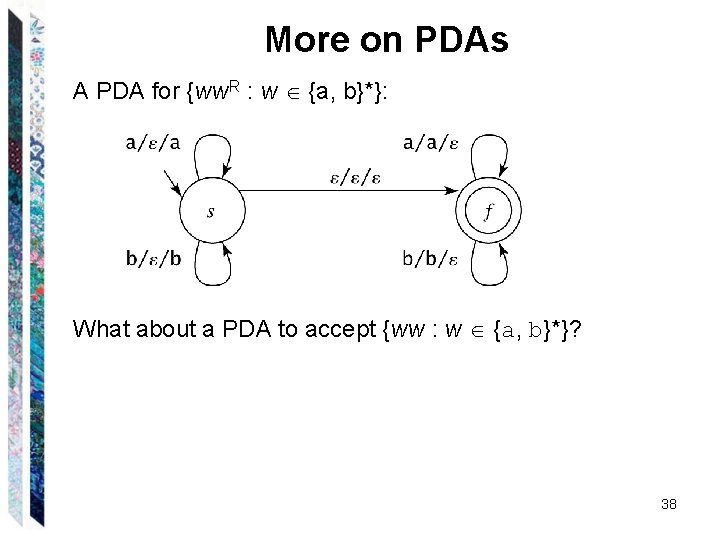
More on PDAs A PDA for {ww. R : w {a, b}*}: What about a PDA to accept {ww : w {a, b}*}? 38