Pushdown automata Programming Language Design and Implementation 4

- Slides: 11
Pushdown automata • Programming Language Design and Implementation (4 th Edition) • by T. Pratt and M. Zelkowitz • Prentice Hall, 2001 • Section 3. 3. 4 - 4. 1
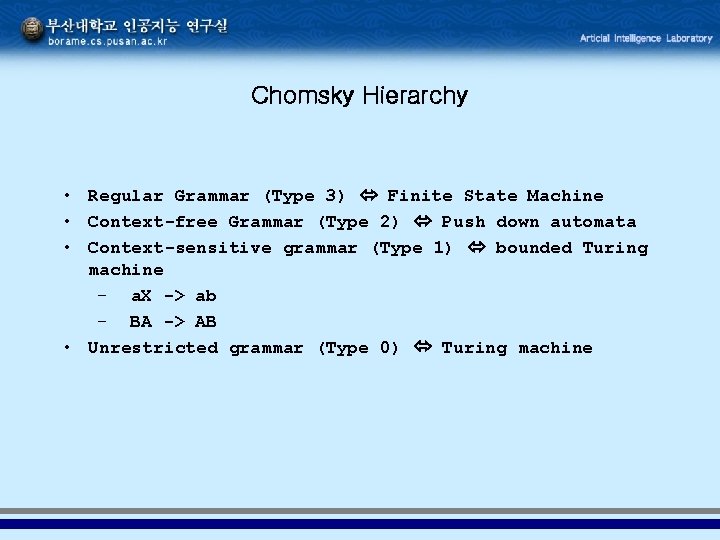
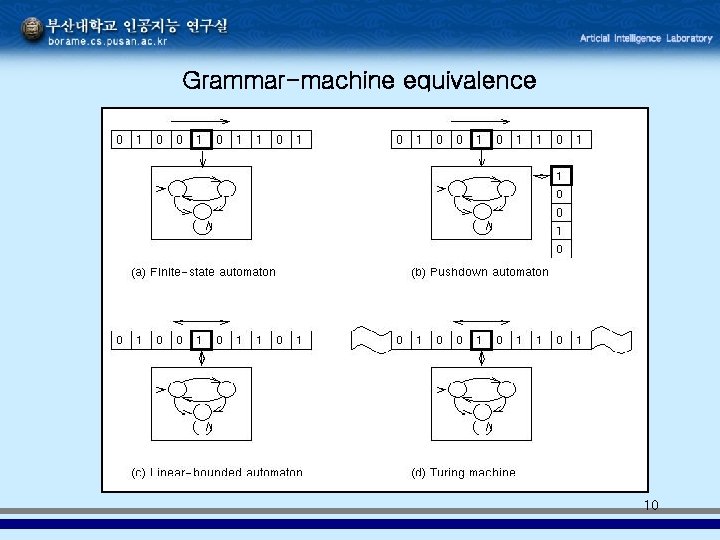
Chomsky Hierarchy • Regular Grammar (Type 3) Finite State Machine • Context-free Grammar (Type 2) Push down automata • Context-sensitive grammar (Type 1) bounded Turing machine – a. X -> ab – BA -> AB • Unrestricted grammar (Type 0) Turing machine
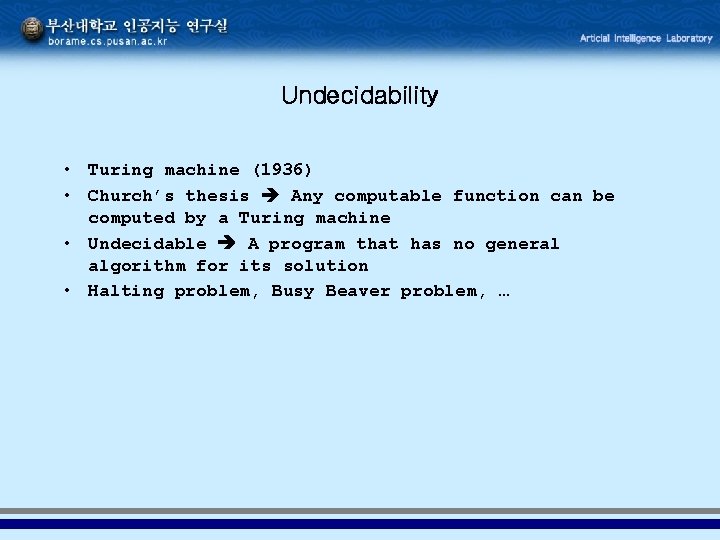
Undecidability • Turing machine (1936) • Church’s thesis Any computable function can be computed by a Turing machine • Undecidable A program that has no general algorithm for its solution • Halting problem, Busy Beaver problem, …
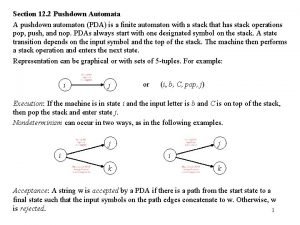
Pushdown Automaton • A pushdown automaton (PDA) is an abstract model machine similar to the FSA • It has a finite set of states. However, in addition, it has a pushdown stack. Moves of the PDA are as follows: • 1. An input symbol is read and the top symbol on the stack is read. • 2. Based on both inputs, the machine enters a new state and writes zero or more symbols onto the pushdown stack. • 3. Acceptance of a string occurs if the stack is ever empty. (Alternatively, acceptance can be if the PDA is in a final state. Both models can be shown to be equivalent. )
Power of PDAs • PDAs are more powerful than FSAs. • anbn, which cannot be recognized by an FSA, can easily be recognized by the PDA. • Stack all a symbols and, for each b, pop an a off the stack. • If the end of input is reached at the same time that the stack becomes empty, the string is accepted. • It is less clear that the languages accepted by • PDAs are equivalent to the context-free languages.
PDAs to produce derivation strings • Given some BNF (context free grammar). Produce the leftmost derivation of a string using a PDA: • 1. If the top of the stack is a terminal symbol, compare it to the next input symbol; pop it off the stack if the same. It is an error if the symbols do not match. • 2. If the top of the stack is a nonterminal symbol X, replace X on the stack with some string , where is the right hand side of some production X . • This PDA now simulates the leftmost derivation for some context-free grammar. • This construction actually develops a nondeterministic PDA that is equivalent to the corresponding BNF grammar. (i. e. , step 2 may have multiple options. )
NDPDAs are different from DPDAs • • What is the relationship between deterministic PDAs and nondeterministic PDAs? They are different. • Consider the set of palindromes, strings reading the same forward and backward, generated by the grammar S 0 S 0 | 1 S 1 | 2 We can recognize such strings by a deterministic PDA: – 1. Stack all 0 s and 1 s as read. – 2. Enter a new state upon reading a 2. – 3. Compare each new input to the top of stack, and pop stack. However, consider the following set of palindromes: S 0 S 0 | 1 S 1 | 0 | 1 In this case, we never know where the middle of the string is. To recognize these palindromes, the automaton must guess where the middle of the string is (i. e. , is nondeterministic). • • •
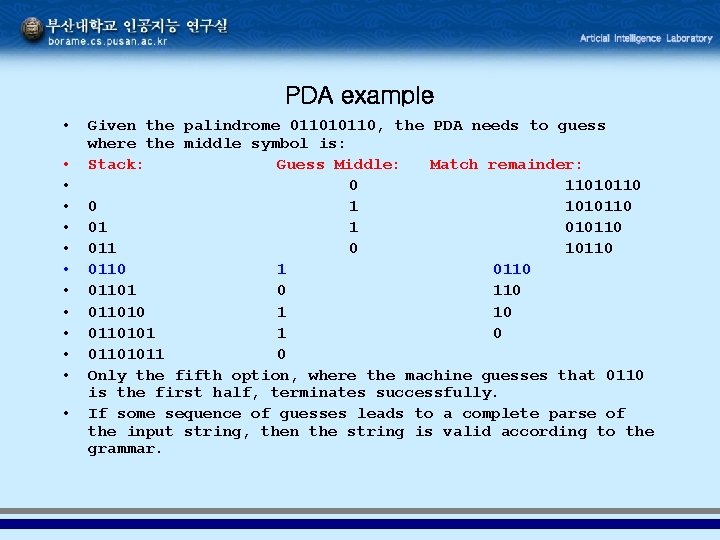
PDA example • • • • Given the palindrome 011010110, the PDA needs to guess where the middle symbol is: Stack: Guess Middle: Match remainder: 0 11010110 0 1 1010110 01 1 010110 011 0 10110 1 01101 0 110 011010 1 10 0110101 1 0 01101011 0 Only the fifth option, where the machine guesses that 0110 is the first half, terminates successfully. If some sequence of guesses leads to a complete parse of the input string, then the string is valid according to the grammar.
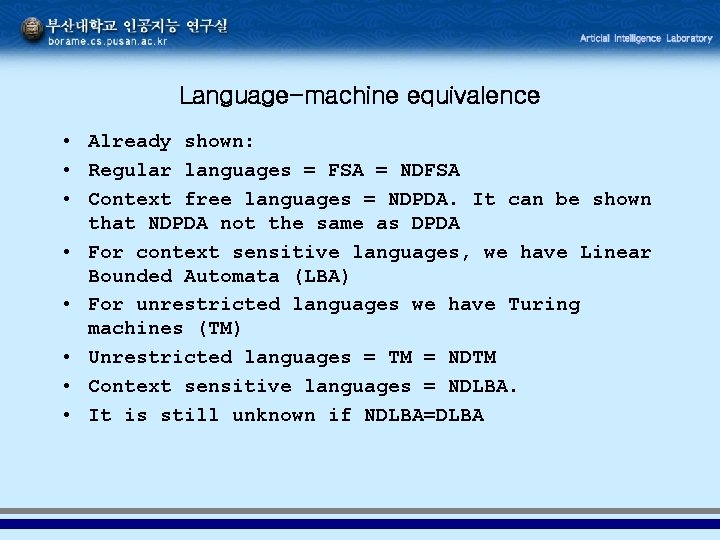
Language-machine equivalence • Already shown: • Regular languages = FSA = NDFSA • Context free languages = NDPDA. It can be shown that NDPDA not the same as DPDA • For context sensitive languages, we have Linear Bounded Automata (LBA) • For unrestricted languages we have Turing machines (TM) • Unrestricted languages = TM = NDTM • Context sensitive languages = NDLBA. • It is still unknown if NDLBA=DLBA
Grammar-machine equivalence 10
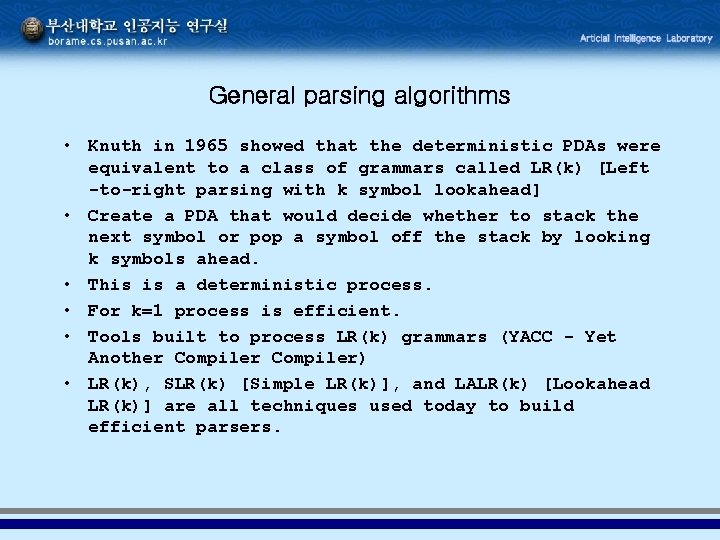
General parsing algorithms • Knuth in 1965 showed that the deterministic PDAs were equivalent to a class of grammars called LR(k) [Left -to-right parsing with k symbol lookahead] • Create a PDA that would decide whether to stack the next symbol or pop a symbol off the stack by looking k symbols ahead. • This is a deterministic process. • For k=1 process is efficient. • Tools built to process LR(k) grammars (YACC - Yet Another Compiler) • LR(k), SLR(k) [Simple LR(k)], and LALR(k) [Lookahead LR(k)] are all techniques used today to build efficient parsers.