
PROFESSIONAL DEVELOPMENT APPRAISAL SYSTEM TEACHER ORIENTATION UPDATE POWER



- Slides: 38
PROFESSIONAL DEVELOPMENT APPRAISAL SYSTEM TEACHER ORIENTATION UPDATE POWER POINT PRESENTATION Developed by Carlene Lenox Division of Administration Region 10 Edited by Shea Schaefer Golden Rule Charter School
PDAS UPDATE TOPICS: 1. Introduction & Overview of PDAS 2. Commissioner’s Rules 3. PDAS Timeline Calendar/District Timeline Calendar 4. Critical Attributes in Domains I-VIII 5. Scoring Factors & Performance Levels (SIVA) 6. Teacher Self-Reports
… The Goal of the Professional Development and Appraisal System is to. . . “Enhance student learning through the professional development of teachers. ”
PROFESSIONAL DEVELOPMENT: It’s not the QUANTITY of staff development that is significant, it is the QUALITY that is important.
Quality staff development must be aligned with: • needs of students • curriculum and district/campus goals and objectives This alignment must result in enhancing the performance of students.
OVERVIEW OF PDAS
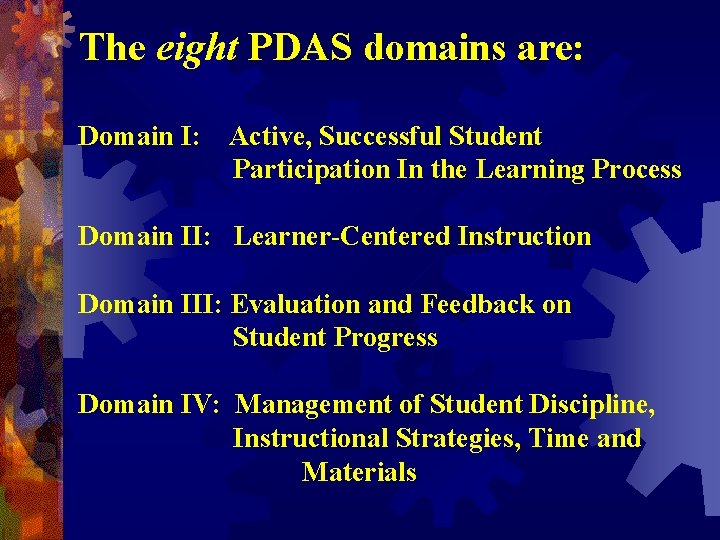
The eight PDAS domains are: Domain I: Active, Successful Student Participation In the Learning Process Domain II: Learner-Centered Instruction Domain III: Evaluation and Feedback on Student Progress Domain IV: Management of Student Discipline, Instructional Strategies, Time and Materials
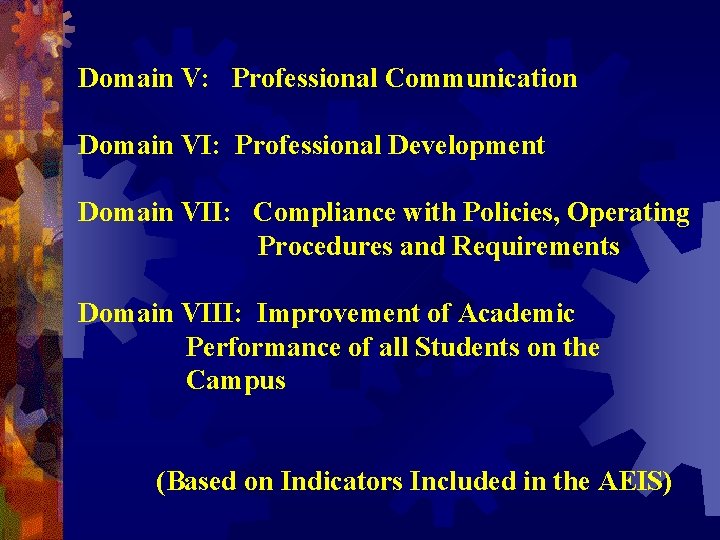
Domain V: Professional Communication Domain VI: Professional Development Domain VII: Compliance with Policies, Operating Procedures and Requirements Domain VIII: Improvement of Academic Performance of all Students on the Campus (Based on Indicators Included in the AEIS)
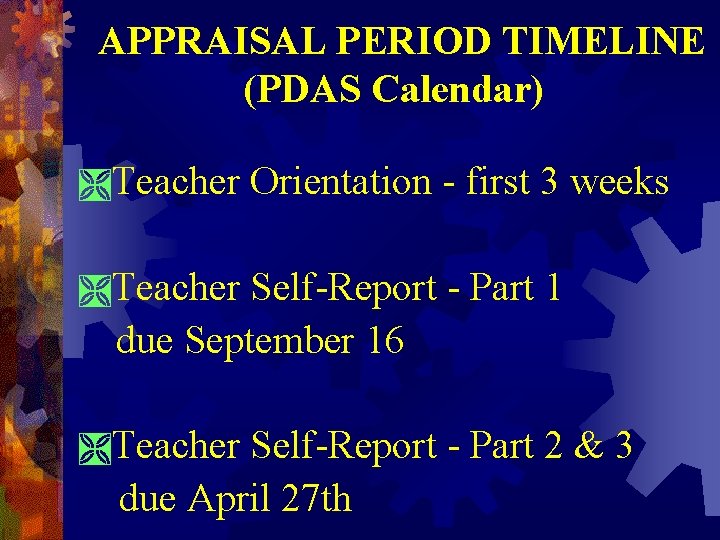
APPRAISAL PERIOD TIMELINE (PDAS Calendar) ÌTeacher Orientation - first 3 weeks ÌTeacher Self-Report - Part 1 due September 16 ÌTeacher Self-Report - Part 2 & 3 due April 27 th
PDAS Calendar Continued ÌFormal Observation ®at least 45 minutes or shorter segments ®written summary within 10 days ®advanced ®follow ®may notice will not be given district Appraisal Calendar request pre/post conference at request of Teacher or Appraiser
PDAS Calendar Continued ò Walk-Through ò Teacher Visits Response ò To be used at the discretion of the appraiser ò Documentation 10 days shared with teacher within
PDAS Calendar Continued Summative Annual Report ® 5 working days before conference ®No later than 15 working days before last day of instruction ®Observation Summary ®Walk-through ®TSR I, III documentation
PDAS Calendar Continued ®Summative Conference ® at least 5 days after you are given summative report ® at least 15 days before the last day of instruction ® may be waived in writing by teacher, NOT appraiser ® If appraiser is not administrator on campus, principal/asst. or designated supervisory staff will participate.
Additional Time Line Issues If you disagree. . . Respond in writing Ë Within 10 working days (Appraiser may extend to 15 days) Ë May rebut or request 2 nd appraisal in writing within 10 working days after receiving documentation
The local appraisal calendar can be found on -line in the Employee Handbook
Things to Remember: PDAS is NOT a portfolio system Teachers are encouraged to use the TSR as their primary documentation tool of the system. PDAS does not require additional documentation other than the space and pages of the TSR.
DISCUSSION OF The PDAS FRAMEWORK Domains I - VIII
Professional Development and Appraisal System Appraisal Framework Domain I: Active, Successful Student Participation in the Learning Process I-1 I-2 I-3 Students are actively engaged in learning. Students are successful in learning. Student behaviors indicate learning is at a high cognitive level.
Professional Development and Appraisal System Appraisal Framework Domain I: Active, Successful Student Participation in the Learning Process I-4 Students are self-directed/self-initiated as appropriate to the lesson objectives. I-5 Students connecting learning to work and life applications, both within the discipline, and with other disciplines.
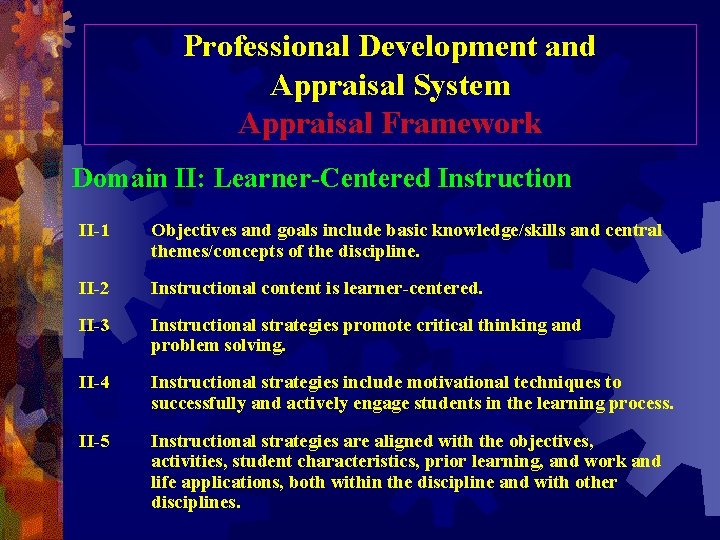
Professional Development and Appraisal System Appraisal Framework Domain II: Learner-Centered Instruction II-1 Objectives and goals include basic knowledge/skills and central themes/concepts of the discipline. II-2 Instructional content is learner-centered. II-3 Instructional strategies promote critical thinking and problem solving. II-4 Instructional strategies include motivational techniques to successfully and actively engage students in the learning process. II-5 Instructional strategies are aligned with the objectives, activities, student characteristics, prior learning, and work and life applications, both within the discipline and with other disciplines.
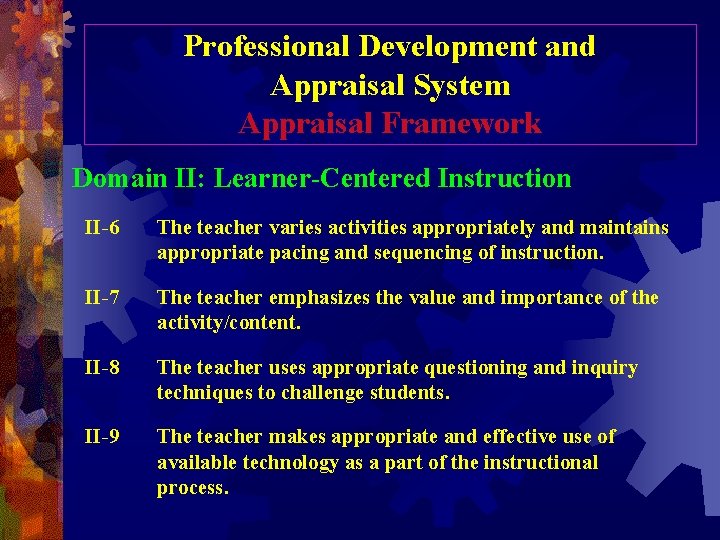
Professional Development and Appraisal System Appraisal Framework Domain II: Learner-Centered Instruction II-6 The teacher varies activities appropriately and maintains appropriate pacing and sequencing of instruction. II-7 The teacher emphasizes the value and importance of the activity/content. II-8 The teacher uses appropriate questioning and inquiry techniques to challenge students. II-9 The teacher makes appropriate and effective use of available technology as a part of the instructional process.
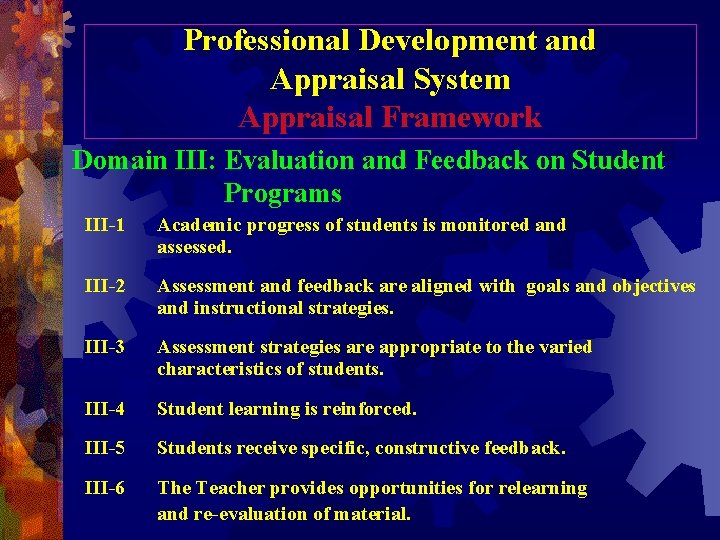
Professional Development and Appraisal System Appraisal Framework Domain III: Evaluation and Feedback on Student Programs III-1 Academic progress of students is monitored and assessed. III-2 Assessment and feedback are aligned with goals and objectives and instructional strategies. III-3 Assessment strategies are appropriate to the varied characteristics of students. III-4 Student learning is reinforced. III-5 Students receive specific, constructive feedback. III-6 The Teacher provides opportunities for relearning and re-evaluation of material.
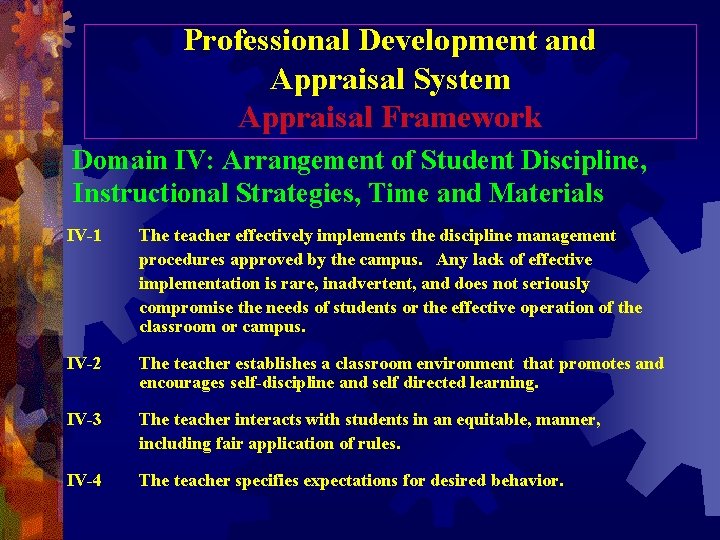
Professional Development and Appraisal System Appraisal Framework Domain IV: Arrangement of Student Discipline, Instructional Strategies, Time and Materials IV-1 The teacher effectively implements the discipline management procedures approved by the campus. Any lack of effective implementation is rare, inadvertent, and does not seriously compromise the needs of students or the effective operation of the classroom or campus. IV-2 The teacher establishes a classroom environment that promotes and encourages self-discipline and self directed learning. IV-3 The teacher interacts with students in an equitable, manner, including fair application of rules. IV-4 The teacher specifies expectations for desired behavior.
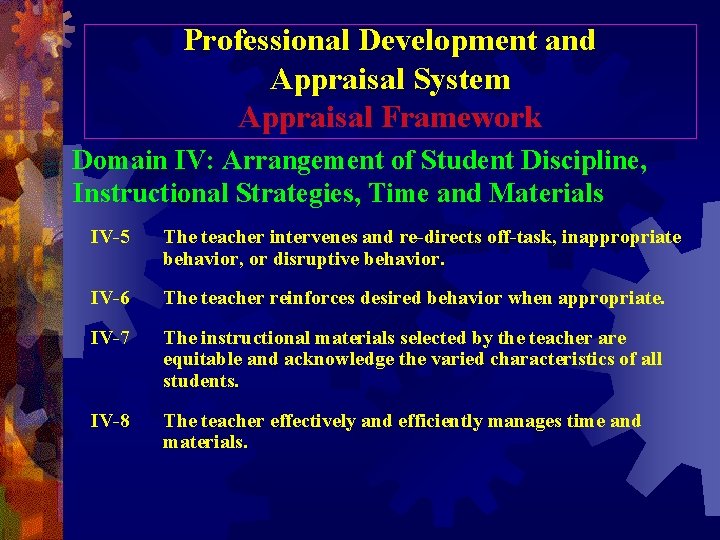
Professional Development and Appraisal System Appraisal Framework Domain IV: Arrangement of Student Discipline, Instructional Strategies, Time and Materials IV-5 The teacher intervenes and re-directs off-task, inappropriate behavior, or disruptive behavior. IV-6 The teacher reinforces desired behavior when appropriate. IV-7 The instructional materials selected by the teacher are equitable and acknowledge the varied characteristics of all students. IV-8 The teacher effectively and efficiently manages time and materials.
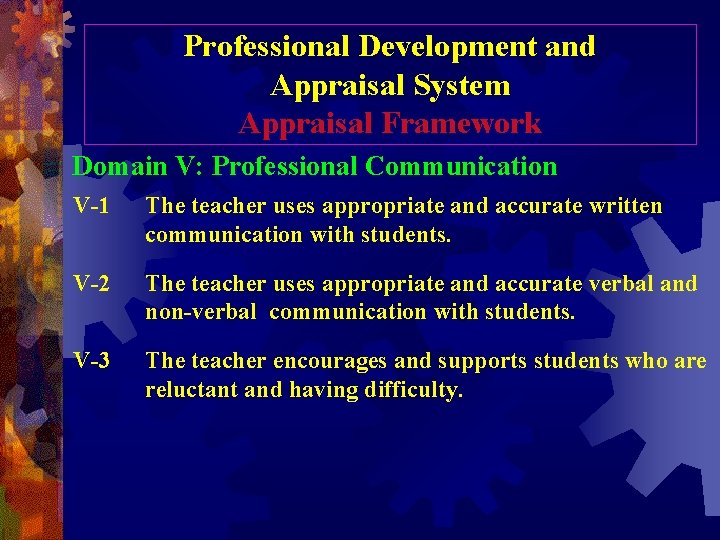
Professional Development and Appraisal System Appraisal Framework Domain V: Professional Communication V-1 The teacher uses appropriate and accurate written communication with students. V-2 The teacher uses appropriate and accurate verbal and non-verbal communication with students. V-3 The teacher encourages and supports students who are reluctant and having difficulty.
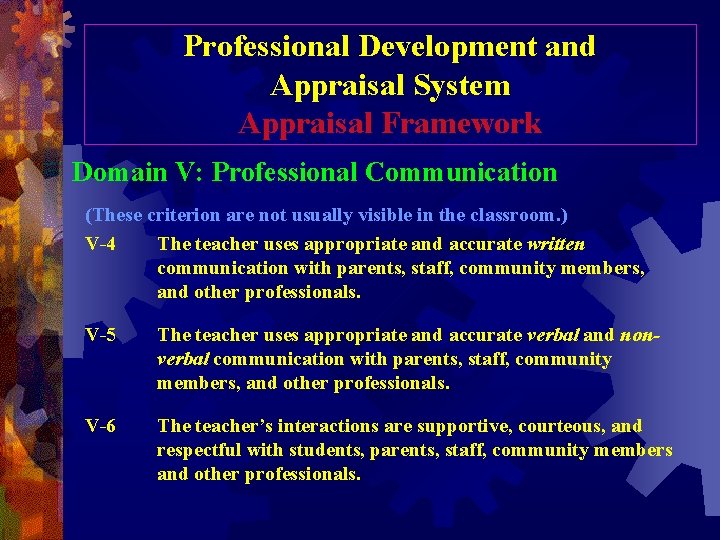
Professional Development and Appraisal System Appraisal Framework Domain V: Professional Communication (These criterion are not usually visible in the classroom. ) V-4 The teacher uses appropriate and accurate written communication with parents, staff, community members, and other professionals. V-5 The teacher uses appropriate and accurate verbal and nonverbal communication with parents, staff, community members, and other professionals. V-6 The teacher’s interactions are supportive, courteous, and respectful with students, parents, staff, community members and other professionals.
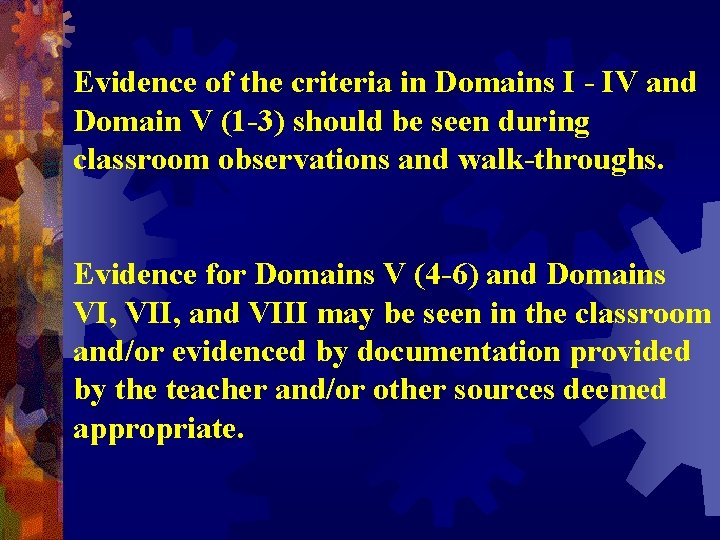
Evidence of the criteria in Domains I - IV and Domain V (1 -3) should be seen during classroom observations and walk-throughs. Evidence for Domains V (4 -6) and Domains VI, VII, and VIII may be seen in the classroom and/or evidenced by documentation provided by the teacher and/or other sources deemed appropriate.
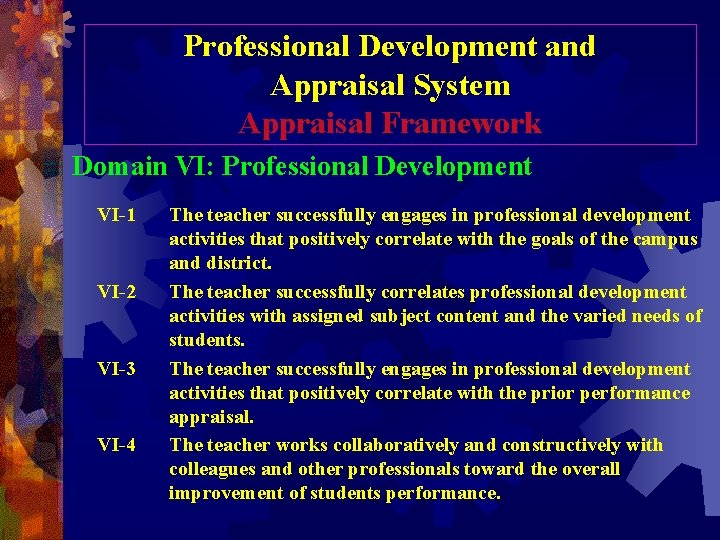
Professional Development and Appraisal System Appraisal Framework Domain VI: Professional Development VI-1 VI-2 VI-3 VI-4 The teacher successfully engages in professional development activities that positively correlate with the goals of the campus and district. The teacher successfully correlates professional development activities with assigned subject content and the varied needs of students. The teacher successfully engages in professional development activities that positively correlate with the prior performance appraisal. The teacher works collaboratively and constructively with colleagues and other professionals toward the overall improvement of students performance.
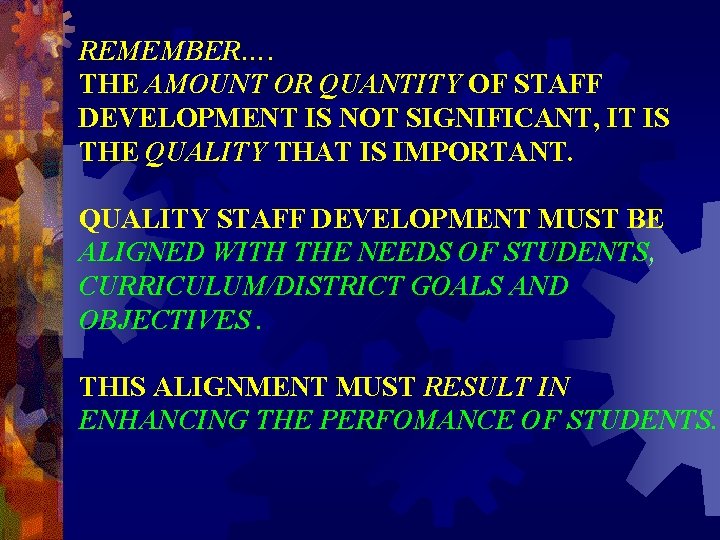
REMEMBER…. THE AMOUNT OR QUANTITY OF STAFF DEVELOPMENT IS NOT SIGNIFICANT, IT IS THE QUALITY THAT IS IMPORTANT. QUALITY STAFF DEVELOPMENT MUST BE ALIGNED WITH THE NEEDS OF STUDENTS, CURRICULUM/DISTRICT GOALS AND OBJECTIVES. THIS ALIGNMENT MUST RESULT IN ENHANCING THE PERFOMANCE OF STUDENTS.
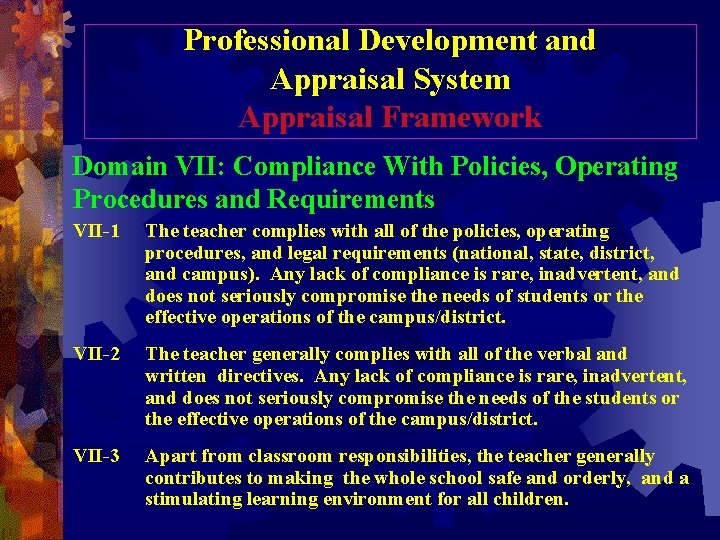
Professional Development and Appraisal System Appraisal Framework Domain VII: Compliance With Policies, Operating Procedures and Requirements VII-1 The teacher complies with all of the policies, operating procedures, and legal requirements (national, state, district, and campus). Any lack of compliance is rare, inadvertent, and does not seriously compromise the needs of students or the effective operations of the campus/district. VII-2 The teacher generally complies with all of the verbal and written directives. Any lack of compliance is rare, inadvertent, and does not seriously compromise the needs of the students or the effective operations of the campus/district. VII-3 Apart from classroom responsibilities, the teacher generally contributes to making the whole school safe and orderly, and a stimulating learning environment for all children.
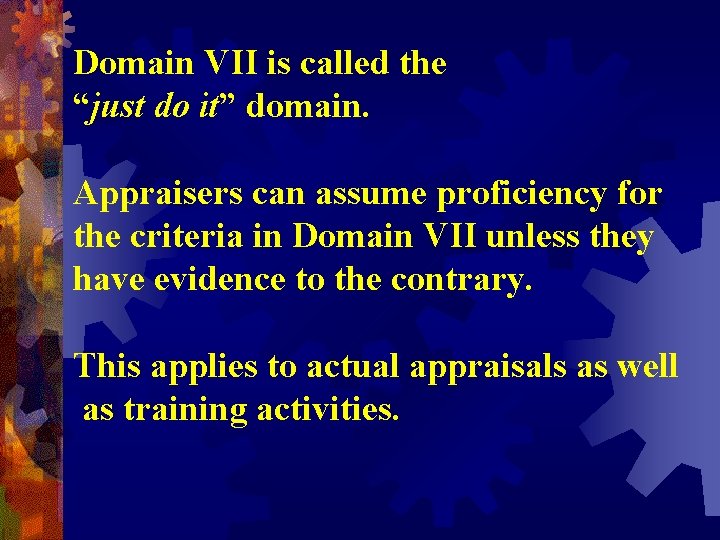
Domain VII is called the “just do it” domain. Appraisers can assume proficiency for the criteria in Domain VII unless they have evidence to the contrary. This applies to actual appraisals as well as training activities.
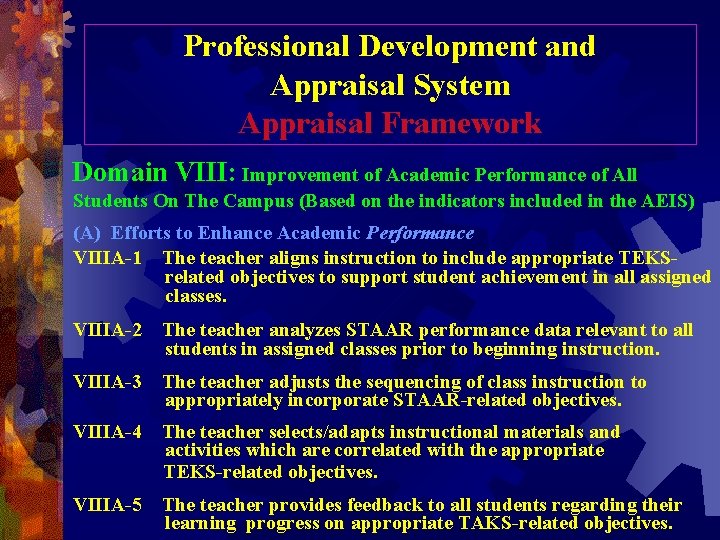
Professional Development and Appraisal System Appraisal Framework Domain VIII: Improvement of Academic Performance of All Students On The Campus (Based on the indicators included in the AEIS) (A) Efforts to Enhance Academic Performance VIIIA-1 The teacher aligns instruction to include appropriate TEKSrelated objectives to support student achievement in all assigned classes. VIIIA-2 The teacher analyzes STAAR performance data relevant to all students in assigned classes prior to beginning instruction. VIIIA-3 The teacher adjusts the sequencing of class instruction to appropriately incorporate STAAR-related objectives. VIIIA-4 The teacher selects/adapts instructional materials and activities which are correlated with the appropriate TEKS-related objectives. VIIIA-5 The teacher provides feedback to all students regarding their learning progress on appropriate TAKS-related objectives.
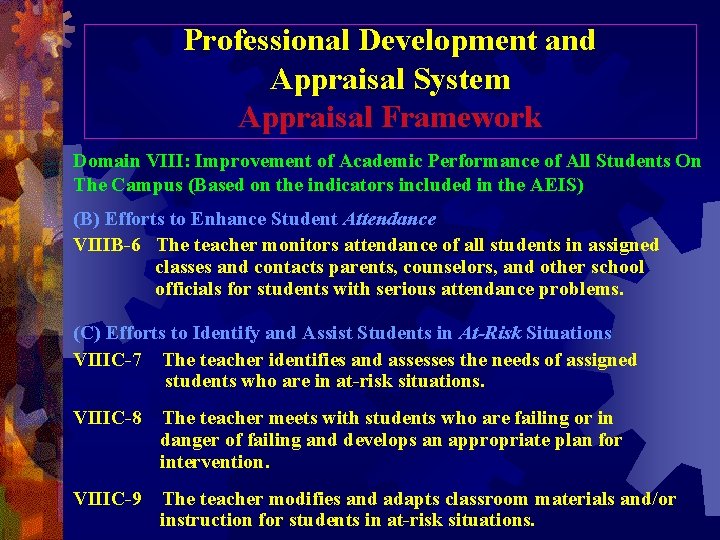
Professional Development and Appraisal System Appraisal Framework Domain VIII: Improvement of Academic Performance of All Students On The Campus (Based on the indicators included in the AEIS) (B) Efforts to Enhance Student Attendance VIIIB-6 The teacher monitors attendance of all students in assigned classes and contacts parents, counselors, and other school officials for students with serious attendance problems. (C) Efforts to Identify and Assist Students in At-Risk Situations VIIIC-7 The teacher identifies and assesses the needs of assigned students who are in at-risk situations. VIIIC-8 The teacher meets with students who are failing or in danger of failing and develops an appropriate plan for intervention. VIIIC-9 The teacher modifies and adapts classroom materials and/or instruction for students in at-risk situations.
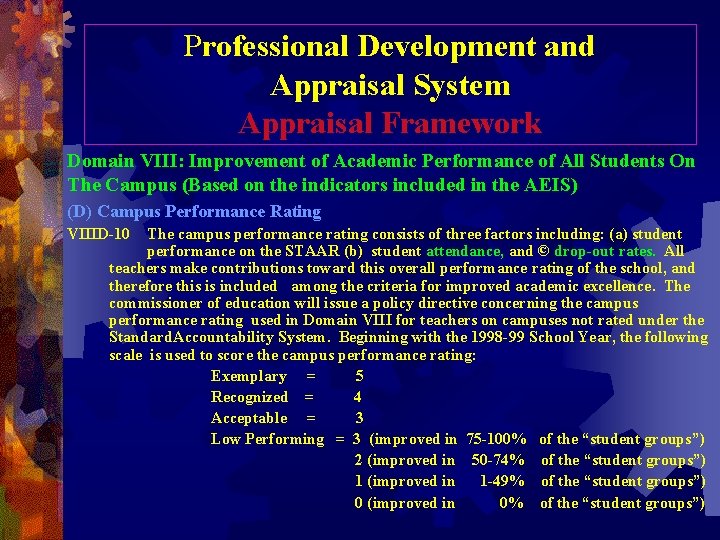
Professional Development and Appraisal System Appraisal Framework Domain VIII: Improvement of Academic Performance of All Students On The Campus (Based on the indicators included in the AEIS) (D) Campus Performance Rating VIIID-10 The campus performance rating consists of three factors including: (a) student performance on the STAAR (b) student attendance, and © drop-out rates. All teachers make contributions toward this overall performance rating of the school, and therefore this is included among the criteria for improved academic excellence. The commissioner of education will issue a policy directive concerning the campus performance rating used in Domain VIII for teachers on campuses not rated under the Standard. Accountability System. Beginning with the 1998 -99 School Year, the following scale is used to score the campus performance rating: Exemplary = 5 Recognized = 4 Acceptable = 3 Low Performing = 3 (improved in 75 -100% of the “student groups”) 2 (improved in 50 -74% of the “student groups”) 1 (improved in 1 -49% of the “student groups”) 0 (improved in 0% of the “student groups”)
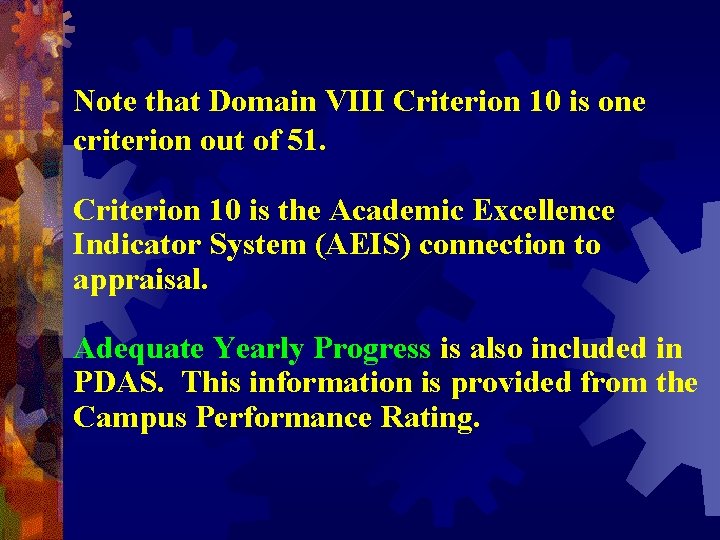
Note that Domain VIII Criterion 10 is one criterion out of 51. Criterion 10 is the Academic Excellence Indicator System (AEIS) connection to appraisal. Adequate Yearly Progress is also included in PDAS. This information is provided from the Campus Performance Rating.
The Scoring Criteria Guide… is a tool you can use to look at some of the behaviors associated with each of the criteria. The descriptors are designed to help you view the impact on student learning associated with each of the four performance levels.
Teacher Self-Report: Purpose www. tea. state. tx. us Provides for teacher input into the appraisal process. h Allows for documentation for performance related to domains not primarily evaluated through classroom observation. h Provides a link between individual instructional planning and campus goals. h Serves as a reflective and planning tool for the benefit of both the teacher and appraiser. h Informs the appraiser of information and topics the teacher may wish to discuss in the summative annual conferences. h
!Teacher Self-Report/Part I is due by September 16, 2016. The focus is on the TEKS related objectives. ! Parts II and III of the TSR are due by April 27, 2017 ! The information is related to: ! ! Domain VI (Professional Development) and Domain VIII (Academic Performance).