
Equivalence of CFGs and PDAs Section 3 4






- Slides: 45
Equivalence of CFGs and PDAs Section 3. 4 Wed, Oct 29, 2004
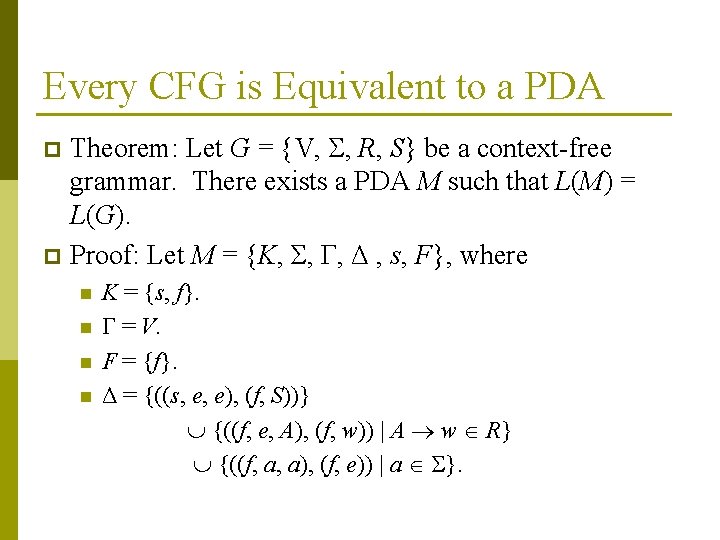
Every CFG is Equivalent to a PDA Theorem: Let G = {V, , R, S} be a context-free grammar. There exists a PDA M such that L(M) = L(G). p Proof: Let M = {K, Σ, Γ, Δ , s, F}, where p n n K = {s, f}. Γ = V. F = {f}. Δ = {((s, e, e), (f, S))} {((f, e, A), (f, w)) | A w R} {((f, a, a), (f, e)) | a }.
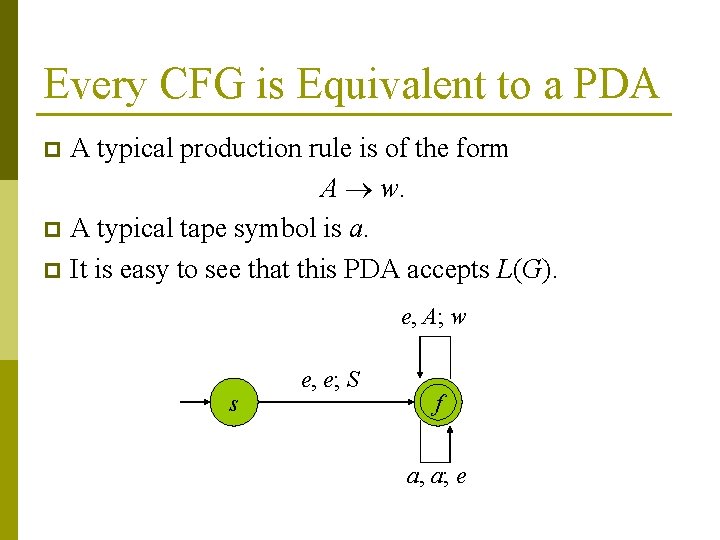
Every CFG is Equivalent to a PDA A typical production rule is of the form A w. p A typical tape symbol is a. p It is easy to see that this PDA accepts L(G). p e, A; w s e, e; S f a, a; e
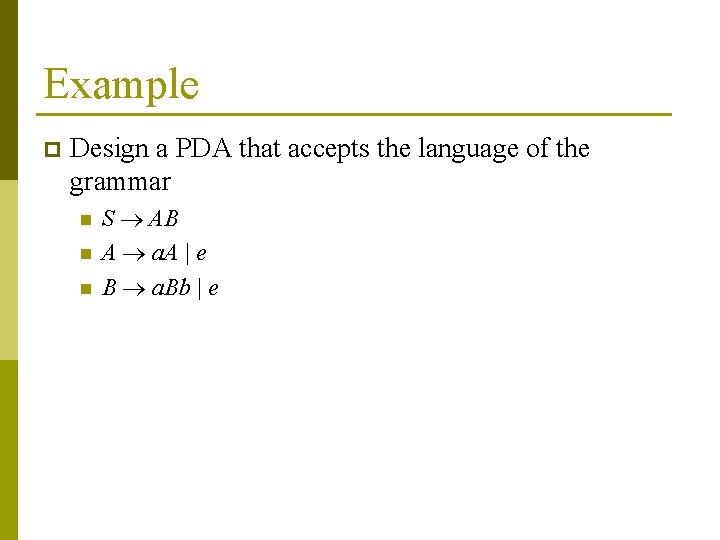
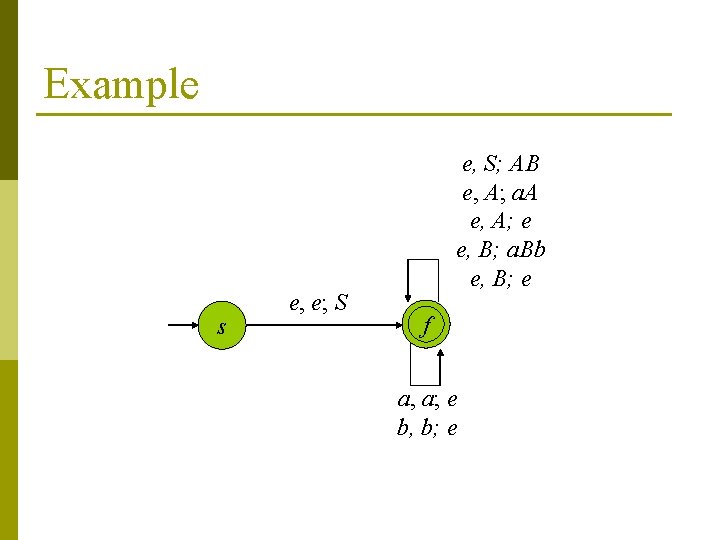
Example p Design a PDA that accepts the language of the grammar n n n S AB A a. A | e B a. Bb | e
Example s e, e; S e, S; AB e, A; a. A e, A; e e, B; a. Bb e, B; e f a, a; e b, b; e
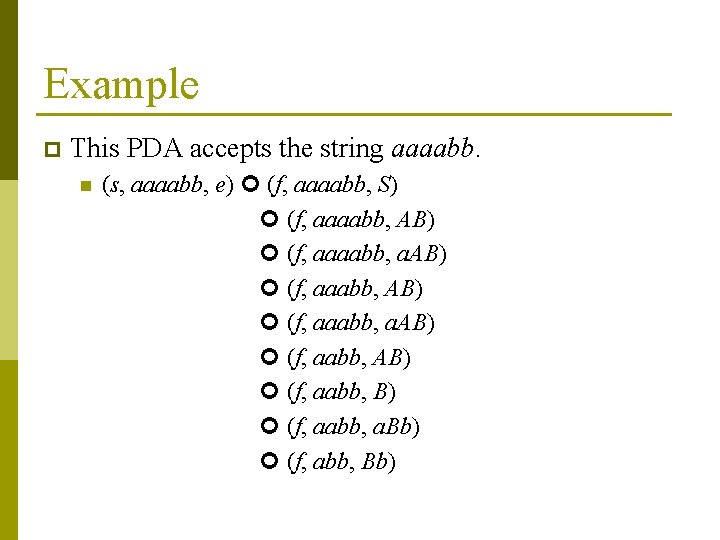
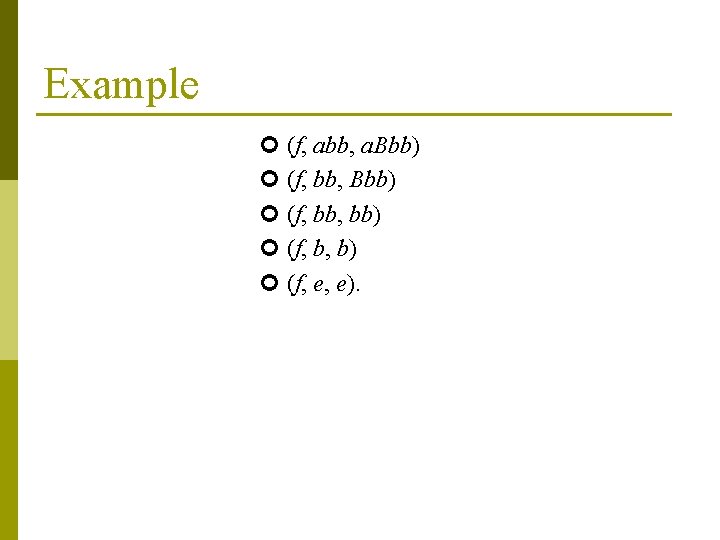
Example p This PDA accepts the string aaaabb. n (s, aaaabb, e) (f, aaaabb, S) (f, aaaabb, AB) (f, aaaabb, a. AB) (f, aabb, B) (f, aabb, a. Bb) (f, abb, Bb)
Example (f, abb, a. Bbb) (f, bb, bb) (f, b, b) (f, e, e).
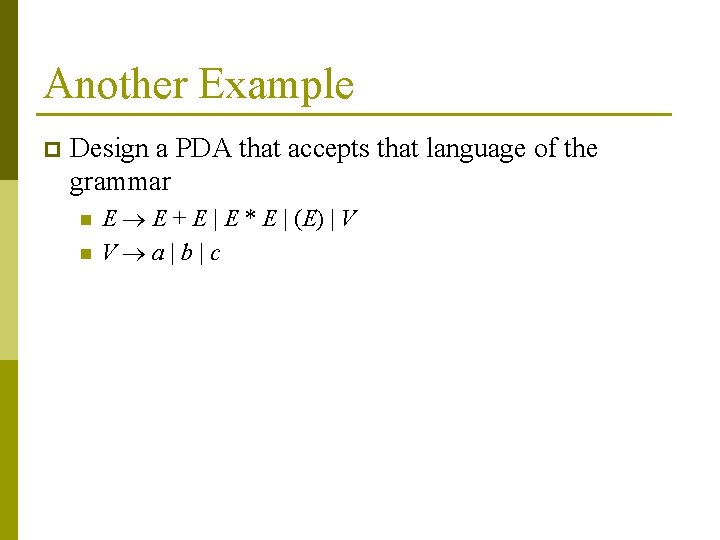
Another Example p Design a PDA that accepts that language of the grammar n n E E + E | E * E | (E) | V V a|b|c
Another Example e, E; E + E e, E; E * E e, E; (E) e, E; V e, V; a e, V; b e, V; c e, e; E f s a, a; e b, b; e c, c; e (, (; e ), ); e +, +; e *, *; e
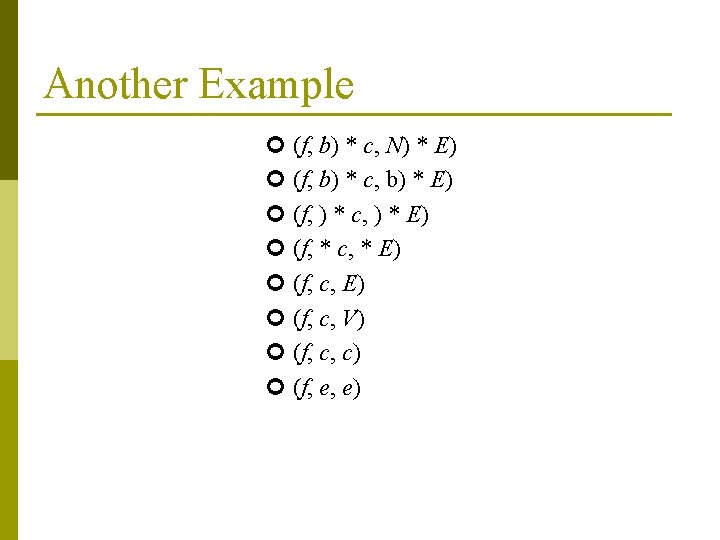
Another Example p Derive the string (a + b) * c. n (s, (a + b) * c, e) (f, (a + b) * c, E * E) (f, (a + b) * c, (E) * E) (f, a + b) * c, E + E) * E) (f, a + b) * c, V + E) * E) (f, a + b) * c, a + E) * E) (f, + b) * c, + E) * E) (f, b) * c, E) * E)
Another Example (f, b) * c, N) * E) (f, b) * c, b) * E) (f, ) * c, ) * E) (f, * c, * E) (f, c, V) (f, c, c) (f, e, e)
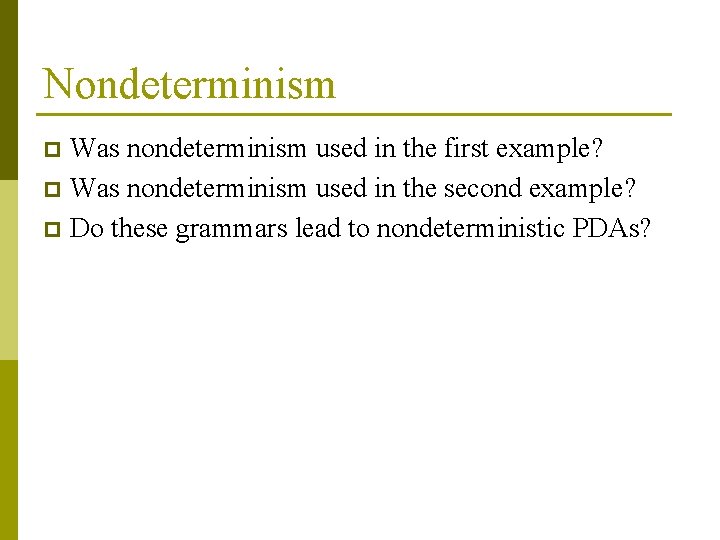
Nondeterminism Was nondeterminism used in the first example? p Was nondeterminism used in the second example? p Do these grammars lead to nondeterministic PDAs? p
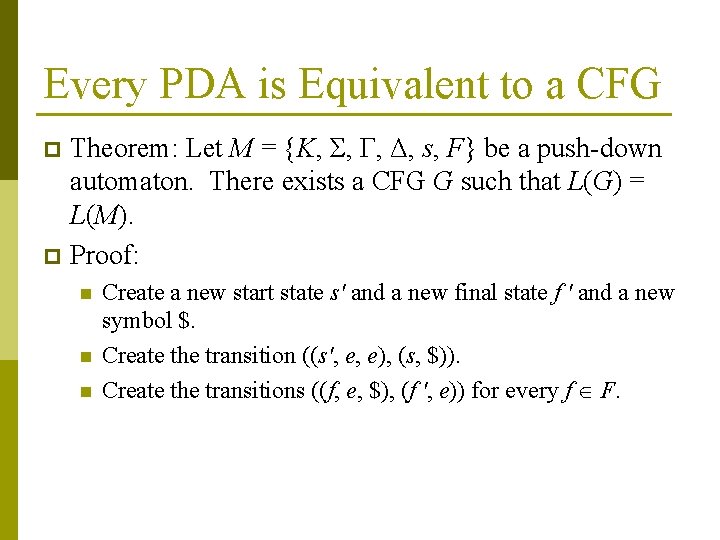
Every PDA is Equivalent to a CFG Theorem: Let M = {K, Σ, Γ, Δ, s, F} be a push-down automaton. There exists a CFG G such that L(G) = L(M). p Proof: p n n n Create a new start state s' and a new final state f ' and a new symbol $. Create the transition ((s', e, e), (s, $)). Create the transitions ((f, e, $), (f ', e)) for every f F.
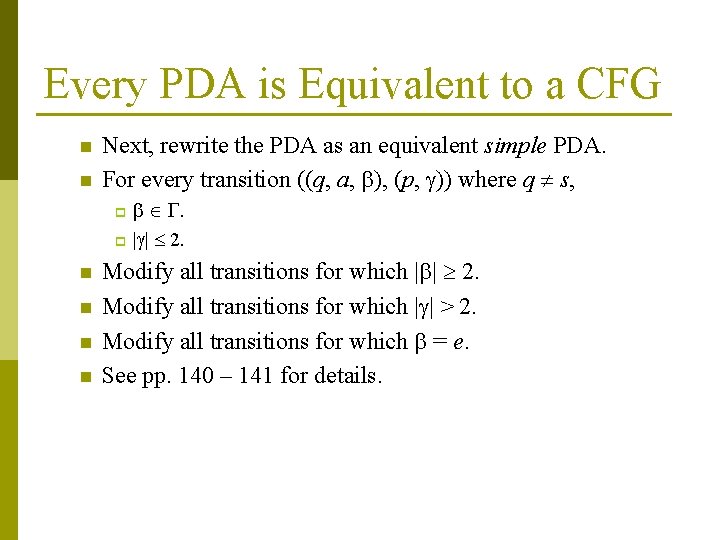
Every PDA is Equivalent to a CFG n n Next, rewrite the PDA as an equivalent simple PDA. For every transition ((q, a, ), (p, )) where q s, . p | | 2. p n n Modify all transitions for which | | 2. Modify all transitions for which | | > 2. Modify all transitions for which = e. See pp. 140 – 141 for details.
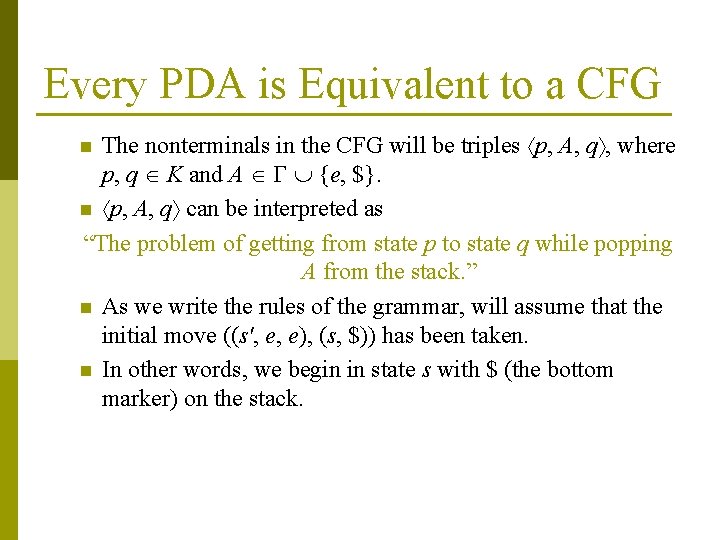
Every PDA is Equivalent to a CFG The nonterminals in the CFG will be triples p, A, q , where p, q K and A {e, $}. n p, A, q can be interpreted as “The problem of getting from state p to state q while popping A from the stack. ” n As we write the rules of the grammar, will assume that the initial move ((s', e, e), (s, $)) has been taken. n In other words, we begin in state s with $ (the bottom marker) on the stack. n
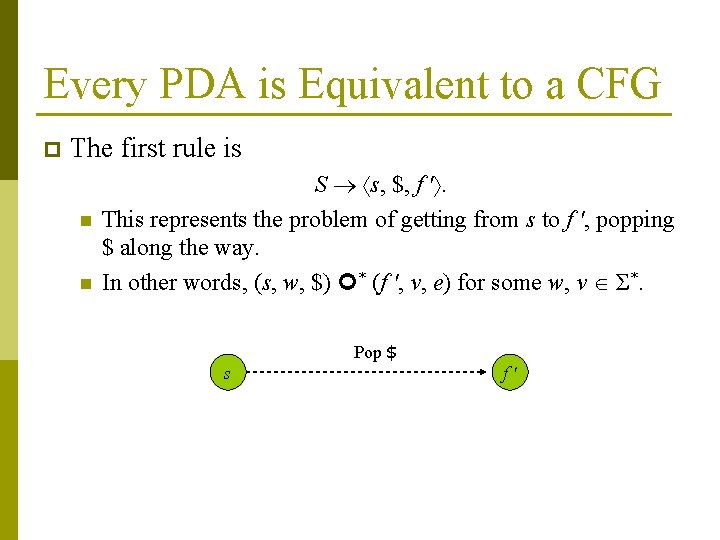
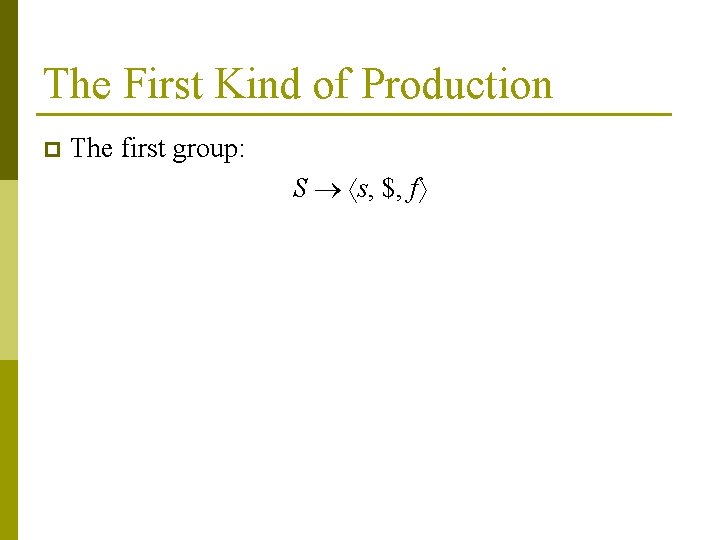
Every PDA is Equivalent to a CFG p The first rule is n n S s, $, f '. This represents the problem of getting from s to f ', popping $ along the way. In other words, (s, w, $) * (f ', v, e) for some w, v Σ*. Pop $ s f'
Every PDA is Equivalent to a CFG p The second set of rules. n n For each transition ((q, a, B), (r, C)) where a {e} and B, C {e}, and for each p K, q, B, p a r, C, p. This represents replacing the problem of getting from q to p, popping B, with the problem of getting from r to p, reading a and popping C. q Pop B Push C p r Pop C
Every PDA is Equivalent to a CFG p The third set of rules. n For each transition ((q, a, B), (r, C 1 C 2)) where a {e} and B {e}, C 1, C 2 , and for each p, p' K, q, B, p a r, C 1, p' p', C 2, p. Pop B Push C 2 Push C 1 Pop B q p p' r Pop C 1 Pop C 2
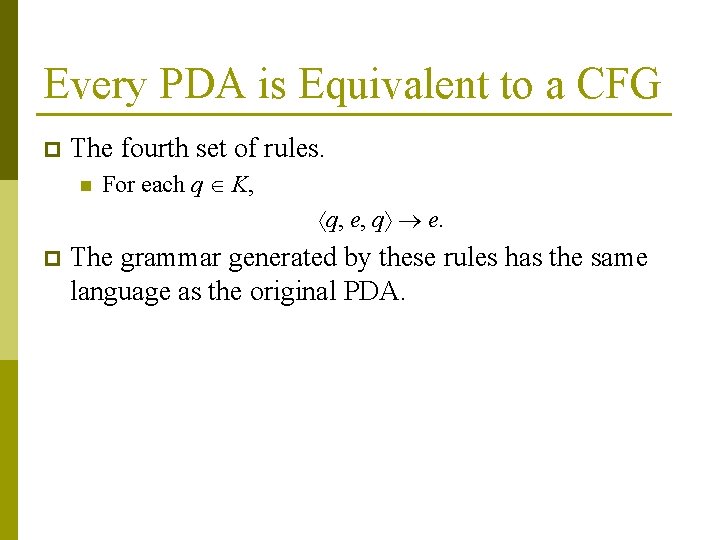
Every PDA is Equivalent to a CFG p The fourth set of rules. n For each q K, q, e, q e. p The grammar generated by these rules has the same language as the original PDA.
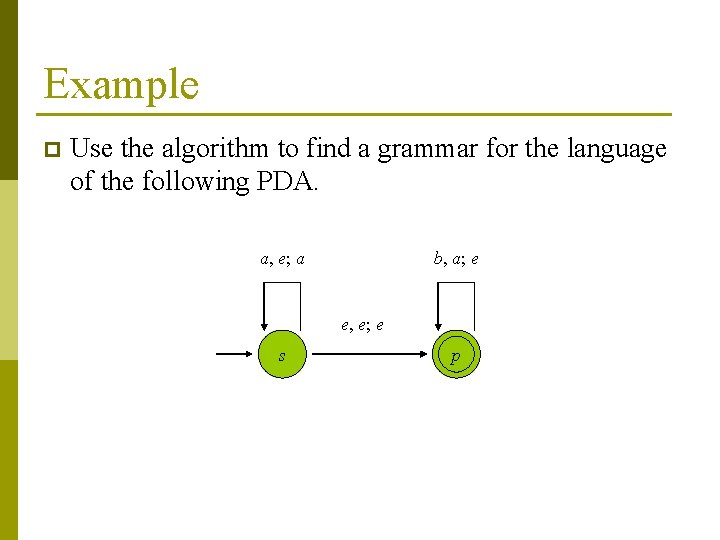
Example p Use the algorithm to find a grammar for the language of the following PDA. a, e; a b, a; e e, e; e s p
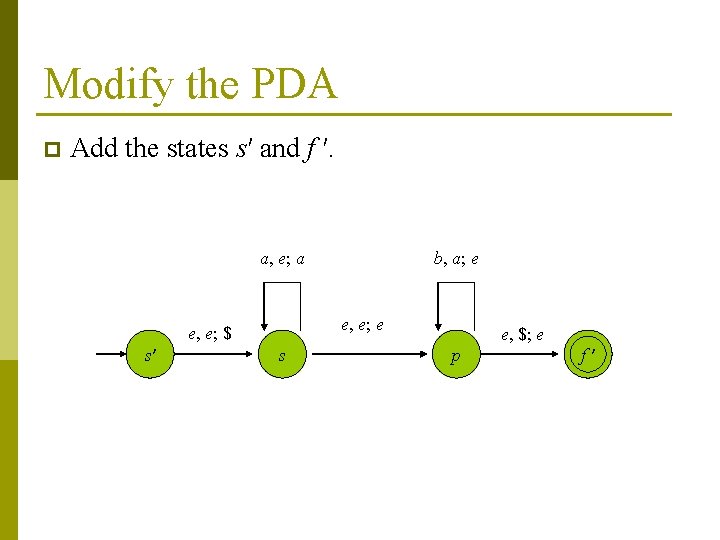
Modify the PDA p Add the states s′ and f ′. a, e; a e, e; e e, e; $ s′ b, a; e s e, $; e p f′
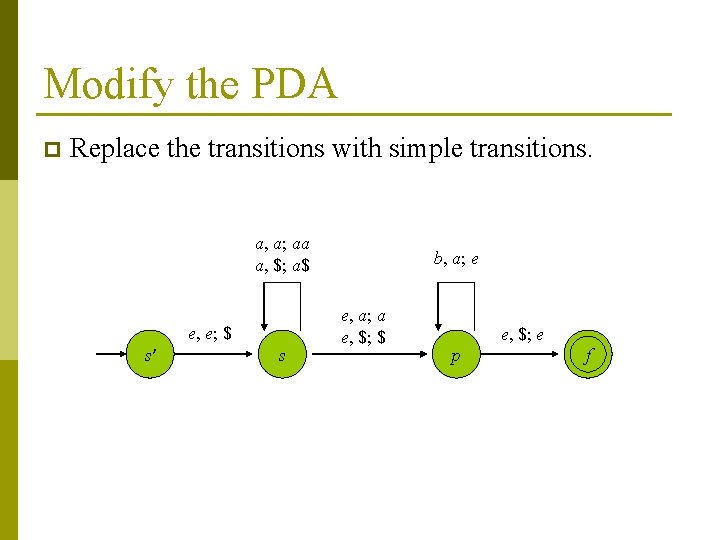
Modify the PDA p Replace the transitions with simple transitions. a, a; aa a, $; a$ e, e; $ s′ s b, a; e e, a; a e, $; $ e, $; e p f
The First Kind of Production p The first group: S s, $, f
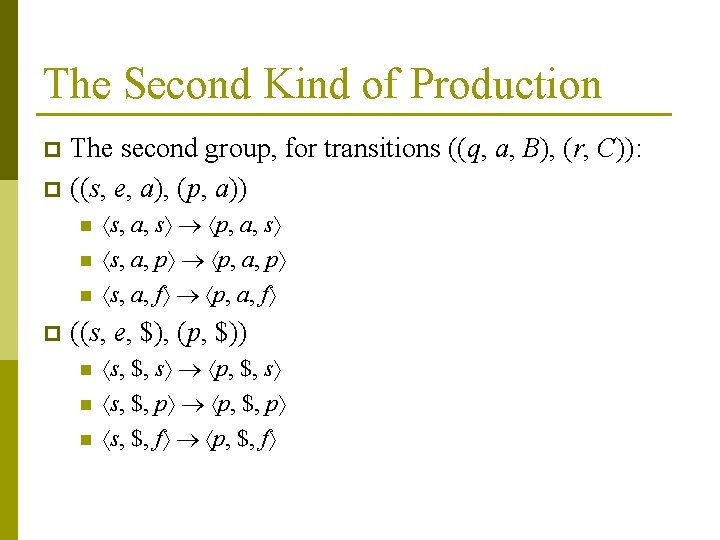
The Second Kind of Production The second group, for transitions ((q, a, B), (r, C)): p ((s, e, a), (p, a)) p n n n p s, a, s p, a, s s, a, p p, a, p s, a, f p, a, f ((s, e, $), (p, $)) n n n s, $, s p, $, s s, $, p p, $, p s, $, f p, $, f
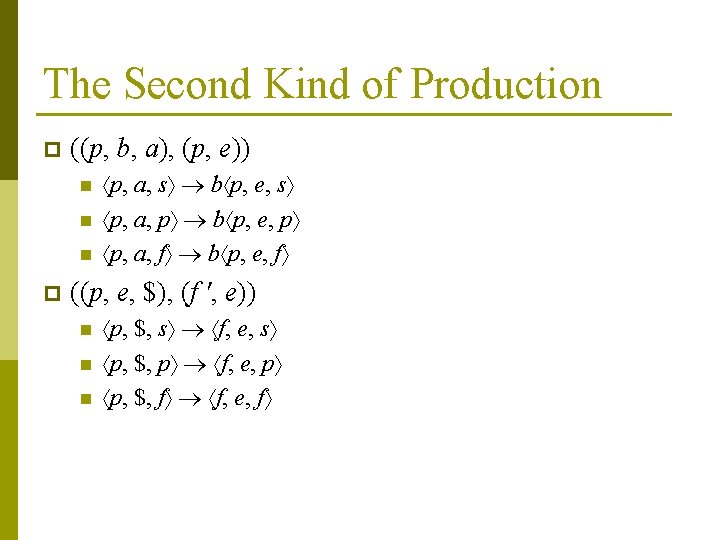
The Second Kind of Production p ((p, b, a), (p, e)) n n n p p, a, s b p, e, s p, a, p b p, e, p p, a, f b p, e, f ((p, e, $), (f ′, e)) n n n p, $, s f, e, s p, $, p f, e, p p, $, f f, e, f
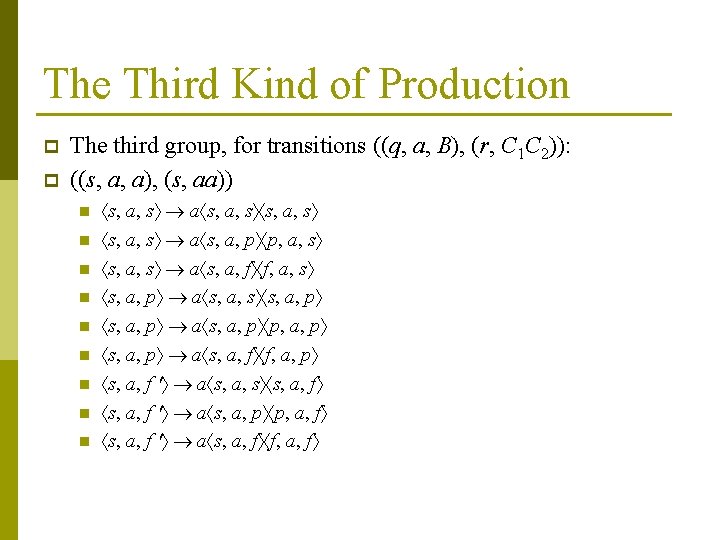
The Third Kind of Production p p The third group, for transitions ((q, a, B), (r, C 1 C 2)): ((s, a, a), (s, aa)) n n n n n s, a, s a s, a, s a s, a, p p, a, s s, a, s a s, a, f f, a, s s, a, p a s, a, s s, a, p a s, a, p p, a, p s, a, p a s, a, f f, a, p s, a, f ′ a s, a, s s, a, f ′ a s, a, p p, a, f s, a, f ′ a s, a, f f, a, f
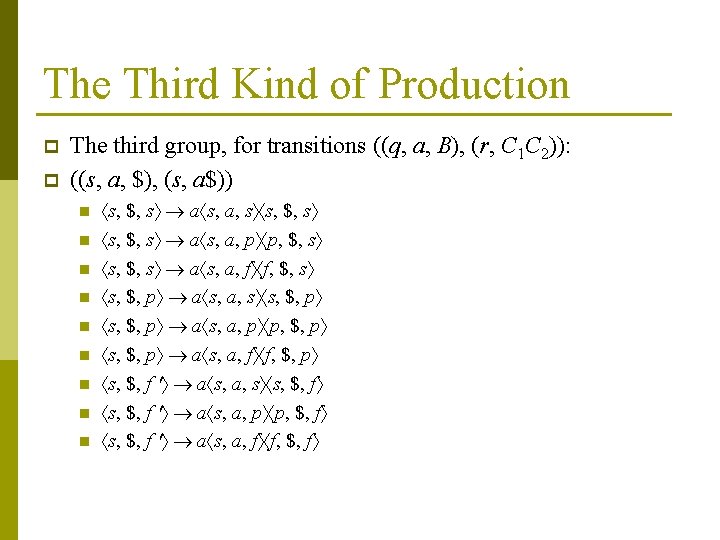
The Third Kind of Production p p The third group, for transitions ((q, a, B), (r, C 1 C 2)): ((s, a, $), (s, a$)) n n n n n s, $, s a s, a, s s, $, s a s, a, p p, $, s s, $, s a s, a, f f, $, s s, $, p a s, a, s s, $, p a s, a, p p, $, p s, $, p a s, a, f f, $, p s, $, f ′ a s, a, s s, $, f ′ a s, a, p p, $, f s, $, f ′ a s, a, f f, $, f
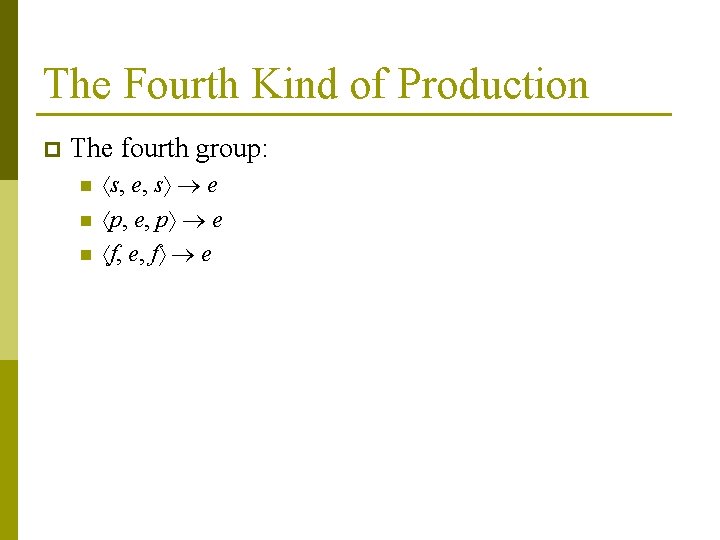
The Fourth Kind of Production p The fourth group: n n n s, e, s e p, e, p e f, e, f e
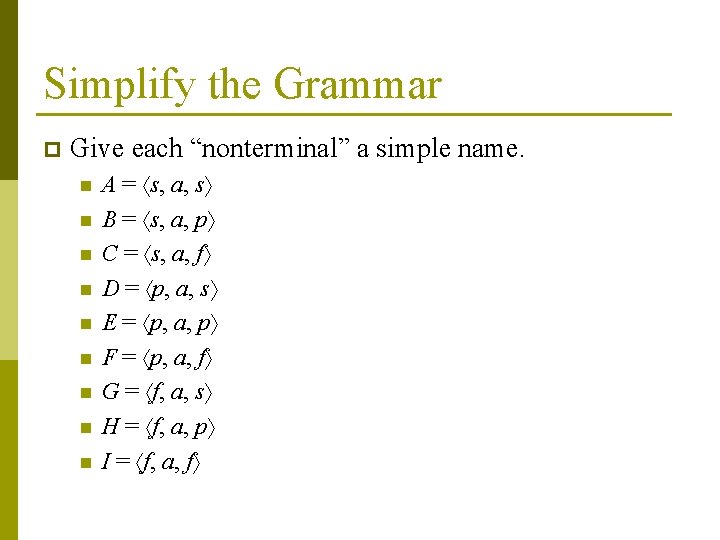
Simplify the Grammar p Give each “nonterminal” a simple name. n n n n n A = s, a, s B = s, a, p C = s, a, f D = p, a, s E = p, a, p F = p, a, f G = f, a, s H = f, a, p I = f, a, f
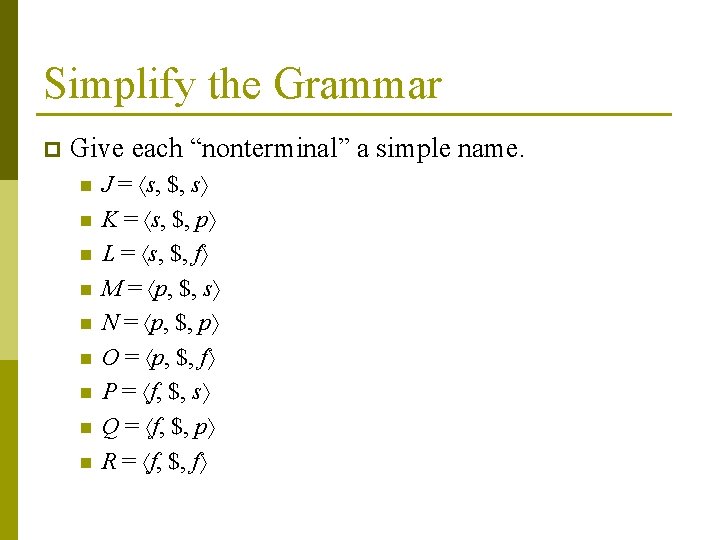
Simplify the Grammar p Give each “nonterminal” a simple name. n n n n n J = s, $, s K = s, $, p L = s, $, f M = p, $, s N = p, $, p O = p, $, f P = f, $, s Q = f, $, p R = f, $, f
Simplify the Grammar p Give each “nonterminal” a simple name. n n n n n T = s, e, s U = s, e, p V = s, e, f W = p, e, s X = p, e, p Y = p, e, f Z = f, e, s = f, e, p = f, e, f
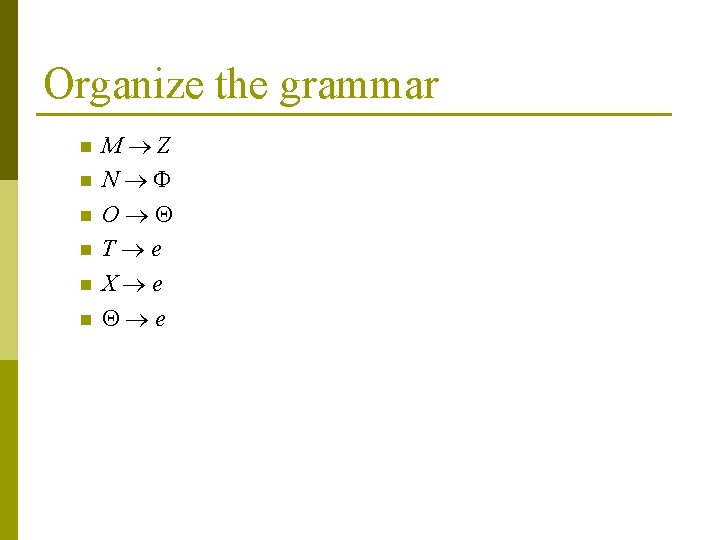
Organize the grammar p Write the productions, using the simpler names, in alphabetical order (except for S), grouping them according to the nonterminal on the left.
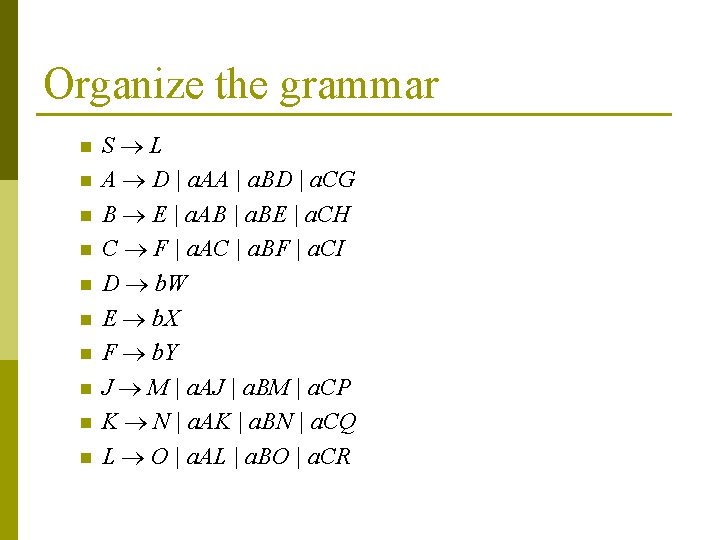
Organize the grammar n n n n n S L A D | a. AA | a. BD | a. CG B E | a. AB | a. BE | a. CH C F | a. AC | a. BF | a. CI D b. W E b. X F b. Y J M | a. AJ | a. BM | a. CP K N | a. AK | a. BN | a. CQ L O | a. AL | a. BO | a. CR
Organize the grammar n n n M Z N O T e X e e
Simplify the grammar This algorithm typically produces a huge list of productions, most of which are unnecessary. p We will describe a procedure that will eliminate all unnecessary productions. p
Eliminate “Dead-End” Nonterminals Identify all nonterminals that do not appear on the left side of any production or that do not appear on the right side of any production. p Remove all productions involving those nonterminals. p Repeat this until there is no change. p
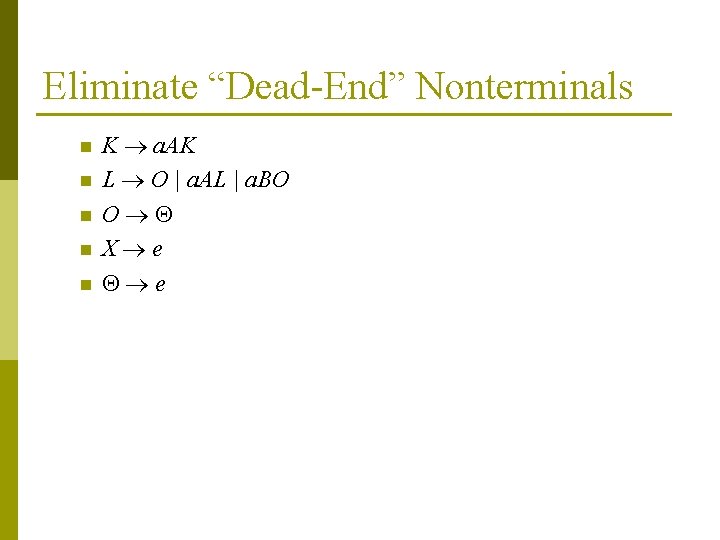
Eliminate “Dead-End” Nonterminals Those nonterminals are initially G, H, I, P, Q, R, T, U, V, W, Y, Z, . p Then we also eliminate D, F, M, N. p The remaining productions are p n n n S L A a. AA B E | a. AB | a. BE C a. AC E b. X J a. AJ
Eliminate “Dead-End” Nonterminals n n n K a. AK L O | a. AL | a. BO O X e e
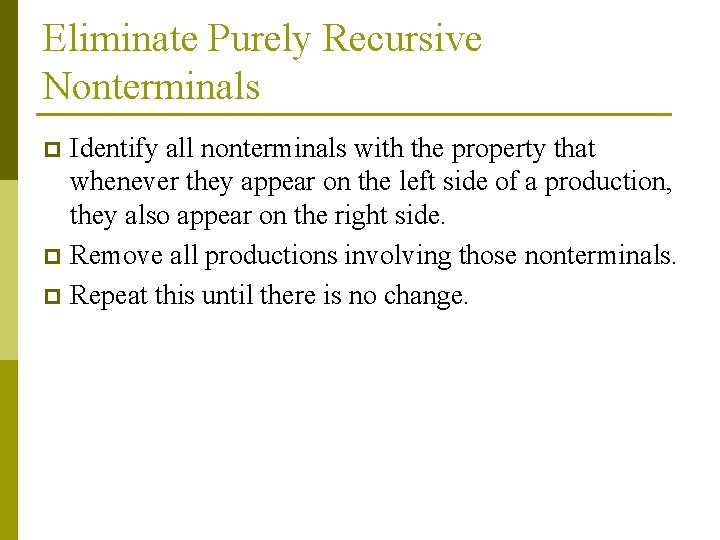
Eliminate Purely Recursive Nonterminals Identify all nonterminals with the property that whenever they appear on the left side of a production, they also appear on the right side. p Remove all productions involving those nonterminals. p Repeat this until there is no change. p
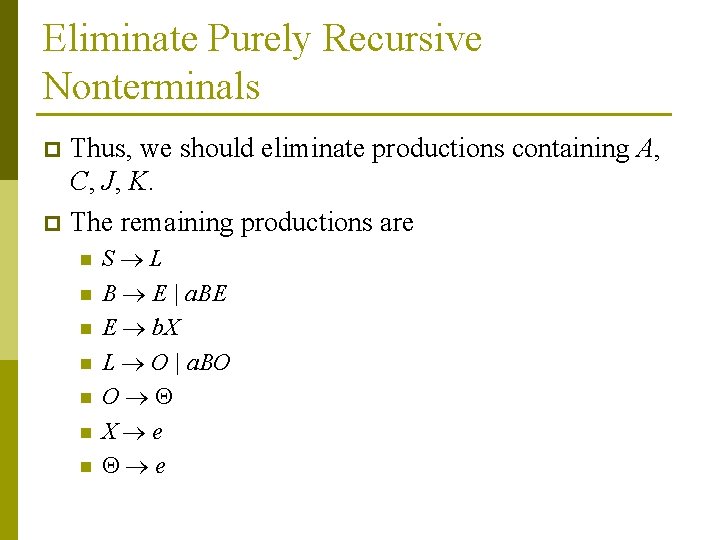
Eliminate Purely Recursive Nonterminals Thus, we should eliminate productions containing A, C, J, K. p The remaining productions are p n n n n S L B E | a. BE E b. X L O | a. BO O X e e
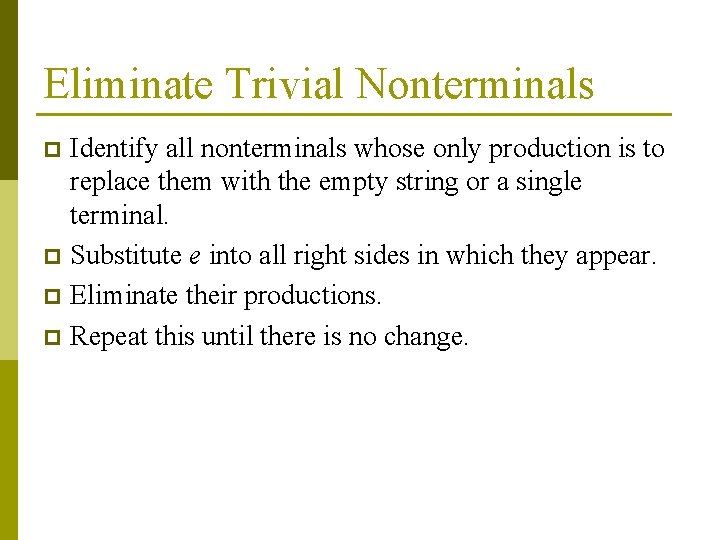
Eliminate Trivial Nonterminals Identify all nonterminals whose only production is to replace them with the empty string or a single terminal. p Substitute e into all right sides in which they appear. p Eliminate their productions. p Repeat this until there is no change. p
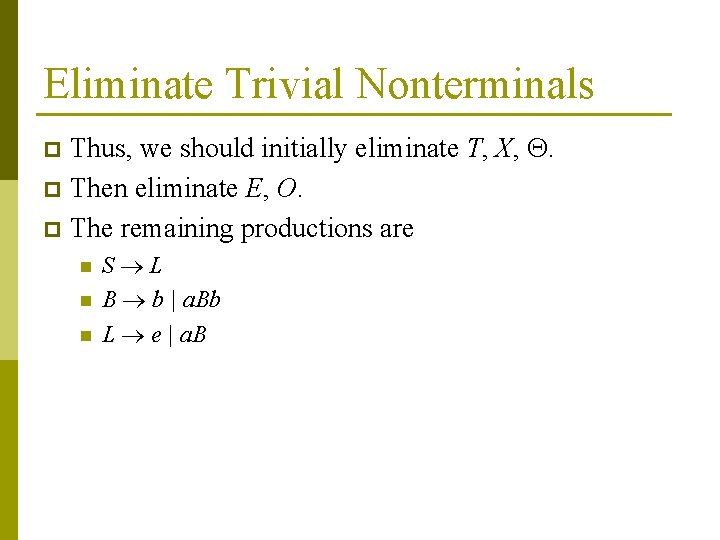
Eliminate Trivial Nonterminals Thus, we should initially eliminate T, X, . p Then eliminate E, O. p The remaining productions are p n n n S L B b | a. Bb L e | a. B
Eliminate Trivial Nonterminals Identify all nonterminals whose only production replaces them with another nonterminal. p Make the substitution in all right sides. p Eliminate their productions. p The production for the start symbol S may be handled differently since we must retain S. p
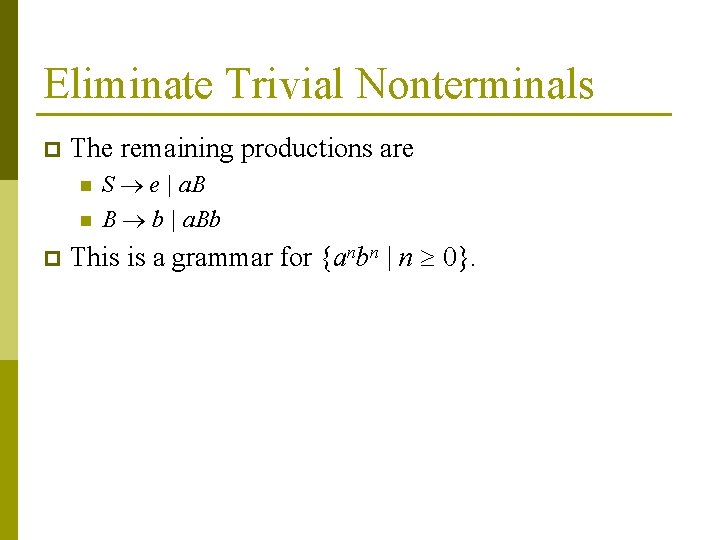
Eliminate Trivial Nonterminals p The remaining productions are n n p S e | a. B B b | a. Bb This is a grammar for {anbn | n 0}.
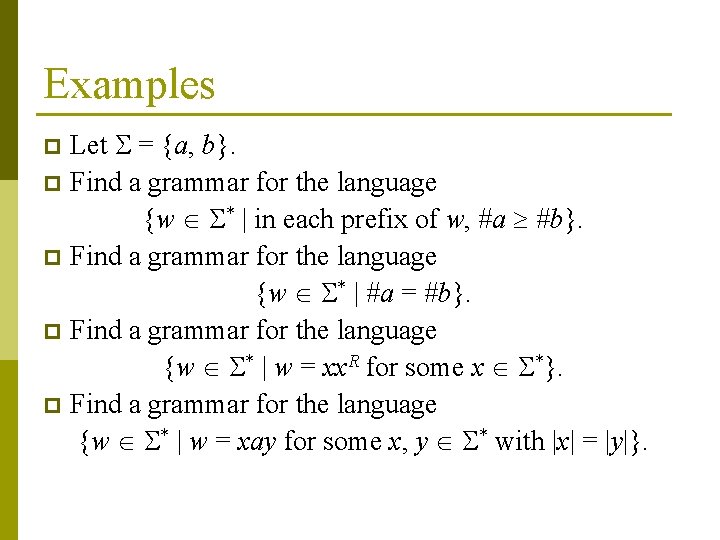
Examples Let = {a, b}. p Find a grammar for the language {w * | in each prefix of w, #a #b}. p Find a grammar for the language {w * | #a = #b}. p Find a grammar for the language {w * | w = xx. R for some x *}. p Find a grammar for the language {w * | w = xay for some x, y * with |x| = |y|}. p