PSY 369 Psycholinguistics Language Production Theories Models Announcements

- Slides: 110
PSY 369: Psycholinguistics Language Production: Theories & Models
Announcements n Homework 7 (Due April 22) n Try to be vigilant for four or five days in noting speech errors made by yourself and others. Write each slip down (carry a small notebook and pencil with you). Then, when you have accumulated a reasonably size sample (aim for 20 to 30, but don't panic if you don't get that many), try to classify each slip in terms of n n the unit(s) involved the type of error n n Remember that each error may be interpreted in different ways. For some of them, see if you can come up with more than one possibility. Exam 3 Extra extra credit opportunity: n n Up to 30 points added to your exam score 2 additional journal summaries (due April 29 th) n n Taft and Hambly (1986) – 15 pts Perfetti et al (1987) – 15 pts
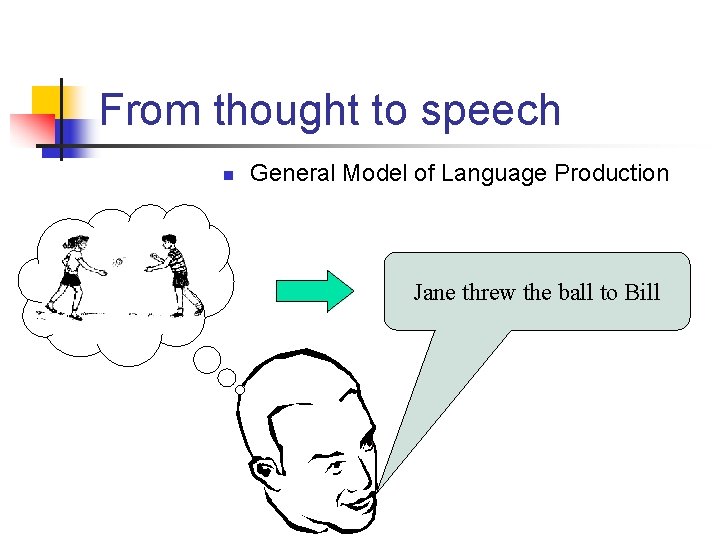
From thought to speech n General Model of Language Production Jane threw the ball to Bill
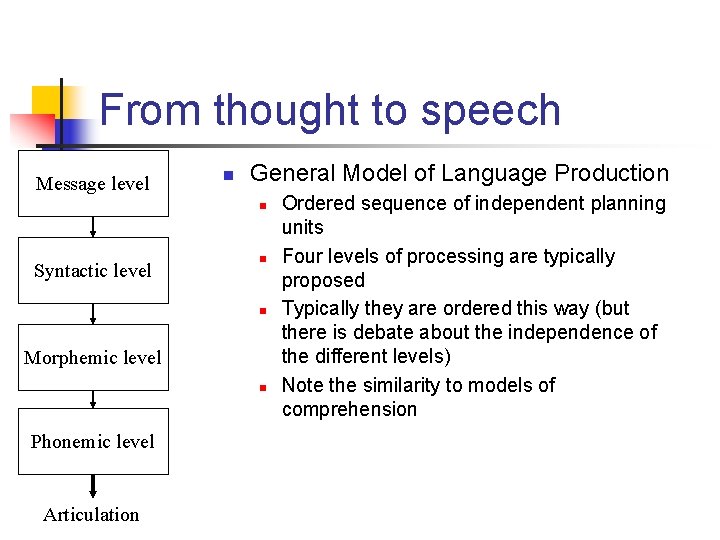
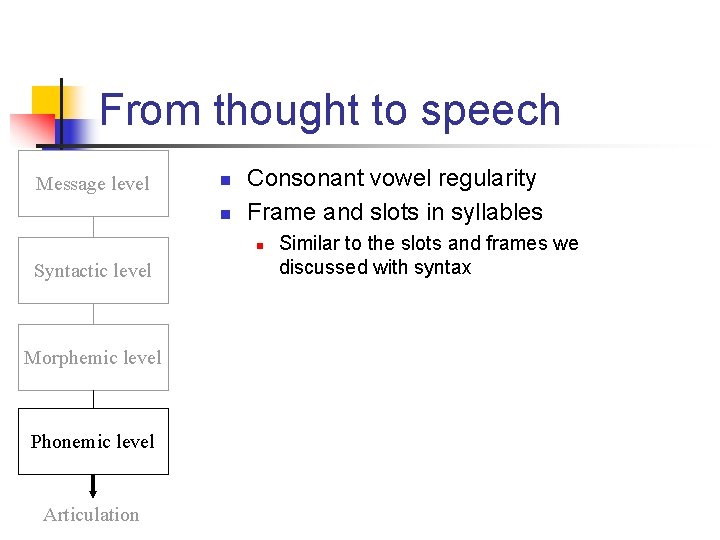
From thought to speech Message level n General Model of Language Production n Syntactic level n n Morphemic level n Phonemic level Articulation Ordered sequence of independent planning units Four levels of processing are typically proposed Typically they are ordered this way (but there is debate about the independence of the different levels) Note the similarity to models of comprehension
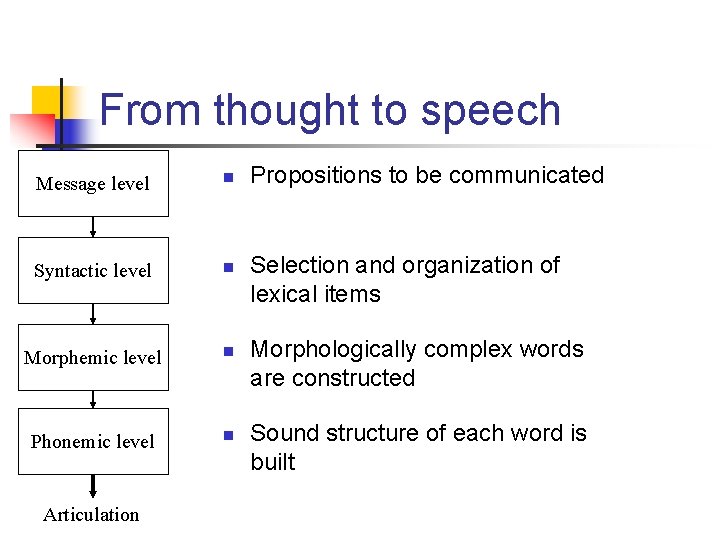
From thought to speech Message level n Syntactic level n Morphemic level n Phonemic level n Articulation Propositions to be communicated Selection and organization of lexical items Morphologically complex words are constructed Sound structure of each word is built
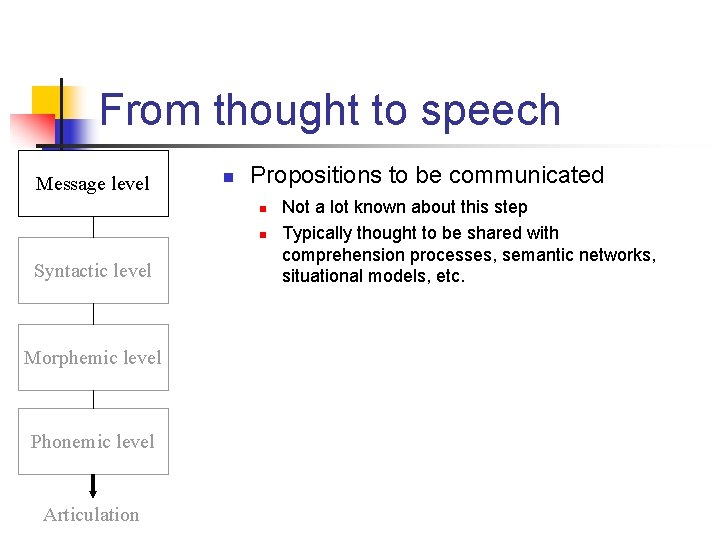
From thought to speech Message level n Propositions to be communicated n n Syntactic level Morphemic level Phonemic level Articulation Not a lot known about this step Typically thought to be shared with comprehension processes, semantic networks, situational models, etc.
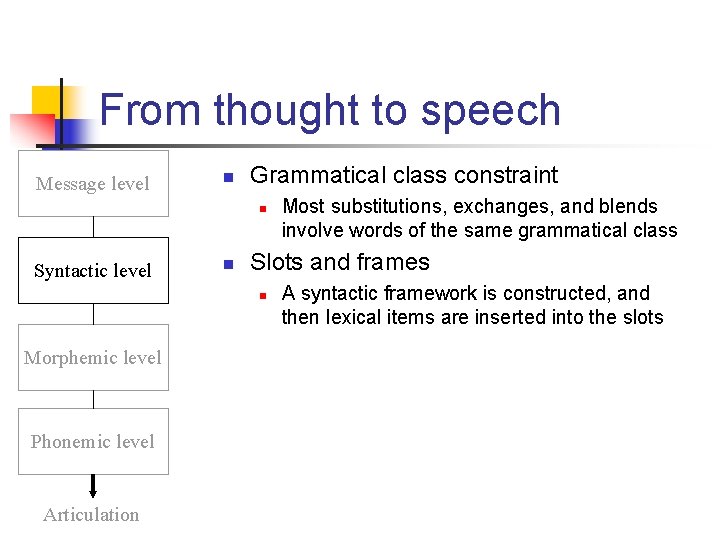
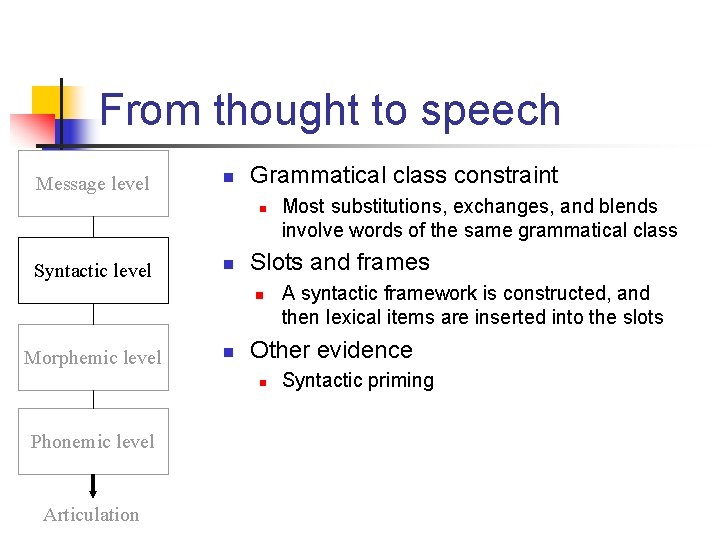
From thought to speech Message level n Grammatical class constraint n Syntactic level n Slots and frames n Morphemic level Phonemic level Articulation Most substitutions, exchanges, and blends involve words of the same grammatical class A syntactic framework is constructed, and then lexical items are inserted into the slots
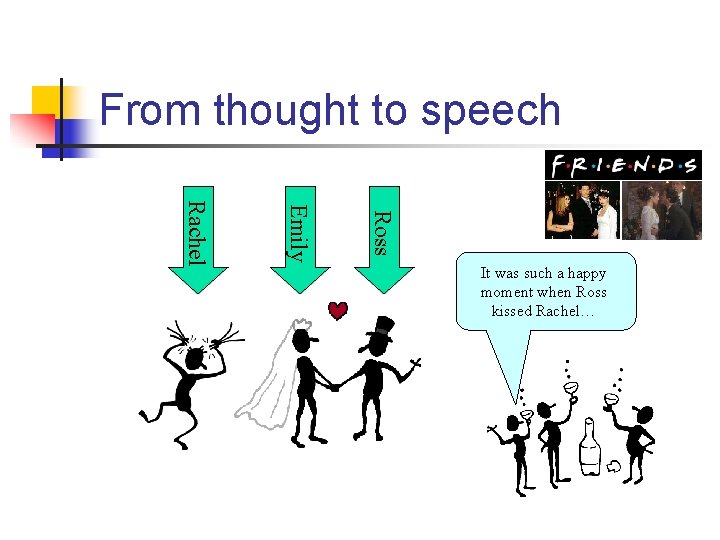
From thought to speech Ross Emily Rachel It was such a happy moment when Ross kissed Rachel…
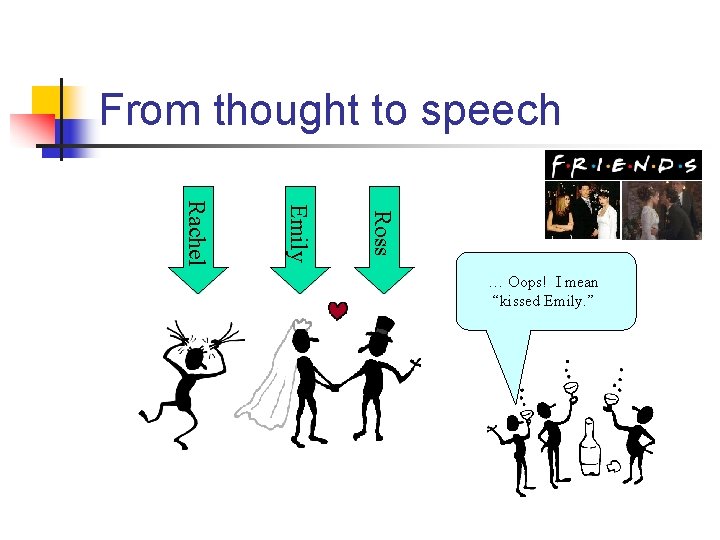
From thought to speech Ross Emily Rachel … Oops! I mean “kissed Emily. ”
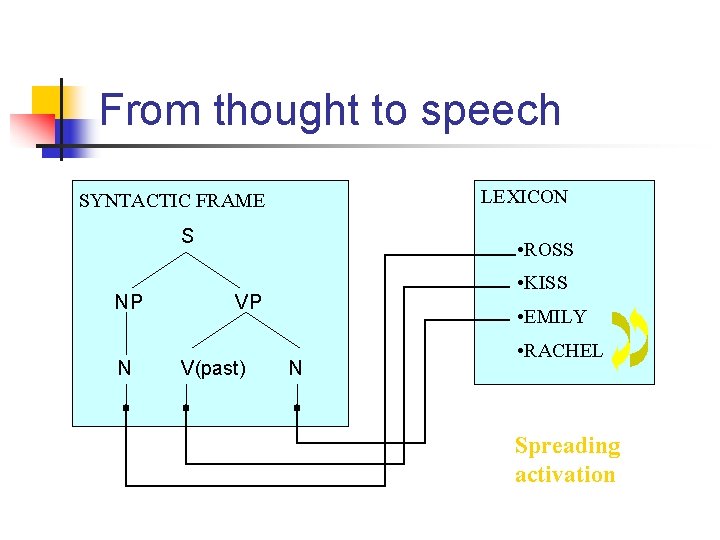
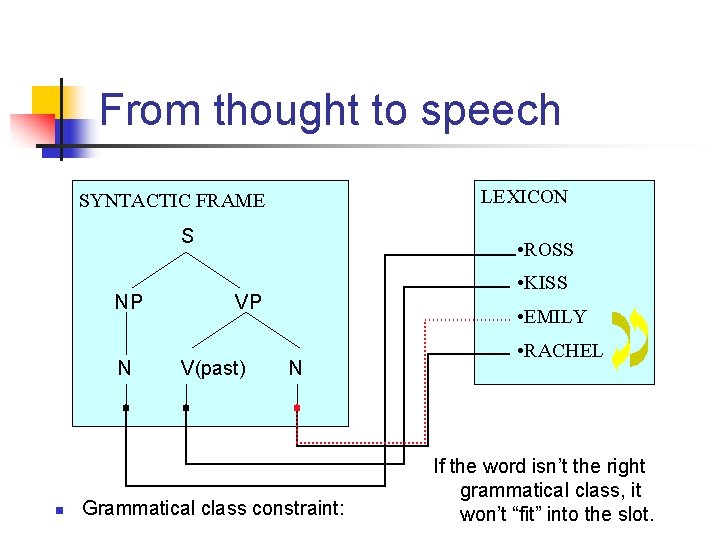
From thought to speech LEXICON SYNTACTIC FRAME S NP N • ROSS • KISS VP V(past) • EMILY N • RACHEL Spreading activation
From thought to speech LEXICON SYNTACTIC FRAME S NP N n • ROSS • KISS VP V(past) • EMILY N Grammatical class constraint: • RACHEL If the word isn’t the right grammatical class, it won’t “fit” into the slot.
From thought to speech Message level n Grammatical class constraint n Syntactic level n Slots and frames n Morphemic level n Articulation A syntactic framework is constructed, and then lexical items are inserted into the slots Other evidence n Phonemic level Most substitutions, exchanges, and blends involve words of the same grammatical class Syntactic priming
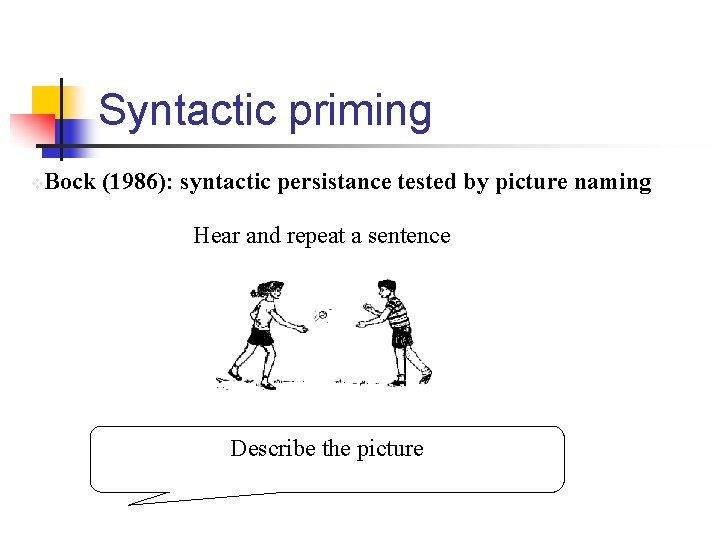
Syntactic priming v Bock (1986): syntactic persistance tested by picture naming Hear and repeat a sentence Describe the picture
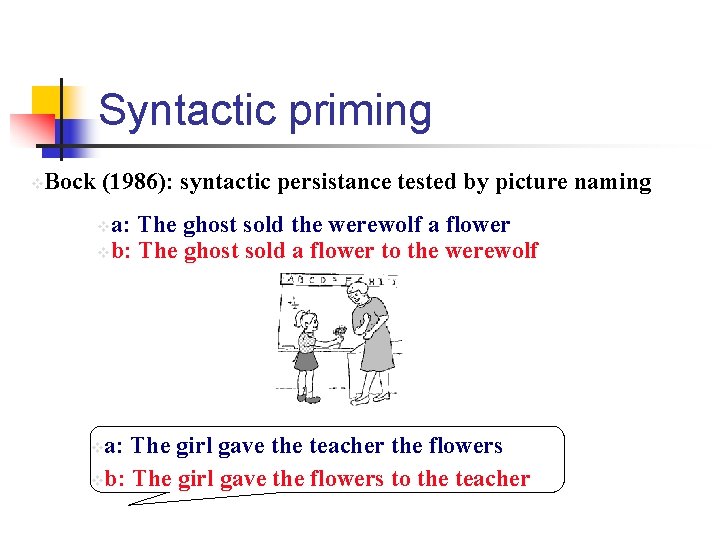
Syntactic priming v Bock (1986): syntactic persistance tested by picture naming a: The ghost sold the werewolf a flower vb: The ghost sold a flower to the werewolf v a: The girl gave the teacher the flowers vb: The girl gave the flowers to the teacher v
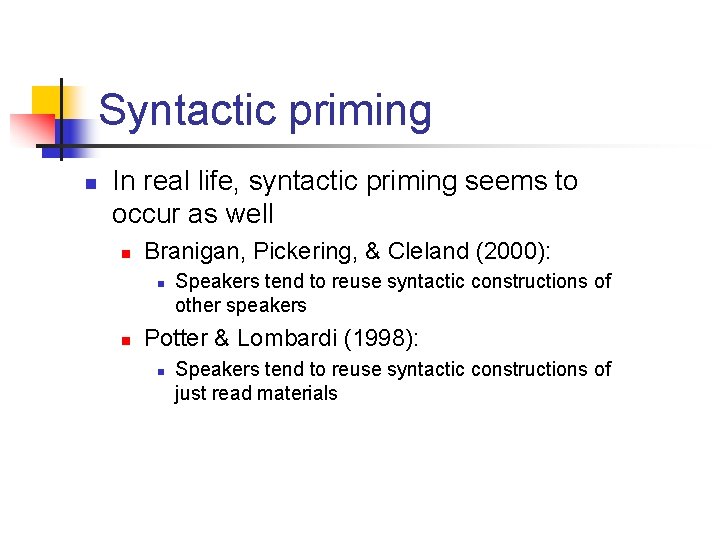
Syntactic priming n In real life, syntactic priming seems to occur as well n Branigan, Pickering, & Cleland (2000): n n Speakers tend to reuse syntactic constructions of other speakers Potter & Lombardi (1998): n Speakers tend to reuse syntactic constructions of just read materials
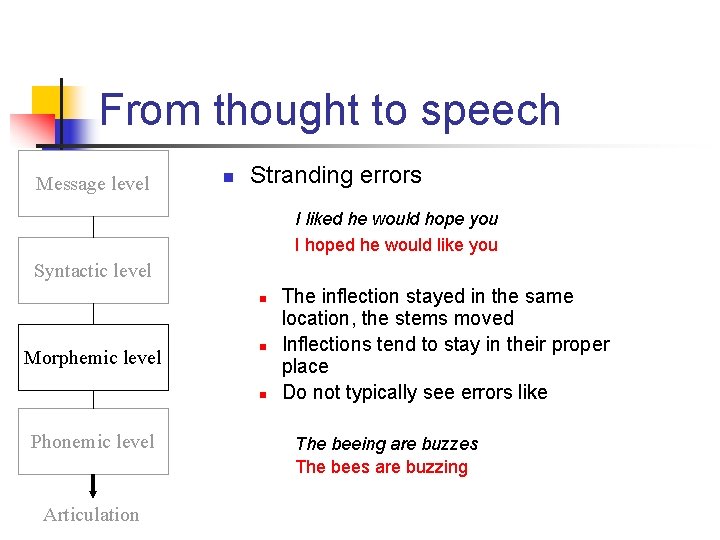
From thought to speech Message level n Stranding errors I liked he would hope you I hoped he would like you Syntactic level n Morphemic level n n Phonemic level Articulation The inflection stayed in the same location, the stems moved Inflections tend to stay in their proper place Do not typically see errors like The beeing are buzzes The bees are buzzing
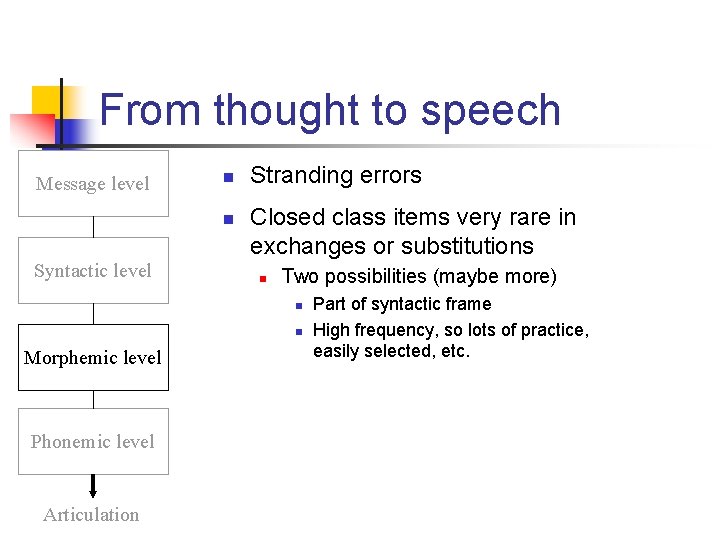
From thought to speech Message level n n Syntactic level Stranding errors Closed class items very rare in exchanges or substitutions n Two possibilities (maybe more) n n Morphemic level Phonemic level Articulation Part of syntactic frame High frequency, so lots of practice, easily selected, etc.
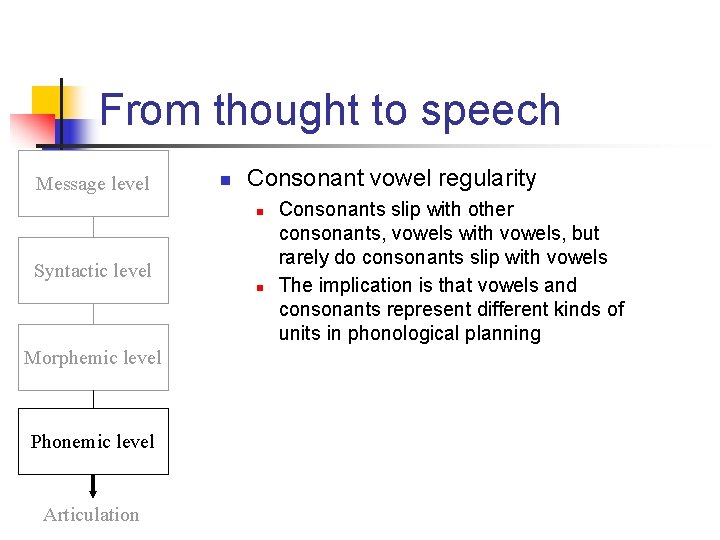
From thought to speech Message level n Consonant vowel regularity n Syntactic level n Morphemic level Phonemic level Articulation Consonants slip with other consonants, vowels with vowels, but rarely do consonants slip with vowels The implication is that vowels and consonants represent different kinds of units in phonological planning
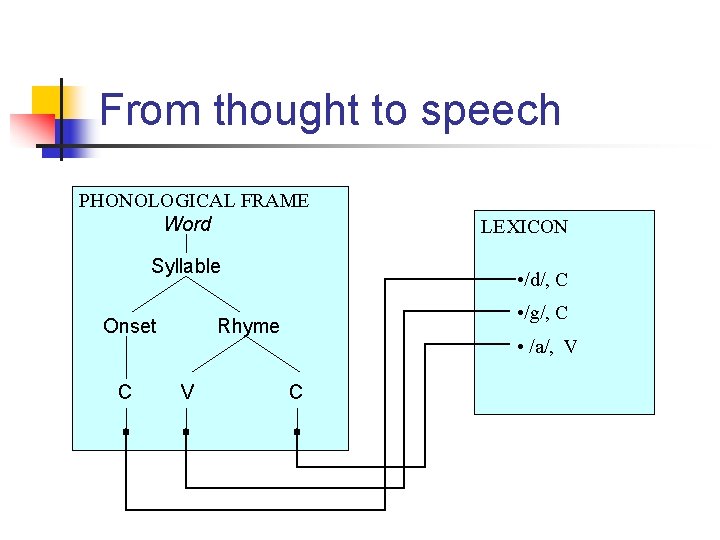
From thought to speech Message level n n Consonant vowel regularity Frame and slots in syllables n Syntactic level Morphemic level Phonemic level Articulation Similar to the slots and frames we discussed with syntax
From thought to speech PHONOLOGICAL FRAME Word Syllable Onset C • /d/, C • /g/, C Rhyme V LEXICON • /a/, V C
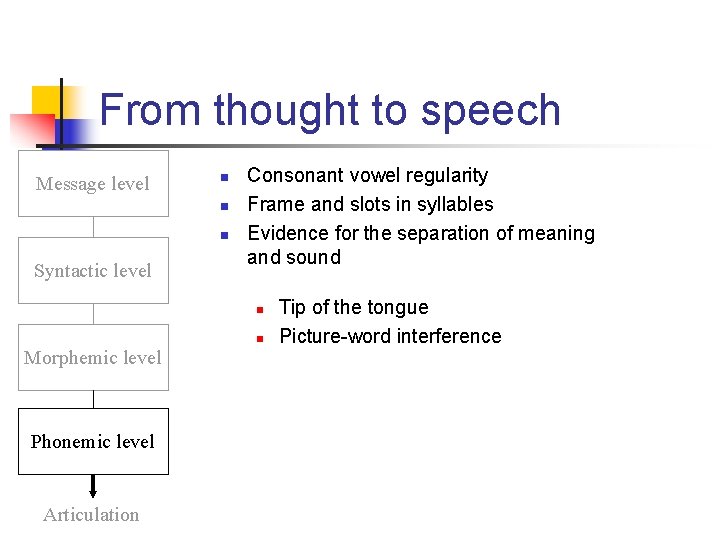
From thought to speech Message level n n n Syntactic level Consonant vowel regularity Frame and slots in syllables Evidence for the separation of meaning and sound n n Morphemic level Phonemic level Articulation Tip of the tongue Picture-word interference
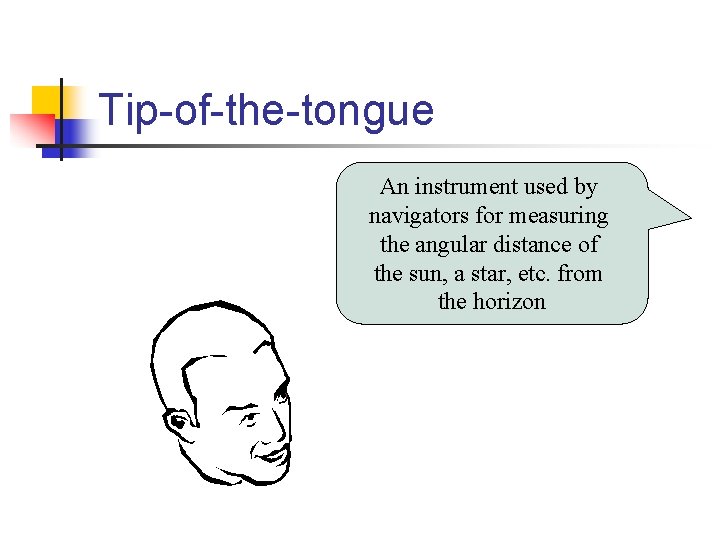
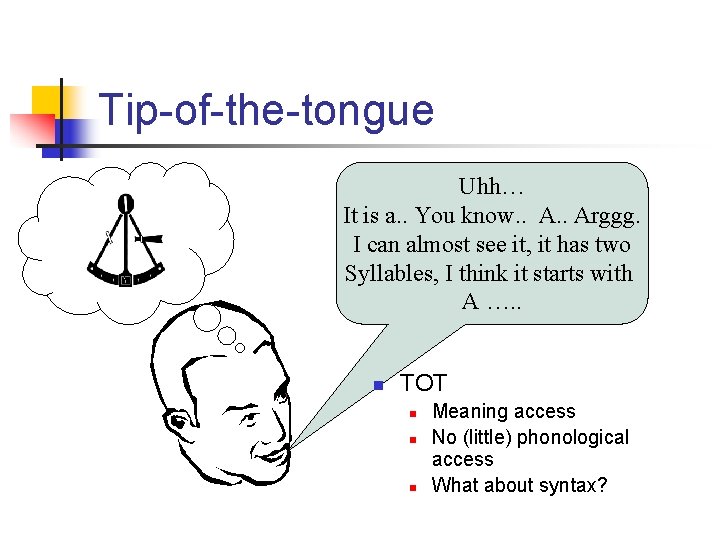
Tip-of-the-tongue An instrument used by navigators for measuring the angular distance of the sun, a star, etc. from the horizon
Tip-of-the-tongue Uhh… It is a. . You know. . Arggg. I can almost see it, it has two Syllables, I think it starts with A …. . n TOT n n n Meaning access No (little) phonological access What about syntax?
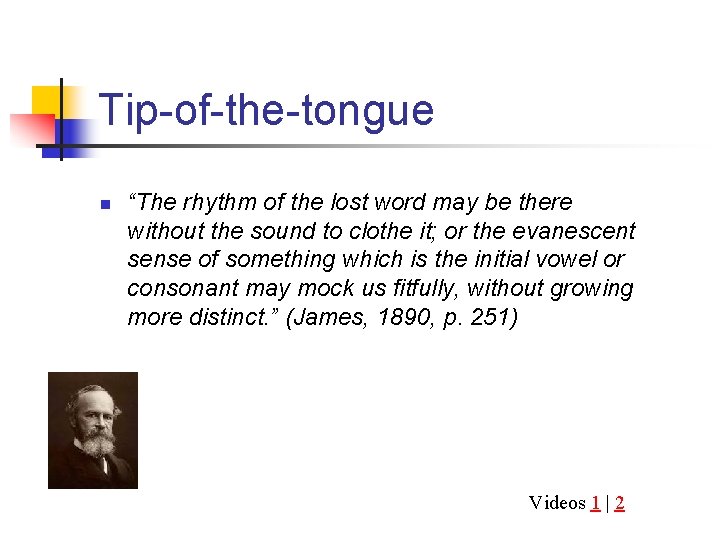
Tip-of-the-tongue n “The rhythm of the lost word may be there without the sound to clothe it; or the evanescent sense of something which is the initial vowel or consonant may mock us fitfully, without growing more distinct. ” (James, 1890, p. 251) Videos 1 | 2
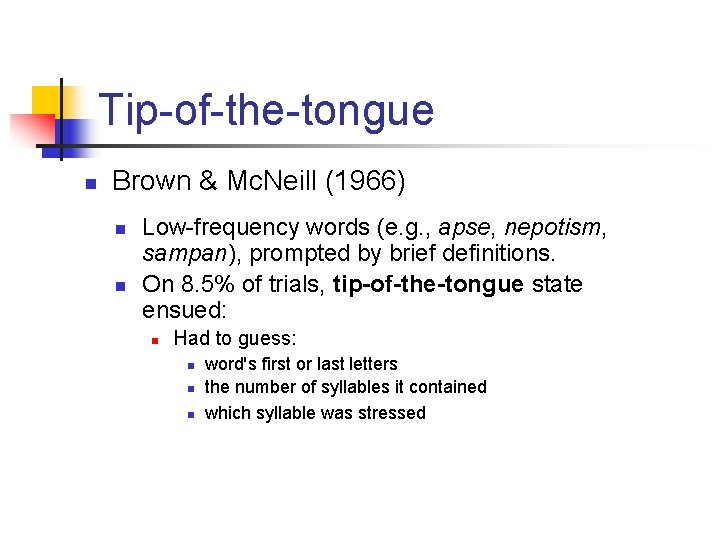
Tip-of-the-tongue n Brown & Mc. Neill (1966) n n Low-frequency words (e. g. , apse, nepotism, sampan), prompted by brief definitions. On 8. 5% of trials, tip-of-the-tongue state ensued: n Had to guess: n n n word's first or last letters the number of syllables it contained which syllable was stressed
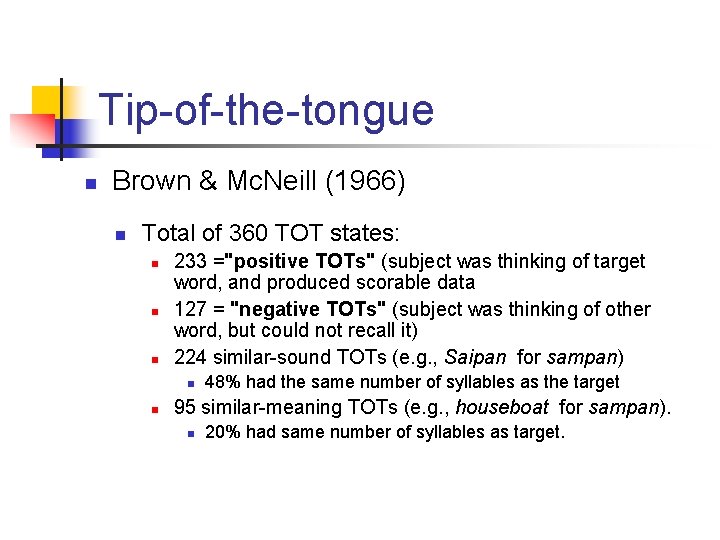
Tip-of-the-tongue n Brown & Mc. Neill (1966) n Total of 360 TOT states: n n n 233 ="positive TOTs" (subject was thinking of target word, and produced scorable data 127 = "negative TOTs" (subject was thinking of other word, but could not recall it) 224 similar-sound TOTs (e. g. , Saipan for sampan) n n 48% had the same number of syllables as the target 95 similar-meaning TOTs (e. g. , houseboat for sampan). n 20% had same number of syllables as target.
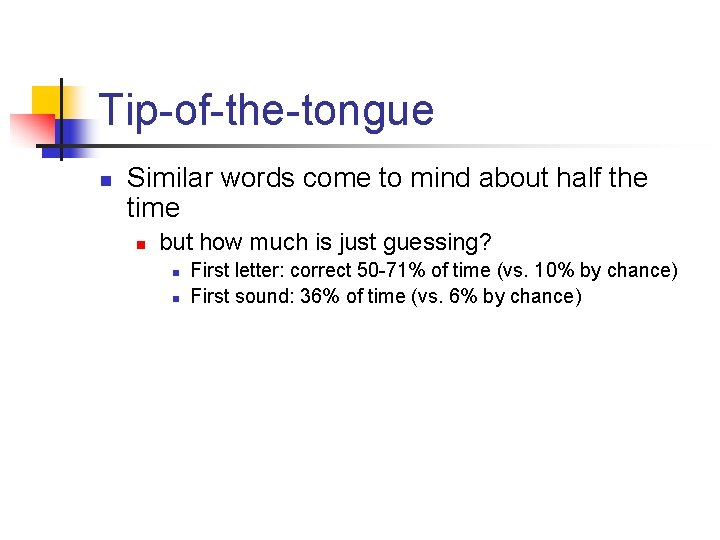
Tip-of-the-tongue n Similar words come to mind about half the time n but how much is just guessing? n n First letter: correct 50 -71% of time (vs. 10% by chance) First sound: 36% of time (vs. 6% by chance)
Tip-of-the-tongue n Results suggest a basic split between semantics/syntax and phonology: n People can access meaning and grammar but not pronunciation
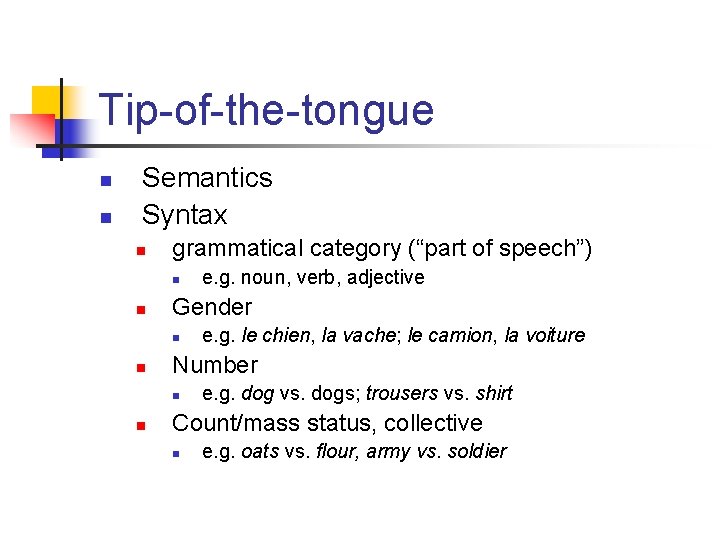
Tip-of-the-tongue n n Semantics Syntax n grammatical category (“part of speech”) n n Gender n n e. g. le chien, la vache; le camion, la voiture Number n n e. g. noun, verb, adjective e. g. dog vs. dogs; trousers vs. shirt Count/mass status, collective n e. g. oats vs. flour, army vs. soldier
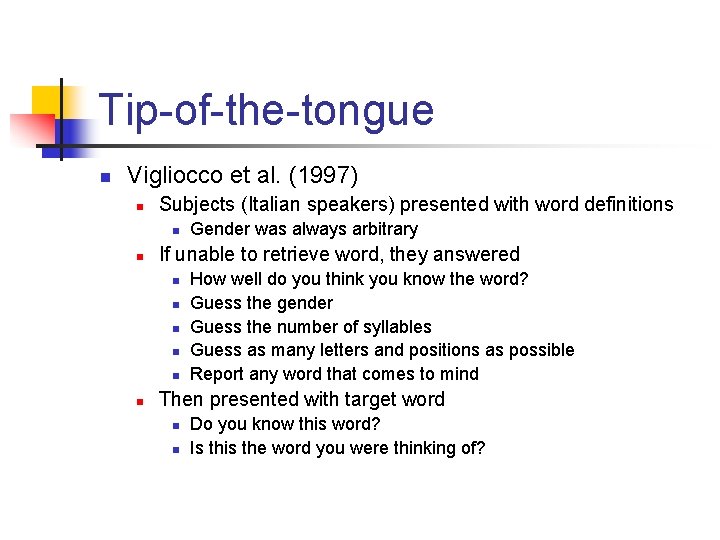
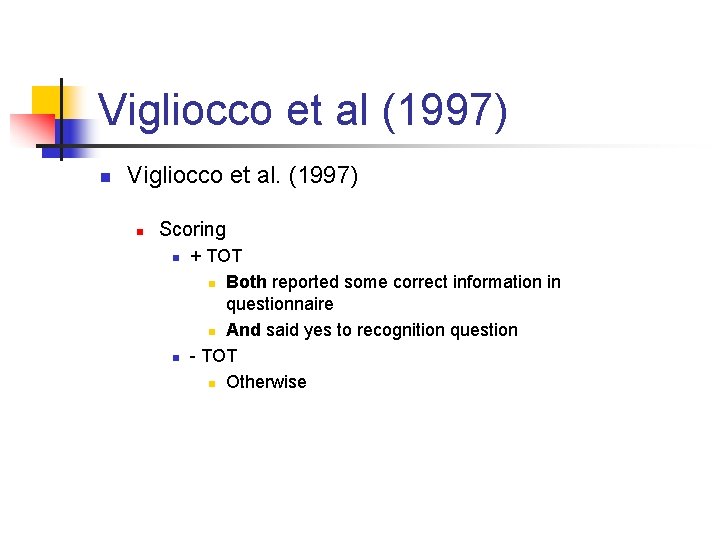
Tip-of-the-tongue n Vigliocco et al. (1997) n Subjects (Italian speakers) presented with word definitions n n If unable to retrieve word, they answered n n n Gender was always arbitrary How well do you think you know the word? Guess the gender Guess the number of syllables Guess as many letters and positions as possible Report any word that comes to mind Then presented with target word n n Do you know this word? Is this the word you were thinking of?
Vigliocco et al (1997) n Vigliocco et al. (1997) n Scoring n n + TOT n Both reported some correct information in questionnaire n And said yes to recognition question - TOT n Otherwise
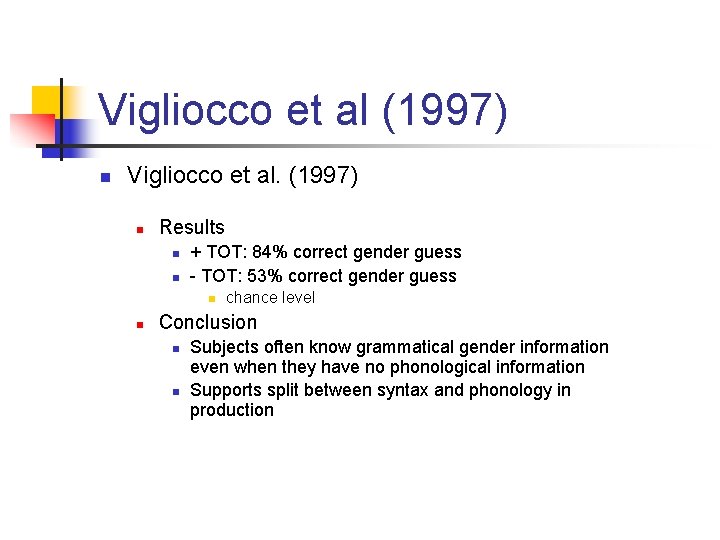
Vigliocco et al (1997) n Vigliocco et al. (1997) n Results n n + TOT: 84% correct gender guess - TOT: 53% correct gender guess n n chance level Conclusion n n Subjects often know grammatical gender information even when they have no phonological information Supports split between syntax and phonology in production
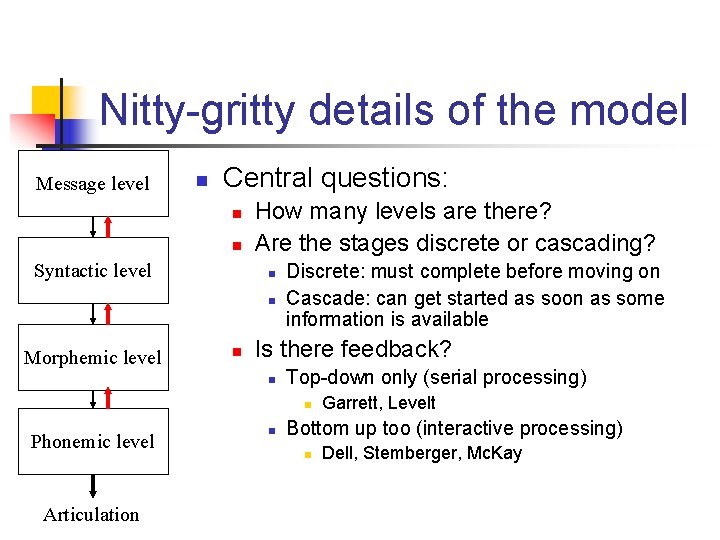
Nitty-gritty details of the model Message level n Central questions: n n Syntactic level How many levels are there? Are the stages discrete or cascading? n n Morphemic level n Discrete: must complete before moving on Cascade: can get started as soon as some information is available Is there feedback? n Top-down only (serial processing) n Phonemic level Articulation n Garrett, Levelt Bottom up too (interactive processing) n Dell, Stemberger, Mc. Kay
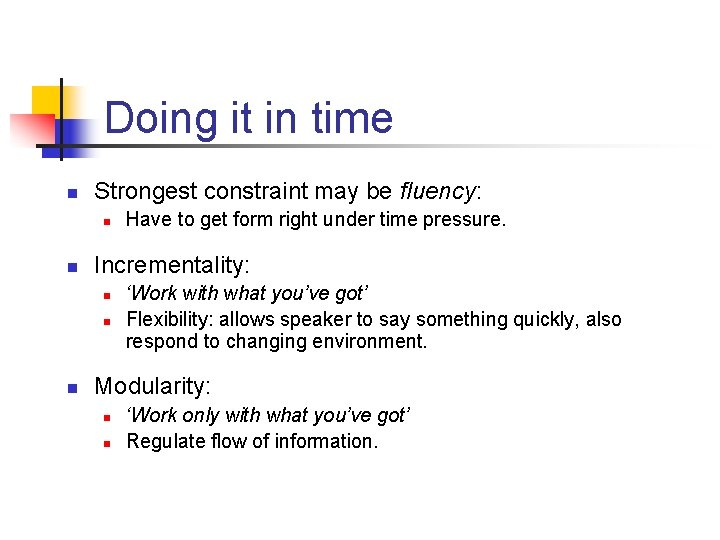
Doing it in time n Strongest constraint may be fluency: n n Incrementality: n n n Have to get form right under time pressure. ‘Work with what you’ve got’ Flexibility: allows speaker to say something quickly, also respond to changing environment. Modularity: n n ‘Work only with what you’ve got’ Regulate flow of information.
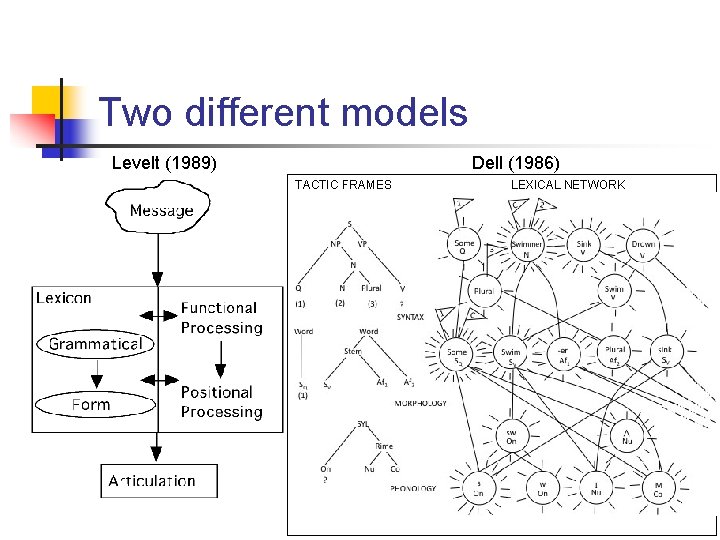
Two different models Levelt (1989) Dell (1986) TACTIC FRAMES LEXICAL NETWORK
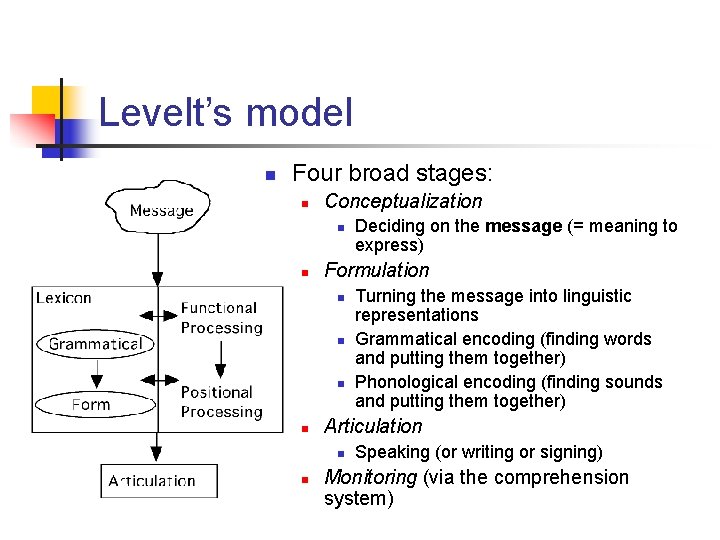
Levelt’s model n Four broad stages: n Conceptualization n n Formulation n n Turning the message into linguistic representations Grammatical encoding (finding words and putting them together) Phonological encoding (finding sounds and putting them together) Articulation n n Deciding on the message (= meaning to express) Speaking (or writing or signing) Monitoring (via the comprehension system)
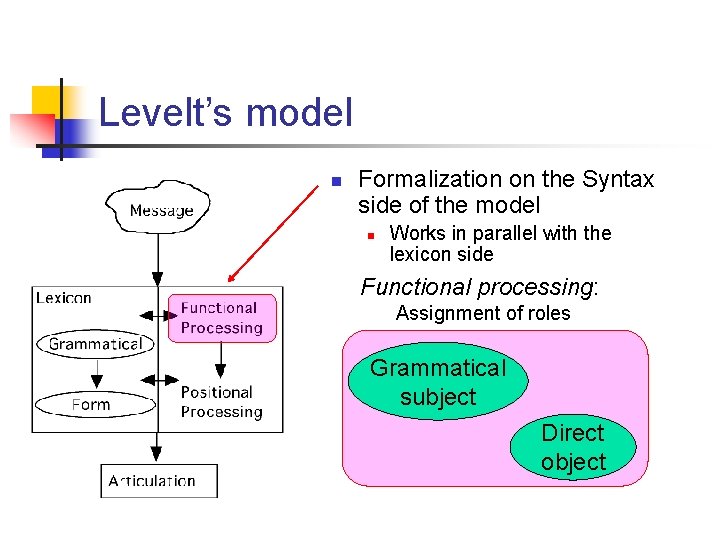
Levelt’s model n Formalization on the Syntax side of the model n Works in parallel with the lexicon side Functional processing: Assignment of roles Grammatical subject Direct object
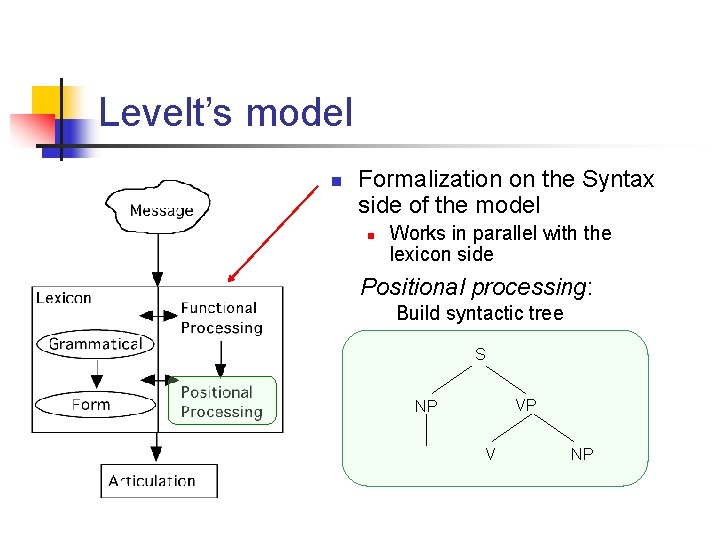
Levelt’s model n Formalization on the Syntax side of the model n Works in parallel with the lexicon side Positional processing: Build syntactic tree S VP NP V NP
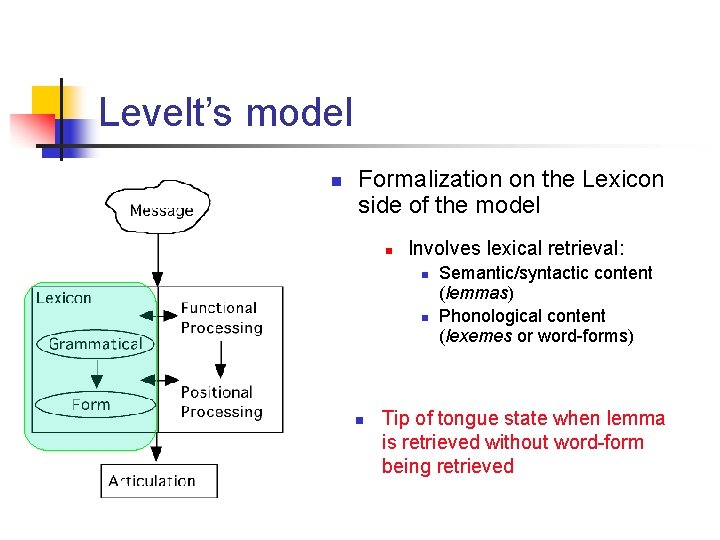
Levelt’s model n Formalization on the Lexicon side of the model n Involves lexical retrieval: n n n Semantic/syntactic content (lemmas) Phonological content (lexemes or word-forms) Tip of tongue state when lemma is retrieved without word-form being retrieved
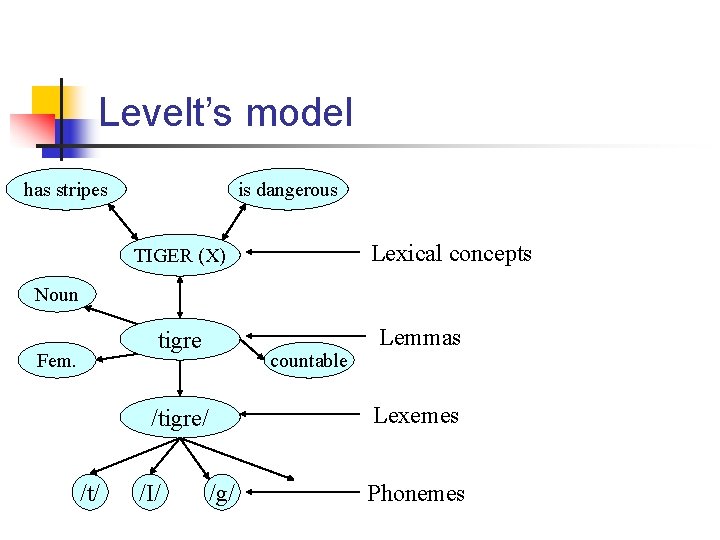
Levelt’s model has stripes is dangerous Lexical concepts TIGER (X) Noun tigre Fem. countable Lexemes /tigre/ /t/ /I/ Lemmas /g/ Phonemes
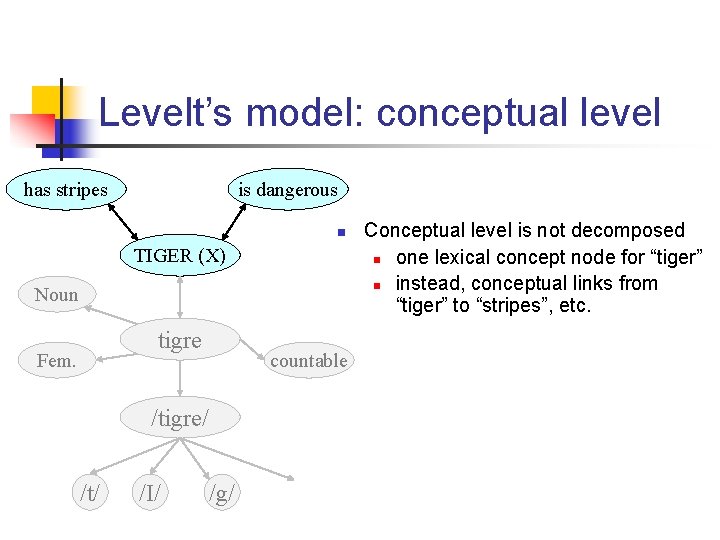
Levelt’s model: conceptual level has stripes is dangerous n TIGER (X) Noun tigre Fem. countable /tigre/ /t/ /I/ /g/ Conceptual level is not decomposed n one lexical concept node for “tiger” n instead, conceptual links from “tiger” to “stripes”, etc.
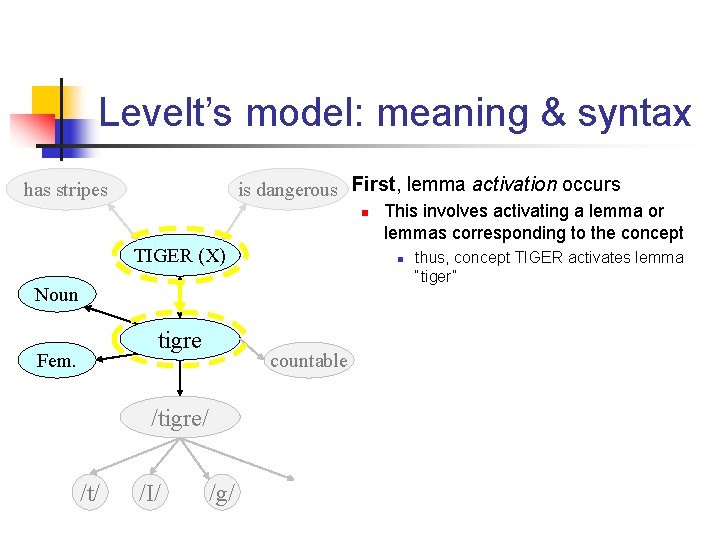
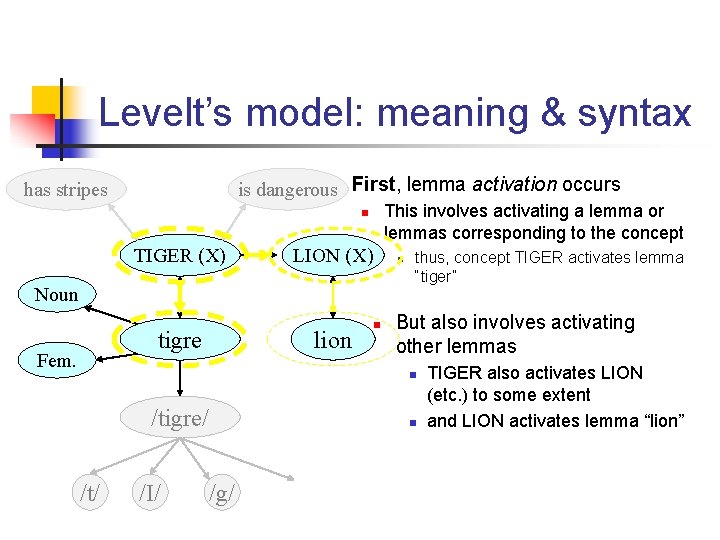
Levelt’s model: meaning & syntax n First, lemma activation occurs is dangerous has stripes n TIGER (X) n Noun tigre Fem. countable /tigre/ /t/ /I/ /g/ This involves activating a lemma or lemmas corresponding to the concept thus, concept TIGER activates lemma “tiger”
Levelt’s model: meaning & syntax n First, lemma activation occurs is dangerous has stripes This involves activating a lemma or lemmas corresponding to the concept n TIGER (X) LION (X) Noun tigre Fem. lion n n thus, concept TIGER activates lemma “tiger” But also involves activating other lemmas n /tigre/ /t/ /I/ n /g/ TIGER also activates LION (etc. ) to some extent and LION activates lemma “lion”
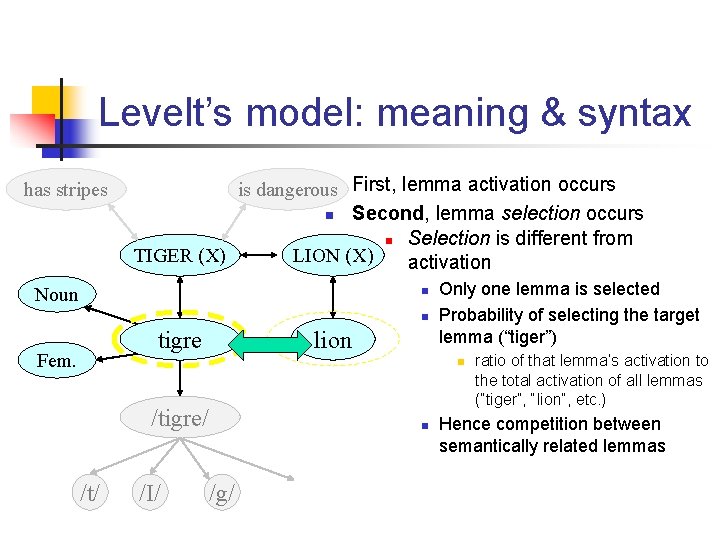
Levelt’s model: meaning & syntax has stripes n First, lemma activation occurs is dangerous n Second, lemma selection occurs n Selection is different from TIGER (X) LION (X) activation Noun n n tigre Fem. lion Only one lemma is selected Probability of selecting the target lemma (“tiger”) n /tigre/ /t/ /I/ n /g/ ratio of that lemma’s activation to the total activation of all lemmas (“tiger”, “lion”, etc. ) Hence competition between semantically related lemmas
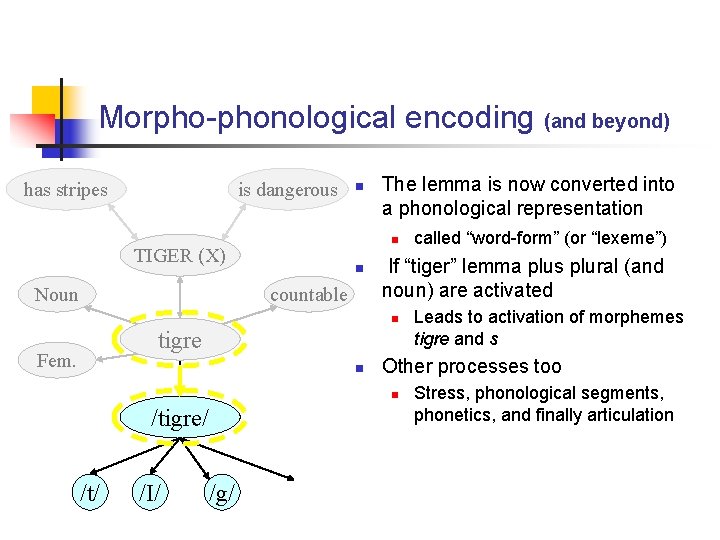
Morpho-phonological encoding (and beyond) has stripes is dangerous The lemma is now converted into a phonological representation n TIGER (X) Noun n n countable If “tiger” lemma plus plural (and noun) are activated n tigre Fem. n /t/ /I/ /g/ Leads to activation of morphemes tigre and s Other processes too n /tigre/ called “word-form” (or “lexeme”) Stress, phonological segments, phonetics, and finally articulation
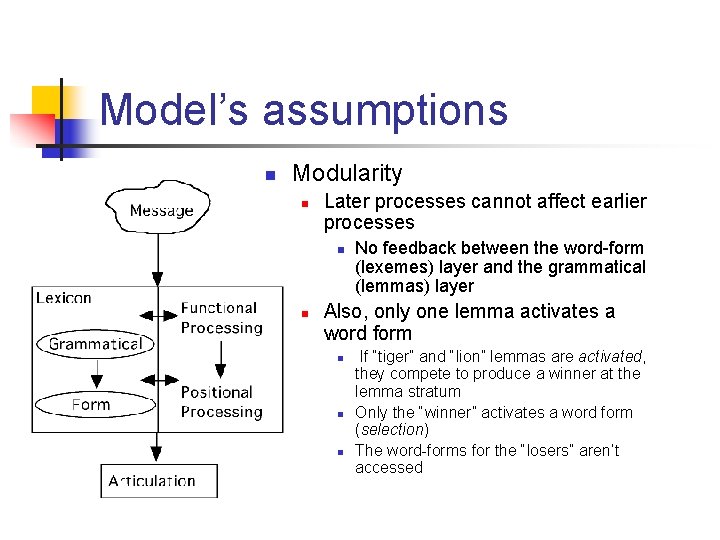
Model’s assumptions n Modularity n Later processes cannot affect earlier processes n n No feedback between the word-form (lexemes) layer and the grammatical (lemmas) layer Also, only one lemma activates a word form n n n If “tiger” and “lion” lemmas are activated, they compete to produce a winner at the lemma stratum Only the “winner” activates a word form (selection) The word-forms for the “losers” aren’t accessed
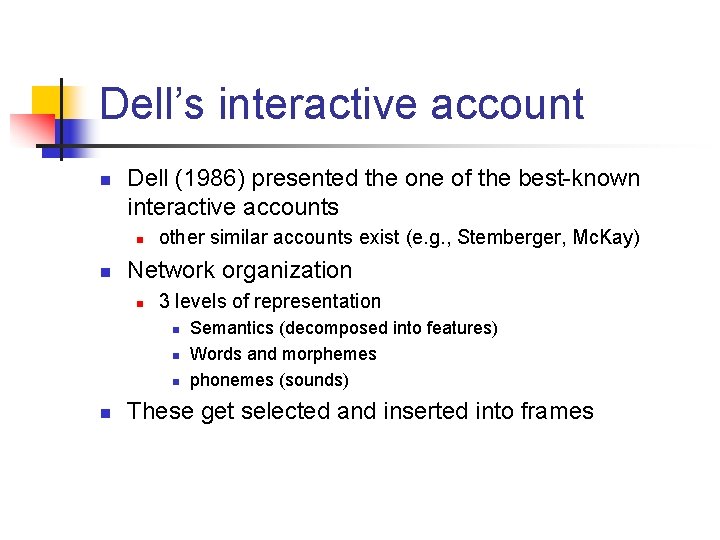
Dell’s interactive account n Dell (1986) presented the one of the best-known interactive accounts n n other similar accounts exist (e. g. , Stemberger, Mc. Kay) Network organization n 3 levels of representation n n Semantics (decomposed into features) Words and morphemes phonemes (sounds) These get selected and inserted into frames
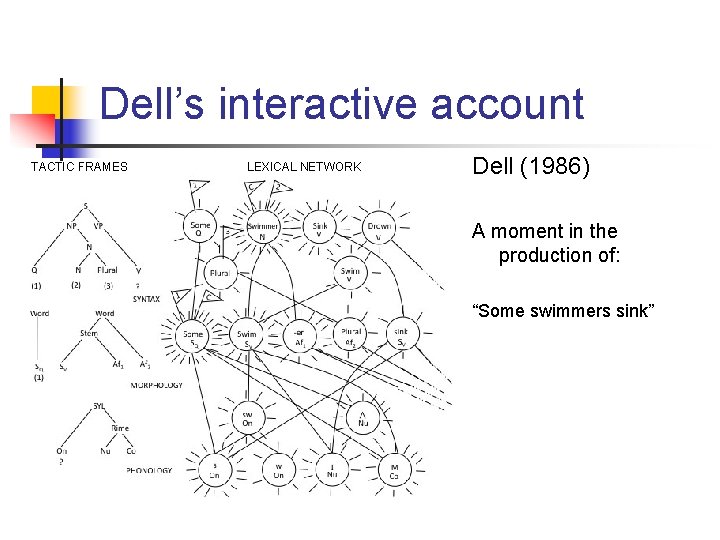
Dell’s interactive account TACTIC FRAMES LEXICAL NETWORK Dell (1986) A moment in the production of: “Some swimmers sink”
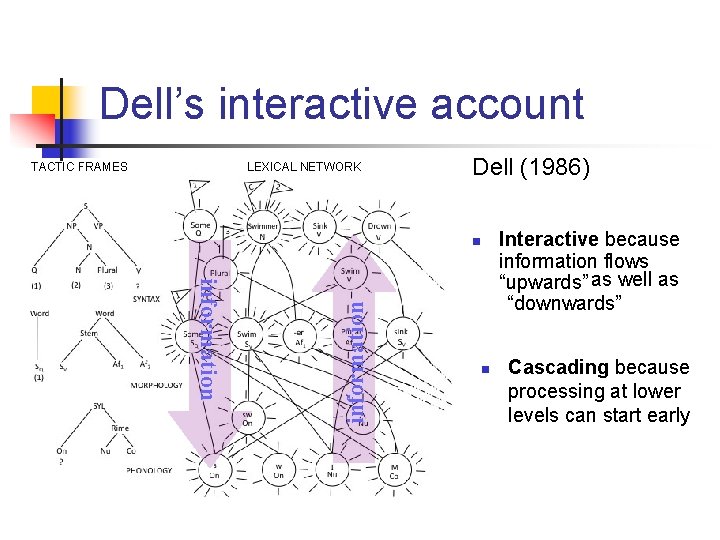
Dell’s interactive account TACTIC FRAMES LEXICAL NETWORK Dell (1986) information n n Interactive because information flows “upwards” as well as “downwards” Cascading because processing at lower levels can start early
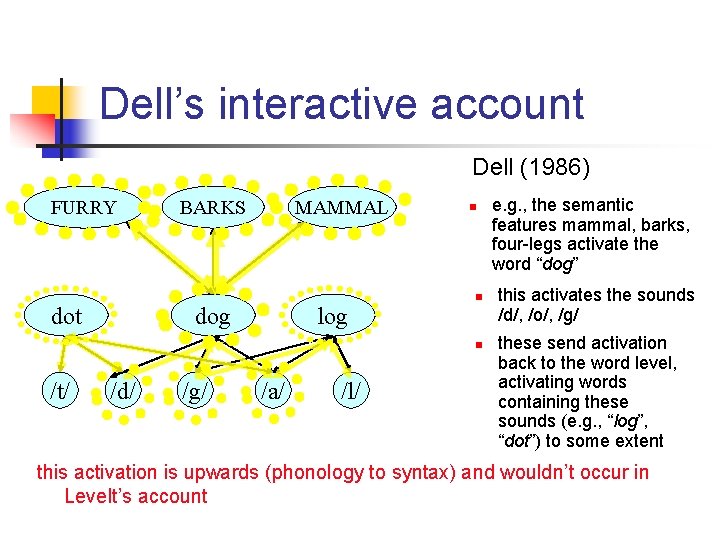
Dell’s interactive account Dell (1986) FURRY dot BARKS MAMMAL dog log n n n /t/ /d/ /g/ /a/ /l/ e. g. , the semantic features mammal, barks, four-legs activate the word “dog” this activates the sounds /d/, /o/, /g/ these send activation back to the word level, activating words containing these sounds (e. g. , “log”, “dot”) to some extent this activation is upwards (phonology to syntax) and wouldn’t occur in Levelt’s account
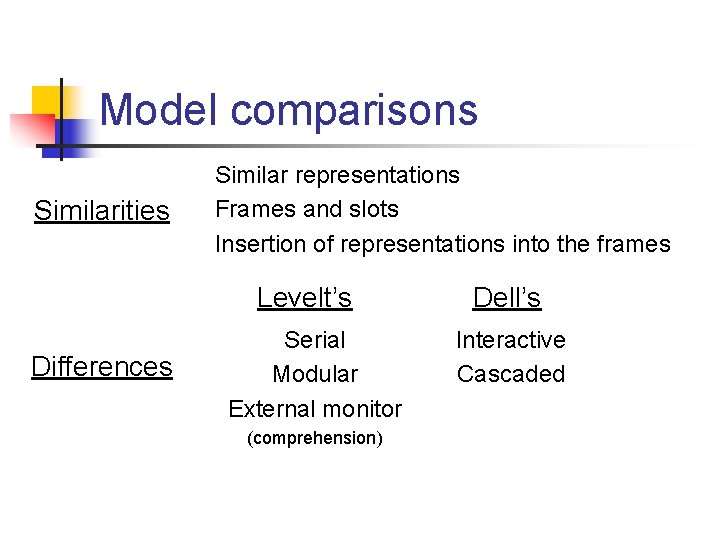
Model comparisons Similarities Similar representations Frames and slots Insertion of representations into the frames Levelt’s Differences Serial Modular External monitor (comprehension) Dell’s Interactive Cascaded
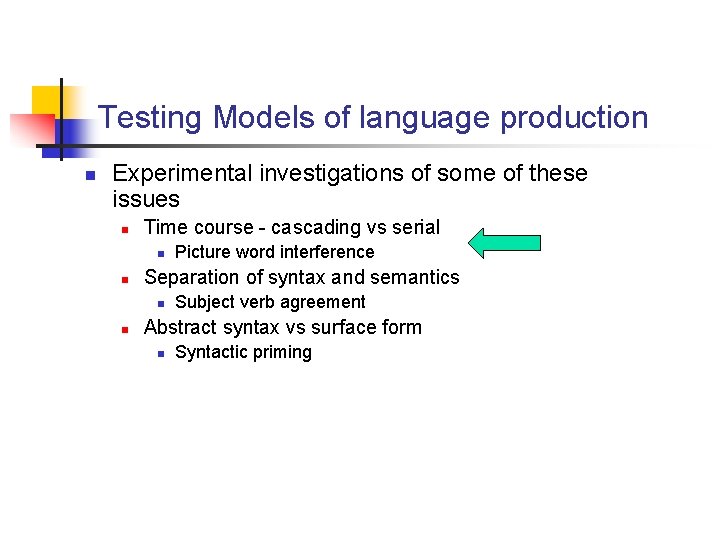
Testing Models of language production n Experimental investigations of some of these issues n Time course - cascading vs serial n n Separation of syntax and semantics n n Picture word interference Subject verb agreement Abstract syntax vs surface form n Syntactic priming
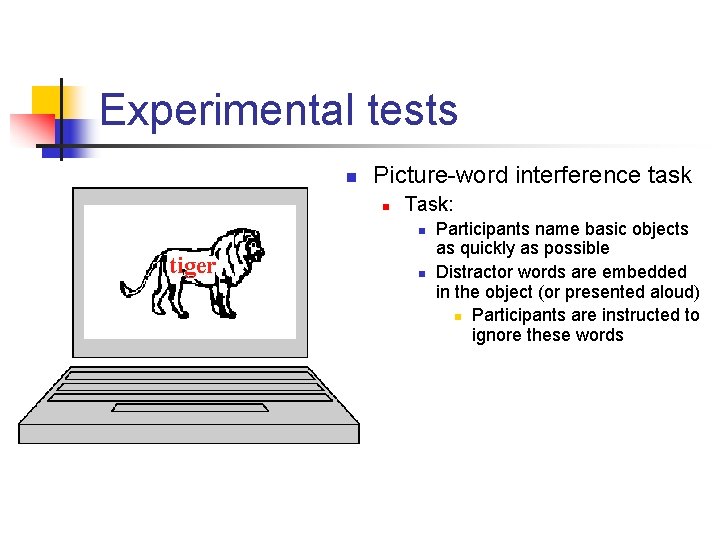
Experimental tests n Picture-word interference task n Task: n tiger n Participants name basic objects as quickly as possible Distractor words are embedded in the object (or presented aloud) n Participants are instructed to ignore these words
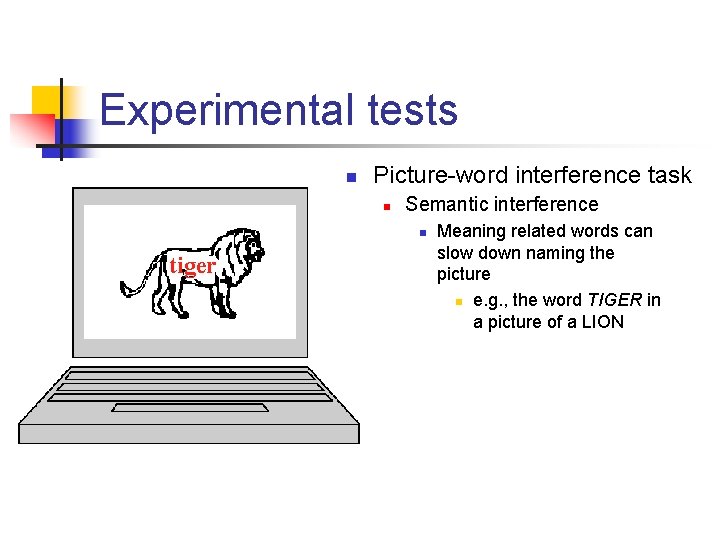
Experimental tests n Picture-word interference task n Semantic interference n tiger Meaning related words can slow down naming the picture n e. g. , the word TIGER in a picture of a LION
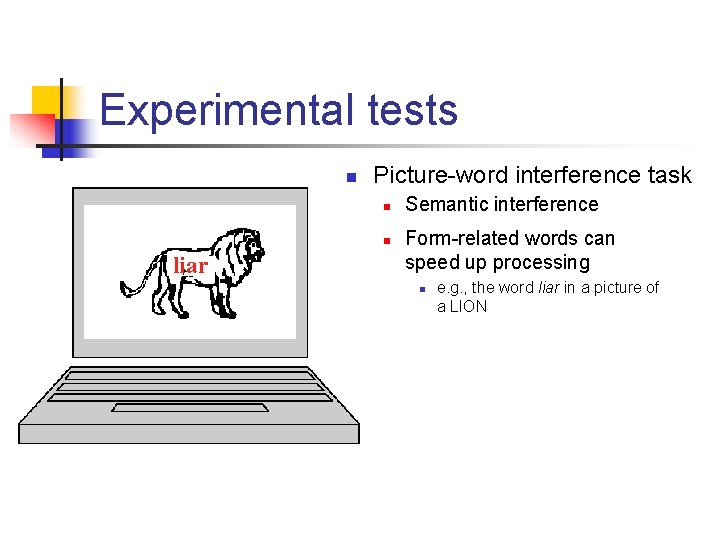
Experimental tests n Picture-word interference task n n liar Semantic interference Form-related words can speed up processing n e. g. , the word liar in a picture of a LION
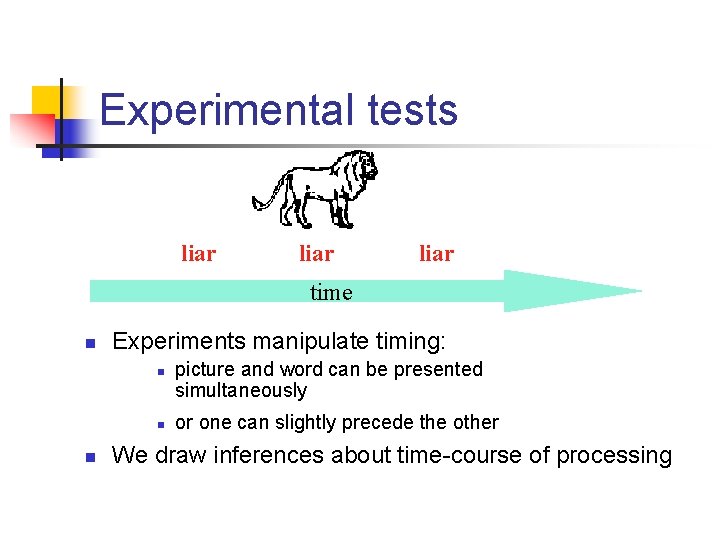
Experimental tests liar time n Experiments manipulate timing: n n n picture and word can be presented simultaneously or one can slightly precede the other We draw inferences about time-course of processing
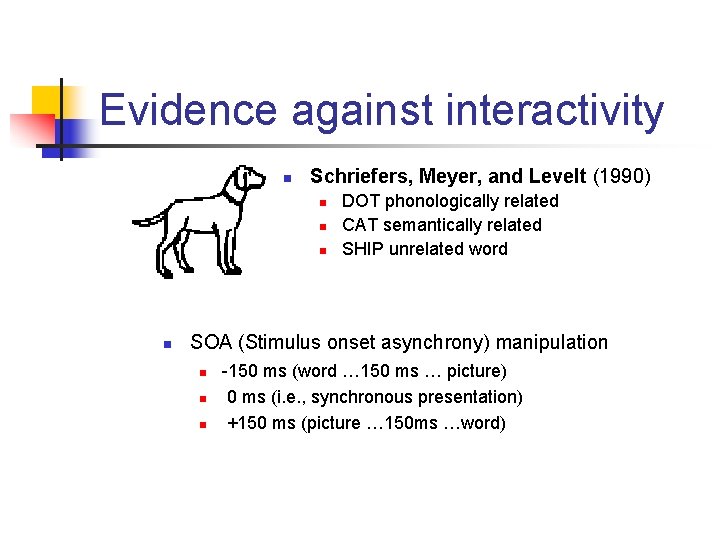
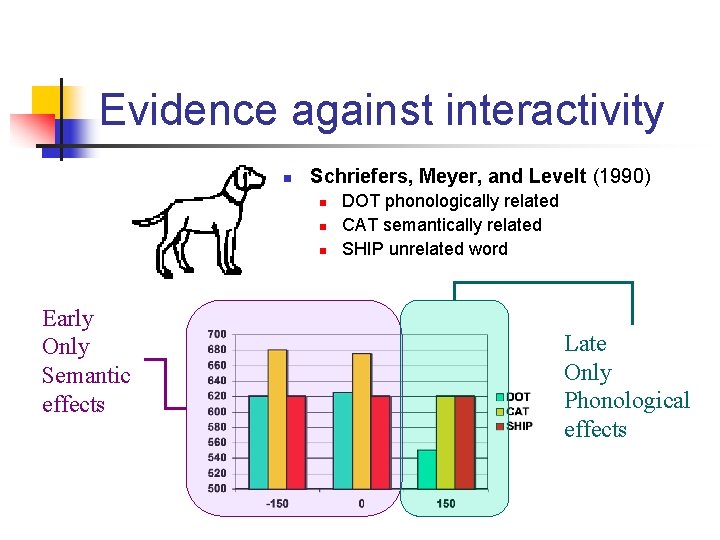
Evidence against interactivity n Schriefers, Meyer, and Levelt (1990) n n DOT phonologically related CAT semantically related SHIP unrelated word SOA (Stimulus onset asynchrony) manipulation n -150 ms (word … 150 ms … picture) 0 ms (i. e. , synchronous presentation) +150 ms (picture … 150 ms …word)
Evidence against interactivity n Schriefers, Meyer, and Levelt (1990) n n n Early Only Semantic effects DOT phonologically related CAT semantically related SHIP unrelated word Late Only Phonological effects
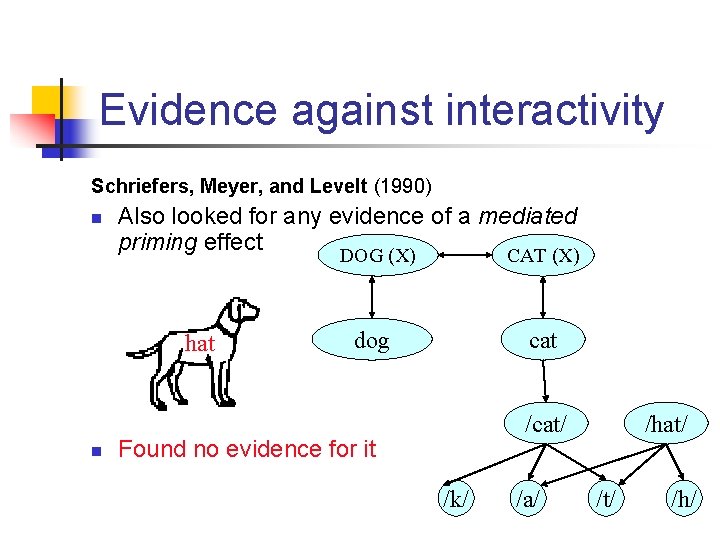
Evidence against interactivity Schriefers, Meyer, and Levelt (1990) n Also looked for any evidence of a mediated priming effect hat n DOG (X) CAT (X) dog cat /cat/ Found no evidence for it /k/ /a/ /hat/ /h/
Interpretation n n Early semantic inhibition Late phonological facilitation Fits with the assumption that semantic processing precedes phonological processing No overlap n n suggests two discrete stages in production an interactive account might find semantic and phonological effects at the same time
Evidence for interactivity n Mixed errors n n Both semantic and phonological relationship to target word Target = “cat” n n semantic error = “dog” phonological error = “hat” mixed error = “rat” Occur more often than predicted by modular models n if you can go wrong at either stage, it would only be by chance that an error would be mixed
Evidence for interactivity n Dell’s explanation n The process of making an error n n n The semantic features of dog activate “cat” Some features (e. g. , animate, mammalian) activate “rat” as well “cat” then activates the sounds /k/, /ae/, /t/ /ae/ and /t/ activate “rat” by feedback This confluence of activation leads to increased tendency for “rat” to be uttered Also explains the tendency for phonological errors to be real words (lexical bias effect) n Sounds can only feed back to words (non-words not represented) so only words can feedback to sound level
Evidence for interactivity n A number of recent experimental findings appear to support interaction under some circumstances (or at least cascading models) n n n Damian & Martin (1999) Cutting & Ferreira (1999) Peterson & Savoy (1998)
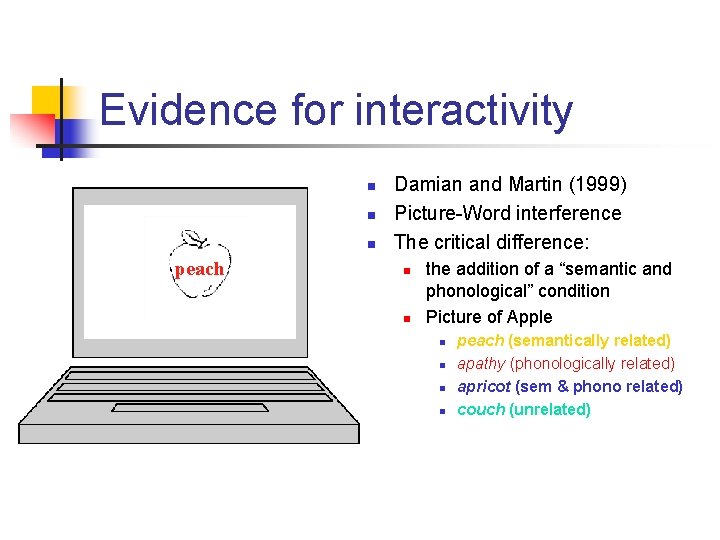
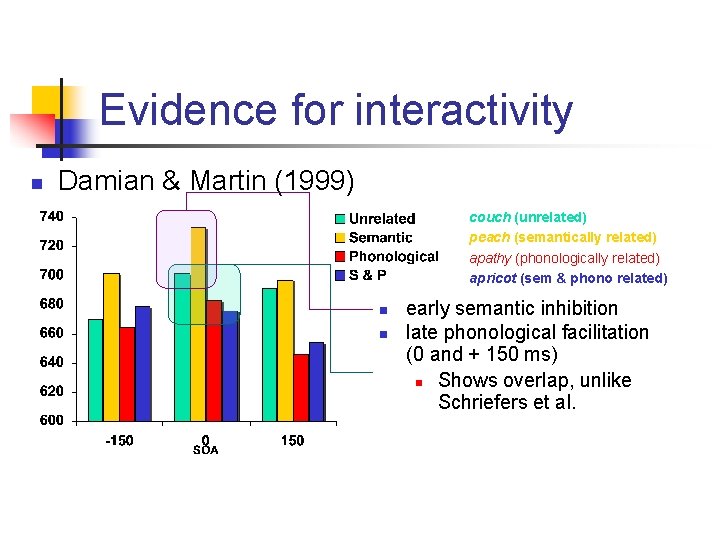
Evidence for interactivity n n n peach Damian and Martin (1999) Picture-Word interference The critical difference: n n the addition of a “semantic and phonological” condition Picture of Apple n n peach (semantically related) apathy (phonologically related) apricot (sem & phono related) couch (unrelated)
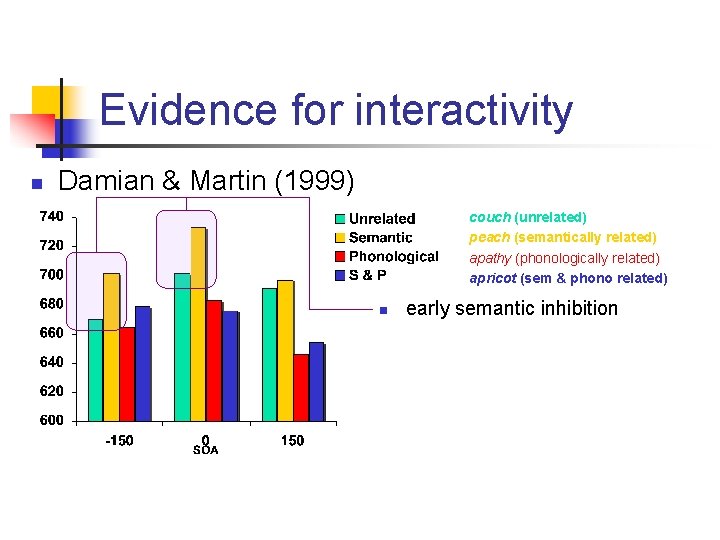
Evidence for interactivity n Damian & Martin (1999) couch (unrelated) peach (semantically related) apathy (phonologically related) apricot (sem & phono related) n early semantic inhibition
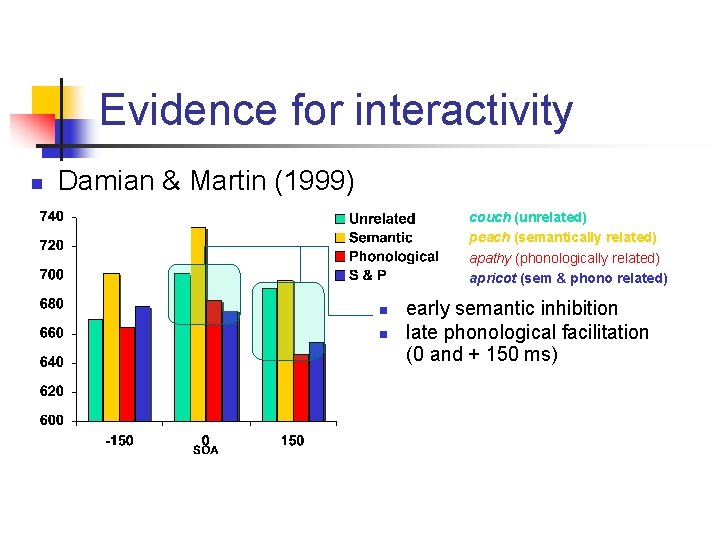
Evidence for interactivity n Damian & Martin (1999) couch (unrelated) peach (semantically related) apathy (phonologically related) apricot (sem & phono related) n n early semantic inhibition late phonological facilitation (0 and + 150 ms)
Evidence for interactivity n Damian & Martin (1999) couch (unrelated) peach (semantically related) apathy (phonologically related) apricot (sem & phono related) n n early semantic inhibition late phonological facilitation (0 and + 150 ms) n Shows overlap, unlike Schriefers et al.
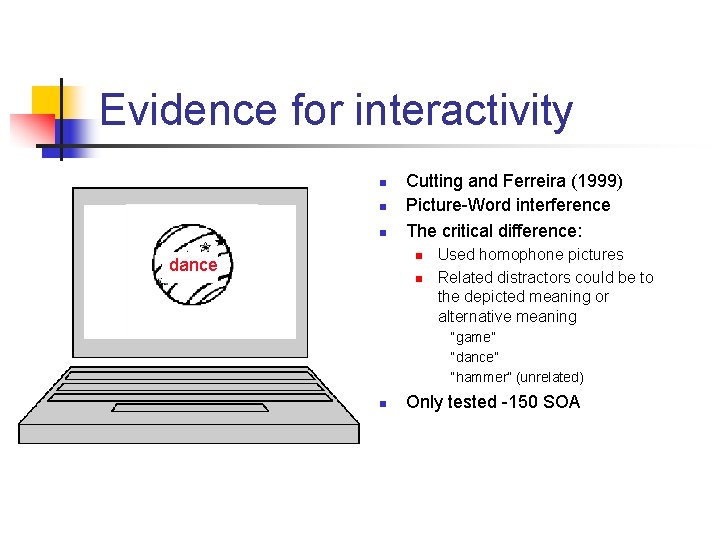
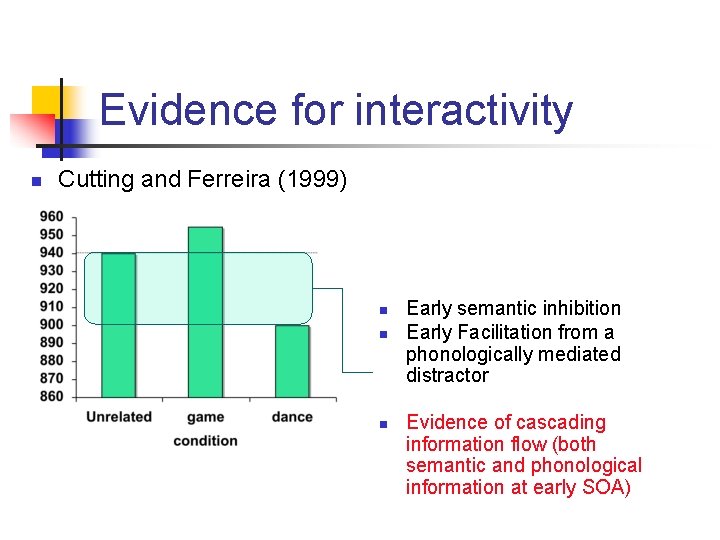
Evidence for interactivity n n n Cutting and Ferreira (1999) Picture-Word interference The critical difference: n dance n Used homophone pictures Related distractors could be to the depicted meaning or alternative meaning “game” “dance” “hammer” (unrelated) n Only tested -150 SOA
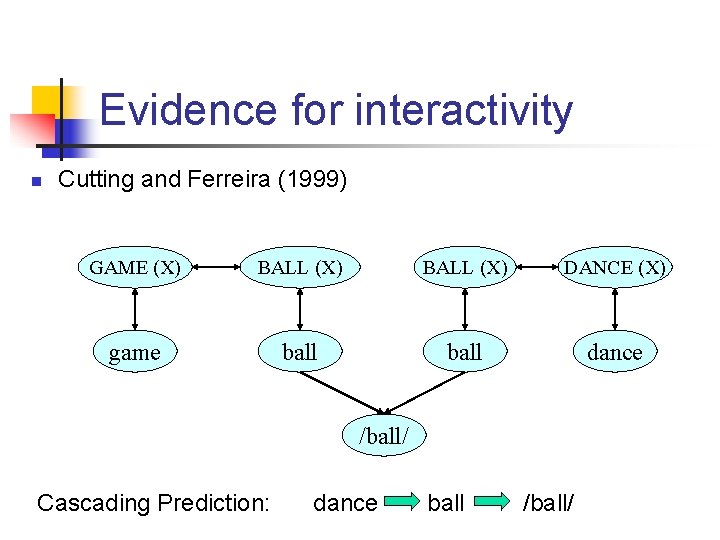
Evidence for interactivity n Cutting and Ferreira (1999) GAME (X) BALL (X) DANCE (X) game ball dance /ball/ Cascading Prediction: dance ball /ball/
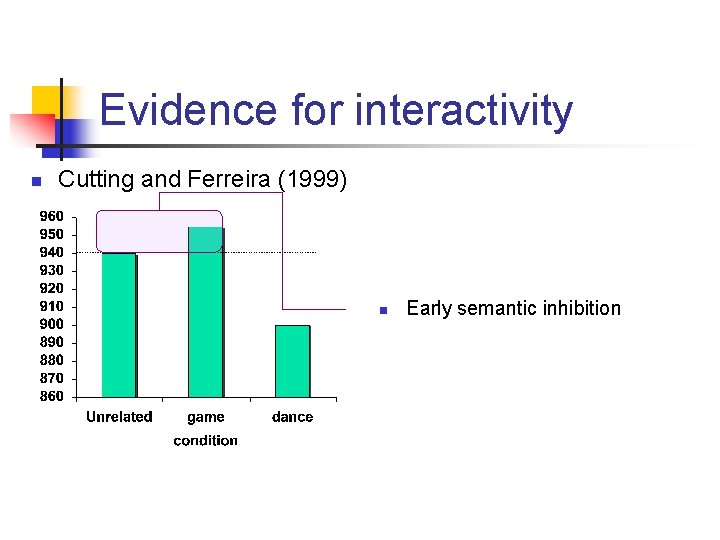
Evidence for interactivity n Cutting and Ferreira (1999) n Early semantic inhibition
Evidence for interactivity n Cutting and Ferreira (1999) n n n Early semantic inhibition Early Facilitation from a phonologically mediated distractor Evidence of cascading information flow (both semantic and phonological information at early SOA)
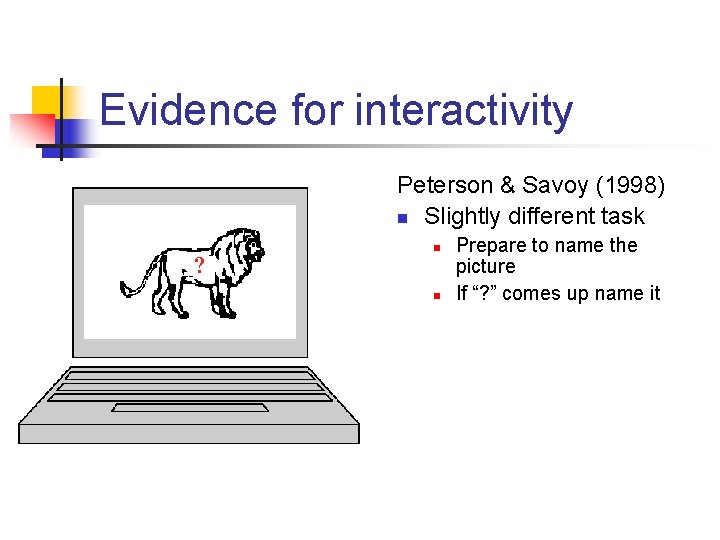
Evidence for interactivity Peterson & Savoy (1998) n Slightly different task ? n n Prepare to name the picture If “? ” comes up name it
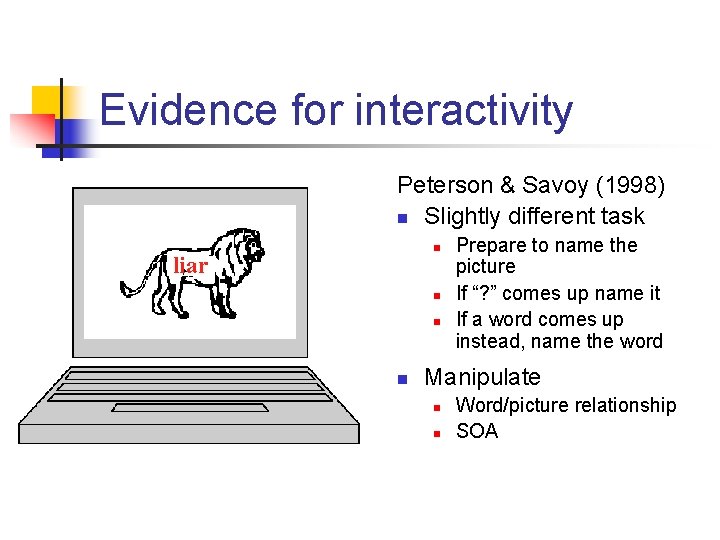
Evidence for interactivity Peterson & Savoy (1998) n Slightly different task n liar n n n Prepare to name the picture If “? ” comes up name it If a word comes up instead, name the word Manipulate n n Word/picture relationship SOA
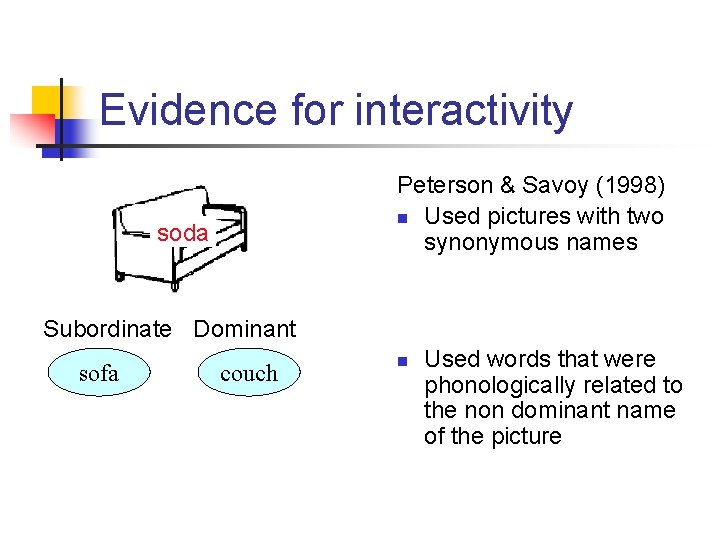
Evidence for interactivity Peterson & Savoy (1998) n Used pictures with two synonymous names soda Subordinate Dominant sofa couch n Used words that were phonologically related to the non dominant name of the picture
Evidence for interactivity n Peterson & Savoy n Found evidence for phonological activation of near synonyms: n n Participants slower to say distractor soda than unrelated distractor when naming couch n Soda is related to non-selected sofa Remember that Levelt et al. assume that only one lemma can be selected and hence activate a phonological form n Levelt et al’s explanation: Could be erroneous selection of two lemmas?
Can the two-stage account be saved? n Evidence for interaction is hard to reconcile with the Levelt account n However, most attempts are likely to revolve around the monitor n n Basically, people sometimes notice a problem and screen it out Levelt argues that evidence for interaction really involves “special cases”, not directly related to normal processing
Overall summary n Levelt et al. ’s theory of word production: n n n Dell’s interactive account: n n Strictly modular lexical access Syntactic processing precedes phonological processing Interaction between syntactic and phonological processing Experimental evidence is equivocal, but increasing evidence that more than one lemma may activate associated word-form
Conversational interaction n n n n ABBOTT: Super Duper computer store. Can I help you? COSTELLO: Thanks. I'm setting up an office in my den, and I'm thinking about buying a computer. ABBOTT: Mac? COSTELLO: No, the name is Lou. ABBOTT: Your computer? COSTELLO: I don't own a computer. I want to buy one. ABBOTT: Mac? COSTELLO: I told you, my name is Lou. ABBOTT: What about Windows? COSTELLO: Why? Will it get stuffy in here? ABBOTT: Do you want a computer with windows? COSTELLO: I don't know. What will I see when I look in the windows? ABBOTT: Wallpaper. COSTELLO: Never mind the windows. I need a computer and software. ABBOTT: Software for windows? COSTELLO: No. On the computer! I need something I can use to write proposals, track expenses and run my business. What have you got? ABBOTT: Office.
Conversational interaction n n n n COSTELLO: Yeah, for my office. Can you recommend anything? ABBOTT: I just did. COSTELLO: You just did what? ABBOTT: Recommend something. COSTELLO: You recommended something? ABBOTT: Yes. COSTELLO: For my office? ABBOTT: Yes. COSTELLO: OK, what did you recommend for my office? ABBOTT: Office. COSTELLO: Yes, for my office! ABBOTT: I recommend office with windows. COSTELLO: I already have an office and it has windows!OK, lets just say, I'm sitting at my computer and I want to type a proposal. What do I need? ABBOTT: Word. COSTELLO: What word? ABBOTT: Word in Office. COSTELLO: The only word in office is office. ABBOTT: The Word in Office for Windows.
Conversational interaction n n n n COSTELLO: Which word in office for windows? ABBOTT: The Word you get when you click the blue "W. ” COSTELLO: I'm going to click your blue "w" if you don't start with some straight answers. OK, forget that. Can I watch movies on the Internet? ABBOTT: Yes, you want Real One. COSTELLO: Maybe a real one, maybe a cartoon. What I watch is none of your business. Just tell me what I need! ABBOTT: Real One. COSTELLO: If it’s a long movie I also want to see reel 2, 3 and 4. Can I watch them? ABBOTT: Of course. COSTELLO: Great, with what? ABBOTT: Real One. COSTELLO; OK, I'm at my computer and I want to watch a movie. What do I do? ABBOTT: You click the blue "1. ” COSTELLO: I click the blue one what? ABBOTT: The blue "1. ” COSTELLO: Is that different from the blue "W"? ABBOTT: The blue 1 is Real One and the blue W is Word. COSTELLO: What word?
Conversational interaction n n n ABBOTT: The Word in Office for Windows. COSTELLO: But there are three words in "office for windows"! ABBOTT: No, just one. But it’s the most popular Word in the world. COSTELLO: It is? ABBOTT: Yes, but to be fair, there aren't many other Words left. It pretty much wiped out all the other Words. COSTELLO: And that word is real one? ABBOTT: Real One has nothing to do with Word. Real One isn't even Part of Office. COSTELLO: Stop! Don't start that again. What about financial bookkeeping you have anything I can track my money with? ABBOTT: Money. COSTELLO: That's right. What do you have? ABBOTT: Money. COSTELLO: I need money to track my money? ABBOTT: It comes bundled with your computer. COSTELLO: What's bundled to my computer? ABBOTT: Money.
Conversational interaction n n COSTELLO: Money comes with my computer? ABBOTT: Yes. No extra charge. COSTELLO: I get a bundle of money with my computer? How much? ABBOTT: One copy. COSTELLO: Isn't it illegal to copy money? ABBOTT: Microsoft gave us a license to copy money. COSTELLO: They can give you a license to copy money? ABBOTT: Why not? THEY OWN IT! (LATER) COSTELLO: How do I turn my computer off? ? ABBOTT: Click on "START".
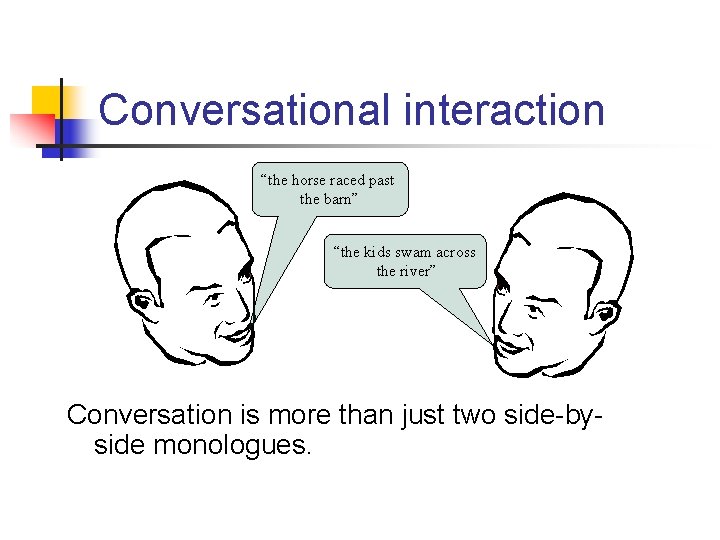
Conversational interaction “the horse raced past the barn” “the kids swam across the river” Conversation is more than just two side-byside monologues.
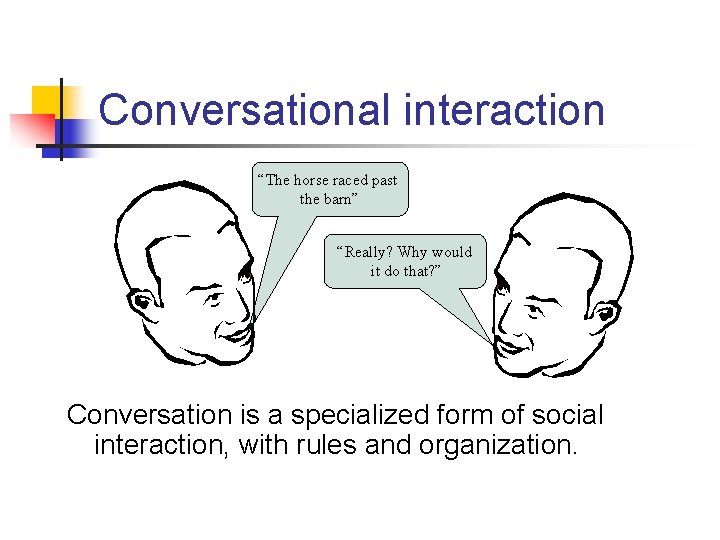
Conversational interaction “The horse raced past the barn” “Really? Why would it do that? ” Conversation is a specialized form of social interaction, with rules and organization.
Conversation n Fillmore (1981) “The language of face-to-face conversation is the basic and primary use of language” (pg. 152) n So all instances of language usage can (should) be compared to conversation n What is the impact of the presence or absence of different features of face-to-face conversation?
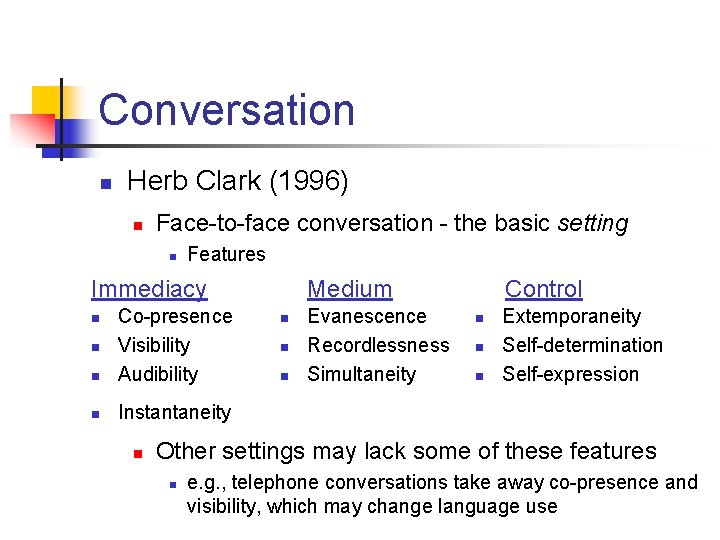
Conversation n Herb Clark (1996) n Face-to-face conversation - the basic setting n Features Immediacy n Co-presence Visibility Audibility n Instantaneity n n n Medium n n n Evanescence Recordlessness Simultaneity Control n n n Extemporaneity Self-determination Self-expression Other settings may lack some of these features n e. g. , telephone conversations take away co-presence and visibility, which may change language use
Conversation n Herb Clark (1996) n Joint action n Autonomous actions n n Things that you do by yourself Participatory actions n n n Individual acts only done as parts of joint actions People acting in coordination with one another n Doing the tango n Driving a car with a pedestrian crossing the street The participants don’t always do similar things
Conversation n Herb Clark (1996) n Speaking and listening n Traditionally treated as autonomous actions n n Contributing to the tradition of studying language comprehension and production separately Clark proposed that they should be treated as participatory actions
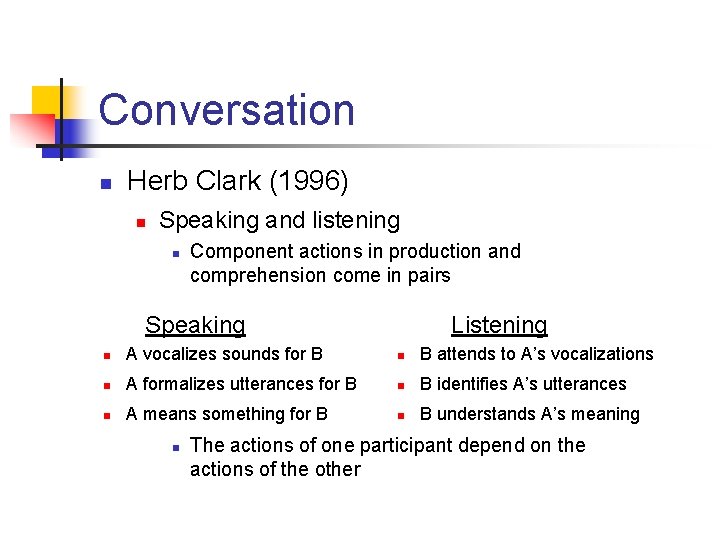
Conversation n Herb Clark (1996) n Speaking and listening n Component actions in production and comprehension come in pairs Speaking Listening n A vocalizes sounds for B n B attends to A’s vocalizations n A formalizes utterances for B n B identifies A’s utterances n A means something for B n B understands A’s meaning n The actions of one participant depend on the actions of the other
Conversation n Herb Clark (1996) n Arena’s of language use - places where people do things with language n Meaning and understanding n n Establishing Common Ground Identifying participants Layers Conversation is structured
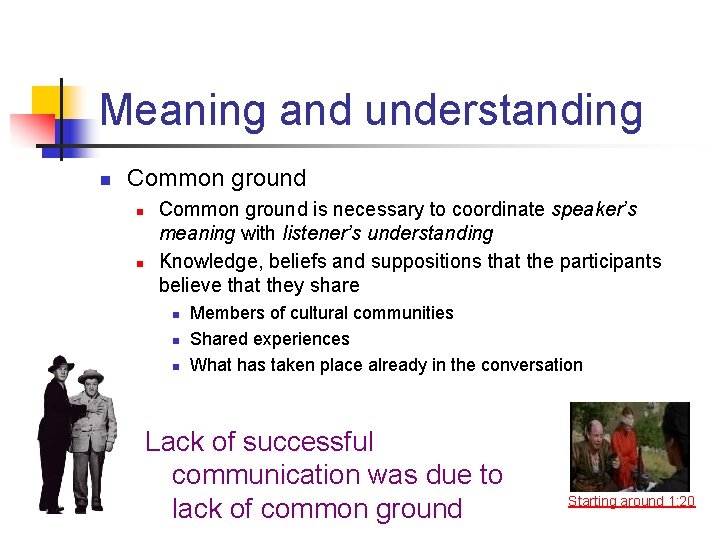
Meaning and understanding n Common ground n n Common ground is necessary to coordinate speaker’s meaning with listener’s understanding Knowledge, beliefs and suppositions that the participants believe that they share n n n Members of cultural communities Shared experiences What has taken place already in the conversation Lack of successful communication was due to lack of common ground Starting around 1: 20
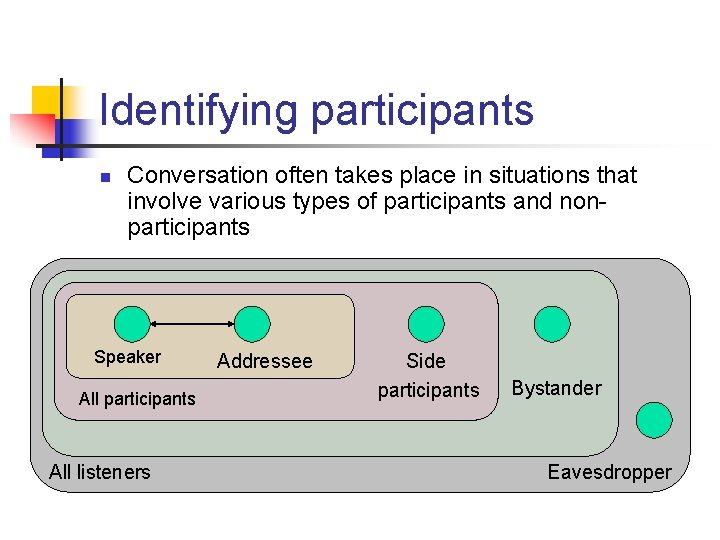
Identifying participants n Conversation often takes place in situations that involve various types of participants and nonparticipants Speaker All participants All listeners Addressee Side participants Bystander Eavesdropper
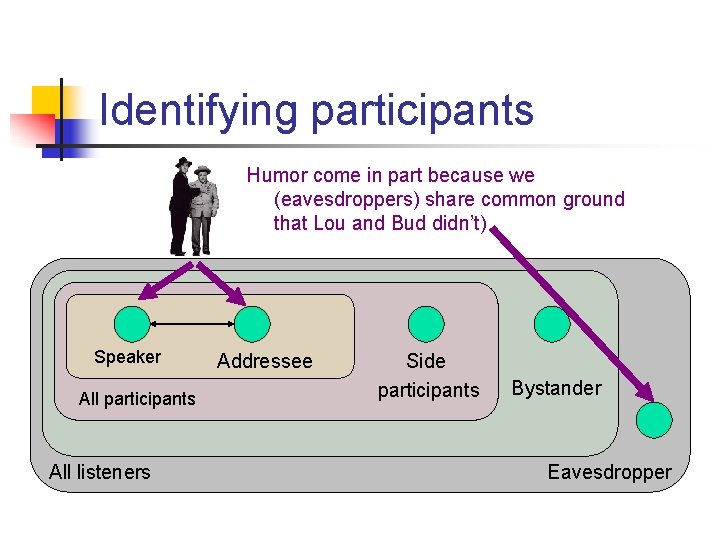
Identifying participants Humor come in part because we (eavesdroppers) share common ground that Lou and Bud didn’t) Speaker All participants All listeners Addressee Side participants Bystander Eavesdropper
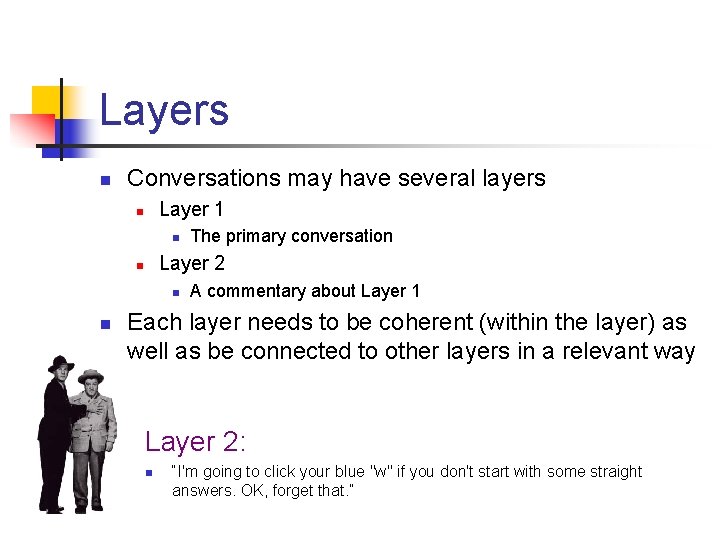
Layers n Conversations may have several layers Layer 1 n n Layer 2 n n n The primary conversation A commentary about Layer 1 Each layer needs to be coherent (within the layer) as well as be connected to other layers in a relevant way Layer 2: n “I'm going to click your blue "w" if you don't start with some straight answers. OK, forget that. ”
Structure of a conversation n Conversations are purposive and unplanned n n n Typically you can’t plan exactly what you’re going to say because it depends on another participant Conversations look planned only in retrospect Conversations have a fairly stable structure n n n Opening the conversation Identifying participants Taking turns Negotiating topics Closing conversations
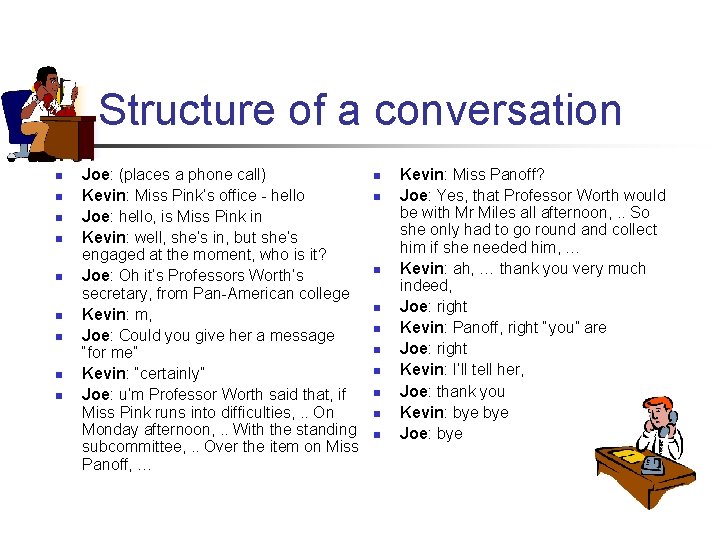
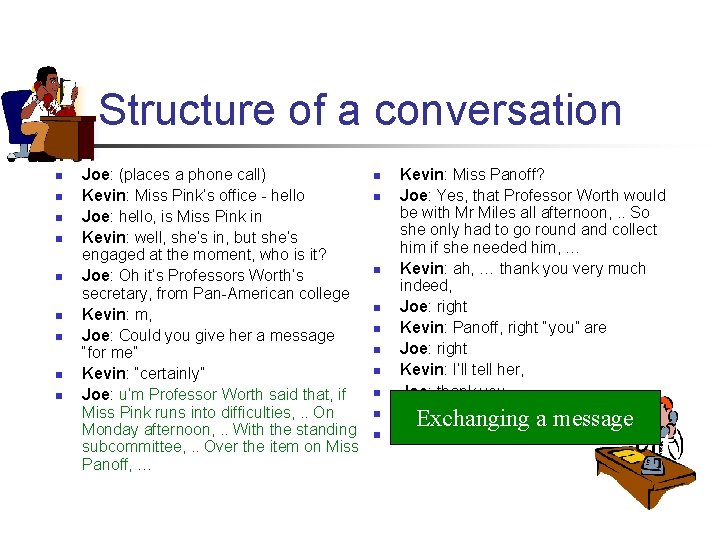
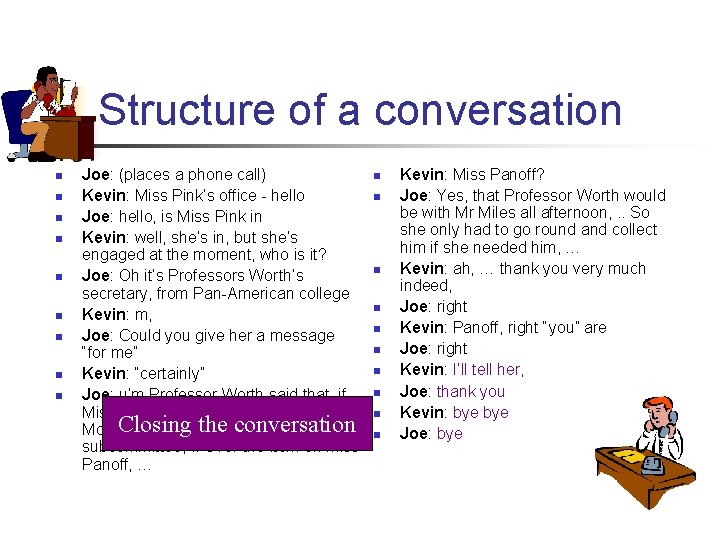
Structure of a conversation n n n n Joe: (places a phone call) Kevin: Miss Pink’s office - hello Joe: hello, is Miss Pink in Kevin: well, she’s in, but she’s engaged at the moment, who is it? Joe: Oh it’s Professors Worth’s secretary, from Pan-American college Kevin: m, Joe: Could you give her a message “for me” Kevin: “certainly” Joe: u’m Professor Worth said that, if Miss Pink runs into difficulties, . . On Monday afternoon, . . With the standing subcommittee, . . Over the item on Miss Panoff, … n n n n n Kevin: Miss Panoff? Joe: Yes, that Professor Worth would be with Mr Miles all afternoon, . . So she only had to go round and collect him if she needed him, … Kevin: ah, … thank you very much indeed, Joe: right Kevin: Panoff, right “you” are Joe: right Kevin: I’ll tell her, Joe: thank you Kevin: bye Joe: bye
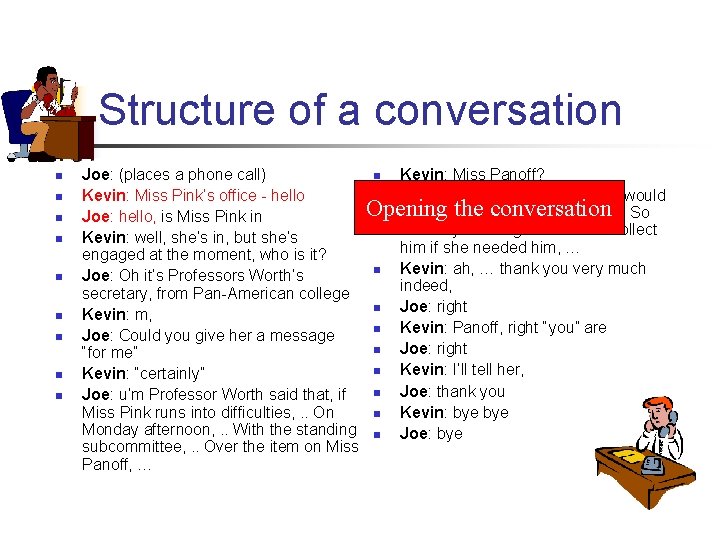
Structure of a conversation n n n n Joe: (places a phone call) Kevin: Miss Pink’s office - hello Joe: hello, is Miss Pink in Kevin: well, she’s in, but she’s engaged at the moment, who is it? Joe: Oh it’s Professors Worth’s secretary, from Pan-American college Kevin: m, Joe: Could you give her a message “for me” Kevin: “certainly” Joe: u’m Professor Worth said that, if Miss Pink runs into difficulties, . . On Monday afternoon, . . With the standing subcommittee, . . Over the item on Miss Panoff, … Kevin: Miss Panoff? n Joe: Yes, that Professor Worth would Opening conversation be with the Mr Miles all afternoon, . . So she only had to go round and collect him if she needed him, … n Kevin: ah, … thank you very much indeed, n Joe: right n Kevin: Panoff, right “you” are n Joe: right n Kevin: I’ll tell her, n Joe: thank you n Kevin: bye n Joe: bye n
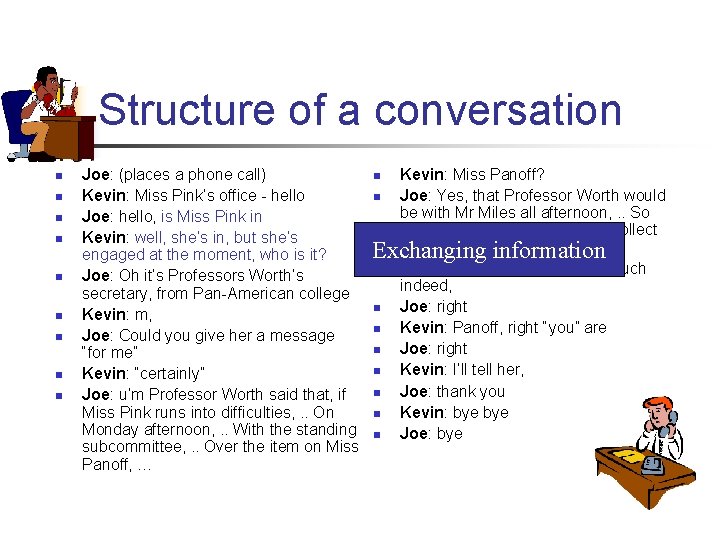
Structure of a conversation n n n n Joe: (places a phone call) Kevin: Miss Pink’s office - hello Joe: hello, is Miss Pink in Kevin: well, she’s in, but she’s engaged at the moment, who is it? Joe: Oh it’s Professors Worth’s secretary, from Pan-American college Kevin: m, Joe: Could you give her a message “for me” Kevin: “certainly” Joe: u’m Professor Worth said that, if Miss Pink runs into difficulties, . . On Monday afternoon, . . With the standing subcommittee, . . Over the item on Miss Panoff, … Kevin: Miss Panoff? n Joe: Yes, that Professor Worth would be with Mr Miles all afternoon, . . So she only had to go round and collect him if she needed him, … Exchanging information n Kevin: ah, … thank you very much indeed, n Joe: right n Kevin: Panoff, right “you” are n Joe: right n Kevin: I’ll tell her, n Joe: thank you n Kevin: bye n Joe: bye n
Structure of a conversation n n n n Joe: (places a phone call) Kevin: Miss Pink’s office - hello Joe: hello, is Miss Pink in Kevin: well, she’s in, but she’s engaged at the moment, who is it? Joe: Oh it’s Professors Worth’s secretary, from Pan-American college Kevin: m, Joe: Could you give her a message “for me” Kevin: “certainly” Joe: u’m Professor Worth said that, if Miss Pink runs into difficulties, . . On Monday afternoon, . . With the standing subcommittee, . . Over the item on Miss Panoff, … n n n n n Kevin: Miss Panoff? Joe: Yes, that Professor Worth would be with Mr Miles all afternoon, . . So she only had to go round and collect him if she needed him, … Kevin: ah, … thank you very much indeed, Joe: right Kevin: Panoff, right “you” are Joe: right Kevin: I’ll tell her, Joe: thank you Kevin: bye Exchanging a message Joe: bye
Structure of a conversation n n n n Joe: (places a phone call) Kevin: Miss Pink’s office - hello Joe: hello, is Miss Pink in Kevin: well, she’s in, but she’s engaged at the moment, who is it? Joe: Oh it’s Professors Worth’s secretary, from Pan-American college Kevin: m, Joe: Could you give her a message “for me” Kevin: “certainly” Joe: u’m Professor Worth said that, if Miss Pink runs into difficulties, . . On Closing the. . With conversation Monday afternoon, the standing subcommittee, . . Over the item on Miss Panoff, … n n n n n Kevin: Miss Panoff? Joe: Yes, that Professor Worth would be with Mr Miles all afternoon, . . So she only had to go round and collect him if she needed him, … Kevin: ah, … thank you very much indeed, Joe: right Kevin: Panoff, right “you” are Joe: right Kevin: I’ll tell her, Joe: thank you Kevin: bye Joe: bye
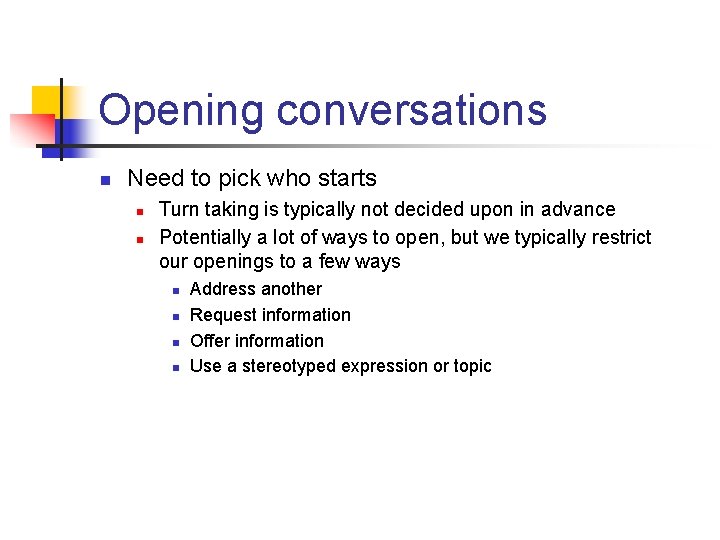
Opening conversations n Need to pick who starts n n Turn taking is typically not decided upon in advance Potentially a lot of ways to open, but we typically restrict our openings to a few ways n n Address another Request information Offer information Use a stereotyped expression or topic
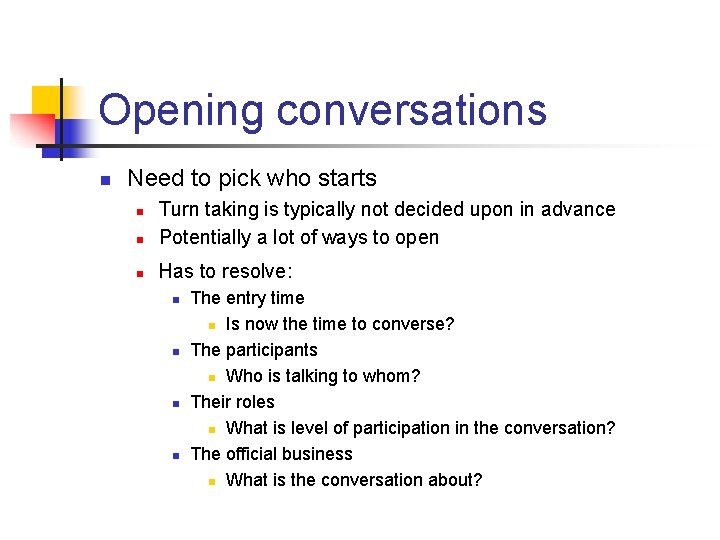
Opening conversations n Need to pick who starts n Turn taking is typically not decided upon in advance Potentially a lot of ways to open n Has to resolve: n n n The entry time n Is now the time to converse? The participants n Who is talking to whom? Their roles n What is level of participation in the conversation? The official business n What is the conversation about?
Taking turns n Typically conversations don’t involve two (or more) people talking at the same time n n n Individual styles of turn-taking vary widely Length of a turn is a fairly stable characteristic within a given individual’s conversational interactions Standard signals indicate a change in turn: a head nod, a glance, a questioning tone
Taking turns n Typically conversations don’t involve two (or more) people talking at the same time n Three implicit rules (Sacks et al, 1974) n n Rule 1: Current speakers selects next speaker Rule 2: Self-selection: if rule 1 isn’t used, then next speaker can select themselves Rule 3: current speaker may continue (or not) These principles are ordered in terms of priority n The first is the most important, and the last is the least important n Just try violating them in an actual conversation (but debrief later!)
Taking turns n Typically conversations don’t involve two (or more) people talking at the same time n Use of non-verbal cues n n n Drop of pitch Drawl on final syllable Termination of hand signals Drop in loudness Completion of a grammatical clause Use of stereotyped phrase n “you know”
Negotiating topics n Keep the discourse relevant to the topic (remember Grice’s maxims) n Coherence again n n Earlier we looked at coherence within a speaker, now we consider it across multiple speakers Must use statements to signal topic shifts
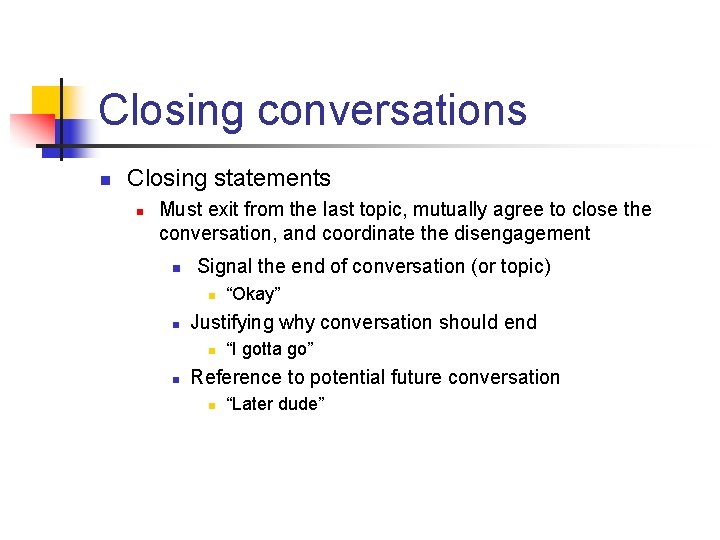
Closing conversations n Closing statements n Must exit from the last topic, mutually agree to close the conversation, and coordinate the disengagement n Signal the end of conversation (or topic) n n Justifying why conversation should end n n “Okay” “I gotta go” Reference to potential future conversation n “Later dude”
Dialog is the key n Why so little research on dialog? n Most linguistic theories were developed to account for sentences in de-contextualized isolation n Dialog doesn’t fit the competence/performance distinction well Hard to do experimentally n Conversations are interactive and largely unplanned Pickering and Garrod (2004) n Proposed that processing theories of language comprehension and production may be flawed because of a focus on monologues
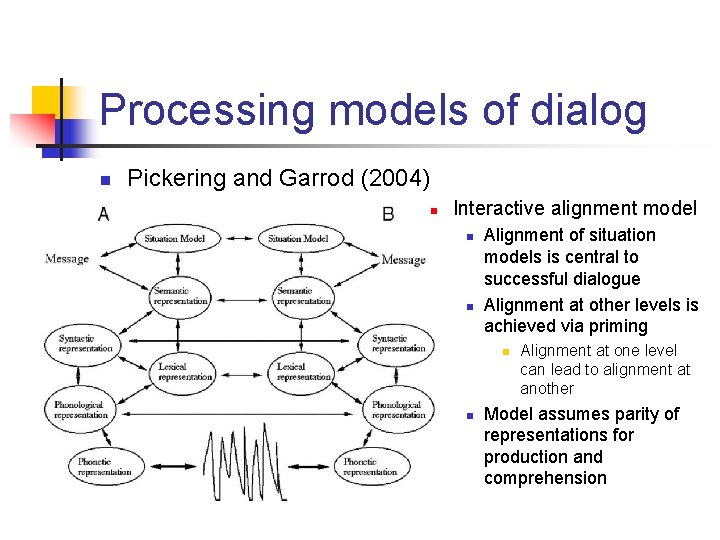
Processing models of dialog n Pickering and Garrod (2004) n Interactive alignment model n n Alignment of situation models is central to successful dialogue Alignment at other levels is achieved via priming n n Alignment at one level can lead to alignment at another Model assumes parity of representations for production and comprehension
Summary n “People use language for doing things with each other, and their use of language is itself a joint action. ” Clark (1996, pg 387) n Conversation is structured n n But, that structure depends on more than one individual Models of language use (production and comprehension) need to be developed within this perspective