
Psycholinguistics Psycholinguistics is the study of the cognitive




![Levelt's Speaking Model n Conceptualizer n Formulator n Articulator n [Self-Monitor] De Bot, Kees](https://slidetodoc.com/presentation_image_h/2632514f2c4eb58f0d4f9160fadb656e/image-7.jpg "Levelt's Speaking Model n Conceptualizer n Formulator n Articulator n [Self-Monitor] De Bot, Kees")





- Slides: 19
Psycholinguistics “Psycholinguistics is the study of the cognitive processes that support the acquisition and use of language. The scope of psycholinguistics includes language performance under normal circumstances and when it breaks down…” De Bot, Kees and Judith F. Kroll. 2010. Psycholinguistics. In Norbert Schmitt, editor, An Introduction to Applied Linguistics, 2 nd edition, Chapter 8, pp. 124 -142. London: Hodder Education, p. 124.
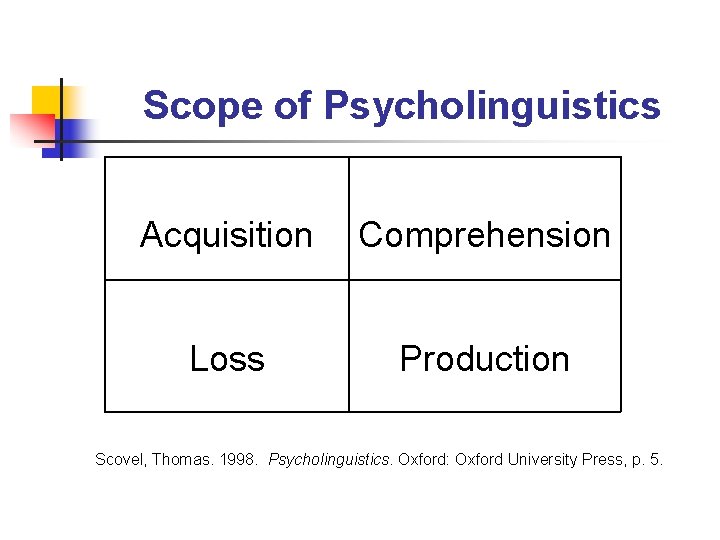
Scope of Psycholinguistics Acquisition Comprehension Loss Production Scovel, Thomas. 1998. Psycholinguistics. Oxford: Oxford University Press, p. 5.
Why should bilinguals interest us? 1 1. Because we teach or will teach a second language.
Why should bilinguals interest us? 2 2. “Because bilinguals outnumber monolinguals in the world's population, bilinguals more than monolinguals provide a genuinely universal account of the cognitive mechanisms that underlie language performance. ” De Bot, Kees and Judith F. Kroll. 2010. Psycholinguistics. In Norbert Schmitt, editor, An Introduction to Applied Linguistics, 2 nd edition, Chapter 8, pp. 124 -142. London: Hodder Education, p. 124.
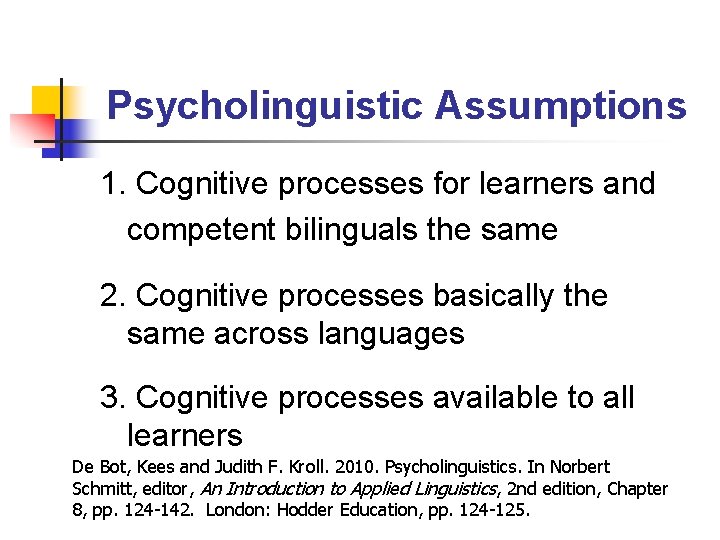
Psycholinguistic Assumptions 1. Cognitive processes for learners and competent bilinguals the same 2. Cognitive processes basically the same across languages 3. Cognitive processes available to all learners De Bot, Kees and Judith F. Kroll. 2010. Psycholinguistics. In Norbert Schmitt, editor, An Introduction to Applied Linguistics, 2 nd edition, Chapter 8, pp. 124 -142. London: Hodder Education, pp. 124 -125.
Purpose of Theories or Models “In psycholinguistics, researchers try to develop models to describe and preferably predict specific linguistic behaviour. The aim is to capture all aspects of language use. Ultimately, the goal is to have a model that describes how language is processed in our brains…” De Bot, Kees and Judith F. Kroll. 2010. Psycholinguistics. In Norbert Schmitt, editor, An Introduction to Applied Linguistics, 2 nd edition, Chapter 8, pp. 124 -142. London: Hodder Education, pp. 125 -126.
Levelt's Speaking Model n Conceptualizer n Formulator n Articulator n [Self-Monitor] De Bot, Kees and Judith F. Kroll. 2010. Psycholinguistics. In Norbert Schmitt, editor, An Introduction to Applied Linguistics, 2 nd edition, Chapter 8, pp. 124 -142. London: Hodder Education, p. 126.
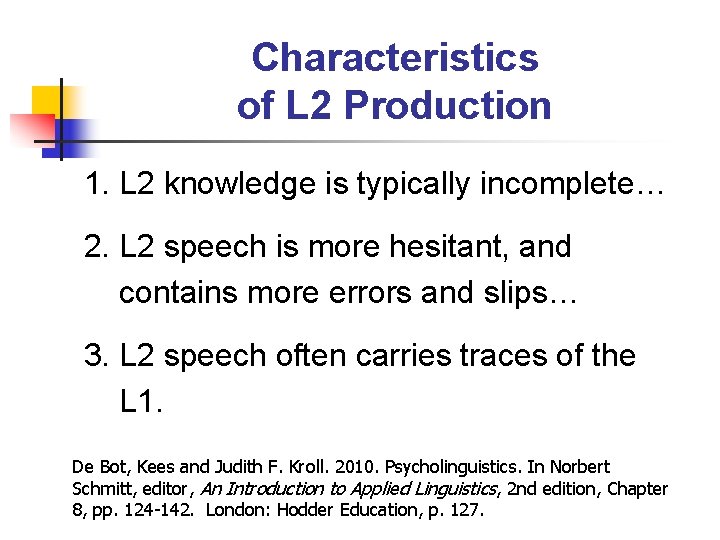
Characteristics of L 2 Production 1. L 2 knowledge is typically incomplete… 2. L 2 speech is more hesitant, and contains more errors and slips… 3. L 2 speech often carries traces of the L 1. De Bot, Kees and Judith F. Kroll. 2010. Psycholinguistics. In Norbert Schmitt, editor, An Introduction to Applied Linguistics, 2 nd edition, Chapter 8, pp. 124 -142. London: Hodder Education, p. 127.
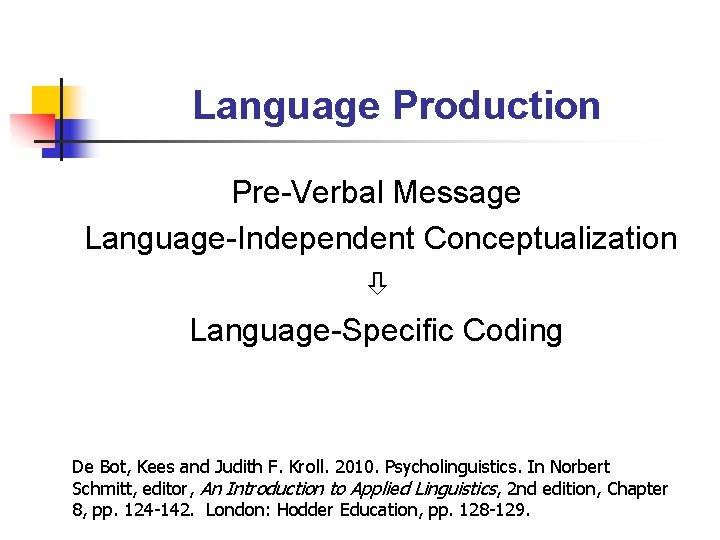
Language Production Pre-Verbal Message Language-Independent Conceptualization Language-Specific Coding De Bot, Kees and Judith F. Kroll. 2010. Psycholinguistics. In Norbert Schmitt, editor, An Introduction to Applied Linguistics, 2 nd edition, Chapter 8, pp. 124 -142. London: Hodder Education, pp. 128 -129.
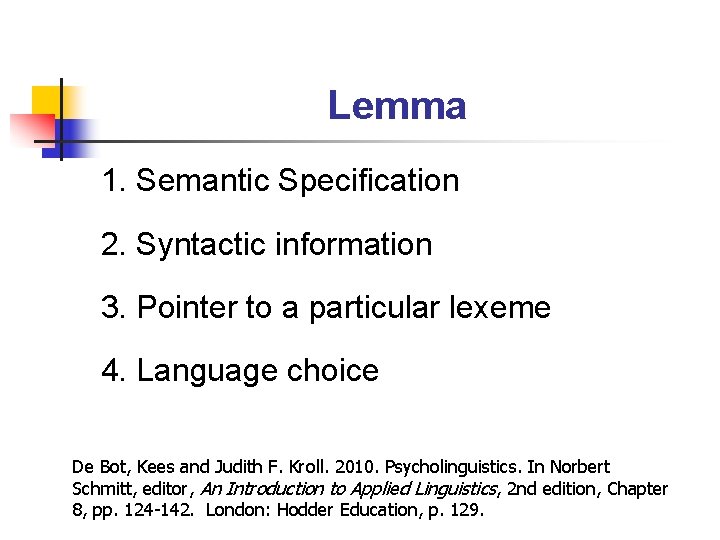
Lemma 1. Semantic Specification 2. Syntactic information 3. Pointer to a particular lexeme 4. Language choice De Bot, Kees and Judith F. Kroll. 2010. Psycholinguistics. In Norbert Schmitt, editor, An Introduction to Applied Linguistics, 2 nd edition, Chapter 8, pp. 124 -142. London: Hodder Education, p. 129.
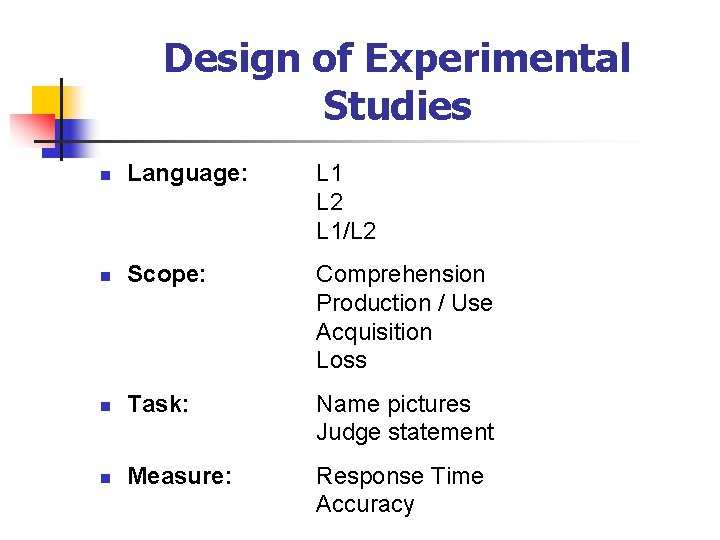
Design of Experimental Studies n Language: L 1 L 2 L 1/L 2 n Scope: Comprehension Production / Use Acquisition Loss n Task: Name pictures Judge statement n Measure: Response Time Accuracy
Summarizing a Study n n n n n Article: Study: Language(s): Subjects: Time: Task(s): Measure: Findings: Conclusion: Memorable quotes:
Summarizing a Study (Expanded) ALWAYS INCLUDE PAGE NUMBERS (and maybe column) n Article: (complete bibliographic info) n Study: (about what) n Language(s): n Subjects: (EVERYTHING) n Time: (date, time of school year, over what period of time) n Task(s): (what did subjects have to do? ) n Measure: (what was measured? ) n Findings: n Conclusion: (including implications, suggestions) n Memorable quotes: (quotes you really liked that you MIGHT want to use when you write up YOUR study)
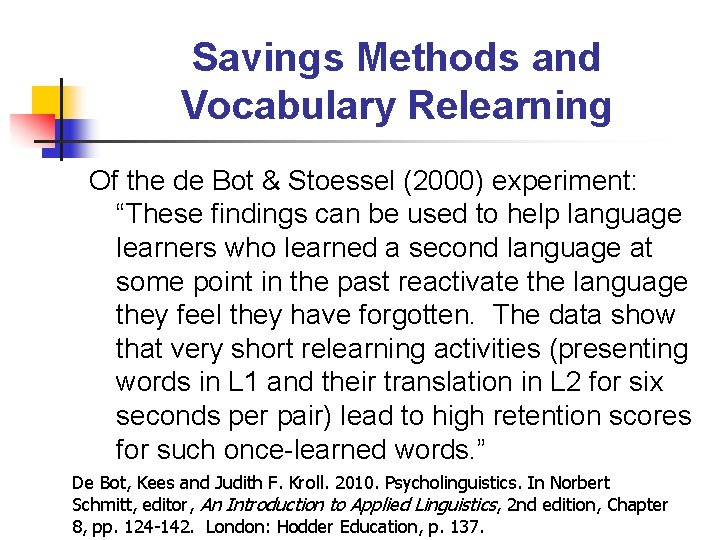
Savings Methods and Vocabulary Relearning Of the de Bot & Stoessel (2000) experiment: “These findings can be used to help language learners who learned a second language at some point in the past reactivate the language they feel they have forgotten. The data show that very short relearning activities (presenting words in L 1 and their translation in L 2 for six seconds per pair) lead to high retention scores for such once-learned words. ” De Bot, Kees and Judith F. Kroll. 2010. Psycholinguistics. In Norbert Schmitt, editor, An Introduction to Applied Linguistics, 2 nd edition, Chapter 8, pp. 124 -142. London: Hodder Education, p. 137.
Language Maintenance Key Factors 1. High initial proficiency 2. Continuing contact with L 2 3. Motivation (to seek opportunities to use L 2) De Bot, Kees and Judith F. Kroll. 2010. Psycholinguistics. In Norbert Schmitt, editor, An Introduction to Applied Linguistics, 2 nd edition, Chapter 8, pp. 124 -142. London: Hodder Education, p. 137.
Implications of Psycholinguistic Studies on Second Language 1. Accessibility of L 2 linguistic elements depends on acquisition, storage, and automatic retrieval. 2. L 2 linguistic knowledge is not stable. 3. L 2 acquisition does not have negative consequences for cognitive processing. De Bot, Kees and Judith F. Kroll. 2010. Psycholinguistics. In Norbert Schmitt, editor, An Introduction to Applied Linguistics, 2 nd edition, Chapter 8, pp. 124 -142. London: Hodder Educationp, p. 137 -138.
Possible Research Topics 1 1. Language attrition and more on reactivation old language knowledge. (Follow-up on Mary Liu’s study. ) 2. Assessment of relative proficiency for bilingual Taiwanese. Measure the time subjects wait until they begin to say the name (in L 1 or L 2) of what they see in a picture.
Possible Research Topics 2 3. Determine if Chinese-English bilinguals show language is non-selective in comprehension tasks. 4. Promoting automaticity. 5. Examine possible benefits of training subjects to access linguistic elements as quickly as possible a la Hulstijn & friends.
Possible Research Topics 3 6. Promoting depth of learning. 7. Code switching. 8. Gestures.