
Second Language Acquisition Is L 1 similar to

- Slides: 13
Second Language Acquisition
Is L 1 similar to L 2? How? 1. Both require communicative input 2. Both have developmental stages 3. Both exhibit growth from one-word utterances to phrases to sentences 4. Both seem resistant to external manipulation
How are L 1 and L 2 different? There is considerable variation in how proficient L 2 learners become; whereas everyone is proficient in their L 1 (under normal circumstances) L 2 learners already have one linguistic system; L 1 learners do not L 2 learners don’t go through “babbling” stage L 1 learners spend first five years of life playing and interacting
PEPSI-Ahh… Pre-production Early Production Speech emergence Intermediate fluency Advanced fluency
L 2: Stages Stage I: Pre-production This is the silent period. ELLs may have up to 500 words in their receptive vocabulary but they are not yet speaking Some students will, however, repeat every thing you say; they are not really producing language but are parroting
L 2: Stages Stage II: Early production May last up to six months Students will develop a receptive and active vocabulary of about 1000 words Students can usually speak in one- or two-word phrases; they can use short language chunks that have been memorized although these chunks may not always be used correctly
L 2: Stages Stage III: Speech emergence Have developed a vocabulary of about 3, 000 words Can communicate with simple phrases and sentences They will ask simple questions, that may or may not be grammatically correct, such as “ May go to bathroom? ”
L 2: Stages Stage IV: Intermediate fluency Have a vocabulary of 6000 active words Beginning to use more complex sentences when speaking and writing Willing to express opinions and share their thoughts They will ask questions to clarify what they are learning in class.
L 2: Stages Stage V: Advanced Fluency It takes students from 4 -10 years to achieve native-like proficiency in a second language Most ELLs at this stage have been exited from ESL and other support programs At the beginning of this stage, however, they will need continued support from classroom teachers especially in content areas such as history/social studies and in writing.
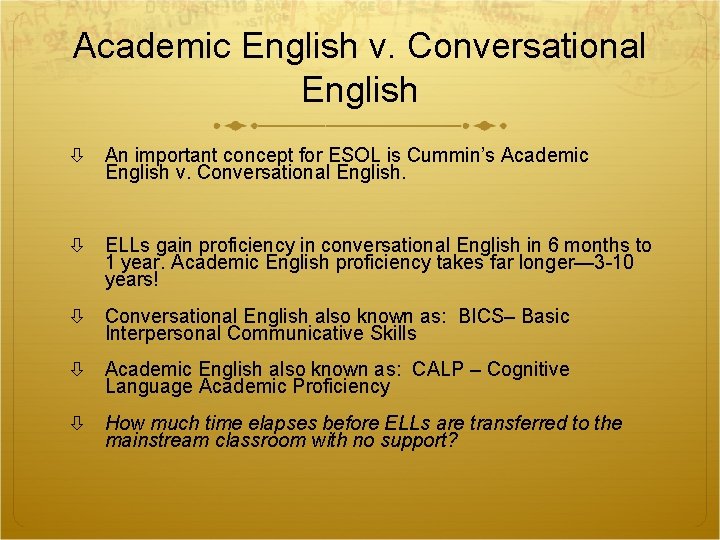
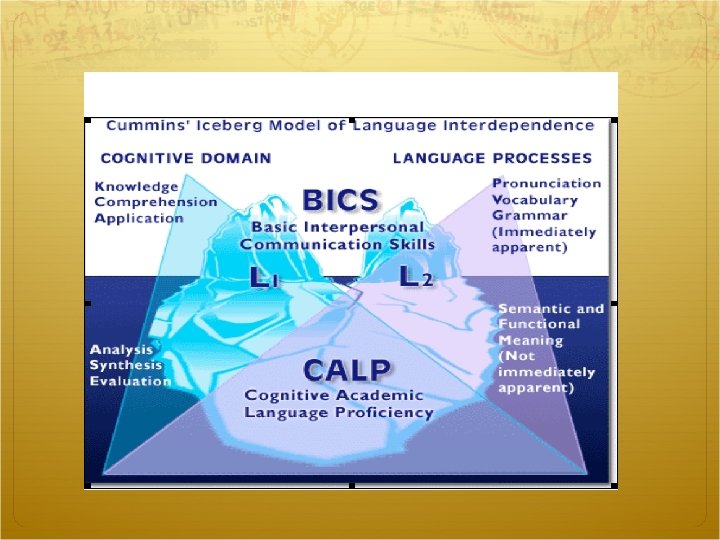
Academic English v. Conversational English An important concept for ESOL is Cummin’s Academic English v. Conversational English. ELLs gain proficiency in conversational English in 6 months to 1 year. Academic English proficiency takes far longer— 3 -10 years! Conversational English also known as: BICS– Basic Interpersonal Communicative Skills Academic English also known as: CALP – Cognitive Language Academic Proficiency How much time elapses before ELLs are transferred to the mainstream classroom with no support?
What about using the L 1 in the classroom? Use of L 1 in early stages of English development is necessary as a tool for learners to manage their environment and learning tasks Research shows that as learners gain familiarity with a task, their use of the L 1 drops dramatically Use of L 1 dissipates as learners gain control over English usage
How do we best help our ELL students sitting in our classroom?