PID 6893 A solution for inflation of indwelling


- Slides: 54
PID 6893
A solution for inflation of indwelling catheter balloons; a new innovation to improve patient safety • Jane Graham - Senior New Product Development Specialist, Clini. Med Ltd • Sharon Holroyd - Lead Continence Nurse Specialist - Calderdale Bladder & Bowel Service (Adults & Children), Beechwood Community Health Centre
Part One • Information regarding the innovation
Part Two • Experience in practice, including the patients perspective • Has it improved patient safety?
Agenda – Part 1 1 2 3 4 5 • Catheterisation • Problems with catheterisation/encrustation • Current management • Farco-fill® Protect – What is it? • Evidence-based information on Farco-fill® Protect 1
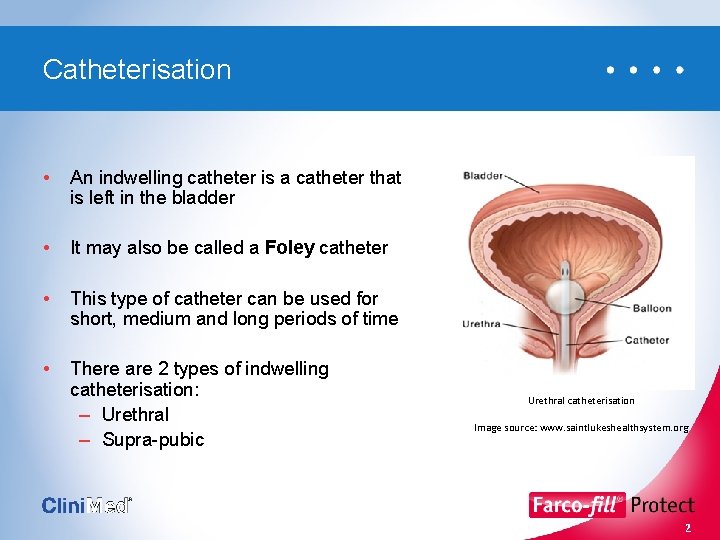
Catheterisation • An indwelling catheter is a catheter that is left in the bladder • It may also be called a Foley catheter • This type of catheter can be used for short, medium and long periods of time • There are 2 types of indwelling catheterisation: – Urethral – Supra-pubic Urethral catheterisation Image source: www. saintlukeshealthsystem. org 2
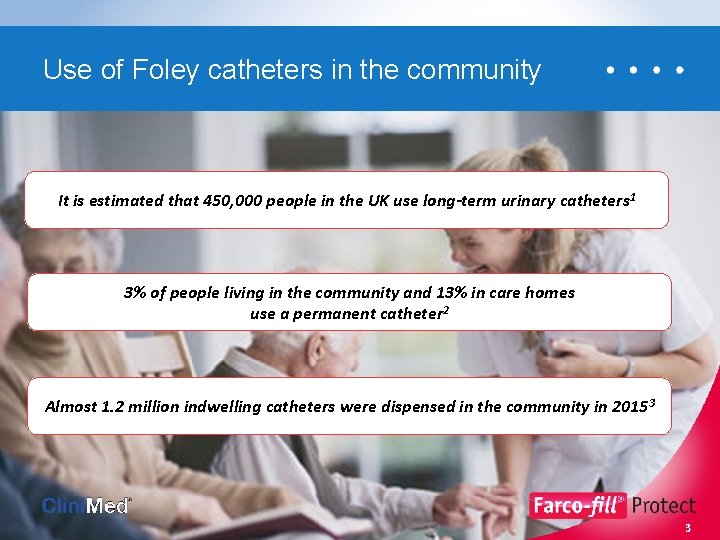
Use of Foley catheters in the community It is estimated that 450, 000 people in the UK use long-term urinary catheters 1 3% of people living in the community and 13% in care homes use a permanent catheter 2 Almost 1. 2 million indwelling catheters were dispensed in the community in 20153 3
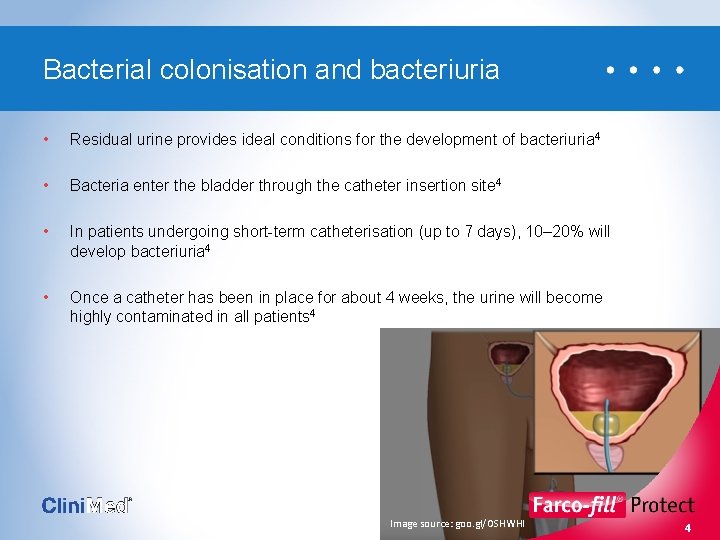
Bacterial colonisation and bacteriuria • Residual urine provides ideal conditions for the development of bacteriuria 4 • Bacteria enter the bladder through the catheter insertion site 4 • In patients undergoing short-term catheterisation (up to 7 days), 10– 20% will develop bacteriuria 4 • Once a catheter has been in place for about 4 weeks, the urine will become highly contaminated in all patients 4 Image source: goo. gl/OSHWHI 4
Bacterial colonisation and bacteriuria • In the absence of symptoms antibiotics are not given (asymptomatic bacteriuria)4 • Contaminated urine can be flowing through a catheter throughout its scheduled life span, which can be up to 12 weeks 4 • Eventually bacteria start adhering on the surface of the catheter, creating biofilms 4 Image source: www. dostallfarms. com 5
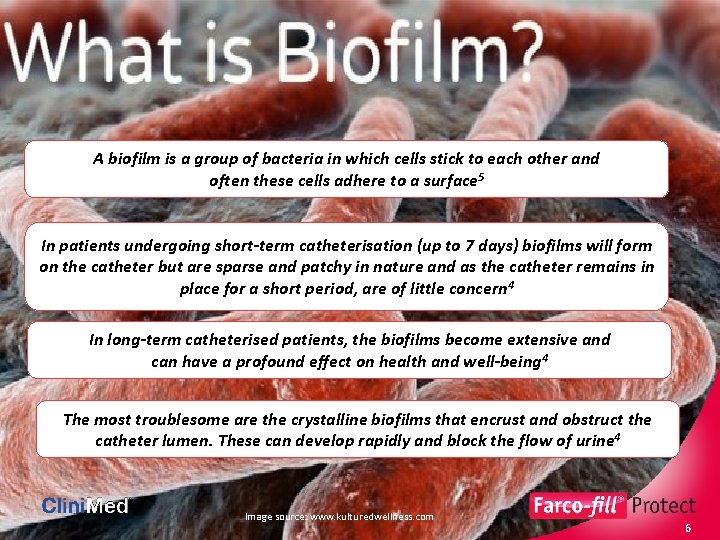
A biofilm is a group of bacteria in which cells stick to each other and often these cells adhere to a surface 5 In patients undergoing short-term catheterisation (up to 7 days) biofilms will form on the catheter but are sparse and patchy in nature and as the catheter remains in place for a short period, are of little concern 4 In long-term catheterised patients, the biofilms become extensive and can have a profound effect on health and well-being 4 The most troublesome are the crystalline biofilms that encrust and obstruct the catheter lumen. These can develop rapidly and block the flow of urine 4 Image source: www. kulturedwellness. com 6
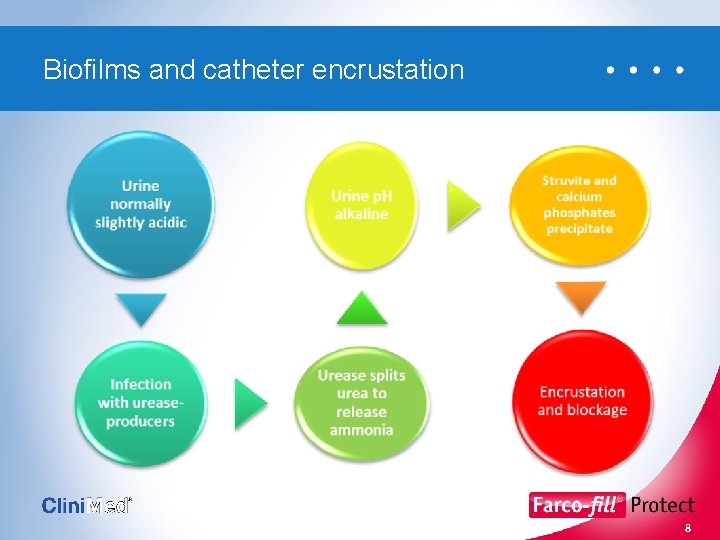
Biofilms and catheter encrustation 8
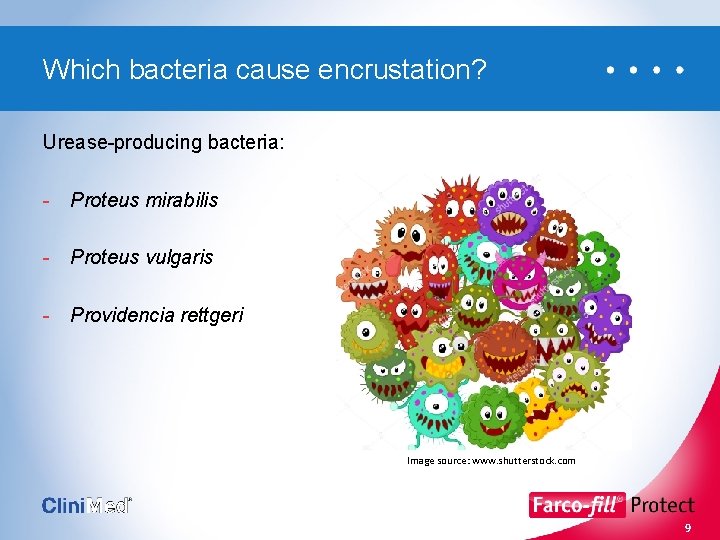
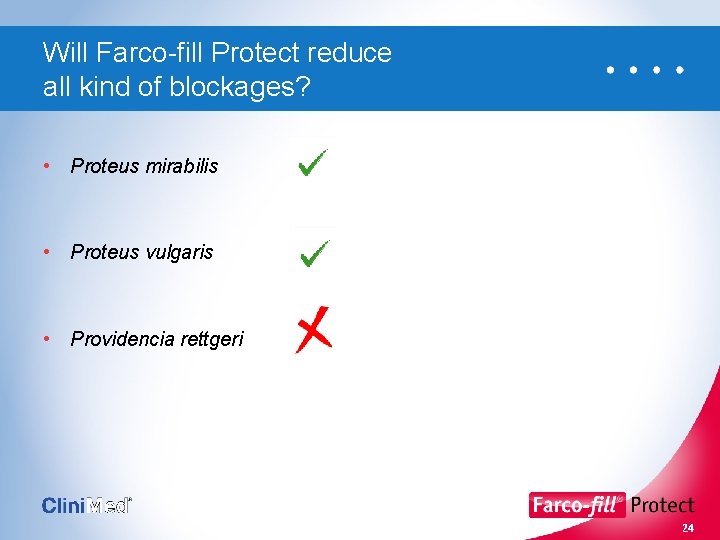
Which bacteria cause encrustation? Urease-producing bacteria: - Proteus mirabilis - Proteus vulgaris - Providencia rettgeri Image source: www. shutterstock. com 9
Proteus mirabilis • Is part of the normal flora of the human gastrointestinal tract • It produces a potent urease (enzyme) Image source: www. atcepoxy. com • Has the greatest ability to attach to catheters out of all gram-negative organisms • Is able to migrate over all the basic types of catheter more effectively than any other urinary tract pathogen Image source: www. testingnyc. wordpress. com 10
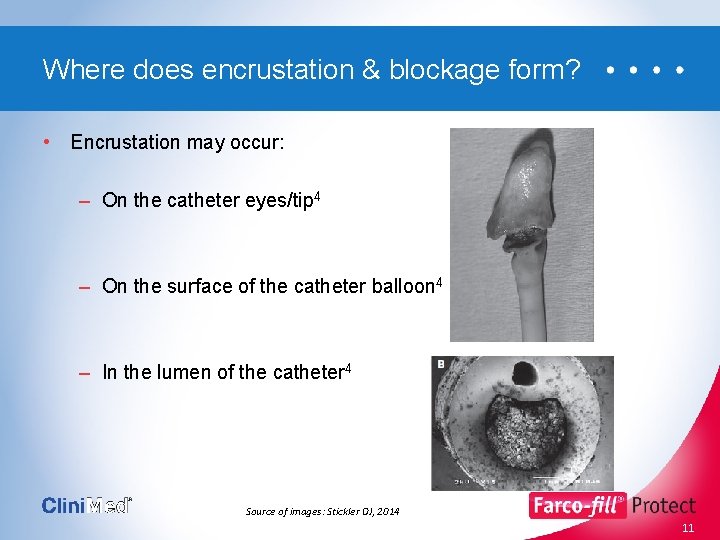
Where does encrustation & blockage form? • Encrustation may occur: – On the catheter eyes/tip 4 – On the surface of the catheter balloon 4 – In the lumen of the catheter 4 Source of images: Stickler DJ, 2014 11
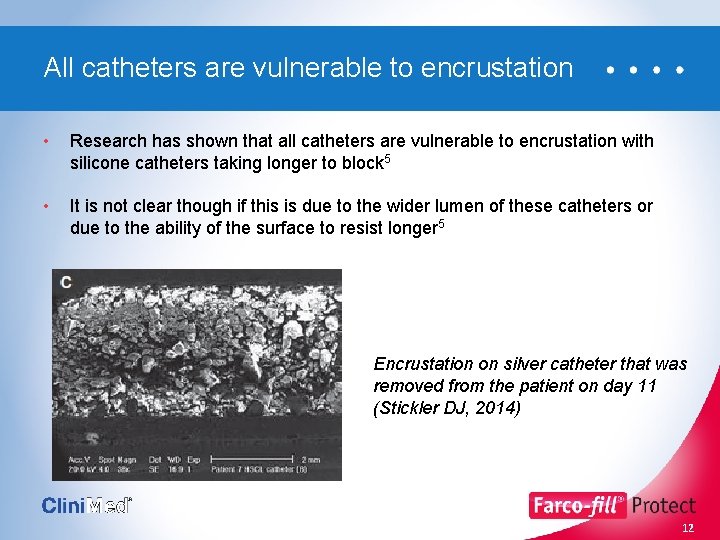
All catheters are vulnerable to encrustation • Research has shown that all catheters are vulnerable to encrustation with silicone catheters taking longer to block 5 • It is not clear though if this is due to the wider lumen of these catheters or due to the ability of the surface to resist longer 5 Encrustation on silver catheter that was removed from the patient on day 11 (Stickler DJ, 2014) 12
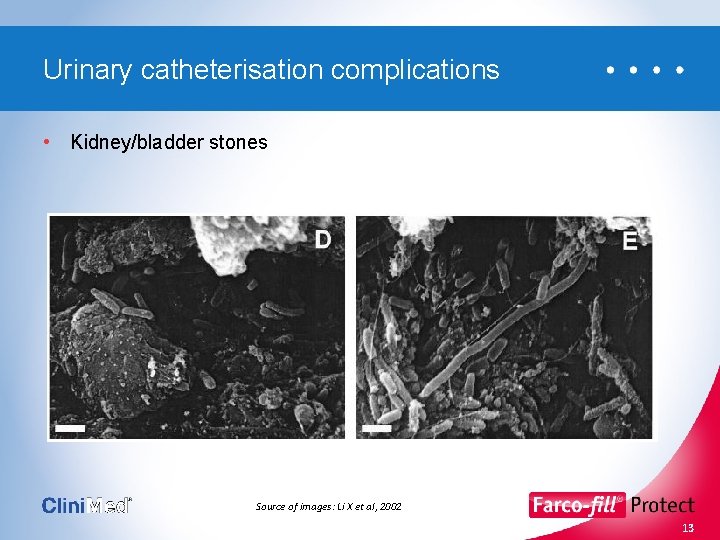
Urinary catheterisation complications • Kidney/bladder stones Source of images: Li X et al, 2002 13
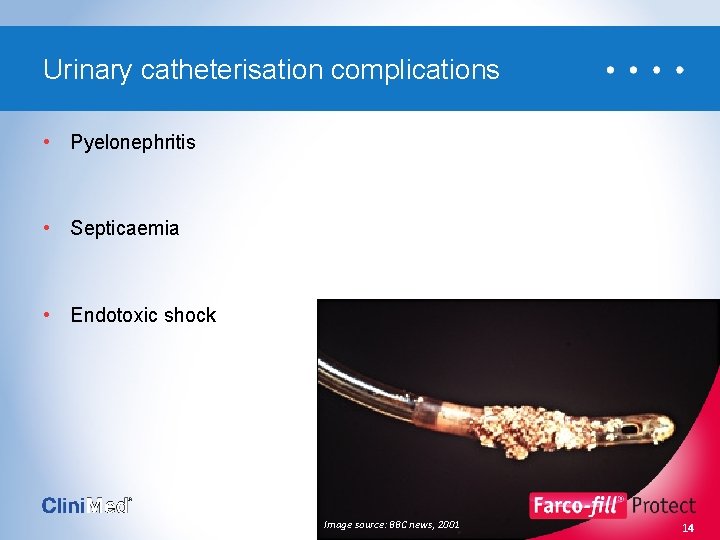
Urinary catheterisation complications • Pyelonephritis • Septicaemia • Endotoxic shock Image source: BBC news, 2001 14
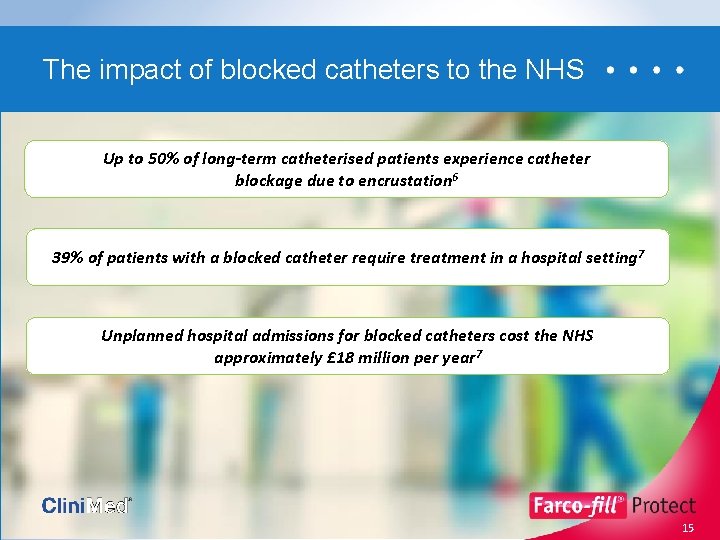
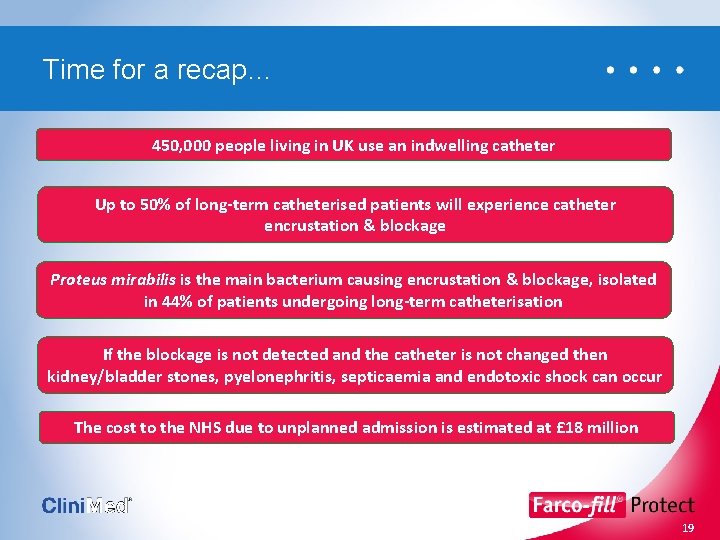
The impact of blocked catheters to the NHS Up to 50% of long-term catheterised patients experience catheter blockage due to encrustation 6 39% of patients with a blocked catheter require treatment in a hospital setting 7 Unplanned hospital admissions for blocked catheters cost the NHS approximately £ 18 million per year 7 15
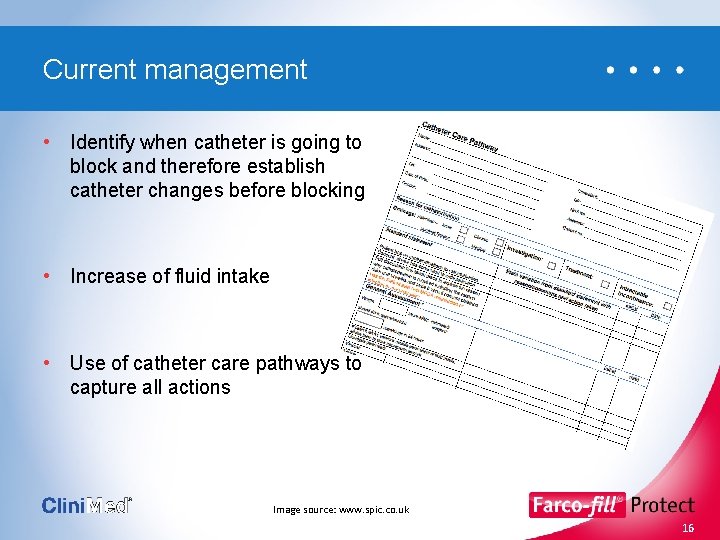
Current management • Identify when catheter is going to block and therefore establish catheter changes before blocking • Increase of fluid intake • Use of catheter care pathways to capture all actions Image source: www. spic. co. uk 16
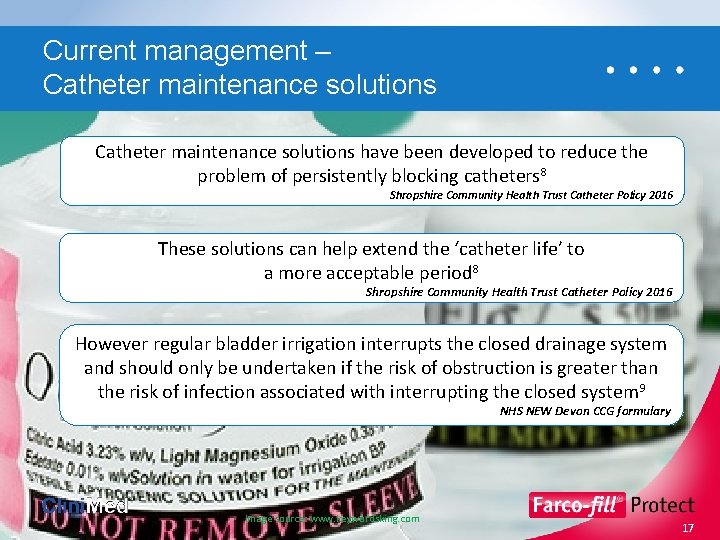
Current management – Catheter maintenance solutions have been developed to reduce the problem of persistently blocking catheters 8 Shropshire Community Health Trust Catheter Policy 2016 These solutions can help extend the ‘catheter life’ to a more acceptable period 8 Shropshire Community Health Trust Catheter Policy 2016 However regular bladder irrigation interrupts the closed drainage system and should only be undertaken if the risk of obstruction is greater than the risk of infection associated with interrupting the closed system 9 NHS NEW Devon CCG formulary Image source: www. keywordsking. com 17
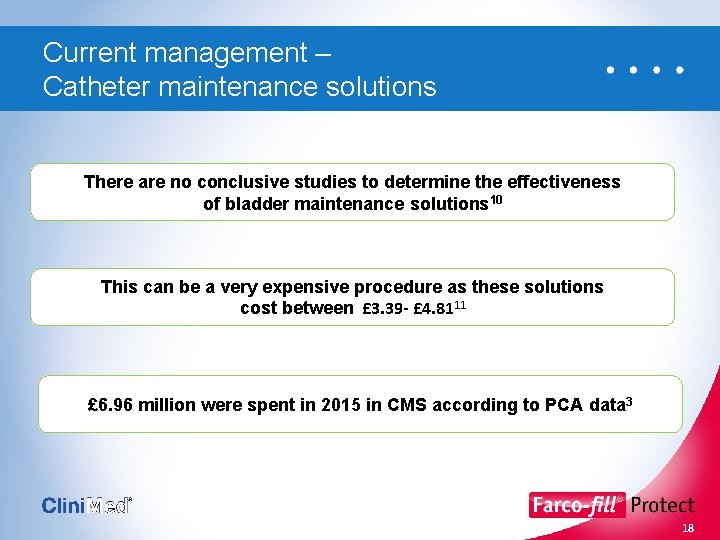
Current management – Catheter maintenance solutions There are no conclusive studies to determine the effectiveness of bladder maintenance solutions 10 This can be a very expensive procedure as these solutions cost between £ 3. 39 - £ 4. 8111 £ 6. 96 million were spent in 2015 in CMS according to PCA data 3 18
Time for a recap… 450, 000 people living in UK use an indwelling catheter Up to 50% of long-term catheterised patients will experience catheter encrustation & blockage Proteus mirabilis is the main bacterium causing encrustation & blockage, isolated in 44% of patients undergoing long-term catheterisation If the blockage is not detected and the catheter is not changed then kidney/bladder stones, pyelonephritis, septicaemia and endotoxic shock can occur The cost to the NHS due to unplanned admission is estimated at £ 18 million 19
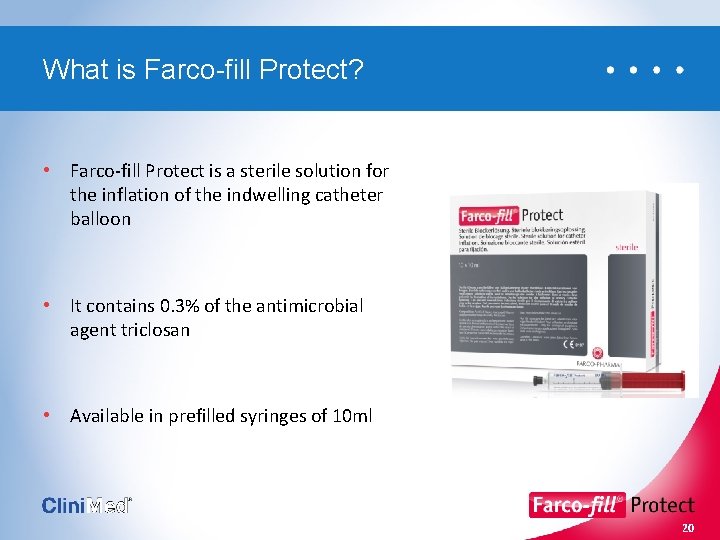
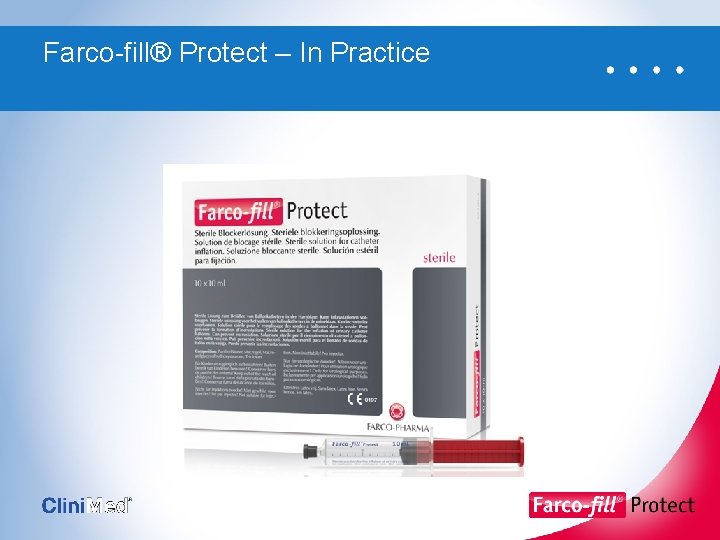
What is Farco-fill Protect? • Farco-fill Protect is a sterile solution for the inflation of the indwelling catheter balloon • It contains 0. 3% of the antimicrobial agent triclosan • Available in prefilled syringes of 10 ml 20
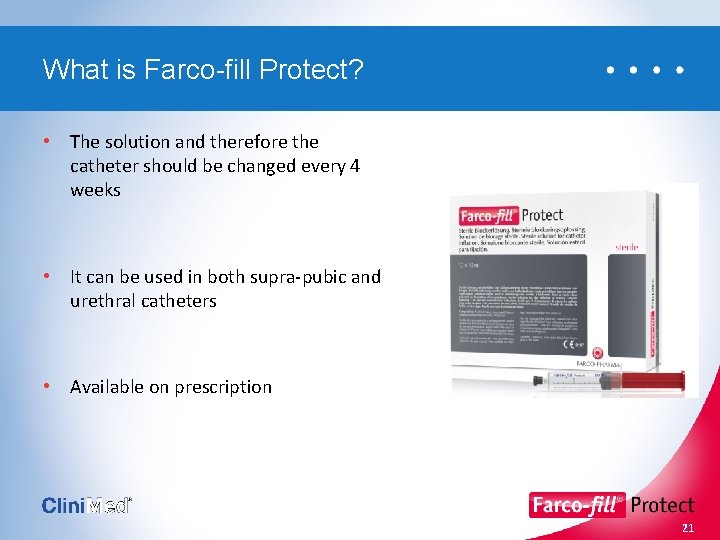
What is Farco-fill Protect? • The solution and therefore the catheter should be changed every 4 weeks • It can be used in both supra-pubic and urethral catheters • Available on prescription 21
How Farco-fill Protect works? Can reduce encrustation caused by urease-producing bacteria Image source: faudzil. blogspot. com 22
Will Farco-fill Protect reduce all kind of blockages? • Proteus mirabilis • Proteus vulgaris • Providencia rettgeri 24
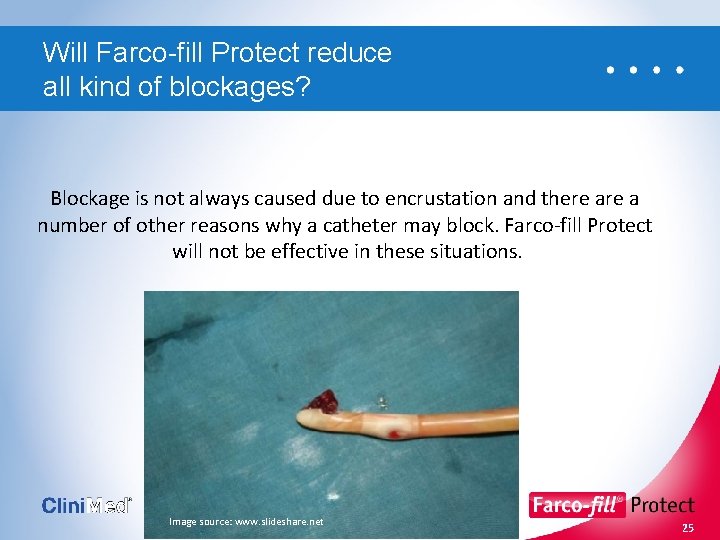
Will Farco-fill Protect reduce all kind of blockages? Blockage is not always caused due to encrustation and there a number of other reasons why a catheter may block. Farco-fill Protect will not be effective in these situations. Image source: www. slideshare. net 25
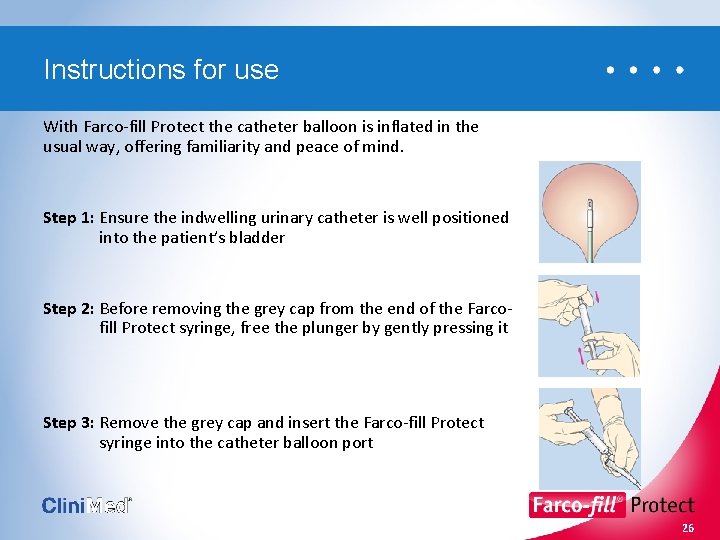
Instructions for use With Farco-fill Protect the catheter balloon is inflated in the usual way, offering familiarity and peace of mind. Step 1: Ensure the indwelling urinary catheter is well positioned into the patient’s bladder Step 2: Before removing the grey cap from the end of the Farcofill Protect syringe, free the plunger by gently pressing it Step 3: Remove the grey cap and insert the Farco-fill Protect syringe into the catheter balloon port 26
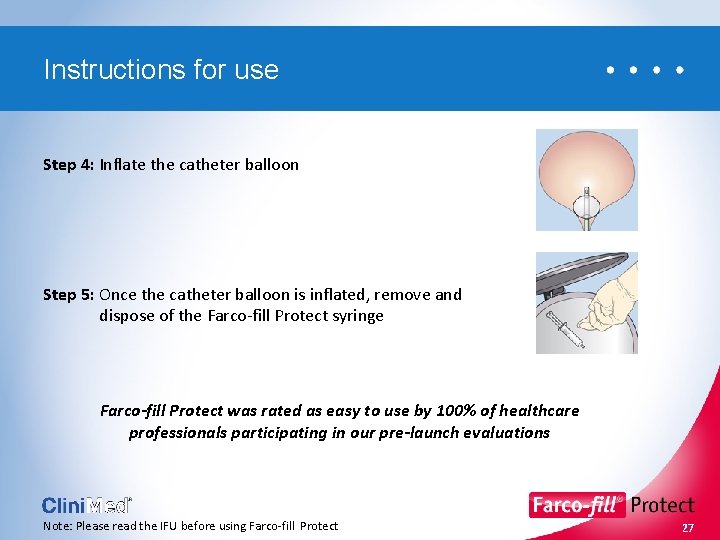
Instructions for use Step 4: Inflate the catheter balloon Step 5: Once the catheter balloon is inflated, remove and dispose of the Farco-fill Protect syringe Farco-fill Protect was rated as easy to use by 100% of healthcare professionals participating in our pre-launch evaluations Note: Please read the IFU before using Farco-fill Protect 27
Benefits from using Farco-fill Protect Healthcare professionals can benefit from: • More time to concentrate on other patients due to fewer catheter changes • Cost savings, as fewer devices and less nursing time is required • Reduced call outs and emergency admissions as a result of blocked catheters • Improved quality of life for their patients Image source: www. okclipart. com 28
Benefits from using Farco-fill Protect Patients who suffer from chronic catheter blockages can benefit from: • Longer in situ catheter time • Reduced painful catheter changes • Decreased emergency call outs and admissions for blocked catheters • Confidence to enjoy life without the worry of blockage Image source: www. okclipart. com 29
Farco-fill Protect is aimed for patients that are: – Known blockers – Block due to encrustation – Catheter needs to be changed in less than 4 weeks Image source: www. strategies. com 30
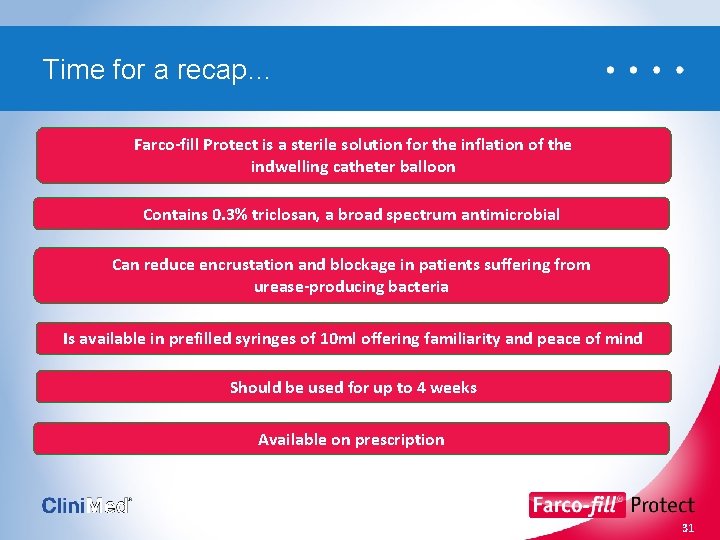
Time for a recap… Farco-fill Protect is a sterile solution for the inflation of the indwelling catheter balloon Contains 0. 3% triclosan, a broad spectrum antimicrobial Can reduce encrustation and blockage in patients suffering from urease-producing bacteria Is available in prefilled syringes of 10 ml offering familiarity and peace of mind Should be used for up to 4 weeks Available on prescription 31
Clini. Med clinical evaluations 36
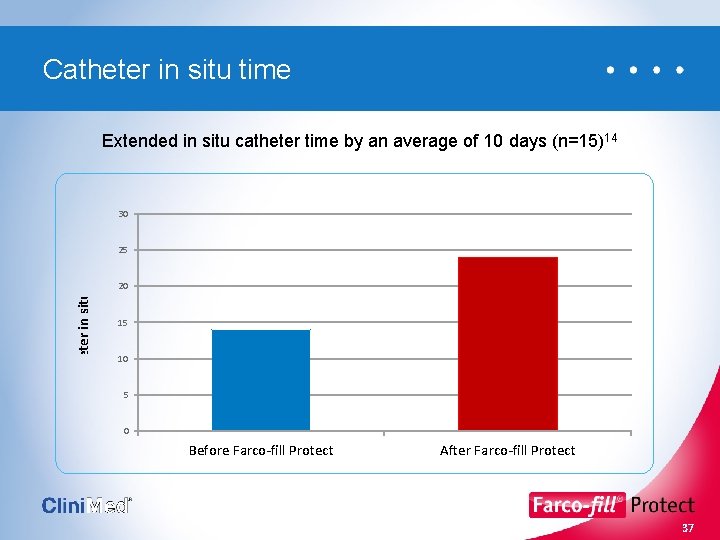
Catheter in situ time Average catheter in situ time (Days) Extended in situ catheter time by an average of 10 days (n=15)14 30 25 20 15 10 5 0 Before Farco-fill Protect After Farco-fill Protect 37
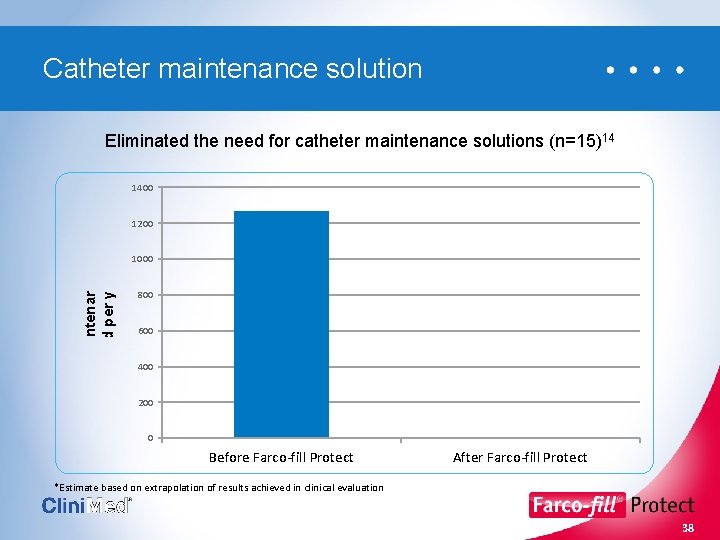
Catheter maintenance solution Eliminated the need for catheter maintenance solutions (n=15)14 Catheter maintenance solutions used per year* 1400 1200 1000 800 600 400 200 0 Before Farco-fill Protect After Farco-fill Protect *Estimate based on extrapolation of results achieved in clinical evaluation 38
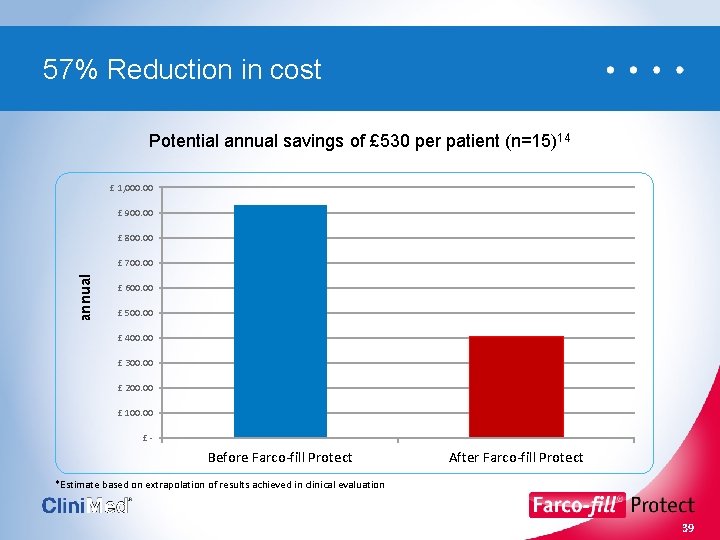
57% Reduction in cost Potential annual savings of £ 530 per patient (n=15)14 £ 1, 000. 00 Average annual costs (£)* £ 900. 00 £ 800. 00 £ 700. 00 £ 600. 00 £ 500. 00 £ 400. 00 £ 300. 00 £ 200. 00 £ 100. 00 £- Before Farco-fill Protect After Farco-fill Protect *Estimate based on extrapolation of results achieved in clinical evaluation 39
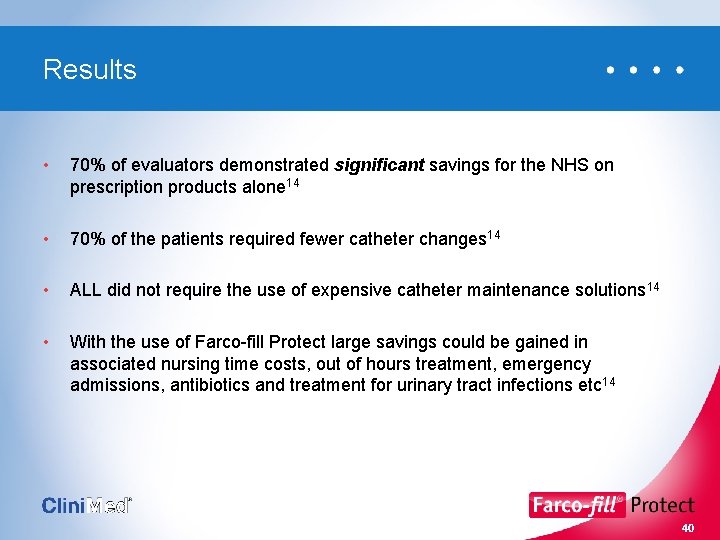
Results • 70% of evaluators demonstrated significant savings for the NHS on prescription products alone 14 • 70% of the patients required fewer catheter changes 14 • ALL did not require the use of expensive catheter maintenance solutions 14 • With the use of Farco-fill Protect large savings could be gained in associated nursing time costs, out of hours treatment, emergency admissions, antibiotics and treatment for urinary tract infections etc 14 40
Farco-fill® Protect – In Practice
• Catheter blockage and bypassing are common problems • Most likely caused by infection and encrustation • Increased negative pressure created by a free drainage catheter system can lead to the walls of the bladder being ‘sucked’ into the drainage eyelets and preventing the flow of urine through the system • 30 cm bag rule • First choice solution + catheter / bladder washouts
• Antibiotics and antiseptics have little effect on encrustation • Breaking the catheter’s closed system every time the solution is administered • Acidic solutions may damage the urothelial lining of the bladder and cause an inflammatory response • Increased pressure under which they may be administered can also contribute to significant damage and increased infection risk • CHALLENGE TO CLINICAL STAFF, repeated call outs, increased patient discomfort, increased costs, sepsis, death?
Case Study – Mr B • 51 year old gentleman with complex health needs • Acquired brain injury resulting in epilepsy and a neurogenic bladder • Supra-pubic catheter blocked frequently requiring several changes of catheter every few days • Significant encrustation on the tip, Mr B complained of internal pain and discomfort around the catheter tip • Tried several different types of catheter material and tips, BWO • Introduced 10 mls of Farco-fill Protect into the retention balloon of an open tip catheter
Mr B continued • Mr B reported the catheter felt more comfortable and lasted 2 weeks before it blocked • Each subsequent use of Farco-fill Protect demonstrated less evidence of blockage and encrustation • Now at 4 week changes • Symptoms of pain discomfort and blockage have resolved • Accumulative improvement in the efficacy of the catheter since the introduction of Farcofill, extending the life of the catheter and improving the patient experience through relief of symptoms.
Case History – Mr W • 67 year old gentleman with multiple sclerosis • Bladder drainage is managed with an indwelling long term urethral catheter • Issues with encrustation, bypassing of urine and catheter blockage resulting in catheter changes once a week
Mr W continued • Variety of catheter materials and tips, BWO (saline and citric acid) • Eating and drinking adequately reporting regular normal bowel movements • Introduction of Farco-fill Protect on the next catheter change • This catheter lasted for 4 weeks before a recurrence of the symptoms were reported • We have continued to use Farco-fill Protect on each catheter change, and as with the previous case history, there appears to be an accumulative effect that extends the catheter life each time it is used. Mr W remains on a standardised programme for his catheter changes and feels his bladder management is much better controlled
Case History – Mrs G • COPD and other long term conditions affecting mobility and general health • Long term urethral catheter to manage intractable incontinence • Frequent catheter blockages that have not responded to any other interventions • Frequent bladder washouts every few days, increasing risk of infection caused by the repeated breaking of the closed drainage system
Mrs G continued • Introduced Farco-fill Protect for balloon instillation on the next catheter change in January 2016 • The staff and patient noticed an immediate improvement • Currently on a 4 week schedule for catheter changes. • Little visual evidence of debris or encrustation on the catheter tips • Mrs G has reported an improvement in her comfort in relation to the catheter and is much happier having less interventions and time spent managing the blockages and washouts • To date she has not required a bladder washout since introducing the Farco-fill Protect regime
Case History – Mr S • • Multiple CVA’s resulting in a significant impairment of mobility, dexterity and cognition. No natural bladder function and requires a urethral catheter to empty bladder. Catheter has repeatedly blocked and required frequent changes every week, causing distress and discomfort to the patient Tried valve system – little change Introduced use of Farco-fill Protect to reduce the incidence of catheter blockage The staff and patient have reported an instant improvement Now has a scheduled catheter change every 4 weeks with little evidence of encrustation on the catheter tip.
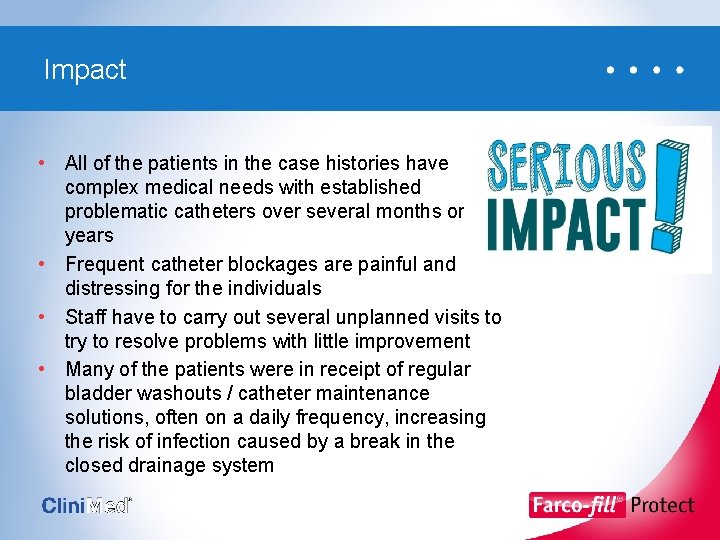
Impact • All of the patients in the case histories have complex medical needs with established problematic catheters over several months or years • Frequent catheter blockages are painful and distressing for the individuals • Staff have to carry out several unplanned visits to try to resolve problems with little improvement • Many of the patients were in receipt of regular bladder washouts / catheter maintenance solutions, often on a daily frequency, increasing the risk of infection caused by a break in the closed drainage system
• Several services were called out of hours • Some patients had unplanned acute hospital visits when their catheter issues could not be resolved locally • Impacted on the patients’ quality of life • Increased the workload for staff • Negative psychological impact and increasing the financial costs of managing these caseloads
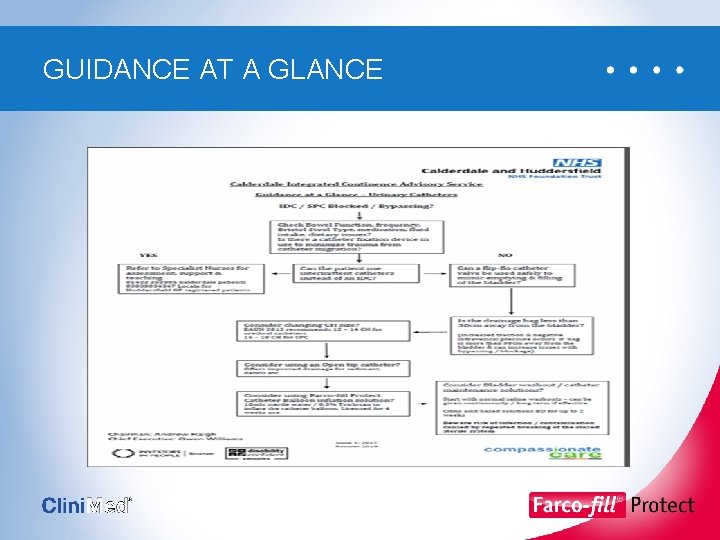
GUIDANCE AT A GLANCE
Conclusion • Introducing Farco-fill Protect has extended the life of the catheter • Re-established an acceptable schedule for catheter changes • All patients involved in trialling the product have reported a reduction in the pain and discomfort previously reported • The introduction of Farco-fill Protect has negated or reduced the need and frequency for bladder washouts • All patients need an individualised clinical assessment & treatment plan for effective bladder drainage / management with an IDC • Many short term catheters will not cause issues of encrustation or blockage • Farco-fill Protect is invaluable in the complex patient with a problematic long term catheter
53
References 1. 2. 3. 4. 5. 6. 7. 8. 9. 10. 11. 12. 13. 14. Prinjha, S and Chapple A. Living with an indwelling urinary catheter. Nursing times 2003, 109 (44), 12 -14 Royal College of Physicians. Report of the National Audit of Continence Care for Older People (65 years and above) in England, Wales and Northern Ireland. London 2005 Prescription cost analysis data, 2015. Available at: www. nhsbsa. nhs. uk/Prescription. Services. Accessed March 2017 Stickler DJ. Clinical complications of urinary catheters caused by crystalline biofilms: something needs to be done. J Intern Med 2014; 276: 120– 129 Morris NS et. al. Which indwelling urethral catheters resist encrustation by Proteus mirabilis biofilms? British Journal of Urology 1997; 80: 58– 63 Getliffe K. , Managing Recurrent Urinary Catheter Blockage: Problems, Promises, and Practicalities. J Wound Ostomy Continence Nurs. 2003 May; 30(3): 146 -51 The Medical Technology Group. Admissions of failure. The truth about unplanned NHS admissions in England. 2015. Available at: http: //www. mtg. org. uk/wp-content/uploads/2016/07/Admissions-of-Failure-2015. pdf. Accessed April 2017. Shropshire Community Health Trust Catheter Policy – V 3 June 2016. Approved on 06/06/2016. Review date: 06/06/2019. Available at: www. shropscommunityhealth. nhs. uk/content/doclib/11075. pdf. Accessed April 2017 North & East Devon Formulary and Referral, an initiative of NHS NEW Devon CCG. Available at: www. northeast. devonformularyguidance. nhs. uk/formulary/chapters/18 -continence/catheter-patency-maintenance-solutions. Accessed April 2017 Geng V. et al. Evidence-based Guidelines for Best Practice in Urological Health Care Catheterisation Indwelling catheters in adults Urethral and Suprapubic, European Association of Urology Nurses. 2012. Available at: www. nursing. nl/pagefiles/11870/001_1391694991387. pdf. Accessed April 2017 Drug Tariff England Wales. Available at: www. nhsbsa. nhs. uk/Prescription. Services/4941. aspx. Accessed March 2017 Pannek J, Vestweber AM. Clinical utility of an antimicrobial blocking solution in patients with an indwelling catheter. Aktuelle Urol 2011; 42: 51– 54 Sperling H, et al. Überprüfung des Einsatzes von Triclosan bei Dauerkatheterträgern. Der Urologe 2014; 53: 1512– 1517 Clin. Med. Data on file. 2015 42