
STI PID Genital Tb Kibruyisfawe zewdie MD Sexually
STI, PID, Genital Tb Kibruyisfawe zewdie, MD
Sexually Transmitted Diseases • 1. 2. 3. 4. 5. The term denote disorders spread principally by intimate contact: Sexual intercourse, Close body contact, kissing, and anal intercourse. Transplacental spread, Passage through the birth canal, and Lactation during the neonatal period
Terminology • WHO recommends that the term STD be replaced by the term STI. • STI has been adopted since 1999 as it better incorporates asymptomatic infections. • Has also been adopted by a wide range of scientific societies & publications.
Introduction • the most common infectious diseases in the most parts of the world • five key points about all STDs today:
1. STDs affect men and women of all backgrounds and economic levels. - They are most prevalent among teenagers and young adults. - Nearly two-thirds of all STDs occur in people younger than 25 years of age.
continued 2. The incidence of STDs is rising - Because in the last few decades, young people have become sexually active earlier yet are marrying later. - In addition, divorce is more common. - The net result is that sexually active people today are more likely to have multiple sex partners during their lives and are potentially at risk for developing STDs.
continued 3 Most of the time, STDs cause no symptoms, particularly in women. - When and if symptoms develop, they may be confused with those of other diseases not transmitted through sexual contact. - Even when an STD causes no symptoms, however, a person who is infected may be able to pass the disease on to a sex partner. - recommend periodic testing or screening for people who have more than one sex partner.
continued 4, STDs tend to be more severe and more frequent for women than for men, - because the frequency of asymptomatic infection many women do not seek care until serious problems have developed. - Some STDs can spread to cause PID, which in turn infertility & ectopic (tubal) pregnancy. - may be associated with cervical cancer; HPV - causes genital warts - other genital cancers.
continued 5. STDs can be passed from a mother to her baby before, during, or immediately after birth; - When diagnosed and treated early, many STDs can be treated effectively. - Some infections have become resistant to the drugs used to treat them and now require newer types of antibiotics.
STD; microorganisms • Long list 1. Transmitted by sexual route (conventional STI) 2. Transmission described but less defined evidence
Approaches to STD Dx & Rx Three approaches 1. Laboratory based 2. Clinical without laboratory support 3. Syndromic Approach
Background • Traditional approach to STD Dx and Rx relies on laboratory diagnosis to determine etiologic agents üExpensive üInvolves delay in Dx and Rx üDepends on technician and lab accuracy üOften not available in resource poor settings üRequires quality control procedures
…Background • Alternative approach – Clinical Dx üPresumptive Dx of one etiology based on clinical findings üOften inaccurate and incomplete • Similarities of Sn and Sx • Misses Co-infection • Atypical presentation - HIV
Definition • Syndromic Management is a management approach that uses clinical algorithms on an STD Syndrome, the constellation of patient symptoms and clinical signs to determine therapy. • Algorithms are adapted to local STD prevalence • Chooses antimicrobial agents to cover all the possible pathogens responsible for the syndromes in the specific geographic area.
…Syndromic Management Components 1. Identification and Rx of the Syndrome 2. Education and counseling on - Rx compliance - Risk reduction including condom use 3. Partner notification 4. Provision of condoms 5. VCT for HIV
Advantages • Expedited care • Cost savings – less technically demanding • Increased client satisfaction • Treatment at first visit ØDecreases further transmission ØDecreases complication ØEliminates need for return visit • Decrease incidence of HIV (by 42% in Tanzania)
Major STD Clinical Syndromes • • Genital ulcer Urethral discharge Abnormal vaginal discharge Lower abdominal pain Bubo inguinale Scrotal swelling Neonatal conjuctivitis
Genital Ulcer Disease (GUD) • 1. 2. 3. • • Algorithms for GUD try to identify presence of Herpes, Syphilis and/or Chancroid Frequency of causative agents differ in different parts Review – syndromic treatment without lab support showed high cure rate Ø 100% - Cote D’ivore Ø 64% - Zambia
Herpes Simplex Virus – DNA virus • remain in latent form • other members of the family includes VZ, CMV , EBV • there are different antigenic strains • but are divided in two: • Type 1 = oral • Type 2 = genital – primary infection occurs in child hood – latent infection resides in the sensory ganglion of trigeminal, sacral & vagal – 50 -100% of adults have serologic evidence of HSV 1 – 20 -80% type 2
HSV Cont… • transmission = only by direct contact • clinical disease • painful papule followed by vesicle , ulceration crusting & healing • more sever in women • Primary Vs Recurrent • primary episode – – more symptomatic incubation range 2 -14 days there is fever & lymphadenities viral shedding & healing prolonged
HSV Cont… • recurrent episode – frequently have prodromal period signaling active viral replication, – lesions are often localized – shedding is shorter – recurrences is not usually from re infection but are reaction of latent viruses
• Diagnosis = mainly clinical – Tissue culture • best method but lengthy and costly – ELISA testing 70% – Direct immunofluoresent staining 75% sensitive = both the negative culture and smear don't exclude infection
Syphilis • organism characteristics & microbiology – By treponema pallidum – is tightly coiled a spirochete that can not be grown – can invade intact mucous membrane or area of abraded skin. • incidence and epidemiology – the incidence is rising – only 30% of patients exposed acquire the disease – in those infected patients not taking medication 60% do develop immune defense sufficient to control the infection – the remaining will go to late and tertiary syphilis
• Clinical diseases 1. EARLY SYPHILIS A = primary syphilis, • • painless chancre is the whole mark it occurs at the site of inoculation there is regional lymphadenopathy incubation period 10 -90 days B = 20 syphilis - mucocutaneous skin lesion 6 -8 weeks after the original inoculation - alopacia, hepatitis & nephrotic syndrome
continued 2. Latent syphilis – characterized by serologic evidences but no clinical signs &symptoms – most patients are not infectious about 25% could have recent skin lesion – arbitrary division of this stage but has no clinical significance with regard to treatment – early latency (< 4 years from initial infection ) – latency (>4 years )
continued 3. LATE SYPHILIS • 5 -30 years after initial infection – there are three divisions 1. benign disease(gummas) - lesion occur in vital organs – can be life threatening if they compromise the organ 2. cardiovascular disease - involvement of the heart and the aorta are frequent dysfunction may cause serious problem 3. neurological diseases - three clinical syndromes of neurological involvement – asymptomatic disease no neurological manifestations but abnormal CSF – meningovascular disease the commonest manifestation is paresis , (tabis dorsalis) – parenchymatous disease dementia the commonest manifestation
• Diagnosis A. Non treponemal specific test: - • RPR (rapid plasma reagin) test, • standard VDRL slide test, B. Treponemal specific test; • FTA-ABS; fluorescent treponemal antibody absorbed (used commonly for adults ), • MHA_TP micro haemagglutination assay( for neonates) C. Dark field microscopy • the higher the titer the higher the inflammatory reaction • false +ve tests in chronic illnesses – e. g. leprosy - auto immune diseases( lupus) – pregnancy - drug addiction
Chancroid • Haemophilus ducreyi : - a gram negative bacteria • is a painful soft chancre ragged with raised borders • kissing ulcers do occur • unilateral lymphadenopathy that may suppurate • incubation period is 2 -5 days • the organism is fastidious
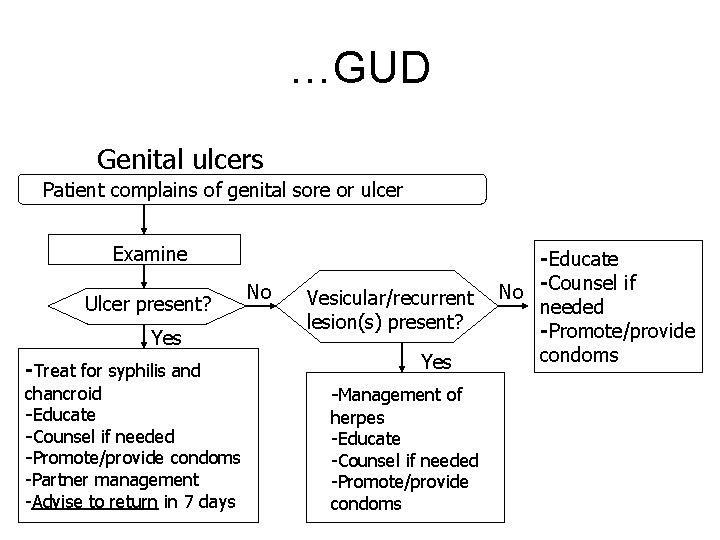
…GUD Genital ulcers Patient complains of genital sore or ulcer Examine Ulcer present? Yes -Treat for syphilis and chancroid -Educate -Counsel if needed -Promote/provide condoms -Partner management -Advise to return in 7 days No Vesicular/recurrent lesion(s) present? Yes -Management of herpes -Educate -Counsel if needed -Promote/provide condoms -Educate No -Counsel if needed -Promote/provide condoms
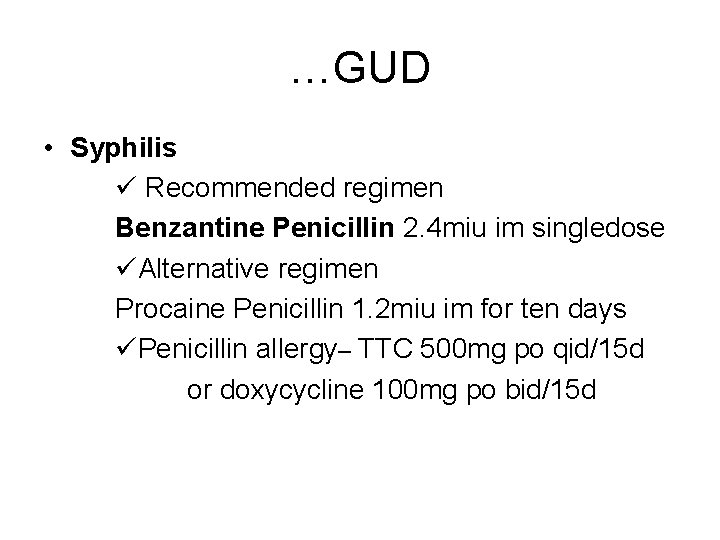
…GUD • Syphilis ü Recommended regimen Benzantine Penicillin 2. 4 miu im singledose üAlternative regimen Procaine Penicillin 1. 2 miu im for ten days üPenicillin allergy– TTC 500 mg po qid/15 d or doxycycline 100 mg po bid/15 d
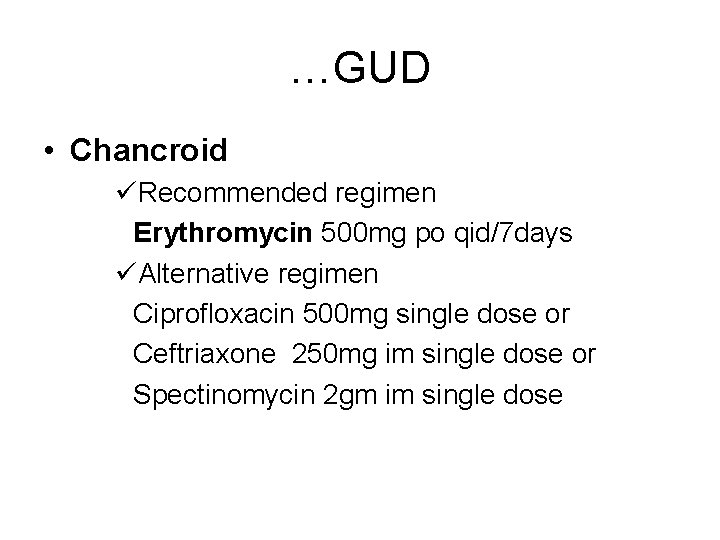
…GUD • Chancroid üRecommended regimen Erythromycin 500 mg po qid/7 days üAlternative regimen Ciprofloxacin 500 mg single dose or Ceftriaxone 250 mg im single dose or Spectinomycin 2 gm im single dose
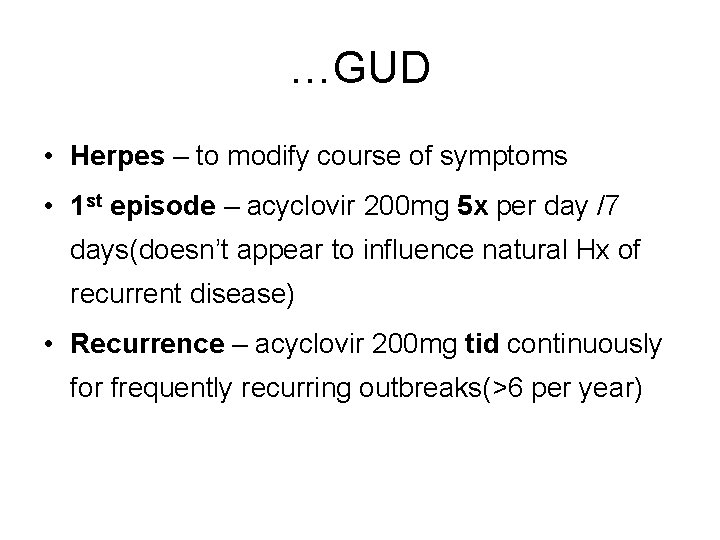
…GUD • Herpes – to modify course of symptoms • 1 st episode – acyclovir 200 mg 5 x per day /7 days(doesn’t appear to influence natural Hx of recurrent disease) • Recurrence – acyclovir 200 mg tid continuously for frequently recurring outbreaks(>6 per year)
Inguinal Bubo • Inguinal adenopathy • LGV (L 1, L 2, L 3), • Chancroid, • G I (donovanosis) is – Klebsiella granulomatis, formerly known as Calymmatobacterium granulomatis • Common in the tropics as a cause of genital ulcer • Men affected more than females • Prostitution is reservoir • Painful adenopathy
Inguinal Bubo, cont’d • Rare systemic symptoms except LGV • Common predisposing factor for the spread of HIV • Complications: – – – Abscess formation PID Lymphatic obstruction Stenosis Infertility
Differential Diagnosis • Infection in the lower limbs and perineum • Malignancy • Herpes genitalis • Syphilis
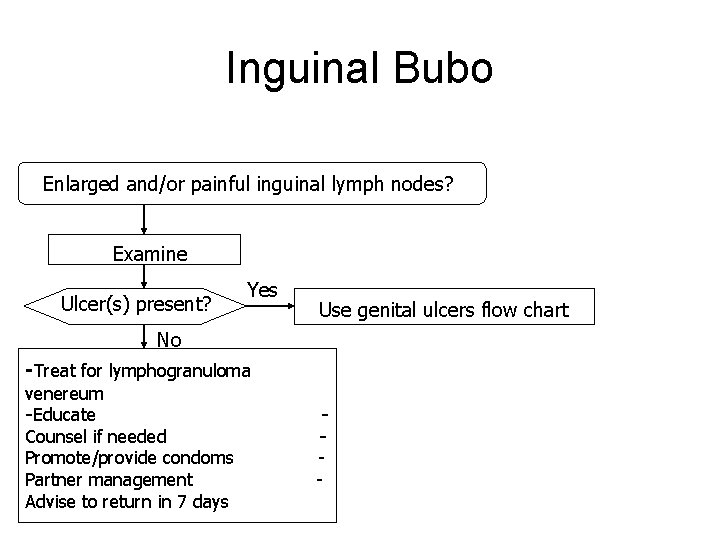
Inguinal Bubo Enlarged and/or painful inguinal lymph nodes? Examine Ulcer(s) present? Yes Use genital ulcers flow chart No -Treat for lymphogranuloma venereum -Educate Counsel if needed Promote/provide condoms Partner management Advise to return in 7 days -
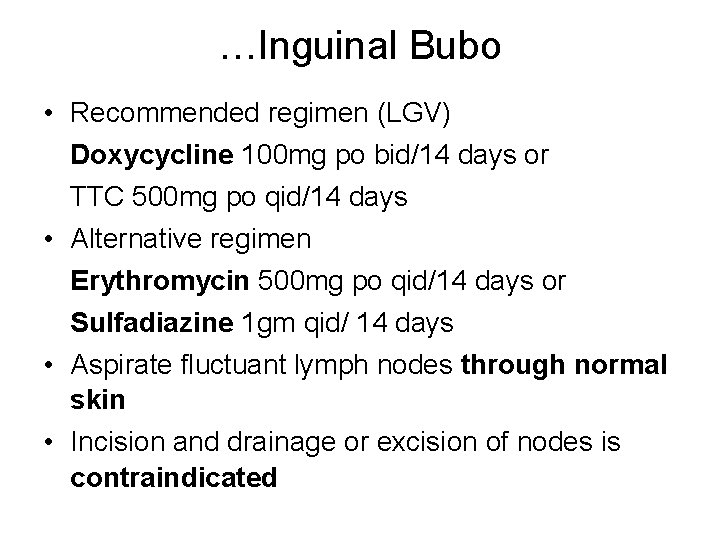
…Inguinal Bubo • Recommended regimen (LGV) Doxycycline 100 mg po bid/14 days or TTC 500 mg po qid/14 days • Alternative regimen Erythromycin 500 mg po qid/14 days or Sulfadiazine 1 gm qid/ 14 days • Aspirate fluctuant lymph nodes through normal skin • Incision and drainage or excision of nodes is contraindicated
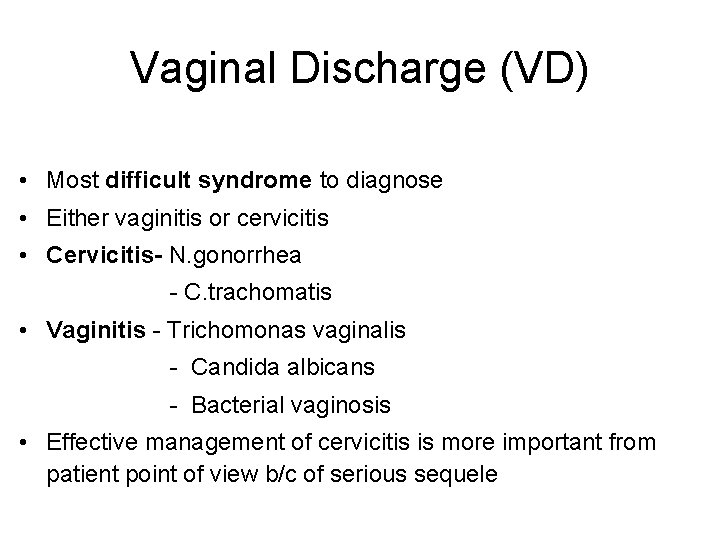
Vaginal Discharge (VD) • Most difficult syndrome to diagnose • Either vaginitis or cervicitis • Cervicitis- N. gonorrhea - C. trachomatis • Vaginitis - Trichomonas vaginalis - Candida albicans - Bacterial vaginosis • Effective management of cervicitis is more important from patient point of view b/c of serious sequele
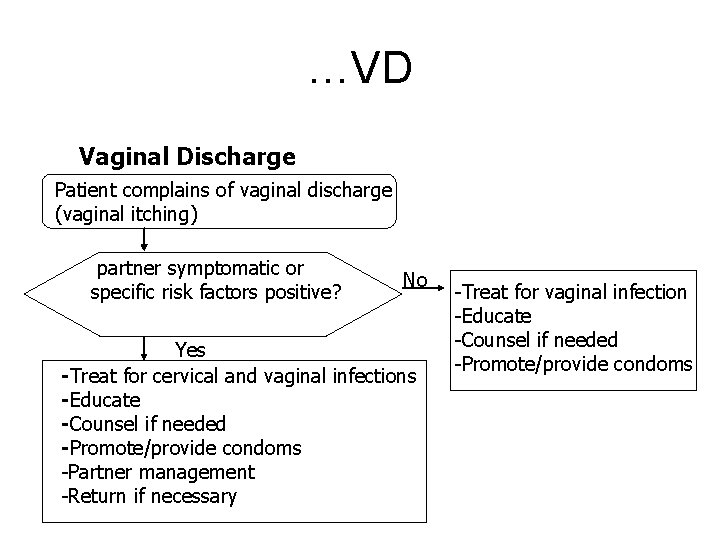
…VD Vaginal Discharge Patient complains of vaginal discharge (vaginal itching) partner symptomatic or specific risk factors positive? No Yes -Treat for cervical and vaginal infections -Educate -Counsel if needed -Promote/provide condoms -Partner management -Return if necessary -Treat for vaginal infection -Educate -Counsel if needed -Promote/provide condoms
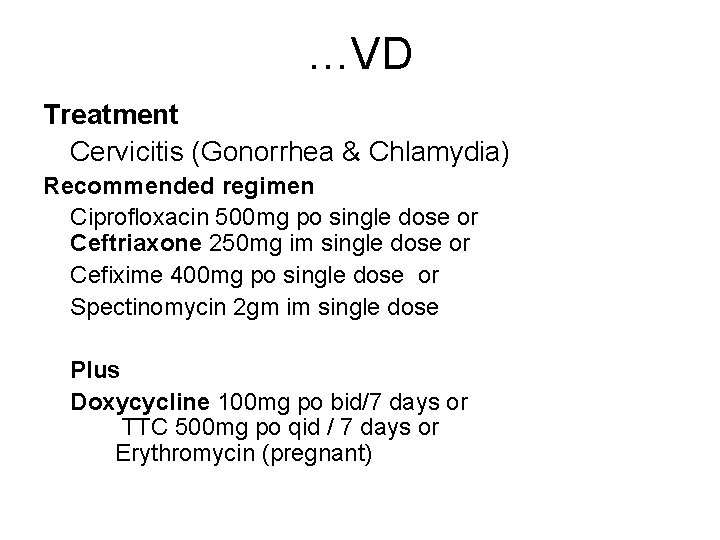
…VD Treatment Cervicitis (Gonorrhea & Chlamydia) Recommended regimen Ciprofloxacin 500 mg po single dose or Ceftriaxone 250 mg im single dose or Cefixime 400 mg po single dose or Spectinomycin 2 gm im single dose Plus Doxycycline 100 mg po bid/7 days or TTC 500 mg po qid / 7 days or Erythromycin (pregnant)
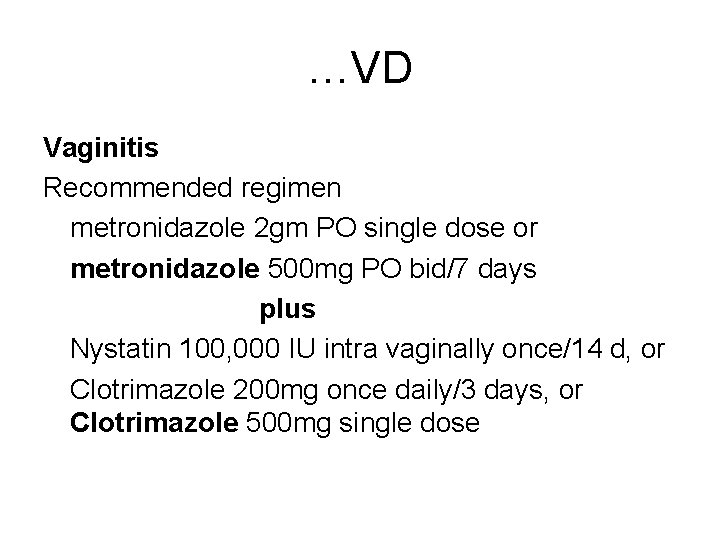
…VD Vaginitis Recommended regimen metronidazole 2 gm PO single dose or metronidazole 500 mg PO bid/7 days plus Nystatin 100, 000 IU intra vaginally once/14 d, or Clotrimazole 200 mg once daily/3 days, or Clotrimazole 500 mg single dose
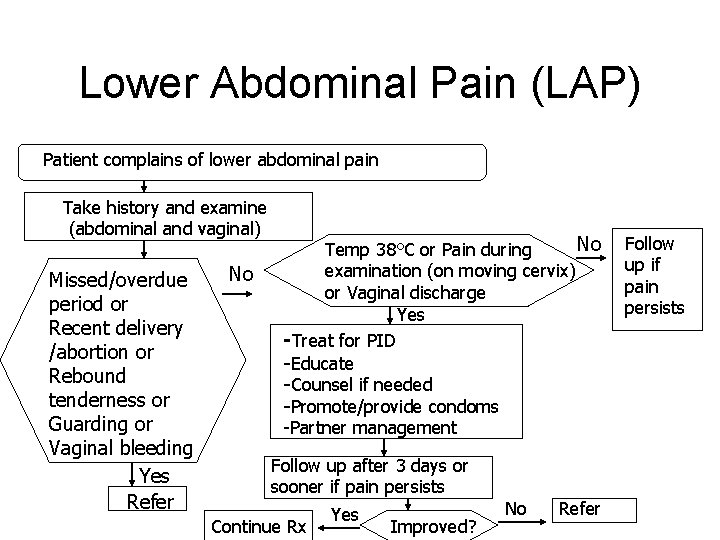
Lower Abdominal Pain (LAP) Patient complains of lower abdominal pain Take history and examine (abdominal and vaginal) Missed/overdue period or Recent delivery /abortion or Rebound tenderness or Guarding or Vaginal bleeding Yes Refer No No Temp 38°C or Pain during examination (on moving cervix) or Vaginal discharge Yes -Treat for PID -Educate -Counsel if needed -Promote/provide condoms -Partner management Follow up after 3 days or sooner if pain persists Continue Rx Yes Improved? No Refer Follow up if pain persists
PID • PID refers to acute infection of the upper genital tract (above the internal cervical os) • community-acquired Vs Iatrogenic • USA - annually 2. 5 million outpatient visits, • 200, 000 hospitalizations, and • 100, 000 surgical procedures • incurs an annual total expense of more than $5 billion
• Acute PID= attributed to an ascending spread of microorganisms from the vagina and endocervix. • Acute PID Vs Acute salpingitis – are often used interchangeably, – but PID is not limited to tubal infection only. • A more descriptive term = (UGTI). – Severity & Extent of disease • This is differentiated from (LGTI) because response to treatment appears to be different in these two entities.
• • • Etiology Neisseria gonorrhoeae and Chlamydia trachomatis serovars D-K common cause of PID = 1/3 rd each; However, most = polymicrobial infection caused by ascending infection 15% of infections occur after procedures that break the cervical mucous barrier C. trachomatis etiologic role is very different from N. gonorrhea
• • • N. Gonnorrhea Gram-negative IC diplococcus rapid cycle 20 to 40 minutes to divide rapid and intense inflammatory response Less complication Early Rx • • • C. Trachomatis is a slow-growing intracellular organism. lack of mitochondria growth cycle 48 to 72 hours does not induce a rapid or violent inflammatory response destruction by rupture Delayed Rx
Initial PID → • tissue damage provides fertile ground for the growth of secondarily infecting aerobic and anaerobic bacteria. • This necrotic tissue is an excellent growth medium, and • the epithelial damage enhances the breakdown of the surface defense mechanisms
• • • Classification: Post STI / menustral Post abortal Post Partum Post Instrumentation IUD – Related Secondary PID
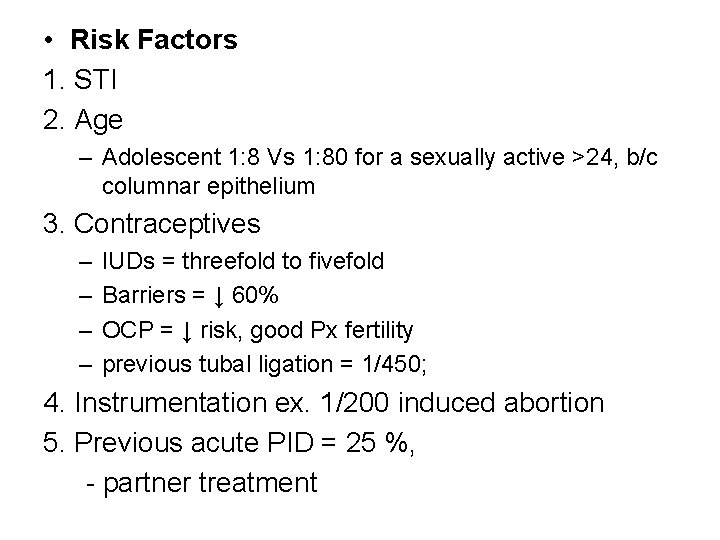
• Risk Factors 1. STI 2. Age – Adolescent 1: 8 Vs 1: 80 for a sexually active >24, b/c columnar epithelium 3. Contraceptives – – IUDs = threefold to fivefold Barriers = ↓ 60% OCP = ↓ risk, good Px fertility previous tubal ligation = 1/450; 4. Instrumentation ex. 1/200 induced abortion 5. Previous acute PID = 25 %, - partner treatment
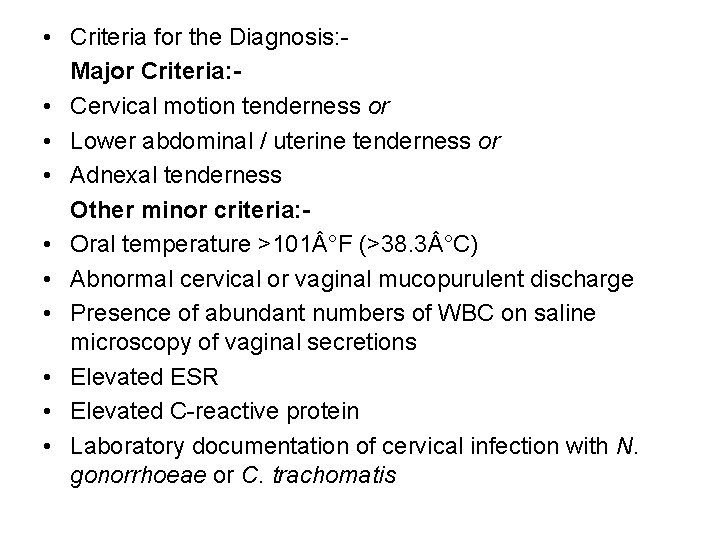
• Criteria for the Diagnosis: Major Criteria: • Cervical motion tenderness or • Lower abdominal / uterine tenderness or • Adnexal tenderness Other minor criteria: • Oral temperature >101 °F (>38. 3 °C) • Abnormal cervical or vaginal mucopurulent discharge • Presence of abundant numbers of WBC on saline microscopy of vaginal secretions • Elevated ESR • Elevated C-reactive protein • Laboratory documentation of cervical infection with N. gonorrhoeae or C. trachomatis
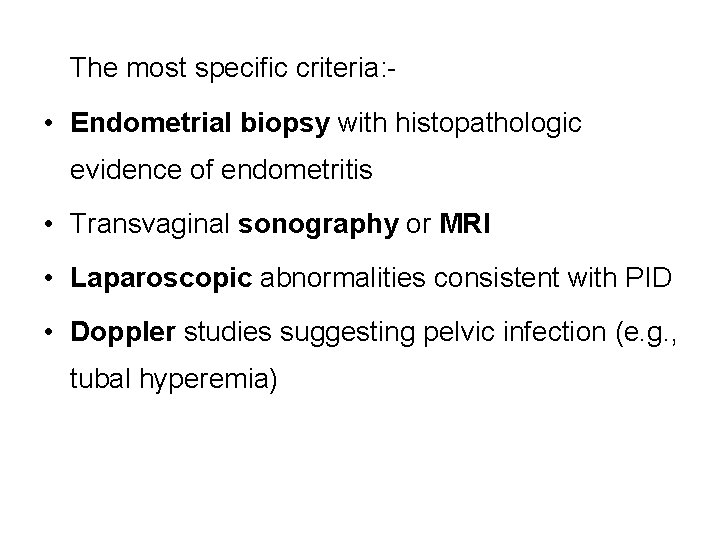
The most specific criteria: - • Endometrial biopsy with histopathologic evidence of endometritis • Transvaginal sonography or MRI • Laparoscopic abnormalities consistent with PID • Doppler studies suggesting pelvic infection (e. g. , tubal hyperemia)
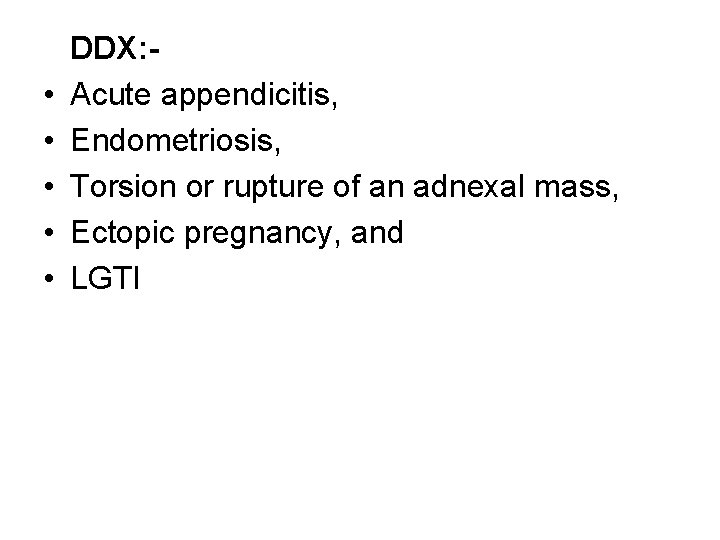
• • • DDX: Acute appendicitis, Endometriosis, Torsion or rupture of an adnexal mass, Ectopic pregnancy, and LGTI
• Complication: Early • Sepsis → MOF → Death( ruptured TOA = 10 %) • Surgical morbidity (TOA) Late • Infertility = 20% • Ectopic Pregnancy = 6 -10 X higher; 12 % • Chronic pelvic Pain = 20% • Chronic PID • Psychological consequences
Treatment • based on the consensus that PID is polymicrobial in cause. • Empirical antibiotic protocols should cover a wide range of bacteria • Oral therapy can be considered for women with mild to moderately severe acute PID
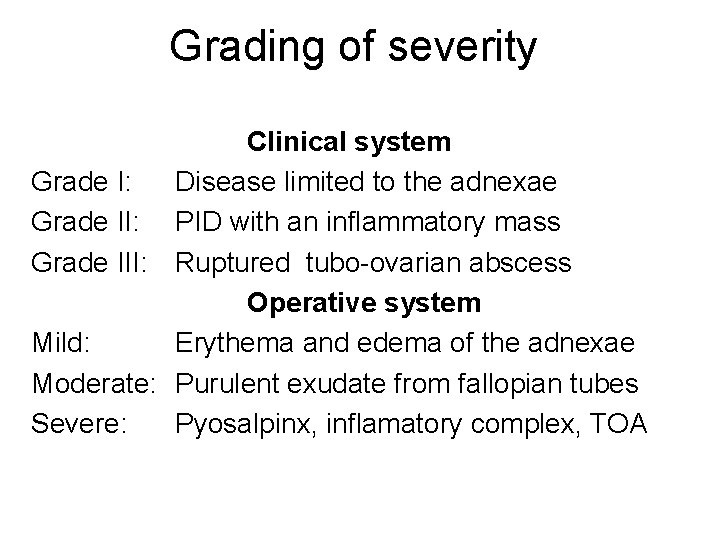
Grading of severity Clinical system Grade I: Disease limited to the adnexae Grade II: PID with an inflammatory mass Grade III: Ruptured tubo-ovarian abscess Operative system Mild: Erythema and edema of the adnexae Moderate: Purulent exudate from fallopian tubes Severe: Pyosalpinx, inflamatory complex, TOA
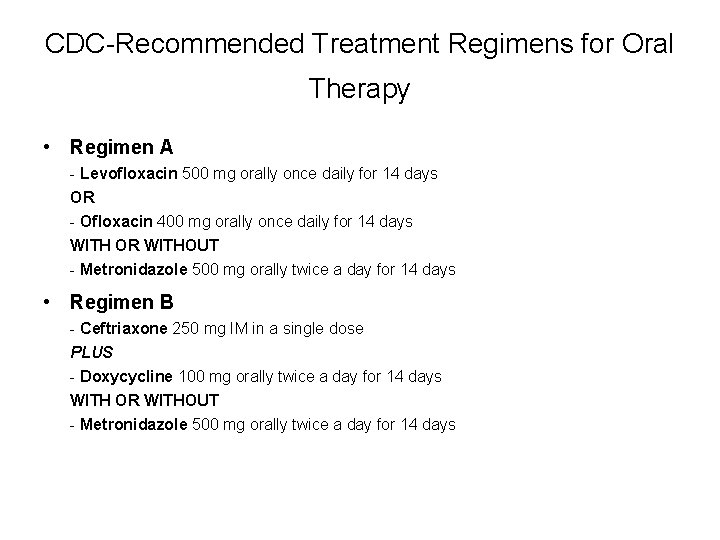
CDC-Recommended Treatment Regimens for Oral Therapy • Regimen A - Levofloxacin 500 mg orally once daily for 14 days OR - Ofloxacin 400 mg orally once daily for 14 days WITH OR WITHOUT - Metronidazole 500 mg orally twice a day for 14 days • Regimen B - Ceftriaxone 250 mg IM in a single dose PLUS - Doxycycline 100 mg orally twice a day for 14 days WITH OR WITHOUT - Metronidazole 500 mg orally twice a day for 14 days
Criteria for Hospitalization • Surgical emergencies (such as appendicitis) cannot be excluded. • Pregnant. • No response clinically to oral therapy. • Unable to follow or tolerate oral regimen. • Has severe illness, nausea and vomiting, or high fever. • The patient has a tuboovarian abscess. • Adolescents • HIV / Aids
CDC-Recommended Parenteral Treatment Regimen A - Cefotetan 2 g IV every 12 hours OR - Cefoxitin 2 g IV every 6 hours PLUS - Doxycycline 100 mg orally or IV every 12 hours Regimen B - Clindamycin 900 mg IV every 8 hours PLUS - Gentamicin • D/C IV 24 hours after a patient improves clinically; • Continue oral therapy – doxycycline 100 mg orally twice a day or – Clindamycin 450 mg orally four times a day • complete a total of 14 days of therapy
• Male sex partners of women with PID should be examined and treated • Education for the prevention of reinfection, • Proper contraception Surgical Mx • Laparascopy • Laparatomy • Colpotomy • Percutaneous drainage
Pelivic Tuberculosis • it is a frequent cause of chronic PID and infertility in developing world • produced primarily by either: – Mycobacterium tuberculosis or – Mycobacterium bovis • The fallopian tubes = predominant site • spread to the endometrium → ovaries.
Female reproductive tract are usually infected by: - 1. Hematogenous miliary spread from a primary pulmonary lesion, 2. Hematogenous spread from a secondary miliary site 3. Lymphatic spread from a primary pulmonary site to intestinal lymph nodes and then to the pelvis, 4. Direct extension from adjacent abdominal organs 5. A venereal transmission
Clinical Features • most often = 20 and 40 years • Chronic pelvic pain, • Inflammatory Pelvic Mass • General malaise, low grade fever • Menstrual irregularity (50%), and infertility • Amenorrhea or oligomenorrhea = 27% • Failure of fever to subside with high doses of broad-spectrum antibiotic • 10 -20 % of pts with pulmonary Tb have pelvic Tb
Diagnosis • Mainly clinical • Biopsy – dilatation and curettage or endometrial biopsy – From cervical ulcer • • • HSG Culture – menstrual blood, luteal phase Laparatomy / Laparoscopy Acid-fast stains of tissue Other studies ex. CXR, Culture etc…

Thank You
- Slides: 64