Managing RD projects The changing nature of RD

- Slides: 25
Managing R&D projects
• The changing nature of R&D management • Three important factors: • Technology explosion • Shortening of the technology cycle • Globalisation of technology
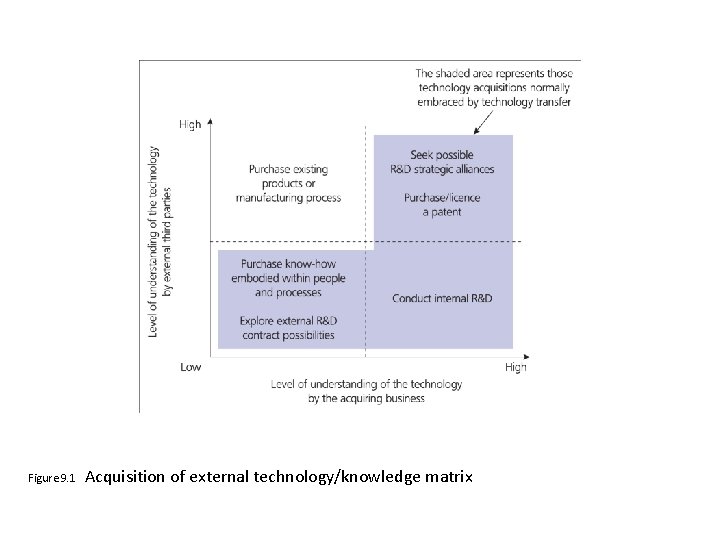
• Importance now placed on technology acquisition by technology based companies reveals a departure from a focus on internal R and D and an acknowlwdgement that internal R and D is only one of many technology development options available.
Technology transfer • The process of promoting technical innovation through the transfer of ideas , knowledge , devices and artefacts from leading edge companies , R and D organisations and academic research to more general and effective application in industry and commerce. • (Seaton and Cordey-Hayes, 1993)
Figure 9. 1 Acquisition of external technology/knowledge matrix
• Industry is expanding support to university research • Increased number of technological collaborations • Inter departmental interactions • Dramatic rise in use of project management • Expansion of industrial agreements.
• The focus of these new areas of work is on external knowledge acquisition and assimilation. • Many companies are being forced to reassess the way they manage their R and D. • The increased portfolio of activities rwequires a different range of skills from the individuals involved. • Additional attributes needed are the ability to interact with a wide variety of external organisations, thereby increasing awareness of specific customer needs , market changes, the activities of the competitors and the larger environment.
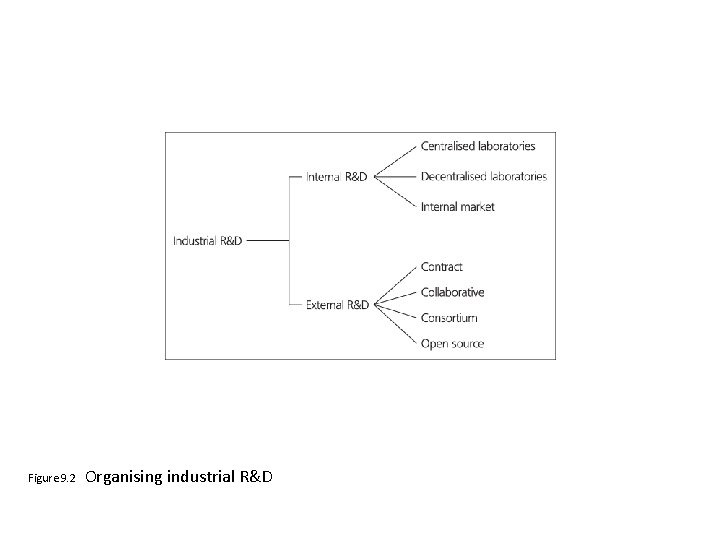
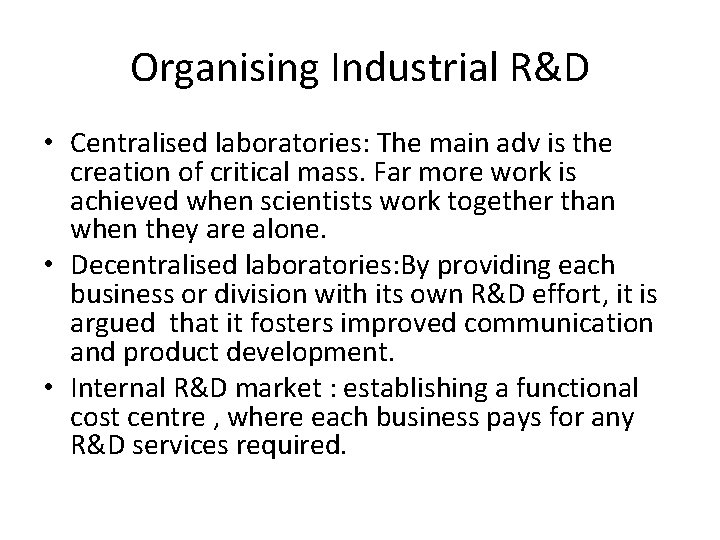
Figure 9. 2 Organising industrial R&D
Organising Industrial R&D • Centralised laboratories: The main adv is the creation of critical mass. Far more work is achieved when scientists work together than when they are alone. • Decentralised laboratories: By providing each business or division with its own R&D effort, it is argued that it fosters improved communication and product development. • Internal R&D market : establishing a functional cost centre , where each business pays for any R&D services required.
The acquisition of external technology • The process of promoting technical innovation through transfer of ideas, knowledge, devices and artefacts from leading edge companies, R&D organisations and academic research to more general and effective application in industry and commerce. • Seaton and Cordey-Hayes, 1993
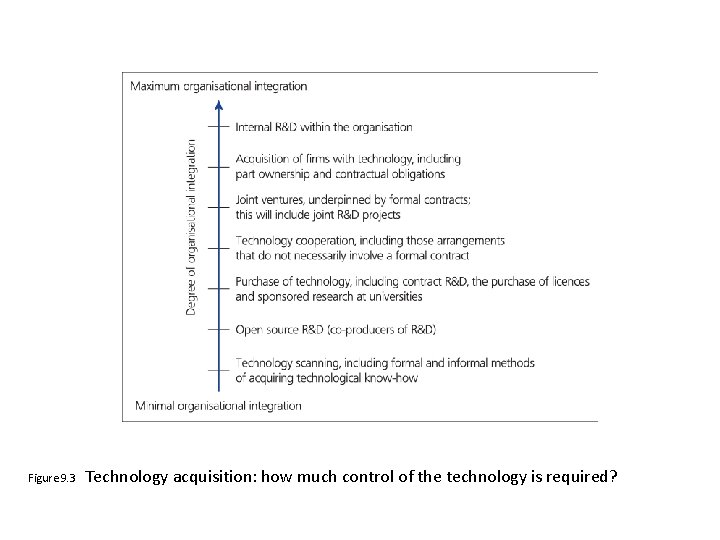
Level of control of technology required • The particular stage of developmentof the research , or its position in the technology life cycle , will heavily influence the level of control required.
Figure 9. 3 Technology acquisition: how much control of the technology is required?
Forms of external R&D • Contract R&D: Where the business has a low level of understanding of the technology (bottom left hand corner in the tech acquistion matrix), contractiong the R&D to a third party is often suitable.
R&D Strategic alliances and Joint Ventures • Strategic alliance is a generic term for all forms of cooperation, both formal and informal , including joint ventures. • With JV, the cost and possible benefits from R&D research project would be shared. They are usually established for a specific project and would cease once the project is completed. • Ex: Sony and Ericsson JV in 2001 to develop cell phones.
JV advantages and disadvantages • Advantages • Sharing of expertise • Reduce costs • Reduce risk Disadvantage: - either company can pass knowledge to the other company and receive little in return.
R&D Consortia • In Japan , KEIRETSUS(societies of business) consist of 20 -50 companies. • In South Korea, CHAEBOLS. Similar to the keiretsus , but financed by the govt. • Consortia usage has increased in the past decade in US and UK. Ex: SEMETECH, a consortium of 14 semi conductor companies. • Potential weakness : » reduction of competition » Organisatons operating illegal cartel » One company gain more than others like it is possible in a JV • Advantages: • Reduce cost and risk • Access technoliogies • Influence industry standards
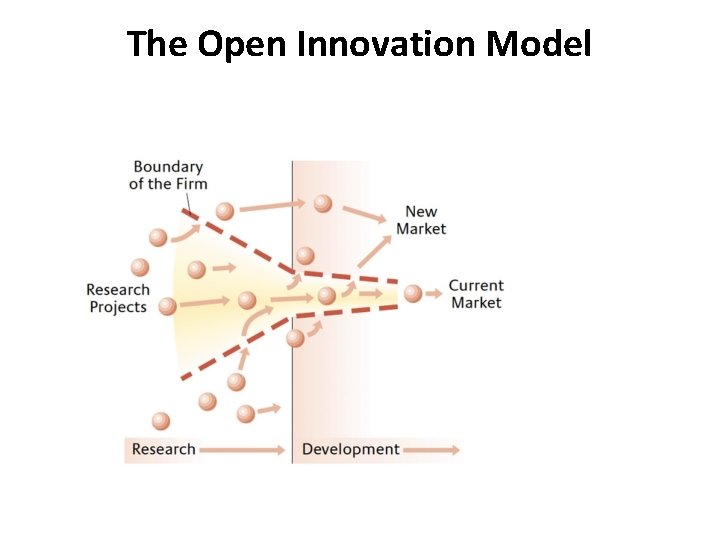
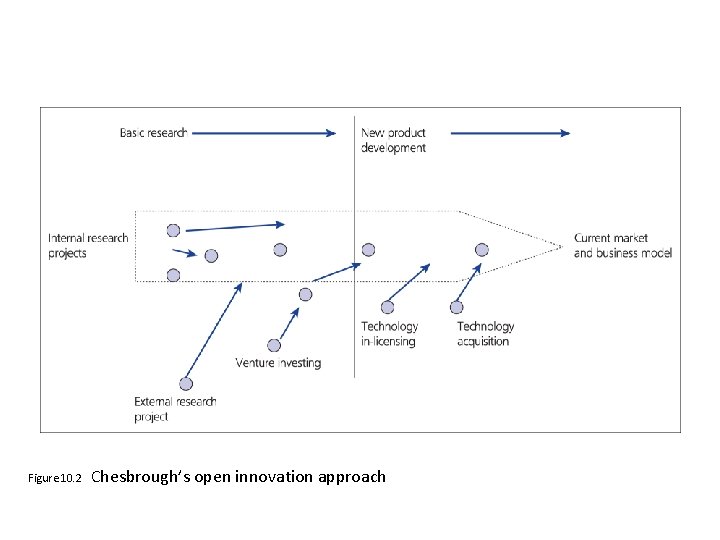
The Open Innovation Model
The Open Innovation Model • Chesbrough (2006) promoted this model • In the new model of open innovation, a company commercializes both its own ideas as well as innovations from other firms and seeks ways to bring its in-house ideas to market by deploying pathways outside its current businesses. Note that the boundary between the company and its surrounding environment is porous (represented by a dashed line), enabling innovations to move more easily between the two. •
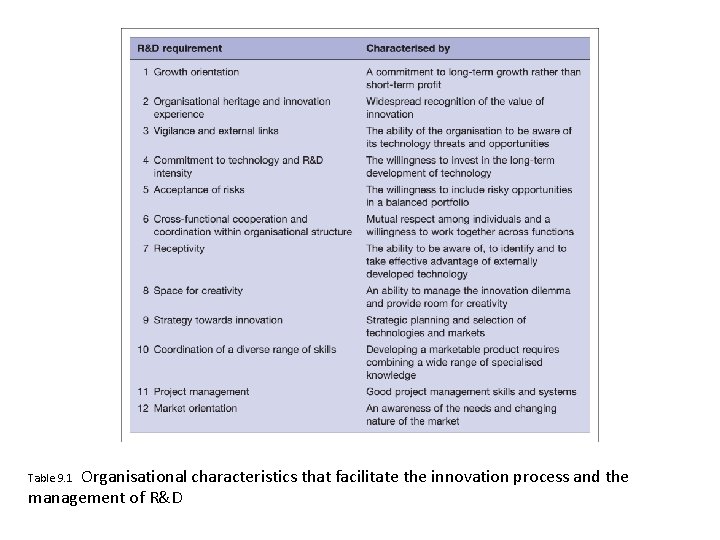
Organisational characteristics that facilitate the innovation process and the management of R&D Table 9. 1
Figure 9. 4 Managing scientific freedom within an R&D function
Table 9. 2 Research project outcomes
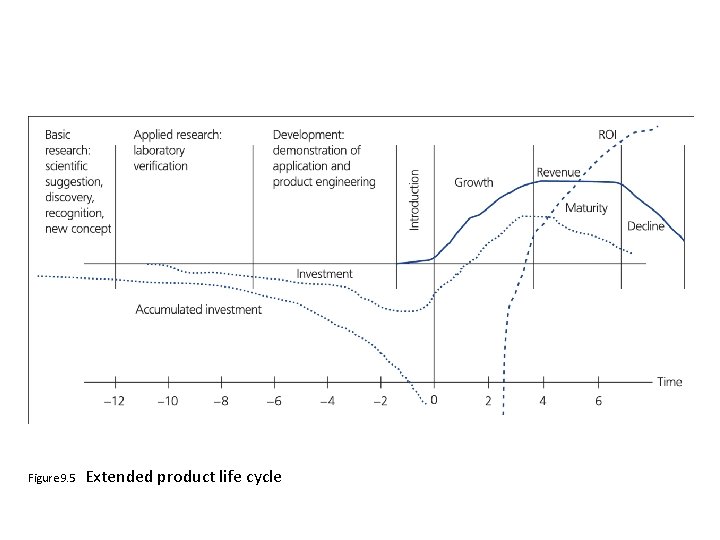
Figure 9. 5 Extended product life cycle
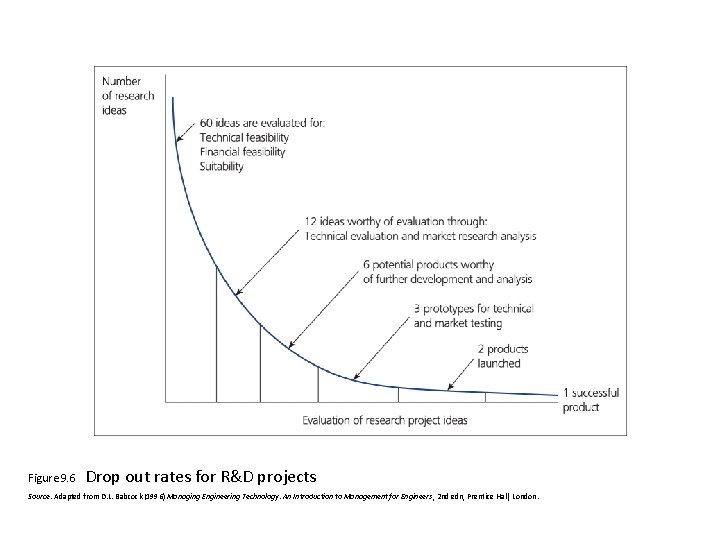
Figure 9. 6 Drop out rates for R&D projects Source: Adapted from D. L. Babcock (1996) Managing Engineering Technology: An Introduction to Management for Engineers , 2 nd edn, Prentice Hall, London.
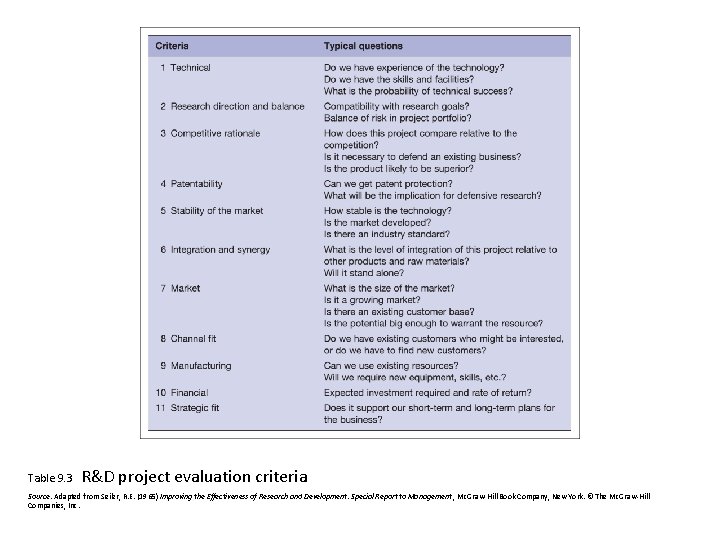
Table 9. 3 R&D project evaluation criteria Source: Adapted from Seiler, R. E. (1965) Improving the Effectiveness of Research and Development: Special Report to Management , Mc. Graw-Hill Book Company, New York. © The Mc. Graw-Hill Companies, Inc.
Figure 10. 2 Chesbrough’s open innovation approach