Changing nature of Leadership Leading in a Changing










- Slides: 51
Changing nature of Leadership Leading in a Changing World – M 005 Unit: 6
Module Learning Outcomes • Reflect critically on and apply conceptual and practical approaches to leadership in a range of different organisational settings • Apply to their analysis an understanding of the key tensions within leadership and how it relates to other business themes such as globalisation, strategy, innovation and organisational change • Explore the ethical relationships between leaders and followers
Week 10 presentations • Change Management presentations • Counts 10% towards your end of term assignment marks • Review week 9 for the case study and requirements
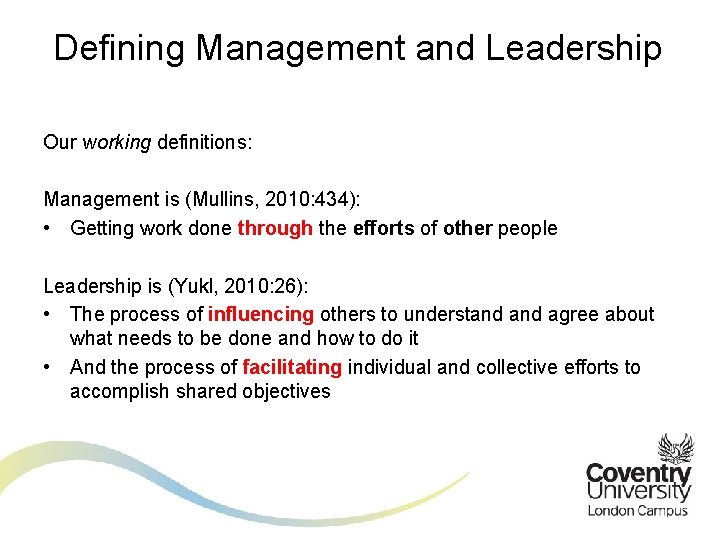
Defining Management and Leadership Our working definitions: Management is (Mullins, 2010: 434): • Getting work done through the efforts of other people Leadership is (Yukl, 2010: 26): • The process of influencing others to understand agree about what needs to be done and how to do it • And the process of facilitating individual and collective efforts to accomplish shared objectives
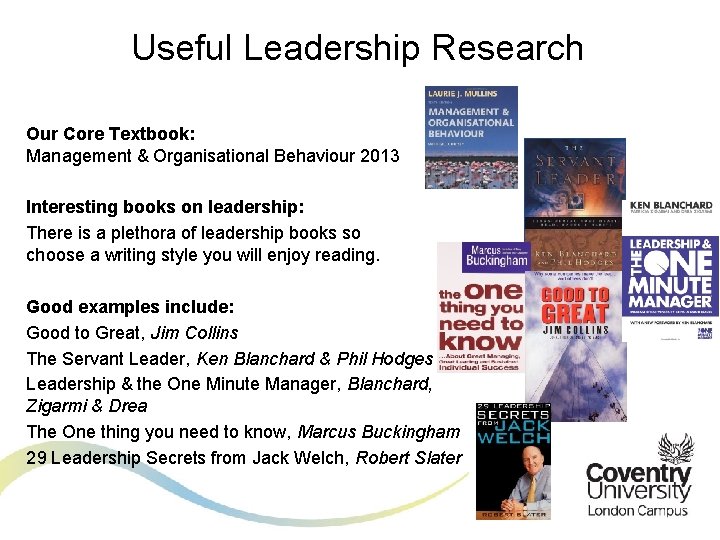
Useful Leadership Research Our Core Textbook: Management & Organisational Behaviour 2013 Interesting books on leadership: There is a plethora of leadership books so choose a writing style you will enjoy reading. Good examples include: Good to Great, Jim Collins The Servant Leader, Ken Blanchard & Phil Hodges Leadership & the One Minute Manager, Blanchard, Zigarmi & Drea The One thing you need to know, Marcus Buckingham 29 Leadership Secrets from Jack Welch, Robert Slater
Useful Leadership Research https: //www. bcgperspectives. com/talent_and_leadership http: //www. mckinsey. com/insights/leading_in_the_21 st_century/interview s_with_leaders? cid=other-eml-alt-mip-mck-oth-1311 http: //blogs. hbr. org/2010/04/the-new-21 st-century-leaders-1/ Type https: //twitter. com/search? q=leadership into your web browser to find out what’s trending re leadership on Twitter Confounded Interest – http: //confoundedinterest. wordpress. com. Not a leadership blog but an example of an interestingly written & informative blog Linked. In Today – http: //www. linkedin. com/today/ – Linked. In Today uses your linked in profile to gather articles relevant to your field & follow topics of interest
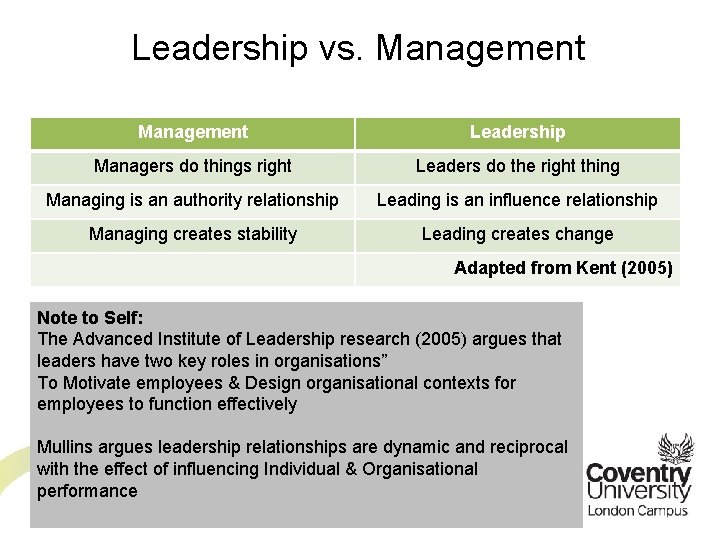
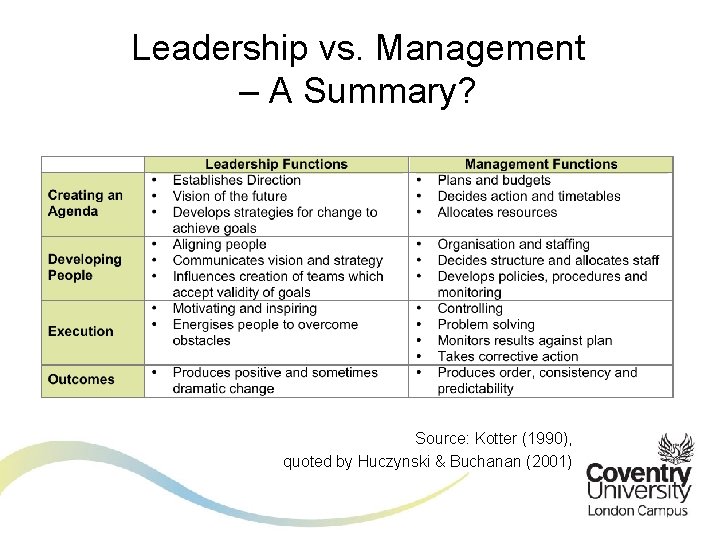
Leadership vs. Management Leadership Managers do things right Leaders do the right thing Managing is an authority relationship Leading is an influence relationship Managing creates stability Leading creates change Adapted from Kent (2005) Note to Self: The Advanced Institute of Leadership research (2005) argues that leaders have two key roles in organisations” To Motivate employees & Design organisational contexts for employees to function effectively Mullins argues leadership relationships are dynamic and reciprocal with the effect of influencing Individual & Organisational performance
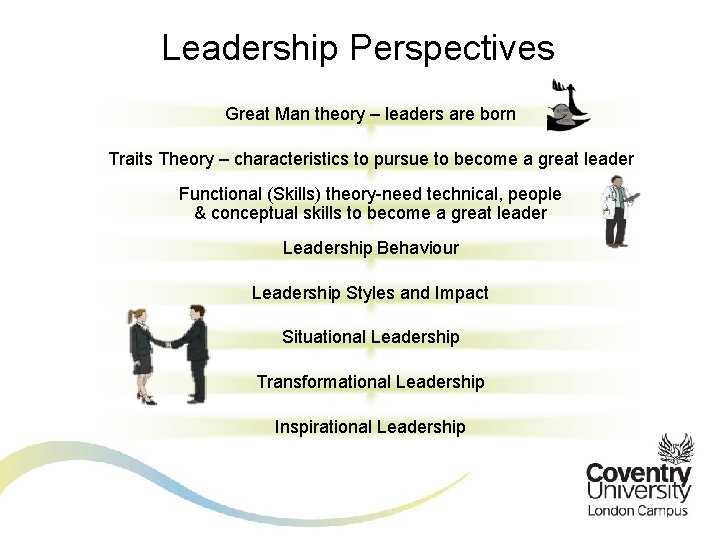
Leadership Perspectives Great Man theory – leaders are born Traits Theory – characteristics to pursue to become a great leader Functional (Skills) theory-need technical, people & conceptual skills to become a great leader Leadership Behaviour Leadership Styles and Impact Situational Leadership Transformational Leadership Inspirational Leadership
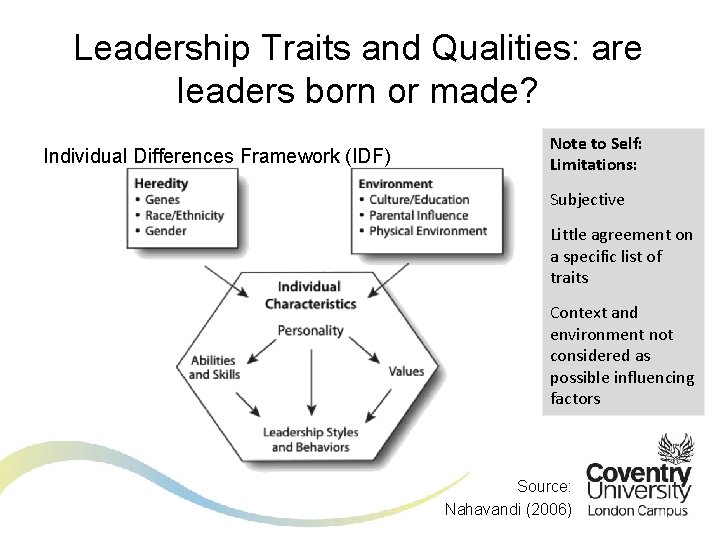
Leadership Traits and Qualities: are leaders born or made? Individual Differences Framework (IDF) Note to Self: Limitations: Subjective Little agreement on a specific list of traits Context and environment not considered as possible influencing factors Source: Nahavandi (2006)
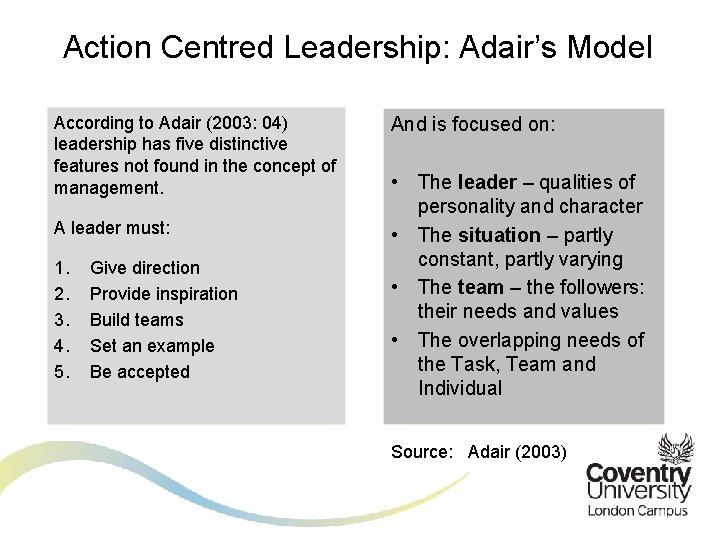
Action Centred Leadership: Adair’s Model According to Adair (2003: 04) leadership has five distinctive features not found in the concept of management. A leader must: 1. 2. 3. 4. 5. Give direction Provide inspiration Build teams Set an example Be accepted And is focused on: • The leader – qualities of personality and character • The situation – partly constant, partly varying • The team – the followers: their needs and values • The overlapping needs of the Task, Team and Individual Source: Adair (2003)
Action Centred Leadership: Adair’s Model Note to Self: Adair’s approach argues a close relationships between management and leadership: -Achieving the task = Management -Satisfying individual needs = Leadership -Building the team = Leadership Task Needs Leader Team Maintenance Needs Individual Needs Key Question: Does this distinction help us understand distinguish the skills and behaviours of the leader/manager? Source: Adair (1979)
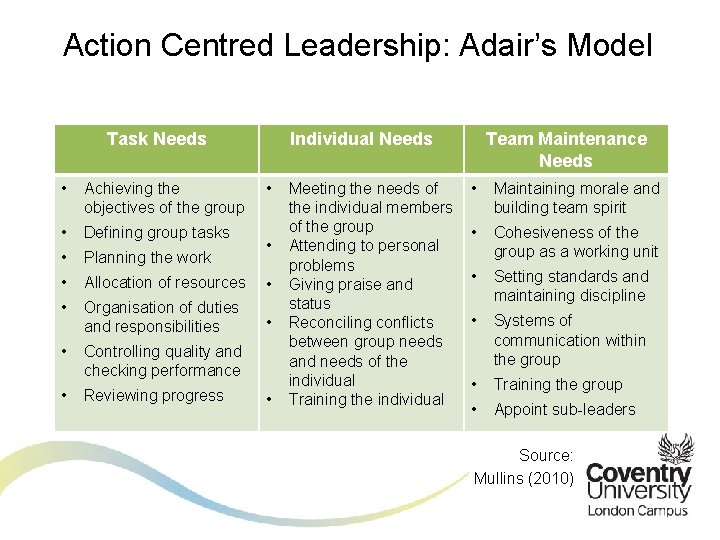
Action Centred Leadership: Adair’s Model Task Needs Individual Needs • Achieving the objectives of the group • • Defining group tasks • Planning the work • Allocation of resources • • Organisation of duties and responsibilities • • Controlling quality and checking performance • Reviewing progress • • Meeting the needs of the individual members of the group Attending to personal problems Giving praise and status Reconciling conflicts between group needs and needs of the individual Training the individual Team Maintenance Needs • Maintaining morale and building team spirit • Cohesiveness of the group as a working unit • Setting standards and maintaining discipline • Systems of communication within the group • Training the group • Appoint sub-leaders Source: Mullins (2010)
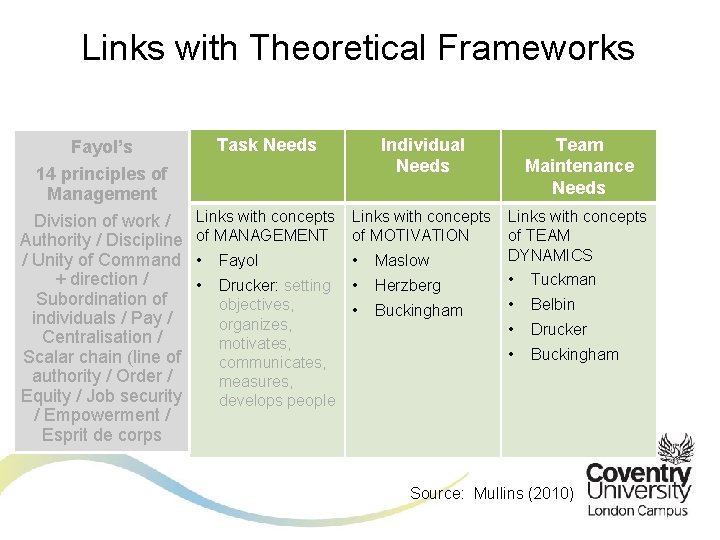
Links with Theoretical Frameworks Task Needs Fayol’s 14 principles of Management Division of work / Authority / Discipline / Unity of Command + direction / Subordination of individuals / Pay / Centralisation / Scalar chain (line of authority / Order / Equity / Job security / Empowerment / Esprit de corps Individual Needs Team Maintenance Needs Links with concepts of MANAGEMENT of MOTIVATION of TEAM DYNAMICS • Fayol • Maslow • Drucker: setting objectives, organizes, motivates, communicates, measures, develops people • Herzberg • Tuckman • Buckingham • Belbin • Drucker • Buckingham Source: Mullins (2010)
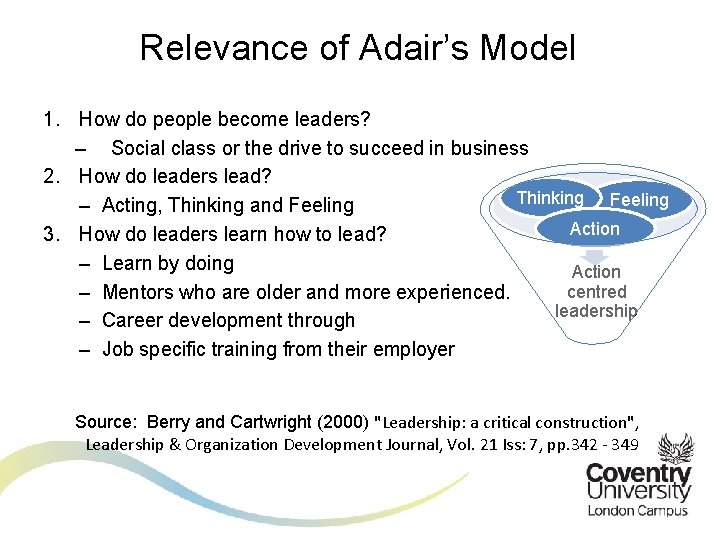
Relevance of Adair’s Model 1. How do people become leaders? – Social class or the drive to succeed in business 2. How do leaders lead? Thinking Feeling – Acting, Thinking and Feeling Action 3. How do leaders learn how to lead? – Learn by doing Action centred – Mentors who are older and more experienced. leadership – Career development through – Job specific training from their employer Source: Berry and Cartwright (2000) "Leadership: a critical construction", Leadership & Organization Development Journal, Vol. 21 Iss: 7, pp. 342 - 349
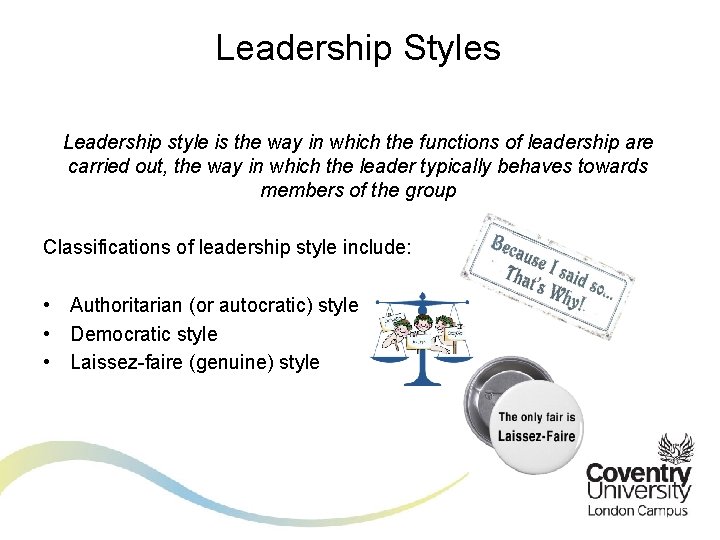
Leadership Styles Leadership style is the way in which the functions of leadership are carried out, the way in which the leader typically behaves towards members of the group Classifications of leadership style include: • Authoritarian (or autocratic) style • Democratic style • Laissez-faire (genuine) style
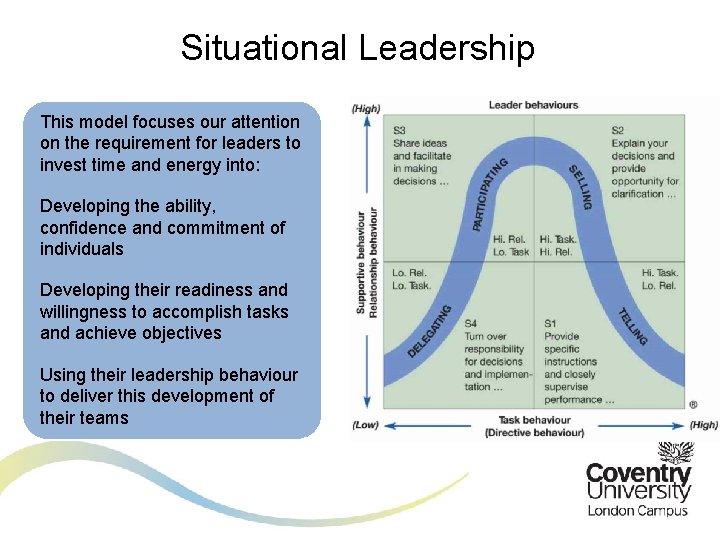
Situational Leadership Situational leadership is based on the ‘readiness’ of the followers that the leader needs to influence. Readiness = ability + willingness to accomplish a task Hersey and Blanchard (1997) argue the appropriate leadership style is based on the combination of two behaviours & the needs of the task must be identified before the appropriate leadership style can be adopted: • • Task behaviour is the extent to which the leader provides appropriate directions for the actions of followers, sets goals for them and defines their roles and how to undertake them. Relationship behaviour is the extent to which the leader engages in twoway communication with followers, listens to them and provides support and encouragement. Source: Mullins (2010: 389)
Situational Leadership This model focuses our attention on the requirement for leaders to invest time and energy into: Developing the ability, confidence and commitment of individuals Developing their readiness and willingness to accomplish tasks and achieve objectives Using their leadership behaviour to deliver this development of their teams
Situational Leadership: Team Members The four combinations of competence (ability, knowledge skills & commitment (confidence & motivation) = Developmental levels of followers: • (D 1) enthusiastic beginner, low on competence and high on commitment; • (D 2) disillusioned learner with increasing competence and low commitment; • (D 3) capable but cautious contributor, with moderate to high competence and variable commitment; and • (D 4) self-reliant achiever who is high on both competence and commitment. Source: Brighide et al (2011: 1060)
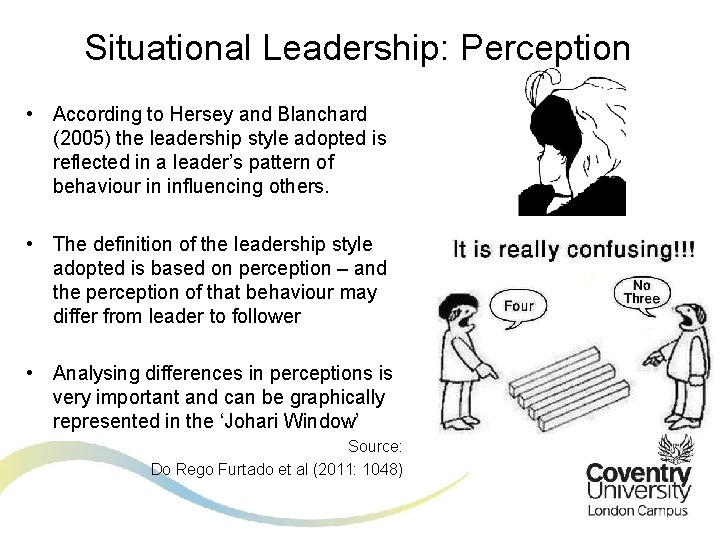
Situational Leadership: Perception • According to Hersey and Blanchard (2005) the leadership style adopted is reflected in a leader’s pattern of behaviour in influencing others. • The definition of the leadership style adopted is based on perception – and the perception of that behaviour may differ from leader to follower • Analysing differences in perceptions is very important and can be graphically represented in the ‘Johari Window’ Source: Do Rego Furtado et al (2011: 1048)
Using Feedback to Confirm Perceptions Using ‘Johari Window’ to develop self-insight in order to: - Reduce the ‘Hidden’ area through self-disclosure - Reduce the ‘Blind’ area through feedback from others Source: Mullins (2010: 359)
Situational Leadership: Questions? Having considered Hersey & Blanchard’s Situational Leadership Model, what does this model require a leader to do? • How do we invest time & energy to develop an individual’s ability, confidence, commitment? • Will cultural norms impact leadership styles? • How can leaders develop these skills? • Is Readiness a characteristic or a state? • Can readiness be influenced? • What Organisational Development practices could leaders use?
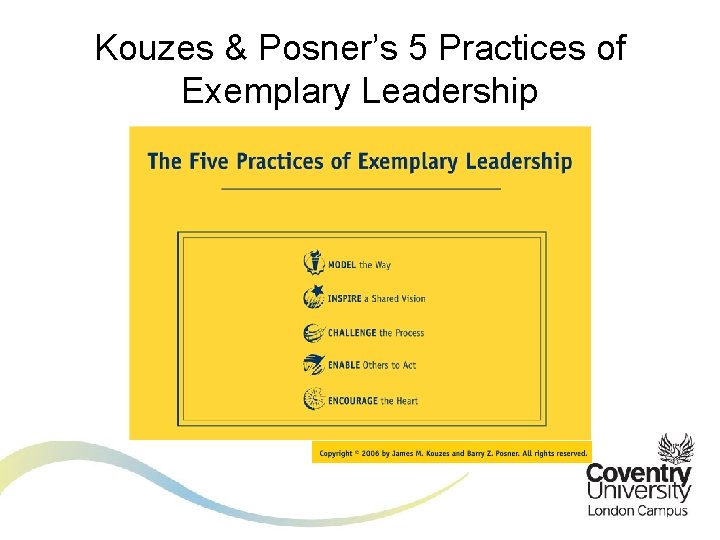
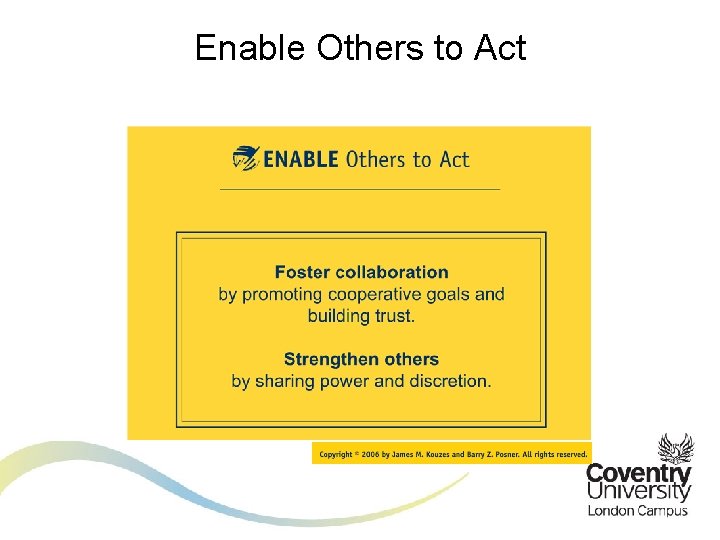
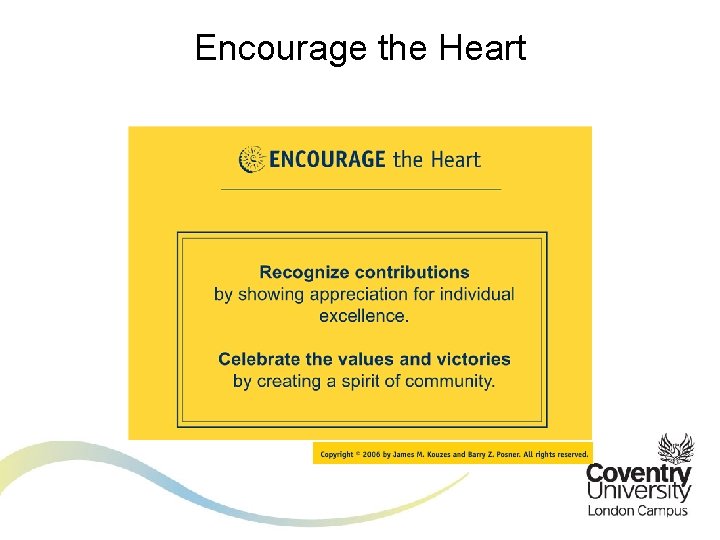
Kouzes & Posner’s 5 Practices of Exemplary Leadership
Model the Way
Inspire a Shared Vision
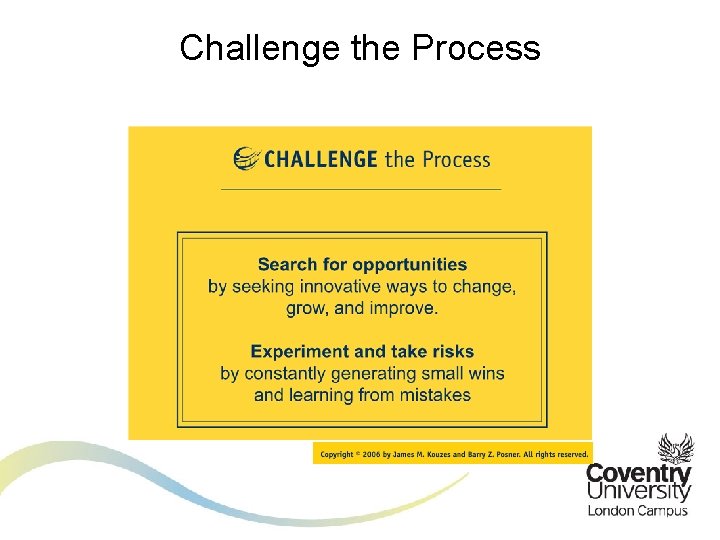
Challenge the Process
Enable Others to Act
Encourage the Heart
Kouzes and Posner – Criticism In trying to operationalise this model of leadership, Thompson (2012) identifies a range of assumptions or challenges to applying this model within an industry in change: Inspiring a Shared – a team culture that acknowledges the role of delegation Challenge the Process – up to date knowledge of industry trends & best practices Enabling Others to Act – open relationship to address development needs Modelling the Way – ability & motivation to role model, mentor team members Encourage the Heart – procedures and culture that promotes personal development and celebrates success
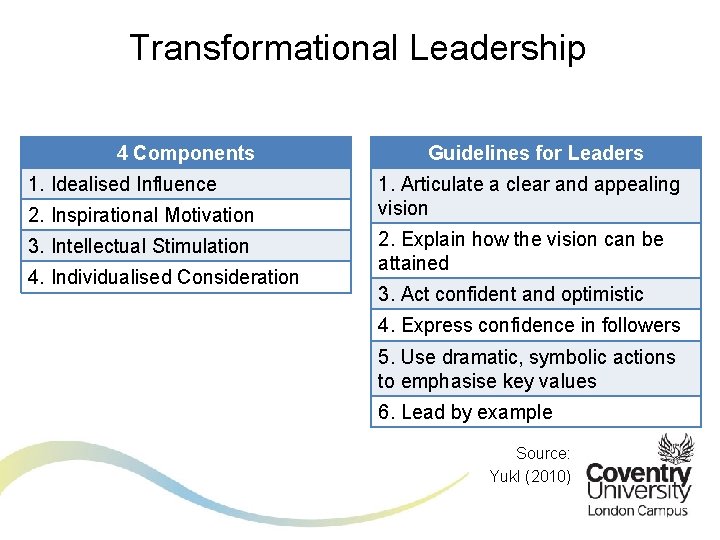
Transformational Leadership 4 Components 1. Idealised Influence 2. Inspirational Motivation 3. Intellectual Stimulation 4. Individualised Consideration Guidelines for Leaders 1. Articulate a clear and appealing vision 2. Explain how the vision can be attained 3. Act confident and optimistic 4. Express confidence in followers 5. Use dramatic, symbolic actions to emphasise key values 6. Lead by example Source: Yukl (2010)
Three Factors of Effective Leadership 2 Metac ate the 1950 gories in s 0 s e g n a Ch in 98 1 e th Effective Leadership Orientations • Task • Relations • Change Note to self: To what extent can a leader’s behaviour be categorised with one specific dimension? How would you view the impact of a coaching conversation with a direct report? 3 dimensions removing barriers identifying development Source: needs approaching situations Yukl (2010) in new ways
Discretionary Effort – Links to Leadership Discretionary effort, or discretionary behaviour will be inspired by: - Good HR practices delivered positively by skilled and able line managers - And in a culture driven by an enabling vision and overarching value structure And will result in people willing and able to perform their job roles better Source: CIPD (2010: 26)
Discretionary Effort – Leadership Style Discretionary effort, or discretionary behaviour will be inspired when leaders: • • Are skilled in communication Can build relationships based on trust Enable and support staff to carry out their role Allow staff flexibility in over how they perform their role Source: CIPD (2010: 27)
Leadership vs. Management – A Summary? Source: Kotter (1990), quoted by Huczynski & Buchanan (2001)
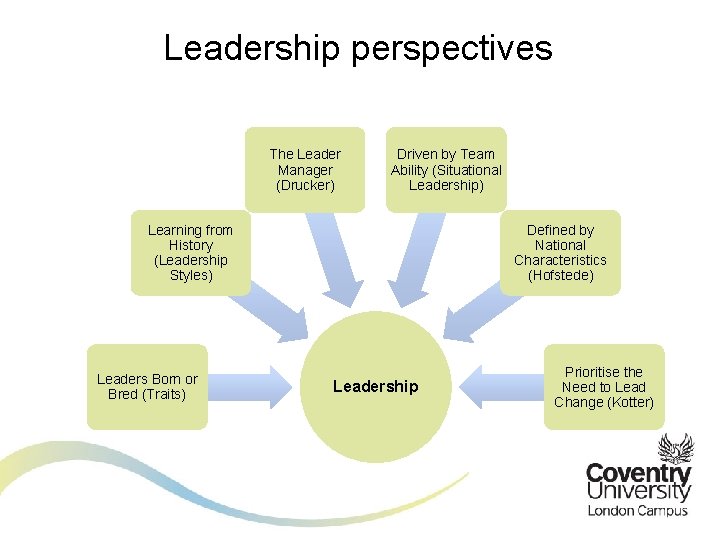
Leadership perspectives The Leader Manager (Drucker) Driven by Team Ability (Situational Leadership) Learning from History (Leadership Styles) Leaders Born or Bred (Traits) Defined by National Characteristics (Hofstede) Leadership Prioritise the Need to Lead Change (Kotter)
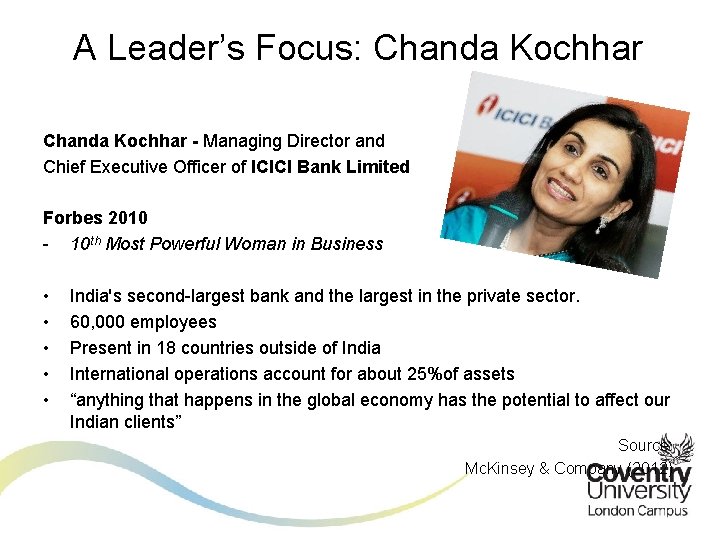
A Leader’s Focus: Chanda Kochhar - Managing Director and Chief Executive Officer of ICICI Bank Limited Forbes 2010 - 10 th Most Powerful Woman in Business • • • India's second-largest bank and the largest in the private sector. 60, 000 employees Present in 18 countries outside of India International operations account for about 25%of assets “anything that happens in the global economy has the potential to affect our Indian clients” Source: Mc. Kinsey & Company (2012)
A Leader’s Focus: Chanda Kochhar Her Approach to Leadership 1. Keep an eye on global future trends and a clear view of day-to-day operations ‘the essence of the CEO’s job’ 2. Be accountable for the decision about where the organisation needs to go 3. Absorb all the views of all stakeholders – its more than just listening 4. Make sure the rest of the team understands your vision and the reasoning behind it, the benefits – so they are with you for the execution 5. Use communication to not just share your vision but also how the individual can contribute to the performance of the organisation 6. Learn constantly from people who interact with your customers 7. Develop your future leaders and allow their careers to evolve 8. Leaders have to be able to work together to execute our plans Source: Mc. Kinsey & Company (2012)
A Leader’s Own Model: Indra Nooyi - Pepsi. Co Chairman and CEO Her 5 Cs Model of Leadership: 1. Competency – Be the go to person for something & a lifelong student 2. Courage and Confidence – Based on your knowledge 3. Communication Skills – Written and Oral skills to mobilise your troops 4. Consistency – So your teams know which way you are going 5. Compass – Integrity is critical Source: Pepsi. Co (2011)
List of References Adair, J. (2003), Concise Adair On Leadership, Thorogood Publishing Ltd Berry, A. J. and Cartwright, S. (2000) "Leadership: a critical construction", Leadership & Organization Development Journal, Vol. 21 Iss: 7, pp. 342 - 349 Kouzes, J. & Posner, B. Z. , (2008) The Leadership Challenge, 4 th Edition, Jossey-Bass CIPD (2010) Sustainable organisation performance What really makes the d. Ifference? Interim Report January 2010, London: CIPD Thompson, J. (2012) 'Transformational leadership can improve workforce competencies', Nursing Management - UK, 18, 10, pp. 21 -24.
What are we going to cover next? In our next Knowledgecast, we will: • Apply to their analysis an understanding of the key tensions within leadership and how it relates to other business themes such as globalisation, strategy, innovation and organisational change • Critically reflect upon personal experiences and aspirations around leadership enabling them to develop originality in their own leadership capabilities • Explore the ethical relationships between leaders and followers
Knowledgecast Summary • • • Reflect critically on and apply conceptual and practical approaches to leadership in a range of different organisational settings – Leadership framework and Leadership effectiveness Apply to their analysis an understanding of the key tensions within leadership and how it relates to other business themes such as globalisation, strategy, innovation and organisational change – Leadership skills and competencies Explore the ethical relationships between leaders and followers – Employee readiness (ability + willingness)
Seminar: Leadership and Teams Based on your reading of the article Hamel, G. (2011), 'FIRST, LET'S FIRE ALL THE MANAGERS. (cover story)', Harvard Business Review, 89, 12, pp. 48 -60’, prepare your answers to the following questions: • How does this organisation define leadership? Who are the leaders in this organisation? • What are the important features of the culture of the organisation that help this organisation be successful? • Can we apply this organisation's way of working to other organisations? If not, why not?
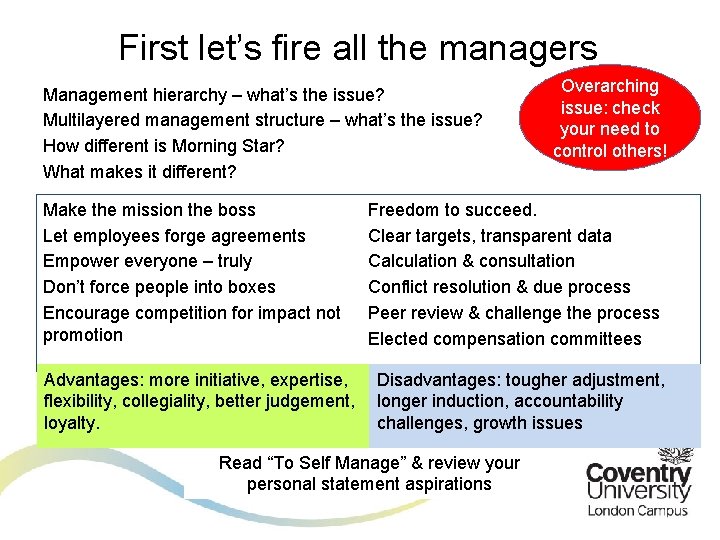
First let’s fire all the managers Management hierarchy – what’s the issue? Multilayered management structure – what’s the issue? How different is Morning Star? What makes it different? Make the mission the boss Let employees forge agreements Empower everyone – truly Don’t force people into boxes Encourage competition for impact not promotion Overarching issue: check your need to control others! Freedom to succeed. Clear targets, transparent data Calculation & consultation Conflict resolution & due process Peer review & challenge the process Elected compensation committees Advantages: more initiative, expertise, Disadvantages: tougher adjustment, flexibility, collegiality, better judgement, longer induction, accountability challenges, growth issues loyalty. Read “To Self Manage” & review your personal statement aspirations
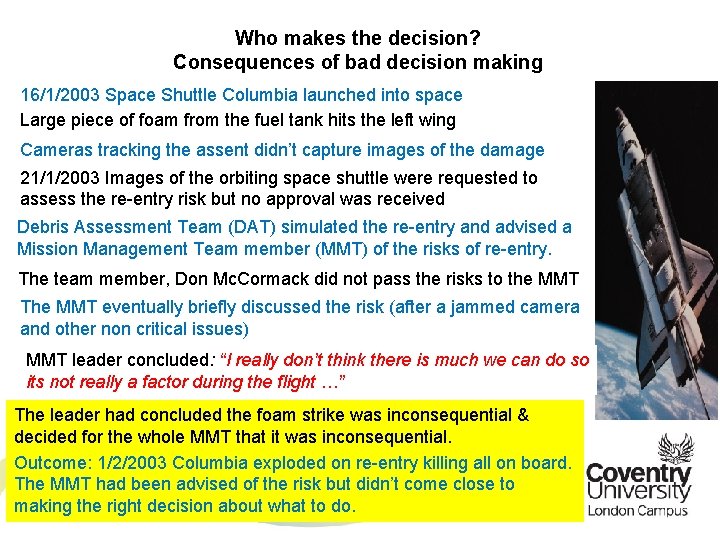
Who makes the decision? Consequences of bad decision making 16/1/2003 Space Shuttle Columbia launched into space Large piece of foam from the fuel tank hits the left wing Cameras tracking the assent didn’t capture images of the damage 21/1/2003 Images of the orbiting space shuttle were requested to assess the re-entry risk but no approval was received Debris Assessment Team (DAT) simulated the re-entry and advised a Mission Management Team member (MMT) of the risks of re-entry. The team member, Don Mc. Cormack did not pass the risks to the MMT The MMT eventually briefly discussed the risk (after a jammed camera and other non critical issues) MMT leader concluded: “I really don’t think there is much we can do so its not really a factor during the flight …” The leader had concluded the foam strike was inconsequential & decided for the whole MMT that it was inconsequential. Outcome: 1/2/2003 Columbia exploded on re-entry killing all on board. The MMT had been advised of the risk but didn’t come close to making the right decision about what to do.
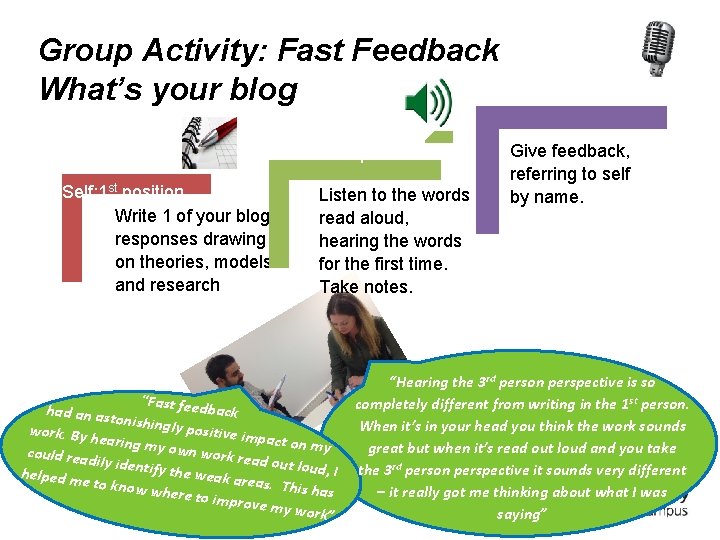
Group Activity: Fast Feedback Observer: 3 What’s your blog Other: 2 nd position Self: 1 st position Write 1 of your blog responses drawing on theories, models and research Listen to the words read aloud, hearing the words for the first time. Take notes. “Fast feed back had an as tonishing ly positive work. By impact on hearing m my y o w n work re could rea ad out lou dily ident ify the we d, I helped m ak areas. e to know This has where to improve m y work” rd position Give feedback, referring to self by name. “Hearing the 3 rd person perspective is so completely different from writing in the 1 st person. When it’s in your head you think the work sounds great but when it’s read out loud and you take the 3 rd person perspective it sounds very different – it really got me thinking about what I was saying”
Group Activity: End of Module Assignment - Blog 1 Hav them e you int rodu e, re f e r e used nced the conc real exam theo r l word uded usi ples and y, ng s and view your ow s, b n Theme 1: Leadership & Ethics by th e the acked up ory. Part 1: Ethical leadership, is defined as "the demonstration of normatively appropriate conduct through personal actions and interpersonal relationships, and the promotion of such conduct to followers through twoway communication, reinforcement and decision-making"… [and] Part 2: the evidence suggests that ethical leader behavior can have important positive effects on both individual and organizational effectiveness (Rubin et al 2010: 216 -17). Part 1: What are the different sides of this debate ie the 2 principle areas of ethics? (see Unit 1 for a brief summary) and what model of leadership have you chosen to help to define the complex concept of ethical leadership? Part 2: What organisational examples of good and bad ethical behaviour from your chosen industry illustrate this debate? What are your conclusions from this debate for your understanding of the role of a manager or leader in your chosen industry?
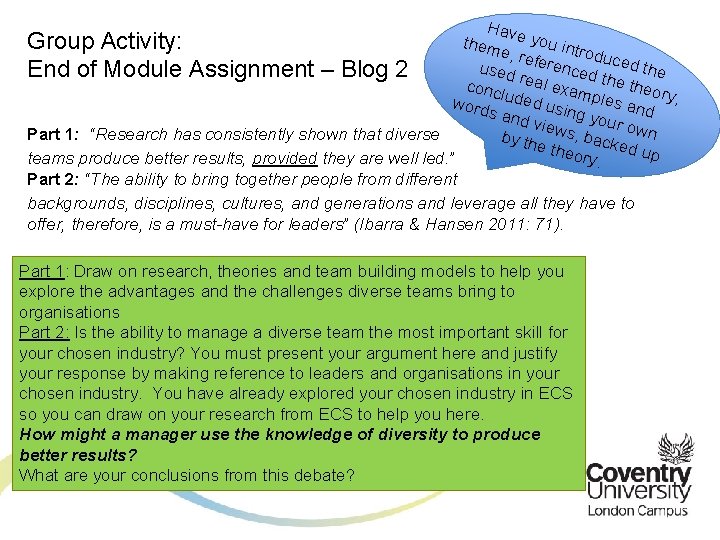
Have t Group Activity: heme you intr oduc , refe r e used nced ed the End of Module Assignment – Blog 2 conc real exam theo r l word uded usi ples and y, ng s and view your ow s, b n Part 1: “Research has consistently shown that diverse by th e the acked up ory. teams produce better results, provided they are well led. ” Part 2: “The ability to bring together people from different backgrounds, disciplines, cultures, and generations and leverage all they have to offer, therefore, is a must-have for leaders” (Ibarra & Hansen 2011: 71). Part 1: Draw on research, theories and team building models to help you explore the advantages and the challenges diverse teams bring to organisations Part 2: Is the ability to manage a diverse team the most important skill for your chosen industry? You must present your argument here and justify your response by making reference to leaders and organisations in your chosen industry. You have already explored your chosen industry in ECS so you can draw on your research from ECS to help you here. How might a manager use the knowledge of diversity to produce better results? What are your conclusions from this debate?
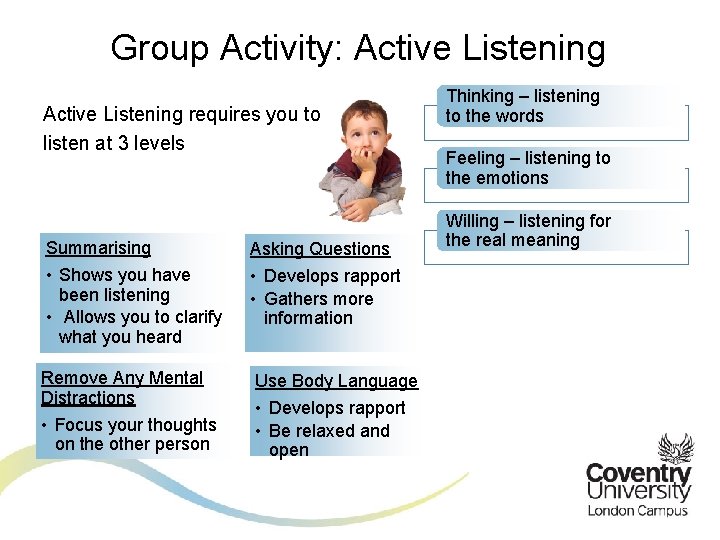
Group Activity: Active Listening requires you to listen at 3 levels Summarising Asking Questions • Shows you have been listening • Allows you to clarify what you heard • Develops rapport • Gathers more information Remove Any Mental Distractions • Focus your thoughts on the other person Use Body Language • Develops rapport • Be relaxed and open Thinking – listening to the words Feeling – listening to the emotions Willing – listening for the real meaning
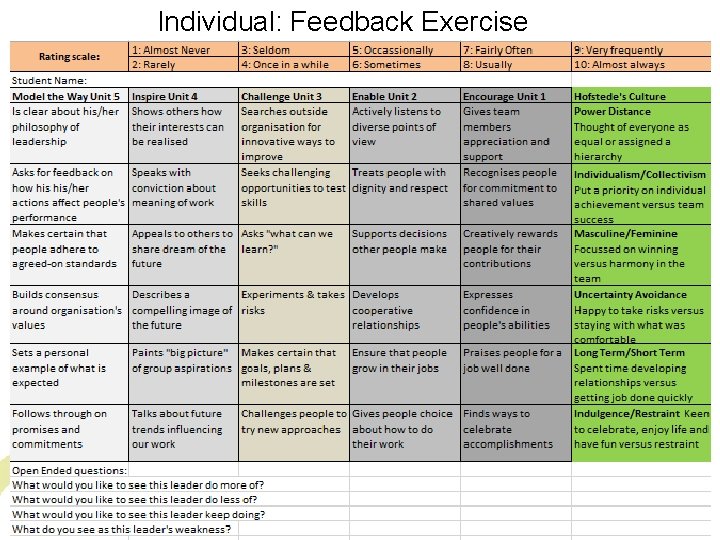
Individual: Feedback Exercise
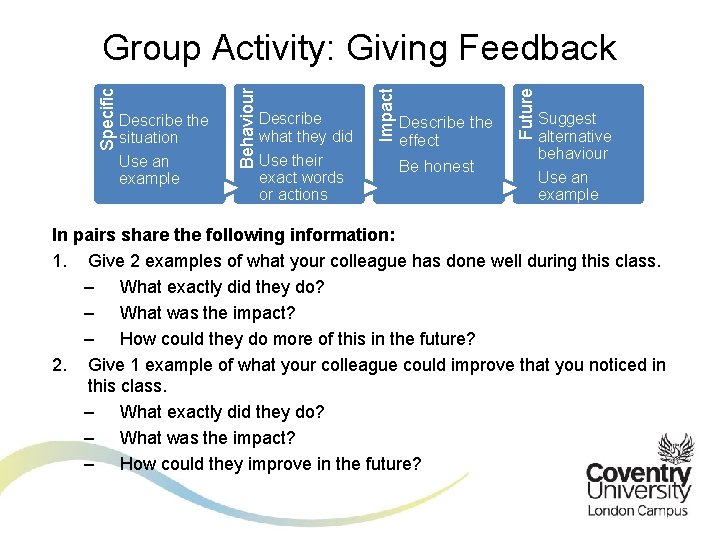
Use an example Describe the effect Be honest Future Describe what they did Use their exact words or actions Impact Describe the situation Behaviour Specific Group Activity: Giving Feedback Suggest alternative behaviour Use an example In pairs share the following information: 1. Give 2 examples of what your colleague has done well during this class. – What exactly did they do? – What was the impact? – How could they do more of this in the future? 2. Give 1 example of what your colleague could improve that you noticed in this class. – What exactly did they do? – What was the impact? – How could they improve in the future?