Chapter One The Nature of Leadership Lecturer SENG
- Slides: 21
Chapter One The Nature of Leadership Lecturer: SENG THEARA, MBA
Chapter Objectives • After finishing this chapter, all students will be able: 1. 2. 3. 4. 5. Define the definition of Leadership Distinguish between the Leadership and Management Describe the differences of Leadership and Followership Explain the Myth: Leadership Development Discus the Leadership Development Mc. Graw-Hill/Irwin © 2010 The Mc. Graw-Hill Companies, Inc. All rights reserved. 1 -2
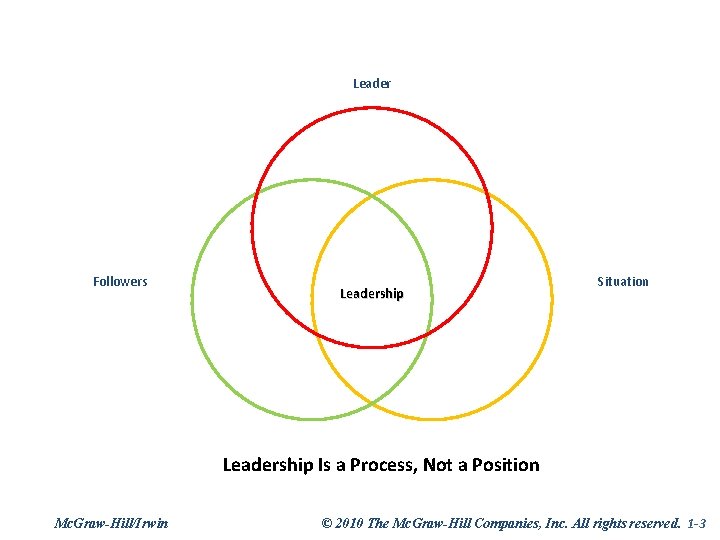
Leader Followers Leadership Situation Leadership Is a Process, Not a Position Mc. Graw-Hill/Irwin © 2010 The Mc. Graw-Hill Companies, Inc. All rights reserved. 1 -3
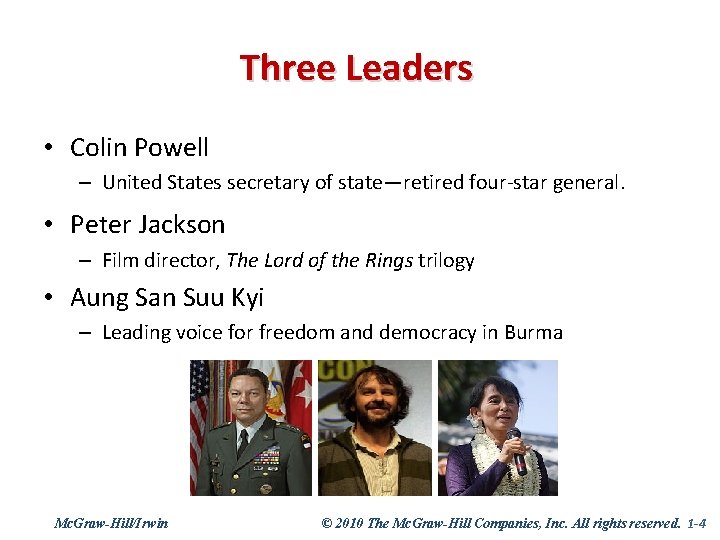
Three Leaders • Colin Powell – United States secretary of state—retired four-star general. • Peter Jackson – Film director, The Lord of the Rings trilogy • Aung San Suu Kyi – Leading voice for freedom and democracy in Burma Mc. Graw-Hill/Irwin © 2010 The Mc. Graw-Hill Companies, Inc. All rights reserved. 1 -4
What Is Leadership • The creative and directive force of moral (Munson, 1921). • The presence of a particular influence relationship between two or more persons (Hollander & Julian, 1969). • Directing and coordinating the work of group members (Fiedler, 1967). Mc. Graw-Hill/Irwin © 2010 The Mc. Graw-Hill Companies, Inc. All rights reserved. 1 -5
What Is Leadership (Cont’d) • An interpersonal relations in which others comply because they want to, not because they have to (Merston, 1969, Hogan, Curphy, & Hogan, 1994). • Transforming followers, creating visions of the goals that may be attained, and articulating for the followers the ways to attain those goals (Bass, 1985; Tichy & Devanna, 1986). Mc. Graw-Hill/Irwin © 2010 The Mc. Graw-Hill Companies, Inc. All rights reserved. 1 -6
What Is Leadership (Cont’d) • The process of influencing an organized group toward accomplishing its goals (Roach & Behling, 1984). • Actions that focus resources to create desirable opportunities (Campbell, 1991). • The leader’s job is to create conditions for the team to be effective (Ginnett, 1996. ) Mc. Graw-Hill/Irwin © 2010 The Mc. Graw-Hill Companies, Inc. All rights reserved. 1 -7
Leadership is The process of influencing an organized group toward accomplishing its goals. Mc. Graw-Hill/Irwin © 2010 The Mc. Graw-Hill Companies, Inc. All rights reserved. 1 -8
What Is Leadership (Cont’d) • Leadership is Both Science and Art – Bass & Stogdill’s Handbook of Leadership cites approximately 8, 000 studies on leadership. – Some scholars in the field of leadership may be relatively poor leaders themselves. – Some managers may be effective leaders without ever having taken a course or training program in leadership. – The art of leadership concerns the skill of understanding leadership situations and influencing others to accomplish group goals. Mc. Graw-Hill/Irwin © 2010 The Mc. Graw-Hill Companies, Inc. All rights reserved. 1 -9
What Is Leadership (Cont’d) • Leadership is Both Rational and Emotional – Leadership includes actions and influences based on reason and logic as well as those based on inspiration and passion. – Good leadership is more than just calculation and planning, or following a “checklist. ” – Good leadership is also an emotional side of human nature that must be acknowledged, so emotions play an important role in leadership too. Mc. Graw-Hill/Irwin © 2010 The Mc. Graw-Hill Companies, Inc. All rights reserved. 1 -10
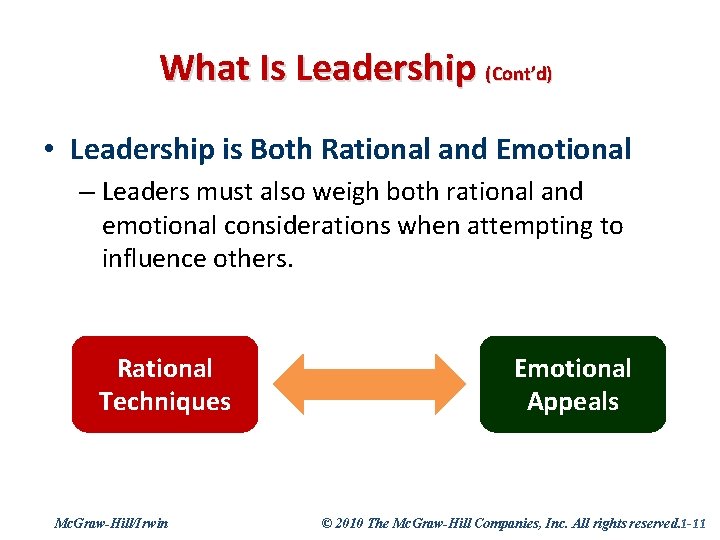
What Is Leadership (Cont’d) • Leadership is Both Rational and Emotional – Leaders must also weigh both rational and emotional considerations when attempting to influence others. Rational Techniques Mc. Graw-Hill/Irwin Emotional Appeals © 2010 The Mc. Graw-Hill Companies, Inc. All rights reserved. 1 -11
Leadership and Management • Leadership – Is “the process of influencing others toward achieving group goals (Richard L. Hughes) • Management – Is a process of having something done effectively and efficiently. Mc. Graw-Hill/Irwin © 2010 The Mc. Graw-Hill Companies, Inc. All rights reserved. 1 -12
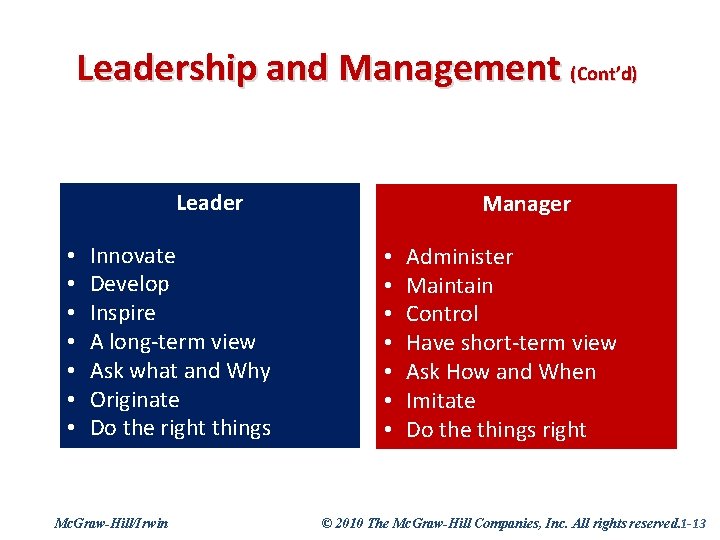
Leadership and Management (Cont’d) Leader • • Innovate Develop Inspire A long-term view Ask what and Why Originate Do the right things Mc. Graw-Hill/Irwin Manager • • Administer Maintain Control Have short-term view Ask How and When Imitate Do the things right © 2010 The Mc. Graw-Hill Companies, Inc. All rights reserved. 1 -13
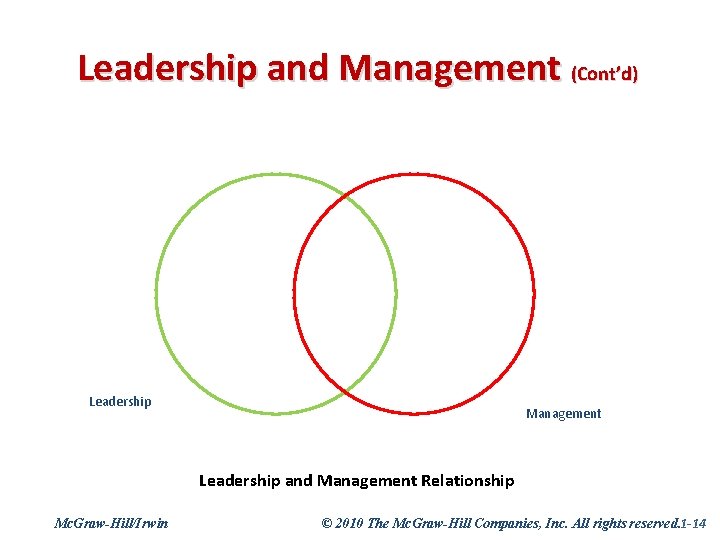
Leadership and Management (Cont’d) Leadership Management Leadership and Management Relationship Mc. Graw-Hill/Irwin © 2010 The Mc. Graw-Hill Companies, Inc. All rights reserved. 1 -14
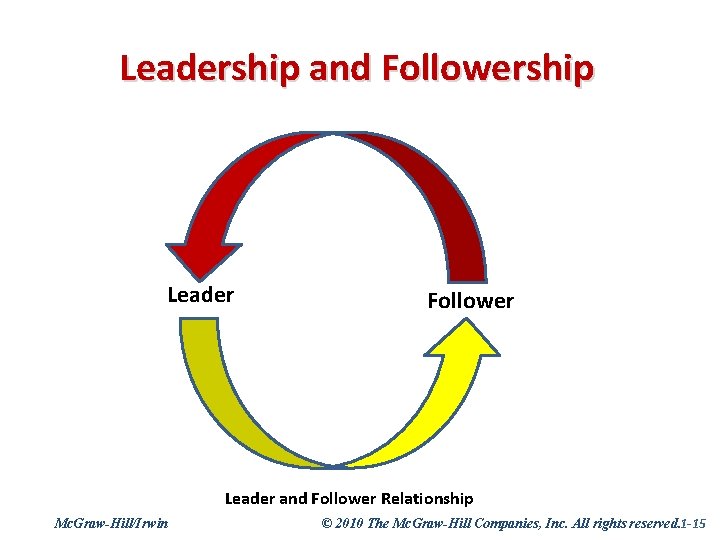
Leadership and Followership Leader Follower Leader and Follower Relationship Mc. Graw-Hill/Irwin © 2010 The Mc. Graw-Hill Companies, Inc. All rights reserved. 1 -15
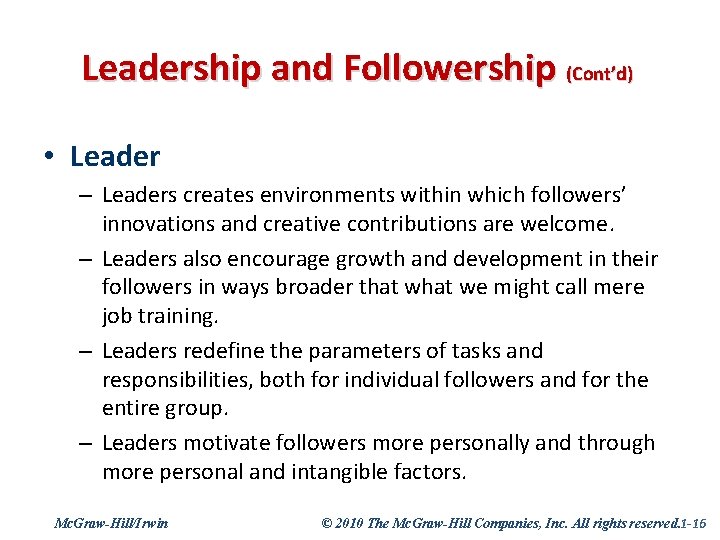
Leadership and Followership (Cont’d) • Leader – Leaders creates environments within which followers’ innovations and creative contributions are welcome. – Leaders also encourage growth and development in their followers in ways broader that we might call mere job training. – Leaders redefine the parameters of tasks and responsibilities, both for individual followers and for the entire group. – Leaders motivate followers more personally and through more personal and intangible factors. Mc. Graw-Hill/Irwin © 2010 The Mc. Graw-Hill Companies, Inc. All rights reserved. 1 -16
Leadership and Followership (Cont’d) • Follower – Followers are a critical part of the leadership equation, but their role has not always been appreciated. – The followers expectations, personality traits, maturity levels, levels of competence, and motivation affect the leadership process. – The nature of the followers’ motivation to do their work is also important. Mc. Graw-Hill/Irwin © 2010 The Mc. Graw-Hill Companies, Inc. All rights reserved. 1 -17
Myth: Leadership Development • Few things pose a greater obstacle to leadership development than certain unsubstantiated and self-limiting beliefs about leadership. – Myth: Good leader is all common sense—myth says one needs only common sense to be a good leader. – Myth: Leader are born, not made—some people believe being a leader is in one’s genes Mc. Graw-Hill/Irwin © 2010 The Mc. Graw-Hill Companies, Inc. All rights reserved. 1 -18
Myth: Leadership Development (Cont’d) – Myth: Myth Formal study and learning from experience compliment each other. • It is important to understand what kind of study will help students learn to discern critical lessons about leadership from their own experience. • Being able to analyze your experiences from multiple perspectives may be the greatest single contribution a formal course in leadership can give you. Mc. Graw-Hill/Irwin © 2010 The Mc. Graw-Hill Companies, Inc. All rights reserved. 1 -19
Leadership Development • Three important life and work experiences that contribute to leadership development are education, experience as leader, and coaching. • Education – Generally refers to acquiring knowledge without concern about its immediate application. • Formal education • Informal education Mc. Graw-Hill/Irwin © 2010 The Mc. Graw-Hill Companies, Inc. All rights reserved. 1 -20
Leadership Development (Cont’d) • Experience – On-the-job experience is an obvious contributor to leadership effectiveness. • Work with other people • Own tasks • Coaching – Another experience-based way to development leadership capacity is to be coached by an experienced knowledgeable leader. Mc. Graw-Hill/Irwin © 2010 The Mc. Graw-Hill Companies, Inc. All rights reserved. 1 -21