LINQ Language INtegrated Query LINQ using System using



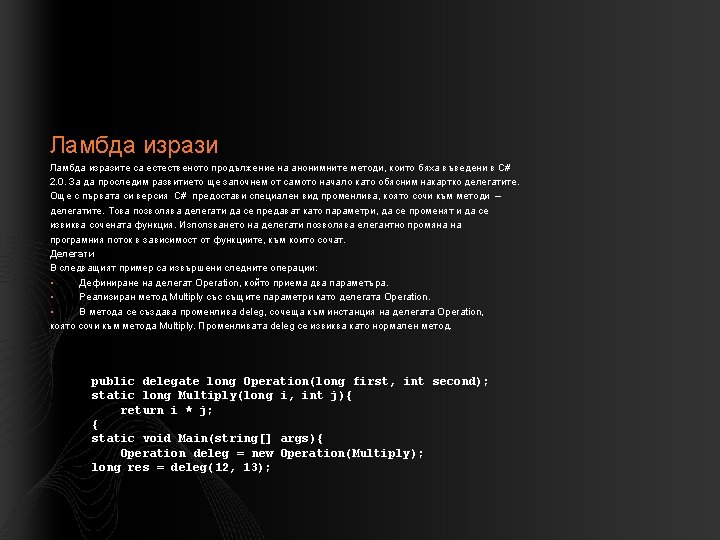
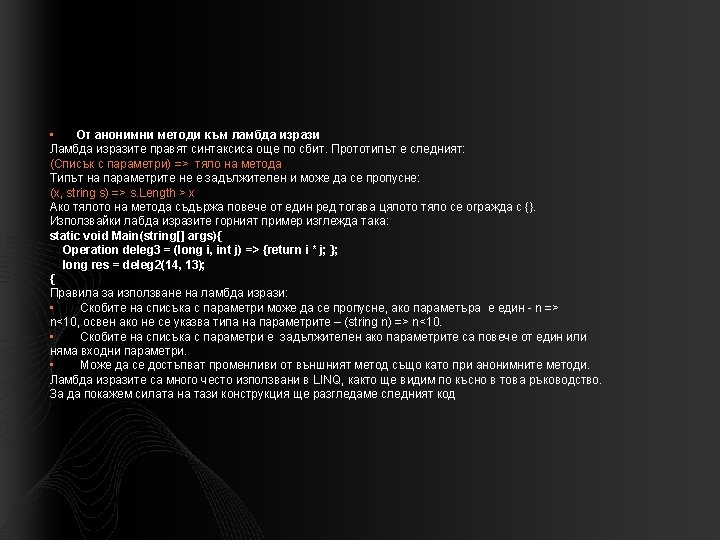
- Slides: 76
LINQ – Language INtegrated Query ( заявки вградени в езика )
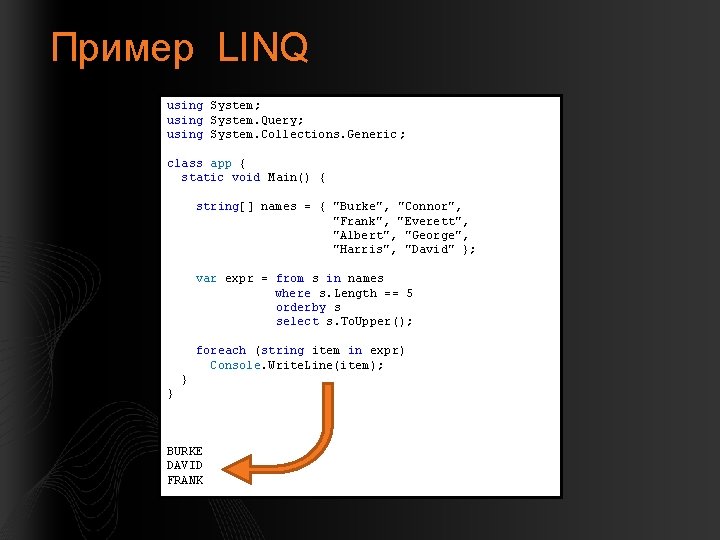
Пример LINQ using System; using System. Query; using System. Collections. Generic ; class app { static void Main() { string[] names = { "Burke", "Connor", "Frank", "Everett", "Albert", "George", "Harris", "David" }; var expr = from s in names where s. Length == 5 orderby s select s. To. Upper(); foreach (string item in expr) Console. Write. Line(item); } } BURKE DAVID FRANK
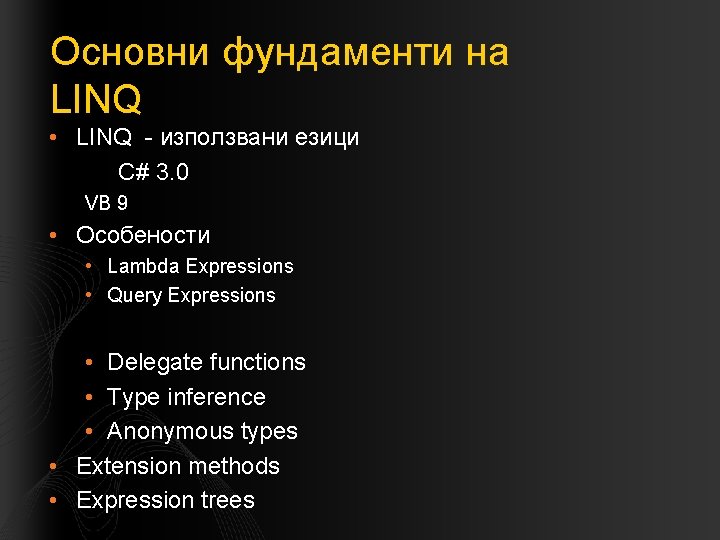
Основни фундаменти на LINQ • LINQ - използвани езици C# 3. 0 VB 9 • Особености • Lambda Expressions • Query Expressions • Delegate functions • Type inference • Anonymous types • Extension methods • Expression trees
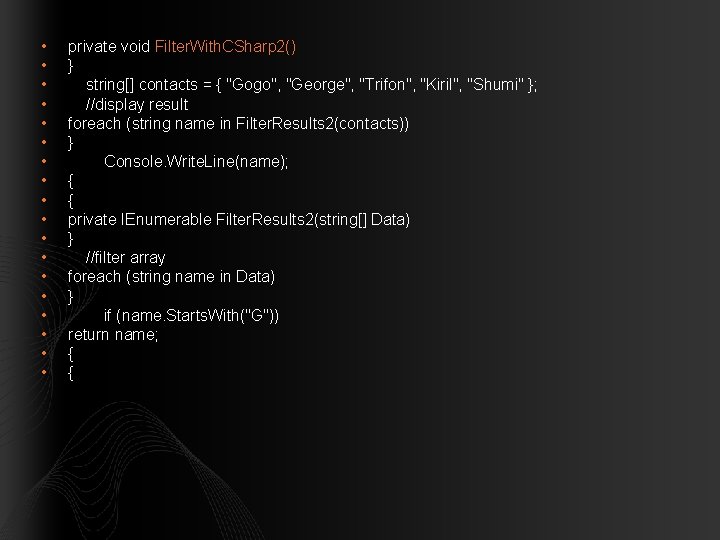
• • • • • private void Filter. With. CSharp 2() } string[] contacts = { "Gogo", "George", "Trifon", "Kiril", "Shumi" }; //display result foreach (string name in Filter. Results 2(contacts)) } Console. Write. Line(name); { { private IEnumerable Filter. Results 2(string[] Data) } //filter array foreach (string name in Data) } if (name. Starts. With("G")) return name; { {
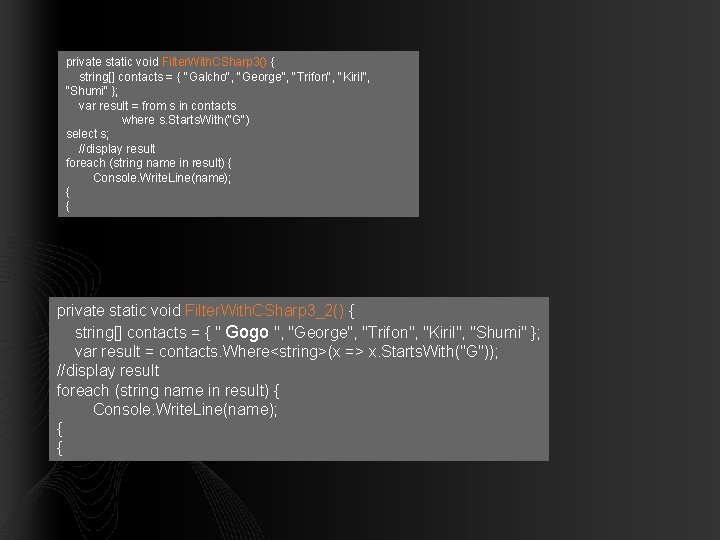
private static void Filter. With. CSharp 3() { string[] contacts = { "Galcho", "George", "Trifon", "Kiril", "Shumi" }; var result = from s in contacts where s. Starts. With("G") select s; //display result foreach (string name in result) { Console. Write. Line(name); { { private static void Filter. With. CSharp 3_2() { string[] contacts = { " Gogo ", "George", "Trifon", "Kiril", "Shumi" }; var result = contacts. Where<string>(x => x. Starts. With("G")); //display result foreach (string name in result) { Console. Write. Line(name); { {
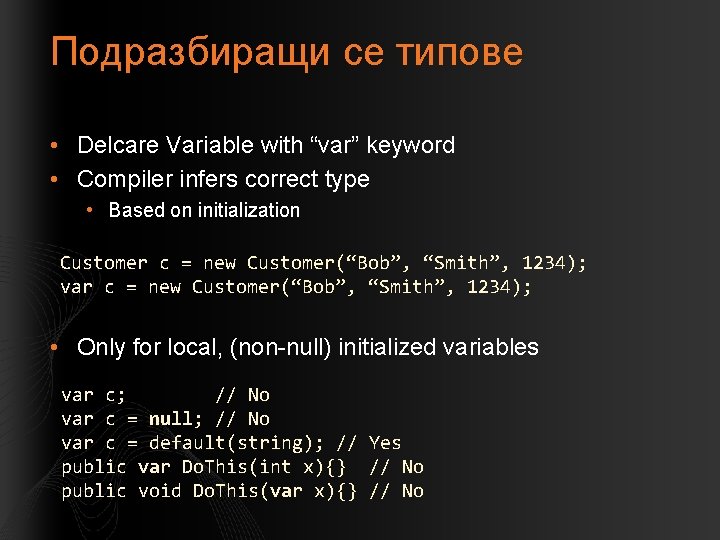
Подразбиращи се типове • Delcare Variable with “var” keyword • Compiler infers correct type • Based on initialization Customer c = new Customer(“Bob”, “Smith”, 1234); var c = new Customer(“Bob”, “Smith”, 1234); • Only for local, (non-null) initialized variables var c; // No var c = null; // No var c = default(string); // Yes public var Do. This(int x){} // No public void Do. This(var x){} // No
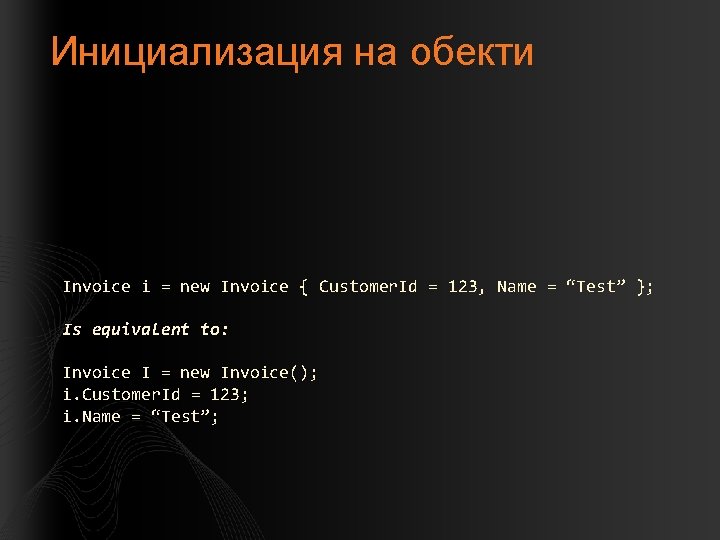
Инициализация на обекти Invoice i = new Invoice { Customer. Id = 123, Name = “Test” }; Is equivalent to: Invoice I = new Invoice(); i. Customer. Id = 123; i. Name = “Test”;
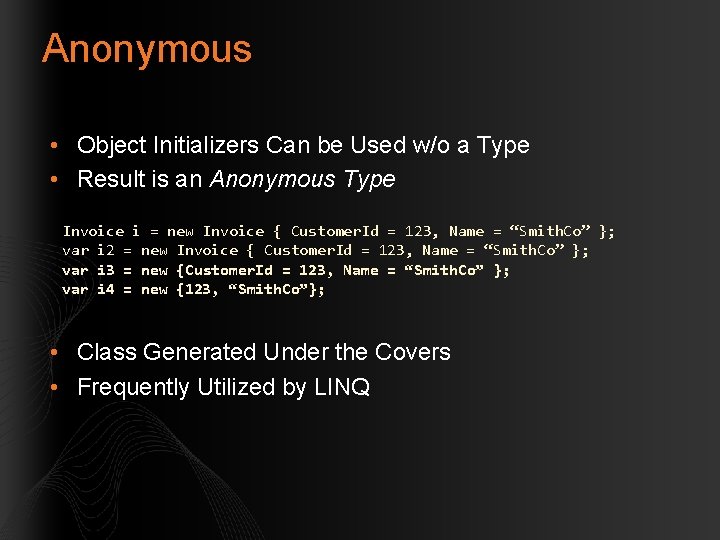
Anonymous • Object Initializers Can be Used w/o a Type • Result is an Anonymous Type Invoice i = new Invoice { Customer. Id = 123, Name = “Smith. Co” }; var i 2 = new Invoice { Customer. Id = 123, Name = “Smith. Co” }; var i 3 = new {Customer. Id = 123, Name = “Smith. Co” }; var i 4 = new {123, “Smith. Co”}; • Class Generated Under the Covers • Frequently Utilized by LINQ
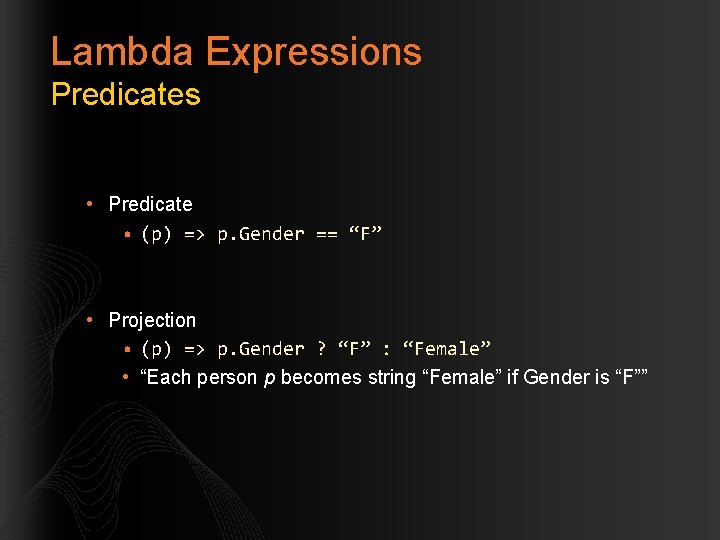
Lambda Expressions Predicates • Predicate • (p) => p. Gender == “F” • Projection • (p) => p. Gender ? “F” : “Female” • “Each person p becomes string “Female” if Gender is “F””
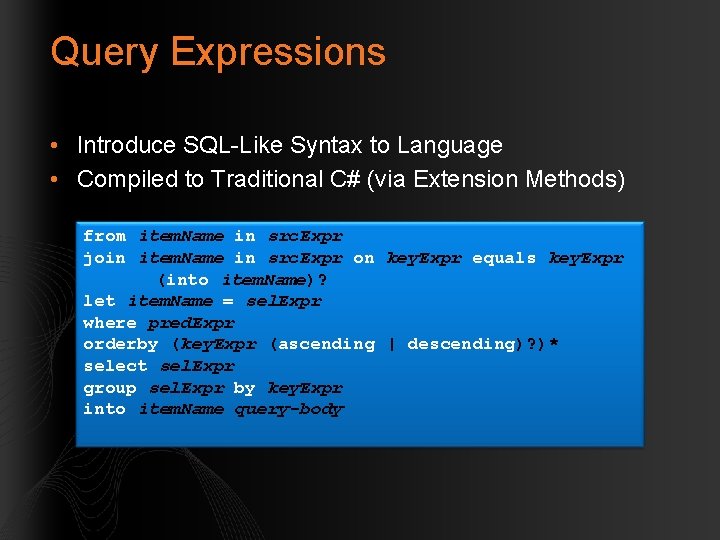
Query Expressions • Introduce SQL-Like Syntax to Language • Compiled to Traditional C# (via Extension Methods) from item. Name in src. Expr join item. Name in src. Expr on key. Expr equals key. Expr (into item. Name)? let item. Name = sel. Expr where pred. Expr orderby (key. Expr (ascending | descending)? )* select sel. Expr group sel. Expr by key. Expr into item. Name query-body
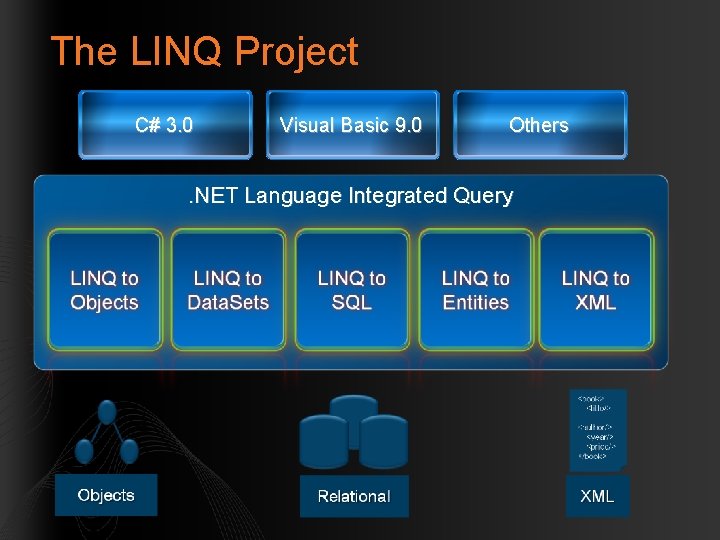
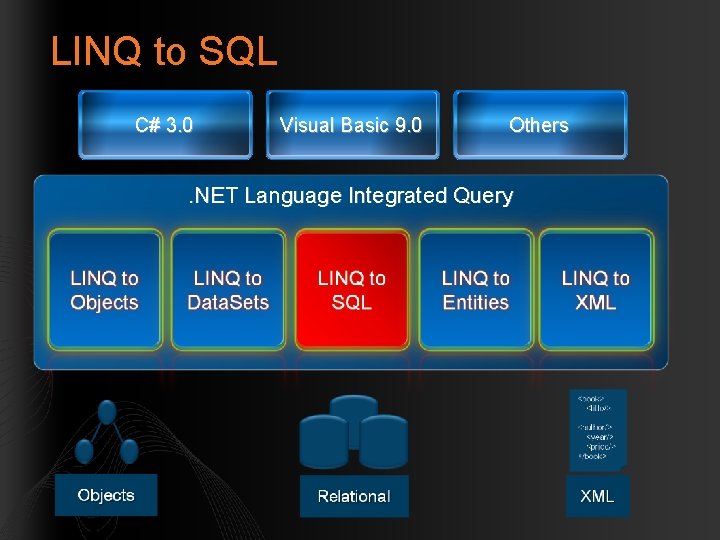
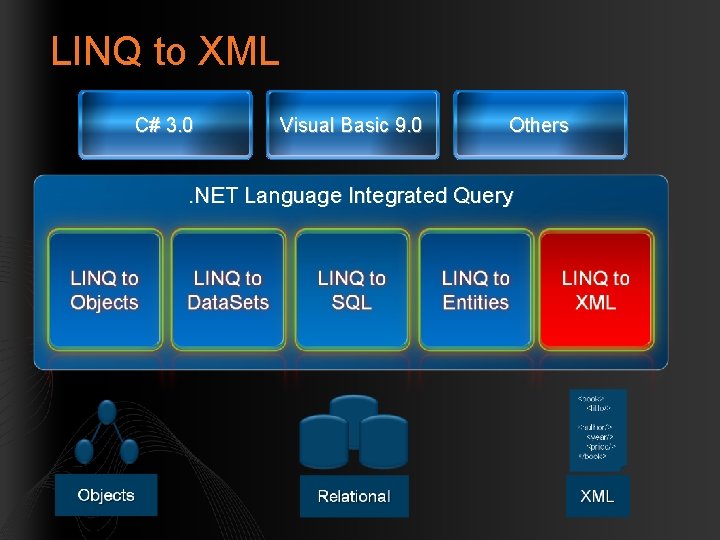
The LINQ Project C# 3. 0 Visual Basic 9. 0 Others . NET Language Integrated Query
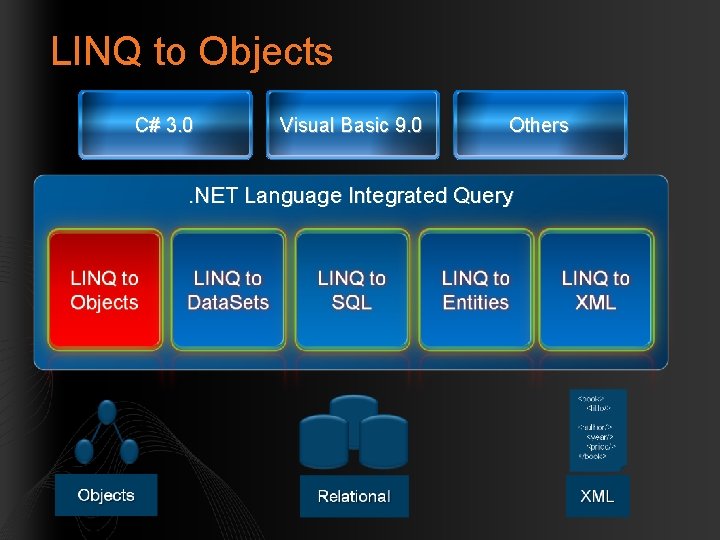
LINQ to Objects C# 3. 0 Visual Basic 9. 0 Others . NET Language Integrated Query
LINQ to Objects • • Native query syntax in C# and VB • Intelli. Sense • Autocompletion Query Operators can be used against any . NET collection (IEnumerable<T>) • Select, Where, Group. By, Join, etc. Deferred Query Evaluation Lambda Expressions using System; using System. Query; using System. Collections. Generic ; class app { static void Main() { string[] names = { "Allen", "Arthur", string[] names = { "Burke", "Connor", "Bennett" }; "Frank", "Everett", "Albert", "George", IEnumerable<string> ayes = names "Harris", "David" }; Func<string, bool> filter = s => s. Length == 5; . Where(s => s[0] == 'A'); IEnumerable<string> expr = Func<string, string> extract = s => s; foreach (string item in ayes) Func<string, string> project = s. To. Upper(); from s in names where s. Length == 5 Console. Write. Line(item); orderby s IEnumerable<string> expr = names[0] = "Bob"; select s. To. Upper(); . Where(filter) . Order. By(extract) foreach (string item in ayes) foreach (string item in expr) . Select(project); Console. Write. Line(item); } foreach (string item in expr) } Console. Write. Line(item); } Arthur Allen } Arthur BURKE DAVID FRANK
LINQ to SQL C# 3. 0 Visual Basic 9. 0 Others . NET Language Integrated Query
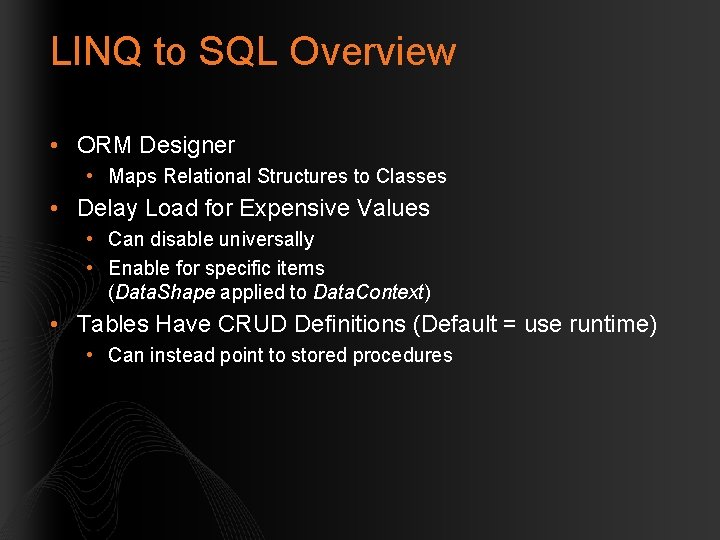
LINQ to SQL Overview • ORM Designer • Maps Relational Structures to Classes • Delay Load for Expensive Values • Can disable universally • Enable for specific items (Data. Shape applied to Data. Context) • Tables Have CRUD Definitions (Default = use runtime) • Can instead point to stored procedures
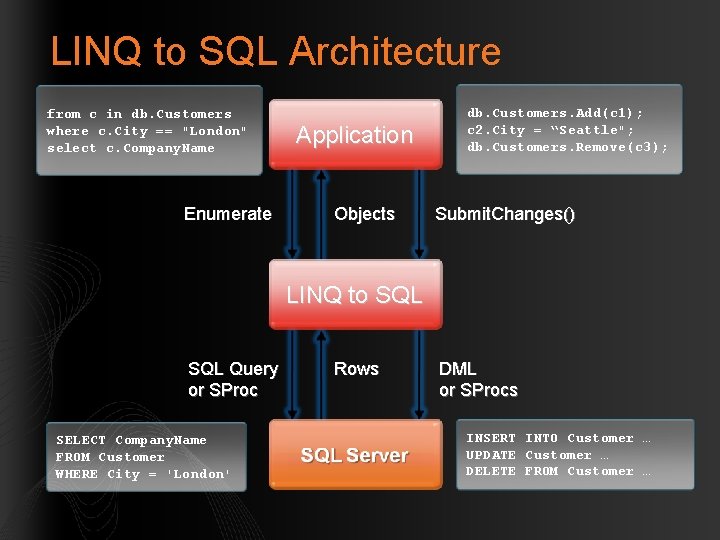
LINQ to SQL Architecture from c in db. Customers where c. City == "London" select c. Company. Name Enumerate Application Objects db. Customers. Add(c 1); c 2. City = “Seattle"; db. Customers. Remove(c 3); Submit. Changes() LINQ to SQL Query or SProc SELECT Company. Name FROM Customer WHERE City = 'London' Rows DML or SProcs INSERT INTO Customer … UPDATE Customer … DELETE FROM Customer …
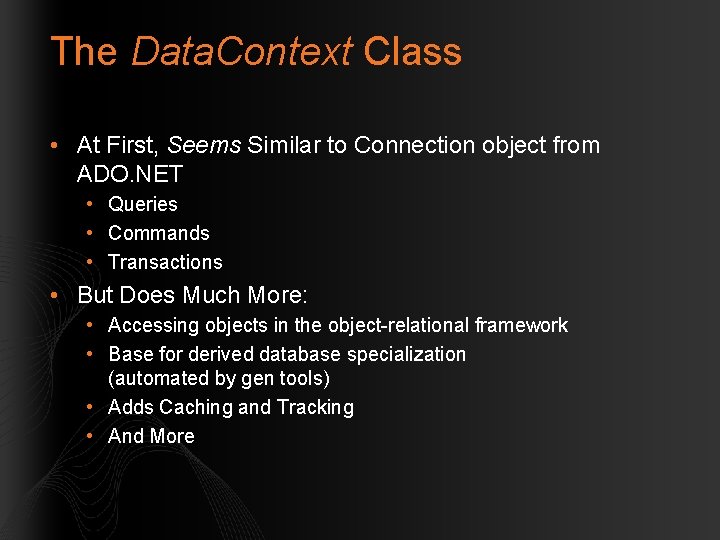
The Data. Context Class • At First, Seems Similar to Connection object from ADO. NET • Queries • Commands • Transactions • But Does Much More: • Accessing objects in the object-relational framework • Base for derived database specialization (automated by gen tools) • Adds Caching and Tracking • And More
LINQ to XML C# 3. 0 Visual Basic 9. 0 Others . NET Language Integrated Query
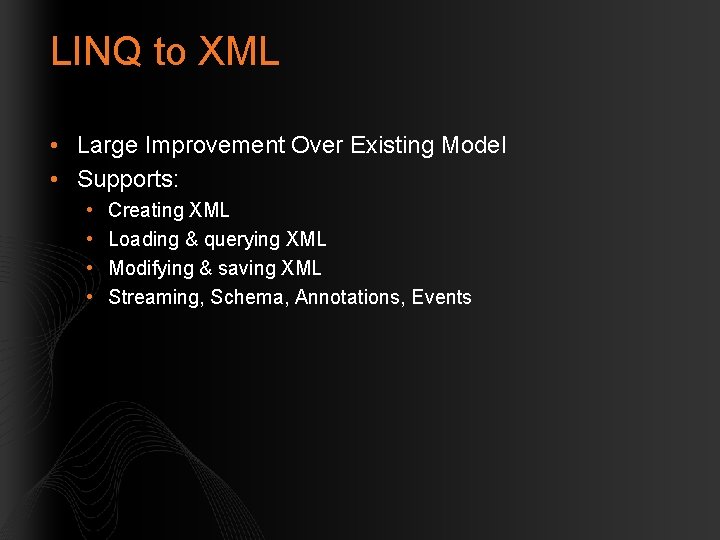
LINQ to XML • Large Improvement Over Existing Model • Supports: • • Creating XML Loading & querying XML Modifying & saving XML Streaming, Schema, Annotations, Events
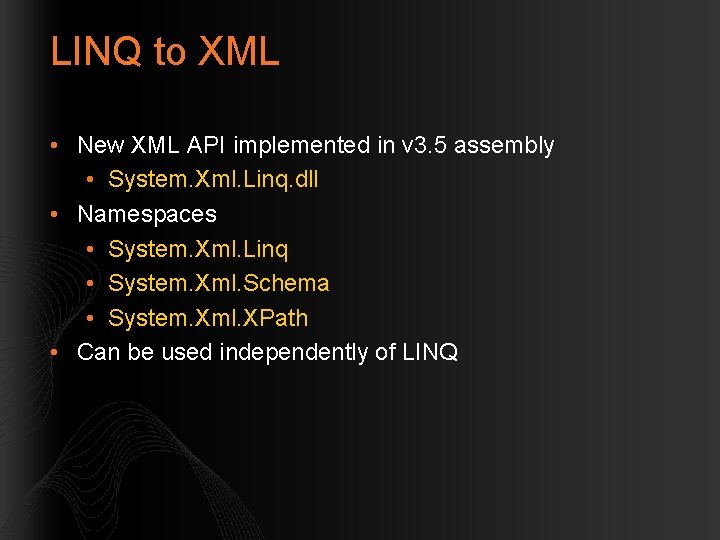
LINQ to XML • New XML API implemented in v 3. 5 assembly • System. Xml. Linq. dll • Namespaces • System. Xml. Linq • System. Xml. Schema • System. Xml. XPath • Can be used independently of LINQ
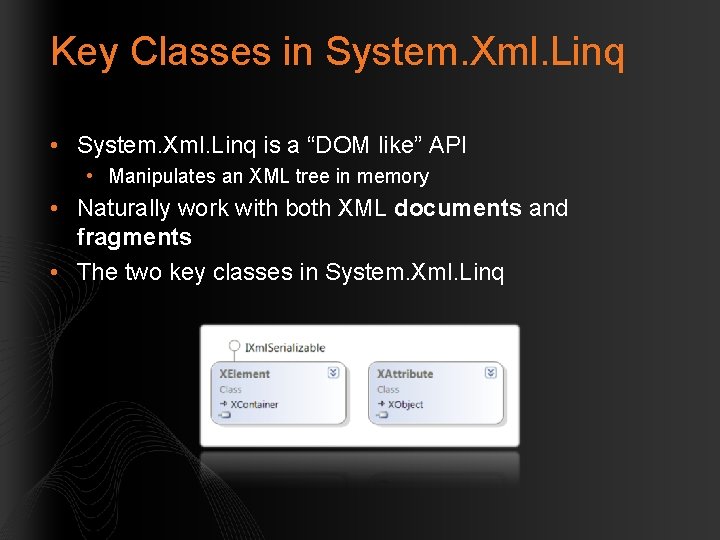
Key Classes in System. Xml. Linq • System. Xml. Linq is a “DOM like” API • Manipulates an XML tree in memory • Naturally work with both XML documents and fragments • The two key classes in System. Xml. Linq
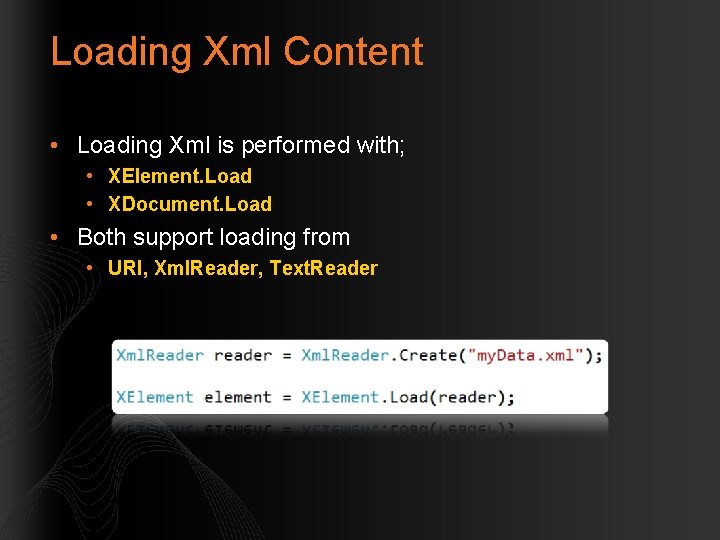
Loading Xml Content • Loading Xml is performed with; • XElement. Load • XDocument. Load • Both support loading from • URI, Xml. Reader, Text. Reader
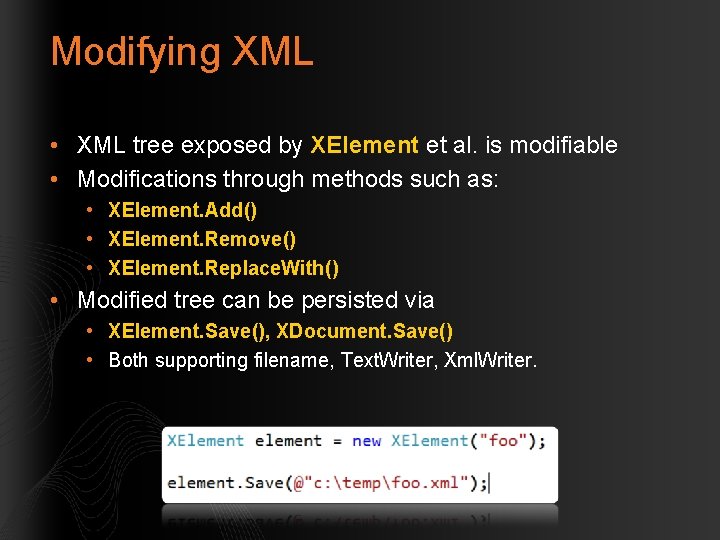
Modifying XML • XML tree exposed by XElement et al. is modifiable • Modifications through methods such as: • XElement. Add() • XElement. Remove() • XElement. Replace. With() • Modified tree can be persisted via • XElement. Save(), XDocument. Save() • Both supporting filename, Text. Writer, Xml. Writer.
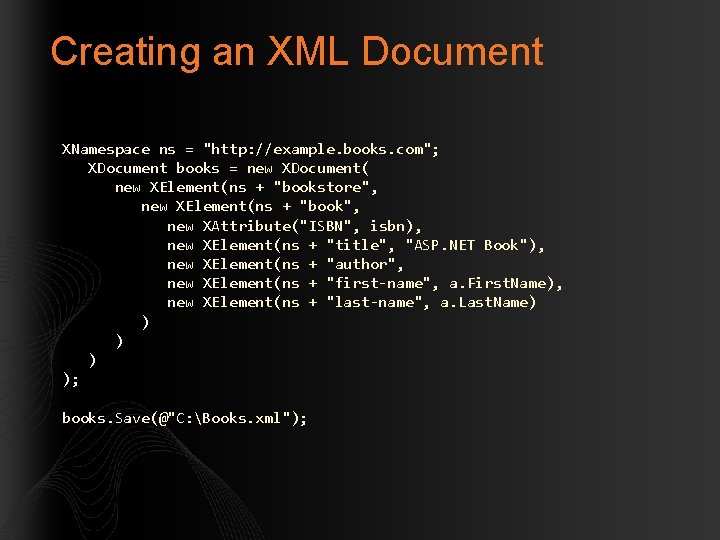
Creating an XML Document XNamespace ns = "http: //example. books. com"; XDocument books = new XDocument( new XElement(ns + "bookstore", new XElement(ns + "book", new XAttribute("ISBN", isbn), new XElement(ns + "title", "ASP. NET Book"), new XElement(ns + "author", new XElement(ns + "first-name", a. First. Name), new XElement(ns + "last-name", a. Last. Name) ) ); books. Save(@"C: Books. xml");
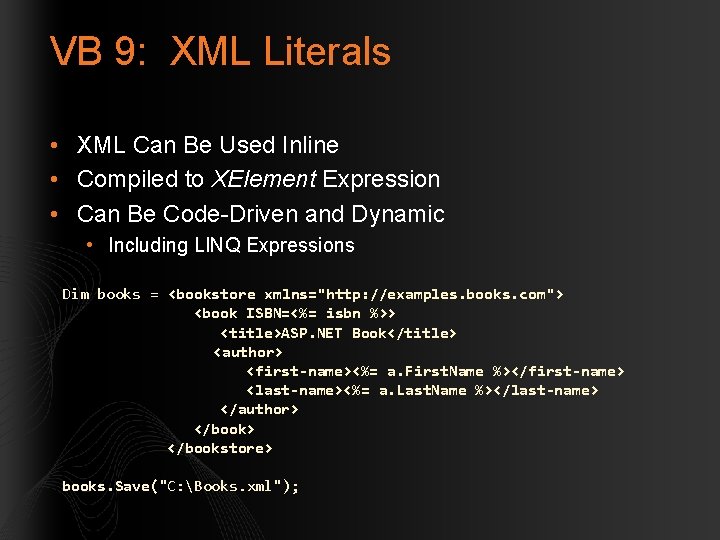
VB 9: XML Literals • XML Can Be Used Inline • Compiled to XElement Expression • Can Be Code-Driven and Dynamic • Including LINQ Expressions Dim books = <bookstore xmlns="http: //examples. books. com"> <book ISBN=<%= isbn %>> <title>ASP. NET Book</title> <author> <first-name><%= a. First. Name %></first-name> <last-name><%= a. Last. Name %></last-name> </author> </bookstore> books. Save("C: Books. xml");
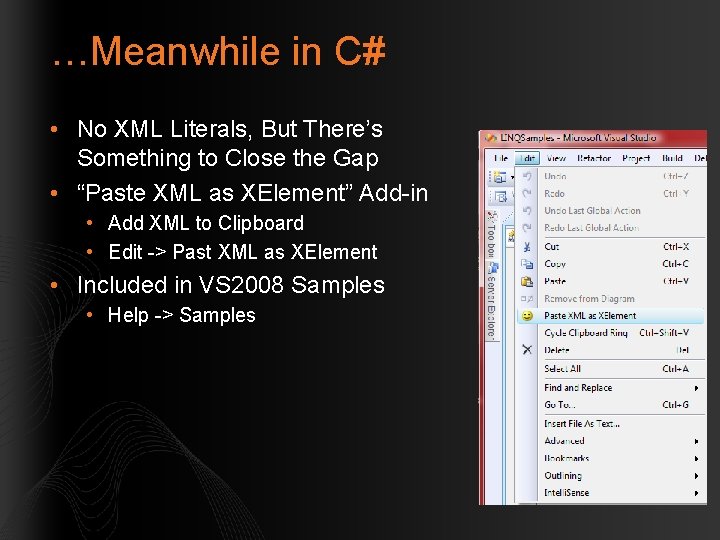
…Meanwhile in C# • No XML Literals, But There’s Something to Close the Gap • “Paste XML as XElement” Add-in • Add XML to Clipboard • Edit -> Past XML as XElement • Included in VS 2008 Samples • Help -> Samples
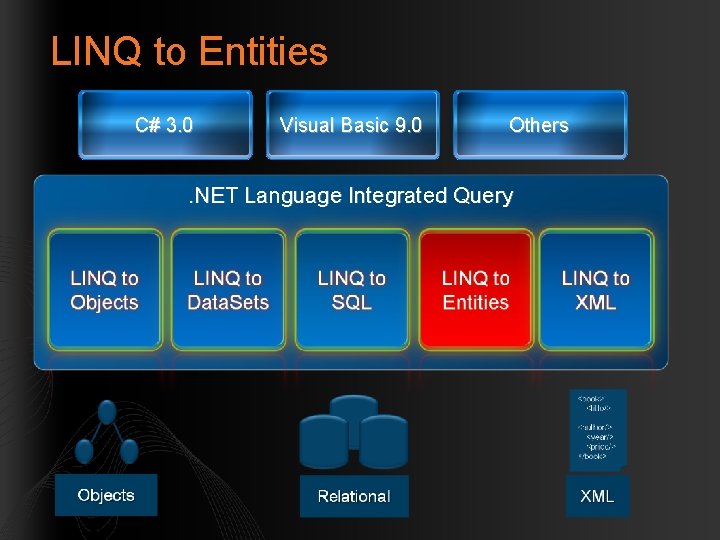
LINQ to Entities C# 3. 0 Visual Basic 9. 0 Others . NET Language Integrated Query
ADO. NET Entity Framework ORM & LINQ. NET Provider (Entity. SQL) • Relationships • Inheritance Conceptual Model • Functionality • Flexibility of Entity Framework model & mapping • Productivity of LINQ V 2. 0 Mapping • Schema and Store independence • Higher-Level Constructs V 3. 0 . NET Provider • Ships post-VS 2008 • At Beta 2 Today • Tooling at CTP 1 Store
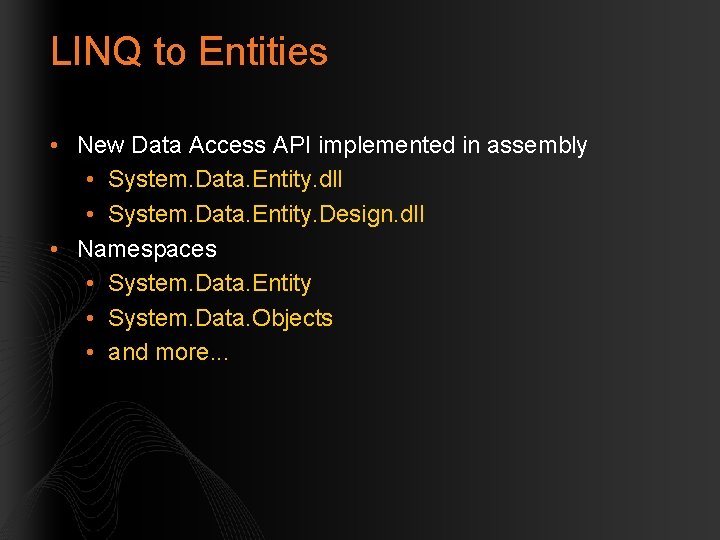
LINQ to Entities • New Data Access API implemented in assembly • System. Data. Entity. dll • System. Data. Entity. Design. dll • Namespaces • System. Data. Entity • System. Data. Objects • and more. . .
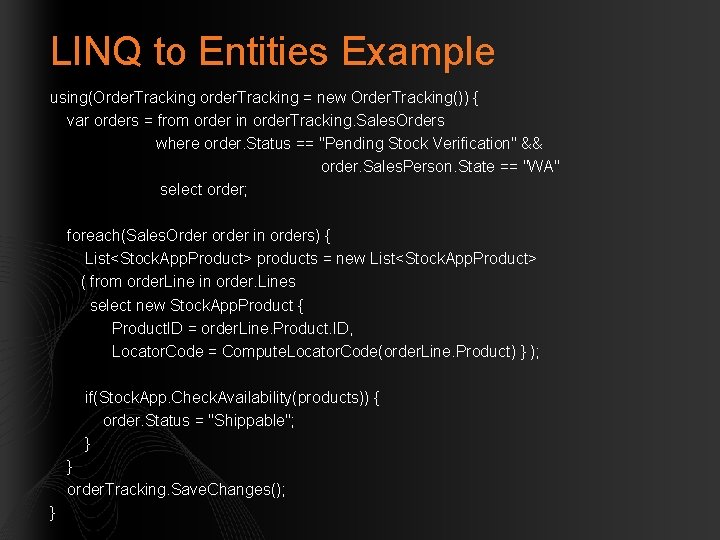
LINQ to Entities Example using(Order. Tracking order. Tracking = new Order. Tracking()) { var orders = from order in order. Tracking. Sales. Orders where order. Status == "Pending Stock Verification" && order. Sales. Person. State == "WA" select order; foreach(Sales. Order order in orders) { List<Stock. App. Product> products = new List<Stock. App. Product> ( from order. Line in order. Lines select new Stock. App. Product { Product. ID = order. Line. Product. ID, Locator. Code = Compute. Locator. Code(order. Line. Product) } ); if(Stock. App. Check. Availability(products)) { order. Status = "Shippable"; } } order. Tracking. Save. Changes(); }
LINQ • A C# language extension: • Use SQL-like syntax in C#. • Outline: • Examples • Understanding the witchcraft • • • Delegate functions Lambda expressions Type inference Anonymous types Extension methods Expression trees
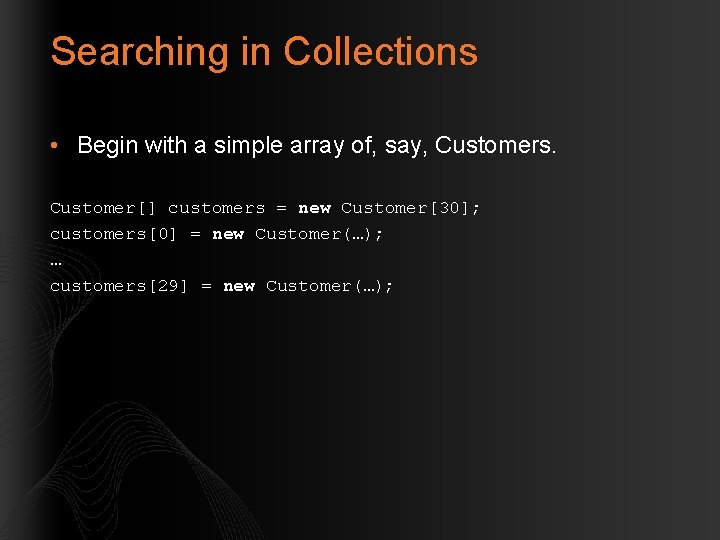
Searching in Collections • Begin with a simple array of, say, Customers. Customer[] customers = new Customer[30]; customers[0] = new Customer(…); … customers[29] = new Customer(…);
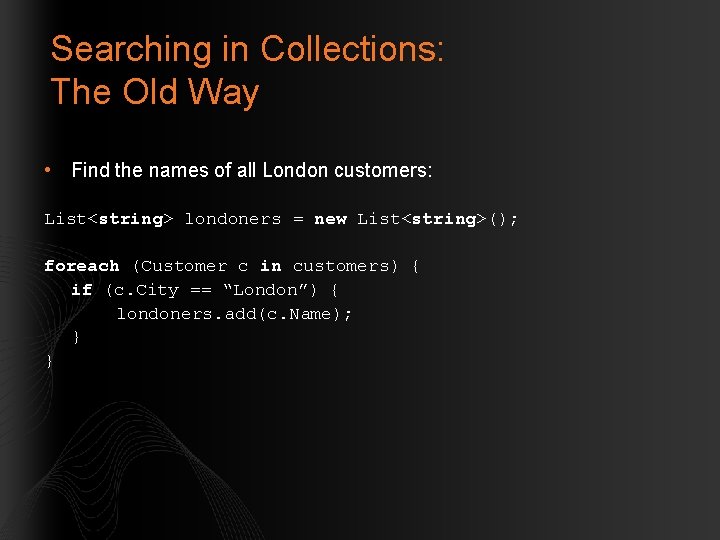
Searching in Collections: The Old Way • Find the names of all London customers: List<string> londoners = new List<string>(); foreach (Customer c in customers) { if (c. City == “London”) { londoners. add(c. Name); } }
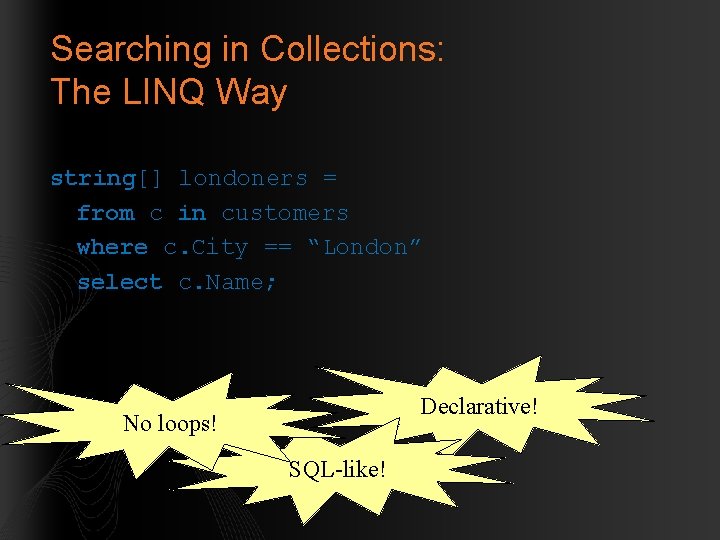
Searching in Collections: The LINQ Way string[] londoners = from c in customers where c. City == “London” select c. Name; Declarative! No loops! SQL-like!
LINQ: How Does It Work? • LINQ syntax = shorthand for method invocation. • “Translation maps”
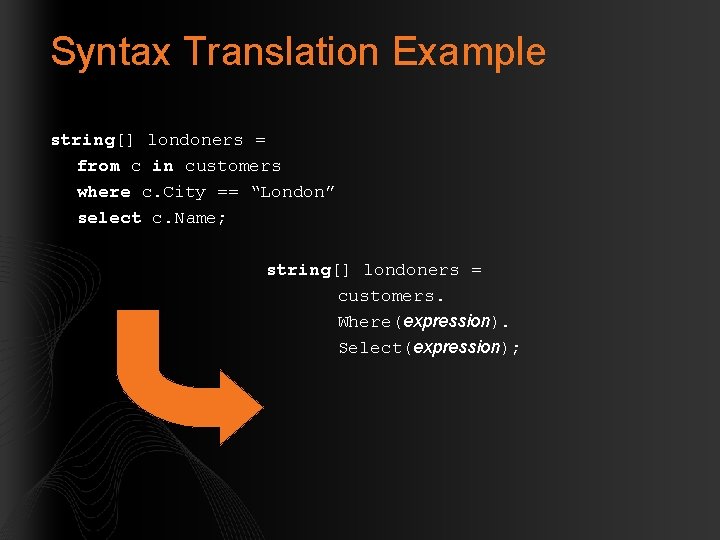
Syntax Translation Example string[] londoners = from c in customers where c. City == “London” select c. Name; string[] londoners = customers. Where(expression). Select(expression);
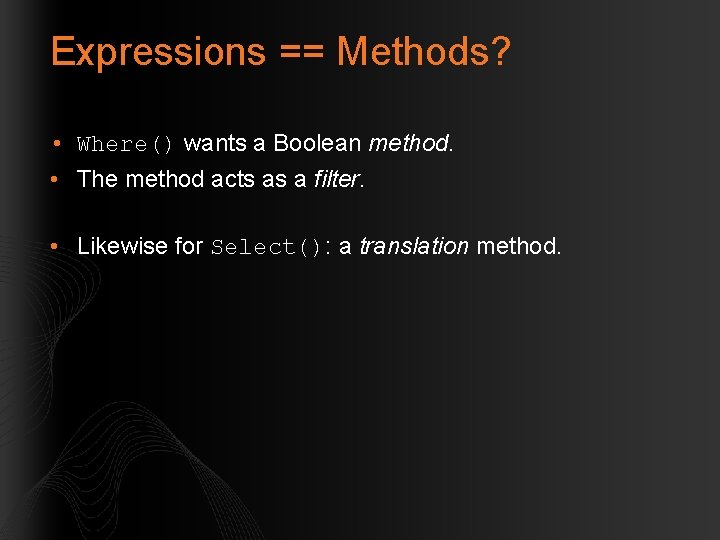
Expressions == Methods? • Where() wants a Boolean method. • The method acts as a filter. • Likewise for Select(): a translation method.
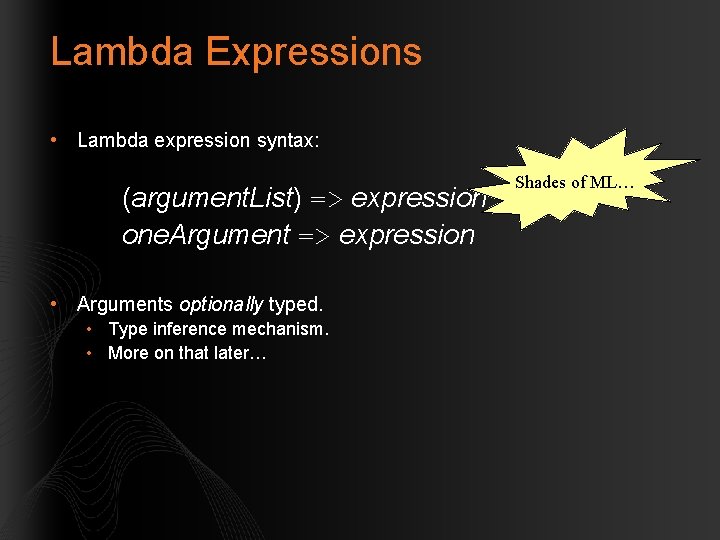
Lambda Expressions • Lambda expression syntax: (argument. List) => expression one. Argument => expression • Arguments optionally typed. • Type inference mechanism. • More on that later… Shades of ML…
Where’s Where()? • We invoked Where() on Customers[]. • On the resulting Customers[], we invoked Select(). • New methods for arrays!?
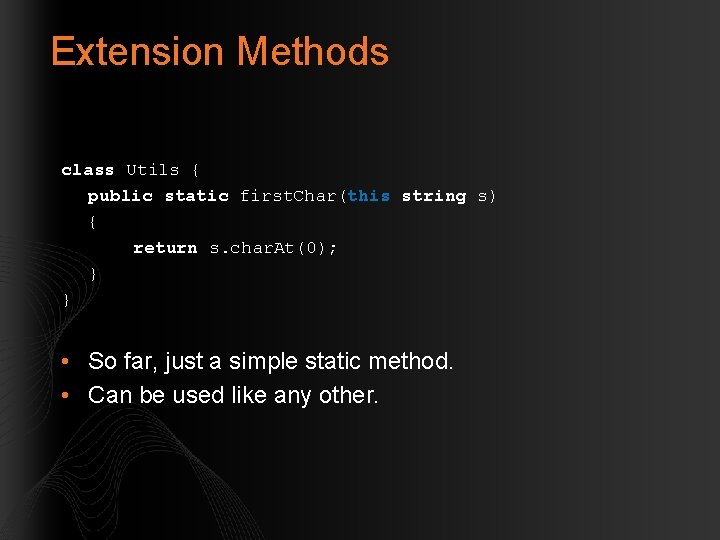
Extension Methods class Utils { public static first. Char(this string s) { return s. char. At(0); } } • So far, just a simple static method. • Can be used like any other.
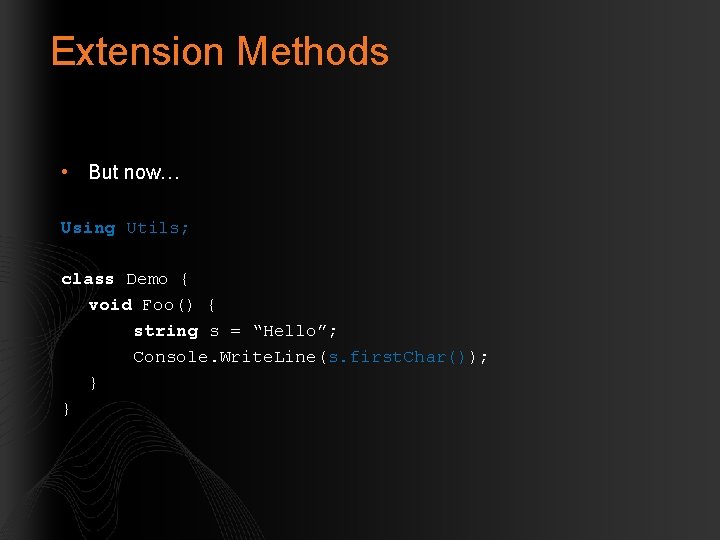
Extension Methods • But now… Using Utils; class Demo { void Foo() { string s = “Hello”; Console. Write. Line(s. first. Char()); } }
Extension Methods • Static methods that seem to extend existing types. • Where(), Select(), etc. extend IEnumerable<T>. • Defined in System. Query. • Applicable to one-dimensional array types.
Query Your Own Types! • LINQ can be applied to any type. • Just implement Where(), Select(), etc.
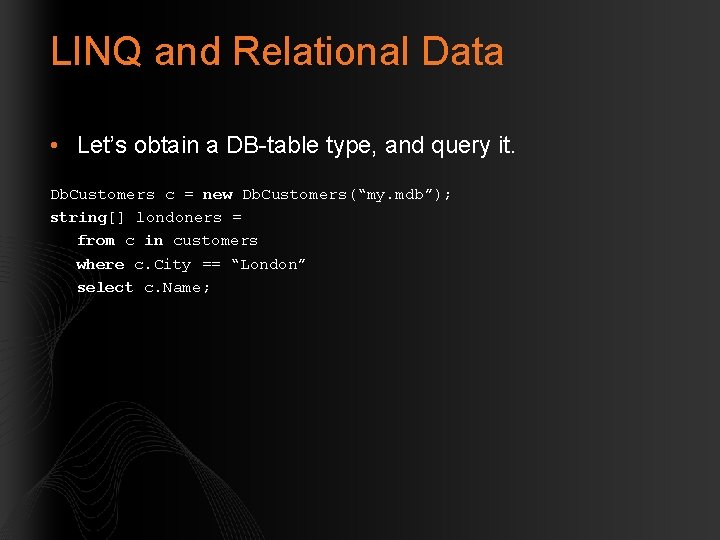
LINQ and Relational Data • Let’s obtain a DB-table type, and query it. Db. Customers c = new Db. Customers(“my. mdb”); string[] londoners = from c in customers where c. City == “London” select c. Name;
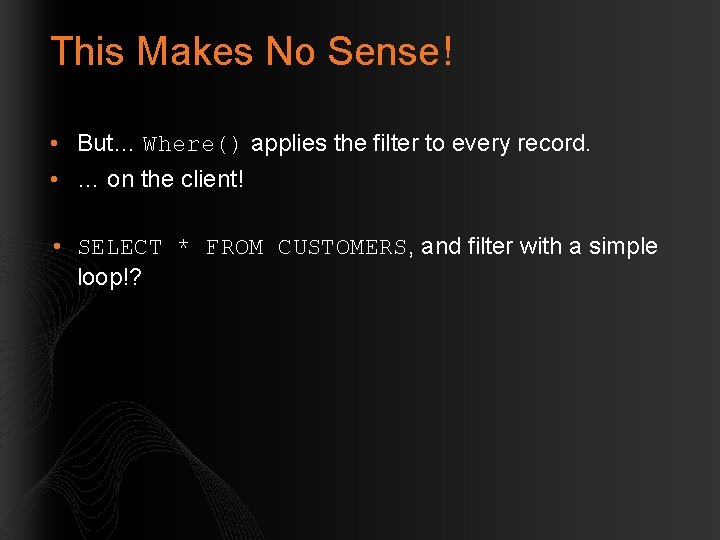
This Makes No Sense! • But… Where() applies the filter to every record. • … on the client! • SELECT * FROM CUSTOMERS, and filter with a simple loop!?
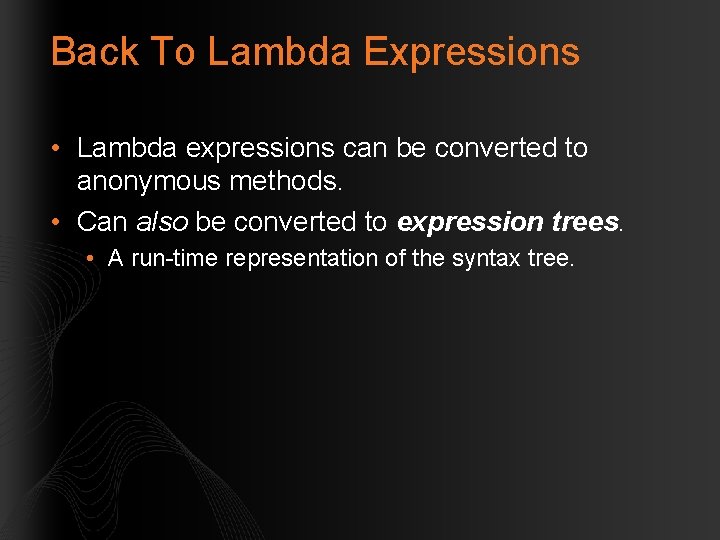
Back To Lambda Expressions • Lambda expressions can be converted to anonymous methods. • Can also be converted to expression trees. • A run-time representation of the syntax tree.
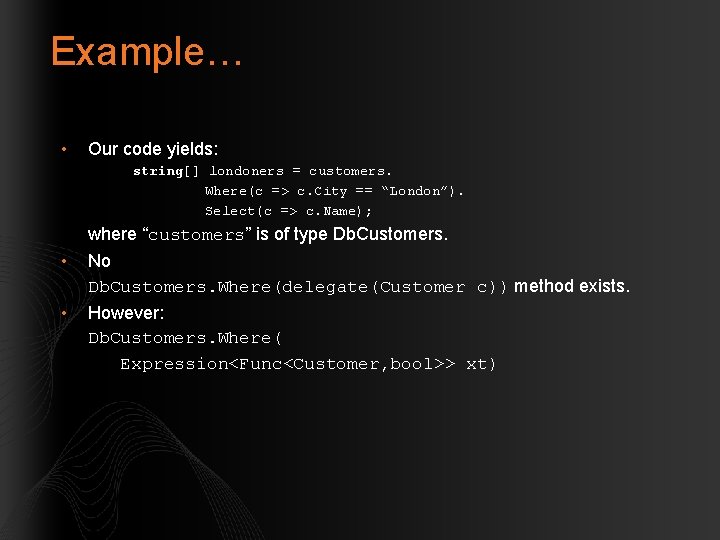
Example… • Our code yields: string[] londoners = customers. Where(c => c. City == “London”). Select(c => c. Name); where “customers” is of type Db. Customers. • No Db. Customers. Where(delegate(Customer c)) method exists. • However: Db. Customers. Where( Expression<Func<Customer, bool>> xt)
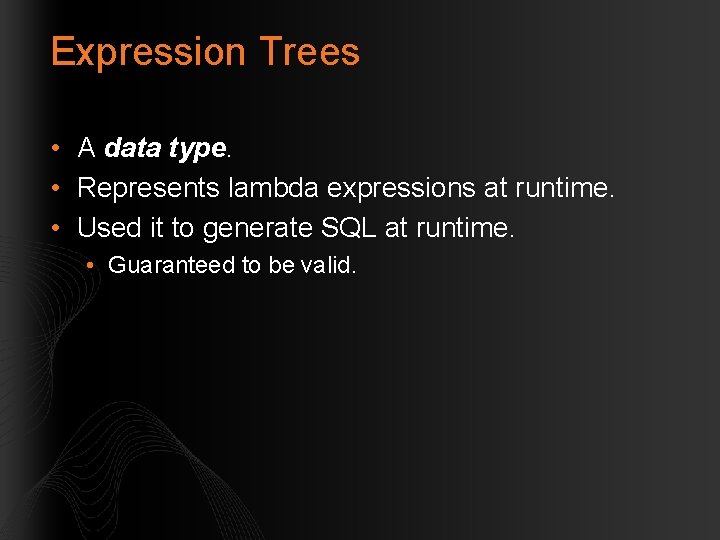
Expression Trees • A data type. • Represents lambda expressions at runtime. • Used it to generate SQL at runtime. • Guaranteed to be valid.
Relational Algebra: Joins, Projections
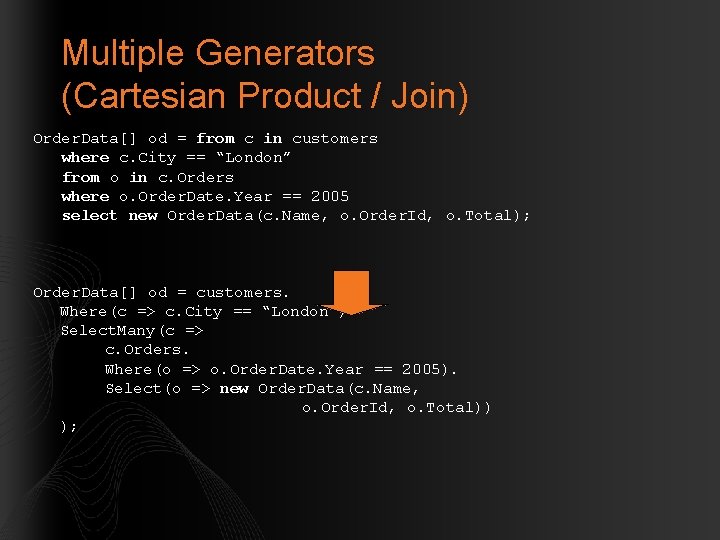
Multiple Generators (Cartesian Product / Join) Order. Data[] od = from c in customers where c. City == “London” from o in c. Orders where o. Order. Date. Year == 2005 select new Order. Data(c. Name, o. Order. Id, o. Total); Order. Data[] od = customers. Where(c => c. City == “London”). Select. Many(c => c. Orders. Where(o => o. Order. Date. Year == 2005). Select(o => new Order. Data(c. Name, o. Order. Id, o. Total)) );
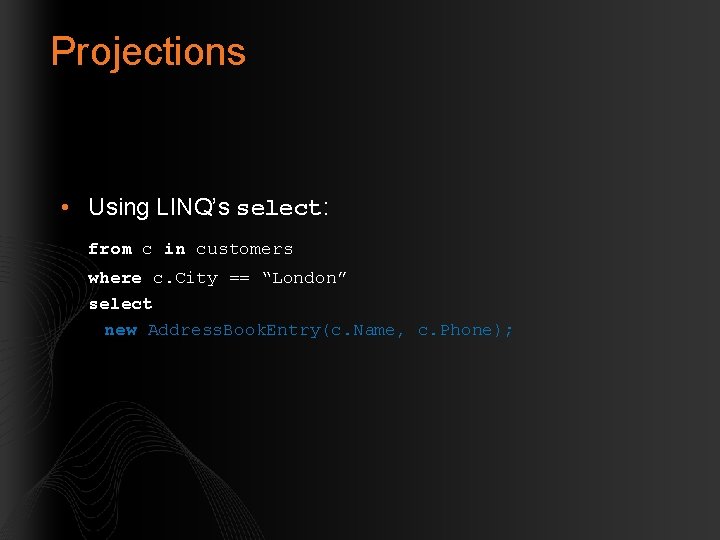
Projections • Using LINQ’s select: from c in customers where c. City == “London” select new Address. Book. Entry(c. Name, c. Phone);
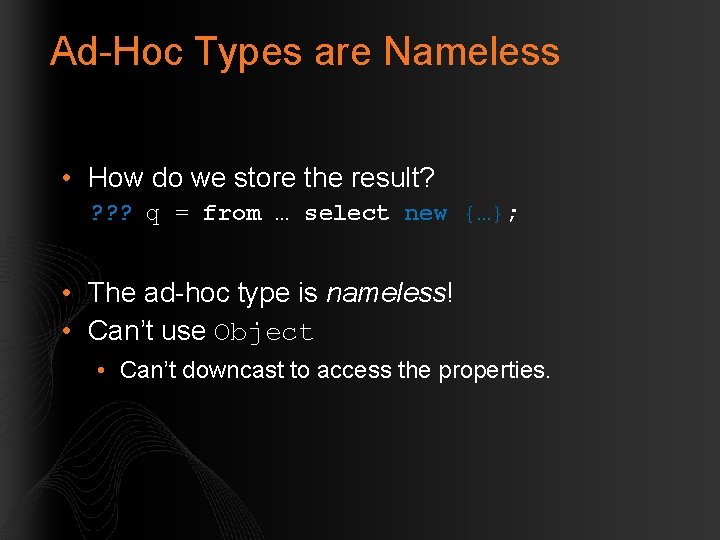
Ad-Hoc Types are Nameless • How do we store the result? ? q = from … select new {…}; • The ad-hoc type is nameless! • Can’t use Object • Can’t downcast to access the properties.
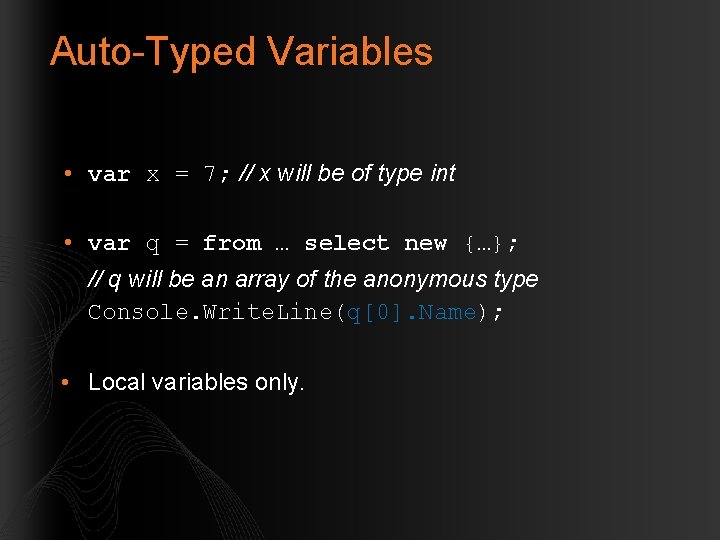
Auto-Typed Variables • var x = 7; // x will be of type int • var q = from … select new {…}; // q will be an array of the anonymous type Console. Write. Line(q[0]. Name); • Local variables only.
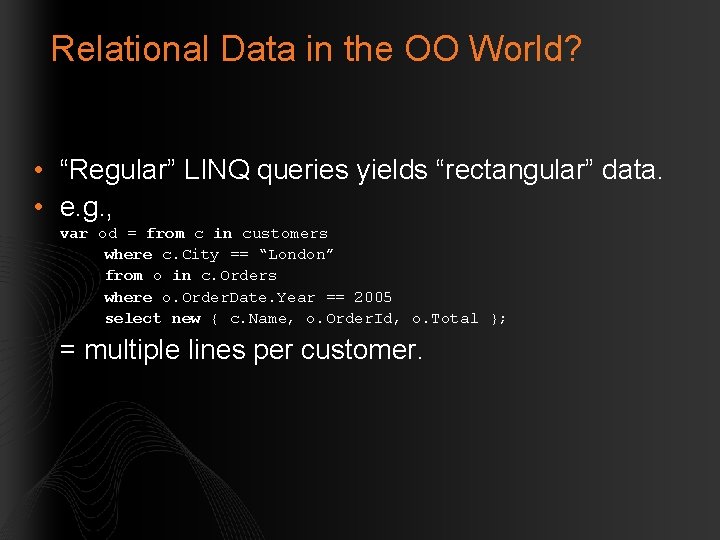
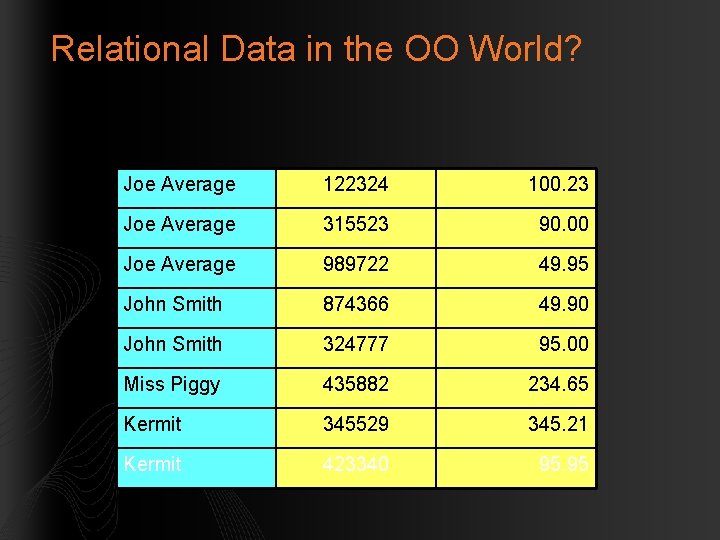
Relational Data in the OO World? • “Regular” LINQ queries yields “rectangular” data. • e. g. , var od = from c in customers where c. City == “London” from o in c. Orders where o. Order. Date. Year == 2005 select new { c. Name, o. Order. Id, o. Total }; = multiple lines per customer.
Relational Data in the OO World? Joe Average 122324 100. 23 Joe Average 315523 90. 00 Joe Average 989722 49. 95 John Smith 874366 49. 90 John Smith 324777 95. 00 Miss Piggy 435882 234. 65 Kermit 345529 345. 21 Kermit 423340 95. 95
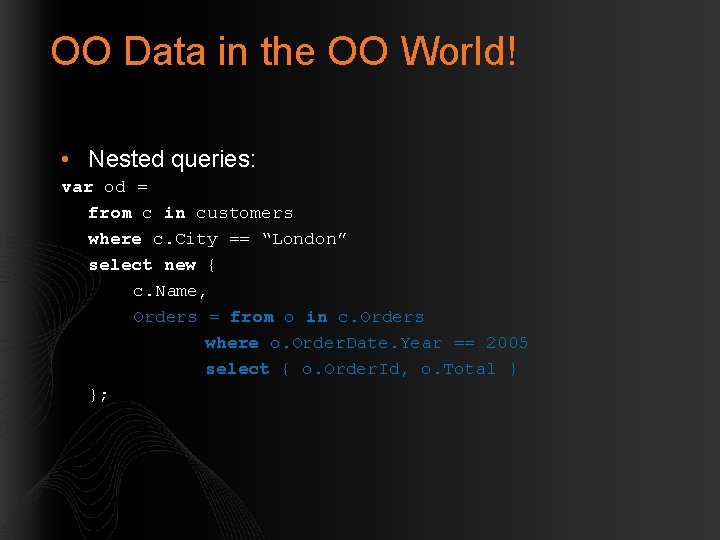
OO Data in the OO World! • Nested queries: var od = from c in customers where c. City == “London” select new { c. Name, Orders = from o in c. Orders where o. Order. Date. Year == 2005 select { o. Order. Id, o. Total } };
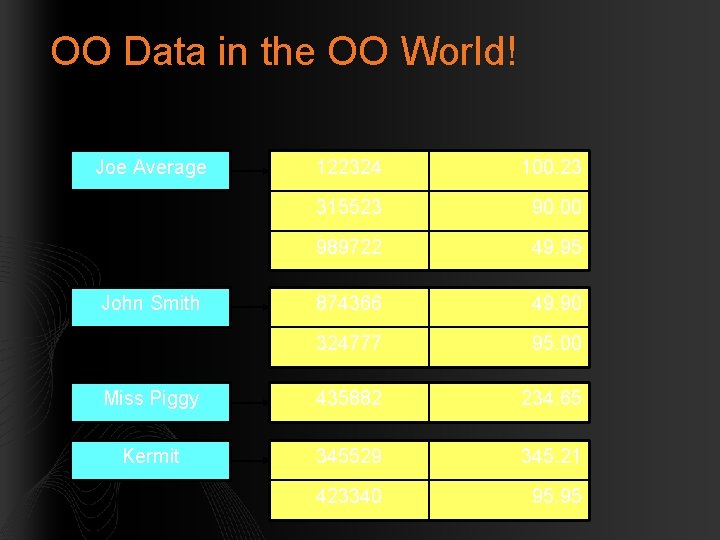
OO Data in the OO World! Joe Average 122324 100. 23 315523 90. 00 989722 49. 95 874366 49. 90 324777 95. 00 Miss Piggy 435882 234. 65 Kermit 345529 345. 21 423340 95. 95 John Smith
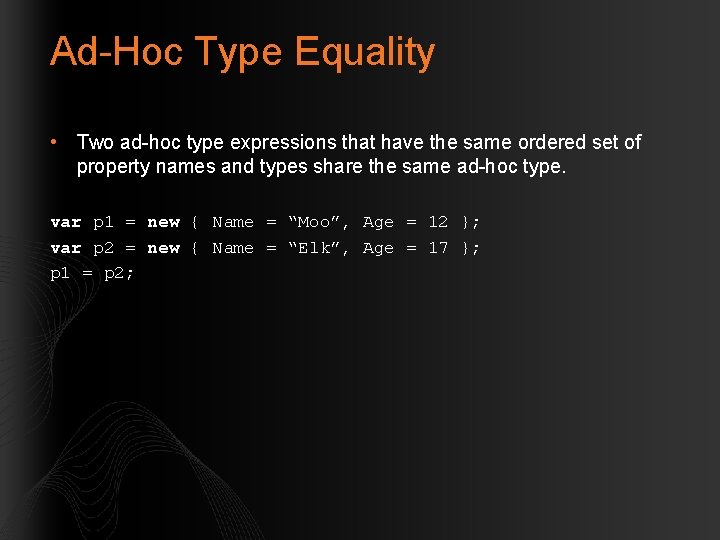
Ad-Hoc Type Equality • Two ad-hoc type expressions that have the same ordered set of property names and types share the same ad-hoc type. var p 1 = new { Name = “Moo”, Age = 12 }; var p 2 = new { Name = “Elk”, Age = 17 }; p 1 = p 2;
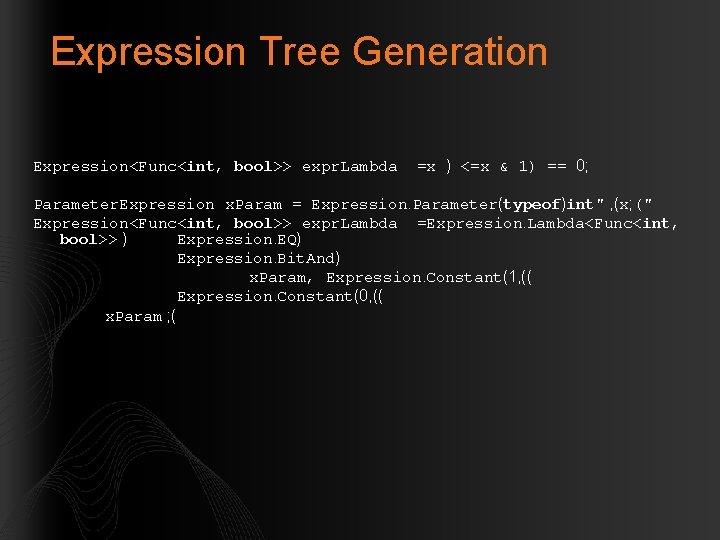
Expression Tree Generation Expression<Func<int, bool>> expr. Lambda =x ) <=x & 1) == 0; Parameter. Expression x. Param = Expression. Parameter(typeof)int" , (x; (" Expression<Func<int, bool>> expr. Lambda =Expression. Lambda<Func<int, bool>> ) Expression. EQ) Expression. Bit. And) x. Param, Expression. Constant(1, (( Expression. Constant(0, (( x. Param ; (
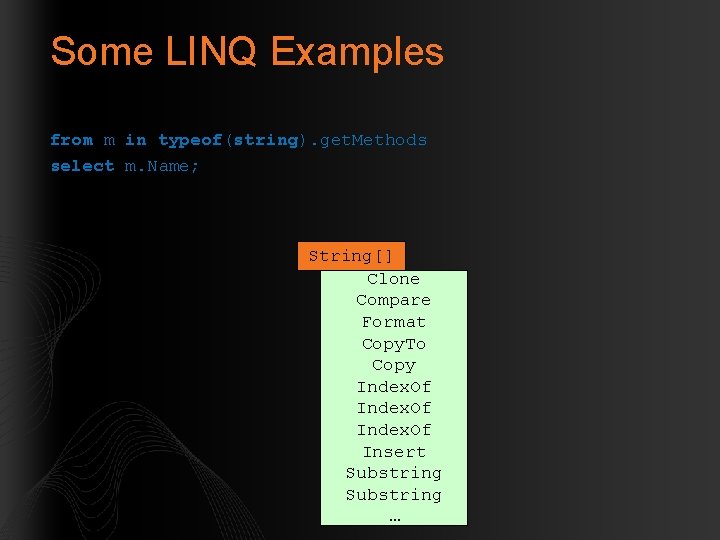
Some LINQ Examples from m in typeof(string). get. Methods select m. Name; String[] Clone Compare Format Copy. To Copy Index. Of Insert Substring …
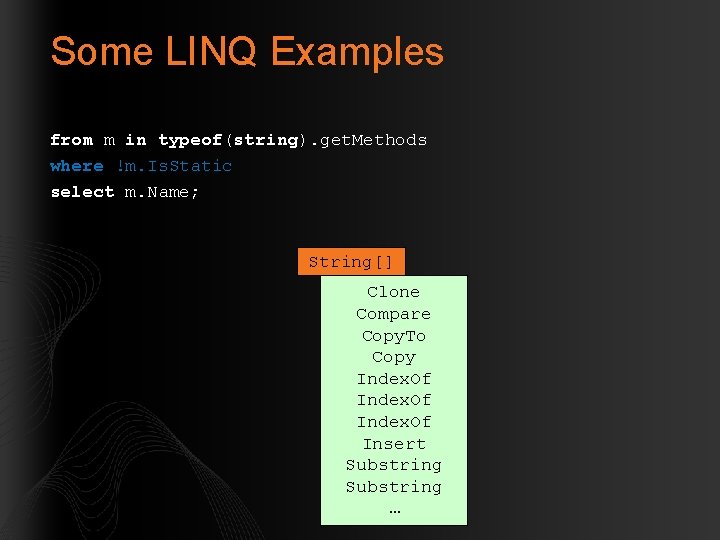
Some LINQ Examples from m in typeof(string). get. Methods where !m. Is. Static select m. Name; String[] Clone Compare Copy. To Copy Index. Of Insert Substring …
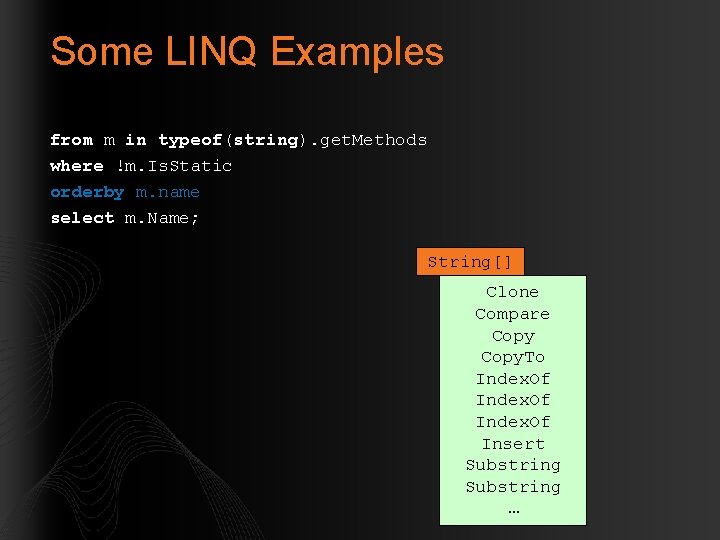
Some LINQ Examples from m in typeof(string). get. Methods where !m. Is. Static orderby m. name select m. Name; String[] Clone Compare Copy. To Index. Of Insert Substring …
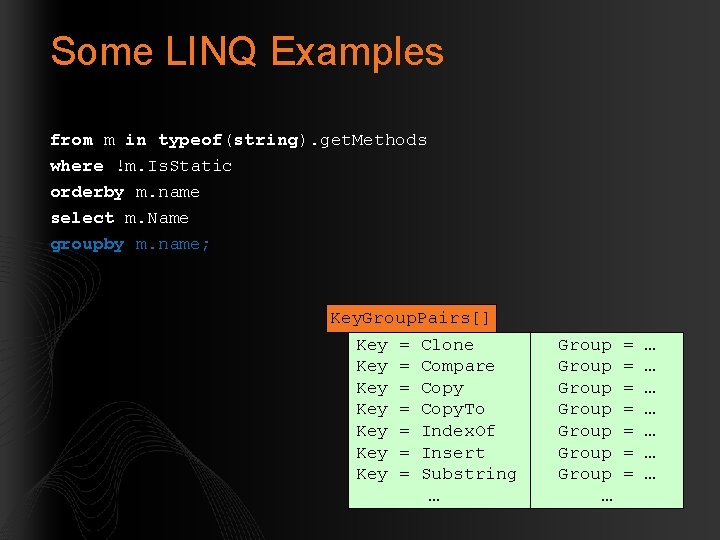
Some LINQ Examples from m in typeof(string). get. Methods where !m. Is. Static orderby m. name select m. Name groupby m. name; Key. Group. Pairs[] Key = Clone Key = Compare Key = Copy. To Key = Index. Of Key = Insert Key = Substring … Group = … Group = … …
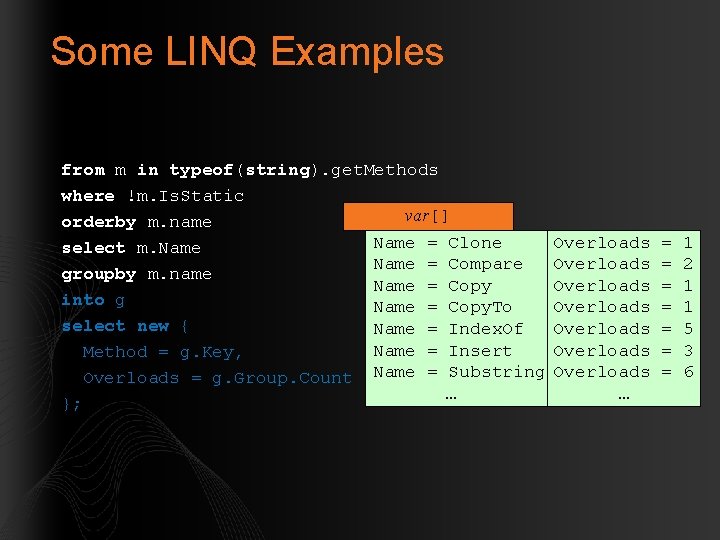
Some LINQ Examples from m in typeof(string). get. Methods where !m. Is. Static var[] orderby m. name Name = Clone select m. Name = Compare groupby m. name Name = Copy into g Name = Copy. To select new { Name = Index. Of Name = Insert Method = g. Key, Overloads = g. Group. Count Name = Substring … }; Overloads = 1 Overloads = 2 Overloads = 1 Overloads = 5 Overloads = 3 Overloads = 6 …
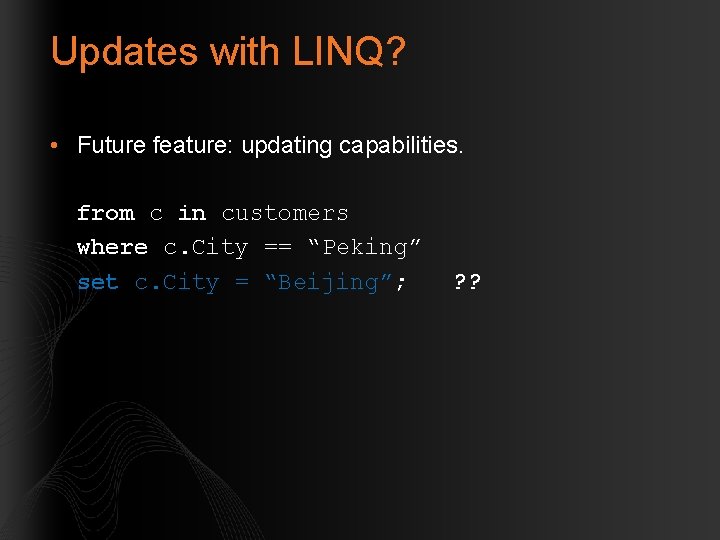
Updates with LINQ? • Future feature: updating capabilities. from c in customers where c. City == “Peking” set c. City = “Beijing”; ? ?
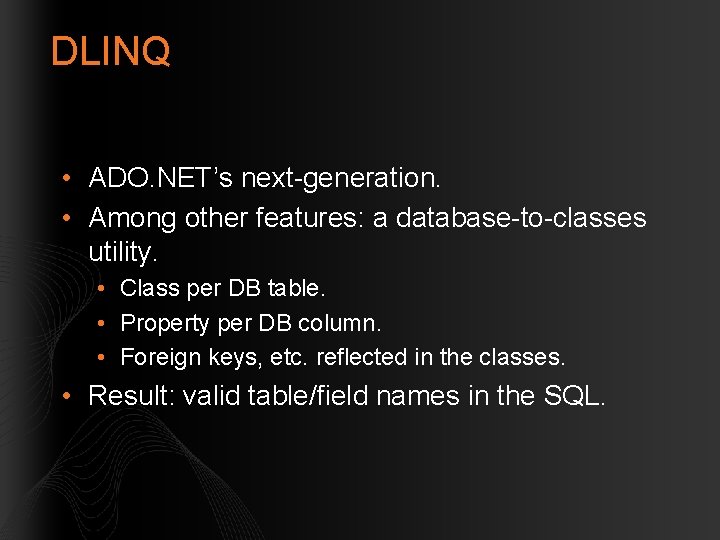
DLINQ • ADO. NET’s next-generation. • Among other features: a database-to-classes utility. • Class per DB table. • Property per DB column. • Foreign keys, etc. reflected in the classes. • Result: valid table/field names in the SQL.
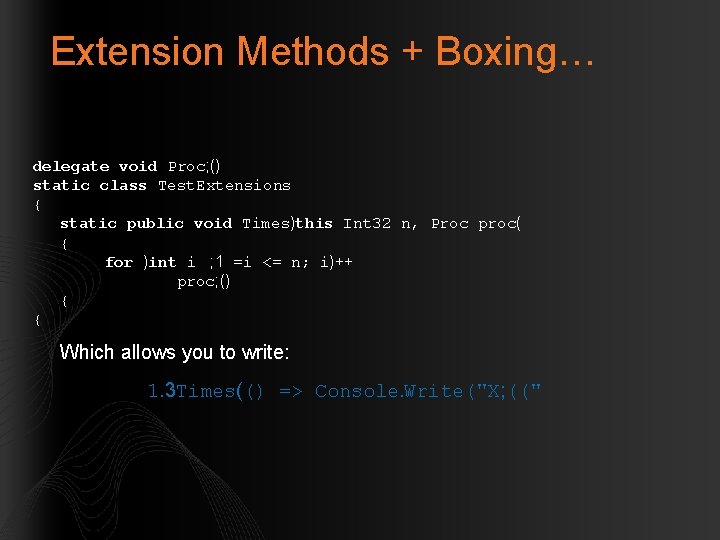
Extension Methods + Boxing… delegate void Proc; () static class Test. Extensions { static public void Times)this Int 32 n, Proc proc( { for )int i ; 1 =i <= n; i)++ proc; () { { Which allows you to write: 1. 3 Times(() => Console. Write("X; (("
Resources • LINQ Home http: //msdn. com/linq • 101 LINQ Examples http: //tinyurl. com/2 rsmpd [VB] • http: //tinyurl. com/ymmyr 7 [C#] • LINQ Videos http: //www. asp. net/learn/linq-videos • Scott Guthrie’s Blog weblogs. asp. net/scottgu/ • LINQPad http: //www. linqpad. net
Примери http: //msdn. microsoft. com/en-us/vcsharp/aa 336746 http: //www. galcho. com/articles/LINQTutorial/Tutorial. LINQ. pdf
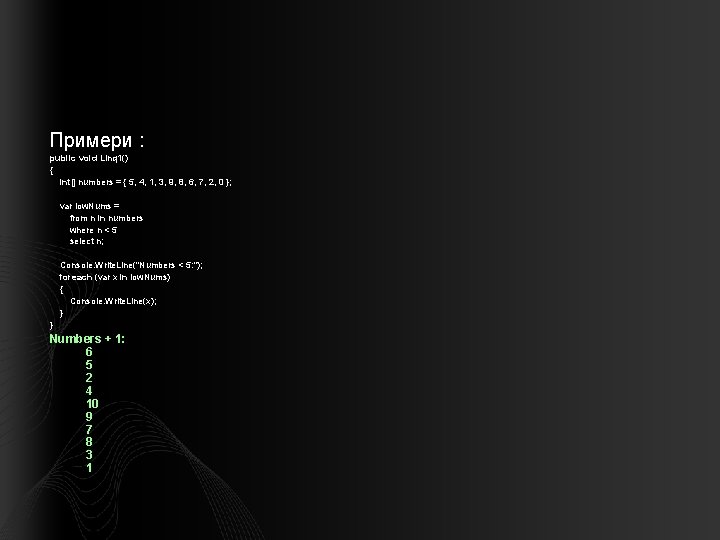
Примери : public void Linq 1() { int[] numbers = { 5, 4, 1, 3, 9, 8, 6, 7, 2, 0 }; var low. Nums = from n in numbers where n < 5 select n; Console. Write. Line("Numbers < 5: "); foreach (var x in low. Nums) { Console. Write. Line(x); } } Numbers + 1: 6 5 2 4 10 9 7 8 3 1
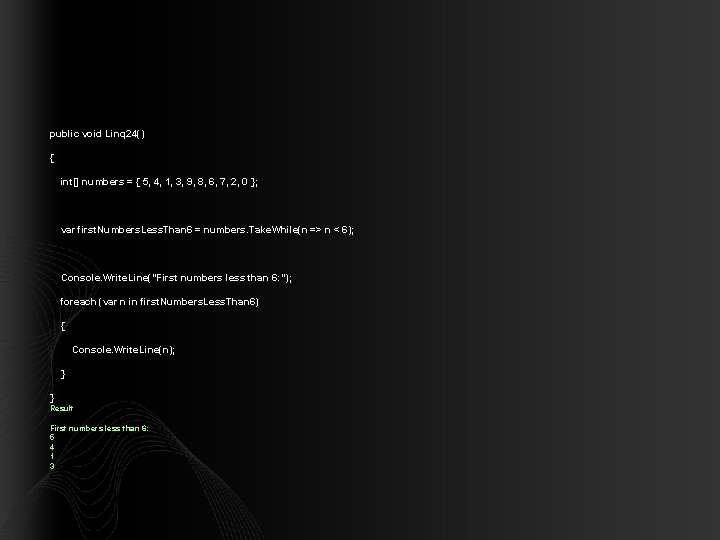
public void Linq 24() { int[] numbers = { 5, 4, 1, 3, 9, 8, 6, 7, 2, 0 }; var first. Numbers. Less. Than 6 = numbers. Take. While(n => n < 6); Console. Write. Line("First numbers less than 6: "); foreach (var n in first. Numbers. Less. Than 6) { Console. Write. Line(n); } } Result First numbers less than 6: 5 4 1 3
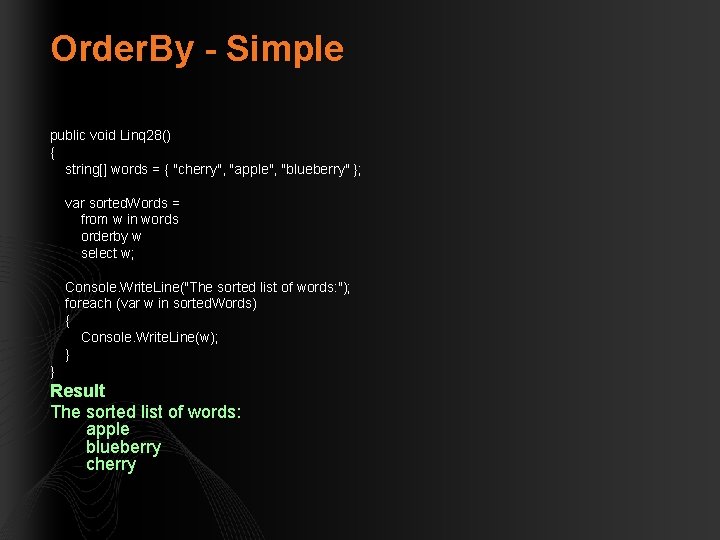
Order. By - Simple public void Linq 28() { string[] words = { "cherry", "apple", "blueberry" }; var sorted. Words = from w in words orderby w select w; Console. Write. Line("The sorted list of words: "); foreach (var w in sorted. Words) { Console. Write. Line(w); } } Result The sorted list of words: apple blueberry cherry
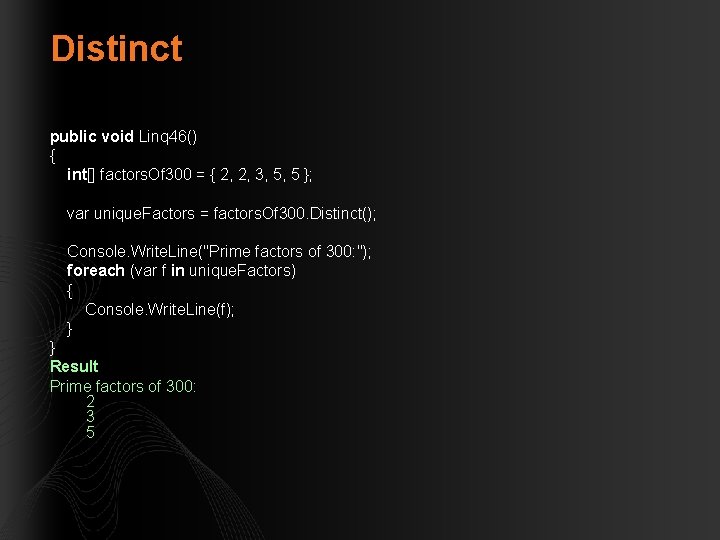
Distinct public void Linq 46() { int[] factors. Of 300 = { 2, 2, 3, 5, 5 }; var unique. Factors = factors. Of 300. Distinct(); Console. Write. Line("Prime factors of 300: "); foreach (var f in unique. Factors) { Console. Write. Line(f); } } Result Prime factors of 300: 2 3 5
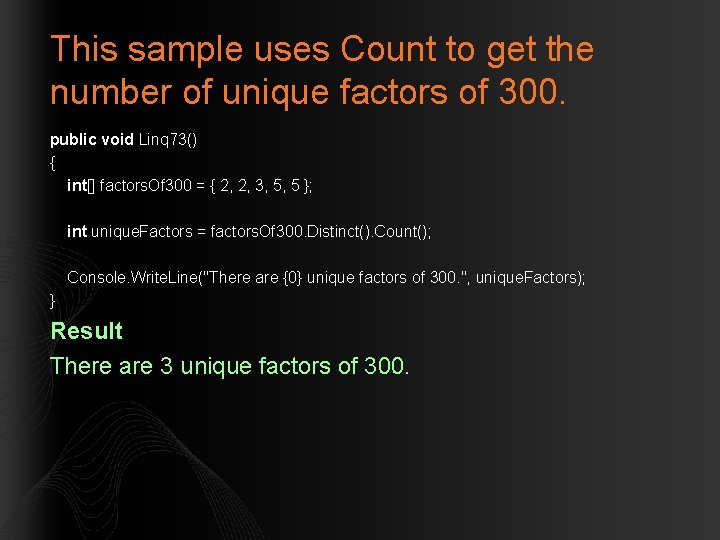
This sample uses Count to get the number of unique factors of 300. public void Linq 73() { int[] factors. Of 300 = { 2, 2, 3, 5, 5 }; int unique. Factors = factors. Of 300. Distinct(). Count(); Console. Write. Line("There are {0} unique factors of 300. ", unique. Factors); } Result There are 3 unique factors of 300.