Query Processing Parser Parse tree Semantic Checker Query
- Slides: 36
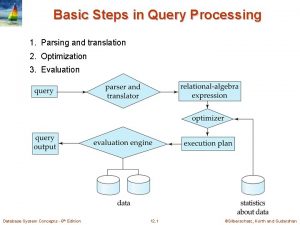
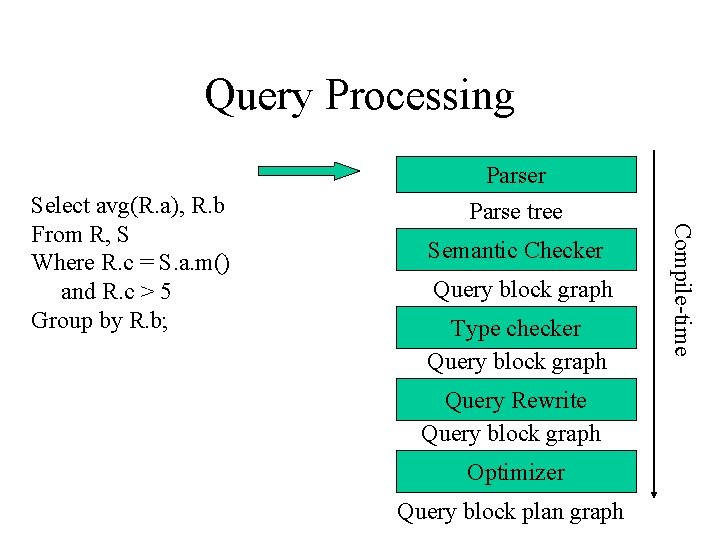
Query Processing Parser Parse tree Semantic Checker Query block graph Type checker Query block graph Query Rewrite Query block graph Optimizer Query block plan graph Compile-time Select avg(R. a), R. b From R, S Where R. c = S. a. m() and R. c > 5 Group by R. b;
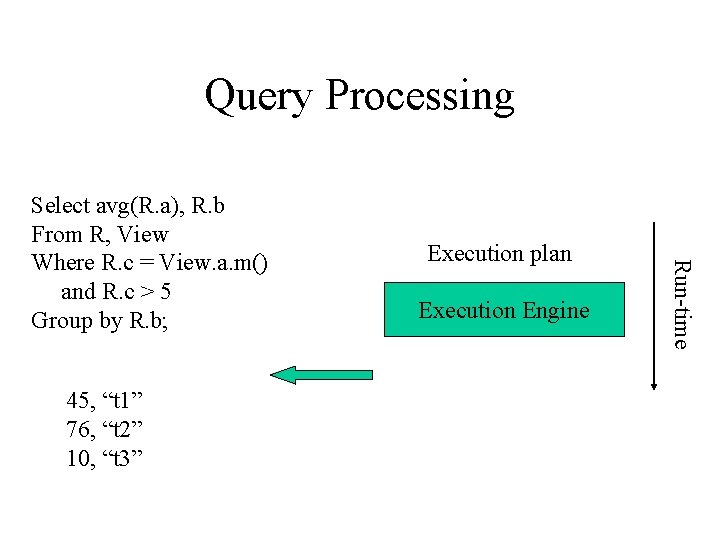
Query Processing 45, “t 1” 76, “t 2” 10, “t 3” Execution plan Execution Engine Run-time Select avg(R. a), R. b From R, View Where R. c = View. a. m() and R. c > 5 Group by R. b;
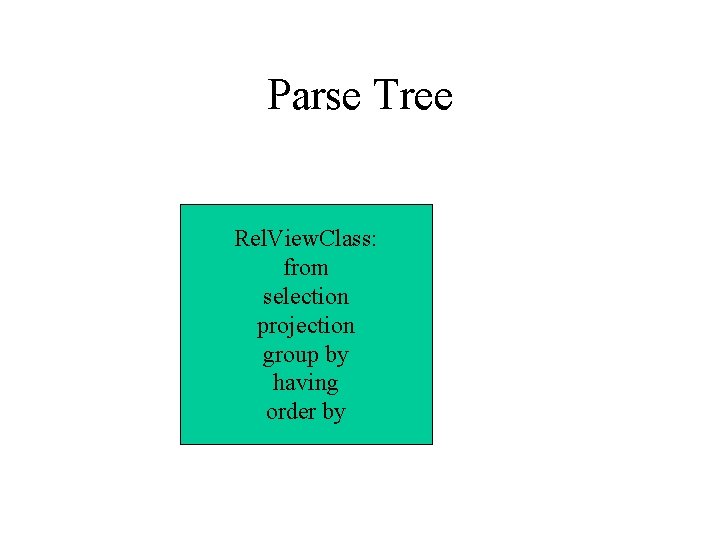
Parse Tree Rel. View. Class: from selection projection group by having order by
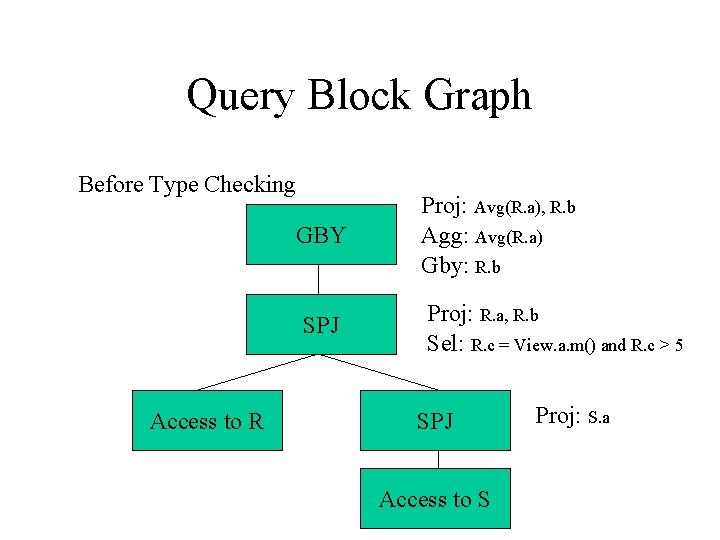
Query Block Graph Before Type Checking GBY SPJ Access to R Proj: Avg(R. a), R. b Agg: Avg(R. a) Gby: R. b Proj: R. a, R. b Sel: R. c = View. a. m() and R. c > 5 SPJ Access to S Proj: S. a
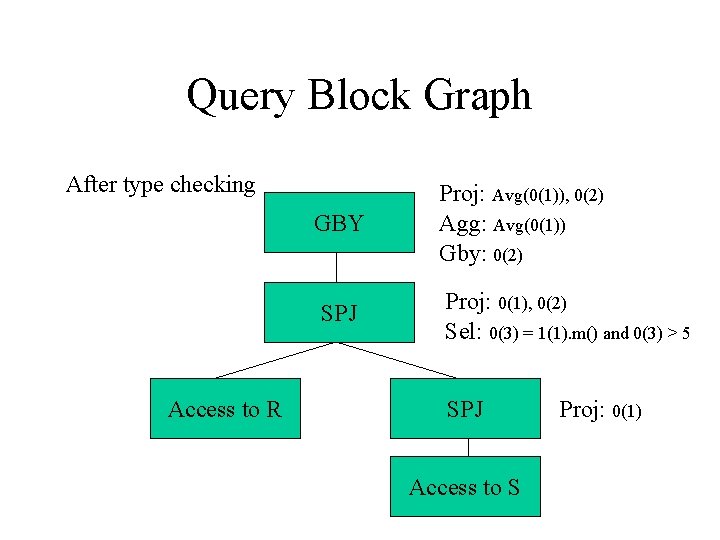
Query Block Graph After type checking GBY SPJ Access to R Proj: Avg(0(1)), 0(2) Agg: Avg(0(1)) Gby: 0(2) Proj: 0(1), 0(2) Sel: 0(3) = 1(1). m() and 0(3) > 5 SPJ Access to S Proj: 0(1)
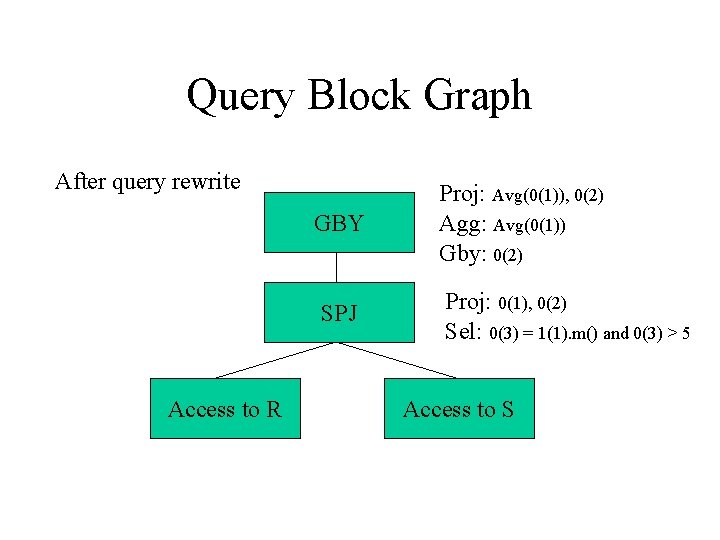
Query Block Graph After query rewrite GBY SPJ Access to R Proj: Avg(0(1)), 0(2) Agg: Avg(0(1)) Gby: 0(2) Proj: 0(1), 0(2) Sel: 0(3) = 1(1). m() and 0(3) > 5 Access to S
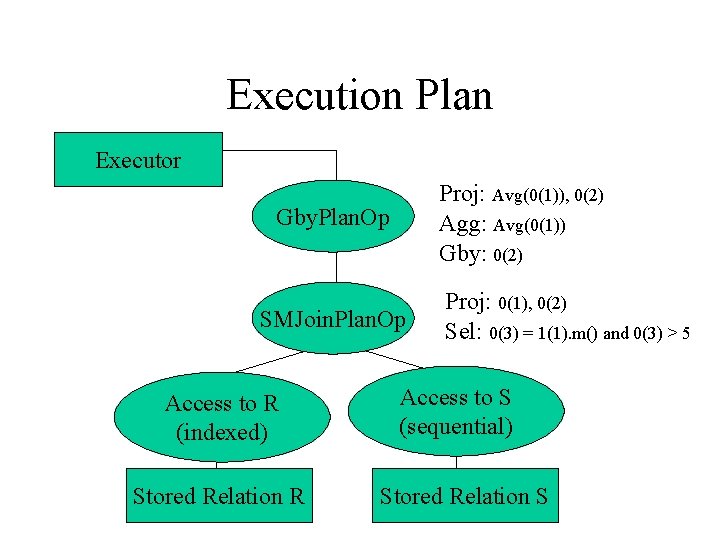
Execution Plan Executor Proj: Avg(0(1)), 0(2) Agg: Avg(0(1)) Gby: 0(2) Gby. Plan. Op SMJoin. Plan. Op Access to R (indexed) Stored Relation R Proj: 0(1), 0(2) Sel: 0(3) = 1(1). m() and 0(3) > 5 Access to S (sequential) Stored Relation S
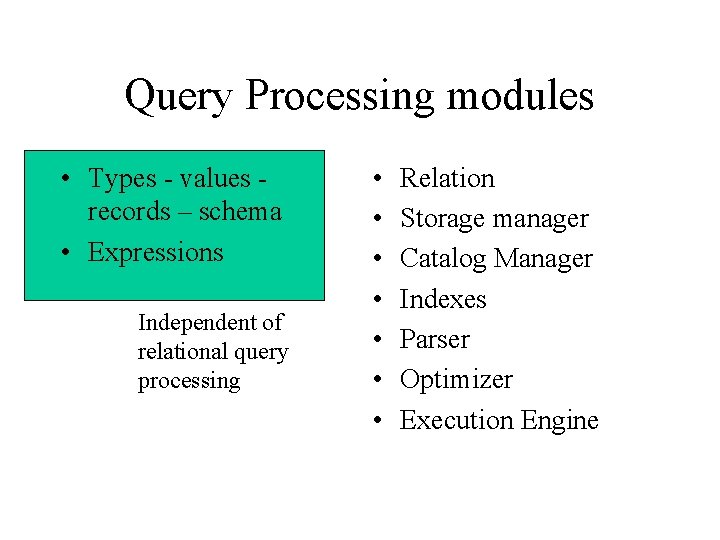
Query Processing modules • Types - values records – schema • Expressions Independent of relational query processing • • Relation Storage manager Catalog Manager Indexes Parser Optimizer Execution Engine
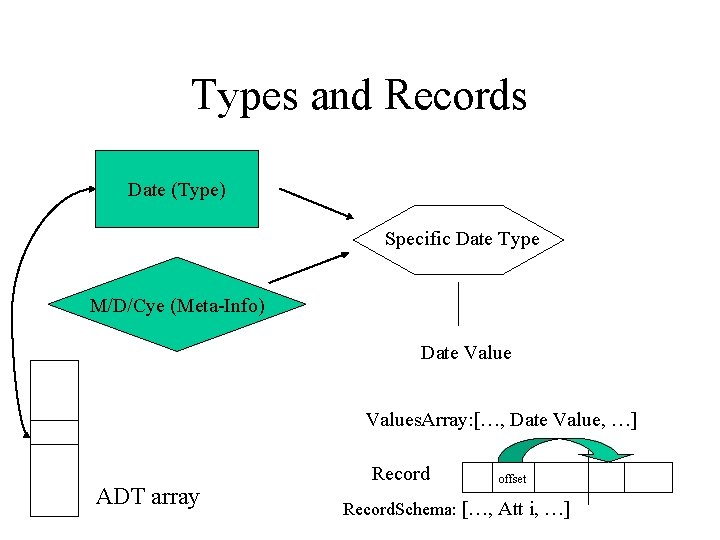
Types and Records Date (Type) Specific Date Type M/D/Cye (Meta-Info) Date Values. Array: […, Date Value, …] ADT array Record offset Record. Schema: […, Att i, …]
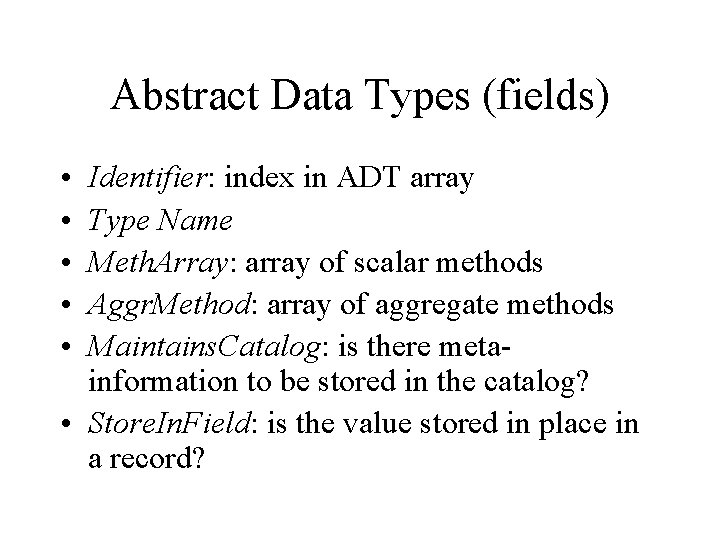
Abstract Data Types (fields) • • • Identifier: index in ADT array Type Name Meth. Array: array of scalar methods Aggr. Method: array of aggregate methods Maintains. Catalog: is there metainformation to be stored in the catalog? • Store. In. Field: is the value stored in place in a record?
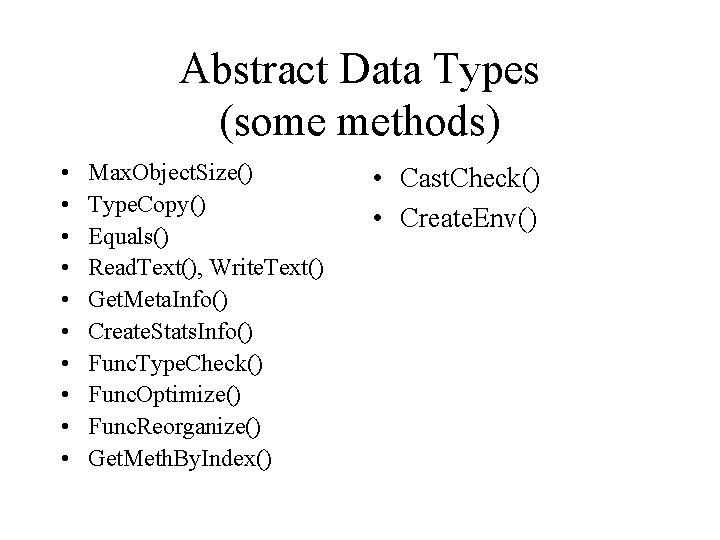
Abstract Data Types (some methods) • • • Max. Object. Size() Type. Copy() Equals() Read. Text(), Write. Text() Get. Meta. Info() Create. Stats. Info() Func. Type. Check() Func. Optimize() Func. Reorganize() Get. Meth. By. Index() • Cast. Check() • Create. Env()
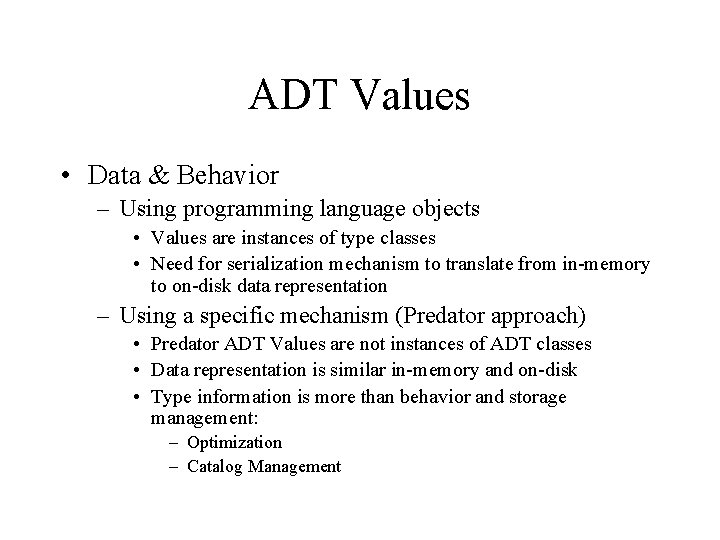
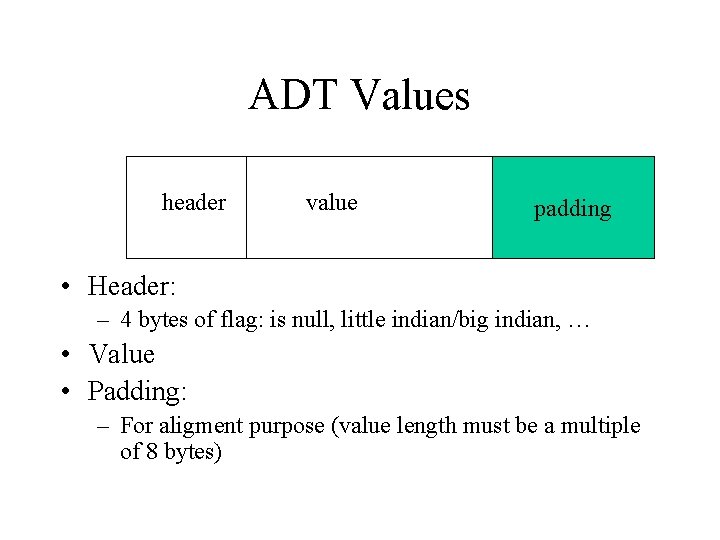
ADT Values • Data & Behavior – Using programming language objects • Values are instances of type classes • Need for serialization mechanism to translate from in-memory to on-disk data representation – Using a specific mechanism (Predator approach) • Predator ADT Values are not instances of ADT classes • Data representation is similar in-memory and on-disk • Type information is more than behavior and storage management: – Optimization – Catalog Management
ADT Values header value padding • Header: – 4 bytes of flag: is null, little indian/big indian, … • Value • Padding: – For aligment purpose (value length must be a multiple of 8 bytes)
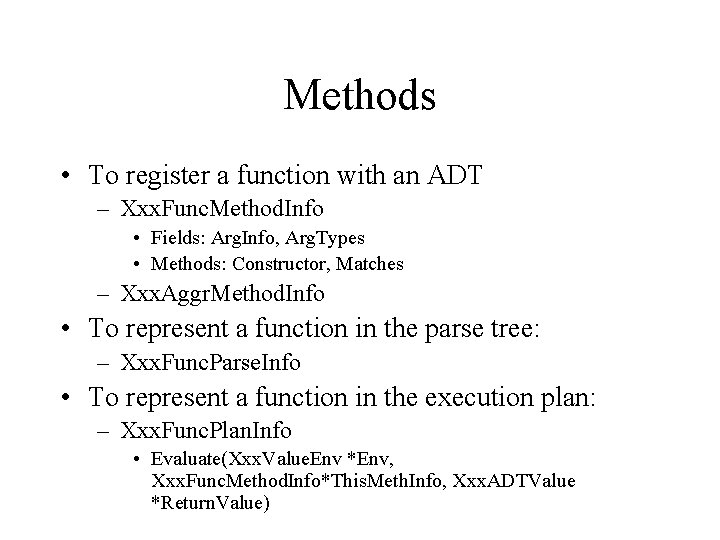
Methods • To register a function with an ADT – Xxx. Func. Method. Info • Fields: Arg. Info, Arg. Types • Methods: Constructor, Matches – Xxx. Aggr. Method. Info • To represent a function in the parse tree: – Xxx. Func. Parse. Info • To represent a function in the execution plan: – Xxx. Func. Plan. Info • Evaluate(Xxx. Value. Env *Env, Xxx. Func. Method. Info*This. Meth. Info, Xxx. ADTValue *Return. Value)
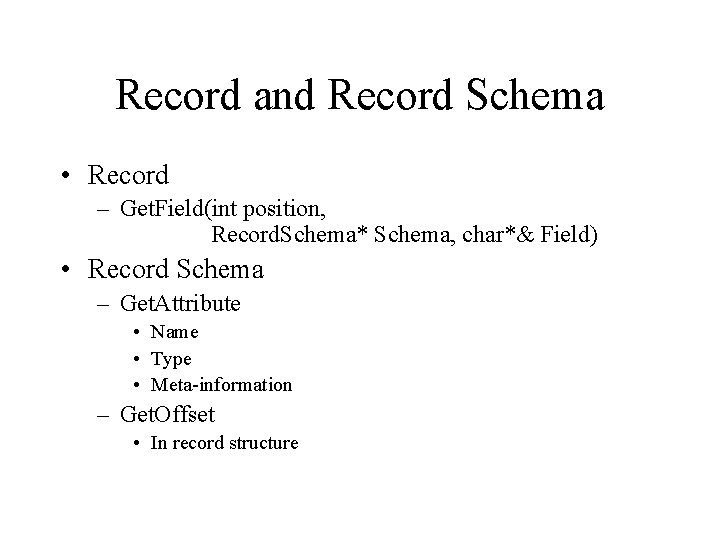
Record and Record Schema • Record – Get. Field(int position, Record. Schema* Schema, char*& Field) • Record Schema – Get. Attribute • Name • Type • Meta-information – Get. Offset • In record structure
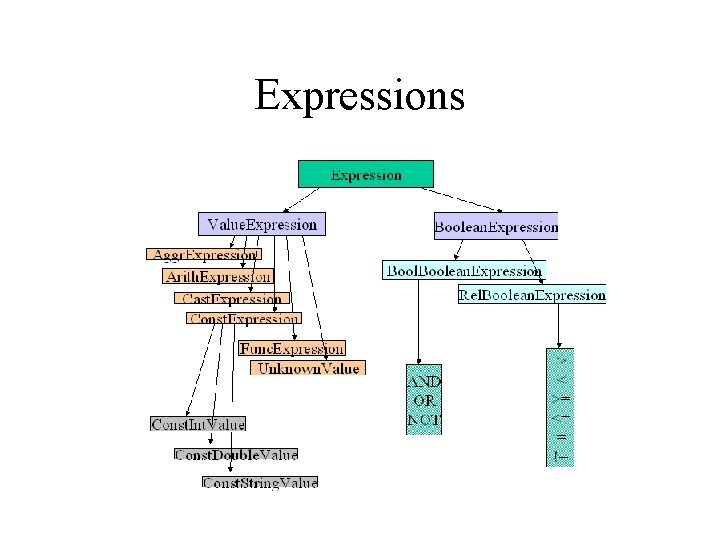
Expressions
Unknown Value (fields) • Name of the attribute • Index – Source: child block – Attribute Index: position in child block • Correlation Height
Unknown Value (some methods) • Resolve Variables / Update Unknowns – Manipulate index for source and attribute • Get Dependencies / Redirect Dependencies – Initialize dependency bitmap structure • Match – Checks whether function expression matches a given expression -- matching information is returned • Evaluate – Extracts the ADT Value from position Attribute. Index in Source. Index child record
Expression & Plan • Function Expression – – Func. Parse. Info Owner, Arg Update Unknowns, Get. Dependencies, Match Optimize • Function Plan – – Func. Plan. Info Owner. Plan, Arg. Plan eval. Owner, eval. Args Evaluate
Relational Query Processing • Relational ADT – No ADT methods defined • Data Engine – Relation – Storage Manager – Catalog Manager • Query Processing Engine – Parse – Optimize – Execute
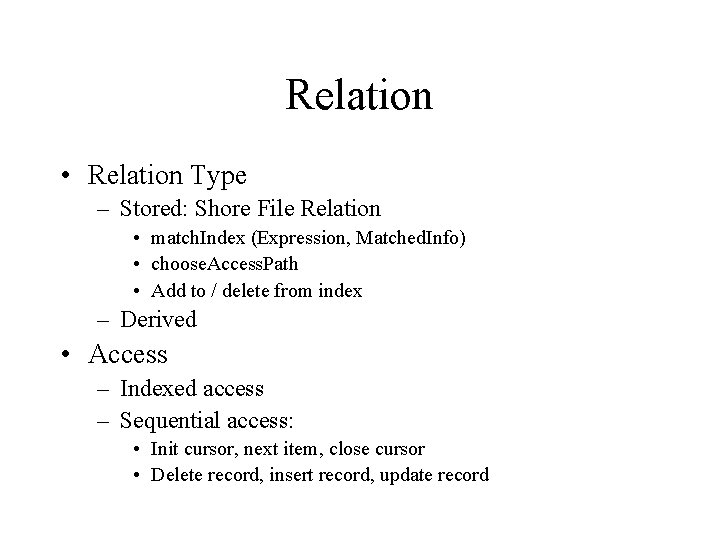
Relation • Relation Type – Stored: Shore File Relation • match. Index (Expression, Matched. Info) • choose. Access. Path • Add to / delete from index – Derived • Access – Indexed access – Sequential access: • Init cursor, next item, close cursor • Delete record, insert record, update record
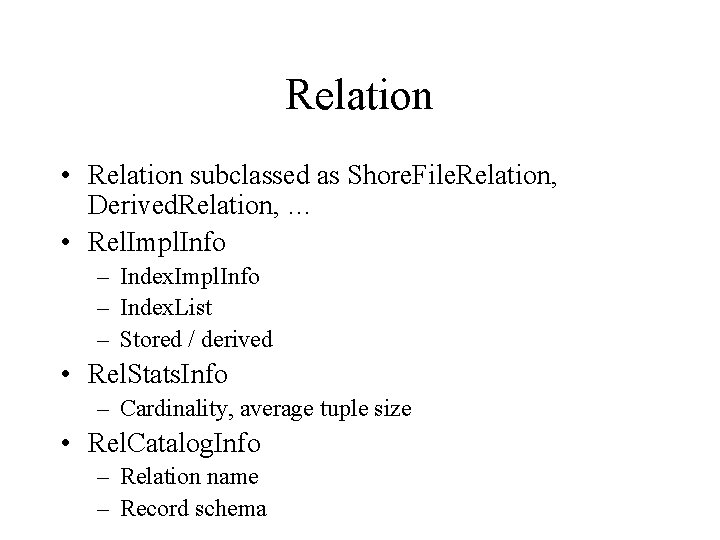
Relation • Relation subclassed as Shore. File. Relation, Derived. Relation, … • Rel. Impl. Info – Index. List – Stored / derived • Rel. Stats. Info – Cardinality, average tuple size • Rel. Catalog. Info – Relation name – Record schema
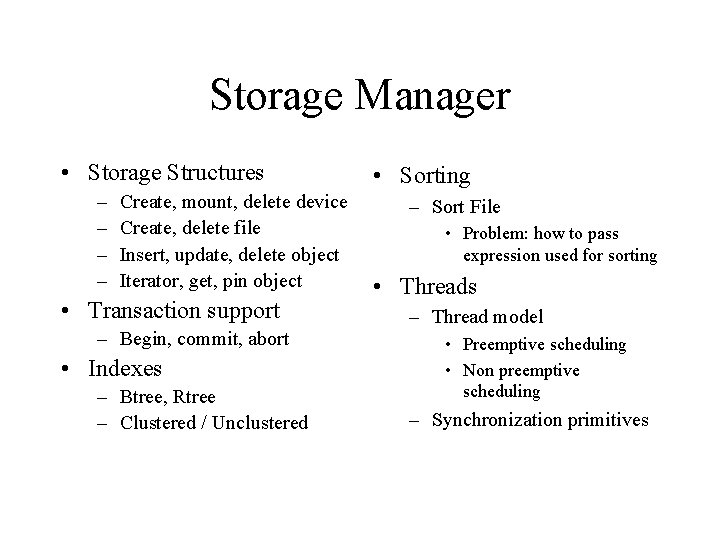
Storage Manager • Storage Structures – – Create, mount, delete device Create, delete file Insert, update, delete object Iterator, get, pin object • Transaction support – Begin, commit, abort • Indexes – Btree, Rtree – Clustered / Unclustered • Sorting – Sort File • Problem: how to pass expression used for sorting • Threads – Thread model • Preemptive scheduling • Non preemptive scheduling – Synchronization primitives
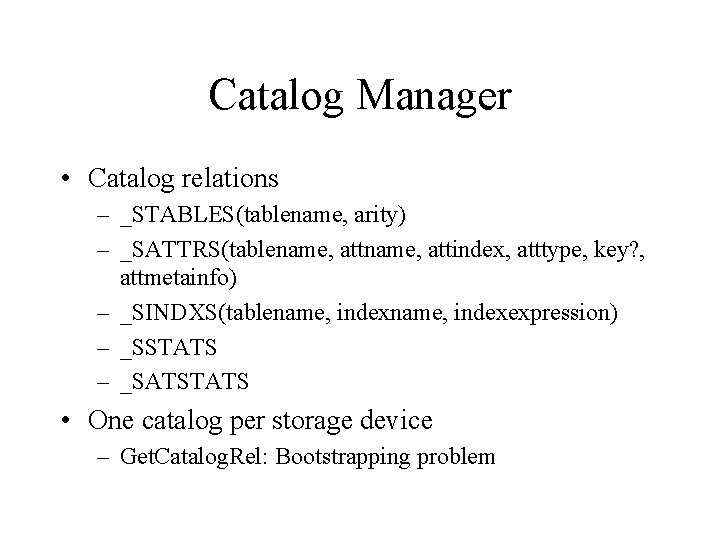
Catalog Manager • Catalog relations – _STABLES(tablename, arity) – _SATTRS(tablename, attindex, atttype, key? , attmetainfo) – _SINDXS(tablename, indexexpression) – _SSTATS – _SATSTATS • One catalog per storage device – Get. Catalog. Rel: Bootstrapping problem
Indexes • Index Class (superclass of Shore. BTree and Shore. RTree) – Type Id – Index range: get range(given an Expression), merge ranges – Create / delete index – Insert, delete, get entry – Match (specific to Index class) • Index. Impl. Info associated to a relation – Index Type – Index expression – Match
SQL Parser • Flex (tokenizer)/ Bison (grammar) • Interaction with: – Expressions – Types – Data Engine • Insert, Update, Delete Record into Relation • Create, Delete Index • Create, Delete Relation – Query Engine • Store View • Exec Query • Generates Parse Tree
Semantic Checker • Creates Query Graph – – – SPJ block One block per relation in the From clause Views are developed Aggregate block is added If needed a SPJ block is added at the root • Verifies conditions on SQL input – Targets with similar names, aggregates in where clause, grouping without aggregates, same expression in aggregate and to group on, …
Type Checker • Traverses the Query Block graph – Bottom-up then top down • Relies on – Query graph structure – Methods defined for Unknown Variables • Resolve Variables
Query Rewrite Rules • Rule Engine – Vector list of rules – Execute rules on one downward and one upward pass • Rules – Manipulation across query blocks • Pushing projections, selections • Merging query blocks • Eliminating distinct clauses – Each rule is a class that implements the following method • Apply. Rule(Rel. Query. Node *In, Xxx. Bool &Success, Rel. Query. Node *Out)
Optimizer • Predicates – Array of predicate plans, predicate dependencies and predicate selectivities – Init, Selection, Join, Residual bitmaps • Query Block Plan – Redirect dependencies
Optimizers • Simple – Naive • Join order fixed by order in the from clause. Generates a single N-way SPJ node. – Greedy • Join order based on cardinality of intermediate relations. Generates a leftdeep pipeline of two-way joins. • Cost based – Simplified KBZ • Tries each relation as outer most relation and compares cost. Generates a left-deep pipeline of twoway joins. – Dynamic Programming • System R like enumeration of join space and pruning. Generates a left-deep pipeline of two-way joins.
SPJ Naive Optimization phases • Step 1: – Generate plan for children blocks • Step 2: – Create the predicate bitmap for the selections and joins • Step 3: – Construct a remapping of unknown variables depending on schema of children • Step 4: – Modify all expressions based on remapping • Step 5: – Generate plan operator for SPJ
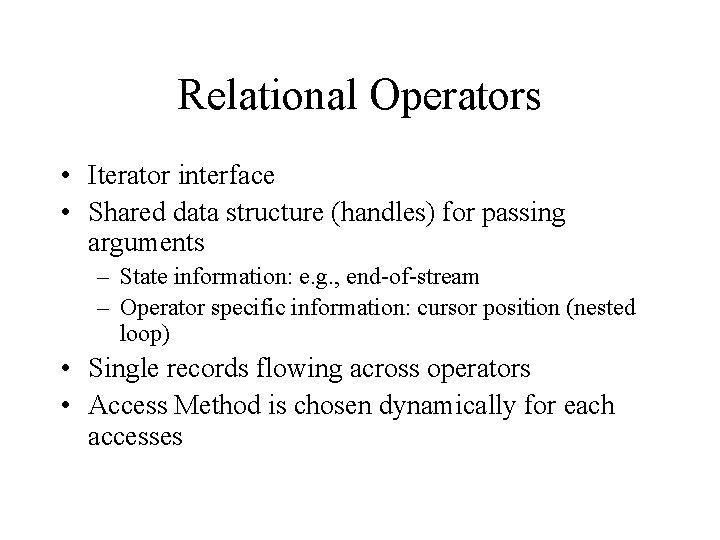
Relational Operators • Iterator interface • Shared data structure (handles) for passing arguments – State information: e. g. , end-of-stream – Operator specific information: cursor position (nested loop) • Single records flowing across operators • Access Method is chosen dynamically for each accesses
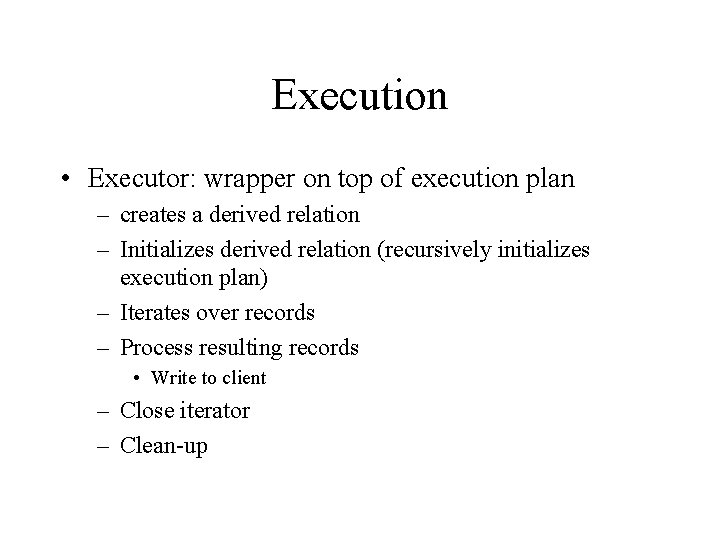
Execution • Executor: wrapper on top of execution plan – creates a derived relation – Initializes derived relation (recursively initializes execution plan) – Iterates over records – Process resulting records • Write to client – Close iterator – Clean-up
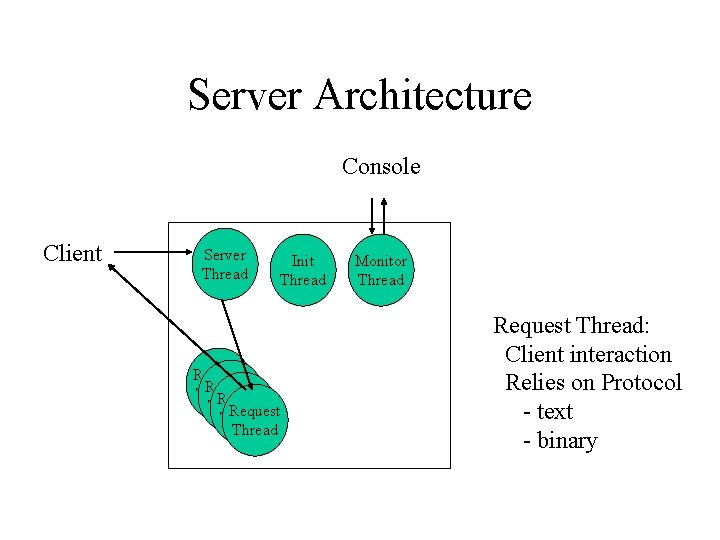
Server Architecture Console Client Server Thread Init Thread Request Thread Monitor Thread Request Thread: Client interaction Relies on Protocol - text - binary
Summary • Predator achieves extensibility by isolating these modules which are independent from the rest of the system – Types and Expressions are used throughout the system and are prone to changes • Predator reuses the clean internal data structures defined in Starbust