
Sketching Streams through the Net Distributed Approximate Query

Sketching Streams through the Net: Distributed Approximate Query Tracking Minos Garofalakis Intel Research Berkeley minos. garofalakis@intel. com (Joint work with Graham Cormode, Bell Labs) Intel Research
Continuous Distributed Queries Traditional data management supports queries one shot – May be look-ups or sophisticated data management tasks, but tend to be on-demand – New large scale data monitoring tasks pose novel data management challenges Continuous , Distributed , High Speed , High Volume … Intel Research
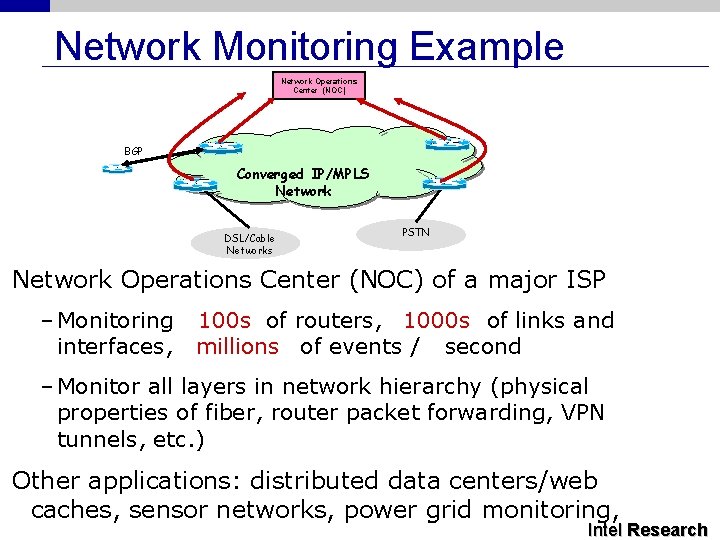
Network Monitoring Example Network Operations Center (NOC) BGP Converged IP/MPLS Network DSL/Cable Networks PSTN Network Operations Center (NOC) of a major ISP – Monitoring 100 s of routers, 1000 s of links and interfaces, millions of events / second – Monitor all layers in network hierarchy (physical properties of fiber, router packet forwarding, VPN tunnels, etc. ) Other applications: distributed data centers/web caches, sensor networks, power grid monitoring, Intel Research
Common Aspects / Challenges Monitoring is Continuous … – Need real-time tracking, not one-shot query/response …Distributed… – Many remote sites, connected over a network, each sees only part of the data stream(s ) – Communication constraints …Streaming… – Each site sees a high speed stream of data, and may be resource (CPU/Memory) constrained …Holistic… – Track quantity/query over the distribution global data …General Purpose… Intel Research
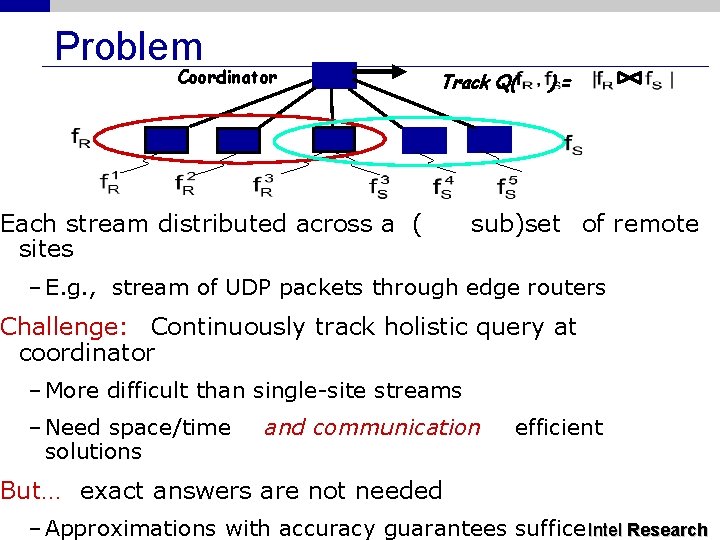
Problem Coordinator Track Q( Each stream distributed across a ( sites )= sub)set of remote – E. g. , stream of UDP packets through edge routers Challenge: Continuously track holistic query at coordinator – More difficult than single-site streams – Need space/time solutions and communication efficient But… exact answers are not needed – Approximations with accuracy guarantees suffice Intel Research
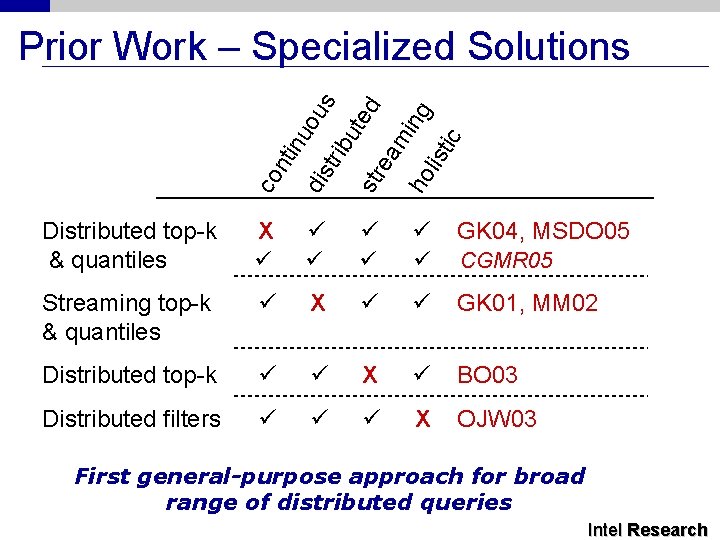
co nti nu ou dis trib s ute str d ea mi ng ho lis tic Prior Work – Specialized Solutions Distributed top-k & quantiles X GK 04, MSDO 05 CGMR 05 Streaming top-k & quantiles X GK 01, MM 02 Distributed top-k X BO 03 Distributed filters X OJW 03 First general-purpose approach for broad range of distributed queries Intel Research
System Architecture Streams at each site add to (or, subtract from) multisets /frequency distribution vectors – More generally, can have hierarchical structure Intel Research
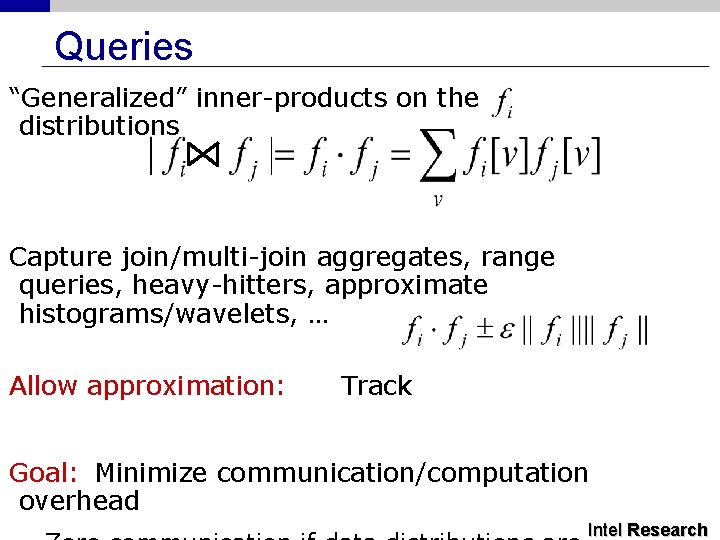
Queries “Generalized” inner-products on the distributions Capture join/multi-join aggregates, range queries, heavy-hitters, approximate histograms/wavelets, … Allow approximation: Track Goal: Minimize communication/computation overhead Intel Research
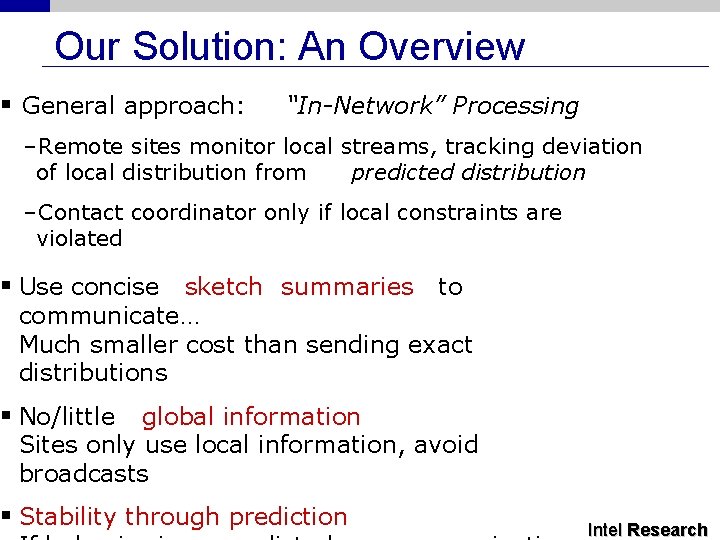
Our Solution: An Overview § General approach: “In-Network” Processing – Remote sites monitor local streams, tracking deviation of local distribution from predicted distribution – Contact coordinator only if local constraints are violated § Use concise sketch summaries to communicate… Much smaller cost than sending exact distributions § No/little global information Sites only use local information, avoid broadcasts § Stability through prediction Intel Research
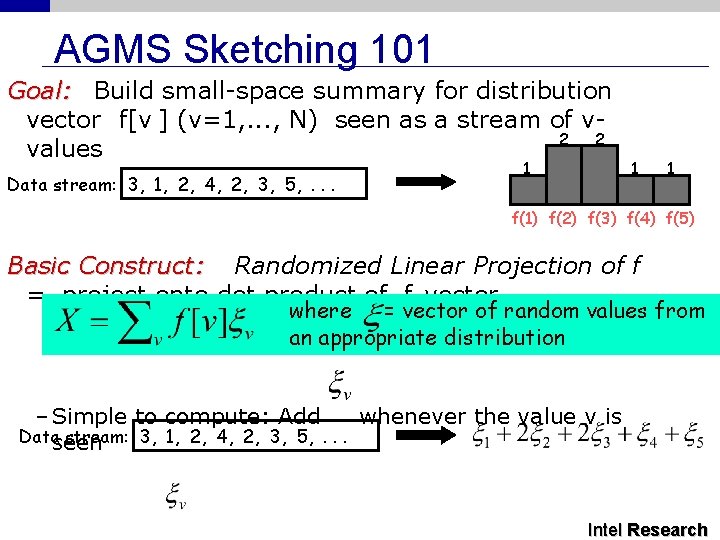
AGMS Sketching 101 Goal: Build small-space summary for distribution vector f[v ] (v=1, . . . , N) seen as a stream of v 2 2 values Data stream: 3, 1, 2, 4, 2, 3, 5, . . . 1 1 1 f(1) f(2) f(3) f(4) f(5) Basic Construct: Randomized Linear Projection of f = project onto dot product of f-vector where = vector of random values from an appropriate distribution – Simple to compute: Add whenever the value v is Dataseen stream: 3, 1, 2, 4, 2, 3, 5, . . . Intel Research
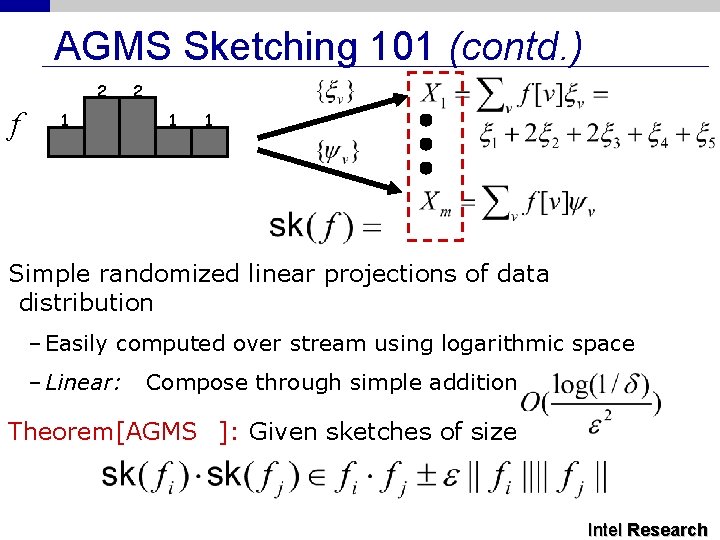
AGMS Sketching 101 (contd. ) 2 f 1 2 1 1 Simple randomized linear projections of data distribution – Easily computed over stream using logarithmic space – Linear: Compose through simple addition Theorem[AGMS ]: Given sketches of size Intel Research
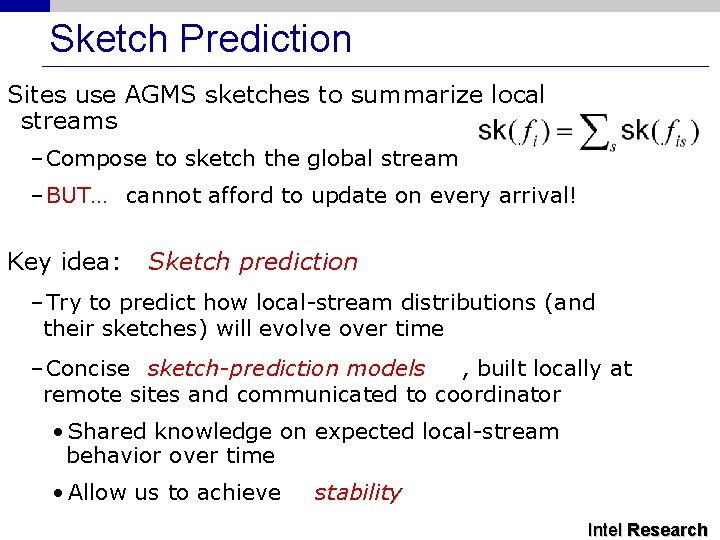
Sketch Prediction Sites use AGMS sketches to summarize local streams – Compose to sketch the global stream – BUT… cannot afford to update on every arrival! Key idea: Sketch prediction – Try to predict how local-stream distributions (and their sketches) will evolve over time – Concise sketch-prediction models , built locally at remote sites and communicated to coordinator • Shared knowledge on expected local-stream behavior over time • Allow us to achieve stability Intel Research
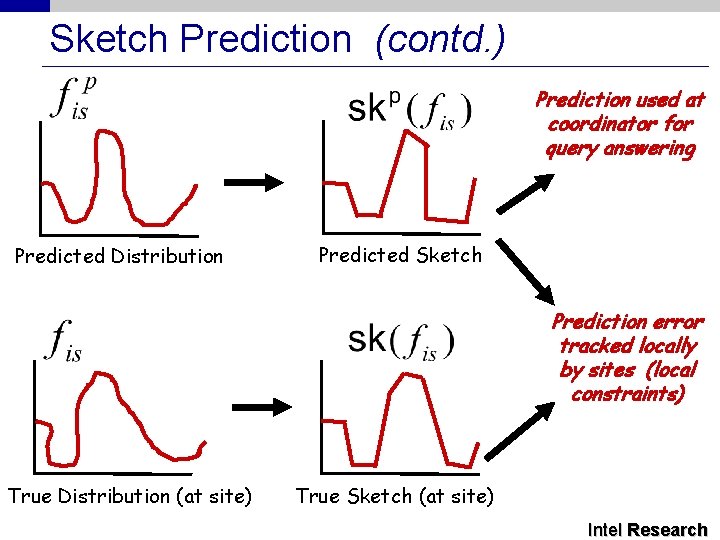
Sketch Prediction (contd. ) Prediction used at coordinator for query answering Predicted Distribution Predicted Sketch Prediction error tracked locally by sites (local constraints) True Distribution (at site) True Sketch (at site) Intel Research
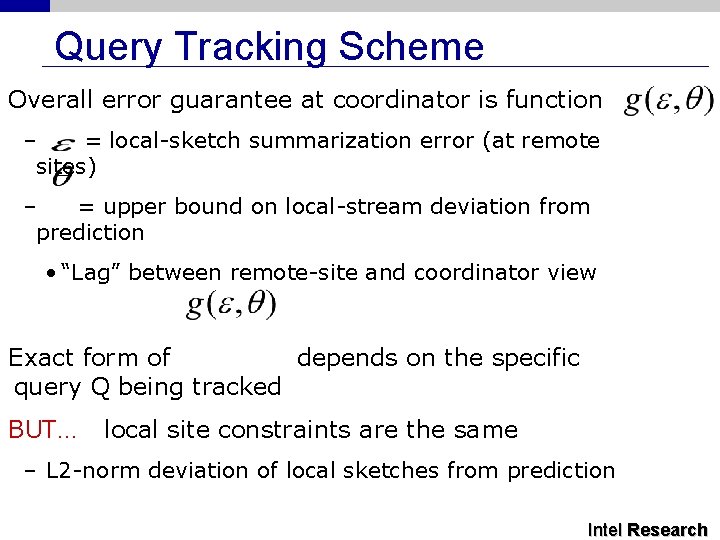
Query Tracking Scheme Overall error guarantee at coordinator is function – = local-sketch summarization error (at remote sites) – = upper bound on local-stream deviation from prediction • “Lag” between remote-site and coordinator view Exact form of depends on the specific query Q being tracked BUT… local site constraints are the same – L 2 -norm deviation of local sketches from prediction Intel Research
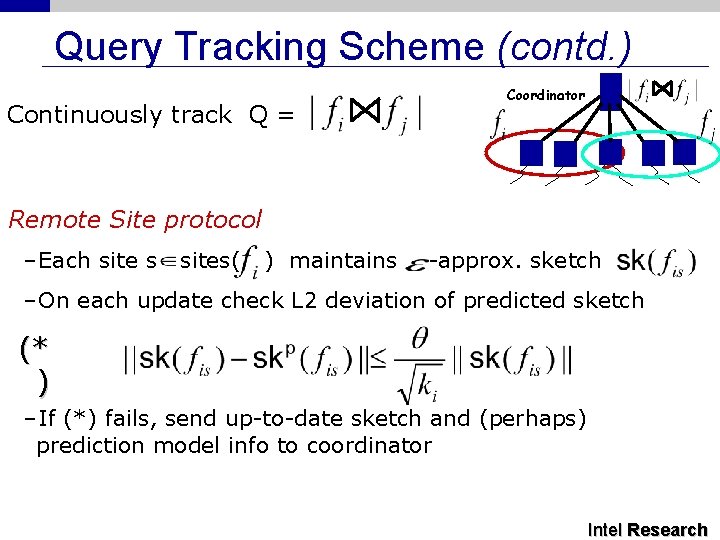
Query Tracking Scheme (contd. ) Continuously track Q = Coordinator Remote Site protocol – Each site s sites( ) maintains -approx. sketch – On each update check L 2 deviation of predicted sketch (* ) – If (*) fails, send up-to-date sketch and (perhaps) prediction model info to coordinator Intel Research
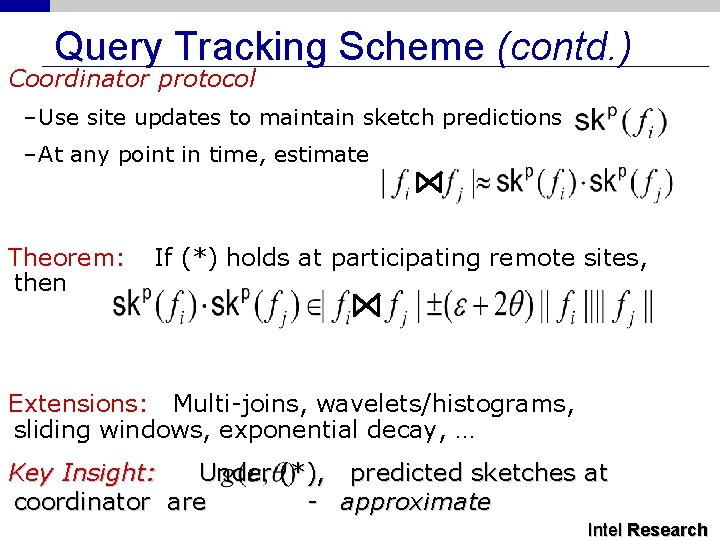
Query Tracking Scheme (contd. ) Coordinator protocol – Use site updates to maintain sketch predictions – At any point in time, estimate Theorem: then If (*) holds at participating remote sites, Extensions: Multi-joins, wavelets/histograms, sliding windows, exponential decay, … Key Insight: Under (*), predicted sketches at coordinator are - approximate Intel Research
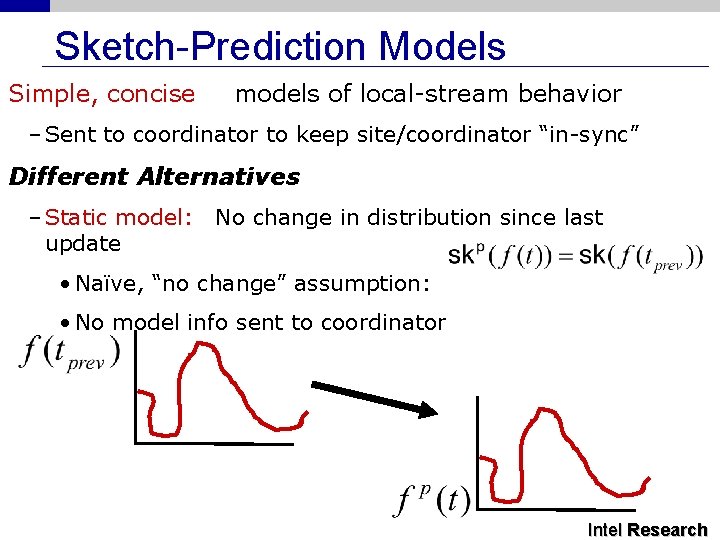
Sketch-Prediction Models Simple, concise models of local-stream behavior – Sent to coordinator to keep site/coordinator “in-sync” Different Alternatives – Static model: No change in distribution since last update • Naïve, “no change” assumption: • No model info sent to coordinator Intel Research
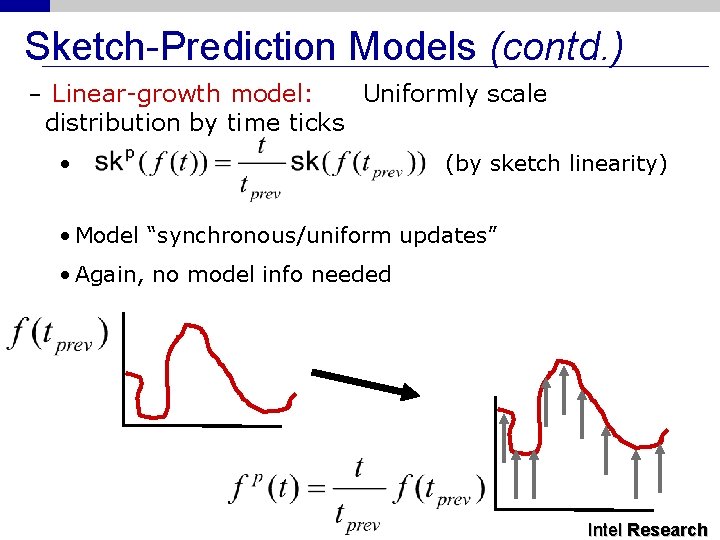
Sketch-Prediction Models (contd. ) – Linear-growth model: distribution by time ticks Uniformly scale • (by sketch linearity) • Model “synchronous/uniform updates” • Again, no model info needed Intel Research
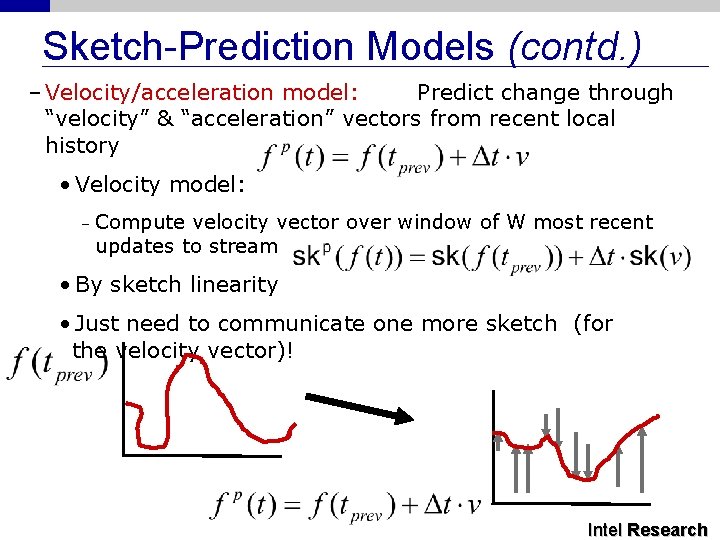
Sketch-Prediction Models (contd. ) – Velocity/acceleration model: Predict change through “velocity” & “acceleration” vectors from recent local history • Velocity model: – Compute velocity vector over window of W most recent updates to stream • By sketch linearity • Just need to communicate one more sketch (for the velocity vector)! Intel Research
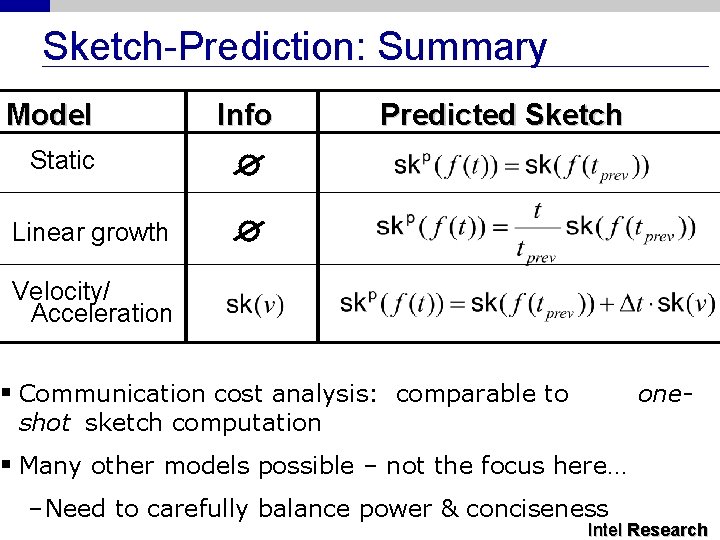
Sketch-Prediction: Summary Model Info Predicted Sketch Static Linear growth Velocity/ Acceleration § Communication cost analysis: comparable to one- shot sketch computation § Many other models possible – not the focus here… – Need to carefully balance power & conciseness Intel Research
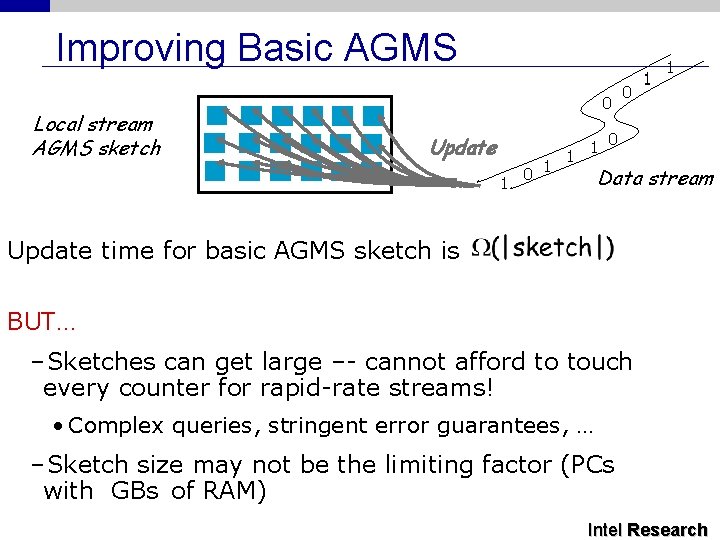
Improving Basic AGMS Local stream AGMS sketch 0 Update 1 0 1 1 0 Data stream Update time for basic AGMS sketch is BUT… – Sketches can get large –- cannot afford to touch every counter for rapid-rate streams! • Complex queries, stringent error guarantees, … – Sketch size may not be the limiting factor (PCs with GBs of RAM) Intel Research
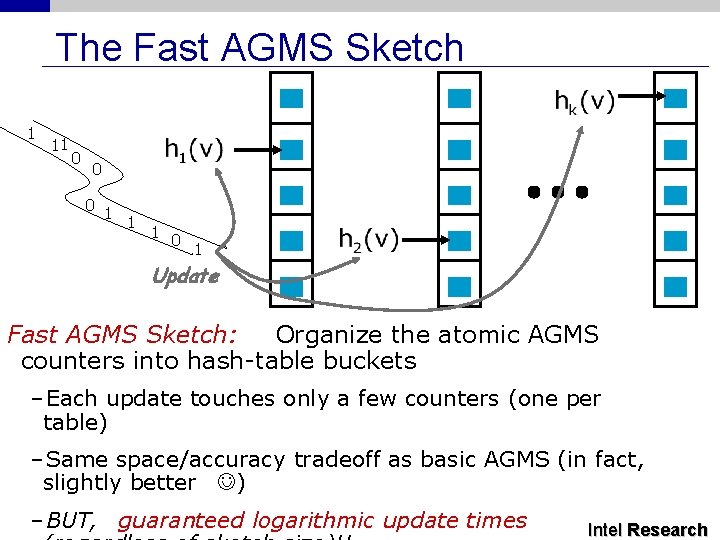
The Fast AGMS Sketch 1 11 0 0 0 1 1 1 0 1 Update Fast AGMS Sketch: Organize the atomic AGMS counters into hash-table buckets – Each update touches only a few counters (one per table) – Same space/accuracy tradeoff as basic AGMS (in fact, slightly better ) – BUT, guaranteed logarithmic update times Intel Research
Experimental Study Prototype implementation of query-tracking schemes in C Measured improvement in communication cost (compared to sending all updates) Ran on real-life data – World Cup 1998 HTTP requests, 4 distributed sites, about 14 m updates per day Explored – Accuracy tradeoffs ( vs. ) – Effectiveness of prediction models – Benefits of Fast AGMS sketch Intel Research
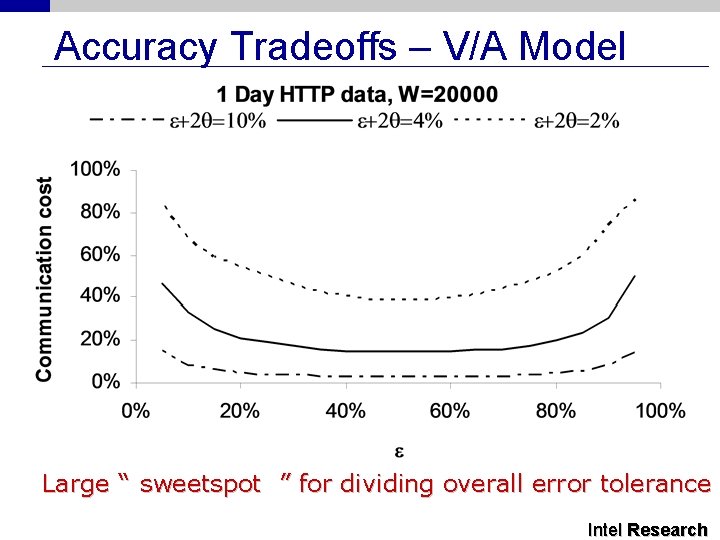
Accuracy Tradeoffs – V/A Model Large “ sweetspot ” for dividing overall error tolerance Intel Research
Prediction Models Intel Research
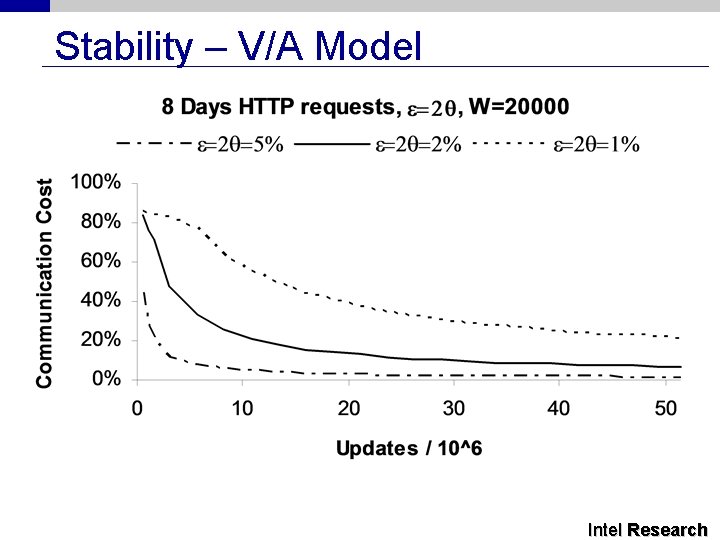
Stability – V/A Model Intel Research
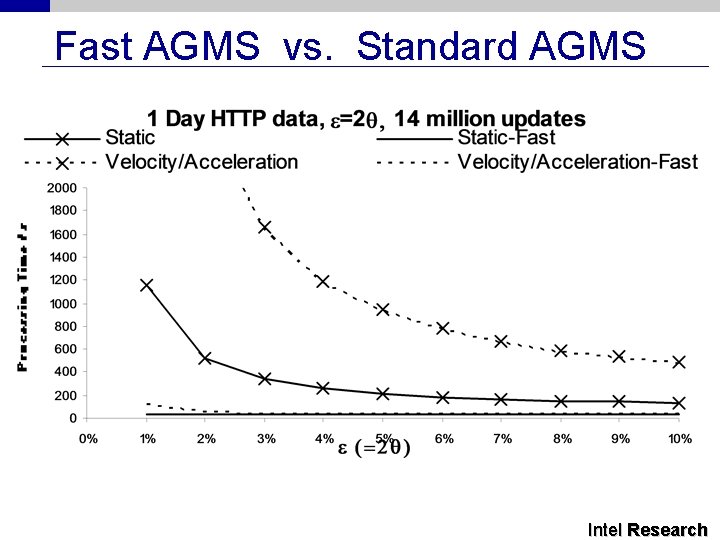
Fast AGMS vs. Standard AGMS Intel Research
Conclusions & Future Directions Novel algorithms for communication-efficient distributed approximate query tracking – Continuous, sketch-based guarantees – General-purpose: solution with error Covers a broad range of queries – “In-network” processing using constraints – Novel sketch structures simple, localized optimized for rapid streams Open problems – Specialized solutions optimized for specific query classes? – More clever prediction models (e. g. , capturing Intel Research
Thank you! http: //www 2. berkeley. intel-research. net/~minos/ minos. garofalakis@intel. com Intel Research
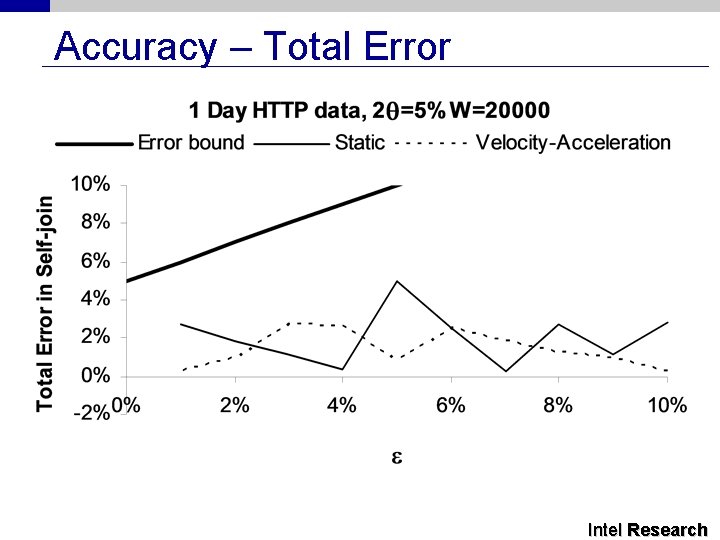
Accuracy – Total Error Intel Research
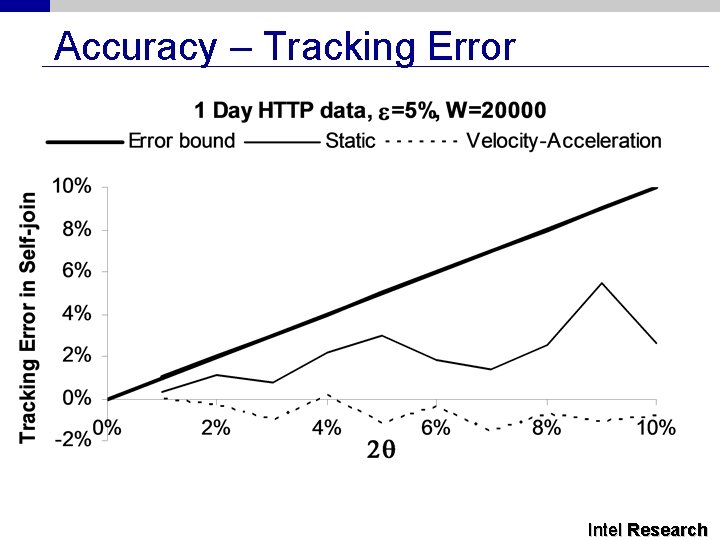
Accuracy – Tracking Error Intel Research
Other Monitoring Applications Sensor networks – Monitor habitat and environmental parameters – Track many objects, intrusions, trend analysis… Utility Companies – Monitor power grid, customer usage patterns etc. – Alerts and rapid response in case of problems Intel Research
- Slides: 32