
Lambda and LINQ Queries on Collections Lambda LINQ

Lambda and LINQ Queries on Collections Lambda LINQ Soft. Uni Team Technical Trainers Software University http: //softuni. bg Q N LI
Table of Contents 1. LINQ § What is LINQ? § Math operations with LINQ § Reading collections in a single line 2. Data Processing with Lambda and LINQ § Filtering, Mapping, Ordering 2
Questions? sli. do #extended-softuni 3
Q N LI f(x) y Lambda Functions and LINQ in Action: Filtering, Mapping, Ordering
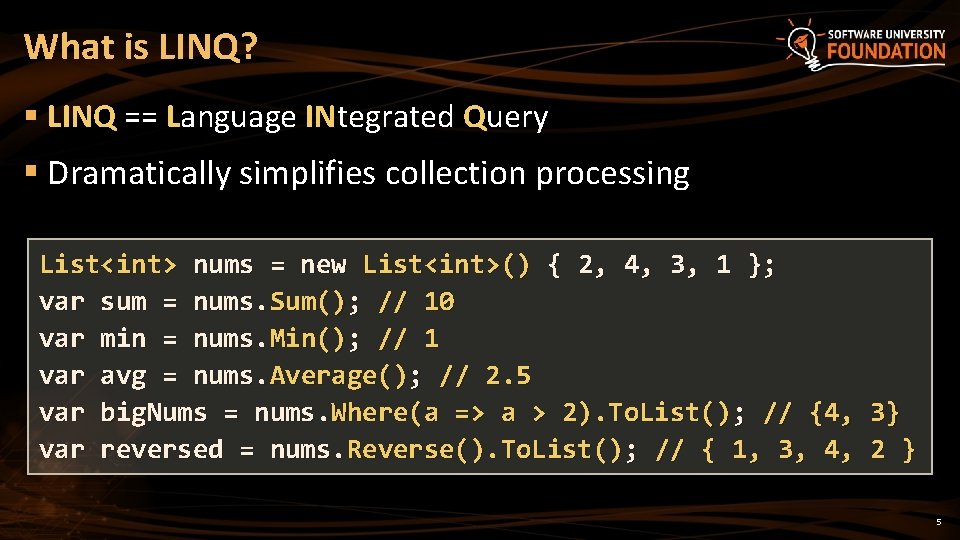
What is LINQ? § LINQ == Language INtegrated Query § Dramatically simplifies collection processing List<int> nums = new List<int>() { 2, 4, 3, 1 }; var sum = nums. Sum(); // 10 var min = nums. Min(); // 1 var avg = nums. Average(); // 2. 5 var big. Nums = nums. Where(a => a > 2). To. List(); // {4, 3} var reversed = nums. Reverse(). To. List(); // { 1, 3, 4, 2 } 5
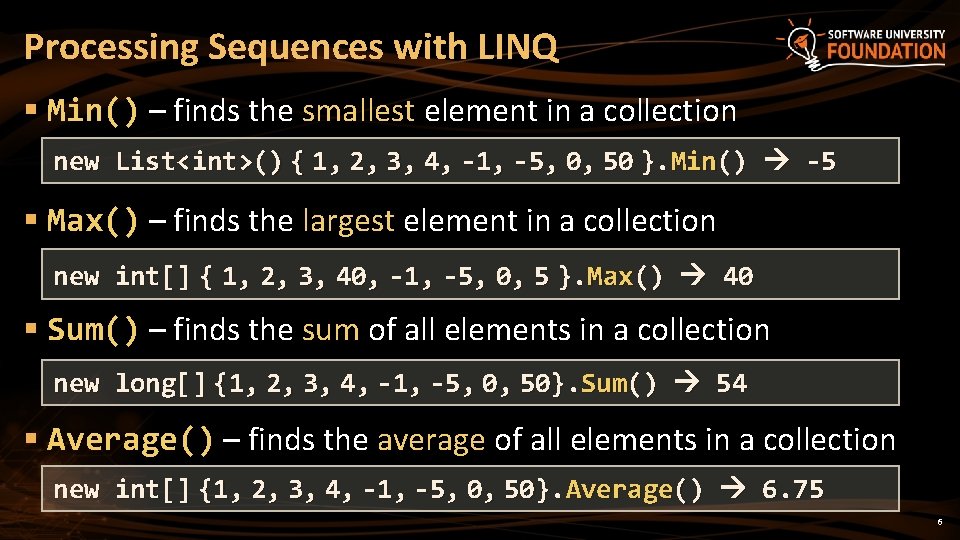
Processing Sequences with LINQ § Min() – finds the smallest element in a collection new List<int>() { 1, 2, 3, 4, -1, -5, 0, 50 }. Min() -5 § Max() – finds the largest element in a collection new int[] { 1, 2, 3, 40, -1, -5, 0, 5 }. Max() 40 § Sum() – finds the sum of all elements in a collection new long[] {1, 2, 3, 4, -1, -5, 0, 50}. Sum() 54 § Average() – finds the average of all elements in a collection new int[] {1, 2, 3, 4, -1, -5, 0, 50}. Average() 6. 75 6
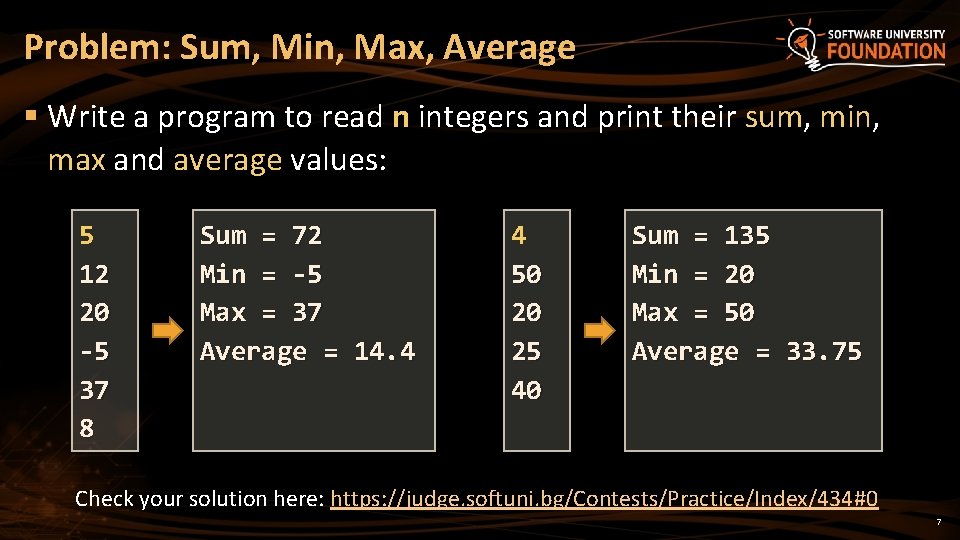
Problem: Sum, Min, Max, Average § Write a program to read n integers and print their sum, min, max and average values: 5 12 20 -5 37 8 Sum = 72 Min = -5 Max = 37 Average = 14. 4 4 50 20 25 40 Sum = 135 Min = 20 Max = 50 Average = 33. 75 Check your solution here: https: //judge. softuni. bg/Contests/Practice/Index/434#0 7
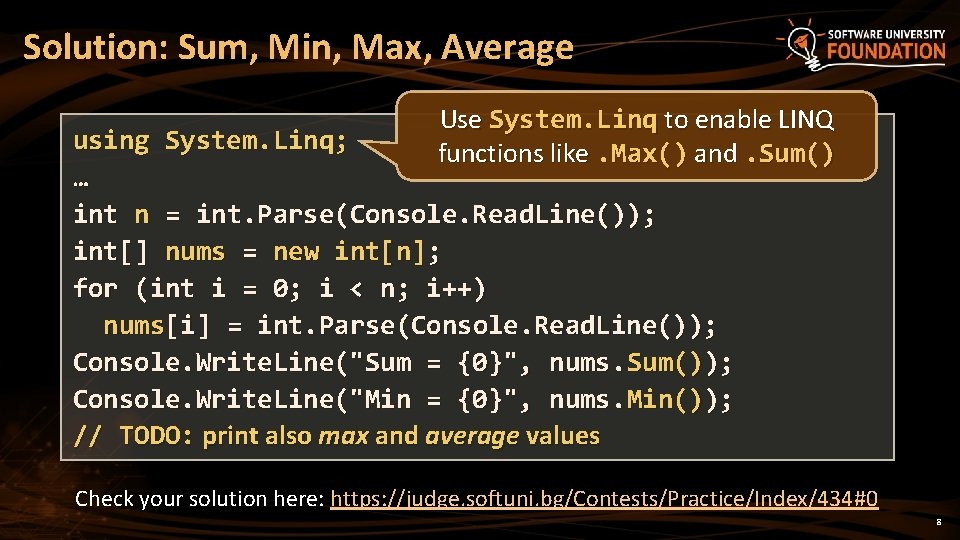
Solution: Sum, Min, Max, Average Use System. Linq to enable LINQ functions like. Max() and. Sum() using System. Linq; … int n = int. Parse(Console. Read. Line()); int[] nums = new int[n]; for (int i = 0; i < n; i++) nums[i] = int. Parse(Console. Read. Line()); Console. Write. Line("Sum = {0}", nums. Sum()); Console. Write. Line("Min = {0}", nums. Min()); // TODO: print also max and average values Check your solution here: https: //judge. softuni. bg/Contests/Practice/Index/434#0 8
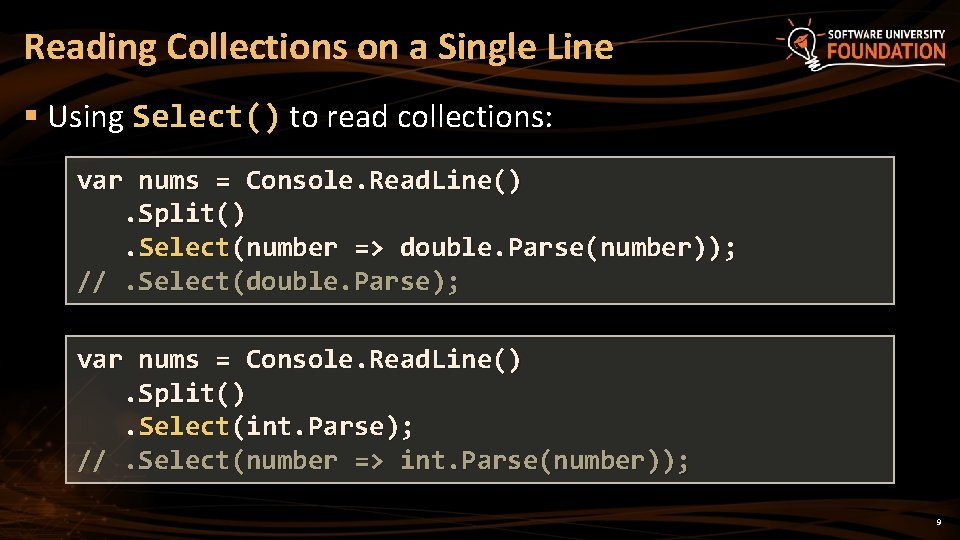
Reading Collections on a Single Line § Using Select() to read collections: var nums = Console. Read. Line(). Split(). Select(number => double. Parse(number)); //. Select(double. Parse); var nums = Console. Read. Line(). Split(). Select(int. Parse); //. Select(number => int. Parse(number)); 9
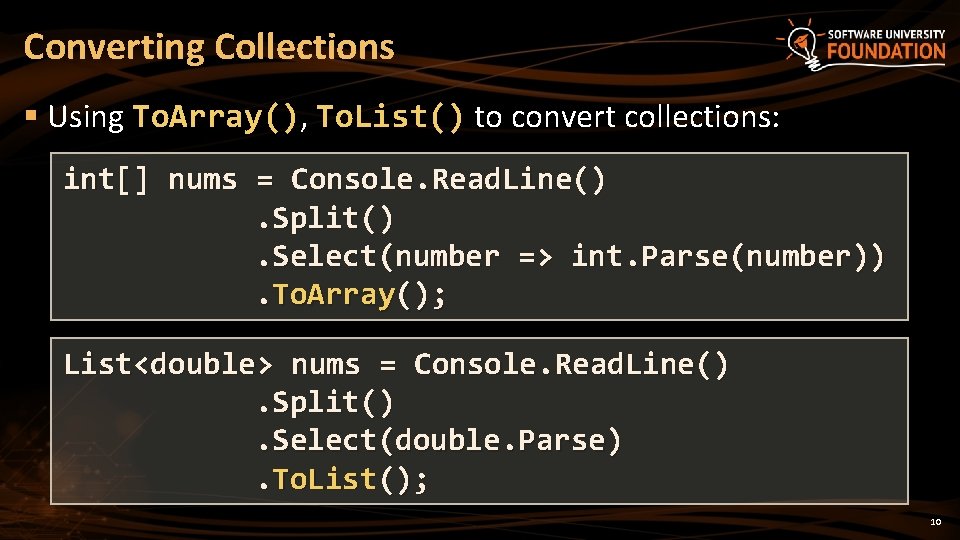
Converting Collections § Using To. Array(), To. List() to convert collections: int[] nums = Console. Read. Line(). Split(). Select(number => int. Parse(number)). To. Array(); List<double> nums = Console. Read. Line(). Split(). Select(double. Parse). To. List(); 10
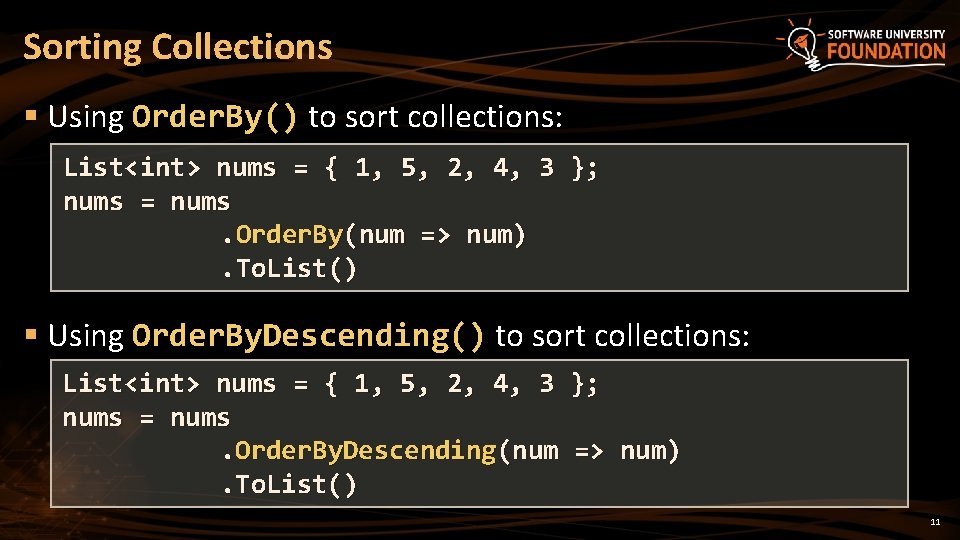
Sorting Collections § Using Order. By() to sort collections: List<int> nums = { 1, 5, 2, 4, 3 }; nums = nums. Order. By(num => num). To. List() § Using Order. By. Descending() to sort collections: List<int> nums = { 1, 5, 2, 4, 3 }; nums = nums. Order. By. Descending(num => num). To. List() 11
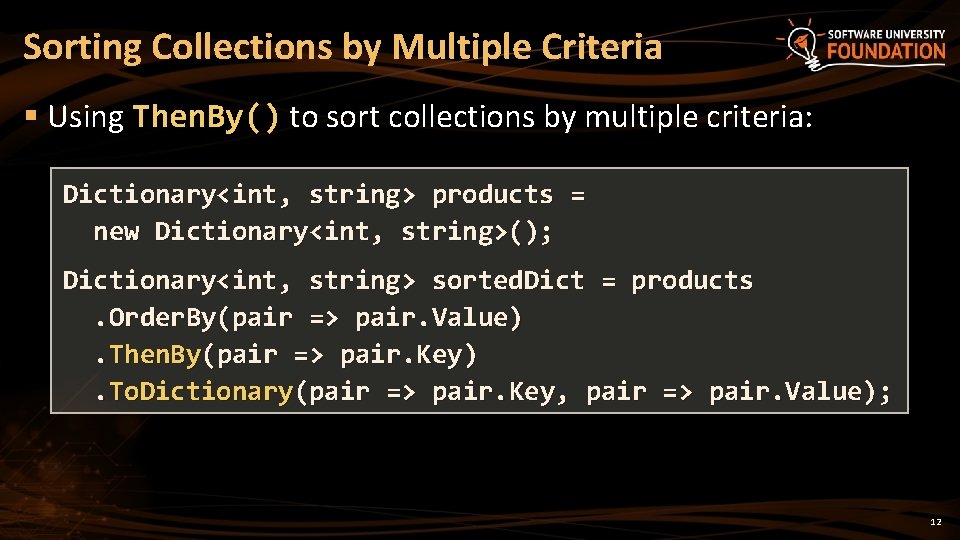
Sorting Collections by Multiple Criteria § Using Then. By() to sort collections by multiple criteria: Dictionary<int, string> products = new Dictionary<int, string>(); Dictionary<int, string> sorted. Dict = products. Order. By(pair => pair. Value). Then. By(pair => pair. Key). To. Dictionary(pair => pair. Key, pair => pair. Value); 12
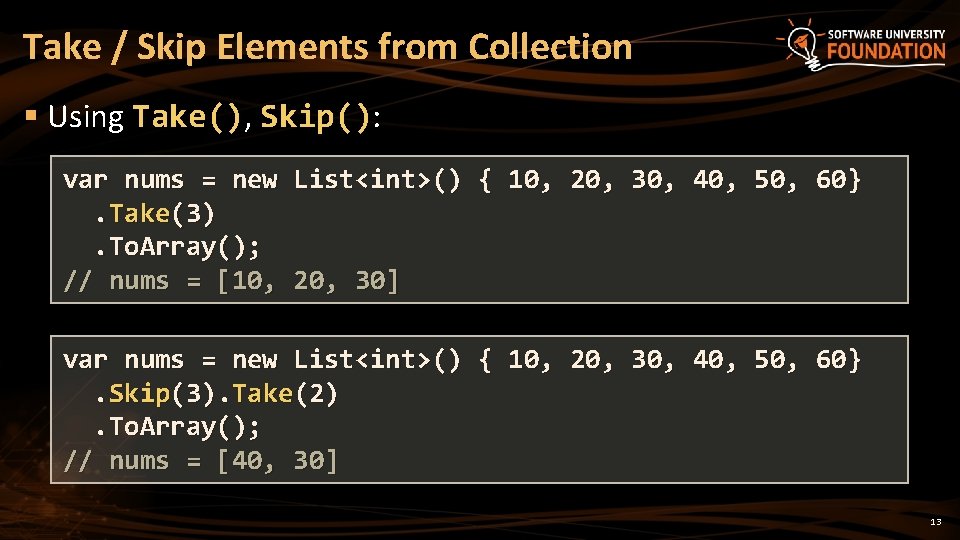
Take / Skip Elements from Collection § Using Take(), Skip(): var nums = new List<int>() { 10, 20, 30, 40, 50, 60}. Take(3). To. Array(); // nums = [10, 20, 30] var nums = new List<int>() { 10, 20, 30, 40, 50, 60}. Skip(3). Take(2). To. Array(); // nums = [40, 30] 13
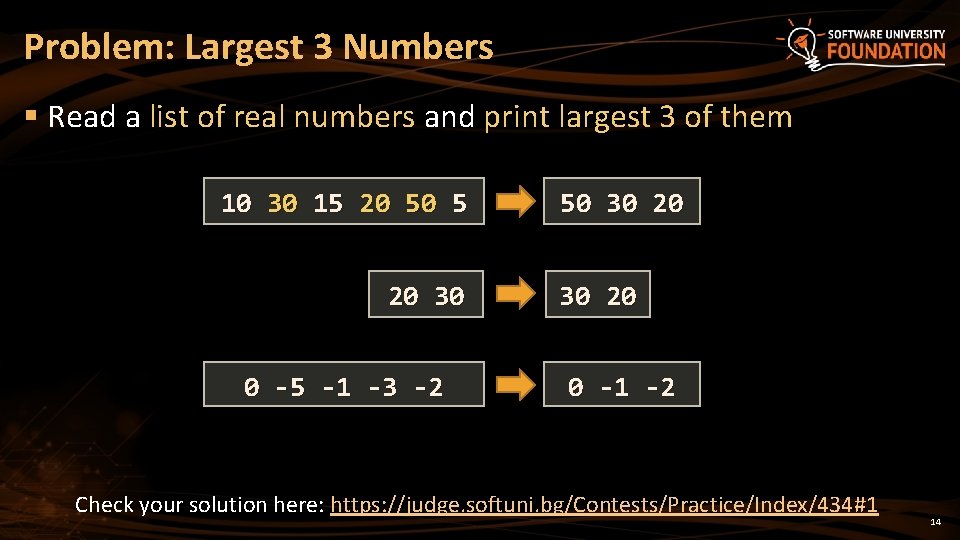
Problem: Largest 3 Numbers § Read a list of real numbers and print largest 3 of them 10 30 15 20 50 5 20 30 0 -5 -1 -3 -2 50 30 20 0 -1 -2 Check your solution here: https: //judge. softuni. bg/Contests/Practice/Index/434#1 14
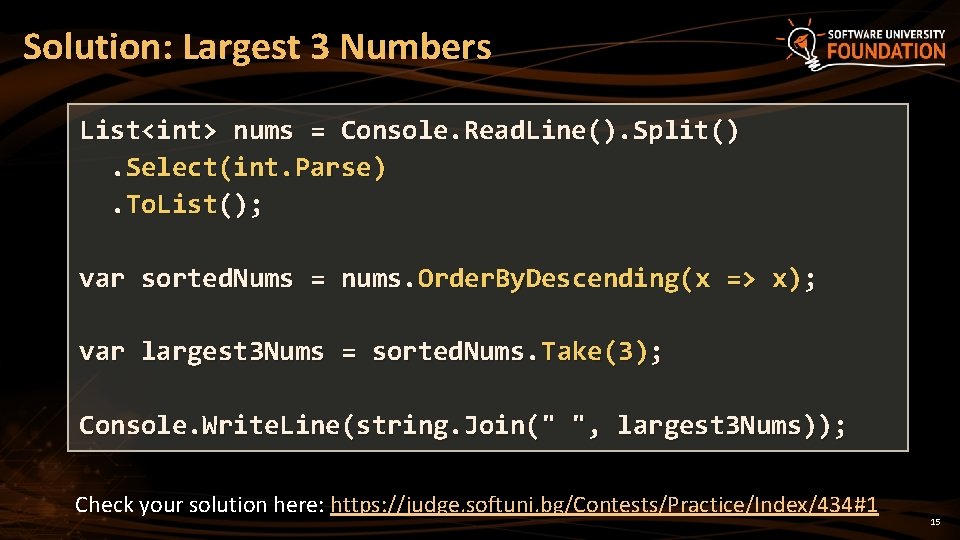
Solution: Largest 3 Numbers List<int> nums = Console. Read. Line(). Split(). Select(int. Parse). To. List(); var sorted. Nums = nums. Order. By. Descending(x => x); var largest 3 Nums = sorted. Nums. Take(3); Console. Write. Line(string. Join(" ", largest 3 Nums)); Check your solution here: https: //judge. softuni. bg/Contests/Practice/Index/434#1 15
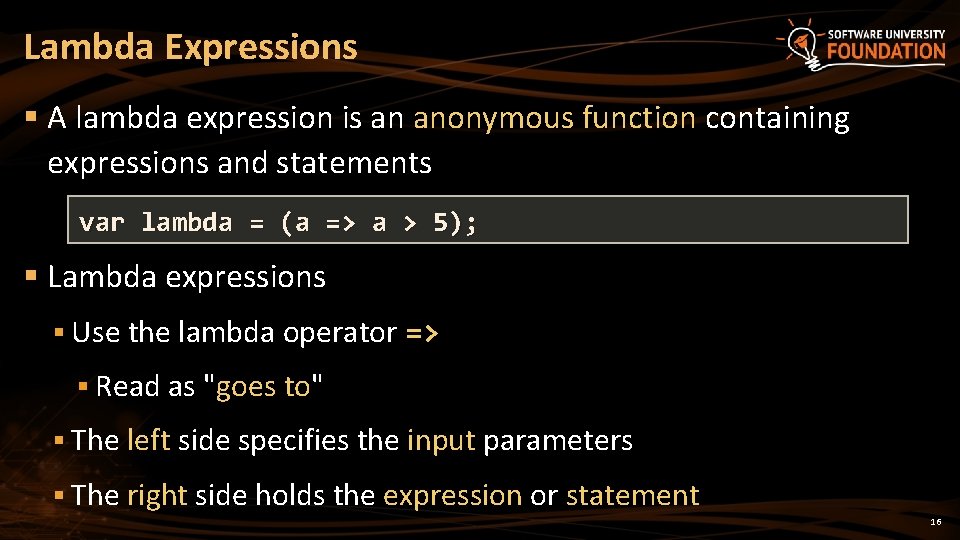
Lambda Expressions § A lambda expression is an anonymous function containing expressions and statements var lambda = (a => a > 5); § Lambda expressions § Use the lambda operator => § Read as "goes to" § The left side specifies the input parameters § The right side holds the expression or statement 16
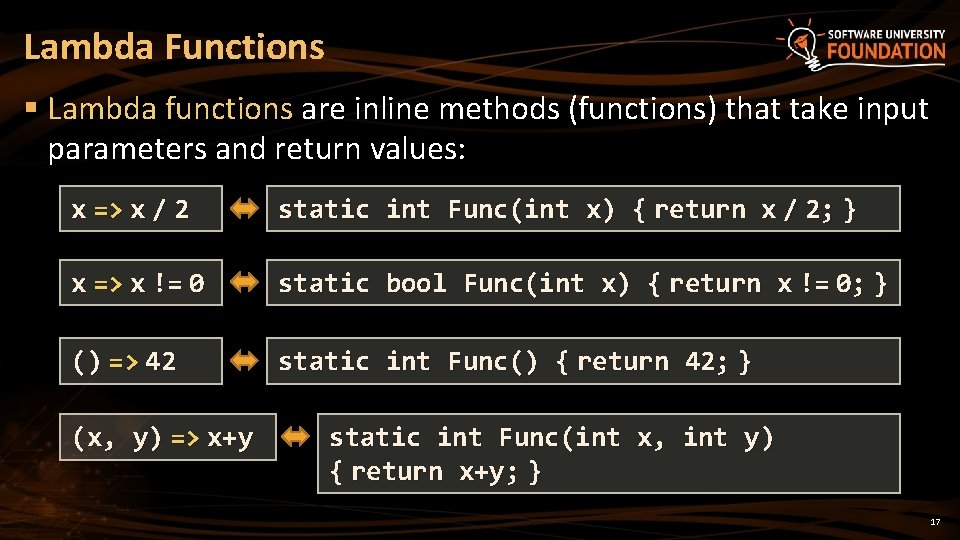
Lambda Functions § Lambda functions are inline methods (functions) that take input parameters and return values: x => x / 2 static int Func(int x) { return x / 2; } x => x != 0 static bool Func(int x) { return x != 0; } () => 42 static int Func() { return 42; } (x, y) => x+y static int Func(int x, int y) { return x+y; } 17
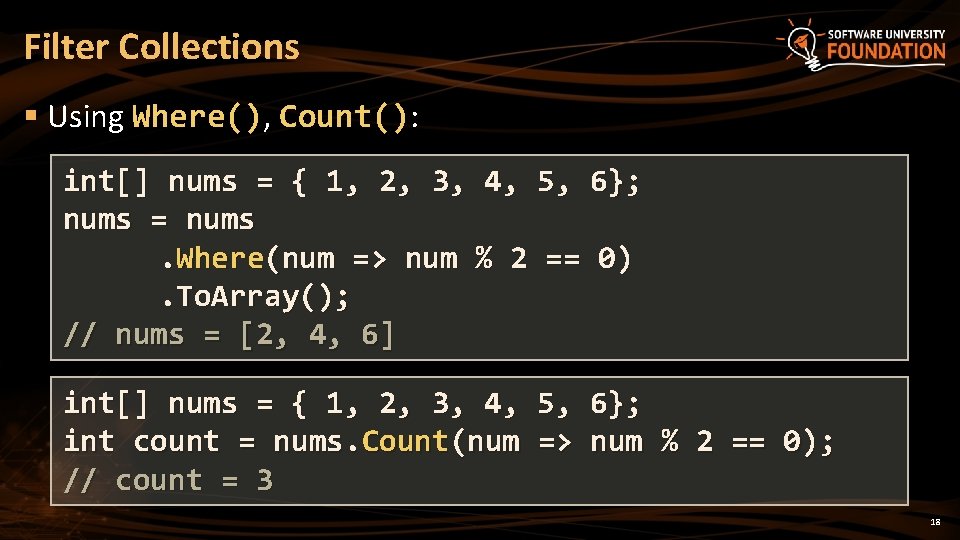
Filter Collections § Using Where(), Count(): int[] nums = { 1, 2, 3, 4, 5, 6}; nums = nums. Where(num => num % 2 == 0). To. Array(); // nums = [2, 4, 6] int[] nums = { 1, 2, 3, 4, 5, 6}; int count = nums. Count(num => num % 2 == 0); // count = 3 18
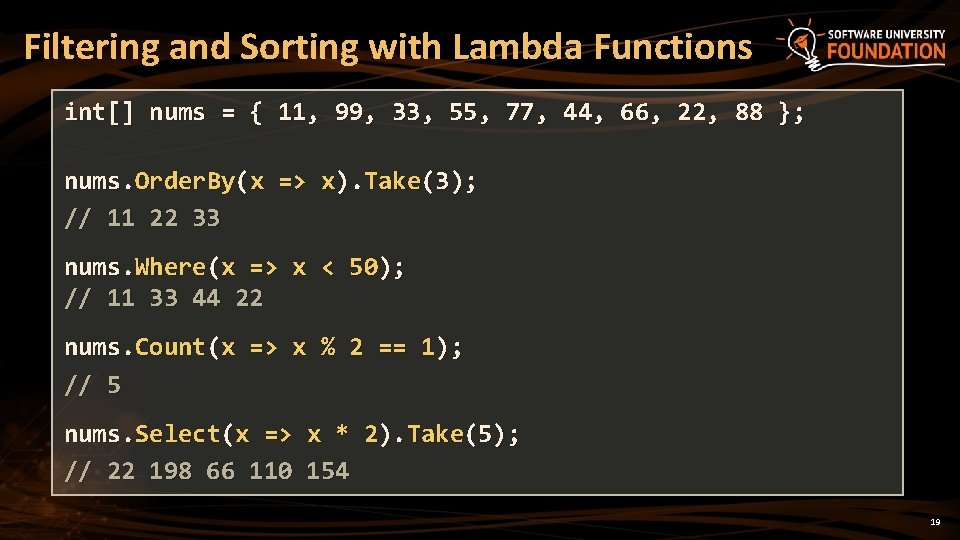
Filtering and Sorting with Lambda Functions int[] nums = { 11, 99, 33, 55, 77, 44, 66, 22, 88 }; nums. Order. By(x => x). Take(3); // 11 22 33 nums. Where(x => x < 50); // 11 33 44 22 nums. Count(x => x % 2 == 1); // 5 nums. Select(x => x * 2). Take(5); // 22 198 66 110 154 19
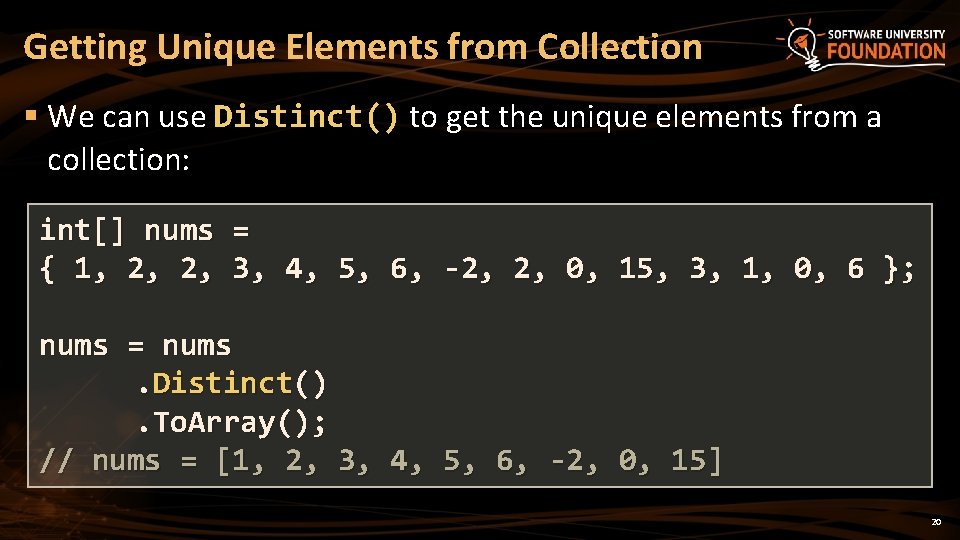
Getting Unique Elements from Collection § We can use Distinct() to get the unique elements from a collection: int[] nums = { 1, 2, 2, 3, 4, 5, 6, -2, 2, 0, 15, 3, 1, 0, 6 }; nums = nums. Distinct(). To. Array(); // nums = [1, 2, 3, 4, 5, 6, -2, 0, 15] 20
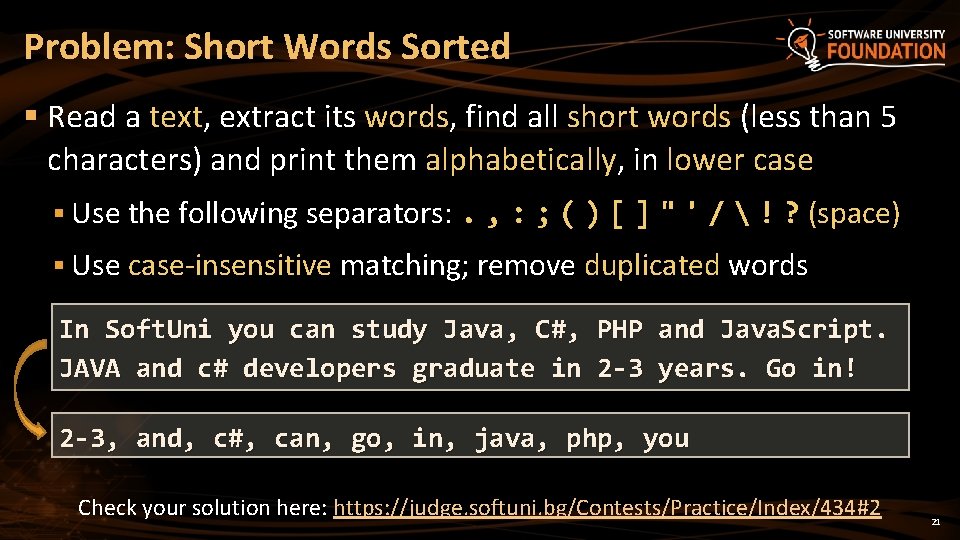
Problem: Short Words Sorted § Read a text, extract its words, find all short words (less than 5 characters) and print them alphabetically, in lower case § Use the following separators: . , : ; ( ) [ ] " ' / ! ? (space) § Use case-insensitive matching; remove duplicated words In Soft. Uni you can study Java, C#, PHP and Java. Script. JAVA and c# developers graduate in 2 -3 years. Go in! 2 -3, and, c#, can, go, in, java, php, you Check your solution here: https: //judge. softuni. bg/Contests/Practice/Index/434#2 21
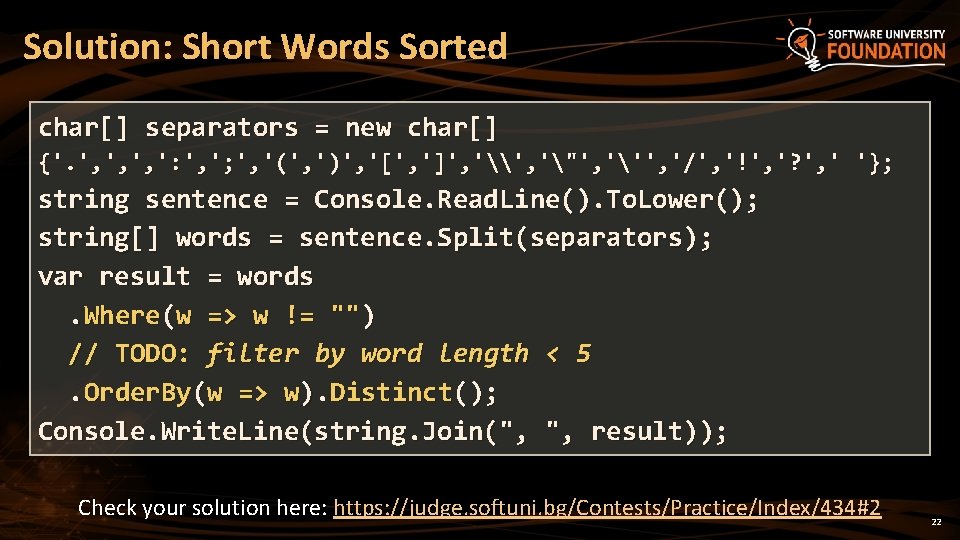
Solution: Short Words Sorted char[] separators = new char[] {'. ', ', ', ': ', '; ', '(', ')', '[', ']', '\', '"', ''', '/', '!', '? ', ' '}; string sentence = Console. Read. Line(). To. Lower(); string[] words = sentence. Split(separators); var result = words. Where(w => w != "") // TODO: filter by word length < 5. Order. By(w => w). Distinct(); Console. Write. Line(string. Join(", ", result)); Check your solution here: https: //judge. softuni. bg/Contests/Practice/Index/434#2 22
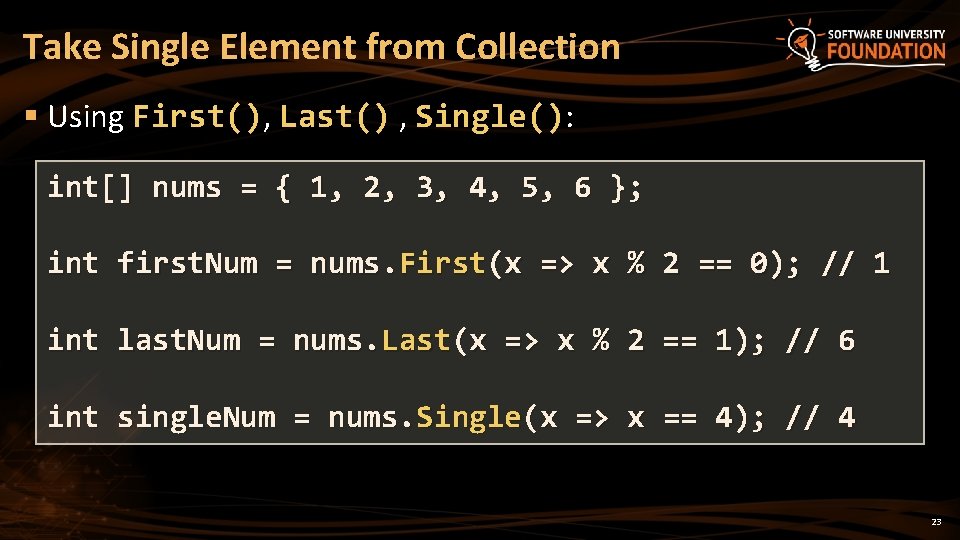
Take Single Element from Collection § Using First(), Last() , Single(): int[] nums = { 1, 2, 3, 4, 5, 6 }; int first. Num = nums. First(x => x % 2 == 0); // 1 int last. Num = nums. Last(x => x % 2 == 1); // 6 int single. Num = nums. Single(x => x == 4); // 4 23
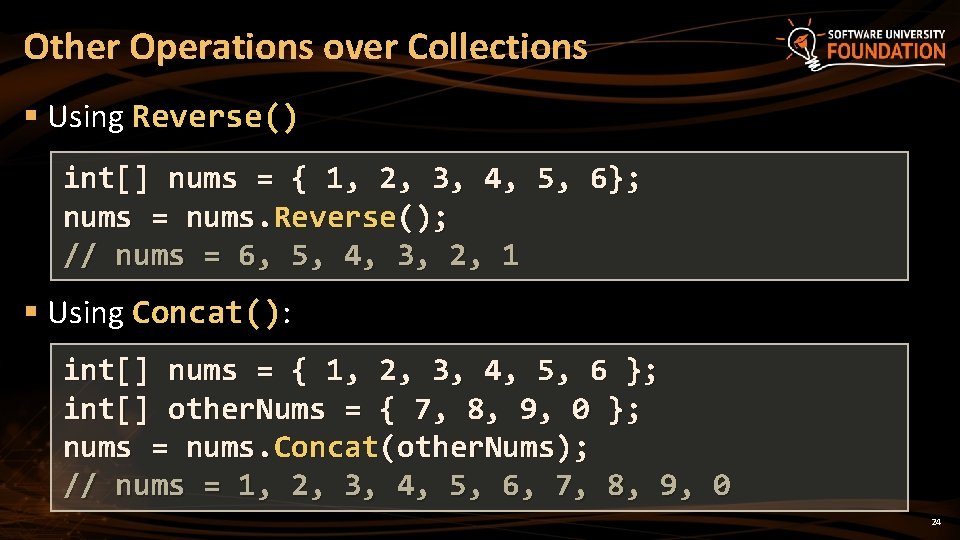
Other Operations over Collections § Using Reverse() int[] nums = { 1, 2, 3, 4, 5, 6}; nums = nums. Reverse(); // nums = 6, 5, 4, 3, 2, 1 § Using Concat(): int[] nums = { 1, 2, 3, 4, 5, 6 }; int[] other. Nums = { 7, 8, 9, 0 }; nums = nums. Concat(other. Nums); // nums = 1, 2, 3, 4, 5, 6, 7, 8, 9, 0 24
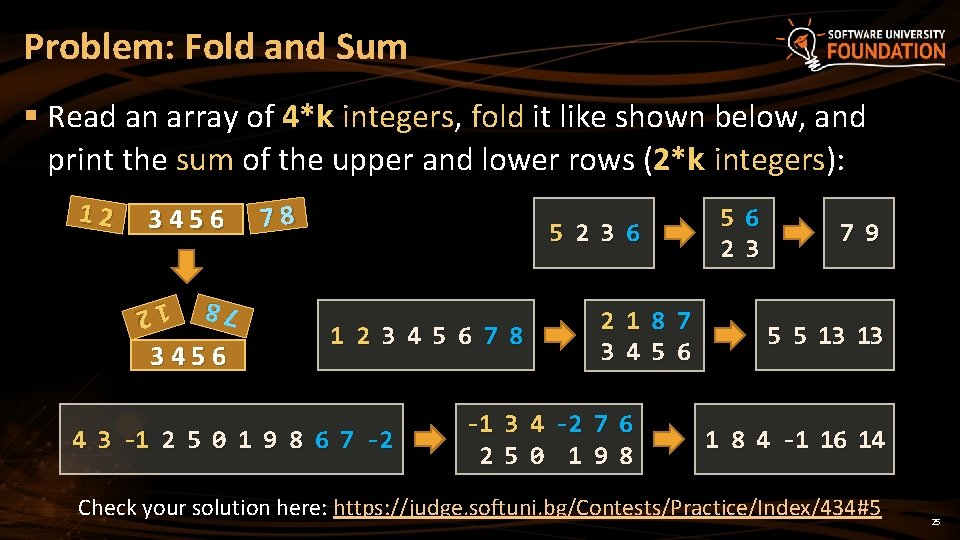
Problem: Fold and Sum § Read an array of 4*k integers, fold it like shown below, and print the sum of the upper and lower rows (2*k integers): 3456 78 12 12 3456 78 5 2 3 6 1 2 3 4 5 6 7 8 4 3 -1 2 5 0 1 9 8 6 7 -2 2 1 8 7 3 4 5 6 -1 3 4 -2 7 6 2 5 0 1 9 8 5 6 2 3 7 9 5 5 13 13 1 8 4 -1 16 14 Check your solution here: https: //judge. softuni. bg/Contests/Practice/Index/434#5 25
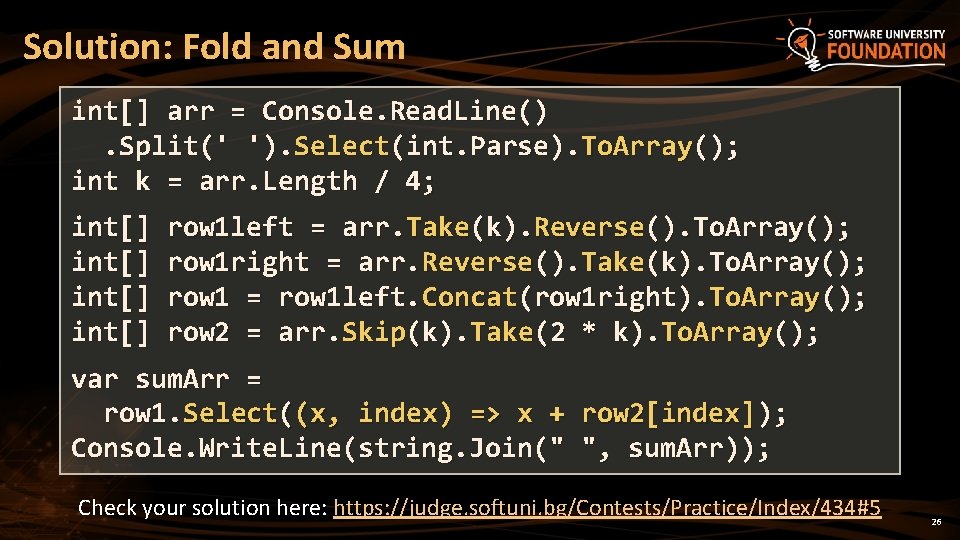
Solution: Fold and Sum int[] arr = Console. Read. Line(). Split(' '). Select(int. Parse). To. Array(); int k = arr. Length / 4; int[] row 1 left = arr. Take(k). Reverse(). To. Array(); row 1 right = arr. Reverse(). Take(k). To. Array(); row 1 = row 1 left. Concat(row 1 right). To. Array(); row 2 = arr. Skip(k). Take(2 * k). To. Array(); var sum. Arr = row 1. Select((x, index) => x + row 2[index]); Console. Write. Line(string. Join(" ", sum. Arr)); Check your solution here: https: //judge. softuni. bg/Contests/Practice/Index/434#5 26
Q N LI var count = arr. Where(e => e % 2 == 0). Count(); Lambda Expressions and LINQ Live Exercises in Class (Lab)
Summary § Lambda and LINQ dramatically simplify collection processing § Can be used for various data aggregation § Sorting § Filtering § Searching § Transforming Elements 28

Lambda and LINQ ? s n stio e u Q ? ? ? https: //softuni. bg/courses/programming-fundamentals
License § This course (slides, examples, demos, videos, homework, etc. ) is licensed under the "Creative Commons Attribution. Non. Commercial-Share. Alike 4. 0 International" license § Attribution: this work may contain portions from § "Fundamentals of Computer Programming with C#" book by Svetlin Nakov & Co. under CC-BY-SA license § Icons from http: //www. flaticon. com/ (credits: Freepik, Madebyoliver) 30

Trainings @ Software University § Software University Foundation – softuni. org § Software University – High-Quality Education, Profession and Job for Software Developers § softuni. bg § Software University @ Facebook § facebook. com/Software. University § Software University Forums – forum. softuni. bg
- Slides: 31