Introductory Chemistry 3 rd Edition Nivaldo Tro Chapter



- Slides: 108
Introductory Chemistry, 3 rd Edition Nivaldo Tro Chapter 9 Electrons in Atoms and the Periodic Table Roy Kennedy Massachusetts Bay Community College Wellesley Hills, MA 2009, Prentice Hall
Blimps • Blimps float because they are filled with a gas that is less dense than the surrounding air. • Early blimps used the gas hydrogen, however, hydrogen’s flammability lead to the Hindenburg disaster. • Blimps now use helium gas, which is not flammable. In fact, it doesn’t undergo any chemical reactions. • This chapter investigates models of the atom we use to explain the differences in the properties of the elements. Tro's "Introductory Chemistry", Chapter 9 2
Classical View of the Universe • Since the time of the ancient Greeks, the stuff of the physical universe has been classified as either matter or energy. • We define matter as the stuff of the universe that has mass and volume. ü Therefore, energy is the stuff of the universe that doesn’t have mass and volume. • We know from our examination of matter that it is ultimately composed of particles, and its the properties of those particles that determine the properties we observe. • Energy, therefore, should not be composed of particles. In fact, the thing that all energy has in common is that it travels in waves. Tro's "Introductory Chemistry", Chapter 9 3
The Nature of Light—Its Wave Nature • Light is one of the forms of energy. • Light is a form of electromagnetic radiation. • Electromagnetic radiation is made of waves. • Electromagnetic radiation moves through space like waves move across the surface of a pond Tro's "Introductory Chemistry", Chapter 9 4
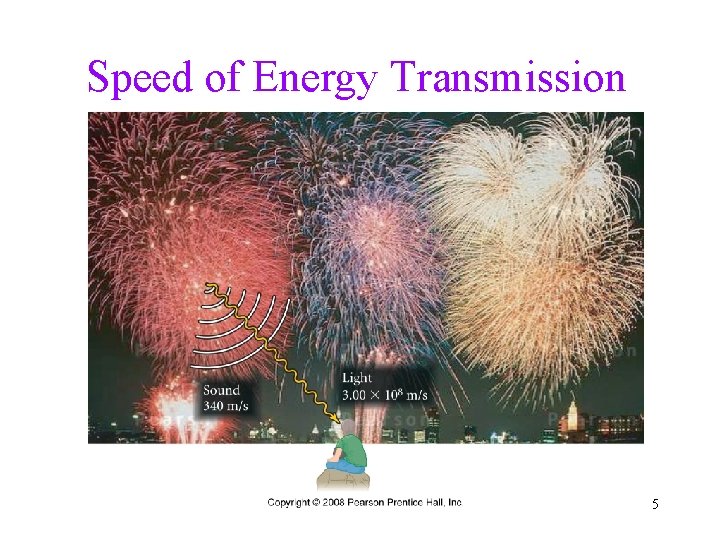
Speed of Energy Transmission 5
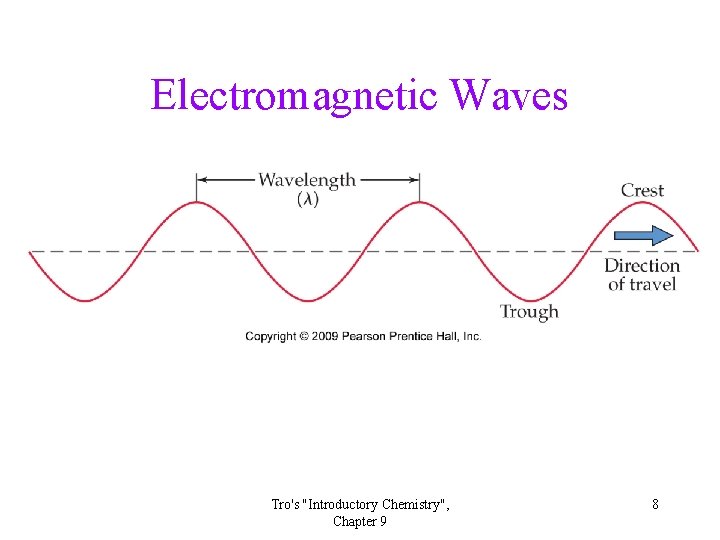
Electromagnetic Waves • Every wave has four characteristics that determine its properties: üwave speed, üheight (amplitude), ülength, ünumber of wave peaks that pass in a given time. • All electromagnetic waves move through space at the same, constant speed. ü 3. 00 x 108 meters per second in a vacuum = The speed of light, c. Tro's "Introductory Chemistry", Chapter 9 6
Characterizing Waves • The amplitude is the height of the wave. ü The distance from node to crest. Ø Or node to trough. ü The amplitude is a measure of how intense the light is—the larger the amplitude, the brighter the light. • The wavelength (l) is a measure of the distance covered by the wave. ü The distance from one crest to the next. Ø Or the distance from one trough to the next, or the distance between alternate nodes. ü Usually measured in nanometers. Ø 1 nm = 1 x 10 -9 m Tro's "Introductory Chemistry", Chapter 9 7
Electromagnetic Waves Tro's "Introductory Chemistry", Chapter 9 8
Characterizing Waves • The frequency (n) is the number of waves that pass a point in a given period of time. üThe number of waves = number of cycles. üUnits are hertz (Hz), or cycles/s = s-1. Ø 1 Hz = 1 s-1 • The total energy is proportional to the amplitude and frequency of the waves. üThe larger the wave amplitude, the more force it has. üThe more frequently the waves strike, the more total force there is. Tro's "Introductory Chemistry", Chapter 9 9
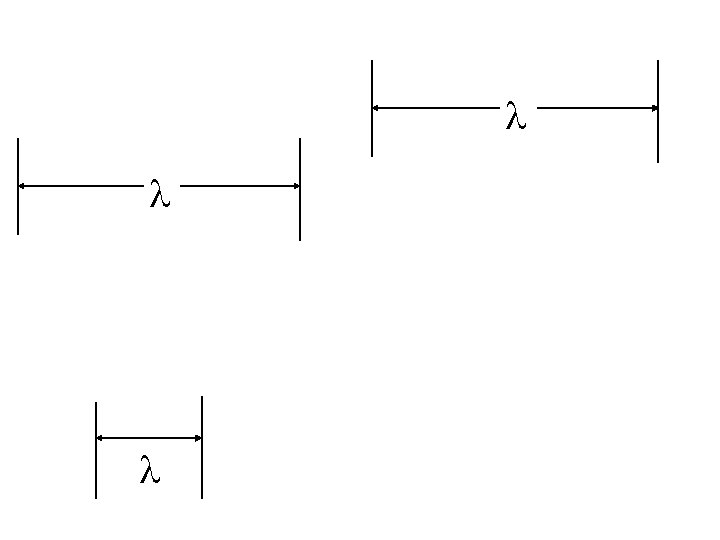
l l l
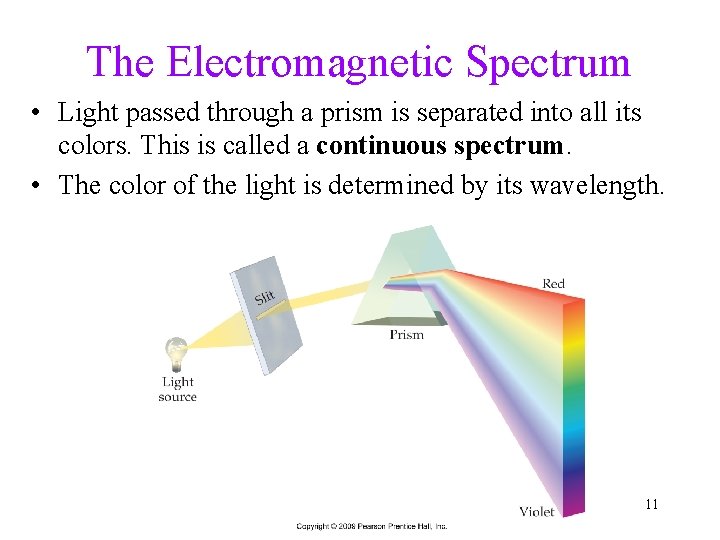
The Electromagnetic Spectrum • Light passed through a prism is separated into all its colors. This is called a continuous spectrum. • The color of the light is determined by its wavelength. 11
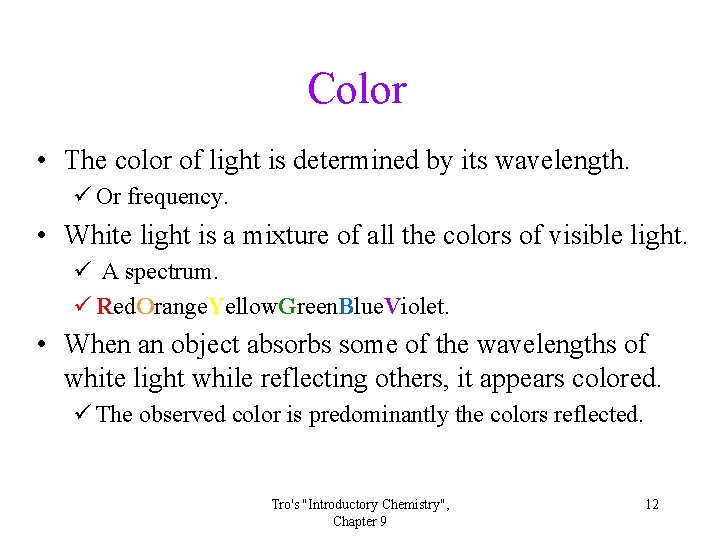
Color • The color of light is determined by its wavelength. ü Or frequency. • White light is a mixture of all the colors of visible light. ü A spectrum. ü Red. Orange. Yellow. Green. Blue. Violet. • When an object absorbs some of the wavelengths of white light while reflecting others, it appears colored. ü The observed color is predominantly the colors reflected. Tro's "Introductory Chemistry", Chapter 9 12
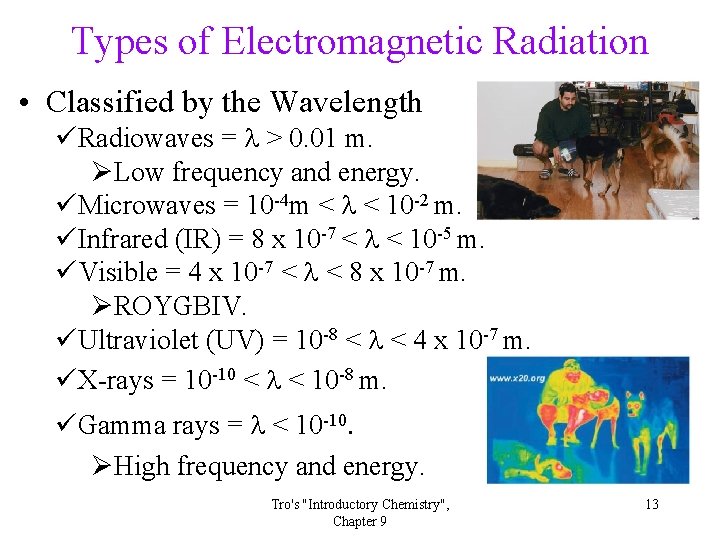
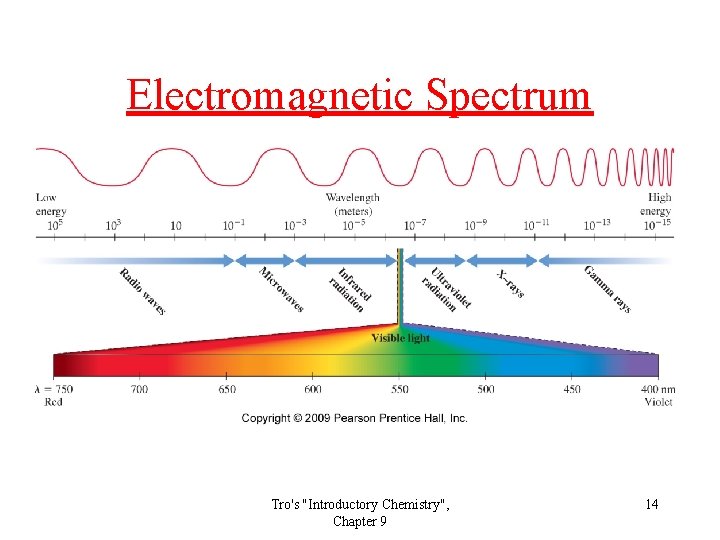
Types of Electromagnetic Radiation • Classified by the Wavelength üRadiowaves = l > 0. 01 m. ØLow frequency and energy. üMicrowaves = 10 -4 m < l < 10 -2 m. üInfrared (IR) = 8 x 10 -7 < l < 10 -5 m. üVisible = 4 x 10 -7 < l < 8 x 10 -7 m. ØROYGBIV. üUltraviolet (UV) = 10 -8 < l < 4 x 10 -7 m. üX-rays = 10 -10 < l < 10 -8 m. üGamma rays = l < 10 -10. ØHigh frequency and energy. Tro's "Introductory Chemistry", Chapter 9 13
Electromagnetic Spectrum Tro's "Introductory Chemistry", Chapter 9 14
Particles of Light • Scientists in the early 20 th century showed that electromagnetic radiation was composed of particles we call photons. üMax Planck and Albert Einstein. üPhotons are particles of light energy. • Each wavelength of light has photons that have a different amount of energy. Tro's "Introductory Chemistry", Chapter 9 15
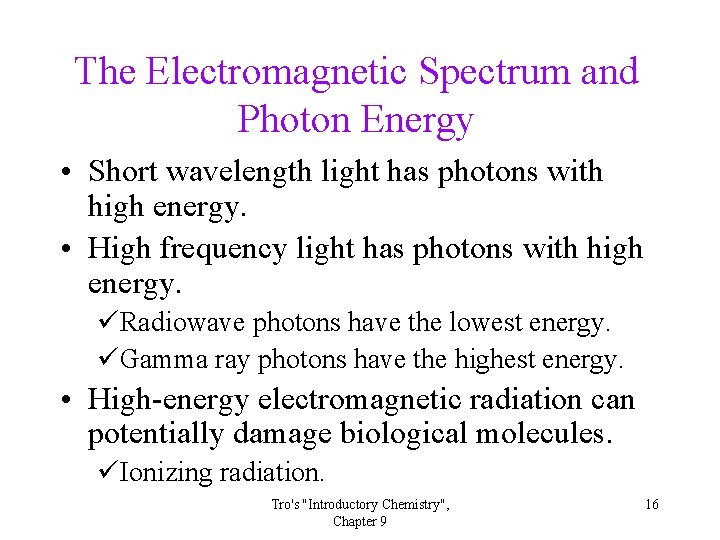
The Electromagnetic Spectrum and Photon Energy • Short wavelength light has photons with high energy. • High frequency light has photons with high energy. üRadiowave photons have the lowest energy. üGamma ray photons have the highest energy. • High-energy electromagnetic radiation can potentially damage biological molecules. üIonizing radiation. Tro's "Introductory Chemistry", Chapter 9 16
Order the Following Types of Electromagnetic Radiation: Microwaves, Gamma Rays, Green Light, Red Light, Ultraviolet Light • By wavelength (short to long). • By frequency (low to high). • By energy (least to most). Tro's "Introductory Chemistry", Chapter 9 17
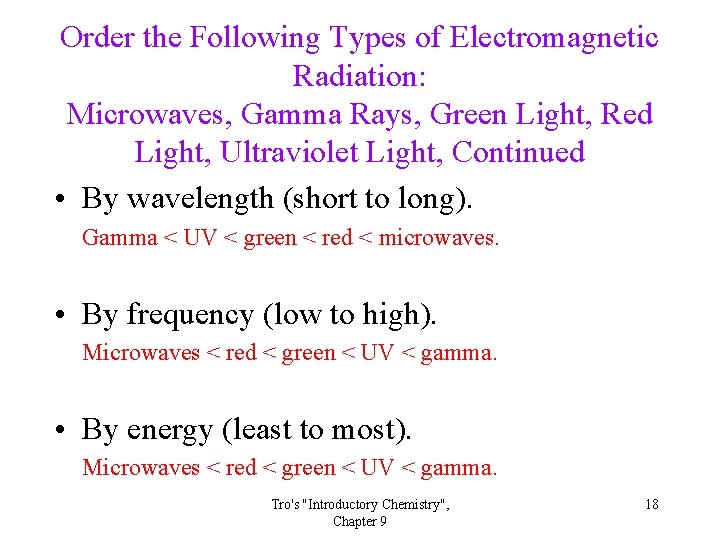
Order the Following Types of Electromagnetic Radiation: Microwaves, Gamma Rays, Green Light, Red Light, Ultraviolet Light, Continued • By wavelength (short to long). Gamma < UV < green < red < microwaves. • By frequency (low to high). Microwaves < red < green < UV < gamma. • By energy (least to most). Microwaves < red < green < UV < gamma. Tro's "Introductory Chemistry", Chapter 9 18
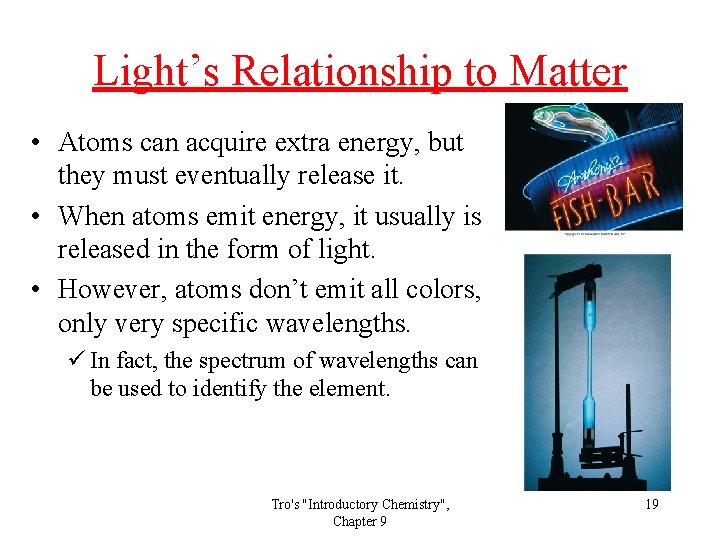
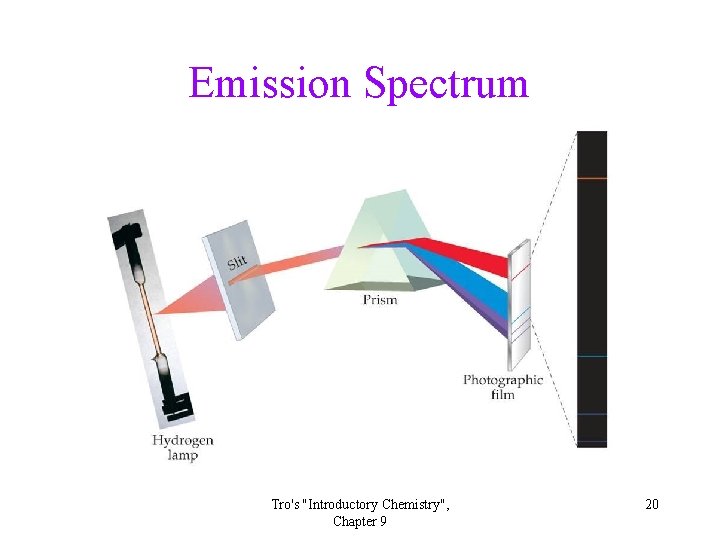
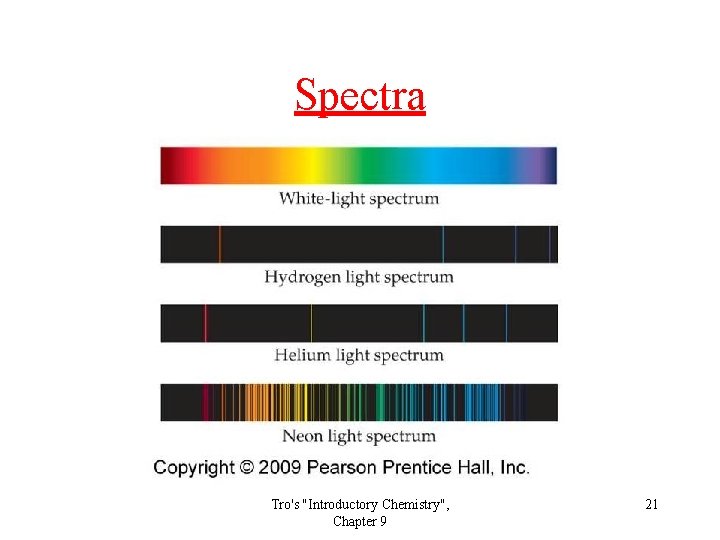
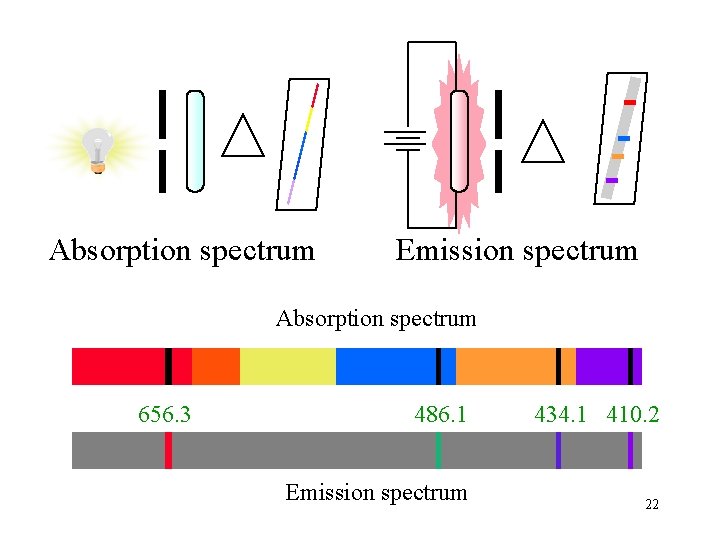
Light’s Relationship to Matter • Atoms can acquire extra energy, but they must eventually release it. • When atoms emit energy, it usually is released in the form of light. • However, atoms don’t emit all colors, only very specific wavelengths. ü In fact, the spectrum of wavelengths can be used to identify the element. Tro's "Introductory Chemistry", Chapter 9 19
Emission Spectrum Tro's "Introductory Chemistry", Chapter 9 20
Spectra Tro's "Introductory Chemistry", Chapter 9 21
Absorption spectrum Emission spectrum Absorption spectrum 656. 3 486. 1 Emission spectrum 434. 1 410. 2 22
The Bohr Model of the Atom • The nuclear model of the atom does not explain how the atom can gain or lose energy. • Neils Bohr developed a model of the atom to explain how the structure of the atom changes when it undergoes energy transitions. • Bohr’s major idea was that the energy of the atom was quantized, and that the amount of energy in the atom was related to the electron’s position in the atom. ü Quantized means that the atom could only have very specific amounts of energy. Tro's "Introductory Chemistry", Chapter 9 23
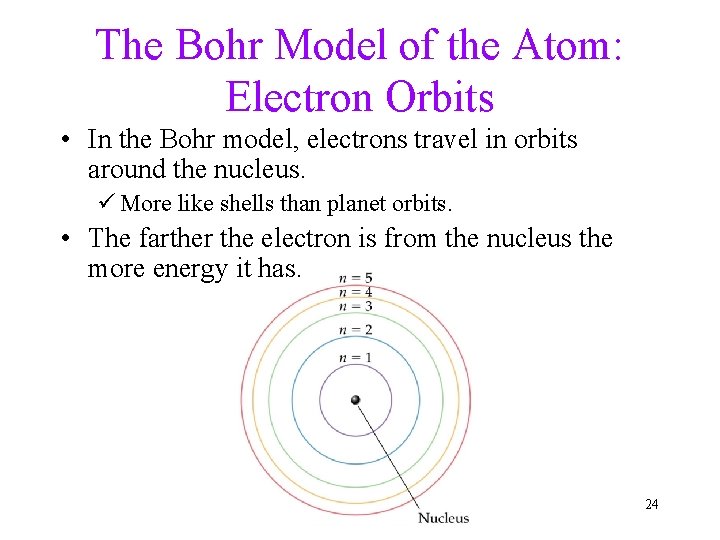
The Bohr Model of the Atom: Electron Orbits • In the Bohr model, electrons travel in orbits around the nucleus. ü More like shells than planet orbits. • The farther the electron is from the nucleus the more energy it has. 24
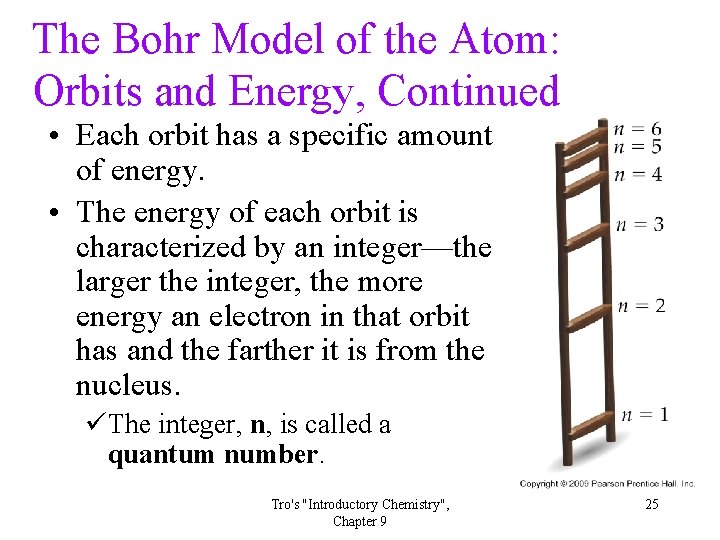
The Bohr Model of the Atom: Orbits and Energy, Continued • Each orbit has a specific amount of energy. • The energy of each orbit is characterized by an integer—the larger the integer, the more energy an electron in that orbit has and the farther it is from the nucleus. üThe integer, n, is called a quantum number. Tro's "Introductory Chemistry", Chapter 9 25
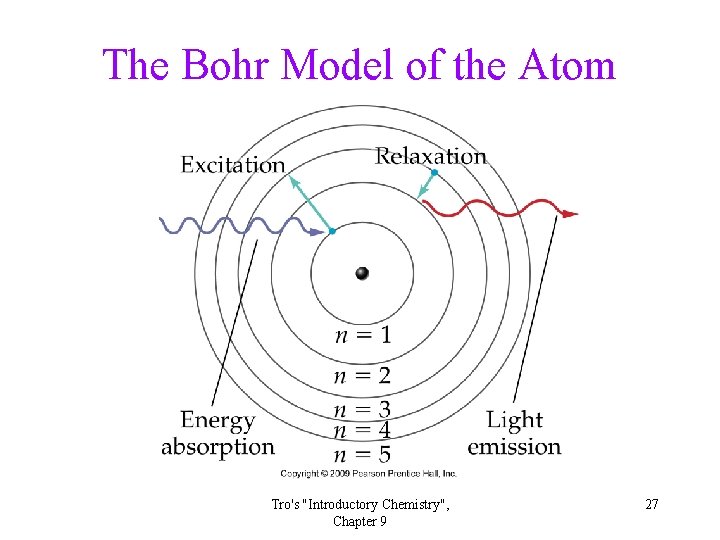
The Bohr Model of the Atom: Energy Transitions • When the atom gains energy, the electron leaps from a lower energy orbit to one that is further from the nucleus. ü However, during that “quantum leap” it doesn’t travel through the space between the orbits, it just disappears from the lower orbit and appears in the higher orbit. • When the electron leaps from a higher energy orbit to one that is closer to the nucleus, energy is emitted from the atom as a photon of light—a quantum of energy. Tro's "Introductory Chemistry", Chapter 9 26
The Bohr Model of the Atom Tro's "Introductory Chemistry", Chapter 9 27
The Bohr Model of the Atom: Ground and Excited States • In the Bohr model of hydrogen, the lowest amount of energy hydrogen’s one electron can have corresponds to being in the n = 1 orbit. We call this its ground state. • When the atom gains energy, the electron leaps to a higher energy orbit. We call this an excited state. • The atom is less stable in an excited state and so it will release the extra energy to return to the ground state. ü Either all at once or in several steps. Tro's "Introductory Chemistry", Chapter 9 28
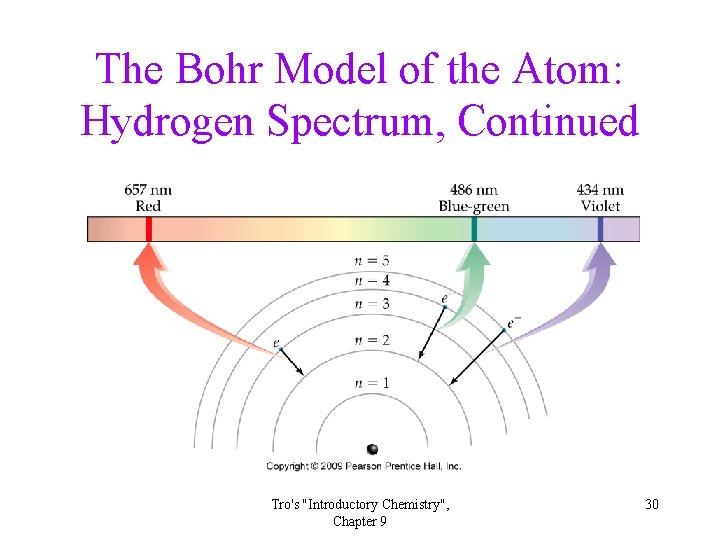
The Bohr Model of the Atom: Hydrogen Spectrum • Every hydrogen atom has identical orbits, so every hydrogen atom can undergo the same energy transitions. • However, since the distances between the orbits in an atom are not all the same, no two leaps in an atom will have the same energy. ü The closer the orbits are in energy, the lower the energy of the photon emitted. ü Lower energy photon = longer wavelength. • Therefore, we get an emission spectrum that has a lot of lines that are unique to hydrogen. Tro's "Introductory Chemistry", Chapter 9 29
The Bohr Model of the Atom: Hydrogen Spectrum, Continued Tro's "Introductory Chemistry", Chapter 9 30
The Bohr Model of the Atom: Success and Failure • The mathematics of the Bohr model very accurately predicts the spectrum of hydrogen. • However, its mathematics fails when applied to multi-electron atoms. üIt cannot account for electron-electron interactions. • A better theory was needed. Tro's "Introductory Chemistry", Chapter 9 31
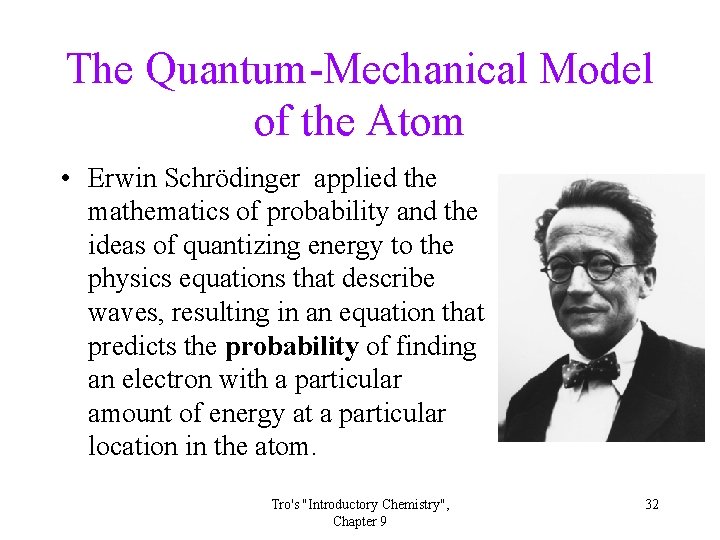
The Quantum-Mechanical Model of the Atom • Erwin Schrödinger applied the mathematics of probability and the ideas of quantizing energy to the physics equations that describe waves, resulting in an equation that predicts the probability of finding an electron with a particular amount of energy at a particular location in the atom. Tro's "Introductory Chemistry", Chapter 9 32
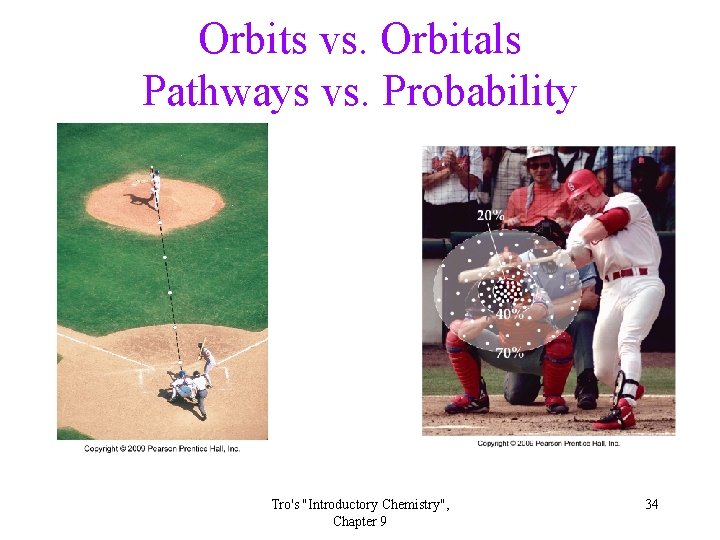
The Quantum-Mechanical Model: Orbitals • The result is a map of regions in the atom that have a particular probability for finding the electron. • An orbital is a region where we have a very high probability of finding the electron when it has a particular amount of energy. üGenerally set at 90 or 95%. Tro's "Introductory Chemistry", Chapter 9 33
Orbits vs. Orbitals Pathways vs. Probability Tro's "Introductory Chemistry", Chapter 9 34
Wave–Particle Duality • We’ve seen that light has the characteristics of waves and particles (photons) at the same time—how we view it depends on the application. • In the same way, electrons have the characteristics of both particles and waves at the same time. • This makes it impossible to predict the path of an electron in an atom. Tro's "Introductory Chemistry", Chapter 9 35
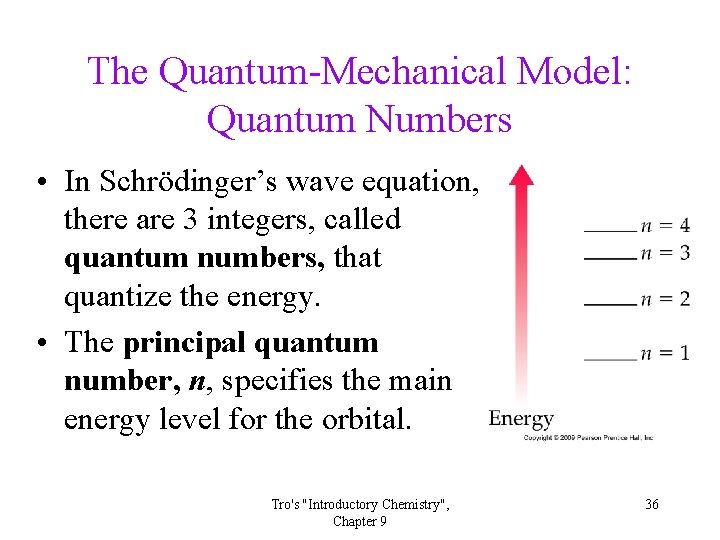
The Quantum-Mechanical Model: Quantum Numbers • In Schrödinger’s wave equation, there are 3 integers, called quantum numbers, that quantize the energy. • The principal quantum number, n, specifies the main energy level for the orbital. Tro's "Introductory Chemistry", Chapter 9 36
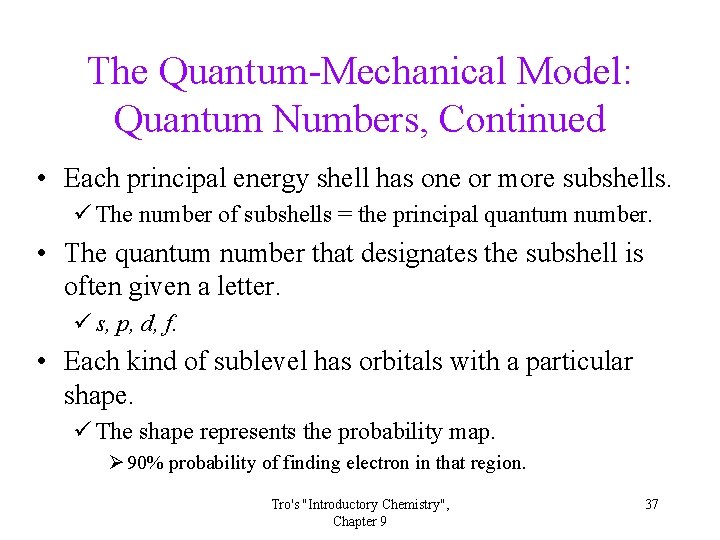
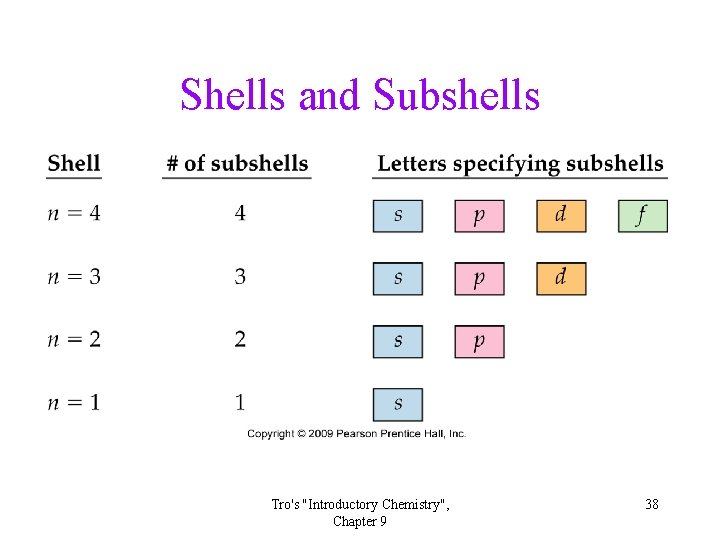
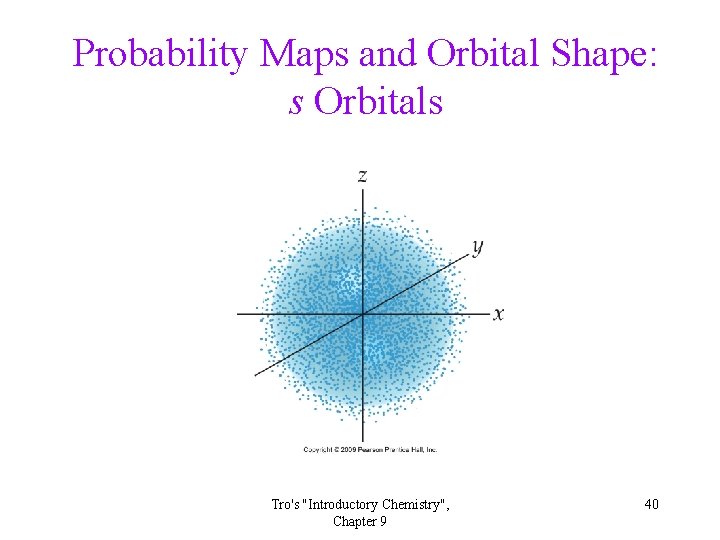
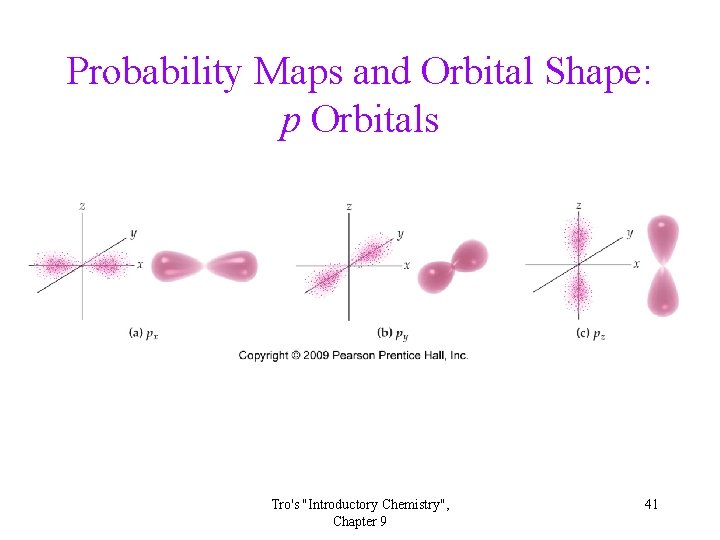
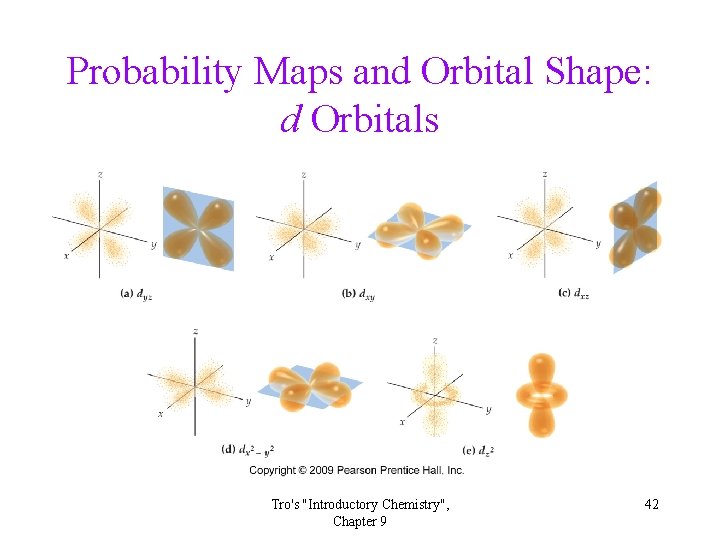
The Quantum-Mechanical Model: Quantum Numbers, Continued • Each principal energy shell has one or more subshells. ü The number of subshells = the principal quantum number. • The quantum number that designates the subshell is often given a letter. ü s, p, d, f. • Each kind of sublevel has orbitals with a particular shape. ü The shape represents the probability map. Ø 90% probability of finding electron in that region. Tro's "Introductory Chemistry", Chapter 9 37
Shells and Subshells Tro's "Introductory Chemistry", Chapter 9 38
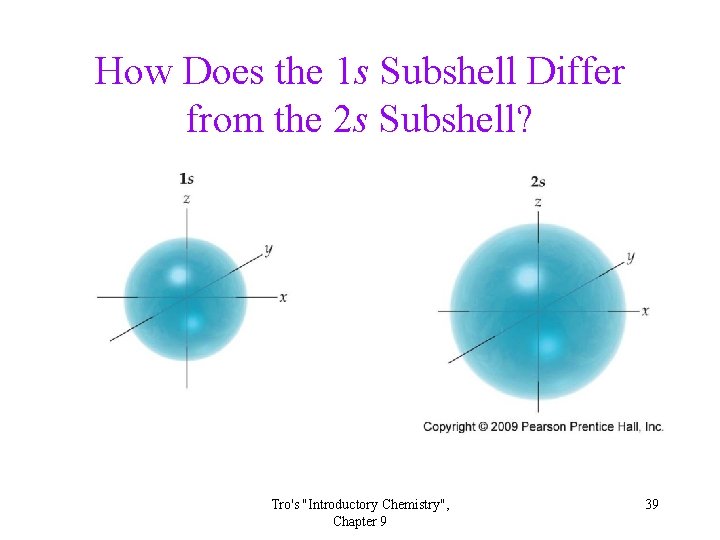
How Does the 1 s Subshell Differ from the 2 s Subshell? Tro's "Introductory Chemistry", Chapter 9 39
Probability Maps and Orbital Shape: s Orbitals Tro's "Introductory Chemistry", Chapter 9 40
Probability Maps and Orbital Shape: p Orbitals Tro's "Introductory Chemistry", Chapter 9 41
Probability Maps and Orbital Shape: d Orbitals Tro's "Introductory Chemistry", Chapter 9 42
Subshells and Orbitals • The subshells of a principal shell have slightly different energies. ü The subshells in a shell of H all have the same energy, but for multielectron atoms the subshells have different energies. ü s < p < d < f. • Each subshell contains one or more orbitals. ü s subshells have 1 orbital. ü p subshells have 3 orbitals. ü d subshells have 5 orbitals. ü f subshells have 7 orbitals. Tro's "Introductory Chemistry", Chapter 9 43
The Quantum-Mechanical Model: Energy Transitions • As in the Bohr model, atoms gain or lose energy as the electron leaps between orbitals in different energy shells and subshells. • The ground state of the electron is the lowest energy orbital it can occupy. • Higher energy orbitals are excited states. Tro's "Introductory Chemistry", Chapter 9 44
The Bohr Model vs. the Quantum-Mechanical Model • Both the Bohr and quantum-mechanical models predict the spectrum of hydrogen very accurately. • Only the quantum-mechanical model predicts the spectra of multi-electron atoms. Tro's "Introductory Chemistry", Chapter 9 45
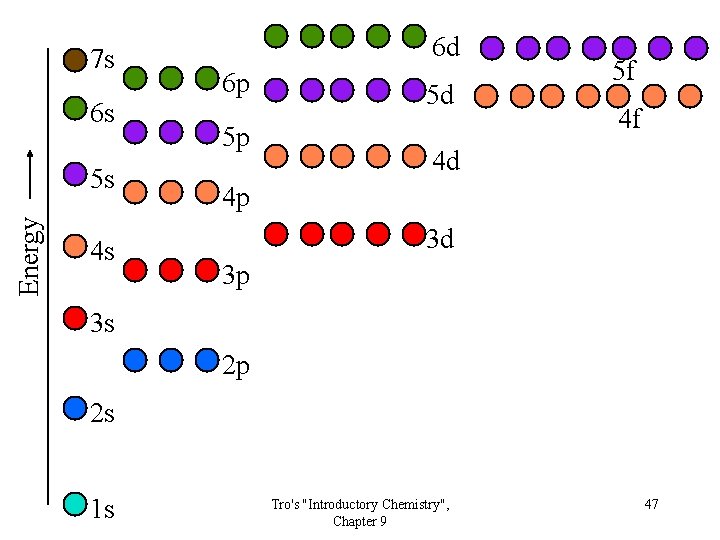
Electron Configurations • The distribution of electrons into the various energy shells and subshells in an atom in its ground state is called its electron configuration. • Each energy shell and subshell has a maximum number of electrons it can hold. ü s = 2, p = 6, d = 10, f = 14. ü Based on the number of orbitals in the subshell. • We place electrons in the energy shells and subshells in order of energy, from low energy up. ü Aufbau principle. Tro's "Introductory Chemistry", Chapter 9 46
7 s 6 s Energy 5 s 4 s 6 d 6 p 5 p 5 d 5 f 4 f 4 d 4 p 3 d 3 p 3 s 2 p 2 s 1 s Tro's "Introductory Chemistry", Chapter 9 47
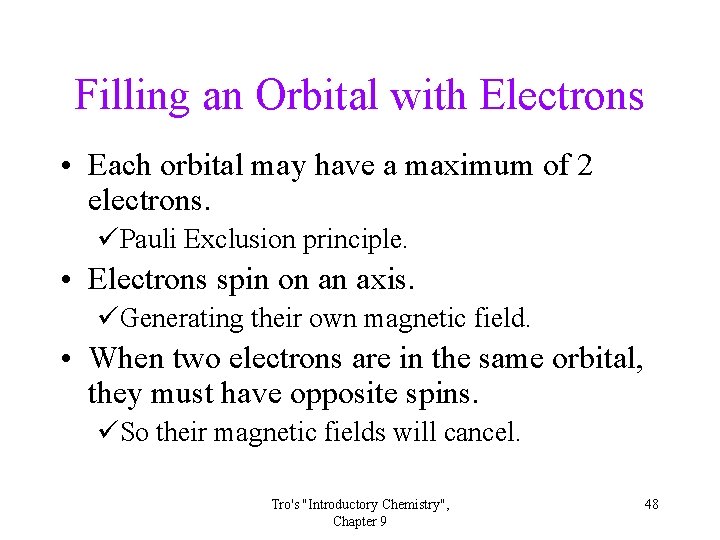
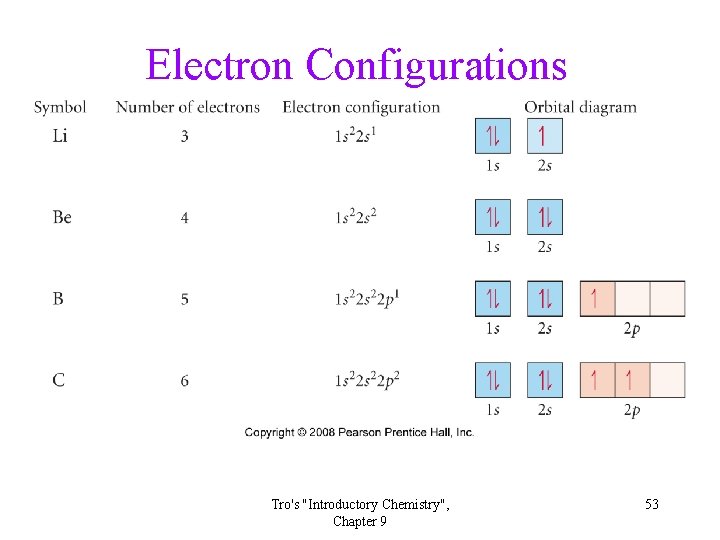
Filling an Orbital with Electrons • Each orbital may have a maximum of 2 electrons. üPauli Exclusion principle. • Electrons spin on an axis. üGenerating their own magnetic field. • When two electrons are in the same orbital, they must have opposite spins. üSo their magnetic fields will cancel. Tro's "Introductory Chemistry", Chapter 9 48
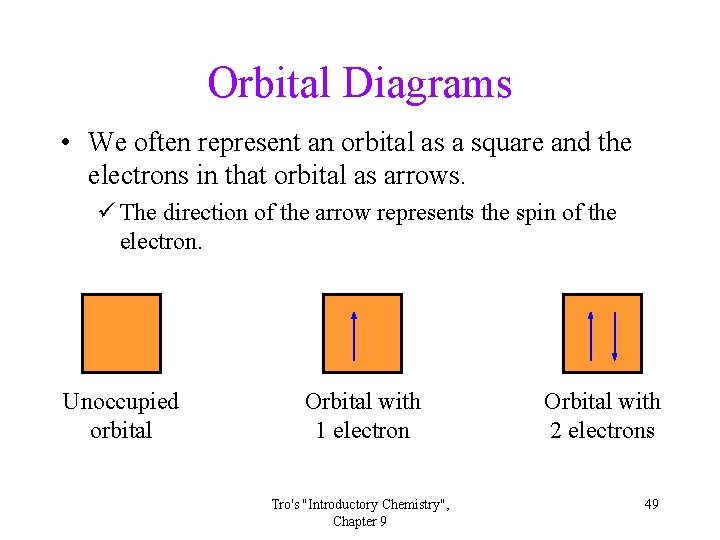
Orbital Diagrams • We often represent an orbital as a square and the electrons in that orbital as arrows. ü The direction of the arrow represents the spin of the electron. Unoccupied orbital Orbital with 1 electron Tro's "Introductory Chemistry", Chapter 9 Orbital with 2 electrons 49
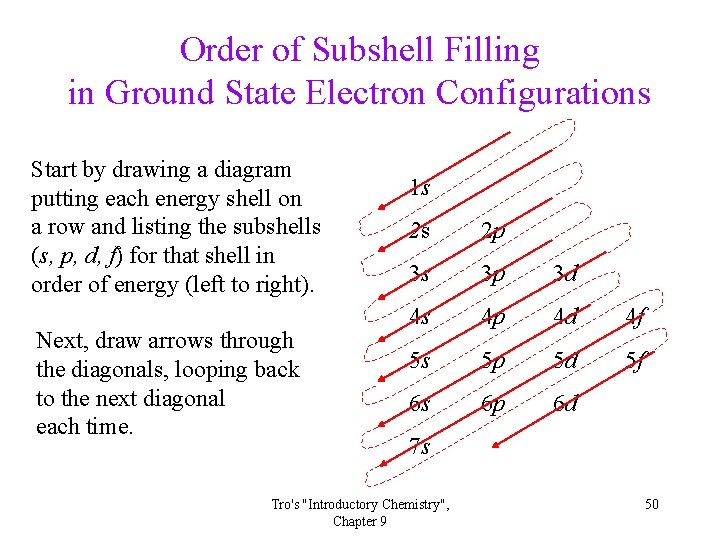
Order of Subshell Filling in Ground State Electron Configurations Start by drawing a diagram putting each energy shell on a row and listing the subshells (s, p, d, f) for that shell in order of energy (left to right). Next, draw arrows through the diagonals, looping back to the next diagonal each time. 1 s 2 s 2 p 3 s 3 p 3 d 4 s 4 p 4 d 4 f 5 s 5 p 5 d 5 f 6 s 6 p 6 d 7 s Tro's "Introductory Chemistry", Chapter 9 50
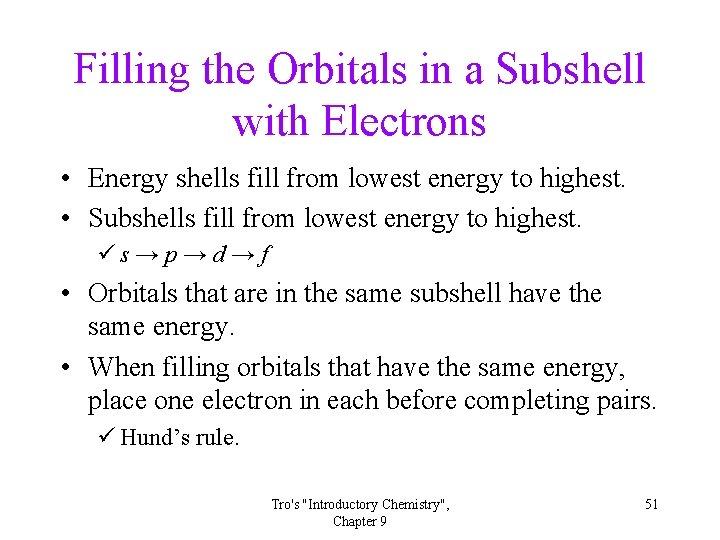
Filling the Orbitals in a Subshell with Electrons • Energy shells fill from lowest energy to highest. • Subshells fill from lowest energy to highest. üs → p → d → f • Orbitals that are in the same subshell have the same energy. • When filling orbitals that have the same energy, place one electron in each before completing pairs. ü Hund’s rule. Tro's "Introductory Chemistry", Chapter 9 51
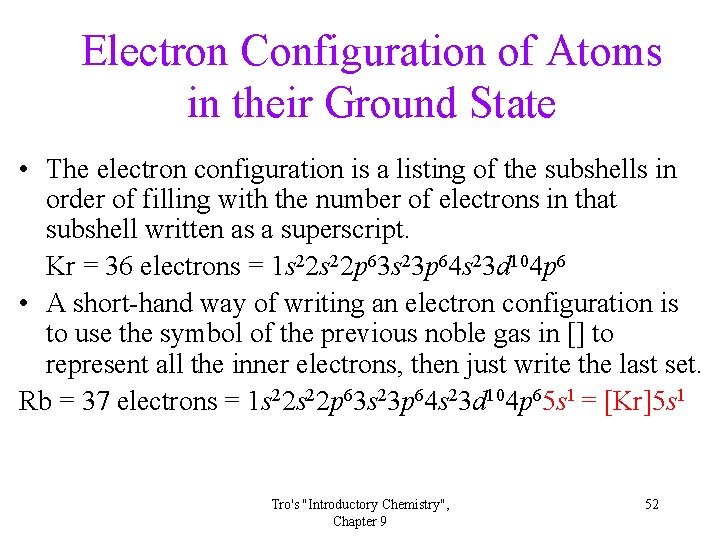
Electron Configuration of Atoms in their Ground State • The electron configuration is a listing of the subshells in order of filling with the number of electrons in that subshell written as a superscript. Kr = 36 electrons = 1 s 22 p 63 s 23 p 64 s 23 d 104 p 6 • A short-hand way of writing an electron configuration is to use the symbol of the previous noble gas in [] to represent all the inner electrons, then just write the last set. Rb = 37 electrons = 1 s 22 p 63 s 23 p 64 s 23 d 104 p 65 s 1 = [Kr]5 s 1 Tro's "Introductory Chemistry", Chapter 9 52
Electron Configurations Tro's "Introductory Chemistry", Chapter 9 53
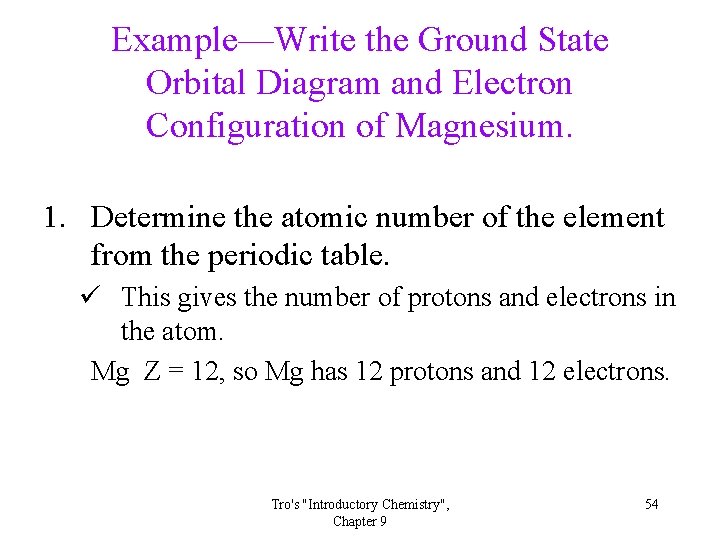
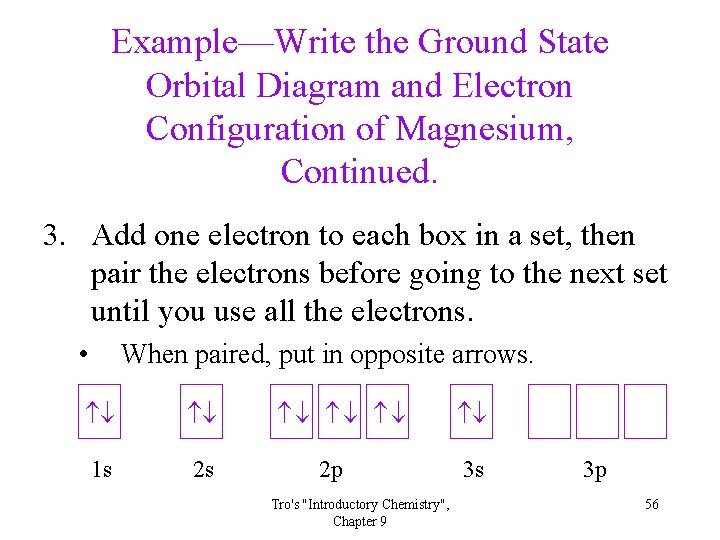
Example—Write the Ground State Orbital Diagram and Electron Configuration of Magnesium. 1. Determine the atomic number of the element from the periodic table. ü This gives the number of protons and electrons in the atom. Mg Z = 12, so Mg has 12 protons and 12 electrons. Tro's "Introductory Chemistry", Chapter 9 54
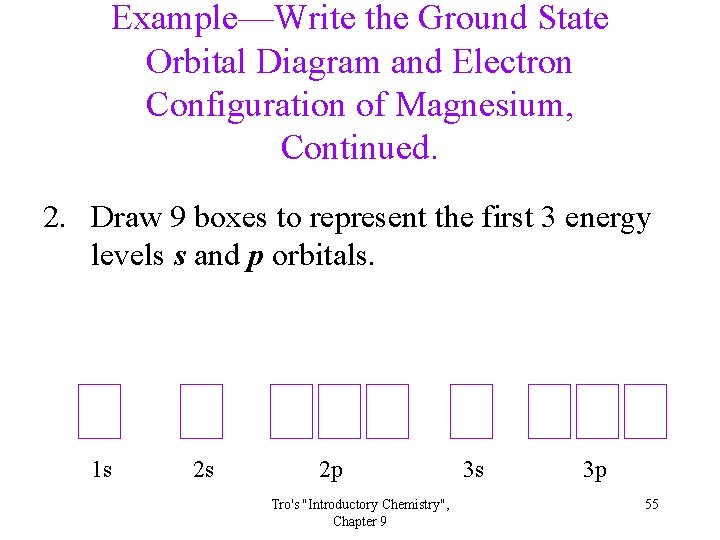
Example—Write the Ground State Orbital Diagram and Electron Configuration of Magnesium, Continued. 2. Draw 9 boxes to represent the first 3 energy levels s and p orbitals. 1 s 2 s 2 p Tro's "Introductory Chemistry", Chapter 9 3 s 3 p 55
Example—Write the Ground State Orbital Diagram and Electron Configuration of Magnesium, Continued. 3. Add one electron to each box in a set, then pair the electrons before going to the next set until you use all the electrons. • When paired, put in opposite arrows. 1 s 2 s 2 p Tro's "Introductory Chemistry", Chapter 9 3 s 3 p 56
Example—Write the Ground State Orbital Diagram and Electron Configuration of Magnesium, Continued. 4. Use the diagram to write the electron configuration. ü Write the number of electrons in each set as a superscript next to the name of the orbital set. 1 s 22 p 63 s 2 = [Ne]3 s 2 1 s 2 s 2 p Tro's "Introductory Chemistry", Chapter 9 3 s 3 p 57
Example—Write the Full Ground State Orbital Diagram and Electron Configuration of Manganese. Mn Z = 25, therefore 25 e− s subshell holds 2 e− 1 s p subshell holds 6 e− 2 e− 2 s 2 p d subshell holds 10 e− +2 = 3 s 4 e− 1 s 2 s 2 p 3 s 3 p 3 p 3 d 4 s − − +6 +2 = 12 e f subshell holds 14 e 4 s 4 p 4 d 4 f +6 +2 = 20 e− +10 = 30 e− 3 d 22 s 22 p 63 s 23 p 64 s 23 d 5 Therefore the electron configuration is 1 s Based on the order of subshell filling, we will need the first 7 subshells Tro's "Introductory Chemistry", Chapter 9 58
Practice—Write the Full Ground State Orbital Diagram and Electron Configuration of Potassium. Tro's "Introductory Chemistry", Chapter 9 59
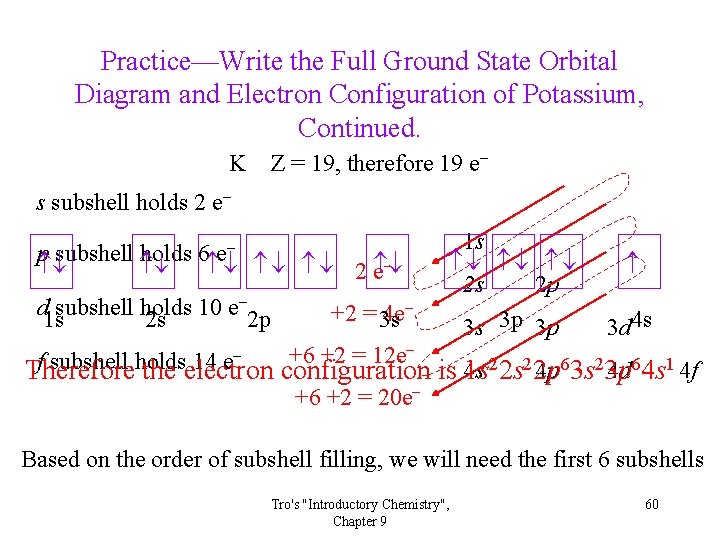
Practice—Write the Full Ground State Orbital Diagram and Electron Configuration of Potassium, Continued. K Z = 19, therefore 19 e− s subshell holds 2 e− p subshell holds 6 e− 2 e− d subshell holds 10 e− +2 = 3 s 4 e− 1 s 2 s 2 p − − +6 +2 = 12 e f subshell holds 14 e 1 s 2 s 2 p 3 s 3 p 3 p 3 d 4 s 4 p 63 s 23 p 4 d 64 s 1 4 f Therefore the electron configuration is 4 s 1 s 22 p +6 +2 = 20 e− Based on the order of subshell filling, we will need the first 6 subshells Tro's "Introductory Chemistry", Chapter 9 60
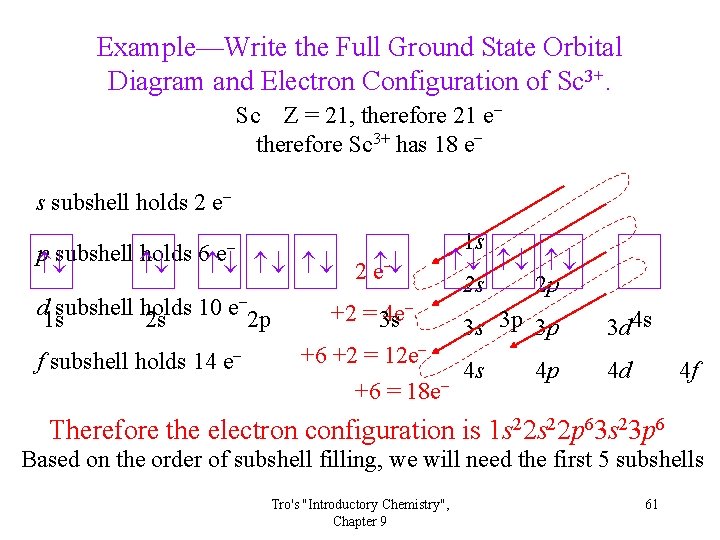
Example—Write the Full Ground State Orbital Diagram and Electron Configuration of Sc 3+. Sc Z = 21, therefore 21 e− therefore Sc 3+ has 18 e− s subshell holds 2 e− 1 s p subshell holds 6 e− 2 e− 2 s 2 p d subshell holds 10 e− +2 = 3 s 4 e− 1 s 2 s 2 p 3 s 3 p 3 p − − +6 +2 = 12 e f subshell holds 14 e 4 s 4 p − +6 = 18 e 3 d 4 s 4 d 4 f Therefore the electron configuration is 1 s 22 p 63 s 23 p 6 Based on the order of subshell filling, we will need the first 5 subshells Tro's "Introductory Chemistry", Chapter 9 61
Practice—Write the Full Ground State Orbital Diagram and Electron Configuration of F−. Tro's "Introductory Chemistry", Chapter 9 62
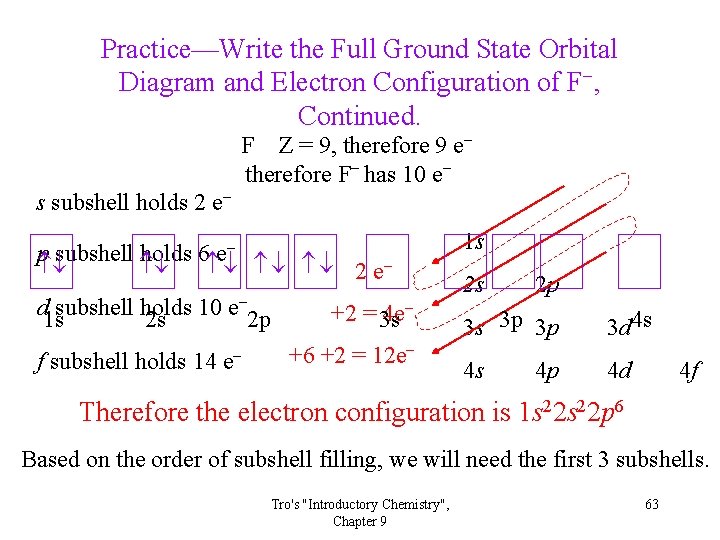
Practice—Write the Full Ground State Orbital Diagram and Electron Configuration of F−, Continued. F Z = 9, therefore 9 e− therefore F− has 10 e− s subshell holds 2 e− p subshell holds 6 e− 2 e− d subshell holds 10 e− +2 = 3 s 4 e− 1 s 2 s 2 p − − +6 +2 = 12 e f subshell holds 14 e 1 s 2 s 2 p 3 s 3 p 3 p 3 d 4 s 4 s 4 d 4 p 4 f Therefore the electron configuration is 1 s 22 p 6 Based on the order of subshell filling, we will need the first 3 subshells. Tro's "Introductory Chemistry", Chapter 9 63
Valence Electrons • The electrons in all the subshells with the highest principal energy shells are called the valence electrons. • Electrons in lower energy shells are called core electrons. • Chemists have observed that one of the most important factors in the way an atom behaves, both chemically and physically, is the number of valence electrons. Tro's "Introductory Chemistry", Chapter 9 64
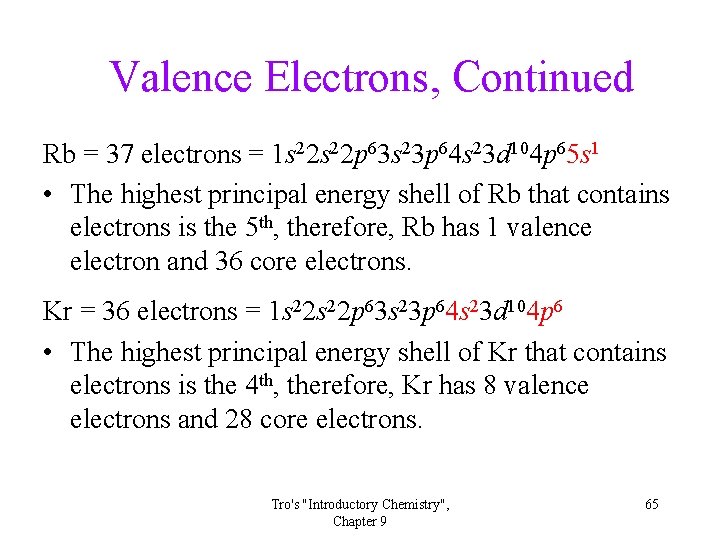
Valence Electrons, Continued Rb = 37 electrons = 1 s 22 p 63 s 23 p 64 s 23 d 104 p 65 s 1 • The highest principal energy shell of Rb that contains electrons is the 5 th, therefore, Rb has 1 valence electron and 36 core electrons. Kr = 36 electrons = 1 s 22 p 63 s 23 p 64 s 23 d 104 p 6 • The highest principal energy shell of Kr that contains electrons is the 4 th, therefore, Kr has 8 valence electrons and 28 core electrons. Tro's "Introductory Chemistry", Chapter 9 65
Practice—Determine the Number and Types of Valence Electrons in an Arsenic, As, Atom. Tro's "Introductory Chemistry", Chapter 9 66
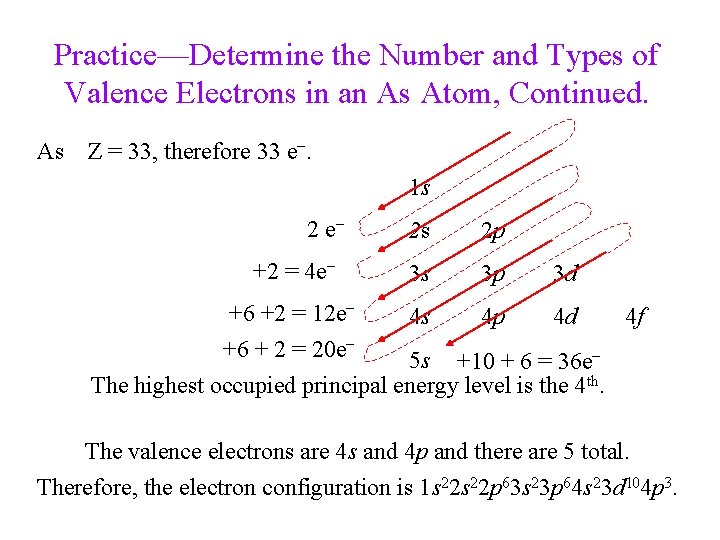
Practice—Determine the Number and Types of Valence Electrons in an As Atom, Continued. As Z = 33, therefore 33 e−. 1 s 2 e− +2 = 4 e− 2 s 2 p 3 s 3 p 3 d +6 +2 = 12 e− 4 s 4 p 4 d 4 f +6 + 2 = 20 e− 5 s +10 + 6 = 36 e− The highest occupied principal energy level is the 4 th. The valence electrons are 4 s and 4 p and there are 5 total. Therefore, the electron configuration is 1 s 22 p 63 s 23 p 64 s 23 d 104 p 3.
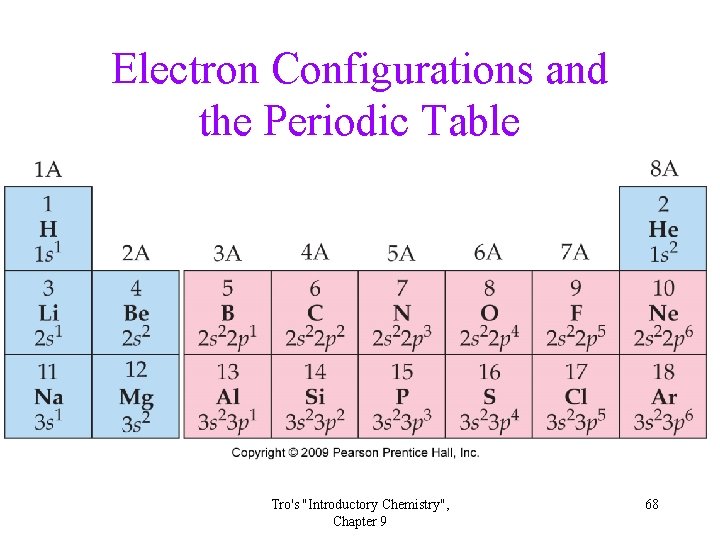
Electron Configurations and the Periodic Table Tro's "Introductory Chemistry", Chapter 9 68
Electron Configurations from the Periodic Table • Elements in the same period (row) have valence electrons in the same principal energy shell. • The number of valence electrons increases by one as you progress across the period. • Elements in the same group (column) have the same number of valence electrons and the valence electrons are in the same type of subshell. Tro's "Introductory Chemistry", Chapter 9 69
Electron Configuration and the Periodic Table • Elements in the same column have similar chemical and physical properties because their valence shell electron configuration is the same. • The number of valence electrons for the main group elements is the same as the group number. Tro's "Introductory Chemistry", Chapter 9 70
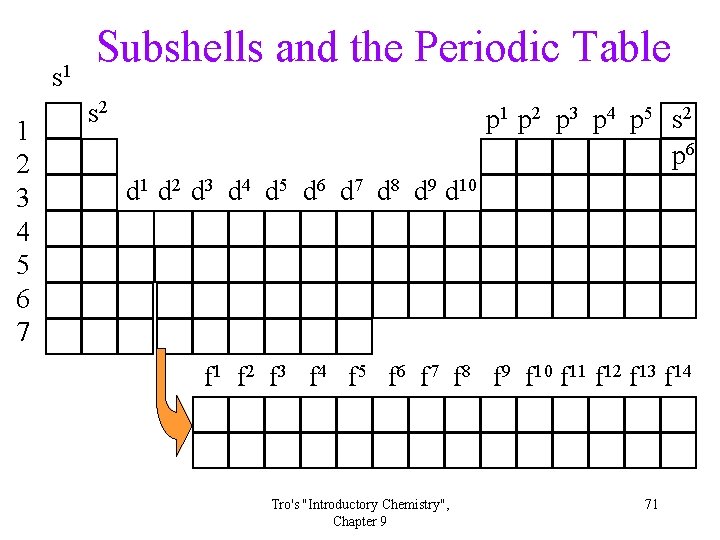
s 1 1 2 3 4 5 6 7 Subshells and the Periodic Table s 2 p 1 p 2 p 3 p 4 p 5 s 2 p 6 d 1 d 2 d 3 d 4 d 5 d 6 d 7 d 8 d 9 d 10 f 1 f 2 f 3 f 4 f 5 f 6 f 7 f 8 f 9 f 10 f 11 f 12 f 13 f 14 Tro's "Introductory Chemistry", Chapter 9 71
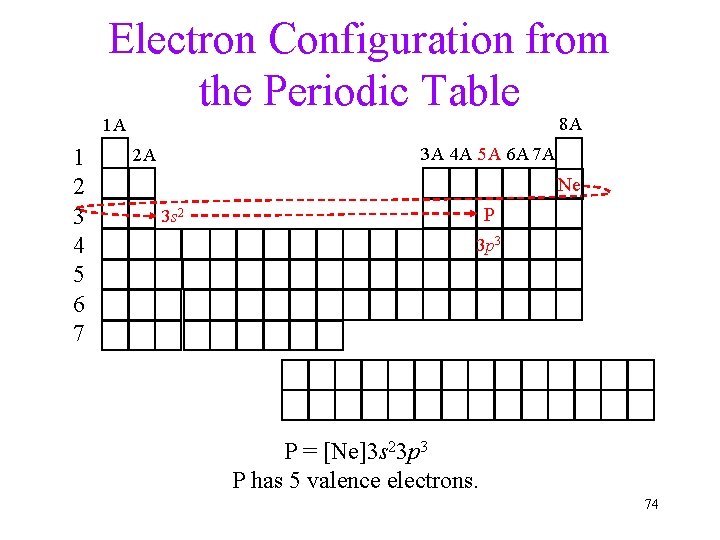
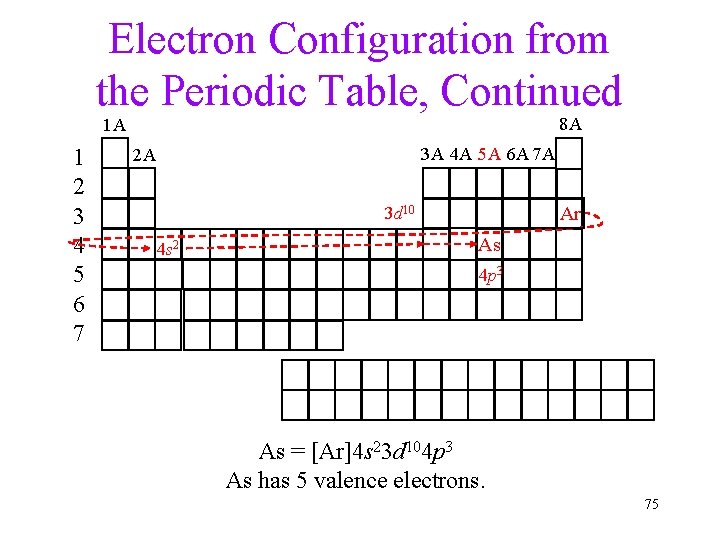
Electron Configuration from the Periodic Table • The inner electron configuration is the same as the noble gas of the preceding period. • To get the outer electron configuration from the preceding noble gas, loop through the next period, marking the subshells as you go, until you reach the element. ü The valence energy shell = the period number. ü The d block is always one energy shell below the period number and the f is two energy shells below. Tro's "Introductory Chemistry", Chapter 9 72
Periodic Table and Valence Electrons • For the main group elements, the number of valence electrons is the same as the column number. ü Except for He. • For the transition elements, the number of valence electrons is usually 2. ü There are some elements whose electron configurations do not exactly fit our pattern. ü Because as we traverse the transition metals we are putting electrons into a lower principal energy shell. Tro's "Introductory Chemistry", Chapter 9 73
Electron Configuration from the Periodic Table 8 A 1 A 1 2 3 4 5 6 7 3 A 4 A 5 A 6 A 7 A 2 A Ne P 3 s 2 3 p 3 P = [Ne]3 s 23 p 3 P has 5 valence electrons. 74
Electron Configuration from the Periodic Table, Continued 8 A 1 A 1 2 3 4 5 6 7 3 A 4 A 5 A 6 A 7 A 2 A Ar 3 d 10 4 s 2 As 4 p 3 As = [Ar]4 s 23 d 104 p 3 As has 5 valence electrons. 75
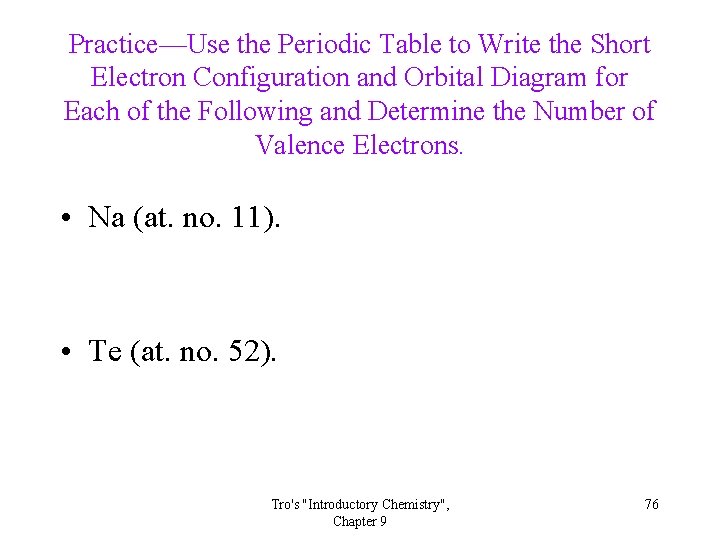
Practice—Use the Periodic Table to Write the Short Electron Configuration and Orbital Diagram for Each of the Following and Determine the Number of Valence Electrons. • Na (at. no. 11). • Te (at. no. 52). Tro's "Introductory Chemistry", Chapter 9 76
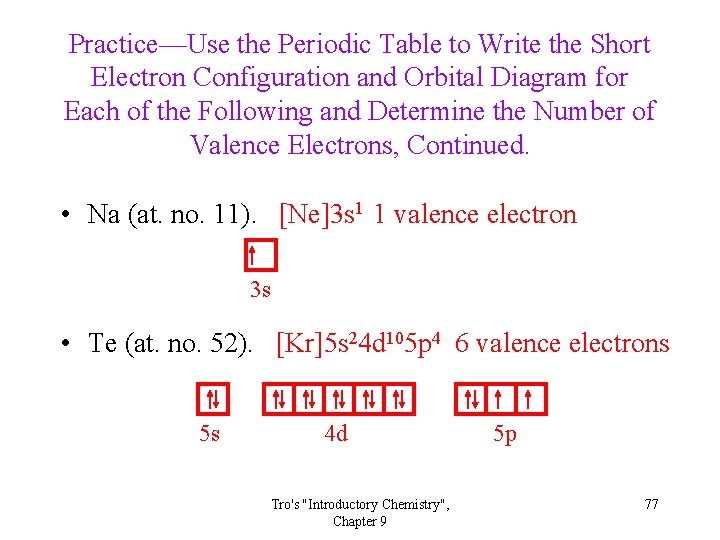
Practice—Use the Periodic Table to Write the Short Electron Configuration and Orbital Diagram for Each of the Following and Determine the Number of Valence Electrons, Continued. • Na (at. no. 11). [Ne]3 s 1 1 valence electron 3 s • Te (at. no. 52). [Kr]5 s 24 d 105 p 4 6 valence electrons 5 s 4 d Tro's "Introductory Chemistry", Chapter 9 5 p 77
The Explanatory Power of the Quantum-Mechanical Model • The properties of the elements are largely determined by the number of valence electrons they contain. • Since elements in the same column have the same number of valence electrons, they show similar properties. • Since the number of valence electrons increases across the period, the properties vary in a regular fashion. Tro's "Introductory Chemistry", Chapter 9 78
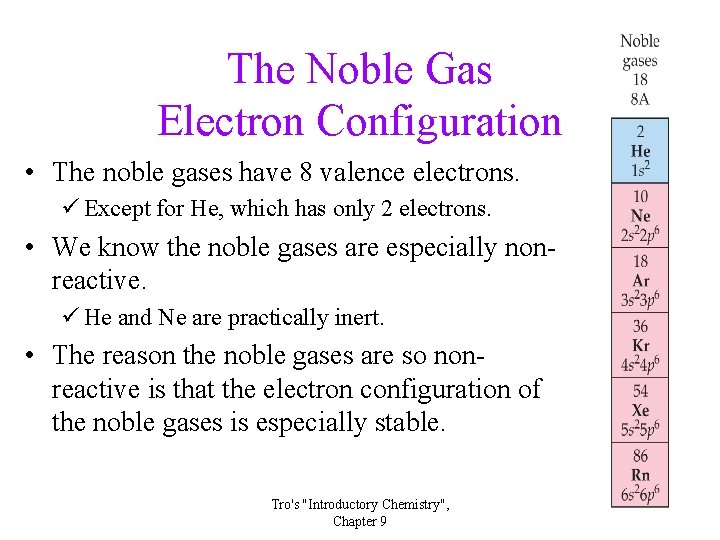
The Noble Gas Electron Configuration • The noble gases have 8 valence electrons. ü Except for He, which has only 2 electrons. • We know the noble gases are especially nonreactive. ü He and Ne are practically inert. • The reason the noble gases are so nonreactive is that the electron configuration of the noble gases is especially stable. Tro's "Introductory Chemistry", Chapter 9
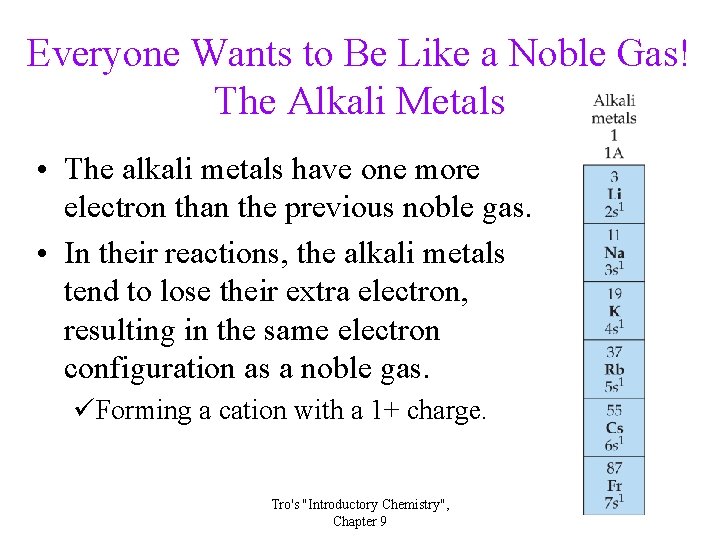
Everyone Wants to Be Like a Noble Gas! The Alkali Metals • The alkali metals have one more electron than the previous noble gas. • In their reactions, the alkali metals tend to lose their extra electron, resulting in the same electron configuration as a noble gas. üForming a cation with a 1+ charge. Tro's "Introductory Chemistry", Chapter 9
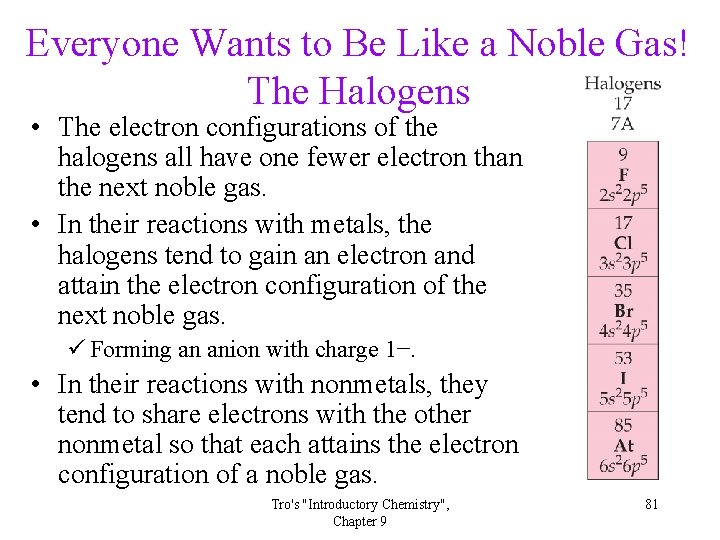
Everyone Wants to Be Like a Noble Gas! The Halogens • The electron configurations of the halogens all have one fewer electron than the next noble gas. • In their reactions with metals, the halogens tend to gain an electron and attain the electron configuration of the next noble gas. ü Forming an anion with charge 1−. • In their reactions with nonmetals, they tend to share electrons with the other nonmetal so that each attains the electron configuration of a noble gas. Tro's "Introductory Chemistry", Chapter 9 81
Everyone Wants to Be Like a Noble Gas! • As a group, the alkali metals are the most reactive metals. üThey react with many things and do so rapidly. • The halogens are the most reactive group of nonmetals. • One reason for their high reactivity is the fact that they are only one electron away from having a very stable electron configuration. üThe same as a noble gas. Tro's "Introductory Chemistry", Chapter 9 82
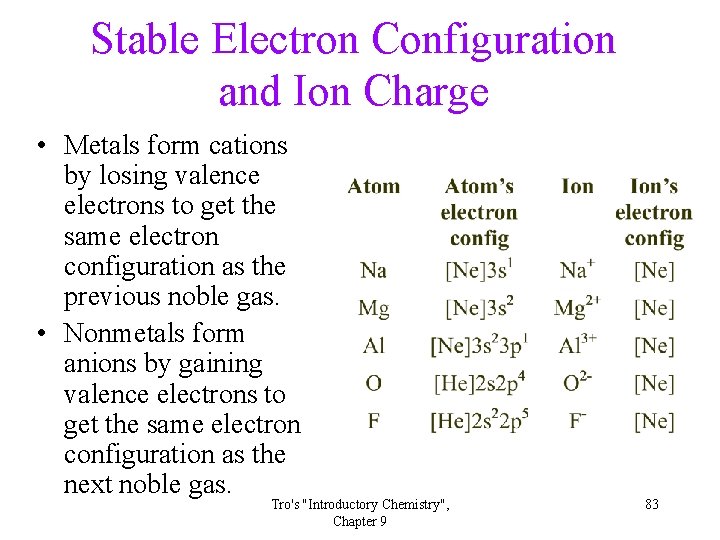
Stable Electron Configuration and Ion Charge • Metals form cations by losing valence electrons to get the same electron configuration as the previous noble gas. • Nonmetals form anions by gaining valence electrons to get the same electron configuration as the next noble gas. Tro's "Introductory Chemistry", Chapter 9 83
Periodic Trends in the Properties of the Elements Tro's "Introductory Chemistry", Chapter 9
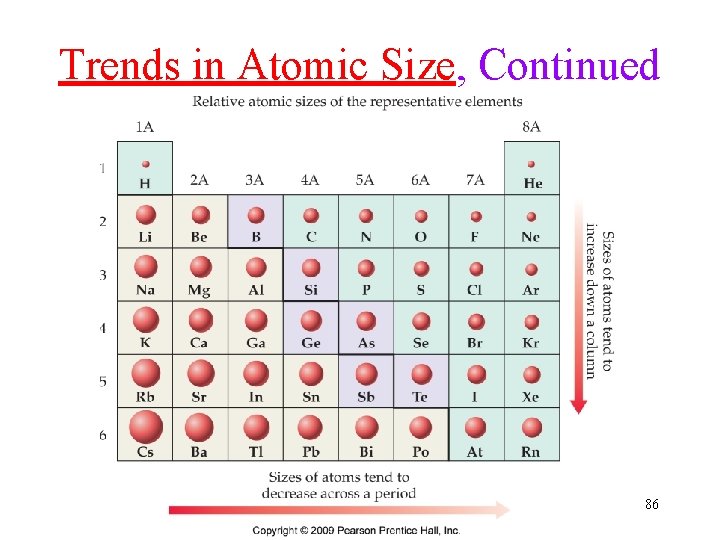
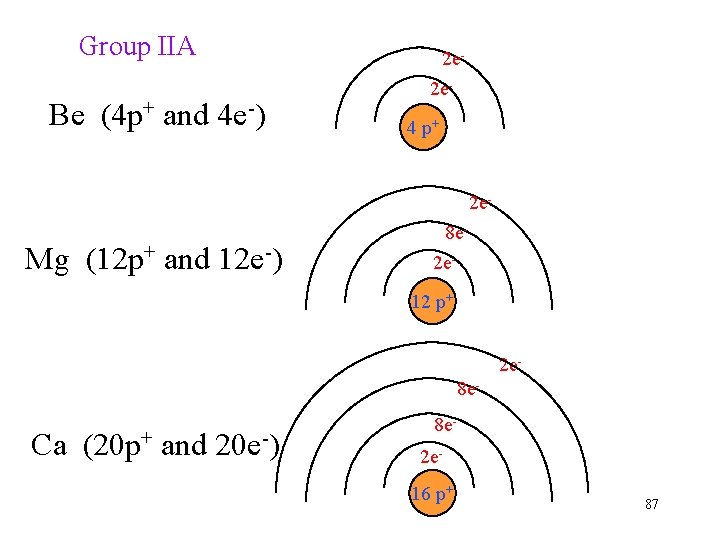
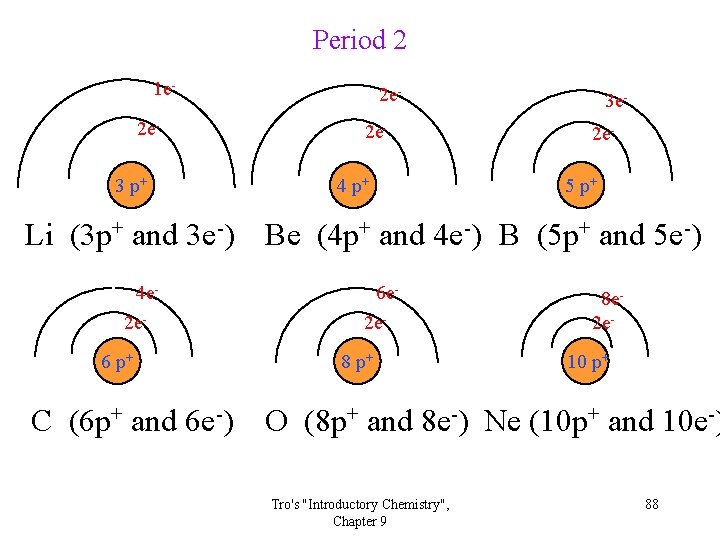
Trends in Atomic Size • Either volume or radius. ü Treat atom as a hard marble. • As you traverse down a column on the periodic table, the size of the atom increases. ü Valence shell farther from nucleus. ü Effective nuclear charge fairly close. • As you traverse left to right across a period, the size of the atom decreases. ü Adding electrons to same valence shell. ü Effective nuclear charge increases. ü Valence shell held closer. Tro's "Introductory Chemistry", Chapter 9 85
Trends in Atomic Size, Continued 86
Group IIA Be (4 p+ and 4 e-) 2 e 2 e 4 p+ 2 e- Mg (12 p+ and 12 e-) 8 e 2 e 12 p+ 2 e 8 e- Ca (20 p+ and 20 e-) 8 e 2 e 16 p+ 87
Period 2 1 e 2 e 3 p+ 2 e 2 e 4 p+ 3 e 2 e 5 p+ Li (3 p+ and 3 e-) Be (4 p+ and 4 e-) B (5 p+ and 5 e-) 4 e 2 e 6 p+ 6 e 2 e 8 p+ 8 e 2 e 10 p+ C (6 p+ and 6 e-) O (8 p+ and 8 e-) Ne (10 p+ and 10 e-) Tro's "Introductory Chemistry", Chapter 9 88
Tro's "Introductory Chemistry", Chapter 9 89
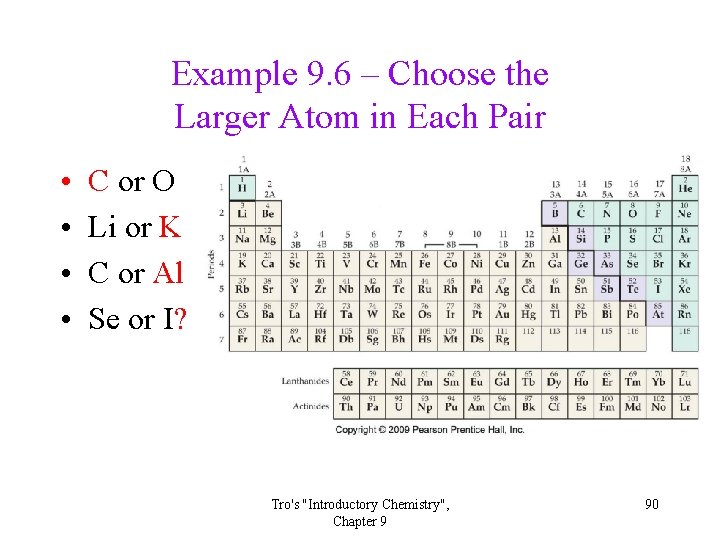
Example 9. 6 – Choose the Larger Atom in Each Pair • • C or O Li or K C or Al Se or I? Tro's "Introductory Chemistry", Chapter 9 90
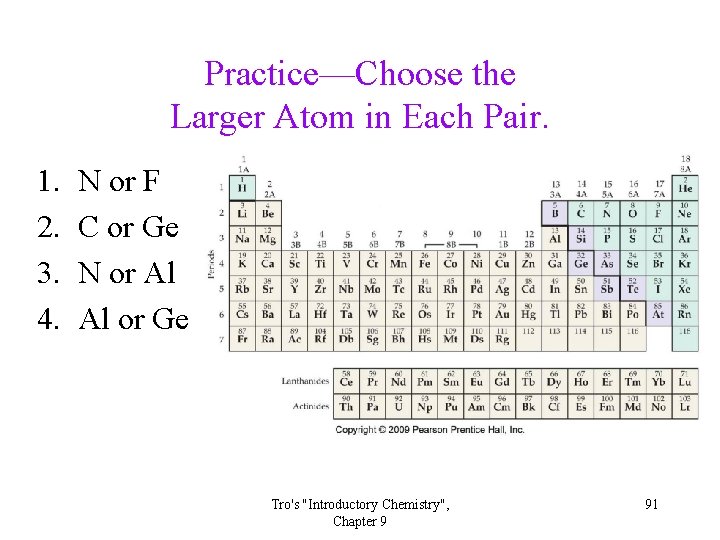
Practice—Choose the Larger Atom in Each Pair. 1. 2. 3. 4. N or F C or Ge N or Al Al or Ge Tro's "Introductory Chemistry", Chapter 9 91
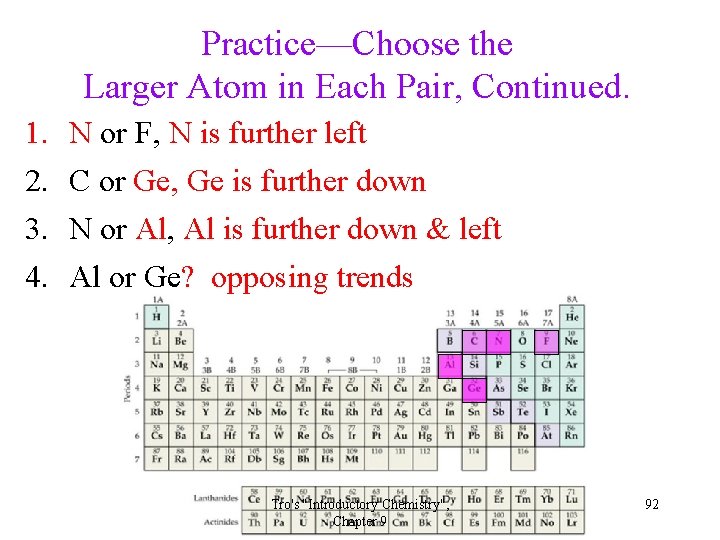
Practice—Choose the Larger Atom in Each Pair, Continued. 1. 2. 3. 4. N or F F, N is further left C or Ge Ge, Ge is further down N or Al, Al Al is further down & left Al or Ge? opposing trends Tro's "Introductory Chemistry", Chapter 9 92
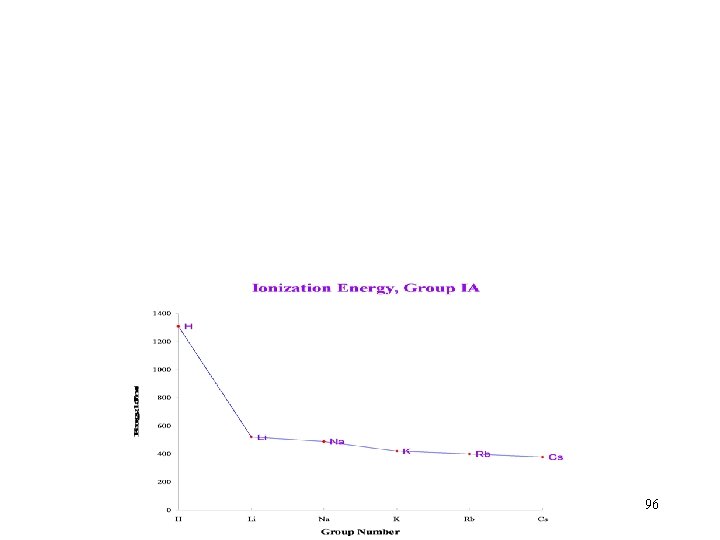
Ionization Energy • Minimum energy needed to remove an electron from an atom. üGas state. üEndothermic process. üValence electron easiest to remove. üM(g) + 1 st IE M 1+(g) + 1 eüM+1(g) + 2 nd IE M 2+(g) + 1 eØFirst ionization energy = energy to remove electron from neutral atom; 2 nd IE = energy to remove from +1 ion; etc. Tro's "Introductory Chemistry", Chapter 9 93
94
Tro's "Introductory Chemistry", Chapter 9 95
96
Tro's "Introductory Chemistry", Chapter 9 97
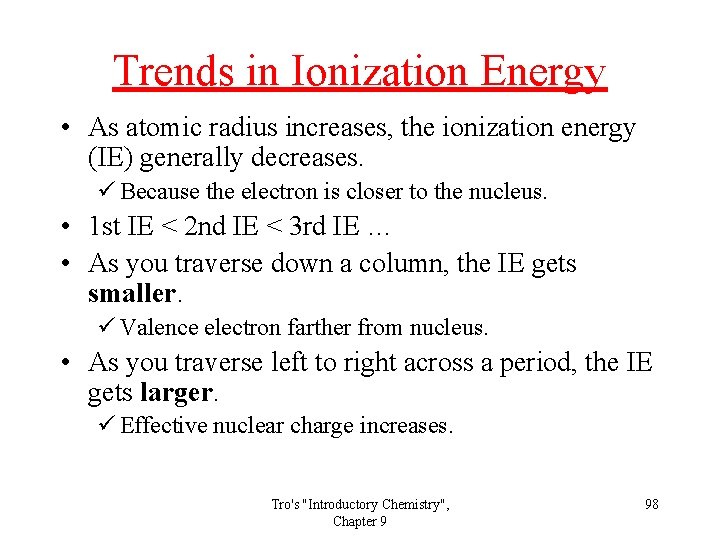
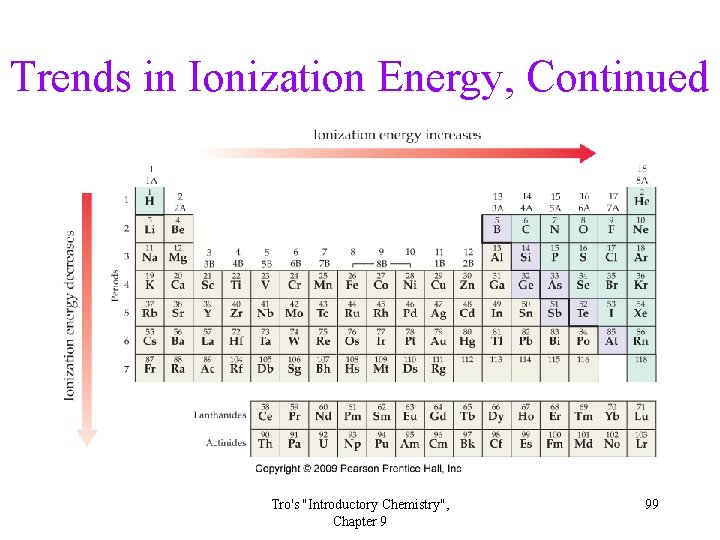
Trends in Ionization Energy • As atomic radius increases, the ionization energy (IE) generally decreases. ü Because the electron is closer to the nucleus. • 1 st IE < 2 nd IE < 3 rd IE … • As you traverse down a column, the IE gets smaller. ü Valence electron farther from nucleus. • As you traverse left to right across a period, the IE gets larger. ü Effective nuclear charge increases. Tro's "Introductory Chemistry", Chapter 9 98
Trends in Ionization Energy, Continued Tro's "Introductory Chemistry", Chapter 9 99
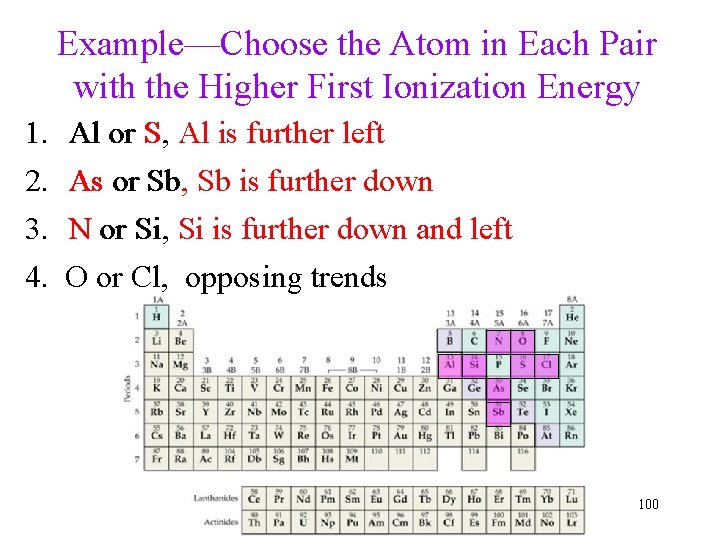
Example—Choose the Atom in Each Pair with the Higher First Ionization Energy 1. 2. 3. 4. Al or S S, Al is further left As or Sb Sb, Sb is further down N or Si Si, Si is further down and left O or Cl, opposing trends 100
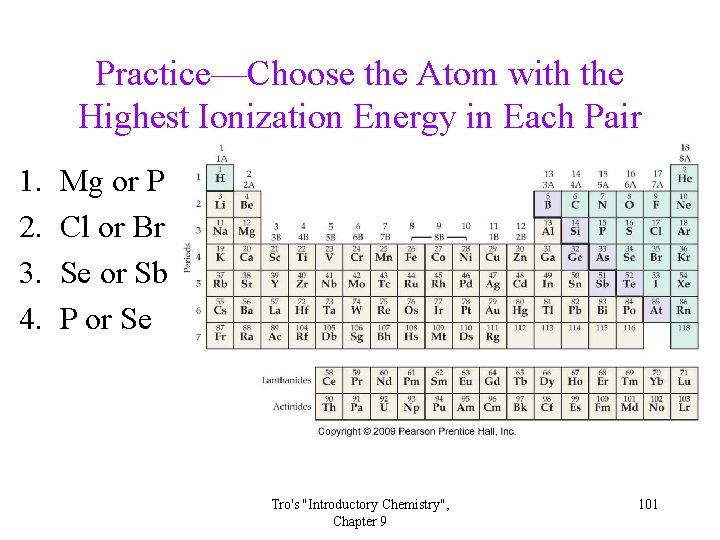
Practice—Choose the Atom with the Highest Ionization Energy in Each Pair 1. 2. 3. 4. Mg or P Cl or Br Se or Sb P or Se Tro's "Introductory Chemistry", Chapter 9 101
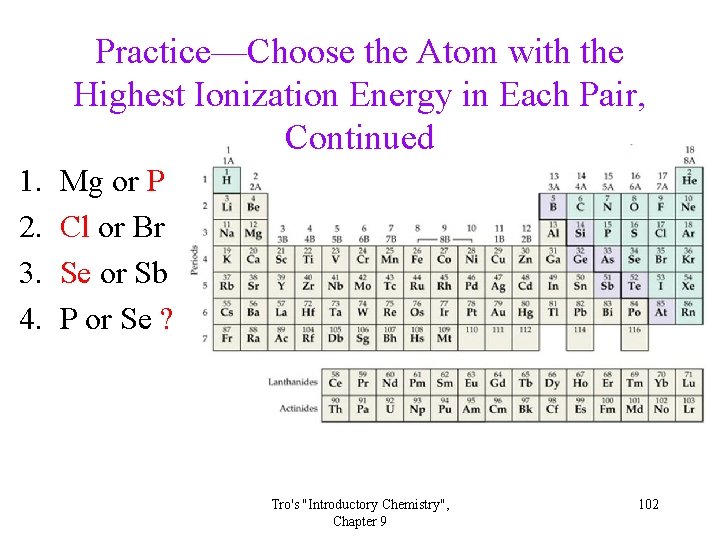
Practice—Choose the Atom with the Highest Ionization Energy in Each Pair, Continued 1. 2. 3. 4. Mg or P Cl or Br Se or Sb P or Se ? Tro's "Introductory Chemistry", Chapter 9 102
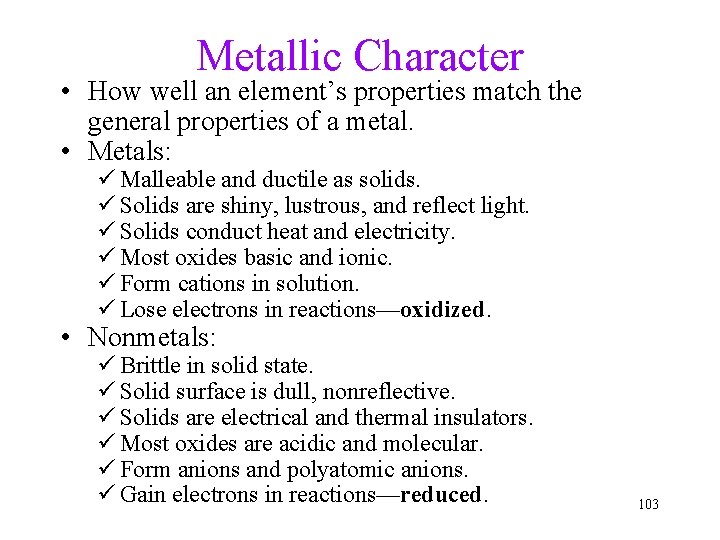
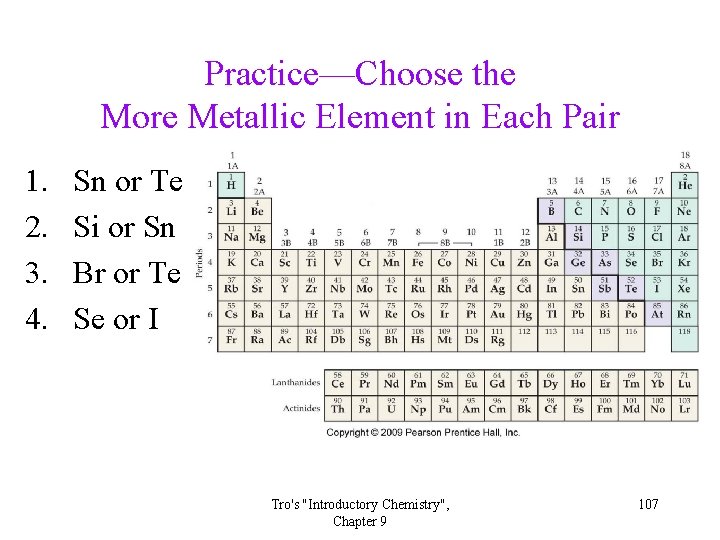
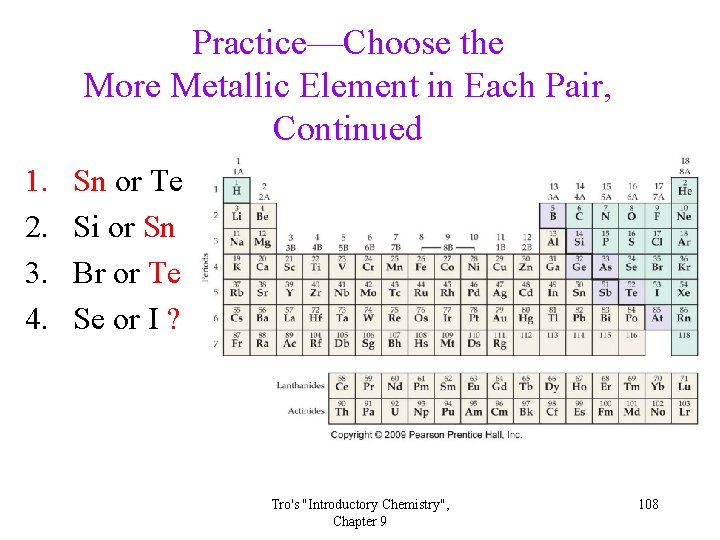
Metallic Character • How well an element’s properties match the general properties of a metal. • Metals: ü Malleable and ductile as solids. ü Solids are shiny, lustrous, and reflect light. ü Solids conduct heat and electricity. ü Most oxides basic and ionic. ü Form cations in solution. ü Lose electrons in reactions—oxidized. • Nonmetals: ü Brittle in solid state. ü Solid surface is dull, nonreflective. ü Solids are electrical and thermal insulators. ü Most oxides are acidic and molecular. ü Form anions and polyatomic anions. ü Gain electrons in reactions—reduced. 103
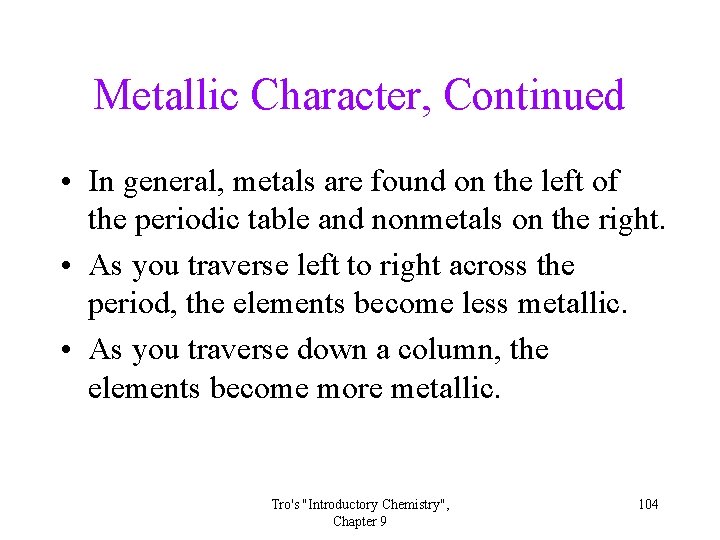
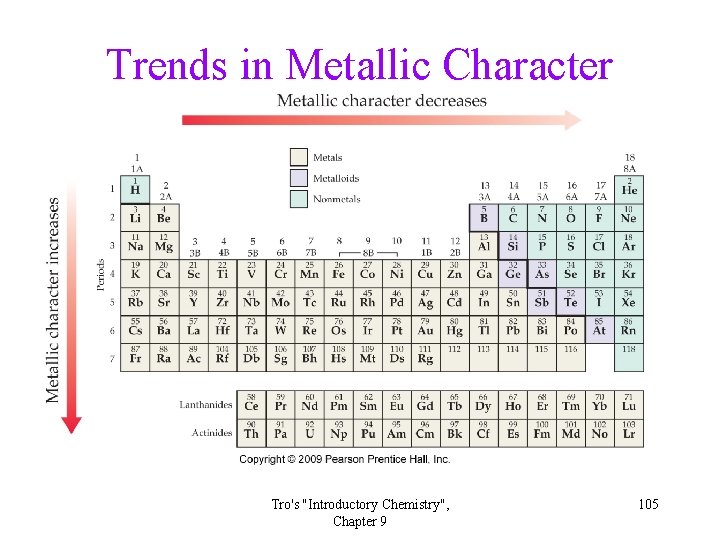
Metallic Character, Continued • In general, metals are found on the left of the periodic table and nonmetals on the right. • As you traverse left to right across the period, the elements become less metallic. • As you traverse down a column, the elements become more metallic. Tro's "Introductory Chemistry", Chapter 9 104
Trends in Metallic Character Tro's "Introductory Chemistry", Chapter 9 105
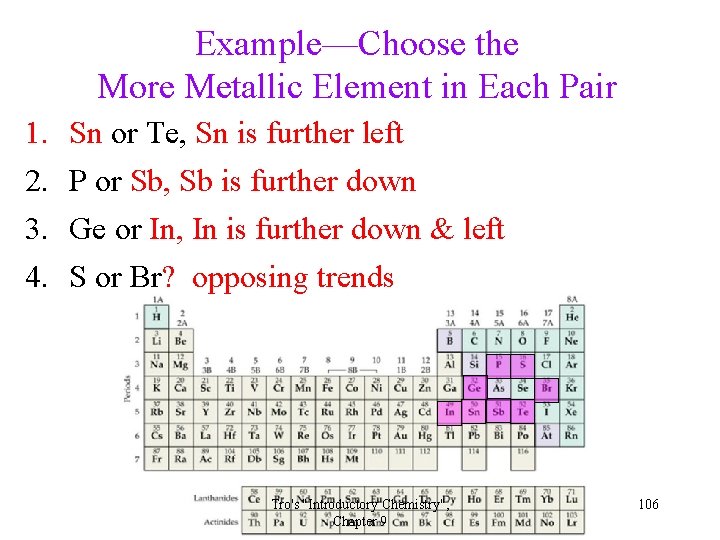
Example—Choose the More Metallic Element in Each Pair 1. 2. 3. 4. Sn or Te Te, Sn is further left P or Sb Sb, Sb is further down Ge or In In, In is further down & left S or Br? opposing trends Tro's "Introductory Chemistry", Chapter 9 106
Practice—Choose the More Metallic Element in Each Pair 1. 2. 3. 4. Sn or Te Si or Sn Br or Te Se or I Tro's "Introductory Chemistry", Chapter 9 107
Practice—Choose the More Metallic Element in Each Pair, Continued 1. 2. 3. 4. Sn or Te Si or Sn Br or Te Se or I ? Tro's "Introductory Chemistry", Chapter 9 108