INTERNATIONAL CLASSIFICATION OF PRIMARY CARE ICPC ICPC1 1987





- Slides: 100
INTERNATIONAL CLASSIFICATION OF PRIMARY CARE (ICPC) ICPC-1: 1987, ICPC-2: 1998, ICPC-2 -E: 2000, ICPC-2 -R: 2005
NOTE This ICPC Tutorial has been developed by Henk Lamberts and Inge Okkes. We have used some slides/ideas from presentations by Dr. Bob Bernstein (University of Ottawa, Canada), and Dr. Jean Karl Soler (Attard, Malta). It is recommended to view the Tutorial in the presentation mode.
1. GENERAL INTRODUCTION
A classification is the ordering principle of a defined domain
ICPC orders the domain of primary care (family medicine)…
. . and allows the coding of encounters in an episode of care structure
An encounter - the professional interchange between patient and FP - is, in ICPC, characterized by three elements…
1. patient’s reason(s) for encounter (RFE): why has s/he come? 2. FP’s diagnosis/es: what’s the patient’s problem? 3. process: what is done?
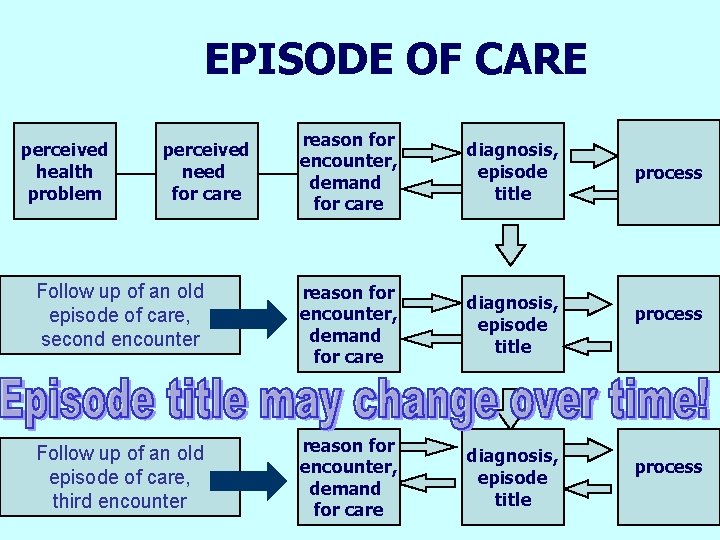
An episode of care is a health problem from its first presentation to a health care provider until (and including) the last encounter for it
At an encounter, more than 1 episode of care may be dealt with, e. g. diabetes and hypertension…
. . in such a case, diabetes and hypertension are the two sub-encounters in that encounter
An episode of care can be dealt with in a single encounter, or extend over a long period of time, with any number of encounters
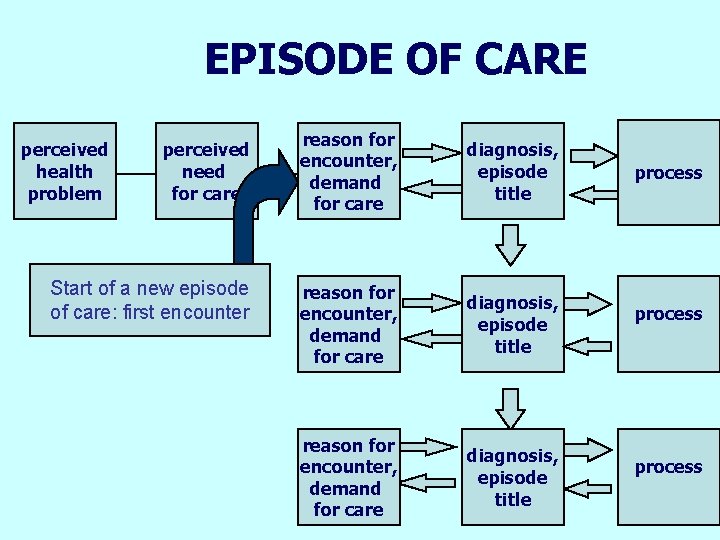
EPISODE OF CARE perceived health problem perceived need for care Start of a new episode of care: first encounter reason for encounter, demand for care diagnosis, episode title process
EPISODE OF CARE reason for encounter, demand for care diagnosis, episode title Follow up of an old episode of care, second encounter reason for encounter, demand for care diagnosis, episode title Follow up of an old episode of care, third encounter reason for encounter, demand for care diagnosis, episode title perceived health problem perceived need for care process
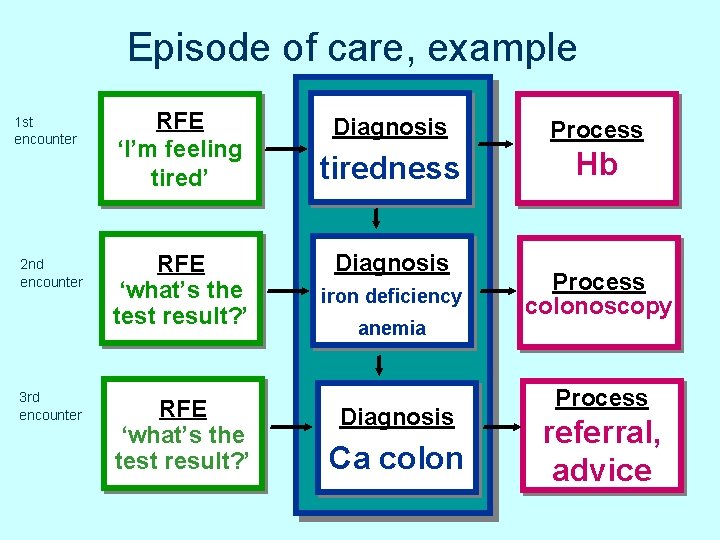
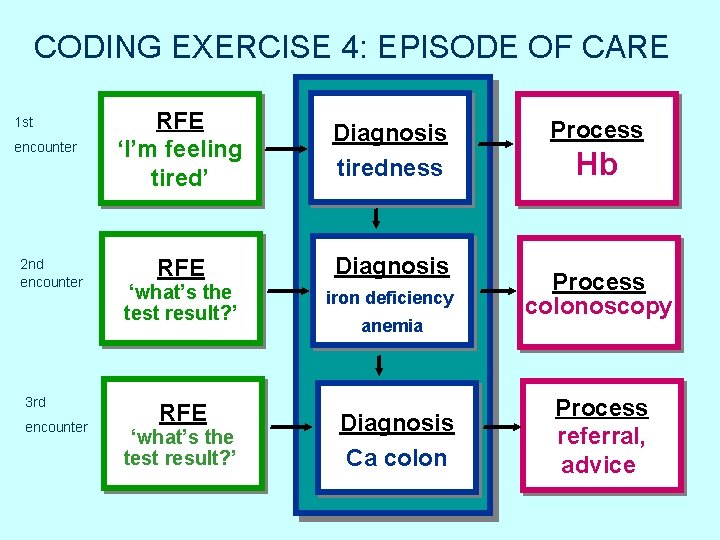
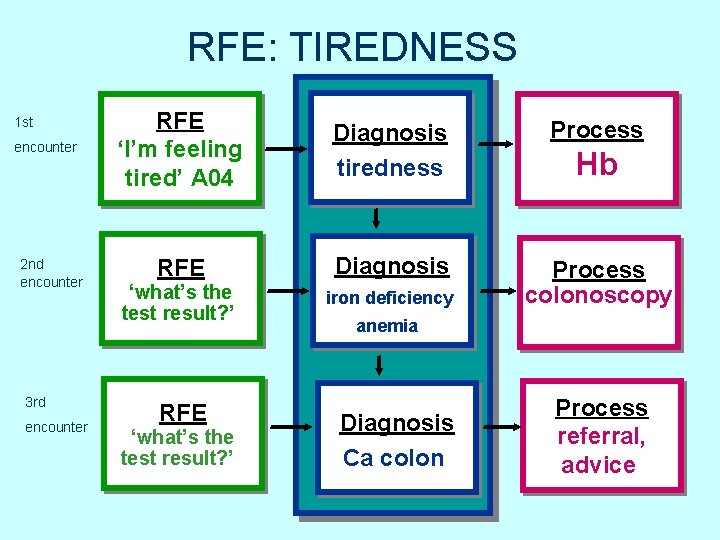
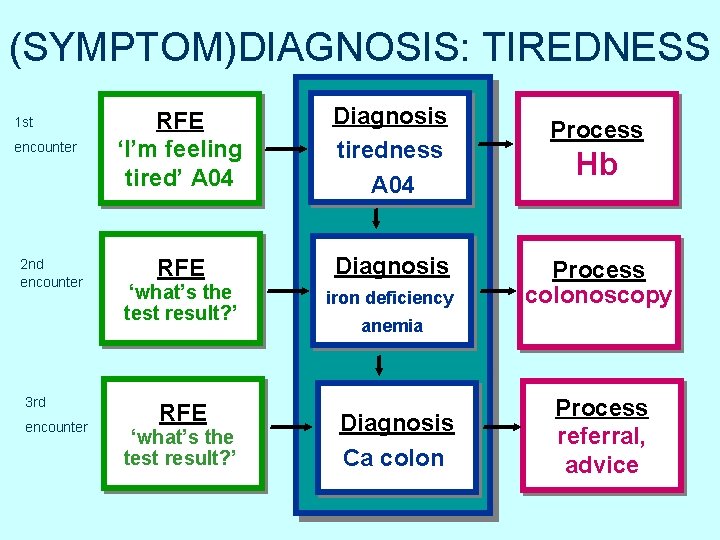
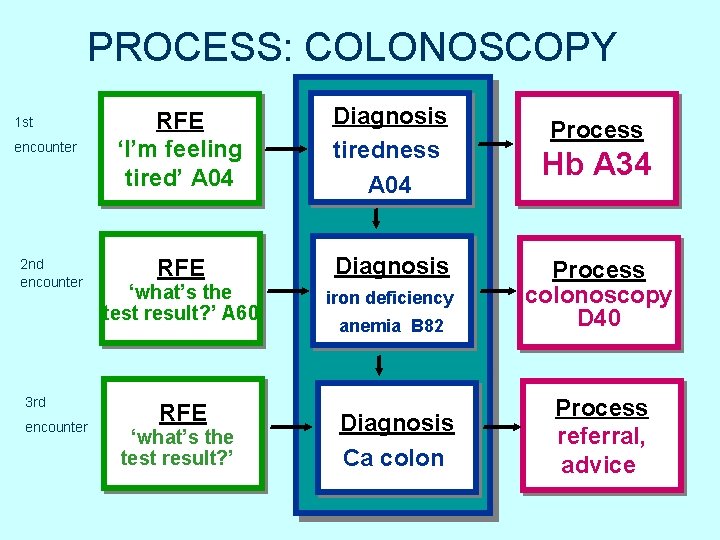
Episode of care, example 1 st encounter 2 nd encounter 3 rd encounter RFE ‘I’m feeling tired’ RFE ‘what’s the test result? ’ Diagnosis Process tiredness Hb Diagnosis iron deficiency anemia Diagnosis Ca colon Process colonoscopy Process referral, advice
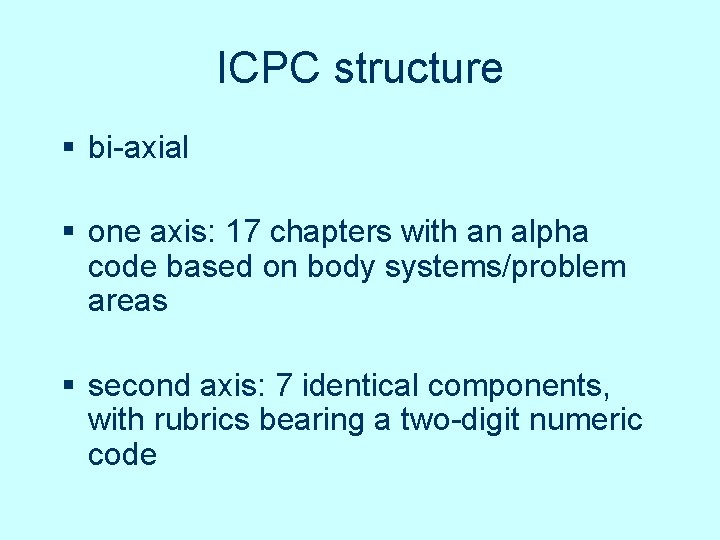
ICPC structure § bi-axial § one axis: 17 chapters with an alpha code based on body systems/problem areas § second axis: 7 identical components, with rubrics bearing a two-digit numeric code
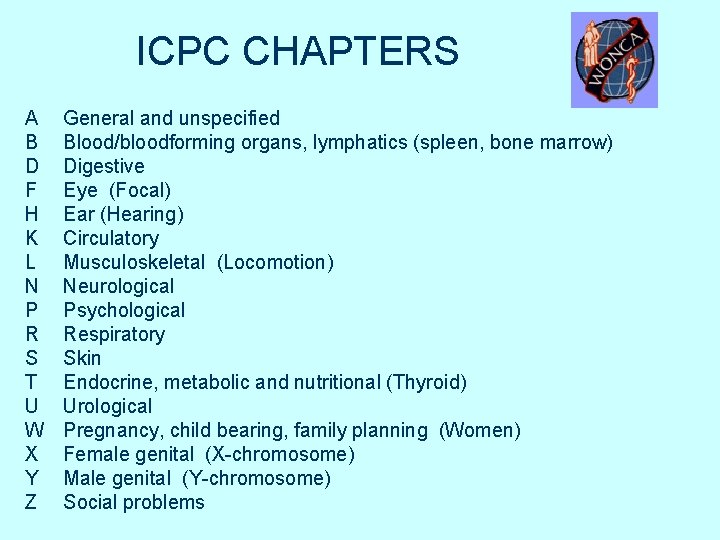
ICPC CHAPTERS A B D F H K L N P R S T U W X Y Z General and unspecified Blood/bloodforming organs, lymphatics (spleen, bone marrow) Digestive Eye (Focal) Ear (Hearing) Circulatory Musculoskeletal (Locomotion) Neurological Psychological Respiratory Skin Endocrine, metabolic and nutritional (Thyroid) Urological Pregnancy, child bearing, family planning (Women) Female genital (X-chromosome) Male genital (Y-chromosome) Social problems
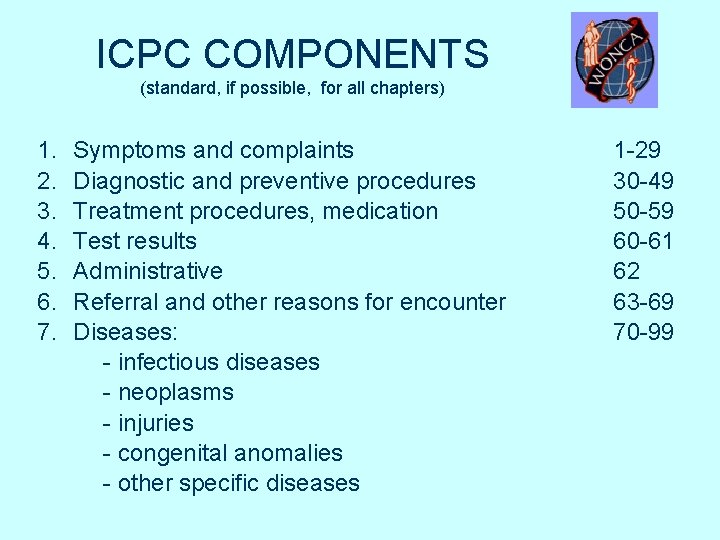
ICPC COMPONENTS (standard, if possible, for all chapters) 1. 2. 3. 4. 5. 6. 7. Symptoms and complaints Diagnostic and preventive procedures Treatment procedures, medication Test results Administrative Referral and other reasons for encounter Diseases: - infectious diseases - neoplasms - injuries - congenital anomalies - other specific diseases 1 -29 30 -49 50 -59 60 -61 62 63 -69 70 -99
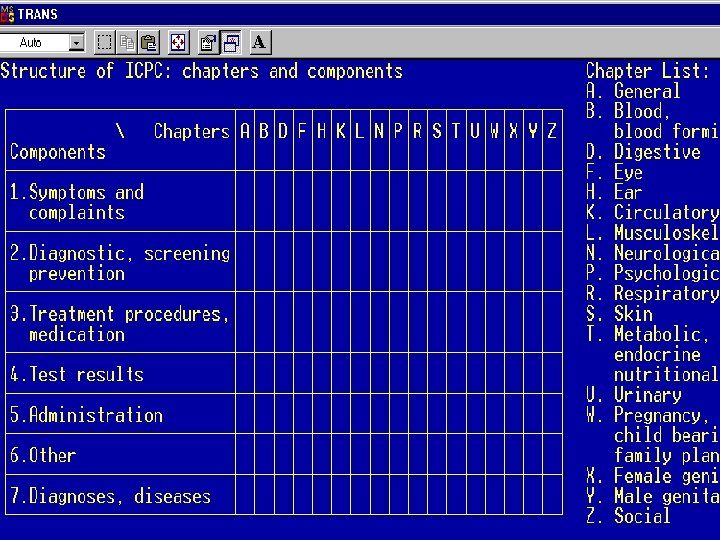
Chapters and components together form a ‘chessboard’. .
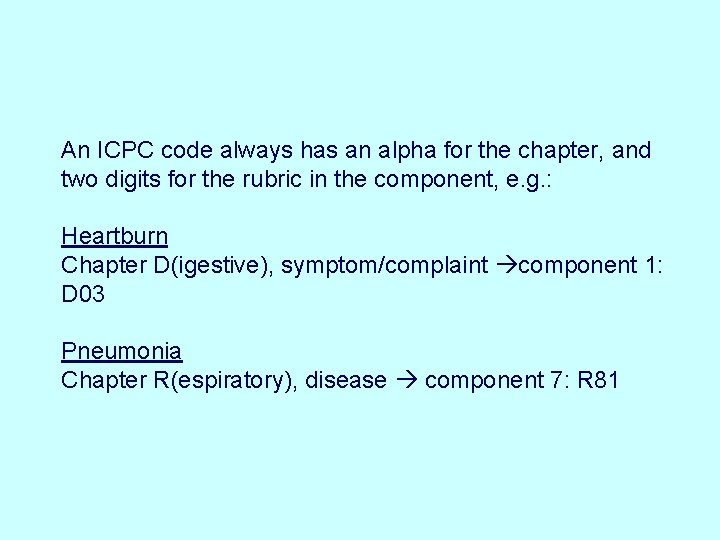
An ICPC code always has an alpha for the chapter, and two digits for the rubric in the component, e. g. : Heartburn Chapter D(igestive), symptom/complaint component 1: D 03 Pneumonia Chapter R(espiratory), disease component 7: R 81
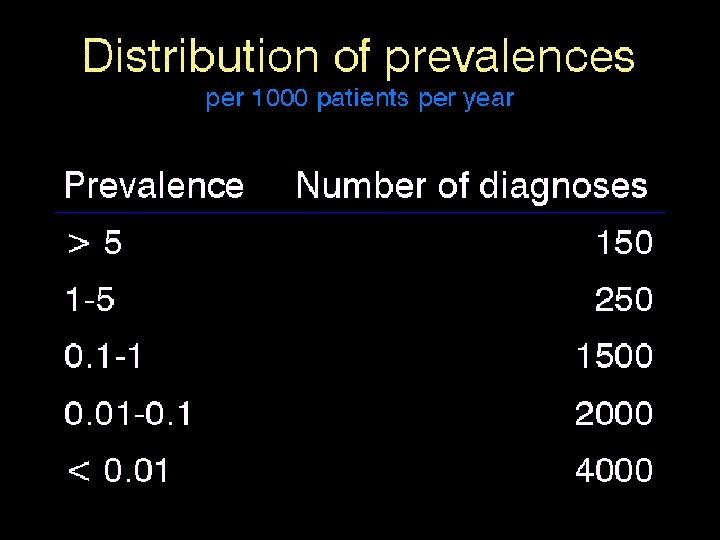
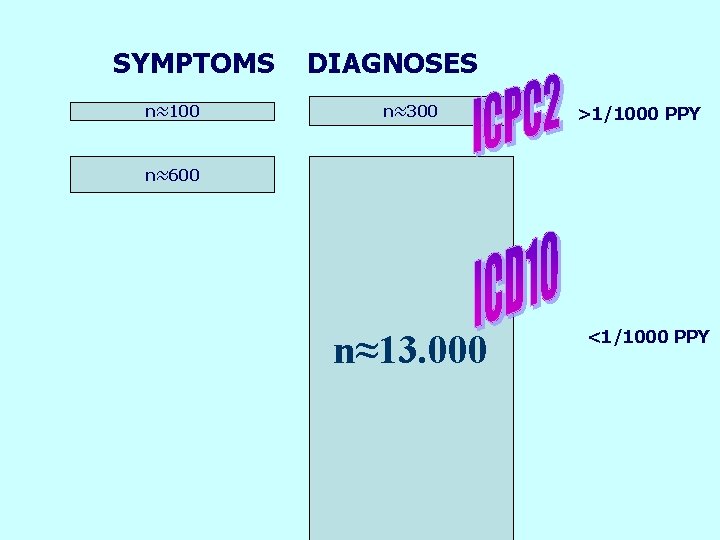
ICPC provides separate codes for RFEs, diagnoses, and interventions that are frequent in primary care (≥ 1/1000 ppy)…
…which is, for diagnoses, only a small proportion of all known diseases…
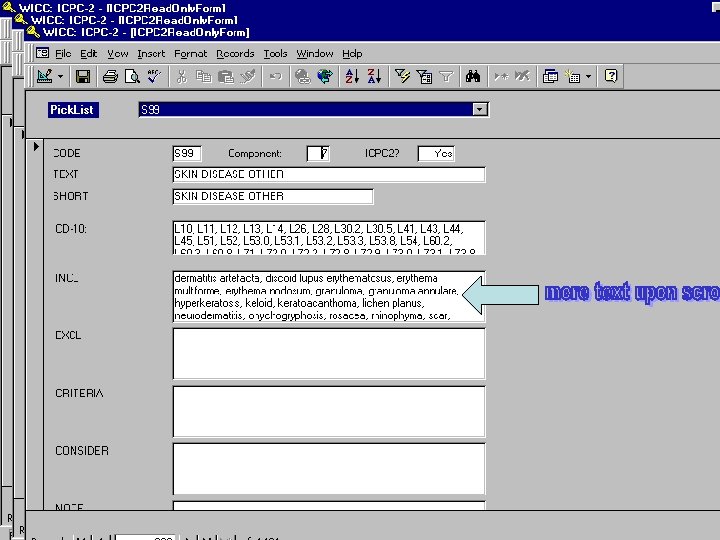
In ICPC, entities without a separate code are included in rag-bag rubrics at the end of each (sub)section, where the diseases included in that rag-bag are listed. . e. g. S 99: other skin disease. .
ICPC orders the domain of primary care… …. but has insufficient granularity to document all individual patients’ diagnoses
SYMPTOMS n≈100 DIAGNOSES n≈300 >1/1000 PPY n≈600 n≈13. 000 <1/1000 PPY
For hierarchical expansion of ICPC, ICD-10 is recommended; the ICPC 2 -ICD 10 Thesaurus on this CD-ROM allows…
easy, semi-automatic double coding by the simultaneous use of: § ICPC-2 as an ordering principle (based on the high prevalence of common diagnoses in family practice), § and of ICD-10 as a nomenclature (based on the wide range of ‘known’ diagnoses)
2. THE CONTENT OF ICPC IN MORE DETAIL
CODING WITH ICPC § is easy because of its substantial mnemonic quality: the chapter’s alpha refers to the body system (S: Skin), and components and order of rubrics are, as far as possible, the same in all chapters; § first select the chapter: what body system or problem area? § next the component (symptom? disease? intervention? ) § next the rubric
EPISODE OF CARE: A CORE CONCEPT IN ICPC • a health problem from its first presentation to a health care provider until the completion of the last encounter for it • the unit of assessment of ICPC coded data: an individual patient’s problem followed over time
EPISODE OF CARE: ELEMENTS § the patient’s Reason(s) for Encounter (RFEs): § should be recognizable by the patient as an acceptable description of his/her demand for care § the FP’s diagnosis: § gives the name to the episode of care § qualified as new or old, and certain or uncertain § process: the interventions that occur
REASON FOR ENCOUNTER (RFE). . . is a true primary care concept, since primary care is RFE driven rather than diagnosis driven. .
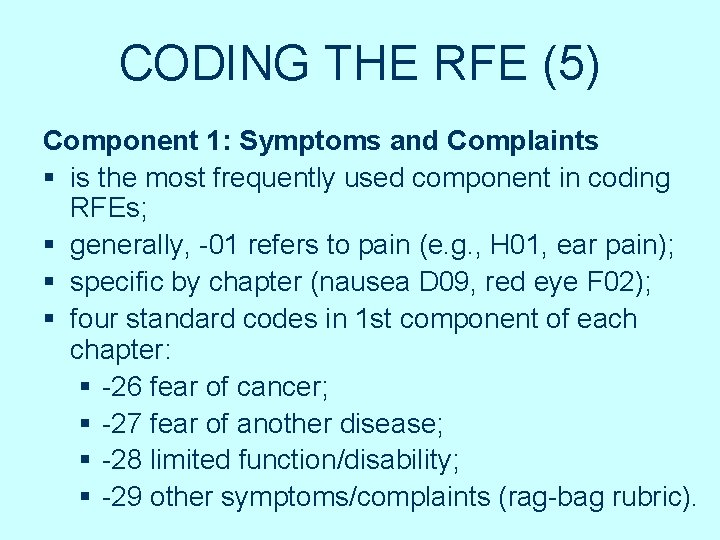
CODING THE RFE (1) Most importantly: it is the PATIENT’S statement, clarified by the FP. For coding RFE(s), all ICPC codes may be used. An RFE may be a: § Symptom/complaint (headache, tiredness, feeling depressed, fear of cancer): 1 st component of each chapter; § Disease (diabetes, mumps): 7 th component of each chapter (except chapter Z); § Request for an intervention (BP, prescription, test results, administrative procedure): 2 nd-6 th components of each chapter.
CODING THE RFE (2) • The RFE should be agreed upon by patient and FP, and the code should be as close as possible to the original statement by the patient (or his/ her representative, e. g. parent); • All RFEs should be coded, regardless of the stage of the encounter at which it is presented; • Inclusion criteria are NOT TO BE USED when coding RFEs.
CODING THE RFE (3) First, choose the chapter: is the RFE linked to a digestive problem? D. . . to a social problem? Z. . . to a skin problem? S
CODING THE RFE (4) Next: choose a component. .
CODING THE RFE (5) Component 1: Symptoms and Complaints § is the most frequently used component in coding RFEs; § generally, -01 refers to pain (e. g. , H 01, ear pain); § specific by chapter (nausea D 09, red eye F 02); § four standard codes in 1 st component of each chapter: § -26 fear of cancer; § -27 fear of another disease; § -28 limited function/disability; § -29 other symptoms/complaints (rag-bag rubric).
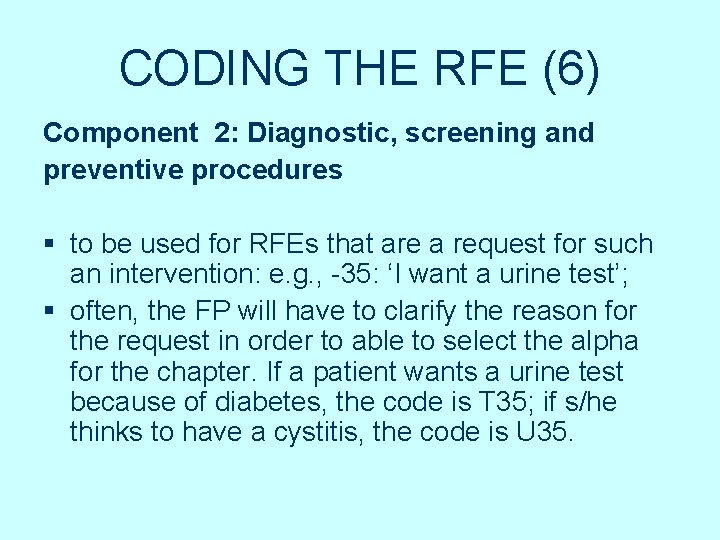
CODING THE RFE (6) Component 2: Diagnostic, screening and preventive procedures § to be used for RFEs that are a request for such an intervention: e. g. , -35: ‘I want a urine test’; § often, the FP will have to clarify the reason for the request in order to able to select the alpha for the chapter. If a patient wants a urine test because of diabetes, the code is T 35; if s/he thinks to have a cystitis, the code is U 35.
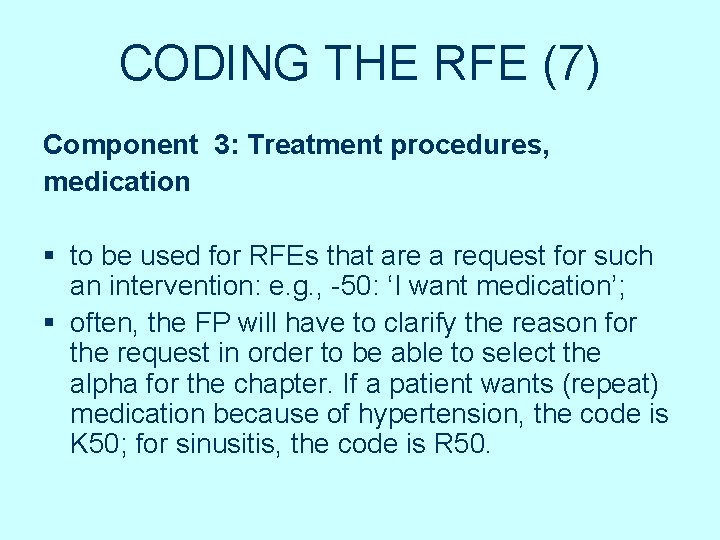
CODING THE RFE (7) Component 3: Treatment procedures, medication § to be used for RFEs that are a request for such an intervention: e. g. , -50: ‘I want medication’; § often, the FP will have to clarify the reason for the request in order to be able to select the alpha for the chapter. If a patient wants (repeat) medication because of hypertension, the code is K 50; for sinusitis, the code is R 50.
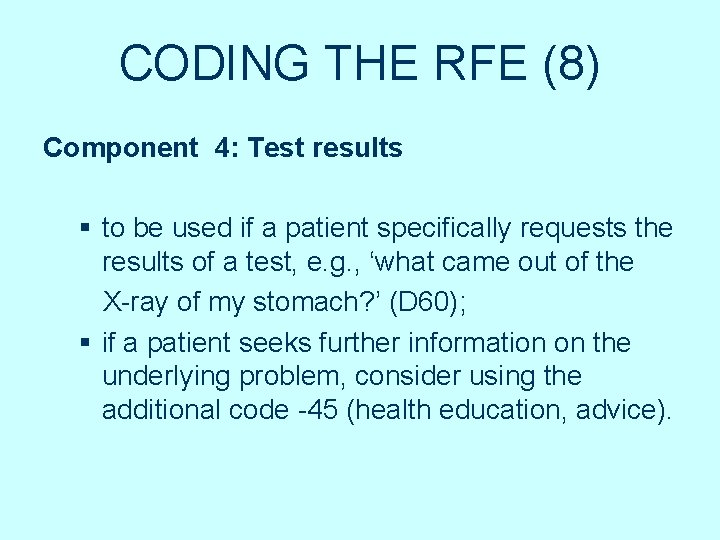
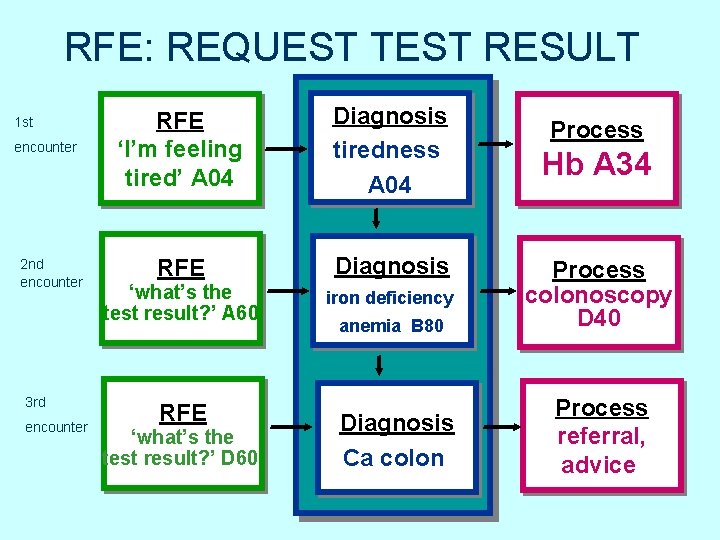
CODING THE RFE (8) Component 4: Test results § to be used if a patient specifically requests the results of a test, e. g. , ‘what came out of the X-ray of my stomach? ’ (D 60); § if a patient seeks further information on the underlying problem, consider using the additional code -45 (health education, advice).
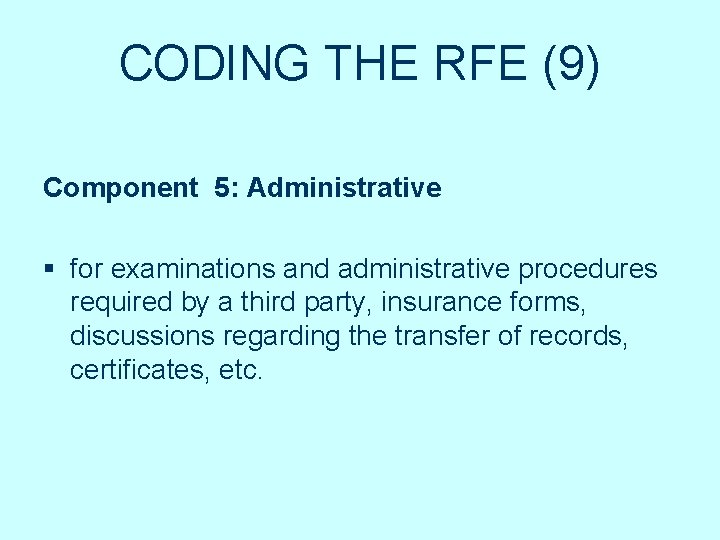
CODING THE RFE (9) Component 5: Administrative § for examinations and administrative procedures required by a third party, insurance forms, discussions regarding the transfer of records, certificates, etc.
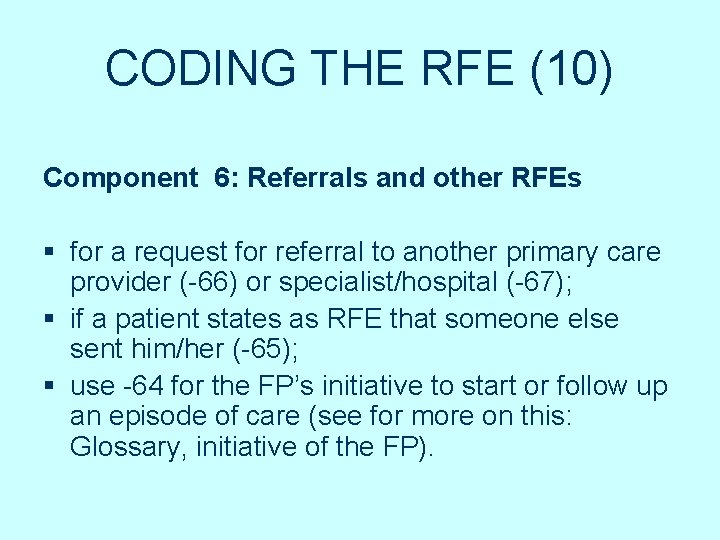
CODING THE RFE (10) Component 6: Referrals and other RFEs § for a request for referral to another primary care provider (-66) or specialist/hospital (-67); § if a patient states as RFE that someone else sent him/her (-65); § use -64 for the FP’s initiative to start or follow up an episode of care (see for more on this: Glossary, initiative of the FP).
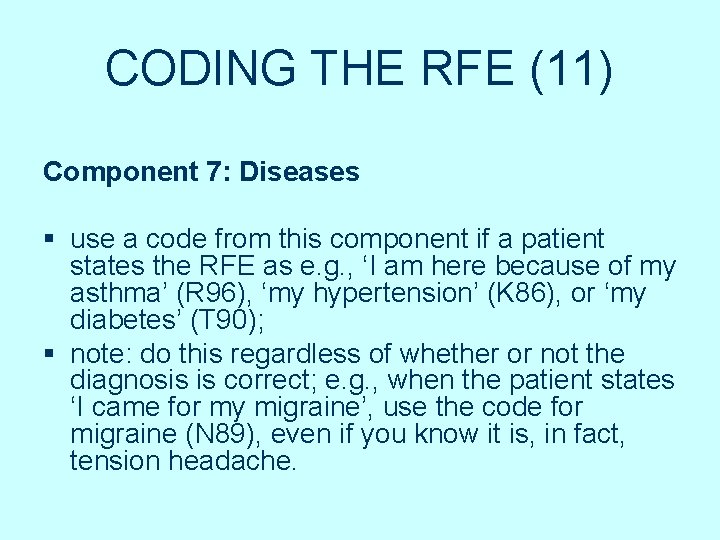
CODING THE RFE (11) Component 7: Diseases § use a code from this component if a patient states the RFE as e. g. , ‘I am here because of my asthma’ (R 96), ‘my hypertension’ (K 86), or ‘my diabetes’ (T 90); § note: do this regardless of whether or not the diagnosis is correct; e. g. , when the patient states ‘I came for my migraine’, use the code for migraine (N 89), even if you know it is, in fact, tension headache.
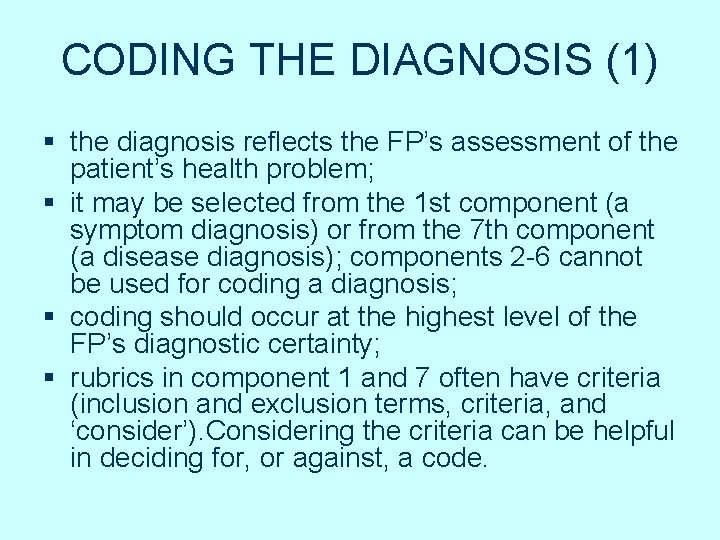
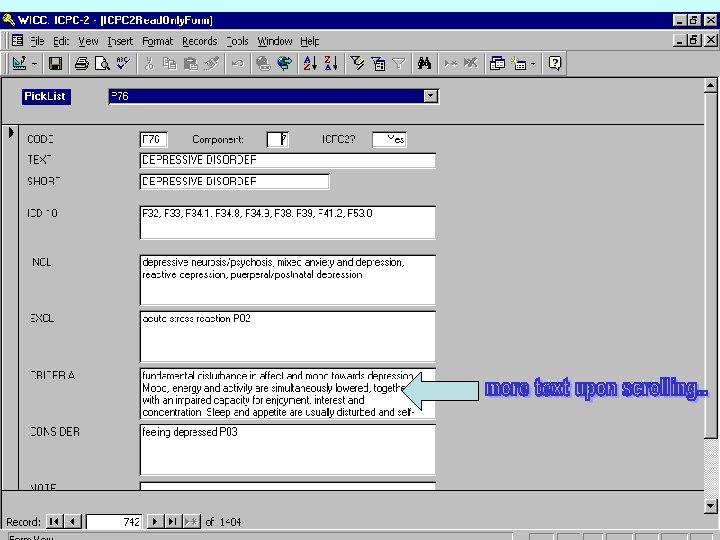
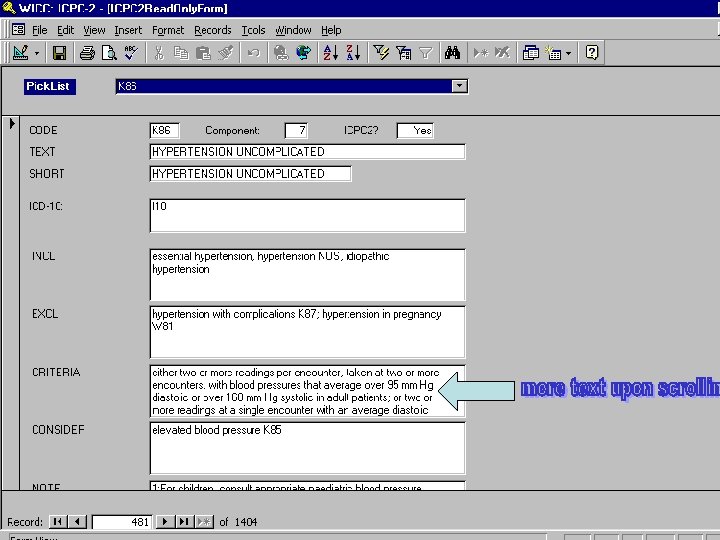
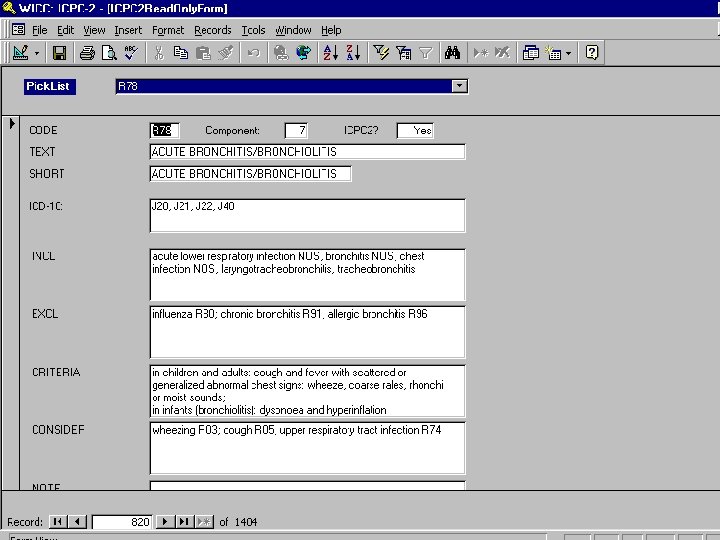
CODING THE DIAGNOSIS (1) § the diagnosis reflects the FP’s assessment of the patient’s health problem; § it may be selected from the 1 st component (a symptom diagnosis) or from the 7 th component (a disease diagnosis); components 2 -6 cannot be used for coding a diagnosis; § coding should occur at the highest level of the FP’s diagnostic certainty; § rubrics in component 1 and 7 often have criteria (inclusion and exclusion terms, criteria, and ‘consider’). Considering the criteria can be helpful in deciding for, or against, a code.
CODING THE DIAGNOSIS (2) In ICPC, localization takes precedence over aetiology. When coding a condition that because of its nature could be coded in more than one chapter (e. g. trauma), the most appropriate chapter should be used. Chapter A (general) is mainly to be used in case of an unspecified site, or if the disease affects more than two body systems.
CODING THE DIAGNOSIS (3) The inclusion criteria in ICPC contain the minimum requirements for that diagnosis. Criteria are NOT meant as a diagnostic tool, but rather as a tool to assign the correct code. The next three slides show examples of criteria in ICPC. . .
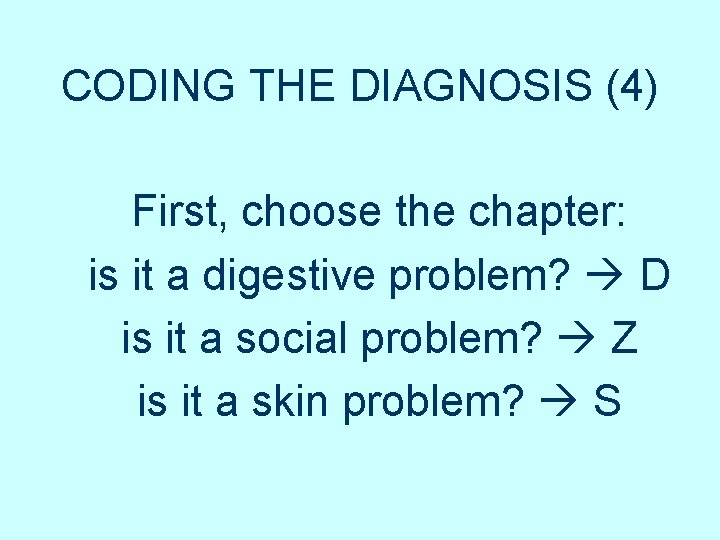
CODING THE DIAGNOSIS (4) First, choose the chapter: is it a digestive problem? D is it a social problem? Z is it a skin problem? S
CODING THE DIAGNOSIS (5) Next: choose a component. .
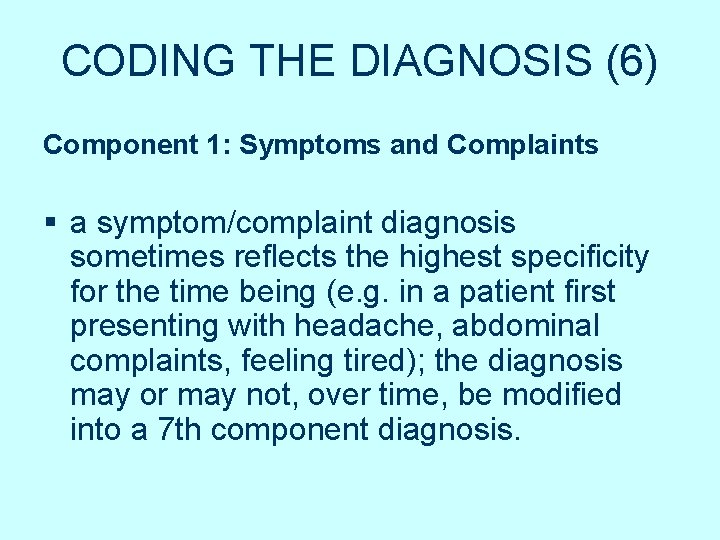
CODING THE DIAGNOSIS (6) Component 1: Symptoms and Complaints § a symptom/complaint diagnosis sometimes reflects the highest specificity for the time being (e. g. in a patient first presenting with headache, abdominal complaints, feeling tired); the diagnosis may or may not, over time, be modified into a 7 th component diagnosis.
CODING THE DIAGNOSIS (7) Component 7: Diseases § generally, rubrics in component 7 are ordered as follows: § infectious diseases § neoplasms § injuries § congenital anomalies § other specific diseases § Chapter Z (social problems) has, for obvious reasons, no 7 th component
CODING THE DIAGNOSIS (8) Component 7: Diseases § note the following important codes: § A 97: in case a patient presents with a question or symptom leading to the diagnosis ‘no disease’; § A 98: prevention. § these codes are essential, since they preclude patients’ inclusion in a rubric indicating a problem/disease. In the EFP data base, A 97 and A 98 have been combined into code A 97 (no disease/prevention).
CODING PROCESS (1) § For coding interventions (process), components 2, 3, 5 and 6 (except rubrics -63, -64, -65, and -69) can be used; § ICPC’s potential to code interventions (process) is limited; rubrics are broad and general; § 4 th and 5 th digits might be added for more specificity, according to national needs.
CODING PROCESS (2) again, first choose the chapter (usually the same as for the diagnosis), and next the component. . .
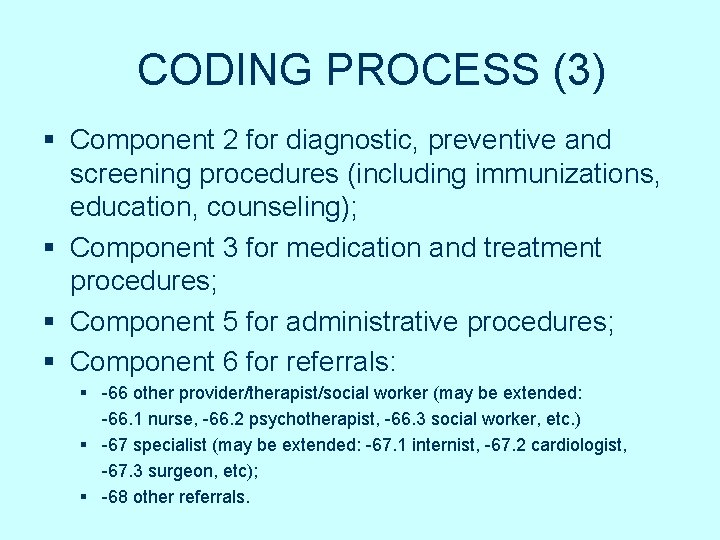
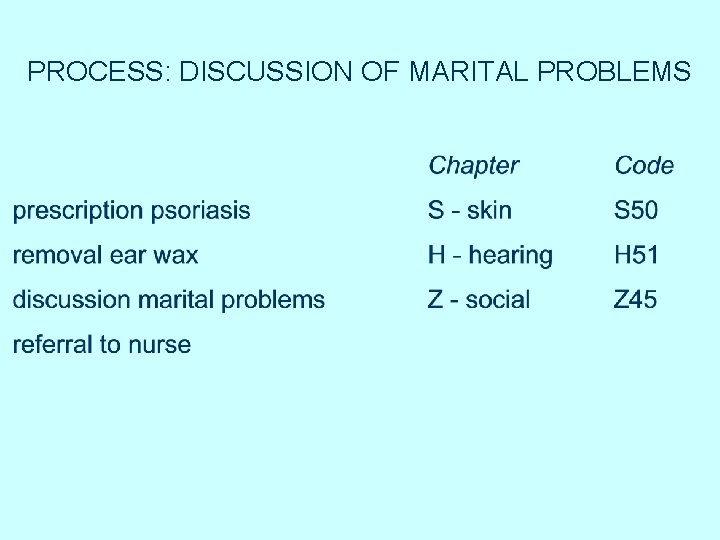
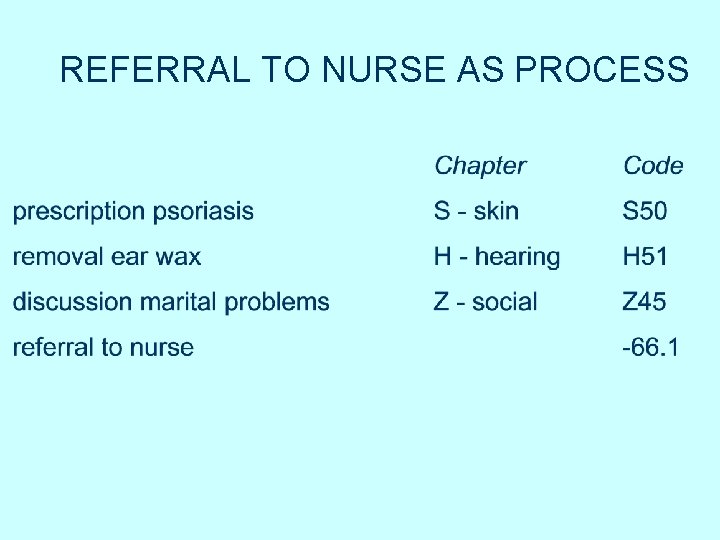
CODING PROCESS (3) § Component 2 for diagnostic, preventive and screening procedures (including immunizations, education, counseling); § Component 3 for medication and treatment procedures; § Component 5 for administrative procedures; § Component 6 for referrals: § -66 other provider/therapist/social worker (may be extended: -66. 1 nurse, -66. 2 psychotherapist, -66. 3 social worker, etc. ) § -67 specialist (may be extended: -67. 1 internist, -67. 2 cardiologist, -67. 3 surgeon, etc); § -68 other referrals.
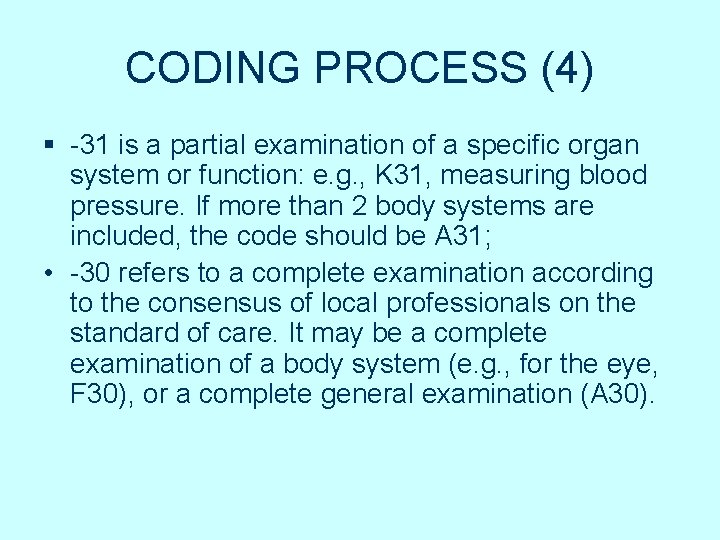
CODING PROCESS (4) § -31 is a partial examination of a specific organ system or function: e. g. , K 31, measuring blood pressure. If more than 2 body systems are included, the code should be A 31; • -30 refers to a complete examination according to the consensus of local professionals on the standard of care. It may be a complete examination of a body system (e. g. , for the eye, F 30), or a complete general examination (A 30).
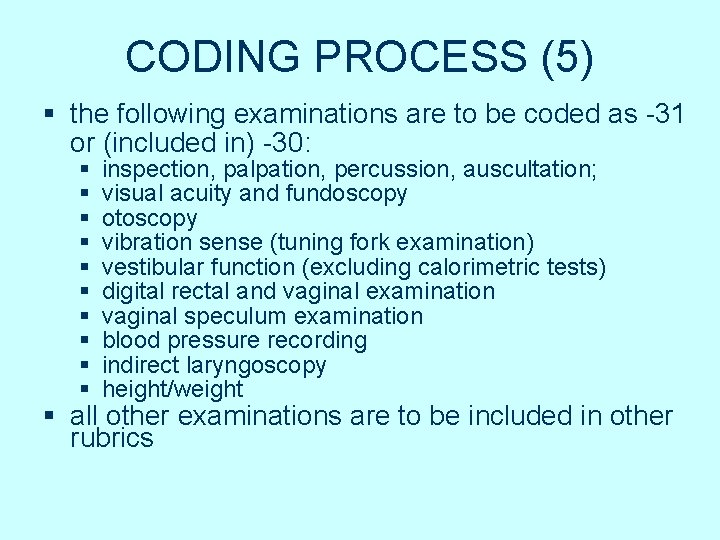
CODING PROCESS (5) § the following examinations are to be coded as -31 or (included in) -30: § § § § § inspection, palpation, percussion, auscultation; visual acuity and fundoscopy otoscopy vibration sense (tuning fork examination) vestibular function (excluding calorimetric tests) digital rectal and vaginal examination vaginal speculum examination blood pressure recording indirect laryngoscopy height/weight § all other examinations are to be included in other rubrics
CODING EXERCISE 1: RFE
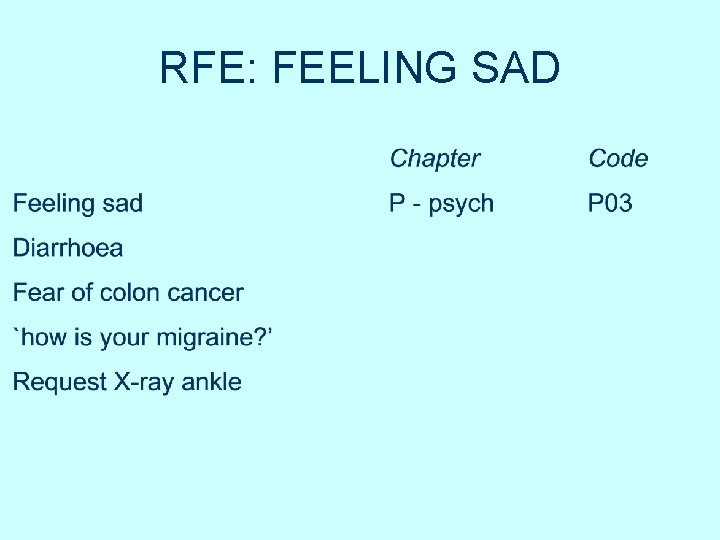
RFE: FEELING SAD
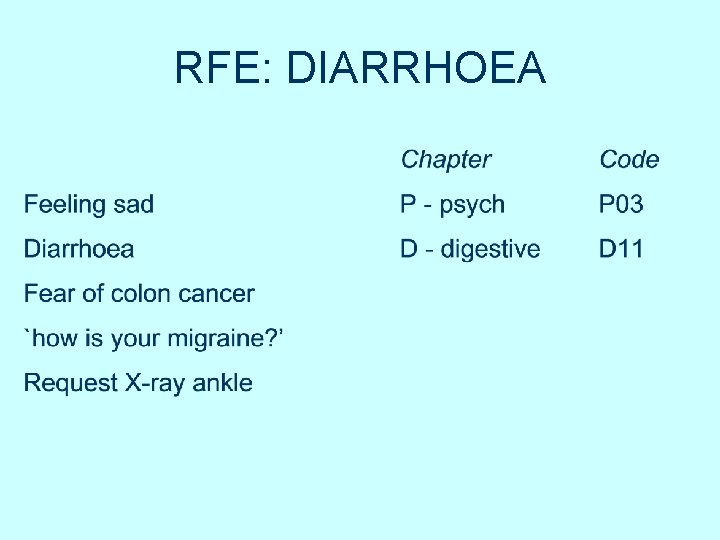
RFE: DIARRHOEA
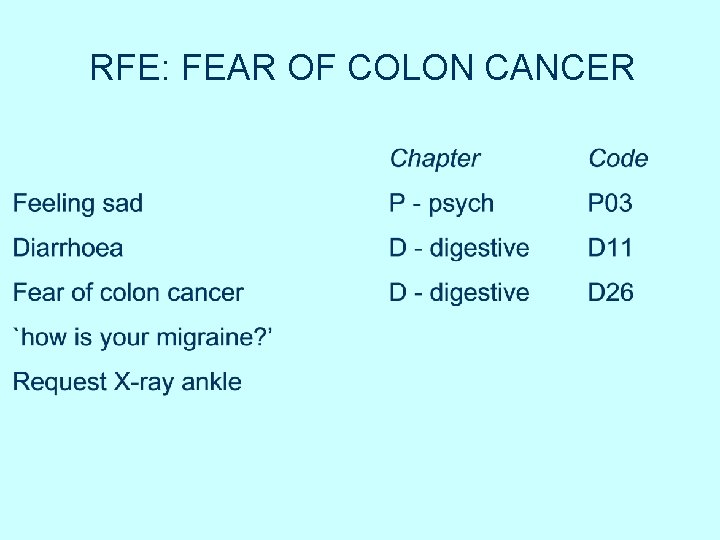
RFE: FEAR OF COLON CANCER
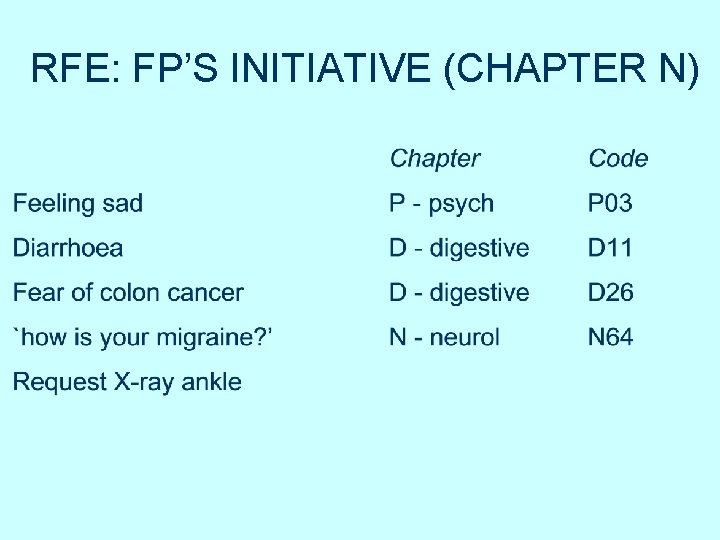
RFE: FP’S INITIATIVE (CHAPTER N)
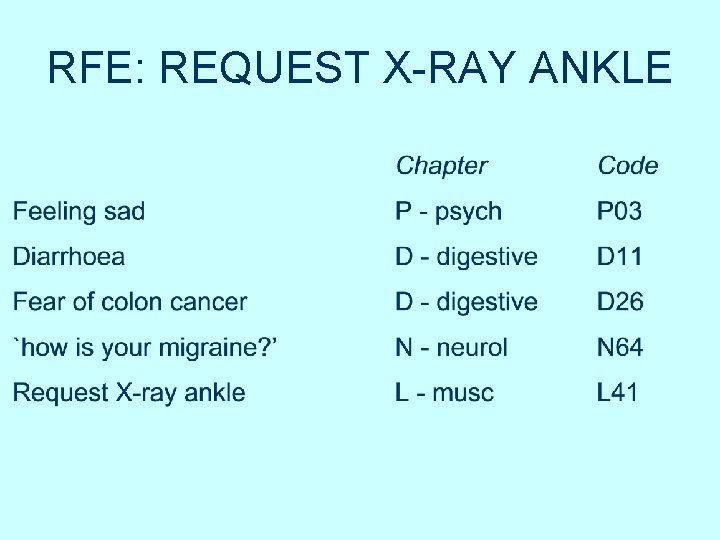
RFE: REQUEST X-RAY ANKLE
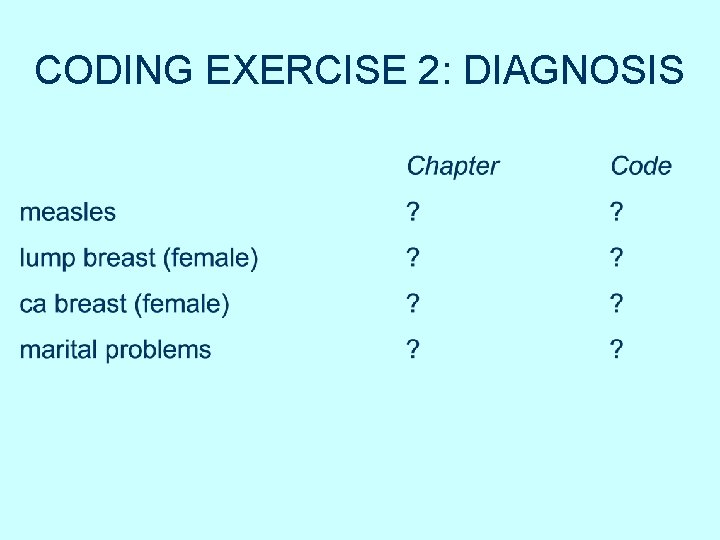
CODING EXERCISE 2: DIAGNOSIS
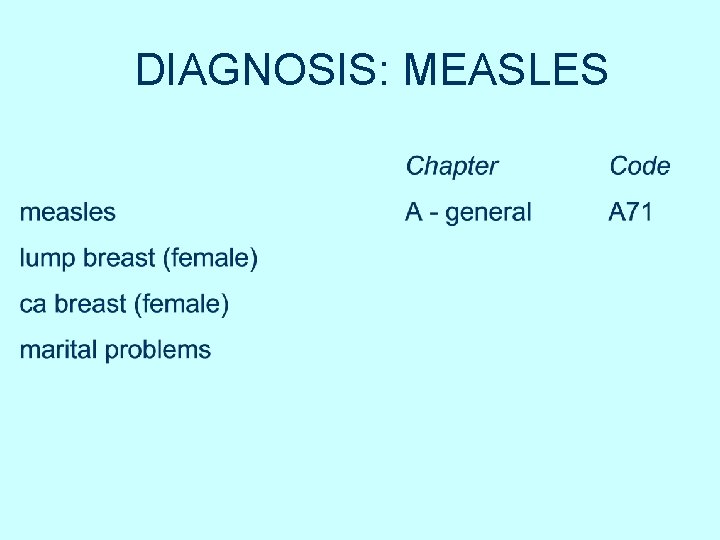
DIAGNOSIS: MEASLES
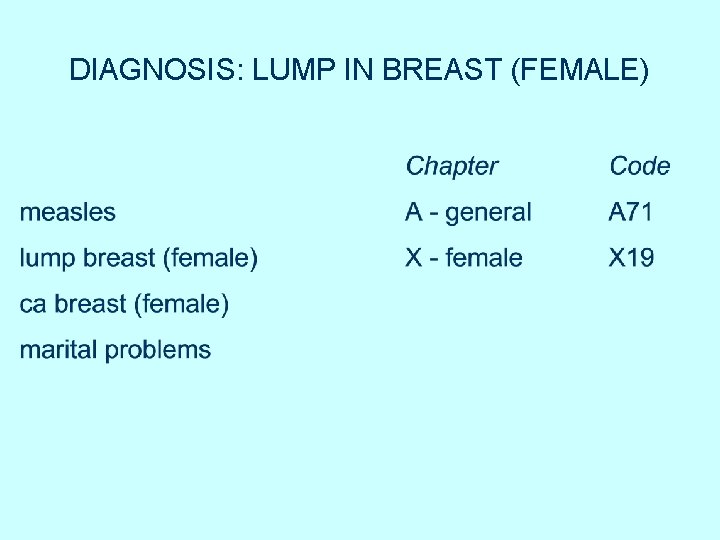
DIAGNOSIS: LUMP IN BREAST (FEMALE)
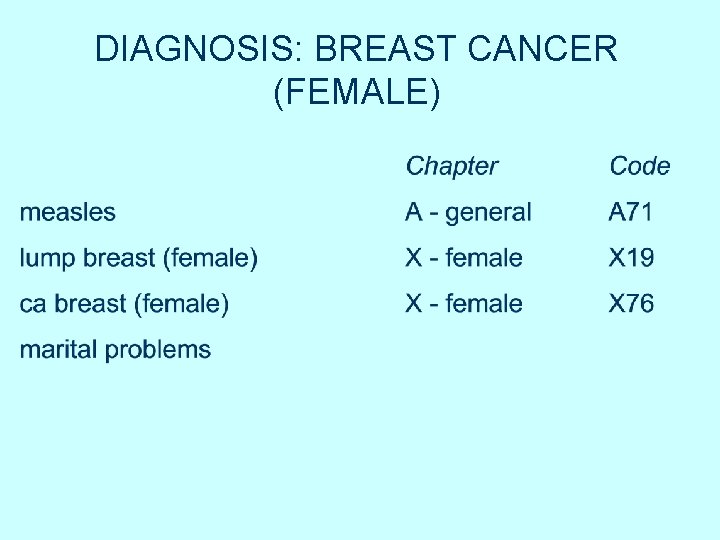
DIAGNOSIS: BREAST CANCER (FEMALE)
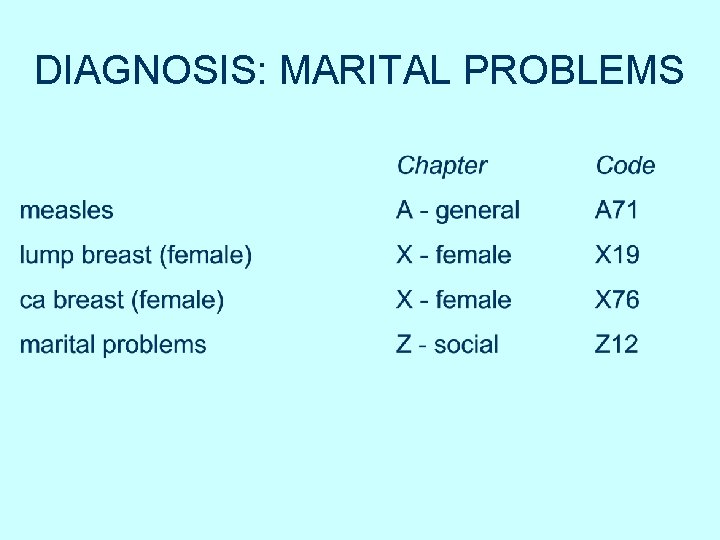
DIAGNOSIS: MARITAL PROBLEMS
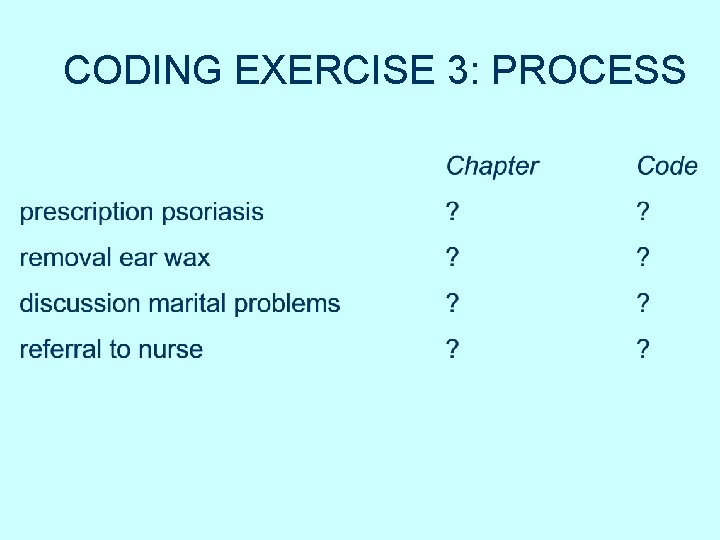
CODING EXERCISE 3: PROCESS
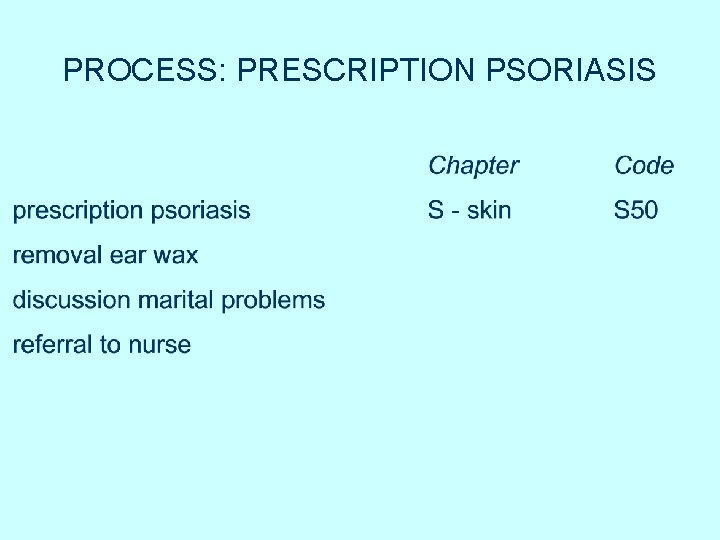
PROCESS: PRESCRIPTION PSORIASIS
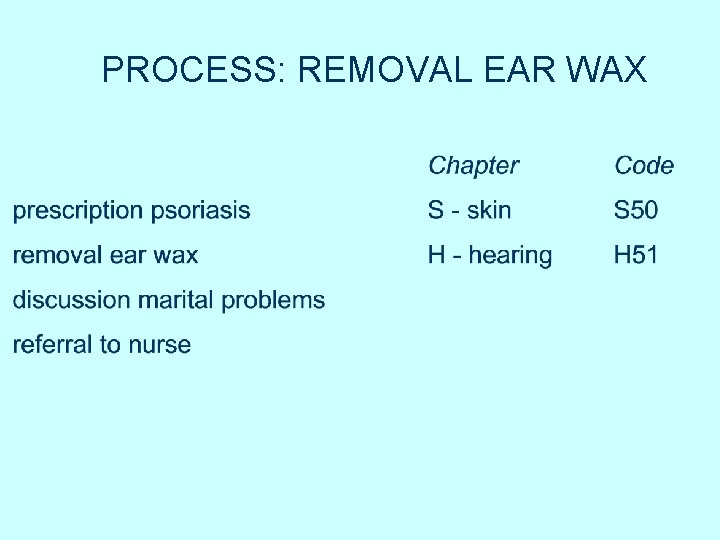
PROCESS: REMOVAL EAR WAX
PROCESS: DISCUSSION OF MARITAL PROBLEMS
REFERRAL TO NURSE AS PROCESS
CODING EXERCISE 4: EPISODE OF CARE 1 st encounter 2 nd encounter 3 rd encounter RFE ‘I’m feeling tired’ Diagnosis tiredness RFE Diagnosis ‘what’s the test result? ’ RFE ‘what’s the test result? ’ iron deficiency anemia Diagnosis Ca colon Process Hb Process colonoscopy Process referral, advice
RFE: TIREDNESS 1 st encounter 2 nd encounter 3 rd encounter RFE ‘I’m feeling tired’ A 04 Diagnosis tiredness Process RFE Diagnosis Process colonoscopy ‘what’s the test result? ’ RFE ‘what’s the test result? ’ iron deficiency Hb anemia Diagnosis Ca colon Process referral, advice
(SYMPTOM)DIAGNOSIS: TIREDNESS 1 st encounter 2 nd encounter 3 rd encounter RFE ‘I’m feeling tired’ A 04 Diagnosis tiredness A 04 RFE Diagnosis ‘what’s the test result? ’ RFE ‘what’s the test result? ’ iron deficiency Process Hb Process colonoscopy anemia Diagnosis Ca colon Process referral, advice
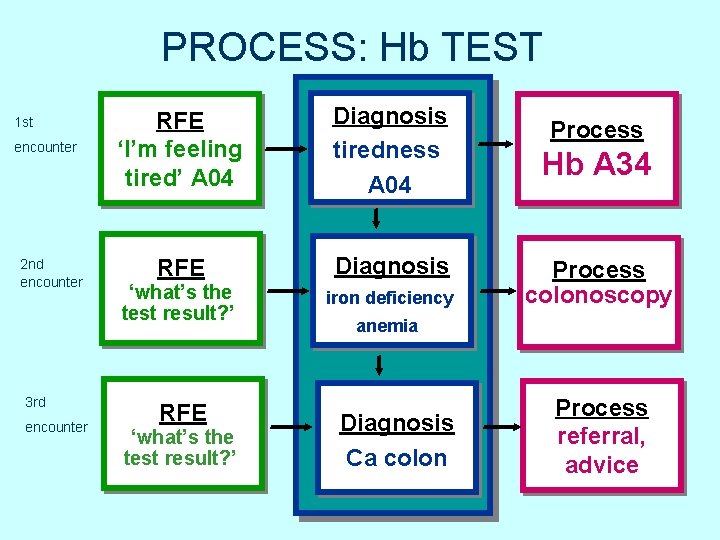
PROCESS: Hb TEST 1 st encounter 2 nd encounter 3 rd encounter RFE ‘I’m feeling tired’ A 04 Diagnosis tiredness A 04 RFE Diagnosis ‘what’s the test result? ’ RFE ‘what’s the test result? ’ iron deficiency Process Hb A 34 Process colonoscopy anemia Diagnosis Ca colon Process referral, advice
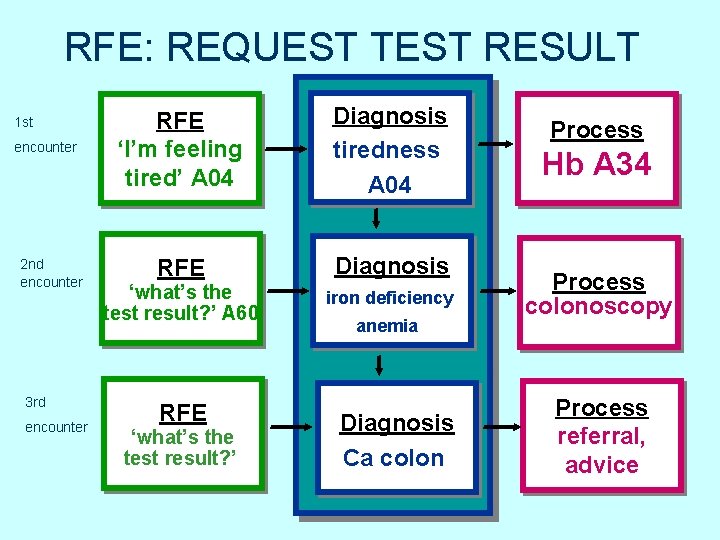
RFE: REQUEST TEST RESULT 1 st encounter 2 nd encounter 3 rd encounter RFE ‘I’m feeling tired’ A 04 Diagnosis tiredness A 04 RFE Diagnosis ‘what’s the test result? ’ A 60 RFE ‘what’s the test result? ’ iron deficiency anemia Diagnosis Ca colon Process Hb A 34 Process colonoscopy Process referral, advice
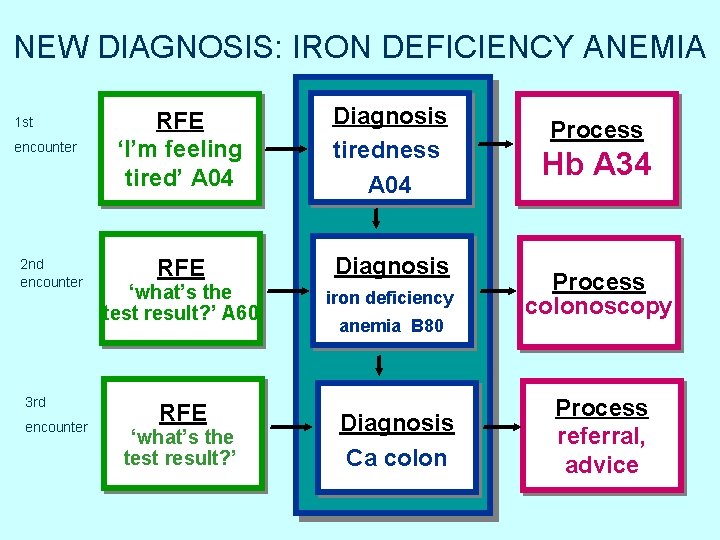
NEW DIAGNOSIS: IRON DEFICIENCY ANEMIA 1 st encounter 2 nd encounter 3 rd encounter RFE ‘I’m feeling tired’ A 04 Diagnosis tiredness A 04 RFE Diagnosis ‘what’s the test result? ’ A 60 RFE ‘what’s the test result? ’ iron deficiency anemia B 80 Diagnosis Ca colon Process Hb A 34 Process colonoscopy Process referral, advice
PROCESS: COLONOSCOPY 1 st encounter 2 nd encounter 3 rd encounter RFE ‘I’m feeling tired’ A 04 Diagnosis tiredness A 04 RFE Diagnosis ‘what’s the test result? ’ A 60 RFE ‘what’s the test result? ’ Process Hb A 34 anemia B 82 Process colonoscopy D 40 Diagnosis Ca colon Process referral, advice iron deficiency
RFE: REQUEST TEST RESULT 1 st encounter 2 nd encounter 3 rd encounter RFE ‘I’m feeling tired’ A 04 Diagnosis tiredness A 04 RFE Diagnosis ‘what’s the test result? ’ A 60 RFE ‘what’s the test result? ’ D 60 Process Hb A 34 anemia B 80 Process colonoscopy D 40 Diagnosis Ca colon Process referral, advice iron deficiency
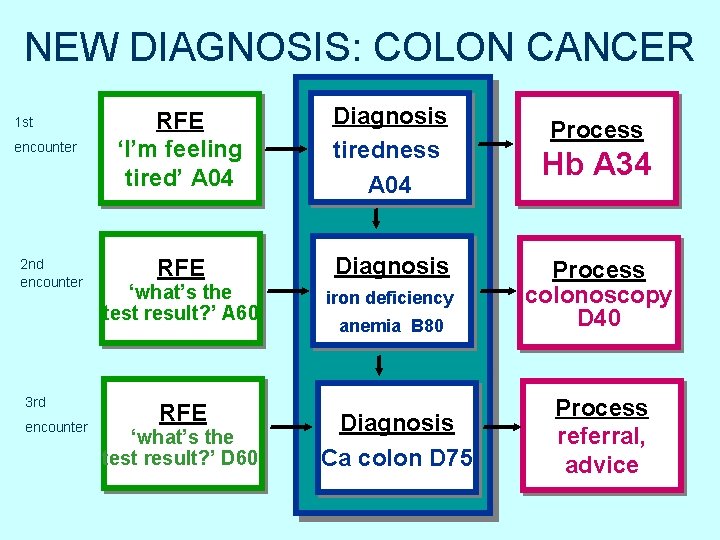
NEW DIAGNOSIS: COLON CANCER 1 st encounter 2 nd encounter 3 rd encounter RFE ‘I’m feeling tired’ A 04 Diagnosis tiredness A 04 RFE Diagnosis ‘what’s the test result? ’ A 60 RFE ‘what’s the test result? ’ D 60 Process Hb A 34 anemia B 80 Process colonoscopy D 40 Diagnosis Ca colon D 75 Process referral, advice iron deficiency
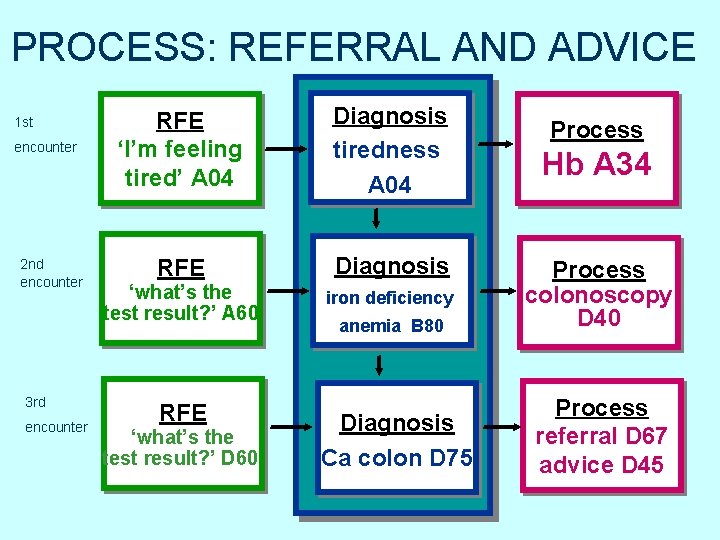
PROCESS: REFERRAL AND ADVICE 1 st encounter 2 nd encounter 3 rd encounter RFE ‘I’m feeling tired’ A 04 Diagnosis tiredness A 04 RFE Diagnosis ‘what’s the test result? ’ A 60 RFE ‘what’s the test result? ’ D 60 Process Hb A 34 anemia B 80 Process colonoscopy D 40 Diagnosis Ca colon D 75 Process referral D 67 advice D 45 iron deficiency
3. THE USE OF ICPC IN THE TRANSITION PROJECT
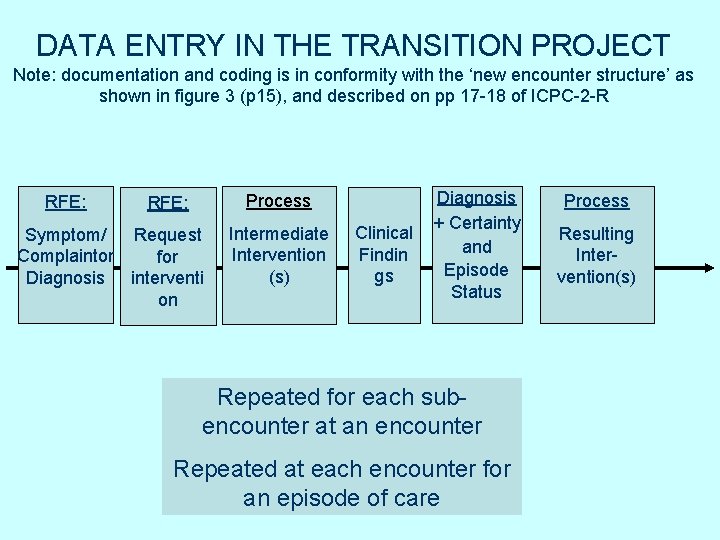
DATA ENTRY IN THE TRANSITION PROJECT Note: documentation and coding is in conformity with the ‘new encounter structure’ as shown in figure 3 (p 15), and described on pp 17 -18 of ICPC-2 -R RFE: Process RFE: Symptom/ Request Complaintor for Diagnosis interventi on Intermediate Intervention (s) Clinical Findin gs Diagnosis + Certainty and Episode Status Repeated for each subencounter at an encounter Repeated at each encounter for an episode of care Process Resulting Intervention(s)
SOME SCREENS FROM THE WINDOWS VERSION OF TRANSHIS, THE EPR IN USE IN THE TRANSITION PROJECT. .
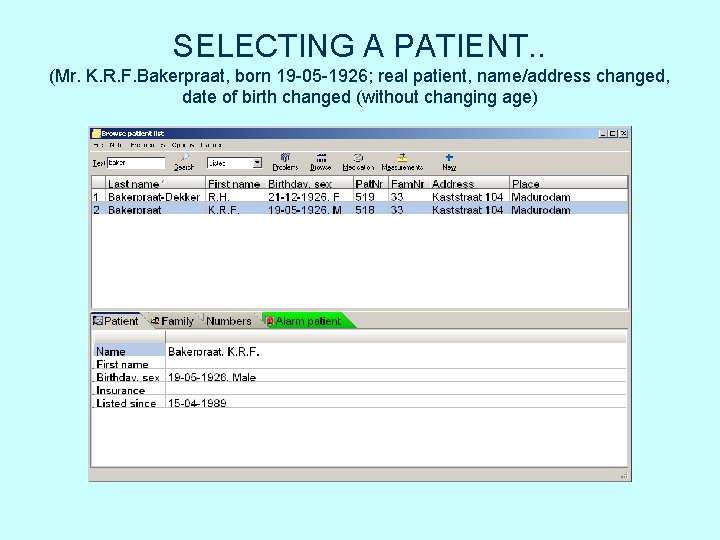
SELECTING A PATIENT. . (Mr. K. R. F. Bakerpraat, born 19 -05 -1926; real patient, name/address changed, date of birth changed (without changing age)
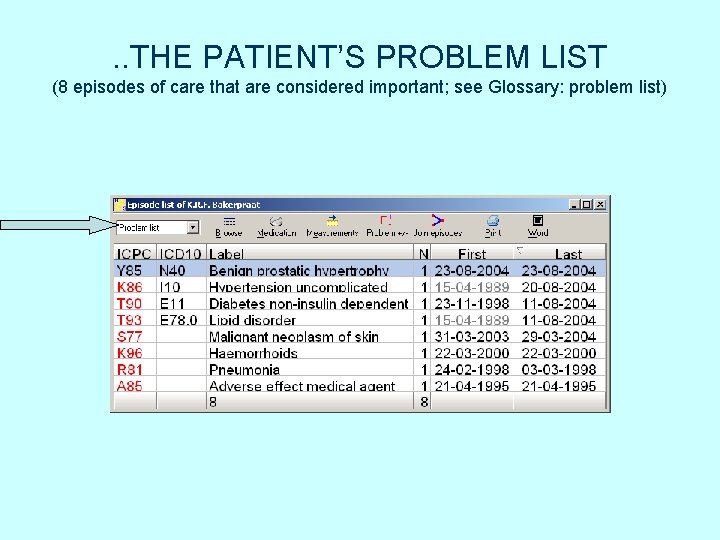
. . THE PATIENT’S PROBLEM LIST (8 episodes of care that are considered important; see Glossary: problem list)
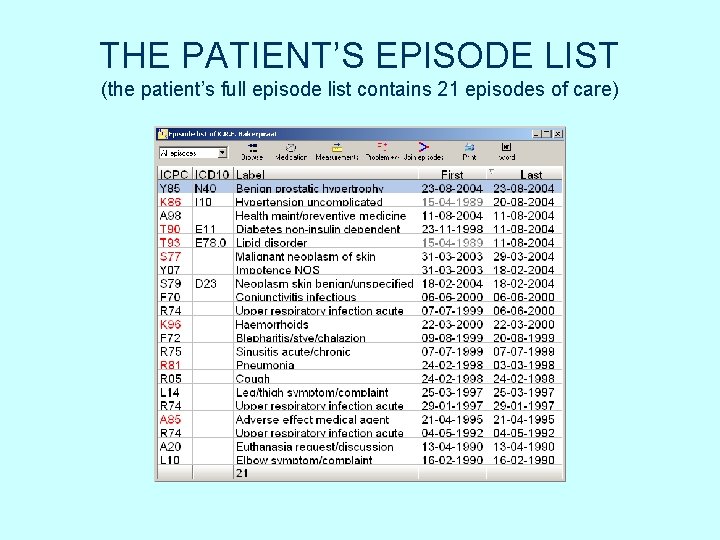
THE PATIENT’S EPISODE LIST (the patient’s full episode list contains 21 episodes of care)
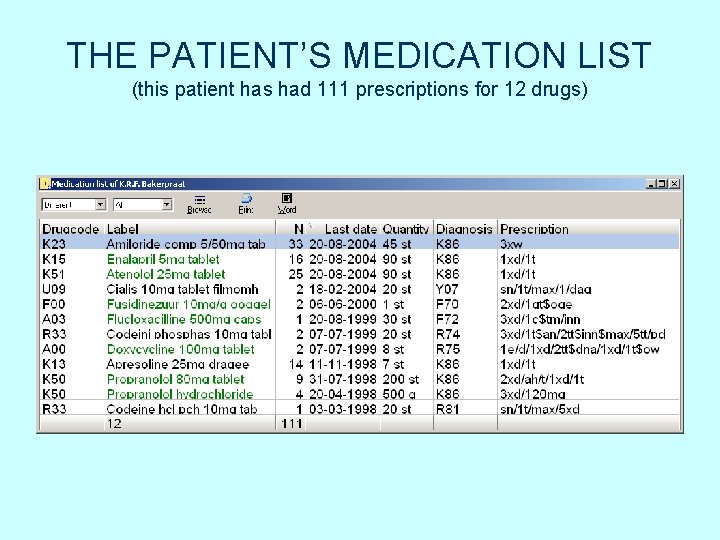
THE PATIENT’S MEDICATION LIST (this patient has had 111 prescriptions for 12 drugs)
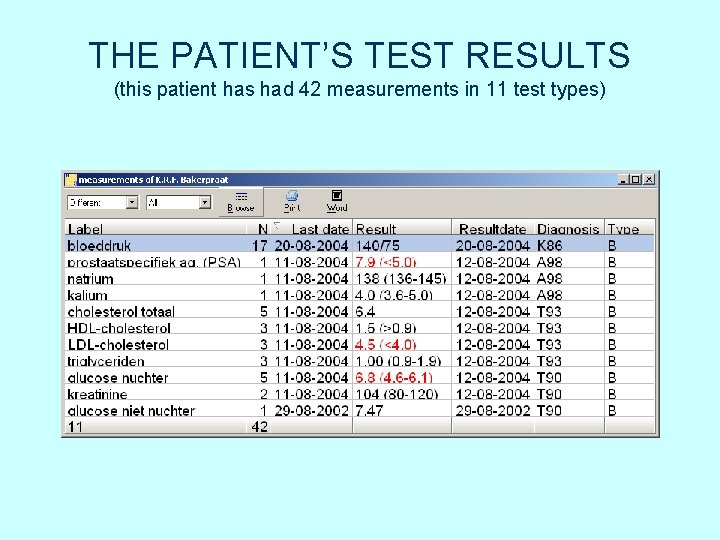
THE PATIENT’S TEST RESULTS (this patient has had 42 measurements in 11 test types)
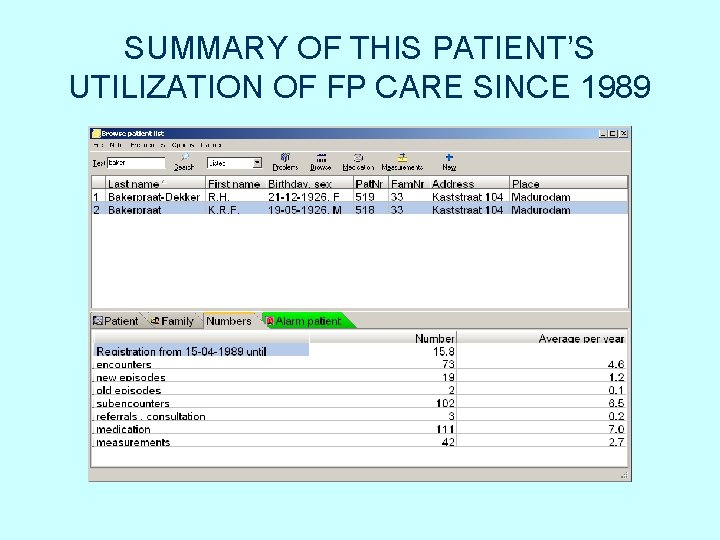
SUMMARY OF THIS PATIENT’S UTILIZATION OF FP CARE SINCE 1989
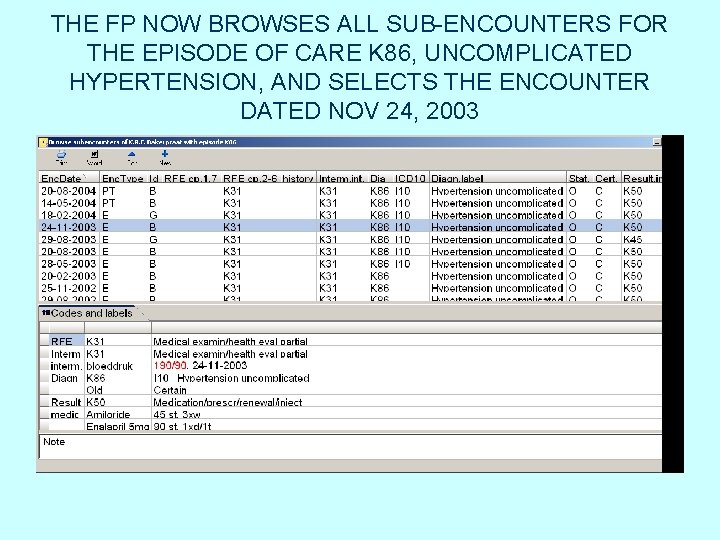
THE FP NOW BROWSES ALL SUB-ENCOUNTERS FOR THE EPISODE OF CARE K 86, UNCOMPLICATED HYPERTENSION, AND SELECTS THE ENCOUNTER DATED NOV 24, 2003
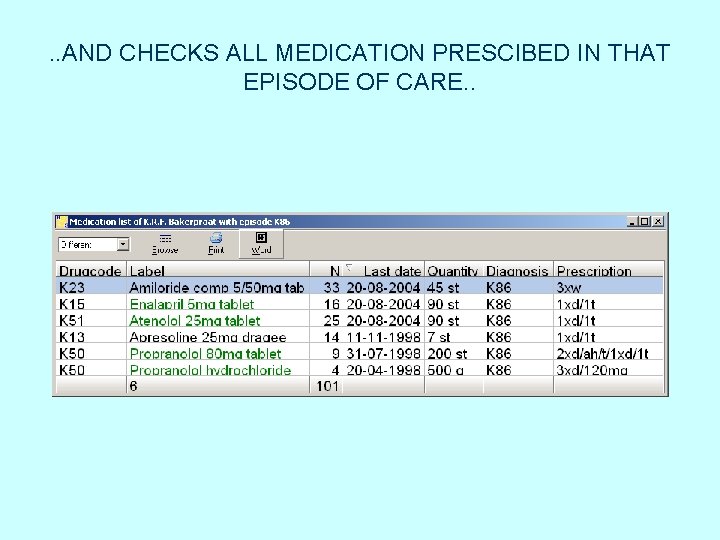
. . AND CHECKS ALL MEDICATION PRESCIBED IN THAT EPISODE OF CARE. .
. . END OF THE ICPC TUTORIAL. . also check the Glossary for any questions you might have. . .