Immigration Medical Exams Form I693 USCIS Civil Surgeon


- Slides: 60
Immigration Medical Exams & Form I-693 USCIS Civil Surgeon Seminar Series August 4, 2016 1
About this Presentation n n 2 Authors: Roselyn Brown-Frei and Bruce R. Larson Date of last revision: August 1, 2016 This presentation is valid only as of the date of the last revision. This presentation contains no sensitive Personally Identifiable Information (PII). Any references in documents or text, with the exception of case law, relate to fictitious individuals.
Disclaimer n This presentation is intended to be used for informational purposes only. It is not intended to, does not, and may not be relied upon to create or confer any right(s) or benefit(s), substantive or procedural, enforceable at law by any individual or other party in benefit applications before U. S. Citizenship and Immigration Services (USCIS), in removal proceedings, in litigation with the United States, or in any other form or manner. n This training module does not have the force of law, or of a U. S. Department of Homeland Security (DHS) directive. 3
Dissemination n This presentation may not be reproduced without the written consent of the USCIS Customer Service and Public Engagement Directorate. n Please contact the USCIS Customer Service and Public Engagement Directorate at public. engagement@uscis. dhs. gov. 4
Overview n n n n 5 Health-related Grounds of Inadmissibility Medical Exam and Role of Civil Surgeons Physical and Mental Disorders with Associated Harmful Behavior Substance Use and Substance Abuse Update: New Gonorrhea Component Common Errors in Completing Form I-693 Resources for Civil Surgeons
Admissibility n Generally, all applicants for adjustment of status must be “admissible” to the United States. n Inadmissibility: acts, conditions, and conduct specified in Immigration and Nationality Act (INA) section 212(a) that bar foreign nationals from obtaining a visa, entering the United States, or obtaining adjustment of status, such as: n Health-related grounds. n Criminal, security, or terrorist grounds. n Public charge grounds. n Previous immigration violations. 6
Health-related Grounds of Inadmissibility INA section 212(a)(1): n Communicable disease of public health significance (Class A) n Failure to show proof of required vaccinations (for lawful permanent resident applicants ONLY) n Physical or mental disorder with associated harmful behavior (Class A) n Substance Use and Substance Abuse(Class A) 7
Medical Examination 8 n Purpose: To determine whether the applicant has a Class A condition that would render the applicant inadmissible and so ineligible for adjustment of status. n Technical Instructions for the Examination of Aliens in the United States (TIs) supplement 42 CFR 34 and provide detailed guidance for how civil surgeons must perform the examination and report the results.
The Role of Civil Surgeons 9 n Must follow CDC’s TIs and any updates when conducting the medical examination. n Must verify the identity of the applicant and take necessary fraud prevention measures, as outlined in the instructions of Form I-693 and the TIs. n Must report medical examination results on Form I 693.
The Role of Civil Surgeons n Provide applicants with the completed Form I-693 in a sealed envelope. n Provide applicants with a copy of the medical examination. n Stay current with the TIs. n If contact information has changed, notify USCIS within 15 days at Public. Engagement@uscis. dhs. gov. Note: only USCIS determines whether the applicant is admissible or inadmissible. 10
The Role of Civil Surgeons Referrals n Civil surgeons must refer foreign nationals when: * required under the TIs; * civil surgeon is unable to make a definitive diagnosis or is unable to determine whether a disease or disorder is a Class A or a Class B condition. 11
The Role of Civil Surgeons Referrals (cont’d) n Must ensure that a physician receiving the referral verifies the identity of the applicant and takes the necessary fraud prevention measures, as outlined in the Form I-693 instructions and the TIs. n The civil surgeon remains responsible for completing and forwarding the medical report form to the applicant so that the applicant can submit it to a USCIS/DHS official. The report of any consulting physician, as received by the civil surgeon, must be included with the Form I-693. 12
Physical or Mental Disorders with Associated Harmful Behavior (Form I-693: Civil Surgeon Worksheet, Section 2) 13
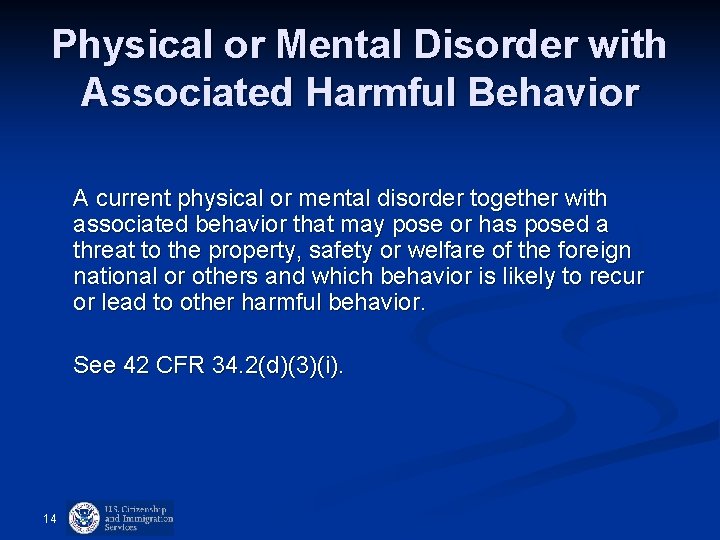
Physical or Mental Disorder with Associated Harmful Behavior A current physical or mental disorder together with associated behavior that may pose or has posed a threat to the property, safety or welfare of the foreign national or others and which behavior is likely to recur or lead to other harmful behavior. See 42 CFR 34. 2(d)(3)(i). 14
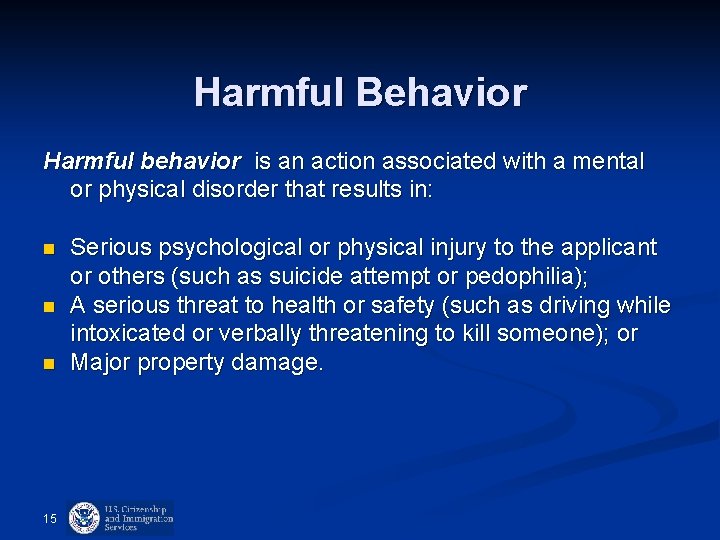
Harmful Behavior Harmful behavior is an action associated with a mental or physical disorder that results in: n n n 15 Serious psychological or physical injury to the applicant or others (such as suicide attempt or pedophilia); A serious threat to health or safety (such as driving while intoxicated or verbally threatening to kill someone); or Major property damage.
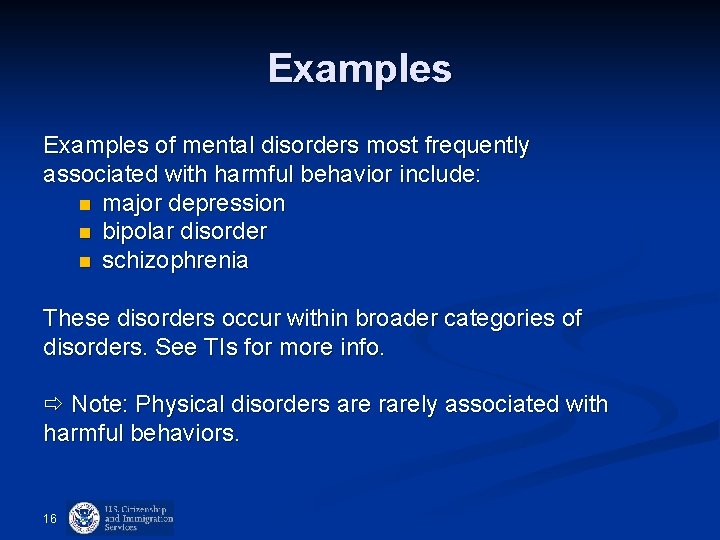
Examples of mental disorders most frequently associated with harmful behavior include: n major depression n bipolar disorder n schizophrenia These disorders occur within broader categories of disorders. See TIs for more info. Note: Physical disorders are rarely associated with harmful behaviors. 16
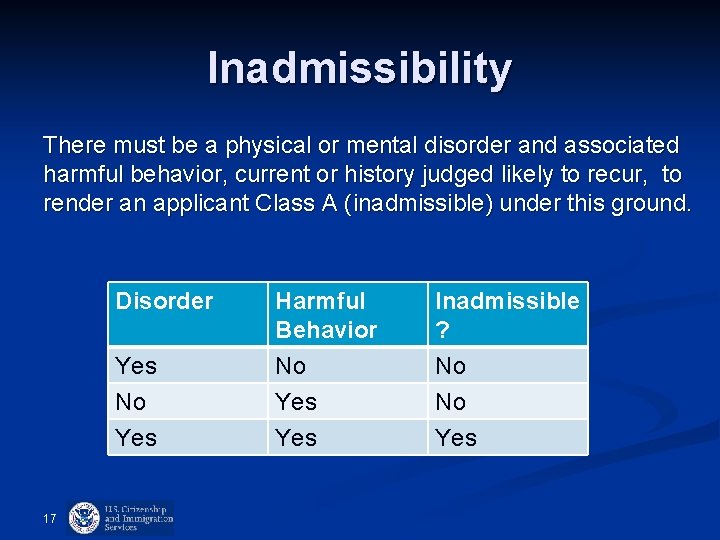
Inadmissibility There must be a physical or mental disorder and associated harmful behavior, current or history judged likely to recur, to render an applicant Class A (inadmissible) under this ground. Disorder Yes No Yes 17 Harmful Behavior No Yes Inadmissible ? No No Yes
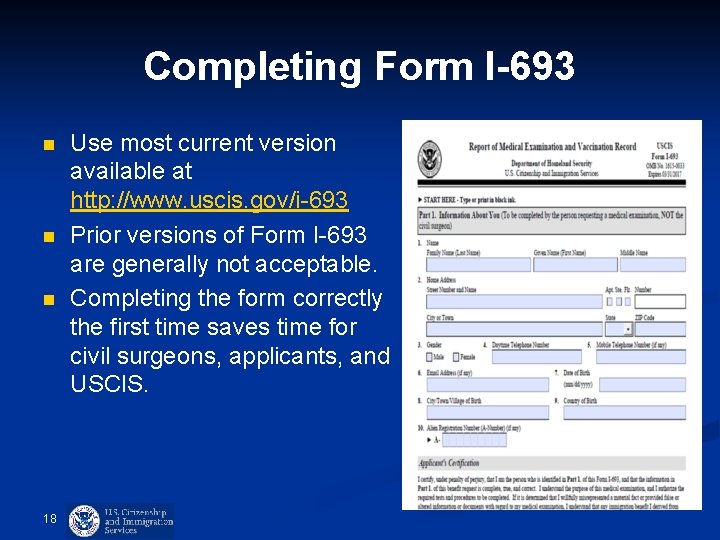
Completing Form I-693 n n n 18 Use most current version available at http: //www. uscis. gov/i-693 Prior versions of Form I-693 are generally not acceptable. Completing the form correctly the first time saves time for civil surgeons, applicants, and USCIS.
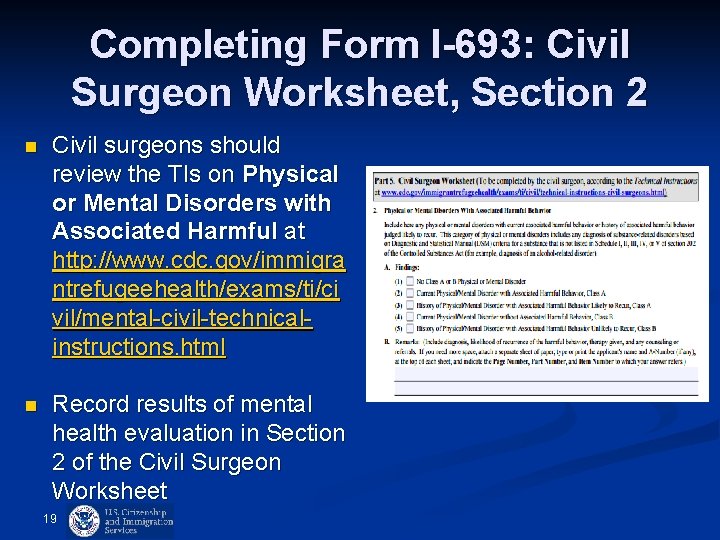
Completing Form I-693: Civil Surgeon Worksheet, Section 2 n Civil surgeons should review the TIs on Physical or Mental Disorders with Associated Harmful at http: //www. cdc. gov/immigra ntrefugeehealth/exams/ti/ci vil/mental-civil-technicalinstructions. html n Record results of mental health evaluation in Section 2 of the Civil Surgeon Worksheet 19
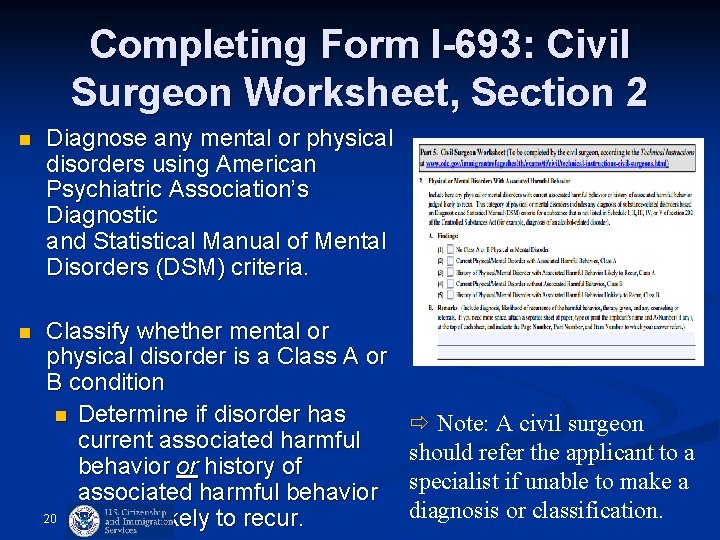
Completing Form I-693: Civil Surgeon Worksheet, Section 2 n Diagnose any mental or physical disorders using American Psychiatric Association’s Diagnostic and Statistical Manual of Mental Disorders (DSM) criteria. n Classify whether mental or physical disorder is a Class A or B condition n Determine if disorder has current associated harmful behavior or history of associated harmful behavior 20 judged likely to recur. Note: A civil surgeon should refer the applicant to a specialist if unable to make a diagnosis or classification.
Completing Form I-693: Civil Surgeon Worksheet, Section 2 STEP 1: Review the applicant’s medical history. n Review past medical records. n When possible, obtain other relevant records (such as police, military, school) that might indicate a history of harmful behavior associated with physical or mental disorders. n Ask questions about past medical history. n Ask about mental disorders in the family and, when appropriate, about signs of mental problems or odd behaviors. n Ask about harmful behaviors. 21
Completing Form I-693: Civil Surgeon Worksheet, Section 2 n STEP 2: Conduct an activities assessment and mental status examination that assesses, at a minimum: n Orientation n Mood n Speech and language n Anxiety n Thought processes and content n Behavior n The civil surgeon or specialist generally will not need to conduct additional psychological or neuropsychological testing. For certain cases, however, these tests may aid in making a diagnosis. 22
Completing Form I-693: Civil Surgeon Worksheet, Section 2 The civil surgeon may recognize that an applicant with a physical or mental disorder might have an associated harmful behavior at any point during the medical exam: n n n 23 While taking the medical history of the mental disorder. While taking history of harmful behavior. While observing for current abnormal behavior during the physical exam.
Completing Form I-693: Civil Surgeon Worksheet, Section 2 STEP 3: Determine whether the applicant has any physical or mental disorder using DSM criteria. STEP 4: If the applicant is diagnosed with a disorder, determine if it has current associated harmful behavior or past associated harmful behavior judged likely to recur. 24
Completing Form I-693: Civil Surgeon Worksheet, Section 2 Civil surgeons should also determine: n Remission status of previously diagnosed disorder. n Likelihood of recurrence of harmful behaviors associated with the physical or mental disorder. n The disorder must at least be in remission or reliably controlled by medication or other effective treatment for a civil surgeon to find that the harmful behavior is unlikely to recur. n If it has been at least 12 months since the harmful behavior last occurred, it is less likely to recur (general guideline) See TIs for more info, including a list of factors affecting the applicant’s likelihood of maintaining remission or having a disorder under control. 25
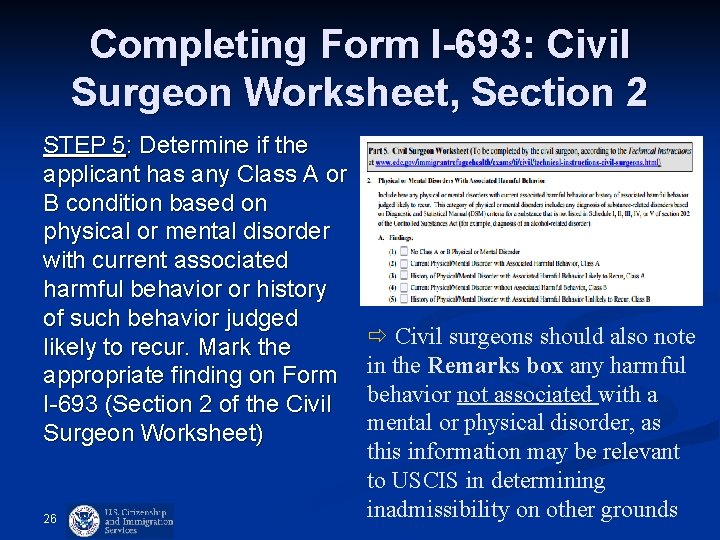
Completing Form I-693: Civil Surgeon Worksheet, Section 2 STEP 5: Determine if the applicant has any Class A or B condition based on physical or mental disorder with current associated harmful behavior or history of such behavior judged likely to recur. Mark the appropriate finding on Form I-693 (Section 2 of the Civil Surgeon Worksheet) 26 Civil surgeons should also note in the Remarks box any harmful behavior not associated with a mental or physical disorder, as this information may be relevant to USCIS in determining inadmissibility on other grounds
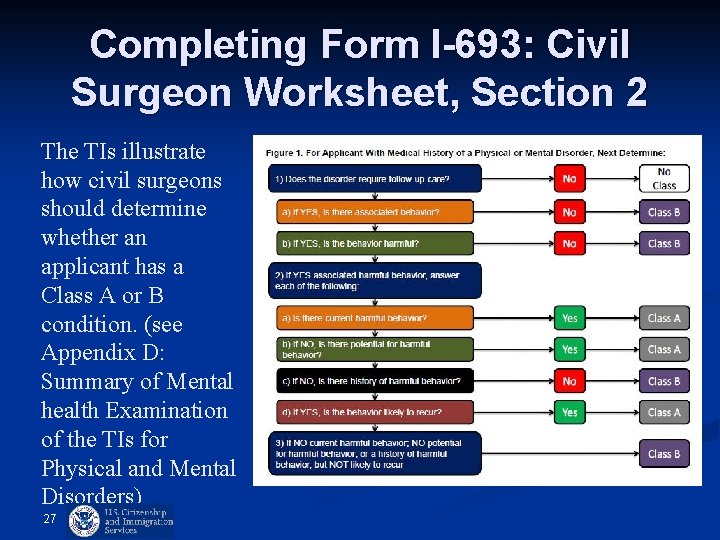
Completing Form I-693: Civil Surgeon Worksheet, Section 2 The TIs illustrate how civil surgeons should determine whether an applicant has a Class A or B condition. (see Appendix D: Summary of Mental health Examination of the TIs for Physical and Mental Disorders) 27
Completing Form I-693: Civil Surgeon Worksheet, Section 2 Specialist Referral: Civil surgeons should refer applicant to a specialist if they’re unable to: n Arrive at a probable diagnosis to determine if applicant has/had a mental or physical disorder with associated harmful behavior n Rule out the presence of a physical or mental disorder n Determine if harmful behavior has been associated with the disorder or if it is likely to recur n Determine if any diagnosed disorder affecting behavior is in remission or under control, or the likelihood the applicant can ⇨ As with any referral, sections 5 -6 of the Civil Surgeon Worksheet maintain remission or effective control should be completed by the civil surgeon and physician receiving referral, respectively. 28
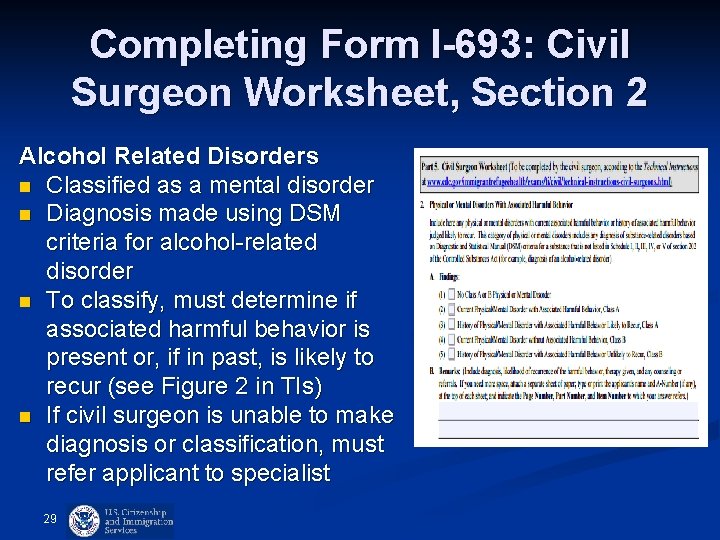
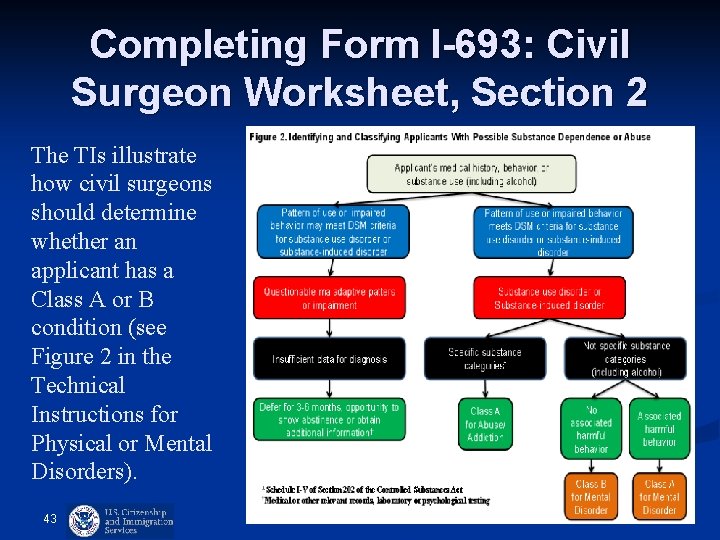
Completing Form I-693: Civil Surgeon Worksheet, Section 2 Alcohol Related Disorders n Classified as a mental disorder n Diagnosis made using DSM criteria for alcohol-related disorder n To classify, must determine if associated harmful behavior is present or, if in past, is likely to recur (see Figure 2 in TIs) n If civil surgeon is unable to make diagnosis or classification, must refer applicant to specialist 29
Substance Abuse and Substance Addiction (Form I-693: Civil Surgeon Worksheet, Section 3) 30
Definition n n Drug Abuse: Current substance use disorder or substanceinduced disorder which is “mild” as defined in the current edition of the Diagnostic and Statistical Manual for Mental Disorders (DSM) published by the American Psychiatric Association (or in another authoritative source as approved by the CDC Director) of a substance listed in Section 202 of the Controlled Substances Act, as amended (21 U. S. C. 802). Drug Addiction: Current substance use disorder or substance : -induced disorder which is “moderate or severe” as defined in the current edition of the DSM (or in another authoritative source as approved by the CDC Director) of a substance listed in Section 202 of the Controlled Substances Act, as amended (21 U. S. C. 802). See 42 CFR 34. 2(h) and (i). 31
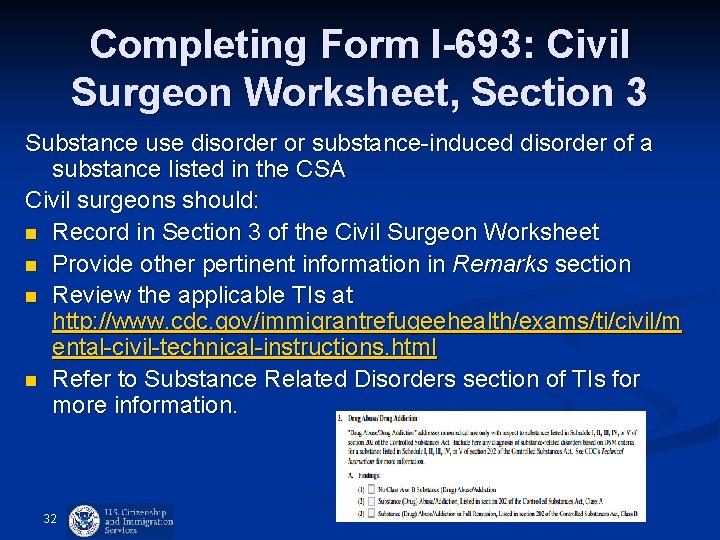
Completing Form I-693: Civil Surgeon Worksheet, Section 3 Substance use disorder or substance-induced disorder of a substance listed in the CSA Civil surgeons should: n Record in Section 3 of the Civil Surgeon Worksheet n Provide other pertinent information in Remarks section n Review the applicable TIs at http: //www. cdc. gov/immigrantrefugeehealth/exams/ti/civil/m ental-civil-technical-instructions. html n Refer to Substance Related Disorders section of TIs for more information. 32
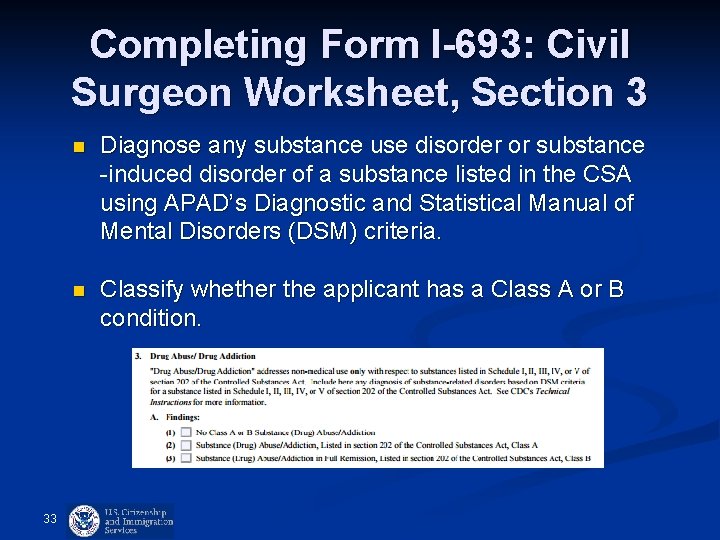
Completing Form I-693: Civil Surgeon Worksheet, Section 3 33 n Diagnose any substance use disorder or substance any -induced disorder of a substance listed in the CSA using APAD’s Diagnostic and Statistical Manual of Mental Disorders (DSM) criteria. n Classify whether the applicant has a Class A or B condition.
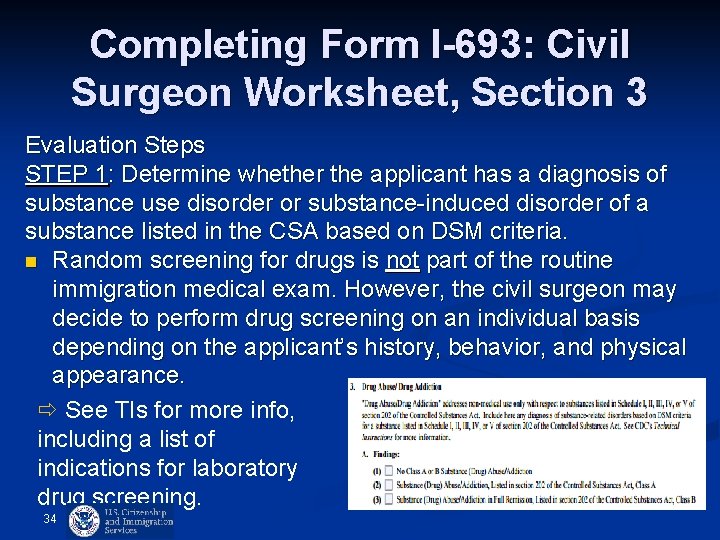
Completing Form I-693: Civil Surgeon Worksheet, Section 3 Evaluation Steps STEP 1: Determine whether the applicant has a diagnosis of substance use disorder or substance-induced disorder of a substance listed in the CSA based on DSM criteria. n Random screening for drugs is not part of the routine immigration medical exam. However, the civil surgeon may decide to perform drug screening on an individual basis depending on the applicant’s history, behavior, and physical appearance. See TIs for more info, including a list of indications for laboratory drug screening. 34
Completing Form I-693: Civil Surgeon Worksheet, Section 3 Deferring diagnosis and classification: If unable to determine whether applicant has a diagnosis of such substance use disorder or substance-induced disorder, classification may be deferred for 3 -6 months to give the applicant an opportunity to show abstinence or obtain additional information (such as medical or other relevant records, laboratory or psychological testing). 35
Completing Form I-693: Civil Surgeon Worksheet, Section 3 Deferring diagnosis and classification (cont’d): Civil surgeons should explain to the applicant what is expected of the applicant during the 3 -6 months (for example, requiring clinical reports from health care professionals to demonstrate participation in drug treatment program). The civil surgeon should consider documenting the expectations and obtaining the applicant’s signature. 36
Completing Form I-693: Civil Surgeon Worksheet, Section 3 The civil surgeon should use the DSM criteria when making a diagnosis: n n 37 Substance use disorder: essential feature is a cluster of cognitive, behavioral, and physiological symptoms indicating that the individual continues using the substance despite significant substancerelated problems. Substance-induced disorder: includes but is not limited to intoxication, withdrawal, and other substance/medication-induced mental disorders
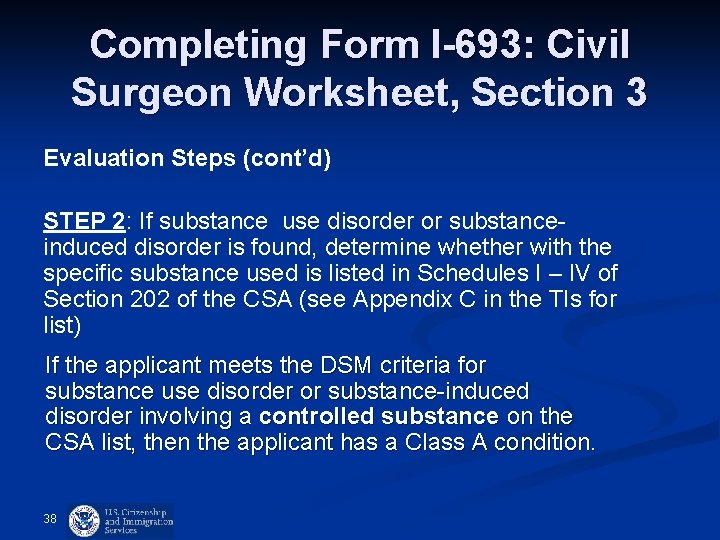
Completing Form I-693: Civil Surgeon Worksheet, Section 3 Evaluation Steps (cont’d) STEP 2: If substance use disorder or substanceinduced disorder is found, determine whether with the specific substance used is listed in Schedules I – IV of Section 202 of the CSA (see Appendix C in the TIs for list) If the applicant meets the DSM criteria for substance use disorder or substance-induced disorder involving a controlled substance on the CSA list, then the applicant has a Class A condition. 38
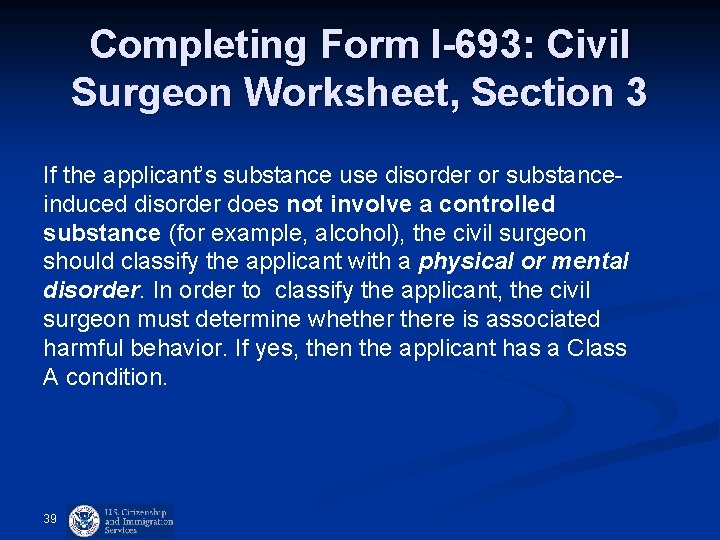
Completing Form I-693: Civil Surgeon Worksheet, Section 3 If the applicant’s substance use disorder or substanceinduced disorder does not involve a controlled substance (for example, alcohol), the civil surgeon should classify the applicant with a physical or mental disorder. In order to classify the applicant, the civil surgeon must determine whethere is associated harmful behavior. If yes, then the applicant has a Class A condition. 39
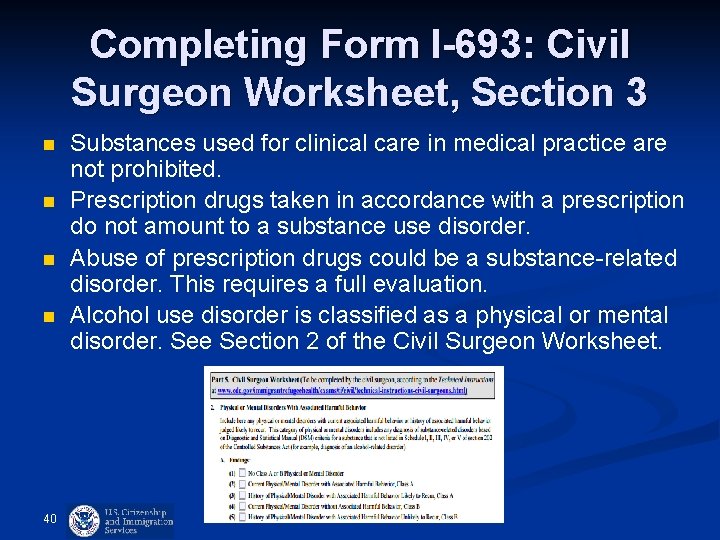
Completing Form I-693: Civil Surgeon Worksheet, Section 3 n n 40 Substances used for clinical care in medical practice are not prohibited. Prescription drugs taken in accordance with a prescription do not amount to a substance use disorder. Abuse of prescription drugs could be a substance-related disorder. This requires a full evaluation. Alcohol use disorder is classified as a physical or mental disorder. See Section 2 of the Civil Surgeon Worksheet.
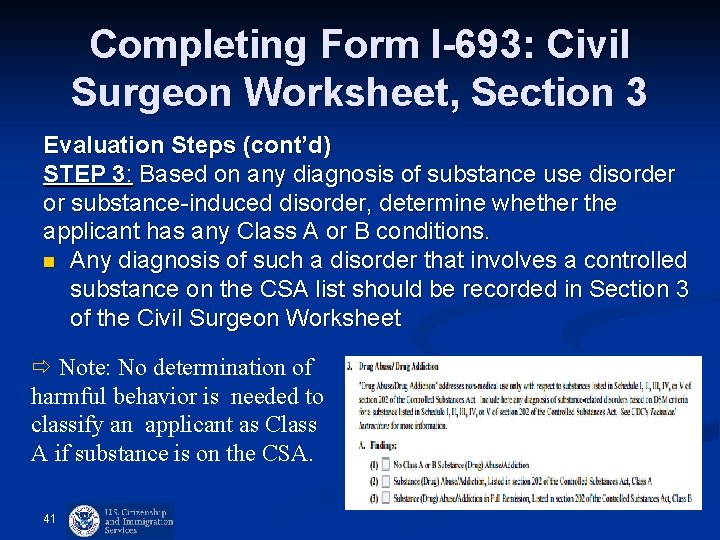
Completing Form I-693: Civil Surgeon Worksheet, Section 3 Evaluation Steps (cont’d) STEP 3: Based on any diagnosis of substance use disorder or substance-induced disorder, determine whether the applicant has any Class A or B conditions. n Any diagnosis of such a disorder that involves a controlled substance on the CSA list should be recorded in Section 3 of the Civil Surgeon Worksheet Note: No determination of harmful behavior is needed to classify an applicant as Class A if substance is on the CSA. 41
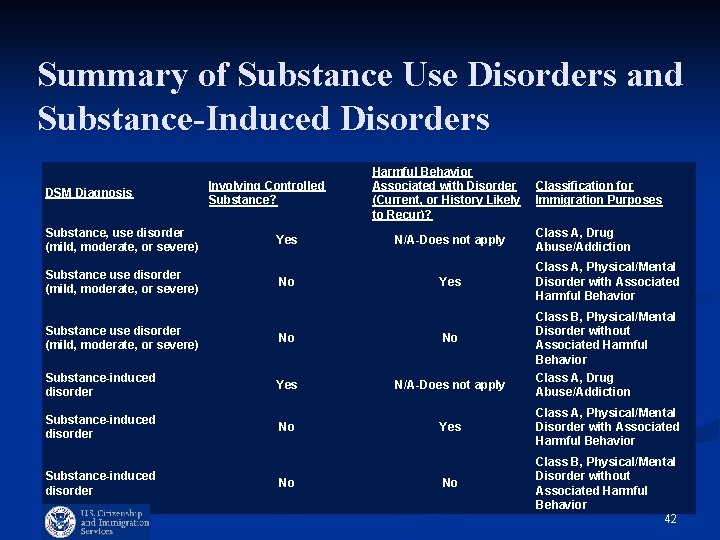
Summary of Substance Use Disorders and Substance-Induced Disorders DSM Diagnosis Substance, use disorder (mild, moderate, or severe) Substance use disorder (mild, moderate, or severe) Involving Controlled Substance? Yes No Harmful Behavior Associated with Disorder (Current, or History Likely to Recur)? N/A-Does not apply Yes Class B, Physical/Mental Disorder without Associated Harmful Behavior No No Substance-induced disorder Yes N/A-Does not apply Substance-induced disorder No Yes No Class A, Drug Abuse/Addiction Class A, Physical/Mental Disorder with Associated Harmful Behavior Substance use disorder (mild, moderate, or severe) Substance-induced disorder Classification for Immigration Purposes No Class A, Drug Abuse/Addiction Class A, Physical/Mental Disorder with Associated Harmful Behavior Class B, Physical/Mental Disorder without Associated Harmful Behavior 42
Completing Form I-693: Civil Surgeon Worksheet, Section 2 The TIs illustrate how civil surgeons should determine whether an applicant has a Class A or B condition (see Figure 2 in the Technical Instructions for Physical or Mental Disorders). 43
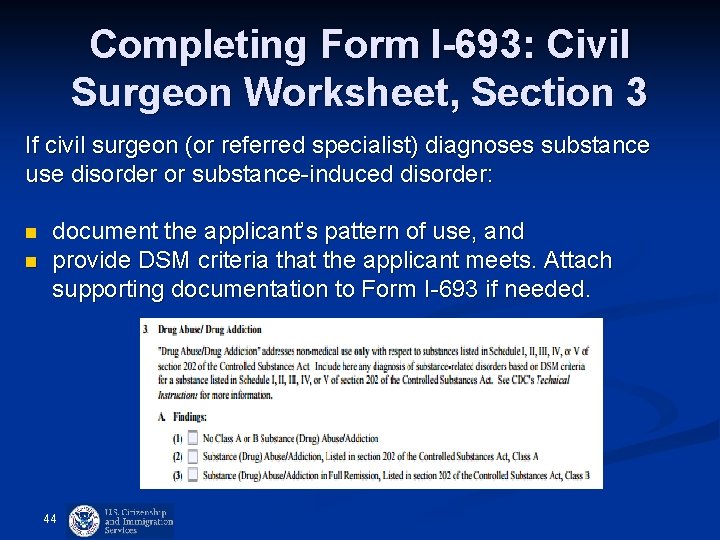
Completing Form I-693: Civil Surgeon Worksheet, Section 3 If civil surgeon (or referred specialist) diagnoses substance use disorder or substance-induced disorder: n n document the applicant’s pattern of use, and provide DSM criteria that the applicant meets. Attach supporting documentation to Form I-693 if needed. 44
Completing Form I-693: Civil Surgeon Worksheet, Section 3 Civil surgeons should refer applicants to a specialist if unable to: n n Make a diagnosis of substance use disorder or substanceinduced disorder according to DSM criteria. Determine whether any diagnosis of a substance use disorder or substance-induced disorder is in remission based on DSM criteria. ⇨ As with any referral, civil surgeon and referral specialist must complete Sections 5 -6 of the Civil Surgeon 45 Worksheet.
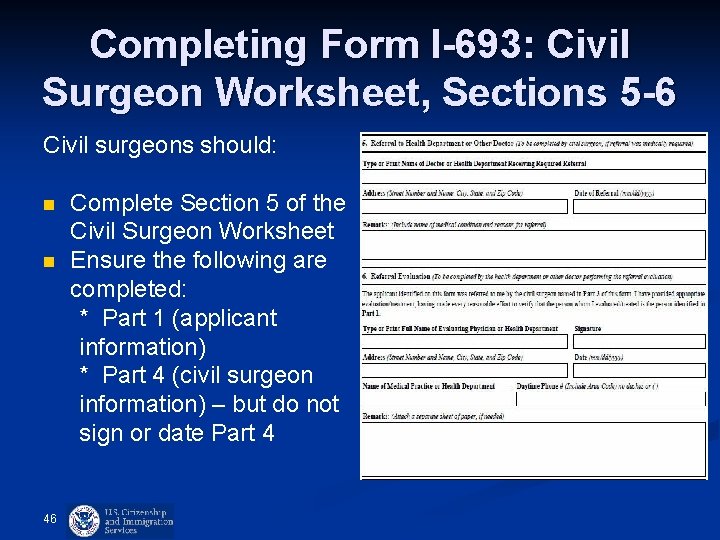
Completing Form I-693: Civil Surgeon Worksheet, Sections 5 -6 Civil surgeons should: n n 46 Complete Section 5 of the Civil Surgeon Worksheet Ensure the following are completed: * Part 1 (applicant information) * Part 4 (civil surgeon information) – but do not sign or date Part 4
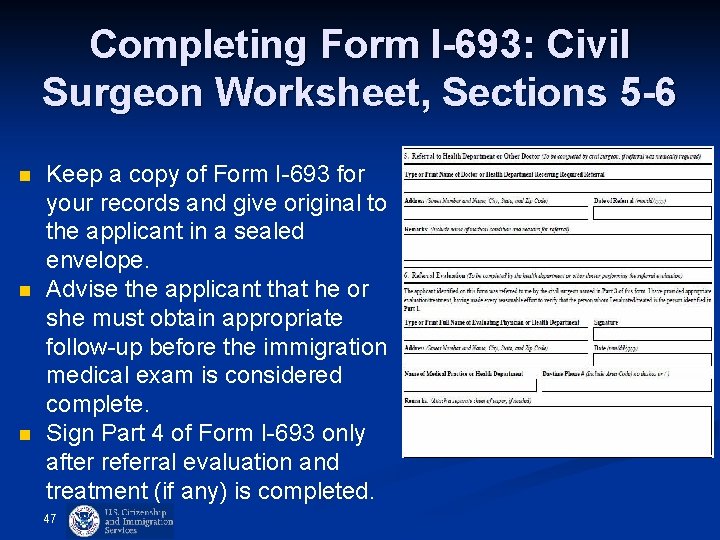
Completing Form I-693: Civil Surgeon Worksheet, Sections 5 -6 n n n Keep a copy of Form I-693 for your records and give original to the applicant in a sealed envelope. Advise the applicant that he or she must obtain appropriate follow-up before the immigration medical exam is considered complete. Sign Part 4 of Form I-693 only after referral evaluation and treatment (if any) is completed. 47
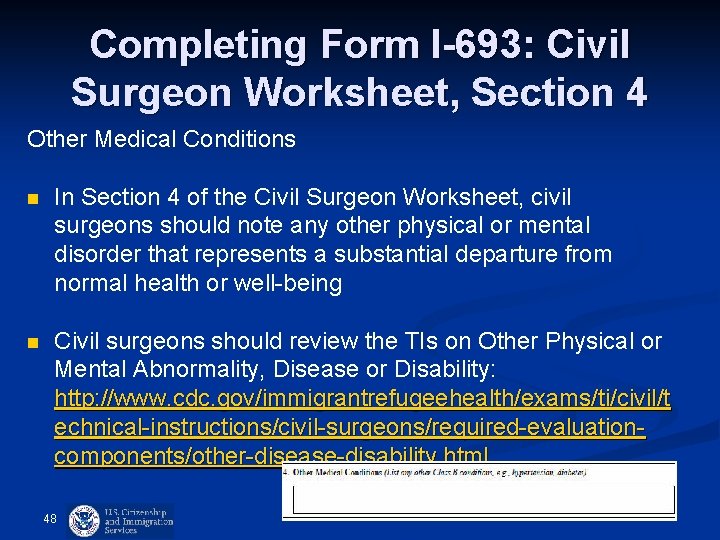
Completing Form I-693: Civil Surgeon Worksheet, Section 4 Other Medical Conditions n In Section 4 of the Civil Surgeon Worksheet, civil surgeons should note any other physical or mental disorder that represents a substantial departure from normal health or well-being n Civil surgeons should review the TIs on Other Physical or Mental Abnormality, Disease or Disability: http: //www. cdc. gov/immigrantrefugeehealth/exams/ti/civil/t echnical-instructions/civil-surgeons/required-evaluationcomponents/other-disease-disability. html 48
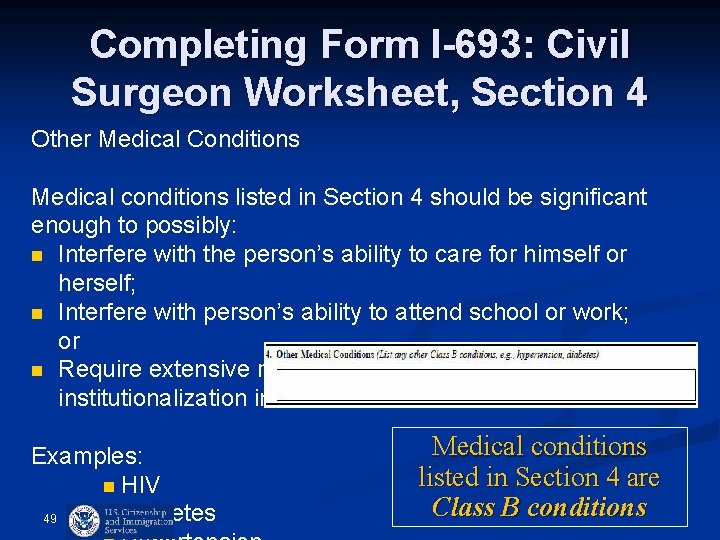
Completing Form I-693: Civil Surgeon Worksheet, Section 4 Other Medical Conditions Medical conditions listed in Section 4 should be significant enough to possibly: n Interfere with the person’s ability to care for himself or herself; n Interfere with person’s ability to attend school or work; or n Require extensive medical treatment or institutionalization in the future Examples: n HIV n Diabetes 49 Medical conditions listed in Section 4 are Class B conditions
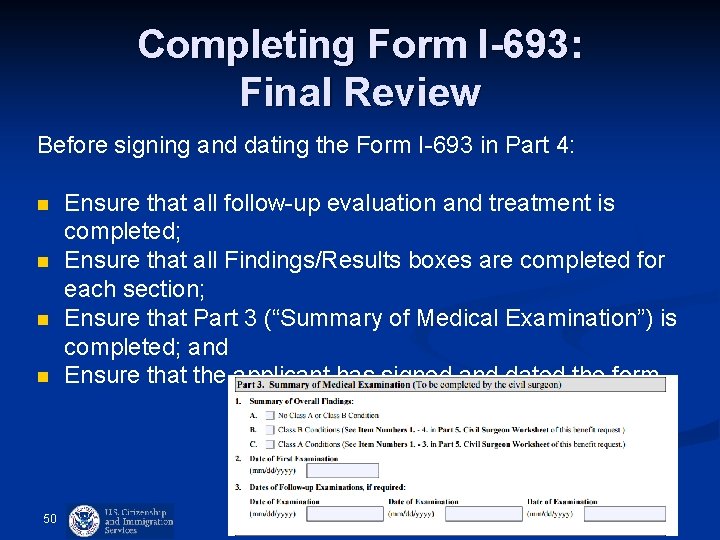
Completing Form I-693: Final Review Before signing and dating the Form I-693 in Part 4: n n 50 Ensure that all follow-up evaluation and treatment is completed; Ensure that all Findings/Results boxes are completed for each section; Ensure that Part 3 (“Summary of Medical Examination”) is completed; and Ensure that the applicant has signed and dated the form.
Latest Developments New Gonorrhea Component: n Under a new TI effective August 1, 2016, civil surgeons are required to perform gonorrhea lab testing for applicants 15 years of age and older. n Civil surgeons must also assign a Class A or B classification on the Form I-693 for gonorrhea and include all medical documentation, such as any laboratory reports, with the Form I-693. Applicants with untreated gonorrhea are Class A; after completing treatment, they are reclassified as Class B. 51
Latest Developments New Gonorrhea Component (cont’d) n If the applicant received treatment, the civil surgeon is required to document the following on Form I-693 or attached documentation: n n n 52 Laboratory test used to make the diagnosis. Drug regimen received (including doses, dosage units, and administration routes of all medications), start date, completion date, and any periods of interruption. Clinical course observed, such as clinical improvement or lack of improvement during and after treatment, including resolution of symptoms and signs, as well as any drug reactions.
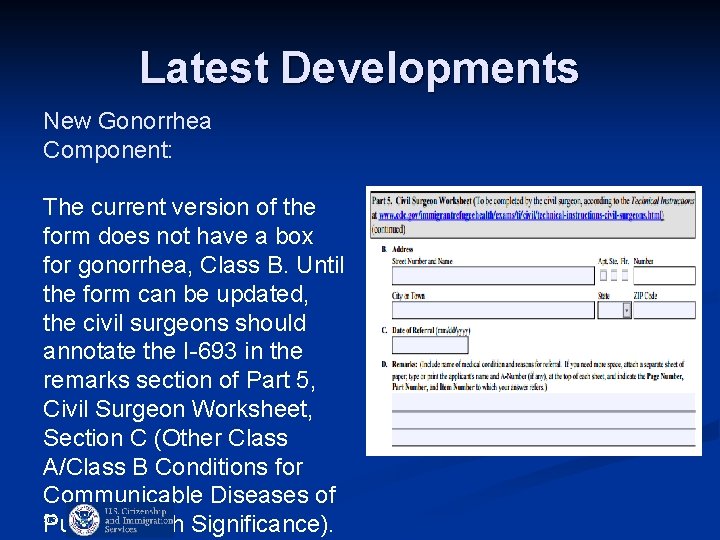
Latest Developments New Gonorrhea Component: The current version of the form does not have a box for gonorrhea, Class B. Until the form can be updated, the civil surgeons should annotate the I-693 in the remarks section of Part 5, Civil Surgeon Worksheet, Section C (Other Class A/Class B Conditions for Communicable Diseases of 53 Public Health Significance).
Common Errors in Completing I 693 Applicant signatures n Applicants must sign the I-693 in the presence of the civil surgeon when so directed by the physician. (This is one of multiple facts the civil surgeon attests to when signing the form. ) n USCIS has seen cases where the civil surgeon signs/dates the form after the date on which the applicant has signed. When that happens, USCIS is unable to conclude the applicant signed in the presence of the civil surgeon. n USCIS recommends civil surgeons sign Form I-693 only after the applicant signs and dates the form. 54
Common Errors in Completing I 693 Verifying Applicant’s Identity n The TIs require civil surgeons to verify the identity of applicants whom they examine. n USCIS has seen instances where the civil surgeon has crossed out the Part 4 Certification that says the physician has verified the applicant’s identity. When that happens, the I-693 is not valid and USCIS will RFE for a corrected form. If a particular civil surgeon persists in crossing out this certification, USCIS could take steps to rescind the physician’s designation due to such continued 55 noncompliance. n
Common Errors in Completing I 693 One Form I-693 per Envelope n USCIS has seen instances where the civil surgeon places Forms I-693 for an entire family group into one sealed envelope. n As a reminder, each applicant’s Form I-693 must be placed individually into its own sealed envelope – one Form I-693 per envelope only. 56
Common Errors in Completing I 693 Vaccination Record Incomplete n USCIS has seen instances where applicants refuse the influenza vaccine for purely personal reasons (even though the vaccine is age-appropriate and not contraindicated) during flu season; however, the civil surgeon fails to check the box regarding influenza and otherwise fails to check the box indicating the applicant either does not meet the immunization requirements (or annotate the comments box) or that applicant will apply for a moral/religious exemption. n USCIS may need to RFE to correct this error. 57
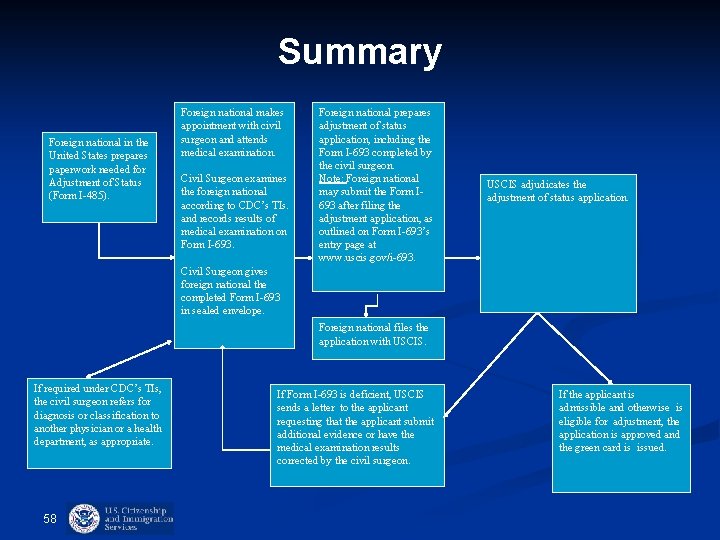
Summary Foreign national in the United States prepares paperwork needed for Adjustment of Status (Form I-485). Foreign national makes appointment with civil surgeon and attends medical examination. Civil Surgeon examines the foreign national according to CDC’s TIs. and records results of medical examination on Form I-693. Foreign national prepares adjustment of status application, including the Form I-693 completed by the civil surgeon. Note: Foreign national may submit the Form I 693 after filing the adjustment application, as outlined on Form I-693’s entry page at www. uscis. gov/i-693. . USCIS adjudicates the adjustment of status application. . Civil Surgeon gives foreign national the completed Form I-693 in sealed envelope. Foreign national files the application with USCIS. If required under CDC’s TIs, the civil surgeon refers for diagnosis or classification to another physician or a health department, as appropriate. 58 If Form I-693 is deficient, USCIS sends a letter to the applicant requesting that the applicant submit additional evidence or have the medical examination results corrected by the civil surgeon. If the applicant is admissible and otherwise is eligible for adjustment, the application is approved and the green card is issued.
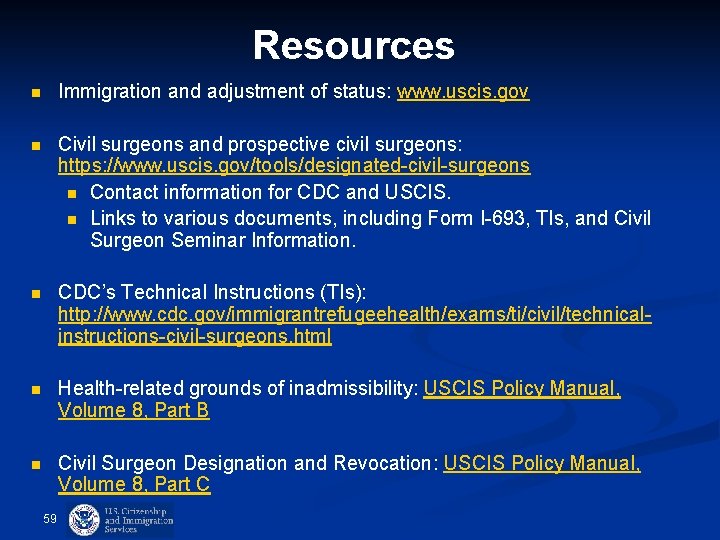
Resources n Immigration and adjustment of status: www. uscis. gov n Civil surgeons and prospective civil surgeons: https: //www. uscis. gov/tools/designated-civil-surgeons n Contact information for CDC and USCIS. n Links to various documents, including Form I-693, TIs, and Civil Surgeon Seminar Information. n CDC’s Technical Instructions (TIs): http: //www. cdc. gov/immigrantrefugeehealth/exams/ti/civil/technicalinstructions-civil-surgeons. html n Health-related grounds of inadmissibility: USCIS Policy Manual, Volume 8, Part B n Civil Surgeon Designation and Revocation: USCIS Policy Manual, Volume 8, Part C 59
Thank you! USCIS Customer Service and Public Engagement Directorate public. engagement@uscis. dhs. gov n 60