IDEA GENERATION WORKSHOP HCDE 593 Ruth KikinGil 02













- Slides: 85
IDEA GENERATION WORKSHOP HCDE 593 Ruth Kikin-Gil 02 2015 RUTHKG@UW. EDU
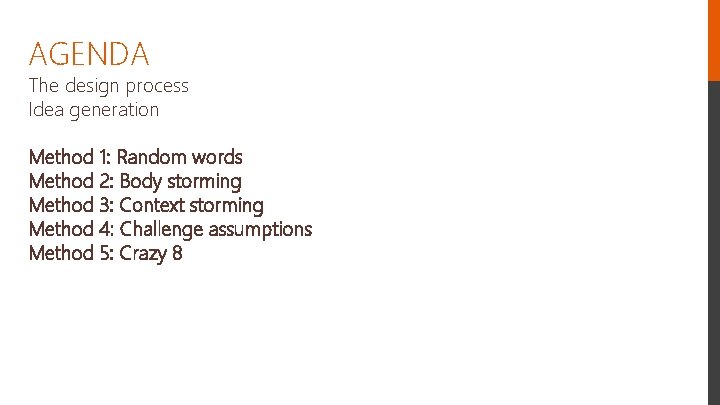
AGENDA The design process Idea generation Method 1: Random words Method 2: Body storming Method 3: Context storming Method 4: Challenge assumptions Method 5: Crazy 8
Divide to groups of 3 -5
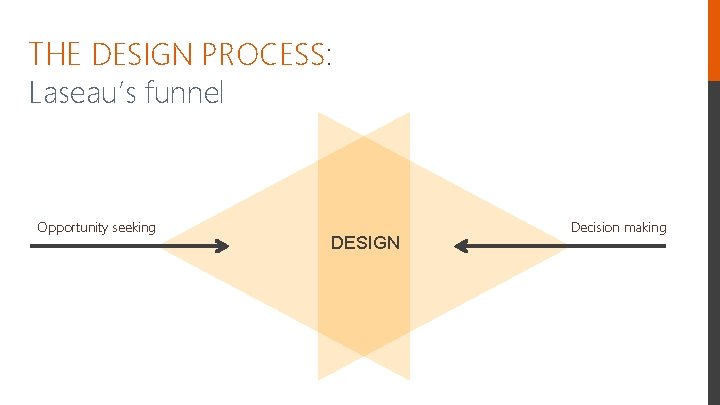
THE DESIGN PROCESS: Laseau’s funnel Opportunity seeking DESIGN Decision making
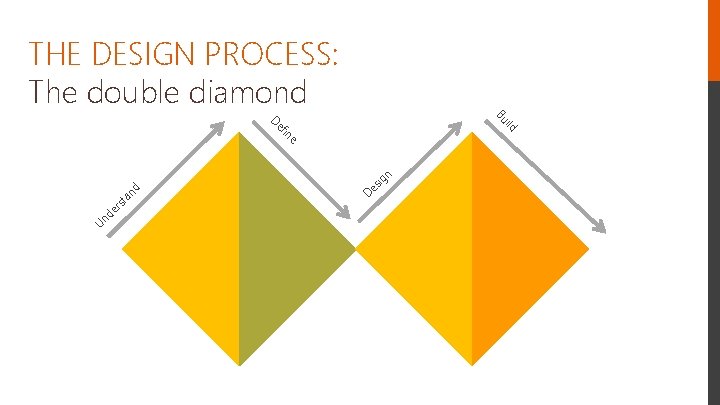
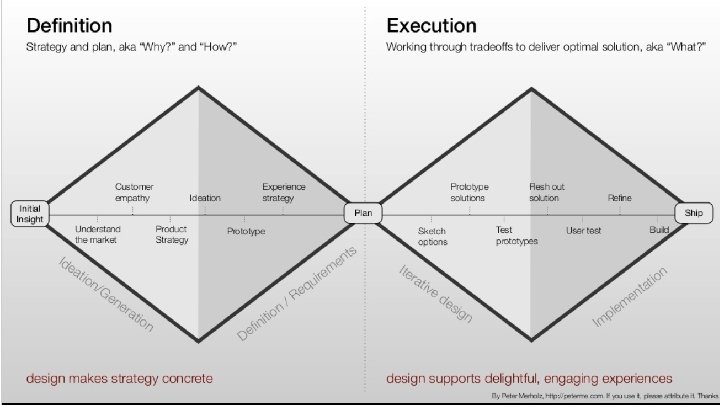
THE DESIGN PROCESS: The double diamond De Bu ild fin Un de De sig rs ta nd n e
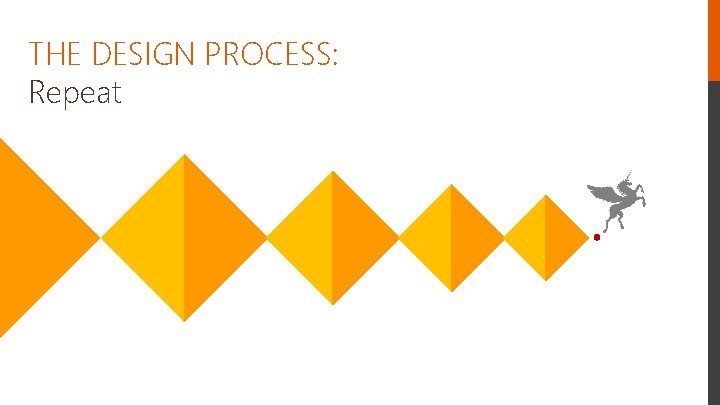
THE DESIGN PROCESS: Repeat
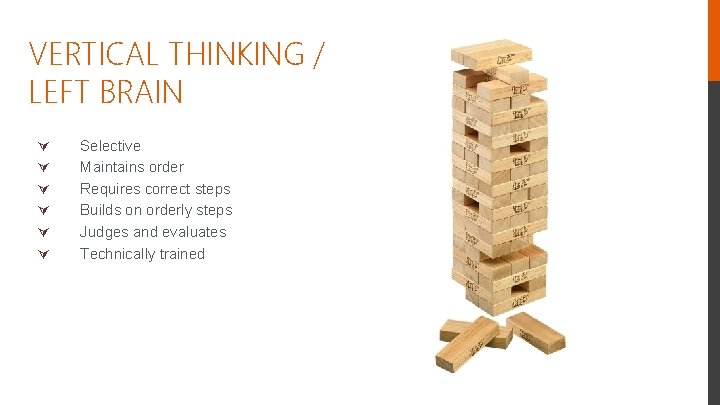
VERTICAL THINKING / LEFT BRAIN Ú Ú Ú Selective Maintains order Requires correct steps Builds on orderly steps Judges and evaluates Technically trained
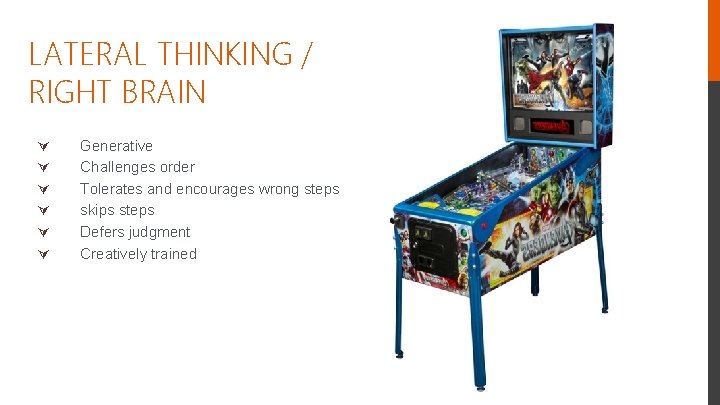
LATERAL THINKING / RIGHT BRAIN Ú Ú Ú Generative Challenges order Tolerates and encourages wrong steps skips steps Defers judgment Creatively trained
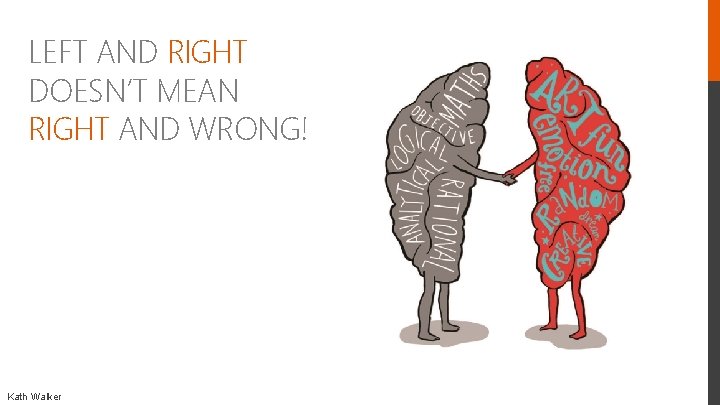
LEFT AND RIGHT DOESN’T MEAN RIGHT AND WRONG! Kath Walker
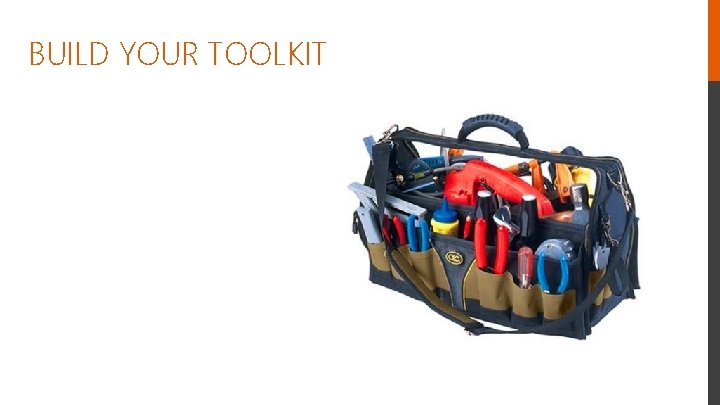
BUILD YOUR TOOLKIT
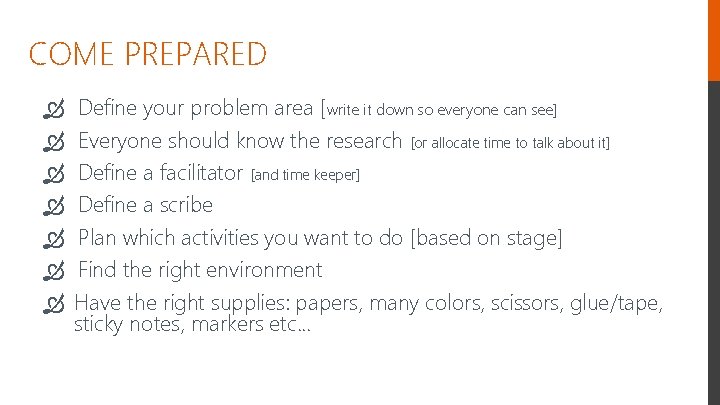
COME PREPARED Define your problem area [write it down so everyone can see] Everyone should know the research [or allocate time to talk about it] Define a facilitator [and time keeper] Define a scribe Plan which activities you want to do [based on stage] Find the right environment Have the right supplies: papers, many colors, scissors, glue/tape, sticky notes, markers etc…
What’s YOUR problem areas?
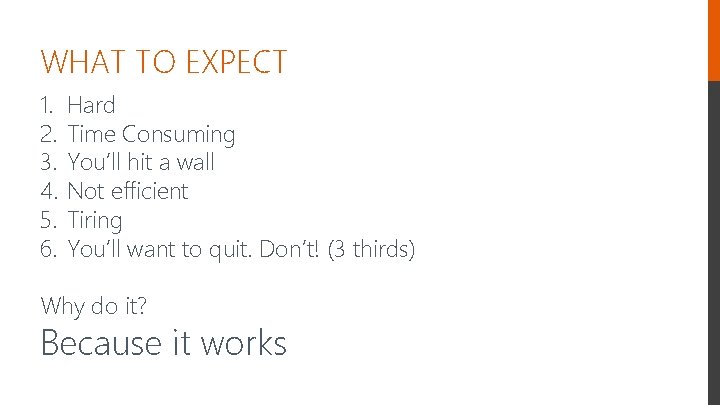
WHAT TO EXPECT 1. 2. 3. 4. 5. 6. Hard Time Consuming You’ll hit a wall Not efficient Tiring You’ll want to quit. Don’t! (3 thirds) Why do it? Because it works
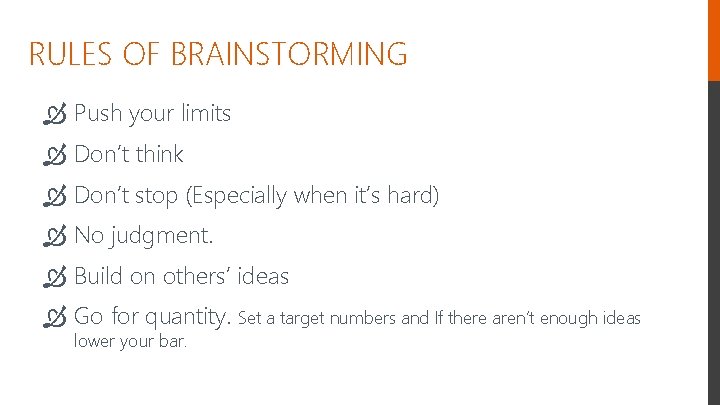
RULES OF BRAINSTORMING Push your limits Don’t think Don’t stop (Especially when it’s hard) No judgment. Build on others’ ideas Go for quantity. Set a target numbers and If there aren’t enough ideas lower your bar.
TAKE A MAGIC PILL (DON’T EAT IT YET) 17
RANDOM WORDS 1. Define a problem (CONTEXT) 2. Take a random word, extract its underlying principles (INITIAL STIMULUS) 3. Apply those principals to your problem to see how they can help (BRIDGING IDEA)
RANDOM WORDS Initial Stimulus: the random word itself Bridging idea: an idea based on the stimulus. The idea is used as a bridge between the stimulus and an idea which you could actually use on your problem.
RANDOM WORDS. EXAMPLE: Using the random word "Balloon" in the context of new ideas about cars. A bridging idea: inflate the balloon under the car. The advantages of this would be that the car jack would not puncture rusty cars and that cars could be raised on soft ground. The resulting final idea could be to have a car jack which spreads its force more evenly under the car and onto the ground.
Exercise Define the problem
Exercise: problem + random word = ? ARMADILLO 3 minutes Create “bridging ideas”
Exercise: problem + random word = ? Share + ground to reality 3 minutes
BODYSTORMING What would you do? 3 Minutes
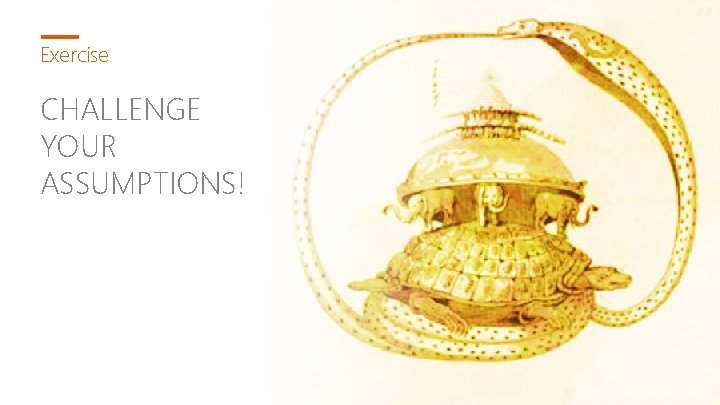
Exercise CHALLENGE YOUR ASSUMPTIONS!
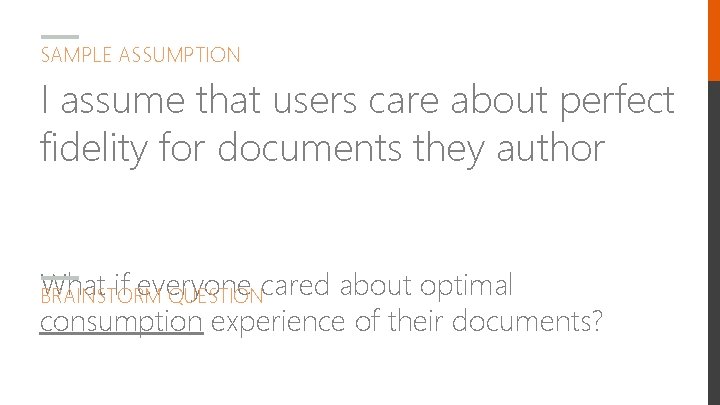
SAMPLE ASSUMPTION I assume that users care about perfect fidelity for documents they author What if everyone BRAINSTORM QUESTIONcared about optimal consumption experience of their documents?
CHALLENGE OUR ASSUMPTIONS Now, let’s list our assumptions, reverse them, and see what products, services, and features we can come up with
Exercise Choose the problem
Exercise: List assumptions LIST ASSUMPTIONS Together, 3 minutes
Exercise: List assumptions BRAINSTORM IN GROUPS 3 minutes
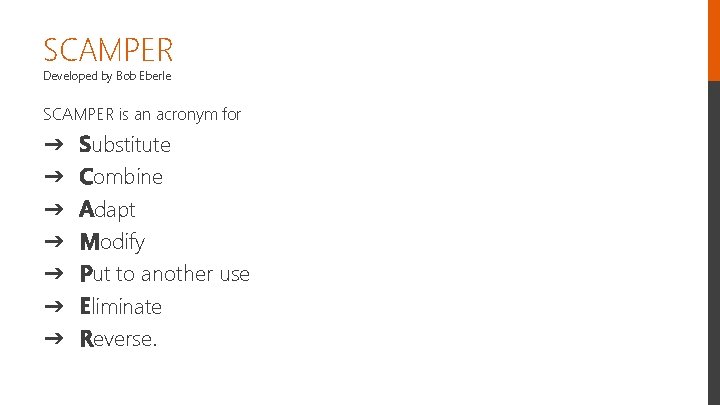
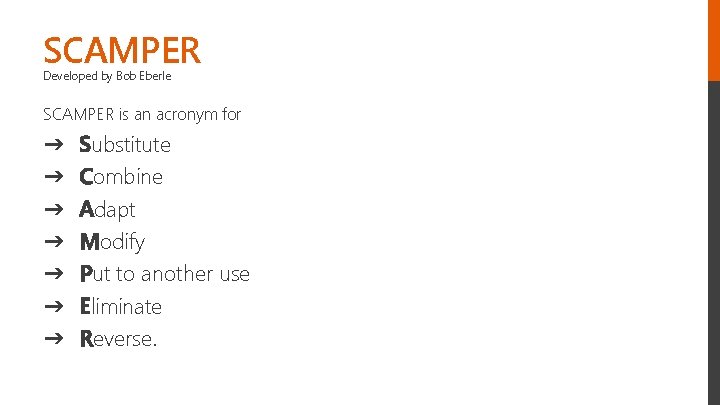
SCAMPER Developed by Bob Eberle SCAMPER is an acronym for ➔ ➔ ➔ ➔ Substitute Combine Adapt Modify Put to another use Eliminate Reverse.
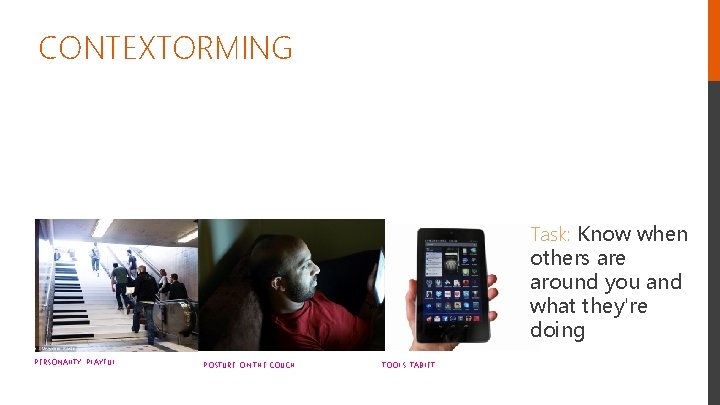
CONTEXTORMING Task: Know when others are around you and what they're doing PERSONALITY: PLAYFUL POSTURE: ON THE COUCH TOOLS: TABLET
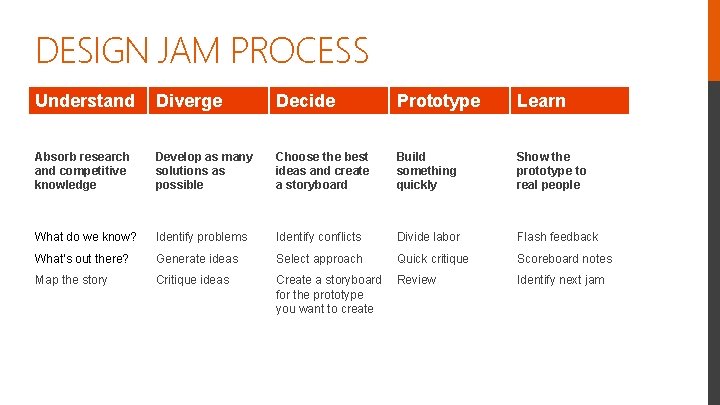
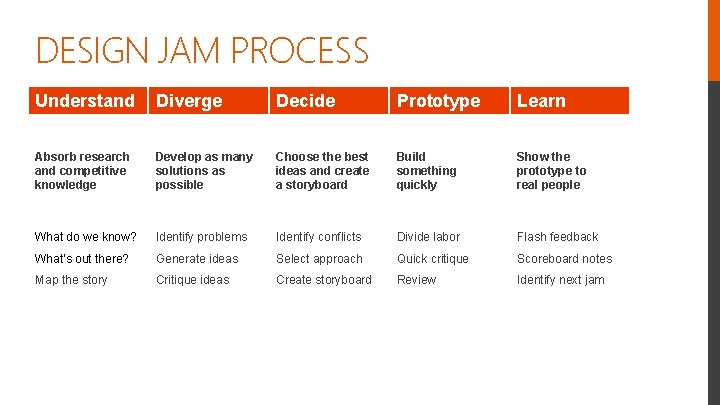
DESIGN JAM PROCESS Understand Diverge Decide Prototype Learn Absorb research and competitive knowledge Develop as many solutions as possible Choose the best ideas and create a storyboard Build something quickly Show the prototype to real people What do we know? Identify problems Identify conflicts Divide labor Flash feedback What’s out there? Generate ideas Select approach Quick critique Scoreboard notes Map the story Critique ideas Create a storyboard for the prototype you want to create Review Identify next jam
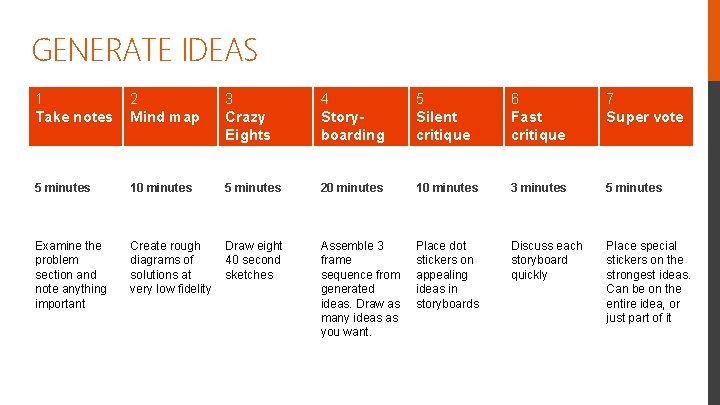
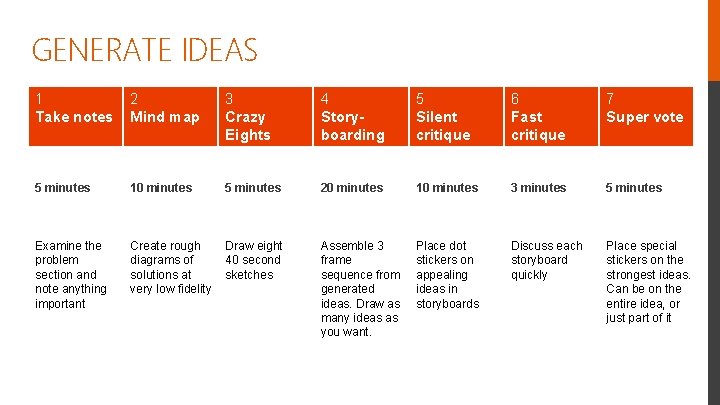
GENERATE IDEAS 1 2 3 Seven step cycle Take notes Mind map Crazy 5 Silent critique 6 Fast critique 7 Super vote Eights 4 Storyboarding 5 minutes 10 minutes 5 minutes 20 minutes 10 minutes 3 minutes 5 minutes Examine the problem section and note anything important Create rough diagrams of solutions at very low fidelity Draw eight 40 second sketches Assemble 3 frame sequence from generated ideas. Draw as many ideas as you want. Place dot stickers on appealing ideas in storyboards Discuss each storyboard quickly Place special stickers on the strongest ideas. Can be on the entire idea, or just part of it
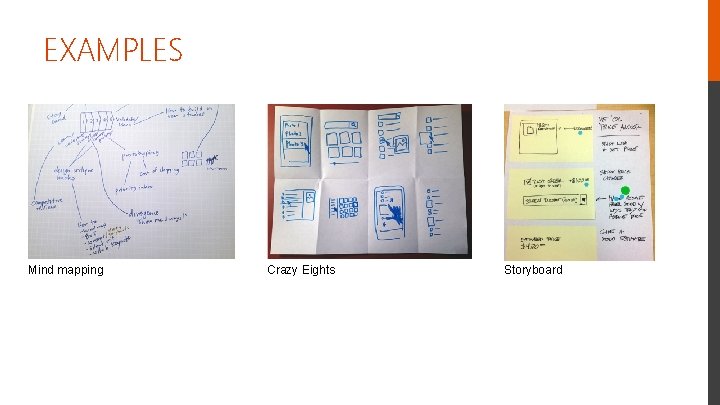
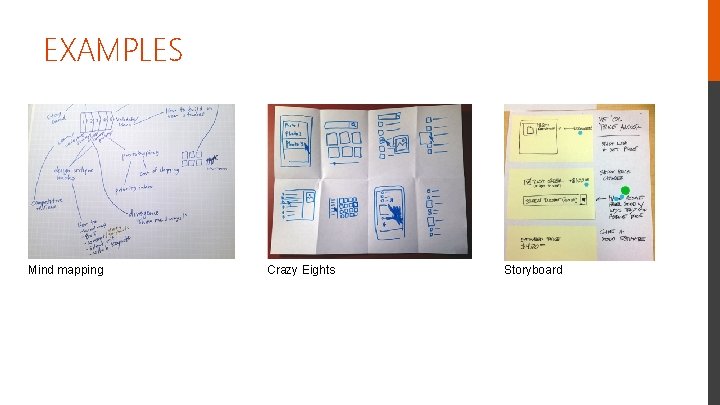
EXAMPLES Mind mapping Crazy Eights Storyboard
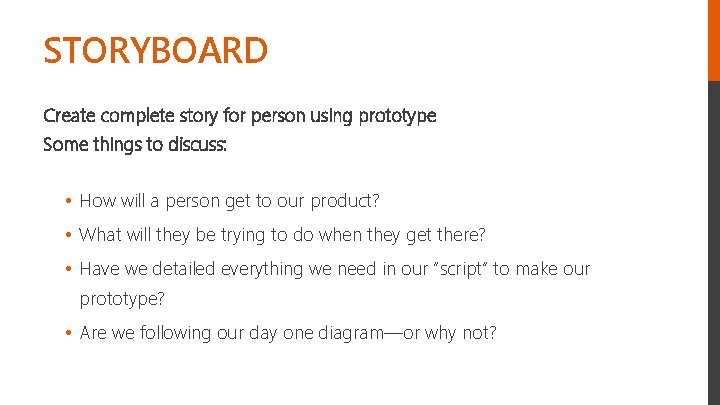
STORYBOARD Create complete story for person using prototype Some things to discuss: • How will a person get to our product? • What will they be trying to do when they get there? • Have we detailed everything we need in our “script” to make our prototype? • Are we following our day one diagram—or why not?
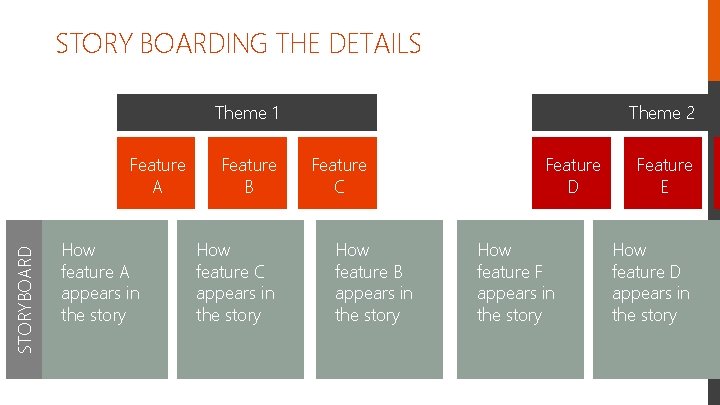
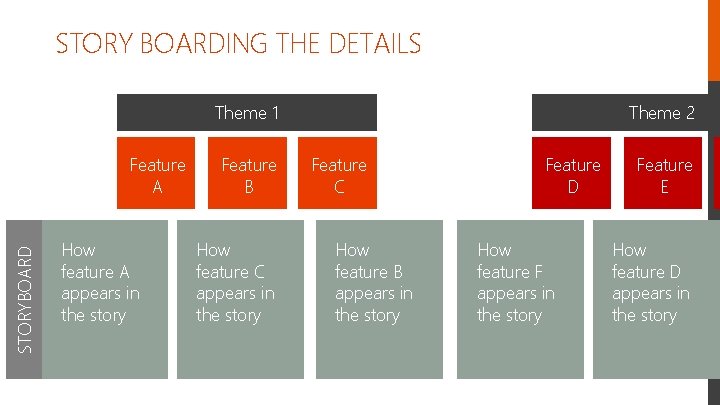
STORY BOARDING THE DETAILS Theme 1 STORYBOARD Feature A How feature A appears in the story Feature B How feature C appears in the story Theme 2 Feature C How feature B appears in the story Feature D How feature F appears in the story Feature E How feature D appears in the story
APPENDIX
SCAMPER Developed by Bob Eberle SCAMPER is an acronym for ➔ ➔ ➔ ➔ Substitute Combine Adapt Modify Put to another use Eliminate Reverse.
SUBSTITUTE EXTREME PERSONAE THE MAFIA
Exercise 2 COMBINE AND CONQUER 44
ROOMBA + WEB CAM PRODUCT 1 PRODUCT 2 = REMOTE CONTROLLED NANNY CAM NEW THING!
Exercise 2 COMBINE AND CONQUER
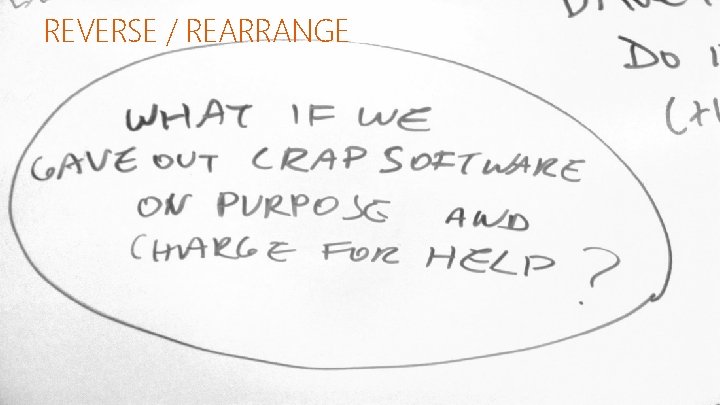
REVERSE / REARRANGE wood Sawdust MDF
REVERSE / REARRANGE
METAPHORS: DRIVE THE PRESENTATION
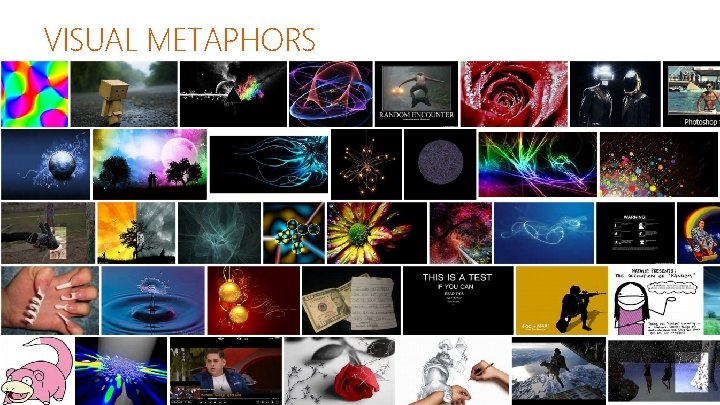
VISUAL METAPHORS
DESIGN JAMS Based on Google ventures design methodology
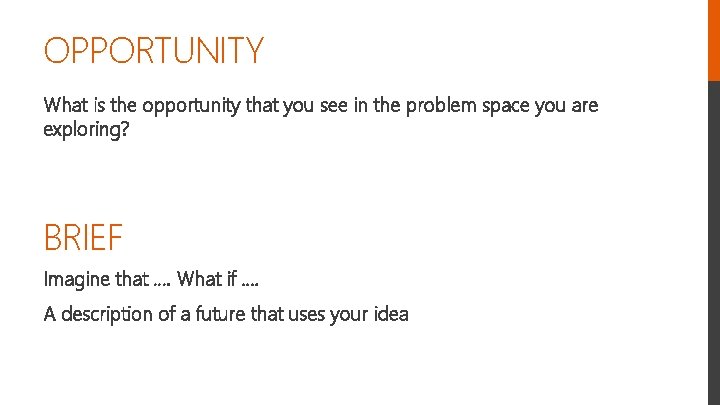
OPPORTUNITY What is the opportunity that you see in the problem space you are exploring? BRIEF Imagine that …. What if …. A description of a future that uses your idea
DESIGN JAM PROCESS Understand Diverge Decide Prototype Learn Absorb research and competitive knowledge Develop as many solutions as possible Choose the best ideas and create a storyboard Build something quickly Show the prototype to real people What do we know? Identify problems Identify conflicts Divide labor Flash feedback What’s out there? Generate ideas Select approach Quick critique Scoreboard notes Map the story Critique ideas Create storyboard Review Identify next jam
UNDERSTAN D DAY 1
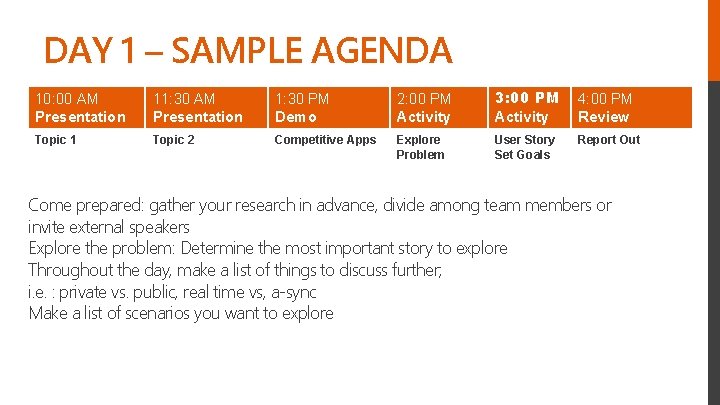
DAY 1 – SAMPLE AGENDA 10: 00 AM Presentation 11: 30 AM Presentation 1: 30 PM Demo 2: 00 PM Activity 3: 00 PM Activity 4: 00 PM Review Topic 1 Topic 2 Competitive Apps Explore Problem User Story Set Goals Report Out Come prepared: gather your research in advance, divide among team members or invite external speakers Explore the problem: Determine the most important story to explore Throughout the day, make a list of things to discuss further; i. e. : private vs. public, real time vs, a-sync Make a list of scenarios you want to explore
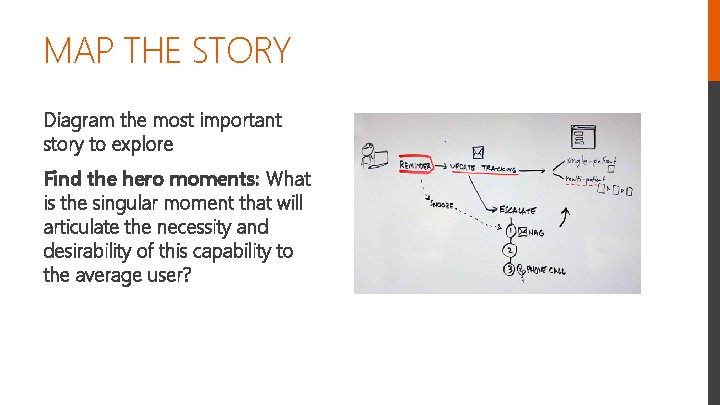
MAP THE STORY Diagram the most important story to explore Find the hero moments: What is the singular moment that will articulate the necessity and desirability of this capability to the average user?
SET GOALS Determine what we want to learn from the prototype Some things to discuss: • When we show our prototype to users, what do we hope to learn? What do we need to design and prototype in order to learn those things?
DIVERGE DAY 2
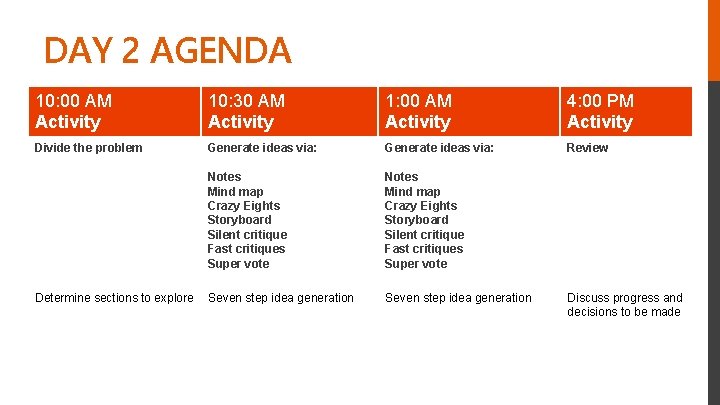
DAY 2 AGENDA 10: 00 AM Activity 10: 30 AM Activity 1: 00 AM Activity 4: 00 PM Activity Divide the problem Generate ideas via: Review Notes Mind map Crazy Eights Storyboard Silent critique Fast critiques Super vote Seven step idea generation Determine sections to explore Discuss progress and decisions to be made
LIST EXISTING IDEAS Catalog solutions we know of today
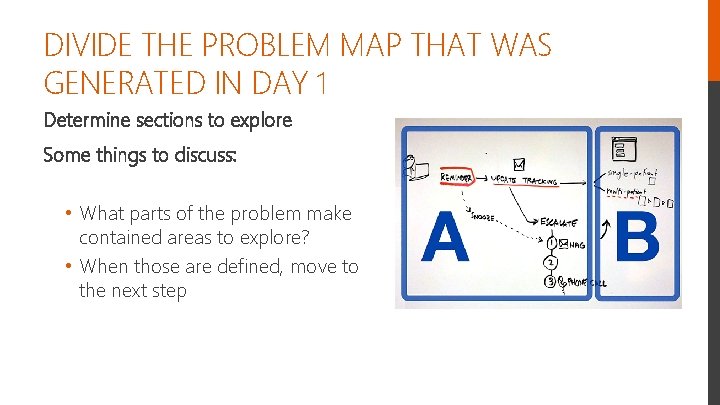
DIVIDE THE PROBLEM MAP THAT WAS GENERATED IN DAY 1 Determine sections to explore Some things to discuss: • What parts of the problem make contained areas to explore? • When those are defined, move to the next step
GENERATE IDEAS 1 2 3 Seven step cycle Take notes Mind map Crazy 5 Silent critique 6 Fast critique 7 Super vote Eights 4 Storyboarding 5 minutes 10 minutes 5 minutes 20 minutes 10 minutes 3 minutes 5 minutes Examine the problem section and note anything important Create rough diagrams of solutions at very low fidelity Draw eight 40 second sketches Assemble 3 frame sequence from generated ideas. Draw as many ideas as you want. Place dot stickers on appealing ideas in storyboards Discuss each storyboard quickly Place special stickers on the strongest ideas. Can be on the entire idea, or just part of it
EXAMPLES Mind mapping Crazy Eights Storyboard
REVIEW After the “super vote”, discuss progress and which decisions need to be made next Some things to discuss: Do we have enough ideas to choose from? Do we have the right kind of ideas? What do we need to decide tomorrow?
DECIDE DAY 3
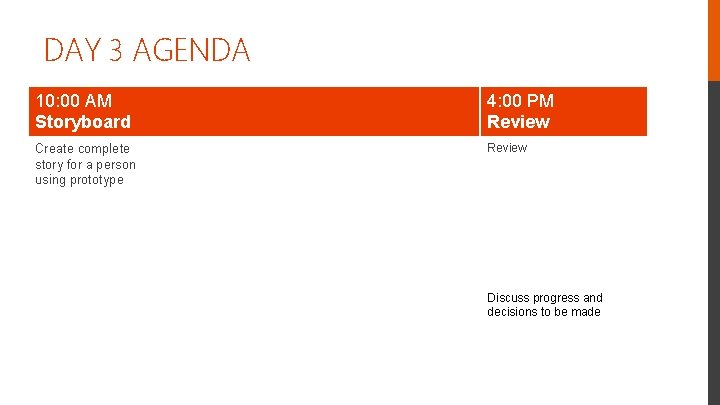
DAY 3 AGENDA 10: 00 AM Storyboard 4: 00 PM Review Create complete story for a person using prototype Review Discuss progress and decisions to be made
STORYBOARD Create complete story for person using prototype Some things to discuss: • How will a person get to our product? • What will they be trying to do when they get there? • Have we detailed everything we need in our “script” to make our prototype? • Are we following our day one diagram—or why not?
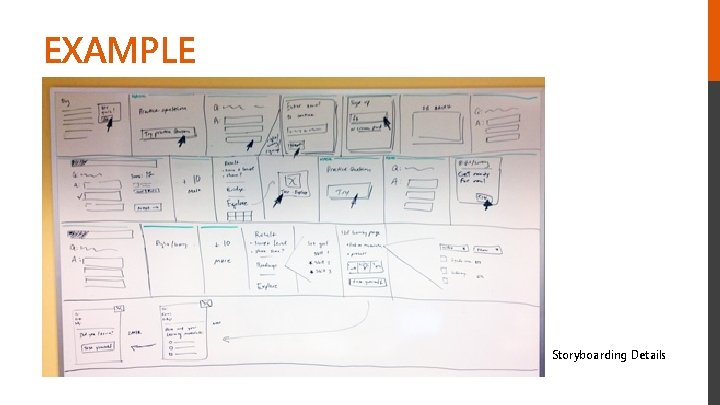
EXAMPLE Storyboarding Details
STORY BOARDING THE DETAILS Theme 1 STORYBOARD Feature A How feature A appears in the story Feature B How feature C appears in the story Theme 2 Feature C How feature B appears in the story Feature D How feature F appears in the story Feature E How feature D appears in the story
WIREFRAMES Create rough screens to create detailed designs and prototype from Feature Some things to discuss: • Define key screens to mock up and prototype
REVIEW Discuss prototype production Some things to discuss: • What logistical issues do we need to resolve? • Who is going to do what?
PROTOTYPE DAY 4
LEARN USER STUDY
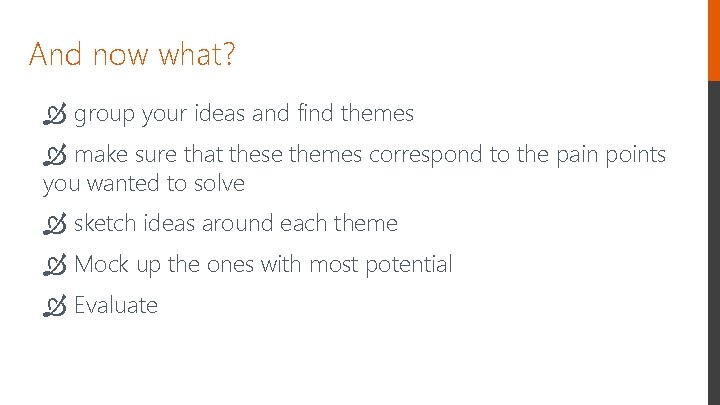
And now what? group your ideas and find themes make sure that these themes correspond to the pain points you wanted to solve sketch ideas around each theme Mock up the ones with most potential Evaluate
TENETS AND TRAPS - IDENTIFY HOLES IN YOUR DESIGNS AND FIND SOLUTIONS TENETS general attributes of good interface design + TRAPS problems that degrade good interface design
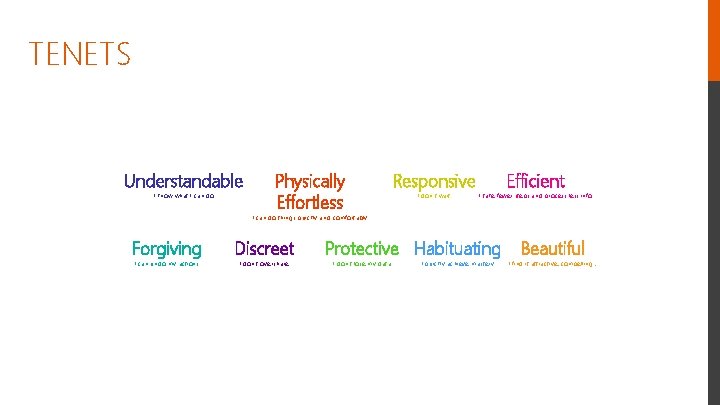
TENETS Understandable I know what I can do Physically Effortless Responsive I don’t wait Efficient I take fewer steps and process less info I can do things quickly and comfortably Forgiving I can undo my actions Discreet I don’t overshare Protective Habituating I don’t lose my data I quickly achieve mastery Beautiful I find it attractive, compelling…
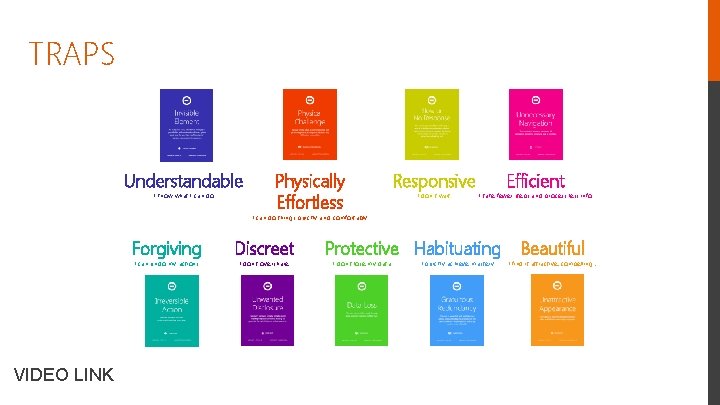
TRAPS Understandable I know what I can do Physically Effortless Responsive I don’t wait Efficient I take fewer steps and process less info I can do things quickly and comfortably Forgiving I can undo my actions VIDEO LINK Discreet I don’t overshare Protective Habituating I don’t lose my data I quickly achieve mastery Beautiful I find it attractive, compelling…
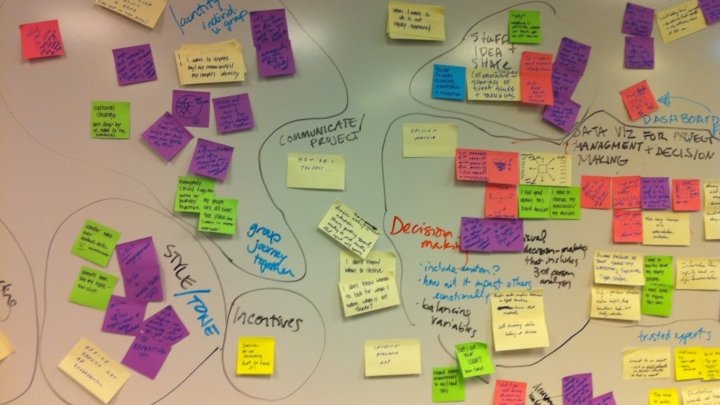
TEAM IDEA MAPPING Each team member brainstorms individually on a pre-defined topic, then all ideas are combined into one large idea map, which is an abstract ‘web’ of interconnected ideas. Participants share the meaning of their ideas, and during the sharing new ideas are formed as associations are made.
GROUP PASSING Everyone writes an idea, and then passes it to the next person, who adds to it. This continues until everyone gets their original paper back, at which point the group will have elaborated on each of the ideas.
PETER MERHOLTZ’S DOUBLE DIAMOND
RULES OF BRAINSTORMING
DON’T JUDGE! "Inventions have long since reached their limit, and I see no hope for further development“ Julius Frontinus (Highly respected engineer in Rome, 1 st century A. D. ) 12/7/2020 Microsoft confidential 84
GO WILD! "If at first the idea is not absurd, then there is no hope for it“ Albert Einstein 12/7/2020 Microsoft confidential 85
QUANTITY OVER QUALITY "If you wish to advance into the infinite, explore the finite in all directions” Johann Wolfgang von Goethe 12/7/2020 Microsoft confidential 86
BUILD ON OTHERS’ IDEAS "If I have seen further it is by standing on the shoulders of giants. " Sir Isaac Newton 12/7/2020 Microsoft confidential 87
ALL IDEAS ARE BORN EQUAL "Nurture your minds with great thoughts. To believe in the heroic makes heroes. " Benjamin D’israeli 12/7/2020 Microsoft confidential 88