32 E 11100 Legal Aspects of Finance Fintech



- Slides: 41
32 E 11100 Legal Aspects of Finance Fintech: New solutions – and questions 15. 10. 2018 Ruth Kaila Aalto University Department of Industrial 0 Engineering and Management
Contents Drivers of the disruption on the financial industry 1. Changing society 2. New technologies 3. Regulation 4. New players TRUST Subsectors of the financial industry 1. Payments 2. Digital Banking 3. Investment Management 4. Lending 5. Crowdfunding 6. Insurance Ruth Kaila, Aalto University, 10. 2018 Based partly on the World Economic Forum Fintech 1 report from August 2017
1. Changing society • Internet ja digitalization have changed peoples behavior and life • Platform economy provides new possibilities; sharing economy • Job requirements/profile and criteria have changed; increasing amount of freelance-type contracts • Large tech companies have modified expectations of online customer experience • Payment becomes an invisible part of the buying process; online-shopping has brought new ways of paying Ruth Kaila, Aalto University, 10. 2018 2
2. New technologies • Platform economy • New business opportunities for Fintech startups • Cooperation possibilities between bank and other companies, enabled, for example, by new technology related to APIs (Application programming interface) • Machine‐learning and artificial intelligence • • Better risk assessment in banking and investments Technology related to authentication; technology to recognize faces Chatbots, computer programs that discuss with people/customers Et cetera • Blockchain technology • This technology is still developing, too heavy for many applications, a lot of open questions, a lot of expectations • Possibilities in the future: payments, smart contracts, fraud detection, checking the background of customers • IN 2017, World Economic Forum forecasts that in 2025, 10 % of GDF will be stored in blockchains or behind blockchain technology • Cloud technology • Big data and data analytics. Ruth Kaila, Aalto University, 10. 2018 3
3. New regulation (EU-area) Objective • Regulation should not depend on technology; To enhance financial stability • more competition and players in the financial sector ‐> smaller systemic risk as there will similar actions/services should have similar be more players, not only very large too‐big‐to‐fail financial institutions regulation • • Not more or less regulation but better regulation To enhance investing and investments • also small portions of money into work When and to what extent should new actions/services be regulated? • easier fundraising for companies Developing the infrastructure needed by digital financial markets • one single European digital financial market, competitiveness against China How does regulation of EU‐companies affect their international competitiveness? • Are we regulating in the correct way? (f. ex. PSD 1) New technologies bringing transparency to profit customers and companies BUT should not create new risks (market manipulation, misleading marketing, problems in cybersecurity, systemic risk) Ruth Kaila, Aalto University, 10. 2018 4
New regulation, 3 important directives PSD 2, MIFID II and GDPR PSD 2 Payment Services Directive 2 Forces the banks to provide access to their customers accounts and payment history for third party service providers IF the customer gives a permission Objectives according to European Commission: • Contribute to a more integrated and efficient European payments market Entered into force in the beginning of 2018, BUT details still open • Improve the level playing field for payment service providers (including new players) • what information should be given free, what can be sold • Make payments safer and more secure • Protect consumers • Encourage lower prices for payments Who has the right to be third party service provider? • security is the critical factor • Payment initiation service provider, PISP • Service provider/merchant can link directly to the customer’s bank account with customer’s permission • Account information services, AISP • Services consolidate account information and historical payment information from multiple bank accounts of the customer The security of the new services is a critical factor. 5 Ruth Kaila, Aalto University, 10. 2018
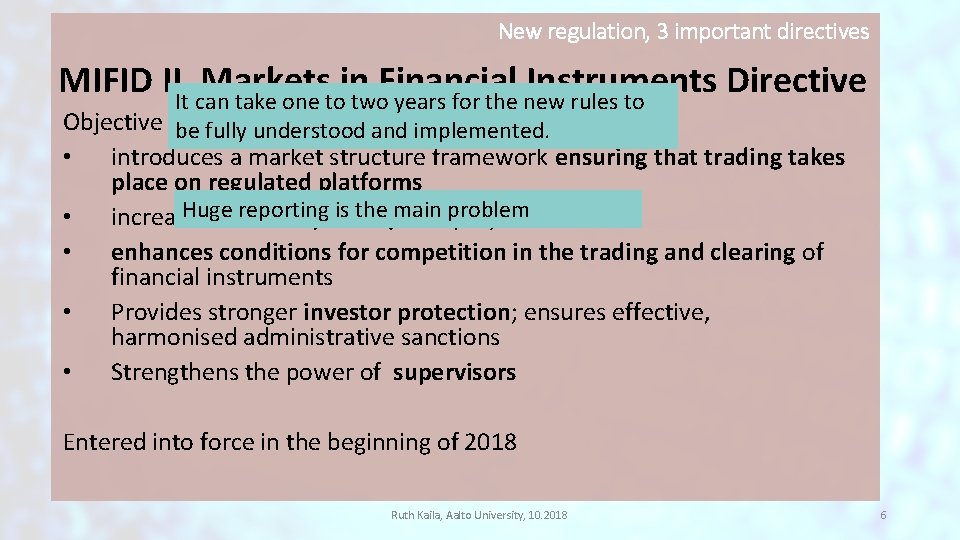
New regulation, 3 important directives MIFID II, Markets in Financial Instruments Directive It can take one to two years for the new rules to Objective be fully understood and implemented. • introduces a market structure framework ensuring that trading takes place on regulated platforms Huge reporting is the main problem • increases the transparency of equity market • enhances conditions for competition in the trading and clearing of financial instruments • Provides stronger investor protection; ensures effective, harmonised administrative sanctions • Strengthens the power of supervisors Entered into force in the beginning of 2018 Ruth Kaila, Aalto University, 10. 2018 6
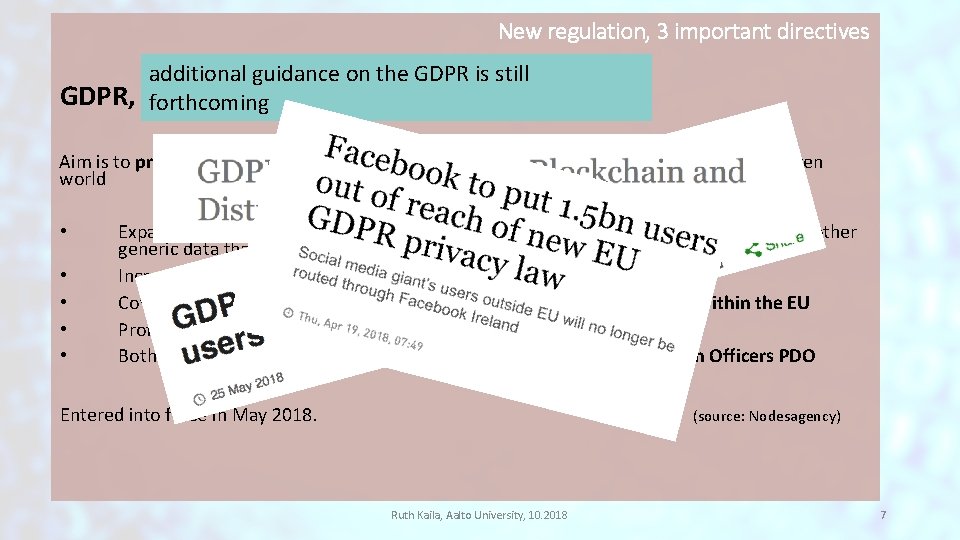
New regulation, 3 important directives additional guidance on the GDPR is still GDPR, General Data Protection Regulation forthcoming Aim is to protect all EU citizens from privacy and data breaches in an increasingly data‐driven world Holds only in the EU‐area; are non‐EU • • • companies profiting of the situation? Expansions on the personal data pool, this will now include IP addresses, cookies and other generic data that have or are assigned to the user; processing of personal data Increased fines, penalties 2%‐ 4% of the gross revenue or € 10 m ‐€ 20 m Coverage of outside EU countries if data is being transferred or stored within the EU Profiling and targeting of big data Both controllers and processers must assign designated Data Protection Officers PDO Entered into force in May 2018. (source: Nodesagency) Ruth Kaila, Aalto University, 10. 2018 7
4. New players A strong political will to help the stratups ‐ More players, less systemic risk Fintech-startups and large tech companies ‐ Entry barriers of the financial sector are typically strong ‐ Also small portions of money into work • Operation on areas that the banks are not interested in ‐ TRUST, one single European digital financial market • Less regulated than traditional banks • Free of complicated and partially very old ICT systems of banks • PSD 2‐payment service directive opens the markets for the startups • Often operates on a small niche, important to have very wide markets • Often more flexible and rapid than traditional banks to react and test new ideas, approaches and methods Ruth Kaila, Aalto University, 10. 2018 8
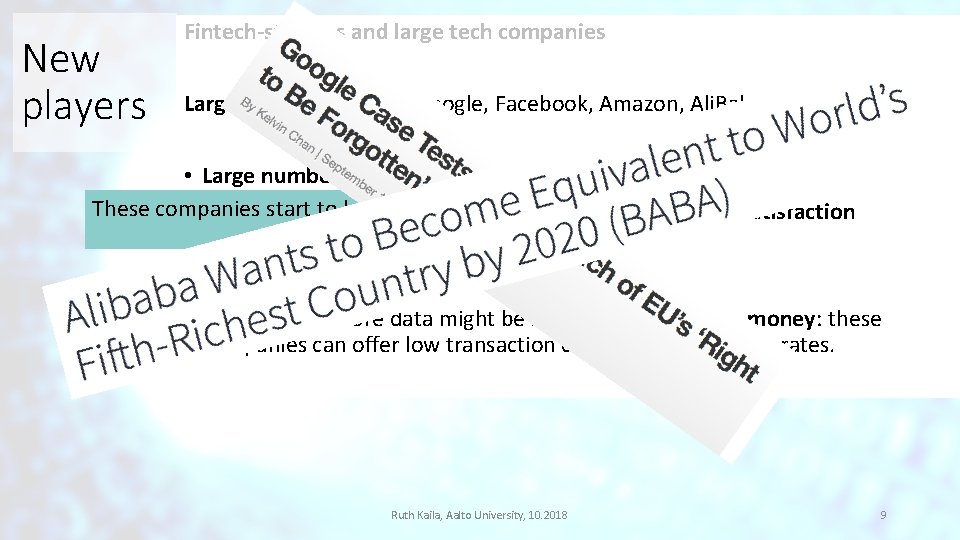
New players Fintech-startups and large tech companies Large tech-companies (Google, Facebook, Amazon, Ali. Baba, Baidu) • Large number of customers, partly very committed These companies start to be too powerful. • Typically a strong emphasis on customer interface and satisfaction • Huge amounts of data on customers • Good reputation in cyber security issues • Getting even more data might be more important than money: these companies can offer low transaction costs and low interest rates. Ruth Kaila, Aalto University, 10. 2018 9
Subsectors of the financial industry Ruth Kaila, Aalto University, 10. 2018 10
Payments Ruth Kaila, Aalto University, 10. 2018 11
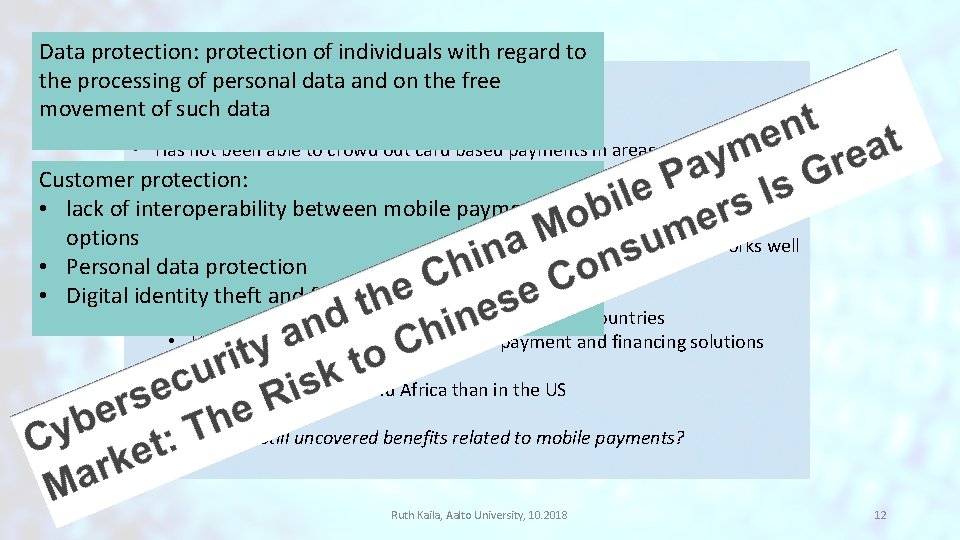
Data protection: protection of individuals with regard to Mobile payment the processing of personal data and on the free movement of such data • Has not been able to crowd out card based payments in areas where the card based payments is widely used and works well (US, Europe) Customer protection: • lack of interoperability between mobile payment • The possible advantages of mobile payment has not been shown well enough options • All vendors don’t adapt mobile payment as card based payment works well • Personal data protection • There is not one official standard for mobile payment • Digital identity theft and fraud • Mobile payment is much more popular in developing countries • Ubiquity of mobile devices traditional payment and financing solutions don’t exist • More popular in Asia and Africa than in the US Would there be still uncovered benefits related to mobile payments? Ruth Kaila, Aalto University, 10. 2018 12
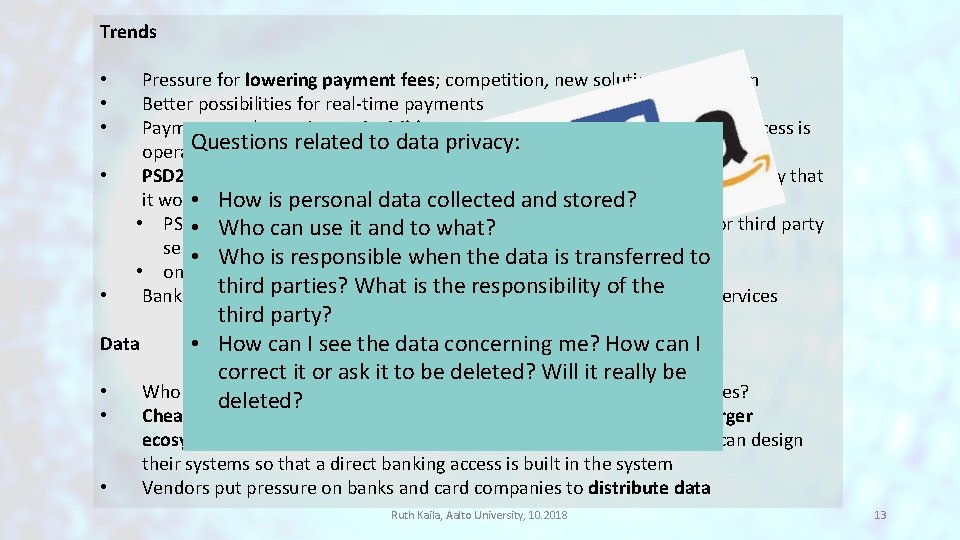
Trends • • • Pressure for lowering payment fees; competition, new solutions, regulation Better possibilities for real‐time payments Paymentsare becoming an invisible part of mobile shopping; often, this process is Questions related to data privacy: operated by large tech‐companies PSD 2 will have a positive impact on mobile payment in Europe, but it is unlikely that it would have an effect in the US • How is personal data collected and stored? • PSD 2 forces the banks to develop simple, secure and effective APIs for third party • Who can use it and to what? service providers (API, Application programming interface) • Who is responsible when the data is transferred to • online‐shopping may move from traditional card payments to APIs third parties? What is the responsibility of the Banks will further cooperate with Fintech‐startups providing payment services third party? Data • How can I see the data concerning me? How can I correct it or ask it to be deleted? Will it really be • Who is the best placed to monetize data obtained from payment services? deleted? • • Cheap payment services might be provided to attract customer in a larger ecosystem; this ecosystem can exploit the data. Large tech‐companies can design their systems so that a direct banking access is built in the system Vendors put pressure on banks and card companies to distribute data Ruth Kaila, Aalto University, 10. 2018 13
Digital Banking Ruth Kaila, Aalto University, 10. 2018 14
Changing landscape, opportunities and challenges Decreasing marginal profit • More competition • Stronger regulation; stronger solvency requirements after financial crisis 2008 • Emphasis on distribution channels and customers Emergence of Banking platforms • Collaboration with other companies provides new opportunities Emergence of could services; Basic systems are moved in the cloud • Do cloud services enable new strategies for exploiting data? Questions related to data and data protection are open PSD 2 payment service directive forces the banks to give third party service providers access to the accounting data and payment history of their customers, if the customer gives a permission to this • Fintech-startups and large tech-companies define the expectations of customer experience and customer interface, banks no longer define customer expectations of the banking experience How to fit new digital systems to legacy? Old legacy makes it difficult to fulfil customer Ruth Kaila, Aalto University, 10. 2018 expectations. 15
Situation right now • Despite notable effort, only few customer have changed from traditional banks to online banking and alternative banks • Physical presence has a value (still) • Alternative banks • Cannot provide solutions for the complicated needs of customers • Typically, alternative banks are secondary banks. To attract customers, they provide often either lower fees or better profits. This results to lower profitability • Traditional banks can optimize their customer base and keep only the most profitable customer segments • Transition to online and mobile banking is technically not very demanding. If the movement of customers to alternative banks accelerates and becomes important, traditional banks can quite easily change their focus in online and mobile banking Ruth Kaila, Aalto University, 10. 2018 16
• It is not clear how banking platforms and platform economy will finally look like. For this reason, many banks have been unwilling to invest in banking platform solutions. • The openess of platforms depends, among others, on regulators. How many regulators in the world will require Open Banking –standards? How will the EU PSD 2‐payment service directive be monitored in practice. • Who manages the platforms used in Open Banking? • banks • large tech‐companies • open platforms Ruth Kaila, Aalto University, 10. 2018 17
1. Platforms managed by banks Banks can outsource the design of less-profitable services Banks can form an optimal product portfolio using different sources The customers profit from varied and tailored solutions, but they are not as free to choose as they would be if the banking platforms were totally open (not managed by banks) • Fintech-startups design white-label products which will be adapted under the brand of the bank • Banks don’t need to develop the open data solutions required by the regulator • Fintech-startups reach their potential customers better via cooperation with banks Ruth Kaila, Aalto University, 10. 2018 18
2. Platforms managed by large tech-companies Fintech‐startups and small banks collaborate with large tech‐companies to maximize their potential customer base • The customers can buy via large tech companies • Traditional players of the financial sector must decide whether to collaborate with large techs; large techs have better access and resources, traditional players must find out other competitive advantage • Maybe only regulated financial services and products will remain in the banks The market position of large tech‐companies might become so dominant that regulator should express their view on the risks related to it. • Large tech companies will obtain even more data of their customers than earlier Ruth Kaila, Aalto University, 10. 2018 19
3. Open platforms • As a result of regulation, the banks are forced to use open application programming interfaces (APIs) • Third party service providers can use these APIs to design their own services • Banks will be competing with the third party service providers • Customer has maximal freedom of choice Ruth Kaila, Aalto University, 10. 2018 20
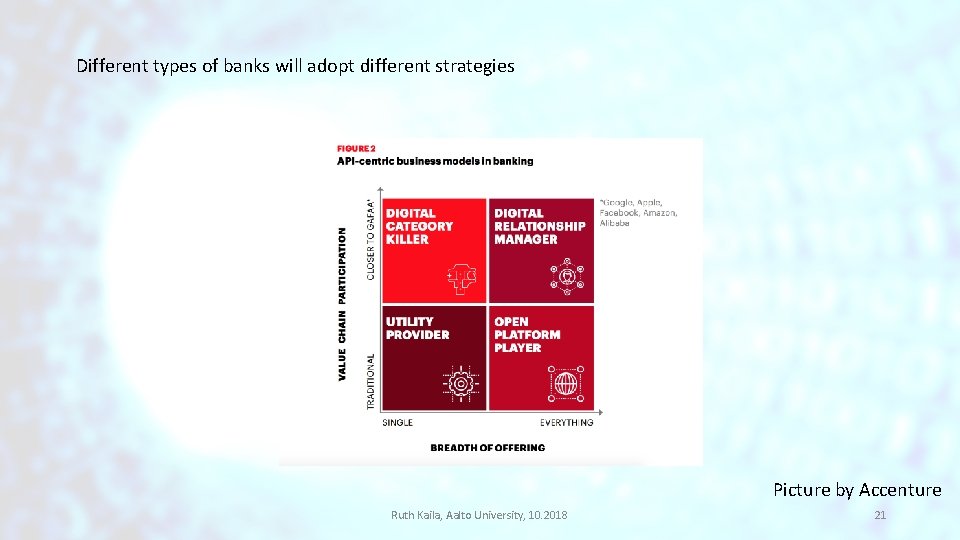
Different types of banks will adopt different strategies Picture by Accenture Ruth Kaila, Aalto University, 10. 2018 21
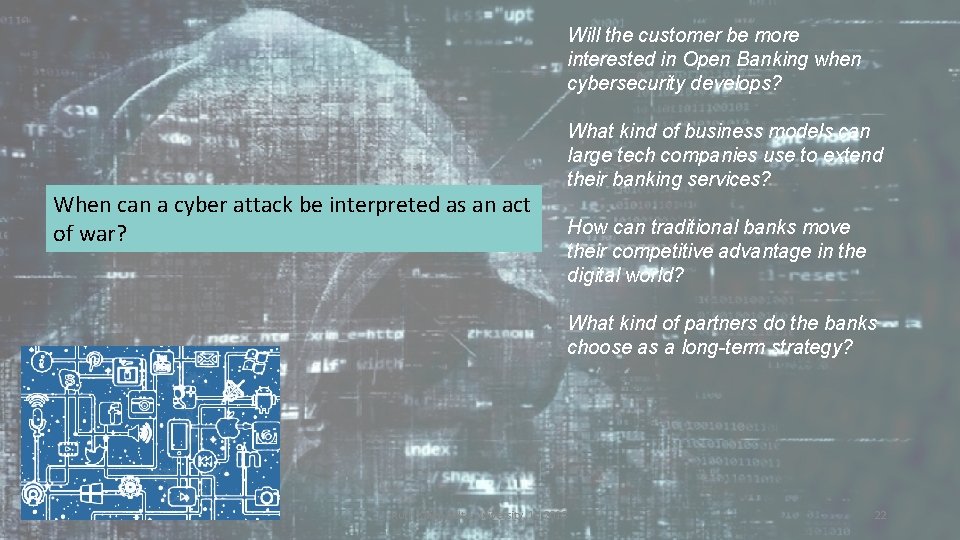
Will the customer be more interested in Open Banking when cybersecurity develops? When can a cyber attack be interpreted as an act of war? What kind of business models can large tech companies use to extend their banking services? How can traditional banks move their competitive advantage in the digital world? What kind of partners do the banks choose as a long-term strategy? Ruth Kaila, Aalto University, 10. 2018 22
Investment management Ruth Kaila, Aalto University, 10. 2018 23
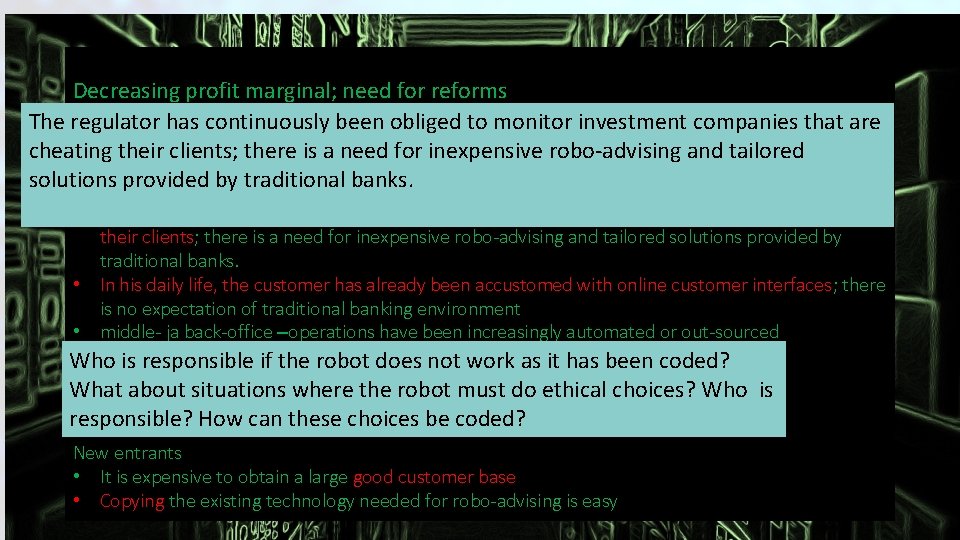
Decreasing profit marginal; need for reforms The regulator has continuously been obliged to monitor investment companies that are Robo-advising in investment management cheating their clients; there is a need for inexpensive robo‐advising and tailored • To be profitable, new inexpensive products require large markets; pressure for consolidations solutions provided by traditional banks. • Robo-advisors can easily serve large markets • The regulator has continuously been obliged to monitor investment companies that are cheating their clients; there is a need for inexpensive robo-advising and tailored solutions provided by traditional banks. • In his daily life, the customer has already been accustomed with online customer interfaces; there is no expectation of traditional banking environment • middle- ja back-office –operations have been increasingly automated or out-sourced • The customers using robo-advisors bring a relatively low profit Who is responsible if the robot does not work as it has been coded? • Traditional customers value traditional advising What about situations where the robot must do ethical choices? Who is • How is it possible to differentiate from other robo-advisors? responsible? How can these choices be coded? New entrants • It is expensive to obtain a large good customer base • Copying the existing technology needed for robo-advising is easy Ruth Kaila, Aalto University, 10. 2018 24
Lending Ruth Kaila, Aalto University, 10. 2018 25
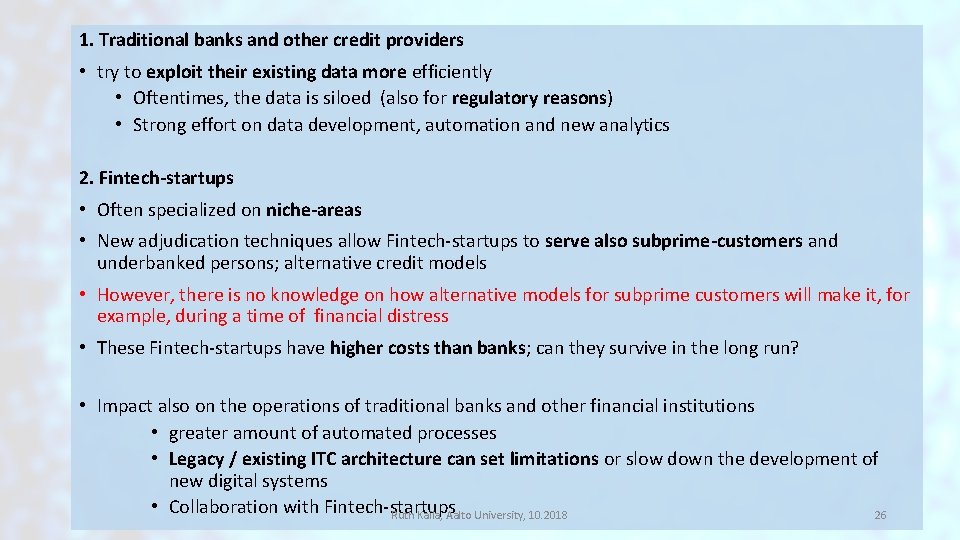
1. Traditional banks and other credit providers • try to exploit their existing data more efficiently • Oftentimes, the data is siloed (also for regulatory reasons) • Strong effort on data development, automation and new analytics 2. Fintech-startups • Often specialized on niche-areas • New adjudication techniques allow Fintech‐startups to serve also subprime-customers and underbanked persons; alternative credit models • However, there is no knowledge on how alternative models for subprime customers will make it, for example, during a time of financial distress • These Fintech‐startups have higher costs than banks; can they survive in the long run? • Impact also on the operations of traditional banks and other financial institutions • greater amount of automated processes • Legacy / existing ITC architecture can set limitations or slow down the development of new digital systems • Collaboration with Fintech‐startups Ruth Kaila, Aalto University, 10. 2018 26
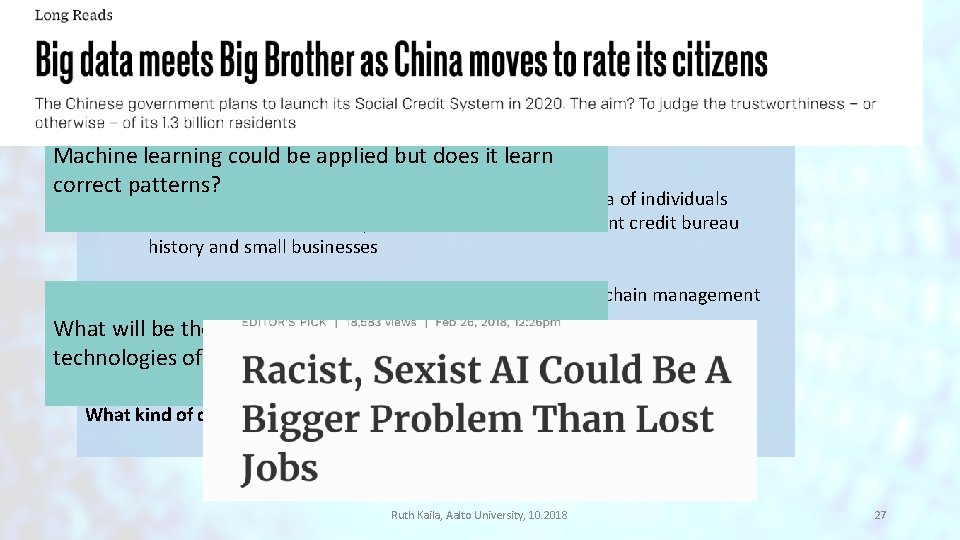
3. Large tech-companies Machine learning could be applied but does it learn correct patterns? • data for risk assessment exist already; social and mobile data of individuals • This data is valuable mainly for individuals with insufficient credit bureau history and small businesses • capture customers in moments of need; f. ex. , during supply chain management What will be the attitude of the regulator towards new • Collaboration with banks and Fintech‐startups technologies of collecting data and new data sources? • More data ‐> better tailored services What kind of data will be the most valuable in assessing customer risk? Ruth Kaila, Aalto University, 10. 2018 27
Crowdfunding Ruth Kaila, Aalto University, 10. 2018 28
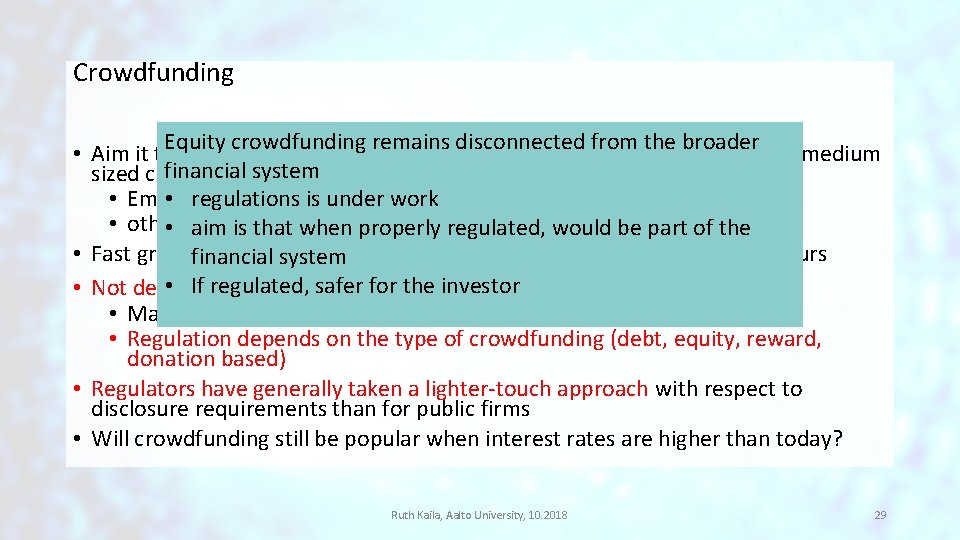
Crowdfunding Equity crowdfunding remains disconnected from the broader • Aim it to facilitate the market-based financing of startups and small and medium financial system sized companies • Emphasis on debt based and equity based financing • regulations is under work • others: reward based and donation based crowdfunding • aim is that when properly regulated, would be part of the • Fast growing sector, strong demand from both investors and entrepreneurs financial system • If regulated, safer for the investor • Not defined in legal terms • Many different practices • Regulation depends on the type of crowdfunding (debt, equity, reward, donation based) • Regulators have generally taken a lighter‐touch approach with respect to disclosure requirements than for public firms • Will crowdfunding still be popular when interest rates are higher than today? Ruth Kaila, Aalto University, 10. 2018 29
Insurances Ruth Kaila, Aalto University, 10. 2018 30
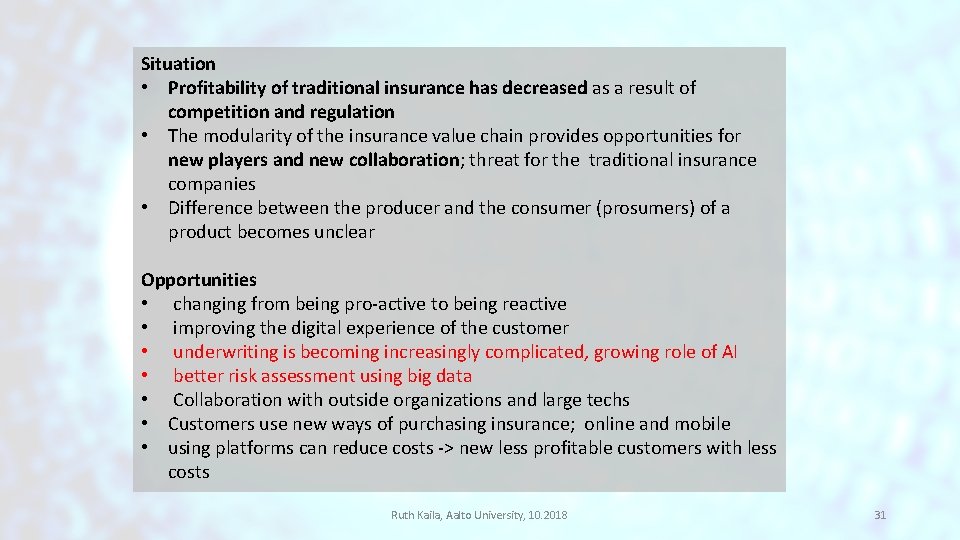
Situation • Profitability of traditional insurance has decreased as a result of competition and regulation • The modularity of the insurance value chain provides opportunities for new players and new collaboration; threat for the traditional insurance companies • Difference between the producer and the consumer (prosumers) of a product becomes unclear Opportunities • changing from being pro‐active to being reactive • improving the digital experience of the customer • underwriting is becoming increasingly complicated, growing role of AI • better risk assessment using big data • Collaboration with outside organizations and large techs • Customers use new ways of purchasing insurance; online and mobile • using platforms can reduce costs ‐> new less profitable customers with less costs Ruth Kaila, Aalto University, 10. 2018 31
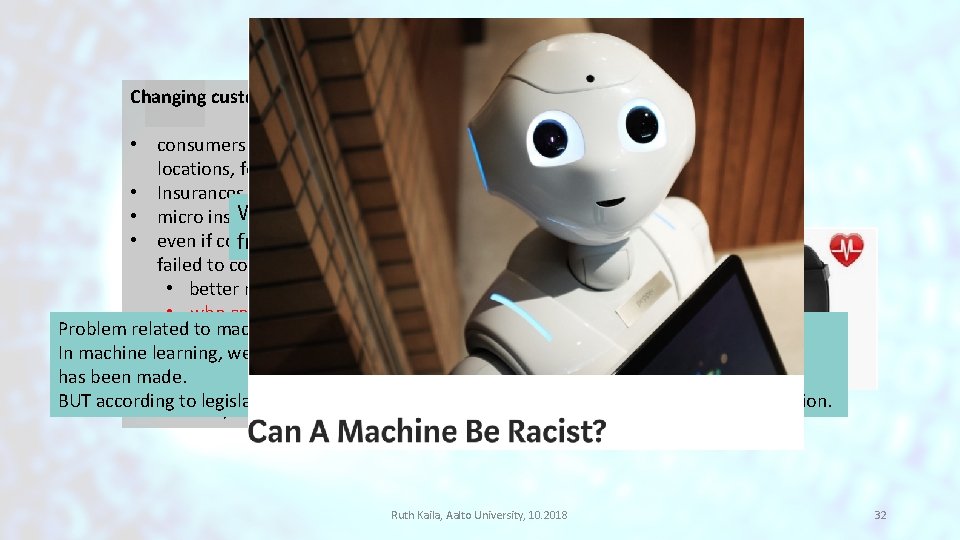
Changing customer lifestyles, new types of insurances • consumers are demanding modularity: insurances fitted in different locations, for different use cases and for different usage patterns • Insurances for new types of risks; cyber, AI, self‐driving cars Who owns / controls the data obtained • micro insurance products, insurance directly tied to a product • even if connected devices are increasing rapidly in number, insurers have from connected devices? failed to convince customers on connected insurance • better risk assessment, but • who controls data obtained from the devices? Problem related to machin learning: • questions related to cyber security In machine learning, we don’t know the exact algorithm according to which the desicion • new types of life‐insurance, fitting the changing lifestyles and demography has been made. • For example, focus away from retirement, to short‐term insurances, BUT according to legislation, customer has the right to know the reasoning behind the decision. for young customers in emerging countries Ruth Kaila, Aalto University, 10. 2018 32
Reg. Tech Ruth Kaila, Aalto University, 10. 2018 33
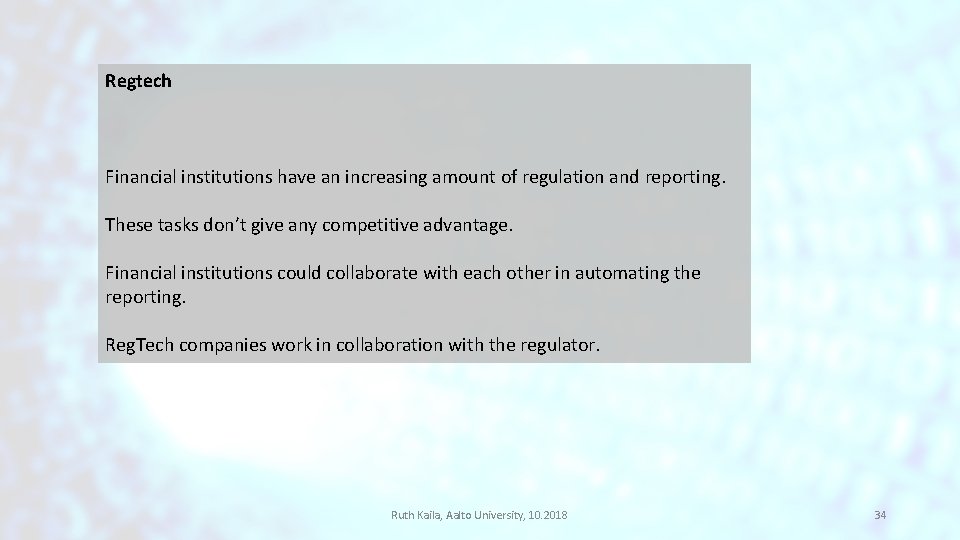
Regtech Financial institutions have an increasing amount of regulation and reporting. These tasks don’t give any competitive advantage. Financial institutions could collaborate with each other in automating the reporting. Reg. Tech companies work in collaboration with the regulator. Ruth Kaila, Aalto University, 10. 2018 34
Blockchain, smart contracts, cryptoassets and ICO’s Ruth Kaila, Aalto University, 10. 2018 35
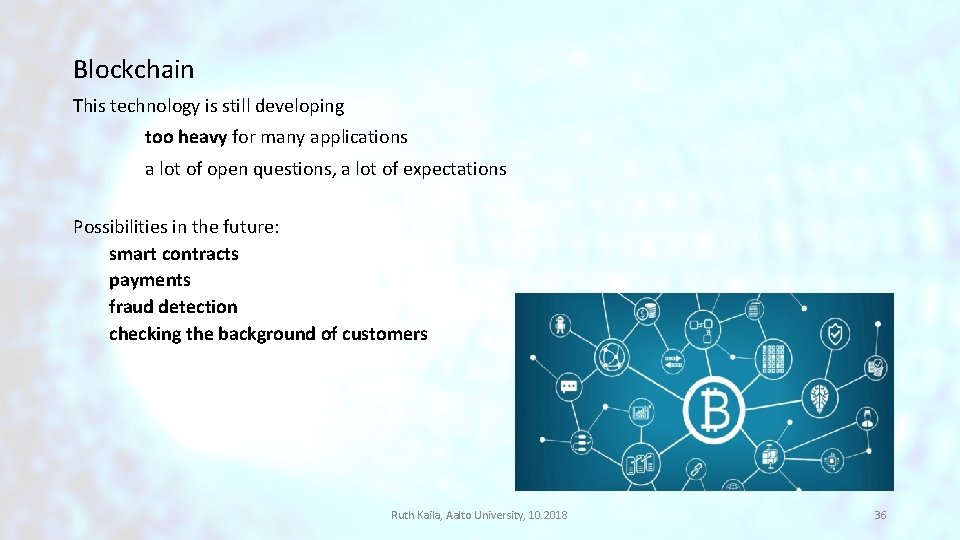
Blockchain This technology is still developing too heavy for many applications a lot of open questions, a lot of expectations Possibilities in the future: smart contracts payments fraud detection checking the background of customers Ruth Kaila, Aalto University, 10. 2018 36
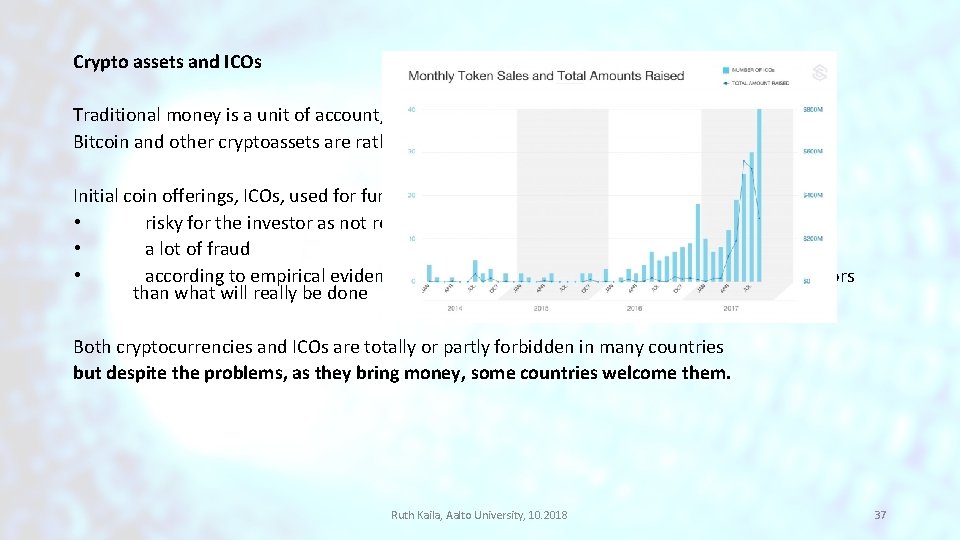
Crypto assets and ICOs Traditional money is a unit of account, medium of exchange, and store of value. Bitcoin and other cryptoassets are rather very high risk investments. Initial coin offerings, ICOs, used for fund rising have become more and more popular • risky for the investor as not regulated • a lot of fraud • according to empirical evidencemarketing tends to be more important for the investors than what will really be done Both cryptocurrencies and ICOs are totally or partly forbidden in many countries but despite the problems, as they bring money, some countries welcome them. Ruth Kaila, Aalto University, 10. 2018 37
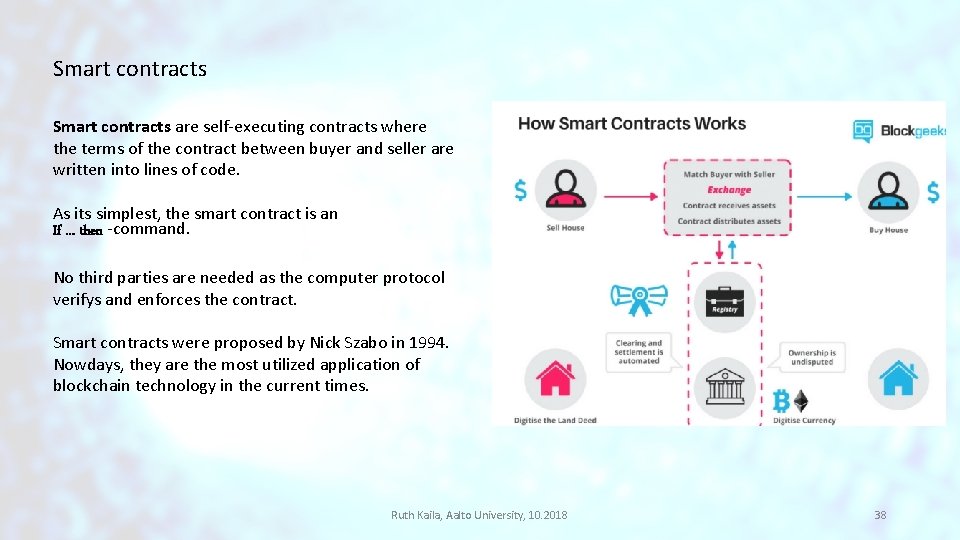
Smart contracts are self‐executing contracts where the terms of the contract between buyer and seller are written into lines of code. As its simplest, the smart contract is an If … then ‐command. No third parties are needed as the computer protocol verifys and enforces the contract. Smart contracts were proposed by Nick Szabo in 1994. Nowdays, they are the most utilized application of blockchain technology in the current times. Ruth Kaila, Aalto University, 10. 2018 38
What are the key success factors? Customer experience Security Ruth Kaila, Aalto University, 10. 2018 Collaboration 39
Kiitos! Ruth Kaila ruth. kaila@aalto. fi Ruth. JKaila Ruth Kaila, Aalto University, 10. 2018 40