How many seconds in 11 years How many











- Slides: 126
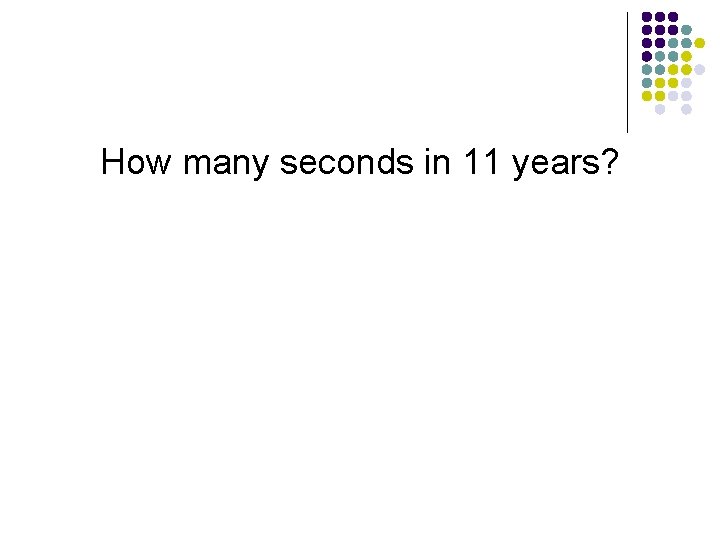
How many seconds in 11 years?
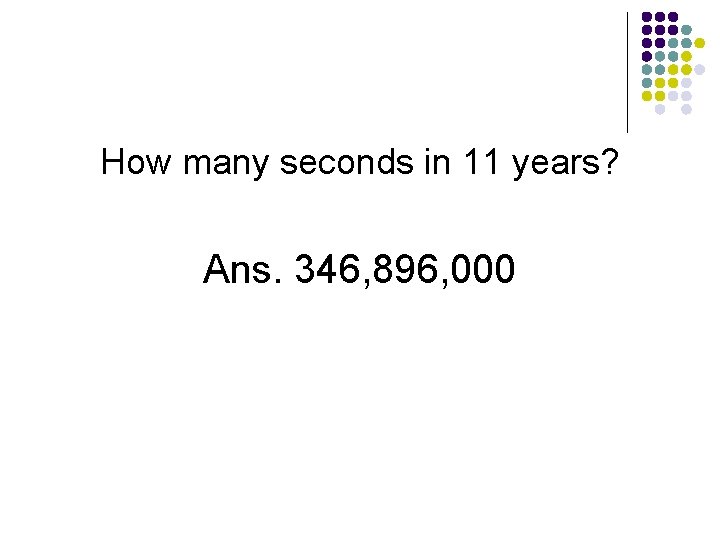
How many seconds in 11 years? Ans. 346, 896, 000
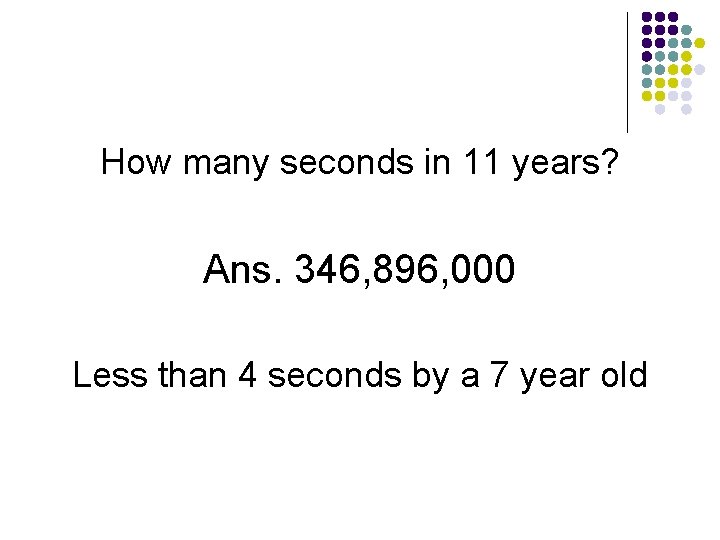
How many seconds in 11 years? Ans. 346, 896, 000 Less than 4 seconds by a 7 year old
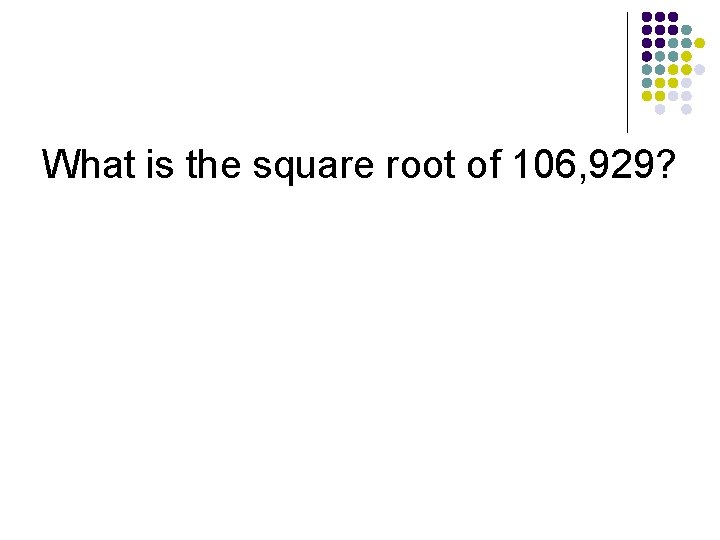
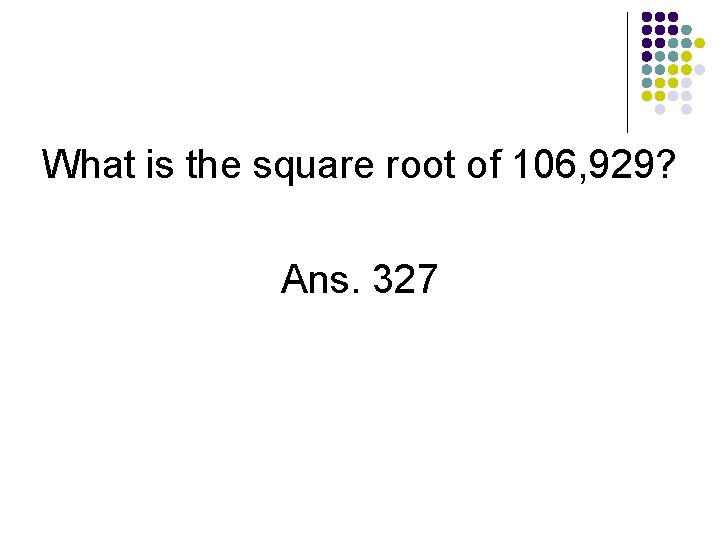
What is the square root of 106, 929?
What is the square root of 106, 929? Ans. 327
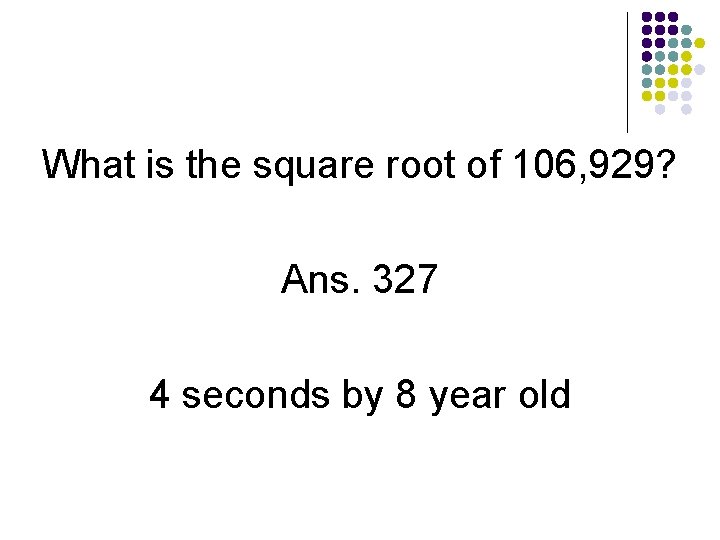
What is the square root of 106, 929? Ans. 327 4 seconds by 8 year old
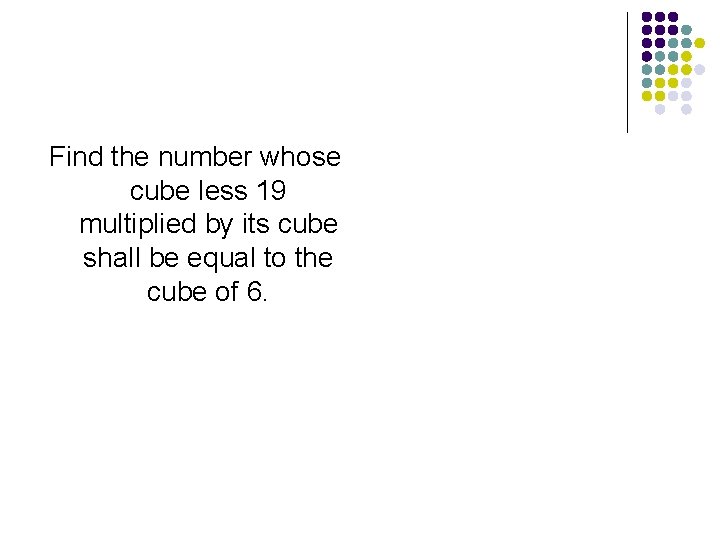
Find the number whose cube less 19 multiplied by its cube shall be equal to the cube of 6.
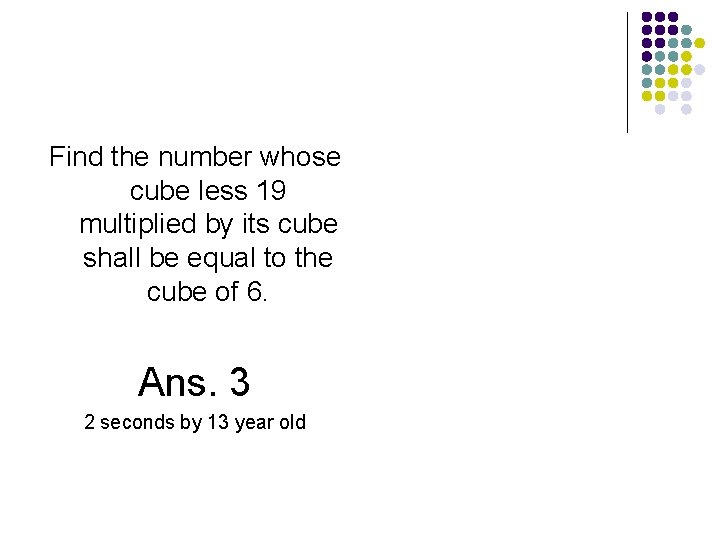
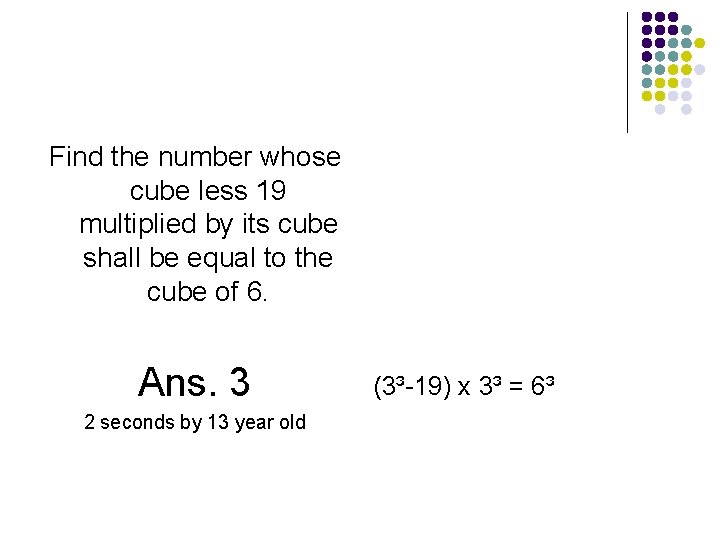
Find the number whose cube less 19 multiplied by its cube shall be equal to the cube of 6. Ans. 3 2 seconds by 13 year old
Find the number whose cube less 19 multiplied by its cube shall be equal to the cube of 6. Ans. 3 2 seconds by 13 year old (3³-19) x 3³ = 6³
Child Prodigy
Child Prodigy l is someone who is a master of one or more skills or arts at an early age.
Child Prodigy l l is someone who is a master of one or more skills or arts at an early age. someone who by the age 11 displays expert proficiency or a profound grasp of the fundamentals in a field usually only undertaken by adults.
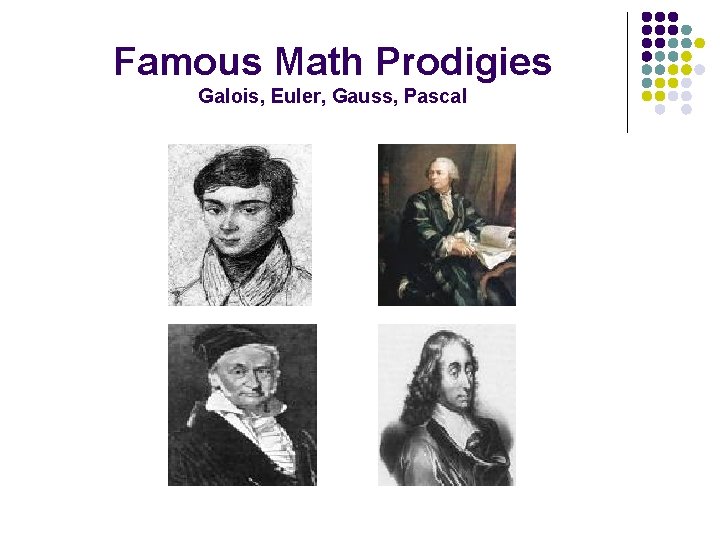
Famous Math Prodigies Galois, Euler, Gauss, Pascal
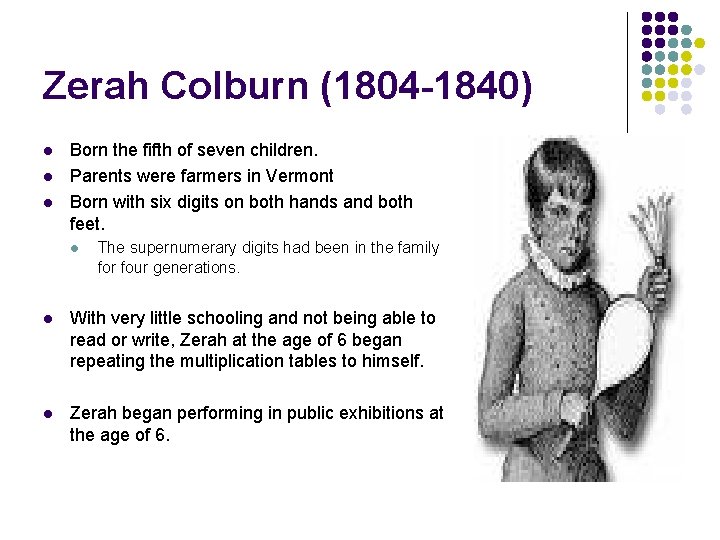
Zerah Colburn (1804 -1840) l l l Born the fifth of seven children. Parents were farmers in Vermont Born with six digits on both hands and both feet. l The supernumerary digits had been in the family for four generations. l With very little schooling and not being able to read or write, Zerah at the age of 6 began repeating the multiplication tables to himself. l Zerah began performing in public exhibitions at the age of 6.
Zerah Colburn (1804 -1840) Questions performed: Admitting the distance between Concord and Boston to be 65 miles, how many steps must I take in going this distance, allowing that I go three feet at a step?
Zerah Colburn (1804 -1840) Questions performed: Admitting the distance between Concord and Boston to be 65 miles, how many steps must I take in going this distance, allowing that I go three feet at a step? The answer of 114, 400 was given in 10 seconds.
Zerah Colburn (1804 -1840) How many days and hours since the Christian era commenced, 1811 years (Zerah usually assumed a 365 -day year and a 30 -day month)?
Zerah Colburn (1804 -1840) How many days and hours since the Christian era commenced, 1811 years (Zerah usually assumed a 365 -day year and a 30 -day month)? Answered in 20 seconds 661, 015 days and 15, 864, 360 hours.
Zerah Colburn (1804 -1840) When asked which two numbers multiplied together produce 1242, Zerah gave answers as fast as he could say them:
Zerah Colburn (1804 -1840) When asked which two numbers multiplied together produce 1242, Zerah gave answers as fast as he could say them: 54 and 23, 9 and 138, 3 and 414, 6 and 207, 27 and 46, 2 and 621.
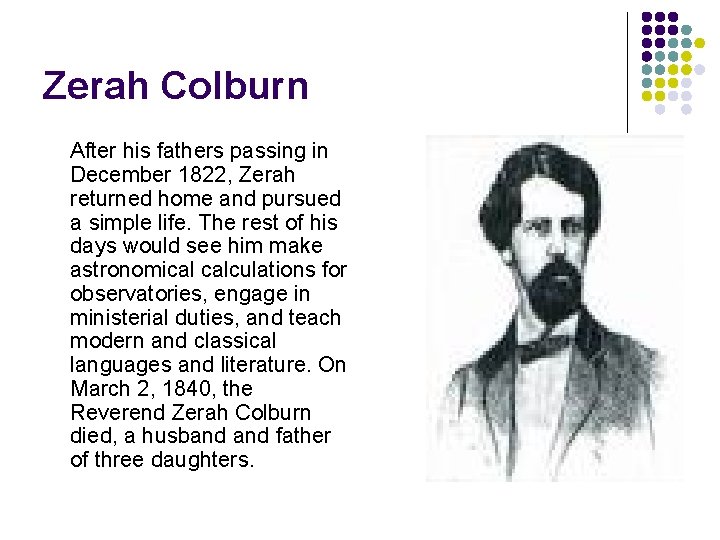
Zerah Colburn After his fathers passing in December 1822, Zerah returned home and pursued a simple life. The rest of his days would see him make astronomical calculations for observatories, engage in ministerial duties, and teach modern and classical languages and literature. On March 2, 1840, the Reverend Zerah Colburn died, a husband father of three daughters.
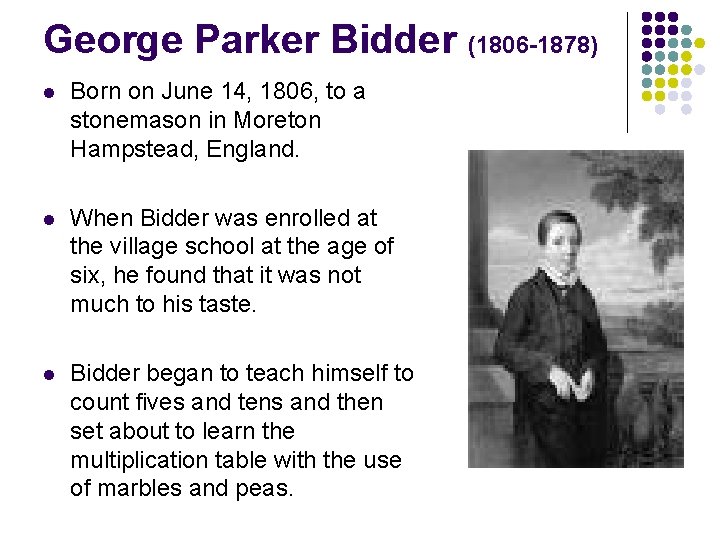
George Parker Bidder (1806 -1878) l Born on June 14, 1806, to a stonemason in Moreton Hampstead, England. l When Bidder was enrolled at the village school at the age of six, he found that it was not much to his taste. l Bidder began to teach himself to count fives and tens and then set about to learn the multiplication table with the use of marbles and peas.
George Parker Bidder l His early days saw Bidder spend many hours with a local blacksmith. l As the months passed, Bidder still had not received any formal instruction. While working with the blacksmith, Bidder would be given new ideas from people who would come to test his powers. People would continually encourage Bidder to improve and master his peculiar faculty until the time when his talent was almost incredible. l At the age of 10, Bidder reached a point where he could multiply 12 places of figures with 12 figures. l Bidder’s father soon saw the financial promise that his son’s talent could generate. Withdrawing him from school, Bidder’s father took his son about the country for the purpose of exhibition.
George Parker Bidder Here are some typical questions put to and answered by Bidder in his exhibitions during the years 1815 -1819. If the moon be distant from the Earth 123, 256 miles and sound travels at a rate of 4 miles per minute, how long would it be before the inhabitants of the moon could hear of the battle of Waterloo?
George Parker Bidder Here are some typical questions put to and answered by Bidder in his exhibitions during the years 1815 -1819. If the moon be distant from the Earth 123, 256 miles and sound travels at a rate of 4 miles per minute, how long would it be before the inhabitants of the moon could hear of the battle of Waterloo? Ans. 2 days, 9 hrs and 34 min in less than a minute.
George Parker Bidder If the pendulum of a clock vibrates the distance of 9¾ inches in a second of time, how many inches will it vibrate in 7 years, 14 days, 2 hours, 1 minute and 56 seconds?
George Parker Bidder If the pendulum of a clock vibrates the distance of 9¾ inches in a second of time, how many inches will it vibrate in 7 years, 14 days, 2 hours, 1 minute and 56 seconds? With each year being 365 days, 5 hours, 48 minutes and 55 seconds, the answer, in less than a minute, was 2, 165, 625, 744 ¾ inches.
George Parker Bidder If the globe is 24, 912 miles in circumference, and a balloon travels 3, 878 feet in a minute, how long would it be in travelling round the world?
George Parker Bidder If the globe is 24, 912 miles in circumference, and a balloon travels 3, 878 feet in a minute, how long would it be in travelling round the world? Ans. in 2 minutes – 23 days, 13 hours, 18 min
George Parker Bidder Accomplishments: l l Played a significant role in the construction of Norway’s first railway. Served as engineer-in-chief of the Royal Danish railway. Advisor for the Metropolitan Board of London regarding draining and purification of the river Thames. Of all his accomplishments and endeavours, Bidder is most known for his construction and development of the Victoria Docks. When one thinks of the early nineteenth century, during the time of great engineering accomplishments, one must not overlook one of the foremost engineers of the time, George Parker Bidder.
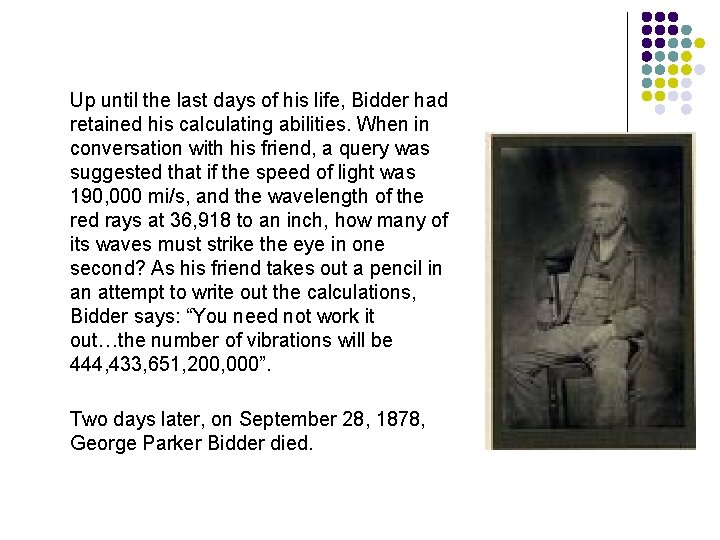
Up until the last days of his life, Bidder had retained his calculating abilities. When in conversation with his friend, a query was suggested that if the speed of light was 190, 000 mi/s, and the wavelength of the red rays at 36, 918 to an inch, how many of its waves must strike the eye in one second? As his friend takes out a pencil in an attempt to write out the calculations, Bidder says: “You need not work it out…the number of vibrations will be 444, 433, 651, 200, 000”. Two days later, on September 28, 1878, George Parker Bidder died.
“He is probably the most outstanding mental calculator of all peoples and all time”.
“He is probably the most outstanding mental calculator of all peoples and all time”. Johann Dase was the one who uttered these words, and of the person he was referring to…
Johann Dase (1824 -1861) “He is probably the most outstanding mental calculator of all peoples and all time”. Johann Dase was the one who uttered these words, and of the person he was referring to… he was referring to himself.
Johann Dase (1824 -1861) l l l Born in Hamburg, Germany on June 23, 1824, the son of a distiller. Very little is known of Dase’s ancestry. As for Dase himself, he began schooling at the age of two and a half years. Although he began at an early age, Dase attributes his ability to later practice and not his early instruction.
Johann Dase (1824 -1861) At the age of 15, Dase began travelling through Germany, Denmark and England performing in public exhibitions. In 1840, while in Vienna, Dase was introduced to scientific work. Under the guidance of a mathematics professor, Dase was shown how to compute π. Having worked on this problem for nearly two months, Dase had successfully computed π to 205 places.
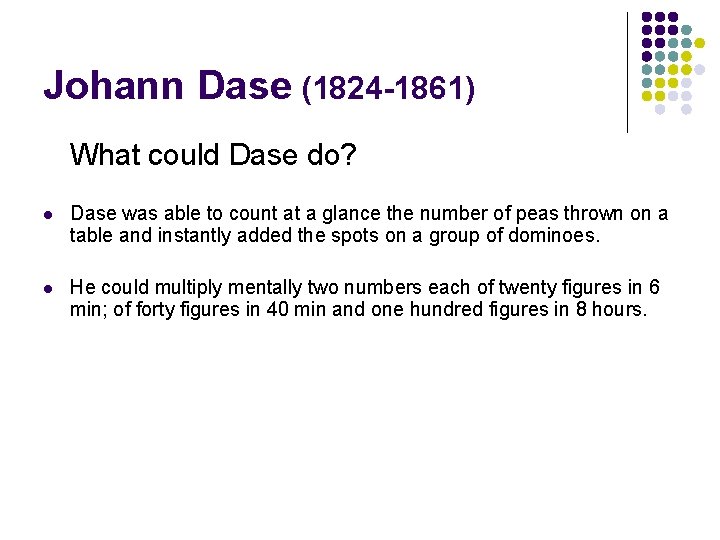
Johann Dase (1824 -1861) What could Dase do?
Johann Dase (1824 -1861) What could Dase do? l Dase was able to count at a glance the number of peas thrown on a table and instantly added the spots on a group of dominoes.
Johann Dase (1824 -1861) What could Dase do? l Dase was able to count at a glance the number of peas thrown on a table and instantly added the spots on a group of dominoes. l He could multiply mentally two numbers each of twenty figures in 6 min; of forty figures in 40 min and one hundred figures in 8 hours.
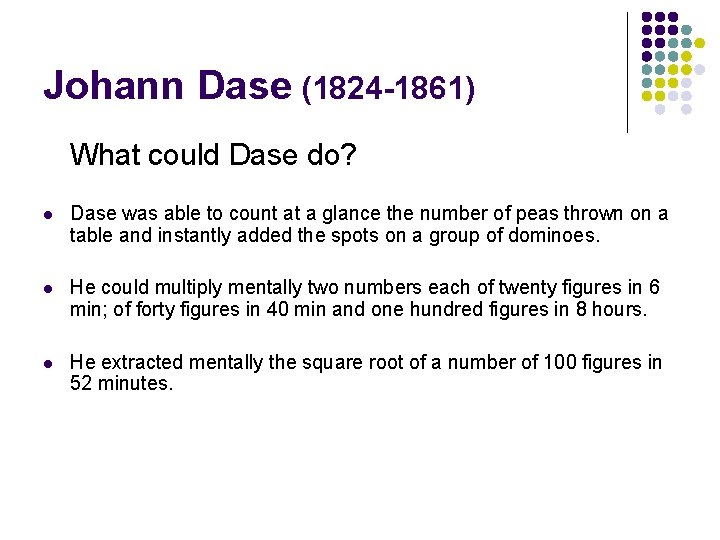
Johann Dase (1824 -1861) What could Dase do? l Dase was able to count at a glance the number of peas thrown on a table and instantly added the spots on a group of dominoes. l He could multiply mentally two numbers each of twenty figures in 6 min; of forty figures in 40 min and one hundred figures in 8 hours. l He extracted mentally the square root of a number of 100 figures in 52 minutes.
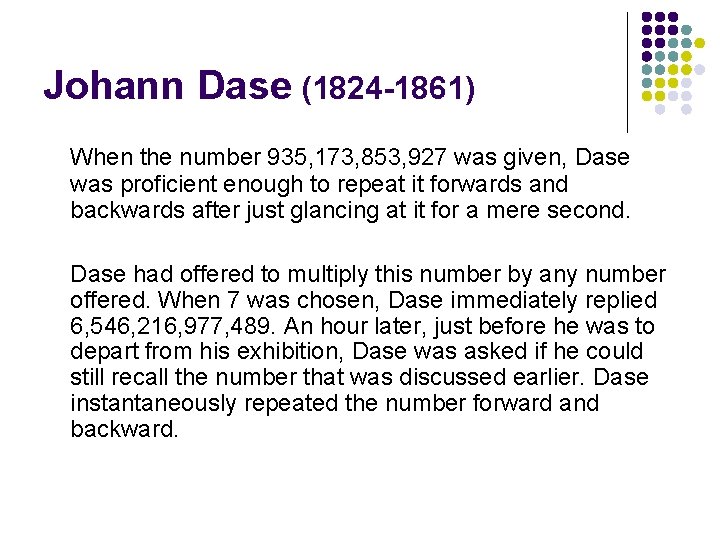
Johann Dase (1824 -1861) When the number 935, 173, 853, 927 was given, Dase was proficient enough to repeat it forwards and backwards after just glancing at it for a mere second. Dase had offered to multiply this number by any number offered. When 7 was chosen, Dase immediately replied 6, 546, 216, 977, 489. An hour later, just before he was to depart from his exhibition, Dase was asked if he could still recall the number that was discussed earlier. Dase instantaneously repeated the number forward and backward.
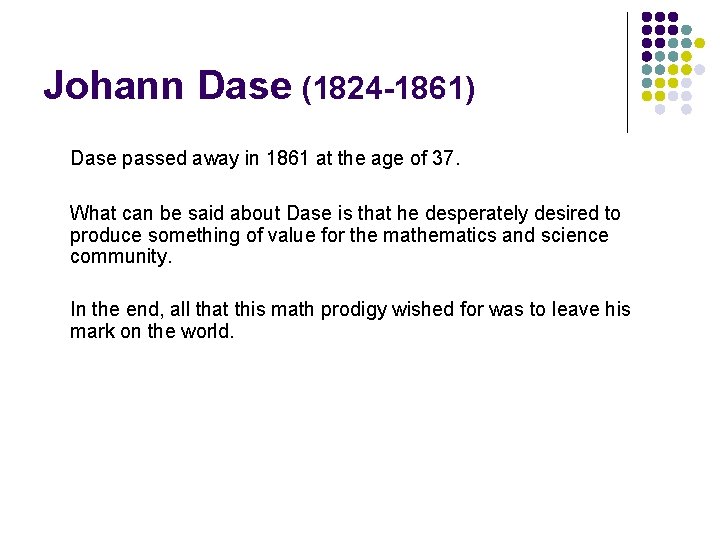
Johann Dase (1824 -1861) Dase passed away in 1861 at the age of 37. What can be said about Dase is that he desperately desired to produce something of value for the mathematics and science community. In the end, all that this math prodigy wished for was to leave his mark on the world.
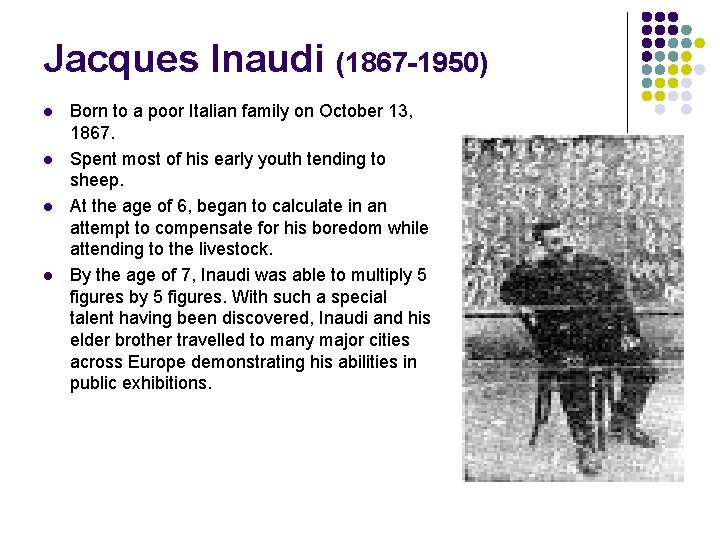
Jacques Inaudi (1867 -1950) l l Born to a poor Italian family on October 13, 1867. Spent most of his early youth tending to sheep. At the age of 6, began to calculate in an attempt to compensate for his boredom while attending to the livestock. By the age of 7, Inaudi was able to multiply 5 figures by 5 figures. With such a special talent having been discovered, Inaudi and his elder brother travelled to many major cities across Europe demonstrating his abilities in public exhibitions.
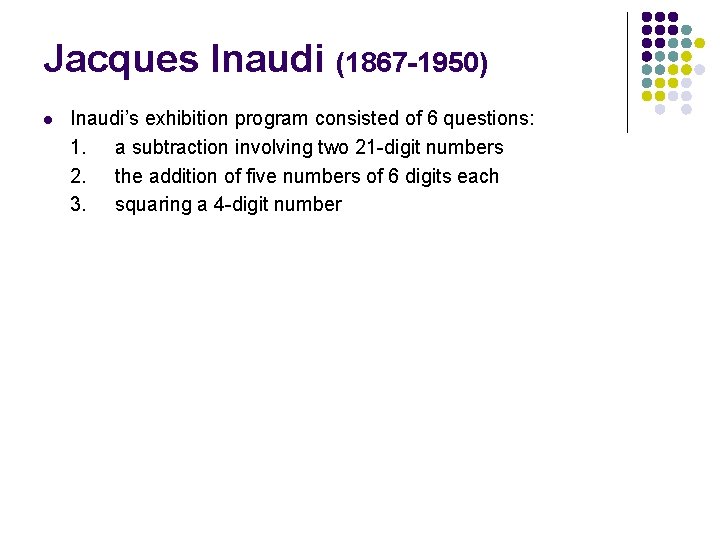
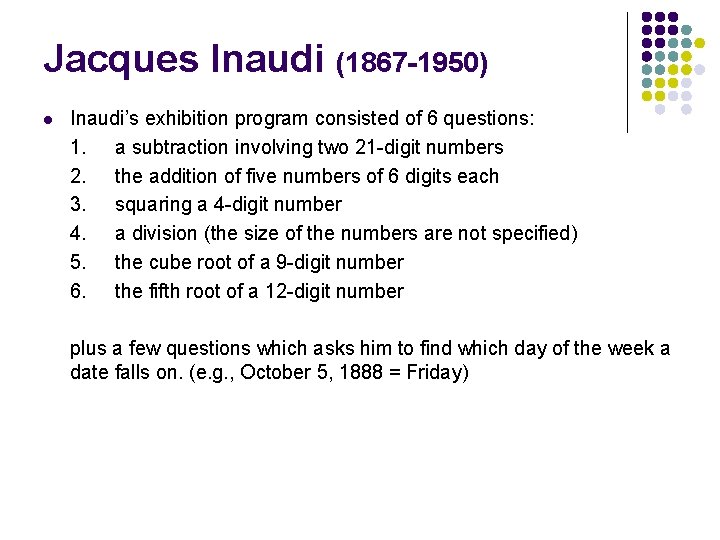
Jacques Inaudi (1867 -1950) l Inaudi’s exhibition program consisted of 6 questions:
Jacques Inaudi (1867 -1950) l Inaudi’s exhibition program consisted of 6 questions: 1. a subtraction involving two 21 -digit numbers
Jacques Inaudi (1867 -1950) l Inaudi’s exhibition program consisted of 6 questions: 1. a subtraction involving two 21 -digit numbers 2. the addition of five numbers of 6 digits each
Jacques Inaudi (1867 -1950) l Inaudi’s exhibition program consisted of 6 questions: 1. a subtraction involving two 21 -digit numbers 2. the addition of five numbers of 6 digits each 3. squaring a 4 -digit number
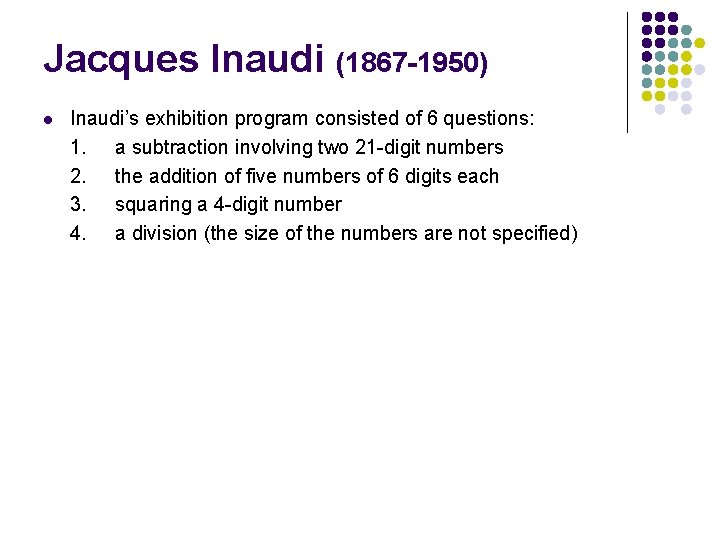
Jacques Inaudi (1867 -1950) l Inaudi’s exhibition program consisted of 6 questions: 1. a subtraction involving two 21 -digit numbers 2. the addition of five numbers of 6 digits each 3. squaring a 4 -digit number 4. a division (the size of the numbers are not specified)
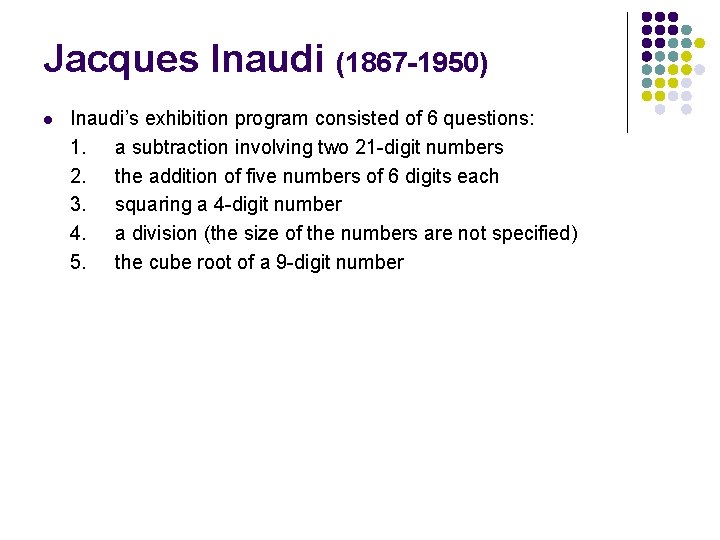
Jacques Inaudi (1867 -1950) l Inaudi’s exhibition program consisted of 6 questions: 1. a subtraction involving two 21 -digit numbers 2. the addition of five numbers of 6 digits each 3. squaring a 4 -digit number 4. a division (the size of the numbers are not specified) 5. the cube root of a 9 -digit number
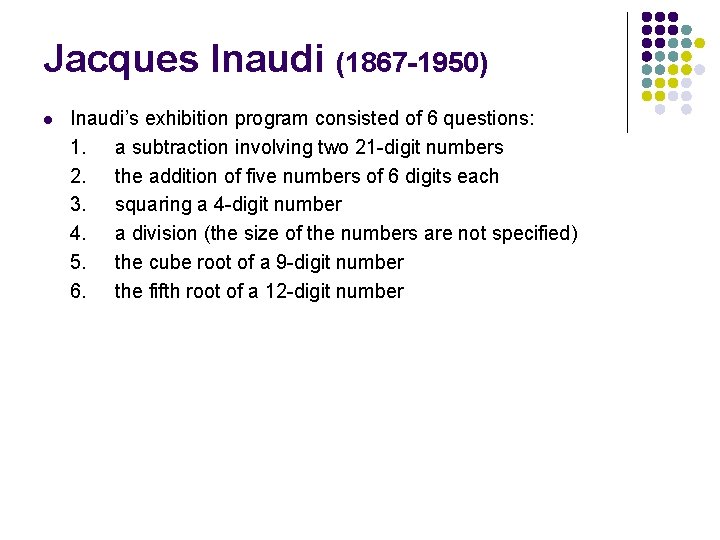
Jacques Inaudi (1867 -1950) l Inaudi’s exhibition program consisted of 6 questions: 1. a subtraction involving two 21 -digit numbers 2. the addition of five numbers of 6 digits each 3. squaring a 4 -digit number 4. a division (the size of the numbers are not specified) 5. the cube root of a 9 -digit number 6. the fifth root of a 12 -digit number
Jacques Inaudi (1867 -1950) l Inaudi’s exhibition program consisted of 6 questions: 1. a subtraction involving two 21 -digit numbers 2. the addition of five numbers of 6 digits each 3. squaring a 4 -digit number 4. a division (the size of the numbers are not specified) 5. the cube root of a 9 -digit number 6. the fifth root of a 12 -digit number plus a few questions which asks him to find which day of the week a date falls on. (e. g. , October 5, 1888 = Friday)
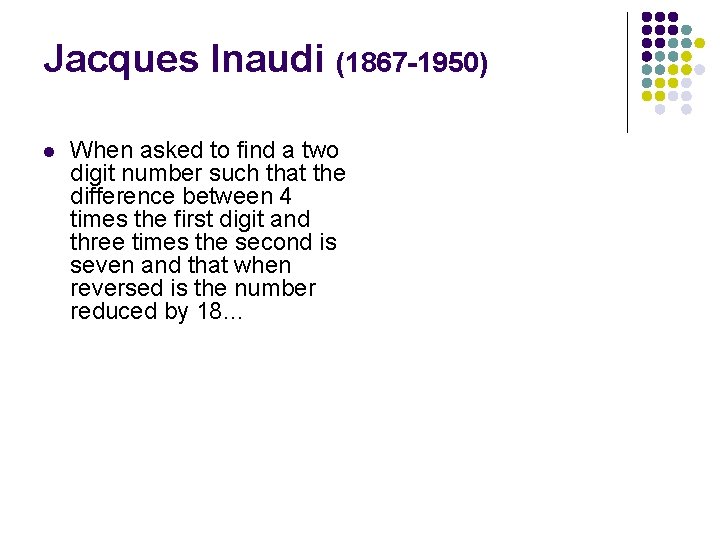
Jacques Inaudi (1867 -1950) l When asked to find a two digit number such that the difference between 4 times the first digit and three times the second is seven and that when reversed is the number reduced by 18…
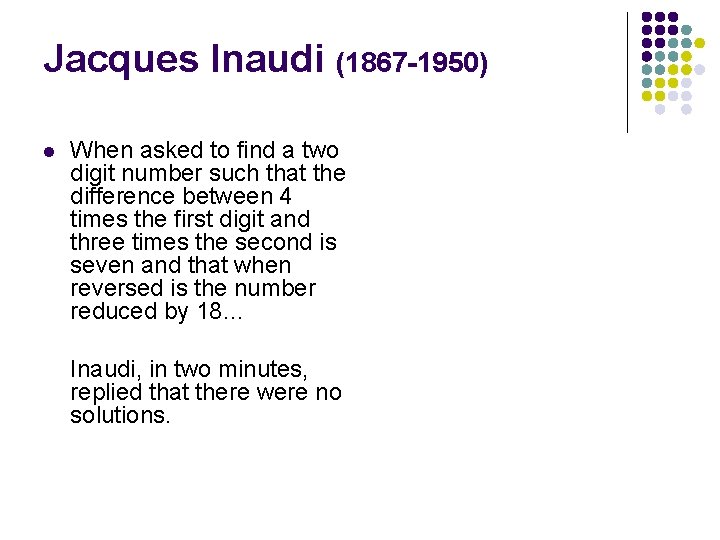
Jacques Inaudi (1867 -1950) l When asked to find a two digit number such that the difference between 4 times the first digit and three times the second is seven and that when reversed is the number reduced by 18… Inaudi, in two minutes, replied that there were no solutions.
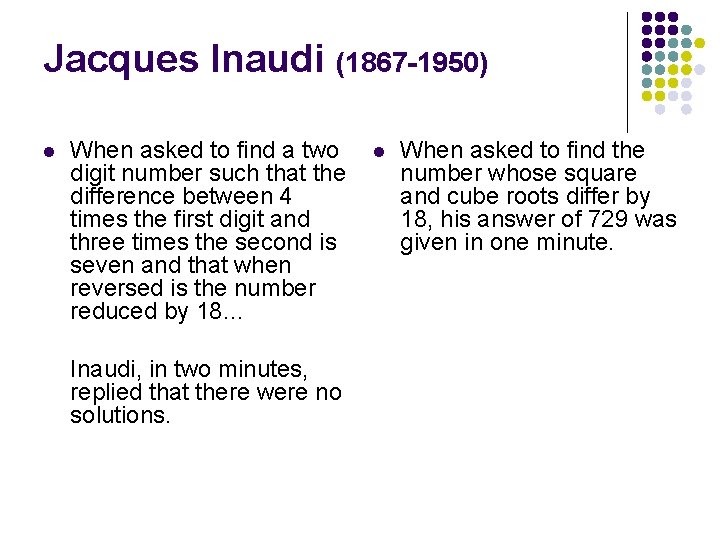
Jacques Inaudi (1867 -1950) l When asked to find a two digit number such that the difference between 4 times the first digit and three times the second is seven and that when reversed is the number reduced by 18… Inaudi, in two minutes, replied that there were no solutions. l When asked to find the number whose square and cube roots differ by 18, his answer of 729 was given in one minute.
Jacques Inaudi (1867 -1950) One of Inaudi’s remarkable traits was his tremendous memory for figures. In a venture to try and memorize a 100 -figure number, Inaudi learned the first 36 numbers in 90 seconds, the first 57 numbers in 4 minutes, 75 figures in 6 minutes and the whole number in 12 minutes. Within a day or two after the venture, he was able recall the number in its entirety.
Jacques Inaudi (1867 -1950) Although Inaudi did not attend any educational institutions nor did he reach great heights like George Parker Bidder, Jacques Inaudi did have a long and successful career as a performer appearing in the United States and all over Europe. In 1950, while in relative poverty, Inaudi died at the age of 83. Inaudi will always be remembered as the mild, modest, calm and very reserved man who, until the final days of his life, continued to amuse his neighbours with his powers.
How long do these powers last? Do they stay with the individual until their dying day or do they merely fade as the years pass?
How long do these powers last? Do they stay with the individual until their dying day or do they merely fade as the years pass? l Like for any language, when one fails to speak it, the ability to recall the language may be that much more difficult.
How long do these powers last? Do they stay with the individual until their dying day or do they merely fade as the years pass? l Like for any language, when one fails to speak it, the ability to recall the language may be that much more difficult. l For those prodigies who excelled later in life, much can be said about their ability to prevent any intrusion of other interests interfere with their everyday lives.
How long do these powers last? Do they stay with the individual until their dying day or do they merely fade as the years pass? l Like for any language, when one fails to speak it, the ability to recall the language may be that much more difficult. l For those prodigies who excelled later in life, much can be said about their ability to prevent any intrusion of other interests interfere with their everyday lives. l This focus allows the individual to develop their gift.
How long do these powers last? Do they stay with the individual until their dying day or do they merely fade as the years pass? l Like for any language, when one fails to speak it, the ability to recall the language may be that much more difficult. l For those prodigies who excelled later in life, much can be said about their ability to prevent any intrusion of other interests interfere with their everyday lives. l l This focus allows the individual to develop their gift. If the prodigy wishes to, the unlimited amount of time available can really allow the prodigy to hone in on their abilities.
How long do these powers last? Do they stay with the individual until their dying day or do they merely fade as the years pass? l Like for any language, when one fails to speak it, the ability to recall the language may be that much more difficult. l For those prodigies who excelled later in life, much can be said about their ability to prevent any intrusion of other interests interfere with their everyday lives. l l This focus allows the individual to develop their gift. If the prodigy wishes to, the unlimited amount of time available can really allow the prodigy to hone in on their abilities. Mental arithmetic requires: - no instruments, or apparatus - no audible practice that might disturb members of the family - no information, much can be found by asking or absorbing The young individual may, at any time of the day, carry on with their practice and research.
How long do these powers last? Do they stay with the individual until their dying day or do they merely fade as the years pass? l When calculating ability falls off, it may well be due to loss of motivation and hence failure to keep in practice.
How long do these powers last? Do they stay with the individual until their dying day or do they merely fade as the years pass? l When calculating ability falls off, it may well be due to loss of motivation and hence failure to keep in practice. l For those whose gift disappeared later in life, they had no recollection of the methods used in childhood to obtain the once easy solutions to the once trivial questions.
How do you account for lightning quick calculation?
How do you account for lightning quick calculation? l Gauss states that in order to make lightning quick calculations, you will need:
How do you account for lightning quick calculation? l Gauss states that in order to make lightning quick calculations, you will need: 1. a powerful memory
How do you account for lightning quick calculation? l Gauss states that in order to make lightning quick calculations, you will need: 1. a powerful memory
How do you account for lightning quick calculation? l Gauss states that in order to make lightning quick calculations, you will need: 1. a powerful memory 2. a real ability for calculation
How do you account for lightning quick calculation? l Gauss states that in order to make lightning quick calculations, you will need: 1. a powerful memory 2. a real ability for calculation
How do you account for lightning quick calculation? l Gauss states that in order to make lightning quick calculations, you will need: 1. a powerful memory 2. a real ability for calculation If, for any reason, the arithmetical prodigy loses interest in calculation, or the opportunity to practice it, his power is likely to diminish or disappear entirely. In this respect, mental calculation is like piano-playing, or any other highly specialized activity dependent on long practice.
How do you account for lightning quick calculation? The more shortcuts…the better.
How do you account for lightning quick calculation? The more shortcuts…the better. Types of shortcuts 1. Arithmetical
How do you account for lightning quick calculation? The more shortcuts…the better. Types of shortcuts 1. Arithmetical 2. Psychological
Why are there far fewer recorded cases of female prodigies?
Why are there far fewer recorded cases of female prodigies? l Apparent reasons for this discrepancy can be attributed to underreporting, lack of opportunity to develop the talent, and lack of encouragement for continued advancement.
Why are there far fewer recorded cases of female prodigies? l Apparent reasons for this discrepancy can be attributed to underreporting, lack of opportunity to develop the talent, and lack encouragement for continued advancement. l For many parents, the thought of taking their daughters across the country to make professional appearances was somewhat unattractive. This can be attributed to the fact that very few women gained distinction, particularly in fields associated with mathematics and calculation. l most females having such talents would most likely have been ignored or more importantly been discouraged from displaying it.
Why are there far fewer recorded cases of female prodigies? l Unlike the young men who would spend their young days with blacksmiths or tending to the family flock, very few girls had the opportunity to isolate themselves where they could then develop any calculating ability. l They were not sent out on lonely vigils with sheep; their chores were apt to be carried out in the presence of others. l Too much human interaction is detrimental to the development of mental calculation.
Top Five Women Prodigies/ Mathematicians in History
Top Five Women Prodigies/ Mathematicians in History 5. Mary Fairfax Somerville (1780 -1872) - Scottish and British - Mathematician - known as the "Queen of Nineteenth Century Science, " she fought family opposition to her study of math, and not only produced her own writings on theoretical and mathematical science, she produced the first geography text in England.
Top Five Women Prodigies/ Mathematicians in History 4. Sophie Germain (1776 -1830) - French - mathematician - She studied geometry to escape boredom during the French Revolution when she was confined to her family's home, and went on to do important work in mathematics, especially her work on Fermat's Last Theorem.
Top Five Women Prodigies/ Mathematicians in History 3. Maria Gaetana Agnesi (1718 -1799) - Italian (Milan) - mathematician - Oldest of 21 children and a child prodigy who studied languages and math, she wrote a textbook to explain math to her brothers which became a noted textbook on mathematics. She was the first woman appointed a university professor of mathematics.
Top Five Women Prodigies/ Mathematicians in History 2. Elena Cornaro Piscopia (1646 -1684) - Italian (Venice) - mathematician, theologian - She was a child prodigy who studied many languages, composed music, sang and played many instruments, and learned philosophy, mathematics and theology. Her doctorate, a first, was from the University of Padua, where she studied theology. She became a lecturer there in mathematics.
Top Five Women Prodigies/ Mathematicians in History 1. Hypatia of Alexandria (355 or 370– 415) - Greek - philosopher, astronomer, mathematician She was the salaried head of the Neoplatonic School in Alexandria, Egypt, from the year 400. Her students were pagan and Christian young men from around the empire.
How do they do that?
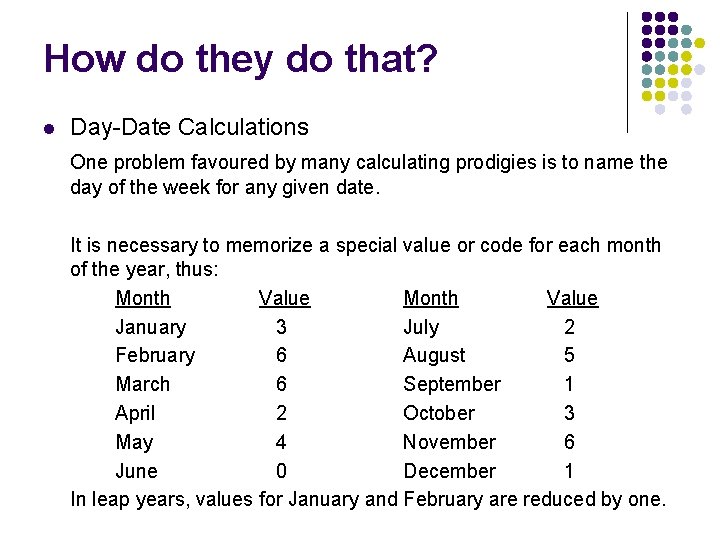
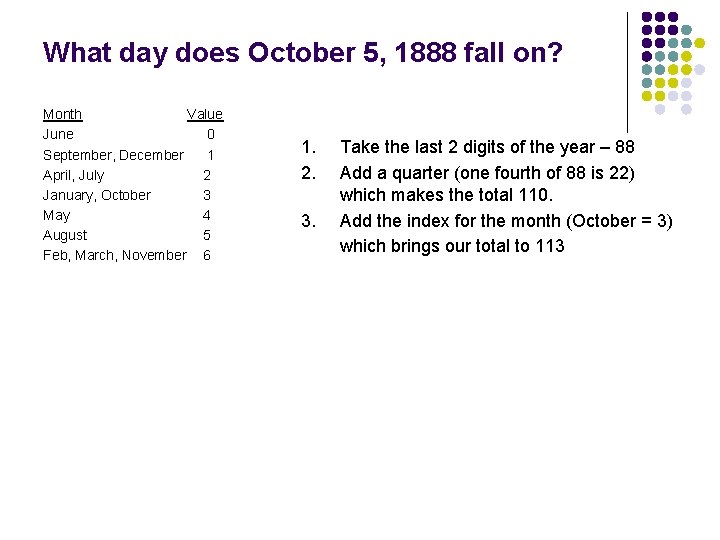
How do they do that? l Day-Date Calculations One problem favoured by many calculating prodigies is to name the day of the week for any given date. It is necessary to memorize a special value or code for each month of the year, thus:
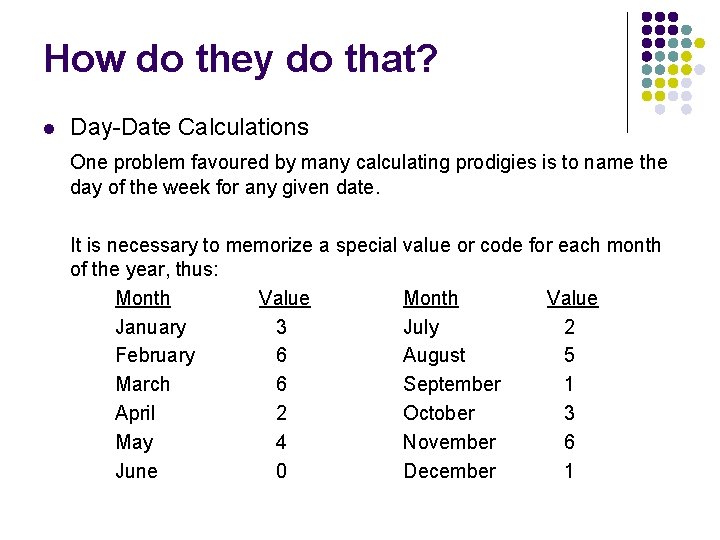
How do they do that? l Day-Date Calculations One problem favoured by many calculating prodigies is to name the day of the week for any given date. It is necessary to memorize a special value or code for each month of the year, thus: Month Value January 3 July 2 February 6 August 5 March 6 September 1 April 2 October 3 May 4 November 6 June 0 December 1
How do they do that? l Day-Date Calculations One problem favoured by many calculating prodigies is to name the day of the week for any given date. It is necessary to memorize a special value or code for each month of the year, thus: Month Value January 3 July 2 February 6 August 5 March 6 September 1 April 2 October 3 May 4 November 6 June 0 December 1 In leap years, values for January and February are reduced by one.
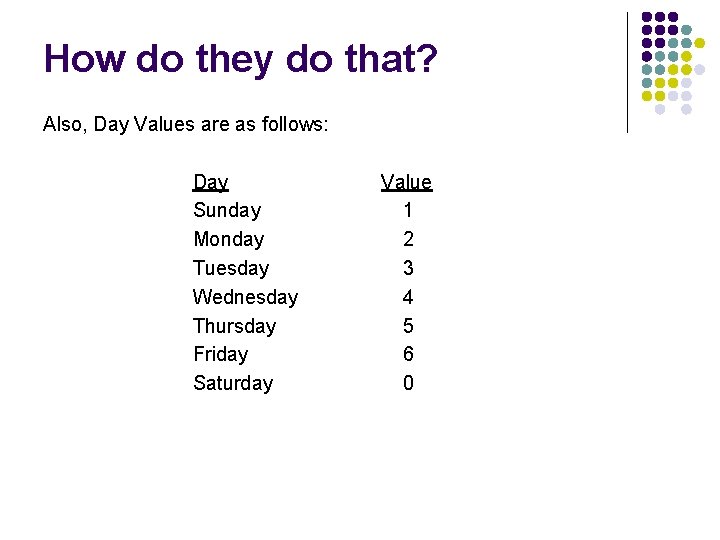
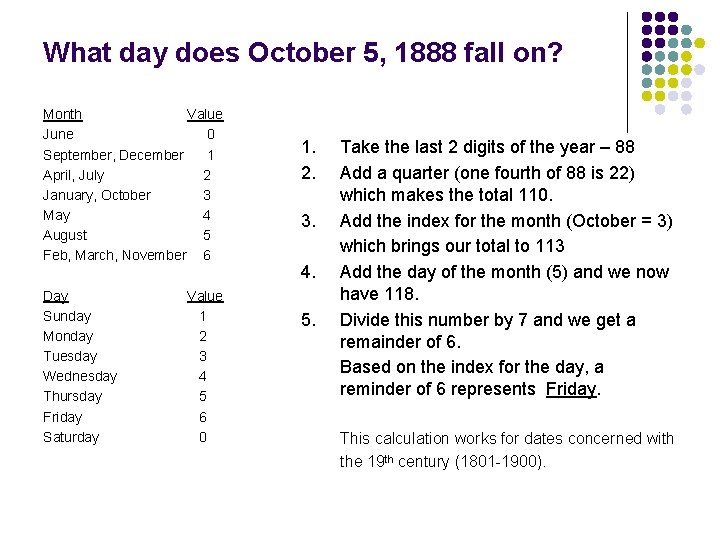
How do they do that? Also, Day Values are as follows: Day Sunday Monday Tuesday Wednesday Thursday Friday Saturday Value 1 2 3 4 5 6 0
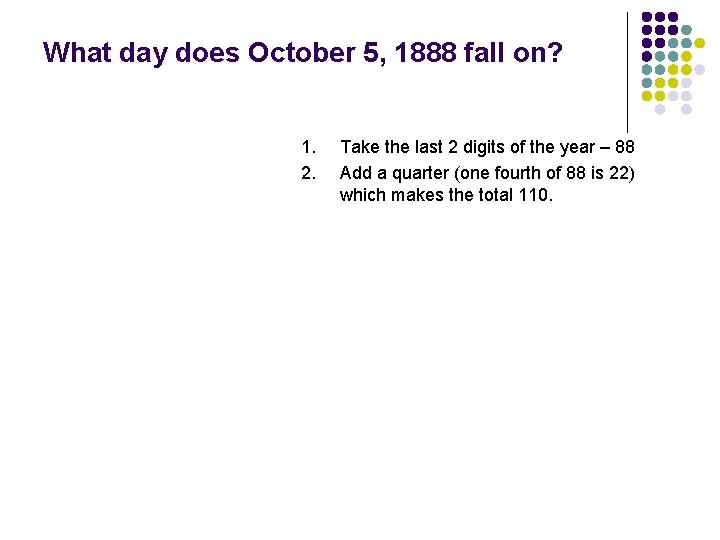
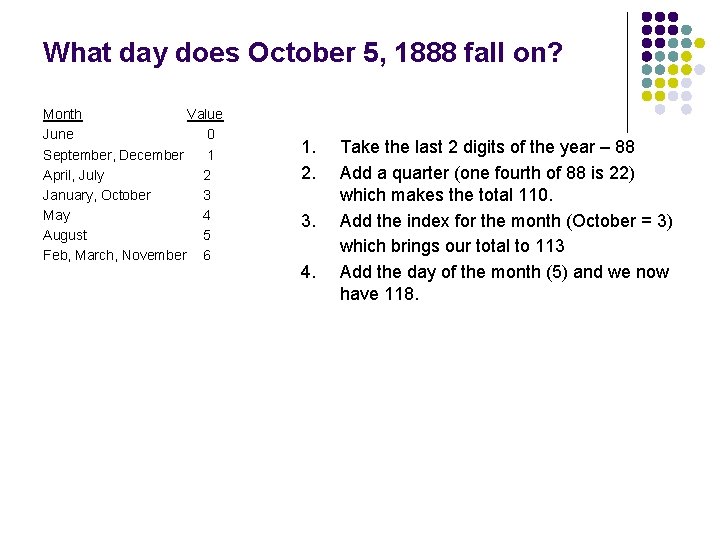
What day does October 5, 1888 fall on?
What day does October 5, 1888 fall on? 1. Take the last 2 digits of the year – 88
What day does October 5, 1888 fall on? 1. 2. Take the last 2 digits of the year – 88 Add a quarter (one fourth of 88 is 22) which makes the total 110.
What day does October 5, 1888 fall on? Month Value June 0 September, December 1 April, July 2 January, October 3 May 4 August 5 Feb, March, November 6 1. 2. 3. Take the last 2 digits of the year – 88 Add a quarter (one fourth of 88 is 22) which makes the total 110. Add the index for the month (October = 3) which brings our total to 113
What day does October 5, 1888 fall on? Month Value June 0 September, December 1 April, July 2 January, October 3 May 4 August 5 Feb, March, November 6 1. 2. 3. 4. Take the last 2 digits of the year – 88 Add a quarter (one fourth of 88 is 22) which makes the total 110. Add the index for the month (October = 3) which brings our total to 113 Add the day of the month (5) and we now have 118.
What day does October 5, 1888 fall on? Month Value June 0 September, December 1 April, July 2 January, October 3 May 4 August 5 Feb, March, November 6 Day Sunday Monday Tuesday Wednesday Thursday Friday Saturday Value 1 2 3 4 5 6 0 1. 2. 3. 4. 5. Take the last 2 digits of the year – 88 Add a quarter (one fourth of 88 is 22) which makes the total 110. Add the index for the month (October = 3) which brings our total to 113 Add the day of the month (5) and we now have 118. Divide this number by 7 and we get a remainder of 6. Based on the index for the day, a reminder of 6 represents Friday. This calculation works for dates concerned with the 19 th century (1801 -1900).
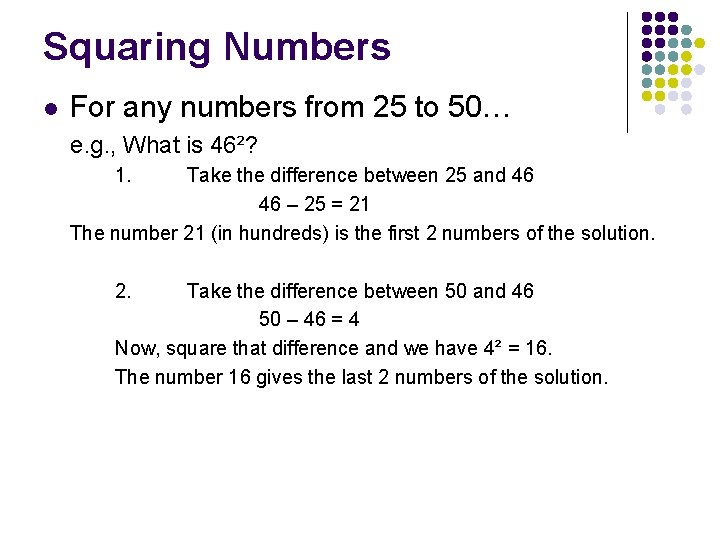
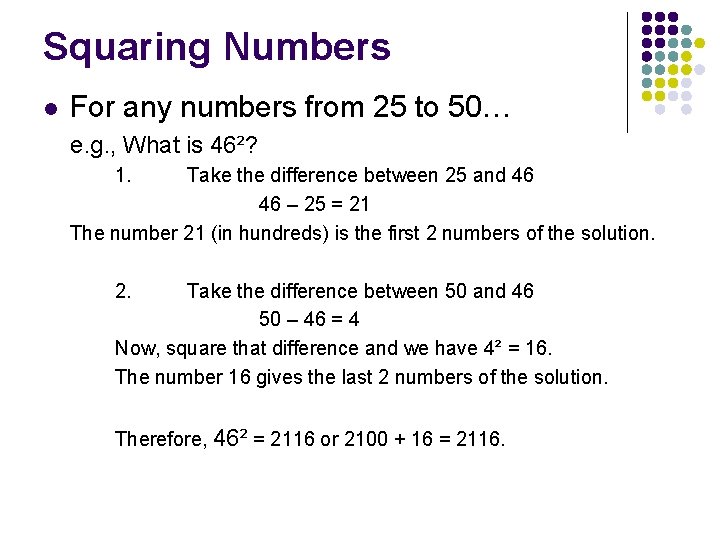
Squaring Numbers l For any numbers from 25 to 50… e. g. , What is 46²?
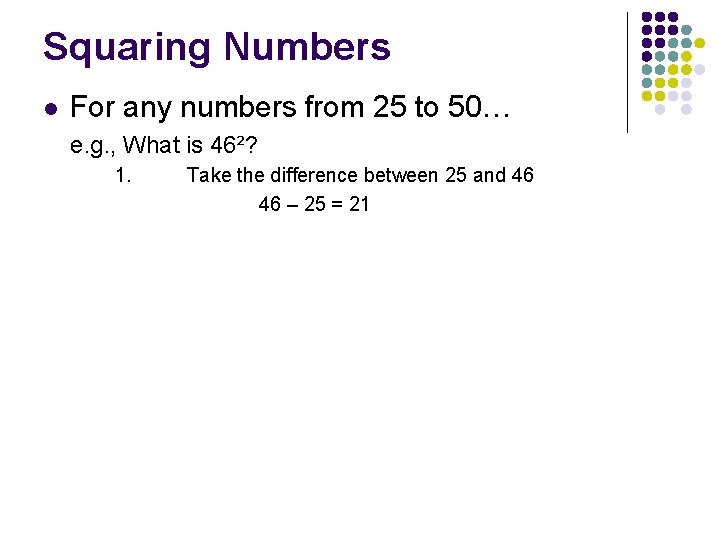
Squaring Numbers l For any numbers from 25 to 50… e. g. , What is 46²? 1. Take the difference between 25 and 46 46 – 25 = 21
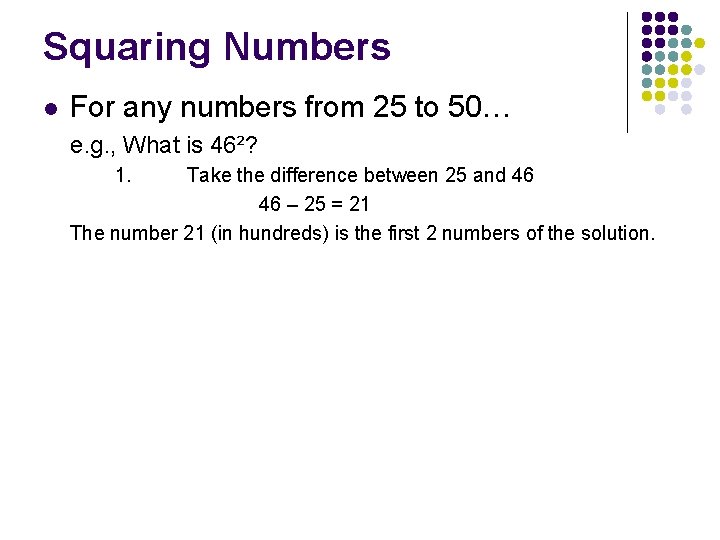
Squaring Numbers l For any numbers from 25 to 50… e. g. , What is 46²? 1. Take the difference between 25 and 46 46 – 25 = 21 The number 21 (in hundreds) is the first 2 numbers of the solution.
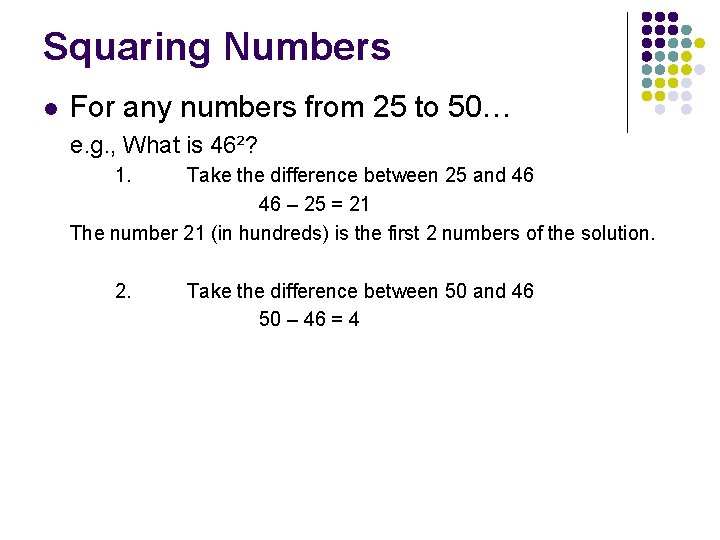
Squaring Numbers l For any numbers from 25 to 50… e. g. , What is 46²? 1. Take the difference between 25 and 46 46 – 25 = 21 The number 21 (in hundreds) is the first 2 numbers of the solution. 2. Take the difference between 50 and 46 50 – 46 = 4
Squaring Numbers l For any numbers from 25 to 50… e. g. , What is 46²? 1. Take the difference between 25 and 46 46 – 25 = 21 The number 21 (in hundreds) is the first 2 numbers of the solution. 2. Take the difference between 50 and 46 50 – 46 = 4 Now, square that difference and we have 4² = 16. The number 16 gives the last 2 numbers of the solution.
Squaring Numbers l For any numbers from 25 to 50… e. g. , What is 46²? 1. Take the difference between 25 and 46 46 – 25 = 21 The number 21 (in hundreds) is the first 2 numbers of the solution. 2. Take the difference between 50 and 46 50 – 46 = 4 Now, square that difference and we have 4² = 16. The number 16 gives the last 2 numbers of the solution. Therefore, 46² = 2116 or 2100 + 16 = 2116.
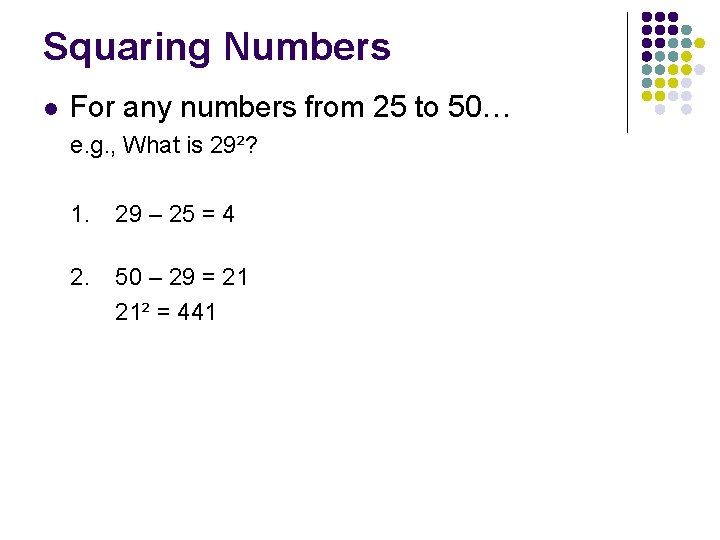
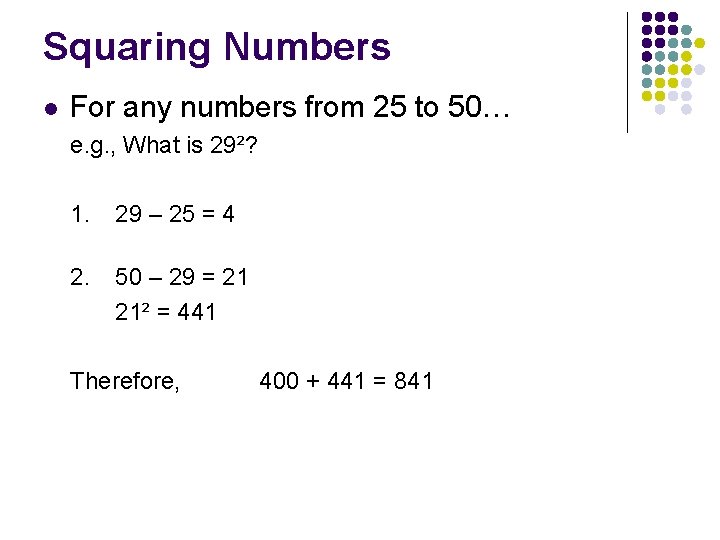
Squaring Numbers l For any numbers from 25 to 50… e. g. , What is 29²?
Squaring Numbers l For any numbers from 25 to 50… e. g. , What is 29²? 1. 29 – 25 = 4
Squaring Numbers l For any numbers from 25 to 50… e. g. , What is 29²? 1. 29 – 25 = 4 2. 50 – 29 = 21 21² = 441
Squaring Numbers l For any numbers from 25 to 50… e. g. , What is 29²? 1. 29 – 25 = 4 2. 50 – 29 = 21 21² = 441 Therefore, 400 + 441 = 841
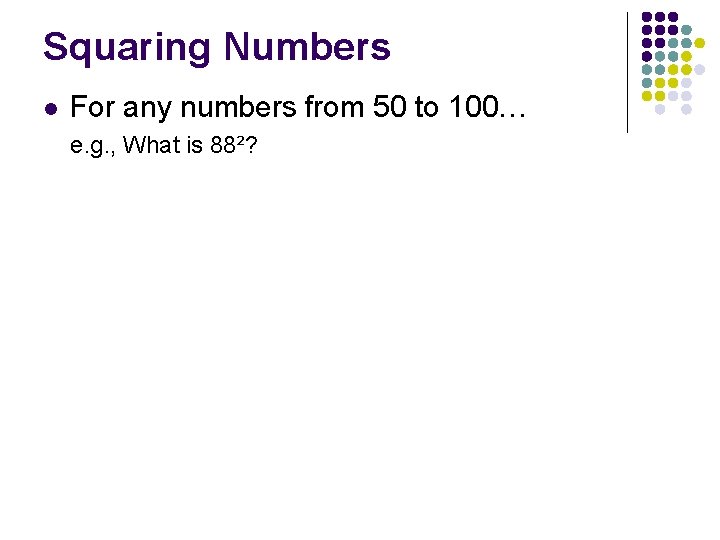
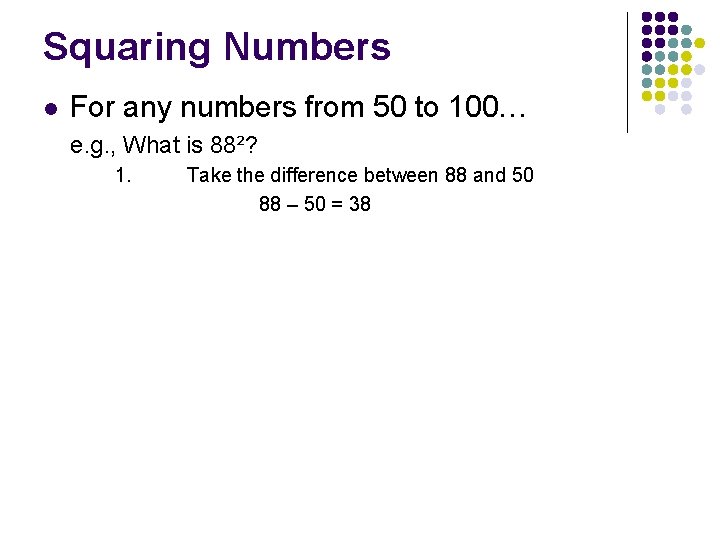
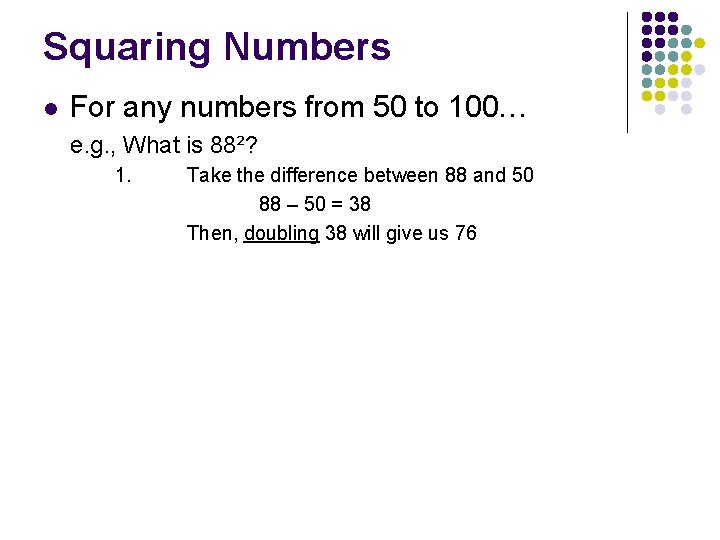
Squaring Numbers l For any numbers from 50 to 100… e. g. , What is 88²?
Squaring Numbers l For any numbers from 50 to 100… e. g. , What is 88²? 1. Take the difference between 88 and 50 88 – 50 = 38
Squaring Numbers l For any numbers from 50 to 100… e. g. , What is 88²? 1. Take the difference between 88 and 50 88 – 50 = 38 Then, doubling 38 will give us 76
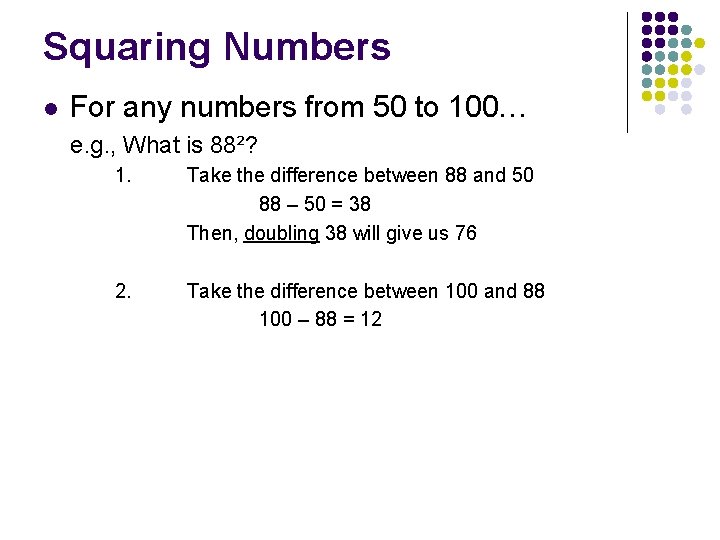
Squaring Numbers l For any numbers from 50 to 100… e. g. , What is 88²? 1. Take the difference between 88 and 50 88 – 50 = 38 Then, doubling 38 will give us 76 2. Take the difference between 100 and 88 100 – 88 = 12
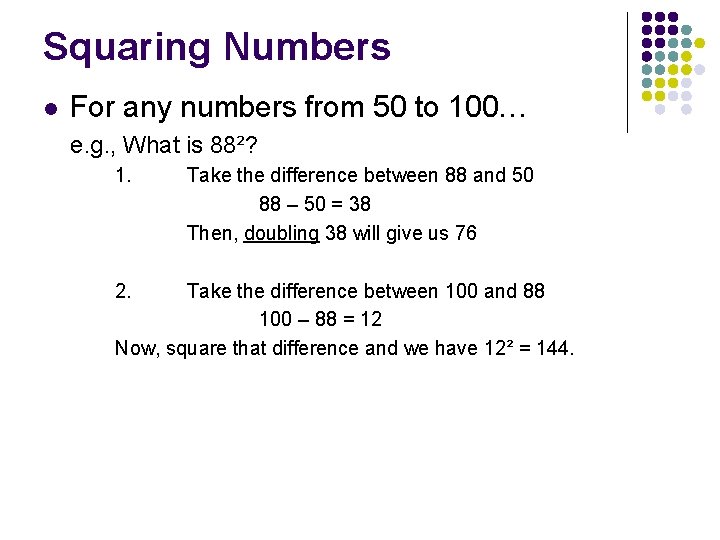
Squaring Numbers l For any numbers from 50 to 100… e. g. , What is 88²? 1. 2. Take the difference between 88 and 50 88 – 50 = 38 Then, doubling 38 will give us 76 Take the difference between 100 and 88 100 – 88 = 12 Now, square that difference and we have 12² = 144.
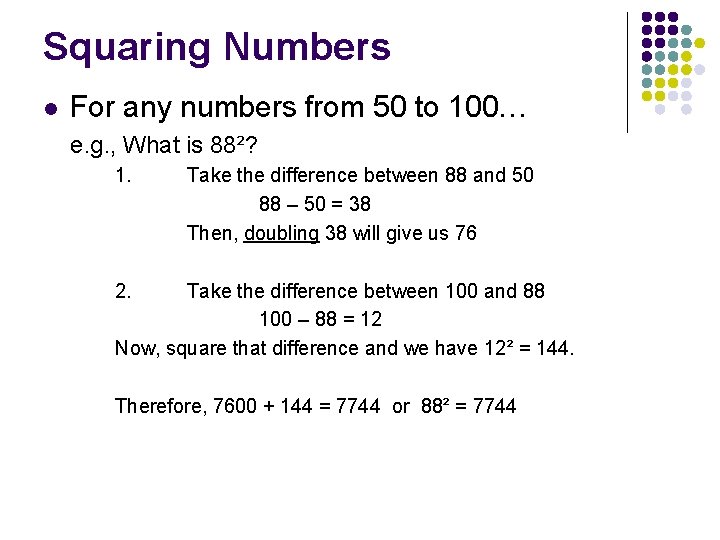
Squaring Numbers l For any numbers from 50 to 100… e. g. , What is 88²? 1. Take the difference between 88 and 50 88 – 50 = 38 Then, doubling 38 will give us 76 2. Take the difference between 100 and 88 100 – 88 = 12 Now, square that difference and we have 12² = 144. Therefore, 7600 + 144 = 7744 or 88² = 7744
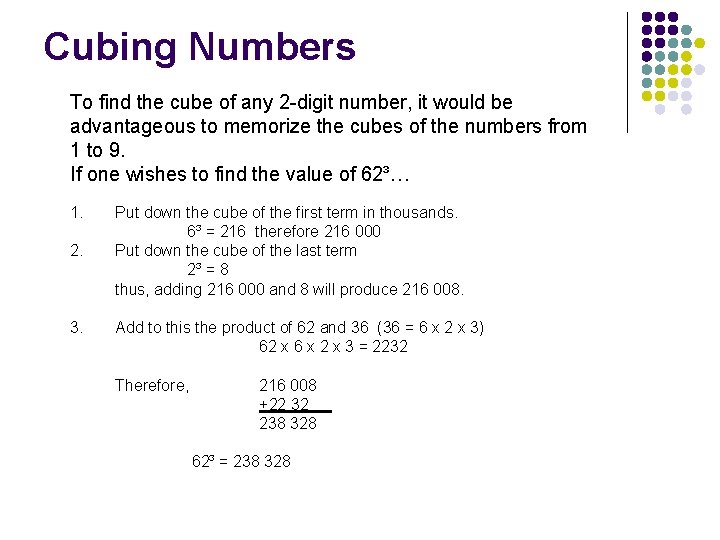
Cubing Numbers To find the cube of any 2 -digit number, it would be advantageous to memorize the cubes of the numbers from 1 to 9. If one wishes to find the value of 62³… 1. 2. 3. Put down the cube of the first term in thousands. 6³ = 216 therefore 216 000 Put down the cube of the last term 2³ = 8 thus, adding 216 000 and 8 will produce 216 008. Add to this the product of 62 and 36 (36 = 6 x 2 x 3) 62 x 6 x 2 x 3 = 2232 Therefore, 216 008 +22 32 238 328 62³ = 238 328
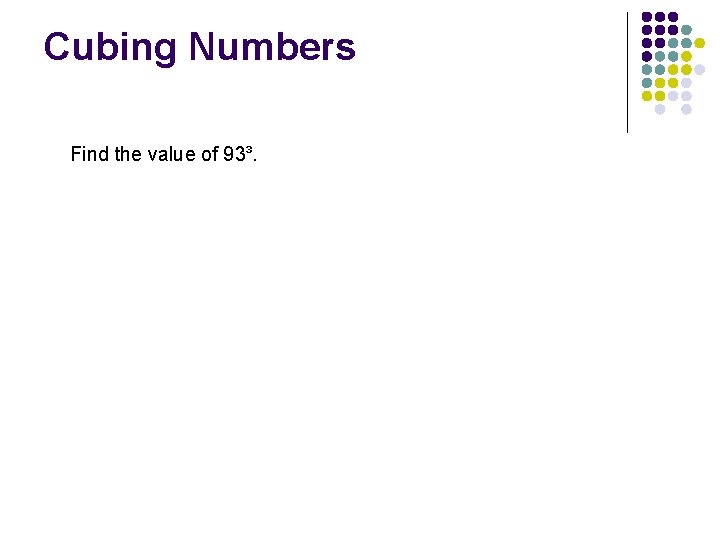
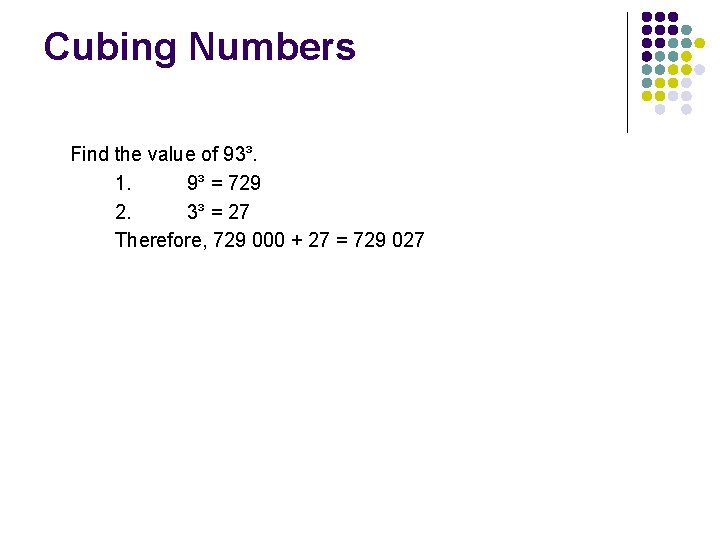
Cubing Numbers Find the value of 93³.
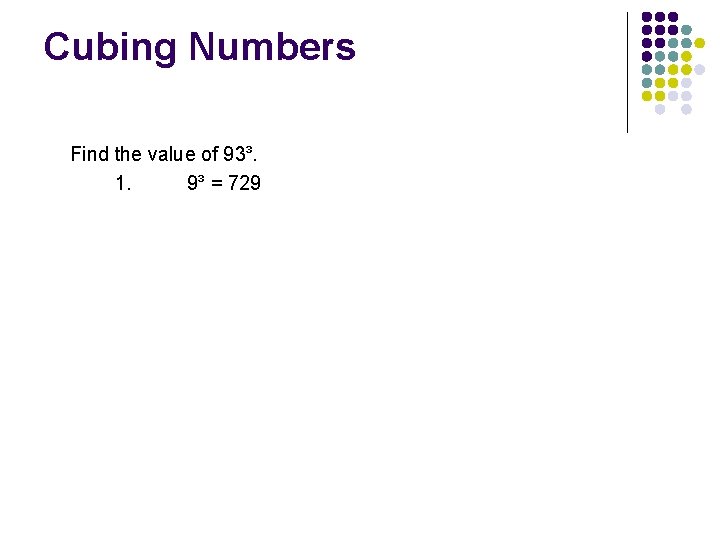
Cubing Numbers Find the value of 93³. 1. 9³ = 729
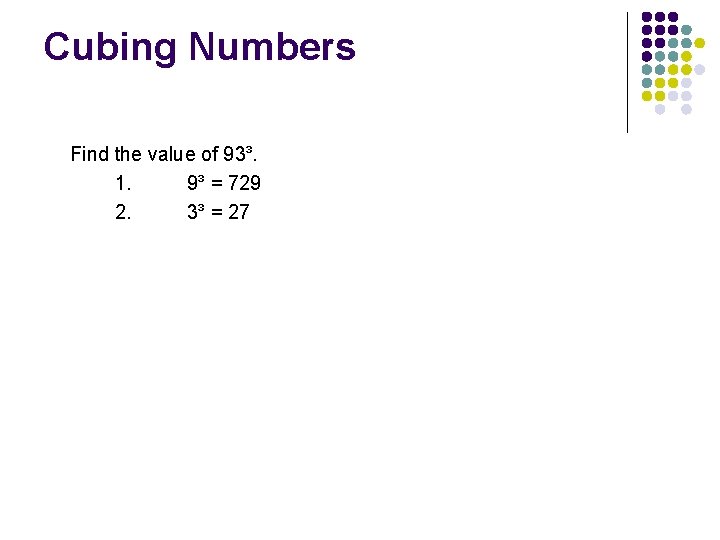
Cubing Numbers Find the value of 93³. 1. 9³ = 729 2. 3³ = 27
Cubing Numbers Find the value of 93³. 1. 9³ = 729 2. 3³ = 27 Therefore, 729 000 + 27 = 729 027
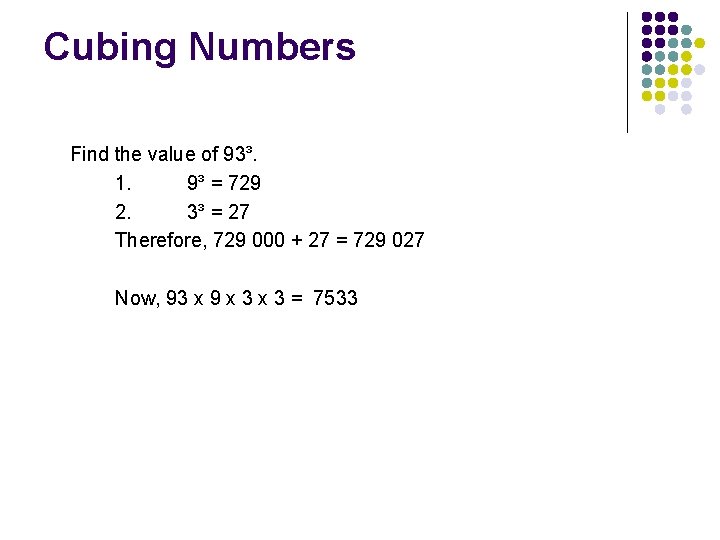
Cubing Numbers Find the value of 93³. 1. 9³ = 729 2. 3³ = 27 Therefore, 729 000 + 27 = 729 027 Now, 93 x 9 x 3 = 7533
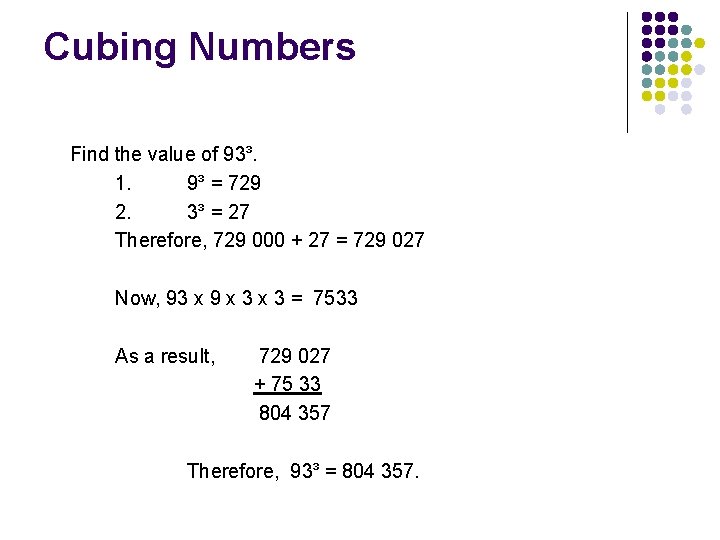
Cubing Numbers Find the value of 93³. 1. 9³ = 729 2. 3³ = 27 Therefore, 729 000 + 27 = 729 027 Now, 93 x 9 x 3 = 7533 As a result, 729 027 + 75 33 804 357 Therefore, 93³ = 804 357.
Gifted Children Speak Out
Gifted Children Speak Out What do you think being gifted means?
Gifted Children Speak Out What do you think being gifted means? It means you can do lots of things without help from grownups. Girl, 10 I think smart and gifted are totally different. Being smart is just being able to answer questions and answer dates. Being gifted means you gave an imagination and spirit and you are able to think creatively. Girl, 10 Gifted means being selected to attend a resource room because of your behaviour and your ability to think and learn a lot easier than others. Boy, 9 I think being gifted means having a special gift from God, I feel that if you are gifted, you are on Earth to fulfill a need that other people can’t fulfill. Girl, 12
Gifted Children Speak Out What is your reaction to being called gifted?
Gifted Children Speak Out What is your reaction to being called gifted? I don’t mind being called gifted as long as I’m not stereotyped as being perfect. Boy, 9 I think the word gifted is perfect, because it means we have a ‘gift’ to understand things others don’t. Girl, 13 I don’t like being called gifted; it’s embarrassing and it’s like bragging. Boy, 9 Sometimes people think ‘gifted’ means stuck up and they think that you are going to make fun of their grades because they don’t make as good grades as you do. Girl, 13
Gifted Children Speak Out Are you gifted?
Gifted Children Speak Out Are you gifted? I do think I am smarter than most kids my age, but in only one way: I put my brain to use and make it do what everyone’s brain can do if they would try to do it, or care. Girl, 9 I’ve never really considered myself a genius but yes, I think I’m smart because I always seem to know the answer to the questions no matter what the questions might be. Boy, 13 I really don’t think I am any more gifted than any of my friends; I just work very hard at everything I do and usually I do very well. Girl, 12 I don’t think that I am gifted because I can always learn something from others. Boy, 10