
Chapter 15 Years of Crisis 1919 1939 Postwar


- Slides: 81
Chapter 15 Years of Crisis, 1919 -1939
Postwar Uncertainty l l l Will reason really prevail? Question traditional beliefs New science and technology Expanded rights New ideas
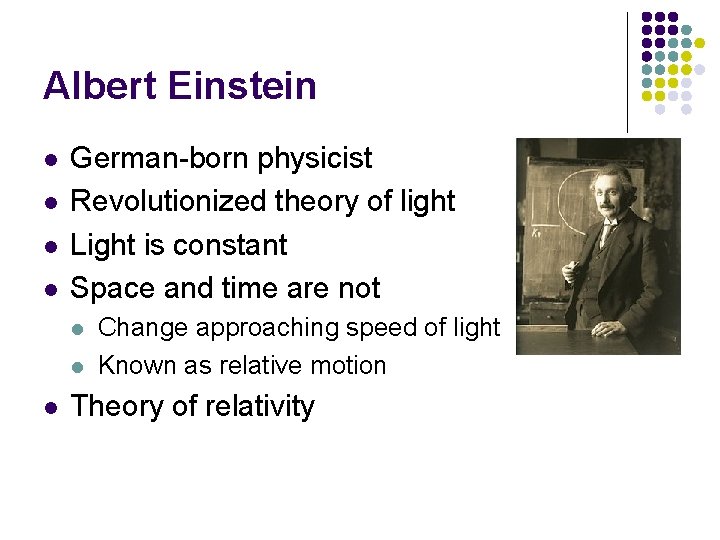
Albert Einstein l l German-born physicist Revolutionized theory of light Light is constant Space and time are not l l l Change approaching speed of light Known as relative motion Theory of relativity
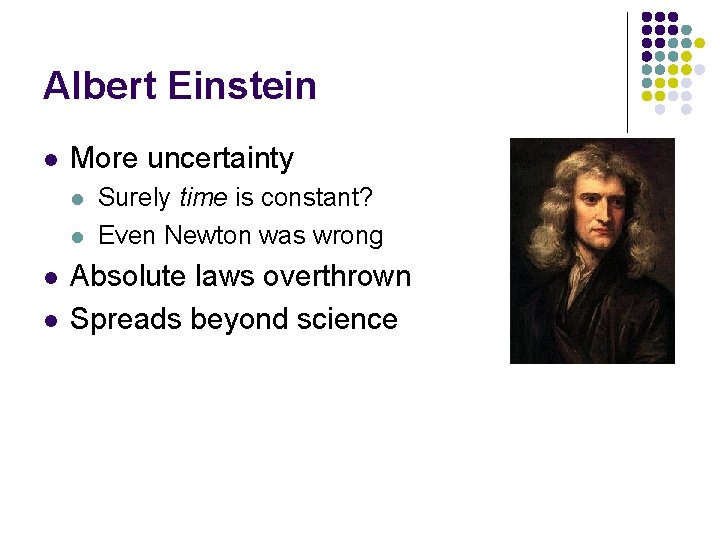
Albert Einstein l More uncertainty l l Surely time is constant? Even Newton was wrong Absolute laws overthrown Spreads beyond science
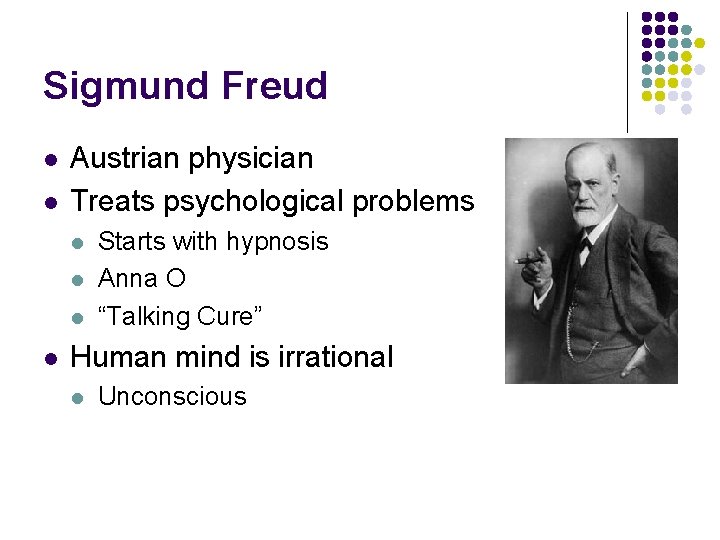
Sigmund Freud l l Austrian physician Treats psychological problems l l Starts with hypnosis Anna O “Talking Cure” Human mind is irrational l Unconscious
Sigmund Freud l Unconscious control drives l l Especially pleasure-seeking Conscious mind unaware Weakens faith in reason Hugely influential by 1920 s l Has tailed off
Literature in the 1920 s l Affected by World War I l l l Reason? Progress? Sense of disillusionment Fears about the future Religious doubt Lots of great stuff
Literature in the 1920 s l Franz Kafka l l l The Trial and The Castle Inescapable situations Hopelessness People turn into cockroaches Hugely popular l Reflects post-war climate
James Joyce l l Irish novelist Influenced by Freud Stream-of-consciousness Ulysses
Existentialism l Insert picture of Sartre here
Existentialism l l Philosophers search for meaning Many turn to existentialism l l No universal meaning Made by ourselves Choices and actions No religion
Section 2 A Worldwide Depression
Review – 1920 s l l l What were two major changes in science? What is existentialism? What were two new artistic movements? How did women’s roles change? What two media came to dominate popular entertainment?
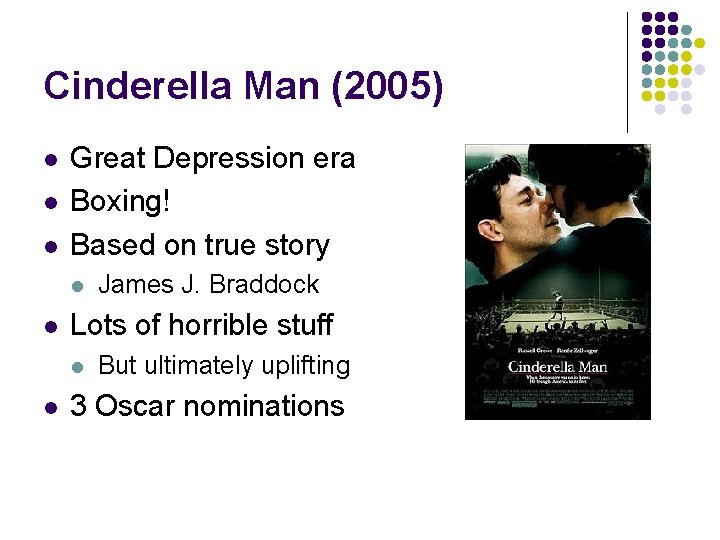
Cinderella Man (2005) l l l Great Depression era Boxing! Based on true story l l Lots of horrible stuff l l James J. Braddock But ultimately uplifting 3 Oscar nominations
Section Preview l l l Europe economies rebuilding Japan and U. S. prospering U. S. providing loans Great American confidence Booming stock market Trouble ahead
Postwar Europe l Europe practically bankrupt l l $338 billion Land devastation Declines in world affairs Still lots of tension l Why?
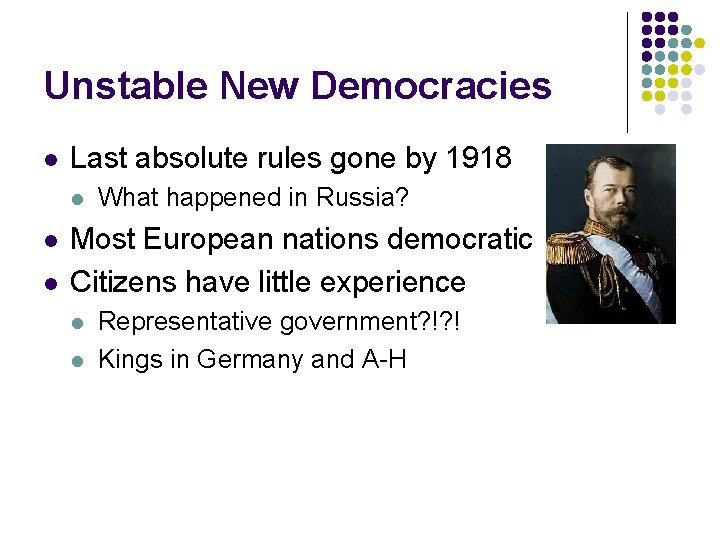
Unstable New Democracies l Last absolute rules gone by 1918 l l l What happened in Russia? Most European nations democratic Citizens have little experience l l Representative government? !? ! Kings in Germany and A-H
Unstable New Democracies l Parliamentary troubles elsewhere l l l France and Italy Political infighting Dozen or more parties One party can’t win support Coalition governments l l Temporary alliance of parties How long do these last?
Unstable New Democracies l Frequent changes = instability l l l Weak leadership No long-term planning Worse in crises l l l Mass panic Sacrifice freedoms Authoritarian leaders rise
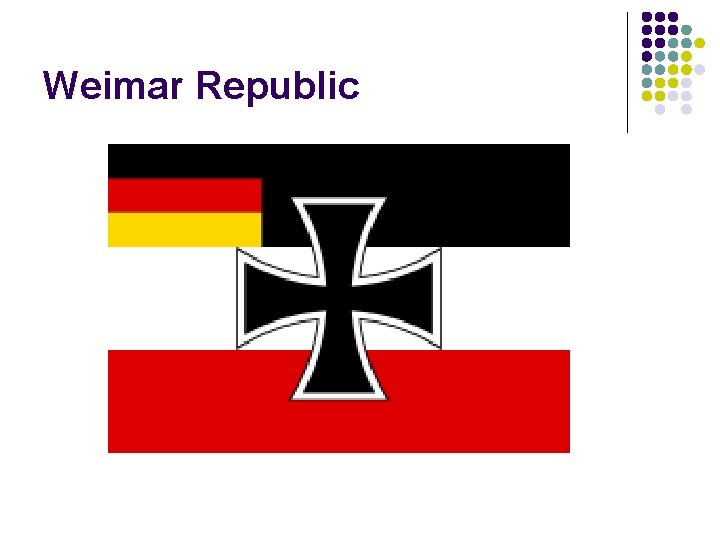
Weimar Republic
Weimar Republic l 1919 – new German government l l l Democratic! National assembly meets in Weimar Doomed from start l l l No democratic tradition Many parties Blamed for WWI defeat
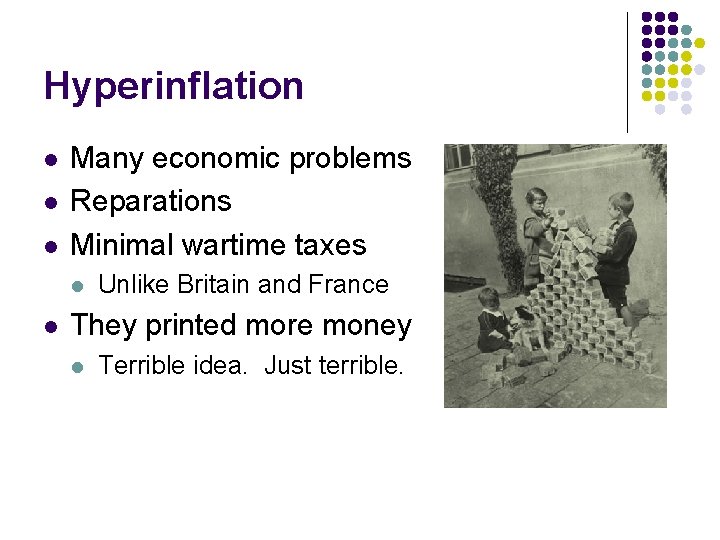
Hyperinflation l l l Many economic problems Reparations Minimal wartime taxes l l Unlike Britain and France They printed more money l Terrible idea. Just terrible.
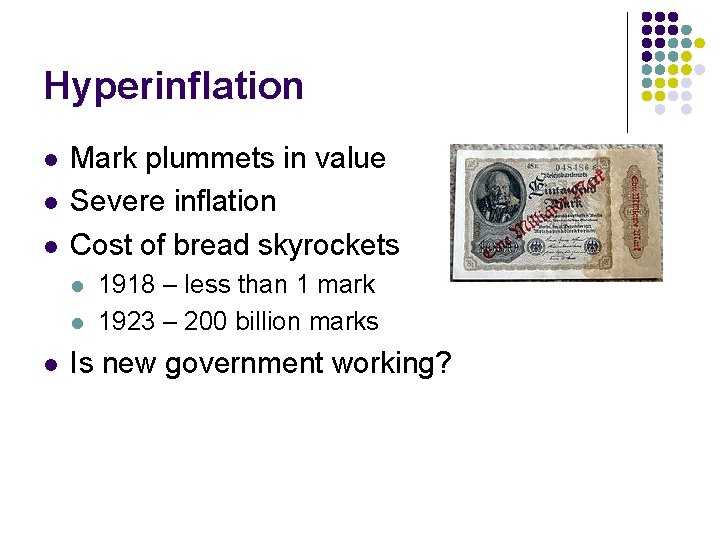
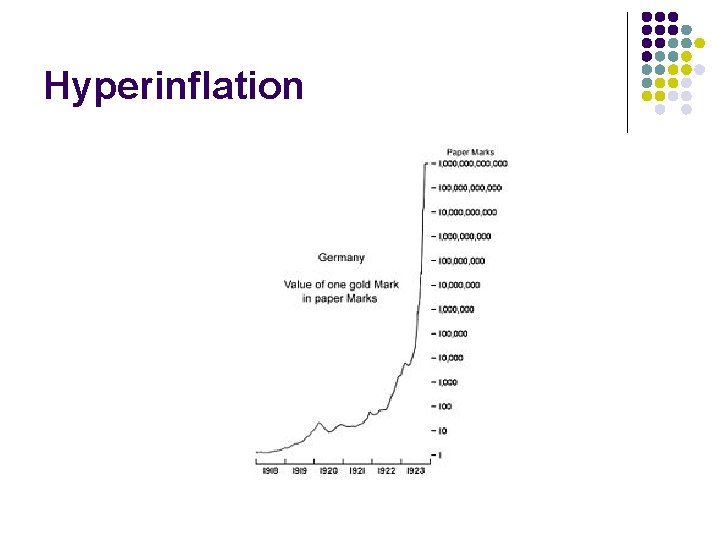
Hyperinflation l l l Mark plummets in value Severe inflation Cost of bread skyrockets l l l 1918 – less than 1 mark 1923 – 200 billion marks Is new government working?
Hyperinflation
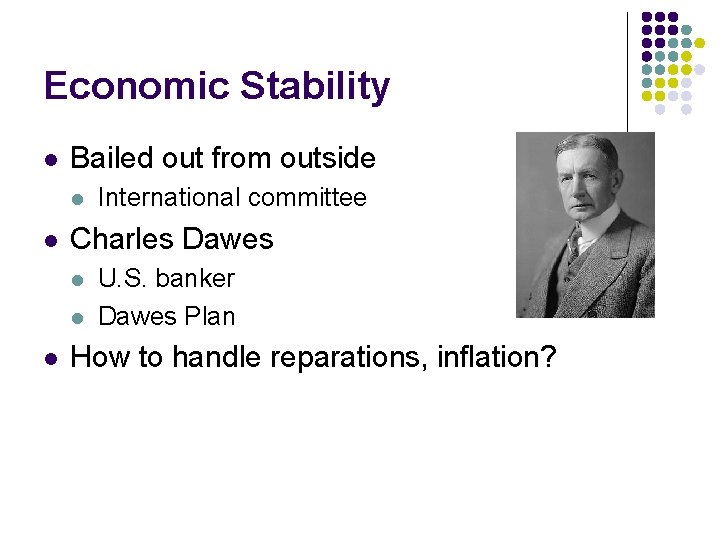
Economic Stability l Bailed out from outside l l Charles Dawes l l l International committee U. S. banker Dawes Plan How to handle reparations, inflation?
Dawes Plan l l $200 million loan from U. S. banks Stabilize currency l l l American dollar more valuable Strengthen economy More realistic reparations payments
Dawes Plan l l Put into effect in 1924 It works l l Slows inflation Attracts U. S. loans, investments 1929 – producing at pre-war levels This sounds like who?
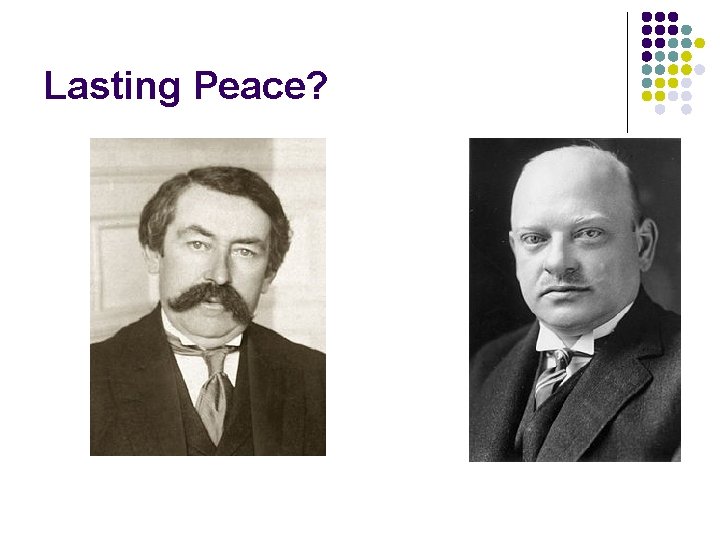
Lasting Peace?
Lasting Peace? l l Gustav Stresemann – Germany Aristide Briand – France 1925 – meet in Switzerland Sign a treaty l l l Never make war with each other Germany respects French, Belgian borders Admitted to League of Nations
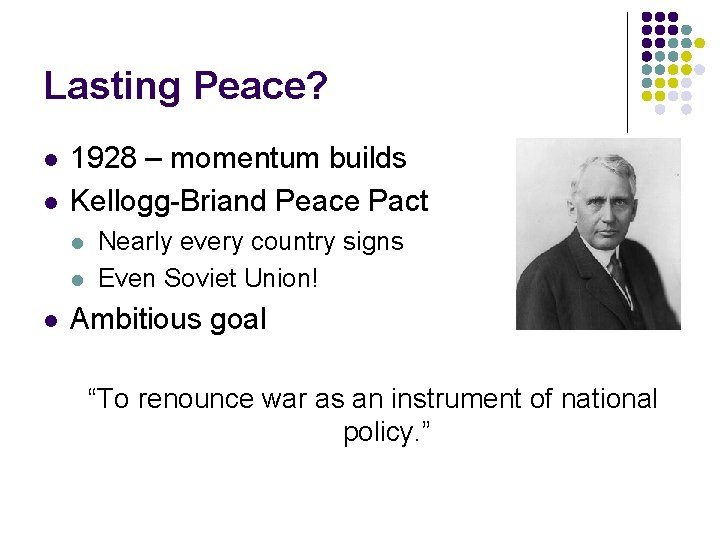
Lasting Peace? l l 1928 – momentum builds Kellogg-Briand Peace Pact l l l Nearly every country signs Even Soviet Union! Ambitious goal “To renounce war as an instrument of national policy. ”
Lasting Peace? l How to enforce? l l No League of Nations military U. S. refuses to join l l Why is this a problem? But a promising start l At least they’re talking
Review l l What were some problems with the transition to democracy in Europe? How did inflation affect the German economy? What was the Weimar Republic? Dawes Plan? How did Germany and France attempt to make peace? Who else joined in?
Road to Perdition l l l Crime and revenge Based on graphic novel Tom Hanks as bad guy 6 Oscar nominations A downer Directed by Sam Mendes
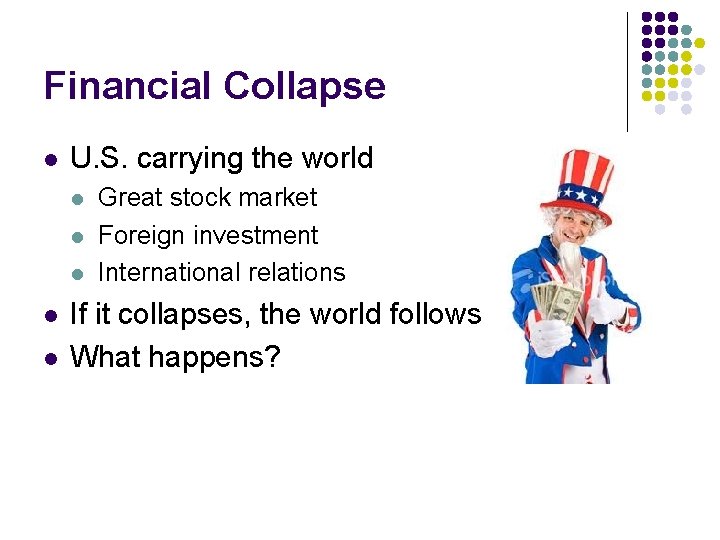
Financial Collapse l U. S. carrying the world l l l Great stock market Foreign investment International relations If it collapses, the world follows What happens?
Flawed U. S. Economy l l Richest 5% - 33% of wealth 60% earn less than $2, 000 l l Too poor to buy goods Orders cut back Factories fire workers The spiral begins
Flawed U. S. Economy l l Uneven distribution of wealth Overproduction l l l Business and agriculture Decreased buying But increased production l 50% of world’s industrial goods
Flawed U. S. Economy l Farmers can’t make profit l l l Danger signs obvious l l l Loans default Go out of business Many provide warnings Don’t gamble in stock market Widely ignored advice
The Stock Market Crashes l l Wall St. – world’s financial capital New York Stock Exchange (NYSE) l l l Investors optimistic Stock prices soar Middle class buys on margin l l Small down payment Borrow the rest
The Stock Market Crashes l l If prices rise, great If they fall, catastrophe l l No money to pay banks September 1929 – panic sets in l l Prices unnaturally high Begin selling off
The Stock Market Crashes l Thursday, Oct. 24 – uh oh l l l Everyone wants to sell l l Gradual lowering snowballs Panic sets in Who wants to buy? October 29 – new low l l 16 million stocks sold And now we have a…?
Review l l l What were some root causes of the stock market crash? What are coalition governments? Do they tend to work? (Hint: no) What was the Weimar Republic? What two countries attempted a “lasting peace”? Tell me 3 developments in science, entertainment, and/or the arts.
Review l l l Three traits of Fascism? Mussolini. Hitler. Go. How does Nazism relate to Fascism?
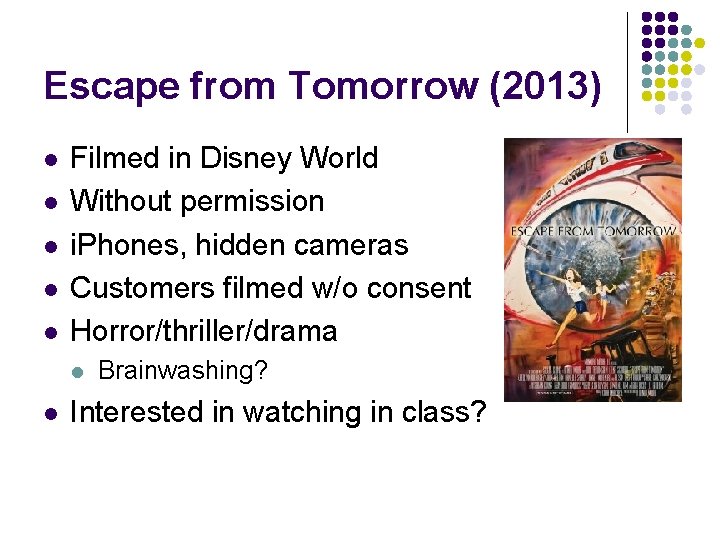
Escape from Tomorrow (2013) l l l Filmed in Disney World Without permission i. Phones, hidden cameras Customers filmed w/o consent Horror/thriller/drama l l Brainwashing? Interested in watching in class?
The Great Depression l l People can’t pay on margin Banks can’t call in loans Stocks worthless Unemployment rises l l Production drops Wages drop Prices drop This is the Great Depression
The Great Depression l l l Many other factors involved Crash simply accelerates process 1932 – 50% production Many businesses close Banks fail l l 9 million lose savings 1933 – 25% unemployment
A Global Depression l l Reverberates around world Bankers demand repayment l l U. S. sets high tariffs l l Withdraw money from Europe Buy American goods Backfires catastrophically Other nations raise tariffs World trade drops 65%
Effects Throughout the World l Germany, A-H in trouble l l 1931 – Austria’s main bank fails Asia – value of exports decline 50% l l Depend on loans, investments U. S. troubles = Europe troubles 1929 -1931 Prices collapse in Latin America l No American demand for crops
Britain l l Britain devastated National Government elected l l Multiparty coalition High tariffs and taxes Regulated currency Low interest rates l Encourage growth
Britain l l l It works eventually Slow, steady recovery Unemployment cut in half l l 1937 Production above 1929 levels Avoids political extremes Preserves democracy
France l l More self-sufficient Heavily agricultural Less dependent on foreign trade But things are still bad l l 1 million unemployed in 1935 Contributes to political instability
France l Coalition governments form, fail l l Antidemocratic forces forming l l 5 in 1933 France and abroad 1936 – large coalition l Moderates, socialists, Communists
France l Popular Front l l l There are wages gains l l l Series of reforms Designed to help workers But also price gains Unemployment still high But democracy prevails!
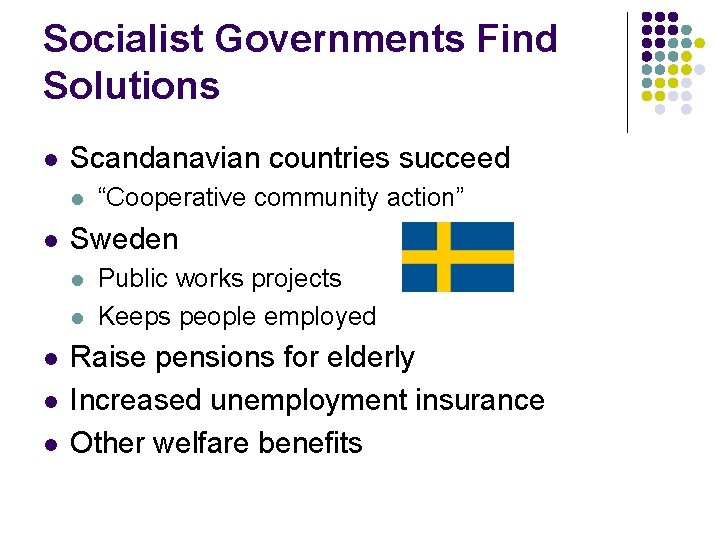
Socialist Governments Find Solutions l Scandanavian countries succeed l l Sweden l l l “Cooperative community action” Public works projects Keeps people employed Raise pensions for elderly Increased unemployment insurance Other welfare benefits
Socialist Governments Find Solutions l How to pay for these? l l l Tax citizens Like Britain and France… Democracy prevails!
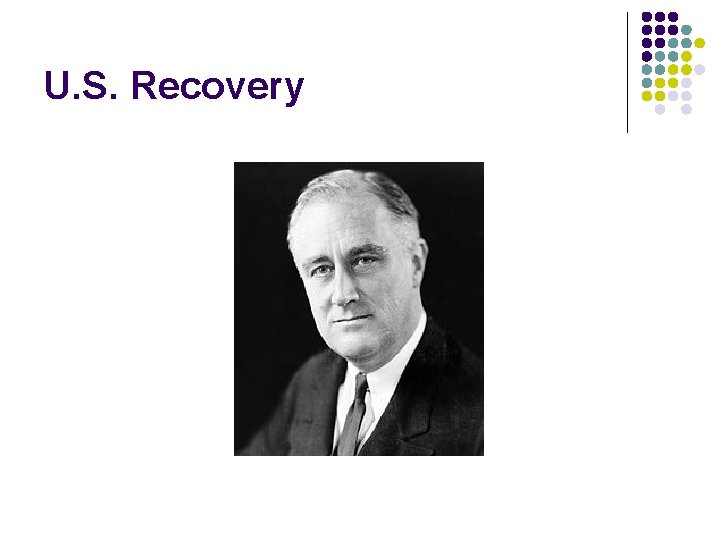
U. S. Recovery
U. S. Recovery l l FDR’s confidence appeals to voters Famous quote: “let me assert my firm belief that the only thing we have to fear is fear itself”
Review l l l France weathered the Depression better than Britain because they were more……? What effect did the U. S. tariff have on the world economy? Britain created a multiparty coalition known as the…. ? What did it do? The Popular Front was a coalition in _______ made up of which 3 groups? In economics, wage gains can be offset by…?
Upstream Color (2013) Director’s second film n He does everything n Hard to explain plot n Limited dialogue n Possibly the best movie ever n On DVD in May n
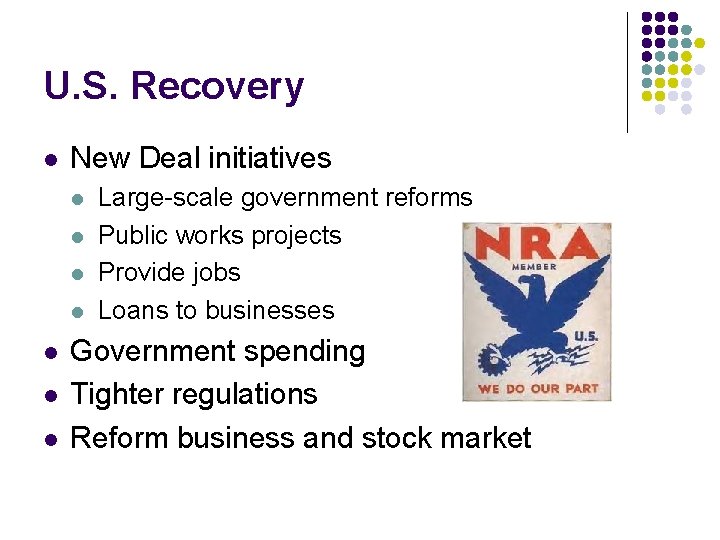
U. S. Recovery l New Deal initiatives l l l l Large-scale government reforms Public works projects Provide jobs Loans to businesses Government spending Tighter regulations Reform business and stock market
U. S. Recovery l l Reforms entire economic system Roosevelt succeeds as leader U. S. keeps faith in democracy Faith in leader will be important l l More problems on horizon Like what?
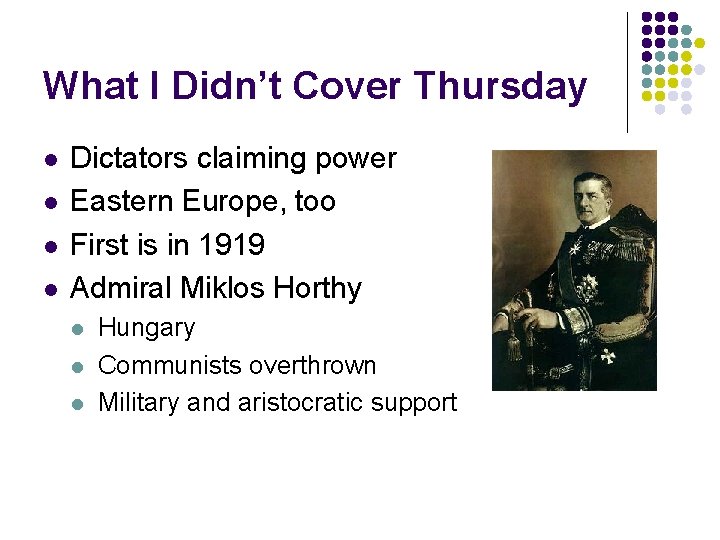
What I Didn’t Cover Thursday l l Dictators claiming power Eastern Europe, too First is in 1919 Admiral Miklos Horthy l l l Hungary Communists overthrown Military and aristocratic support
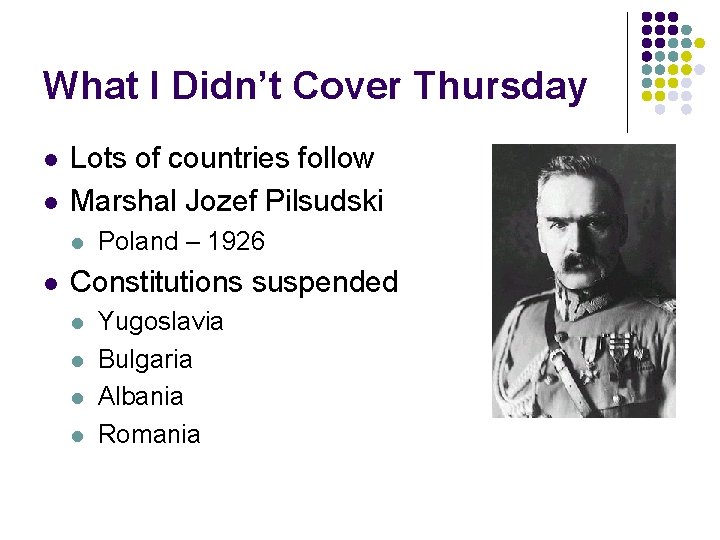
What I Didn’t Cover Thursday l l Lots of countries follow Marshal Jozef Pilsudski l l Poland – 1926 Constitutions suspended l l Yugoslavia Bulgaria Albania Romania
What I Didn’t Cover Thursday l 1935 – ONE democracy in Eastern Europe l l l Democracy survives in some nations Britain, France, Scandinavia l l l Czechoslovakia Why? Europe in 2 antagonistic groups Tell me what they are.
Section 4 Aggressors Invade Nations (Brilliant Title)
Section Preview l l l Germany and Italy very angry World conquest? Democracies distracted l l l By what? Pins hope on League of Nations Fascism in Japan?
Japan Seeks an Empire l 1920 s – more democratic l l As in Europe 1922 – respect China’s borders Signs Kellogg-Briand Pact Weak Parliament l l l Limits on leaders Weak civilian control Military reports to emperor
Militarists Take Over l l l Prosperity helps maintain government Great Depression hits 1929 People blame government l l Just like? Military leaders gain support l Win control shortly
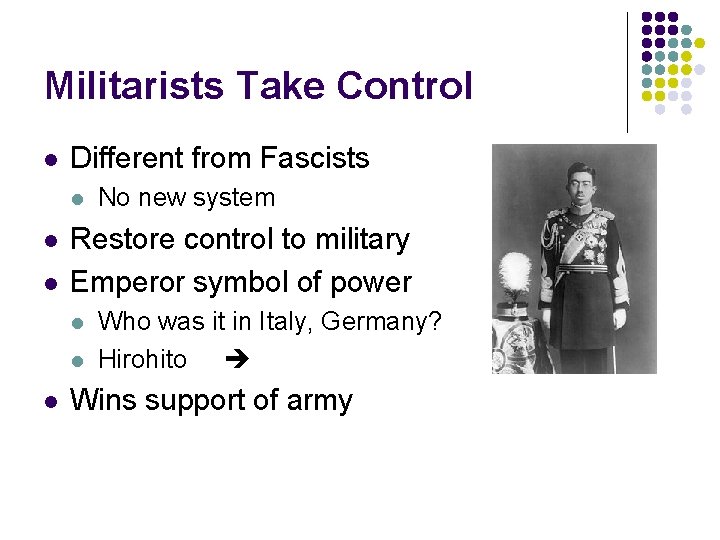
Militarists Take Control l Different from Fascists l l l Restore control to military Emperor symbol of power l l l No new system Who was it in Italy, Germany? Hirohito Wins support of army
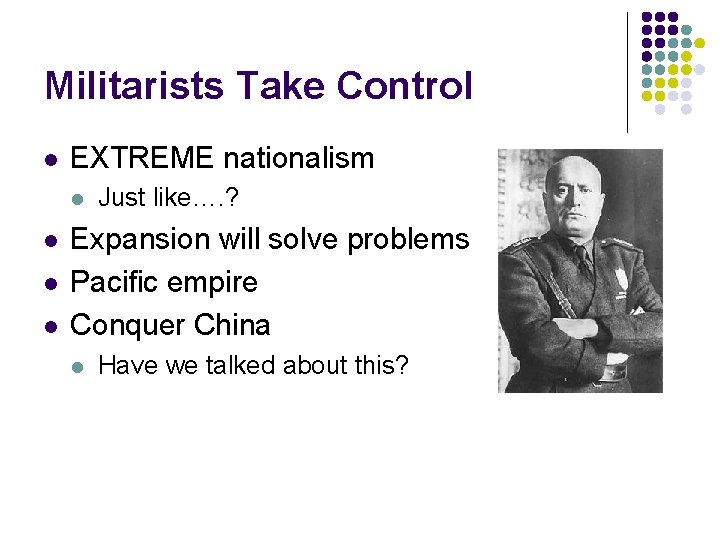
Militarists Take Control l EXTREME nationalism l l Just like…. ? Expansion will solve problems Pacific empire Conquer China l Have we talked about this?
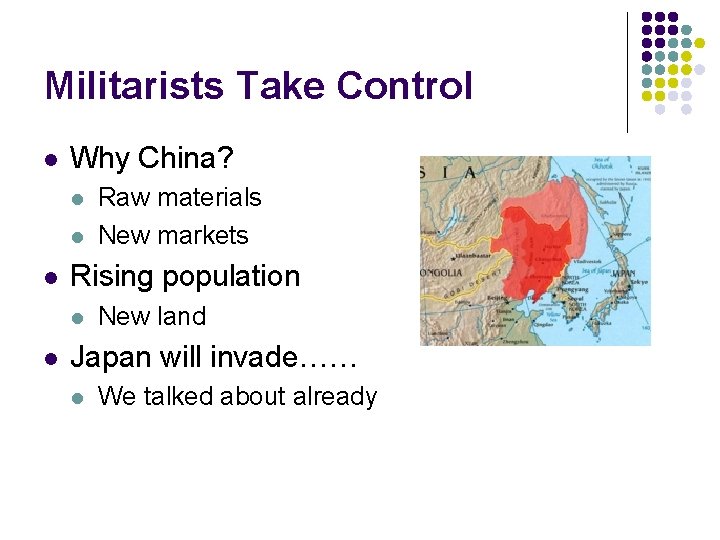
Militarists Take Control l Why China? l l l Rising population l l Raw materials New markets New land Japan will invade…… l We talked about already
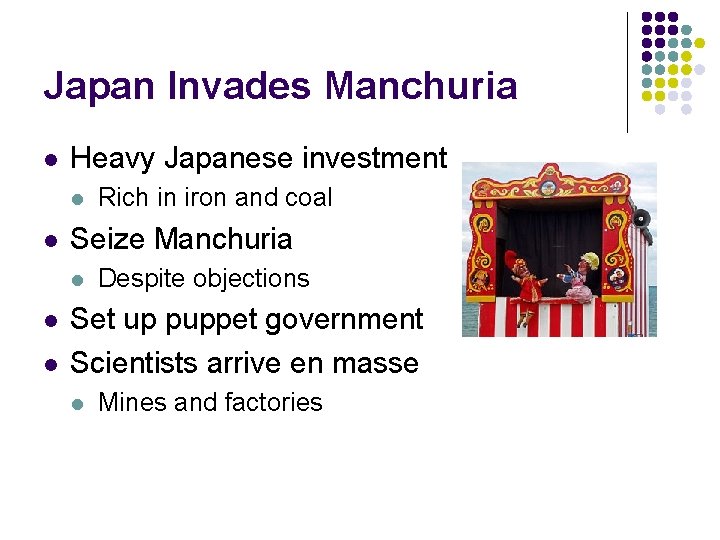
Japan Invades Manchuria l Heavy Japanese investment l l Seize Manchuria l l l Rich in iron and coal Despite objections Set up puppet government Scientists arrive en masse l Mines and factories
Japan Invades Manchuria l l What about League of Nations? All major democracies in 1932 l l Three greatest threats to peace l l Except…? Who might they be? League protests invasion l l Japan doesn’t care Withdraws in 1931
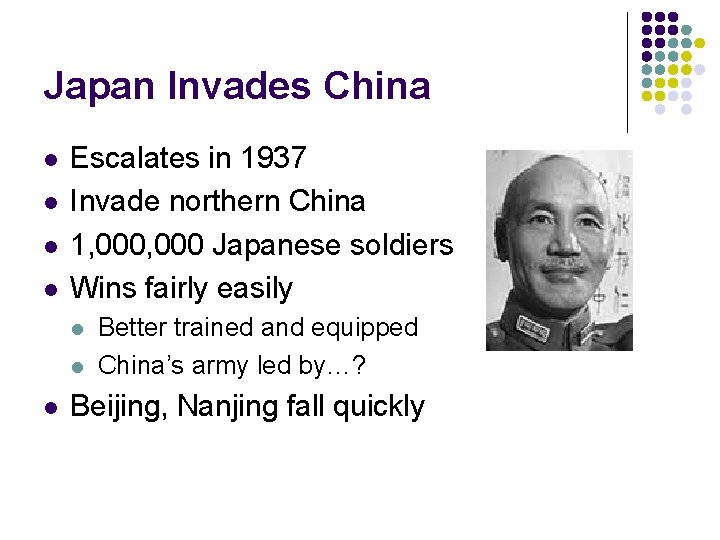
Japan Invades China l l Escalates in 1937 Invade northern China 1, 000 Japanese soldiers Wins fairly easily l l l Better trained and equipped China’s army led by…? Beijing, Nanjing fall quickly
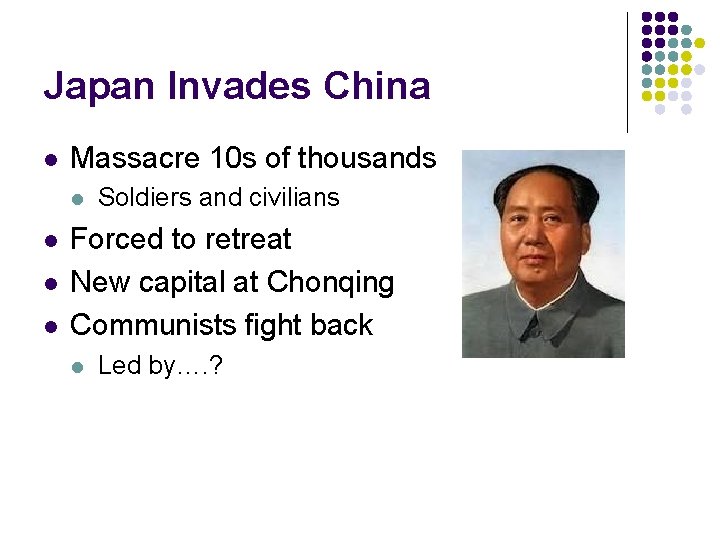
Japan Invades China l Massacre 10 s of thousands l l Soldiers and civilians Forced to retreat New capital at Chonqing Communists fight back l Led by…. ?
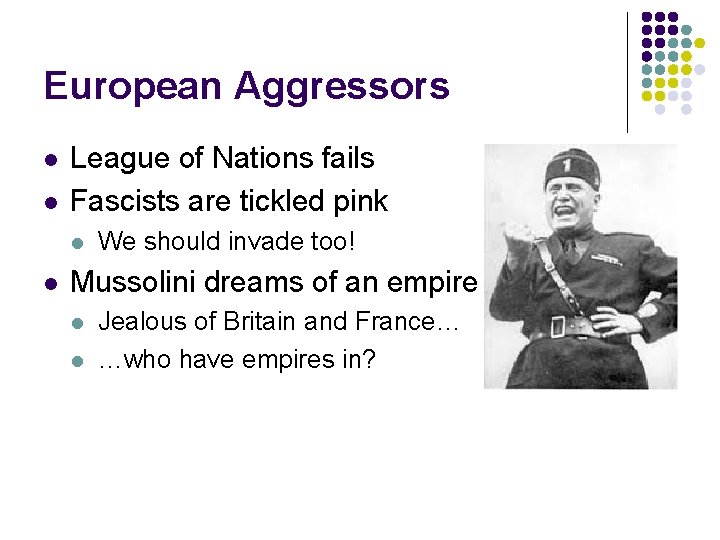
European Aggressors l l League of Nations fails Fascists are tickled pink l l We should invade too! Mussolini dreams of an empire l l Jealous of Britain and France… …who have empires in?
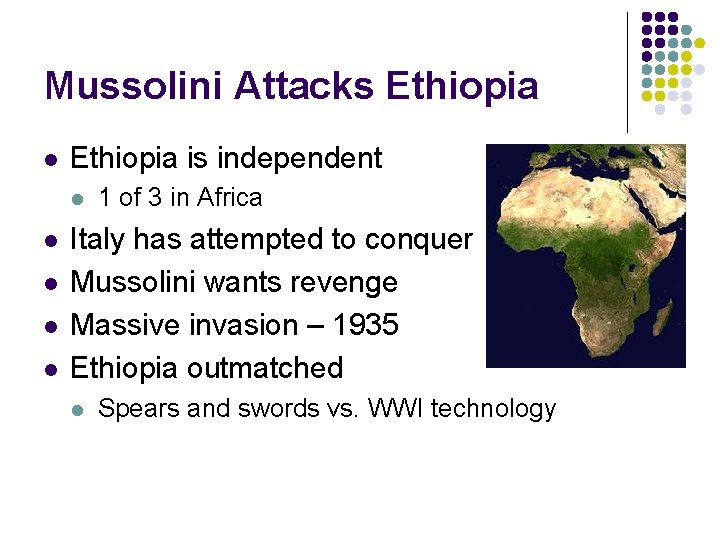
Mussolini Attacks Ethiopia l Ethiopia is independent l l l 1 of 3 in Africa Italy has attempted to conquer Mussolini wants revenge Massive invasion – 1935 Ethiopia outmatched l Spears and swords vs. WWI technology
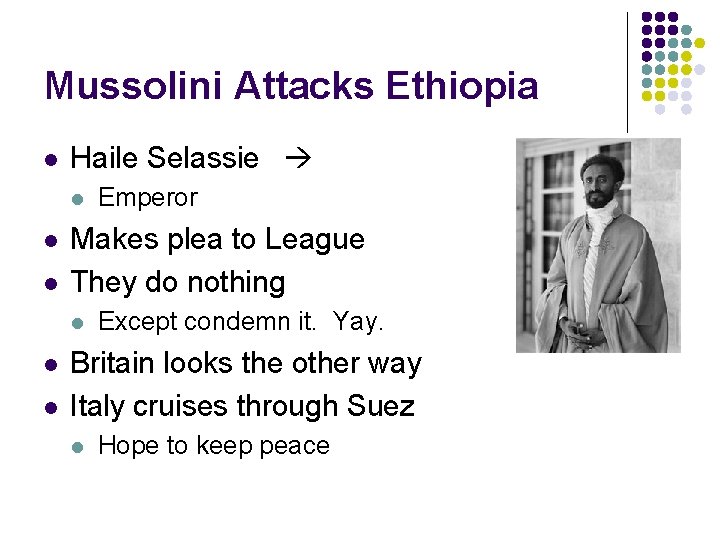
Mussolini Attacks Ethiopia l Haile Selassie l l l Makes plea to League They do nothing l l l Emperor Except condemn it. Yay. Britain looks the other way Italy cruises through Suez l Hope to keep peace
Hitler Defies Versailles Treaty l l Long pledges to undo Versailles Limits size of army Hitler decides to violate this League does nothing l l Except condemn. Yay. Hitler convinced to do more
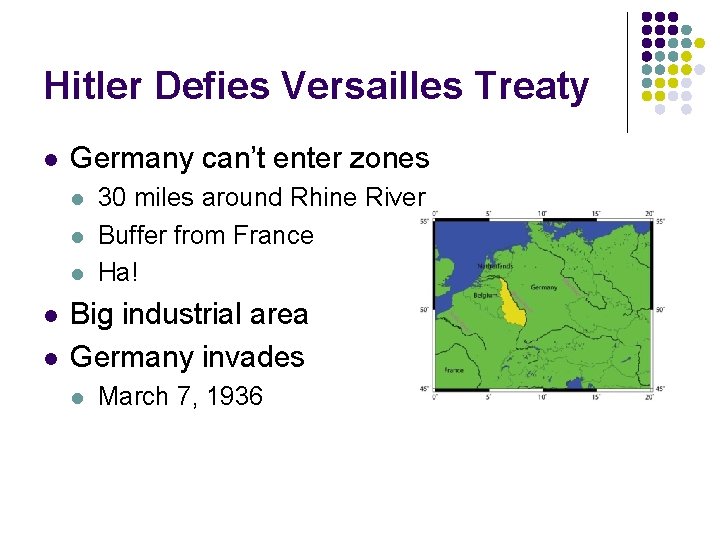
Hitler Defies Versailles Treaty l Germany can’t enter zones l l l 30 miles around Rhine River Buffer from France Ha! Big industrial area Germany invades l March 7, 1936
Hitler Defies Versailles Treaty l l French won’t risk war British push appeasement l l l Hitler would have backed down l l Giving into aggressors Keep the peace Britain, France missed opportunity Turning point
Hitler Defies Versailles Treaty l l Strengthens Hitler’s power Balance of power changes l l France, Belgium vulnerable Hitler speeds up expansion l l Britain, France will stand by How about the League?