Hotze Rullmann Marianne Huijsmans Lisa Matthewson and Neda

- Slides: 40
Hotze Rullmann, Marianne Huijsmans, Lisa Matthewson and Neda Todorović Given! A workshop to celebrate the life and work of Michael Rochemont University of British Columbia December 6 th 2018
1/39
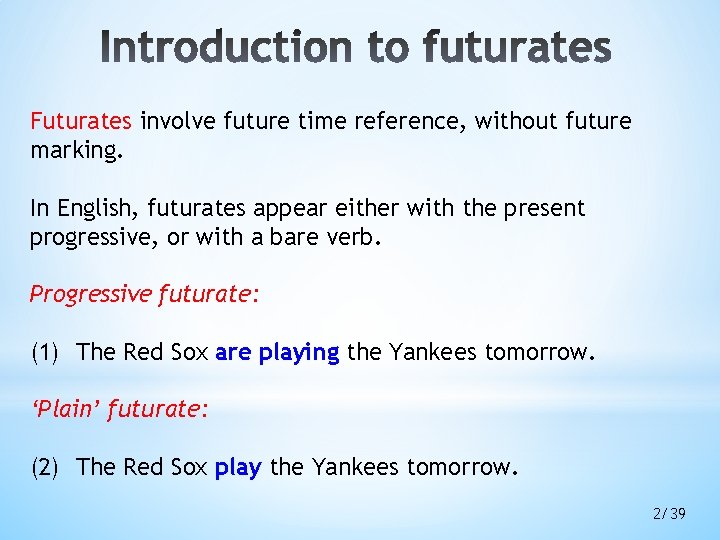
Futurates involve future time reference, without future marking. In English, futurates appear either with the present progressive, or with a bare verb. Progressive futurate: (1) The Red Sox are playing the Yankees tomorrow. ‘Plain’ futurate: (2) The Red Sox play the Yankees tomorrow. 2/39
Q 1: Do progressive and plain futurates convey different meanings? Q 2: What is the special contribution of the plain futurate? Q 3: What are the information structural properties of the plain futurate? 3/39
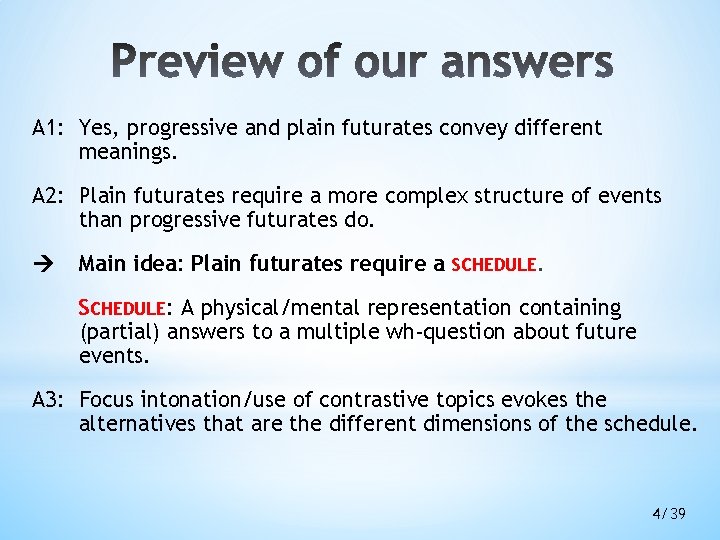
A 1: Yes, progressive and plain futurates convey different meanings. A 2: Plain futurates require a more complex structure of events than progressive futurates do. Main idea: Plain futurates require a SCHEDULE: A physical/mental representation containing (partial) answers to a multiple wh-question about future events. A 3: Focus intonation/use of contrastive topics evokes the alternatives that are the different dimensions of the schedule. 4/39
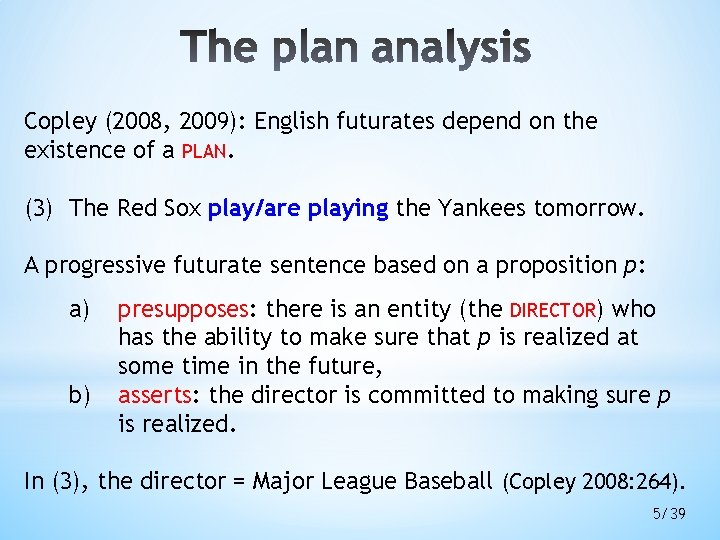
Copley (2008, 2009): English futurates depend on the existence of a PLAN. (3) The Red Sox play/are playing the Yankees tomorrow. A progressive futurate sentence based on a proposition p: a) b) presupposes: there is an entity (the DIRECTOR) who has the ability to make sure that p is realized at some time in the future, asserts: the director is committed to making sure p is realized. In (3), the director = Major League Baseball (Copley 2008: 264). 5/39
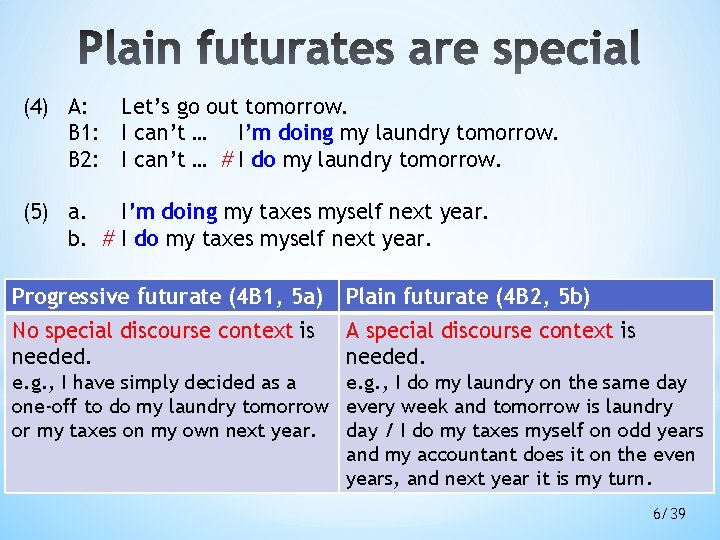
(4) A: Let’s go out tomorrow. B 1: I can’t … I’m doing my laundry tomorrow. B 2: I can’t … # I do my laundry tomorrow. (5) a. I’m doing my taxes myself next year. b. # I do my taxes myself next year. Progressive futurate (4 B 1, 5 a) Plain futurate (4 B 2, 5 b) No special discourse context is needed. A special discourse context is needed. e. g. , I have simply decided as a e. g. , I do my laundry on the same day one-off to do my laundry tomorrow every week and tomorrow is laundry or my taxes on my own next year. day / I do my taxes myself on odd years and my accountant does it on the even years, and next year it is my turn. 6/39
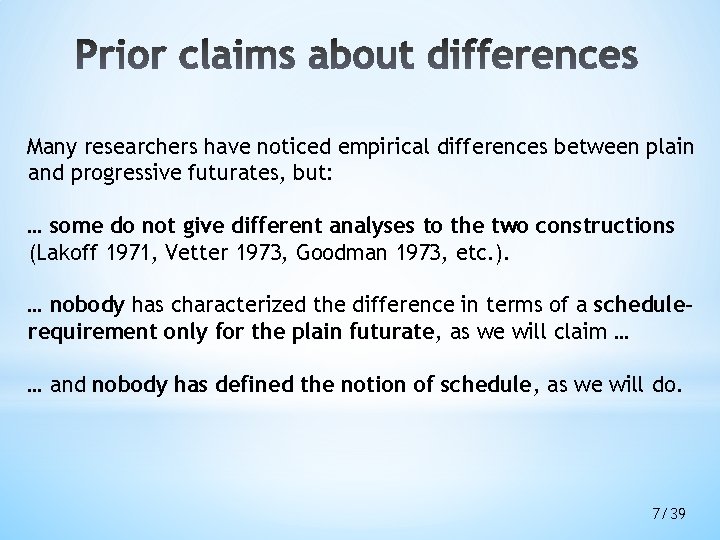
Many researchers have noticed empirical differences between plain and progressive futurates, but: … some do not give different analyses to the two constructions (Lakoff 1971, Vetter 1973, Goodman 1973, etc. ). … nobody has characterized the difference in terms of a schedulerequirement only for the plain futurate, as we will claim … … and nobody has defined the notion of schedule, as we will do. 7/39
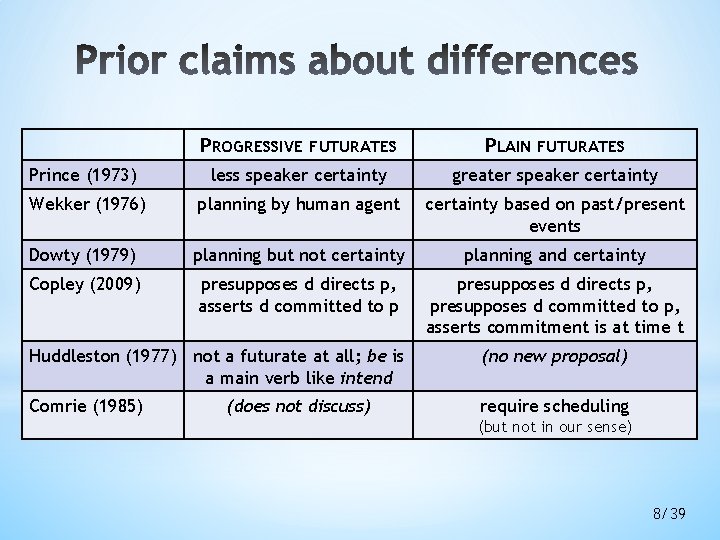
PROGRESSIVE FUTURATES PLAIN FUTURATES Prince (1973) less speaker certainty greater speaker certainty Wekker (1976) planning by human agent certainty based on past/present events Dowty (1979) planning but not certainty planning and certainty Copley (2009) presupposes d directs p, asserts d committed to p presupposes d directs p, presupposes d committed to p, asserts commitment is at time t Huddleston (1977) not a futurate at all; be is a main verb like intend (no new proposal) Comrie (1985) require scheduling (does not discuss) (but not in our sense) 8/39
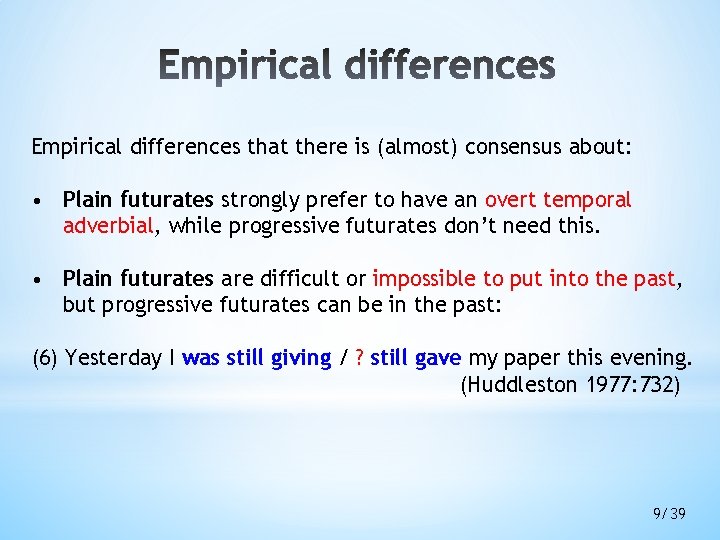
Empirical differences that there is (almost) consensus about: • Plain futurates strongly prefer to have an overt temporal adverbial, while progressive futurates don’t need this. • Plain futurates are difficult or impossible to put into the past, but progressive futurates can be in the past: (6) Yesterday I was still giving / ? still gave my paper this evening. (Huddleston 1977: 732) 9/39
Plain futurates, unlike progressive futurates, require a complex structure of future events: a SCHEDULE. 10/39
11/39
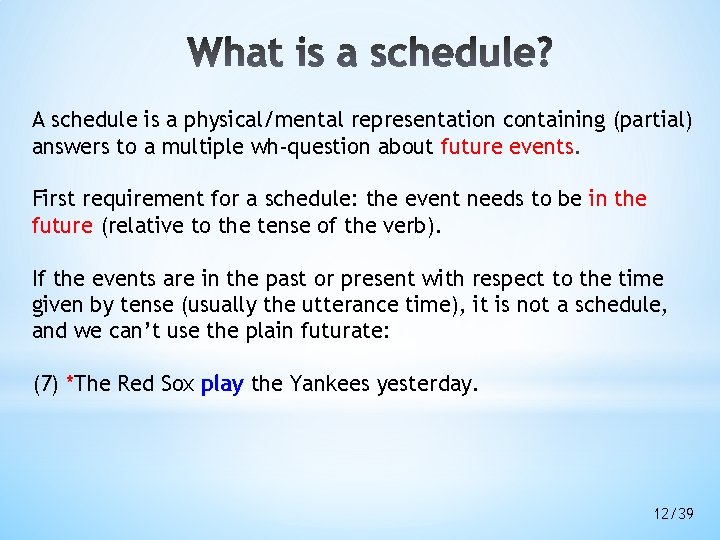
A schedule is a physical/mental representation containing (partial) answers to a multiple wh-question about future events. First requirement for a schedule: the event needs to be in the future (relative to the tense of the verb). If the events are in the past or present with respect to the time given by tense (usually the utterance time), it is not a schedule, and we can’t use the plain futurate: (7) *The Red Sox play the Yankees yesterday. 12/39
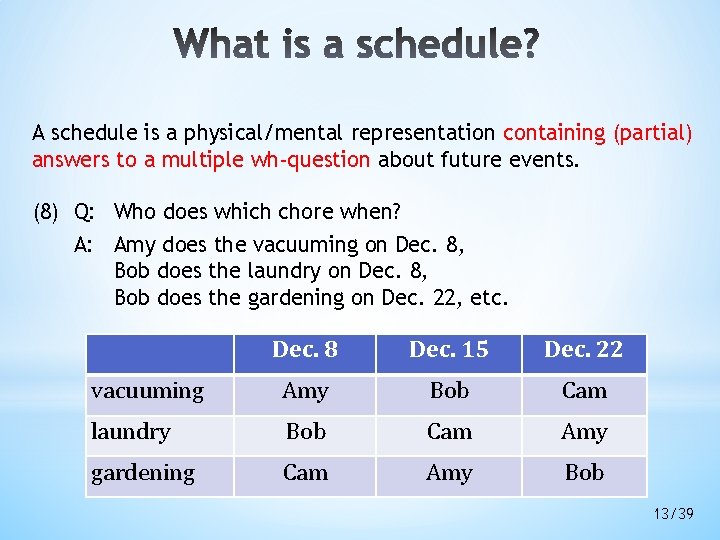
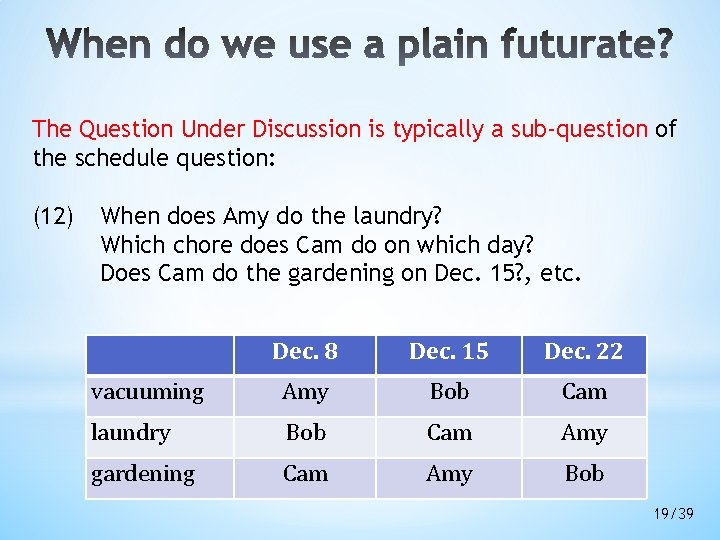
A schedule is a physical/mental representation containing (partial) answers to a multiple wh-question about future events. (8) Q: Who does which chore when? A: Amy does the vacuuming on Dec. 8, Bob does the laundry on Dec. 8, Bob does the gardening on Dec. 22, etc. Dec. 8 Dec. 15 Dec. 22 vacuuming Amy Bob Cam laundry Bob Cam Amy gardening Cam Amy Bob 13/39
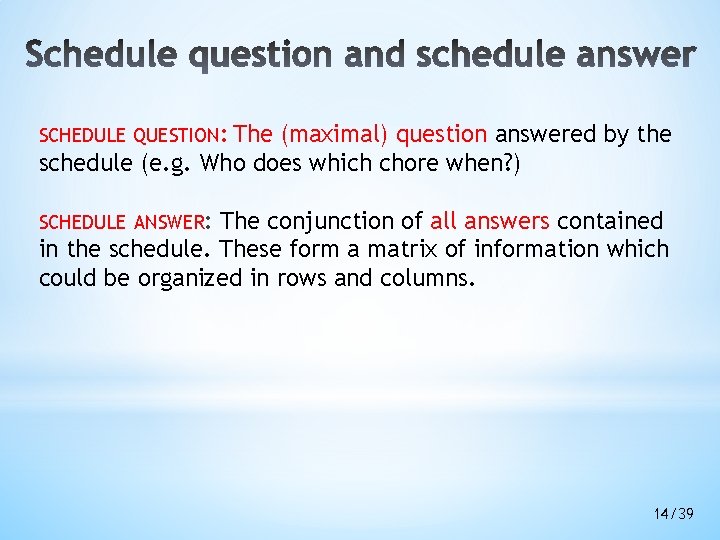
SCHEDULE QUESTION: The (maximal) question answered by the schedule (e. g. Who does which chore when? ) SCHEDULE ANSWER: The conjunction of all answers contained in the schedule. These form a matrix of information which could be organized in rows and columns. 14/39
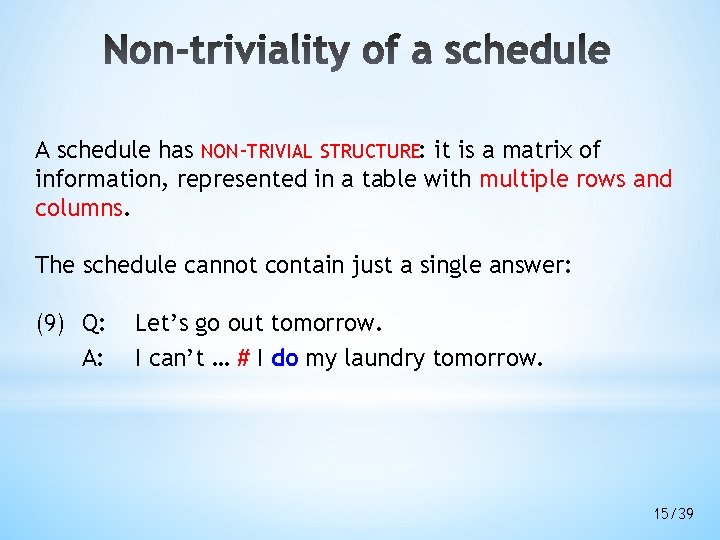
A schedule has NON-TRIVIAL STRUCTURE: it is a matrix of information, represented in a table with multiple rows and columns. The schedule cannot contain just a single answer: (9) Q: A: Let’s go out tomorrow. I can’t … # I do my laundry tomorrow. 15/39
16/39
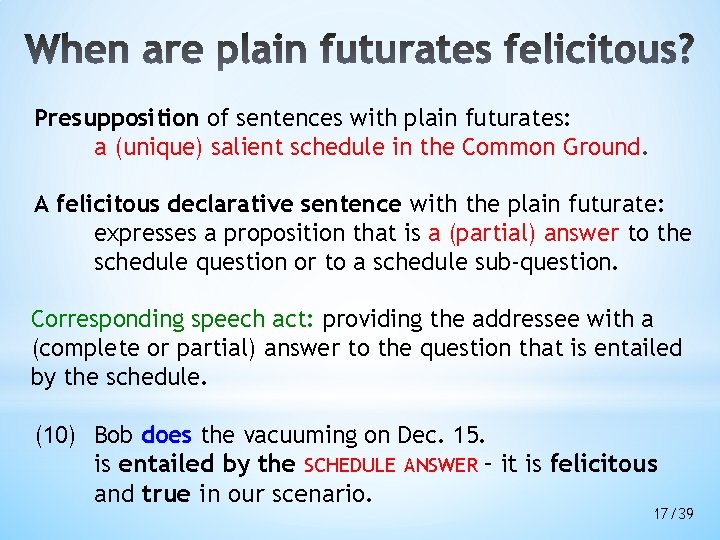
Presupposition of sentences with plain futurates: a (unique) salient schedule in the Common Ground. A felicitous declarative sentence with the plain futurate: expresses a proposition that is a (partial) answer to the schedule question or to a schedule sub-question. Corresponding speech act: providing the addressee with a (complete or partial) answer to the question that is entailed by the schedule. (10) Bob does the vacuuming on Dec. 15. is entailed by the SCHEDULE ANSWER – it is felicitous and true in our scenario. 17/39
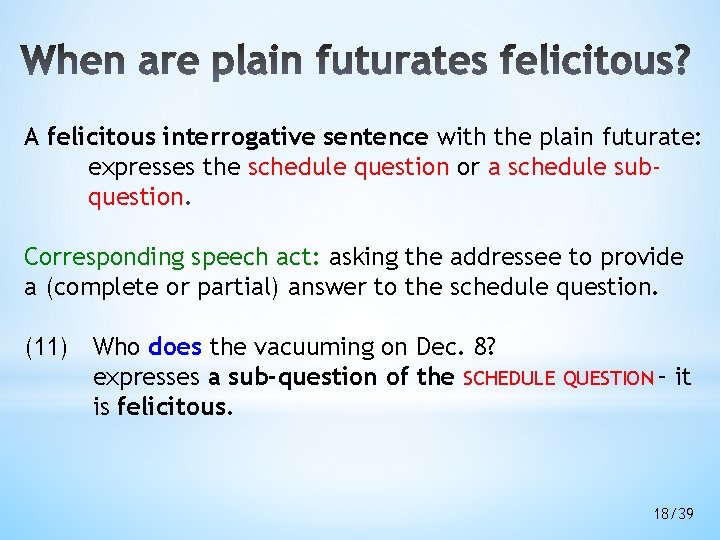
A felicitous interrogative sentence with the plain futurate: expresses the schedule question or a schedule subquestion. Corresponding speech act: asking the addressee to provide a (complete or partial) answer to the schedule question. (11) Who does the vacuuming on Dec. 8? expresses a sub-question of the SCHEDULE QUESTION – it is felicitous. 18/39
The Question Under Discussion is typically a sub-question of the schedule question: (12) When does Amy do the laundry? Which chore does Cam do on which day? Does Cam do the gardening on Dec. 15? , etc. Dec. 8 Dec. 15 Dec. 22 vacuuming Amy Bob Cam laundry Bob Cam Amy gardening Cam Amy Bob 19/39
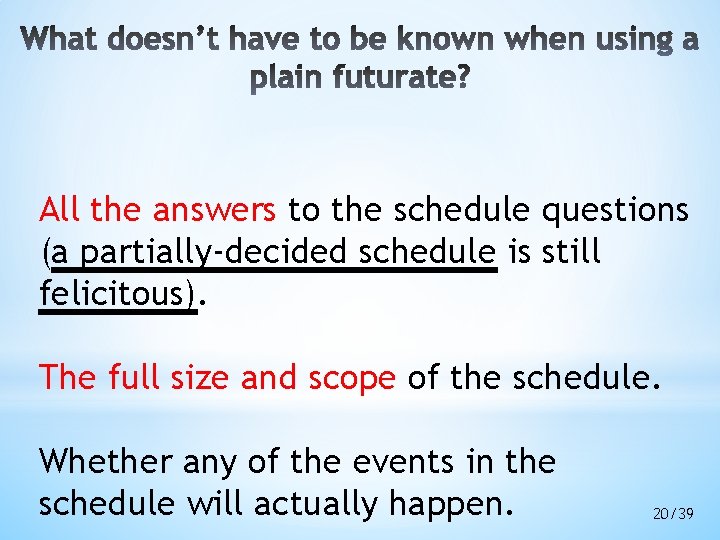
All the answers to the schedule questions (a partially-decided schedule is still felicitous). The full size and scope of the schedule. Whether any of the events in the schedule will actually happen. 20/39
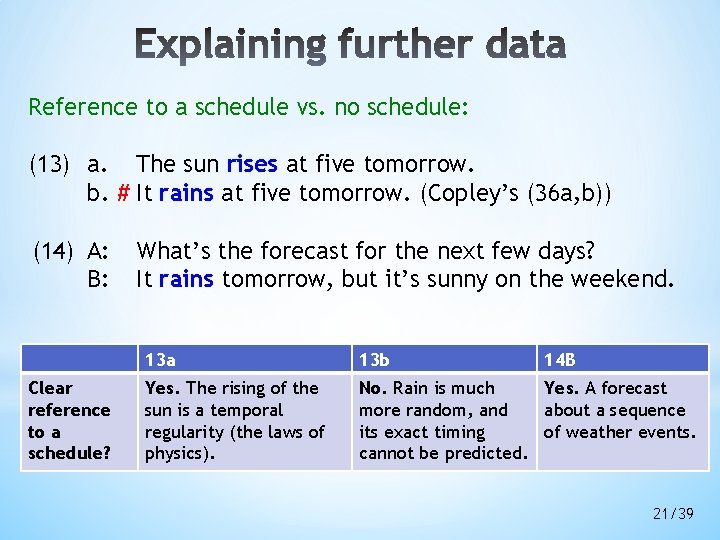
Reference to a schedule vs. no schedule: (13) a. The sun rises at five tomorrow. b. # It rains at five tomorrow. (Copley’s (36 a, b)) (14) A: B: Clear reference to a schedule? What’s the forecast for the next few days? It rains tomorrow, but it’s sunny on the weekend. 13 a 13 b 14 B Yes. The rising of the sun is a temporal regularity (the laws of physics). No. Rain is much Yes. A forecast more random, and about a sequence its exact timing of weather events. cannot be predicted. 21/39
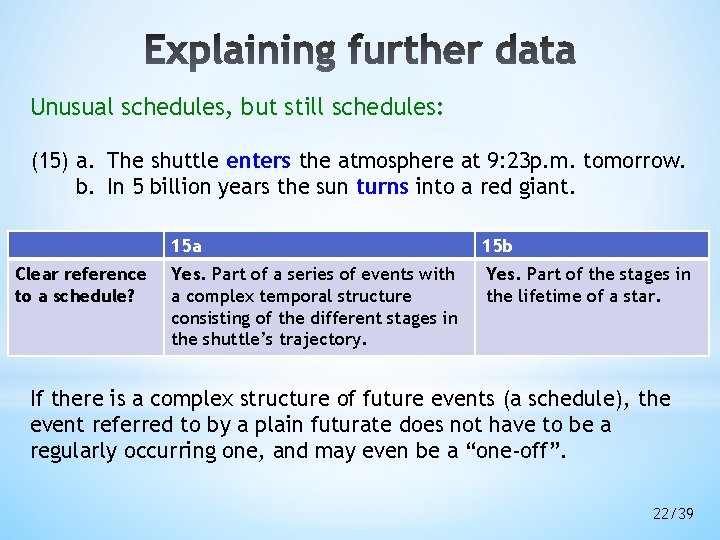
Unusual schedules, but still schedules: (15) a. The shuttle enters the atmosphere at 9: 23 p. m. tomorrow. b. In 5 billion years the sun turns into a red giant. Clear reference to a schedule? 15 a 15 b Yes. Part of a series of events with a complex temporal structure consisting of the different stages in the shuttle’s trajectory. Yes. Part of the stages in the lifetime of a star. If there is a complex structure of future events (a schedule), the event referred to by a plain futurate does not have to be a regularly occurring one, and may even be a “one-off”. 22/39
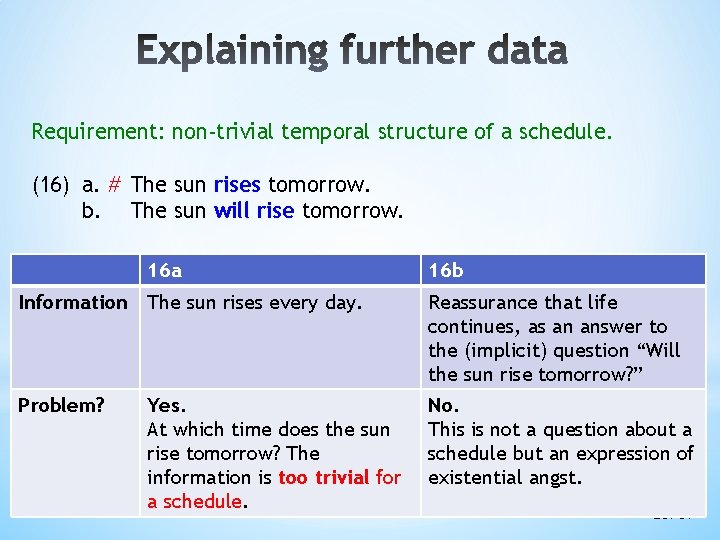
Requirement: non-trivial temporal structure of a schedule. (16) a. # The sun rises tomorrow. b. The sun will rise tomorrow. 16 a 16 b Information The sun rises every day. Reassurance that life continues, as an answer to the (implicit) question “Will the sun rise tomorrow? ” Problem? No. This is not a question about a schedule but an expression of existential angst. Yes. At which time does the sun rise tomorrow? The information is too trivial for a schedule. 23/39
24/39
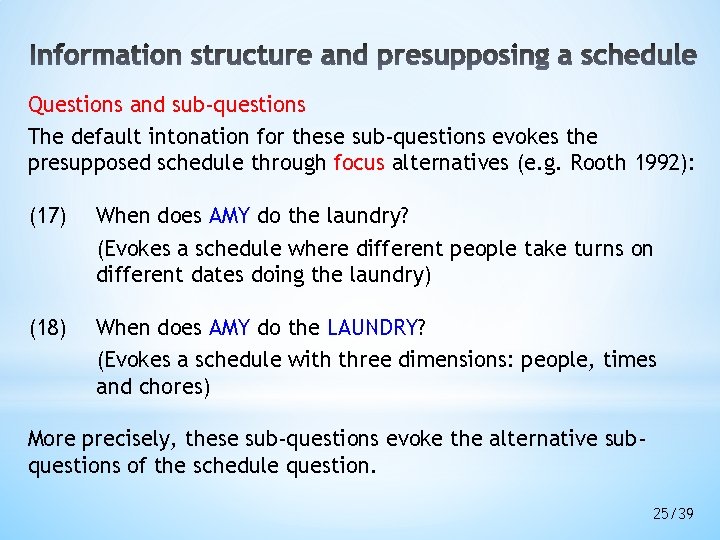
Questions and sub-questions The default intonation for these sub-questions evokes the presupposed schedule through focus alternatives (e. g. Rooth 1992): (17) When does AMY do the laundry? (Evokes a schedule where different people take turns on different dates doing the laundry) (18) When does AMY do the LAUNDRY? (Evokes a schedule with three dimensions: people, times and chores) More precisely, these sub-questions evoke the alternative subquestions of the schedule question. 25/39
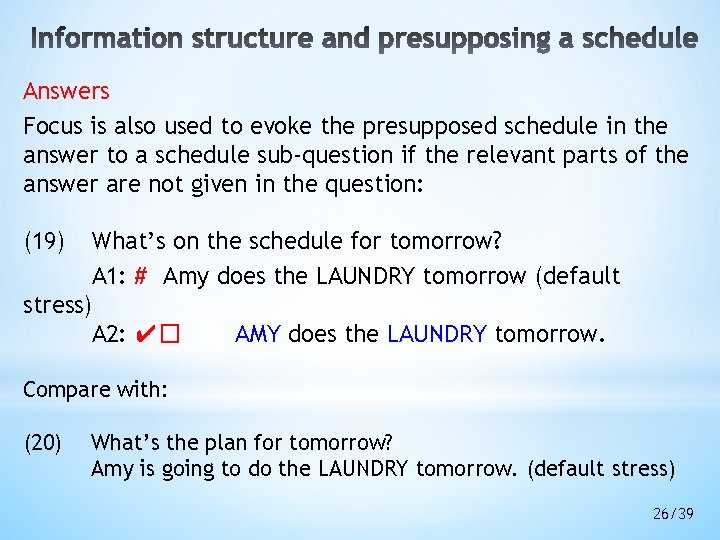
Answers Focus is also used to evoke the presupposed schedule in the answer to a schedule sub-question if the relevant parts of the answer are not given in the question: (19) What’s on the schedule for tomorrow? A 1: # Amy does the LAUNDRY tomorrow (default stress) A 2: ✔� AMY does the LAUNDRY tomorrow. Compare with: (20) What’s the plan for tomorrow? Amy is going to do the LAUNDRY tomorrow. (default stress) 26/39
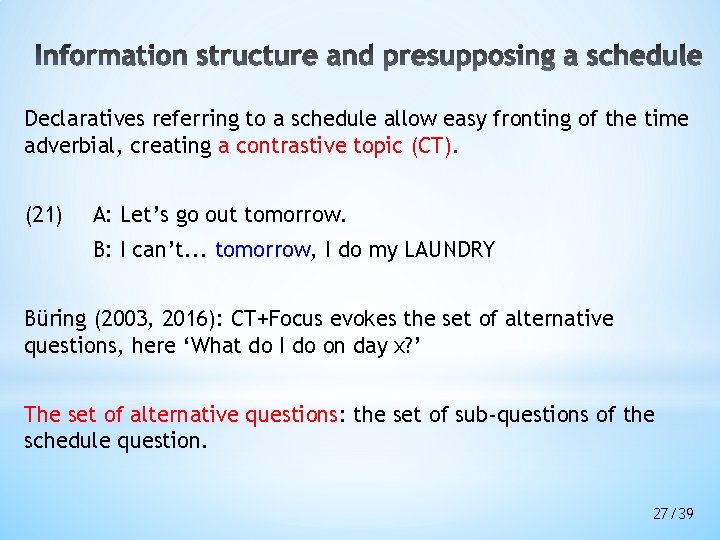
Declaratives referring to a schedule allow easy fronting of the time adverbial, creating a contrastive topic (CT). (21) A: Let’s go out tomorrow. B: I can’t. . . tomorrow, I do my LAUNDRY Büring (2003, 2016): CT+Focus evokes the set of alternative questions, here ‘What do I do on day x? ’ The set of alternative questions: the set of sub-questions of the schedule question. 27/39
28/39
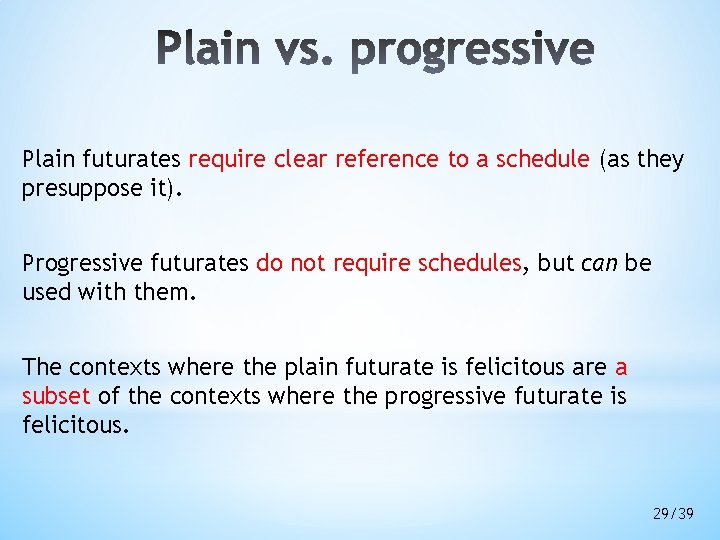
Plain futurates require clear reference to a schedule (as they presuppose it). Progressive futurates do not require schedules, but can be used with them. The contexts where the plain futurate is felicitous are a subset of the contexts where the progressive futurate is felicitous. 29/39
A plan: an intension and the ability to carry something out on the part of the director (Copley 2008). If plan were represented in a table, it could be a trivial table consisting of just one cell. (4) A: Let’s go out tomorrow. B 1: I can’t … I’m doing my laundry tomorrow. B 2: I can’t … # I do my laundry tomorrow. (5) a. I’m doing my taxes myself next year. b. #I do my taxes myself next year. 30/39
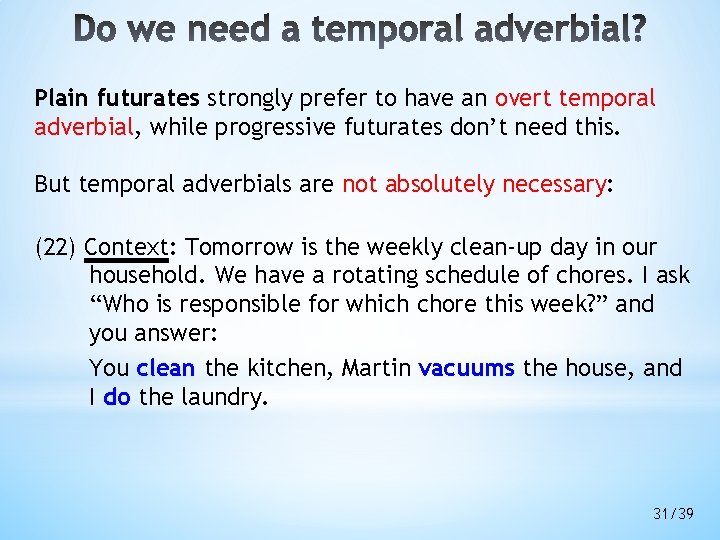
Plain futurates strongly prefer to have an overt temporal adverbial, while progressive futurates don’t need this. But temporal adverbials are not absolutely necessary: (22) Context: Tomorrow is the weekly clean-up day in our household. We have a rotating schedule of chores. I ask “Who is responsible for which chore this week? ” and you answer: You clean the kitchen, Martin vacuums the house, and I do the laundry. 31/39
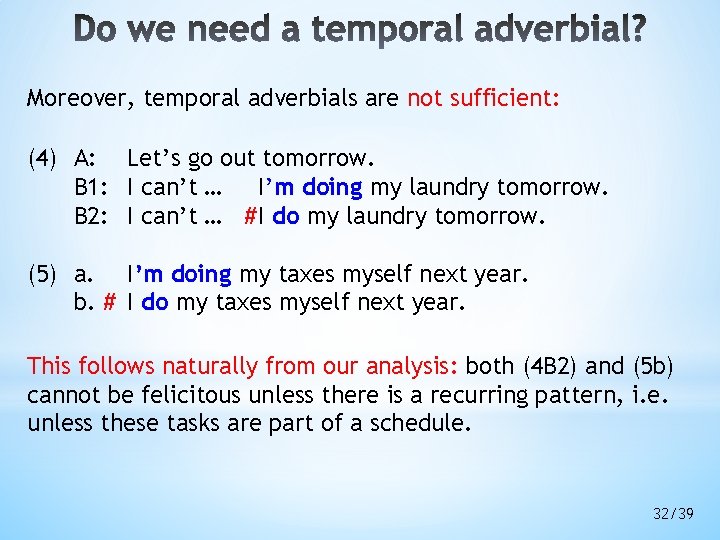
Moreover, temporal adverbials are not sufficient: (4) A: Let’s go out tomorrow. B 1: I can’t … I’m doing my laundry tomorrow. B 2: I can’t … #I do my laundry tomorrow. (5) a. I’m doing my taxes myself next year. b. # I do my taxes myself next year. This follows naturally from our analysis: both (4 B 2) and (5 b) cannot be felicitous unless there is a recurring pattern, i. e. unless these tasks are part of a schedule. 32/39
33/39
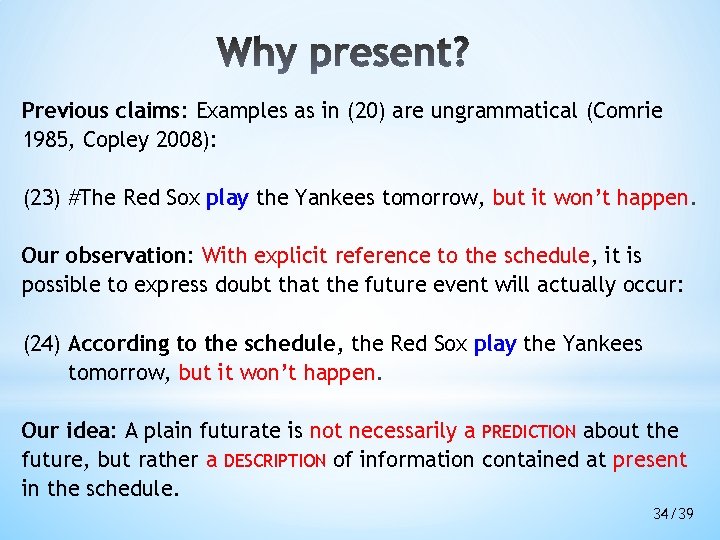
Previous claims: Examples as in (20) are ungrammatical (Comrie 1985, Copley 2008): (23) #The Red Sox play the Yankees tomorrow, but it won’t happen. Our observation: With explicit reference to the schedule, it is possible to express doubt that the future event will actually occur: (24) According to the schedule, the Red Sox play the Yankees tomorrow, but it won’t happen. Our idea: A plain futurate is not necessarily a PREDICTION about the future, but rather a DESCRIPTION of information contained at present in the schedule. 34/39
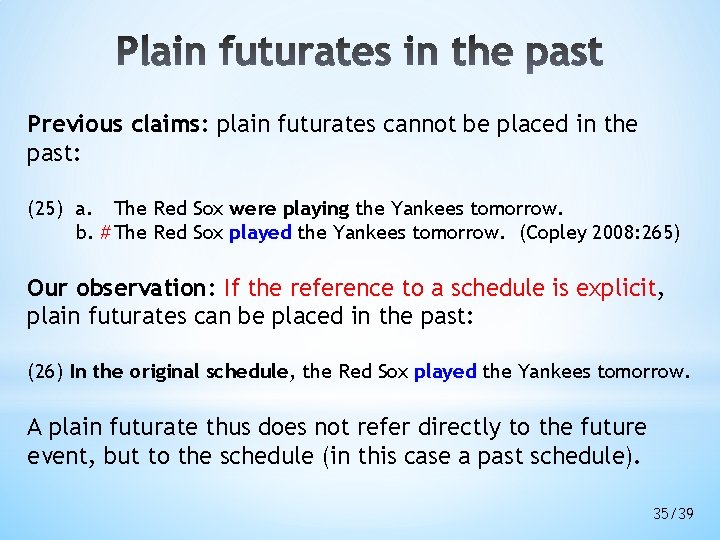
Previous claims: plain futurates cannot be placed in the past: (25) a. The Red Sox were playing the Yankees tomorrow. b. # The Red Sox played the Yankees tomorrow. (Copley 2008: 265) Our observation: If the reference to a schedule is explicit, plain futurates can be placed in the past: (26) In the original schedule, the Red Sox played the Yankees tomorrow. A plain futurate thus does not refer directly to the future event, but to the schedule (in this case a past schedule). 35/39
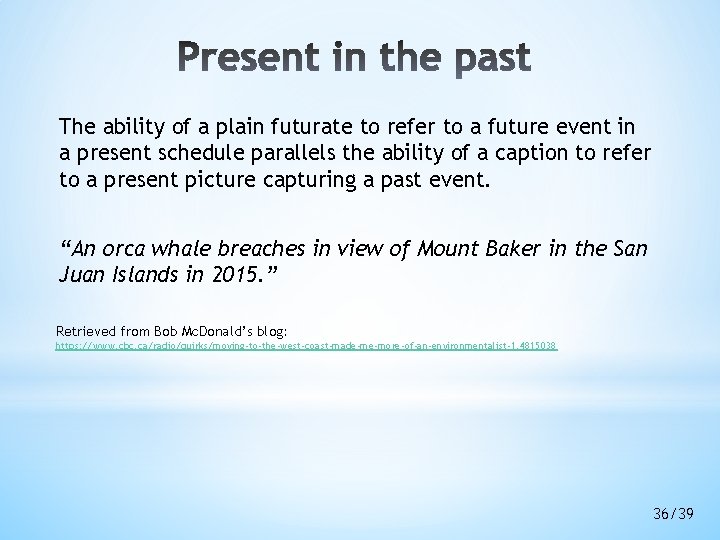
The ability of a plain futurate to refer to a future event in a present schedule parallels the ability of a caption to refer to a present picture capturing a past event. “An orca whale breaches in view of Mount Baker in the San Juan Islands in 2015. ” Retrieved from Bob Mc. Donald’s blog: https: //www. cbc. ca/radio/quirks/moving-to-the-west-coast-made-me-more-of-an-environmentalist-1. 4815038 36/39
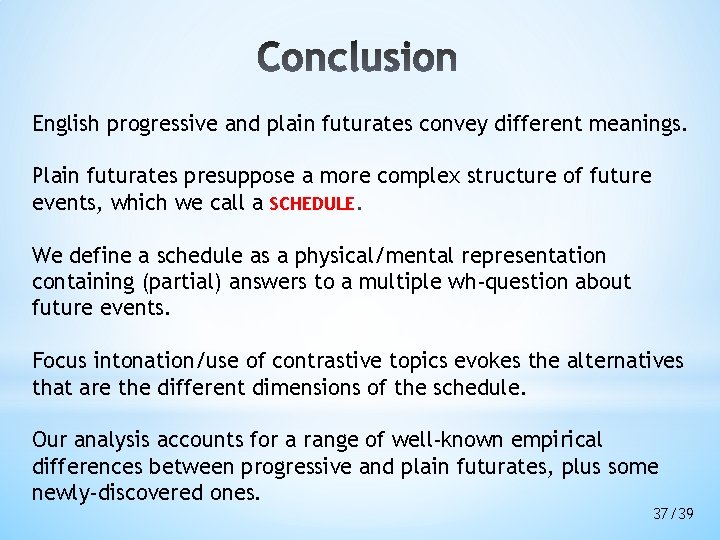
English progressive and plain futurates convey different meanings. Plain futurates presuppose a more complex structure of future events, which we call a SCHEDULE. We define a schedule as a physical/mental representation containing (partial) answers to a multiple wh-question about future events. Focus intonation/use of contrastive topics evokes the alternatives that are the different dimensions of the schedule. Our analysis accounts for a range of well-known empirical differences between progressive and plain futurates, plus some newly-discovered ones. 37/39
It is because of Michael’s influence that we have been prompted to think about these questions in terms of information structure and it is because of Michael’s skill as a teacher that we had the background to do so. His example continues to inspire us to try to approach questions with more intellectual rigor, and we deeply wish he could be here to discuss these ideas with us. We miss him very much as a friend, teacher and colleague and we miss his intellectual contribution to us and our department very much. 38/39
Büring, D. (2003). On D-trees, beans, and B-accents. Linguistics and philosophy, 26(5), 511 -545. Büring, Daniel. 2016. (Contrastive) topic. In The Oxford handbook of information structure, ed. by Caroline Féry and Shin Ishihara, 64– 85. Oxford: Oxford University Press. Comrie, B. (1985). Tense. Cambridge: Cambridge UP. Copley, B. (2008). The plan's the thing: Deconstructing futurate meanings. Linguistic inquiry, 39(2), 261 -274. Copley, B. (2009). The semantics of the future. New York: Routledge. Dowty, D. R. (1979). Word meaning and Montague Grammar: The semantics of verbs and times in generative semantics and in Montague’s PTQ (Studies in Linguistics and Philosophy). Dordrecht, Holland: D. Dordrecht: Reidel. Goodman, F. (1973). On the Semantics of Futurate Sentences, Working Papers in Linguistics (Ohio State University) 16, 76 -89. Huddleston, R. (1977). The futurate construction. Linguistic Inquiry 8(4), 730 -736. Lakoff, G. (1971). Presupposition and Relative Well-Formedness, in D. Steinberg and L. A. Jakobovits, eds. , Semantics. London: Cambridge University Press. Prince, E. (1973). Futurate be-ing or why Yesterday morning, I was leaving tomorrow on the Midnight Special is ok. Paper delivered at the LSA summer meeting, Ann Arbor. Rooth, M. (1992). A theory of focus interpretation. Natural language semantics, 1(1), 75 -116. Vetter, D. C. (1973). Someone Solves This Problem Tomorrow, Linguistic Inquiry 4, 104 -108. Wekker, H. C. (1976). The Expression of Future Time in Contemporary British English, North. Holland, Amsterdam. 39/39