
UNLV Enrollment Forecasting Sabrina Beckman Stefan Cline Dr
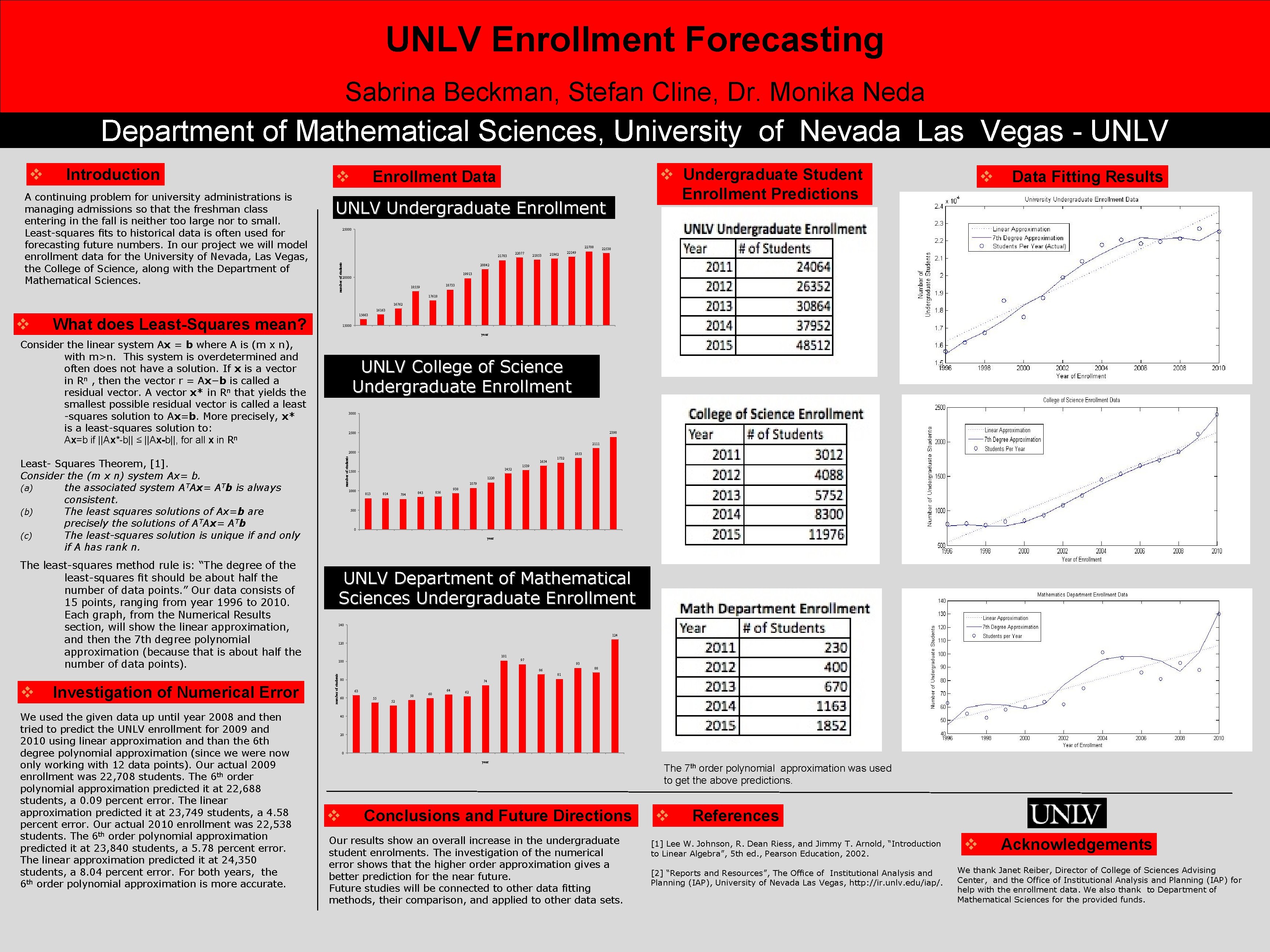
UNLV Enrollment Forecasting Sabrina Beckman, Stefan Cline, Dr. Monika Neda Department of Mathematical Sciences, University of Nevada Las Vegas - UNLV Introduction A continuing problem for university administrations is managing admissions so that the freshman class entering in the fall is neither too large nor to small. Least-squares fits to historical data is often used forecasting future numbers. In our project we will model enrollment data for the University of Nevada, Las Vegas, the College of Science, along with the Department of Mathematical Sciences. v v Undergraduate Student Enrollment Predictions Enrollment Data UNLV Undergraduate Enrollment v Data Fitting Results 25000 22708 21783 number of students v 22077 21853 21962 22538 22149 20842 19913 20000 18733 18559 17618 16762 16163 v 15663 What does Least-Squares mean? 15000 year Consider the linear system Ax = b where A is (m x n), with m>n. This system is overdetermined and often does not have a solution. If x is a vector in Rn , then the vector r = Ax−b is called a residual vector. A vector x* in Rn that yields the smallest possible residual vector is called a least -squares solution to Ax=b. More precisely, x* is a least-squares solution to: Ax=b if ||Ax*-b|| ≤ ||Ax-b||, for all x in Rn UNLV College of Science Undergraduate Enrollment 3000 2398 2500 2111 number of students 2000 Least- Squares Theorem, [1]. Consider the (m x n) system Ax= b. (a) the associated system ATAx= ATb is always consistent. (b) The least squares solutions of Ax=b are precisely the solutions of ATAx= ATb (c) The least-squares solution is unique if and only if A has rank n. We used the given data up until year 2008 and then tried to predict the UNLV enrollment for 2009 and 2010 using linear approximation and than the 6 th degree polynomial approximation (since we were now only working with 12 data points). Our actual 2009 enrollment was 22, 708 students. The 6 th order polynomial approximation predicted it at 22, 688 students, a 0. 09 percent error. The linear approximation predicted it at 23, 749 students, a 4. 58 percent error. Our actual 2010 enrollment was 22, 538 students. The 6 th order polynomial approximation predicted it at 23, 840 students, a 5. 78 percent error. The linear approximation predicted it at 24, 350 students, a 8. 04 percent error. For both years, the 6 th order polynomial approximation is more accurate. 1452 1500 1539 1220 1079 814 813 856 843 794 938 500 0 year UNLV Department of Mathematical Sciences Undergraduate Enrollment 140 124 120 101 100 97 93 88 86 number of students Investigation of Numerical Error 1654 1000 The least-squares method rule is: “The degree of the least-squares fit should be about half the number of data points. ” Our data consists of 15 points, ranging from year 1996 to 2010. Each graph, from the Numerical Results section, will show the linear approximation, and then the 7 th degree polynomial approximation (because that is about half the number of data points). v 1853 1732 81 80 74 63 60 55 58 60 64 62 52 40 20 0 year v Conclusions and Future Directions Our results show an overall increase in the undergraduate student enrolments. The investigation of the numerical error shows that the higher order approximation gives a better prediction for the near future. Future studies will be connected to other data fitting methods, their comparison, and applied to other data sets. The 7 th order polynomial approximation was used to get the above predictions. v References [1] Lee W. Johnson, R. Dean Riess, and Jimmy T. Arnold, “Introduction to Linear Algebra”, 5 th ed. , Pearson Education, 2002. [2] “Reports and Resources”, The Office of Institutional Analysis and Planning (IAP), University of Nevada Las Vegas, http: //ir. unlv. edu/iap/. v Acknowledgements We thank Janet Reiber, Director of College of Sciences Advising Center, and the Office of Institutional Analysis and Planning (IAP) for help with the enrollment data. We also thank to Department of Mathematical Sciences for the provided funds.
- Slides: 1