
Universa Universis Patavina Libertas LIGHTOUTPUT SIMULATIONS FOR NEDA
“Universa Universis Patavina Libertas” LIGHT-OUTPUT SIMULATIONS FOR NEDA Andrea Gottardo Università di Padova 07/03/2021 NEDA meeting 1
Plan of presentation Introduction : The importance of light-output response in scintillators Calculations for light-output produced by neutrons Light-output spectra First estimations of efficiency and cross-talk for NEDA Conclusions 07/03/2021 NEDA meeting 2
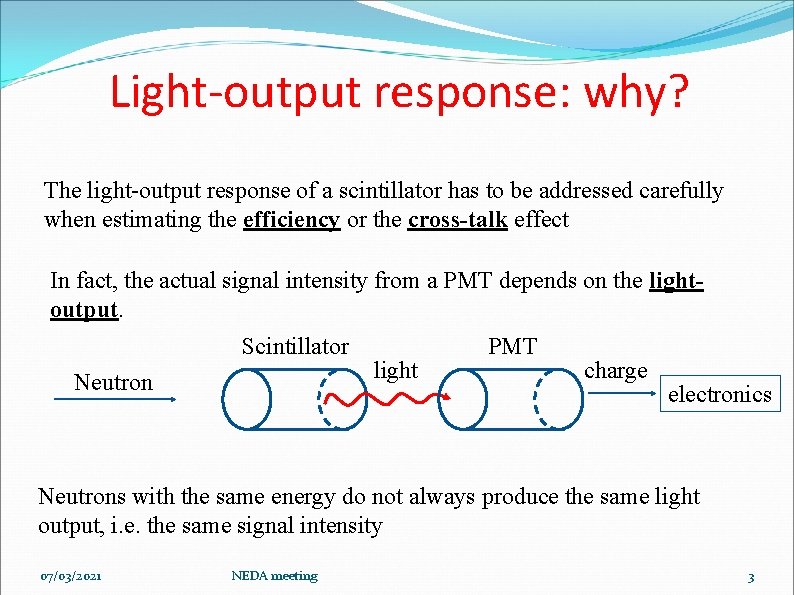
Light-output response: why? The light-output response of a scintillator has to be addressed carefully when estimating the efficiency or the cross-talk effect In fact, the actual signal intensity from a PMT depends on the lightoutput. Scintillator Neutron light PMT charge electronics Neutrons with the same energy do not always produce the same light output, i. e. the same signal intensity 07/03/2021 NEDA meeting 3
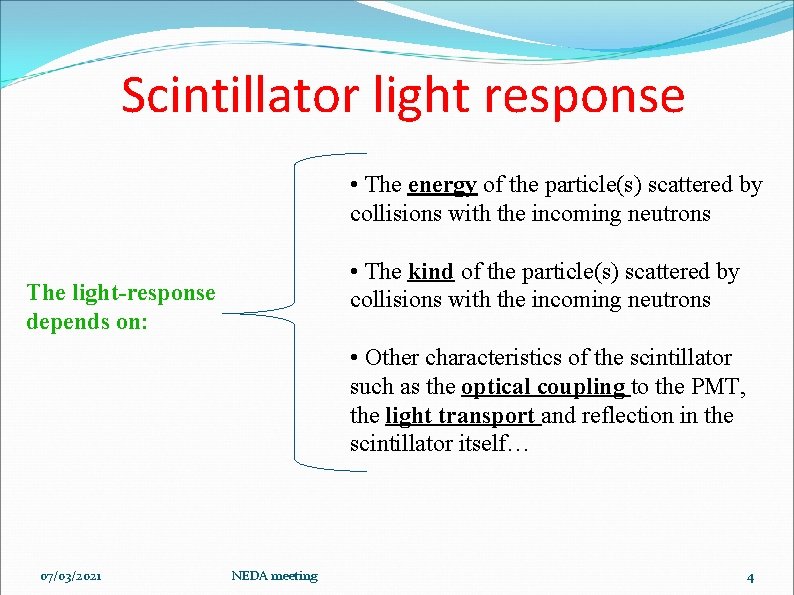
Scintillator light response • The energy of the particle(s) scattered by collisions with the incoming neutrons • The kind of the particle(s) scattered by collisions with the incoming neutrons The light-response depends on: • Other characteristics of the scintillator such as the optical coupling to the PMT, the light transport and reflection in the scintillator itself… 07/03/2021 NEDA meeting 4
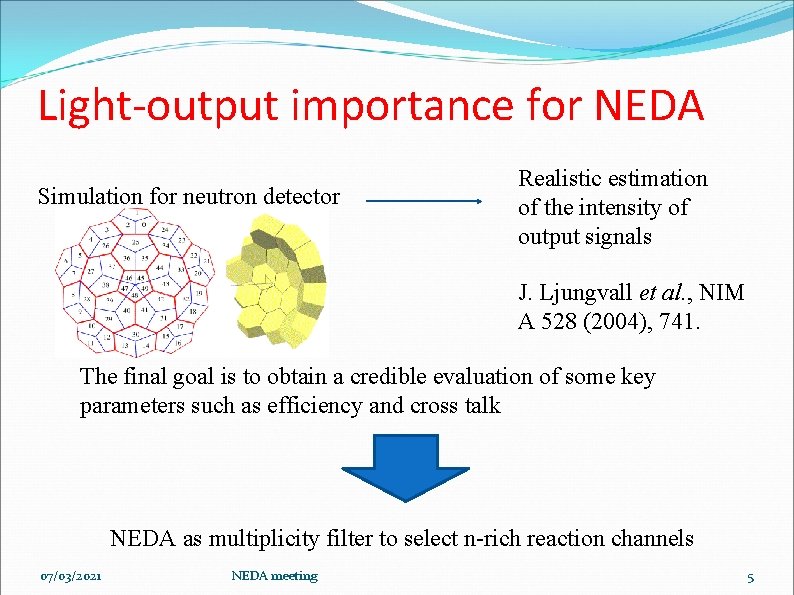
Light-output importance for NEDA Simulation for neutron detector Realistic estimation of the intensity of output signals J. Ljungvall et al. , NIM A 528 (2004), 741. The final goal is to obtain a credible evaluation of some key parameters such as efficiency and cross talk NEDA as multiplicity filter to select n-rich reaction channels 07/03/2021 NEDA meeting 5
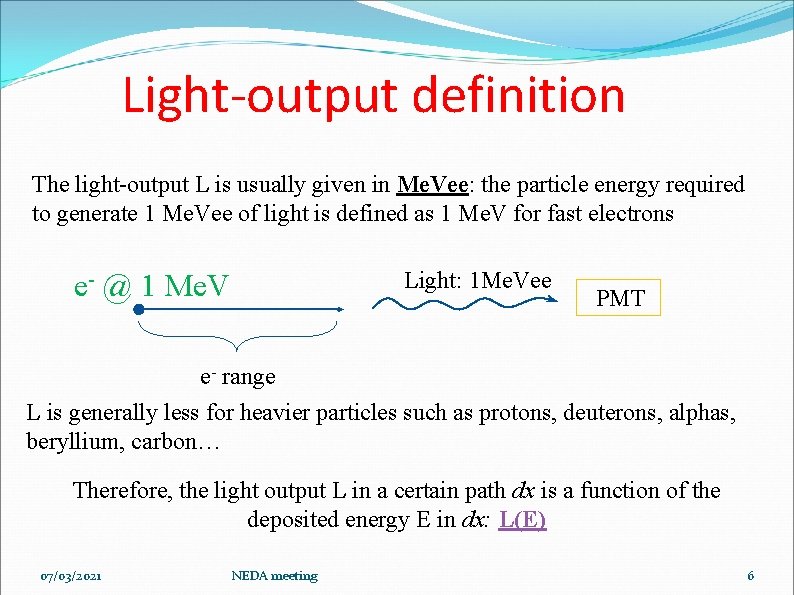
Light-output definition The light-output L is usually given in Me. Vee: the particle energy required to generate 1 Me. Vee of light is defined as 1 Me. V for fast electrons Light: 1 Me. Vee e- @ 1 Me. V PMT e- range L is generally less for heavier particles such as protons, deuterons, alphas, beryllium, carbon… Therefore, the light output L in a certain path dx is a function of the deposited energy E in dx: L(E) 07/03/2021 NEDA meeting 6
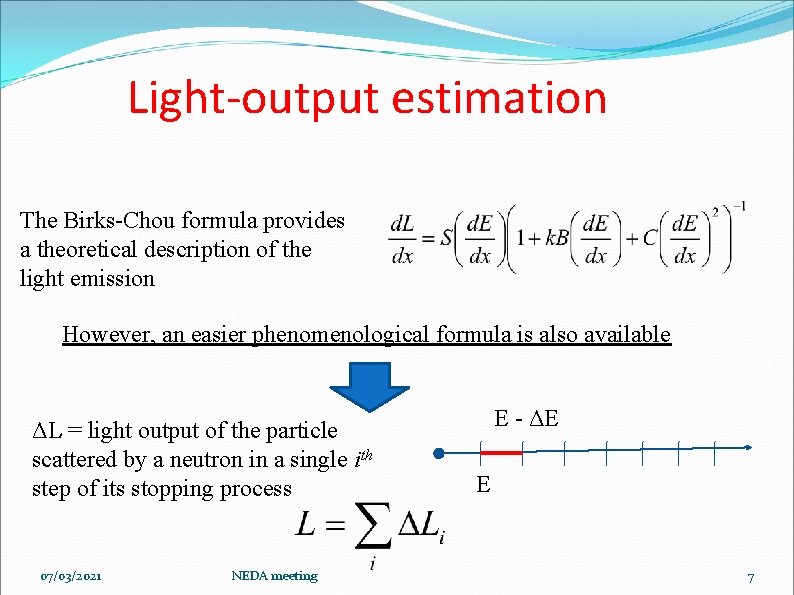
Light-output estimation The Birks-Chou formula provides a theoretical description of the light emission However, an easier phenomenological formula is also available ΔL = light output of the particle scattered by a neutron in a single ith step of its stopping process 07/03/2021 NEDA meeting E - ΔE E 7
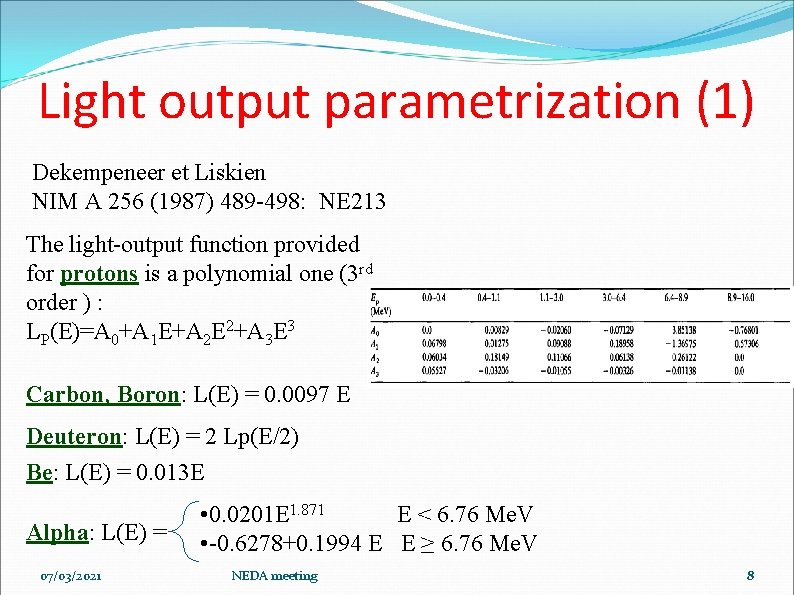
Light output parametrization (1) Dekempeneer et Liskien NIM A 256 (1987) 489 -498: NE 213 The light-output function provided for protons is a polynomial one (3 rd order ) : LP(E)=A 0+A 1 E+A 2 E 2+A 3 E 3 Carbon, Boron: L(E) = 0. 0097 E Deuteron: L(E) = 2 Lp(E/2) Be: L(E) = 0. 013 E Alpha: L(E) = 07/03/2021 • 0. 0201 E 1. 871 E < 6. 76 Me. V • -0. 6278+0. 1994 E E ≥ 6. 76 Me. V NEDA meeting 8
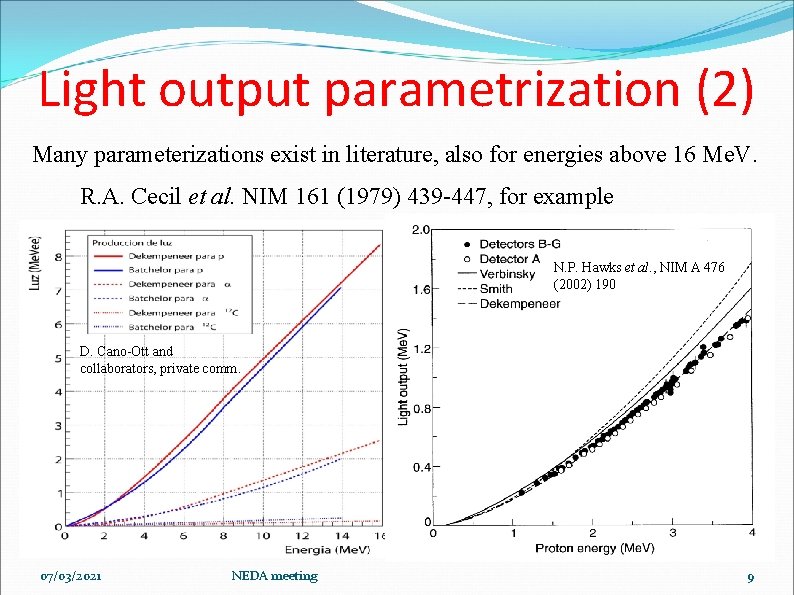
Light output parametrization (2) Many parameterizations exist in literature, also for energies above 16 Me. V. R. A. Cecil et al. NIM 161 (1979) 439 -447, for example N. P. Hawks et al. , NIM A 476 (2002) 190 D. Cano-Ott and collaborators, private comm. 07/03/2021 NEDA meeting 9
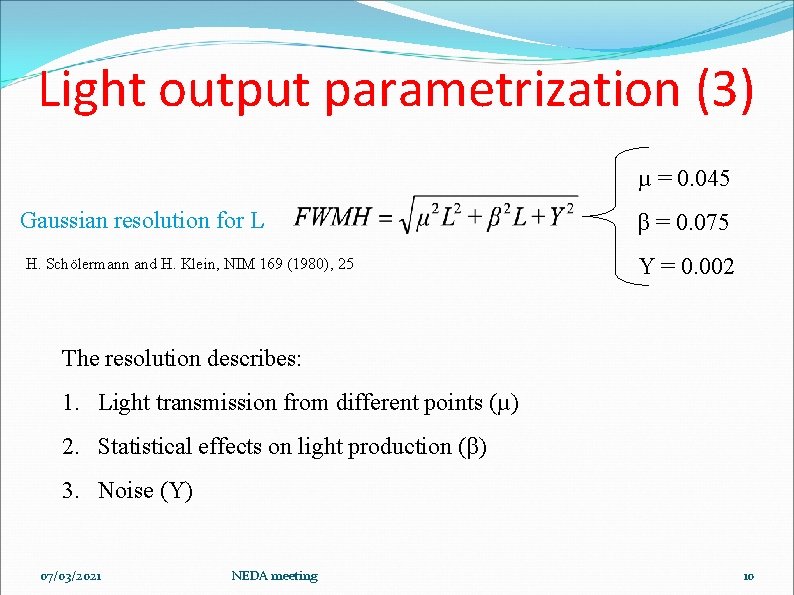
Light output parametrization (3) µ = 0. 045 Gaussian resolution for L H. Schölermann and H. Klein, NIM 169 (1980), 25 β = 0. 075 Y = 0. 002 The resolution describes: 1. Light transmission from different points (µ) 2. Statistical effects on light production (β) 3. Noise (Y) 07/03/2021 NEDA meeting 10
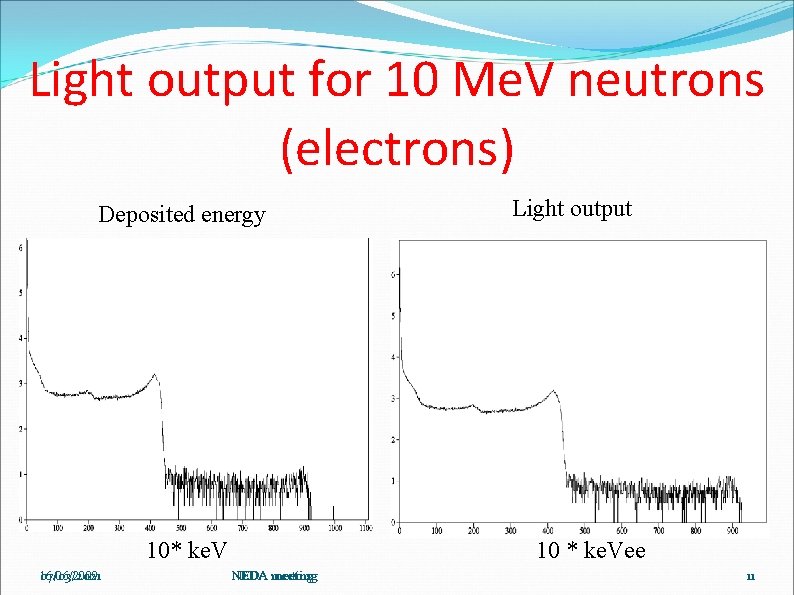
Light output for 10 Me. V neutrons (electrons) Deposited energy 10* ke. V 07/03/2021 16/06/2009 Light output 10 * ke. Vee NEDA meeting 11
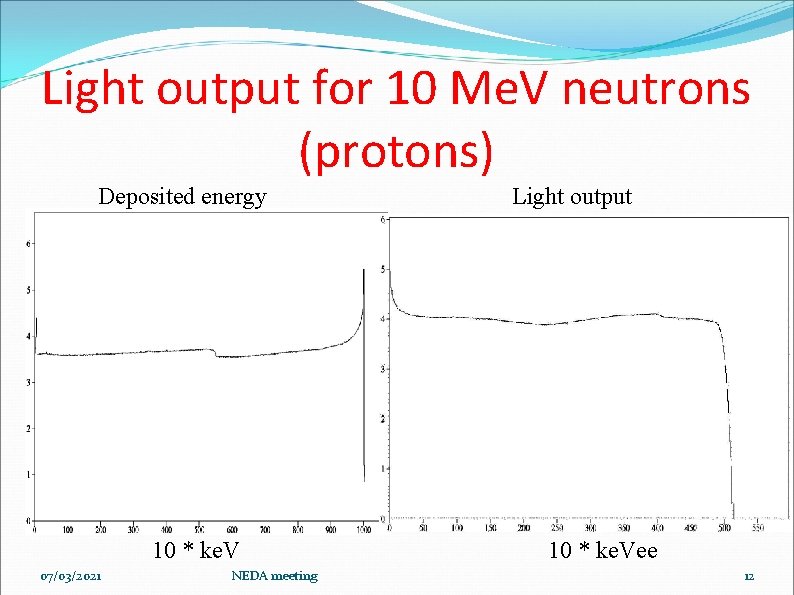
Light output for 10 Me. V neutrons (protons) Deposited energy 10 * ke. V 07/03/2021 NEDA meeting Light output 10 * ke. Vee 12
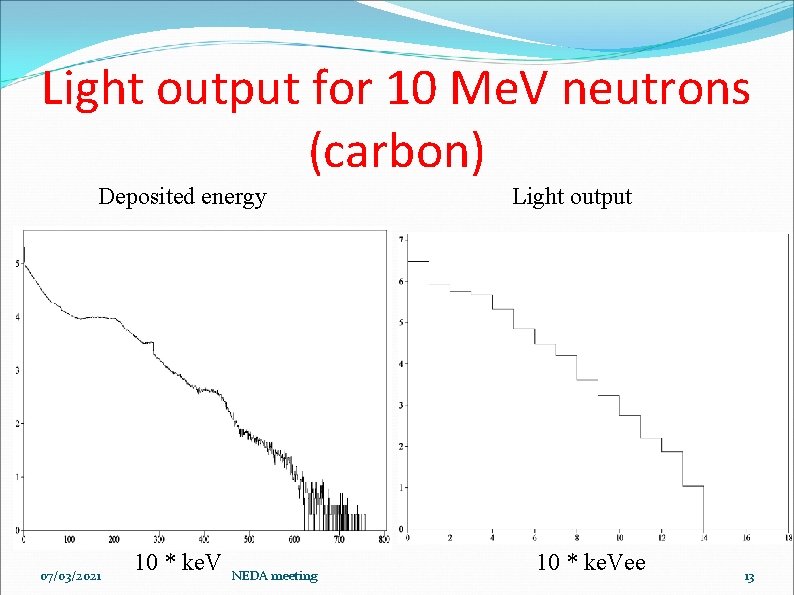
Light output for 10 Me. V neutrons (carbon) Deposited energy 07/03/2021 10 * ke. V NEDA meeting Light output 10 * ke. Vee 13
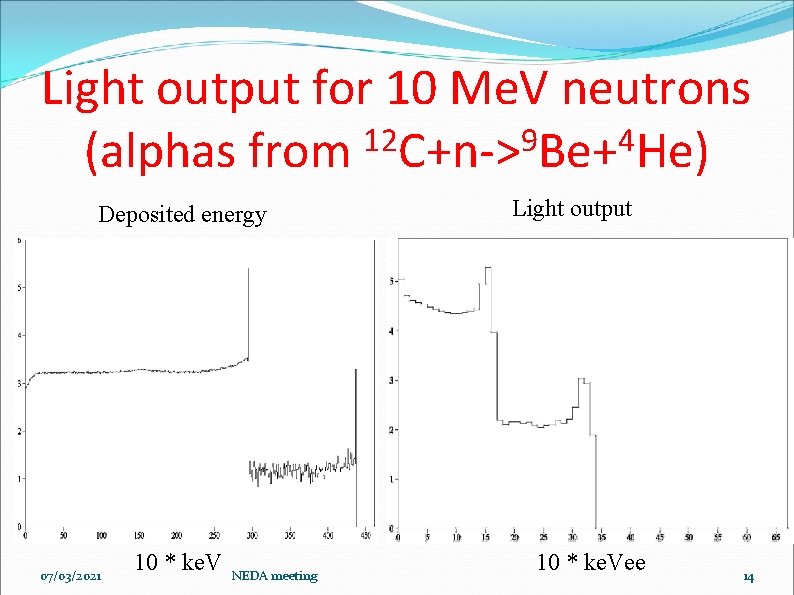
Light output for 10 Me. V neutrons 12 9 4 (alphas from C+n-> Be+ He) Deposited energy 07/03/2021 10 * ke. V NEDA meeting Light output 10 * ke. Vee 14
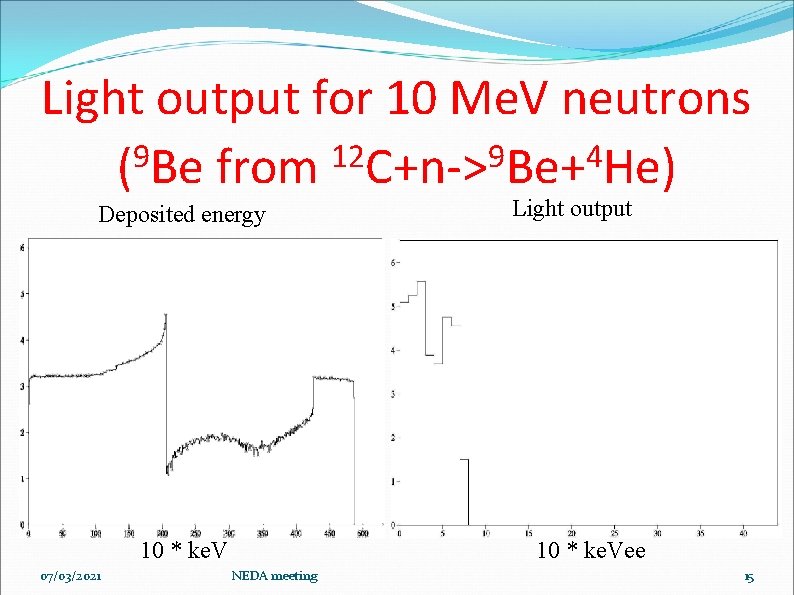
Light output for 10 Me. V neutrons 9 12 9 4 ( Be from C+n-> Be+ He) Deposited energy 10 * ke. V 07/03/2021 Light output 10 * ke. Vee NEDA meeting 15
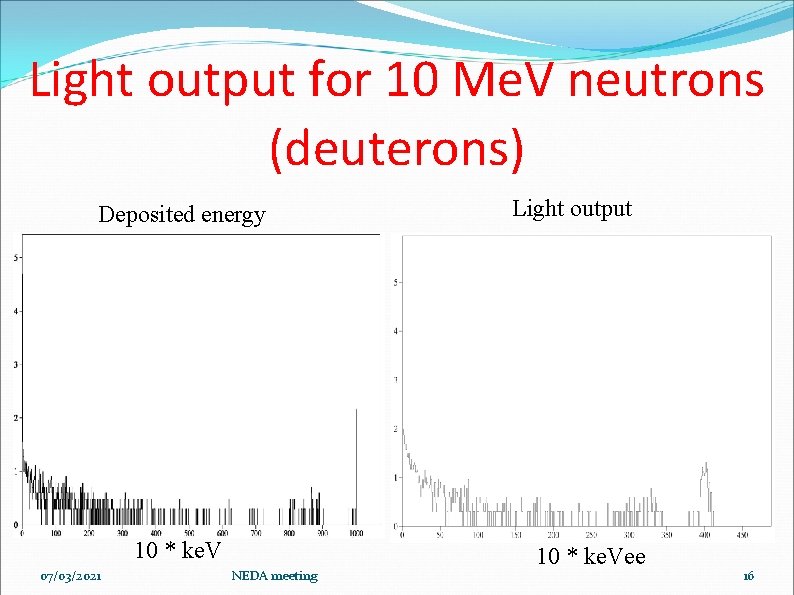
Light output for 10 Me. V neutrons (deuterons) Deposited energy 10 * ke. V 07/03/2021 NEDA meeting Light output 10 * ke. Vee 16
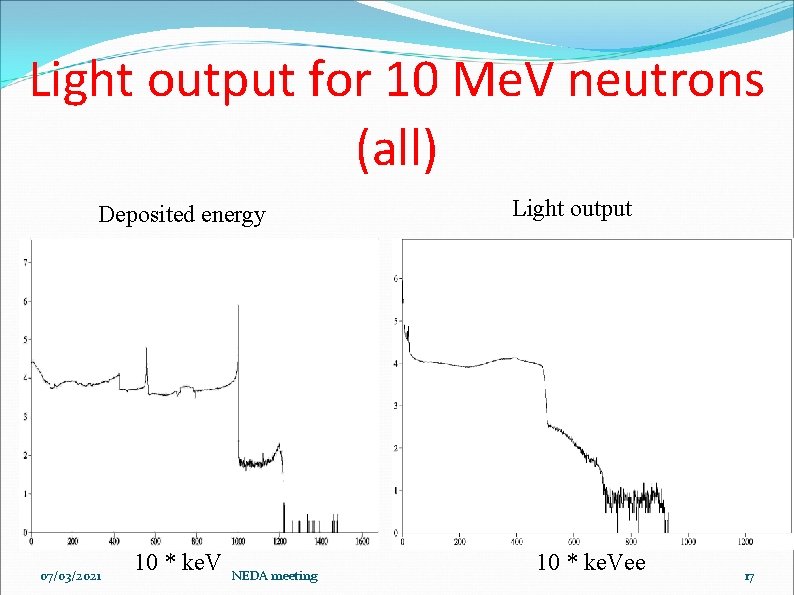
Light output for 10 Me. V neutrons (all) Deposited energy 07/03/2021 10 * ke. V NEDA meeting Light output 10 * ke. Vee 17
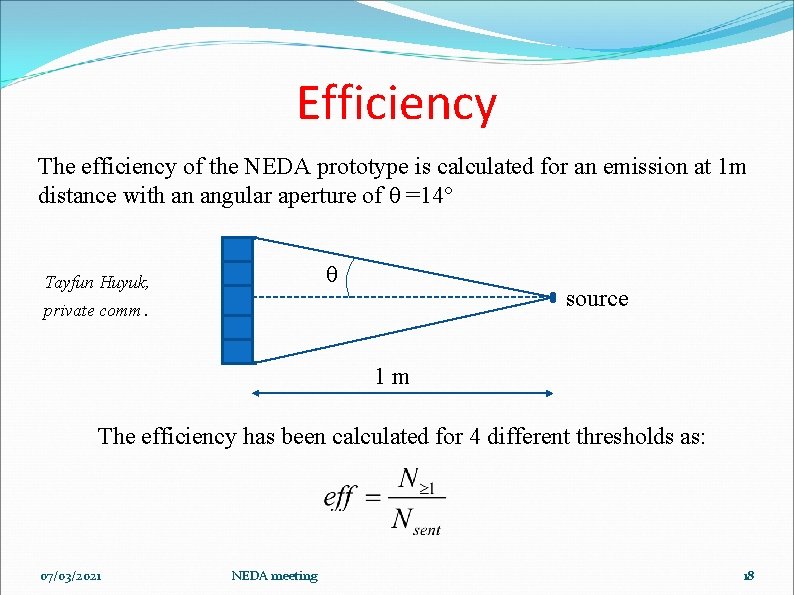
Efficiency The efficiency of the NEDA prototype is calculated for an emission at 1 m distance with an angular aperture of θ =14° θ Tayfun Huyuk, source private comm. 1 m The efficiency has been calculated for 4 different thresholds as: 07/03/2021 NEDA meeting 18
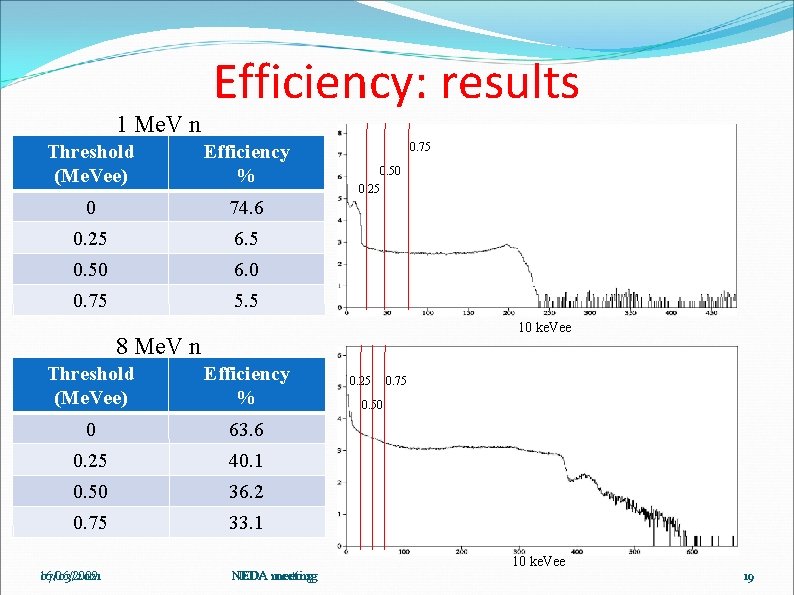
1 Me. V n Efficiency: results Threshold (Me. Vee) Efficiency % 0 74. 6 0. 25 6. 5 0. 50 6. 0 0. 75 5. 5 0. 75 0. 50 0. 25 10 ke. Vee 8 Me. V n Threshold (Me. Vee) Efficiency % 0 63. 6 0. 25 40. 1 0. 50 36. 2 0. 75 33. 1 07/03/2021 16/06/2009 NEDA meeting 0. 25 0. 75 0. 50 10 ke. Vee 19
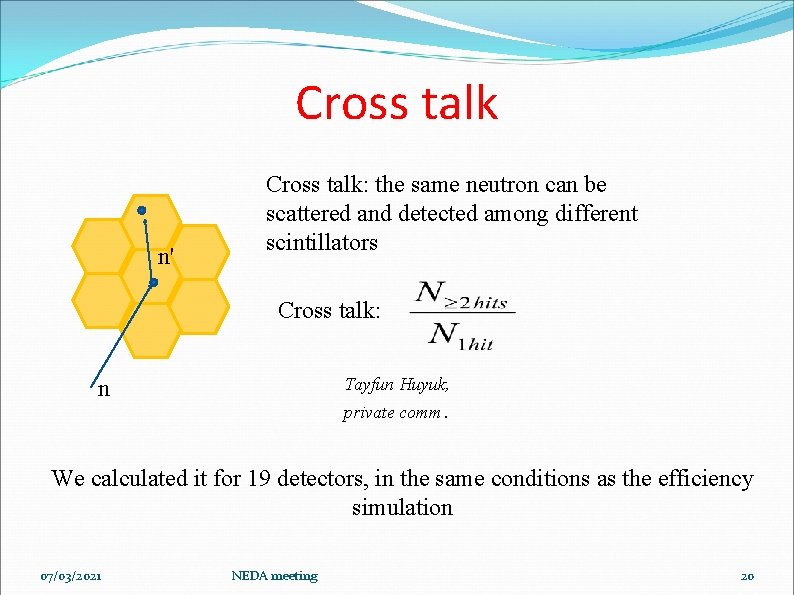
Cross talk n' Cross talk: the same neutron can be scattered and detected among different scintillators Cross talk: Tayfun Huyuk, n private comm. We calculated it for 19 detectors, in the same conditions as the efficiency simulation 07/03/2021 NEDA meeting 20
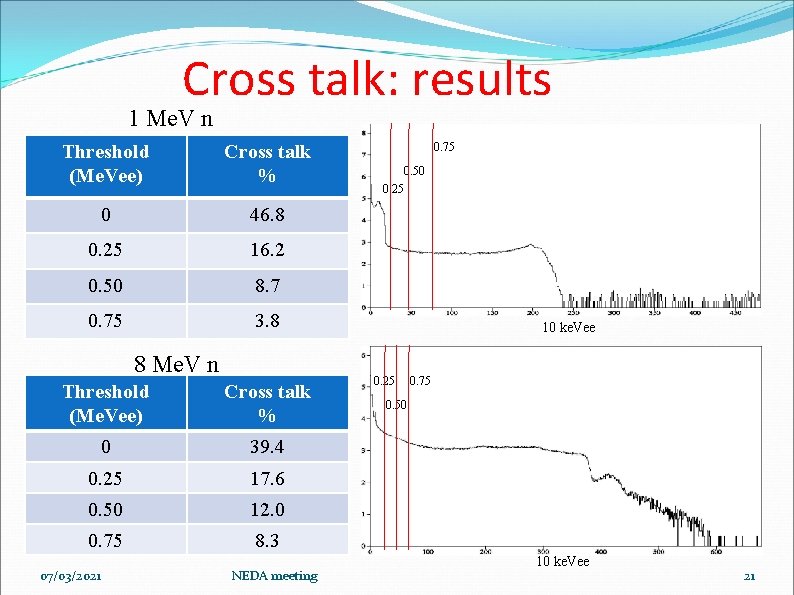
Cross talk: results 1 Me. V n Threshold (Me. Vee) Cross talk % 0 46. 8 0. 25 16. 2 0. 50 8. 7 0. 75 3. 8 8 Me. V n Threshold (Me. Vee) Cross talk % 0 39. 4 0. 25 17. 6 0. 50 12. 0 0. 75 8. 3 07/03/2021 NEDA meeting 0. 75 0. 50 0. 25 10 ke. Vee 0. 25 0. 75 0. 50 10 ke. Vee 21
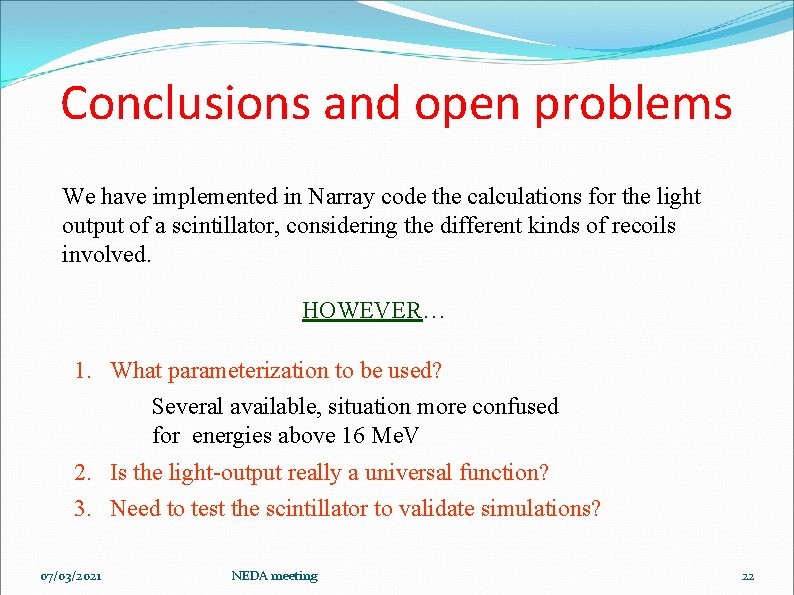
Conclusions and open problems We have implemented in Narray code the calculations for the light output of a scintillator, considering the different kinds of recoils involved. HOWEVER… 1. What parameterization to be used? Several available, situation more confused for energies above 16 Me. V 2. Is the light-output really a universal function? 3. Need to test the scintillator to validate simulations? 07/03/2021 NEDA meeting 22
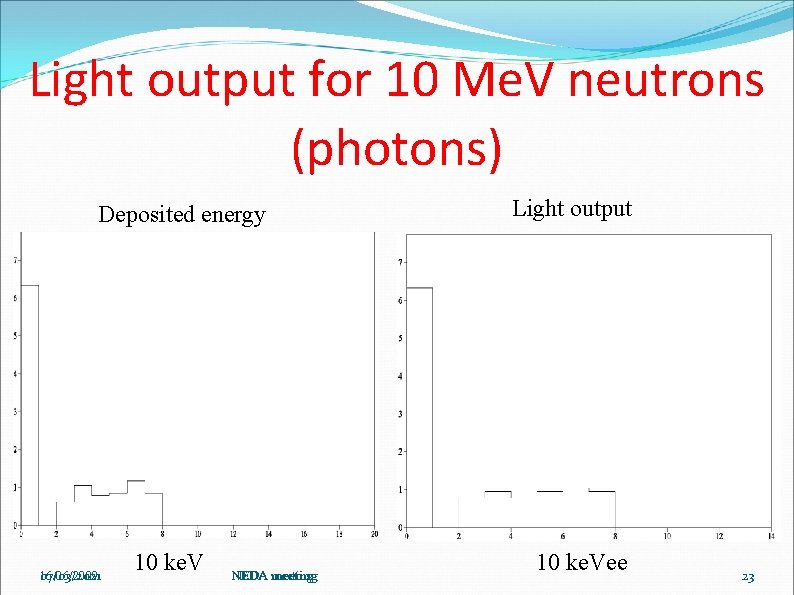
Light output for 10 Me. V neutrons (photons) Deposited energy 07/03/2021 16/06/2009 10 ke. V NEDA meeting Light output 10 ke. Vee 23
- Slides: 23