HighThroughput Phenotyping and Cohort Identification from Electronic Health

- Slides: 59
High-Throughput Phenotyping and Cohort Identification from Electronic Health Records for Clinical and Translational Research Jyotishman Pathak, Ph. D Assistant Professor of Biomedical Informatics Health Sciences Research Grand Rounds April 23, 2012
Background – The Problem • Patient recruitment is a huge bottleneck step in conducting successful clinical research studies • 50% of time is spent in recruitment • Low participant rates (~ 5%); studies are underpowered • Clinicians: lack resources to help patients find appropriate studies and trials • Patients: face difficultly to find appropriate studies that are locally available High-Throughput Phenotyping from EHRs © 2012 MFMER | slide-2
Background – Use Cases • Large-scale genomics research • Linking biospecimens and genetic data to personal • health data via biorepositories Need large sample sizes for study design • Population-based epidemiological studies in understanding disease etiology • Often limited in scope or population diversity • Quality metrics and HITECH Act • Pay-for-Performance and quality-based incentives • Population management and cohort identification is nontrivial High-Throughput Phenotyping from EHRs © 2012 MFMER | slide-3
Electronic health records (EHRs) driven phenotyping – The Proposed Solution • EHRs are becoming more and more prevalent within the U. S. healthcare system • Meaningful Use is one of the major drivers • Overarching goal • To develop techniques and algorithms that operate on normalized EHR data to identify cohorts of potentially eligible subjects on the basis of disease, symptoms, or related findings High-Throughput Phenotyping from EHRs © 2012 MFMER | slide-4
Advantages: EHR-derived phenotyping • There is a LOT of information about subjects • Demographics, labs, meds, procedures, clinical notes… • Identification of otherwise latent population differences • Minimal costs for case ascertainment, no studyspecific recruitment • Records are “retrospectively longitudinal” • Records are real world and contain many different phenotypes • Transportability and reuse of phenotype definitions across EHR enabled sites = power for clinical and research studies High-Throughput Phenotyping from EHRs © 2012 MFMER | slide-5
Challenges: EHR-derived phenotyping • There is a LOT of information about subjects… • Non-standardized, heterogeneous, unstructured • • • data (compared to protocol-based structured data collection) Measured (e. g. , demographics) vs. un-measured (e. g. , socio-economic status) population differences Hospital specialization and coding practices Population/regional market landscape High-Throughput Phenotyping from EHRs © 2012 MFMER | slide-6
The challenges can be addressed…if we • Develop techniques for standardization and normalization of clinical data and phenotypes • Develop techniques for transforming and managing unstructured clinical text into structured representations • Develop techniques for transportability of EHRdriven phenotyping algorithms • Develop a scalable, robust and flexible framework for demonstrating all of the above in a “real-world setting” High-Throughput Phenotyping from EHRs © 2012 MFMER | slide-7
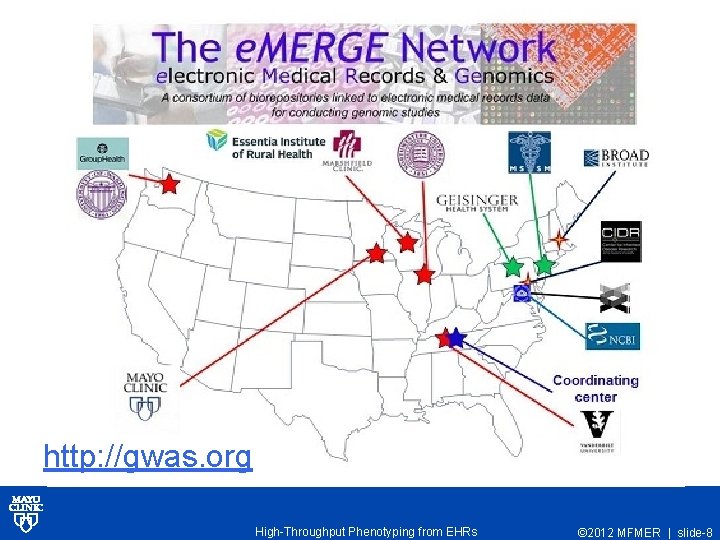
http: //gwas. org High-Throughput Phenotyping from EHRs © 2012 MFMER | slide-8
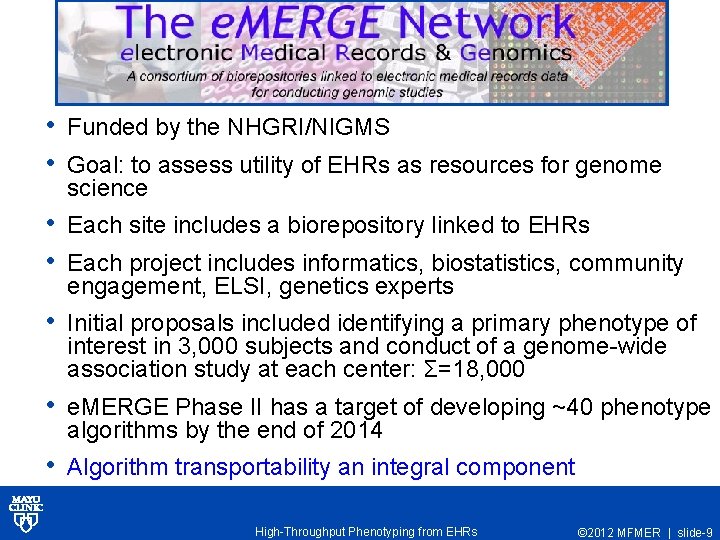
• Funded by the NHGRI/NIGMS • Goal: to assess utility of EHRs as resources for genome science • Each site includes a biorepository linked to EHRs • Each project includes informatics, biostatistics, community engagement, ELSI, genetics experts • Initial proposals included identifying a primary phenotype of interest in 3, 000 subjects and conduct of a genome-wide association study at each center: Σ=18, 000 • e. MERGE Phase II has a target of developing ~40 phenotype algorithms by the end of 2014 • Algorithm transportability an integral component High-Throughput Phenotyping from EHRs © 2012 MFMER | slide-9
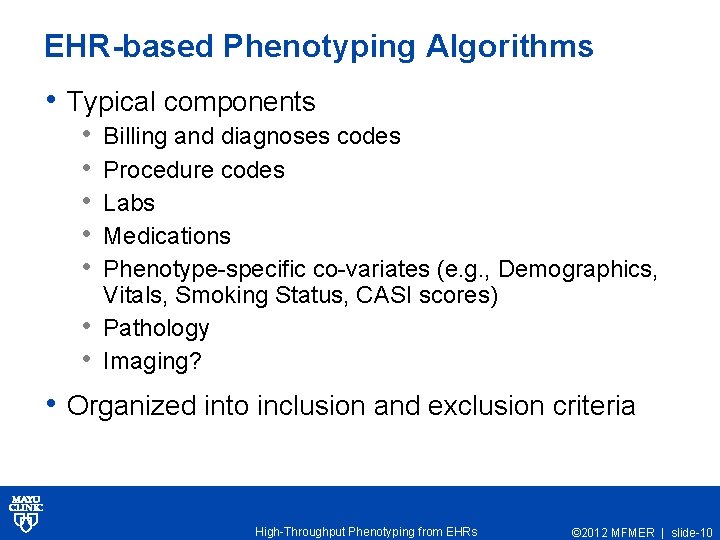
EHR-based Phenotyping Algorithms • Typical components • • Billing and diagnoses codes Procedure codes Labs Medications Phenotype-specific co-variates (e. g. , Demographics, Vitals, Smoking Status, CASI scores) Pathology Imaging? • Organized into inclusion and exclusion criteria High-Throughput Phenotyping from EHRs © 2012 MFMER | slide-10
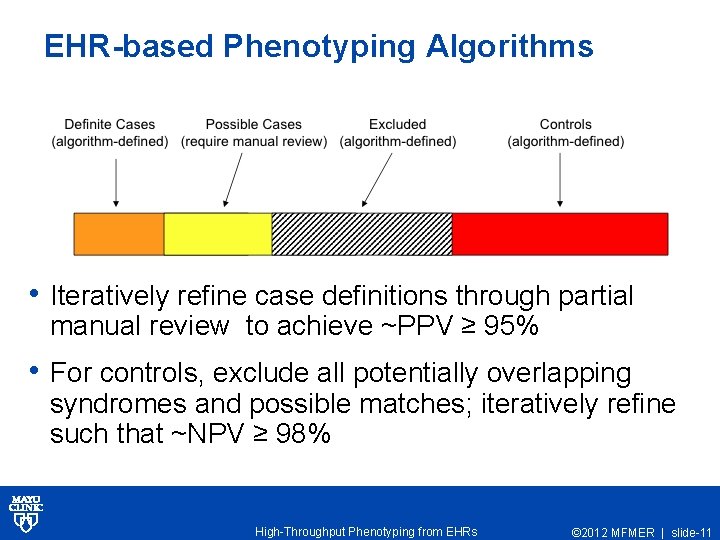
EHR-based Phenotyping Algorithms • Iteratively refine case definitions through partial manual review to achieve ~PPV ≥ 95% • For controls, exclude all potentially overlapping syndromes and possible matches; iteratively refine such that ~NPV ≥ 98% High-Throughput Phenotyping from EHRs © 2012 MFMER | slide-11
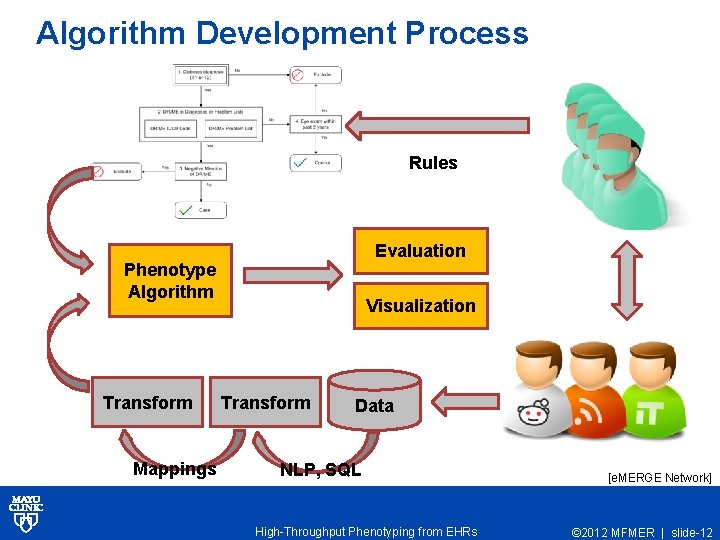
Algorithm Development Process Rules Evaluation Phenotype Algorithm Transform Mappings Visualization Transform Data NLP, SQL High-Throughput Phenotyping from EHRs [e. MERGE Network] © 2012 MFMER | slide-12
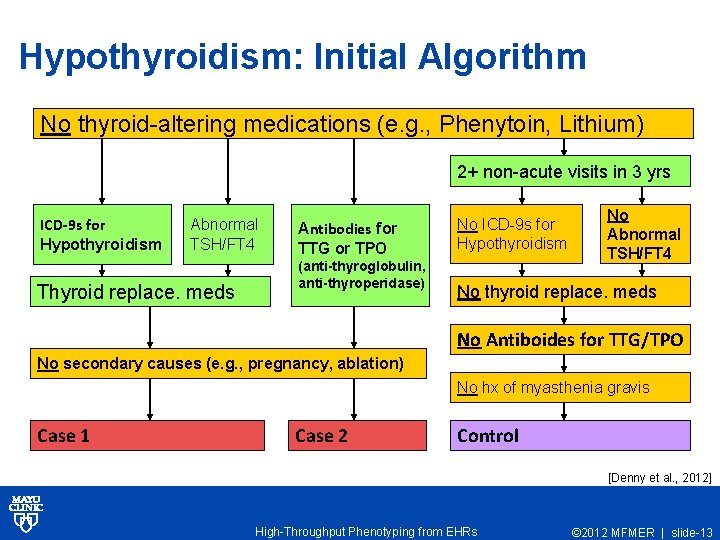
Hypothyroidism: Initial Algorithm No thyroid-altering medications (e. g. , Phenytoin, Lithium) 2+ non-acute visits in 3 yrs ICD-9 s for Hypothyroidism Abnormal TSH/FT 4 Thyroid replace. meds Antibodies for TTG or TPO (anti-thyroglobulin, anti-thyroperidase) No ICD-9 s for Hypothyroidism No Abnormal TSH/FT 4 No thyroid replace. meds No Antiboides for TTG/TPO No secondary causes (e. g. , pregnancy, ablation) No hx of myasthenia gravis Case 1 Case 2 Control [Denny et al. , 2012] High-Throughput Phenotyping from EHRs © 2012 MFMER | slide-13
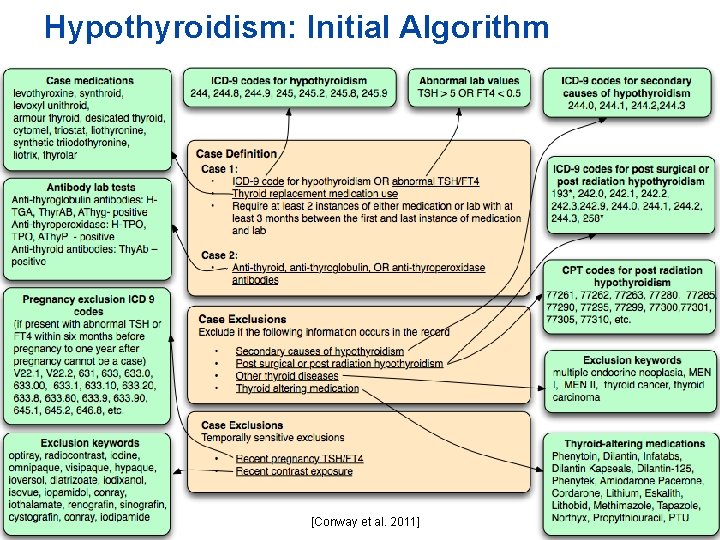
Hypothyroidism: Initial Algorithm [Conway et al. 2011] High-Throughput Phenotyping from EHRs © 2012 MFMER | slide-14
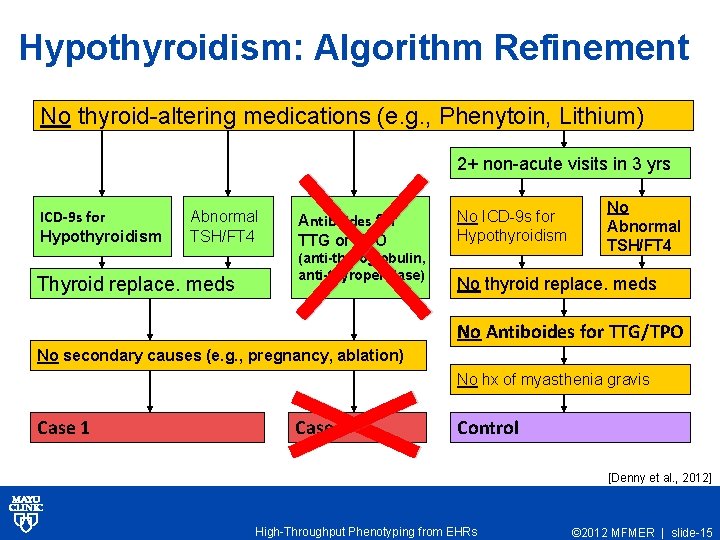
Hypothyroidism: Algorithm Refinement No thyroid-altering medications (e. g. , Phenytoin, Lithium) 2+ non-acute visits in 3 yrs ICD-9 s for Hypothyroidism Abnormal TSH/FT 4 Thyroid replace. meds Antiboides for TTG or TPO (anti-thyroglobulin, anti-thyroperidase) No ICD-9 s for Hypothyroidism No Abnormal TSH/FT 4 No thyroid replace. meds No Antiboides for TTG/TPO No secondary causes (e. g. , pregnancy, ablation) No hx of myasthenia gravis Case 1 Case 2 Control [Denny et al. , 2012] High-Throughput Phenotyping from EHRs © 2012 MFMER | slide-15
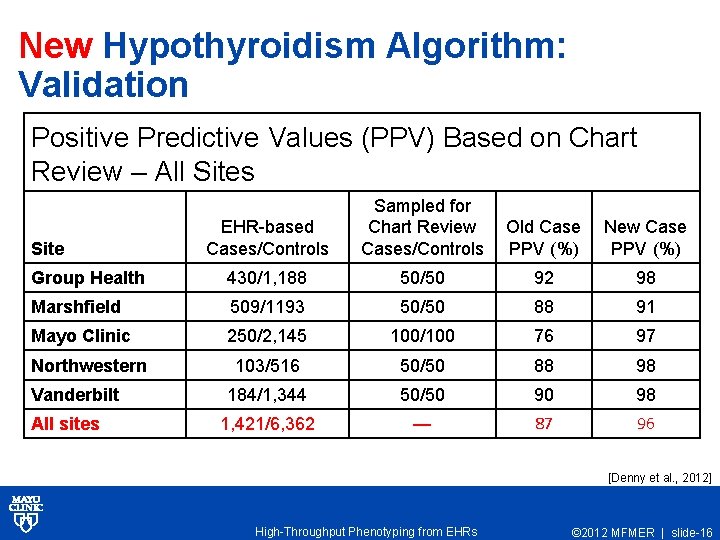
New Hypothyroidism Algorithm: Validation Positive Predictive Values (PPV) Based on Chart Review – All Sites EHR-based Cases/Controls Sampled for Chart Review Cases/Controls Old Case PPV (%) New Case PPV (%) Group Health 430/1, 188 50/50 92 98 Marshfield 509/1193 50/50 88 91 Mayo Clinic 250/2, 145 100/100 76 97 103/516 50/50 88 98 184/1, 344 50/50 90 98 1, 421/6, 362 — 87 96 Site Northwestern Vanderbilt All sites [Denny et al. , 2012] High-Throughput Phenotyping from EHRs © 2012 MFMER | slide-16
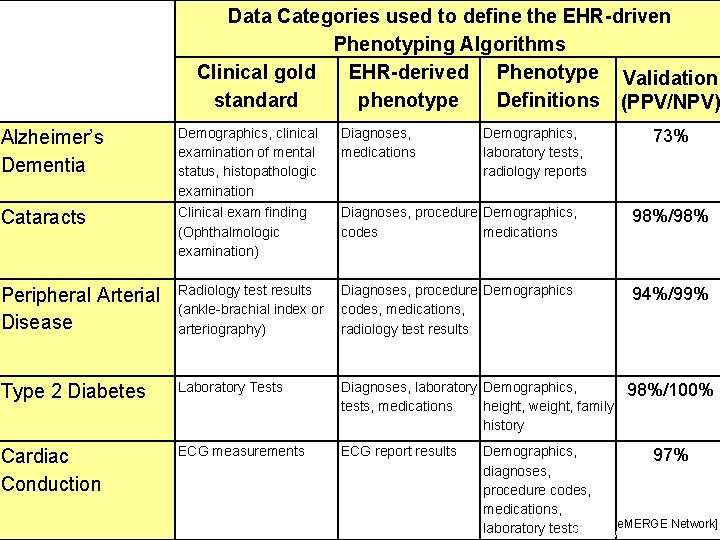
Data Categories used to define the EHR-driven Phenotyping Algorithms Clinical gold EHR-derived Phenotype Validation standard phenotype Definitions (PPV/NPV) Alzheimer’s Dementia Demographics, clinical examination of mental status, histopathologic examination Diagnoses, medications Demographics, laboratory tests, radiology reports Cataracts Clinical exam finding (Ophthalmologic examination) Diagnoses, procedure Demographics, codes medications 98%/98% Peripheral Arterial Disease Radiology test results (ankle-brachial index or arteriography) Diagnoses, procedure Demographics codes, medications, radiology test results 94%/99% Type 2 Diabetes Laboratory Tests Diagnoses, laboratory Demographics, tests, medications height, weight, family history Cardiac Conduction ECG measurements ECG report results 73% 98%/100% Demographics, 97% diagnoses, procedure codes, medications, [e. MERGE Network] laboratory tests © 2012 MFMER | slide-17
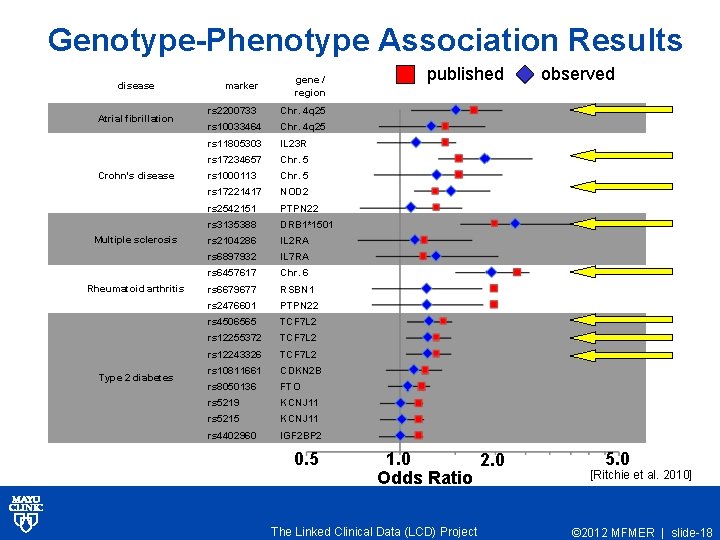
Genotype-Phenotype Association Results disease Atrial fibrillation Crohn's disease Multiple sclerosis Rheumatoid arthritis Type 2 diabetes marker gene / region rs 2200733 Chr. 4 q 25 rs 10033464 Chr. 4 q 25 rs 11805303 IL 23 R rs 17234657 Chr. 5 rs 1000113 Chr. 5 rs 17221417 NOD 2 rs 2542151 PTPN 22 rs 3135388 DRB 1*1501 rs 2104286 IL 2 RA rs 6897932 IL 7 RA rs 6457617 Chr. 6 rs 6679677 RSBN 1 rs 2476601 PTPN 22 rs 4506565 TCF 7 L 2 rs 12255372 TCF 7 L 2 rs 12243326 TCF 7 L 2 rs 10811661 CDKN 2 B rs 8050136 FTO rs 5219 KCNJ 11 rs 5215 KCNJ 11 rs 4402960 IGF 2 BP 2 0. 5 published 1. 0 2. 0 Odds Ratio The Linked Clinical Data (LCD) Project observed 5. 0 [Ritchie et al. 2010] © 2012 MFMER | slide-18
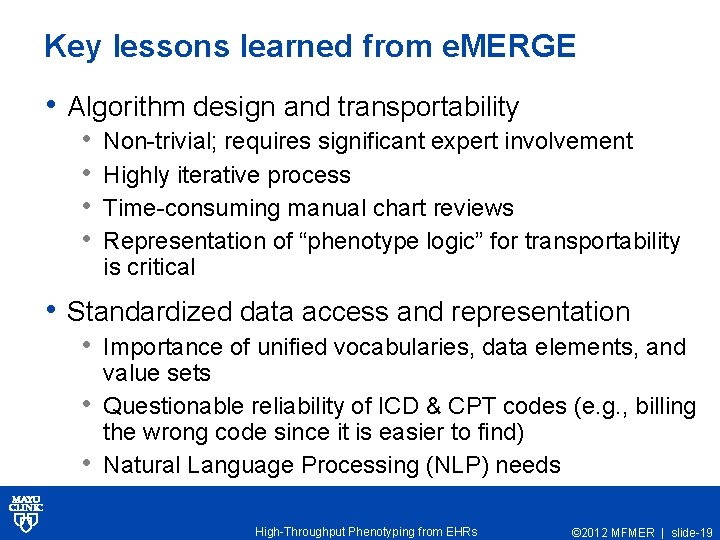
Key lessons learned from e. MERGE • Algorithm design and transportability • • Non-trivial; requires significant expert involvement Highly iterative process Time-consuming manual chart reviews Representation of “phenotype logic” for transportability is critical • Standardized data access and representation • Importance of unified vocabularies, data elements, and • • value sets Questionable reliability of ICD & CPT codes (e. g. , billing the wrong code since it is easier to find) Natural Language Processing (NLP) needs High-Throughput Phenotyping from EHRs © 2012 MFMER | slide-19
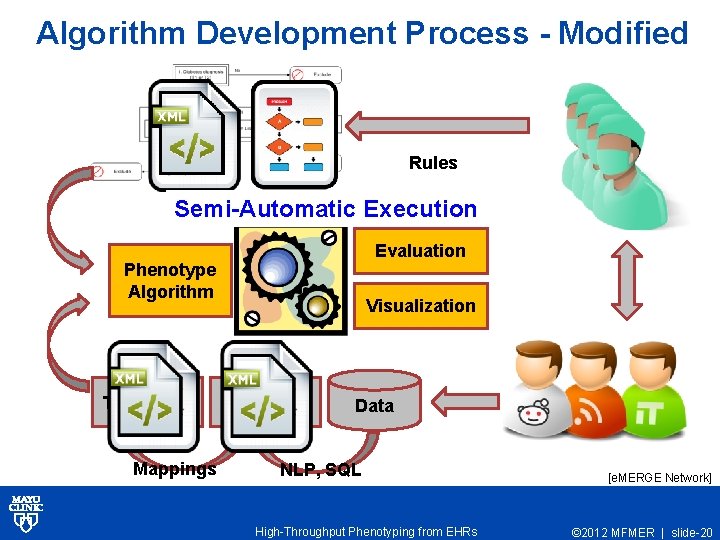
Algorithm Development Process - Modified Rules Semi-Automatic Execution Evaluation Phenotype Algorithm Transform Mappings Visualization Transform Data NLP, SQL High-Throughput Phenotyping from EHRs [e. MERGE Network] © 2012 MFMER | slide-20
Strategic Health IT Advance Research Projects (SHARPn): Secondary Uses of EHR Data • Mission: To enable the use of EHR data for secondary purposes, such as clinical research and public health. Leveraging clinical and health informatics to: • generate new knowledge • improve care • address population needs http: //sharpn. org [Chute et al. 2011] High-Throughput Phenotyping from EHRs © 2012 MFMER | slide-21
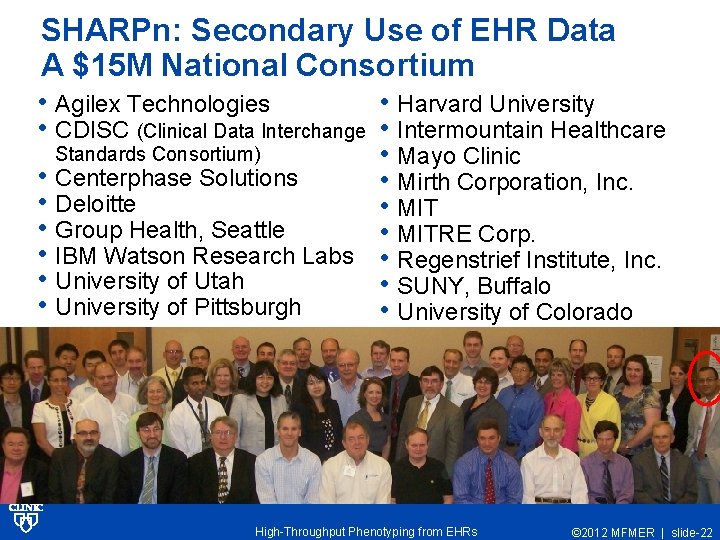
SHARPn: Secondary Use of EHR Data A $15 M National Consortium • Agilex Technologies • Harvard University • CDISC (Clinical Data Interchange • Intermountain Healthcare Standards Consortium) • Mayo Clinic • Centerphase Solutions • Mirth Corporation, Inc. • Deloitte • MIT • Group Health, Seattle • MITRE Corp. • IBM Watson Research Labs • Regenstrief Institute, Inc. • University of Utah • SUNY, Buffalo • University of Pittsburgh • University of Colorado High-Throughput Phenotyping from EHRs © 2012 MFMER | slide-22
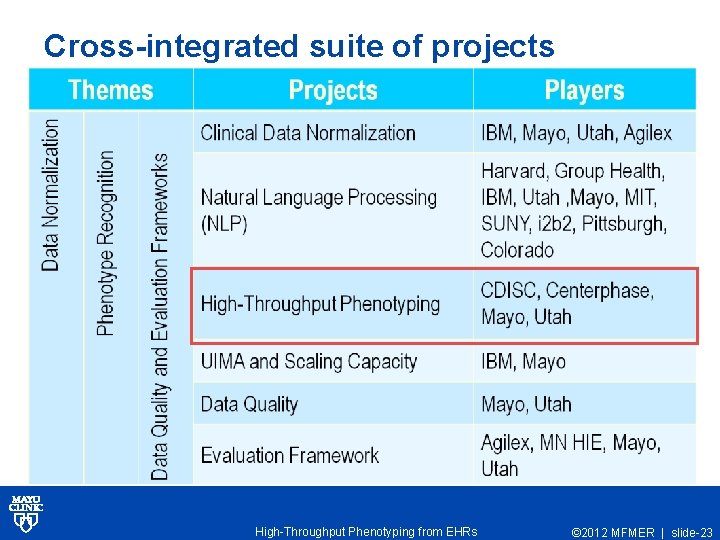
Cross-integrated suite of projects High-Throughput Phenotyping from EHRs © 2012 MFMER | slide-23
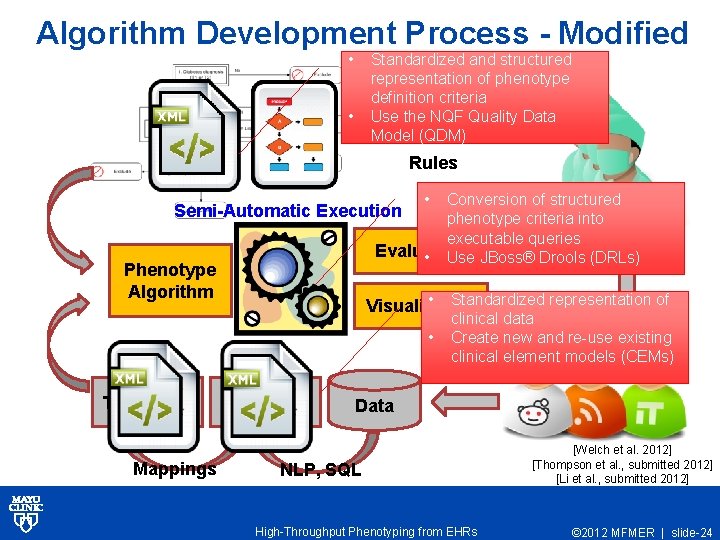
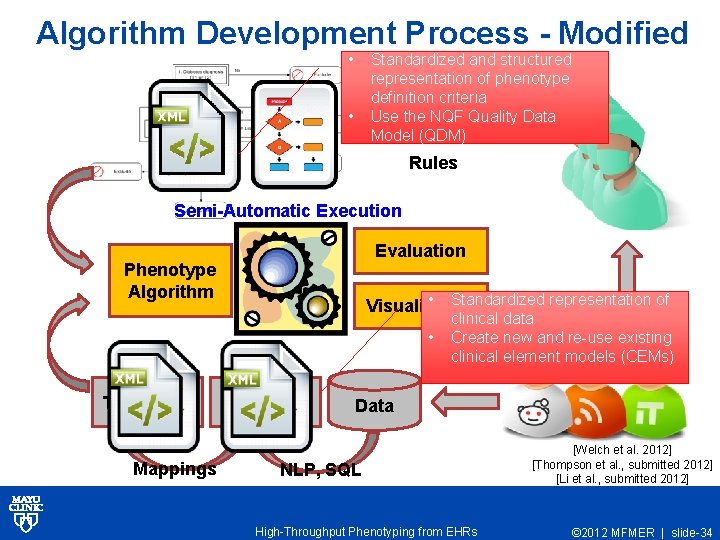
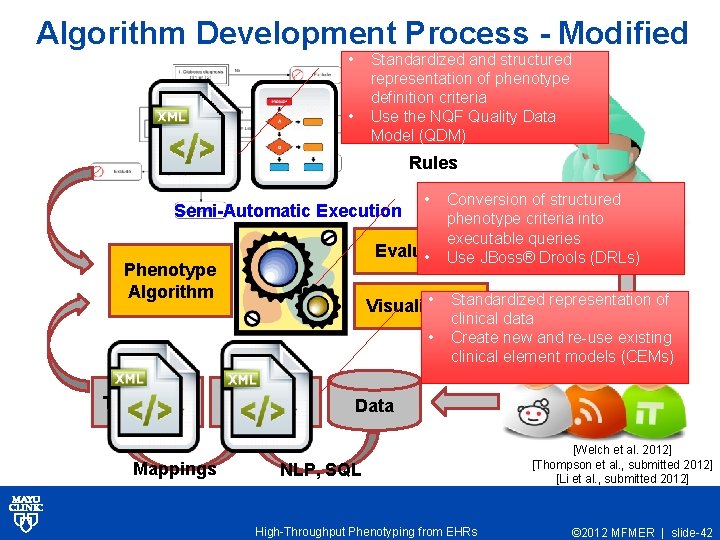
Algorithm Development Process - Modified • Standardized and structured representation of phenotype definition criteria Use the NQF Quality Data Model (QDM) • Rules • Conversion of structured phenotype criteria into executable queries Evaluation • Use JBoss® Drools (DRLs) Semi-Automatic Execution Phenotype Algorithm • Standardized representation of Visualization • Transform Mappings Transform clinical data Create new and re-use existing clinical element models (CEMs) Data NLP, SQL High-Throughput Phenotyping from EHRs [Welch et al. 2012] [Thompson et al. , submitted 2012] [Li et al. , submitted 2012] © 2012 MFMER | slide-24
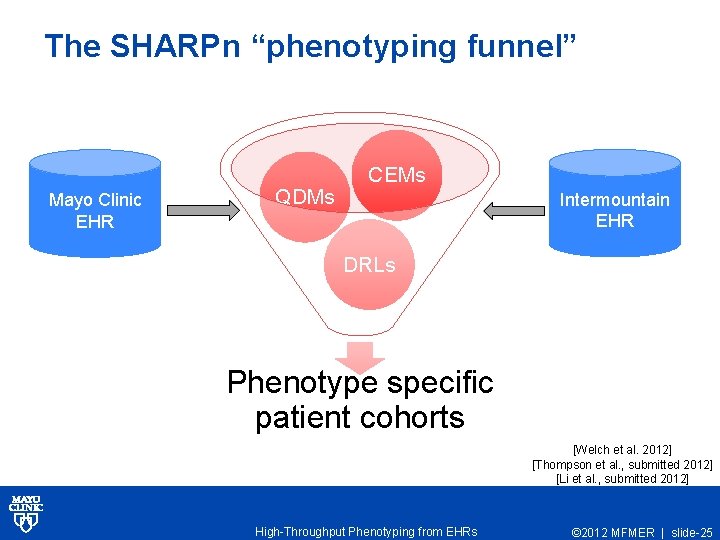
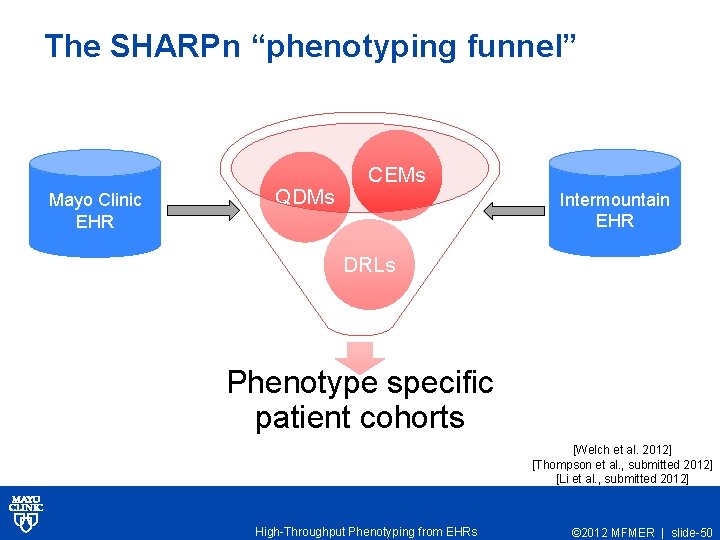
The SHARPn “phenotyping funnel” Mayo Clinic EHR QDMs CEMs Intermountain EHR DRLs Phenotype specific patient cohorts [Welch et al. 2012] [Thompson et al. , submitted 2012] [Li et al. , submitted 2012] High-Throughput Phenotyping from EHRs © 2012 MFMER | slide-25
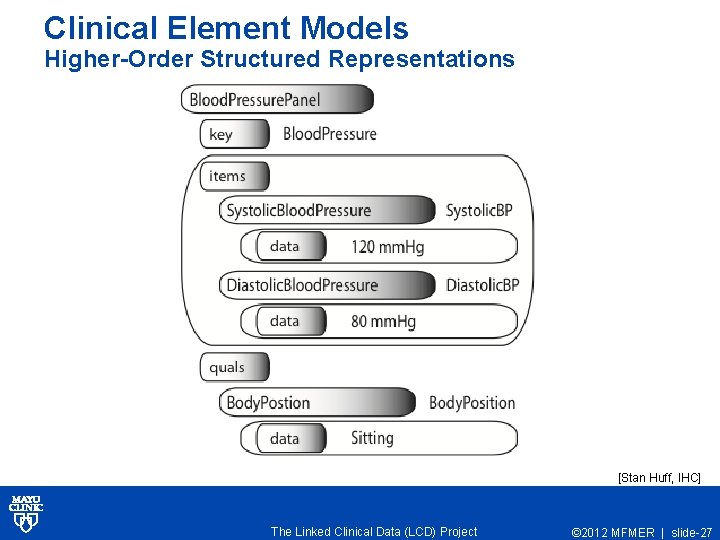
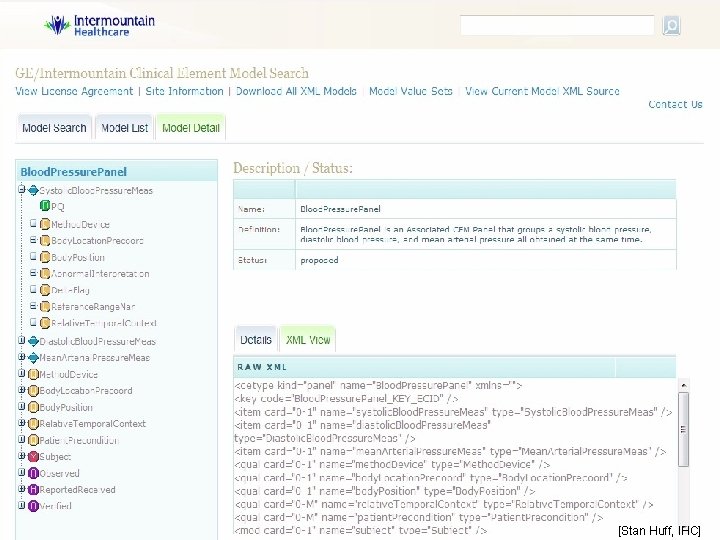
Clinical data normalization • Data Normalization • Clinical data comes in all different forms even for • the same kind of information Comparable and consistent data is foundational to secondary use • Clinical Element Models (CEMs) • Basis for retaining computable meaning when data • is exchanged between heterogeneous computer systems Basis for shared computable meaning when clinical data is referenced in decision support logic High-Throughput Phenotyping from EHRs © 2012 MFMER | slide-26
Clinical Element Models Higher-Order Structured Representations [Stan Huff, IHC] The Linked Clinical Data (LCD) Project © 2012 MFMER | slide-27
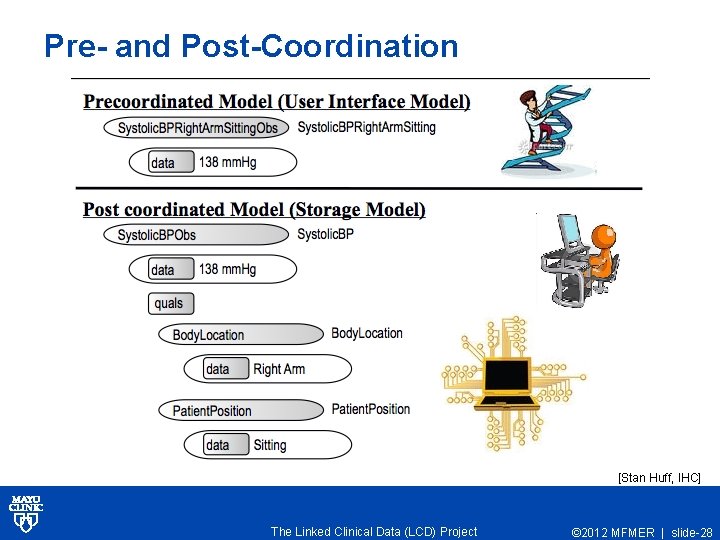
Pre- and Post-Coordination [Stan Huff, IHC] The Linked Clinical Data (LCD) Project © 2012 MFMER | slide-28
High-Throughput Phenotyping from EHRs [Stan Huff, IHC]
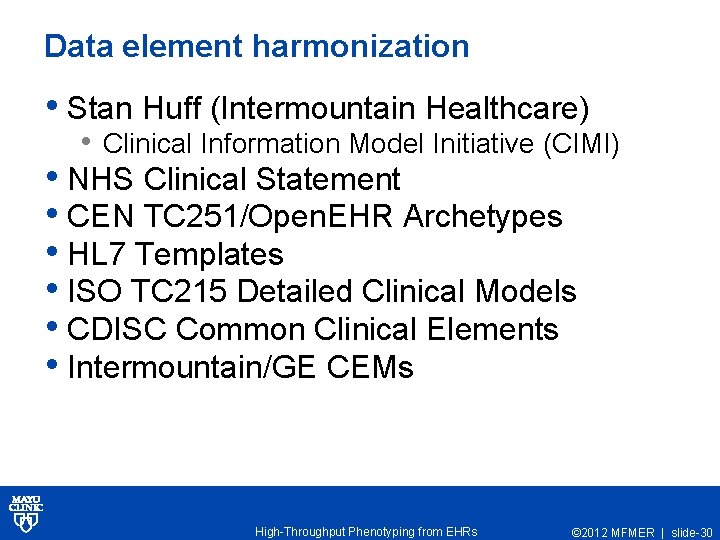
Data element harmonization • Stan Huff (Intermountain Healthcare) • Clinical Information Model Initiative (CIMI) • NHS Clinical Statement • CEN TC 251/Open. EHR Archetypes • HL 7 Templates • ISO TC 215 Detailed Clinical Models • CDISC Common Clinical Elements • Intermountain/GE CEMs High-Throughput Phenotyping from EHRs © 2012 MFMER | slide-30
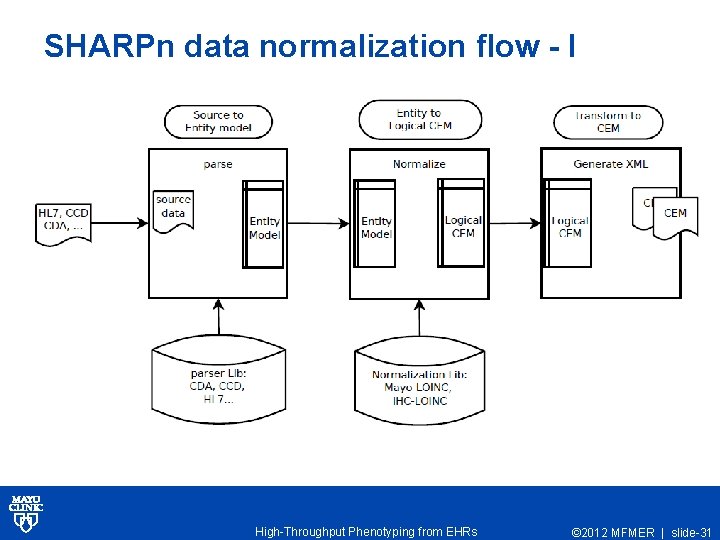
SHARPn data normalization flow - I High-Throughput Phenotyping from EHRs © 2012 MFMER | slide-31
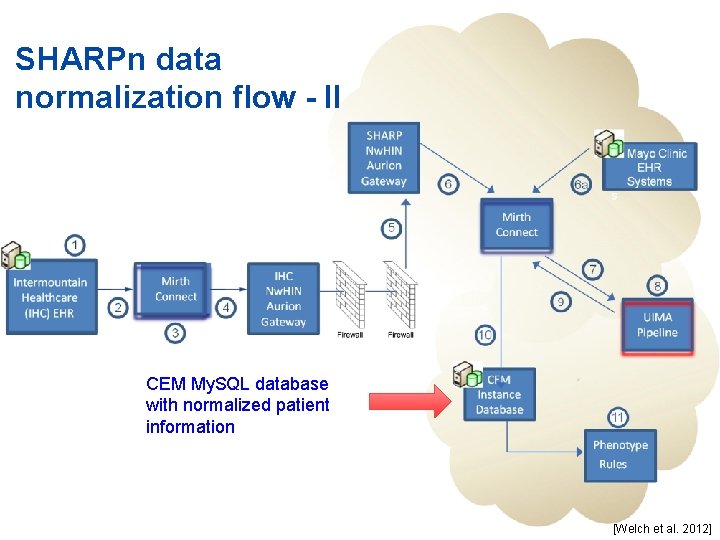
SHARPn data normalization flow - II CEM My. SQL database with normalized patient information [Welch et| al. 2012] © 2012 MFMER slide-32
Algorithm Development Process - Modified • Standardized and structured representation of phenotype definition criteria Use the NQF Quality Data Model (QDM) • Rules Semi-Automatic Execution Evaluation Phenotype Algorithm • Standardized representation of Visualization • Transform Mappings Transform clinical data Create new and re-use existing clinical element models (CEMs) Data NLP, SQL High-Throughput Phenotyping from EHRs [Welch et al. 2012] [Thompson et al. , submitted 2012] [Li et al. , submitted 2012] © 2012 MFMER | slide-34
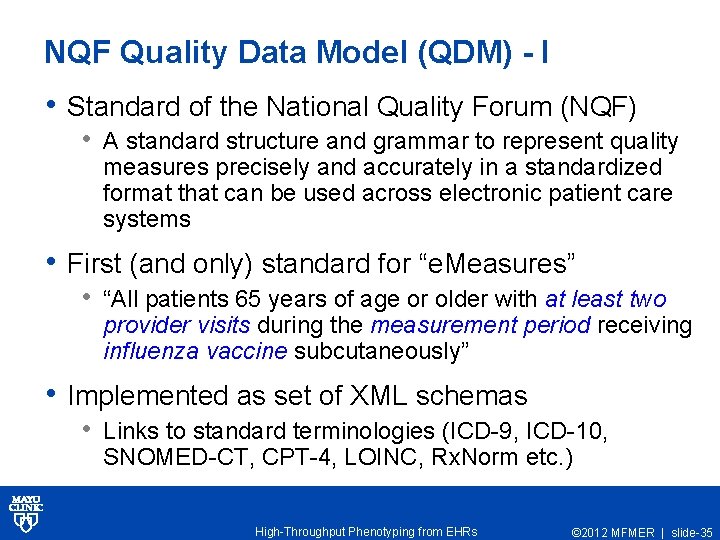
NQF Quality Data Model (QDM) - I • Standard of the National Quality Forum (NQF) • A standard structure and grammar to represent quality measures precisely and accurately in a standardized format that can be used across electronic patient care systems • First (and only) standard for “e. Measures” • “All patients 65 years of age or older with at least two provider visits during the measurement period receiving influenza vaccine subcutaneously” • Implemented as set of XML schemas • Links to standard terminologies (ICD-9, ICD-10, SNOMED-CT, CPT-4, LOINC, Rx. Norm etc. ) High-Throughput Phenotyping from EHRs © 2012 MFMER | slide-35
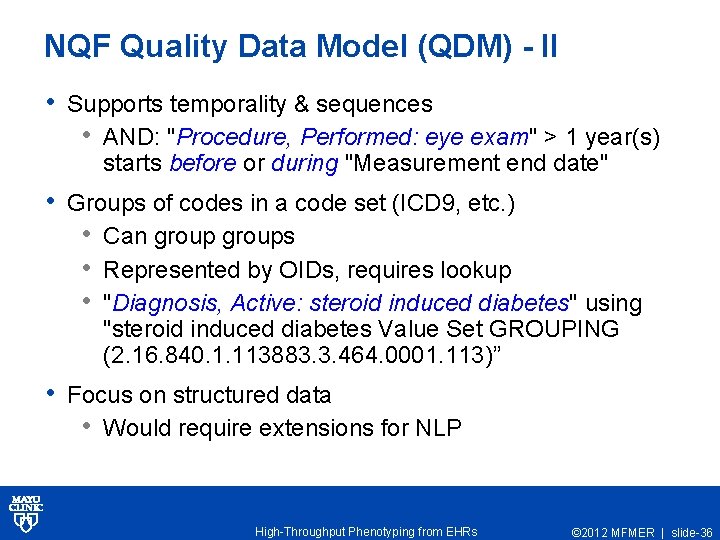
NQF Quality Data Model (QDM) - II • Supports temporality & sequences • AND: "Procedure, Performed: eye exam" > 1 year(s) starts before or during "Measurement end date" • Groups of codes in a code set (ICD 9, etc. ) • Can groups • Represented by OIDs, requires lookup • "Diagnosis, Active: steroid induced diabetes" using "steroid induced diabetes Value Set GROUPING (2. 16. 840. 1. 113883. 3. 464. 0001. 113)” • Focus on structured data • Would require extensions for NLP High-Throughput Phenotyping from EHRs © 2012 MFMER | slide-36
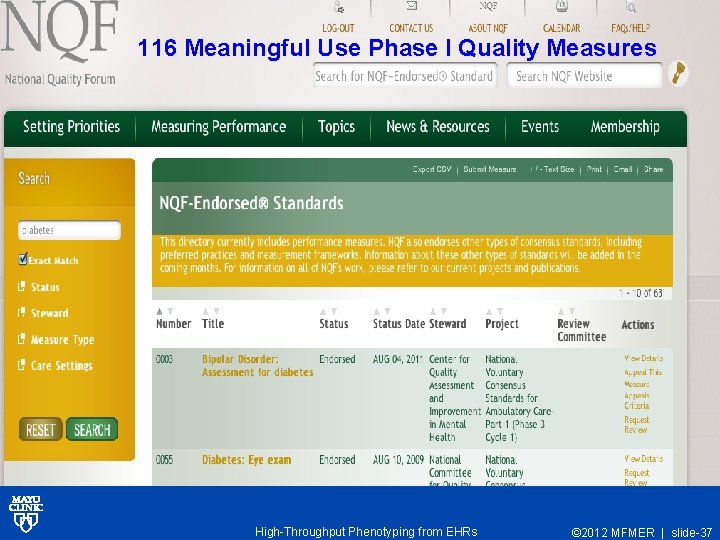
116 Meaningful Use Phase I Quality Measures High-Throughput Phenotyping from EHRs © 2012 MFMER | slide-37
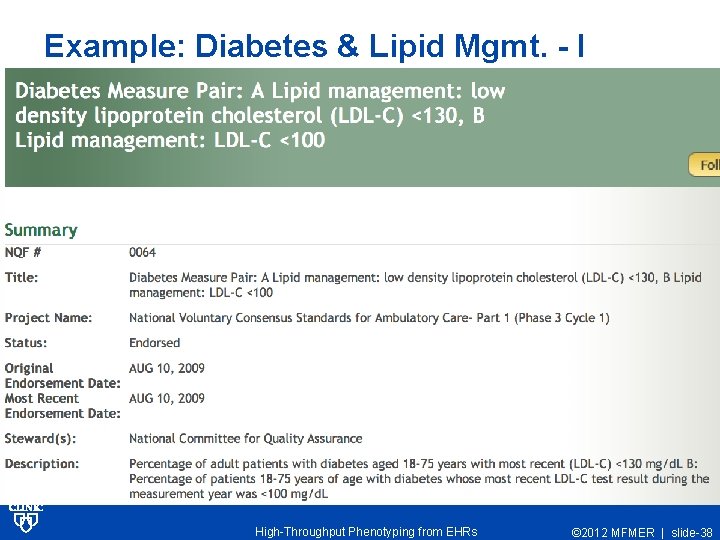
Example: Diabetes & Lipid Mgmt. - I High-Throughput Phenotyping from EHRs © 2012 MFMER | slide-38
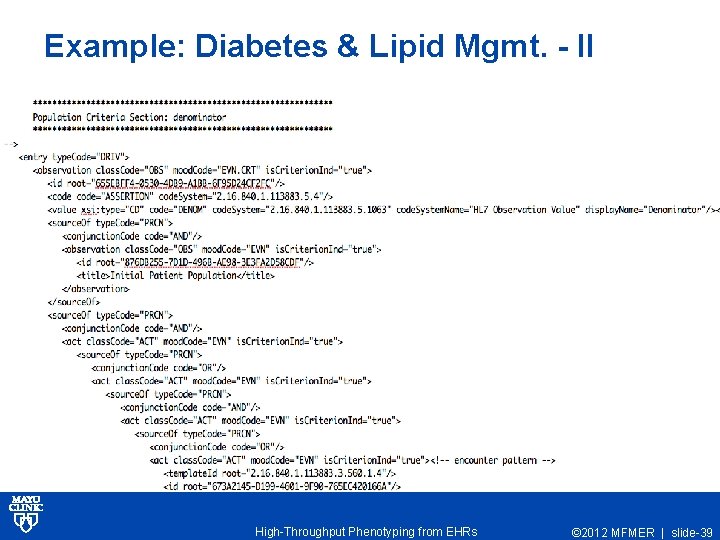
Example: Diabetes & Lipid Mgmt. - II High-Throughput Phenotyping from EHRs © 2012 MFMER | slide-39
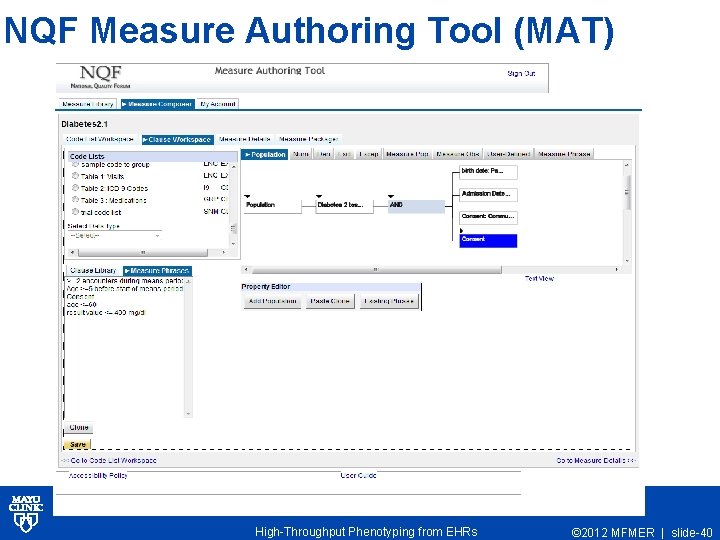
NQF Measure Authoring Tool (MAT) High-Throughput Phenotyping from EHRs © 2012 MFMER | slide-40
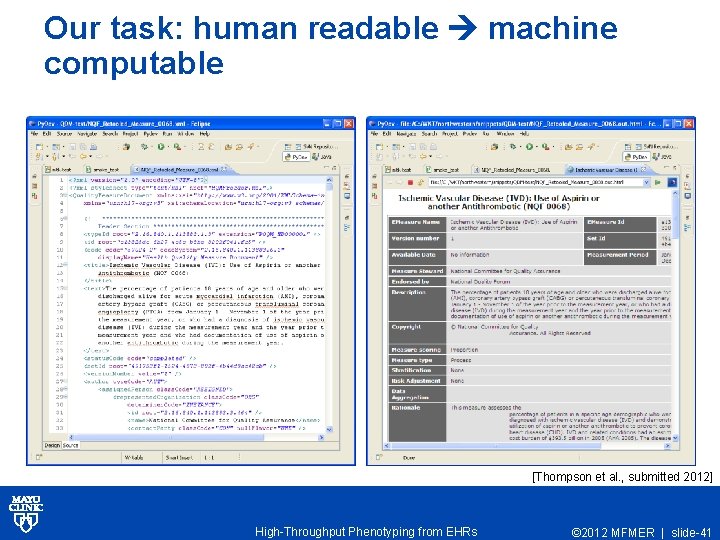
Our task: human readable machine computable [Thompson et al. , submitted 2012] High-Throughput Phenotyping from EHRs © 2012 MFMER | slide-41
Algorithm Development Process - Modified • Standardized and structured representation of phenotype definition criteria Use the NQF Quality Data Model (QDM) • Rules • Conversion of structured phenotype criteria into executable queries Evaluation • Use JBoss® Drools (DRLs) Semi-Automatic Execution Phenotype Algorithm • Standardized representation of Visualization • Transform Mappings Transform clinical data Create new and re-use existing clinical element models (CEMs) Data NLP, SQL High-Throughput Phenotyping from EHRs [Welch et al. 2012] [Thompson et al. , submitted 2012] [Li et al. , submitted 2012] © 2012 MFMER | slide-42
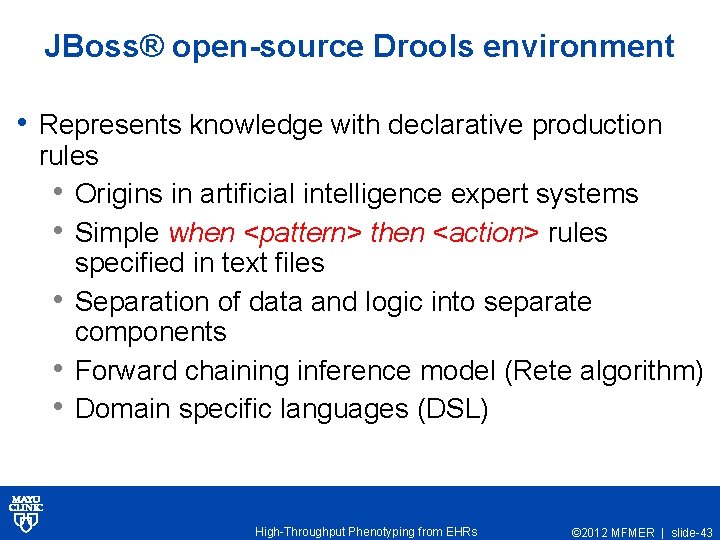
JBoss® open-source Drools environment • Represents knowledge with declarative production rules • Origins in artificial intelligence expert systems • Simple when <pattern> then <action> rules specified in text files • Separation of data and logic into separate components • Forward chaining inference model (Rete algorithm) • Domain specific languages (DSL) High-Throughput Phenotyping from EHRs © 2012 MFMER | slide-43
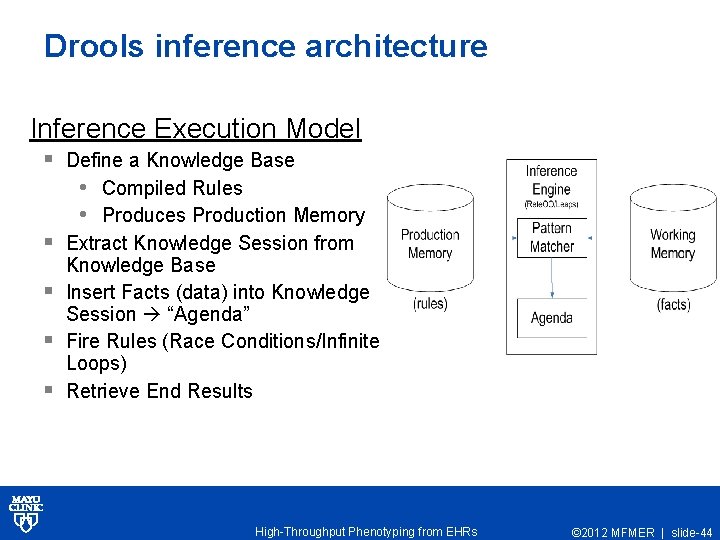
Drools inference architecture Inference Execution Model § Define a Knowledge Base • Compiled Rules • Produces Production Memory § Extract Knowledge Session from § § § Knowledge Base Insert Facts (data) into Knowledge Session “Agenda” Fire Rules (Race Conditions/Infinite Loops) Retrieve End Results High-Throughput Phenotyping from EHRs © 2012 MFMER | slide-44
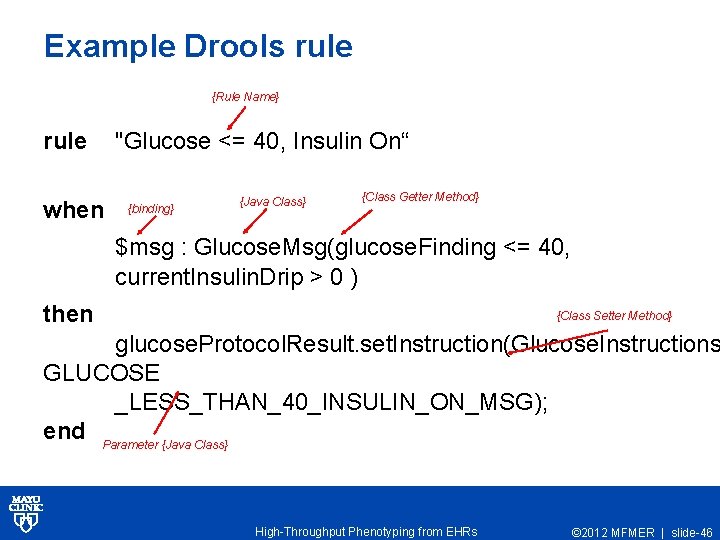
Example Drools rule {Rule Name} rule when "Glucose <= 40, Insulin On“ {binding} {Java Class} {Class Getter Method} $msg : Glucose. Msg(glucose. Finding <= 40, current. Insulin. Drip > 0 ) then {Class Setter Method} glucose. Protocol. Result. set. Instruction(Glucose. Instructions GLUCOSE _LESS_THAN_40_INSULIN_ON_MSG); end Parameter {Java Class} High-Throughput Phenotyping from EHRs © 2012 MFMER | slide-46
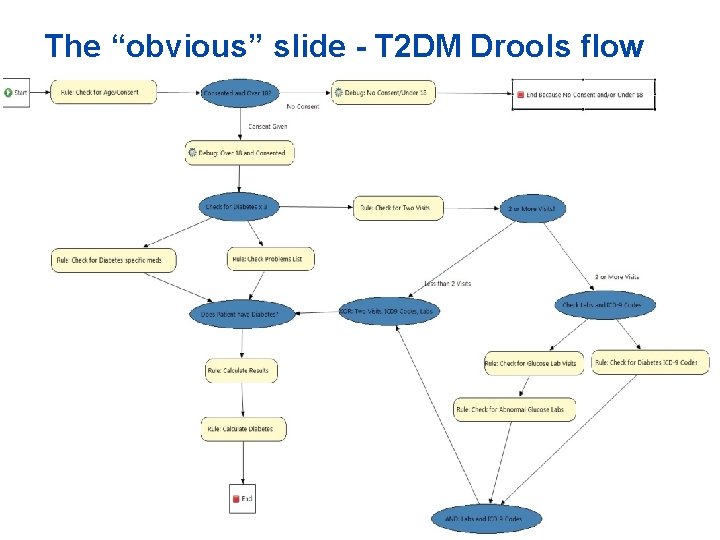
The “obvious” slide - T 2 DM Drools flow High-Throughput Phenotyping from EHRs © 2012 MFMER | slide-47
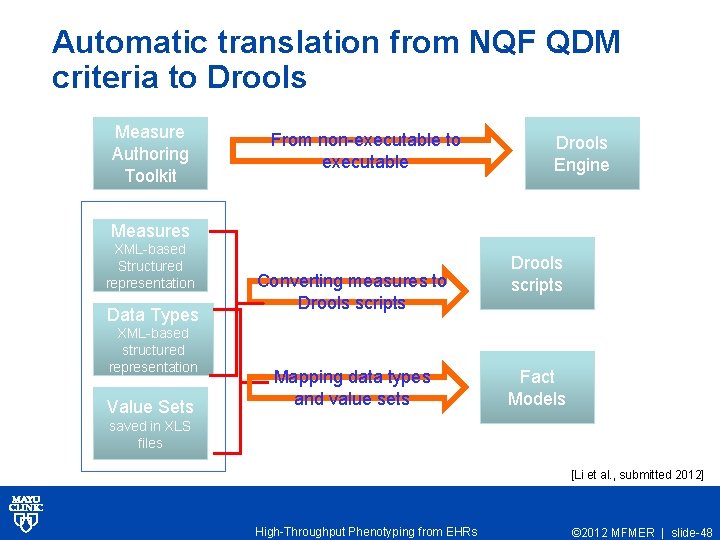
Automatic translation from NQF QDM criteria to Drools Measure Authoring Toolkit From non-executable to executable Drools Engine Measures XML-based Structured representation Data Types XML-based structured representation Value Sets Converting measures to Drools scripts Mapping data types and value sets Drools scripts Fact Models saved in XLS files [Li et al. , submitted 2012] High-Throughput Phenotyping from EHRs © 2012 MFMER | slide-48
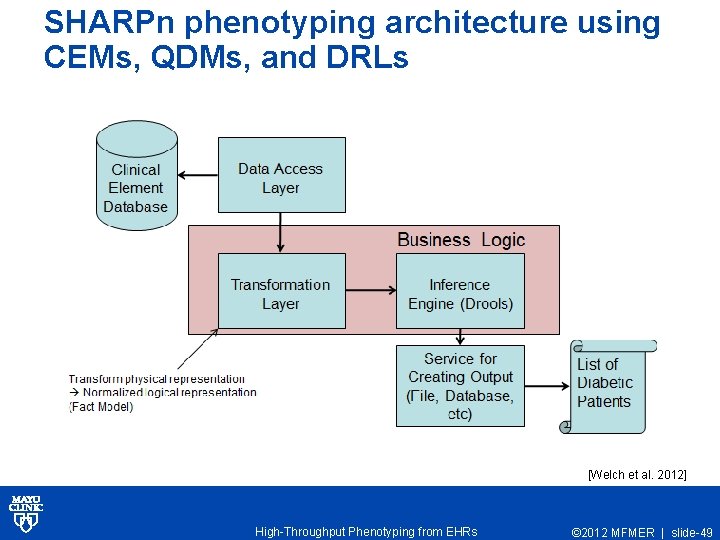
SHARPn phenotyping architecture using CEMs, QDMs, and DRLs [Welch et al. 2012] High-Throughput Phenotyping from EHRs © 2012 MFMER | slide-49
The SHARPn “phenotyping funnel” Mayo Clinic EHR QDMs CEMs Intermountain EHR DRLs Phenotype specific patient cohorts [Welch et al. 2012] [Thompson et al. , submitted 2012] [Li et al. , submitted 2012] High-Throughput Phenotyping from EHRs © 2012 MFMER | slide-50
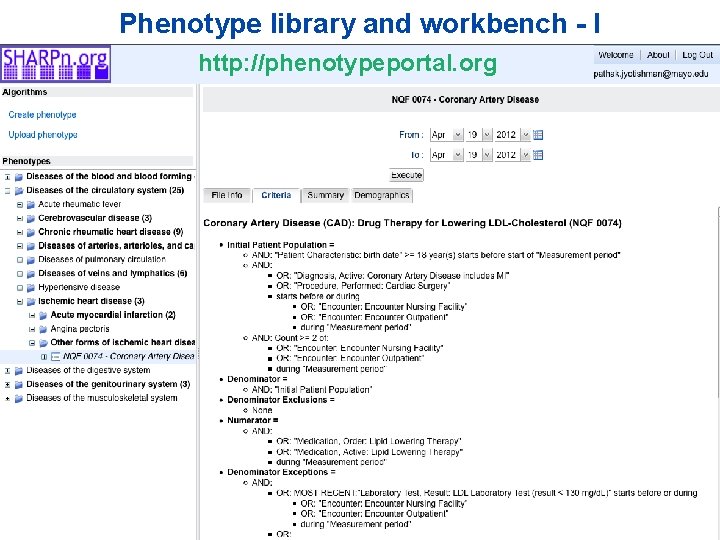
Phenotype library and workbench - I http: //phenotypeportal. org © 2012 MFMER | slide-51
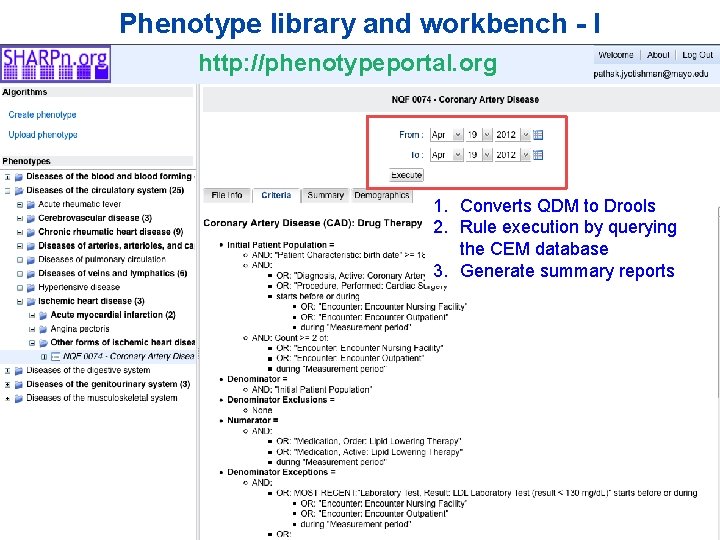
Phenotype library and workbench - I http: //phenotypeportal. org 1. Converts QDM to Drools 2. Rule execution by querying the CEM database 3. Generate summary reports © 2012 MFMER | slide-52
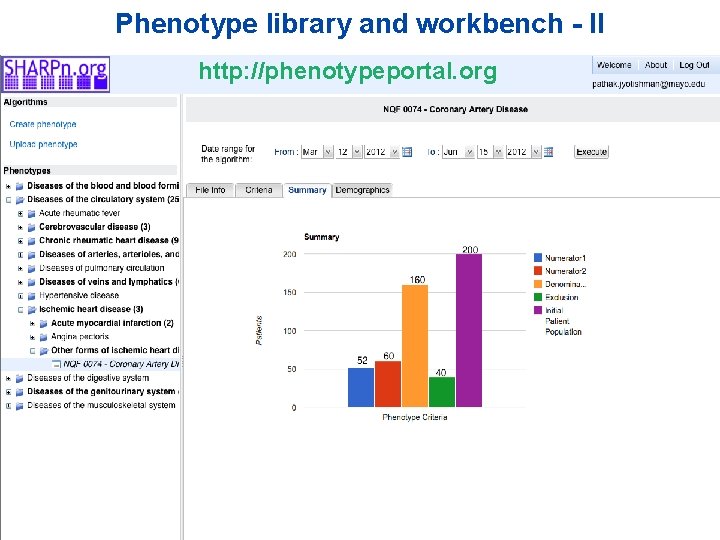
Phenotype library and workbench - II http: //phenotypeportal. org © 2012 MFMER | slide-53
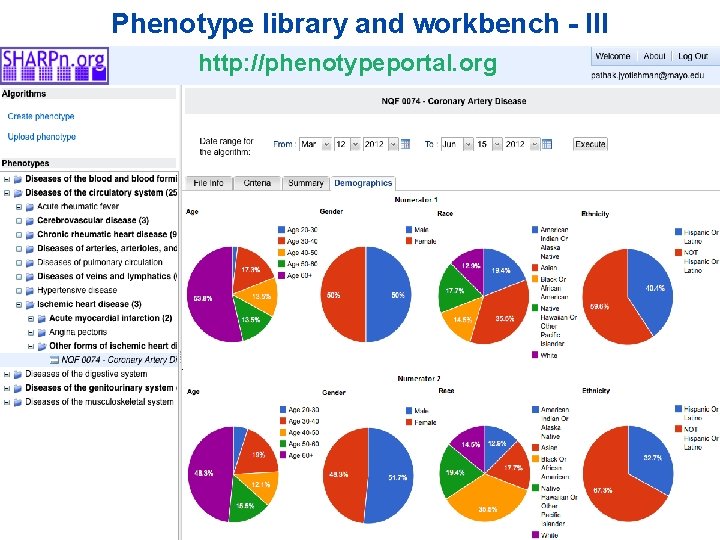
Phenotype library and workbench - III http: //phenotypeportal. org © 2012 MFMER | slide-54
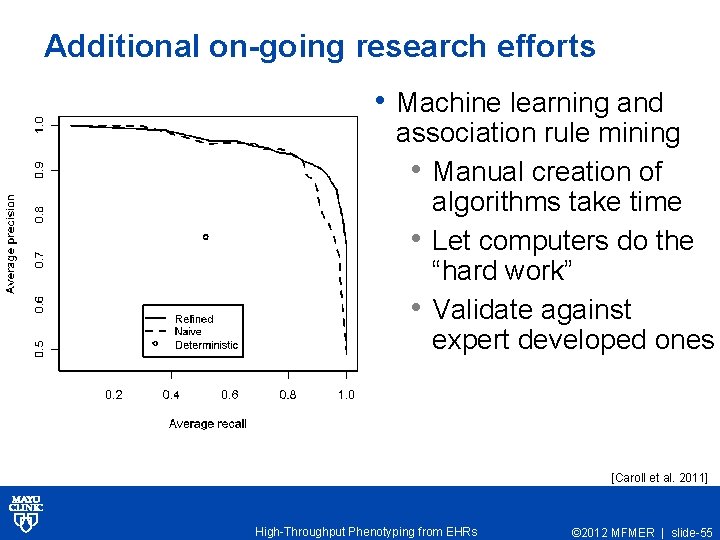
Additional on-going research efforts • Machine learning and association rule mining • Manual creation of algorithms take time • Let computers do the “hard work” • Validate against expert developed ones [Caroll et al. 2011] High-Throughput Phenotyping from EHRs © 2012 MFMER | slide-55
Additional on-going research efforts • Machine learning and association rule mining • Manual creation of algorithms take time • Let computers do the “hard work” • Validate against expert developed ones • Just-in-time phenotyping • Current approach: retrospective, longitudinal • • and offline data processing for phenotypes Future: online, real-time phenotyping by implementing “phenotype sniffers” Applications in active syndrome surveillance for transfusion medicine [Kor et al. 2012] High-Throughput Phenotyping from EHRs © 2012 MFMER | slide-56
What does this R&D mean to HSR? • Common, agreed-upon and well-validated phenotype definitions and criteria • Standardized clinical data retrieval and management • “One-stop place” for visualization, execution, and report generation of phenotyping algorithms • Implications for (to name a few): • Center for Science of Healthcare Delivery (SHCD) • Data Management Services (DMS/BSI) • Epidemiology & Health Care and Policy Research • (Epi. /HCPR/Rochester Epi. Project) Mayo Clinic Biobank/Genome Consortia (Mayo. GC) High-Throughput Phenotyping from EHRs © 2012 MFMER | slide-57
Summary • EHRs contain a wealth of phenotypes for clinical and translational research • EHRs represent real-world data, and hence has challenges with interpretation, wrong diagnoses, and compliance with medications • Handling referral patients even more so • Standardization and normalization of clinical data and phenotype definitions is critical • Phenotyping algorithms are often transportable between multiple EHR settings • Validation is an important component High-Throughput Phenotyping from EHRs © 2012 MFMER | slide-58
Acknowledgements: e. MERGE collaborators • Northwestern • NHGRI • • Rongling Li Teri Manolio • Group Health • • • Eric Larson Gail Jarvik Chris Carlson Wylie Burke Gene Jart David Carrell Malia Fullerton Walter Kukull Paul Crane Noah Weston • Marshfield • • Cathy Mc. Carty Peggy Peissig Marilyn Ritchie Russ Wilke • • Rex Chisholm Bill Lowe Phil Greenland Luke Rassmussen Justin Starren Maureen Smith Jen Allen-Pacheco Will Thompson • Mayo Clinic • • • Christopher G. Chute Iftikhar J. Kullo Suzette Bielinski Mariza de Andrade John Heit Jyoti Pathak Matt Durski Sean Murphy Kevin Bruce • Vanderbilt • • • Dan Roden Josh Denny Brad Malin Ellen Wright Clayton Dana Crawford Melissa Basford High-Throughput Phenotyping from EHRs © 2012 MFMER | slide-59
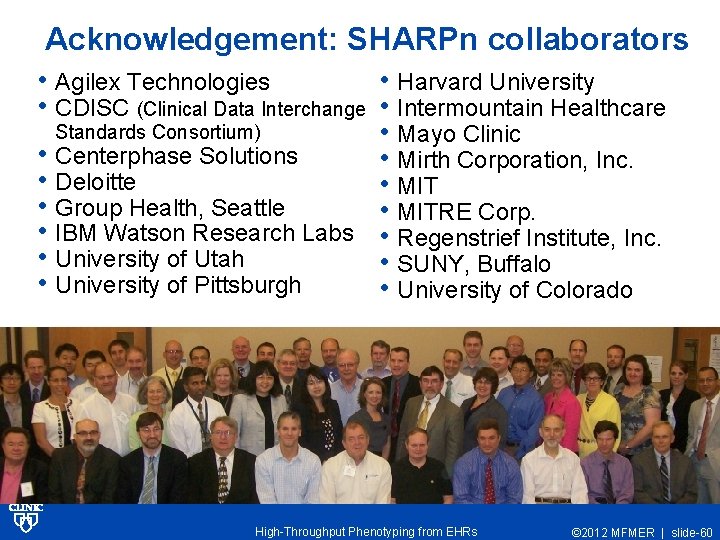
Acknowledgement: SHARPn collaborators • Harvard University • Agilex Technologies • CDISC (Clinical Data Interchange • Intermountain Healthcare Standards Consortium) • Mayo Clinic • Centerphase Solutions • Mirth Corporation, Inc. • Deloitte • MIT • Group Health, Seattle • MITRE Corp. • IBM Watson Research Labs • Regenstrief Institute, Inc. • University of Utah • SUNY, Buffalo • University of Pittsburgh • University of Colorado High-Throughput Phenotyping from EHRs © 2012 MFMER | slide-60
Thank You! http: //jyotishman. info High-Throughput Phenotyping from EHRs © 2012 MFMER | slide-61