Creating a Menu of Interprofessional Learning Activities Lauren

- Slides: 36
Creating a Menu of Interprofessional Learning Activities Lauren Collins, MD Tracey Vause-Earland, MS, OTR/L Sarah Dallas, BA Elizabeth Speakman, Ed. D, RN, ANEF, FNAP
Disclosures The authors have no relevant financial or non-financial relationships to disclose.
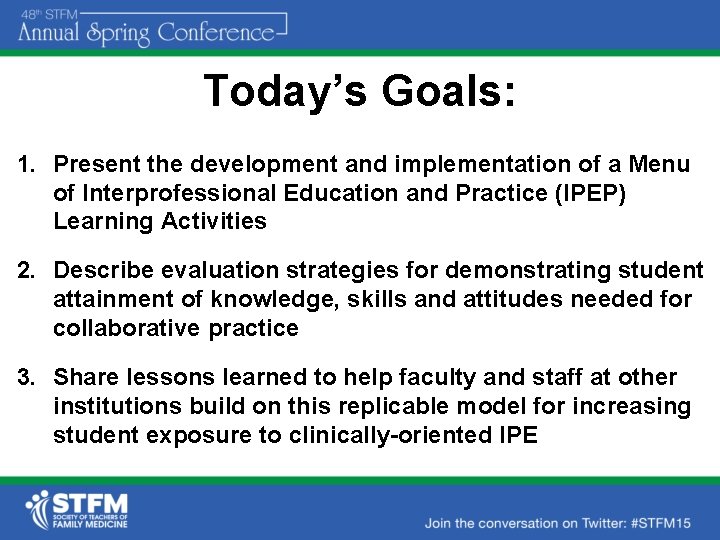
Today’s Goals: 1. Present the development and implementation of a Menu of Interprofessional Education and Practice (IPEP) Learning Activities 2. Describe evaluation strategies for demonstrating student attainment of knowledge, skills and attitudes needed for collaborative practice 3. Share lessons learned to help faculty and staff at other institutions build on this replicable model for increasing student exposure to clinically-oriented IPE
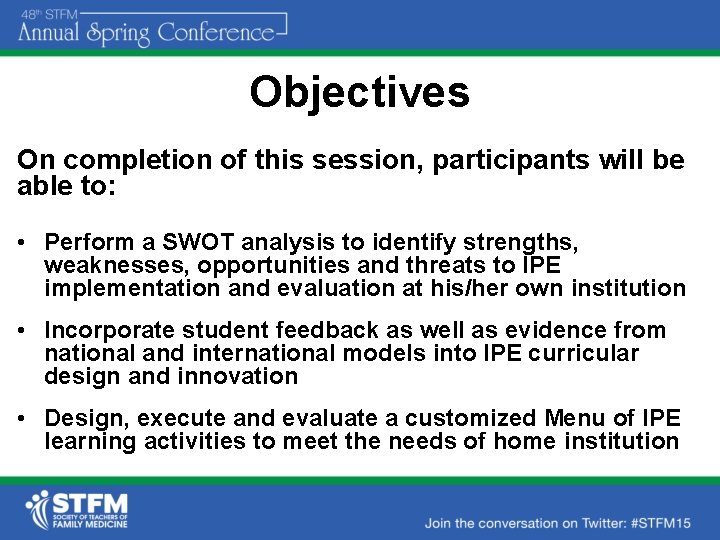
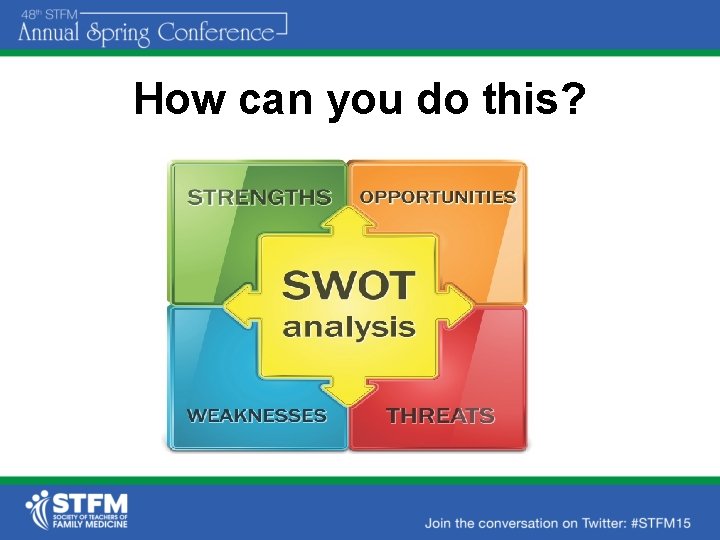
Objectives On completion of this session, participants will be able to: • Perform a SWOT analysis to identify strengths, weaknesses, opportunities and threats to IPE implementation and evaluation at his/her own institution • Incorporate student feedback as well as evidence from national and international models into IPE curricular design and innovation • Design, execute and evaluate a customized Menu of IPE learning activities to meet the needs of home institution
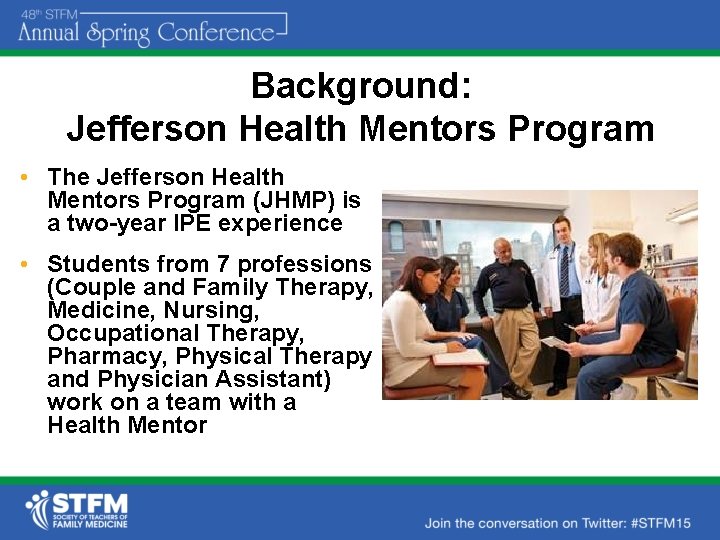
Background: Jefferson Health Mentors Program • The Jefferson Health Mentors Program (JHMP) is a two-year IPE experience • Students from 7 professions (Couple and Family Therapy, Medicine, Nursing, Occupational Therapy, Pharmacy, Physical Therapy and Physician Assistant) work on a team with a Health Mentor
Why do we need IPE? To Prepare for Collaborative Practice • Interprofessional Collaborative Practice: – “When multiple health workers from different professional backgrounds work together with patients, families, carers [sic], and communities to deliver the highest quality of care” (WHO, 2010) • Addresses the “Triple Aim” – Improves patient outcomes – Increases patient (and provider) satisfaction – Decreases costs
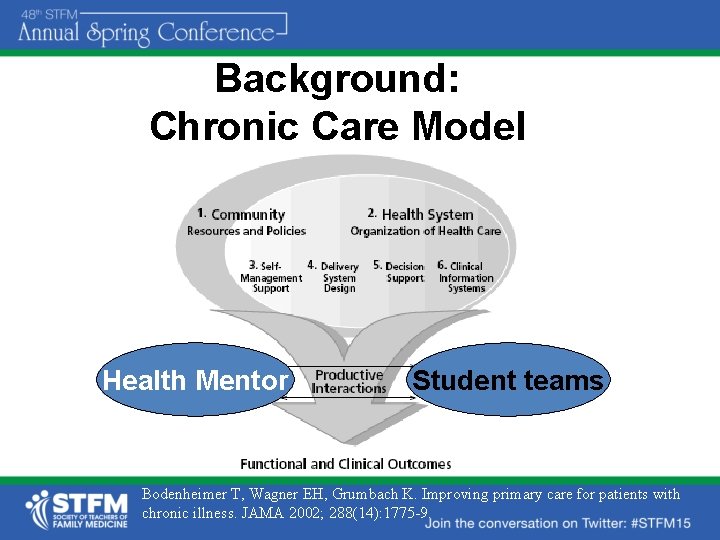
Background: Chronic Care Model Health Mentor Student teams Bodenheimer T, Wagner EH, Grumbach K. Improving primary care for patients with chronic illness. JAMA 2002; 288(14): 1775 -9.
TJU IPE Core Competencies Values/Ethics: • Respect the unique cultures, values, roles/responsibilities and expertise of other health professionals. Roles/Responsibilities: • Explain the roles and responsibilities of other health/healthcare providers and how the team works together to provide care. Interprofessional Communication: • Work to ensure common understanding of information, treatment, and health/healthcare decisions by listening actively, communicating effectively, encouraging ideas and opinions of other team members and expressing one’s knowledge and opinions with confidence, clarity and respect. Team and Teamwork: • Reflect on the attributes of highly functioning teams and demonstrate the responsibilities and practices of effective team member(s). -Adapted from IPEC Core Competencies for Collaborative Practice, 2011
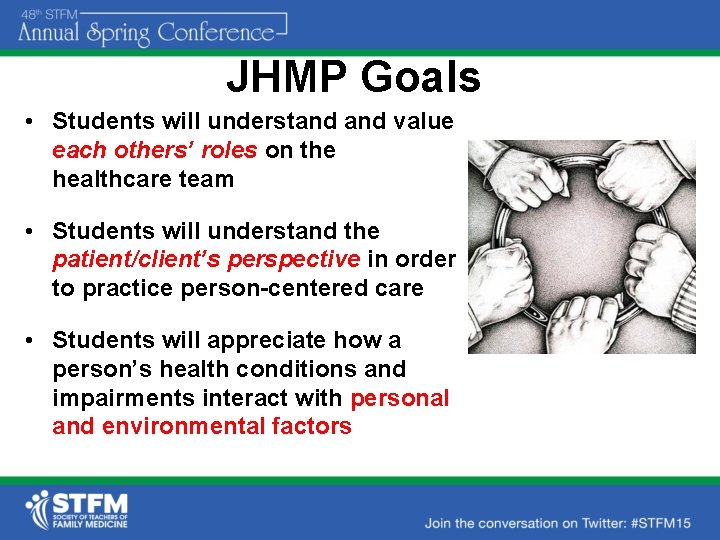
JHMP Goals • Students will understand value each others’ roles on the healthcare team • Students will understand the patient/client’s perspective in order to practice person-centered care • Students will appreciate how a person’s health conditions and impairments interact with personal and environmental factors
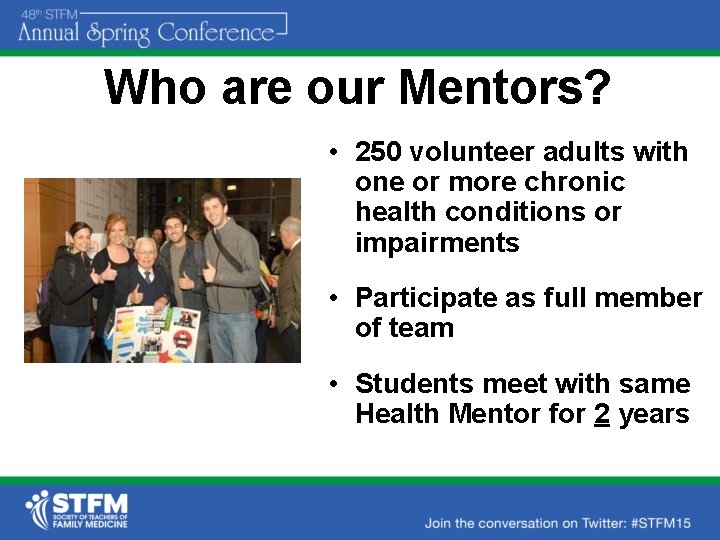
Who are our Mentors? • 250 volunteer adults with one or more chronic health conditions or impairments • Participate as full member of team • Students meet with same Health Mentor for 2 years
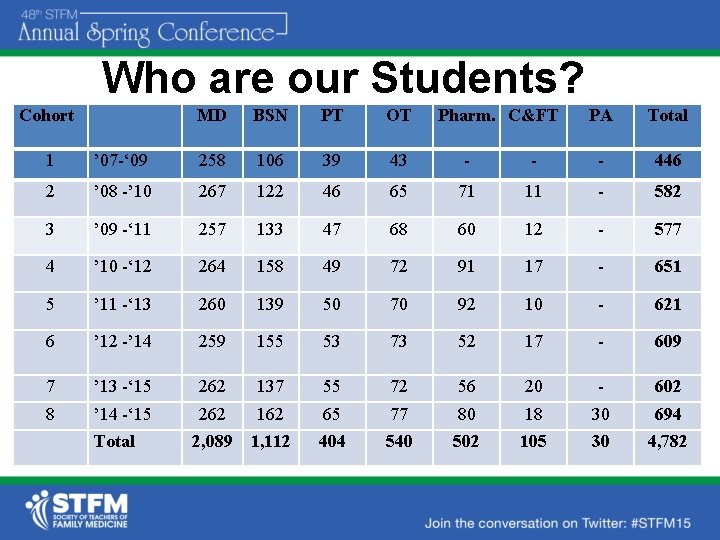
Who are our Students? Cohort MD BSN PT OT Pharm. C&FT PA Total 1 ’ 07 -‘ 09 258 106 39 43 - - - 446 2 ’ 08 -’ 10 267 122 46 65 71 11 - 582 3 ’ 09 -‘ 11 257 133 47 68 60 12 - 577 4 ’ 10 -‘ 12 264 158 49 72 91 17 - 651 5 ’ 11 -‘ 13 260 139 50 70 92 10 - 621 6 ’ 12 -’ 14 259 155 53 73 52 17 - 609 7 ’ 13 -‘ 15 262 137 55 72 56 20 - 602 8 ’ 14 -‘ 15 262 162 65 77 80 18 30 694 2, 089 1, 112 404 540 502 105 30 4, 782 Total
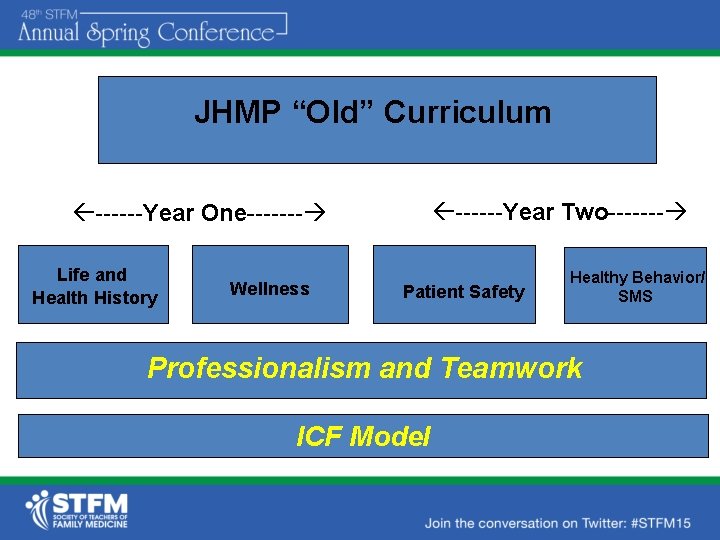
JHMP “Old” Curriculum ------Year Two------- ------Year One------- Life and Health History Wellness Patient Safety Healthy Behavior/ SMS Professionalism and Teamwork ICF Model
Continuous Quality Improvement • Students evaluations collected analyzed at the end of each of 4 modules (over the last 7 years) • Common themes- students want additional opportunities for exposure to real-world collaborative practice teams “It would be great if we could shadow professionals from different disciplines I would have loved to see what an OT or PT does on a day to day bases and how they interact with doctors. ” “I believe that interdisciplinary education could be greatly enhanced if somehow we were able to interact with established employees in other disciplines. ”
Background – Sample Pilot Project • Pilot “IPE Grand Rounds” – April, 2014 • Invited MICU team to discuss a case and discuss roles/responsibilities, teamwork and communication • Voluntary “extra-curricular” event • Number of attendees: 34 • Results – Evaluation: 94% of students “agreed” or “strongly agreed” that they would like to attend future events “like this one”
Background- Sample Pilot Project • Pilot Team STEPPS Simulation– April 2014 – Intro to Team STEPPS communication strategies, like CUS and Speak Up – Simulations with students/observers • SP has a stroke while in rehab gym and seizes • SP has cardiac arrest while in MRI suite – Facilitated debriefing – Number of attendees: 19 – Evaluation: students liked “hands on” activity in a “safe” environment; reported increased understanding of roles, and increased confidence in communication skills
CQI, cont. • Based on student feedback, decision made to revamp Module 4 during summer 2014 • Steering Committee with faculty and student participants developed a new “menu” of IPE Learning Activities • Menu generated by expanding existing successful IPE pilots, forging new partnerships with existing practice teams/providers, and developing several brand new pilot programs
Program Development • Each of the IPE Learning Activities has three primary learning objectives. By participating in this Learning Activity, students will: 1. Learn critical components of collaborative practice and personcentered care through participation in an interprofessional clinical observation, simulation or interactive classroombased experience; 2. Reflect on this experience in light of previous experience with their Health Mentor and interprofessional student team; and 3. Consider ways to incorporate interprofessional knowledge, skills and attitudes into future practice.
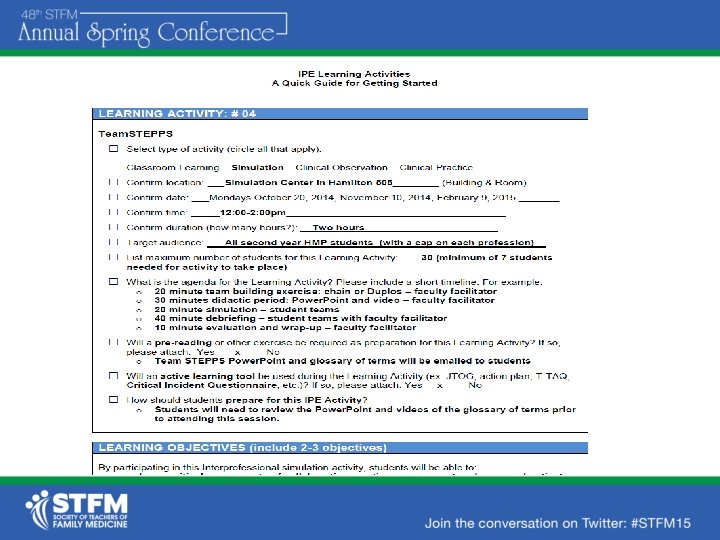
Program Development • Team developed an internal “toolkit” to set up, formalize, and track each Interprofessional Education and Practice (IPEP) Learning Activity • Toolkit included specific details for activity: date, time, location, learning objectives, #learners, #faculty, pre-reading requirements, evaluation strategy, etc.
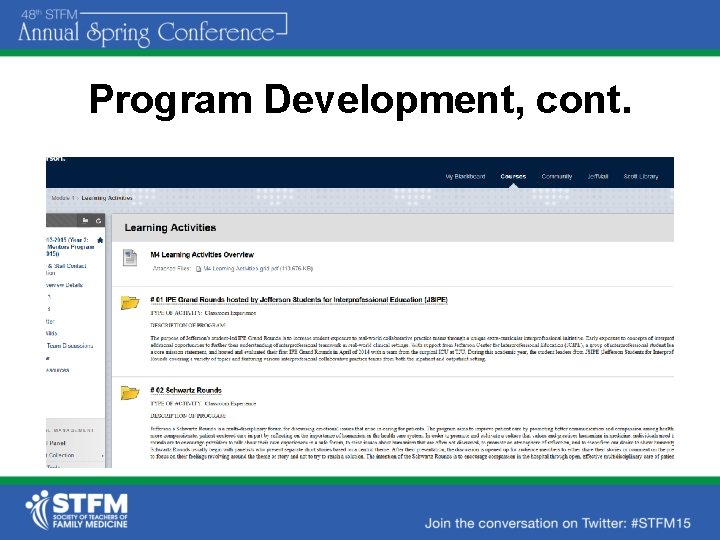
Program Development, cont.
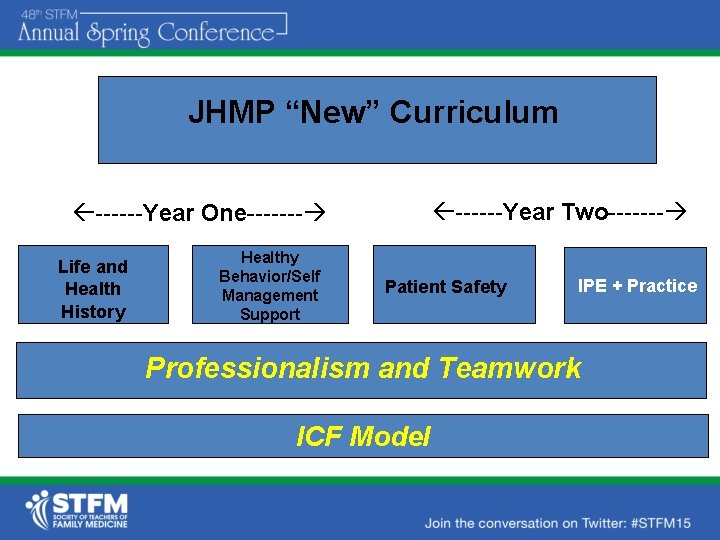
JHMP “New” Curriculum ------Year Two------- ------Year One------- Life and Health History Healthy Behavior/Self Management Support Patient Safety IPE + Practice Professionalism and Teamwork ICF Model
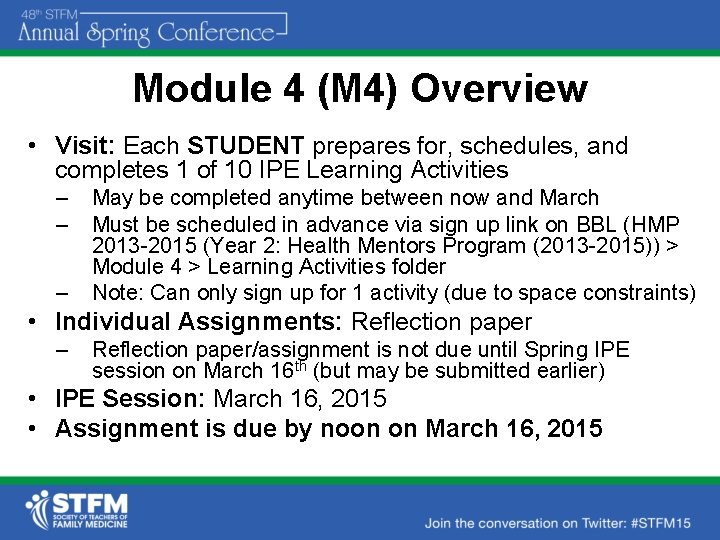
Module 4 (M 4) Overview • Visit: Each STUDENT prepares for, schedules, and completes 1 of 10 IPE Learning Activities – – – May be completed anytime between now and March Must be scheduled in advance via sign up link on BBL (HMP 2013 -2015 (Year 2: Health Mentors Program (2013 -2015)) > Module 4 > Learning Activities folder Note: Can only sign up for 1 activity (due to space constraints) • Individual Assignments: Reflection paper – Reflection paper/assignment is not due until Spring IPE session on March 16 th (but may be submitted earlier) • IPE Session: March 16, 2015 • Assignment is due by noon on March 16, 2015
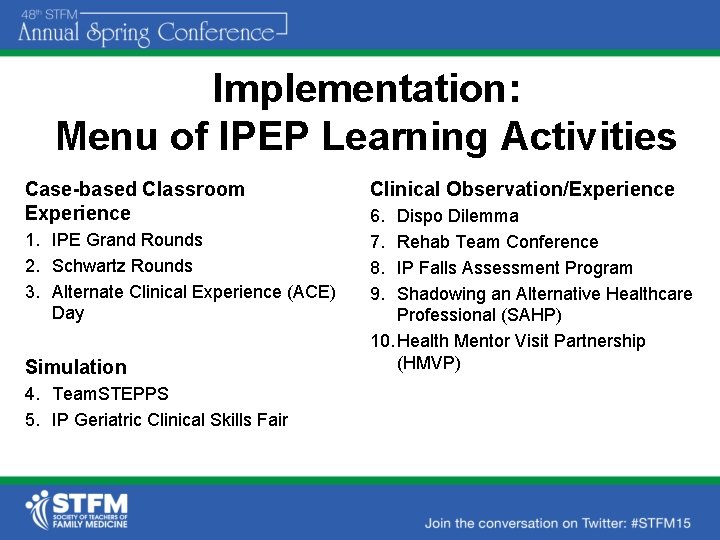
Implementation: Menu of IPEP Learning Activities Case-based Classroom Experience 1. IPE Grand Rounds 2. Schwartz Rounds 3. Alternate Clinical Experience (ACE) Day Simulation 4. Team. STEPPS 5. IP Geriatric Clinical Skills Fair Clinical Observation/Experience 6. 7. 8. 9. Dispo Dilemma Rehab Team Conference IP Falls Assessment Program Shadowing an Alternative Healthcare Professional (SAHP) 10. Health Mentor Visit Partnership (HMVP)
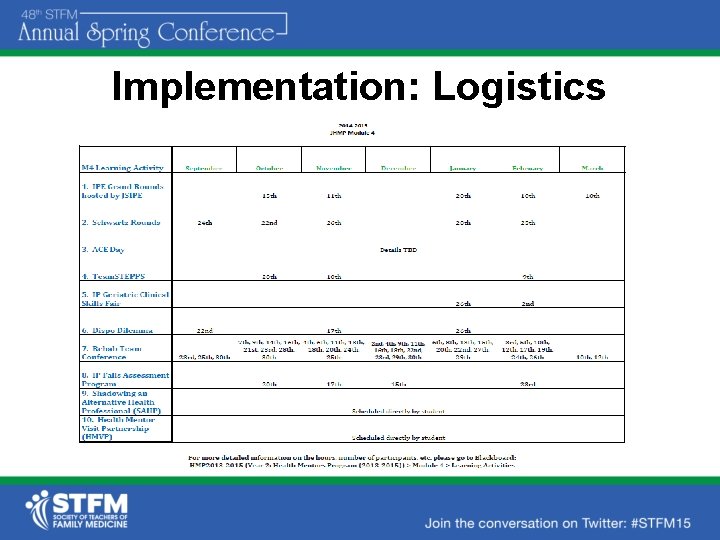
Implementation: Logistics
Implementation: Evaluation • Measurement for each IPEP Learning Activity includes: – Completion of pre-readings – Active participation in selected activity – Completion of reflective essay – Presentation and discussion of selected activity during an faculty-facilitated small group session • Program feedback: students were asked to evaluate the new Module – Data is currently being collected!!
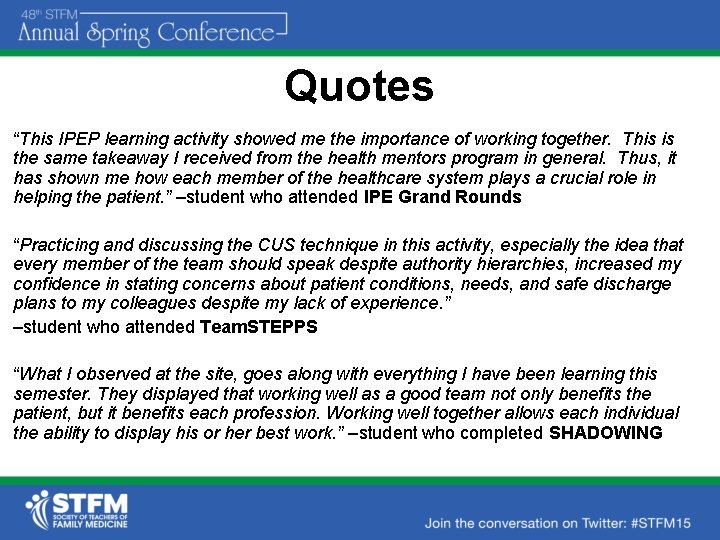
Quotes “This IPEP learning activity showed me the importance of working together. This is the same takeaway I received from the health mentors program in general. Thus, it has shown me how each member of the healthcare system plays a crucial role in helping the patient. ” –student who attended IPE Grand Rounds “Practicing and discussing the CUS technique in this activity, especially the idea that every member of the team should speak despite authority hierarchies, increased my confidence in stating concerns about patient conditions, needs, and safe discharge plans to my colleagues despite my lack of experience. ” –student who attended Team. STEPPS “What I observed at the site, goes along with everything I have been learning this semester. They displayed that working well as a good team not only benefits the patient, but it benefits each profession. Working well together allows each individual the ability to display his or her best work. ” –student who completed SHADOWING
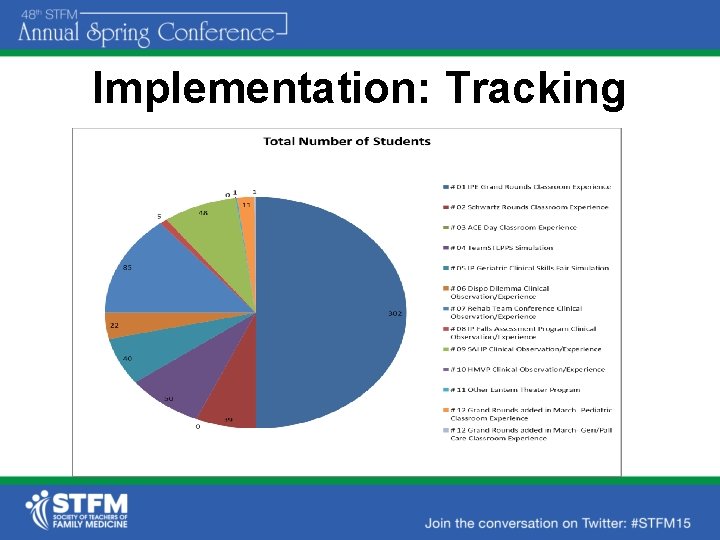
Implementation: Tracking
Lessons Learned: Strengths • Built on existing IP pilots and team-based clinical activities, without adding too much additional work for faculty/staff • Listened to and incorporated student feedback – Students also actively involved in development and implementation of one of the most popular new activities, “IPE Grand Rounds” • Based on early feedback, menu of activities has been very well received – Students like that it allows for choice/self-directed learning and eases scheduling challenges – Students are now asking to have additional and/or earlier exposure to these types of experiences
Lessons Learned, cont. Challenges • Tracking attendance, scheduling logistics for over 600 students from 7 professions • Clinician/faculty development in IPE • Evaluation challenges – variety of tools employed
Program Successes • Responsive to student feedback => increased student “buy-in” • Helps institution to meet IPE accreditation requirements • Moves students along learning continuum from informed/knowledgeable to skilled/proficient • Forging new partnerships between educational and clinical enterprises at our institution • Bridging gap between classroom-based IPE and “real world” collaborative practice
Future Steps • Adding additional new IPEP learning activities for upcoming academic year • Also, building new advanced “IPE electives” for students who want even more exposure • Working toward IPE transcript designation • Developing new evaluation mobile app, Jefferson Teamwork Observation Guide (JTOG), to allow for consistent, standardized 360 degree of all IPE/collaborative practice experiences on campus
How can you do this?
Questions?
Contact us: Lauren Collins, MD Associate Professor, Department of Family and Community Medicine Sidney Kimmel Medical College at TJU Associate Director, Jefferson Inter. Professional Education Center(JCIPE) Lauren. Collins@jefferson. edu JCIPE/Health Mentors website info www. jefferson. edu/jcipe
References • • • Interprofessional Education Collaborative Expert Panel. (2011). Core competencies for interprofessional collaborative practice: Report of an expert panel. Interprofessional Education Collaborative, Washington, DC. Retrieved from: http: //www. aacn. nche. edu/education-resources/ ipecreport. pdf. Sinclair L, Lowe M, Paulenko T, et al. (2007) Facilitating interprofessional clinical learning: Interprofessional education placements and other opportunities. University of Toronto, Office of Interprofessional Education: Toronto. Thibault G. Reforming Health Professions Education Will Require Culture Change And Closer Ties Between Classroom And Practice. Health Affairs 2013; 32(11): 1928 -1932. Reeves S, Perrier L, Goldman J, Freeth D, Zwarenstein M. (2013). Interprofessional education: Effects on professional practice and healthcare outcomes (update). Cochrane Database of Systematic Reviews, 3, CD 002213 [doi: 10. 1002/14651858. CD 002213. pub 3]. Liaison Committee for Medical Education. (2013). Functions and structure of a medical school: Standards for accreditation of medical education programs leading to the M. D. degree. New Accreditation Standard ED-19 -A. Retrieved from: http: //www. lcme. org/publications/.
Please evaluate this session at: stfm. org/sessionevaluation