
Lauren White Hoover La Cerra Dickson Hoover Rogers


- Slides: 63
Lauren White Hoover La. Cerra, Dickson, Hoover, & Rogers, PLLC 212 Center Street, 2 nd Floor Little Rock, AR 72201 www. ldhrlaw. com CASE LAW UPDATE 2018 -2019
SIMON V DHS 2018 ARK. APP. 327 • An order forever terminating parental rights must be based on clear and convincing evidence that termination is in the children's best interest and a statutory ground for termination exists. • Best interest includes consideration of the likelihood that the children will be adopted and the potential harm caused by returning custody of the children to the parent. • Appellant contends that the trial court erred by finding that termination of his parental rights was in the children's best interest where no evidence was offered to support the court's adoptability finding and there was a lesser-restrictive option for the children. • At the conclusion of the termination hearing, DHS asked the trial court to make a finding that the issue of adoptability was "legally insignificant in this case. " However, the court instead found that the children were adoptable and that Madison could do a single-parent adoption. In support of his argument that this error warrants reversal, appellant cites Lively v. Arkansas Department of Human Services. In Lively, our court reversed and remanded the termination of Lively's parental rights to his children because the trial court erroneously found that the children were adoptable although there was no evidence of adoptability and there was no evidence that the children would ever be put up for adoption since they were in the permanent custody of their mother. • It was error for the court to find that the children were adoptable because there was no evidence of adoptability in the record, and there was no finding that this absence of evidence of adoptability made "no legal difference" to the ultimate decision of what was in the children's best interest. Reversed and Remanded
NORTHCROSS V. DHS 2018 ARK. APP. 320 • Putative father" means any man not deemed or adjudicated under the laws of the jurisdiction of the United States to be the biological father of a juvenile who claims to be or is alleged to be the biological father of the juvenile. Ark. Code Ann. § 9 -27 -303(47). • "Parent" is defined as a man "who has been found by a court. . . to be the biological father of the juvenile. " Ark. Code Ann. § 9 -27 -303(40). • Without a finding, the entry of the DNA test was legally insufficient to make Mr. Earls a "parent. " • Here, the exact scenario exists. Plus, as a distinction from Brown, supra, and Johnson, supra, DHS specifically requested in its amended TPR petition that the circuit court make a finding regarding paternity or whether Northcross had contacts with the children sufficient for parental rights to attach. The circuit court made no such finding, but the circuit court specifically reopened the record at the close of the hearing to state that Northcross had not petitioned to establish paternity. This court cannot make a finding regarding paternity when the circuit court deliberately did not do so. Relying on Earls, we reverse and remand.
KANTOR V. DHS 2018 ARK. APP. 402 OVERVIEW • For purposes of Ark. Const. amend. 80, § 6(A), Administrative Order of the Supreme Court No. 14(1)(b), the circuit court had subject matter jurisdiction to hear the guardianship proceeding; while the circuit court might have erred in retaining jurisdiction without a formal request, a failure to follow statutory procedure did not oust the court's jurisdiction; • The documentation regarding the child found in the service plan arguably qualified as an evaluation, but the service plan was not a sworn written statement and did not set out the doctor's qualifications; Ark. Code Ann. § 28 -65 -212(a)(2) requires the evaluation be performed by a professional with expertise, a doctor's authorization for treatment is not a sworn written statement, and the circuit court clearly erred in finding that the child's incapacitation was proven as required by the statute.
KANTOR V. DHS 2018 ARK. APP. 402 • Arkansas Code Annotated section 28 -65 -211(b)(1) (Repl. 2012) states that, in determining the incapacity of a person for whom a guardian is sought to be appointed for cause other than minority, disappearance, or detention, or confinement by a foreign power, the court shall require that the evidence of incapacity include the oral testimony or sworn written statement of one or more qualified professionals, whose qualifications shall be set forth in their testimony or written statements. • The evaluation shall be performed by a professional or professionals with expertise appropriate for the respondent's alleged incapacity. Ark. Code Ann. § 28 -65 -212(a)(2). The evaluation shall include the following: (1) the respondent's medical and physical condition; (2) his or her adaptive behavior; (3) his or her intellectual functioning; and (4) a recommendation as to the specific areas for which assistance is needed and the least restrictive alternatives available. Ark. Code Ann. § 28 -65 -212(b).
KANTOR V. DHS 2018 ARK. APP. 402 • Here, the extensive documentation regarding Rebecca found in the service plan arguably qualifies as an evaluation. • We agree with Linda, however, that the service plan is not a sworn written statement and does not set out the doctor's qualifications. • DHS contends that the doctor's authorization serves as a promise that the information contained in the service plan is accurate and that the "M. D. " following the doctor's name complies with "the spirit" of the statute. However, we are not convinced that the latter suffices under the statute given that section 28 -65212(a)(2) requires that the evaluation be performed by a professional with expertise appropriate for the respondent's alleged incapacity. Moreover, a doctor's authorization for treatment is not a sworn written statement. Alternatively, DHS argues that Linda invited any error given that she alleged in her petition for guardianship that Rebecca was incapacitated. We do not agree that the invited-error doctrine should be applied here. • The opinion is also significant because it rejects a challenge to the circuit court's continuing jurisdiction, notwithstanding no request was made for it to continue jurisdiction, as provided in the statute. The ward turned age eighteen and was handicapped with cerebral palsy. The opinion also rejected challenges to the mother's standing.
BALLARD V. HOWARD 2018 ARK. APP. 479 ADOPTION CASE – BEST INTEREST • The trial court did not clearly err by finding that the child's mother and stepfather failed to meet their burden of showing that adoption of the child by the stepfather was in the child's best interests because the mother and the paternal grandmother testified that there was a significant bond between the child, the grandmother, and his paternal extended family, the father testified that as soon as he was released from jail he would be involved in the child's life, the parents were extremely young when the child was born, and the father was only 21 years at the time of the hearing.
BALLARD V. HOWARD 2018 ARK. APP. 479 • No dispute that father’s consent was not required. • However, the mere fact that a parent has forfeited the right to have his consent to an adoption required does not mean that the adoption must be granted—the court must further find from clear and convincing evidence that the adoption is in the best interest of the child • First, mom and stepdad argued that because the grandmother has no statutory grandparent-visitation order, she does not have any enforceable right to a relationship with BLH. • REJECTED: Having a right as a grandparent does not mean we don’t consider the grandparent in determining what is the child's best interest. The issue here is not whether Donna may intervene but whether declining to sever the relationship BLH has with his paternal family is in BLH's best interest
BALLARD V. HOWARD 2018 ARK. APP. 479 • Next argument is that the trial court’s focus should have been on the relationship between the child and the natural parent instead of the relationship between the child and the person trying to adopt. • PRACTICE POINT: Where possible, try not to exclusively cite cases where the trial court granted the adoption and it was affirmed when you are appealing the denial of an adoption because then you’ll get this comment from the Court: Even still, we note one major distinction between the current case and those cited by the Ballards: in every single case cited by the Ballards, either this court or our supreme court affirmed adoption petitions granted by the trial courts.
BALLARD V. HOWARD 2018 ARK. APP. 479 • This case is more like Hollis. • Instead, this case is more like Hollis, supra. There, the lower court denied a stepparent adoption on a best-interest finding. The mother, while not incarcerated, had a history of drug and alcohol abuse and a DWI conviction, and one of her boyfriends had abused the minor child to be adopted. There was also evidence, however, that the mother had visited the minor child one time at school, was trying to better herself, and had photos of her and the minor child smiling together. There was also evidence that the minor child, as here, had a substantial relationship with his maternal grandmother, whom he loved and called "Nana. " And, as here, the child had a wonderful parentchild relationship in place with the stepparent hoping to adopt. Despite these admittedly sparse findings, we affirmed. We did so because when the issue is one of terminating parental rights, there is a heavy burden on the party seeking to terminate the relationship, and we must give due regard to the trial court's personal observations and assessments of the credibility of the witnesses. • So, as in Hollis, the evidence before us supports the trial court's findings: • Donna and Hailee testified that there was a significant bond between the child and Donna and his paternal extended family. Hailee testified that it would "crush" BLH if his paternal relatives were no longer in his life. • Curtis testified that "Ms. Ballard and I separated when [BLH] was a year and a half old. If I legally remain his parent, as soon as I'm not incarcerated, I would be involved in everything in his life. " • Additionally, the court's statement that "the fact that each party was extremely young when this child was born, Mr. Howard is only 21, now, and that has to play a role in this decision, " also supports the finding. The trial court's decision that the Ballards failed to meet their burden by clear and convincing evidence that adoption was in the best interest of BLH was not clearly erroneous.
HARGIS V. HARGIS 2018 ARK. APP. 490 • As recited more fully in a companion case to this appeal, Hargis v. Hargis, 2018 Ark. App. 469, 561 S. W. 3 d 336, the circuit court entered an order in February 2017 and decided a dispute, which Colonel Allen Hargis filed, over how much military-retirement money Lynn Hargis was entitled to receive from the property-settlement agreement the divorcing couple signed in 2009. • This appeal is about the award of attorneys fees: Wife was ordered to pay $18, 000 + in attorney’s. • The super narrow issue is whether Ms. Hargis was denied a sufficient opportunity under the rules of civil procedure to oppose the fee request before the circuit court decided it. Judge Brandon Harrison wrote the opinion. He’s my favorite writer on the COA. #sharingiscaring
HARGIS V. HARGIS 2018 ARK. APP. 490 • Col’s Motion for Fees contained an affidavit from his attorney that detailed $18, 325 in attorney's fees. Of those fees, the expert witness, Col. Sullivan, charged $15, 871. 20 for his services as a testifying expert witness. He filed under Rule 54(e) and “prevailing party” contract statute. • Ms. Hargis timely objected to the petition. She argued, among other things, that the statute did not apply to a domestic-relations case and that Col. Hargis's "financial abilities" "far exceed[ed]" hers. She asked the court to either deny the motion outright or set a hearing so she could develop the parties' respective financial pictures and abilities to pay fees. Trial court ruled for Colonel as the prevailing party in an action based in contract to enforce a Property Settlement Agreement. He is also the prevailing party on Defendant's Counter-Motion to "interpret" a contract. • Ms. Hargis filed for relief under Rule 59. That motion was deemed denied. Appeal follows
HARGIS V. HARGIS 2018 ARK. APP. 490 • On appeal, Ms. Hargis argues that the circuit court was required to hold a hearing on Col. Hargis's motion so she could present evidence of the parties' relative "financial abilities. " Being denied that opportunity, she says, was a procedural due-process violation under the Fourteenth Amendment to the United States Constitution. “Several legal overtones resonate in this case, but for simplicity's sake we focus on the one best tuned to a civil case involving a routine request for attorney's fees: the rules of civil procedure. They amply embody and advance, for this case's purposes, the basic tenet that a party must be sufficiently heard in opposition to an adversary's attorney-fee request before an award issues. This court avoids climbing a constitutional mountain if it can traverse a procedural hill instead. ” – Judge Brandon Harrison
HARGIS V. HARGIS 2018 ARK. APP. 490 • Turning to Rule 54, which Col. Hargis himself invoked to seek fees, subsection (e)(3)states that if a party asks, then a circuit court "shall afford an opportunity for adversary submissions with respect to the motion in accordance with Rule 43(c) or Rule 78" after a request for attorney's fees has been made. Ark. R. Civ. P. 54(e)(3) (2017). • Shall almost universally means must in legal parlance. Prescott Sch. Dist. v. Steed, 2018 Ark. App. 424, at 2 ("The word 'shall' when used in our rules of civil procedure is construed to mean that compliance is mandatory. "). • We have no reason to deviate from the common understanding. Given that Col. Hargis moved for fees, and Ms. Hargis asked that she be allowed to present opposing evidence, the circuit court was required to permit "an opportunity for [an] adversary submission".
HARGIS V. HARGIS 2018 ARK. APP. 490 • “What does that phrase mean for Rule 54 purposes? Rule 43(c) tells us that when a motion is based on facts that are not of record, then the court may receive affidavits or direct that it will decide the matter on oral testimony or deposition. Ark. R. Civ. P. 43(c)(2017); see also Ark. R. Civ. P. 78(c) (2017) ("Unless a hearing is requested by counsel or is ordered by the court, a hearing will be deemed waived[. ]"). So Rule 54(e)(3)'s phrase "an opportunity for adversary submissions" ties to Rule 43(c)'s declaration that, when a motion is based on facts, then the circuit court must receive (1) affidavits that the parties submit, (2) deposition testimony, or (3) oral testimony. ” • “Paper or people. Those are the options. ” • “The circuit court may suggest that the parties pursue one option over another. The court, in our view, could order one option over another, assuming a party's evidentiary submission was not unduly limited or curtailed by the choice. For example, a circuit court might prefer "paper" evidence by way of affidavits or a deposition transcript instead of receiving live-witness testimony under Rule 43(c)'s "oral testimony" option. Which avenue is best calibrated to do the most good, in the most timely and efficient manner for all involved, is the circuit court's ultimate decision to make. An important threshold question is whether the motion is predicated on facts that need to be placed in the record for the first time or whether the record needs further development before the motion can be fairly decided. A motion for attorney's fees is one based in facts; and Ms. Hargis's timely plea that she be allowed to present evidence on the parties' relative financial positions and abilities to pay fees is likewise a factbased point. ”
HARGIS V. HARGIS 2018 ARK. APP. 490 • DISSENT –KLAPPENBACH and GLADWIN • It is important to note that Lynn's argument in her appellate brief is limited to her general assertion that she was denied an opportunity to present evidence on the relative financial abilities of the parties in violation of procedural due process. Lynn did not cite to any Arkansas Rule of Civil Procedure in her appellate brief. • Equally concerning, the majority opinion "make[s] no attempt to prescribe any formulae for calculating an answer to the 'how much is enough process' query. " The majority refuses to answer the only question Lynn presented, which was whether she was entitled to a hearing on Allen's attorney-fee request. • The majority reverses and remands "for a more fulsome opportunity to be heard" by the trial court conducting a hearing or by the judge ordering Lynn to provide evidence in the form of affidavits. Notably, Lynn does not seek an opportunity to present affidavits; she wants a hearing. Thus, the majority is crafting a potential remedy that she does not request on appeal. • The trial court did not deprive Lynn an opportunity to respond to Allen's request for attorney's fees; she did respond. Lynn failed to support her response with an affidavit, which she could have done. For all the foregoing reasons, Lynn has failed to demonstrate that she was denied procedural due process. Consequently, Lynn has failed to demonstrate reversible error.
BANKS V. BARTON 2018 ARK. APP. 523 • Competing petitions for adoption, lots of procedural appellate issues that I leave you to read on your own. BUT the consent signed by DHS (who had custody of the minor child) was deficient because it did not contain the statutory withdrawal language. Make sure it is in there!!!! You can waive the 10 days, but you cannot waive to less than 5 days. • This majority opinion is 28 pages long. • The dissent points out this is a simple case of competing petitions for adoption between foster parents and paternal grandparents. • Majority affirms the grant of the adoption by foster parents. • Dissent is critical of the majority making this case too complicated and says he cannot endorse granting an adoption of a child into a family who had just been revoked as a foster family for the entire State of AR.
BANKS V. BARTON 2018 ARK. APP. 523 • We have previously stated that the code grants the circuit court the authority to decide the issue of whether DHS unreasonably withheld its consent to the adoption of a minor in its care and custody. In Davis-Lewallen, we stated that "[n]either this court nor the supreme court has provided a test as to what constitutes unreasonable withholding of consent. " • However, the Tom case, cited in Davis-Lewallen, applied the clearly-erroneous standard. Tom, 101 Ark. App. at 393, 278 S. W. 3 d at 113 ("The issue at hand in this case is whether the circuit court's finding that Ms. Cox reasonably withheld her consent to the adoption is clearly erroneous. ". Tom is therefore our best guidance, and we apply the clearly-erroneous standard to questions of whether consent was unreasonably withheld.
IN RE ADOPTION OF Z. K. , A MINOR 2018 ARK. APP. 533 • This case about who has standing to contest an adoption • The issue before us is whether Justin has standing to pursue his petition to vacate the adoption. In other words, was he a person entitled to notice or whose consent was required before the circuit court could enter an adoption decree regarding ZK? ZK was born to parents who were married: Dawn and Allen Williams. Those parents relinquished their parental rights. In Allen’s consent/relinquishment he stated he was married prior to and during the time of conception and that he was the child’s father. • The Keys’ (New adoptive parents) petition to adopt was granted on June 29, 2016. • 9 months later, Justin filed a petition to vacate the final decree of adoption and a supporting brief claiming that he was ZK's biological father and had maintained a significant custodial, personal, and financial relationship with the child when Dawn and ZK lived with Justin from August 2015 through mid-May 2016.
IN RE ADOPTION OF Z. K. , A MINOR 2018 ARK. APP. 533 • On July 24, 2017, Justin filed an additional brief in support of his petition and attached the following documents. He filed an affidavit stating that he and Dawn had an on-and-off relationship from 2014 through sometime in 2016; Dawn told him in December 2014 that she was pregnant with his child; they "broke up" in February 2015; in August 2015, several weeks after ZK's birth, Dawn moved in with Justin and he provided financial support; • Justin performed a "home paternity test" on ZK in March 2016 • he claims that he unsuccessfully attempted to register with the Arkansas Putative Father Registry • June 2016, Justin hired an Oklahoma lawyer for "visitation and custody. " • He attached the results from the home paternity test purporting to indicate that he was the father of ZK. He attached a "Petition for Judicial Order Determining Paternity, Custody and Visitation" that had been filed in Oklahoma on September 20, 2016. • He also attached an affidavit from his Oklahoma attorney, stating that Justin had diligently attempted to provide service information for Dawn but was unable to discover Dawn's whereabouts in Texas until August 2016, at which point Dawn was served with Justin's Oklahoma petition for paternity. • The attorney also stated that Justin did not discover that ZK had been adopted until Dawn filed an answer in the paternity lawsuit so stating. Finally, Justin filed the affidavit of his parents, confirming that Justin and Dawn had a relationship and that Dawn and ZK had lived with Justin for a period of nine months. Justin did not produce any evidence that he had registered with the Arkansas Putative Father Registry or any other putative-father registry, filed a petition for paternity in any Arkansas court, or obtained an order from any court establishing his rights as the father of ZK.
IN RE ADOPTION OF Z. K. , A MINOR 2018 ARK. APP. 533 Ark Code Ann. 9 -9 -206(a) Unless consent is not required under § 9 -9 -207, a petition to adopt a minor may be granted only if written consent to a particular adoption has been executed by: (1) The mother of the minor; (2) The father of the minor if: (A) The father was married to the mother at the time the minor was conceived or at any time thereafter; (B) The minor is his child by adoption; (C) He has physical custody of the minor at the time the petition is filed; (D) He has a written order granting him legal custody of the minor at the time the petition for adoption is filed; (E) A court has adjudicated him to be the legal [***6] father prior to the time the petition for adoption is filed; (F) He proves a significant custodial, personal, or financial relationship existed with the minor before the petition for adoption is filed; or (G) He has acknowledged paternity under § 9 -10 -120(a)
IN RE ADOPTION OF Z. K. , A MINOR 2018 ARK. APP. 533 Arkansas Code Annotated section 9 -9 -207 provides: (a) Consent to adoption is not required of: 1) a parent who has deserted a child without affording means of identification or who has abandoned a child; (2) a parent of a child in the custody of another, if the parent for a period of at least one (1) year has failed significantly without justifiable cause (i) to communicate with the child or (ii) to provide for the care and support of the child as required by law or judicial decree; (3) the father of a minor if the father's consent is not required by § 9 -9 -206(a)(2); (4) a parent who has relinquished his or her right to consent under § 9 -9 -220; (5) a parent whose parental rights have been terminated by order of court under § 9 -9 -220 or § 9 -27 -341; (6) a parent judicially declared incompetent or mentally defective if the court dispenses with the parent's consent; (7) any parent of the individual to be adopted, if the individual is an adult; (8) any legal guardian or lawful custodian of the individual to be adopted, other than a parent, who has failed to respond in writing to a request for consent for a period of sixty (60) days or who, after examination of his or her written reasons for withholding consent, is found by the court to be withholding his or her consent unreasonably; (9) the spouse of the individual to be adopted, if the failure of the spouse to consent to the adoption is excused by the court by reason of prolonged unexplained absence, unavailability, incapacity, or circumstances constituting an unreasonable withholding of consent; (10) a putative father of a minor who signed an acknowledgement of paternity but who failed to establish a significant custodial, personal, or financial relationship with the juvenile prior to the time the petition for adoption is filed; or (11) a putative father of a minor who is listed on the Putative Father Registry but who failed to establish a significant custodial, personal, or financial relationship with the juvenile prior to the time the petition for adoption is filed. (b) Except as provided in §§ 9 -9 -212 and 9 -9 -224, notice of a hearing on a petition for adoption need not be given to a person whose consent is not required or to a person whose consent or relinquishment has been filed with the petition.
IN RE ADOPTION OF Z. K. , A MINOR 2018 ARK. APP. 533 • Justin is not on the putative father registry. • Justin did not sign an acknowledgment of paternity. • Thus, we must determine what is meant by the term "father" and whether Justin presented evidence to satisfy the statute and thereby demonstrate standing to proceed with his petition. A "putative father" is defined throughout the Arkansas Code as any man not legally presumed or adjudicated to be the biological father of a child but who claims or is alleged to be the biological father of the child. • Although he knew Dawn was pregnant with his child, knew Dawn was married before the child's birth, and claims to have established a relationship with ZK after his birth, Justin failed to file with the putative-father registry of Arkansas (or any state) and failed to file a paternity petition in Arkansas to establish his interest in ZK either before or after the adoption. This is in spite of the circuit court's request that he provide proof that he had made a good-faith effort to register and that he had standing to contest the adoption. HN 7 There are specific legal avenues to establish paternity, and there are specific statutes governing notice and consent in an adoption. These statutes are designed to protect the State's interest in ensuring the child's need for permanence and stability. A putative father's interest must be balanced against this important goal.
KAROLCHYK V. KAROLCHYK 2018 ARK. APP. 555 • Keith and Lisa Karolchyck – 10 year marriage. (September 22, 2007 - November 9, 2017. • On appeal, Keith argues that the circuit court erred: • in awarding Lisa $20, 000 from a down payment on a home (the Lonoke House) • $1500 for money Keith allegedly spent on his girlfriend while Keith and Lisa were married • $580 in moving expenses • $2000 for repairs on another house (the Sherwood House). • further argues the circuit court erred in awarding Lisa an amount to be determined for half the reduction of the debt on the Sherwood house, spousal support, and attorney's fees.
KAROLCHYK V. KAROLCHYK 2018 ARK. APP. 555 • The House was marital property, but Wife could easily trace the $20, 000 of which she had taken from her inheritance from her father. Trial court ordered Husband to reimburse Wife for half the equity in the home and $20, 000 for the portion of the down payment that came from her inheritance. Husband argues that he should not have to reimburse Lisa the $20, 000 because the money came from commingled funds and was thus marital property. • Any discussion of division of marital property should begin with the relevant statutory provision. HN 2 Arkansas Code Annotated section 9 -12 -315 (Repl. 2015) defines "marital property" as "all property acquired by either spouse subsequent to the marriage, " subject to certain exceptions. There is a presumption that all property acquired during a marriage is marital property. Id. Relevant exceptions to the statute, however, include "property acquired prior to marriage, or by gift, or by bequest, or by devise, or by descent"; and "property acquired in exchange for property acquired prior to the marriage or in exchange for property acquired by gift, bequest, devise, or descent. " Ark. Code Ann. § 9 -12 -315(b). • It is uncontroverted that Lisa's inheritance was her separate property. But Keith is correct that sometimes the nature of separate property may change to marital in the event commingling occurs. This result, however, occurs only when tracing the way nonmarital property and marital property have been commingled becomes so difficult as to be onerous. See Speer v. Speer, 18 Ark. App. 186, 191, 712 S. W. 2 d 659, 662 (1986). • Here, there is no such difficulty. It is a well-settled rule that property acquired for a consideration paid in part out of community funds and in part out of separate funds of one of the spouses is in part community and in part separate property. The two estates own such property by way of a sort of tenancy in common. The mere pouring of nonmarital funds in and out of a joint checking account does not render them forever funds owned by the entirety. We therefore affirm the trial court's ruling on this point.
KAROLCHYK V. KAROLCHYK 2018 ARK. APP. 555 • Paramour Expenses: It is permissible to have one spouse reimburse the other for improper expenses attributable to a paramour, and we have upheld decisions to do so. • Court ordered him to reimburse Wife in the amount of $1, 500. 00 rather than the $280. 00 he said he spent. • Moving Expenses: This was really the allocation of a marital debt and it was proper for court to order him to be solely responsible for the debt and it was not an unequal division of property. • Spousal Support – H made 55 K, W made 58 K, but needed a kidney transplant. Circuit court awarded $500 per month for 2 years…. . H never argued that he did not have the ability to pay. • Award of Atty Fees not considered because the Notice of Appeal was not amended to include it
STEELAND V. STEELAND 2018 ARK. APP. 551 • Remanded to Trial Court for it to assign a value to a marital business awarded to Husband. • Mike next contends that the trial court clearly erred in finding the home and real estate where the parties and their child resided to be marital property and awarding it to Bobbie Jo. The trial court found as follows: “This property was acquired by [Mike] prior to this marriage. During the marriage, the parties used this property as collateral for various loans, thus converting it to marital property. [Bobbie Jo] values this home at One Hundred Thousand Dollars ($100, 000. 00). [Bobbie Jo] is awarded the marital home as her separate property. ” • HELD: The statutory definition of marital property excludes property acquired before the marriage. The trial court's finding that the property was "converted" into marital property by using it as collateral for loans is clearly erroneous. A non-owning spouse may be entitled to an interest in the other spouse's nonmarital property, but the nonmarital property itself is not transformed into marital property by virtue of the expenditure of marital funds to reduce debt or to make improvements. • However, it has long been held that a non-owning spouse is entitled to some benefit when marital funds have been expended to improve or reduce the debt on the other spouse's nonmarital property. We recognize that the circuit court is given broad powers to distribute both marital and nonmarital property to achieve an equitable division, and the overriding purpose of the property-division statute is to enable the court to make a division that is fair and equitable. • Bobbie Jo may be entitled to some benefit for having expended marital funds to pay off pre- and postmarital debt on this property and to pay for improvements on the property that increased its value. Even so, the trial court was wrong to declare that Mike's premarital property transformed into marital property. • For this reason, we reverse and remand for the trial court to make findings that establish the benefit to which Bobbie Jo is entitled under Arkansas law with regard to Mike's nonmarital property. Because this necessarily affects the overall distribution of the marital estate, the trial court is permitted to render such findings as are necessary to effect a fair and equitable distribution under the facts of this case.
MCGAHHEY V. MCGAHHEY 2018 ARK. APP. 597 • Gary and Rebecca Mc. Gahhey were married on August 23, 1990. Just two months before the couple were married, Rebecca's father died, and Rebecca inherited one third of the stock in Little Prairie Farms, Inc. Her sister and stepmother each also inherited one-third of the stock. About four years later, Rebecca and her sister decided they wanted to buy out their stepmother's interest for $300, 000. Rebecca's sister paid $150, 000 outright, and Rebecca borrowed $150, 000 from First National Bank to pay for her half. • Until around the year 2000, Rebecca made the payments on the note from the income from Little Prairie Farm, Inc. , which she kept in a separate account. • In 2000, Rebecca realized she would not be able to make the annual note payment, so Gary withdrew $40, 000 from his separate nonmarital account and deposited it into Rebecca's account for her to make the note payment. At trial, Gary argued that the later-purchased stock was marital, or that he was at least entitled to reimbursement for the $40, 000 he loaned to Rebecca to cover the note. Rebecca contended that the $40, 000 was a gift. • Two certificates of deposit are also at issue. These CDs are held at Arkansas County Bank. At both the temporary hearing and the final hearing, Gary testified that they were acquired from funds he had inherited from his father and that they had always been maintained solely in his name. At the conclusion of the hearing, the court invited both sides to submit briefs on the property issues and took the matter under advisement.
MCGAHHEY V. MCGAHHEY 2018 ARK. APP. 597 • On February 14, 2017, the court issued a letter opinion finding that the contested stock was Rebecca's nonmarital property and that the $40, 000 was a gift. • It further found that the CDs were marital property. • Three days later, Gary filed a motion for modification of the order (even though the order had not yet been entered), asserting that he was able to obtain copies of the original CDs and that these copies established that the CDs were his nonmarital property. • Rebecca responded and argued the court should not modify its order. A supplemental order was then entered on March 14, 2017, and it was consistent with the letter opinion. The court treated the motion for modification as a motion under Arkansas Rule of Civil Procedure 59 and entered a formal order denying it on March 15, 2017. • Gary timely appealed from both the supplemental order and the order denying his motion for modification.
MCGAHHEY V. MCGAHHEY 2018 ARK. APP. 597 • Gary argues that the circuit court erred in finding that Rebecca's stock interest in Little Prairie Farms, Inc. , that was purchased during the marriage was nonmarital property. COA looked to Kelly v. Kelly 2011 Ark 959: After making note of the exceptions listed in Arkansas Code Annotated section 9 -12 -315, the court explained that because the wife acquired the stock in exchange for a note, she necessarily then did not acquire it in exchange for the considerations listed in subsections 315(b)(2) [Property acquired in exchange for property acquired prior to the marriage or in exchange for property acquired by gift, bequest, devise, or descent] or (7) [Income from property owned prior to the marriage or from property acquired by gift or by reason of the death of another, including, but not limited to, life insurance proceeds, payments made under a deferred compensation plan, or an individual retirement account, and property acquired by right of survivorship, by a trust distribution, by bequest or inheritance, or by a payable on death or a transfer on death arrangement, or in exchange therefor. ] Nor did it matter to the court that she paid on the note with separate nonmarital funds. • The facts in Kelly are strikingly similar to those here. In both cases a note was exchanged for shares of stock. In Kelly, our supreme court did not accept the argument that paying for the property with nonmarital funds changed the character of the property and we do not accept it now. Under these facts, the circuit court clearly erred when it found that the portion of the stock purchased during the marriage was nonmarital property.
TRELOGGEN V. TRELOGGEN 2018 ARK. APP. 596 • Basically, an attorney’s mistake is not a “clerical error” under Rule 60 that allows for the modification of an order over 90 days. • BUT…. here the COAP (Court Order Acceptable for Processing under the Civil Service Retirement System) contained a reservation of jurisdiction: • Paragraph 10 of the COAP provides in pertinent part: "The court shall retain jurisdiction with respect to this Order to the extent required to maintain its status as a COAP and the original intent of the parties as stipulated herein. Further, the court shall retain jurisdiction to enter any such further orders as necessary to enforce the award to the Former Spouse of the benefits awarded herein[. ]“ • Because the trial court specifically considered Stephanie's entitlement to John's post-office retirement benefits in the COAP and because the court's order specifically empowered the court to retain jurisdiction over the COAP, we hold that the trial court retained jurisdiction to modify on that issue.
HIATT V. HIATT 2018 ARK. APP. 591 • Motion for DV should have been granted for failure to prove grounds for divorce and corroboration rather than to allow the record to reopened. • Basically every person’s worst nightmare. • It was communicated in advance by H’s counsel to W’s counsel that grounds were at issue. • Guys, when it’s contested, corroboration of grounds has to only be slight…. . This means there was not even “slight” evidence of corroboration of grounds for general indignities. • To prove general indignities, she had to show (1) habitual, continuous, and permanent hate, alienation, and estrangement (2) pursued with the purpose and effect of causing an enduring alienation and estrangement (3) that rendered her condition intolerable. In addition, our law requires Sheila to corroborate her testimony with other evidence, which had to be based on factual testimony and specific acts and language, not general or conclusory statements. Id. Finally, the corroborating evidence had to be based on the witness's own experience, not what Sheila had told him or her. Id. • With these standards in mind, we hold that the circuit court erred by denying Sherman's motion for directed verdict. Assuming arguendo that Sheila proved her grounds for divorce, she certainly did not corroborate her grounds. Only two witnesses even potentially corroborated her grounds. Mary Whitten testified that Sheila lived with her for approximately three months, told her the marriage was over, and that it was Sherman's fault. Any testimony by Whitten that could possibly corroborate Sheila's grounds is based on what Sheila told her. Thus, Whitten's testimony is insufficient to corroborate grounds for divorce. The only other possible corroborating testimony came from Ken Colley, who testified that Sheila was denied access to the marital home while he was conducting an appraisal for the purposes of this litigation. This, too, is insufficient to corroborate Sheila's grounds for divorce. Neither Whitten's nor Colley's testimony, individually or collectively, satisfies the requirement of showing habitual, continuous, and permanent hate, alienation, and estrangement. Sheila failed to prove grounds for divorce at the August 26 hearing. Accordingly, the circuit court erred by denying Sherman's motion for directed verdict.
ROACH V. ROACH 2019 ARK. APP. 34 The decree in this case is not final because it contemplates further judicial action regarding the division of assets remaining in the couple's banking and investment accounts. In its letter opinion, the circuit court orders the cash balances in the couple's accounts transferred into a bank trust account, and after sale of the rental properties, "any mortgage debt outstanding should be paid from these joint accounts. " The letter opinion further explains that it will consider proposed offsets before dividing the remaining funds, stating as follows: • After all mortgage indebtedness on rental properties are paid these funds will be released subject to the setoffs discussed below. During the trial numerous claims were made for offsets due to improper spending of marital accounts. Counsel for each side should immediately send the Court his proposed findings of fact and proposed language to be included in the decree regarding these offsets. The Court, after reviewing such may select one to be included in the final decree with or without modifications. After proper offsets, the funds will be released. The decree, however, still reserves the division of the money in the bank trust account, as well as any offsets for alleged improper spending for a later date; providing that funds remaining after payment of the mortgage debt will be distributed "per further orders of this Court. " Therefore, because the decree contemplates further judicial action and there is no certificate complying with Ark. R. Civ. P. 54(b) (2018), we must dismiss the appeal and crossappeal without prejudice for lack of a final order.
ROACH V. ROACH 2019 ARK. APP. 34 • Contempt is not merely a collateral issue, like attorney's fees, " a circuit court's order is not final and appealable when a contempt issue remains pending. • The circuit court did not rule on the petition for contempt that Karen filed shortly before the second phase of the trial in April 2015, and Karen did not abandon any pending claim in her notice of cross-appeal under Rule 3(e)(vi) of the Arkansas Rules of Appellate Procedure-Civil. • Therefore, because Karen's contempt petition remains pending and the decree contemplates further judicial action regarding the division of the couple's marital assets, we dismiss the appeal and cross-appeal without prejudice. We urge the parties to ensure, in the event of a future appeal, that these issues—and any others that may remain pending—are resolved by written order. • Appeal dismissed.
SZWEDO V. CYRUS 2019 ARK. APP. 23 • In December 2015, Cyrus sued to establish paternity of the children and requested joint custody. Szwedo answered and counterclaimed for custody, to set visitation, and for child support, both current and retroactive to each child's birth. Cyrus answered the counterclaim, admitting the paternity of the children but denying the remaining allegations. Cyrus amended his answer to Szwedo's counterclaim on May 9, 2017, to plead the affirmative defenses of estoppel, laches, payment, set off, waiver, and satisfaction. • On May 15, 2017, at the beginning of the two-day trial, the circuit court entered a paternity decree that found Cyrus to be the father of A. R. C. and A. G. C. and incorporated and approved the parties' agreement as to custody and visitation. The agreement provided that the parties would have joint legal custody of the children with Szwedo having primary physical custody and Cyrus having visitation. The agreement covered visitation in great detail and provided that [**3] the issues of the children traveling outside Arkansas and outside the United States were reserved for the final hearing. Also reserved for trial were the issues of current and retroactive child support and payment of the attorney ad litem's fees.
SZWEDO V. CYRUS 2019 ARK. APP. 23 • Mom wanted $450, 000 in retroactive child support • Trial Court declined to award it. At one point ordered Dad to pay 100 K each in to education accounts. Dad briefed the trial court that you can’t really do that. Ultimately, the court said no to retroactive support. • HELD: The circuit court abused its discretion in determining not to award any amount of retroactive support. In Walden v. Jackson, 2016 Ark. App. 573, 506 S. W. 3 d 904, we held that the plain language of Arkansas Code Annotated section 9 -10 -111(a) (Repl. 2015) requires an award of retroactive child support from the date of the child's birth. The Arkansas Child Support Guidelines are to be used in setting retroactive support. Akins v. Mofield, 355 Ark. 215, 132 S. W. 3 d 760 (2003). The guidelines set child support at an amount determined by the weekly or monthly take-home pay of the noncustodial parent. Id. at 222, 132 S. W. 3 d at 764 (citing In re Admin. Order No. 10: Ark. Child Support Guidelines, 331 Ark. App'x 581 (1998)). Section (I) of Administrative Order Number 10 provides as follows: • It is a rebuttable presumption that the amount of child support calculated pursuant to the most recent revision of the Family Support Chart is the amount of child support to be awarded in any judicial proceeding for divorce, separation, paternity, or child support. The court may grant less or more support if the evidence shows that the needs of the dependents require a different level of support. • All orders granting or modifying child support (including agreed orders) shall contain the court's determination of the payor's income, recite the amount of support required under the guidelines, and recite whether the court deviated from the Family Support Chart. If the order varies from the guidelines, it shall include a justification of why the order varies as may be permitted under Section V hereinafter. It shall be sufficient in a particular case to rebut the presumption that the amount of child support calculated pursuant to the Family Support chart is correct, if the court enters in the case a specific written finding within the Order that the amount so calculated, after consideration of all relevant [**14] factors, including the best interests of the child, is unjust or inappropriate. • Ark. Sup. Ct. Admin Order No. 10. Section (V) of the guidelines sets out deviation considerations, which include twelve relevant factors, such as food, shelter, and child care, to be applied to the child or children in question, as well as eight additional factors that may warrant an adjustment to the childsupport obligation.
SZWEDO V. CYRUS 2019 ARK. APP. 23 • The circuit court's analysis in this case omitted the important first steps of referencing the guidelines in determining Cyrus's income for the relevant time periods and the amount of support due based on that income before moving to consideration of the deviation factors under the guidelines. Instead, the court appears to have considered deviation factors only when it found that it would be "fundamentally unfair" to award the full amount sought by Szwedo. But the court never explained why it would be "fundamentally unfair" to award the full amount. See Gilbow v. Travis, 2010 Ark. 9, 372 S. W. 3 d 319; Davis v. Bland, 367 Ark. 210, 238 S. W. 3 d 924 (2006). Because the circuit court's analysis did not comport with the guidelines, we reverse and remand for the court to award retroactive child support pursuant to the guidelines in Administrative Order No. 10. We express no opinion as to the proper amount of retroactive support. • In the footnote: Section 9 -10 -111(a) states that "[i]f it is found by the circuit court that the accused is the father of the child and, if claimed by the mother, the circuit court or circuit judge shall give judgment for a monthly sum of not less than ten dollars ($10. 00) per month for every month from the birth of the child until the child attains eighteen (18) years of age. " (Emphasis added. )
FOLKERS V. BUCHY 2019 ARK. APP. 30 Shocking (sarcasm)…a parent diagnosed with intermittent explosive disorder because of his periodic episodes of anger disproportionate to the situation was not awarded joint custody and this finding was affirmed. He doesn’t appeal this, but instead appeals the fact that he only got Friday to Sunday visitation and he can’t go anywhere with the kid for travel. Affirmed. He also was ordered to pay $8, 500. 00 in attorneys fees to Mom. This was affirmed. There are major dissents about the attorneys fee issue……discuss.
WARNER V. WARNER 2019 ARK. APP. 60 • A parent ordinarily has no legal obligation to support a child beyond age eighteen. However, a parent may have a duty to provide continuing support to a child who is disabled upon reaching her majority. Our supreme court recognized in Petty that the onus of supporting the disabled child should not be borne solely by one parent. • As our court stated in Guthrie v. Guthrie, 2015 Ark. App. 108, 455 S. W. 3 d 839: The commonlaw duty to support a disabled adult child, set forth in Petty and Elkins, was not included in section 9 -14 -237 when the legislature enacted that statute in 1993. The statute's automatictermination provision made no exception for disabled children. Nevertheless, since 1993, our courts have continued to recognize a parent's ongoing duty to support a disabled adult child. See Bagley v. Williamson, 101 Ark. App. 1, 269 S. W. 3 d 837 (2007); Davis v. Davis, 79 Ark. App. 178, 84 S. W. 3 d 447 (2002); Kimbrell v. Kimbrell, 47 Ark. App. 56, 884 S. W. 2 d 268 (1994).
WARNER V. WARNER 2019 ARK. APP. 60 • Based on the evidence presented about S. W. 's medical condition, the circuit court found that she (1) suffered from a disability at the time she reached the age of majority; (2) continues to suffer from this disability; and (3) needs continued support. Specifically, the circuit court's order included the following findings: [S. W. ] has been diagnosed with neurocardiogenic syncope, which renders her unable to live independently. She is currently repeating her senior year of high school as a result of this illness. [S. W. ] is unable to work, unable to drive, and cannot live on her own at this time. [S. W. ]'s disability began before she attained the age of majority and continues beyond the age of majority. Different from Towery, where there was no disability at the time of age of majority, but rather disability occurred afterward age of majority.
ARMSTRONG V. DRAPER 2019 ARK. APP. 114 Parties share joint legal custody of the minor child with mother being the primary custodian with Draper having visitation on Monday and Wednesday evenings from 6: 15 p. m. until 9: 00 p. m. as well as every Friday from 10: 00 a. m. until Saturday at 6: 00 p. m. Once the child turned one year old, the court granted Draper visitation as follows: a. every other weekend from Friday at 5: 00 p. m. until Sunday at 5: 00 p. m. b. on the weeks that Father does not have his weekend parenting time he shall have two overnights. Unless otherwise agreed by the parties, these overnights shall be Wednesday from 8: 00 a. m. until Friday at 8: 00 a. m. c. All other times by agreement. Mother expressed to the Court that Father is welcome to visit with the minor child any other reasonable time. If this turns out to be a false promise, Father may petition the Court for relief.
ARMSTRONG V. DRAPER 2019 ARK. APP. 114 • Mom sought to relocate. Totally bogus relocation…. works at the MAC counter at Dillards and wanted to move to CO to work at the MAC counter at Dillards. Had no family there. • Does Hollandsworth or Cooper/Singletary apply? • In determining whether Armstrong was entitled to the Hollandsworth presumption under the facts in this case, we first look to the language in the initial custody order. An order such as the one here that awards the parties joint legal custody but designates one party as the primary physical custodian is ambiguous, and it is proper to review the parties' subsequent statements and conduct. Here, the evidence showed that Draper exercised his visitation two days a week as set out in the order, but he did not see the child much beyond those times. Rather than examining the parties' conduct, the circuit court here relied on the custody order, finding that "[t]here is language in the Order in this case that the percent of visitation by the Plaintiff is enhanced, and that the additional visitation promised should not be a false promise by the Defendant. " Based on these standards, we conclude that the circuit court's findings were clearly erroneous. The evidence showed that Armstrong spent significantly more time with the child than did Draper. The fact that the custody order provided that Draper could "visit with the minor child any other reasonable time" did not elevate the arrangement to one of joint custody. Accordingly, we reverse and remand for the circuit court to apply the Hollandsworth presumption.
RIVERS V. DEBOER 2019 ARK. APP. 132 • Pop Quiz…. what must be proven…. • Mom delivers child out of wedlock. • Default paternity order entered against father by OCSE. • Father petitions for custody. • What does father have to prove? • Material Change or is the initial custody award? • Unsure? You want to hear about how the COA feels about it? 5 to 4. • Judges: BRANDON J. HARRISON, Judge. GRUBER, C. J. , and GLOVER, WHITEAKER, and HIXSON, JJ. , agree. ABRAMSON, KLAPPENBACH, MURPHY, and BROWN, JJ. , dissent. KLAPPENBACH, MURPHY, and BROWN, JJ. , join in this dissent.
RIVERS V. DEBOER 2019 ARK. APP. 132 • In June 2011, the Arkansas Office of Child Support Enforcement (OCSE) filed a paternity complaint in the Jefferson County Circuit Court. The complaint alleged that De. Boer is the father of G. D. , who was born out of wedlock to Karley Rivers in 2009. In the paternity complaint, Alicia Morris, the child's maternal grandmother, was listed as G. D. 's then custodian. De. Boer did not answer the complaint, so OCSE moved for a default judgment. • It received one, in August 2011, when the circuit court entered a judgment of paternity, determined that De. Boer is G. D. 's father, and required him to start paying child support, among other things. The judgment misidentified Morris (the maternal grandmother) as G. D. 's biological mother but to no ill effect. • More to the point, the judgment states, in paragraph 13, “Pursuant to Ark. Code Ann. § 9 -10113. . . the woman giving birth to the child(ren) of this action, has legal custody of the minor child(ren) until the child(ren) reaches the age of eighteen (18) years unless a court of competent jurisdiction enters an order placing the child(ren) in the custody of another. ” • We will say more about this paragraph, and the court's judgment as a whole, in due course. For now, just know that paragraph 13 has a leading role in this appeal.
RIVERS V. DEBOER 2019 ARK. APP. 132 • Dad argued material change of circumstance 5 years after the paternity order. Mom said no material change. The trial court said: • The August 2011 default judgment had established De. Boer's paternity of G. D. , that De. Boer was fit to raise G. D. , and that De. Boer had assumed his responsibilities toward G. D. by providing care, supervision, protection, and financial support. The court also found that "[i]t [wa]s in the best interest of [G. D. ]" to award custody to the father. (These findings comport with Ark. Code Ann. § 9 -10 -113 (Repl. 2015)). Consequently, the court awarded custody to De. Boer and granted Rivers reasonable visitation. The order also noted that to the extent grandmother Morris had made a claim for custody, the claim was abandoned and dismissed. Rivers filed a timely notice of appeal, and here the case has landed. The issue is whether De. Boer was required to establish that a material change in circumstances had occurred between the time the August 2011 "Default Judgment of Paternity" was entered and when he filed [**6] for the change in July 2016. Our dissenting colleagues believe the father was not required to prove such a change because an initial custody determination was not made in the 2011 paternity judgment. In other words, because the custodial provision in the paternity judgment was entered pursuant only to the out-of-wedlock statute, it is not a judicial determination of custody.
RIVERS V. DEBOER 2019 ARK. APP. 132 • Majority reads paragraph 13 to state that, as of 29 August 2011, Rivers had custody of G. D. until a subsequent court order places him in the custody of another person, or he turns eighteen, whichever event would come first. • The authority under which the court initially gave Rivers custody was based on a statute that has been in place since 1987. The court simply exercised its authority under law and entered an enforceable judgment. • Because the judgment placed custody of G. D. with Rivers, it is, by definition, the first (initial) custody order. • Whether it was a temporary or a final decision then becomes the next pivotal question.
RIVERS V. DEBOER 2019 ARK. APP. 132 • The inaugural Arkansas Supreme Court decision, Norwood v. Robinson, 315 Ark. 255, 866 S. W. 2 d 398 (1993). There our supreme court stated that "[t]he order establishing paternity gave the statutory presumption the effect of a judicial determination. " • Norwood's core principle applies here: the order establishing De. Boer's paternity gave the statutory presumption that Rivers had custody over G. D. since he was born the effect of a judicial determination of custody. To hold otherwise is to strike through paragraph 13 and misapply Norwood. On remand the court is directed to make an express finding—on the record the parties filed with this court—whether De. Boer sufficiently established that a material change in circumstances had occurred between the August 2011 judgment and the day he filed his custody petition in July 2016.
RIVERS V. DEBOER 2019 ARK. APP. 132 • DISSENT • Abramson: Simply put, I read this default judgment of paternity as just that--a default judgment of paternity, establishing Caleb as the biological father and ordering child support. Significantly, I note that the case was brought by the Arkansas Office of Child Support Enforcement (OCSE), which is prohibited by law from representing parties or asking for a custody determination. The majority's opinion holds that a default judgment of paternity in a case brought by the OCSE, with no reference to visitation, will now be considered an initial custody determination. This decision will have long-lasting and, some would argue, harmful repercussions on domestic-relations law in Arkansas. I strongly encourage our supreme court to hear this case should a petition for review be filed so that a definitive ruling on this important issue can be made. • Instead, I believe the essential question here is whethere has been an initial custody determination in a default judgment of paternity order that cites only Arkansas Code Annotated section 9 -10 -113, and when the circuit court has heard no evidence related to custody or visitation. • NO ONE DID A PETITION FOR REVIEW…. .
JOHN V. FAITAK, 2019 ARK. APP. 215 • Domestic judge orders Faitak, P. H. d to conduct psych evals in its October 9, 2013 temporary order. In its February 27, 2014 order, the circuit court ordered appellant and Bolinder to submit themselves to monthly mediation sessions with Faitak “to work toward the goal of learning how to have reasonable and respectful communications and the establishment of trust between the parties. ” Faitak was also referred to as a “counselor” in the order and the sessions were referred to as “counseling. ” • During a session on May 29, 2014, in response to appellant’s question of why mom is the better custodial parent, Faitak answered “[b]ecause you have a narcissistic personality disorder. I’m withdrawing the schizoid and going with narcissistic. ” This statement was made in Mom’s presence. • Faitak was fined by AR Psychology Board as engaged in a ‘multiple relationship’ by acting as an evaluator and then a therapist. [He was] supposed to be one or another, not both. • Sued by Dad in civil action. Summary Judgment granted to Faitak under the doctrine of judicial immunity. • court-appointed physician is entitled to judicial immunity so long as he is serving an integral part of the judicial process, by carrying out and acting within the scope of a court’s order
IN RE GUARDIANSHIP OF E. M. R. AND D. C. R. , MINORS, 2019 ARK. 116 • The guardianship of E. R. , born in 2003, and D. R. , born in 2005, arose when appellees Marla and Franklin Reardon, the paternal grandparents, filed a petition for emergency and permanent guardianship in August 2013 after appellant's husband, Sam Hartman, was charged with the sexual abuse of E. R. The court entered an ex parte order for emergency temporary guardianship. Appellant filed a motion to dismiss the petition for guardianship and an alternative answer in which she denied the material allegations in the petition. Following a hearing, the court granted the Reardons a permanent guardianship, finding as follows: • That probable cause existed at the time of the entry of the Ex Parte Order for Emergency Custody and probable cause continues to exist. Specifically, the Court finds that Respondent Christine Hartman has subjected the minor child [E. R. ] to Sam Hartman's family and homes of his family members in Logan County. The Court takes notice that Mr. Hartman is facing charges of Rape, a class Y felony for engaging in deviate sexual activity with the minor [E. R. ] for a period of time from January 1, 2011 until May 6 th, 2013, which was during the course of the marriage with Respondent and Mr. Hartman is also facing charges of Tampering with Physical Evidence, Third Degree Assault on the Respondent, and Interfering with Emergency Communication 1 st Degree. Additionally, the Court finds that Mr. Hartman's family has inappropriately tried to influence the minor child and the court has great concern over the minor children having contact with his family. The minor child testified in court that the situation was troubling her and she felt more safe at the Petitioner's residence. • The court further found that it was in the best interest of both children for the guardianship to be granted. No finding regarding the parental fitness of appellant was made. Appellant was awarded standard unsupervised visitation to take place at the home of her mother, Debra Smyth, with instructions that there was to be no contact between the children and Sam Hartman or his family
IN RE GUARDIANSHIP OF E. M. R. AND D. C. R. , MINORS, 2019 ARK. 116 • On January 24, 2017, appellant filed a petition to terminate the guardianship. She alleged that since the guardianship order had been entered there had been "material changes in circumstances where it is currently now in the best interest of the minor children to be with their biological mother, [appellant]"; that she was fit and appropriate to care for her children; and that the circumstances had changed such that she had filed for divorce and her husband was currently in the Arkansas Department of Correction. A hearing was held on November 14, 2017. At the hearing, the parties agreed that there had been no finding of unfitness as to appellant in the permanent guardianship order. The court asked, "Is this agreed then that we are going to be looking at is that Mom needs to set out why things are different than they were as stated in that 2013 order? " Appellant's counsel responded, "We intend to set that out. I believe that the court could also determine whether she is fit or unfit in this case, but we intend to present both. " Trial Court: The court entered an order denying appellant's petition to terminate guardianship, adopting in full the statements of the Reardons' counsel in closing argument at the hearing (attached to the order as an exhibit and incorporated therein), and setting forth additional findings. The court found that "the original order dealt with Petitioner's failure in allowing Mr. Hartman's family to have access to her daughter, with the crux being that she had exhibited poor judgment and did not prioritize her children. " The court found that "the Petitioner's lack of prioritizing these children and poor judgment was the reason for originally granting this guardianship and those reasons still exist. " Specifically, the court faulted appellant for the length of time it took her to get divorced, which the court attributed to her continuing to choose her husband over her children until his appeals had been exhausted; the fact that she had recently moved into her mother's four-bedroom house, which raised "concerns regarding whether the Petitioner could herself, provide reasonable accommodations for these children"; her testimony regarding having had issues in the past concerning whether she believed E. R. and whether she had anger at E. R. ; and for seeking out parenting education from someone certified in the age group of her youngest child, not the ages of E. R. and D. R. In addition, regarding the second prong of section 28 -65 -401(b)(3), the circuit court found that the children had flourished in their grandparents' care and that "it is not in the best interest of these children to change things mid-stream and return them to a situation that hurt them before. " • In its analysis of the best interest of the children the court cited Graham v. Matheny, 2009 Ark. 481, 346 S. W. 3 d 273, a guardianship case that has been overruled, and Bamburg v. Bamburg, 2014 Ark. App. 269, 435 S. W. 3 d 6, a custody-and-visitation case between ex-spouses. This appeal followed.
IN RE GUARDIANSHIP OF E. M. R. AND D. C. R. , MINORS, 2019 ARK. 116 • The circuit court did not make a finding of unfitness when it granted the permanent guardianship in 2013 or when it denied the petition to terminate the guardianship. The Reardons argue that the court made a "de facto" finding of unfitness in this case. Specifically, they point to the court's statements from the bench that, going back [*6] to the beginning of this case, appellant had shown "a complete disregard for parental responsibility. " However, they cite no authority for such a finding and we decline their invitation to recognize a "de facto" finding of parental unfitness.
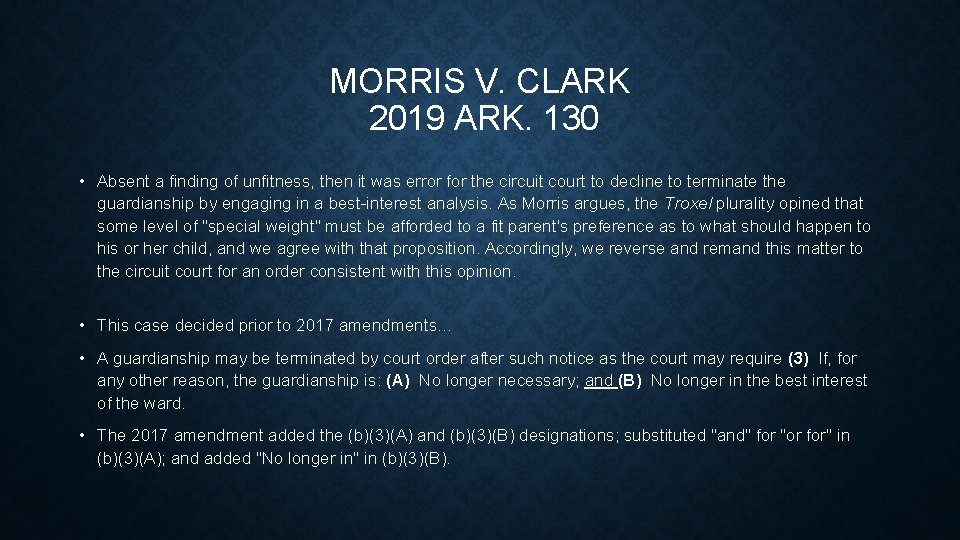
IN RE GUARDIANSHIP OF E. M. R. AND D. C. R. , MINORS, 2019 ARK. 116 • Turning now to the termination-of-guardianship statute, we hold that appellant was entitled to the fit-parent presumption that the guardianship was no longer necessary when she so informed the court in her petition to terminate the guardianship. Ark. Code Ann. § 28 -65 -401(b)(3)(A); see In re Guardianship of W. L. , 2015 Ark. 289, 467 S. W. 3 d 133. At that point, the Reardons had the opportunity to challenge appellant's fitness or to show exceptional circumstances that would overcome the fit-parent presumption. We note that it is clear from the record that the reasons for the guardianship—exposure to Sam Hartman's family members and E. R. 's feeling safer at the Reardons' home—no longer existed by the time of the termination hearing. Accordingly, we hold that the circuit court clearly erred in finding that the reason for originally granting this guardianship still existed. • Regarding the second prong of the statute, whether the guardianship is no longer in the best interest of the wards, see Ark. Code Ann. § 28 -65 -401(b)(3)(B), it appears that the circuit court focused on the success of the children in the guardians' care and found that "there is no reason to remove them from a stable situation mid-course and send them back to the unknown. " However, the circuit court failed to accord appellant the presumption that a fit parent acts in her children's best interest. See Troxel, 530 U. S. at 68 ("[T]here is a presumption that fit parents act in the best interests of their children. "). Furthermore, nothing in this record rebuts that presumption. The evidence showed that appellant had stable employment, a suitable home, family support, and a close relationship with E. R. and D. R. , who both wanted to live with her. Further, overnight visitation had been consistently exercised with no issues other than minor disciplinary disagreements with the Reardons regarding D. R. In short, the presumption that appellant has acted in her children's best interest was not rebutted on this record, and the circuit court clearly erred in finding that it remains in the children's best interest to leave the guardianship intact. Accordingly, we reverse and remand with instructions to the circuit court to enter an order terminating the Reardons' guardianship of E. R. and D. R.
GRIMSLEY V. DREWYOR 2019 ARK. APP. 218 • LAWYER DIVORCE!!!! • The parties in this case, Jill Grimsley and Pine Drewyor, were divorced by decree entered February 2, 2018, after a sixteenyear marriage. Ms. Grimsley appeals from the divorce decree and a postdecree order, arguing that the circuit court erred (1) by awarding joint custody; (2) by awarding permanent alimony to Mr. Drewyor, who has "ample capacity for self-support"; (3) in the amount of alimony awarded; (4) by awarding Mr. Drewyor a one-half interest in Ms. Grimsley's partnership interest; (5) in its treatment of certain marital debt; and (6) in requiring Ms. Grimsley to make a one-time payment of $1. 25 million in child support to Mr. Drewyor constituting 25 percent of a five-million-dollar inheritance from her father. We affirm in part and reverse in part. The parties married in April 2002 [**2] when they were both practicing law in Tulsa, Oklahoma. A year after their first child was born in June 2006, the parties moved to Northwest Arkansas to be near Ms. Grimsley's family. Ms. Grimsley accepted an offer from Mitchell Williams in 2007; five years later, she became a nonequity partner; and in January 2016, she became an equity partner. Mr. Drewyor began a solo practice in 2007 and continues to practice as Drewyor Law Firm, PLC. The parties have three children, two daughters and one son, who were eleven, eight, and five at the time the divorce decree was entered.
GRIMSLEY V. DREWYOR 2019 ARK. APP. 218 • Joint custody awarded. Child support paid by mom to dad based on different incomes. Mom appeals the joint custody (unsuccessfully) and does not appeal the child support award. • The trial court ordered Ms. Grimsley to pay child support to Mr. Drewyor in the amount of $1349 "due to the discrepancy in the net earnings of the parties. " The court also ordered both parties to "pay an additional amount equal to 25% of any net bonus, income, payment, tax refund or any other funds received as defined by Administrative Order No. 10, as additional child support. " Less than six months after entry of the divorce decree, Mr. Drewyor filed a petition for citation for contempt, alleging that Ms. Grimsley had received an inheritance valued at $5 million in December 2017; that the court's February 2018 decree of divorce and our supreme court's opinion in Ford v. Ford, 347 Ark. 485, 65 S. W. 3 d 432 (2002), required her to pay 25 percent of that inheritance to him as child support; and that she should be held in contempt for failing to do so. • Ms. Grimsley responded to the petition, denying that she had received any payments or funds in December 2017; stating that she had received a distribution of unregistered, restricted shares of Grand Savings Bank, a closely held corporation, in 2017; arguing that Ford does not support the payment of child support from a transfer of personalty or realty to a joint-custodial parent who is already receiving adequate support; and alleging that Mr. Drewyor had not shown that a transfer of $1. 25 million to him was in the children's best interest. She argued that Administrative Order No. 10 is premised on the payee's having sole custody and that the amount of child support must be in the best interest of the children, not the payee. • Trial Court orders her to pay him $1. 25 million…….
GRIMSLEY V. DREWYOR 2019 ARK. APP. 218 • $1. 25 million payment REVERSED. • Arkansas Code Annotated section 9 -12 -312(a) directs a court to make an order "concerning the care of the children" that is "reasonable from the circumstances of the parties and the nature of the case. " There is a rebuttable presumption that the amount set forth in the familysupport chart of Administrative Order No. 10 is the correct amount but allows the court to grant more or less support "if the evidence shows that the needs of the dependents require a different level of support. " Ark. Sup. Ct. Admin. Order No. 10(I). The statute and Administrative Order No. 10 refer to the payor as the "noncustodial parent, " although our law authorizes reference to the chart in joint-custody cases as well. Administrative Order No. 10 also allows a court to include child support from other income or bonuses based on a percentage that fluctuates with the number of dependents. Ark. Sup. Ct. Admin. Order No. 10(II). Administrative Order No. 10 defines "income" as any form of "payment" due to an individual, regardless of source, including wages, salaries, commissions, bonuses, worker's compensation, disability, payments pursuant to a pension or retirement program, and interest. Our supreme court has stated that income "is intentionally broad and designed to encompass the widest range of sources for the support of minor children. " • Dare v. Frost, 2018 Ark. 83, 540 S. W. 3 d 281. In Dare, the court held that the increase in a noncustodial parent's investment account was not "income" required to be included in [*21] the calculation of his child-support obligation. The custodial parent, Dare, filed a motion for modification of child support based on the growth in the stock portfolio of the noncustodial parent, Frost. The circuit court denied Dare's request, finding that the growth in Frost's portfolio should be counted as income for child-support purposes only when it was "realized" by the owner, which the court suggested meant disbursed.
GRIMSLEY V. DREWYOR 2019 ARK. APP. 218 • In the case at bar, the parties do not dispute that Ms. Grimsley's inheritance consists of a stock certificate representing 296, 991 shares of restricted stock in a closely held bank; an investment account; and a lot. She testified that she had not received any money with any of the three transactions, that she had not received any money from the investment account, and that none of the assets had been liquidated. No evidence was presented to dispute this testimony. We hold that these three assets do not constitute income as defined in Administrative Order No. 10(II) and that the circuit court abused its discretion in awarding 25 percent of the inheritance to Mr. Drewyor as child support. We therefore reverse the court's order of October 23, 2018. • Additionally, we are concerned with the court's failure in this matter to exercise its discretion. In determining the appropriate amount of child support, particularly when the amount is not specifically designated by the family-support chart, it is critical that the court exercise its discretion. The purpose of child support is to provide for children's "reasonable needs. " Gilbow v. Travis, 2010 Ark. 9, at 8, 372 S. W. 3 d 319, 324. It is not to provide for the accumulation of capital by children. Smith v. Smith, 341 Ark. 590, 596, 19 S. W. 3 d 590, 594 (2000); see also Kemp v. Kemp, 2011 Ark. App. 354, 384 S. W. 3 d 56. • Here, no evidence was presented at the hearing regarding the children's needs, and the court made no findings about their needs or best interest to support such a large child-support award. The court simply determined that the result was required by paragraph [**30] 14 of its previous order and our supreme court's opinion in Ford. See Evans v. Tillery, 361 Ark. 63, 204 S. W. 3 d 547 (2005) (affirming child-support award of $31, 195. 95 on a lump-sum judgment from a lawsuit where circuit court directed that funds be used to benefit the child and required the custodial parent to provide a monthly itemization to the noncustodial parent of how the money was expended with substantiating invoices).
GRIMSLEY V. DREWYOR 2019 ARK. APP. 218 • We do not interpret Ford to require a joint custodian to pay a set percentage of any gift or inheritance to the other joint custodian as child support. Ford does not abrogate a circuit court's duty to exercise its discretion in every case to ensure that the award is necessary to provide for the reasonable needs of the children. The lump-sum payment at issue in Ford included a $3000 gift from a grandparent, not a $5 million inheritance. Further, it was not a case involving joint custody in which the payor was already paying child support to the other joint custodian.
GRIMSLEY V. DREWYOR 2019 ARK. APP. 218 • Trial court ordered $3800. 00 to be paid by lawyer wife to lawyer husband in permanent alimony. REVERSED. • We agree with Ms. Grimsley that the circuit court abused its discretion in awarding permanent alimony of $3787 based on the facts of this case. The evidence demonstrated that both parties are lawyers and that both have been in full-time practice since they married. Neither party stayed home to raise the children. They both testified that they had parented as "a team" while married, and the court awarded joint custody with the parties to share precisely equal physical custody. Although it appears that Ms. Grimsley has earned more than Mr. Drewyor since their move to Northwest Arkansas, it is difficult to tell from the record before us if that is because Mr. Drewyor has chosen to work less, if he has spent an inordinate amount on expenses, or if he has been unable to secure sufficient work in his solo practice to earn more. Whatever the reason, the fact remains that he, like Ms. Grimsley, has a license to practice law and over fifteen years' experience doing so. • Mr. Drewyor currently earns less than Ms. Grimsley; however, he presented no evidence that he was incapable of earning a living in his profession or of working more hours. As Ms. Grimsley has argued, he is educated, healthy, and experienced. Indeed, over a decade ago, while he practiced law in Tulsa, he worked and earned more than he does now. He testified that he plans to continue in solo practice, which provides him with "flexibility, " rather than using his skills to obtain other employment where he might earn more money. This is his choice. Here, the parties have equal earning capacities and share joint custody with equal physical custody. The law does not require Ms. Grimsley to pay permanent alimony to support this choice when it results in such an inequitable distribution of their monthly incomes, leaving him almost twice the income left to her. Accordingly, we hold that the circuit court's alimony award in this case constituted an abuse of discretion, and we reverse.
GRIMSLEY V. DREWYOR 2019 ARK. APP. 218 • Ms. Grimsley also challenges the court's finding that her partnership interest at Mitchell Williams is marital property and its award to Mr. Drewyor of one-half of the $50, 500 used to purchase the interest. Mr. Drewyor contends that the partnership interest was acquired during the marriage and thus constitutes marital property. He argues that Ms. Grimsley's subsequent satisfaction of the debt used to purchase the asset with nonmarital funds did not convert the asset to nonmarital property. He cites Kelly v. Kelly, 2011 Ark. 259, 381 S. W. 3 d 817, in support of his argument. • Ms. Grimsley testified that she became an equity partner at Mitchell Williams in January 2016 for a purchase price of $50, 500, two years before the parties were divorced. She borrowed the money from First Security Bank to purchase the membership. She testified that in February or March 2016, she received a gift of $300, 000 from her father, which she deposited into an account in her sole name. She then used part of the $300, 000 to pay off the First Security Bank loan. She testified that she did not intend to make a gift of the partnership interest to Mr. Drewyor when she paid off the loan and that Mitchell Williams does not allow anyone outside the partnership to hold an interest in the firm. Mr. Drewyor requested that Ms. Grimsley pay him one-half of the value of her interest in her partnership in Mitchell Williams claiming that it was marital property, although he recognized that he could not personally hold an equity interest in the law firm. At the hearing, the court found that Ms. Grimsley's partnership interest was a marital asset, and the money she used to pay off the First Security loan used to purchase the interest constituted a gift to the marital union. • Arkansas Code Annotated section 9 -12 -315 provides that "all marital property shall be distributed one-half to each party unless the court finds such a division to be inequitable. " Ms. Grimsley cites no authority for her argument that the partnership interest, acquired during the marriage, is not marital property. Further, she provides no authority that, as a matter of law, the use of nonmarital funds to satisfy the debt obligation on a marital asset converts the asset from marital to nonmarital.
CHEKURI V. NEKKALAPUDI 2019 ARK. APP. 221 • Arkansas law does not require parties to a divorce to account for every sum spent during a marriage. Our courts have held that a spouse has the right to transfer his or her property, with or without consideration, as long as the spouse does so in good faith and without the intent of defrauding the other spouse. A spouse is not entitled to be reimbursed in a divorce proceeding for every nonconsensual transfer of marital funds made by the other spouse in the absence of proof of an intent to defraud. In Chism, this court reversed a trial court's award of one-half of the wife's income and retirement to the husband, even though the wife had held the funds in a separate account. This court reasoned that there was no evidence that the wife had concealed or disposed of her income in an attempt to defraud the husband. Further, the trial court did not find fraud. • Reversed trial court’s order that Husband pay $68, 000 to Wife as ½ of funds spent between separation and divorce.
BECKER V. BECKER 2019 ARK. APP. 230 • Wife awarded alimony of $1059. 00. • Post divorce, husband loses his job (nothing intentional or voluntary about it) • Husband petitions to modify the alimony payment based on material change because he’s only receiving $1500 in early retirement. • Husband never challenges Wife’s need for alimony…. ever. • Husband has $327 K in retirement from which he can draw from. (retirement was divided equally at the time of divorce in 2003) • Motion to Modify denied. He had an ability and she still had a need.
MORRIS V. CLARK 2019 ARK. 130 • Absent a finding of unfitness, then it was error for the circuit court to decline to terminate the guardianship by engaging in a best-interest analysis. As Morris argues, the Troxel plurality opined that some level of "special weight" must be afforded to a fit parent's preference as to what should happen to his or her child, and we agree with that proposition. Accordingly, we reverse and remand this matter to the circuit court for an order consistent with this opinion. • This case decided prior to 2017 amendments… • A guardianship may be terminated by court order after such notice as the court may require (3) If, for any other reason, the guardianship is: (A) No longer necessary; and (B) No longer in the best interest of the ward. • The 2017 amendment added the (b)(3)(A) and (b)(3)(B) designations; substituted "and" for "or for" in (b)(3)(A); and added "No longer in" in (b)(3)(B).