
Protein Folding Prediction Lauren M Yarholar Rufei Lu


- Slides: 54
Protein Folding Prediction Lauren M. Yarholar Rufei Lu Warren Yates Armando Diaz Miguel J Bagajewicz, Ph. D. School of Chemical, Biological, and Materials Engineering, College of Engineering, University of Oklahoma
Overview ►Introduction ٭ Background ٭ Problem ٭ Energy Forms ►Methods ٭ Genetic Algorithm ►Results and Discussion ►Conclusion ►VBA (Visual Basic Add-in) Program Demonstration
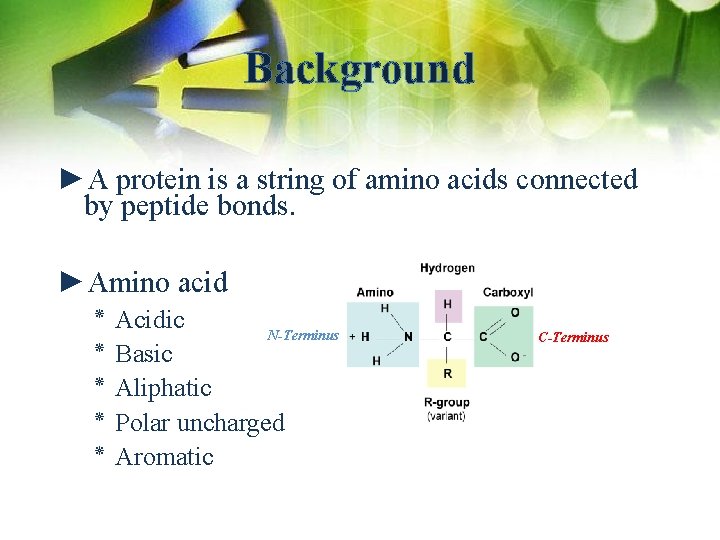
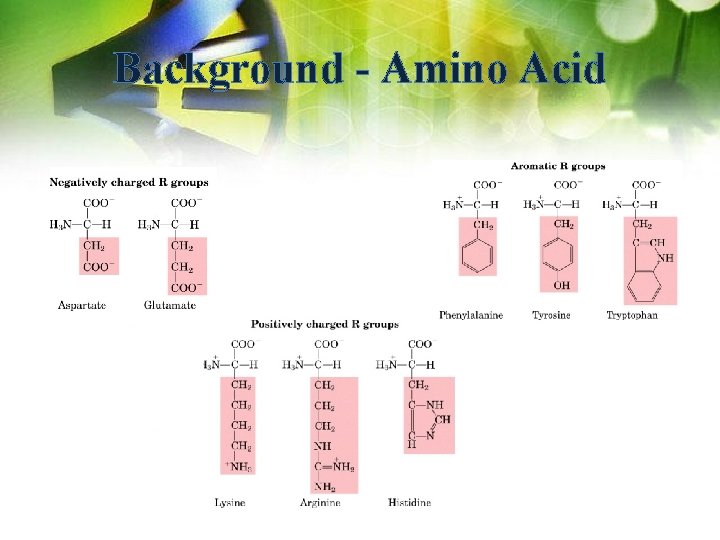
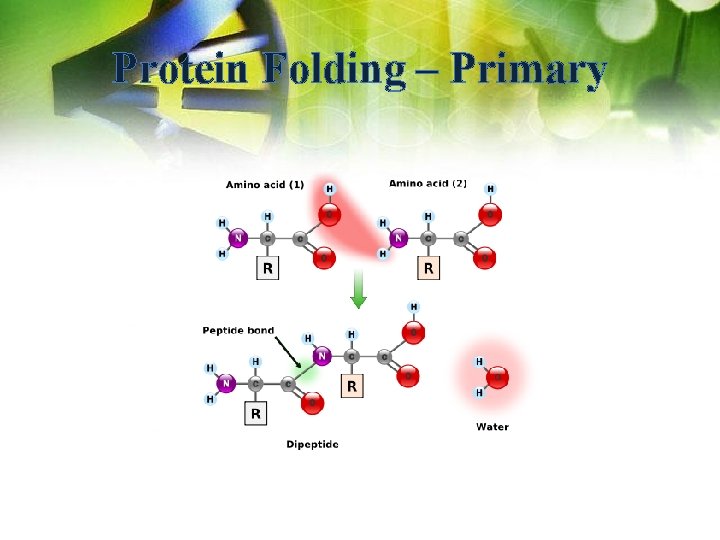
Background ►A protein is a string of amino acids connected by peptide bonds. ►Amino acid ٭ ٭ ٭ Acidic N-Terminus Basic Aliphatic Polar uncharged Aromatic C-Terminus
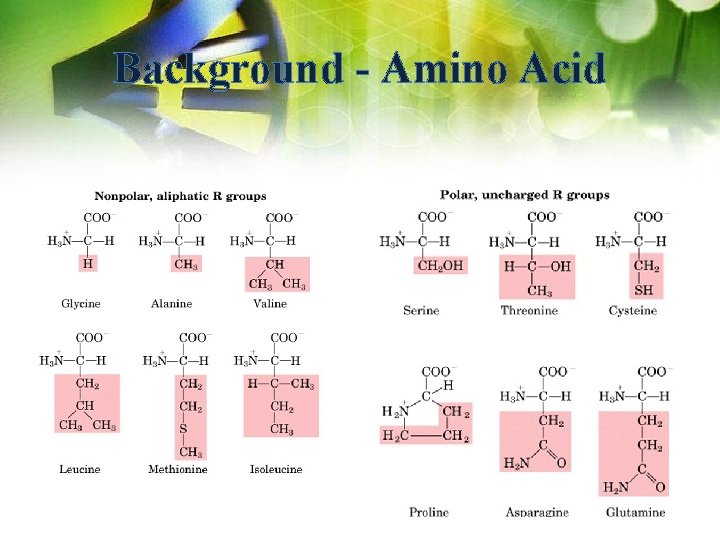
Background - Amino Acid
Background - Amino Acid
Protein Folding – Primary
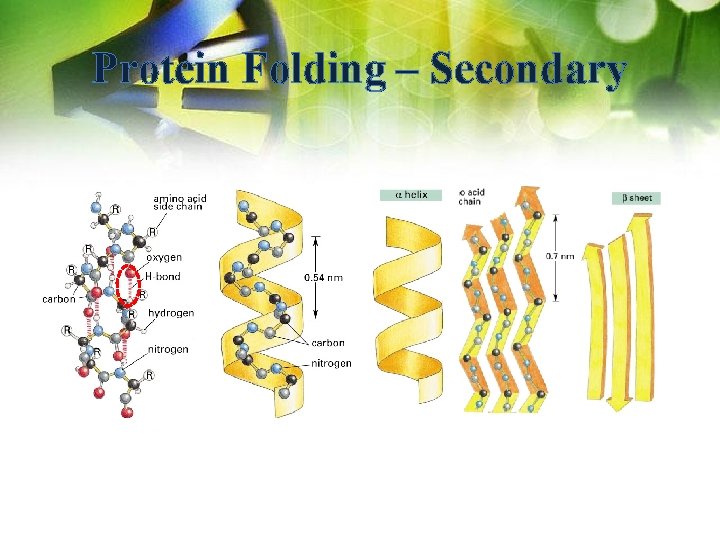
Protein Folding – Secondary
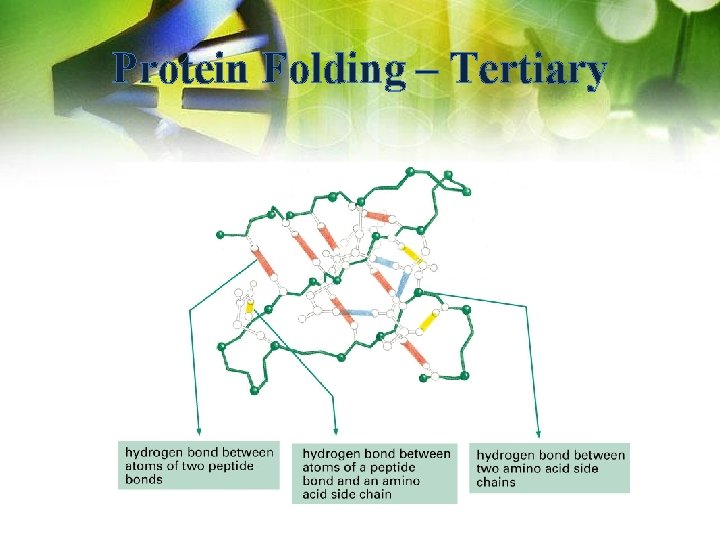
Protein Folding – Tertiary
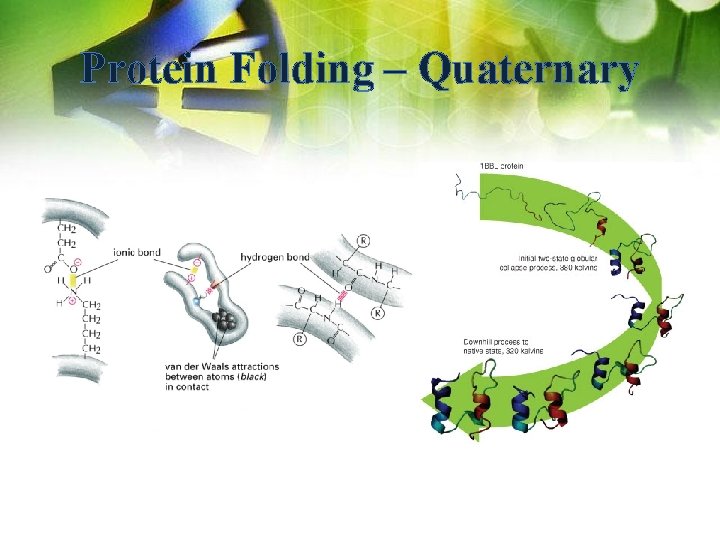
Protein Folding – Quaternary
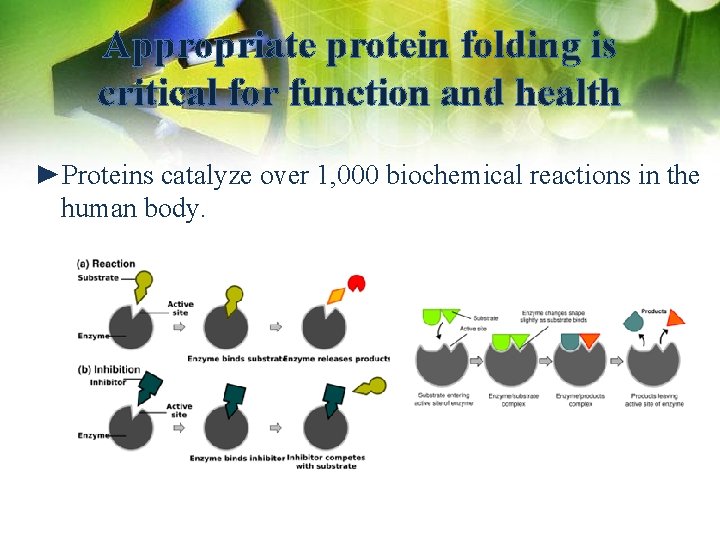
Appropriate protein folding is critical for function and health ►Proteins catalyze over 1, 000 biochemical reactions in the human body.
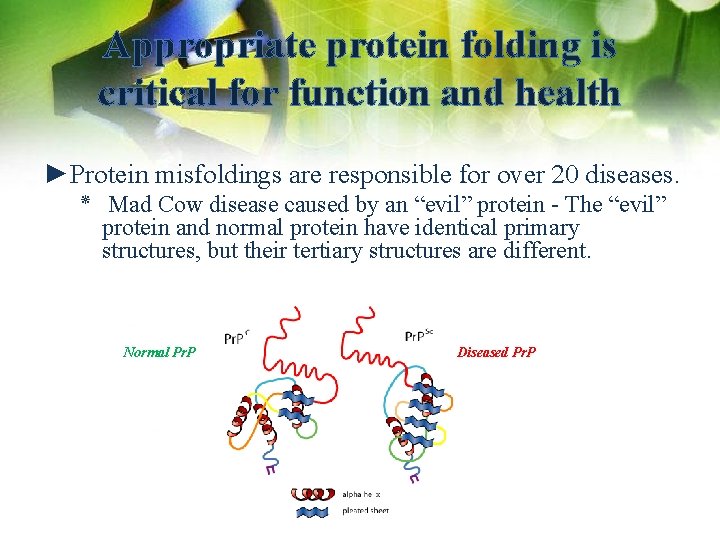
Appropriate protein folding is critical for function and health ►Protein misfoldings are responsible for over 20 diseases. ٭ Mad Cow disease caused by an “evil” protein - The “evil” protein and normal protein have identical primary structures, but their tertiary structures are different. Normal Pr. P Diseased Pr. P
Difficulties of Predicting Protein Structures ►Some proteins fold as fast as a millionth of a second ►Theoretically, a protein of only 100 amino acids following the trial and error method would take 100 billion years to try out all possible conformations! ►Protein structures are highly dependent upon various environmental parameters. ٭ Such as temperature, p. H, solvent, etc.
Protein Folding Prediction Methods ► Comparative - Use evolutionary related protein ٭ Advantages: fast and simple ٭ Disadvantages: conformation depends upon environmental parameters ► Folding Recognition - Utilize a database of known 3 -D protein structure ٭ Advantages: more accurate than comparative ٭ Disadvantages: not enough NMR confirmed protein structures ► Ab Initio - Uses both scientific and engineering approach ٭ Advantages: has potential to predict exact shape and immediate structures ٭ Disadvantages: computing limitations, difficulty in selecting correct potential energy function
Problems with the Current Prediction Methods ► Not enough NMR confirmed protein structure in Protein Data Bank (PDB) ► Evolutionary relatedness does not necessarily translate to similar structure ► Ab initio difficulties ٭ Hydrophilic and hydrophobic modeling gives only general arrangement of the protein ٭ 2 -D modeling does not predict 3 -D shape of the protein ٭ Monte-carlo computing method is time consuming and does not necessarily reach global minimum
Objectives ►Develop a genetic algorithm based program to predict protein conformation ►Reduce the generations needed for prediction, thus enhance the efficiency of the search ►Explore different additional operators to modify genetic algorithm ►Predict the protein conformation of a short 5 -AA peptide, Enkephalin
Energy Calculation Potential Energy Model Energy Calculation Energy VBA program
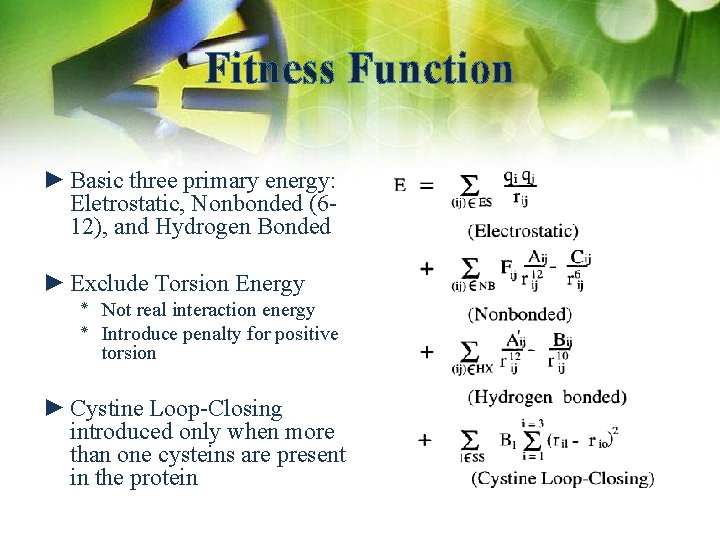
Potential Energy Models ►Electrostatic Energy ►Nonbonding Energy ►Hydrogen Bonding Energy ►Cystein-Cystein Loop Energy
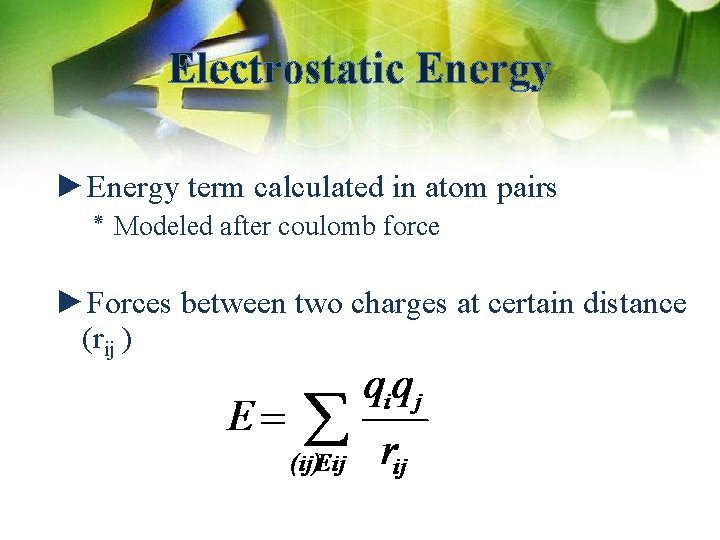
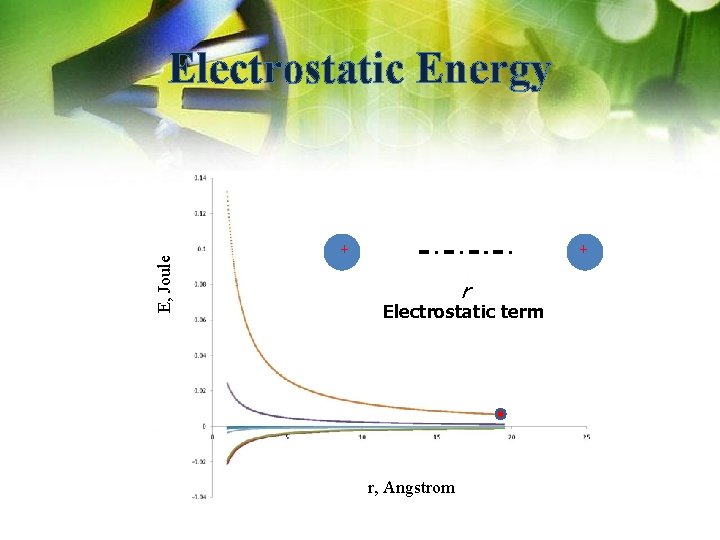
Electrostatic Energy ►Energy term calculated in atom pairs ٭ Modeled after coulomb force ►Forces between two charges at certain distance (rij )
E, Joule Electrostatic Energy + + r Electrostatic term r, Angstrom
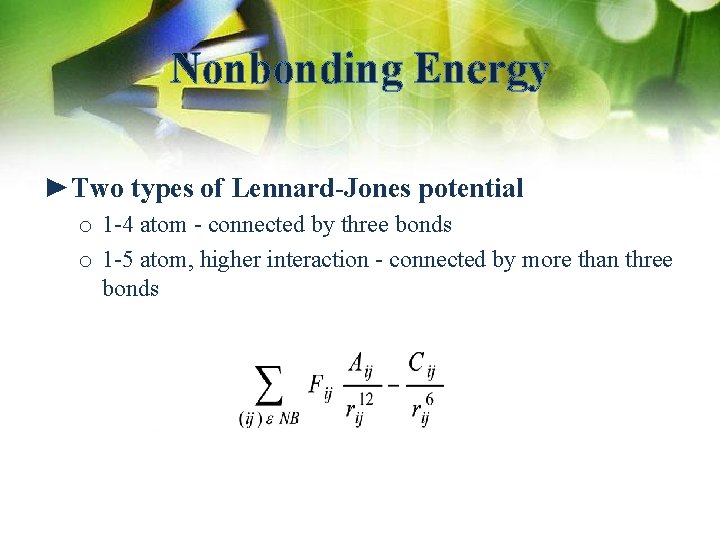
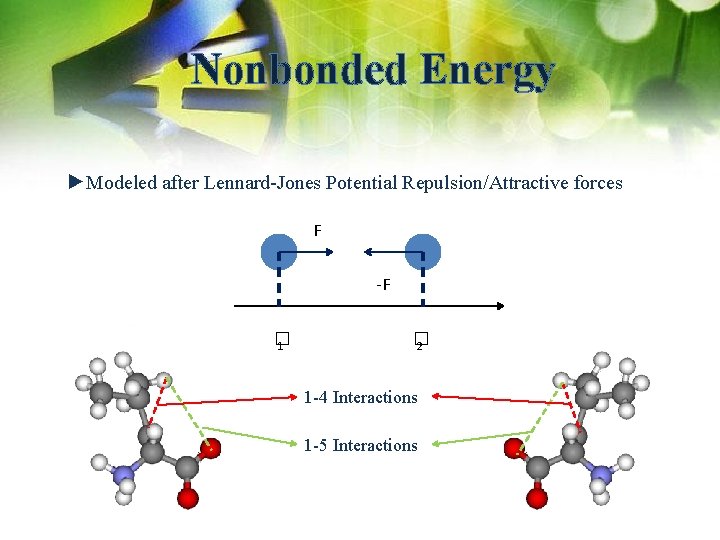
Nonbonding Energy ►Two types of Lennard-Jones potential o 1 -4 atom - connected by three bonds o 1 -5 atom, higher interaction - connected by more than three bonds
Nonbonded Energy ►Modeled after Lennard-Jones Potential Repulsion/Attractive forces F -F � 1 � 2 1 -4 Interactions 1 -5 Interactions
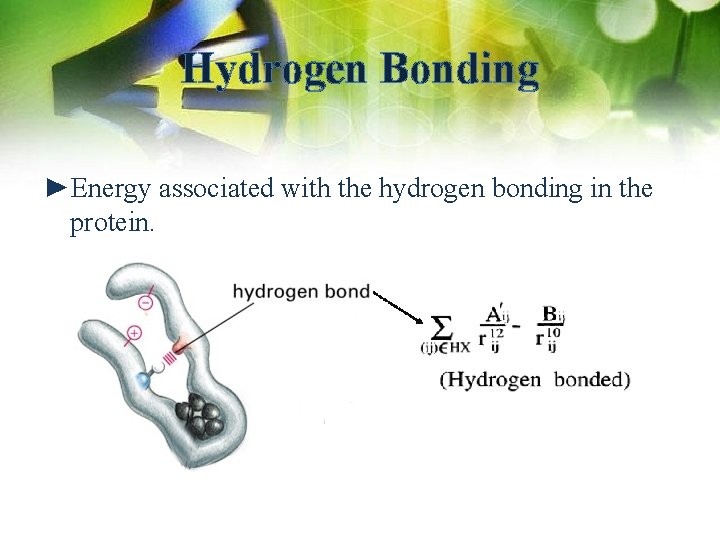
Hydrogen Bonding ►Energy associated with the hydrogen bonding in the protein.
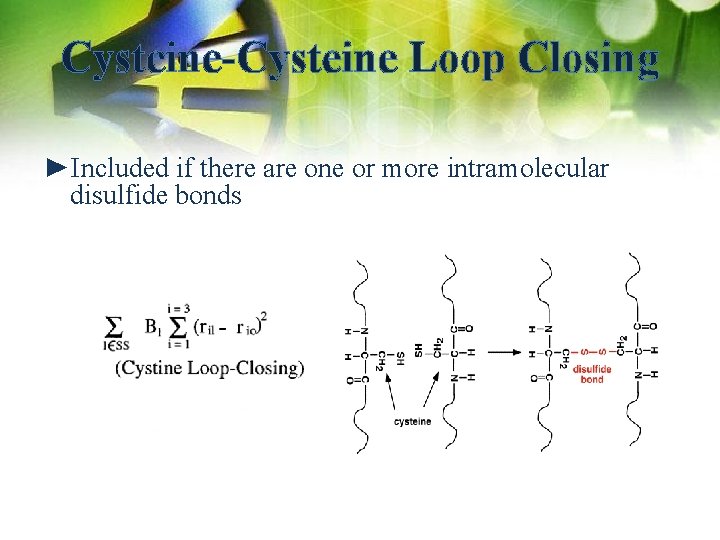
Cysteine-Cysteine Loop Closing ►Included if there are one or more intramolecular disulfide bonds
Atom Position Calculation Backbone Calculation Side-Chain Calculation Branch of Side-Chain Calculation
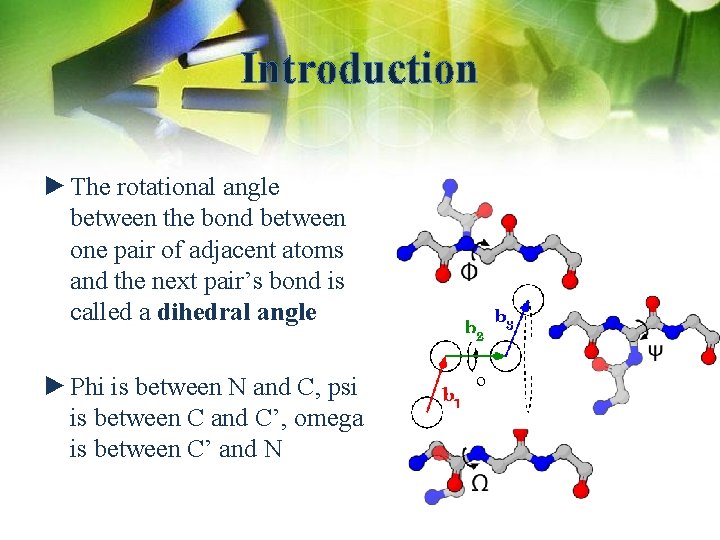
Introduction ►The rotational angle between the bond between one pair of adjacent atoms and the next pair’s bond is called a dihedral angle ►Phi is between N and C, psi is between C and C’, omega is between C’ and N
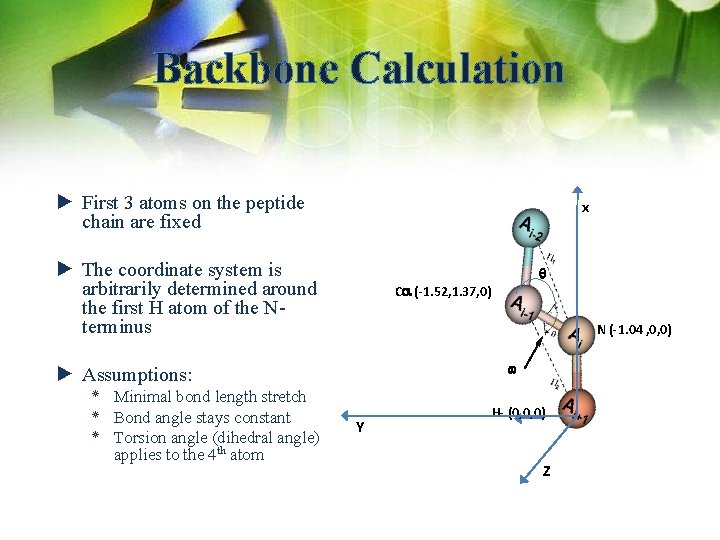
Backbone Calculation ► First 3 atoms on the peptide chain are fixed x ► The coordinate system is arbitrarily determined around the first H atom of the Nterminus q Ca (-1. 52, 1. 37, 0) N (-1. 04 , 0, 0) w ► Assumptions: ٭ Minimal bond length stretch ٭ Bond angle stays constant ٭ Torsion angle (dihedral angle) applies to the 4 th atom Y H- (0, 0, 0) Z
Backbone Calculation The first 3 Bn parameters are fixed due to the previous assumption, B 1, B 2, and B 3 corresponds to the H-, -N-, Ca
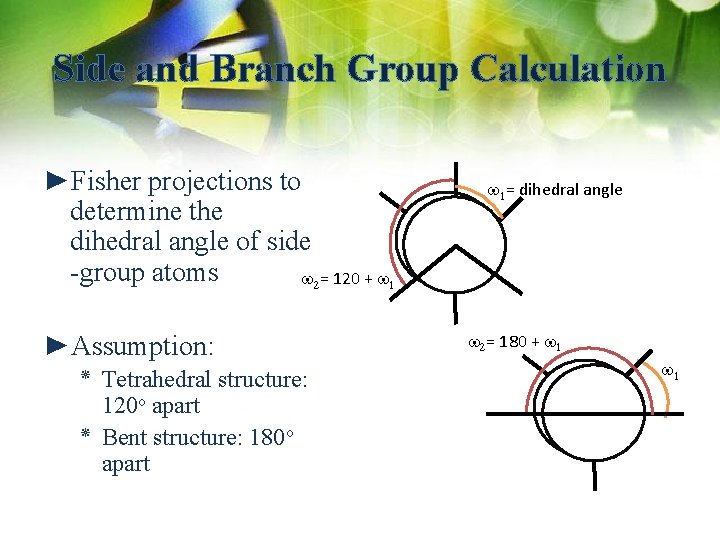
Side and Branch Group Calculation ►Fisher projections to determine the dihedral angle of side -group atoms w 2= 120 + w 1 ►Assumption: ٭ Tetrahedral structure: 120 o apart ٭ Bent structure: 180 o apart w 1= dihedral angle w 2= 180 + w 1
Genetic Algorithm GA Search and Optimization Fitness Function Genetic Operators α-helix and b-sheet implementation Binary GA
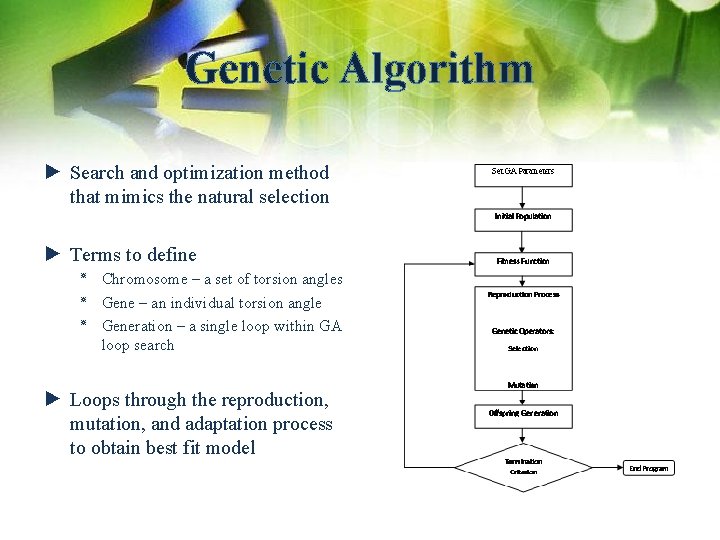
Genetic Algorithm ► Search and optimization method that mimics the natural selection ► Terms to define ٭ Chromosome – a set of torsion angles ٭ Gene – an individual torsion angle ٭ Generation – a single loop within GA loop search ► Loops through the reproduction, mutation, and adaptation process to obtain best fit model
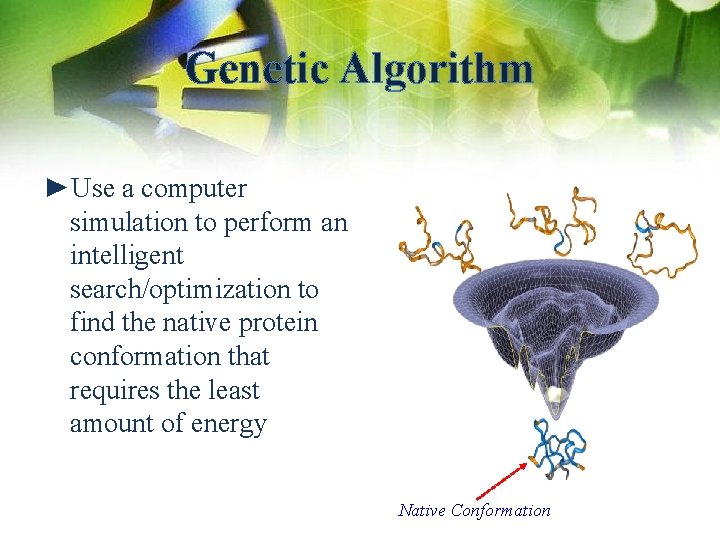
Genetic Algorithm ►Use a computer simulation to perform an intelligent search/optimization to find the native protein conformation that requires the least amount of energy Native Conformation
Genetic Algorithm based Protein Structure Search (GAPSS) ► GAPSS is developed under Visual Basic Add-in environment ► Modified genetic operators ٭ ٭ Fitness function based selection Multiple entries crossover Non-uniform mutation Adaptation ► Advantages ٭ Faster convergence ٭ User-friendly
Fitness Function ► Basic three primary energy: Eletrostatic, Nonbonded (612), and Hydrogen Bonded ► Exclude Torsion Energy ٭ Not real interaction energy ٭ Introduce penalty for positive torsion ► Cystine Loop-Closing introduced only when more than one cysteins are present in the protein
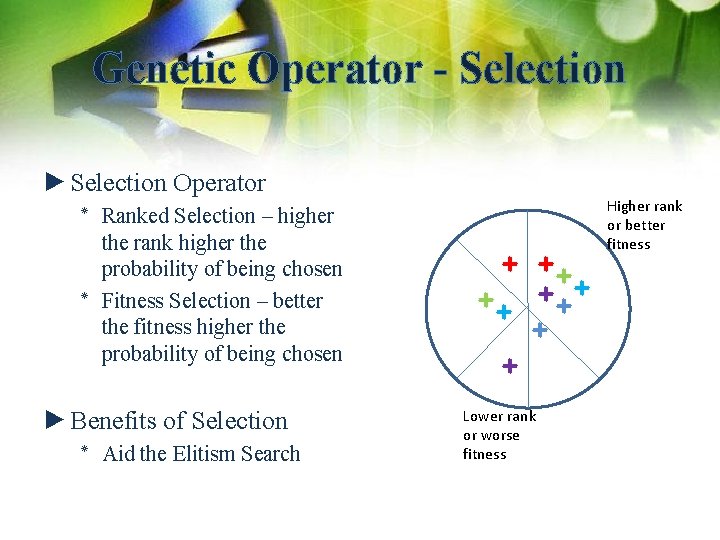
Genetic Operator - Selection ►Selection Operator Higher rank or better fitness ٭ Ranked Selection – higher the rank higher the probability of being chosen ٭ Fitness Selection – better the fitness higher the probability of being chosen ►Benefits of Selection ٭ Aid the Elitism Search Lower rank or worse fitness
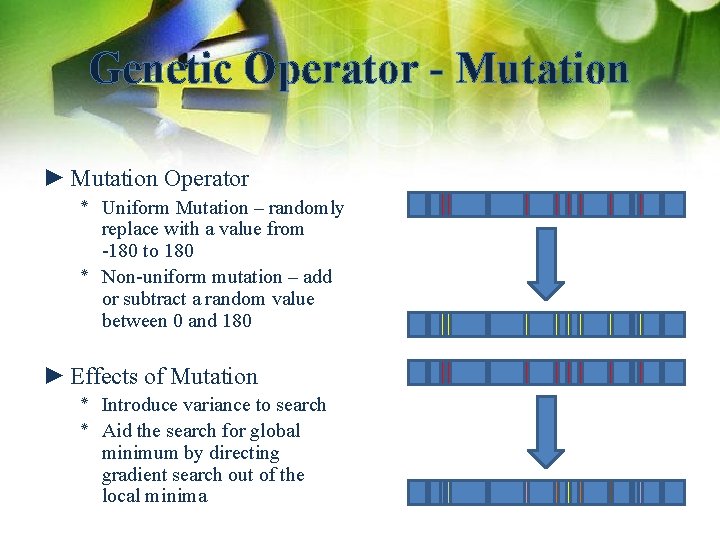
Genetic Operator - Mutation ► Mutation Operator ٭ Uniform Mutation – randomly replace with a value from -180 to 180 ٭ Non-uniform mutation – add or subtract a random value between 0 and 180 ► Effects of Mutation ٭ Introduce variance to search ٭ Aid the search for global minimum by directing gradient search out of the local minima
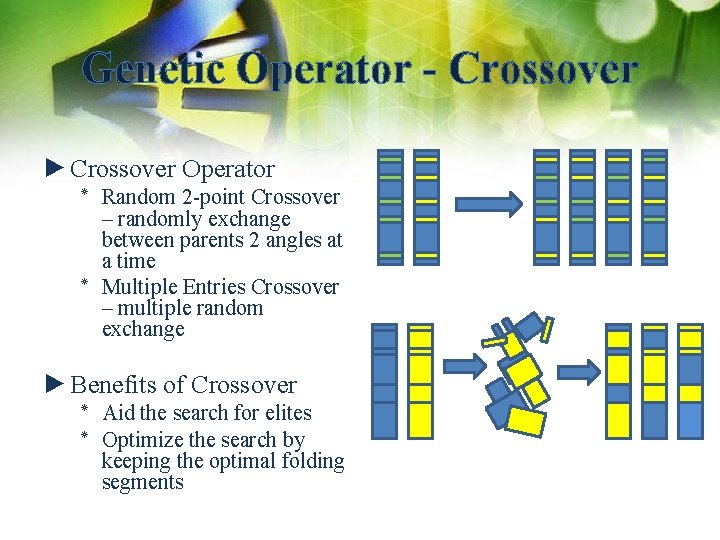
Genetic Operator - Crossover ►Crossover Operator ٭ Random 2 -point Crossover – randomly exchange between parents 2 angles at a time ٭ Multiple Entries Crossover – multiple random exchange ►Benefits of Crossover ٭ Aid the search for elites ٭ Optimize the search by keeping the optimal folding segments
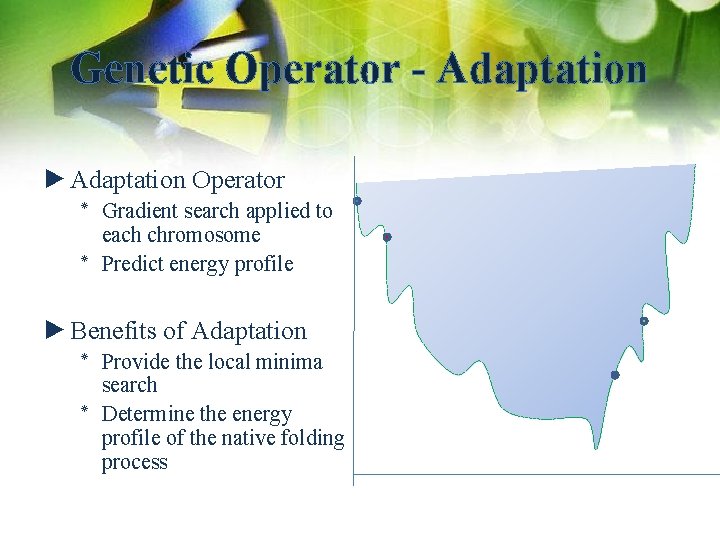
Genetic Operator - Adaptation ►Adaptation Operator ٭ Gradient search applied to each chromosome ٭ Predict energy profile ►Benefits of Adaptation ٭ Provide the local minima search ٭ Determine the energy profile of the native folding process
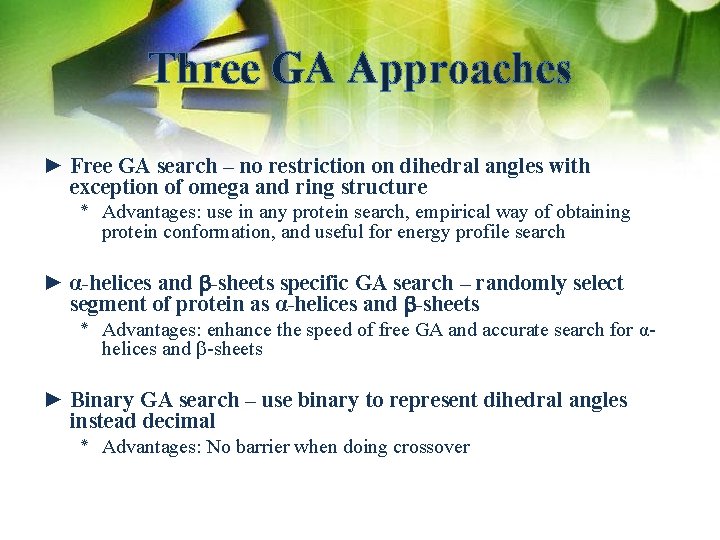
Three GA Approaches ► Free GA search – no restriction on dihedral angles with exception of omega and ring structure ٭ Advantages: use in any protein search, empirical way of obtaining protein conformation, and useful for energy profile search ► α-helices and b-sheets specific GA search – randomly select segment of protein as α-helices and b-sheets ٭ Advantages: enhance the speed of free GA and accurate search for αhelices and b-sheets ► Binary GA search – use binary to represent dihedral angles instead decimal ٭ Advantages: No barrier when doing crossover
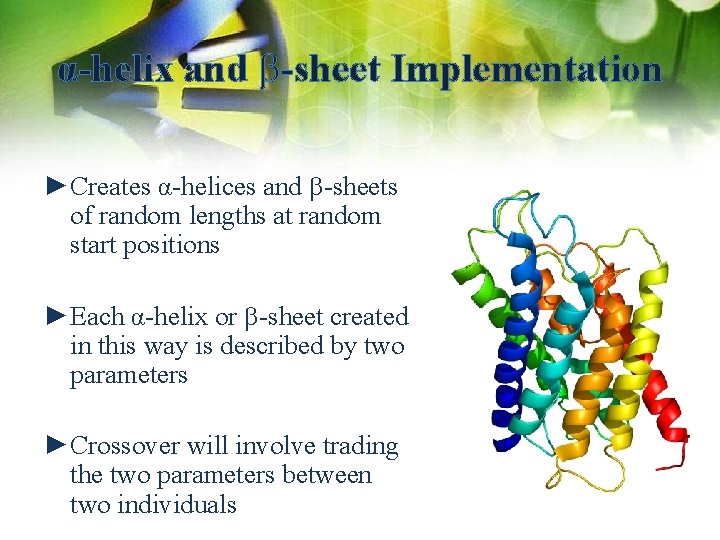
α-helix and b-sheet Implementation ►Creates α-helices and b-sheets of random lengths at random start positions ►Each α-helix or b-sheet created in this way is described by two parameters ►Crossover will involve trading the two parameters between two individuals
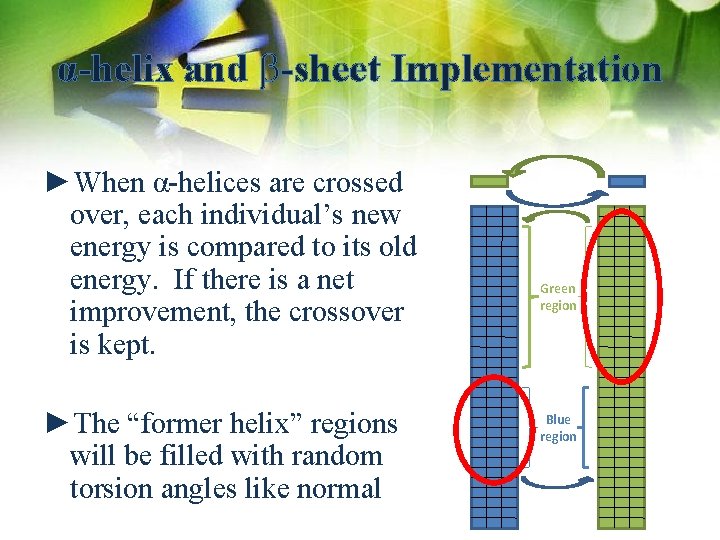
α-helix and b-sheet Implementation ►When α-helices are crossed over, each individual’s new energy is compared to its old energy. If there is a net improvement, the crossover is kept. ►The “former helix” regions will be filled with random torsion angles like normal Green region Blue region
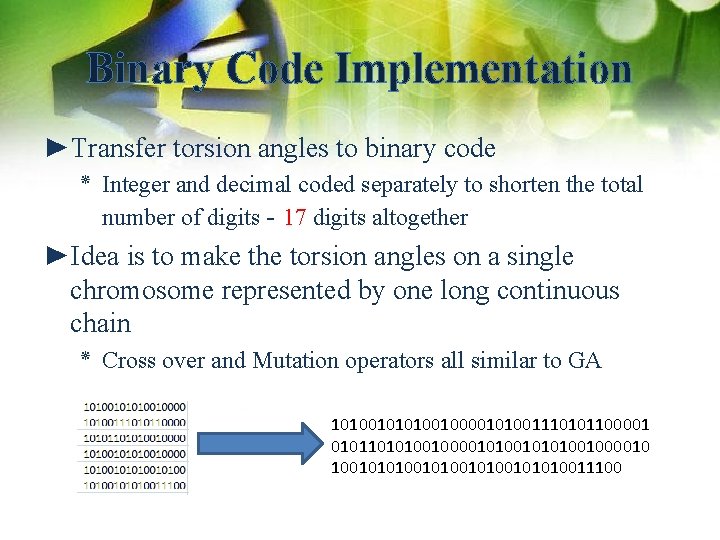
Binary Code Implementation ►Transfer torsion angles to binary code ٭ Integer and decimal coded separately to shorten the total number of digits - 17 digits altogether ►Idea is to make the torsion angles on a single chromosome represented by one long continuous chain ٭ Cross over and Mutation operators all similar to GA 1010010000101001110101100001 010110101001000010101001000010 100101001010011100
Results and Discussion Individual AA Prediction Enkephalin Prediction Performance Analysis Discussion
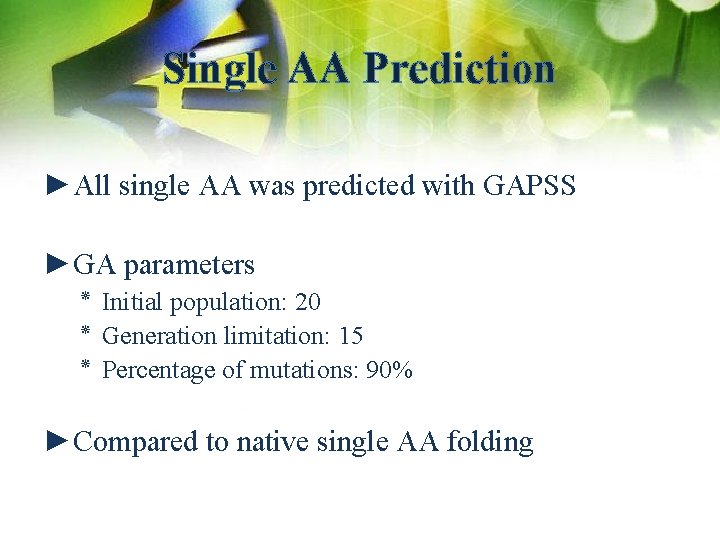
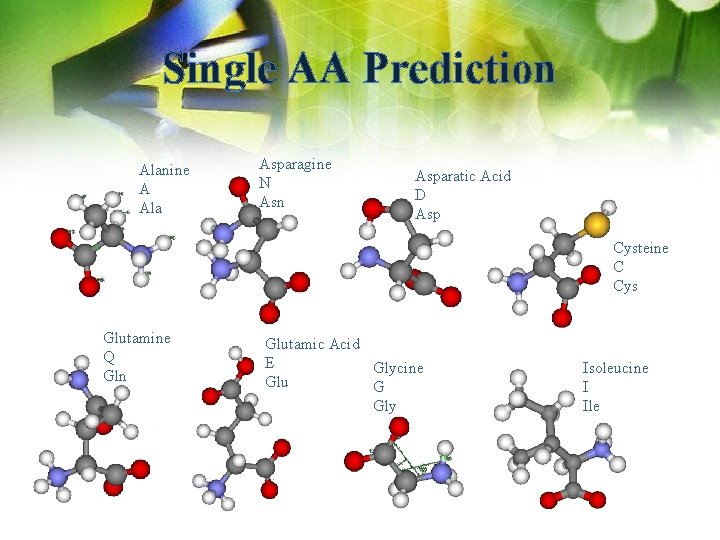
Single AA Prediction ►All single AA was predicted with GAPSS ►GA parameters ٭ Initial population: 20 ٭ Generation limitation: 15 ٭ Percentage of mutations: 90% ►Compared to native single AA folding
Single AA Prediction Alanine A Ala Asparagine N Asn Asparatic Acid D Asp Cysteine C Cys Glutamine Q Gln Glutamic Acid E Glycine Glu G Gly Isoleucine I Ile
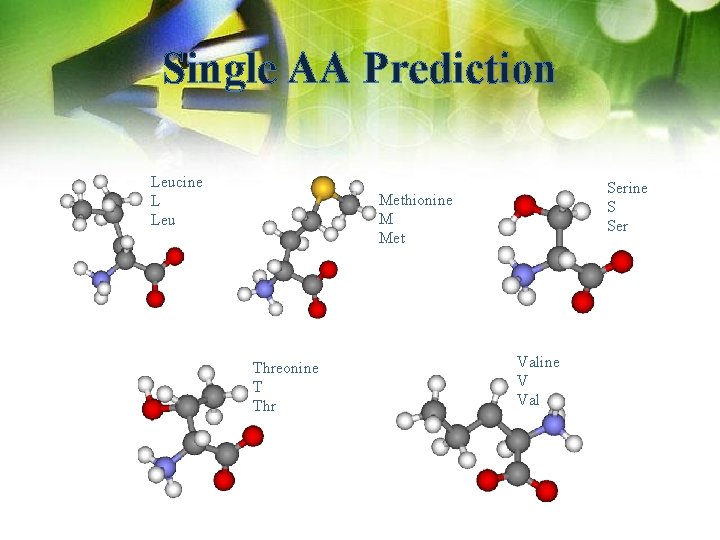
Single AA Prediction Leucine L Leu Serine S Ser Methionine M Met Threonine T Thr Valine V Val
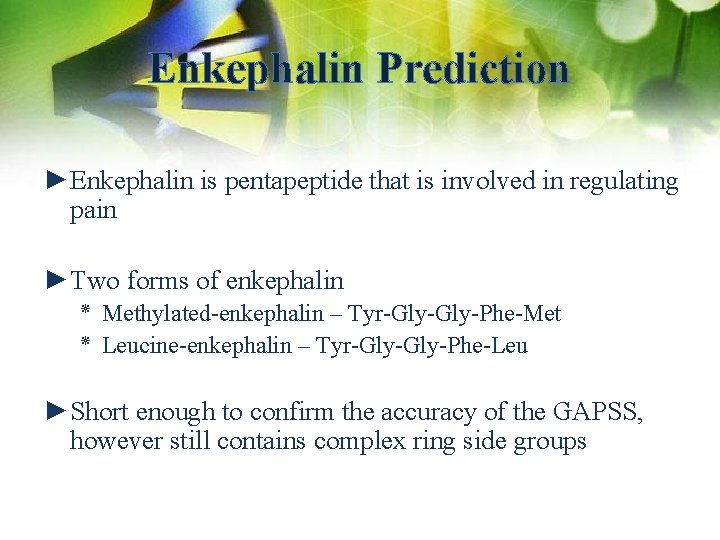
Enkephalin Prediction ►Enkephalin is pentapeptide that is involved in regulating pain ►Two forms of enkephalin ٭ Methylated-enkephalin – Tyr-Gly-Phe-Met ٭ Leucine-enkephalin – Tyr-Gly-Phe-Leu ►Short enough to confirm the accuracy of the GAPSS, however still contains complex ring side groups
Enkephalin Prediction ►Gradient zero conformations suggests the GAPSS are capable of obtaining local minima ►Backbone conformations showed incredible similarities ►Side group conformations still show discrepancy between predicted and theoretical
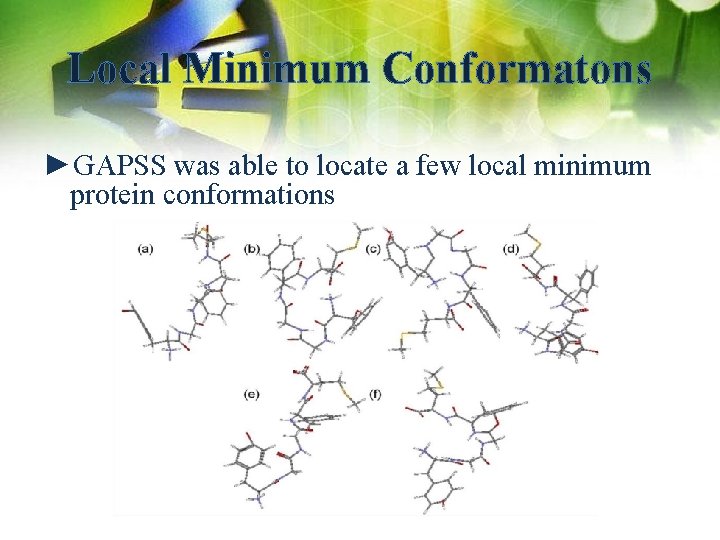
Local Minimum Conformatons ►GAPSS was able to locate a few local minimum protein conformations
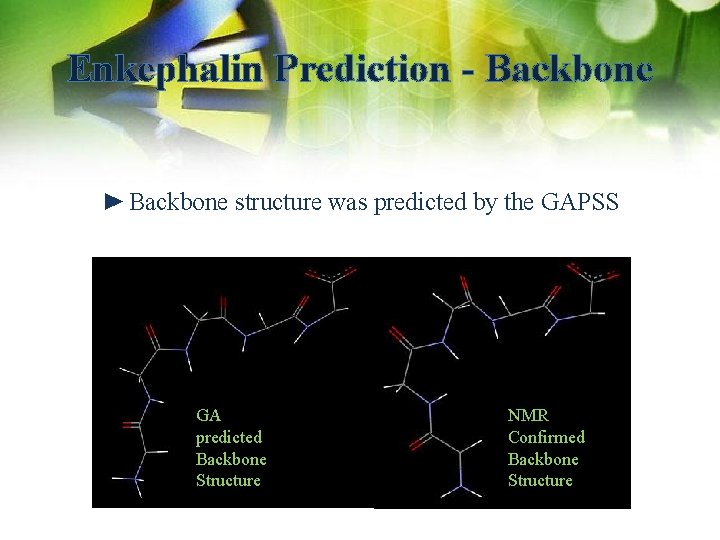
Enkephalin Prediction - Backbone ► Backbone structure was predicted by the GAPSS GA predicted Backbone Structure NMR Confirmed Backbone Structure
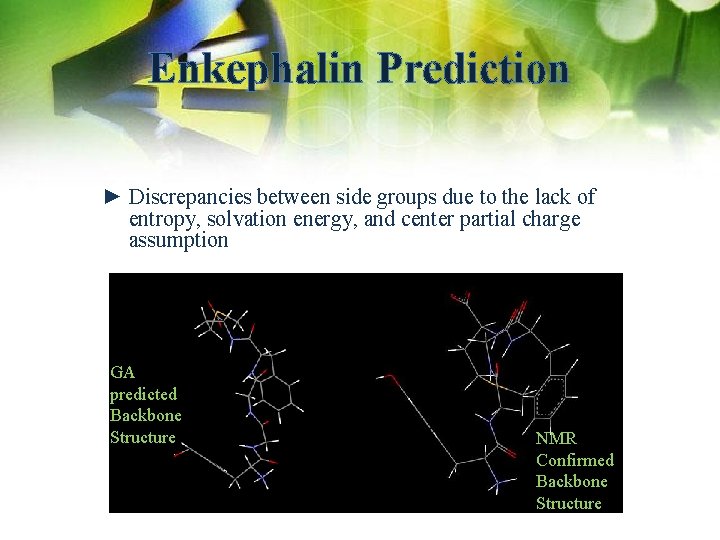
Enkephalin Prediction ► Discrepancies between side groups due to the lack of entropy, solvation energy, and center partial charge assumption GA predicted Backbone Structure NMR Confirmed Backbone Structure
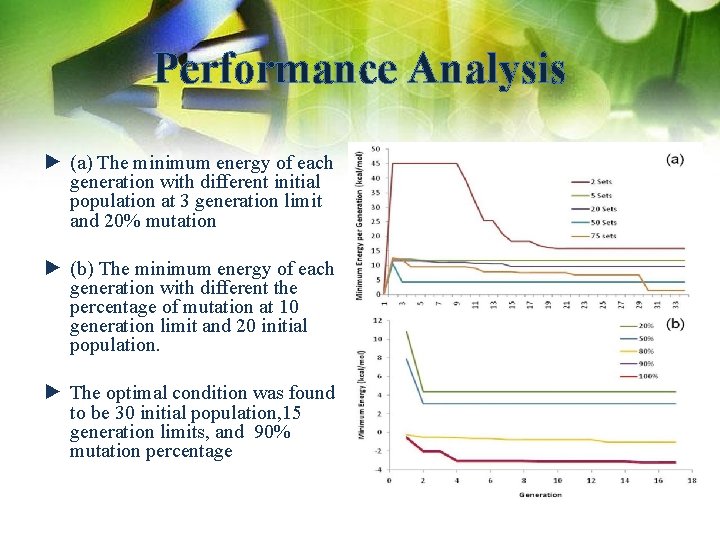
Performance Analysis ► (a) The minimum energy of each generation with different initial population at 3 generation limit and 20% mutation ► (b) The minimum energy of each generation with different the percentage of mutation at 10 generation limit and 20 initial population. ► The optimal condition was found to be 30 initial population, 15 generation limits, and 90% mutation percentage
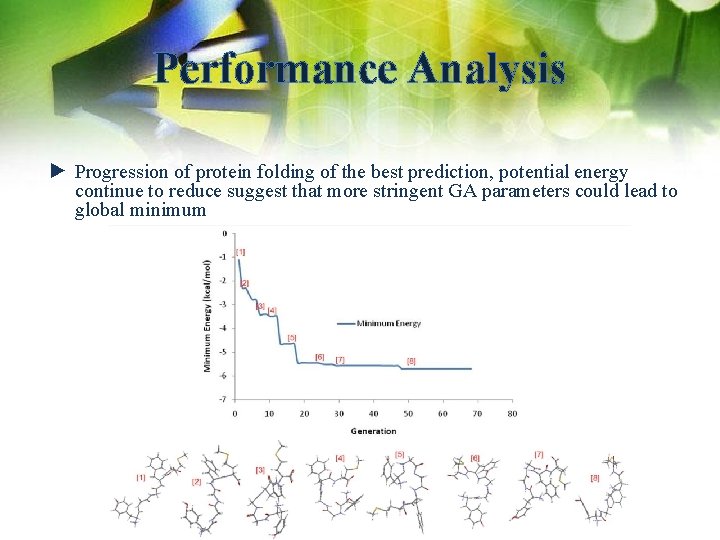
Performance Analysis ► Progression of protein folding of the best prediction, potential energy continue to reduce suggest that more stringent GA parameters could lead to global minimum
Discussion ► Due to computing capability limitation, less stringent GA parameters were used ► Energy level of predicted enkephalin structure is less than theoretical, however, the code is still showing energy decrease ► More sophisticated partial charge calculation and nonbonded energy could improve the prediction ► There are zero gradient structures predicted by the GAPSS
Conclusion ► GA based search and optimization is a simple and efficient method for the isolated native protein structure prediction ► Continuous decimal representation of dihedral angles is more efficient than binary representation of dihedral angles, despite the crossover barriers ► a-helices and b-sheets search converges faster than free torsion angle search ► Similar backbone dihedrals predicted from VBA GA compared to Protein Databank