Cohort Modeling for Enhanced Personalized Search Jinyun Yan


- Slides: 21
Cohort Modeling for Enhanced Personalized Search Jinyun Yan Rutgers University Wei Chu Microsoft Bing Ryen White Microsoft Research
Personalized Search • Many queries have multiple intents – e. g. , [H 2 O] can be a beauty product, wireless, water, movie, band, etc. • Personalized search – Combines relevance and the searcher’s intent – Relevant to the user’s interpretation of query
Challenge • Existing personalized search – Relies on the access to personal history • Queries, clicked URLs, locations, etc. • Re-finding common, but not common enough – Approx. 1/3 of queries are repeats from same user [Teevan et al 2007, Dou et al 2007] – Similar statistics for <user, q, doc> [Shen et al 2012] 2/3 queries new in 2 mo. - ‘cold start’ problem
Motivation for Cohorts • When encountering new query by a user – Turn to other people who submitted the query – e. g. , Utilize global clicks • Drawback – No personalization • Cohorts – A group of users similar along 1+ dimensions, likely to share search interests or intent – Provide useful cohort search history
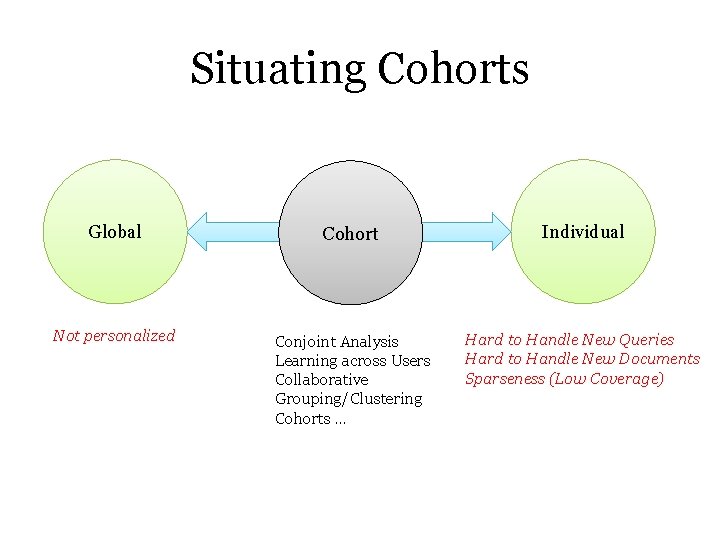
Situating Cohorts Global Cohort Individual Not personalized Conjoint Analysis Learning across Users Collaborative Grouping/Clustering Cohorts … Hard to Handle New Queries Hard to Handle New Documents Sparseness (Low Coverage)
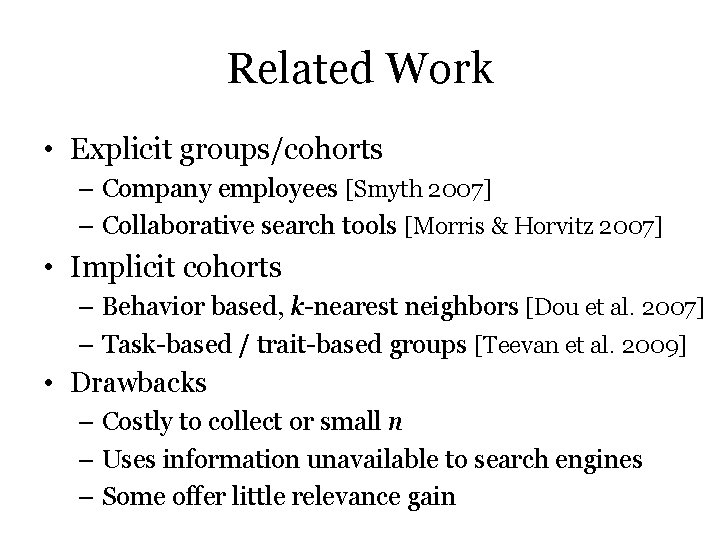
Related Work • Explicit groups/cohorts – Company employees [Smyth 2007] – Collaborative search tools [Morris & Horvitz 2007] • Implicit cohorts – Behavior based, k-nearest neighbors [Dou et al. 2007] – Task-based / trait-based groups [Teevan et al. 2009] • Drawbacks – Costly to collect or small n – Uses information unavailable to search engines – Some offer little relevance gain
Problem • Given search logs with <user, query, clicks>, can we design a cohort model that can improve the relevance of personalized search results?
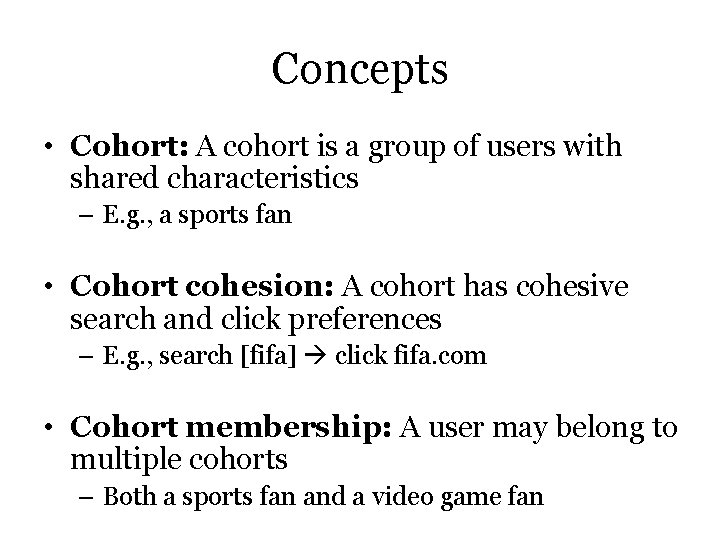
Concepts • Cohort: A cohort is a group of users with shared characteristics – E. g. , a sports fan • Cohort cohesion: A cohort has cohesive search and click preferences – E. g. , search [fifa] click fifa. com • Cohort membership: A user may belong to multiple cohorts – Both a sports fan and a video game fan
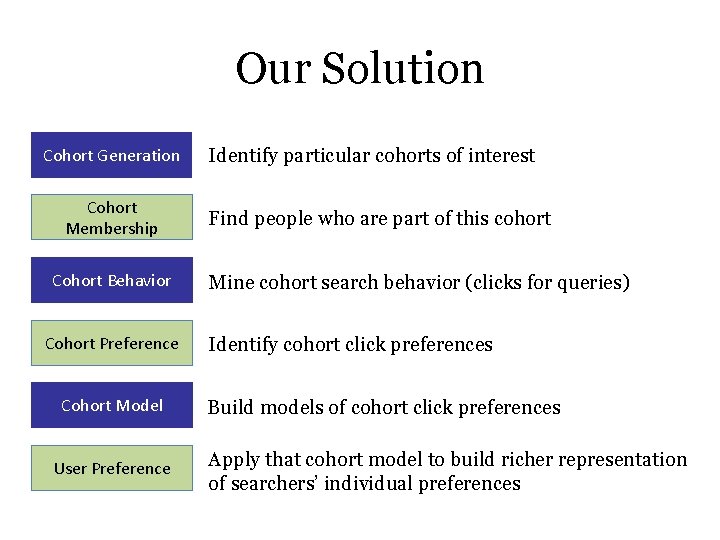
Our Solution Cohort Generation Cohort Membership Cohort Behavior Cohort Preference Cohort Model User Preference Identify particular cohorts of interest Find people who are part of this cohort Mine cohort search behavior (clicks for queries) Identify cohort click preferences Build models of cohort click preferences Apply that cohort model to build richer representation of searchers’ individual preferences
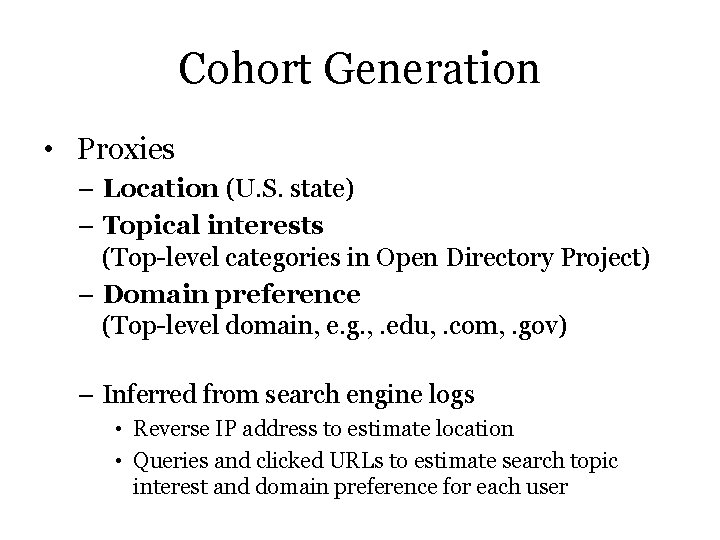
Cohort Generation • Proxies – Location (U. S. state) – Topical interests (Top-level categories in Open Directory Project) – Domain preference (Top-level domain, e. g. , . edu, . com, . gov) – Inferred from search engine logs • Reverse IP address to estimate location • Queries and clicked URLs to estimate search topic interest and domain preference for each user
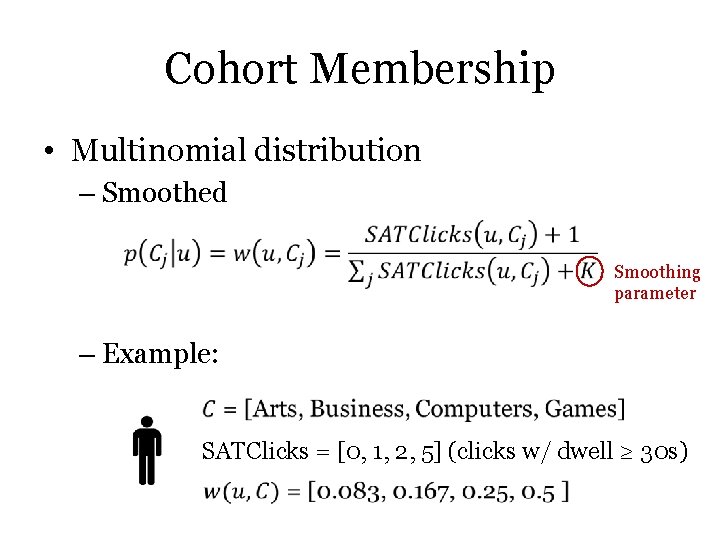
Cohort Membership • Multinomial distribution – Smoothed Smoothing parameter – Example: SATClicks = [0, 1, 2, 5] (clicks w/ dwell ≥ 30 s)
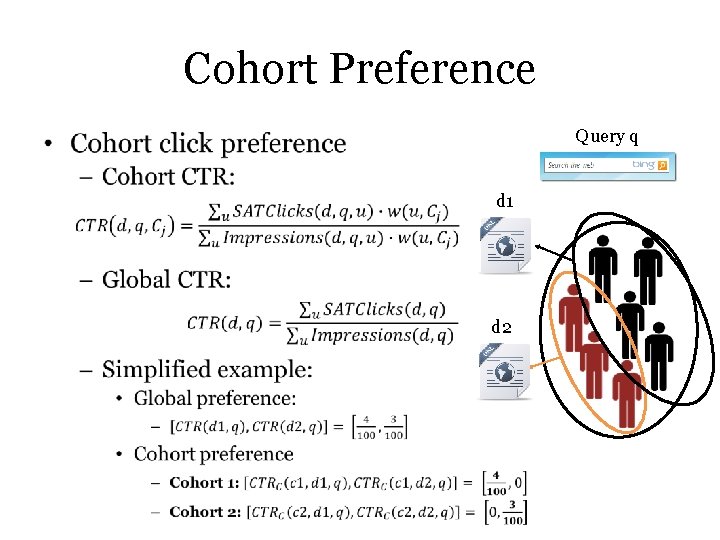
Cohort Preference Query q • d 1 d 2
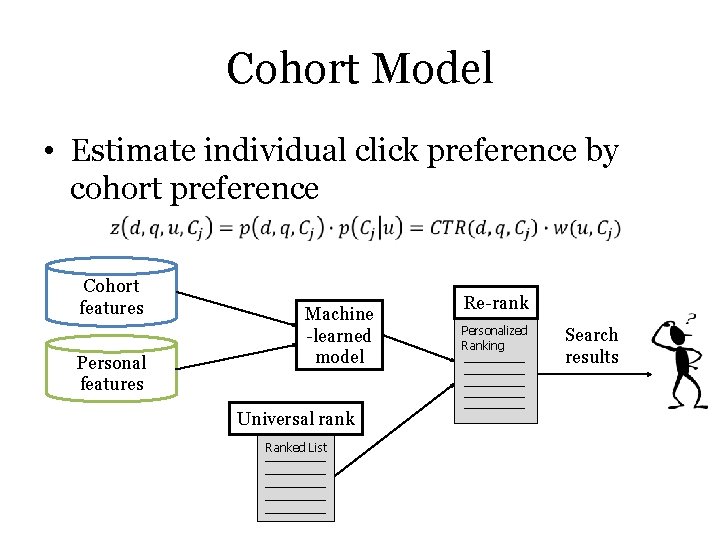
Cohort Model • Estimate individual click preference by cohort preference Cohort features Personal features Machine -learned model Universal rank Ranked List Re-rank Personalized Ranking Search results
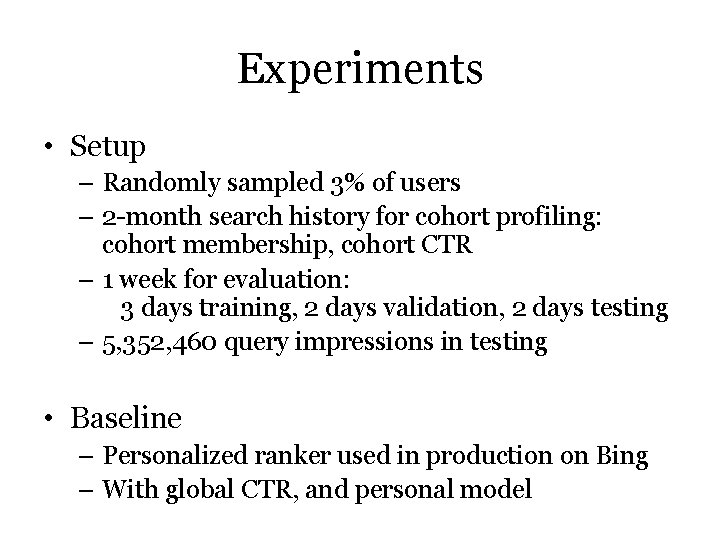
Experiments • Setup – Randomly sampled 3% of users – 2 -month search history for cohort profiling: cohort membership, cohort CTR – 1 week for evaluation: 3 days training, 2 days validation, 2 days testing – 5, 352, 460 query impressions in testing • Baseline – Personalized ranker used in production on Bing – With global CTR, and personal model
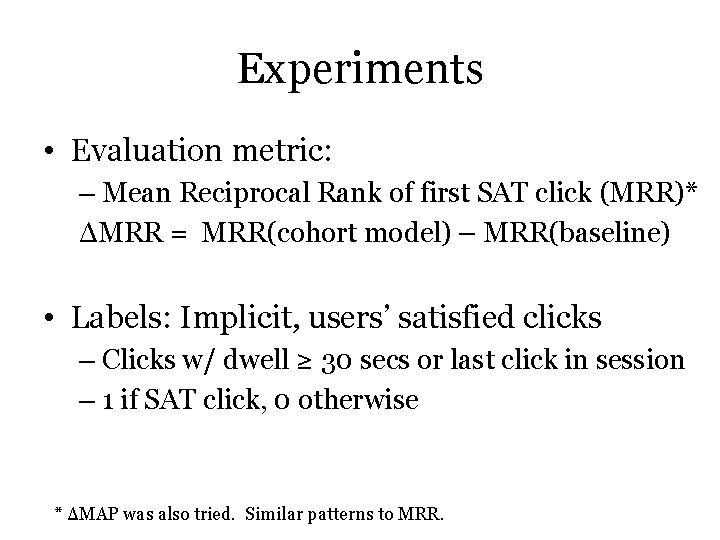
Experiments • Evaluation metric: – Mean Reciprocal Rank of first SAT click (MRR)* ΔMRR = MRR(cohort model) – MRR(baseline) • Labels: Implicit, users’ satisfied clicks – Clicks w/ dwell ≥ 30 secs or last click in session – 1 if SAT click, 0 otherwise * ΔMAP was also tried. Similar patterns to MRR.
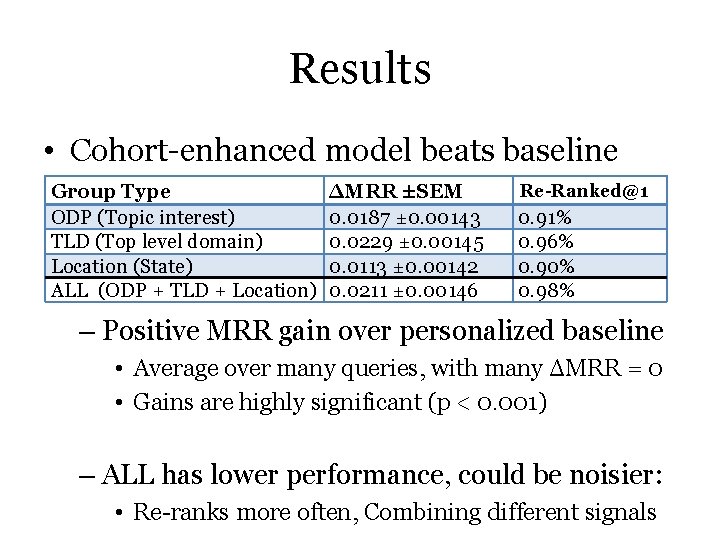
Results • Cohort-enhanced model beats baseline Group Type ODP (Topic interest) TLD (Top level domain) Location (State) ALL (ODP + TLD + Location) ΔMRR ±SEM 0. 0187 ± 0. 00143 0. 0229 ± 0. 00145 0. 0113 ± 0. 00142 0. 0211 ± 0. 00146 Re-Ranked@1 0. 91% 0. 96% 0. 90% 0. 98% – Positive MRR gain over personalized baseline • Average over many queries, with many ΔMRR = 0 • Gains are highly significant (p < 0. 001) – ALL has lower performance, could be noisier: • Re-ranks more often, Combining different signals
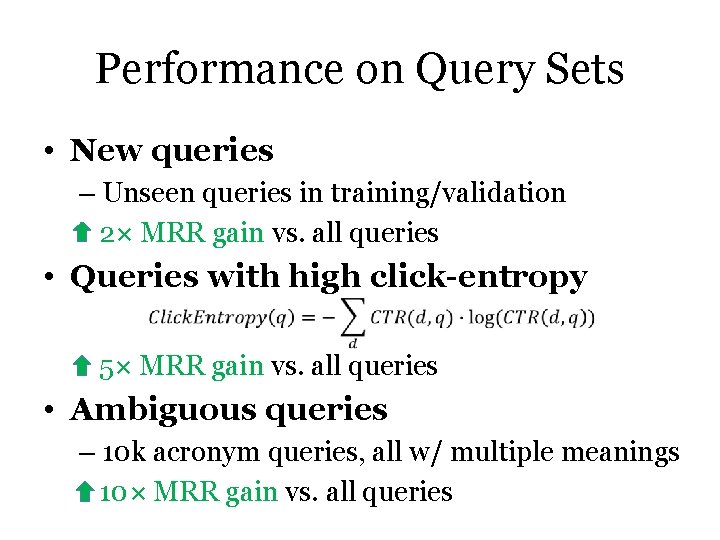
Performance on Query Sets • New queries – Unseen queries in training/validation 2× MRR gain vs. all queries • Queries with high click-entropy 5× MRR gain vs. all queries • Ambiguous queries – 10 k acronym queries, all w/ multiple meanings 10× MRR gain vs. all queries
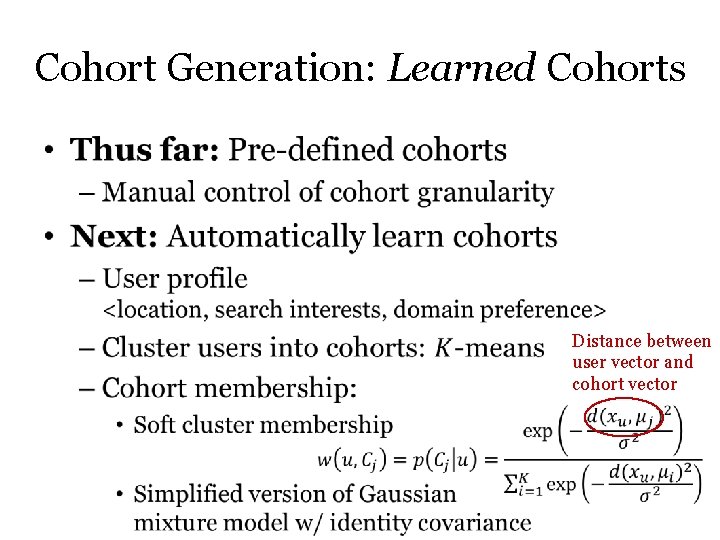
Cohort Generation: Learned Cohorts • Distance between user vector and cohort vector
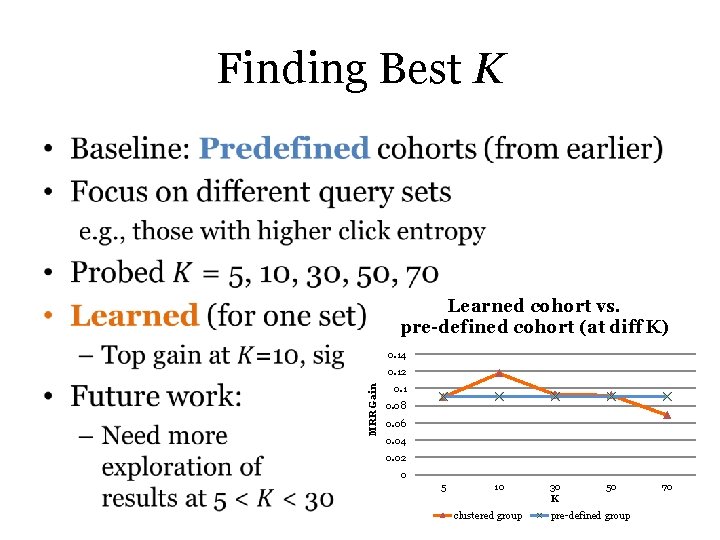
Finding Best K • Learned cohort vs. pre-defined cohort (at diff K) 0. 14 MRR Gain 0. 12 0. 1 0. 08 0. 06 0. 04 0. 02 0 5 10 clustered group 30 K 50 pre-defined group 70
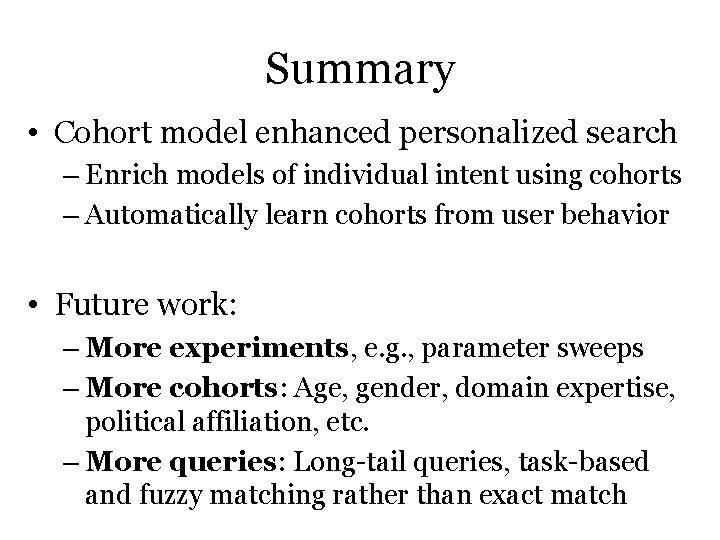
Summary • Cohort model enhanced personalized search – Enrich models of individual intent using cohorts – Automatically learn cohorts from user behavior • Future work: – More experiments, e. g. , parameter sweeps – More cohorts: Age, gender, domain expertise, political affiliation, etc. – More queries: Long-tail queries, task-based and fuzzy matching rather than exact match
Thanks • Questions?