Heavy Water Reactors 1 Physics Concepts and History

- Slides: 95
Heavy Water Reactors: 1. Physics, Concepts and History Blair P. Bromley Reactor and Radiation Physics Branch AECL – Chalk River Laboratories Joint ICTP-IAEA Workshop on Nuclear Reaction Data for Advanced Reactor Technologies May 26/27, 2008 UNRESTRICTED
Outline • • • Many topics to cover (by no means complete) Fundamental Physics Design Options Physics and Engineering Issues Review of Conventional HWR Power Reactors – Prototypes / Experiments (Historical) – Commercial Reactors • Present Day and Near Future • Additional Information (see Appendix) – Other HWR concepts. UNRESTRICTED 2
Goals • Better appreciation of heavy water reactors. – Historical review. – We can learn from the past. – Variables change with time. • Better understanding. – Motivation. – How it works. – Design features. – Physics issues, engineering issues. – Long term prospects, implications for future. UNRESTRICTED 3
References • IAEA, Heavy Water Reactors: Status and Projected Development, Tech. Series 407, Vienna, (2002). • IAEA, Directory of Nuclear Reactors, Volumes I to X, (1962 to 1976). • IAEA, Heavy-Water Power Reactors, Proceedings of Symposium, Vienna, 11 -15 Sept. 1967 (1968). • IAEA, Heavy Water Lattices: Second Panel Report, Tech. Series No. 20, Vienna, (1963). • AECL, Canada Enters the Nuclear Age, Mc. Gill-Queen’s University Press, Montreal, (1997). • AECL, CANDU 6 Technical Outline, TDSI-105, Mississauga, Ontario, Canada, January (1992). UNRESTRICTED 4
A Few Useful References • British Nuclear Energy Society, Steam Generating and Other Heavy Water Reactors, Proc. of Conf. 14 -16 May, (1968). • Power Reactor and Nuclear Fuel Development Corporation (Japan), The 9 th JUICE Meeting on Heavy Water Reactors, Tokyo, March 11, (1982). • R. L. Loftness, Nuclear Power Plants, D. Van Nostrand, Princeton, NJ, (1964). • I. R. Cameron, Nuclear Fission Reactors, Plenum Press, New York, (1982). • J. J. Duderstadt and L. J. Hamilton, Nuclear Reactor Analysis, John Wiley & Sons, New York, (1976). • J. R. Lamarsh, Introduction to Nuclear Engineering, 2 nd Edition, Addison. Wesley, Reading, Massachusetts, (1983). • J. H. Wright, Nuclear Heat Sources for Modern Steam Turbines, Proc. of American Power Conference, Vol. 24, pp. 183 -194, (1962). • J. G. Duffy and C. C. Graves, Design of 10 MWe SDR, Nuclear Engineering and Science Conference, April 6 -9, 1959, Cleveland, Ohio. • And many more. . . . UNRESTRICTED 5
A Few Useful Websites • http: //www. aecl. ca/site 3. aspx • http: //www. aecl. ca/Assets/Publications/C 6 -Technical. Summary. pdf • http: //www. aecl. ca/Assets/Publications/ACR 1000 -Tech. Summary. pdf • http: //www. nuceng. ca/ • http: //canteach. candu. org/image_index. html • http: //www. cns-snc. ca/home_eng. html • http: //www. nuclearfaq. ca/ • http: //www. npcil. nic. in/nupower_vol 13_3/ahwr. htm • Just Google or Yahoo “heavy water reactor” UNRESTRICTED 6
Reactor Physics Considerations • Goal is to sustain fission reactions in a critical assembly using available fissile (and fertile) isotopes. • Fission cross section for various isotopes – Thermal spectrum: ~ 500 barns to 1000 barns – Fast spectrum: ~ 1 barn to 10 barns • Minimize enrichment requirements – Cost – Safety • Incentive to use thermal reactors UNRESTRICTED 7
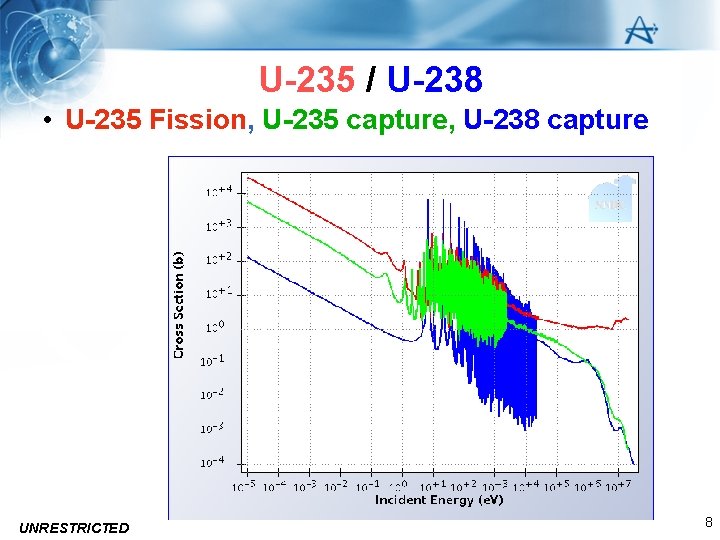
U-235 / U-238 • U-235 Fission, U-235 capture, U-238 capture UNRESTRICTED 8
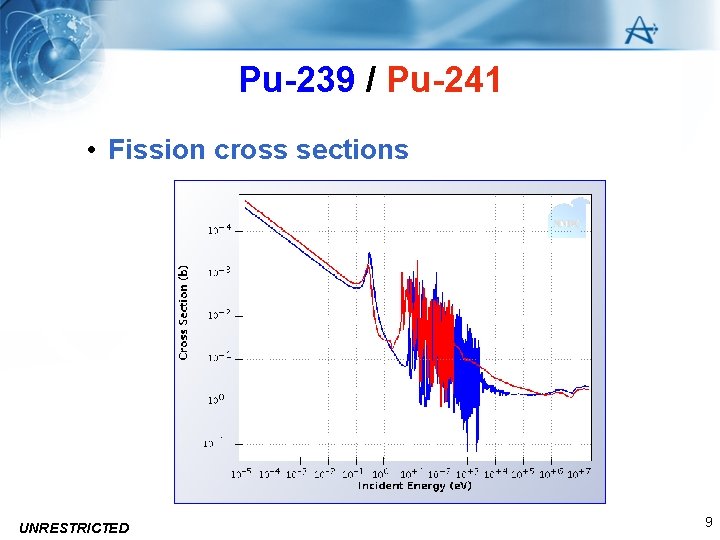
Pu-239 / Pu-241 • Fission cross sections UNRESTRICTED 9
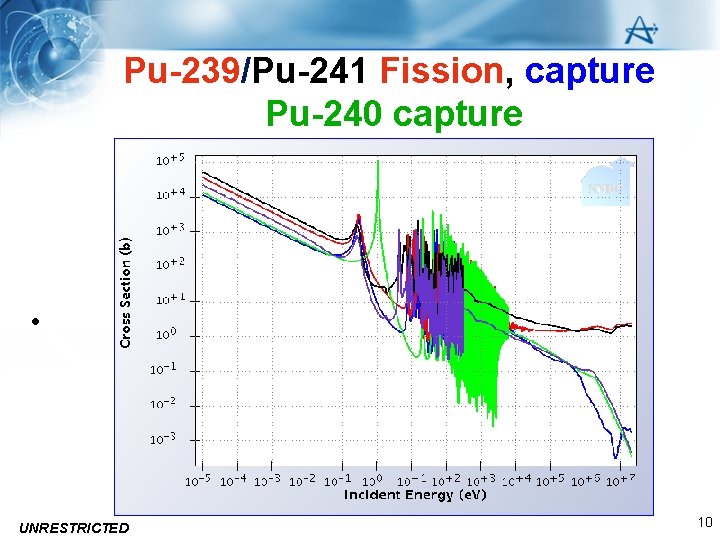
Pu-239/Pu-241 Fission, capture Pu-240 capture • UNRESTRICTED Resonances 10
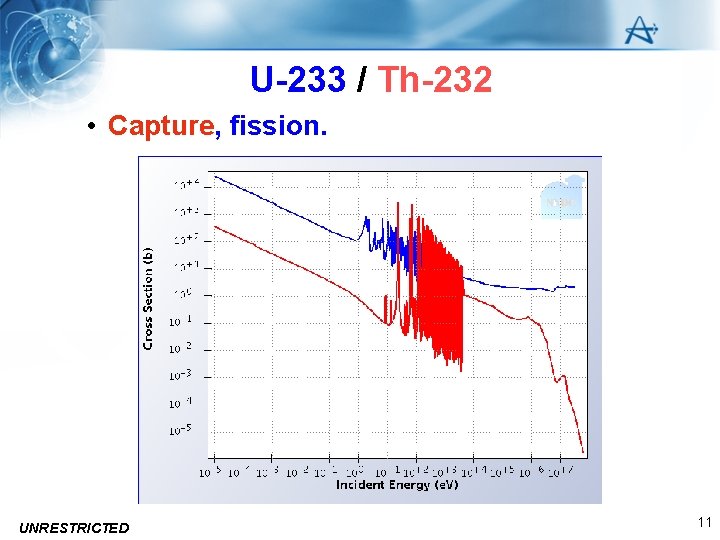
U-233 / Th-232 • Capture, fission. UNRESTRICTED 11
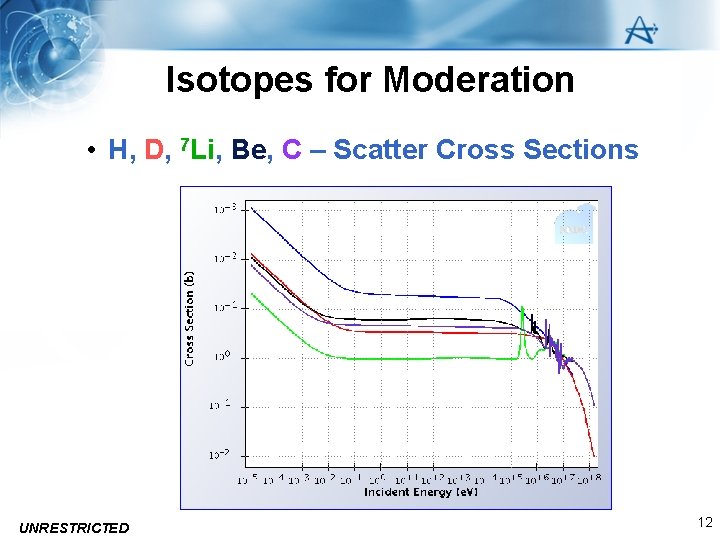
Isotopes for Moderation • H, D, 7 Li, Be, C – Scatter Cross Sections UNRESTRICTED 12
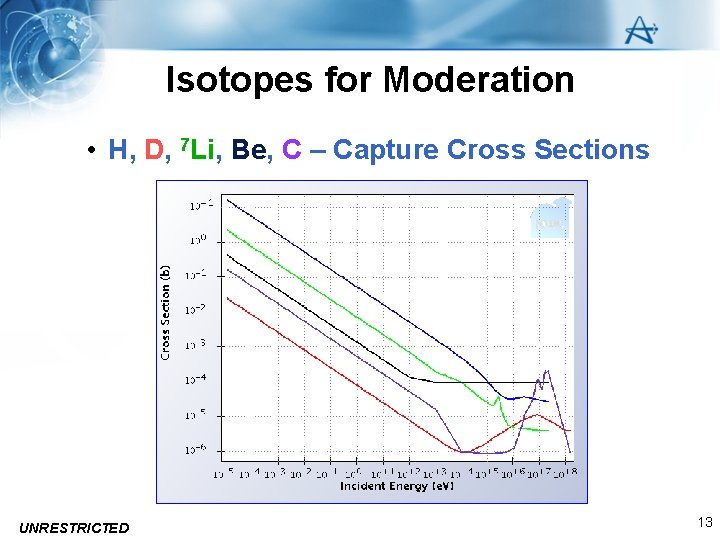
Isotopes for Moderation • H, D, 7 Li, Be, C – Capture Cross Sections UNRESTRICTED 13
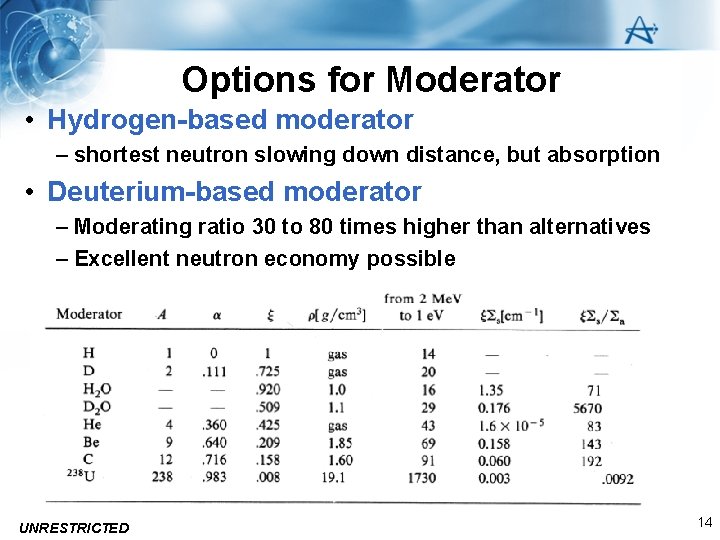
Options for Moderator • Hydrogen-based moderator – shortest neutron slowing down distance, but absorption • Deuterium-based moderator – Moderating ratio 30 to 80 times higher than alternatives – Excellent neutron economy possible UNRESTRICTED 14
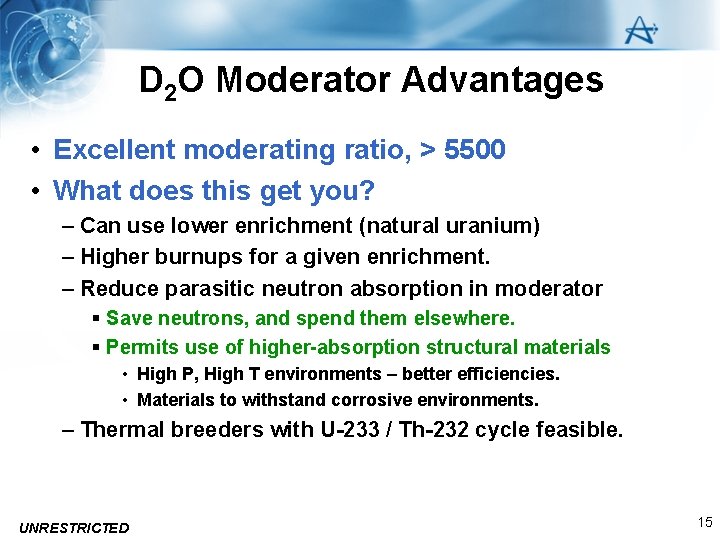
D 2 O Moderator Advantages • Excellent moderating ratio, > 5500 • What does this get you? – Can use lower enrichment (natural uranium) – Higher burnups for a given enrichment. – Reduce parasitic neutron absorption in moderator § Save neutrons, and spend them elsewhere. § Permits use of higher-absorption structural materials • High P, High T environments – better efficiencies. • Materials to withstand corrosive environments. – Thermal breeders with U-233 / Th-232 cycle feasible. UNRESTRICTED 15
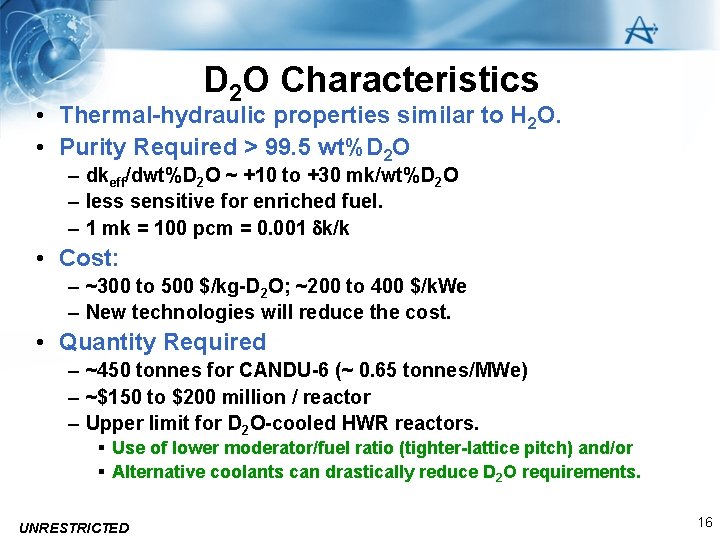
D 2 O Characteristics • Thermal-hydraulic properties similar to H 2 O. • Purity Required > 99. 5 wt%D 2 O – dkeff/dwt%D 2 O ~ +10 to +30 mk/wt%D 2 O – less sensitive for enriched fuel. – 1 mk = 100 pcm = 0. 001 k/k • Cost: – ~300 to 500 $/kg-D 2 O; ~200 to 400 $/k. We – New technologies will reduce the cost. • Quantity Required – ~450 tonnes for CANDU-6 (~ 0. 65 tonnes/MWe) – ~$150 to $200 million / reactor – Upper limit for D 2 O-cooled HWR reactors. § Use of lower moderator/fuel ratio (tighter-lattice pitch) and/or § Alternative coolants can drastically reduce D 2 O requirements. UNRESTRICTED 16
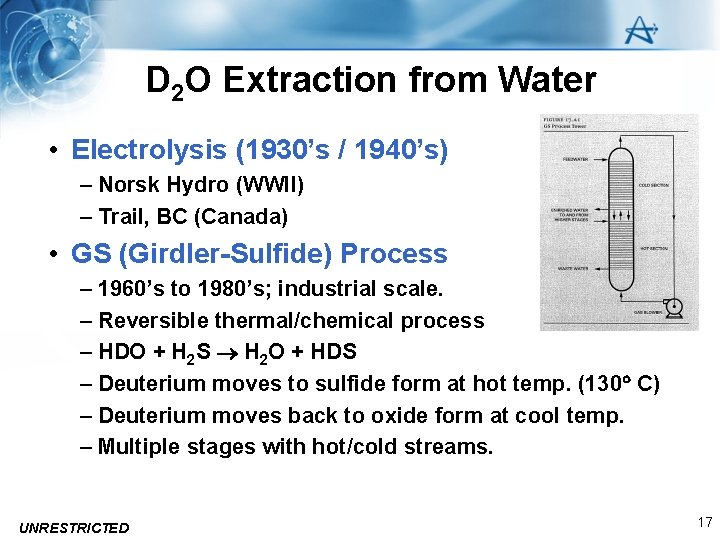
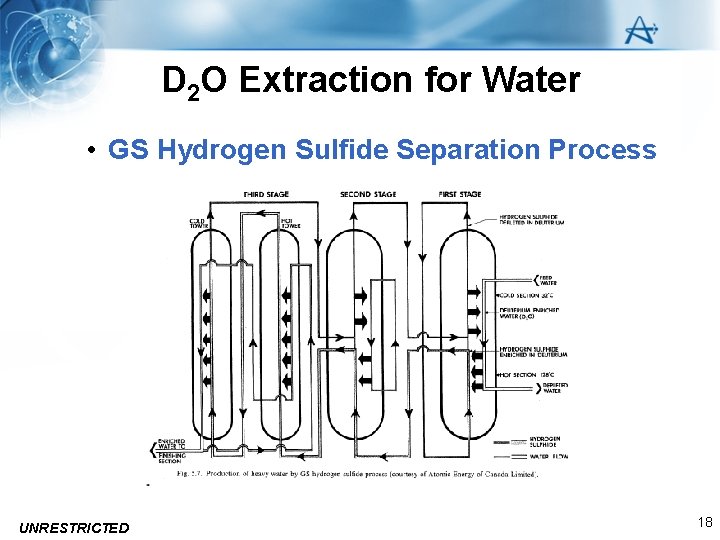
D 2 O Extraction from Water • Electrolysis (1930’s / 1940’s) – Norsk Hydro (WWII) – Trail, BC (Canada) • GS (Girdler-Sulfide) Process – 1960’s to 1980’s; industrial scale. – Reversible thermal/chemical process – HDO + H 2 S H 2 O + HDS – Deuterium moves to sulfide form at hot temp. (130 C) – Deuterium moves back to oxide form at cool temp. – Multiple stages with hot/cold streams. UNRESTRICTED 17
D 2 O Extraction for Water • GS Hydrogen Sulfide Separation Process UNRESTRICTED 18
D 2 O Extraction for Water • Alternative and new processes under advanced development and refinement – – Combined Industrial Reforming and Catalytic Exchange (CIRCE) Combined Electrolysis and Catalytic Exchange (CECE) Bi-thermal Hydrogen–Water (BHW) processes Other physical and chemical processes (ammonia/water, etc. ) • Newer processes more efficient – More cost-effective. • Reference: – Heavy Water: A Manufacturer’s Guide for the Hydrogen Century, by A. I. Miller, Canadian Nuclear Society Bulletin Vol 22, No 1, 2001 February – www. cns-snc. ca/Bulletin/A_Miller_Heavy_Water. pdf UNRESTRICTED 19
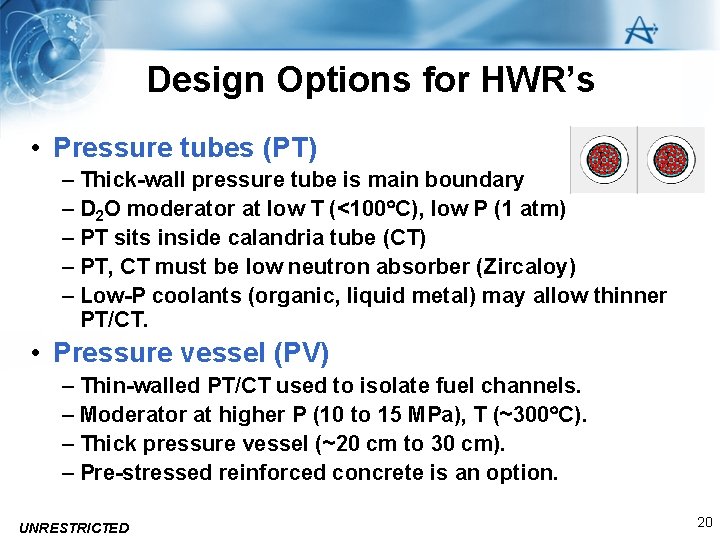
Design Options for HWR’s • Pressure tubes (PT) – Thick-wall pressure tube is main boundary – D 2 O moderator at low T (<100 C), low P (1 atm) – PT sits inside calandria tube (CT) – PT, CT must be low neutron absorber (Zircaloy) – Low-P coolants (organic, liquid metal) may allow thinner PT/CT. • Pressure vessel (PV) – Thin-walled PT/CT used to isolate fuel channels. – Moderator at higher P (10 to 15 MPa), T (~300 C). – Thick pressure vessel (~20 cm to 30 cm). – Pre-stressed reinforced concrete is an option. UNRESTRICTED 20
Coolant Options (Current) • • D 2 O at 10 to 15 MPa (CANDU, Atucha) H 2 O at 10 to 15 MPa (ACR-1000) Boiling H 2 O at 5 to 7 MPa (AHWR) Supercritical H 2 O at 25 MPa (Gen-IV) – SCOTT-R (Westinghouse study, 1960’s) – CANDU-SCR (AECL, Gen-IV) UNRESTRICTED 21
Coolant Features – D 2 O • D 2 O at 10 to 15 MPa (CANDU, Atucha) – Low absorption cross section; neutron economy. – Conventional steam-cycle technology. – Void reactivity § Depending on fuel / lattice design. § May be slightly positive, or negative. – Higher capital costs; minimizing leakage. – Tritium production and handling, but useful by-product. – Water chemistry / corrosion for long-term operation. – Hydriding of Zircaloy-PT. – Efficiencies usually limited to < 34% (30% to 31% typical). UNRESTRICTED 22
Coolant Features – H 2 O • H 2 O at 10 to 15 MPa (ACR-1000) – Cheaper, lower capital costs – Conventional steam-cycle technology. – Higher neutron absorption; reduced neutron economy. – Must design lattice carefully to ensure negative CVR. – Water chemistry / corrosion for long-term operation. – Hydriding of Zircaloy-PT – Net efficiencies usually limited to ~ 34%. UNRESTRICTED 23
Coolant Features – Boiling H 2 O • Boiling H 2 O at 5 to 7 MPa – Cheaper, lower capital costs – Thinner PT’s feasible. – Direct steam cycle § Eliminate steam generator; slightly higher efficiencies. – Neutron absorption in H 2 O – Must design lattice carefully to ensure negative CVR. § Smaller lattice pitch; enriched and/or MOX fuel. § More complicated reactivity control system. – Water chemistry / corrosion; hydriding of Zircaloy-PT – Radioactivity in steam turbine. UNRESTRICTED 24
Coolant Features – Supercritical H 2 O • Supercritical H 2 O at 25 MPa – Similarities to boiling H 2 O. – Higher efficiencies possible, ~45%. – Thicker PT’s required; reduced neutron economy. – Severe conditions; corrosive environment § T~550 C to 600 C. § High-temp. materials required – reduced neutron economy. § Use of Zr. O 2, Mg. O, or graphite liner for PT – Careful design for postulated accidents § Depressurization from 25 MPa. – More challenging to design for on-line refuelling. UNRESTRICTED 25
HWR Physics Characteristics • Moderator isolated from fuel/coolant – Keep at lower temp (< 100 C, for PT reactors) • Physics properties depend on: – Moderator / fuel ratio – Fuel pin size (resonance self shielding) – Composition / enrichment (U, Pu, Th) – Coolant type (D 2 O, H 2 O, gas, organic, liquid metal, etc. ) • Reactivity Coefficients – Fuel temperature comparable to LWR. – Void reactivity (+ or - ), depending on design. – Power coefficient (+ or - ), depending on design. UNRESTRICTED 26
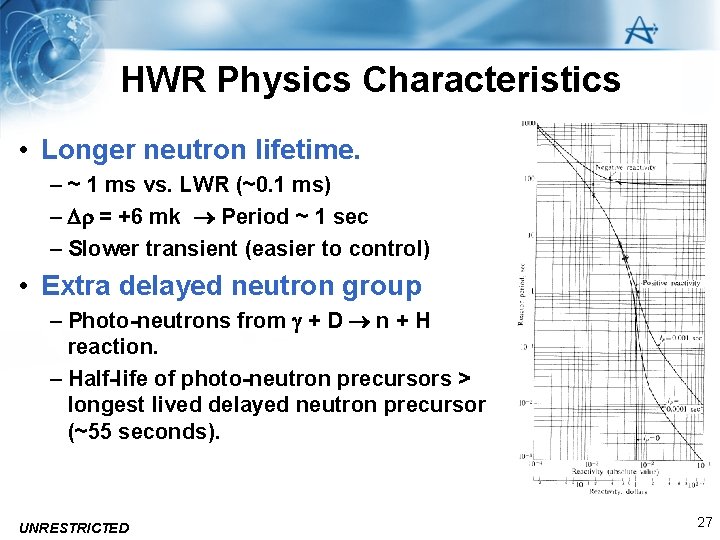
HWR Physics Characteristics • Longer neutron lifetime. – ~ 1 ms vs. LWR (~0. 1 ms) – = +6 mk Period ~ 1 sec – Slower transient (easier to control) • Extra delayed neutron group – Photo-neutrons from + D n + H reaction. – Half-life of photo-neutron precursors > longest lived delayed neutron precursor (~55 seconds). UNRESTRICTED 27
HWR Physics Characteristics • Conversion Ratio – C = 0. 7 to 0. 9 (depends on enrichment, parasitic losses) § U-metal ideal, but UO 2, UC more practical – C > 1. 0 possible for U-233 / Th-232 thermal breeder § Careful design of lattice required to maximize economy. • Burnup of fuel – Natural U ~ 5 GWd/t to 10 GWd/t (CANDU ~8 GWd/t) – Slightly enriched U ~ 10 GWd/t to 30 GWd/t – Feasible to use recovered uranium / spent LWR fuel § Work in tandem with LWR’s to maximize energy extraction. § Potential role for HWR’s in GNEP UNRESTRICTED 28
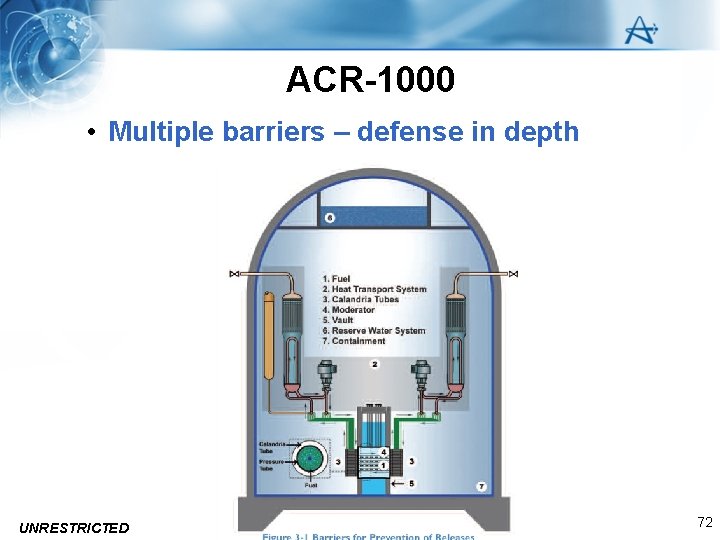
HWR Physics Characteristics • PT D 2 O reactors, some unique safety features – Multiple, independent shutdown systems feasible § Shutdown rods § Moderator poison injection (B 10, Gd, etc. ) § Low-pressure environment for moderator. – Longer reactor period gives time for shutdown to work – Multiple barriers § Fuel clad § Pressure Tube § Calandria Tube – Large heat sink to dissipate heat UNRESTRICTED 29
HWR Physics Characteristics • Power Density in Core – Factor in size/cost of reactor § How much concrete are you going to use? – Depends on enrichment, lattice pitch, coolant. – D 2 O/H 2 O cooled: ~ 9 to 12 k. W/litre § (LWR ~ 50 to 100 k. W/litre) § 15 to 20 k. W/litre feasible with tighter lattice pitch (ACR) – Gas-cooled: ~ 1 to 4 k. W/litre § 10 to 15 k. W/litre feasible with high pressures (10 MPa) – Organics, Liquid Metal ~ 4 to 10 k. W/litre § 10 to 15 k. W/litre feasible UNRESTRICTED 30
HWR Operational Characteristics • Heat load to moderator – 5% to 6% of fission energy deposited – Gamma-heating, neutron slowing down. • Thermal efficiencies (net) – Depends on choice of coolant, secondary cycle. – Typical: 28% to 31% for CANDU-type reactors. § Improved for larger, more modern plants. § Improvements in steam turbines, balance of plant. – 32% to 34% feasible for HWBLW-type reactors. – Gas, organic, liquid metal: 35% to 50% (stretch). – Economies of scale with larger plants. UNRESTRICTED 31
Design Components (CANDU) • Fuel / Bundles – UO 2 clad in Zircaloy-4; collapsed cladding. – Graphite interlayer (CANLUB) to improve durability. – Brazed spacers, bearing pads, appendages § Maintain element separation; enhance cooling – Alternatives § Fuel: UC, U 3 Si § Clad: SAP (organics) or stainless steel (gas, liquid metal, SC H 2 O) • Pressure Tubes – Zr-2. 5%Nb alloy (corrosion, toughness, strength) • Calandria Tubes – Zircaloy-2 • Feeders/Headers – Stainless steel (special mechanical joints with PT) UNRESTRICTED 32
Control Devices • • Control rods (stainless steel – SS, etc. ) Shutdown rods (B 4 C, Cd/Ag/In, SS/Cd, etc. ) Adjusters (flatten flux shape) – Cobalt, SS Zone controllers – Tubes with liquid H 2 O used to adjust local reactivity. • Moderator poison options – Boric acid for long-term reactivity changes – Gadolinium nitrate injection for fast shutdown – Cd. SO 4 • Moderator level – Additional means for reactivity control • Moderator dump tank – Initial designs; not used in later UNRESTRICTED 33
HWR (CANDU) Features • Excellent neutron economy. – High conversion ratios. – Operate on natural uranium – High fuel utilization; conservation of resources. • On-line refuelling. – Low excess reactivity. – Higher fuel burnup for a given enrichment. – High capacity factors (0. 8 to 0. 95) • Modular construction – Pressure tubes; replaceable – Local fabrication UNRESTRICTED 34
NPD-2 (Canada) • • • Operated 1962 -1985; shutdown 1987. 89 MWth / 19 MWe (21. 7% efficiency) World’s first HWR to produce electricity. Pressure tubes, on-line refuelling. Short (0. 5 -m) natural-uranium fuel bundles. Test bed for CANDU technologies. – Demonstration of feasibility of PHWR concept. – Debugging D 2 O leakage, trips, reactivity control – Fuel performance, alternative designs. • Training center for operations. – Experience for later CANDU designs UNRESTRICTED 35
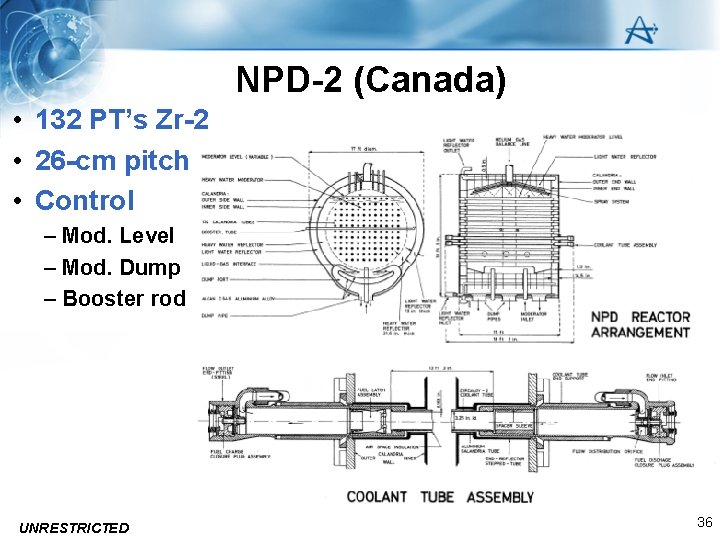
NPD-2 (Canada) • 132 PT’s Zr-2 • 26 -cm pitch • Control – Mod. Level – Mod. Dump – Booster rod UNRESTRICTED 36
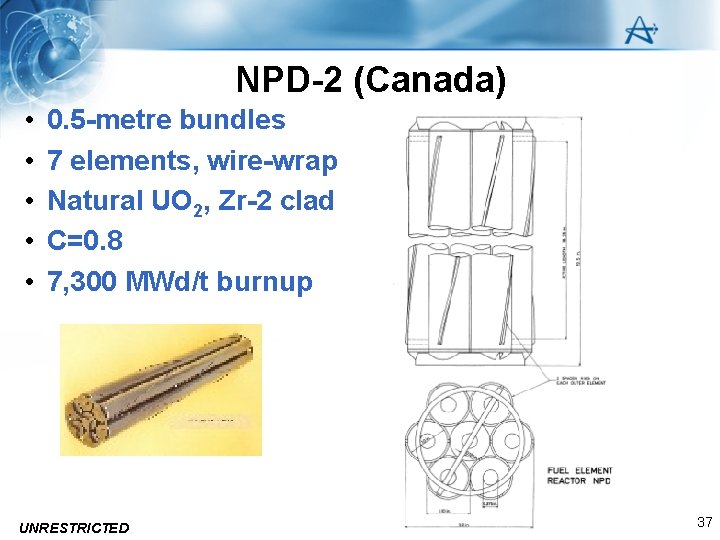
NPD-2 (Canada) • • • 0. 5 -metre bundles 7 elements, wire-wrap Natural UO 2, Zr-2 clad C=0. 8 7, 300 MWd/t burnup UNRESTRICTED 37
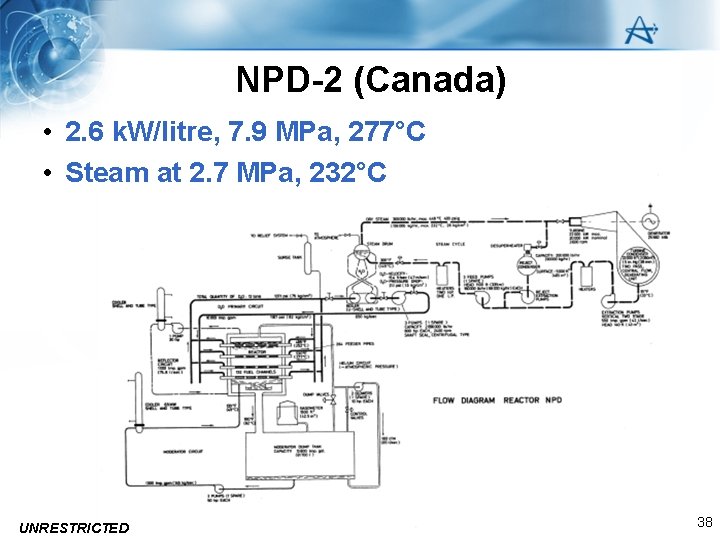
NPD-2 (Canada) • 2. 6 k. W/litre, 7. 9 MPa, 277°C • Steam at 2. 7 MPa, 232°C UNRESTRICTED 38
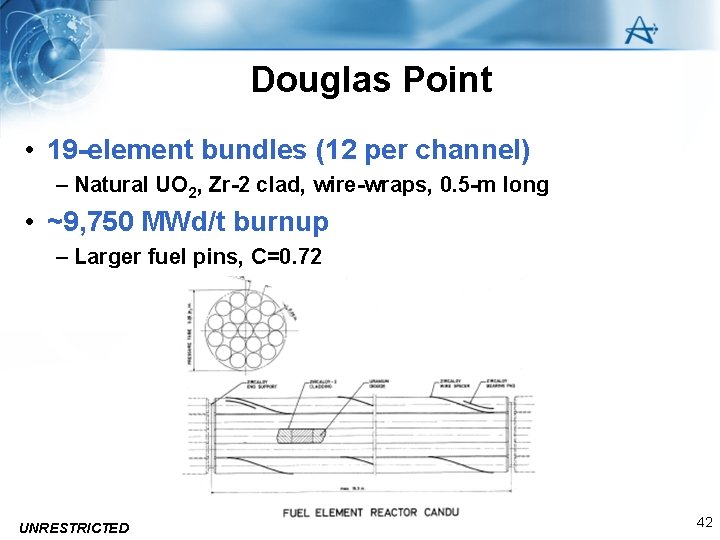
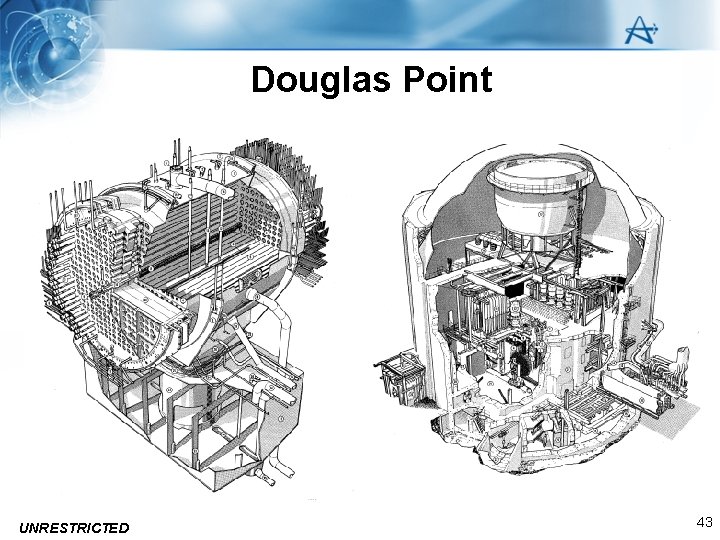
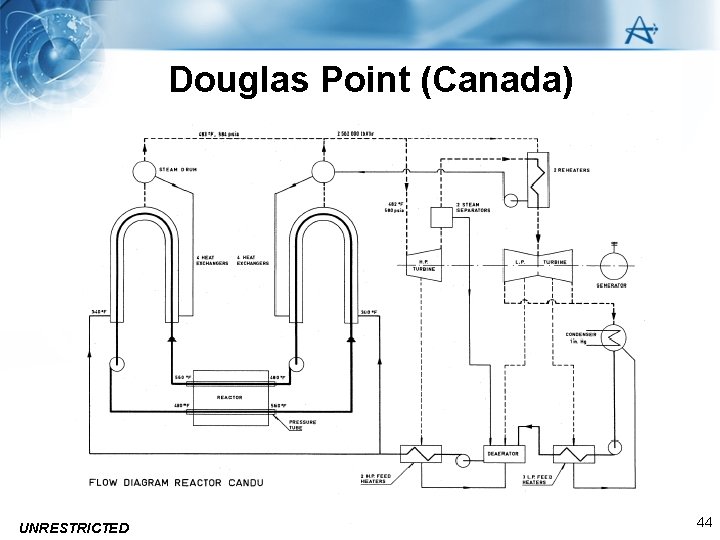
Douglas Point (Canada) • Prototype for commercial PHWR – CANadian Deuterium Uranium (CANDU) – Lessons learned from NPD-2. – Construction/commissioning (1961 -1967) – Operated 1968 -1984 – Larger-scale test bed for equipment and operations. § Debugging HW leaks. • 693 MWth / 200 MWe, 29%, 4. 77 k. W/litre • D 2 O Coolant at 9. 9 MPa, 293°C • Steam generators / drums – Steam at 4. 1 MPa, 250°C UNRESTRICTED 39
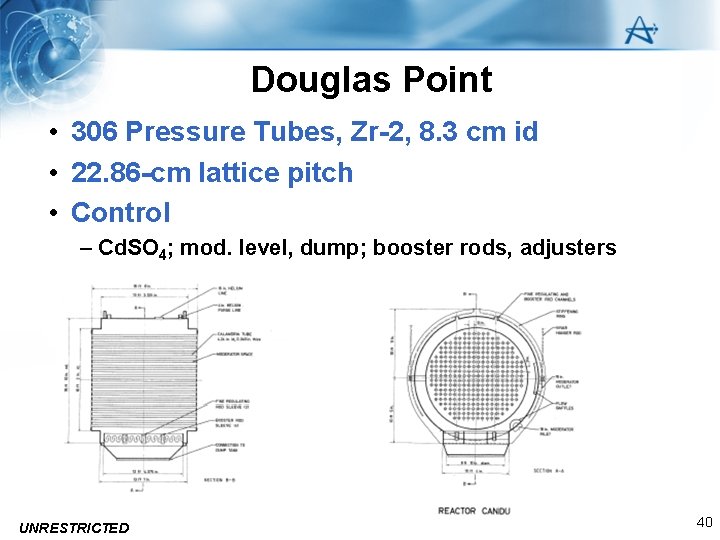
Douglas Point • 306 Pressure Tubes, Zr-2, 8. 3 cm id • 22. 86 -cm lattice pitch • Control – Cd. SO 4; mod. level, dump; booster rods, adjusters UNRESTRICTED 40
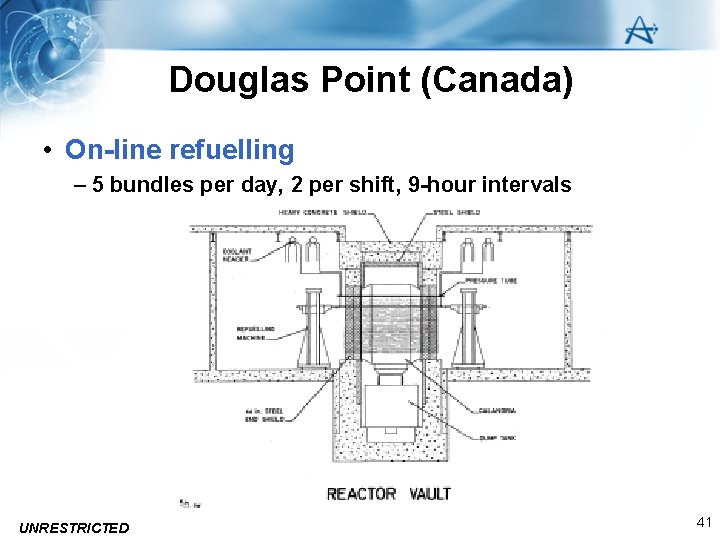
Douglas Point (Canada) • On-line refuelling – 5 bundles per day, 2 per shift, 9 -hour intervals UNRESTRICTED 41
Douglas Point • 19 -element bundles (12 per channel) – Natural UO 2, Zr-2 clad, wire-wraps, 0. 5 -m long • ~9, 750 MWd/t burnup – Larger fuel pins, C=0. 72 UNRESTRICTED 42
Douglas Point • ada UNRESTRICTED 43
Douglas Point (Canada) • adfasf • adfadadfa UNRESTRICTED 44
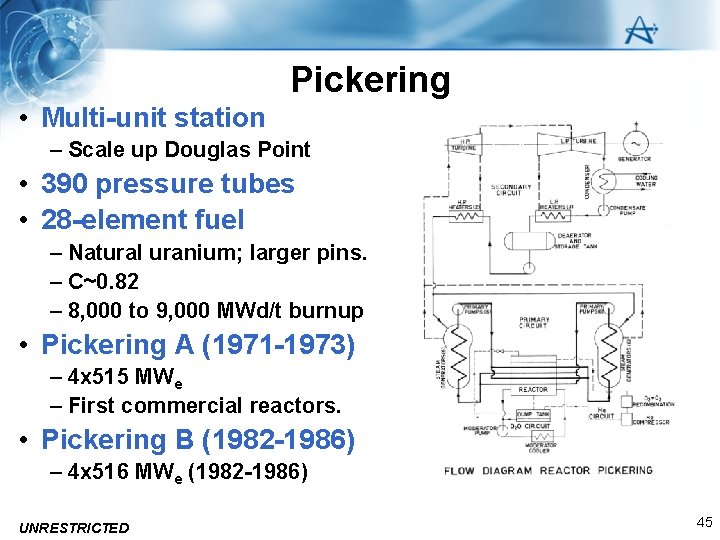
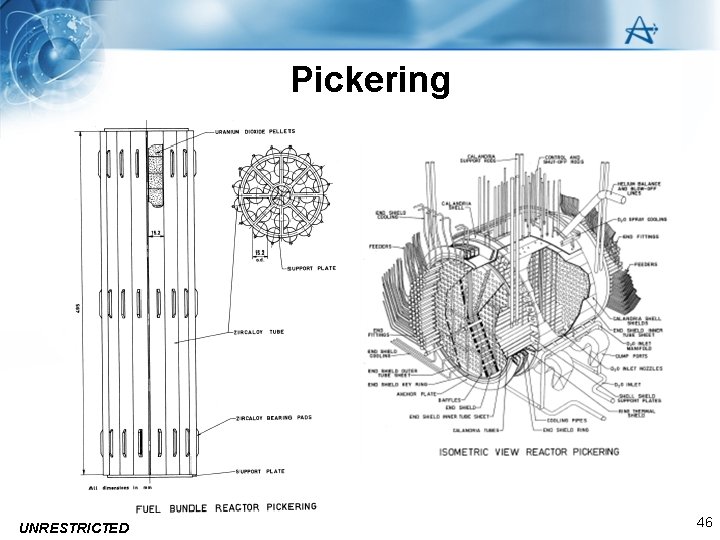
Pickering • Multi-unit station – Scale up Douglas Point • 390 pressure tubes • 28 -element fuel – Natural uranium; larger pins. – C~0. 82 – 8, 000 to 9, 000 MWd/t burnup • Pickering A (1971 -1973) – 4 x 515 MWe – First commercial reactors. • Pickering B (1982 -1986) – 4 x 516 MWe (1982 -1986) UNRESTRICTED 45
Pickering • adfa UNRESTRICTED 46
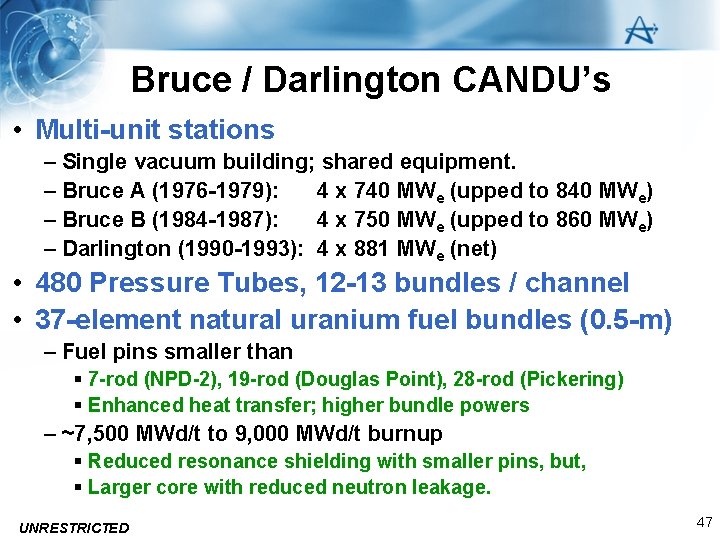
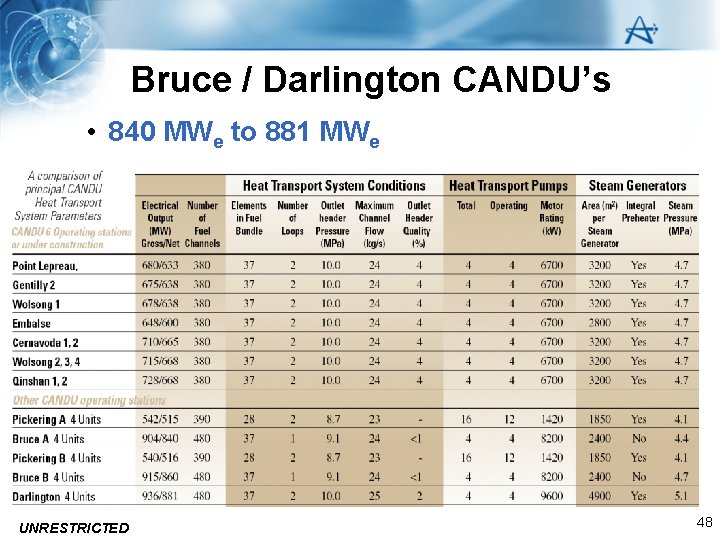
Bruce / Darlington CANDU’s • Multi-unit stations – Single vacuum building; shared equipment. – Bruce A (1976 -1979): 4 x 740 MWe (upped to 840 MWe) – Bruce B (1984 -1987): 4 x 750 MWe (upped to 860 MWe) – Darlington (1990 -1993): 4 x 881 MWe (net) • 480 Pressure Tubes, 12 -13 bundles / channel • 37 -element natural uranium fuel bundles (0. 5 -m) – Fuel pins smaller than § 7 -rod (NPD-2), 19 -rod (Douglas Point), 28 -rod (Pickering) § Enhanced heat transfer; higher bundle powers – ~7, 500 MWd/t to 9, 000 MWd/t burnup § Reduced resonance shielding with smaller pins, but, § Larger core with reduced neutron leakage. UNRESTRICTED 47
Bruce / Darlington CANDU’s • 840 MWe to 881 MWe UNRESTRICTED 48
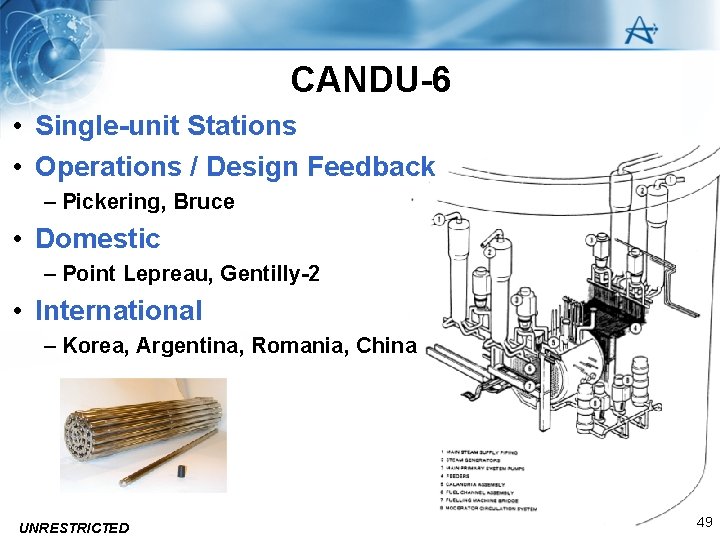
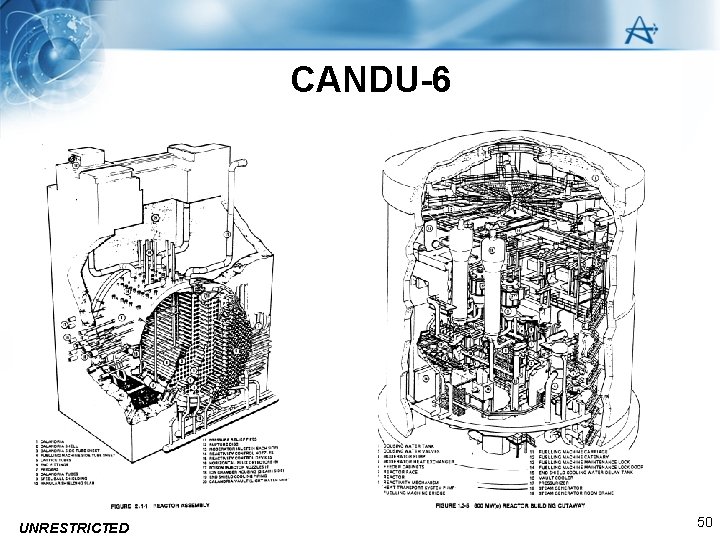
CANDU-6 • Single-unit Stations • Operations / Design Feedback – Pickering, Bruce • Domestic – Point Lepreau, Gentilly-2 • International – Korea, Argentina, Romania, China UNRESTRICTED 49
CANDU-6 • fdsa UNRESTRICTED 50
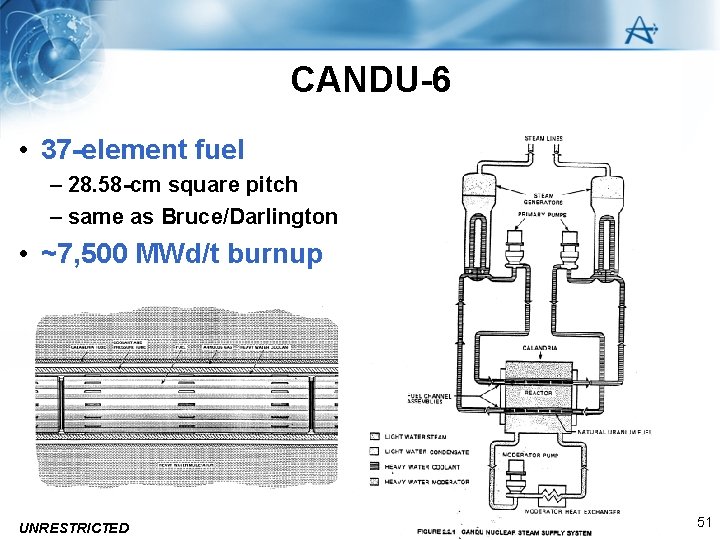
CANDU-6 • 37 -element fuel – 28. 58 -cm square pitch – same as Bruce/Darlington • ~7, 500 MWd/t burnup UNRESTRICTED 51
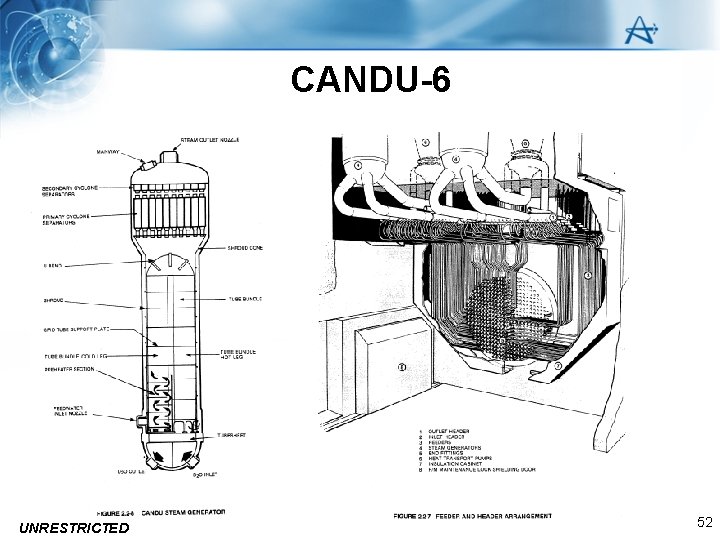
CANDU-6 • asd UNRESTRICTED 52
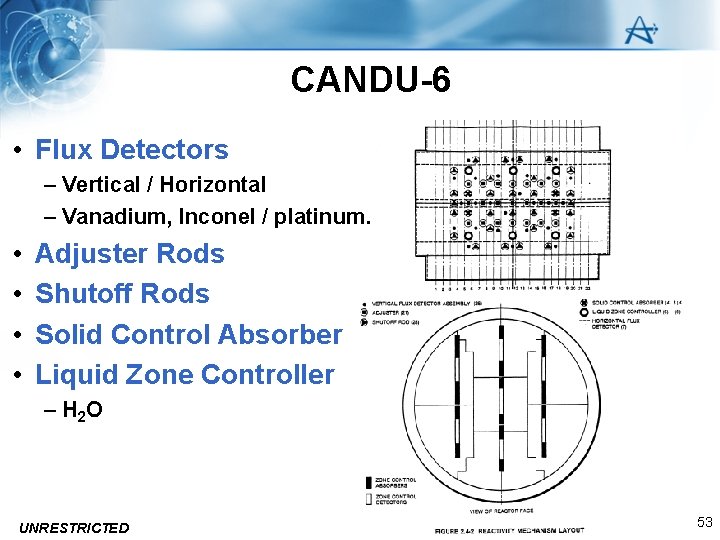
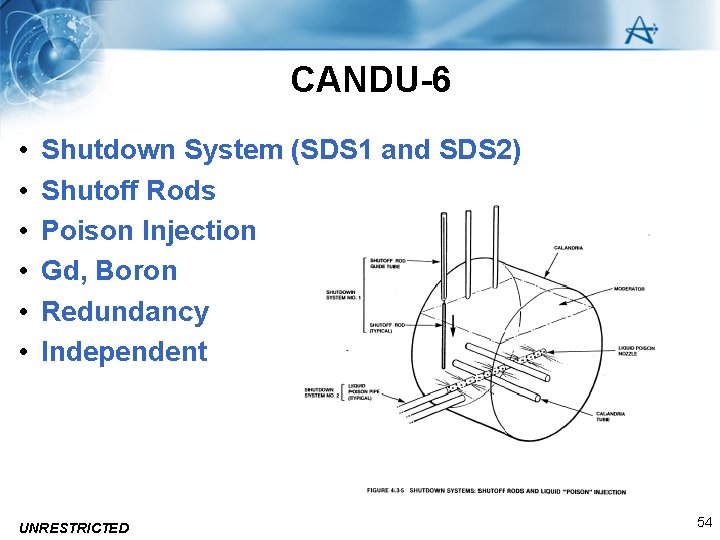
CANDU-6 • Flux Detectors – Vertical / Horizontal – Vanadium, Inconel / platinum. • • Adjuster Rods Shutoff Rods Solid Control Absorber Liquid Zone Controller – H 2 O UNRESTRICTED 53
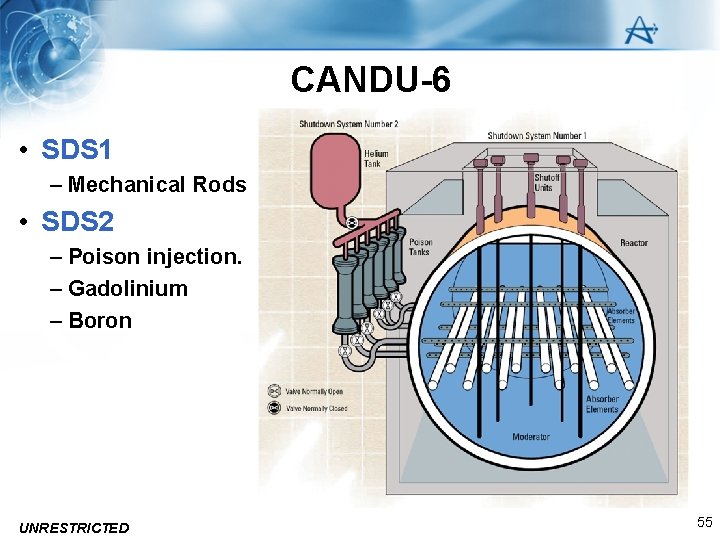
CANDU-6 • • • Shutdown System (SDS 1 and SDS 2) Shutoff Rods Poison Injection Gd, Boron Redundancy Independent UNRESTRICTED 54
CANDU-6 • SDS 1 – Mechanical Rods • SDS 2 – Poison injection. – Gadolinium – Boron UNRESTRICTED 55
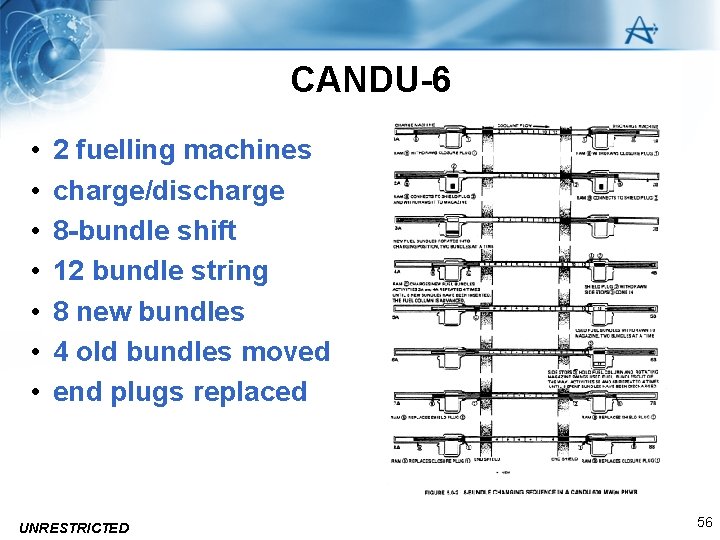
CANDU-6 • • 2 fuelling machines charge/discharge 8 -bundle shift 12 bundle string 8 new bundles 4 old bundles moved end plugs replaced UNRESTRICTED 56
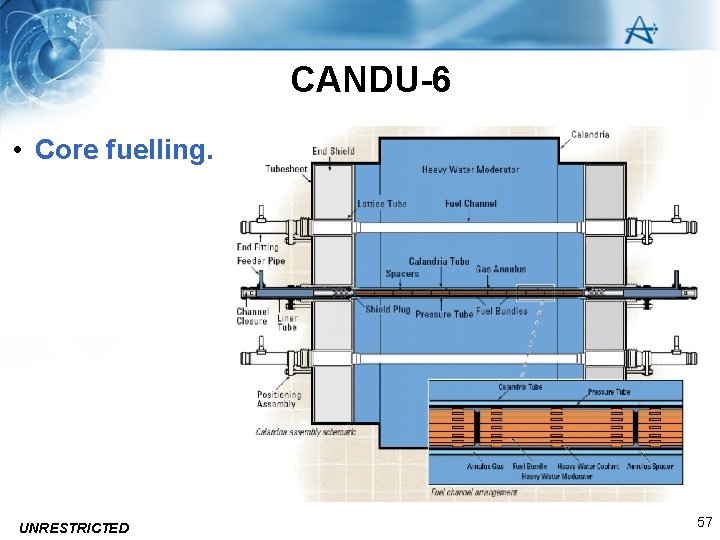
CANDU-6 • Core fuelling. UNRESTRICTED 57
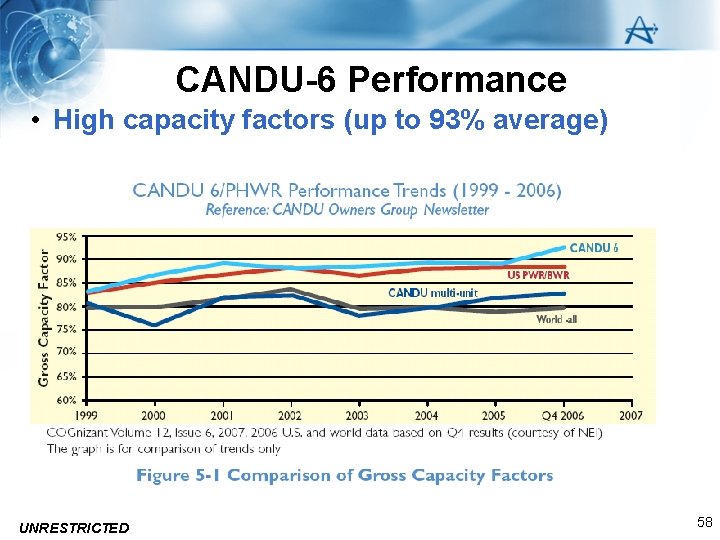
CANDU-6 Performance • High capacity factors (up to 93% average) UNRESTRICTED 58
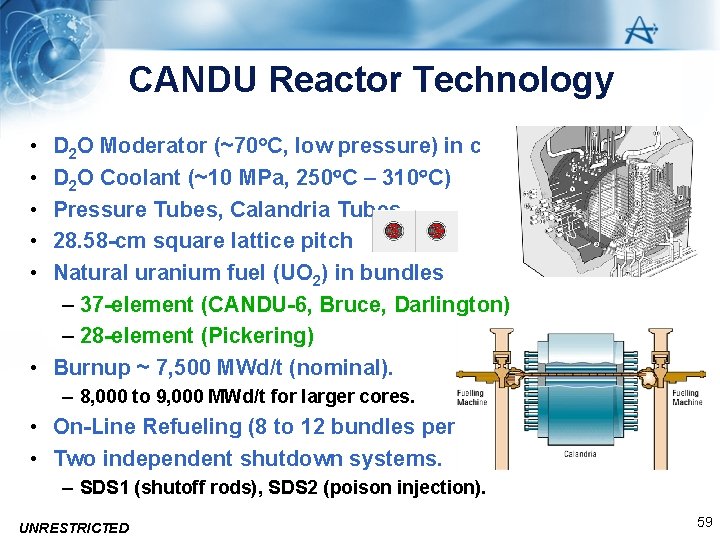
CANDU Reactor Technology • • • D 2 O Moderator (~70 C, low pressure) in calandria. D 2 O Coolant (~10 MPa, 250 C – 310 C) Pressure Tubes, Calandria Tubes 28. 58 -cm square lattice pitch Natural uranium fuel (UO 2) in bundles – 37 -element (CANDU-6, Bruce, Darlington) – 28 -element (Pickering) • Burnup ~ 7, 500 MWd/t (nominal). – 8, 000 to 9, 000 MWd/t for larger cores. • On-Line Refueling (8 to 12 bundles per day) • Two independent shutdown systems. – SDS 1 (shutoff rods), SDS 2 (poison injection). UNRESTRICTED 59
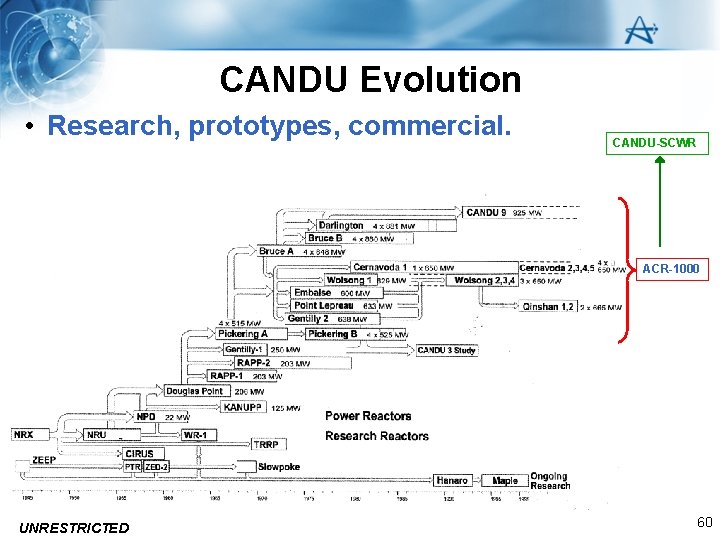
CANDU Evolution • Research, prototypes, commercial. CANDU-SCWR ACR-1000 UNRESTRICTED 60
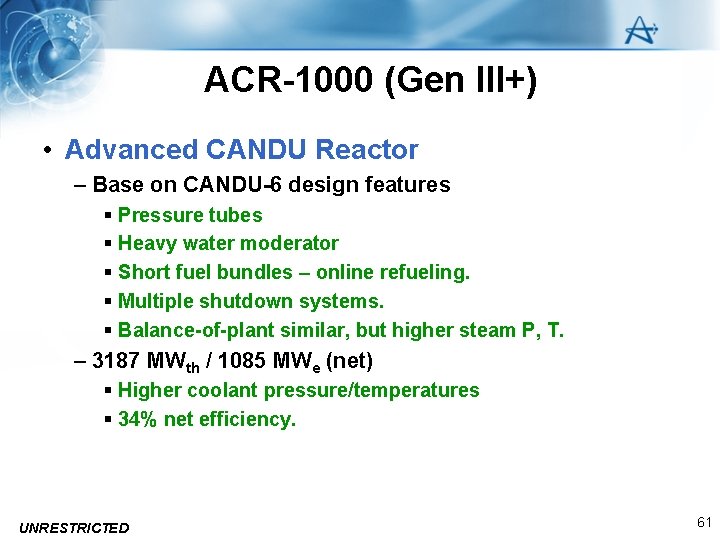
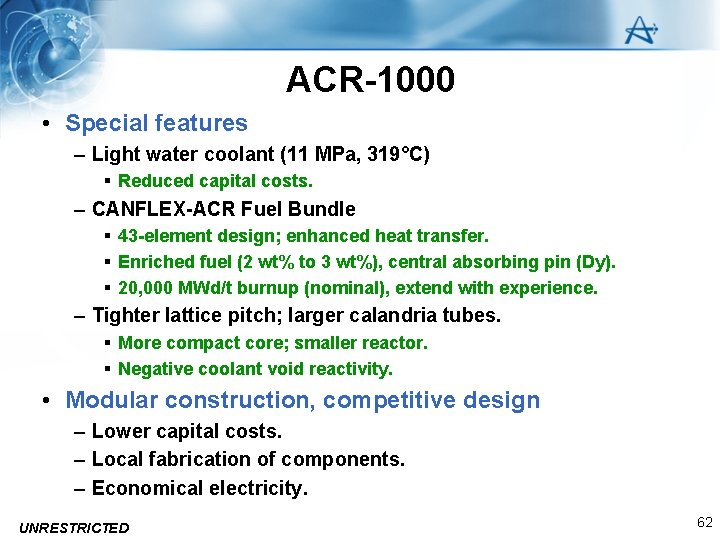
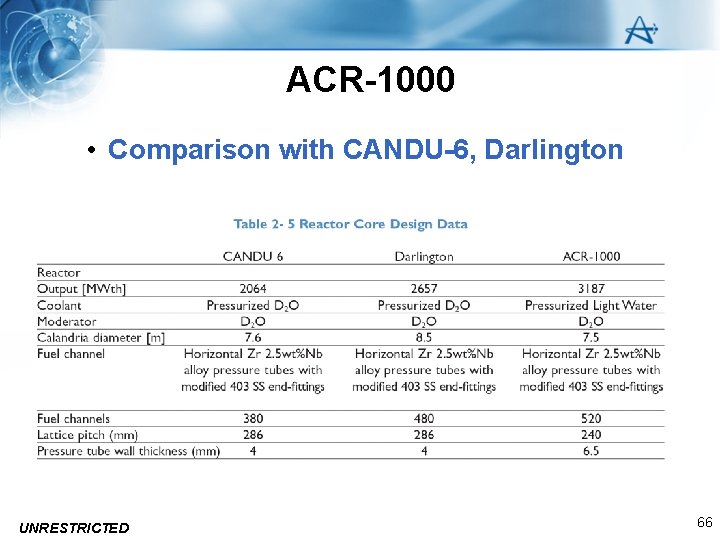
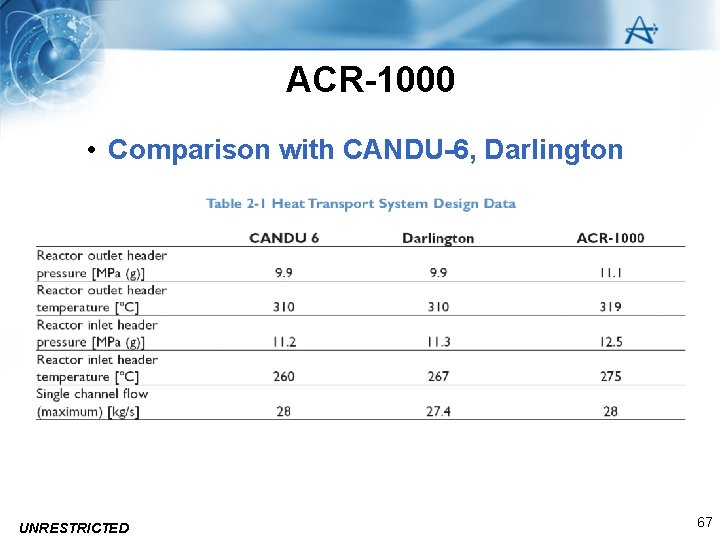
ACR-1000 (Gen III+) • Advanced CANDU Reactor – Base on CANDU-6 design features § Pressure tubes § Heavy water moderator § Short fuel bundles – online refueling. § Multiple shutdown systems. § Balance-of-plant similar, but higher steam P, T. – 3187 MWth / 1085 MWe (net) § Higher coolant pressure/temperatures § 34% net efficiency. UNRESTRICTED 61
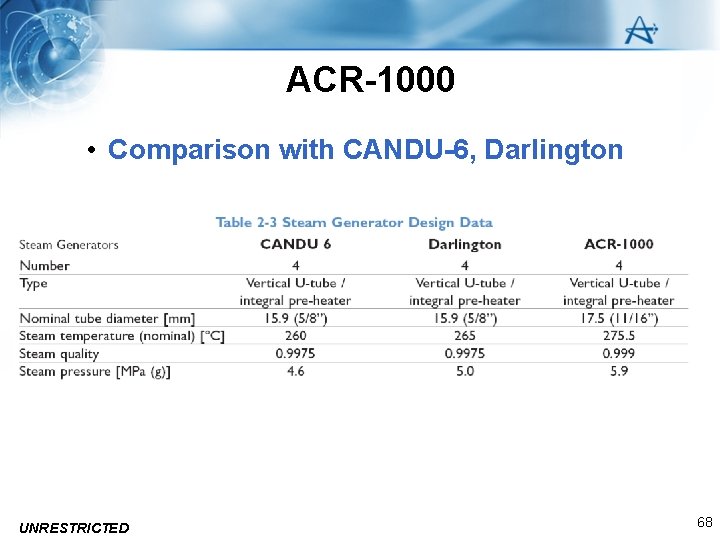
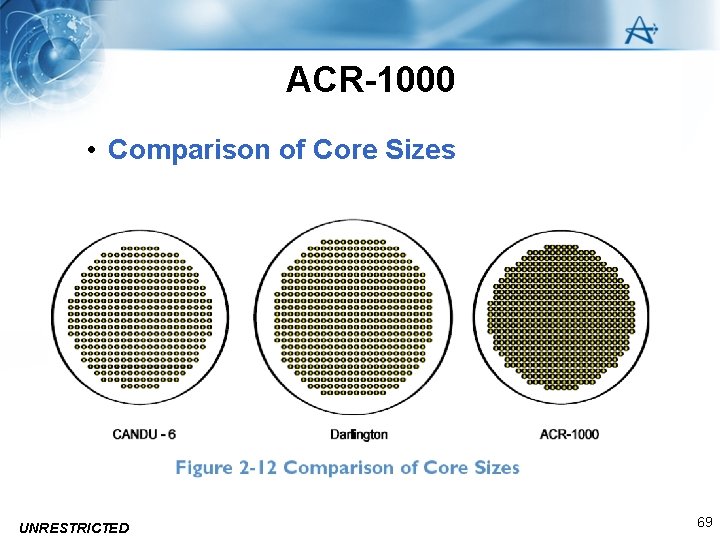
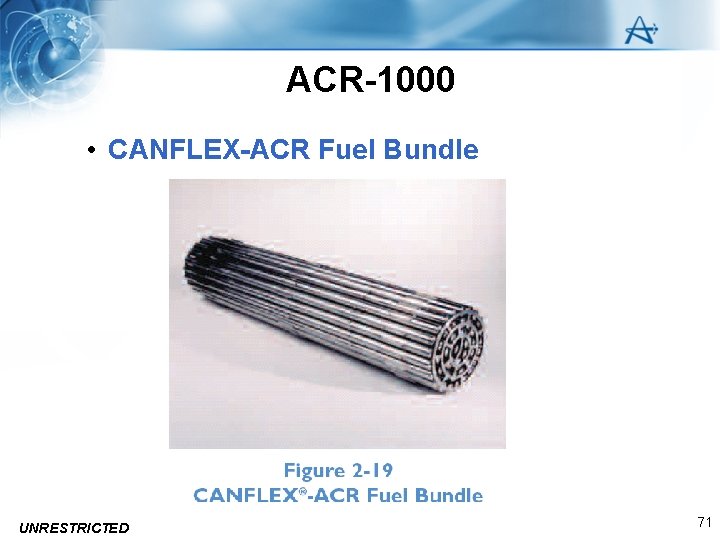
ACR-1000 • Special features – Light water coolant (11 MPa, 319°C) § Reduced capital costs. – CANFLEX-ACR Fuel Bundle § 43 -element design; enhanced heat transfer. § Enriched fuel (2 wt% to 3 wt%), central absorbing pin (Dy). § 20, 000 MWd/t burnup (nominal), extend with experience. – Tighter lattice pitch; larger calandria tubes. § More compact core; smaller reactor. § Negative coolant void reactivity. • Modular construction, competitive design – Lower capital costs. – Local fabrication of components. – Economical electricity. UNRESTRICTED 62
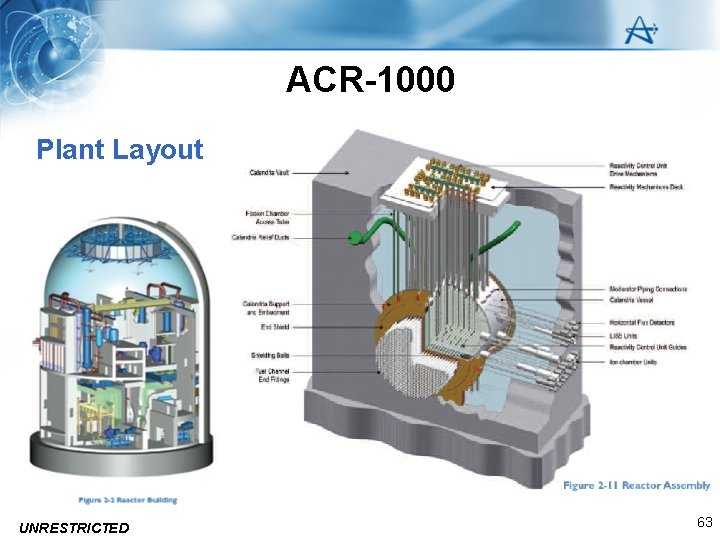
ACR-1000 Plant Layout UNRESTRICTED 63
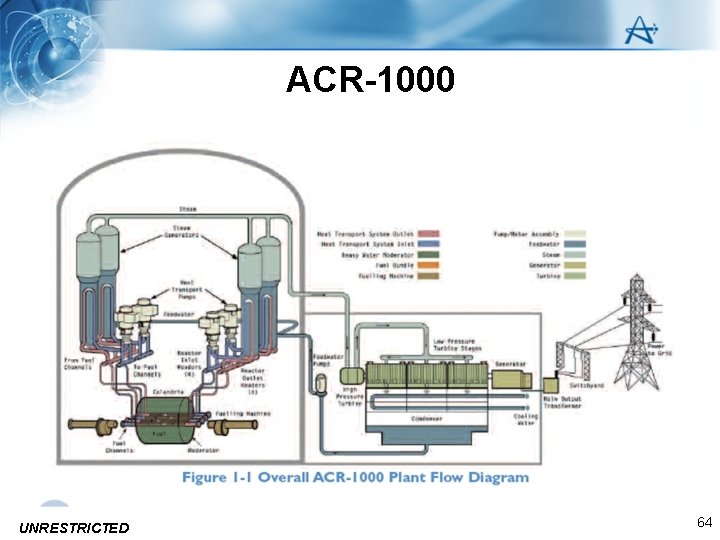
ACR-1000 • aa UNRESTRICTED 64
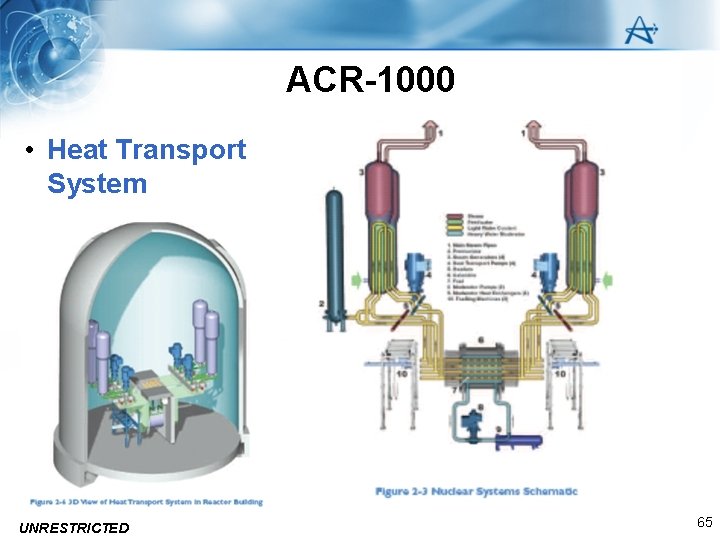
ACR-1000 • Heat Transport System UNRESTRICTED 65
ACR-1000 • Comparison with CANDU-6, Darlington UNRESTRICTED 66
ACR-1000 • Comparison with CANDU-6, Darlington UNRESTRICTED 67
ACR-1000 • Comparison with CANDU-6, Darlington UNRESTRICTED 68
ACR-1000 • Comparison of Core Sizes UNRESTRICTED 69
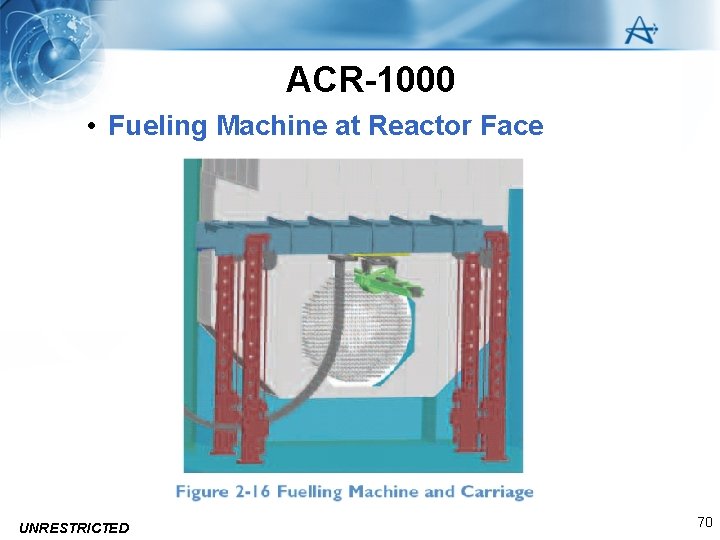
ACR-1000 • Fueling Machine at Reactor Face UNRESTRICTED 70
ACR-1000 • CANFLEX-ACR Fuel Bundle UNRESTRICTED 71
ACR-1000 • Multiple barriers – defense in depth UNRESTRICTED 72
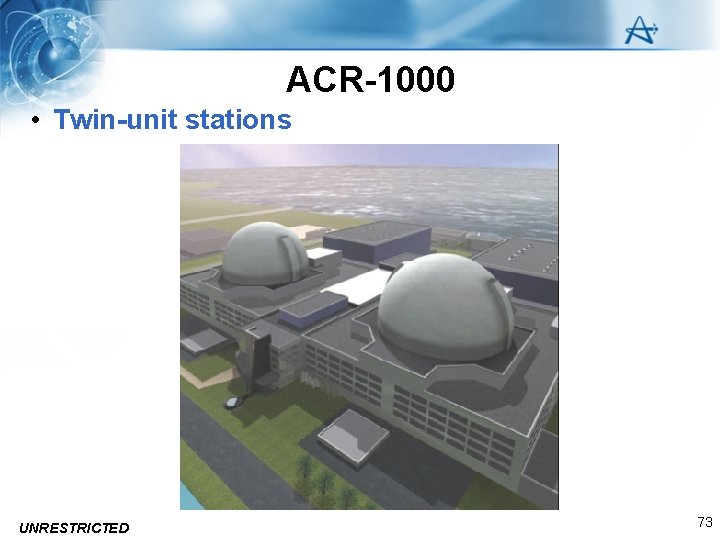
ACR-1000 • Twin-unit stations UNRESTRICTED 73
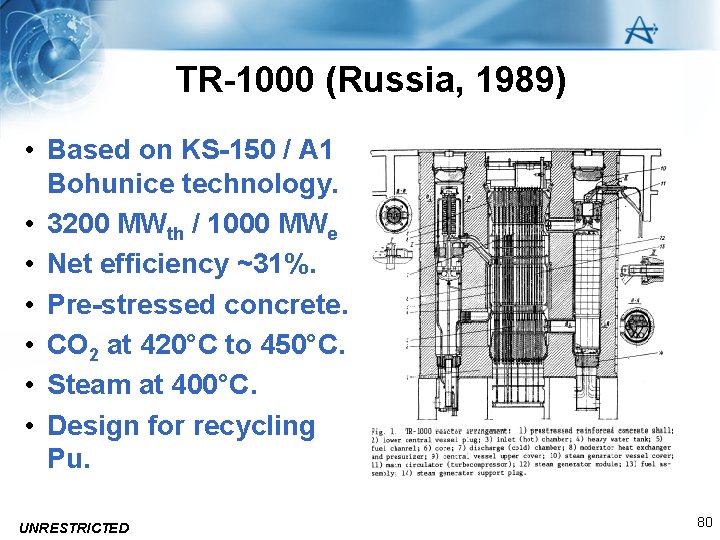
Other Gen III+ HWR Projects • Advanced Heavy Water Reactor (AHWR) – Under current development in India. – Boiling light water coolant, thorium-based fuels • TR-1000 (Russia) – 1989 concept proposal. – CO 2 coolant, 9. 8 MPa, 400 C to 450 C outlet. – Metallic Natural U, or U/Pu, CR>0. 80, 10 GWd/t – Pre-stressed concrete pressure vessel UNRESTRICTED 74
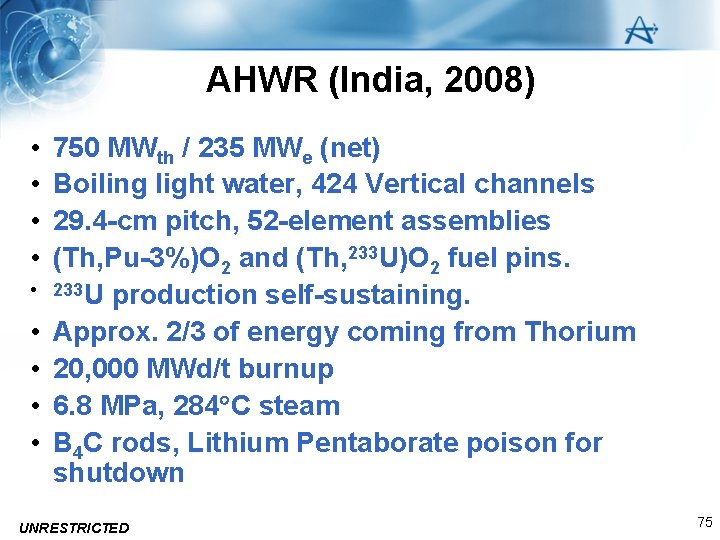
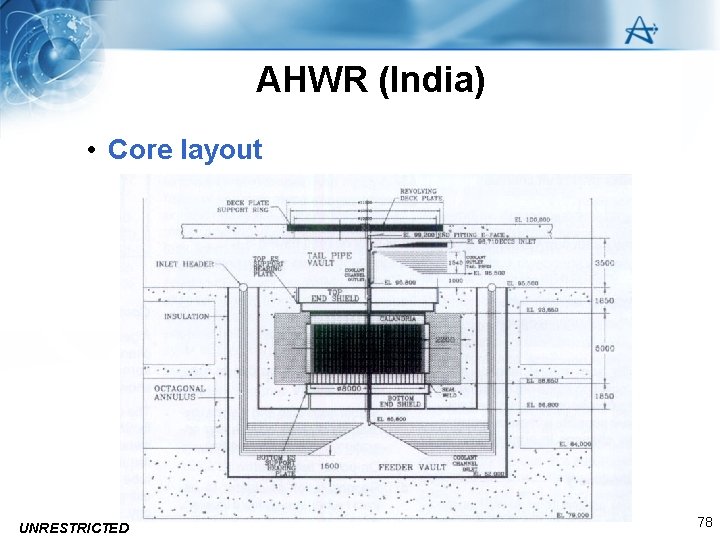
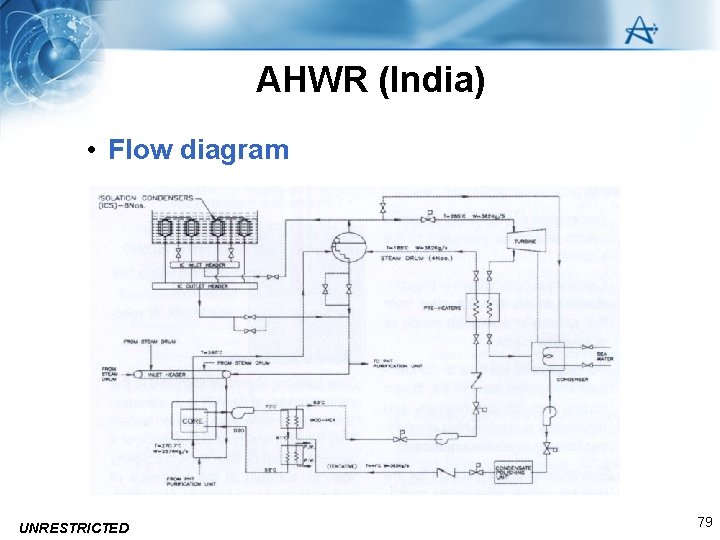
AHWR (India, 2008) • • • 750 MWth / 235 MWe (net) Boiling light water, 424 Vertical channels 29. 4 -cm pitch, 52 -element assemblies (Th, Pu-3%)O 2 and (Th, 233 U)O 2 fuel pins. 233 U production self-sustaining. Approx. 2/3 of energy coming from Thorium 20, 000 MWd/t burnup 6. 8 MPa, 284 C steam B 4 C rods, Lithium Pentaborate poison for shutdown UNRESTRICTED 75
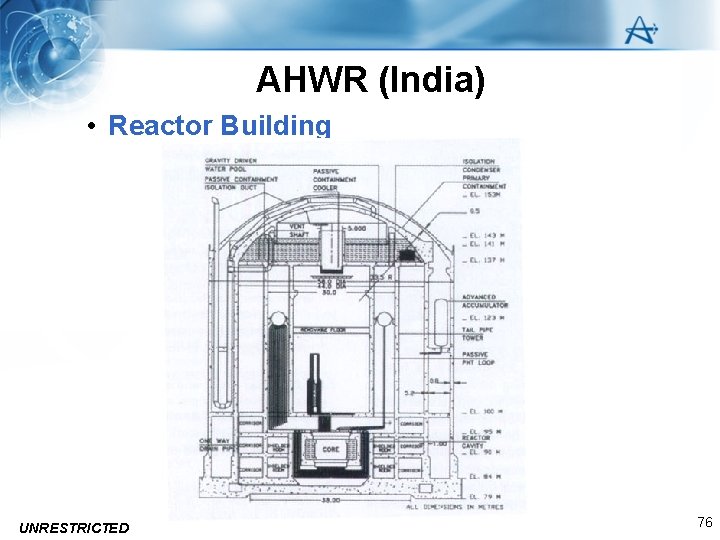
AHWR (India) • Reactor Building UNRESTRICTED 76
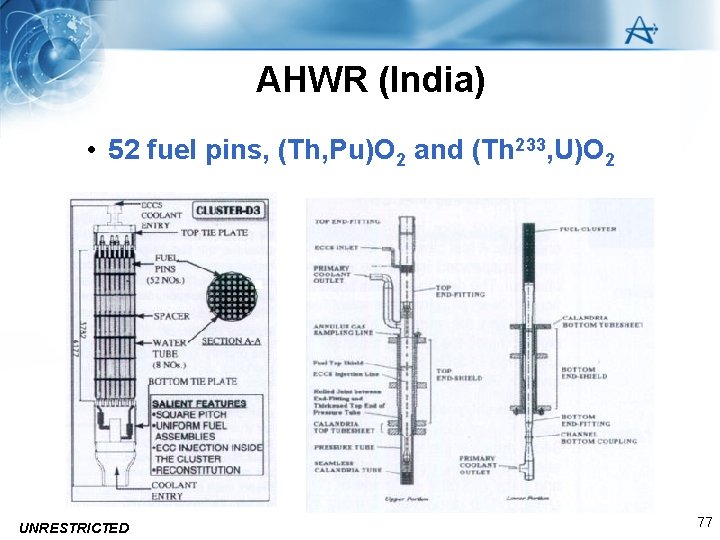
AHWR (India) • 52 fuel pins, (Th, Pu)O 2 and (Th 233, U)O 2 UNRESTRICTED 77
AHWR (India) • Core layout UNRESTRICTED 78
AHWR (India) • Flow diagram UNRESTRICTED 79
TR-1000 (Russia, 1989) • Based on KS-150 / A 1 Bohunice technology. • 3200 MWth / 1000 MWe • Net efficiency ~31%. • Pre-stressed concrete. • CO 2 at 420°C to 450°C. • Steam at 400°C. • Design for recycling Pu. UNRESTRICTED 80
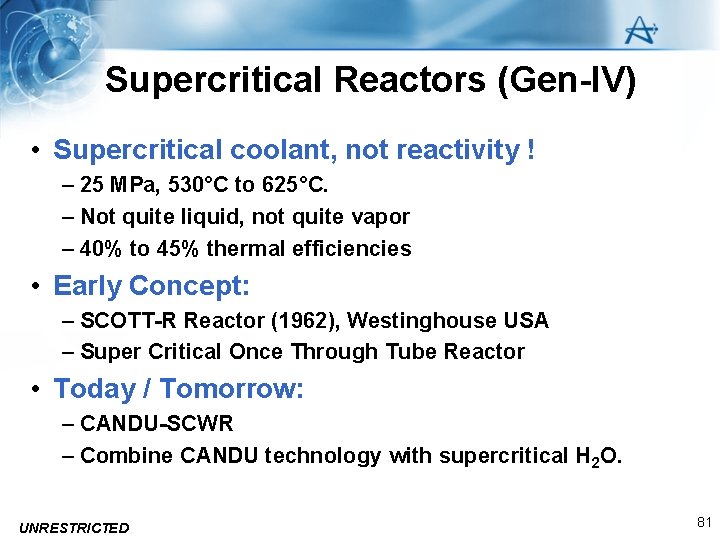
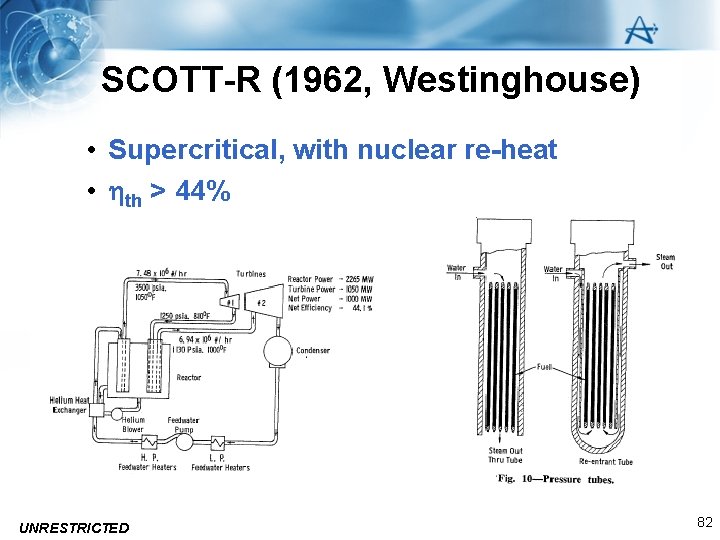
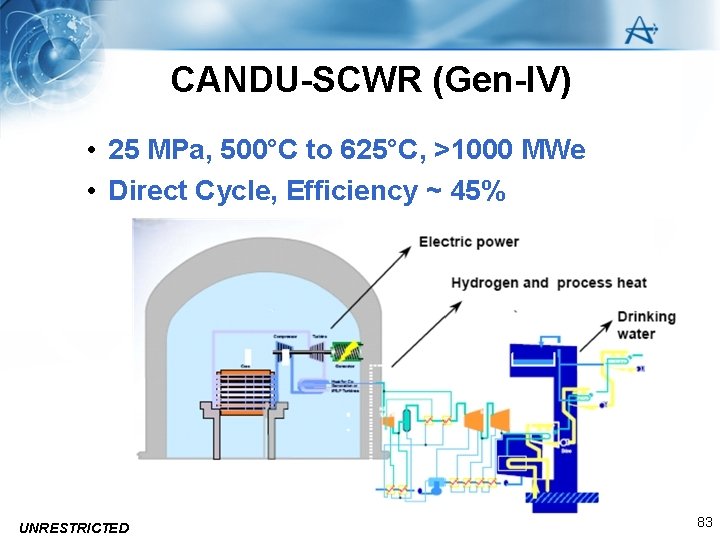
Supercritical Reactors (Gen-IV) • Supercritical coolant, not reactivity ! – 25 MPa, 530°C to 625°C. – Not quite liquid, not quite vapor – 40% to 45% thermal efficiencies • Early Concept: – SCOTT-R Reactor (1962), Westinghouse USA – Super Critical Once Through Tube Reactor • Today / Tomorrow: – CANDU-SCWR – Combine CANDU technology with supercritical H 2 O. UNRESTRICTED 81
SCOTT-R (1962, Westinghouse) • Supercritical, with nuclear re-heat • th > 44% UNRESTRICTED 82
CANDU-SCWR (Gen-IV) • 25 MPa, 500°C to 625°C, >1000 MWe • Direct Cycle, Efficiency ~ 45% UNRESTRICTED 83
Additional Future Roles for HWR’s • Advanced Fuel Cycles – Synergism with LWR’s and fast reactors § Integrated nuclear energy system – Extending nuclear fuel utilization – Minimizing waste management issues § Burning of Pu and higher actinides • Water Desalination – Fresh water is short supply world wide. – Power for reverse-osmosis plants. – Waste heat for low-temperature distillation. UNRESTRICTED 84
Additional Future Roles for HWR’s • Hydrogen Production – High-temperature electrolysis – Thermal/chemical processes – Direct use in fuel cells for transportation, or, – Upgrading of low-grade hydro-carbon fuels § Coal, bitumen, biomass, peat • Synthetic gasoline, diesel, methanol, etc. • High-temperature Steam – Enhanced recovery and upgrading of hydrocarbons § Oilsands, coal UNRESTRICTED 85
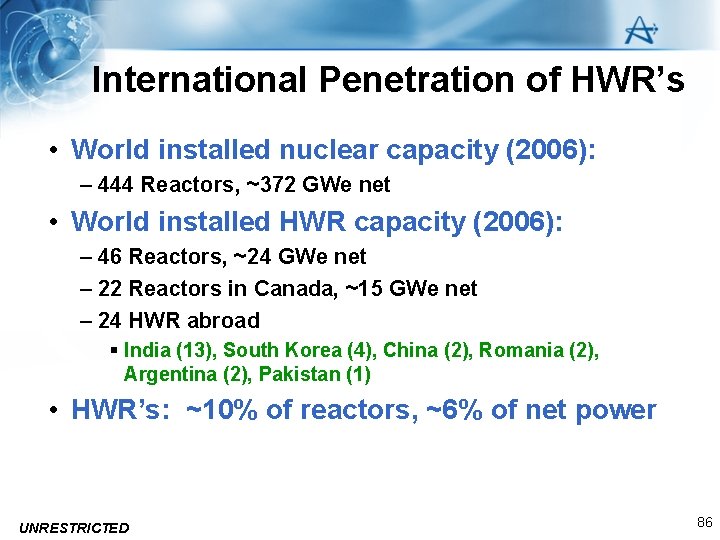
International Penetration of HWR’s • World installed nuclear capacity (2006): – 444 Reactors, ~372 GWe net • World installed HWR capacity (2006): – 46 Reactors, ~24 GWe net – 22 Reactors in Canada, ~15 GWe net – 24 HWR abroad § India (13), South Korea (4), China (2), Romania (2), Argentina (2), Pakistan (1) • HWR’s: ~10% of reactors, ~6% of net power UNRESTRICTED 86
Why are HWR’s not the Dominant Technology Today? • Partly Historical / Competing Technologies – Cost of producing D 2 O. – Graphite much cheaper, although not as good. • Weapons and Naval programs – Development of industrial infrastructure for uranium enrichment. § U. S. A, Russia, U. K. , France – Use of PWR’s for naval submarines. § More compact cores, simple reactor design. – Large investment in LWR technology. § Major head start on alternatives. UNRESTRICTED 87
Why are HWR’s not the Dominant Technology Today? • Uranium supplies available and cheap (for now) – Canada, Australia, U. S. A. , Kazakhstan, Africa, etc. • Enriched uranium supplies assured (for now) – Important for Europe, Japan, Korea • Competing Technologies – Financial resources to support more than one or two technologies limited § Many countries switched / focused on LWR technology • France, Germany, Sweden, Switzerland, Belgium, etc. • Japan, Korea; others have followed suit • Knowledge and experience base is large (U. S. A. , Russia) § U. K. : Magnox and AGR’s were performing well in 1970’s. UNRESTRICTED 88
Motivating Factors to Use more HWR’s in the Future • Fuel Costs – As uranium demand increases and cost goes up. – High conversion ratios become important. – HWR design variants will be advanced converters § Possibly more cost effective than using Fast Breeders alone • Integrated Reactor Systems – HWR’s complementary to LWR’s and Fast Reactors § Extending fissile and fertile fuel resources with high CR. § Burning of Pu and Actinides from spent fuel of LWR’s and FR. § Minimizing spent fuel and waste for long-term storage. UNRESTRICTED 89
Motivating Factors to Use more HWR’s in the Future • Next-generation Designs – Issues for large pressure vessels § Manufacturing challenges, availability, local fabrication. – Modular design with pressure tubes more feasible. § Particularly for supercritical-water coolant designs. – Renewed motivation to use supercritical water, organic, gas, liquid metal, or molten salt coolants. § To achieve high efficiencies ~50% § PT design with maximum neutron economy possible. UNRESTRICTED 90
Conclusions • Heavy Water Reactor Advantages – Excellent neutron economy, better utilization of resources. – Special safety features § Heat sink, multiple shutdown, longer neutron lifetime – Modular construction (pressure tubes) § Local manufacturing. – On-line refuelling high capacity factors. – Flexibility for fuel and coolant types. • Technology Improvements – Reducing cost of D 2 O using advanced separation technologies – Better materials, sealing, less corrosion, easier maintenance. § Similar goals for other technologies. – Improving thermal efficiencies. UNRESTRICTED 91
Conclusions • International Interest in Heavy Water Reactors – Canada – main focus: mature technology / commercialized § Technology development since 1945. § CANDU design development; CANDU-6 exported abroad. § ACR-1000 is next-generation product with reduced capital costs. – India – long-term interest with large supplies of thorium § PHWR’s patterned after / similar to Canada. § Independent / domestic technology development. § AHWR is India’s next-generation design. – Germany, U. K. , Japan, France, Sweden, U. S. A, etc. § Prototypes developed and tested. § Resources to develop and sustain alternative technologies limited. § Secured supply of cheap uranium has put focus on LWR technology, but this could change. UNRESTRICTED 92
Conclusions • Future for HWR Technology – Reducing capital costs; improving efficiencies. – Use of enriched fuel; alternative coolants. – Complement other technologies (faster breeders, LWR’s, etc. ) § Spent fuel from LWR’s could be used in HWR’s. – Increasing cost of fuel favors HWR technology. • Increasing role for HWR’s in nuclear energy supply – World demand for nuclear energy growing. – Keeping all options available is prudent. – HWR’s are an important part of the nuclear energy mix § Today, and even more so in the future. – Plenty of business for everyone. UNRESTRICTED 93
Acknowledgements • Gary Dyck (Advanced Fuels and Fuel Cycles) • Jim Sullivan, Michele Kubota (AECL) • Peter Boczar, Diane Heideman (AECL) • Library Staff (AECL) UNRESTRICTED 94
November 3, 2007 50 th Anniversary of NRU • 50 years of science and technology. • Millions of patients treated from medical radioisotopes. • Test bed for CANDU technology. • Neutron scattering experiments. • Materials testing – Space Shuttle Challenger SRB casing / welds. • Thousands of visiting researchers. • www. aecl. ca/nru 50 UNRESTRICTED 95