
C17 Strategic Airlift Capability SAC Lessons Learned Overview
C-17 Strategic Airlift Capability (SAC) Lessons Learned
Overview • • • Purpose Program summary Lessons learned by program phase Lessons learned by functional area Summary Operational experience 2
Purpose • Summarize pre-MOU lessons learned from the C-17 SAC program for use on other programs • Discuss operational results 3
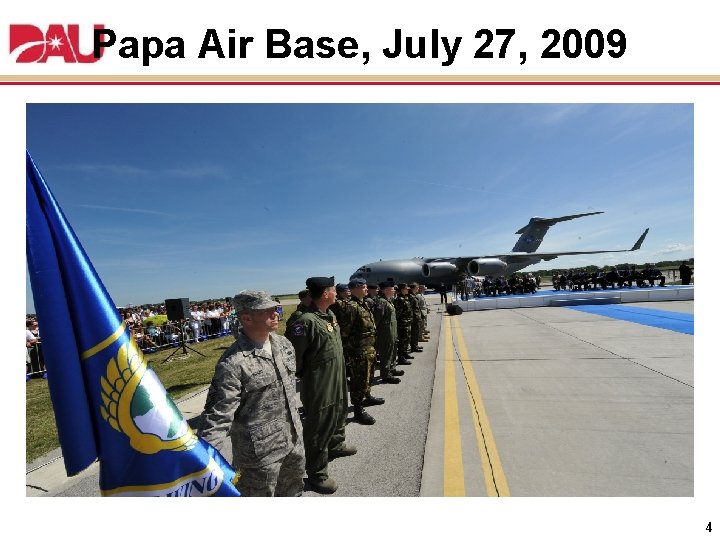
Papa Air Base, July 27, 2009 4
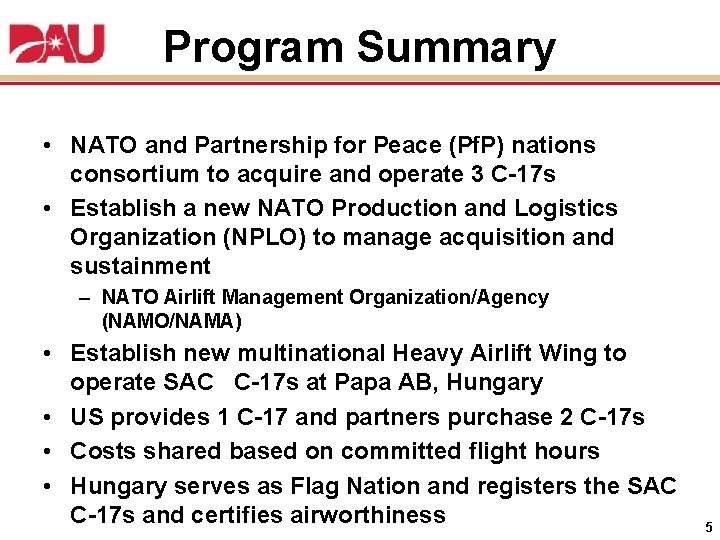
Program Summary • NATO and Partnership for Peace (Pf. P) nations consortium to acquire and operate 3 C-17 s • Establish a new NATO Production and Logistics Organization (NPLO) to manage acquisition and sustainment – NATO Airlift Management Organization/Agency (NAMO/NAMA) • Establish new multinational Heavy Airlift Wing to operate SAC C-17 s at Papa AB, Hungary • US provides 1 C-17 and partners purchase 2 C-17 s • Costs shared based on committed flight hours • Hungary serves as Flag Nation and registers the SAC C-17 s and certifies airworthiness 5
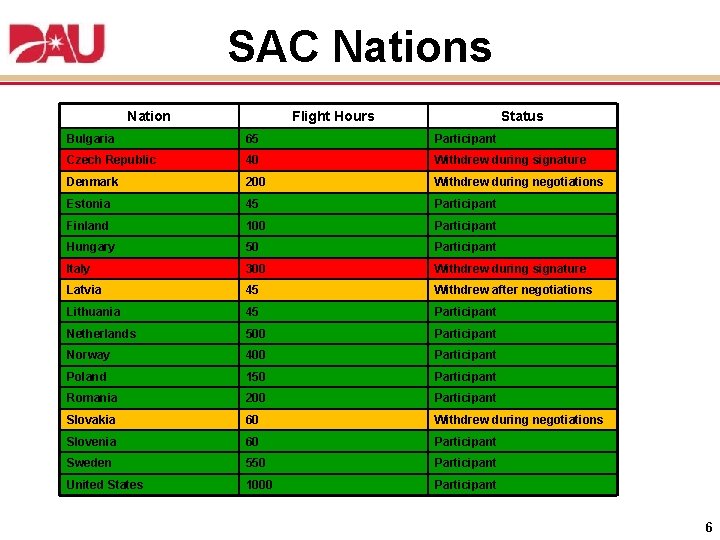
SAC Nations Nation Flight Hours Status Bulgaria 65 Participant Czech Republic 40 Withdrew during signature Denmark 200 Withdrew during negotiations Estonia 45 Participant Finland 100 Participant Hungary 50 Participant Italy 300 Withdrew during signature Latvia 45 Withdrew after negotiations Lithuania 45 Participant Netherlands 500 Participant Norway 400 Participant Poland 150 Participant Romania 200 Participant Slovakia 60 Withdrew during negotiations Slovenia 60 Participant Sweden 550 Participant United States 1000 Participant 6
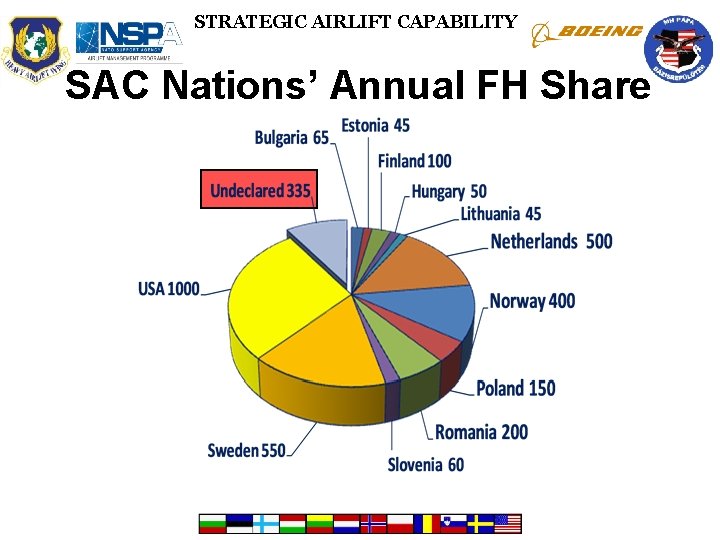
STRATEGIC AIRLIFT CAPABILITY SAC Nations’ Annual FH Share
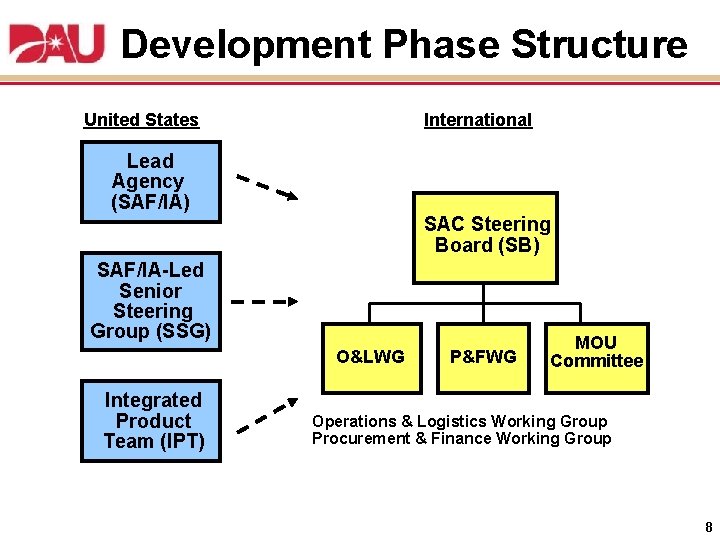
Development Phase Structure United States International Lead Agency (SAF/IA) SAC Steering Board (SB) SAF/IA-Led Senior Steering Group (SSG) O&LWG Integrated Product Team (IPT) P&FWG MOU Committee Operations & Logistics Working Group Procurement & Finance Working Group 8
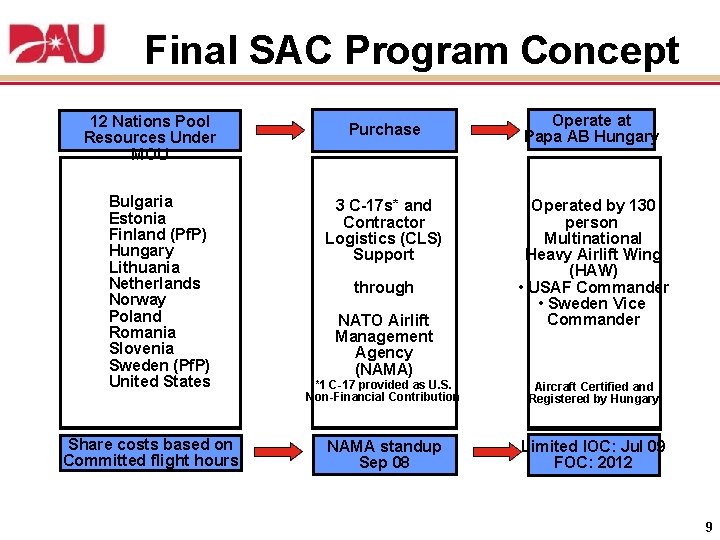
Final SAC Program Concept 12 Nations Pool Resources Under MOU Bulgaria Estonia Finland (Pf. P) Hungary Lithuania Netherlands Norway Poland Romania Slovenia Sweden (Pf. P) United States Share costs based on Committed flight hours Purchase 3 C-17 s* and Contractor Logistics (CLS) Support through NATO Airlift Management Agency (NAMA) Operate at Papa AB Hungary Operated by 130 person Multinational Heavy Airlift Wing (HAW) • USAF Commander • Sweden Vice Commander *1 C-17 provided as U. S. Non-Financial Contribution Aircraft Certified and Registered by Hungary NAMA standup Sep 08 Limited IOC: Jul 09 FOC: 2012 9
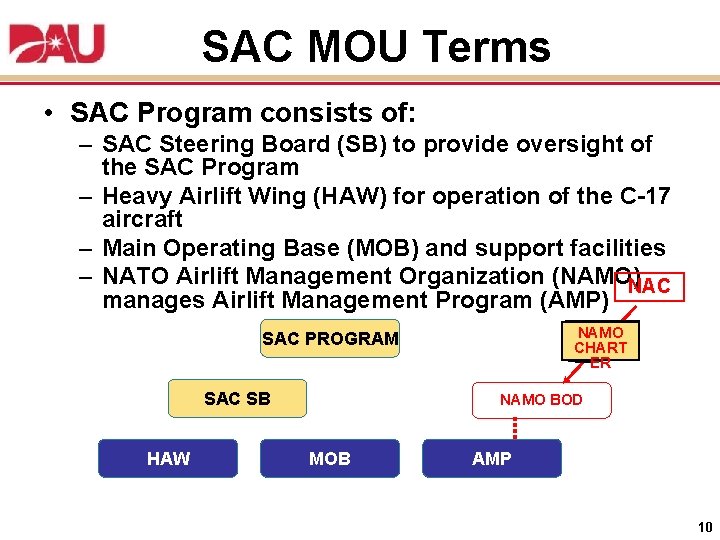
SAC MOU Terms • SAC Program consists of: – SAC Steering Board (SB) to provide oversight of the SAC Program – Heavy Airlift Wing (HAW) for operation of the C-17 aircraft – Main Operating Base (MOB) and support facilities – NATO Airlift Management Organization (NAMO) NAC manages Airlift Management Program (AMP) NAMO CHART ER SAC PROGRAM SAC SB HAW NAMO BOD MOB AMP 10

SAC Program Phases Program Phase Description Time Initiation NATO ASG/DI led effort culminating in signed LOI Early 06 – Nov 06 Development SAF/IA led effort to define Weapon System Partnership Nov 06 – Mar 07 MOU Negotiation SAF/IA led effort to develop and negotiate SAC MOU Mar 07 – Feb 08 Transition Team formed to conduct detailed program planning in parallel with MOU signature process Jan 08 – Sep 08 Execution Program execution after MOU in effect 23 Sep 08 - now 11
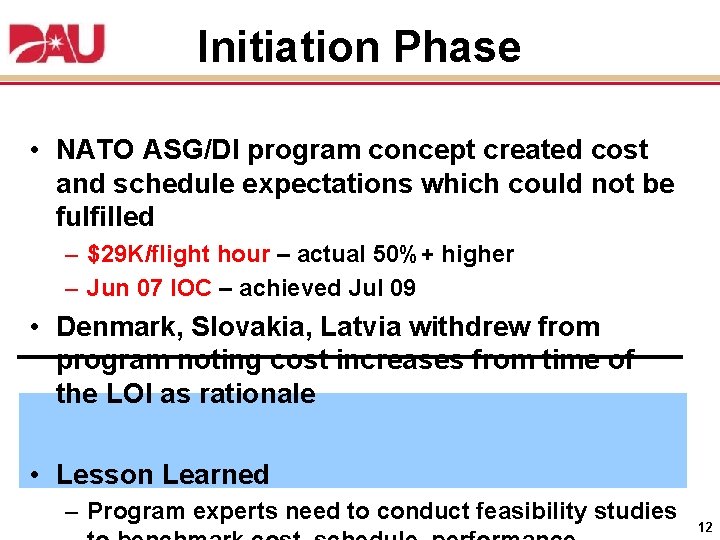
Initiation Phase • NATO ASG/DI program concept created cost and schedule expectations which could not be fulfilled – $29 K/flight hour – actual 50%+ higher – Jun 07 IOC – achieved Jul 09 • Denmark, Slovakia, Latvia withdrew from program noting cost increases from time of the LOI as rationale • Lesson Learned – Program experts need to conduct feasibility studies 12
Development Phase • Initial expectation was to use NAMSA Weapons Systems Partnership (WSP) and base aircraft at Ramstein AB • A 400 M countries (France, Germany, and Spain) blocked the use of the NAMSA WSP citing concerns over liability & NAMSA competencies • Structure of program had to be changed including establishing a new NATO NPLO and separate operational unit • Lesson Learned – Major acquisition programs are inherently political; need to structure programs to avoid political roadblocks 13
MOU Negotiation Phase • Combined acquisition and operational MOU (a first) • Many legal and policy obstacles encountered and overcome • Resulted in acquisition being under NATO and operations conducted outside of NATO jurisdictions; dual board structure • MOU entry into effect at 3500 flight hours • Lessons Learned – Innovative 4 -part MOU for acquisition and operations could provide model for other programs – Entry into effect approach critical on complex multilateral agreements 14
Transition Phase • Transition team formed at NAMSA in Jan 08 – 4 full time Voluntary National Contributions (VNCs) until Jun 08; then zero • 13 Functional Action Teams (FATs) formed in Mar 08 to continue program planning • NAMA personnel selection process initiated in Jun 08 in parallel with MOU signature process • Lessons Learned – Need to manage transition from MOU negotiation phase to execution phase – Need to obtain nations commitment to provide VNCs in initial agreements; FATs were a partially successful alternative – Need to start hiring actions as soon as possible 15
Functional Area Lessons Learned • 2 Years to MOU • Organization • Manpower & Personnel • Role of NAMSA • Program Communication • Program Schedule • Pf. P and NATO Mix • • • FMS Legal Cost and Budget Foreign Disclosure Certification and Registration • New NATO Partners 16
2 Years to MOU/10 Months to Capability • What were the main reasons that the SAC nations were able to conclude the MOU within two years after signature of the LOI and field a capability 10 months later? • The program focus was on fielding capability – not on industrial participation – Off-the-shelf system precluded industrial participation; any industrial participation arrangements are outside scope of MOU • SAC aircraft were taken from USAF production line • FMS was selected over DCS – Time to stand up NAMA removed from critical path for aircraft procurement 17
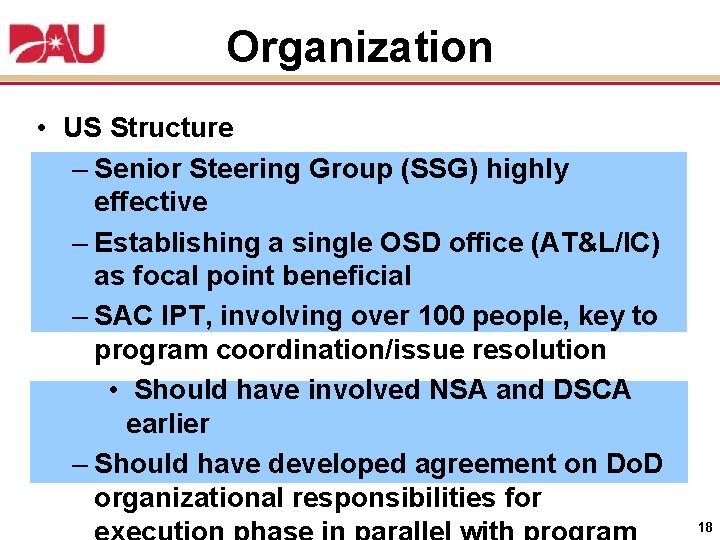
Organization • US Structure – Senior Steering Group (SSG) highly effective – Establishing a single OSD office (AT&L/IC) as focal point beneficial – SAC IPT, involving over 100 people, key to program coordination/issue resolution • Should have involved NSA and DSCA earlier – Should have developed agreement on Do. D organizational responsibilities for 18
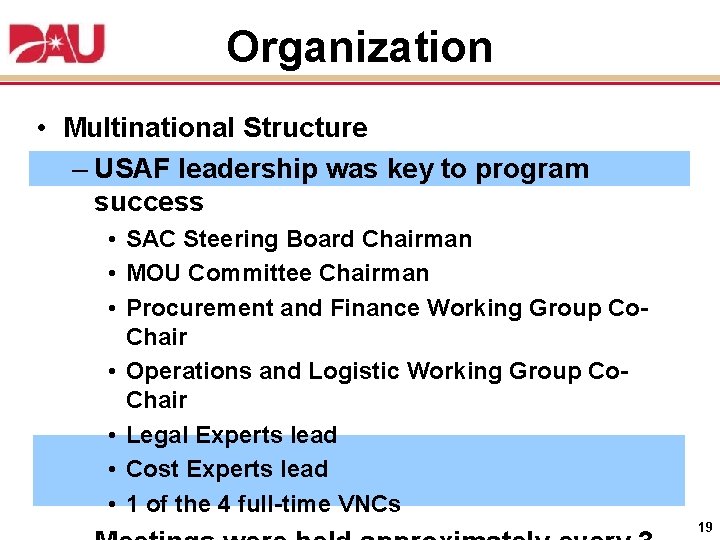
Organization • Multinational Structure – USAF leadership was key to program success • SAC Steering Board Chairman • MOU Committee Chairman • Procurement and Finance Working Group Co. Chair • Operations and Logistic Working Group Co. Chair • Legal Experts lead • Cost Experts lead • 1 of the 4 full-time VNCs 19
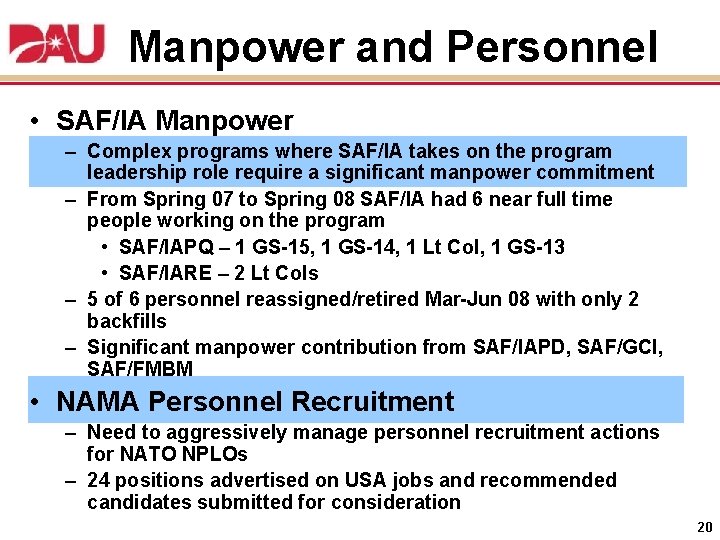
Manpower and Personnel • SAF/IA Manpower – Complex programs where SAF/IA takes on the program leadership role require a significant manpower commitment – From Spring 07 to Spring 08 SAF/IA had 6 near full time people working on the program • SAF/IAPQ – 1 GS-15, 1 GS-14, 1 Lt Col, 1 GS-13 • SAF/IARE – 2 Lt Cols – 5 of 6 personnel reassigned/retired Mar-Jun 08 with only 2 backfills – Significant manpower contribution from SAF/IAPD, SAF/GCI, SAF/FMBM • NAMA Personnel Recruitment – Need to aggressively manage personnel recruitment actions for NATO NPLOs – 24 positions advertised on USA jobs and recommended candidates submitted for consideration 20
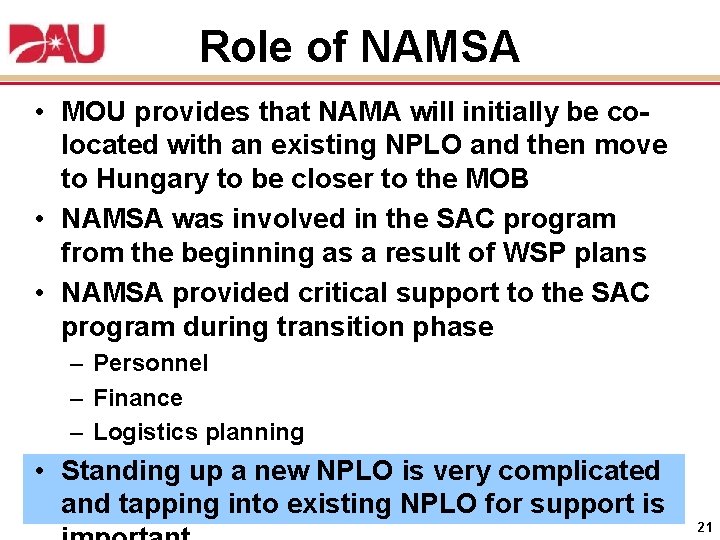
Role of NAMSA • MOU provides that NAMA will initially be colocated with an existing NPLO and then move to Hungary to be closer to the MOB • NAMSA was involved in the SAC program from the beginning as a result of WSP plans • NAMSA provided critical support to the SAC program during transition phase – Personnel – Finance – Logistics planning • Standing up a new NPLO is very complicated and tapping into existing NPLO for support is 21
Program Communications • Effective communication between nations is essential – Extensive use of mass emails – NAMSA provided secretariat function and INFOHUB; secretariat function was a fulltime job • US IPT kept informed by monthly reports and teleconferences • Strategic Communication Plan with FAQs to guide nations’ interaction with media should be prepared early in the 22
Program Schedule • Ambitious, best-achievable schedule objective was used throughout the program – Effective in pushing approvals through 12 nation’s bureaucratic processes • Downside is that people believe schedule is real and begin making commitments based on a schedule unlikely to be achieved • Need to strike a good balance between a 23
NATO and Pf. P Mix • SAC is the first major “NATO” cooperative program with Pf. P (Sweden and Finland) participants • MOU provides that Finland Sweden participation in the NAMO Bo. D is the same as the NATO participants • All MOU language which had Article 5 (collective self defense) implications were carefully worded to satisfy Finland Sweden concerns • Heavy Airlift Wing (HAW) is not part of the NATO force structure 24
Foreign Military Sales • Aircraft acquisition originally planned to be DCS with sustainment through the Globemaster Sustainment Partnership (GSP) through FMS • Nations later agreed to all FMS approach • 516 AESW, AFSAC, and AFSAT were involved from the beginning of MOU discussions – Allowed presentation of FMS cases within 1 -month after MOU entry into effect 25
Legal • Forming Legal Experts team essential on complex programs • SAC legal experts dealt with many issues – Responsibilities of the Flag Nation – Liabilities and claims under different operational scenarios – Customs duties, taxes, and similar charges • Many legal agreements in addition to the MOU – NATO Airlift Management Organization (NAMO) Charter – Host Nation Agreements • Hungary • Luxembourg • US – Hungary Basing Arrangement 26
Cost and Budget • Cost estimates – Developing program cost estimates was a significant effort • Acquisition, sustainment, base infrastructure improvements, and operations for 30 years • Served as basis for MOU cost target and cost ceiling – Forming Cost Experts group is essential • Budget considerations – Meeting frequency and team size drives a large TDY bill • Need to centrally budget TDY funds for US support to program through the transition phase – Need to aggressively work linkages with PPBES • US MOU signature was contingent on Congressional approval of reprogramming action 27
Foreign Disclosure • On programs like SAC, need to determine at program onset if releases are to NATO or the individual nations – Releases were made to NATO, Sweden and Finland; in hindsight, releases to individual nations plus NATO would have been more appropriate (corrected after the fact) • In addition to disclosure for aircraft and equipment, need early identification of tactics, training, and C 2 systems required for disclosure review – Allow sufficient time for disclosure officers to comply with US law and policy – Identify potential non-starters before making 28
Foreign Disclosure (con’t) • Consult with OSD/NII and Joint Staff early on GPS releases • COMSEC release process for multinational programs is incredibly complex and must be started at program inception – Involve NSA in program IPTs from the beginning 29
Certification & Registration • European Union policies are driving nations toward “civil-like” certification of military aircraft • Impacts to SAC program – A Military Type Certificate to be developed – Hungarian authorities to certify • Boeing as the designer and manufacturer • NAMA, as the Weapon System Management Organization (WSMO) • Heavy Airlift Wing (HAW) as the operator • Boeing as the maintenance organization – Detailed exhibits developed in conformance with organizational policies and procedures • SAC program will set precedent on certifying 30
New NATO Partners • New NATO partners are still learning how to work with the US and “old Europe” on cooperative programs of this type • National representatives have mixed English skills • Prudent for program leaders to develop white papers on key program issues to assist national representatives in explaining the program within their 31
Summary • Briefing provides a top-level snapshot of major lessons learned on the SAC program • Lessons learned are very applicable to all types of international armaments cooperation programs 32
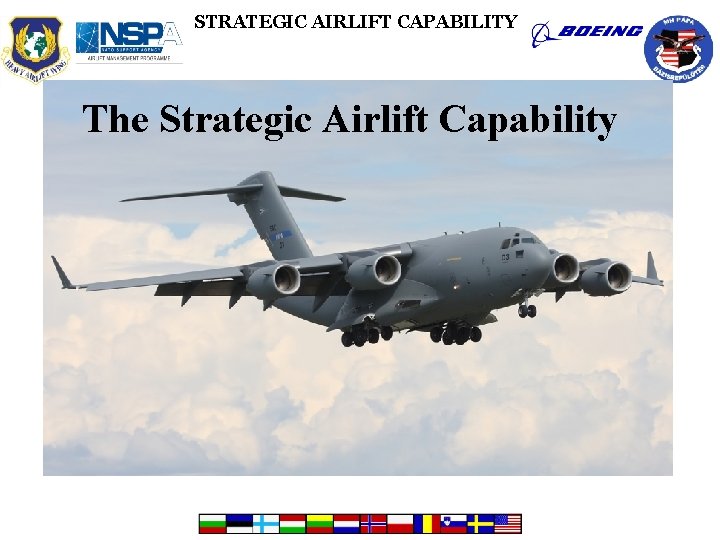
STRATEGIC AIRLIFT CAPABILITY The Strategic Airlift Capability

HEAVY AIRLIFT WING HAW Units 34
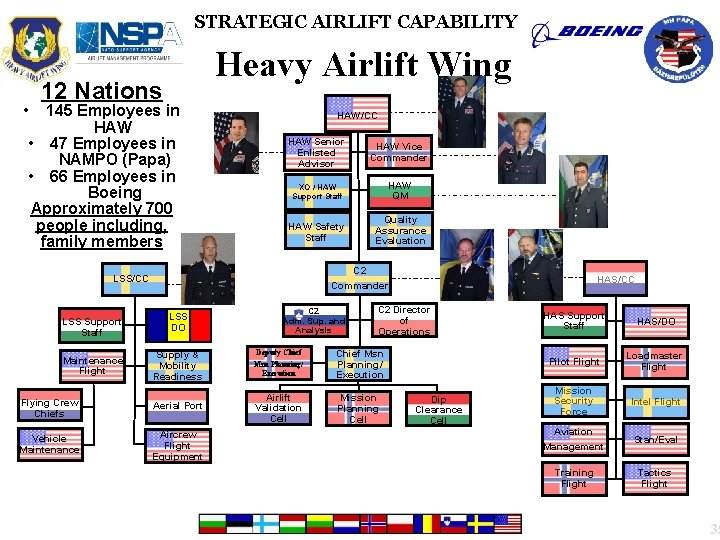
STRATEGIC AIRLIFT CAPABILITY • 12 Nations 145 Employees in HAW • 47 Employees in NAMPO (Papa) • 66 Employees in Boeing Approximately 700 people including, family members Heavy Airlift Wing HAW/CC HAW Senior Enlisted Advisor HAW Vice Commander XO / HAW Support Staff HAW QM HAW Safety Staff Quality Assurance Evaluation C 2 Commander LSS/CC C 2 Adm. Sup. and Analysis C 2 Director of Operations LSS Support Staff LSS/DO DO Maintenance Flight Supply & Mobility Readiness Deputy Chief Msn Planning/ Execution Flying Crew Chiefs Aerial Port Airlift Validation Cell Mission Planning Cell Vehicle Maintenance Aircrew Flight Equipment 15 December 2008 HAS/CC Dip Clearance Cell HAS Support Staff HAS/DO Pilot Flight Loadmaster Flight Mission Security Force Intel Flight Aviation Management Stan/Eval Training Flight Tactics Flight 35 35
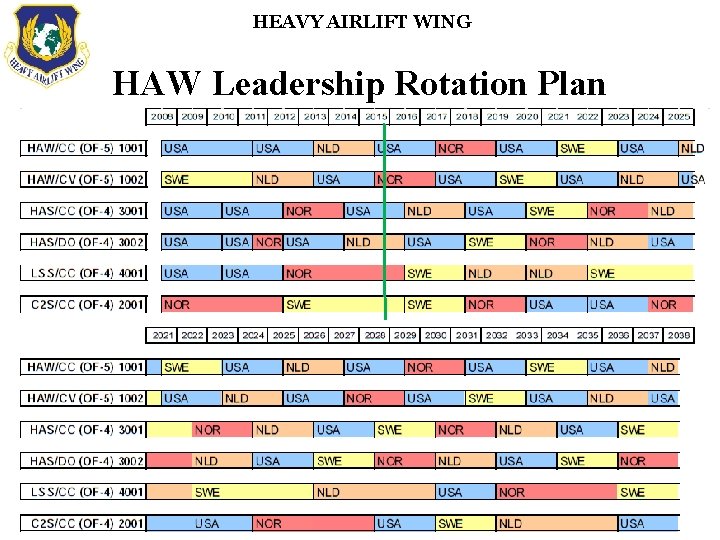
HEAVY AIRLIFT WING HAW Leadership Rotation Plan 36
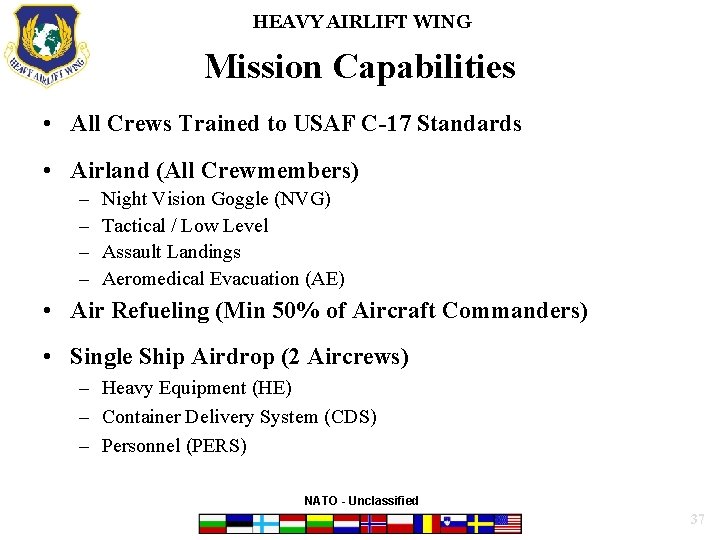
HEAVY AIRLIFT WING Mission Capabilities • All Crews Trained to USAF C-17 Standards • Airland (All Crewmembers) – – Night Vision Goggle (NVG) Tactical / Low Level Assault Landings Aeromedical Evacuation (AE) • Air Refueling (Min 50% of Aircraft Commanders) • Single Ship Airdrop (2 Aircrews) – Heavy Equipment (HE) – Container Delivery System (CDS) – Personnel (PERS) NATO - Unclassified 37
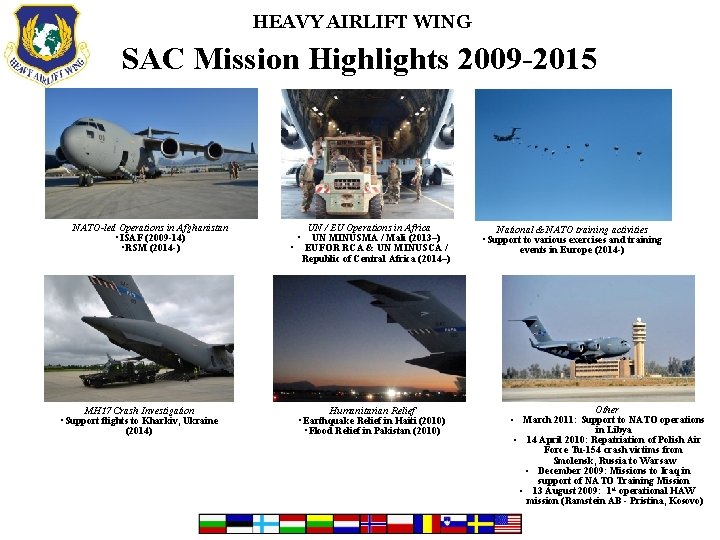
HEAVY AIRLIFT WING SAC Mission Highlights 2009 -2015 NATO-led Operations in Afghanistan • ISAF (2009 -14) • RSM (2014 -) MH 17 Crash Investigation • Support flights to Kharkiv, Ukraine (2014) UN / EU Operations in Africa • UN MINUSMA / Mali (2013–) • EUFOR RCA & UN MINUSCA / Republic of Central Africa (2014–) Humanitarian Relief • Earthquake Relief in Haiti (2010) • Flood Relief in Pakistan (2010) National & NATO training activities • Support to various exercises and training events in Europe (2014 -) Other • March 2011: Support to NATO operations in Libya • 14 April 2010: Repatriation of Polish Air Force Tu-154 crash victims from Smolensk, Russia to Warsaw • December 2009: Missions to Iraq in support of NATO Training Mission • 13 August 2009: 1 st operational HAW mission (Ramstein AB - Pristina, Kosovo)
STRATEGIC AIRLIFT CAPABILITY SAC Program Successes • “Poster Child” for Pooling & Sharing, Smart Defence • Investment Funds Available (Hangar, etc) • Executing Below Expected Costs • Mission Accomplishment Rates Very Good
STRATEGIC AIRLIFT CAPABILITY SAC Potential • SAC Program vs. C-17 Aircraft Life Expectancy – 30, 45, 60 years? • • Increase Hours to Existing Nations Add Nations to the Program Enlarge the Fleet of C-17 s Add other Airlift Mission Set(s) Add non-Airlift Mission Sets Using Pápa more as a hub Extend cooperation with other Programs (EATC, etc) NATO - Unclassified 40
STRATEGIC AIRLIFT CAPABILITY QUESTIONS?
- Slides: 41