Genome Evolution in Yeast Gilles Fischer 27 th
- Slides: 53
Genome Evolution in Yeast Gilles Fischer 27 th January 2009 | European Course on
INTRODUCTION: Comparative genomics Yeasts as model organisms GENOME EVOLUTION: DNA duplications Chromosome dynamics Nucleotide composition
A brief introduction to the field of Comparative Genomics Comparing genomes is a very old idea… DNA carries the genetic information: Avery (1943) and Hershey-Chase (1952) Vendrely and Vendrely (1950): "Il ne fait aucun doute que l'étude systématique de la teneur absolue du noyau en acide désoxyribonucléique, à travers de nombreuses espèces animales puisse fournir des suggestions intéressantes en ce qui concerne le problème de l'évolution" Jacques Monod: "Tout ce qui est vrai pour le colibacille est vrai pour l'éléphant"
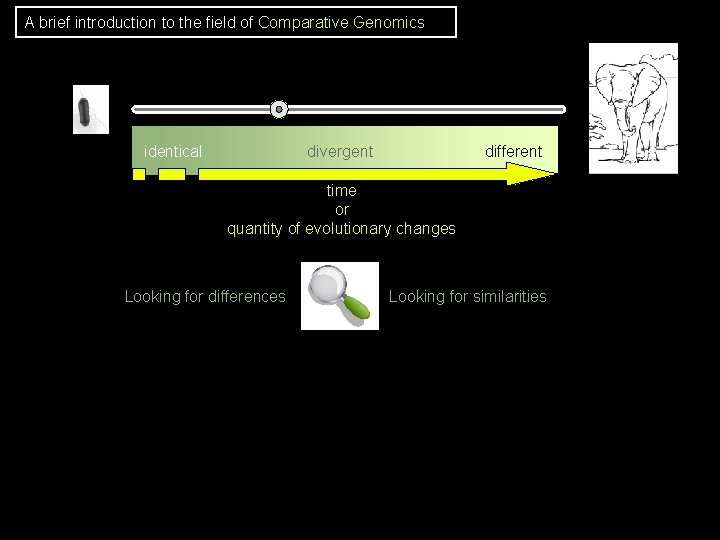
A brief introduction to the field of Comparative Genomics identical divergent different time or quantity of evolutionary changes Looking for differences Looking for similarities
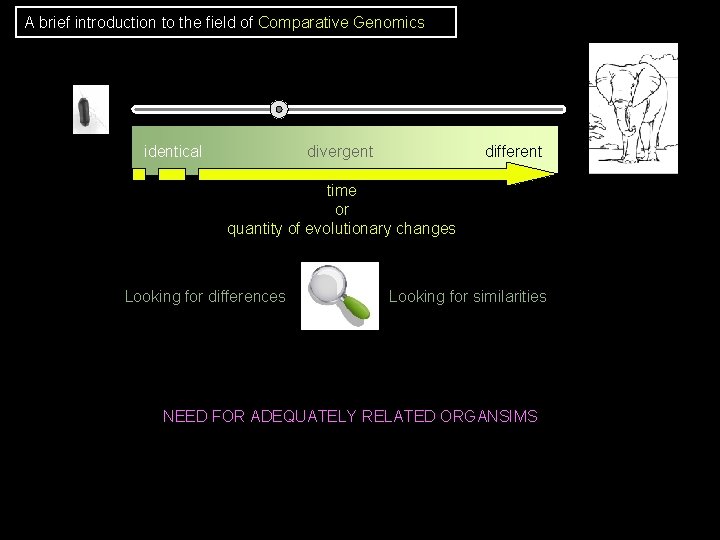
A brief introduction to the field of Comparative Genomics identical divergent different time or quantity of evolutionary changes Looking for differences Looking for similarities NEED FOR ADEQUATELY RELATED ORGANSIMS
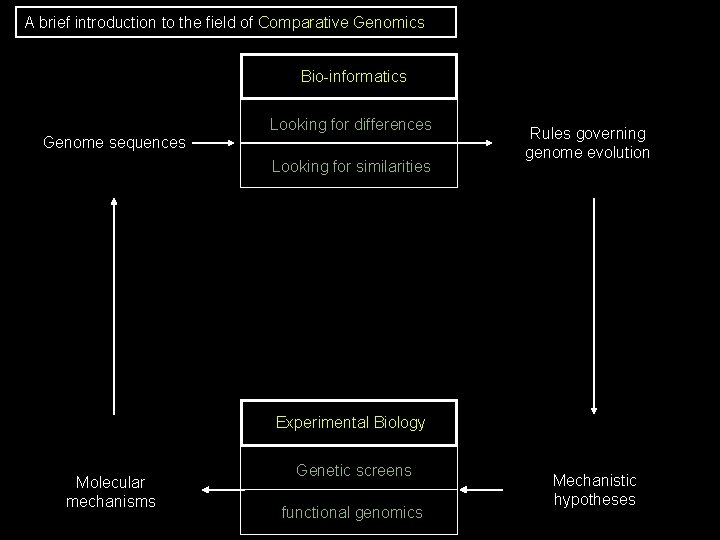
A brief introduction to the field of Comparative Genomics Bio-informatics Looking for differences Genome sequences Looking for similarities Rules governing genome evolution Experimental Biology Molecular mechanisms Genetic screens functional genomics Mechanistic hypotheses
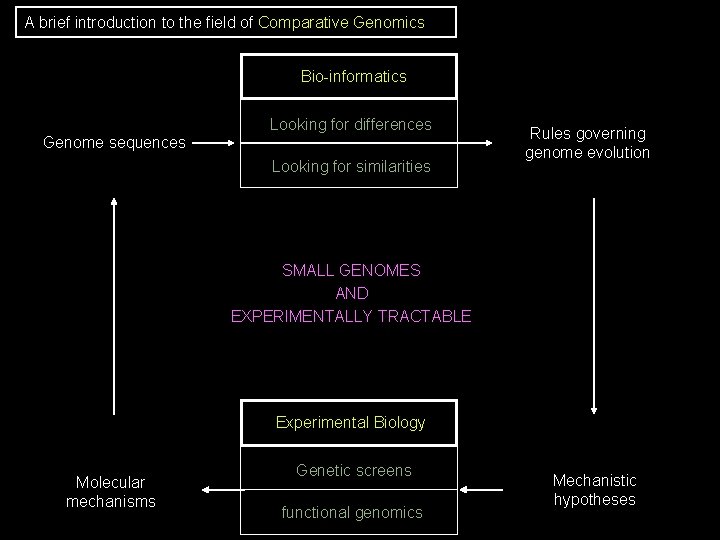
A brief introduction to the field of Comparative Genomics Bio-informatics Looking for differences Genome sequences Looking for similarities Rules governing genome evolution SMALL GENOMES AND EXPERIMENTALLY TRACTABLE Experimental Biology Molecular mechanisms Genetic screens functional genomics Mechanistic hypotheses
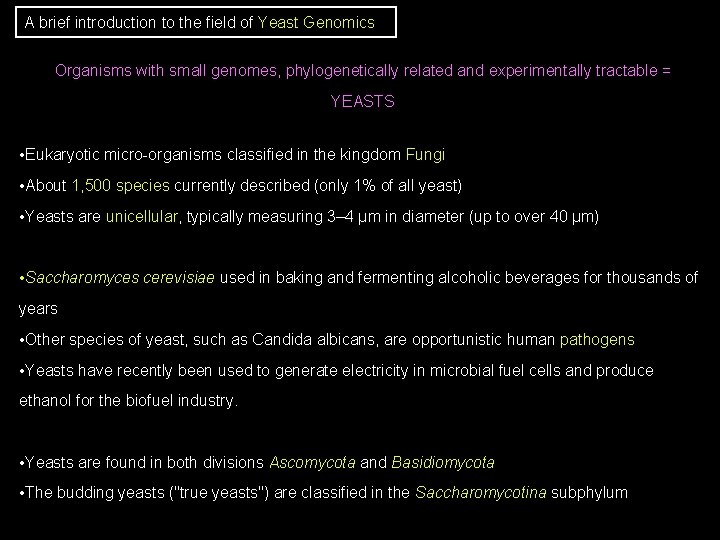
A brief introduction to the field of Yeast Genomics Organisms with small genomes, phylogenetically related and experimentally tractable = YEASTS • Eukaryotic micro-organisms classified in the kingdom Fungi • About 1, 500 species currently described (only 1% of all yeast) • Yeasts are unicellular, typically measuring 3– 4 µm in diameter (up to over 40 µm) • Saccharomyces cerevisiae used in baking and fermenting alcoholic beverages for thousands of years • Other species of yeast, such as Candida albicans, are opportunistic human pathogens • Yeasts have recently been used to generate electricity in microbial fuel cells and produce ethanol for the biofuel industry. • Yeasts are found in both divisions Ascomycota and Basidiomycota • The budding yeasts ("true yeasts") are classified in the Saccharomycotina subphylum
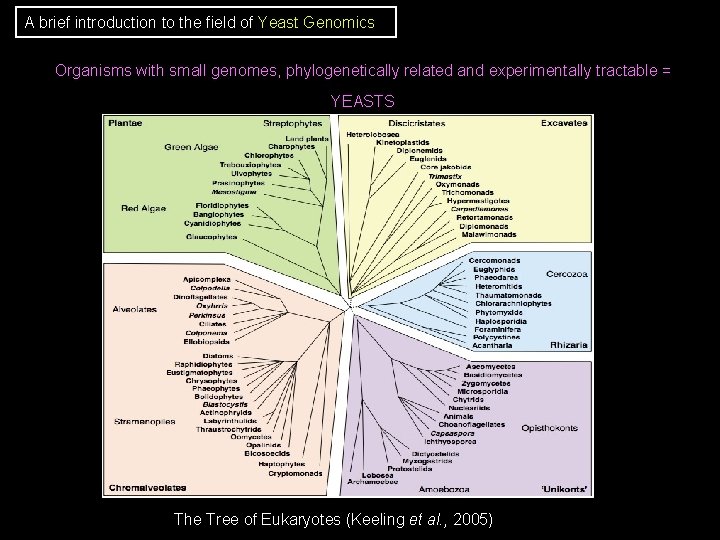
A brief introduction to the field of Yeast Genomics Organisms with small genomes, phylogenetically related and experimentally tractable = YEASTS The Tree of Eukaryotes (Keeling et al. , 2005)
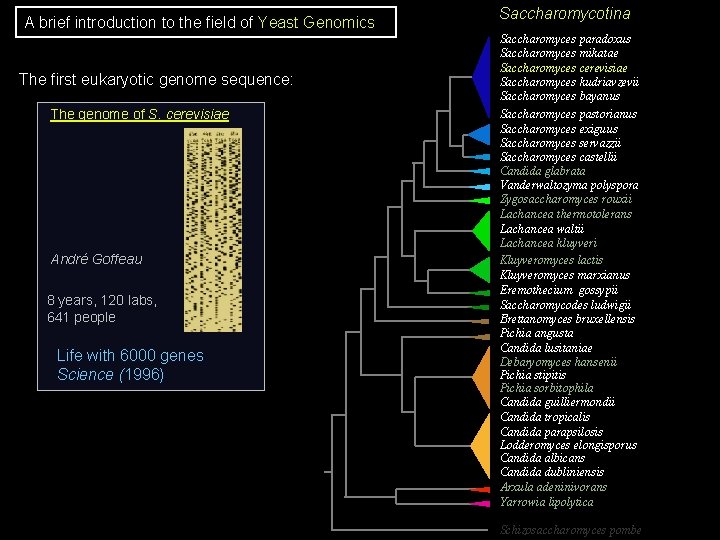
A brief introduction to the field of Yeast Genomics The first eukaryotic genome sequence: The genome of S. cerevisiae André Goffeau 8 years, 120 labs, 641 people Life with 6000 genes Science (1996) Saccharomycotina Saccharomyces paradoxus Saccharomyces mikatae Saccharomyces cerevisiae Saccharomyces kudriavzevii Saccharomyces bayanus Saccharomyces pastorianus Saccharomyces exiguus Saccharomyces servazzii Saccharomyces castellii Candida glabrata Vanderwaltozyma polyspora Zygosaccharomyces rouxii Lachancea thermotolerans Lachancea waltii Lachancea kluyveri Kluyveromyces lactis Kluyveromyces marxianus Eremothecium gossypii Saccharomycodes ludwigii Brettanomyces bruxellensis Pichia angusta Candida lusitaniae Debaryomyces hansenii Pichia stipitis Pichia sorbitophila Candida guilliermondii Candida tropicalis Candida parapsilosis Lodderomyces elongisporus Candida albicans Candida dubliniensis Arxula adeninivorans Yarrowia lipolytica Schizosaccharomyces pombe
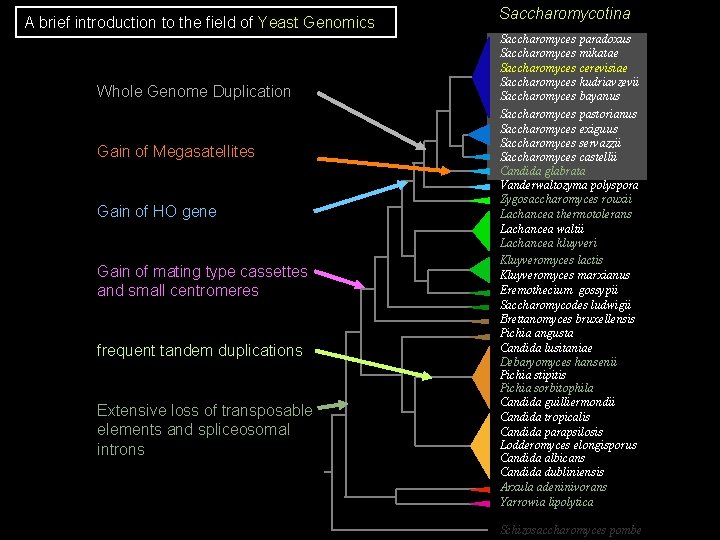
A brief introduction to the field of Yeast Genomics Whole Genome Duplication Gain of Megasatellites Gain of HO gene Gain of mating type cassettes and small centromeres frequent tandem duplications Extensive loss of transposable elements and spliceosomal introns Saccharomycotina Saccharomyces paradoxus Saccharomyces mikatae Saccharomyces cerevisiae Saccharomyces kudriavzevii Saccharomyces bayanus Saccharomyces pastorianus Saccharomyces exiguus Saccharomyces servazzii Saccharomyces castellii Candida glabrata Vanderwaltozyma polyspora Zygosaccharomyces rouxii Lachancea thermotolerans Lachancea waltii Lachancea kluyveri Kluyveromyces lactis Kluyveromyces marxianus Eremothecium gossypii Saccharomycodes ludwigii Brettanomyces bruxellensis Pichia angusta Candida lusitaniae Debaryomyces hansenii Pichia stipitis Pichia sorbitophila Candida guilliermondii Candida tropicalis Candida parapsilosis Lodderomyces elongisporus Candida albicans Candida dubliniensis Arxula adeninivorans Yarrowia lipolytica Schizosaccharomyces pombe
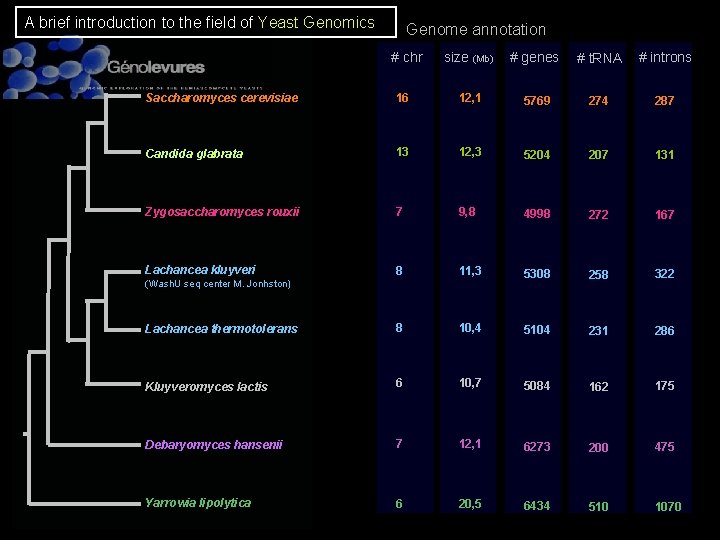
A brief introduction to the field of Yeast Genomics Genome annotation # chr size (Mb) # genes # t. RNA # introns Saccharomyces cerevisiae 16 12, 1 5769 274 287 Candida glabrata 13 12, 3 5204 207 131 Zygosaccharomyces rouxii 7 9, 8 4998 272 167 Lachancea kluyveri 8 11, 3 5308 258 322 Lachancea thermotolerans 8 10, 4 5104 231 286 Kluyveromyces lactis 6 10, 7 5084 162 175 Debaryomyces hansenii 7 12, 1 6273 200 475 Yarrowia lipolytica 6 20, 5 6434 510 1070 (Wash. U seq center M. Jonhston)
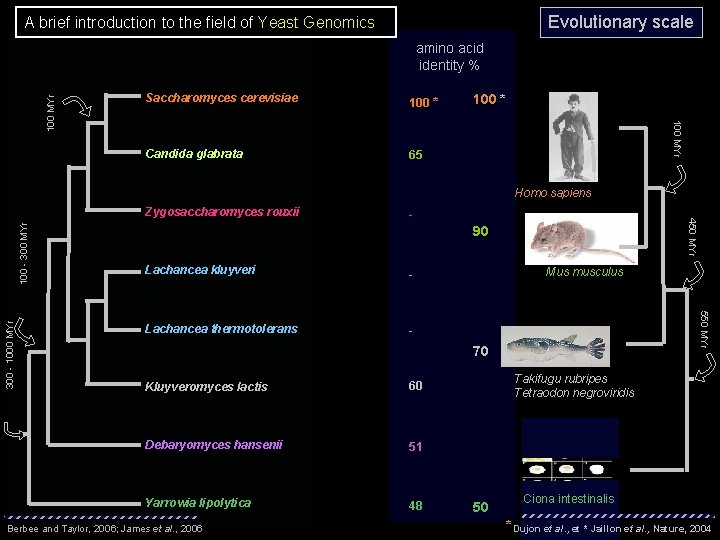
Evolutionary scale A brief introduction to the field of Yeast Genomics Saccharomyces cerevisiae 100 * Candida glabrata 65 100 * 100 MYr amino acid identity % Homo sapiens 100 - 300 MYr 90 Lachancea kluyveri - Lachancea thermotolerans - Mus musculus 550 MYr 300 - 1000 MYr - 450 MYr Zygosaccharomyces rouxii 70 Kluyveromyces lactis 60 Debaryomyces hansenii 51 Yarrowia lipolytica 48 Berbee and Taylor, 2006; James et al. , 2006 Takifugu rubripes Tetraodon negroviridis 50 Ciona intestinalis *Dujon et al. , et * Jaillon et al. , Nature, 2004
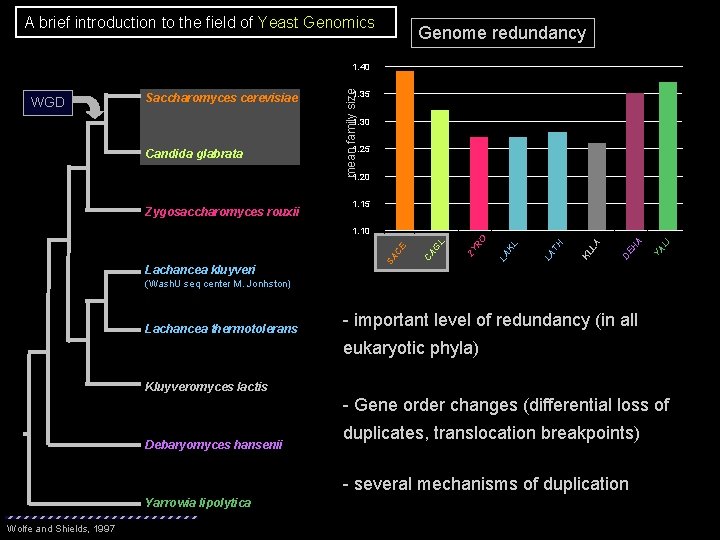
A brief introduction to the field of Yeast Genomics Genome redundancy WGD Saccharomyces cerevisiae mean family size 1. 40 1. 35 1. 30 Candida glabrata 1. 25 1. 20 Zygosaccharomyces rouxii 1. 15 Lachancea kluyveri LI YA A DE H LA KL TH LA LA KL RO ZY GL CA SA CE 1. 10 (Wash. U seq center M. Jonhston) Lachancea thermotolerans - important level of redundancy (in all eukaryotic phyla) Kluyveromyces lactis - Gene order changes (differential loss of Debaryomyces hansenii duplicates, translocation breakpoints) - several mechanisms of duplication Yarrowia lipolytica Wolfe and Shields, 1997
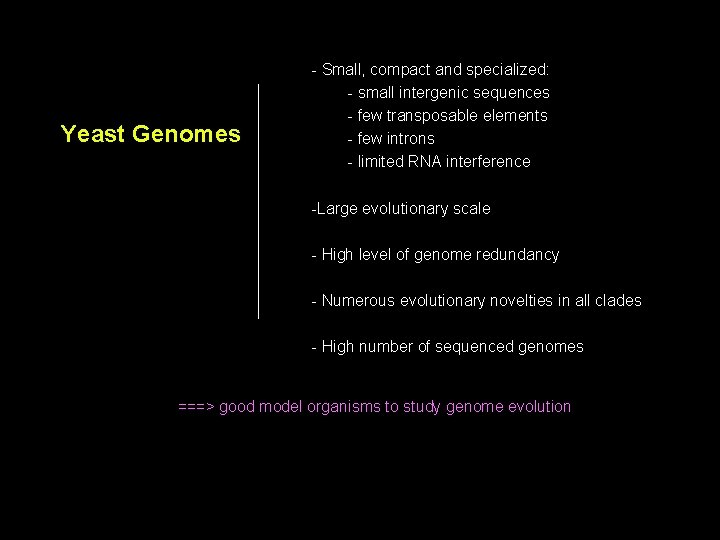
Yeast Genomes - Small, compact and specialized: - small intergenic sequences - few transposable elements - few introns - limited RNA interference -Large evolutionary scale - High level of genome redundancy - Numerous evolutionary novelties in all clades - High number of sequenced genomes ===> good model organisms to study genome evolution
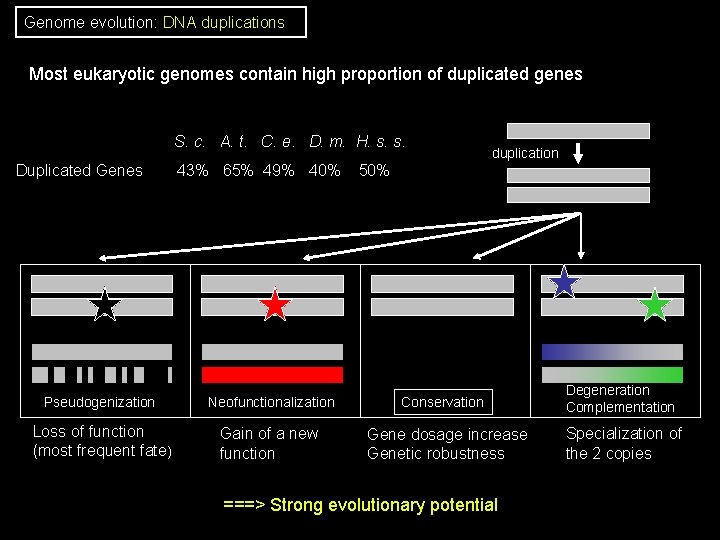
Genome evolution: DNA duplications Most eukaryotic genomes contain high proportion of duplicated genes S. c. A. t. C. e. D. m. H. s. s. Duplicated Genes 43% 65% 49% 40% Pseudogenization Neofunctionalization Loss of function (most frequent fate) Gain of a new function duplication 50% Conservation Gene dosage increase Genetic robustness ===> Strong evolutionary potential Degeneration Complementation Specialization of the 2 copies
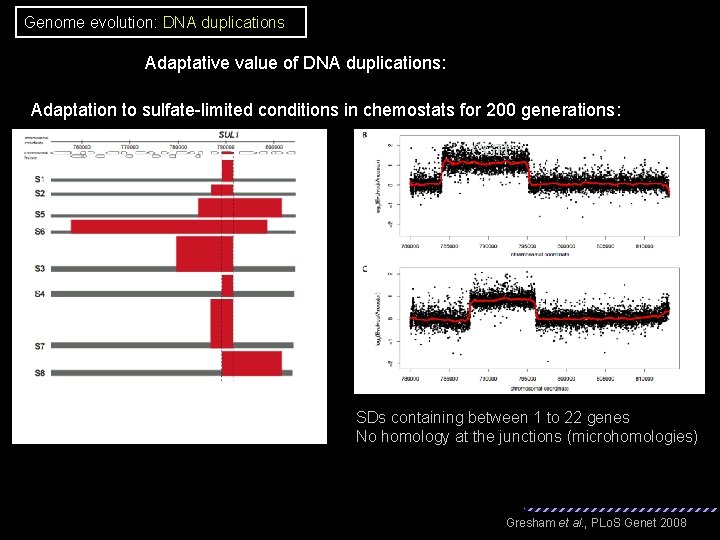
Genome evolution: DNA duplications Adaptative value of DNA duplications: Adaptation to sulfate-limited conditions in chemostats for 200 generations: CGH SDs containing between 1 to 22 genes No homology at the junctions (microhomologies) Gresham et al. , PLo. S Genet 2008
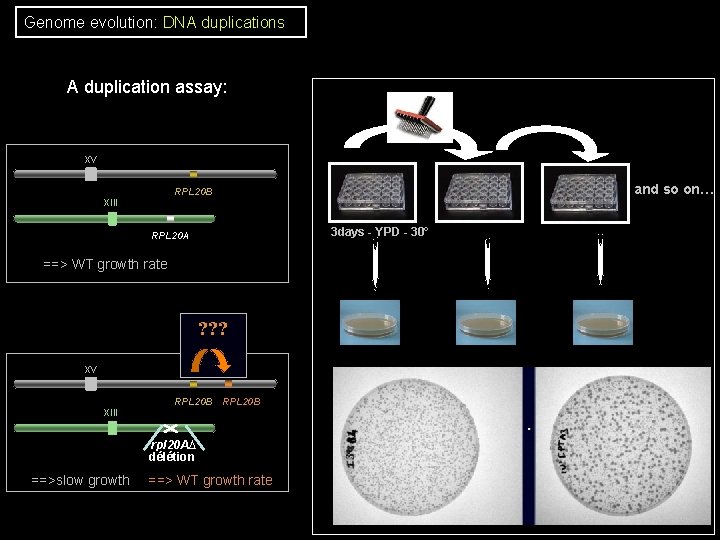
Genome evolution: DNA duplications A duplication assay: XV 3 days - YPD - 30° RPL 20 A ==> WT growth rate ? ? ? XV XIII RPL 20 B rpl 20 A∆ délétion ==>slow growth and so on… RPL 20 B XIII ==> WT growth rate
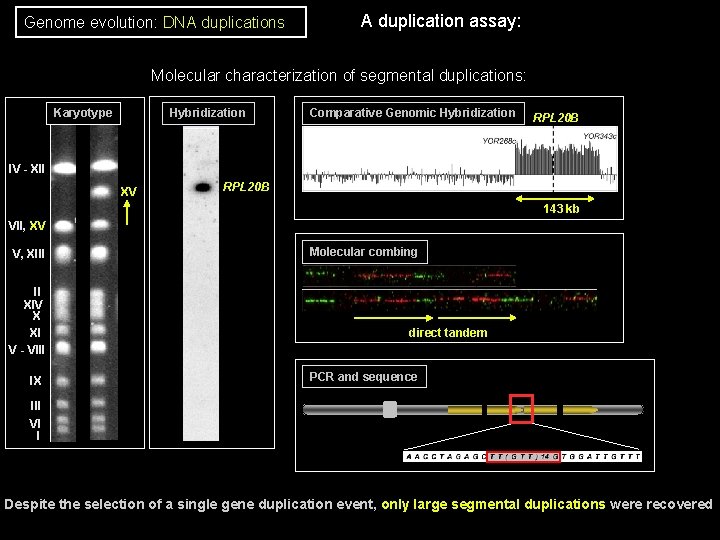
Genome evolution: DNA duplications A duplication assay: Molecular characterization of segmental duplications: Karyotype Hybridization Comparative Genomic Hybridization RPL 20 B IV - XII XV RPL 20 B 143 kb VII, XV V, XIII II XIV X XI V - VIII IX Molecular combing direct tandem PCR and sequence III VI I Despite the selection of a single gene duplication event, only large segmental duplications were recovered
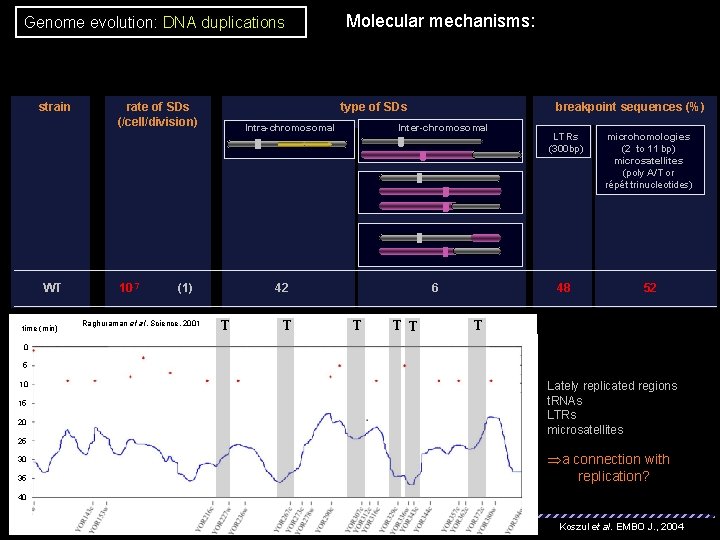
Genome evolution: DNA duplications strain REPLICATION WT pol 32∆ time (min) rate of SDs (/cell/division) 10 -7 type of SDs Intra-chromosomal (1) Raghuraman 2001 0 et al. Science, (<0. 07) Molecular mechanisms: Inter-chromosomal 42 T -T breakpoint sequences (%) 6 T T T - T LTRs (300 bp) microhomologies (2 to 11 bp) microsatellites (poly A/T or répét trinucleotides) 48 52 - - 62 38 0 5 clb 5∆ 7 x 10 -5 (730) 66 3 CPT 3 x 10 -5 (320) 22 0 rad 52∆ 3 x 10 -7 (3) 70 1 10 15 DSB REPAIR 20 25 30 35 40 rad 52∆ rad 1∆ dnl 4∆ 8 x 10 -8 (0. 8) 15 0 Lately replicated regions 54 56 t. RNAs LTRs microsatellites 0 100 a connection with replication? 0 100 Koszul et al. EMBO J. , 2004
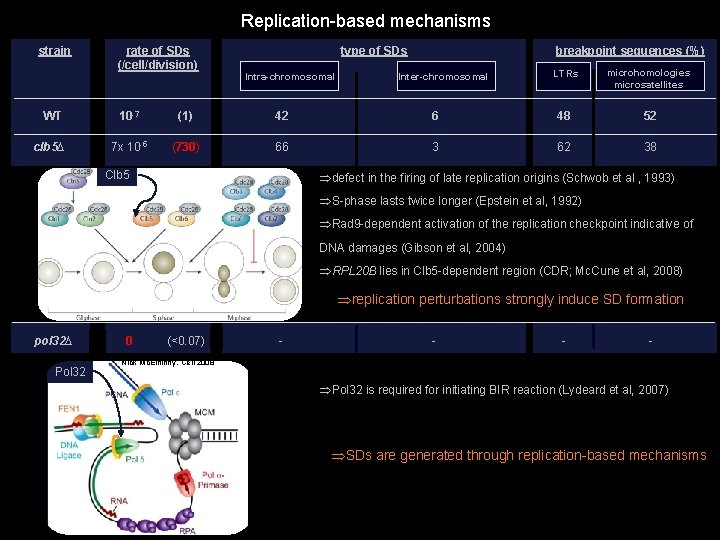
Replication-based mechanisms strain WT clb 5∆ rate of SDs (/cell/division) type of SDs Intra-chromosomal breakpoint sequences (%) Inter-chromosomal LTRs microhomologies microsatellites 10 -7 (1) 42 6 48 52 7 x 10 -5 (730) 66 3 62 38 Clb 5 defect in the firing of late replication origins (Schwob et al , 1993) S-phase lasts twice longer (Epstein et al, 1992) Rad 9 -dependent activation of the replication checkpoint indicative of DNA damages (Gibson et al, 2004) RPL 20 B lies in Clb 5 -dependent region (CDR; Mc. Cune et al, 2008) replication perturbations strongly induce SD formation Bloom and Cross, 2007 0 pol 32∆ Pol 32 (<0. 07) - - Nick Mc. Elhinny, Cell 2008 Pol 32 is required for initiating BIR reaction (Lydeard et al, 2007) SDs are generated through replication-based mechanisms
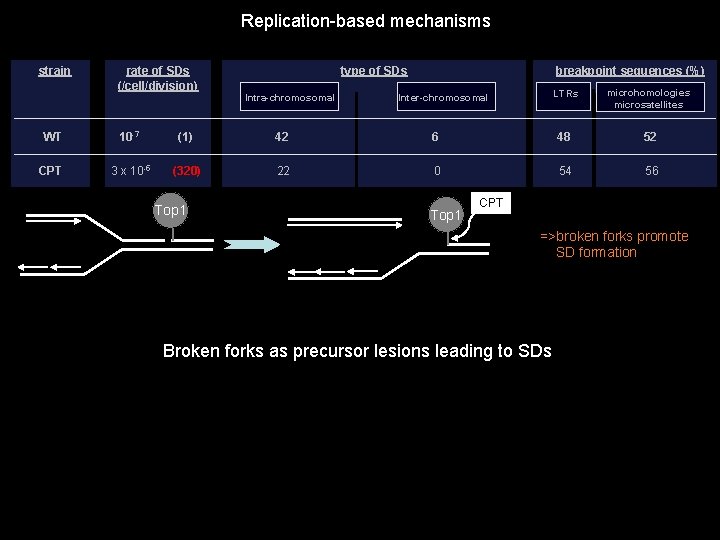
Replication-based mechanisms strain rate of SDs (/cell/division) type of SDs Intra-chromosomal breakpoint sequences (%) Inter-chromosomal LTRs microhomologies microsatellites WT 10 -7 (1) 42 6 48 52 CPT 3 x 10 -5 (320) 22 0 54 56 Top 1 CPT =>broken forks promote SD formation Broken forks as precursor lesions leading to SDs
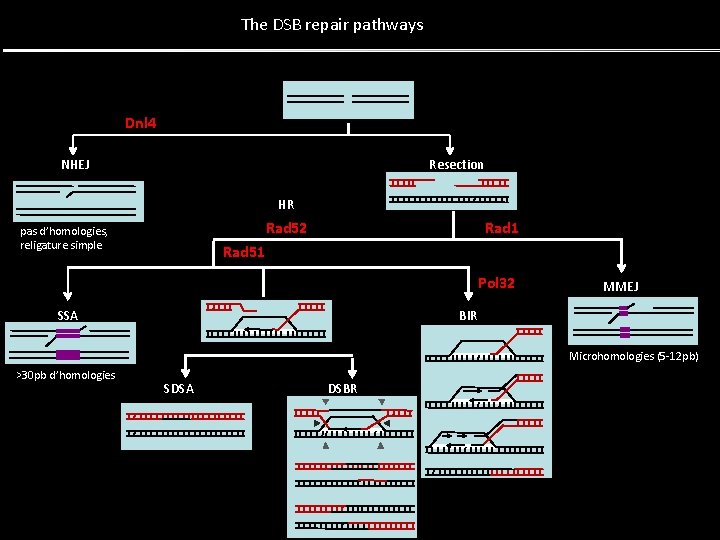
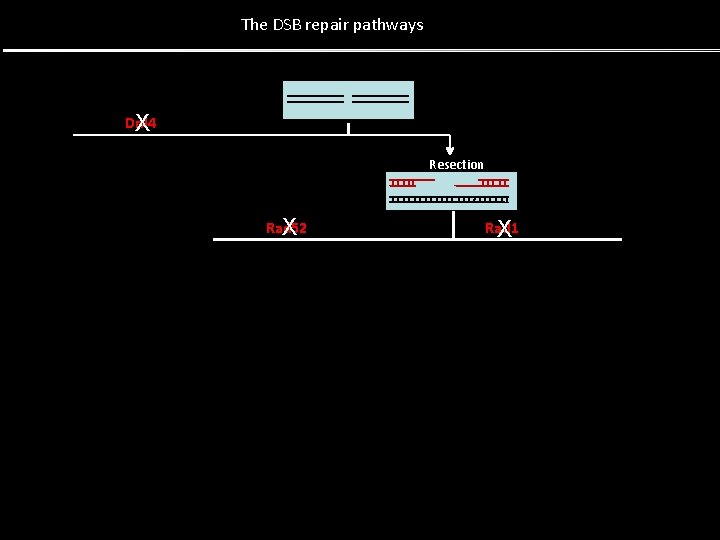
The DSB repair pathways Dnl 4 NHEJ Resection HR Rad 52 pas d’homologies, religature simple Rad 1 Rad 51 Pol 32 SSA MMEJ BIR Microhomologies (5 -12 pb) >30 pb d’homologies SDSA DSBR
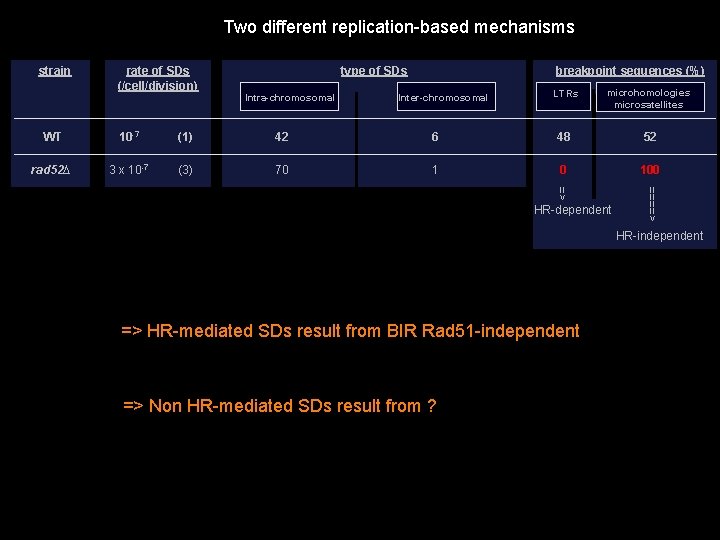
Two different replication-based mechanisms strain rate of SDs (/cell/division) type of SDs Intra-chromosomal breakpoint sequences (%) Inter-chromosomal LTRs microhomologies microsatellites WT 10 -7 (1) 42 6 48 52 rad 52∆ 3 x 10 -7 (3) 70 1 0 100 ====> => HR-dependent HR-independent => HR-mediated SDs result from BIR Rad 51 -independent => Non HR-mediated SDs result from ?
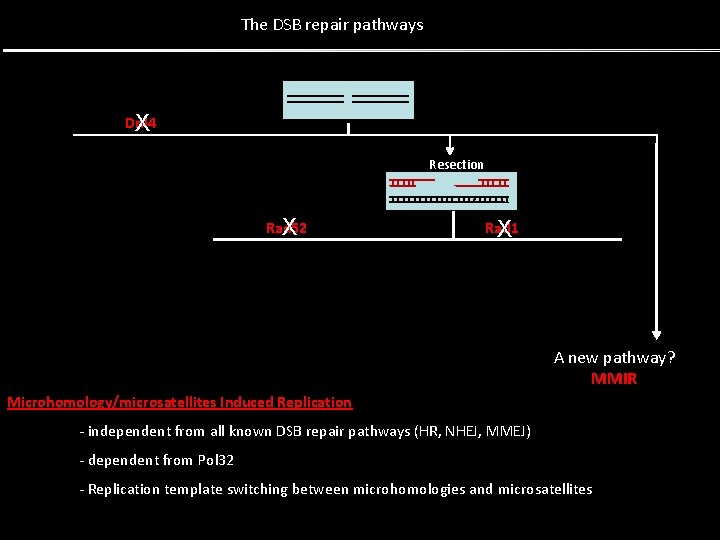
The DSB repair pathways Dnl 4 X Resection Rad 52 X Rad 1 X
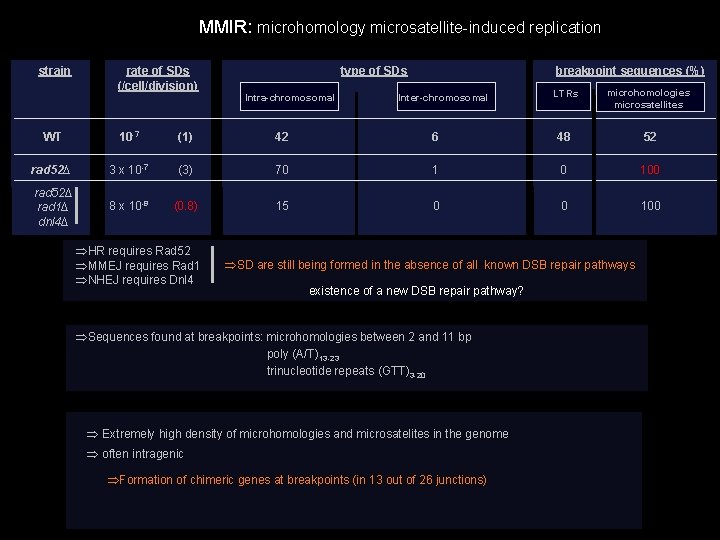
MMIR: microhomology microsatellite-induced replication strain rate of SDs (/cell/division) type of SDs Intra-chromosomal breakpoint sequences (%) Inter-chromosomal LTRs microhomologies microsatellites WT 10 -7 (1) 42 6 48 52 rad 52∆ 3 x 10 -7 (3) 70 1 0 100 rad 52∆ rad 1∆ dnl 4∆ 8 x 10 -8 (0. 8) 15 0 0 100 HR requires Rad 52 MMEJ requires Rad 1 NHEJ requires Dnl 4 SD are still being formed in the absence of all known DSB repair pathways existence of a new DSB repair pathway? Sequences found at breakpoints: microhomologies between 2 and 11 bp poly (A/T)13 -23 trinucleotide repeats (GTT)3 -20 Extremely high density of microhomologies and microsatelites in the genome often intragenic Formation of chimeric genes at breakpoints (in 13 out of 26 junctions)
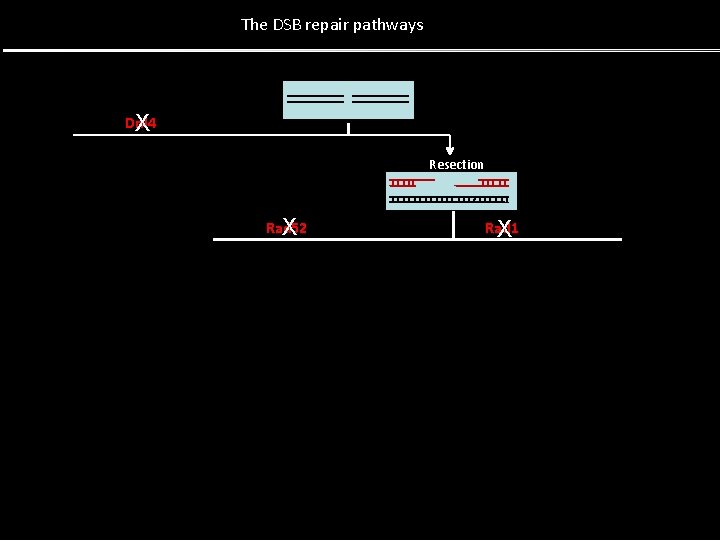
The DSB repair pathways Dnl 4 X Resection Rad 52 X Rad 1 X
The DSB repair pathways Dnl 4 X Resection Rad 52 X Rad 1 X A new pathway? MMIR Microhomology/microsatellites Induced Replication - independent from all known DSB repair pathways (HR, NHEJ, MMEJ) - dependent from Pol 32 - Replication template switching between microhomologies and microsatellites
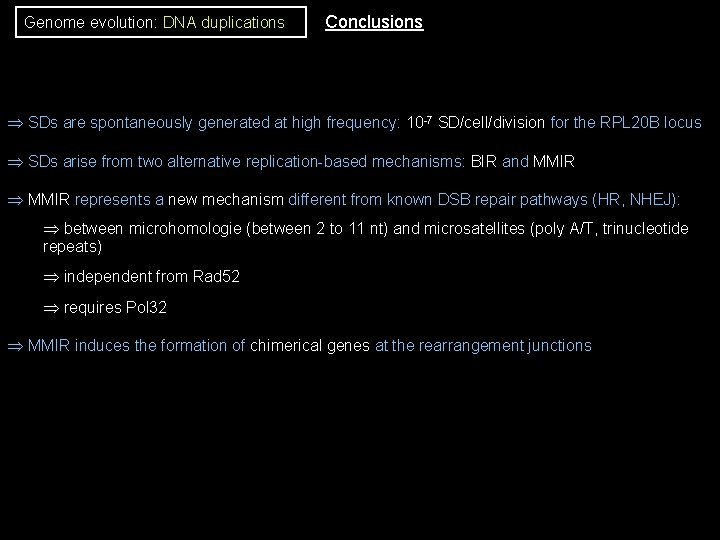
Genome evolution: DNA duplications Conclusions SDs are spontaneously generated at high frequency: 10 -7 SD/cell/division for the RPL 20 B locus SDs arise from two alternative replication-based mechanisms: BIR and MMIR represents a new mechanism different from known DSB repair pathways (HR, NHEJ): between microhomologie (between 2 to 11 nt) and microsatellites (poly A/T, trinucleotide repeats) independent from Rad 52 requires Pol 32 MMIR induces the formation of chimerical genes at the rearrangement junctions
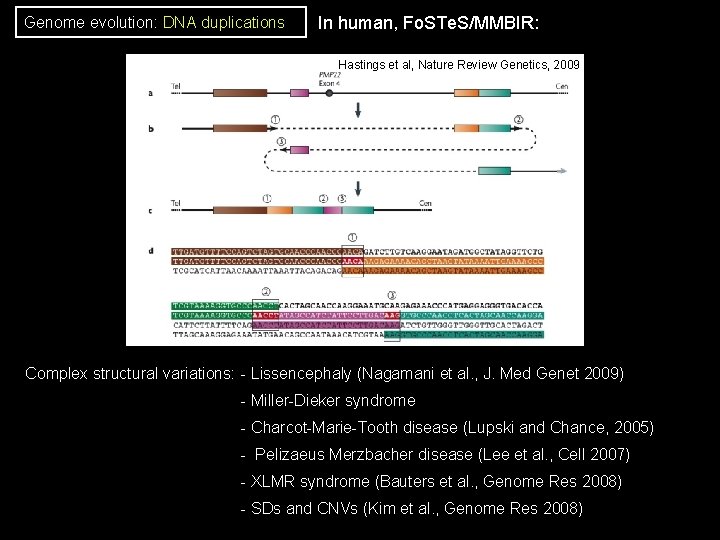
Genome evolution: DNA duplications In human, Fo. STe. S/MMBIR: Hastings et al, Nature Review Genetics, 2009 Complex structural variations: - Lissencephaly (Nagamani et al. , J. Med Genet 2009) - Miller-Dieker syndrome - Charcot-Marie-Tooth disease (Lupski and Chance, 2005) - Pelizaeus Merzbacher disease (Lee et al. , Cell 2007) - XLMR syndrome (Bauters et al. , Genome Res 2008) - SDs and CNVs (Kim et al. , Genome Res 2008)
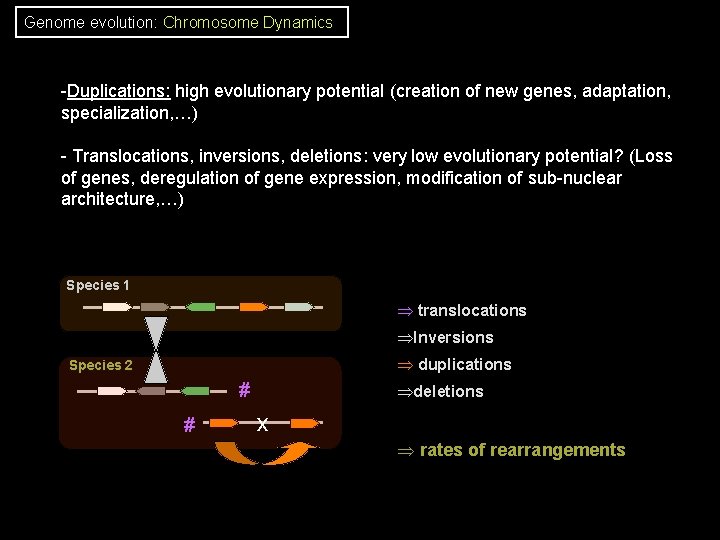
Genome evolution: Chromosome Dynamics -Duplications: high evolutionary potential (creation of new genes, adaptation, specialization, …) - Translocations, inversions, deletions: very low evolutionary potential? (Loss of genes, deregulation of gene expression, modification of sub-nuclear architecture, …) Species 1 translocations Inversions duplications Species 2 # # deletions x rates of rearrangements
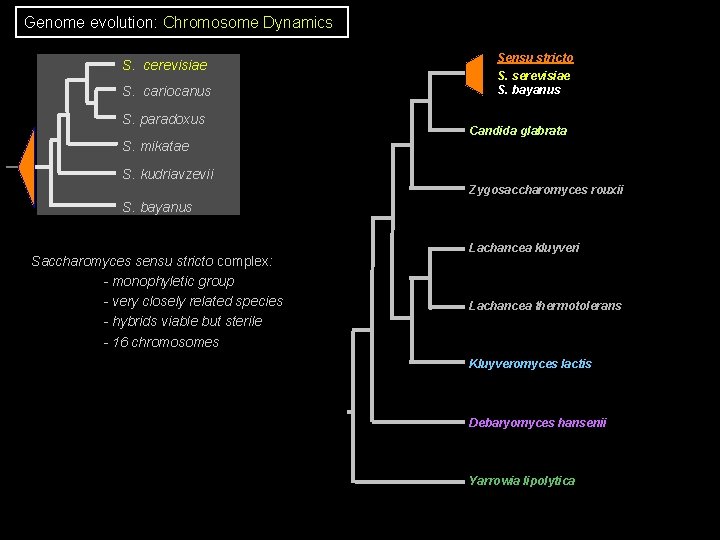
Genome evolution: Chromosome Dynamics S. cerevisiae S. cariocanus S. paradoxus Sensu stricto S. serevisiae S. bayanus Candida glabrata S. mikatae S. kudriavzevii Zygosaccharomyces rouxii S. bayanus Saccharomyces sensu stricto complex: - monophyletic group - very closely related species - hybrids viable but sterile - 16 chromosomes Lachancea kluyveri Lachancea thermotolerans Kluyveromyces lactis Debaryomyces hansenii Yarrowia lipolytica
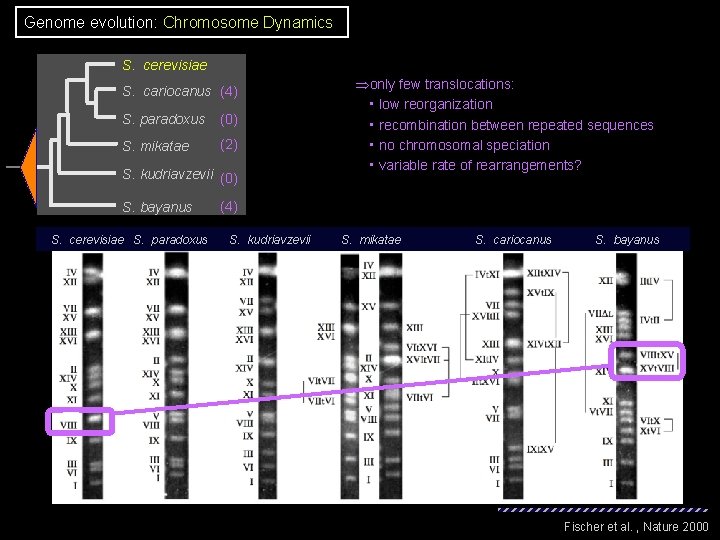
Genome evolution: Chromosome Dynamics S. cerevisiae S. cariocanus (4) S. paradoxus (0) S. mikatae (2) S. kudriavzevii (0) S. bayanus S. cerevisiae S. paradoxus only few translocations: • low reorganization • recombination between repeated sequences • no chromosomal speciation • variable rate of rearrangements? (4) S. kudriavzevii S. mikatae S. cariocanus S. bayanus Fischer et al. , Nature 2000
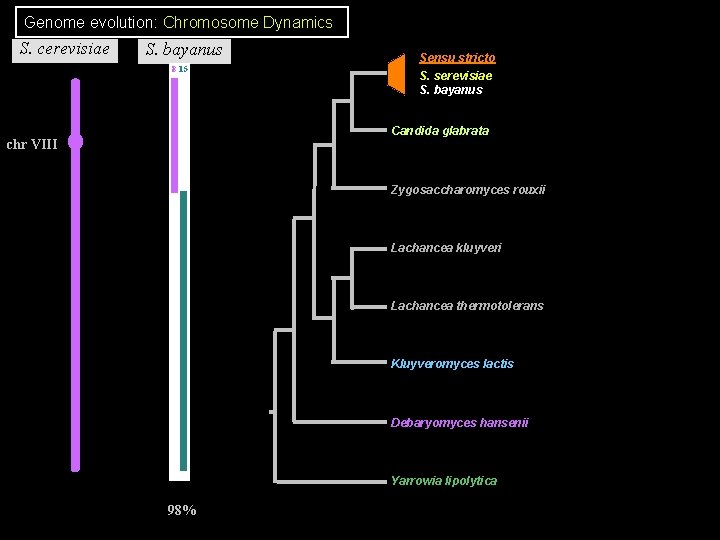
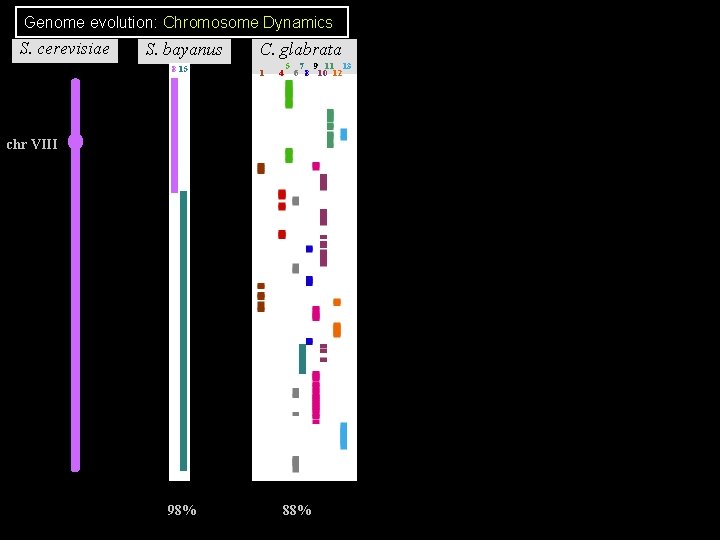
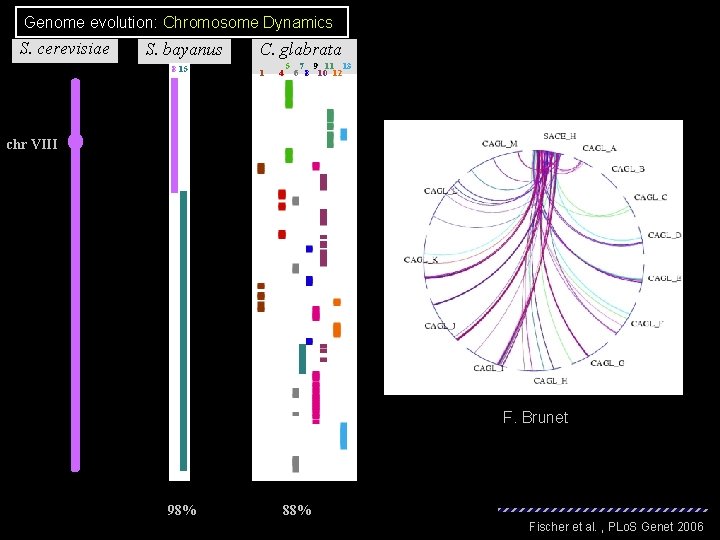
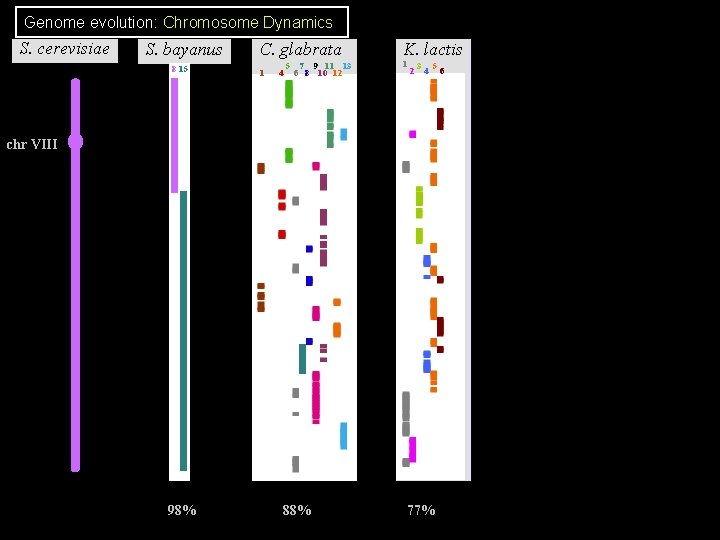
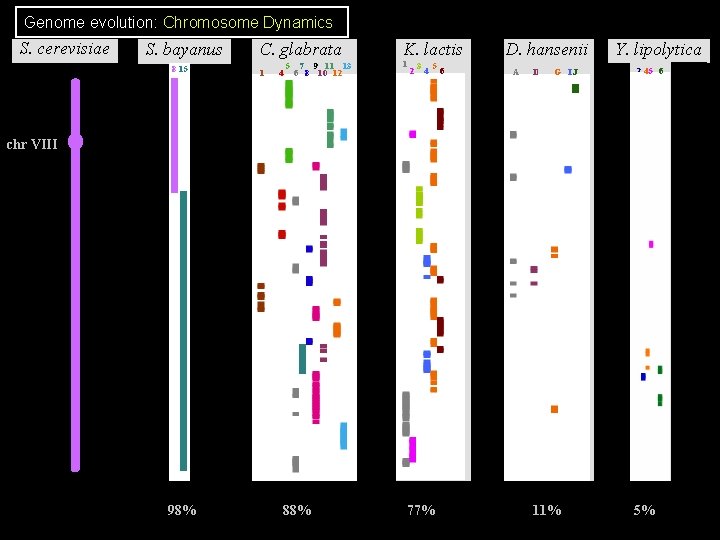
Genome evolution: Chromosome Dynamics S. cerevisiae S. bayanus 8 15 C. glabrata 1 4 5 7 9 11 13 6 8 10 12 K. Sensu lactisstricto D. hansenii 1 3 5 2 4 6 S. serevisiae S. bayanus A D G IJ Y. lipolytica 2 45 6 Candida glabrata chr VIII Zygosaccharomyces rouxii Lachancea kluyveri Lachancea thermotolerans Kluyveromyces lactis Debaryomyces hansenii Yarrowia lipolytica 98% 88% 77% 11% 5%
Genome evolution: Chromosome Dynamics S. cerevisiae S. bayanus 8 15 C. glabrata 1 4 5 7 9 11 13 6 8 10 12 K. lactis 1 3 5 2 4 6 D. hansenii A D G IJ Y. lipolytica 2 45 6 chr VIII 98% 88% 77% 11% 5%
Genome evolution: Chromosome Dynamics S. cerevisiae S. bayanus 8 15 C. glabrata 1 4 5 7 9 11 13 6 8 10 12 K. lactis 1 3 5 2 4 6 D. hansenii A D G IJ Y. lipolytica 2 45 6 chr VIII Fischer F. Brunet 98% 88% 77% Fischer et al. , PLo. S Genet 2006
Genome evolution: Chromosome Dynamics S. cerevisiae S. bayanus 8 15 C. glabrata 1 4 5 7 9 11 13 6 8 10 12 K. lactis 1 3 5 2 4 6 D. hansenii A D G IJ Y. lipolytica 2 45 6 chr VIII 98% 88% 77% 11% 5%
Genome evolution: Chromosome Dynamics S. cerevisiae S. bayanus 8 15 C. glabrata 1 4 5 7 9 11 13 6 8 10 12 K. lactis 1 3 5 2 4 6 D. hansenii A D G IJ Y. lipolytica 2 45 6 chr VIII 98% 88% 77% 11% 5%
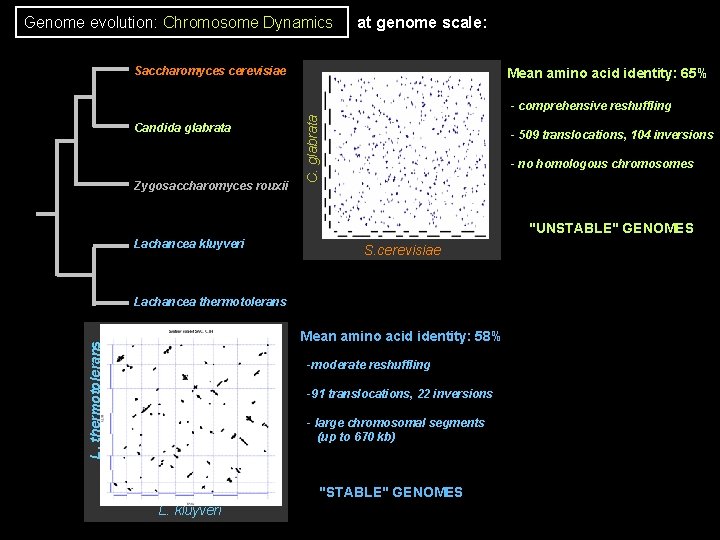
Genome evolution: Chromosome Dynamics at genome scale: Saccharomyces cerevisiae Mean amino acid identity: 65% Candida glabrata Zygosaccharomyces rouxii C. glabrata - comprehensive reshuffling - 509 translocations, 104 inversions - no homologous chromosomes "UNSTABLE" GENOMES Lachancea kluyveri S. cerevisiae Lachancea thermotolerans L. thermotolerans Mean amino acid identity: 58% -moderate reshuffling -91 translocations, 22 inversions - large chromosomal segments (up to 670 kb) "STABLE" GENOMES L. kluyveri
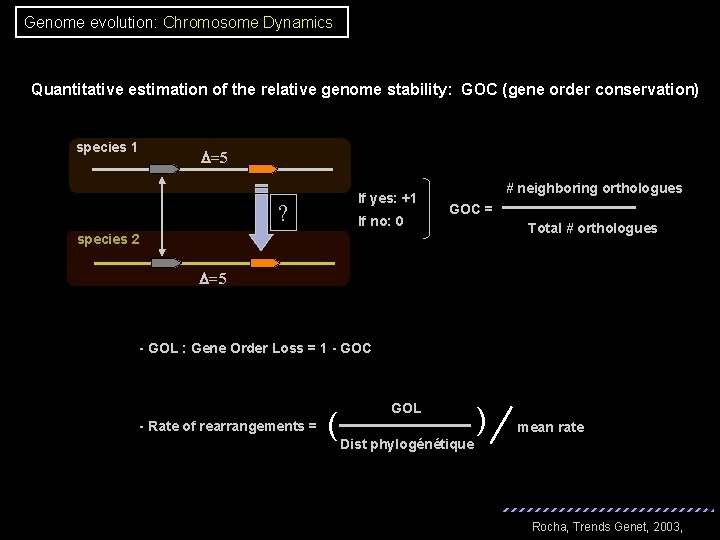
Genome evolution: Chromosome Dynamics Quantitative estimation of the relative genome stability: GOC (gene order conservation) species 1 =5 ? If yes: +1 If no: 0 # neighboring orthologues GOC = Total # orthologues species 2 =5 - GOL : Gene Order Loss = 1 - GOC - Rate of rearrangements = ( Dist phylogénétique ( GOL mean rate Rocha, Trends Genet, 2003,
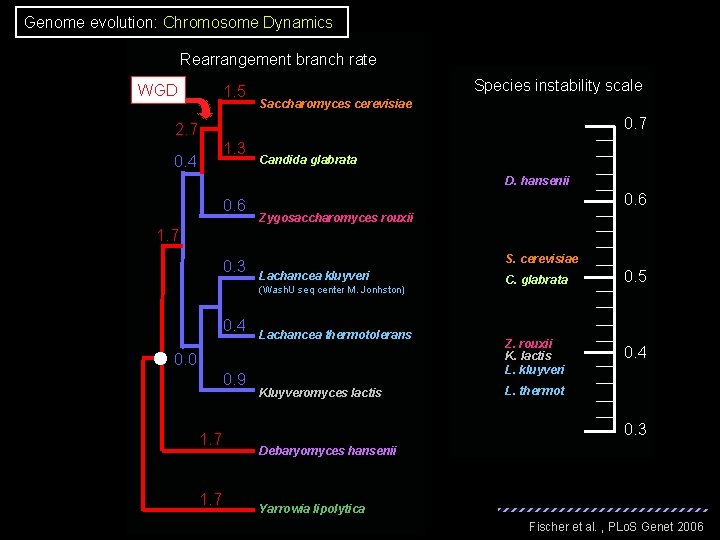
Genome evolution: Chromosome Dynamics Rearrangement branch rate WGD 1. 5 Species instability scale Saccharomyces cerevisiae 0. 7 2. 7 1. 3 0. 4 Candida glabrata D. hansenii 0. 6 Zygosaccharomyces rouxii 1. 7 0. 3 S. cerevisiae Lachancea kluyveri (Wash. U seq center M. Jonhston) 0. 4 Lachancea thermotolerans 0. 0 0. 9 1. 7 Kluyveromyces lactis C. glabrata 0. 5 Z. rouxii K. lactis L. kluyveri 0. 4 L. thermot 0. 3 Debaryomyces hansenii Yarrowia lipolytica Fischer et al. , PLo. S Genet 2006
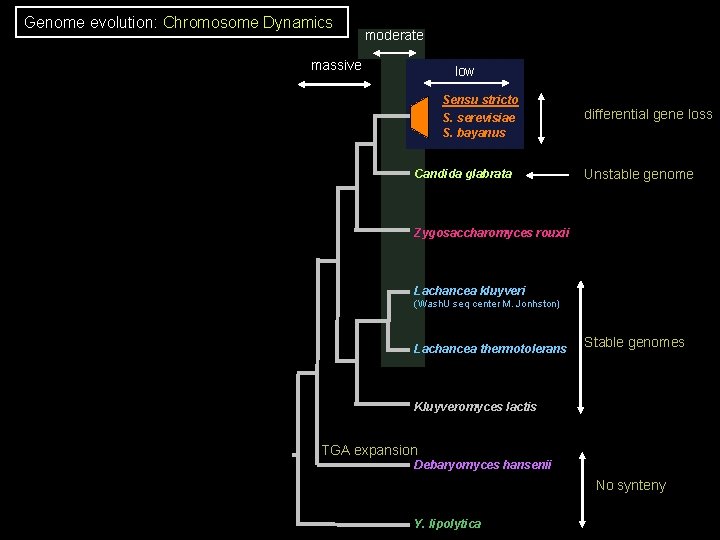
Genome evolution: Chromosome Dynamics moderate massive low Sensu stricto S. serevisiae S. bayanus Candida glabrata differential gene loss Unstable genome Zygosaccharomyces rouxii Lachancea kluyveri (Wash. U seq center M. Jonhston) Lachancea thermotolerans Stable genomes Kluyveromyces lactis TGA expansion Debaryomyces hansenii No synteny Y. lipolytica
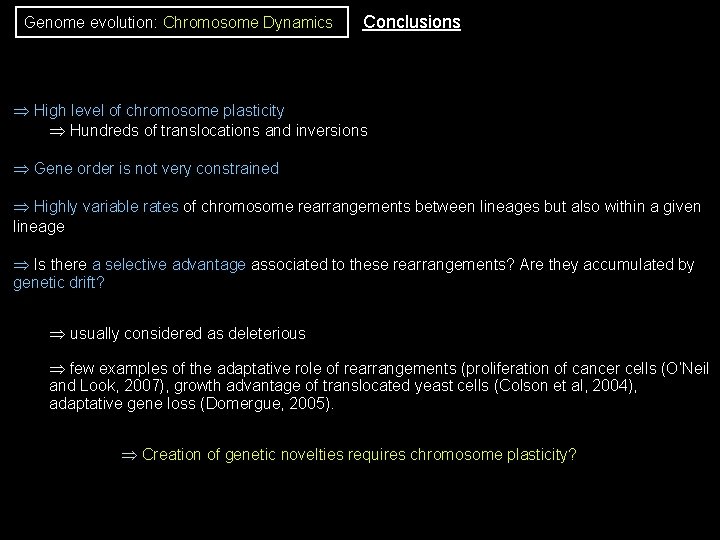
Genome evolution: Chromosome Dynamics Conclusions High level of chromosome plasticity Hundreds of translocations and inversions Gene order is not very constrained Highly variable rates of chromosome rearrangements between lineages but also within a given lineage Is there a selective advantage associated to these rearrangements? Are they accumulated by genetic drift? usually considered as deleterious few examples of the adaptative role of rearrangements (proliferation of cancer cells (O’Neil and Look, 2007), growth advantage of translocated yeast cells (Colson et al, 2004), adaptative gene loss (Domergue, 2005). Creation of genetic novelties requires chromosome plasticity?
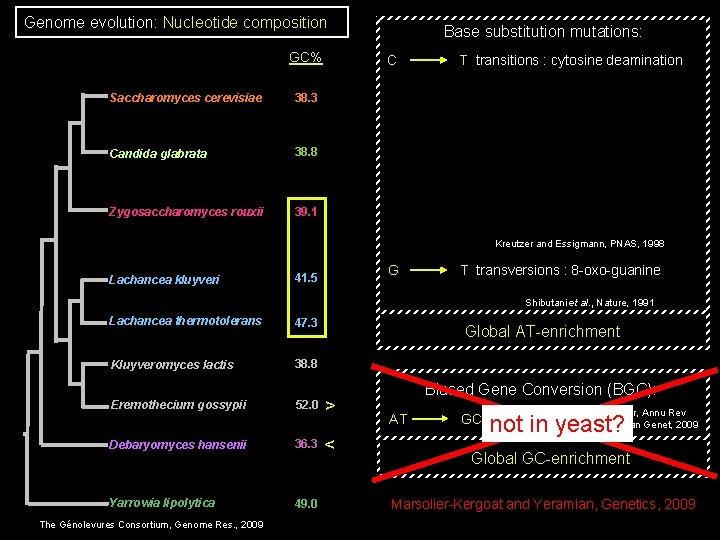
Genome evolution: Nucleotide composition GC% Saccharomyces cerevisiae 38. 3 Candida glabrata 38. 8 Zygosaccharomyces rouxii 39. 1 Base substitution mutations: C T transitions : cytosine deamination Kreutzer and Essigmann, PNAS, 1998 Lachancea kluyveri G 41. 5 T transversions : 8 -oxo-guanine Shibutani et al. , Nature, 1991 Lachancea thermotolerans 47. 3 Kluyveromyces lactis 38. 8 Global AT-enrichment Eremothecium gossypii 52. 0 > Debaryomyces hansenii 36. 3 < Yarrowia lipolytica 49. 0 The Génolevures Consortium, Genome Res. , 2009 Biased Gene Conversion (BGC): AT Duret and Galtier, Annu Rev Genomics Human Genet, 2009 not in yeast? GC mutations Global GC-enrichment Marsolier-Kergoat and Yeramian, Genetics, 2009
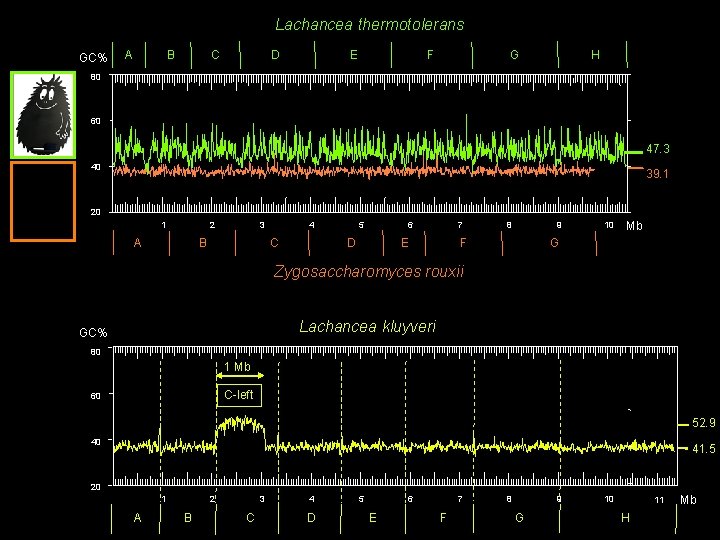
Lachancea thermotolerans GC% A B C D E F G H 80 60 47. 3 40 39. 1 20 1 2 A 3 B 4 C 5 6 D 7 E 8 9 F 10 Mb G Zygosaccharomyces rouxii Lachancea kluyveri GC% 80 1 Mb C-left 60 52. 9 40 41. 5 20 1 A 2 B 3 C 4 D 5 6 E 7 F 8 9 G 10 11 H Mb
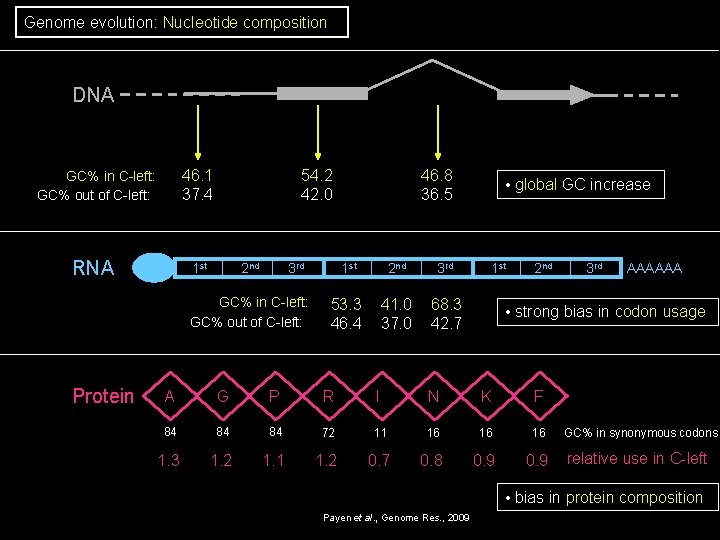
Genome evolution: Nucleotide composition DNA GC% in C-left: GC% out of C-left: 46. 1 37. 4 RNA 1 st 54. 2 42. 0 2 nd 3 rd GC% in C-left: GC% out of C-left: Protein 46. 8 36. 5 1 st 2 nd 3 rd 53. 3 46. 4 41. 0 37. 0 68. 3 42. 7 • global GC increase 1 st 2 nd 3 rd AAAAAA • strong bias in codon usage A G P R I N K F 84 84 84 72 11 16 16 16 1. 3 1. 2 1. 1 1. 2 0. 7 0. 8 0. 9 GC% in synonymous codons relative use in C-left • bias in protein composition Payen et al. , Genome Res. , 2009
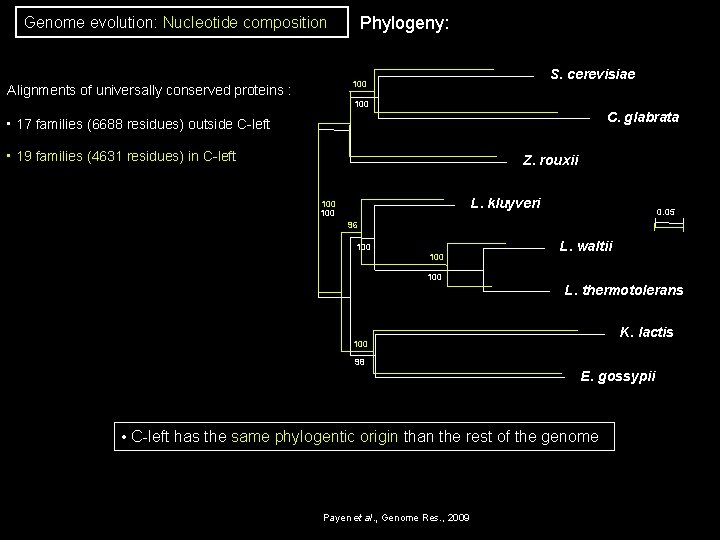
Phylogeny: Genome evolution: Nucleotide composition S. cerevisiae 100 Alignments of universally conserved proteins : 100 C. glabrata • 17 families (6688 residues) outside C-left • 19 families (4631 residues) in C-left Z. rouxii L. kluyveri 100 0. 05 96 100 100 L. waltii L. thermotolerans K. lactis 100 98 E. gossypii • C-left has the same phylogentic origin than the rest of the genome Payen et al. , Genome Res. , 2009
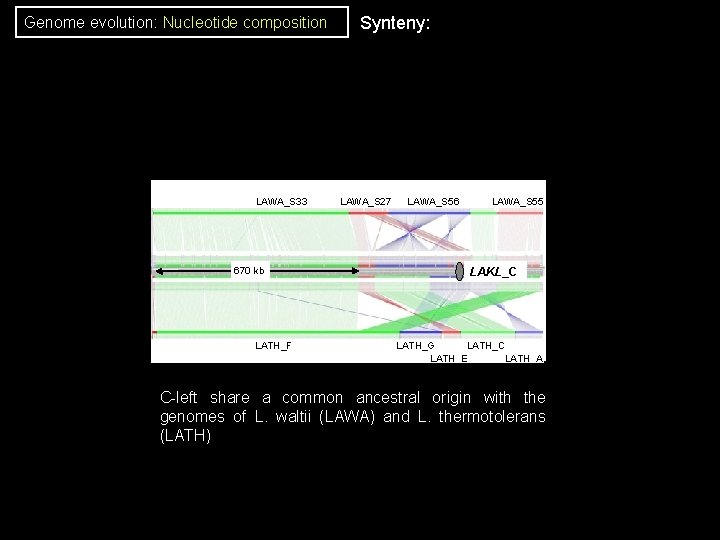
Genome evolution: Nucleotide composition LAWA_S 33 670 kb LATH_F Synteny: LAWA_S 27 LAWA_S 56 LAWA_S 55 LAKL_C LATH_G LATH_C LATH_E LATH_A C-left share a common ancestral origin with the genomes of L. waltii (LAWA) and L. thermotolerans (LATH)
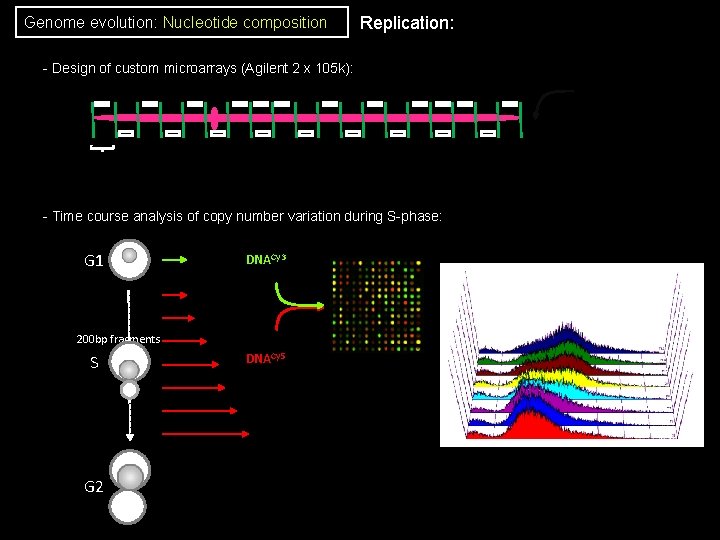
Genome evolution: Nucleotide composition Replication: - Design of custom microarrays (Agilent 2 x 10⁵ k): - Time course analysis of copy number variation during S-phase: G 1 DNACy 3 200 bp fragments S G 2 DNACy 5
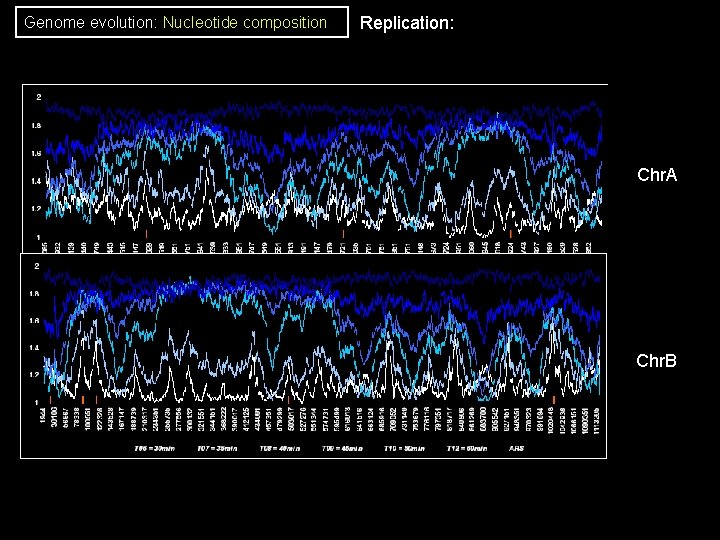
Genome evolution: Nucleotide composition Replication: Chr. A Chr. B
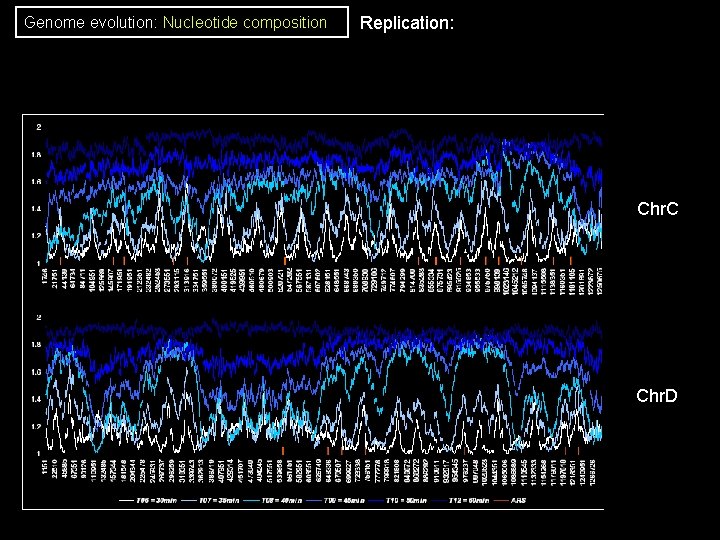
Genome evolution: Nucleotide composition Replication: Chr. C Chr. D
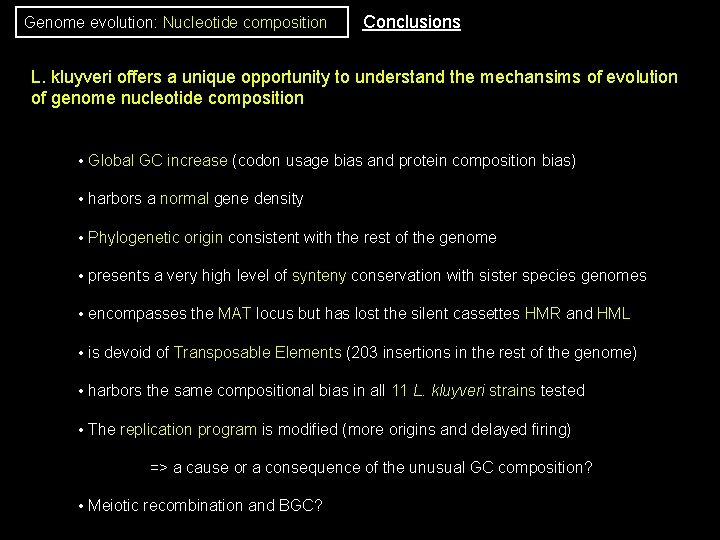
Genome evolution: Nucleotide composition Conclusions L. kluyveri offers a unique opportunity to understand the mechansims of evolution of genome nucleotide composition • Global GC increase (codon usage bias and protein composition bias) • harbors a normal gene density • Phylogenetic origin consistent with the rest of the genome • presents a very high level of synteny conservation with sister species genomes • encompasses the MAT locus but has lost the silent cassettes HMR and HML • is devoid of Transposable Elements (203 insertions in the rest of the genome) • harbors the same compositional bias in all 11 L. kluyveri strains tested • The replication program is modified (more origins and delayed firing) => a cause or a consequence of the unusual GC composition? • Meiotic recombination and BGC?
Merci - Unité de Génétique Moléculaire des Levures, Institut Pasteur Celia Payen Romain Koszul - Unité de Génomique des Microorganismes, équipe Biologie des Génomes Nicolas Agier Guénola Drillon - Génolevures consortium: Jean-Luc Souciet Univ. Louis Pasteur, Strasbourg - Centre National de Séquençage, Evry Jean Weissenbach, Patrick Winker - Génopole Pasteur-Ile de France Christiane Bouchier, Lionel Frangeul - Plateforme Puces ADN, Génopole Pasteur Odile Sismeiro, Jean-Yves Coppé