
Is a Universal Tuna Catch Documentation Scheme Feasible

Is a Universal Tuna Catch Documentation Scheme Feasible? Gilles Hosch – FAO Tuna Market & Trade Specialist – ABNJ
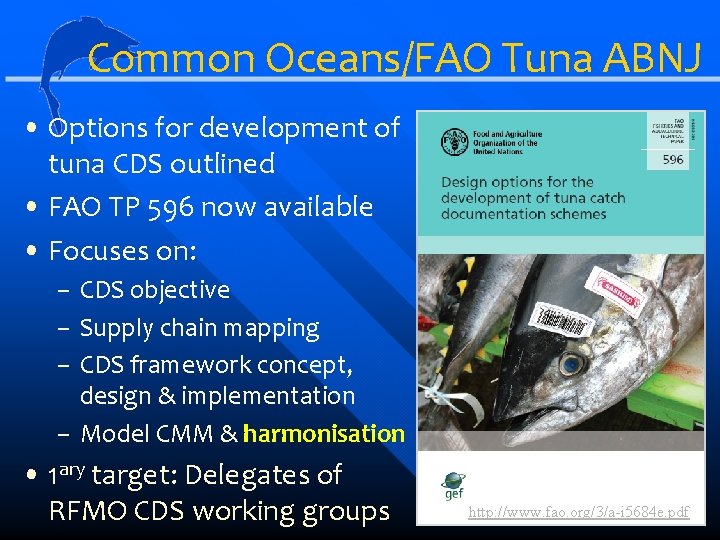
Common Oceans/FAO Tuna ABNJ • Options for development of tuna CDS outlined • FAO TP 596 now available • Focuses on: – CDS objective – Supply chain mapping – CDS framework concept, design & implementation – Model CMM & harmonisation • 1 ary target: Delegates of RFMO CDS working groups http: //www. fao. org/3/a-i 5684 e. pdf
The CDS questions Is it necessary to combat tuna IUU fishing? Are trade tools useful in combatting IUU fishing? and Can IUU tuna be removed from international trade? How many CDS for tuna would it take to do that? 3
Is it necessary? Bluefin tuna lessons (BFT & SBT) • RFMO managed fisheries • TAC & quota systems • Mostly licensed operators • Chronic misreporting & overfishing (IUU) • Looming stock collapses in 2000’s • BFT Black market – 3 -4 billion USD (2000 -2010) • Stock collapse – death of an industry 4
Is it necessary? REMEMBER THIS ONE? • Newfoundland Cod • TAC & quota managed – nationally • Poorly managed & prone to IUU fishing • Collapse in 1992 – moratorium (24 years…) • 35, 000 jobs lost • Natural wealth turned into public liability • Recurrent income loss: 1 billion CAN$ / year 5
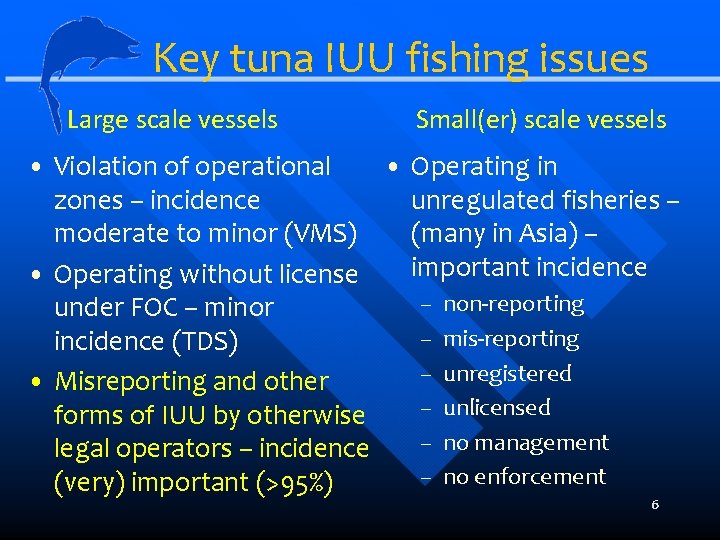
Key tuna IUU fishing issues Large scale vessels Small(er) scale vessels • Violation of operational • Operating in zones – incidence unregulated fisheries – moderate to minor (VMS) (many in Asia) – important incidence • Operating without license – non-reporting under FOC – minor – mis-reporting incidence (TDS) – unregistered • Misreporting and other – unlicensed forms of IUU by otherwise – no management legal operators – incidence – no enforcement (very) important (>95%) 6
CDS definition & objective Draft definition from the FAO Expert Consultation on CDS; Rome; July 2015 A system that traces fish from the point of capture through unloading and throughout the supply chain. A CDS records and certifies information that identifies the origin of fish caught and ensures they were harvested in a manner consistent with relevant national, regional and international conservation and management measures. The objective of the CDS is to combat IUU fishing by limiting access of IUU fish and fishery products to markets. 7
A trade based tool! How does a CDS function? • CDS traces certified fish from unloading, through processing & international trade, into end market • Batches are traced by linking catch certificates to resulting trade certificates • An effective CDS detects “non-originating” fish entering supply chain, and denies laundering • Result: illegal and unreported fish cannot go to market, losing value as a commodity • Ergo: incentive for flouting rules is diminished 8
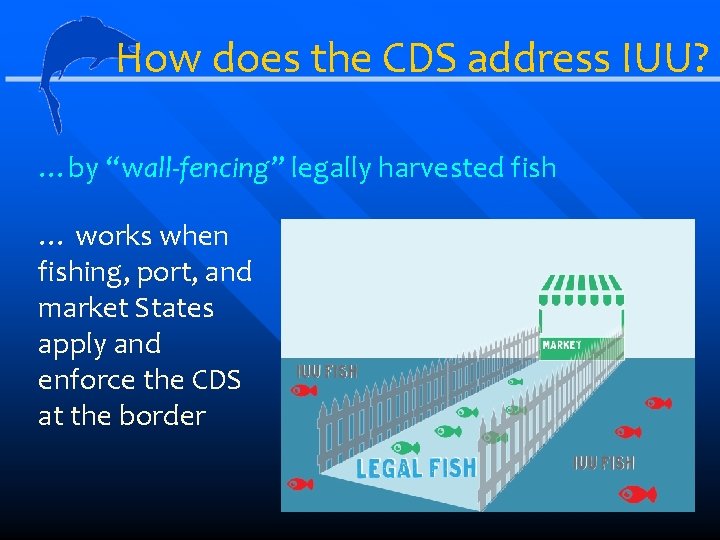
How does the CDS address IUU? …by “wall-fencing” legally harvested fish … works when fishing, port, and market States apply and enforce the CDS at the border 9
Who has got them? What CDS exist today? • Toothfish CDS: CCAMLR (2000) • Tuna CDS: ICCAT (2008) & CCSBT (2010) • Market CDS: EU (2010) • Tuna under CDS represent ± 0. 6% of global tuna catch (by volume) • World tuna harvest not covered by CDS: 99. 4% 10
CDS impact to date… Impact of multilateral (RFMO) CDS systems? • CCAMLR: reduction of IUU from >120% to ± 6% – CDS a critical element in wider mix of actions undertaken to achieving result • Tuna CDS: gradual SBT recovery; strong BFT recovery (IUU from 200+% to <5%) – CDS key to achieving result • EU CDS: no evidence of impact on trade flows or IUU incidence (focus on yellow & red cards) 11
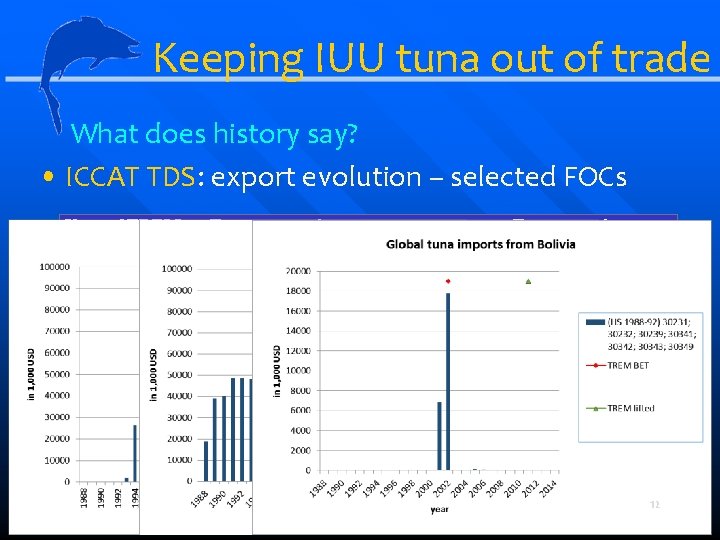
Keeping IUU tuna out of trade What does history say? • ICCAT TDS: export evolution – selected FOCs Year of TREM 1996 1999 2000 2002 Target countries Belize, Honduras and Panama Belize and Honduras Belize, Honduras, Cambodia, and St. Vincent & the Grenadines Bolivia Target species Atlantic Bluefin tuna Swordfish Bigeye tuna 12
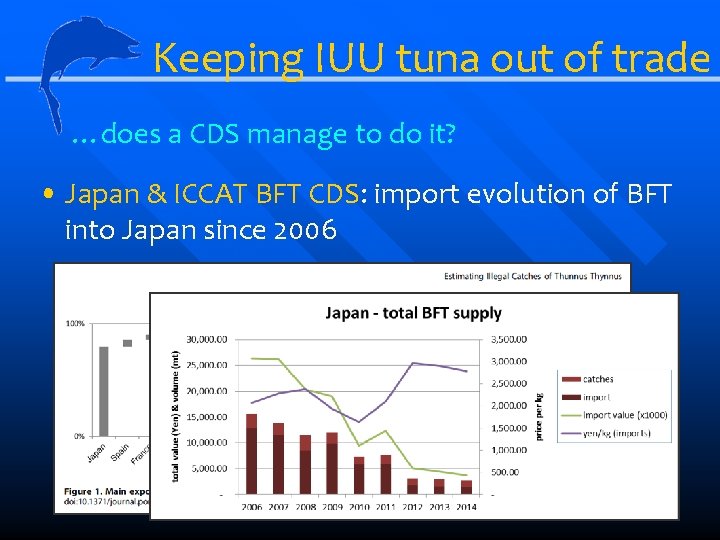
Keeping IUU tuna out of trade …does a CDS manage to do it? • Japan & ICCAT BFT CDS: import evolution of BFT into Japan since 2006 13
Keeping IUU tuna out of trade …do trade-based tools work? • Japan & ICCAT BFT CDS: stance following introduction of ICCAT CDS – Refusing entry to 3, 500 mt of product in 2010 – EU Commission delegation to Japan to negotiate entry – Clear signal regarding import blockage for BFT not covered by valid BCD certificates • Price impact: value of black-market BFT in Mediterranean EU: <80% 14
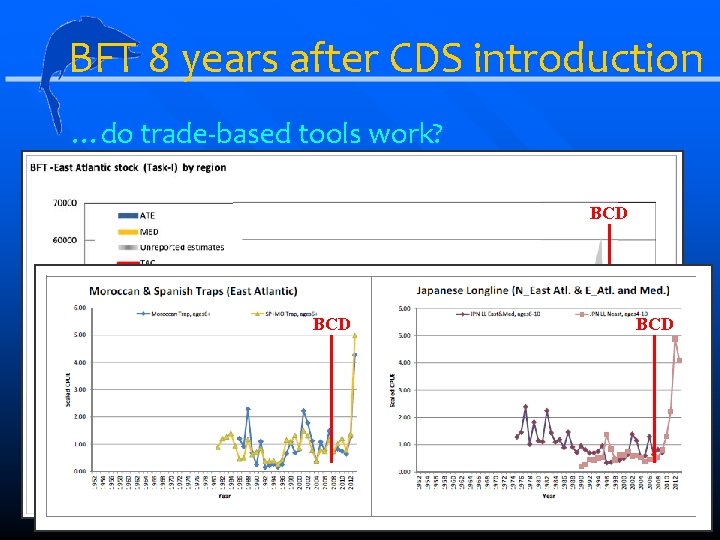
BFT 8 years after CDS introduction …do trade-based tools work? ICCAT SCRS 2014 report BCD • BFT catch mis-reporting estimated close to 0% • Strong signals of BFT stock recovery BCD • 2014: Spain harvests. BCD BFT quota in under 48 hours 15
Challenges - future CDS systems • Existing tuna CDS systems (all Bluefin): – – single species fisheries global range of BFT/SBT covered by single CDS/RFMO low volume; limited gears; rel. simple supply chains simple end-product / end-market situation • Future tuna CDS systems: – multi-species fisheries – no RFMO covers global range of any other species (incl. PBT) – high volume; multi-gear; complex supply chains 16 – complex end-product / end-market situation
Traceability & CDS harmonisation • Potential tuna CDS systems yet to be developed: – – ICCAT (any/all commercial tunas - but BFT) IOTC (any/all commercial tunas) WCPFC (any/all commercial tunas + PBT) IATTC (any/all commercial tunas + PBT) • Partial RFMO coverage (ALB, BET, YFT, SKJ, PBT) • Global sourcing & mixed tuna end-products – opens the door for RFMO & species misreporting • Unlikely inter-operability of multiplying CDS systems – rising burden of compliance for operators • Limited coverage and enforcement potential in future 17 RFMO-based tuna CDS systems
CDS harmonisation • For future tuna CDS – RFMO-based approach (ICCAT, CCSBT & CCAMLR) is of diminished effectiveness for remaining tuna species – “whole species over entire range” CDS approach is needed – A “global CDS” arrangement should be discussed as a standardised technology approach (like VMS) – Single “global CDS” platform to be operated centrally, to which RFMOs (or end-market States) sign up to [CITES] – RFMOs determine functions, enforcement, and sanctions related to the operation and results of the system 18
Universal CDS – how to get there? • Re-kindling a Kobe-type process, discussing a universal CDS solution to the remaining commercial tuna species • Identifying institutional lead to develop, to host and to make the system available • Encourage tuna RFMOs to develop harmonised CMM for tuna CDS – and to adopt the universal scheme as the platform 19
Further reading • Hosch, G. (2016). Design Options for the Development of Tuna Catch Documentation Schemes. FAO Fisheries and Aquaculture Technical Paper 596. FAO, Rome. Italy. http: //www. fao. org/3/a-i 5684 e. pdf • Hosch, G. (2016). Trade Measures to Combat IUU Fishing: Comparative Analysis of Unilateral and Multilateral Approaches. E 15 Initiative. Geneva: International Centre for Trade and Sustainable Development (ICTSD) and World Economic Forum. www. e 15 initiative. org/ • Clarke, S. (2010). Best Practice Study of Fish Catch Documentation Schemes. MRAG Asia Pacific. 20
Thank you! Email: hosch@pt. lu --Cell: +352 621 752418 --Skype: hosch 69
- Slides: 21