Fluency Instruction in the Classroom Module 4 Fluency
- Slides: 23
Fluency Instruction in the Classroom Module 4
Fluency Instruction In the Classroom In this module, we will discuss ways for students to practice reading in the classroom. We will also address how teachers can teach reading fluency using a core, comprehensive reading program.
Learning Target #1 Teachers will understand what fluency instruction looks like in a Tier I setting.
Tier I Reading Instruction Text reading fluency can be developed through a variety of techniques. Tier I reading instruction is delivered to the whole class and address all essential reading components, including fluency.
Selecting Text for Practice-New Findings Stahl and Heubach (2005) noted that when their students selected reading material, they usually selected material that was at or slightly above their instructional level (90%-95% accuracy). The students also benefited from more difficult material than was previously assumed when support and scaffolding were available. Students can read previously read text that is at their instructional level to develop fluency. (Moats, 2009)
Learning Target #2 Teachers will learn best practices for teaching fluency using grade-level text.
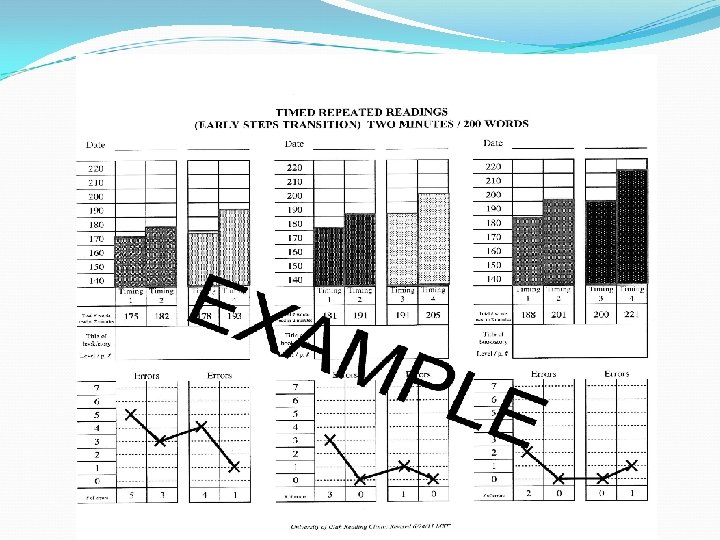
Repeated Reading Previously read instructional level passages Count 200 words, number approximately every 20 words Time student for 2 minutes Mark errors Student charts rate and errors Repeat same procedure with same passage Repeat the process the next day using the same passage totaling 4 reads in all (University of Utah Reading Clinic, 2008)
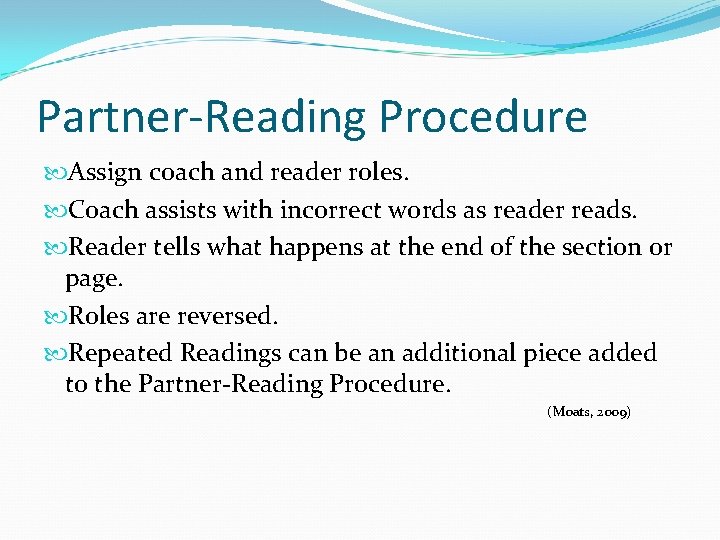
Partner-Reading Procedure Partner-reading is an excellent way to increase the amount of reading students do during the day while freeing up the teacher to work with individuals or small groups. It allows students to support each other as they work toward fluency in grade-level materials. (Moats, 2009)
Partner-Reading Procedure Assign coach and reader roles. Coach assists with incorrect words as reader reads. Reader tells what happens at the end of the section or page. Roles are reversed. Repeated Readings can be an additional piece added to the Partner-Reading Procedure. (Moats, 2009)
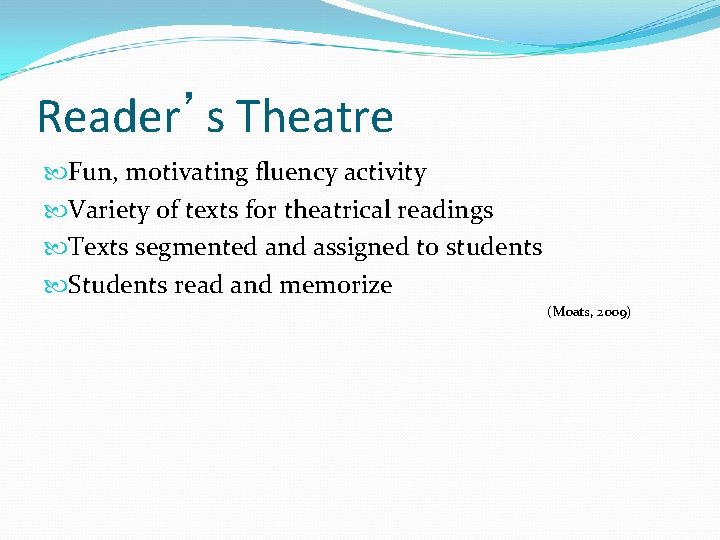
Reader’s Theatre Fun, motivating fluency activity Variety of texts for theatrical readings Texts segmented and assigned to students Students read and memorize (Moats, 2009)
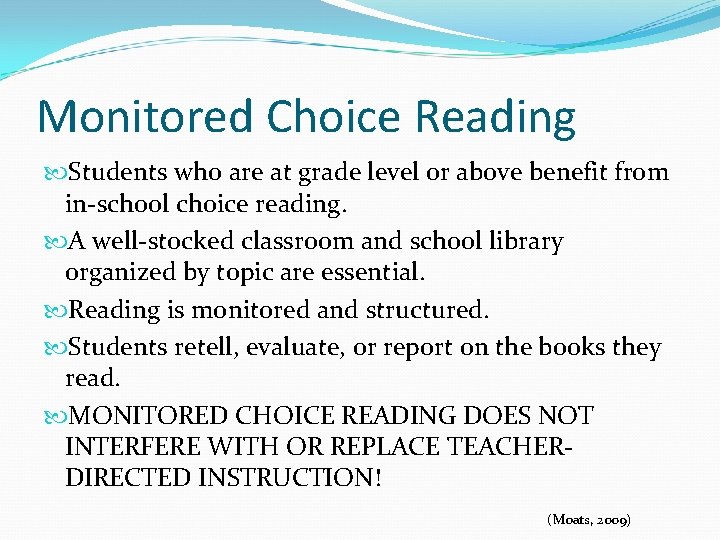
Monitored Choice Reading Students who are at grade level or above benefit from in-school choice reading. A well-stocked classroom and school library organized by topic are essential. Reading is monitored and structured. Students retell, evaluate, or report on the books they read. MONITORED CHOICE READING DOES NOT INTERFERE WITH OR REPLACE TEACHERDIRECTED INSTRUCTION! (Moats, 2009)
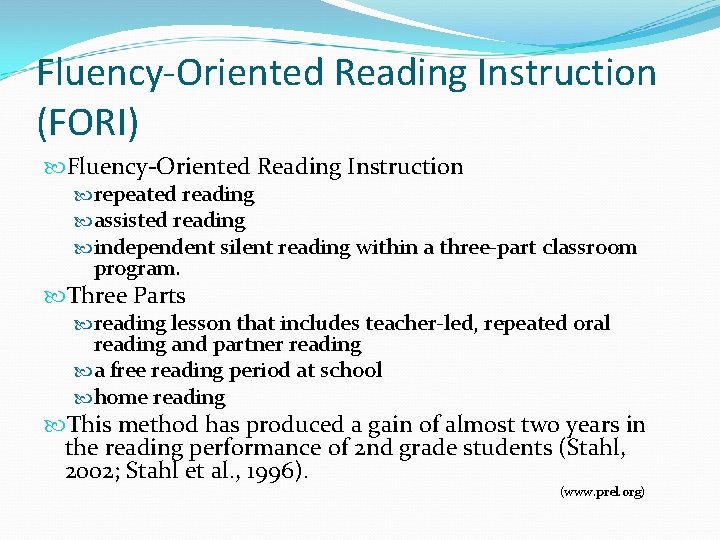
Fluency-Oriented Reading Instruction (FORI) Fluency-Oriented Reading Instruction repeated reading assisted reading independent silent reading within a three-part classroom program. Three Parts reading lesson that includes teacher-led, repeated oral reading and partner reading a free reading period at school home reading This method has produced a gain of almost two years in the reading performance of 2 nd grade students (Stahl, 2002; Stahl et al. , 1996). (www. prel. org)
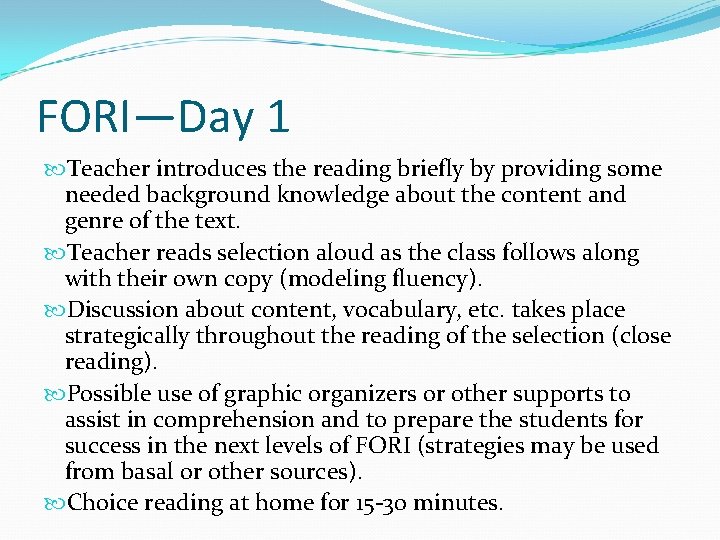
FORI—Day 1 Teacher introduces the reading briefly by providing some needed background knowledge about the content and genre of the text. Teacher reads selection aloud as the class follows along with their own copy (modeling fluency). Discussion about content, vocabulary, etc. takes place strategically throughout the reading of the selection (close reading). Possible use of graphic organizers or other supports to assist in comprehension and to prepare the students for success in the next levels of FORI (strategies may be used from basal or other sources). Choice reading at home for 15 -30 minutes.
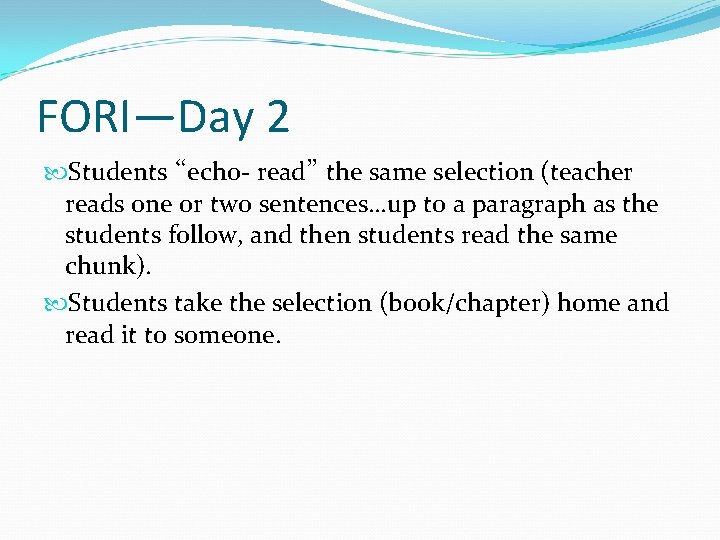
FORI—Day 2 Students “echo- read” the same selection (teacher reads one or two sentences…up to a paragraph as the students follow, and then students read the same chunk). Students take the selection (book/chapter) home and read it to someone.
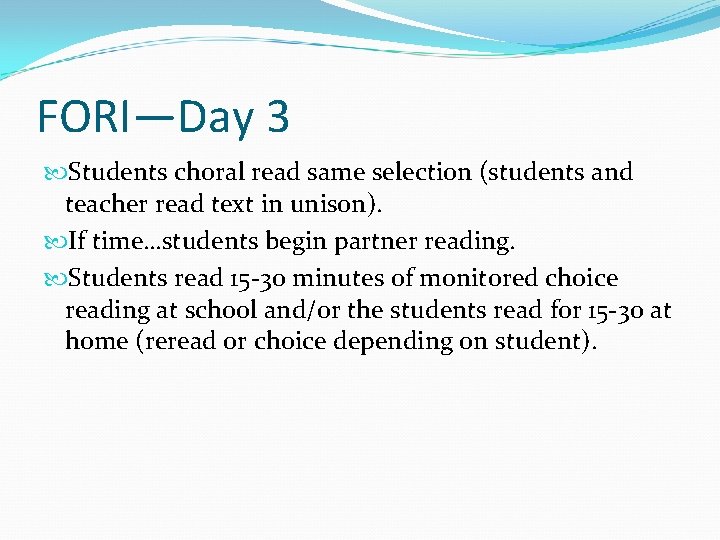
FORI—Day 3 Students choral read same selection (students and teacher read text in unison). If time…students begin partner reading. Students read 15 -30 minutes of monitored choice reading at school and/or the students read for 15 -30 at home (reread or choice depending on student).
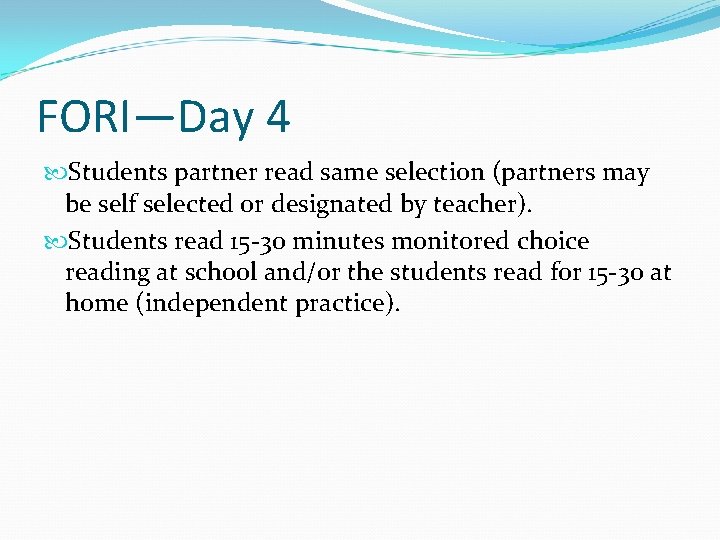
FORI—Day 4 Students partner read same selection (partners may be self selected or designated by teacher). Students read 15 -30 minutes monitored choice reading at school and/or the students read for 15 -30 at home (independent practice).
FORI—Day 5 Students can do extension activities that show they have an understanding of what they read. Because students should be writing throughout the entire day, written responses are excellent for holding students accountable for their reading and assessing how well they understand the material.
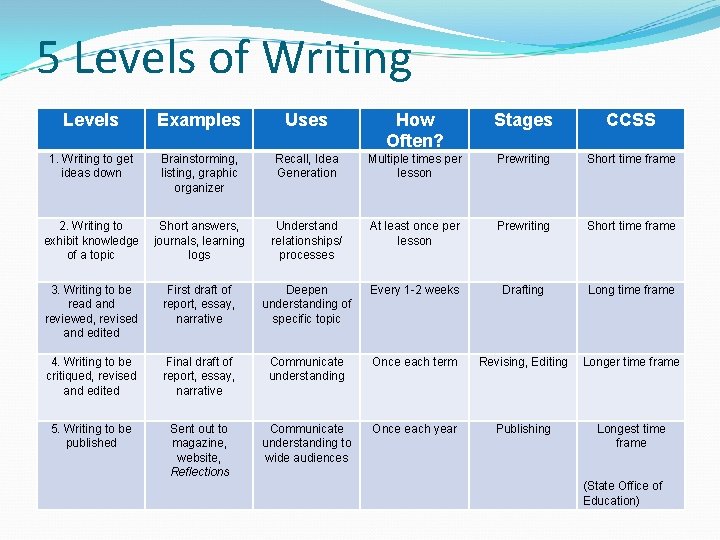
5 Levels of Writing Levels Examples Uses How Often? Stages CCSS 1. Writing to get ideas down Brainstorming, listing, graphic organizer Recall, Idea Generation Multiple times per lesson Prewriting Short time frame 2. Writing to exhibit knowledge of a topic Short answers, journals, learning logs Understand relationships/ processes At least once per lesson Prewriting Short time frame 3. Writing to be read and reviewed, revised and edited First draft of report, essay, narrative Deepen understanding of specific topic Every 1 -2 weeks Drafting Long time frame 4. Writing to be critiqued, revised and edited Final draft of report, essay, narrative Communicate understanding Once each term Revising, Editing Longer time frame 5. Writing to be published Sent out to magazine, website, Reflections Communicate understanding to wide audiences Once each year Publishing Longest time frame (State Office of Education)
FORI—Day 5 On day 5, the teacher can also assess the reading by doing a rate and accuracy check or a 1 minute timing of the reading passage. Other activities to increase or evaluate prosody can take place at this time. (Kuhn et al. , 2007)
Learning Task #1 In the article Reading Comprehension Requires Knowledge—of Word and World by E. D. Hirsch, Jr. , he talks about current scientific consensus on three principles for improving students’ reading comprehension. One of those principles is fluency of word and world. Read the section, Fluency is Important on pages 13 -15. Write 3 to 5 statements that consist of new information for you and state your thoughts about what you learned and how they connect to the new Utah State Core Standards.
Application Task Review slides 13 -20 of this power point. Using a short piece of grade level text (no more than 2 pages), follow the procedures for Fluency Oriented Reading Instruction (FORI) with your students. Respond to the following questions: Did this process increase the fluency and accuracy of the grade level passage for your struggling students? Why do you think it did or didn’t? What scaffolds of support and differentiation were you able to utilize for you students while using FORI? Will you use FORI in the future? If so, what changes will you make in the process next time? Why?
Reflect on Your Practice Do you intentionally plan instruction that teaches children how to read fluently? If so, describe what instructional strategies you us and how you measure the effectiveness of those strategies. Is fluency relegated to the language arts block or do you incorporate fluency instruction into the content areas? Describe one of your content area lessons and how you could incorporate fluency instruction into that lesson.