Essentials of Human Anatomy Physiology Seventh Edition Elaine
- Slides: 63
Essentials of Human Anatomy & Physiology Seventh Edition Elaine N. Marieb Chapter 2 Chemistry Slides 2. 1 – 2. 20 Lecture Slides in Power. Point by Jerry L. Cook Copyright © 2003 Pearson Education, Inc. publishing as Benjamin Cummings
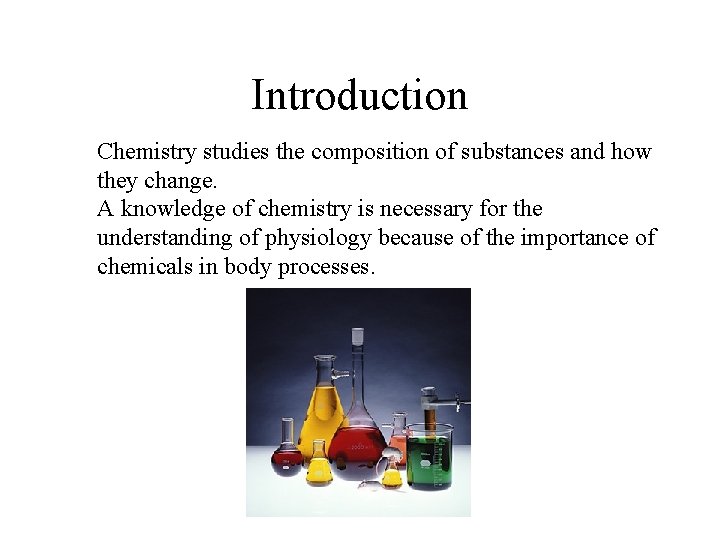
Introduction Chemistry studies the composition of substances and how they change. A knowledge of chemistry is necessary for the understanding of physiology because of the importance of chemicals in body processes.
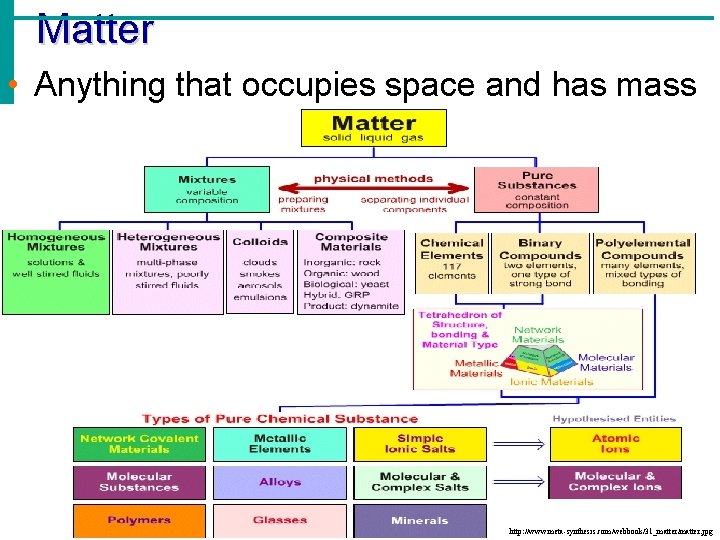
Matter • Anything that occupies space and has mass http: //www. meta-synthesis. com/webbook/31_matter/matter. jpg
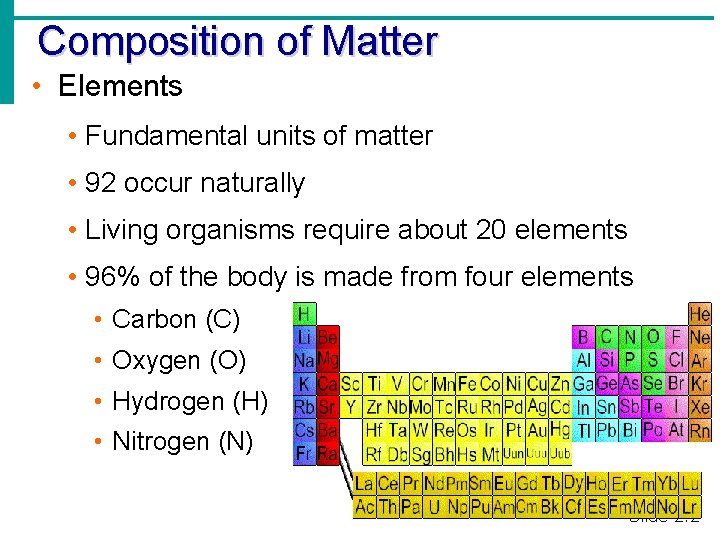
Composition of Matter • Elements • Fundamental units of matter • 92 occur naturally • Living organisms require about 20 elements • 96% of the body is made from four elements • Carbon (C) • Oxygen (O) • Hydrogen (H) • Nitrogen (N) Slide 2. 2
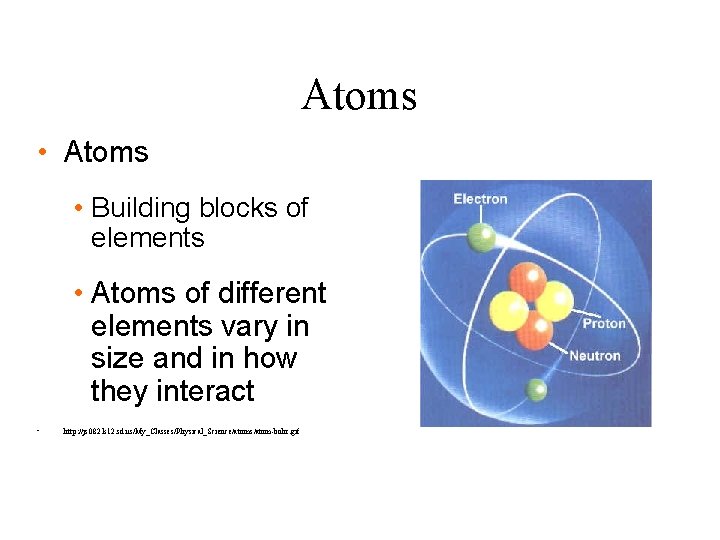
Atoms • Building blocks of elements • Atoms of different elements vary in size and in how they interact • http: //js 082. k 12. sd. us/My_Classes/Physical_Science/atoms/atom-bohr. gif
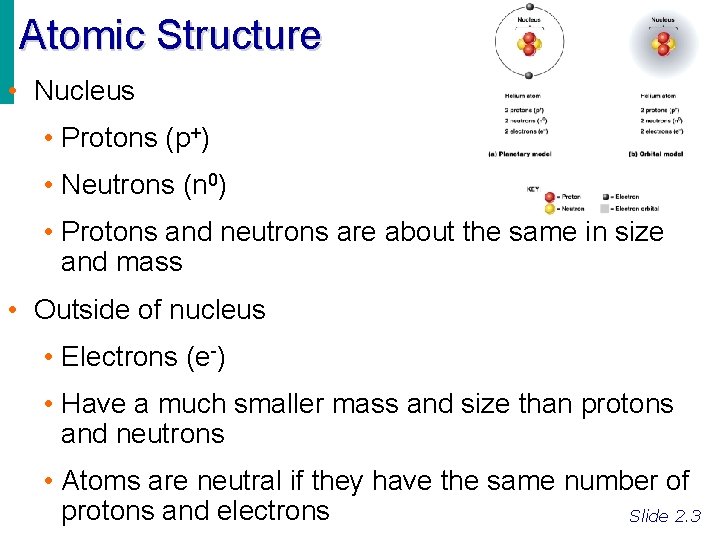
Atomic Structure • Nucleus • Protons (p+) • Neutrons (n 0) • Protons and neutrons are about the same in size and mass • Outside of nucleus • Electrons (e-) • Have a much smaller mass and size than protons and neutrons • Atoms are neutral if they have the same number of protons and electrons Slide 2. 3
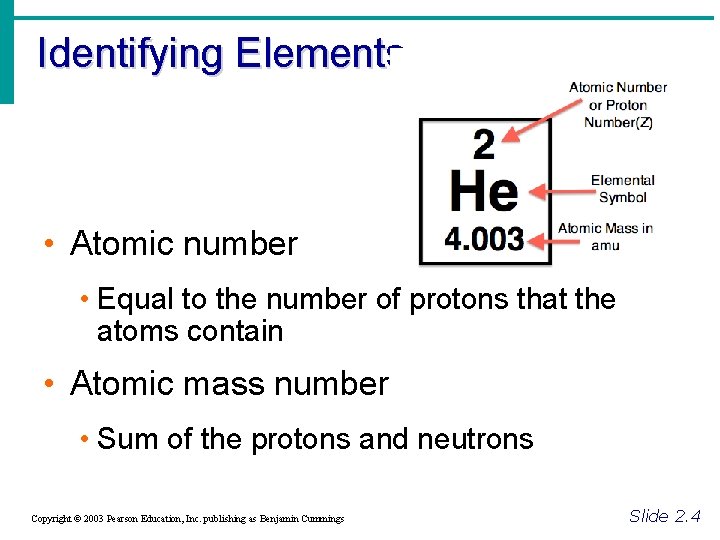
Identifying Elements • Atomic number • Equal to the number of protons that the atoms contain • Atomic mass number • Sum of the protons and neutrons Copyright © 2003 Pearson Education, Inc. publishing as Benjamin Cummings Slide 2. 4
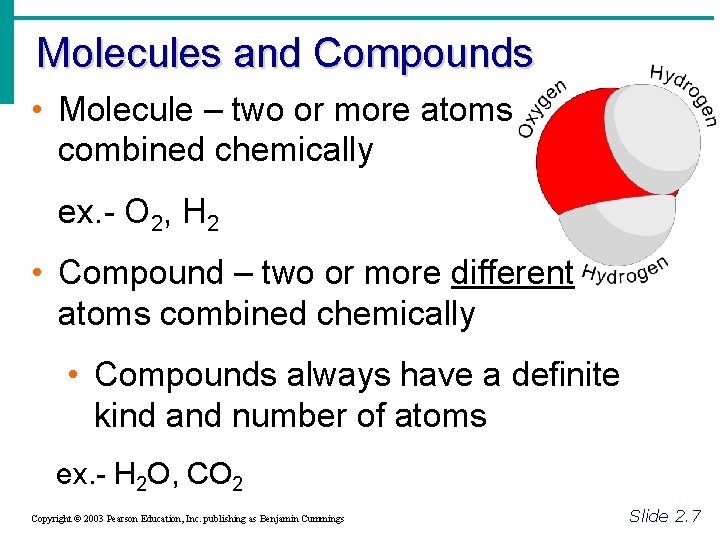
Molecules and Compounds • Molecule – two or more atoms combined chemically ex. - O 2, H 2 • Compound – two or more different atoms combined chemically • Compounds always have a definite kind and number of atoms ex. - H 2 O, CO 2 Copyright © 2003 Pearson Education, Inc. publishing as Benjamin Cummings Slide 2. 7
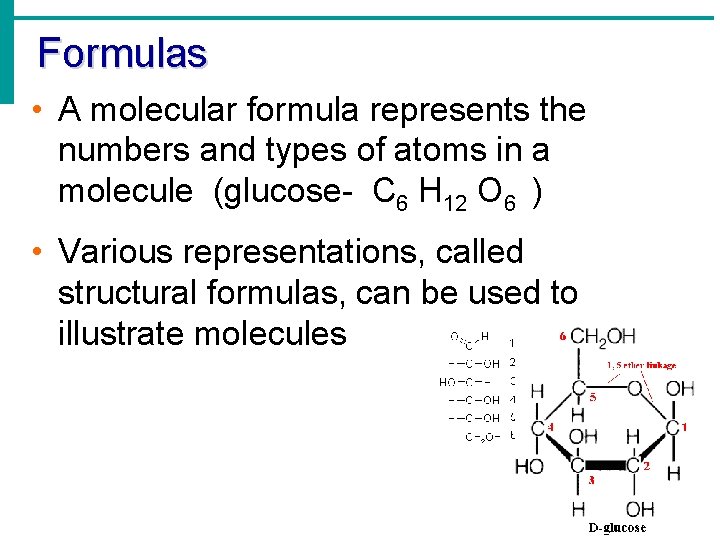
Formulas • A molecular formula represents the numbers and types of atoms in a molecule (glucose- C 6 H 12 O 6 ) • Various representations, called structural formulas, can be used to illustrate molecules
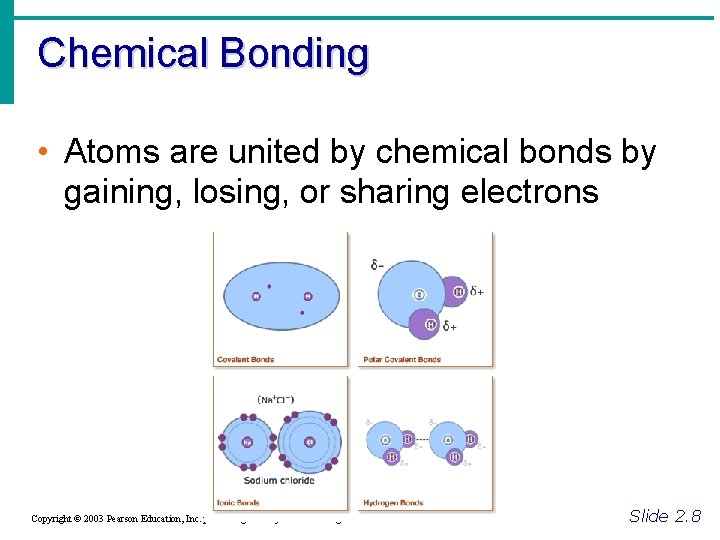
Chemical Bonding • Atoms are united by chemical bonds by gaining, losing, or sharing electrons Copyright © 2003 Pearson Education, Inc. publishing as Benjamin Cummings Slide 2. 8
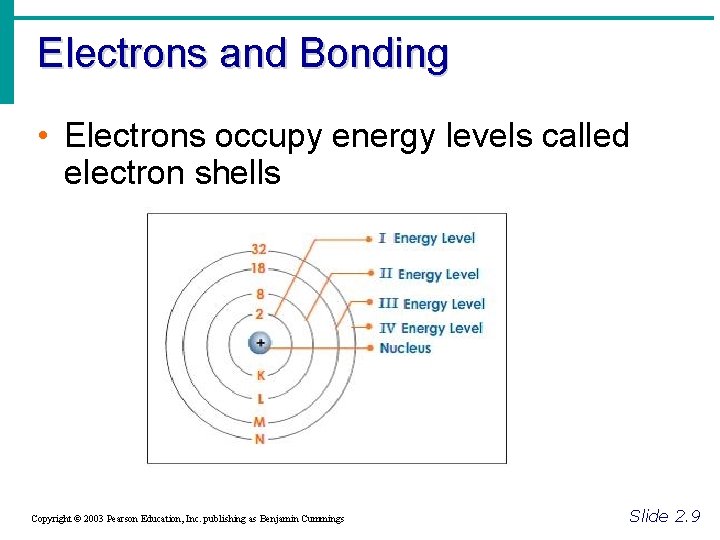
Electrons and Bonding • Electrons occupy energy levels called electron shells Copyright © 2003 Pearson Education, Inc. publishing as Benjamin Cummings Slide 2. 9
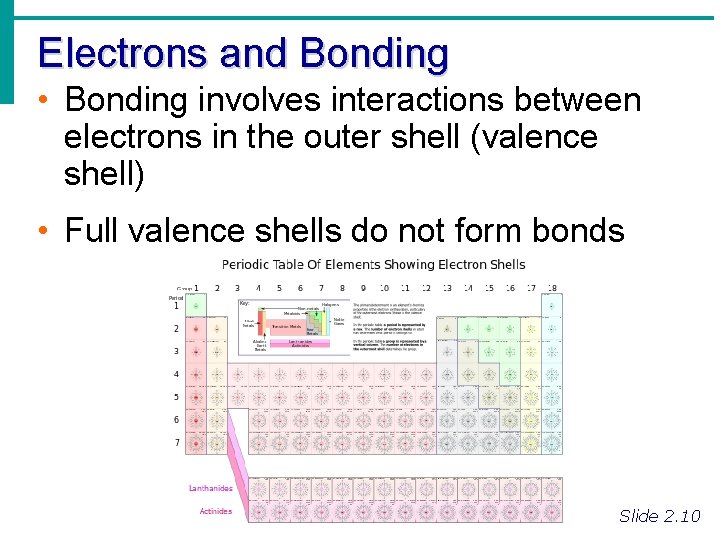
Electrons and Bonding • Bonding involves interactions between electrons in the outer shell (valence shell) • Full valence shells do not form bonds Slide 2. 10
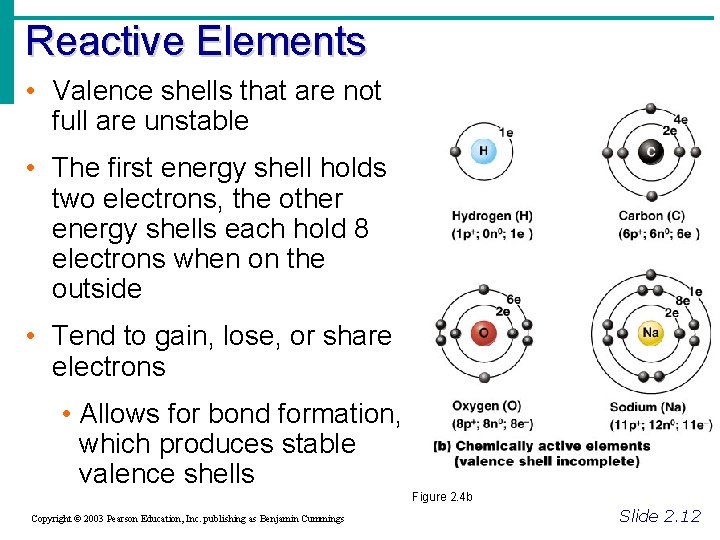
Reactive Elements • Valence shells that are not full are unstable • The first energy shell holds two electrons, the other energy shells each hold 8 electrons when on the outside • Tend to gain, lose, or share electrons • Allows for bond formation, which produces stable valence shells Figure 2. 4 b Copyright © 2003 Pearson Education, Inc. publishing as Benjamin Cummings Slide 2. 12
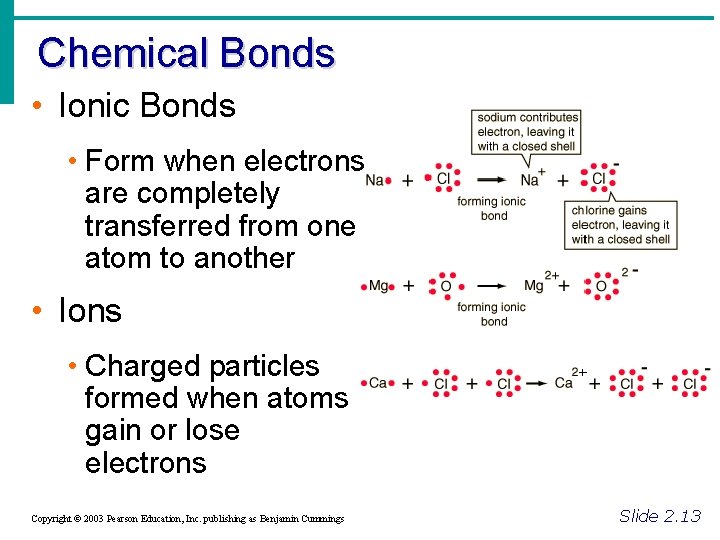
Chemical Bonds • Ionic Bonds • Form when electrons are completely transferred from one atom to another • Ions • Charged particles formed when atoms gain or lose electrons Copyright © 2003 Pearson Education, Inc. publishing as Benjamin Cummings Slide 2. 13
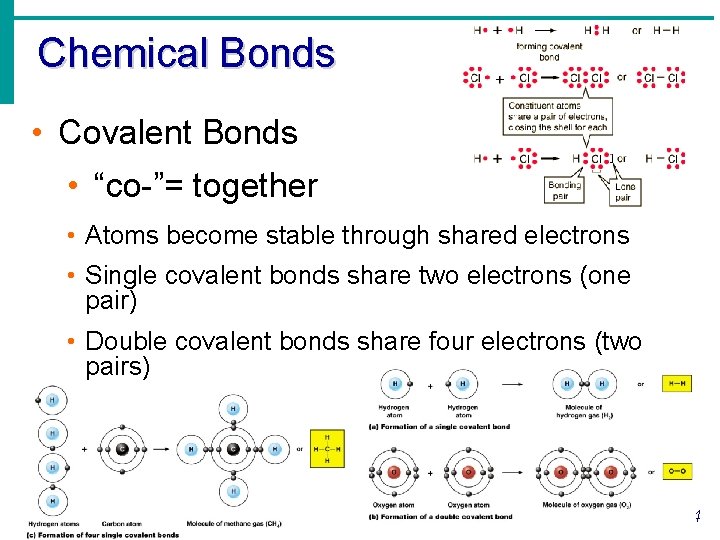
Chemical Bonds • Covalent Bonds • “co-”= together • Atoms become stable through shared electrons • Single covalent bonds share two electrons (one pair) • Double covalent bonds share four electrons (two pairs) Figure 2. 6 c Copyright © 2003 Pearson Education, Inc. publishing as Benjamin Cummings Slide 2. 14
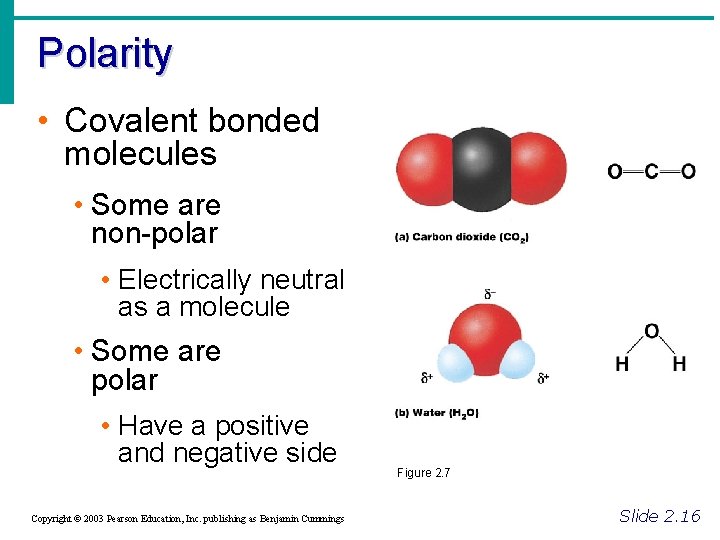
Polarity • Covalent bonded molecules • Some are non-polar • Electrically neutral as a molecule • Some are polar • Have a positive and negative side Copyright © 2003 Pearson Education, Inc. publishing as Benjamin Cummings Figure 2. 7 Slide 2. 16
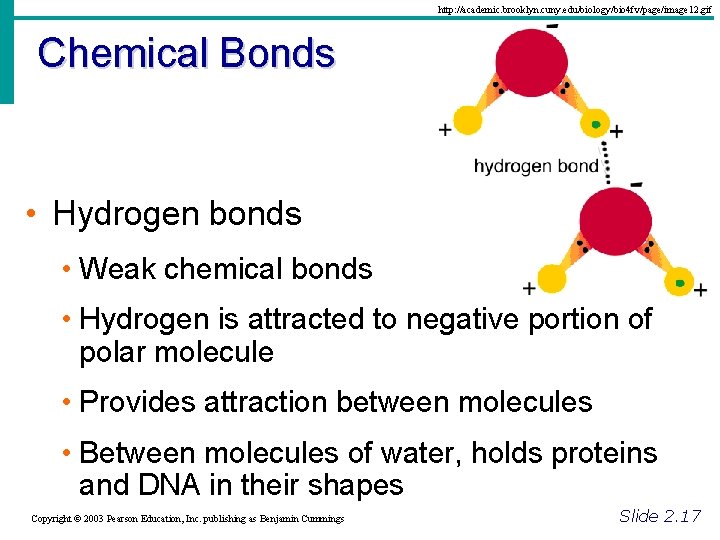
http: //academic. brooklyn. cuny. edu/biology/bio 4 fv/page/image 12. gif Chemical Bonds • Hydrogen bonds • Weak chemical bonds • Hydrogen is attracted to negative portion of polar molecule • Provides attraction between molecules • Between molecules of water, holds proteins and DNA in their shapes Copyright © 2003 Pearson Education, Inc. publishing as Benjamin Cummings Slide 2. 17
Chemical Reactions • A chemical reaction occurs as bonds are formed or broken between atoms, ions or molecules • Those changed by the reaction are the reactants • Those formed are the products • Reversible reactions are symbolized by using two arrows • Catalysts (enzymes in the body) influence the rates of reactions
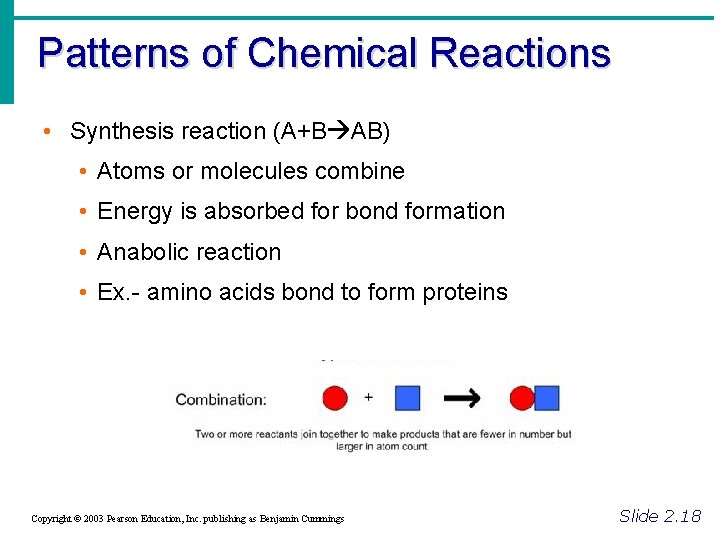
Patterns of Chemical Reactions • Synthesis reaction (A+B AB) • Atoms or molecules combine • Energy is absorbed for bond formation • Anabolic reaction • Ex. - amino acids bond to form proteins Copyright © 2003 Pearson Education, Inc. publishing as Benjamin Cummings Slide 2. 18
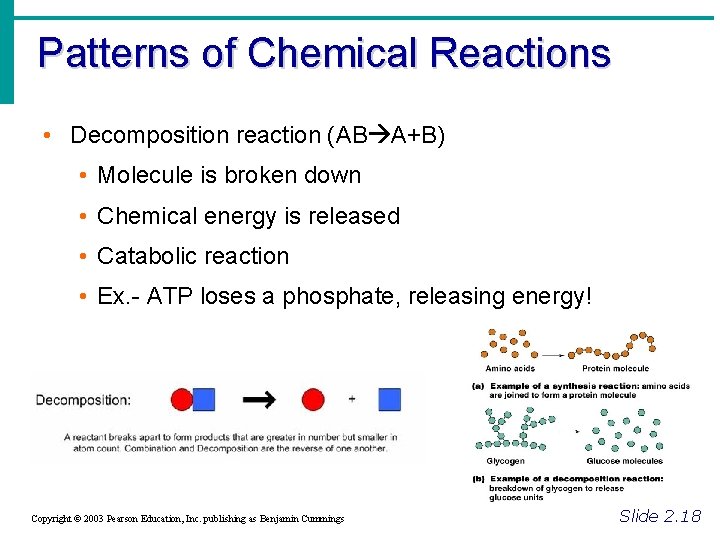
Patterns of Chemical Reactions • Decomposition reaction (AB A+B) • Molecule is broken down • Chemical energy is released • Catabolic reaction • Ex. - ATP loses a phosphate, releasing energy! Copyright © 2003 Pearson Education, Inc. publishing as Benjamin Cummings Slide 2. 18
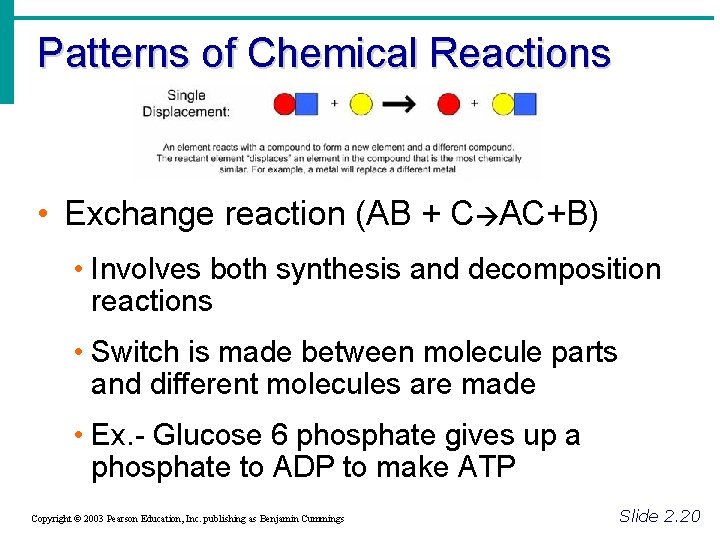
Patterns of Chemical Reactions • Exchange reaction (AB + C AC+B) • Involves both synthesis and decomposition reactions • Switch is made between molecule parts and different molecules are made • Ex. - Glucose 6 phosphate gives up a phosphate to ADP to make ATP Copyright © 2003 Pearson Education, Inc. publishing as Benjamin Cummings Slide 2. 20
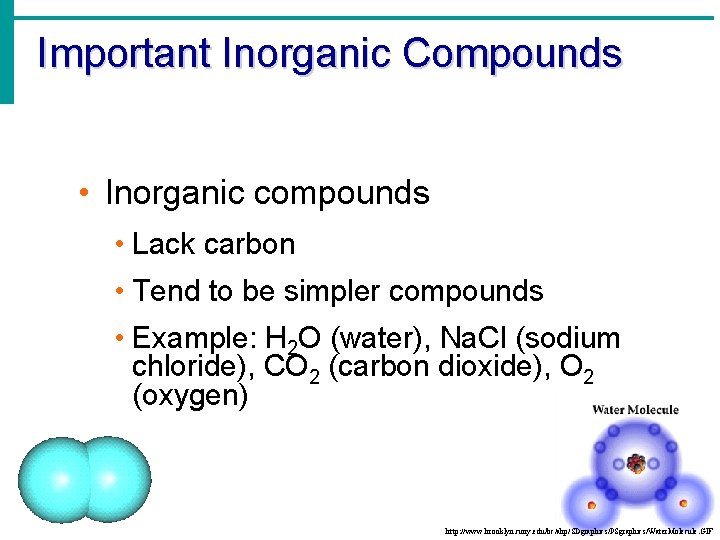
Important Inorganic Compounds • Inorganic compounds • Lack carbon • Tend to be simpler compounds • Example: H 2 O (water), Na. Cl (sodium chloride), CO 2 (carbon dioxide), O 2 (oxygen) http: //www. brooklyn. cuny. edu/bc/ahp/SDgraphics/PSgraphics/Water. Molecule. GIF
Important Inorganic Compounds- Water • Most abundant compound in living things (About 2/3 of the weight of adults) • High heat capacity- does not change temperature easily • Chemical reactivity- serves as a base for reactions • Dehydration synthesis- water is removed from adjacent atoms (H+ from one and OH- from another) to form a bond • Hydrolysis (degradation)- water is used to break bonds between molecules (H+ added to one and OH- added to another) • p. H of 7 (neutral) • Good solvent- able to dissolve many substances if they are polar • Cushion- mucus, internal organs, joints
Important Inorganic Compounds • Salts- ionic compounds • Easily break up into ions in the presence of water (dissociate) • Vital to many body functions • Include electrolytes which conduct electrical currents (ions in solution) • Exapmles: Na. Cl = sodium chloride, Ca 3(PO 4)2= calcium phosphate Copyright © 2003 Pearson Education, Inc. publishing as Benjamin Cummings Slide 2. 23
Important Inorganic Compounds • Acids • Can release detectable hydrogen ions (H+) • Low p. H (below 7), Taste sour • Examples: Common- lemon juice, coffee, carbonic acid in soda In body- Gastric juice, uric acid, vitamin C, amino acids, nucleic acids
Bases • Proton (H+) acceptors (most have hydroxide ions OH-) or release ions that combine with H+ in water • High p. H (above 7), Taste bitter, Slippery • Examples: • Common- Tums, baking soda, egg whites, sea water, Draino, bleach, oven cleaner • In body- blood and semen, just slightly
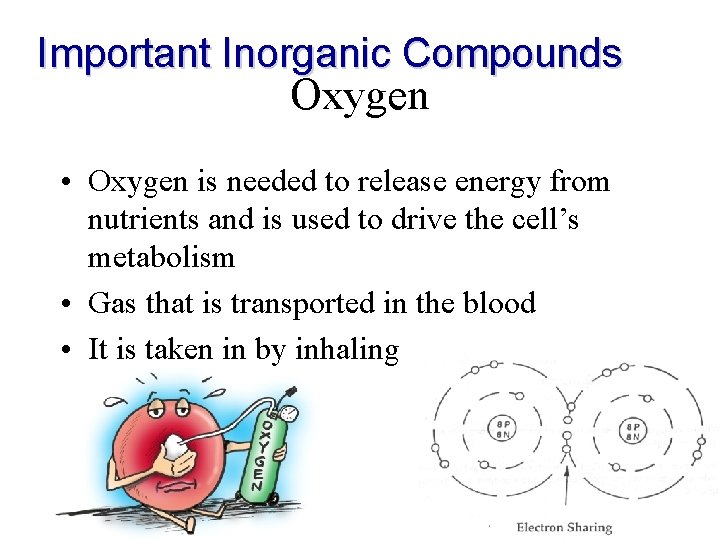
Important Inorganic Compounds Oxygen • Oxygen is needed to release energy from nutrients and is used to drive the cell’s metabolism • Gas that is transported in the blood • It is taken in by inhaling
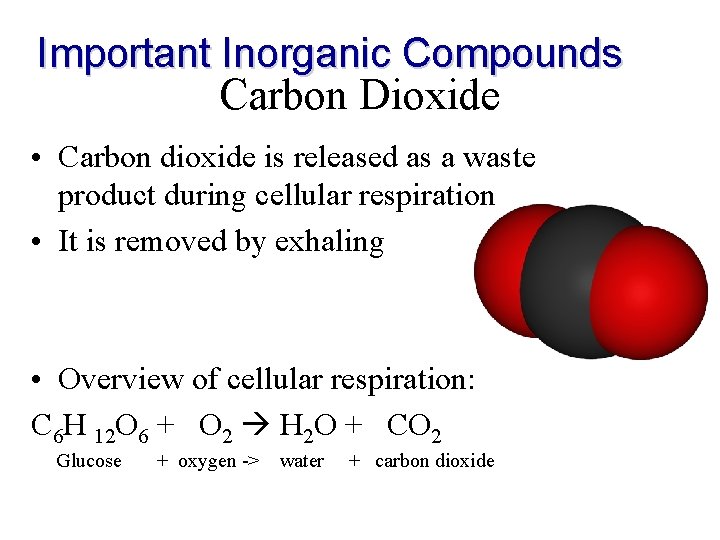
Important Inorganic Compounds Carbon Dioxide • Carbon dioxide is released as a waste product during cellular respiration • It is removed by exhaling • Overview of cellular respiration: C 6 H 12 O 6 + O 2 H 2 O + CO 2 Glucose + oxygen -> water + carbon dioxide
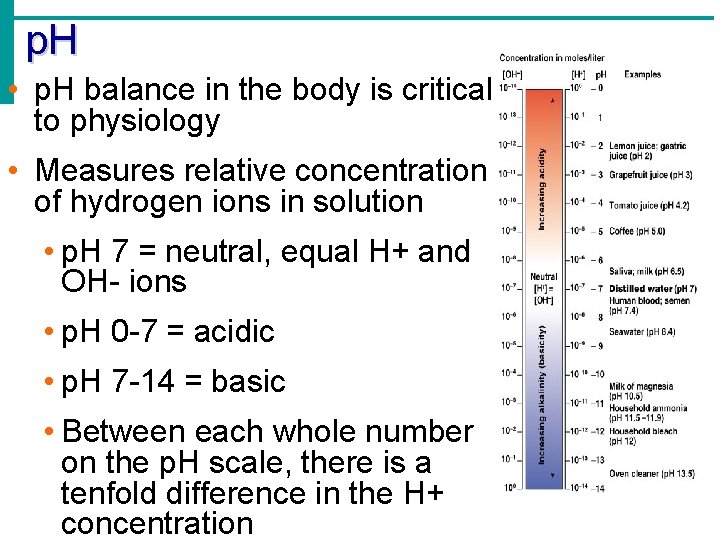
p. H • p. H balance in the body is critical to physiology • Measures relative concentration of hydrogen ions in solution • p. H 7 = neutral, equal H+ and OH- ions • p. H 0 -7 = acidic • p. H 7 -14 = basic • Between each whole number on the p. H scale, there is a tenfold difference in the H+ concentration
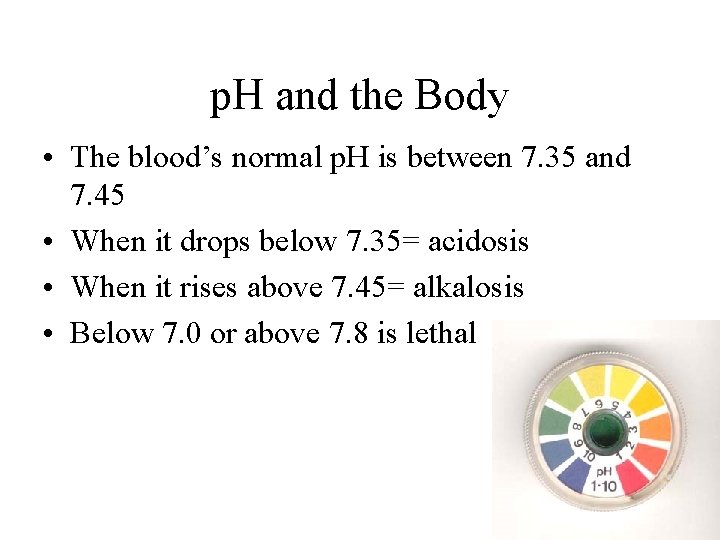
p. H and the Body • The blood’s normal p. H is between 7. 35 and 7. 45 • When it drops below 7. 35= acidosis • When it rises above 7. 45= alkalosis • Below 7. 0 or above 7. 8 is lethal
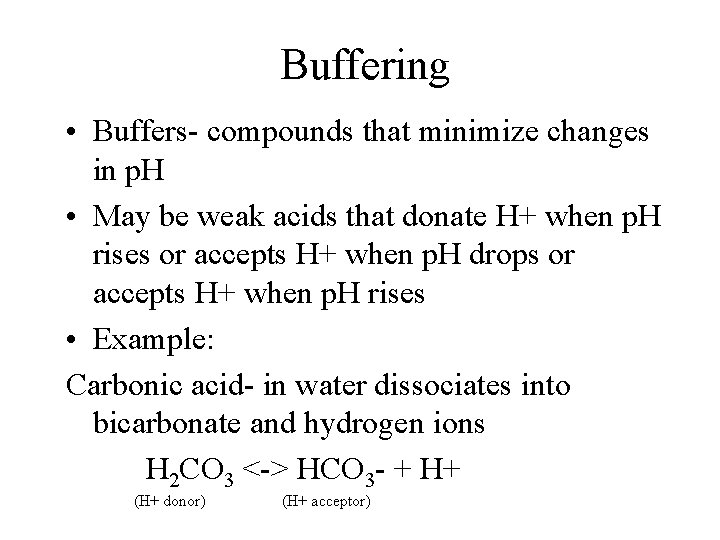
Buffering • Buffers- compounds that minimize changes in p. H • May be weak acids that donate H+ when p. H rises or accepts H+ when p. H drops or accepts H+ when p. H rises • Example: Carbonic acid- in water dissociates into bicarbonate and hydrogen ions H 2 CO 3 <-> HCO 3 - + H+ (H+ donor) (H+ acceptor)
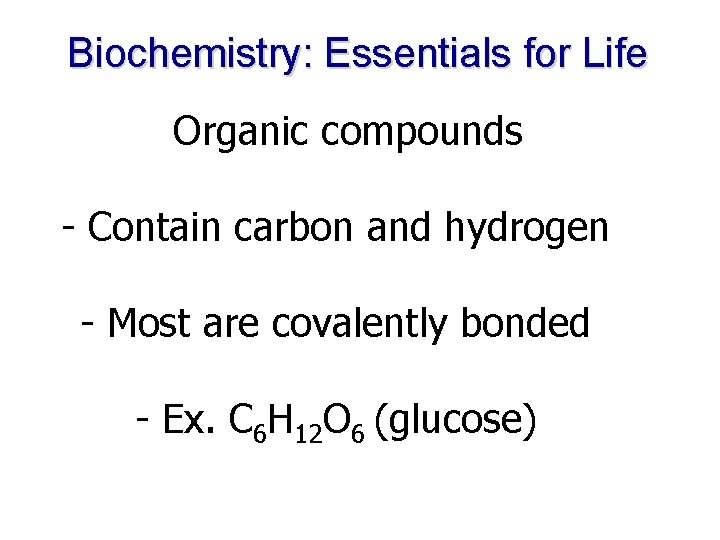
Biochemistry: Essentials for Life Organic compounds - Contain carbon and hydrogen - Most are covalently bonded - Ex. C 6 H 12 O 6 (glucose)
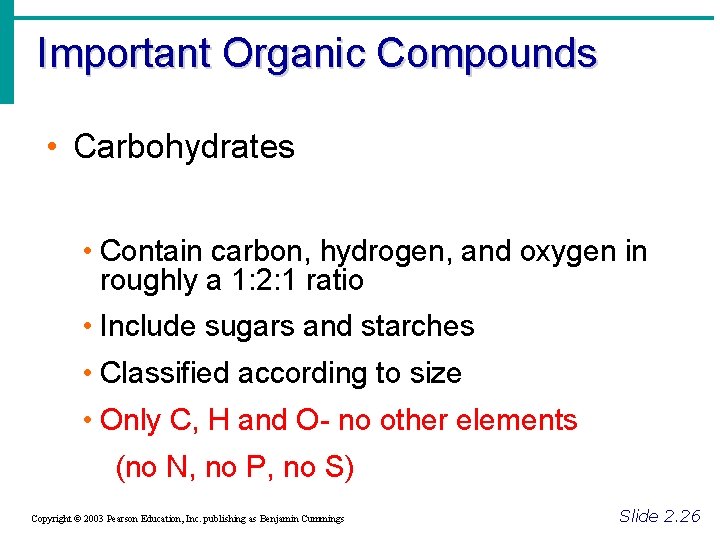
Important Organic Compounds • Carbohydrates • Contain carbon, hydrogen, and oxygen in roughly a 1: 2: 1 ratio • Include sugars and starches • Classified according to size • Only C, H and O- no other elements (no N, no P, no S) Copyright © 2003 Pearson Education, Inc. publishing as Benjamin Cummings Slide 2. 26
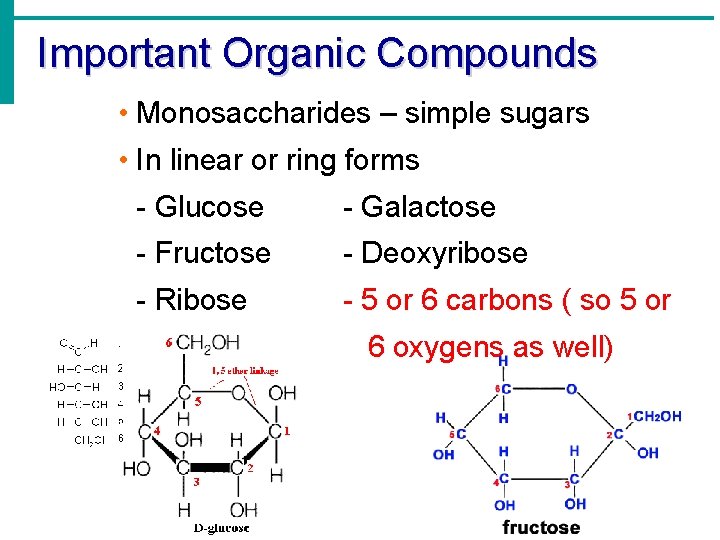
Important Organic Compounds • Monosaccharides – simple sugars • In linear or ring forms - Glucose - Galactose - Fructose - Deoxyribose - Ribose - 5 or 6 carbons ( so 5 or 6 oxygens as well)
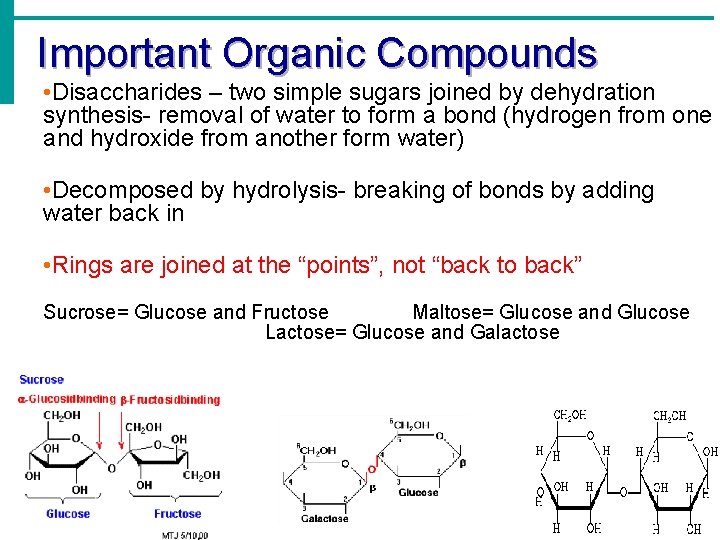
Important Organic Compounds • Disaccharides – two simple sugars joined by dehydration synthesis- removal of water to form a bond (hydrogen from one and hydroxide from another form water) • Decomposed by hydrolysis- breaking of bonds by adding water back in • Rings are joined at the “points”, not “back to back” Sucrose= Glucose and Fructose Maltose= Glucose and Glucose Lactose= Glucose and Galactose
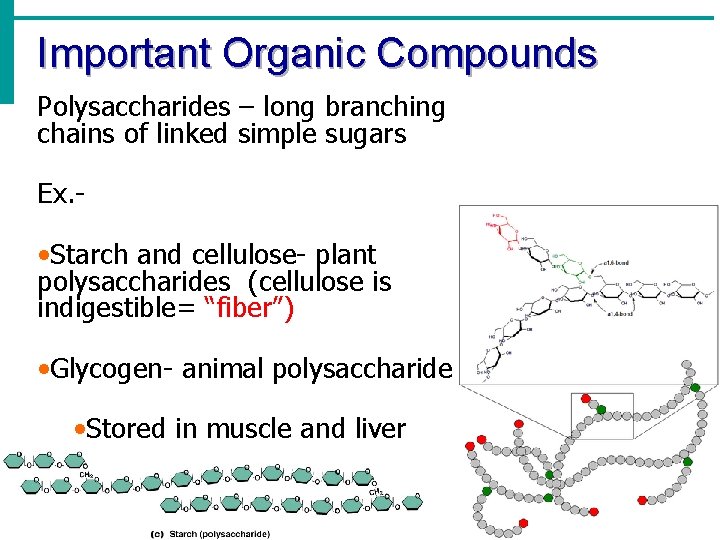
Important Organic Compounds Polysaccharides – long branching chains of linked simple sugars Ex. - • Starch and cellulose- plant polysaccharides (cellulose is indigestible= “fiber”) • Glycogen- animal polysaccharide • Stored in muscle and liver
Important Organic Compounds • Lipids- “fats” • Contain carbon, hydrogen, and oxygen • Carbon and hydrogen outnumber oxygen • Monomers (single units- building blocks) are fatty acids and glycerol • Most are insoluble in water • Most are non-polar • Some have polar heads • May be used to supply energy Copyright © 2003 Pearson Education, Inc. publishing as Benjamin Cummings Slide 2. 29
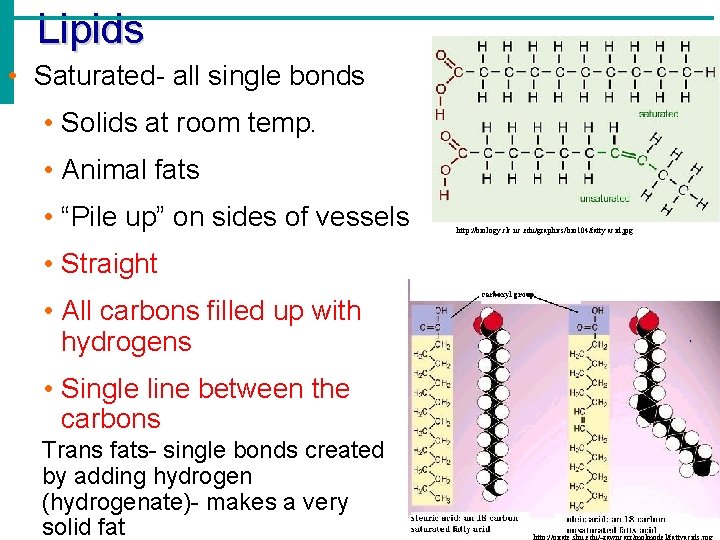
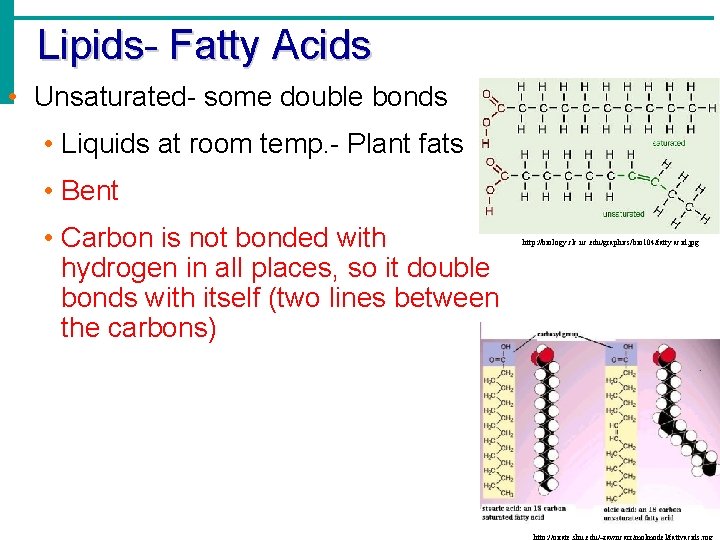
Lipids • Saturated- all single bonds • Solids at room temp. • Animal fats • “Pile up” on sides of vessels • Straight • All carbons filled up with hydrogens • Single line between the carbons Trans fats- single bonds created by adding hydrogen (hydrogenate)- makes a very solid fat http: //biology. clc. uc. edu/graphics/bio 104/fatty acid. jpg
Lipids- Fatty Acids • Unsaturated- some double bonds • Liquids at room temp. - Plant fats • Bent • Carbon is not bonded with hydrogen in all places, so it double bonds with itself (two lines between the carbons) http: //biology. clc. uc. edu/graphics/bio 104/fatty acid. jpg
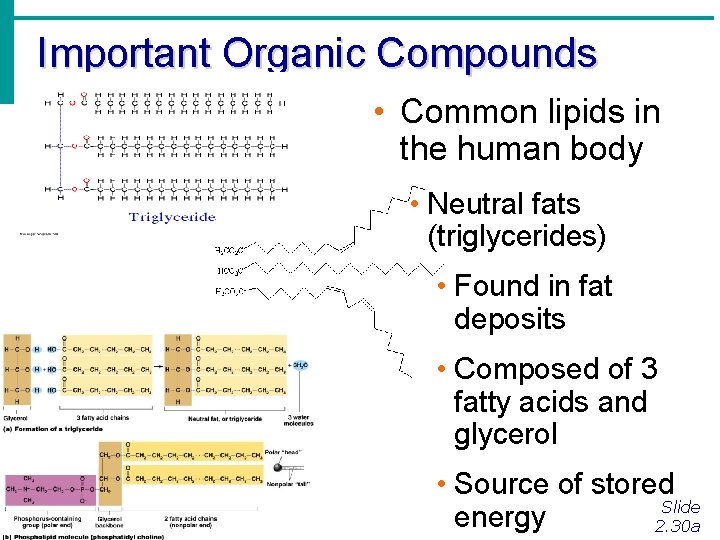
Important Organic Compounds • Common lipids in the human body • Neutral fats (triglycerides) • Found in fat deposits • Composed of 3 fatty acids and glycerol • Source of stored Slide energy 2. 30 a
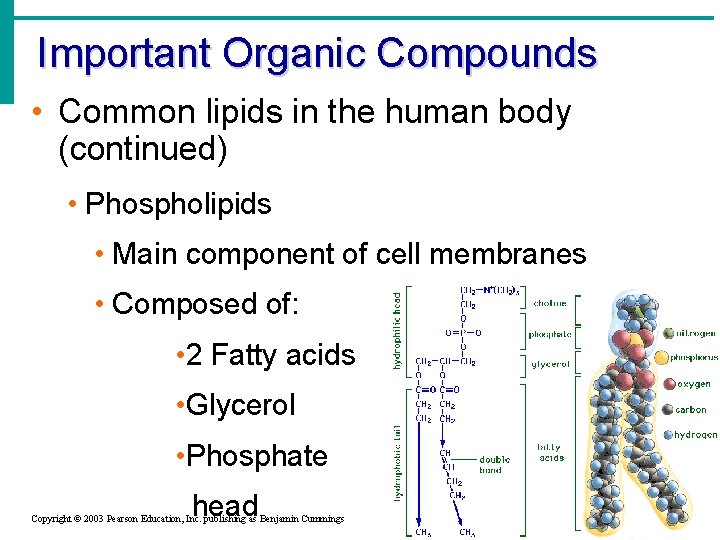
Important Organic Compounds • Common lipids in the human body (continued) • Phospholipids • Main component of cell membranes • Composed of: • 2 Fatty acids • Glycerol • Phosphate head Copyright © 2003 Pearson Education, Inc. publishing as Benjamin Cummings Slide 2. 30 b
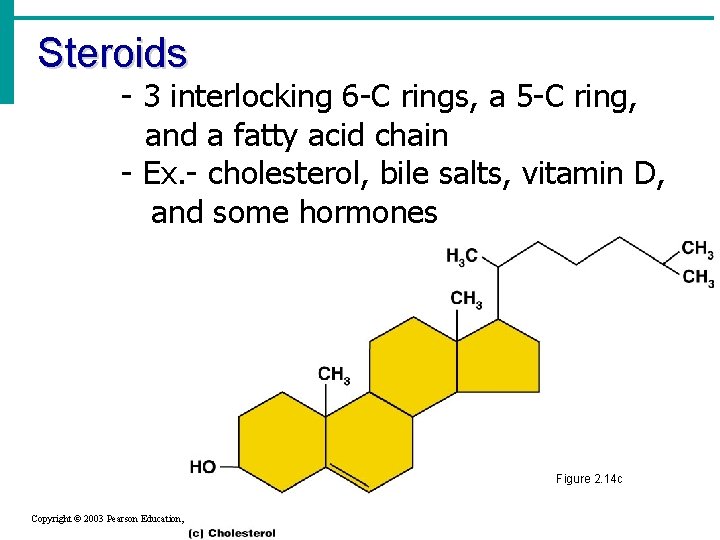
Steroids - 3 interlocking 6 -C rings, a 5 -C ring, and a fatty acid chain - Ex. - cholesterol, bile salts, vitamin D, and some hormones Figure 2. 14 c Copyright © 2003 Pearson Education, Inc. publishing as Benjamin Cummings Slide 2. 32
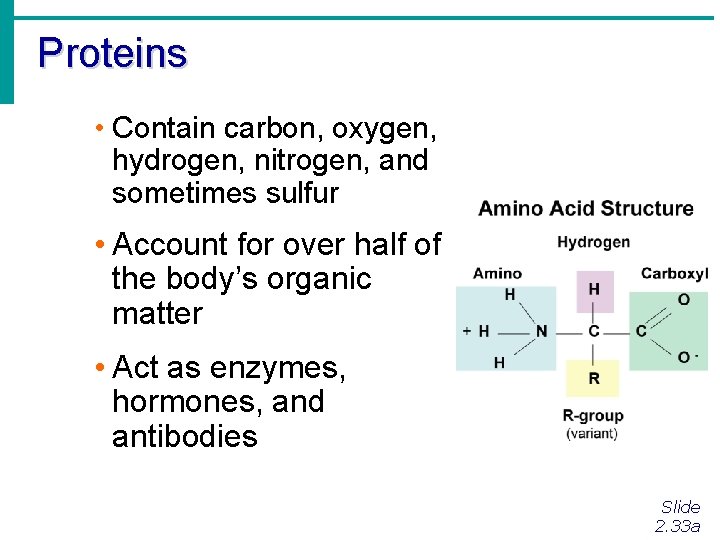
Proteins • Contain carbon, oxygen, hydrogen, nitrogen, and sometimes sulfur • Account for over half of the body’s organic matter • Act as enzymes, hormones, and antibodies Slide 2. 33 a
Proteins - Monomers • Made of amino acids- 20 different ones • Each amino acid differs from others by a variable “R” group • Form peptide bonds through dehydration synthesis • Essential amino acids- needed in diet • Non-essential amino acids- made in body • Provides for construction materials for body tissues • Plays a vital role in cell function Slide 2. 33 b
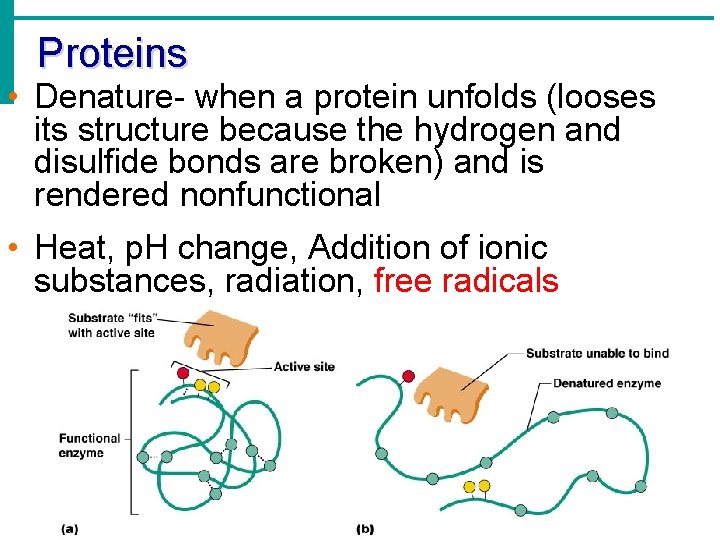
Proteins • Denature- when a protein unfolds (looses its structure because the hydrogen and disulfide bonds are broken) and is rendered nonfunctional • Heat, p. H change, Addition of ionic substances, radiation, free radicals
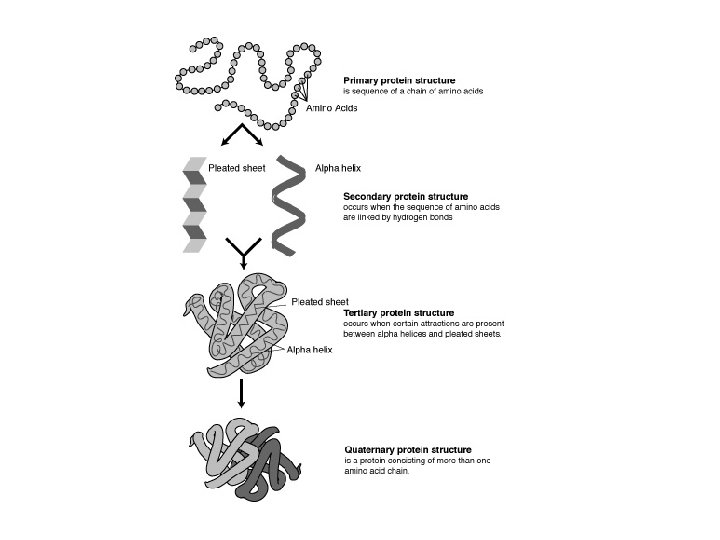
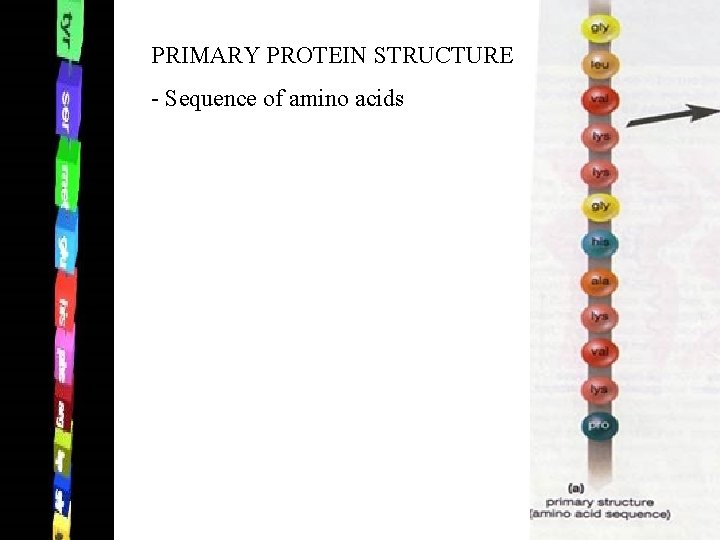
PRIMARY PROTEIN STRUCTURE - Sequence of amino acids
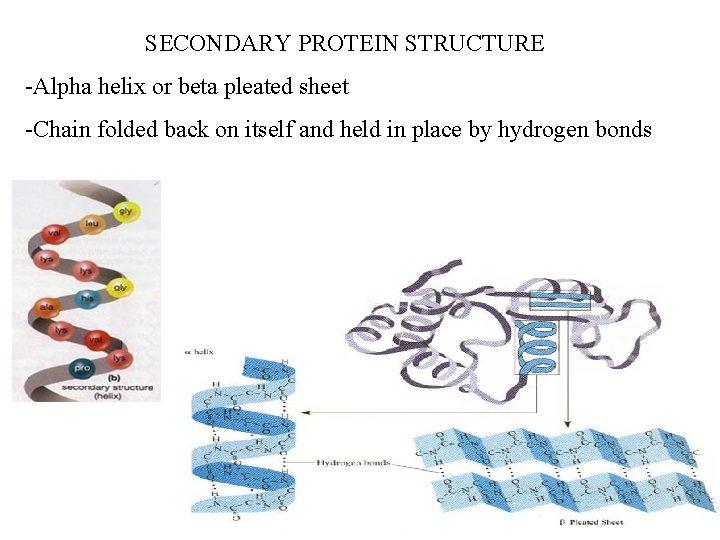
SECONDARY PROTEIN STRUCTURE -Alpha helix or beta pleated sheet -Chain folded back on itself and held in place by hydrogen bonds
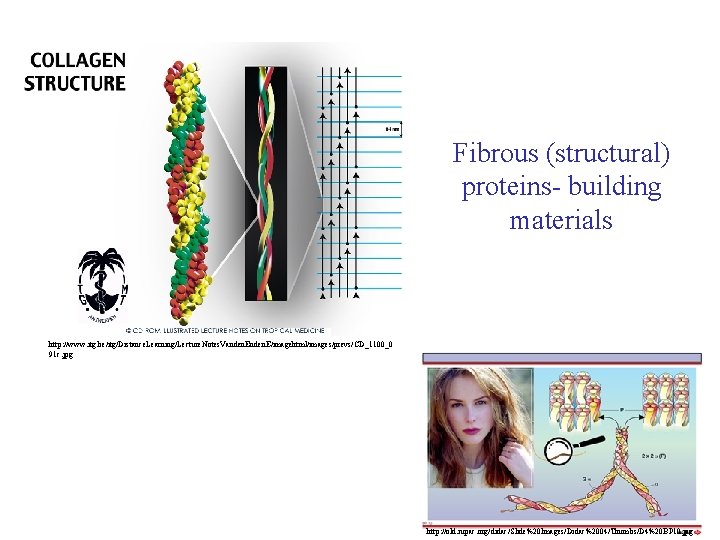
In Quaternary form: Fibrous (structural) proteins- building materials Keratin Collagen http: //www. itg. be/itg/Distance. Learning/Lecture. Notes. Vanden. E/imagehtml/images/prevs/CD_1100_0 91 c. jpg http: //old. iupac. org/didac/Slide%20 Images/Didac%2004/Thumbs/D 4%20 BP 10. jpg
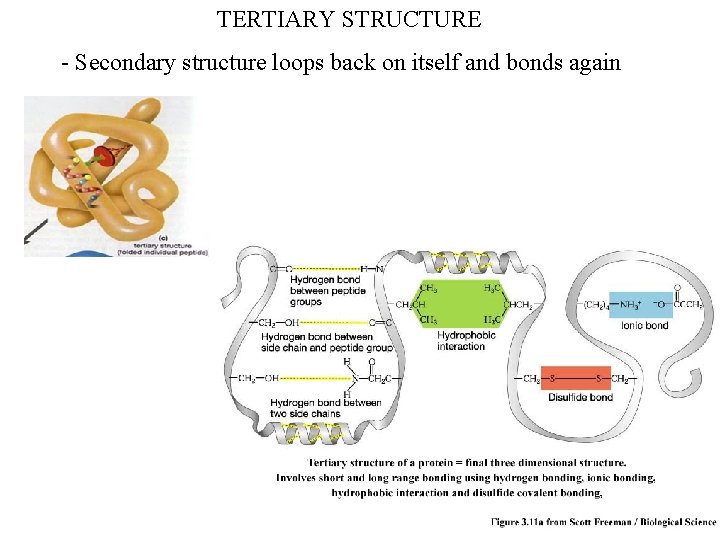
TERTIARY STRUCTURE - Secondary structure loops back on itself and bonds again
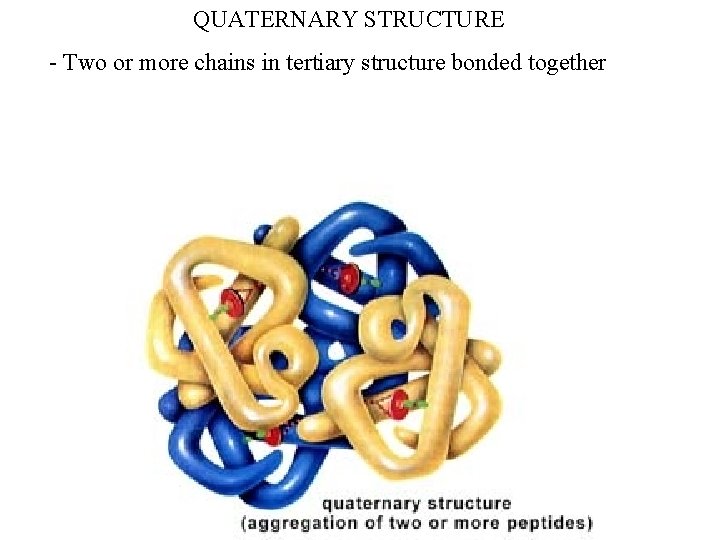
QUATERNARY STRUCTURE - Two or more chains in tertiary structure bonded together
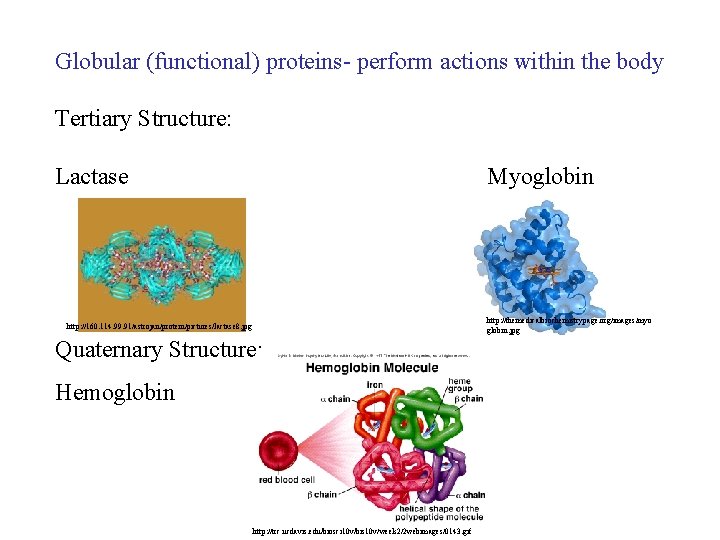
Globular (functional) proteins- perform actions within the body Tertiary Structure: Lactase Myoglobin http: //themedicalbiochemistrypage. org/images/myo globin. jpg http: //160. 114. 99. 91/astrojan/protein/pictures/lactase 8. jpg Quaternary Structure: Hemoglobin http: //trc. ucdavis. edu/biosci 10 v/bis 10 v/week 2/2 webimages/0143. gif
Nucleic Acids • Monomers composed of nucleotides • Sugar (ribose or deoxyribose) • Phosphate • Nucleotide bases • A = Adenine • G = Guanine • C = Cytosine • T = Thymine (Only in DNA) • U = Uracil (Only in RNA) • A bonds to T (U), G to C
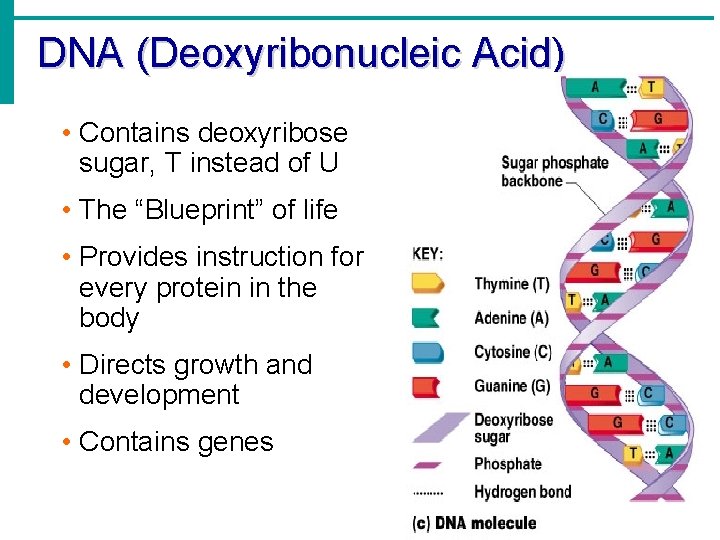
DNA (Deoxyribonucleic Acid) • Contains deoxyribose sugar, T instead of U • The “Blueprint” of life • Provides instruction for every protein in the body • Directs growth and development • Contains genes
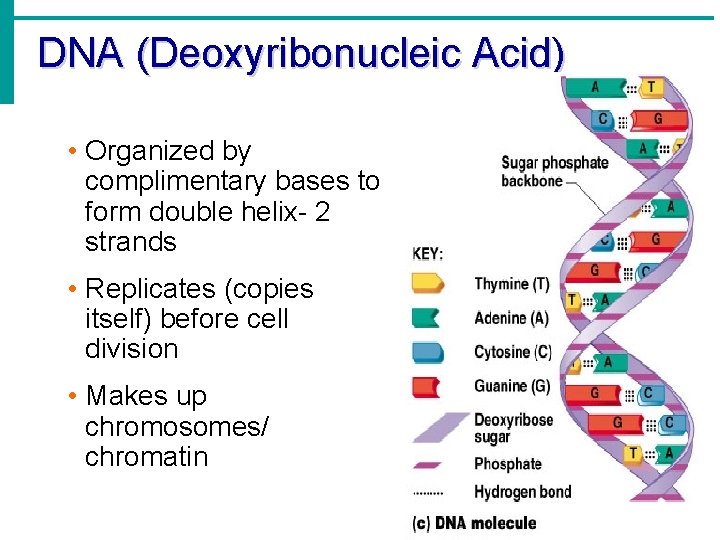
DNA (Deoxyribonucleic Acid) • Organized by complimentary bases to form double helix- 2 strands • Replicates (copies itself) before cell division • Makes up chromosomes/ chromatin
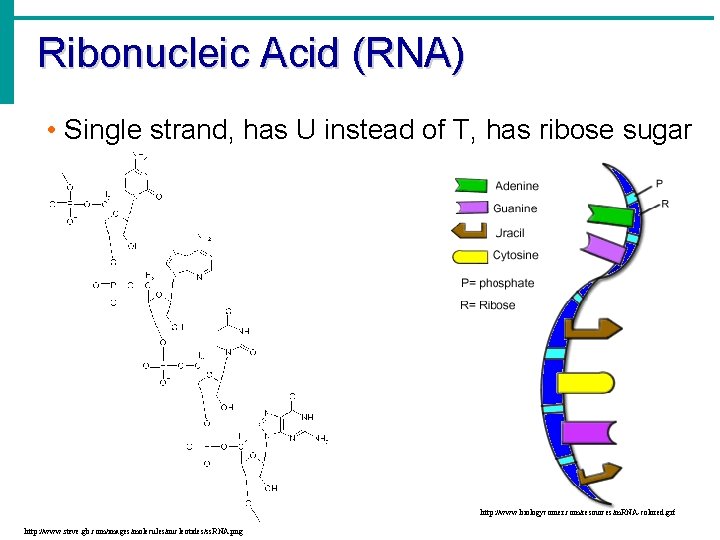
Ribonucleic Acid (RNA) • Single strand, has U instead of T, has ribose sugar http: //www. biologycorner. com/resources/m. RNA-colored. gif http: //www. steve. gb. com/images/molecules/nucleotides/ss. RNA. png
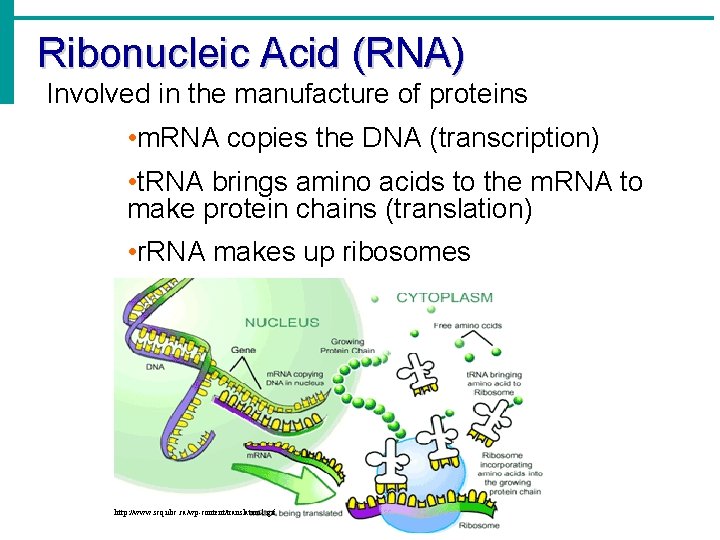
Ribonucleic Acid (RNA) Involved in the manufacture of proteins • m. RNA copies the DNA (transcription) • t. RNA brings amino acids to the m. RNA to make protein chains (translation) • r. RNA makes up ribosomes http: //www. scq. ubc. ca/wp-content/translation 1. gif
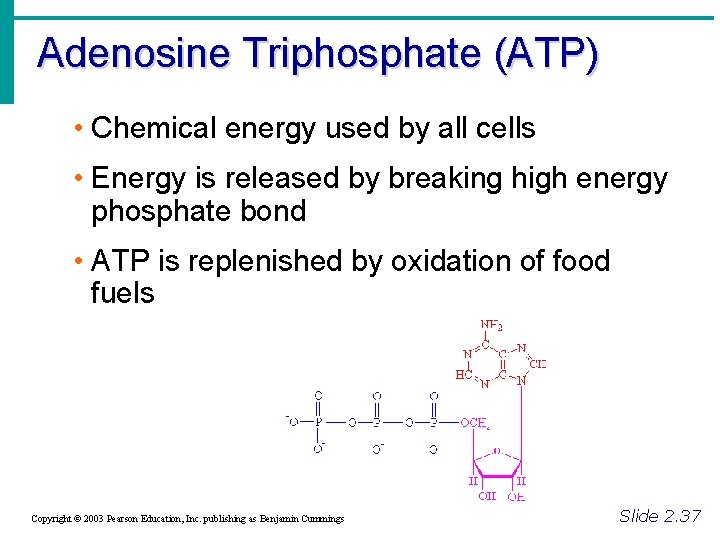
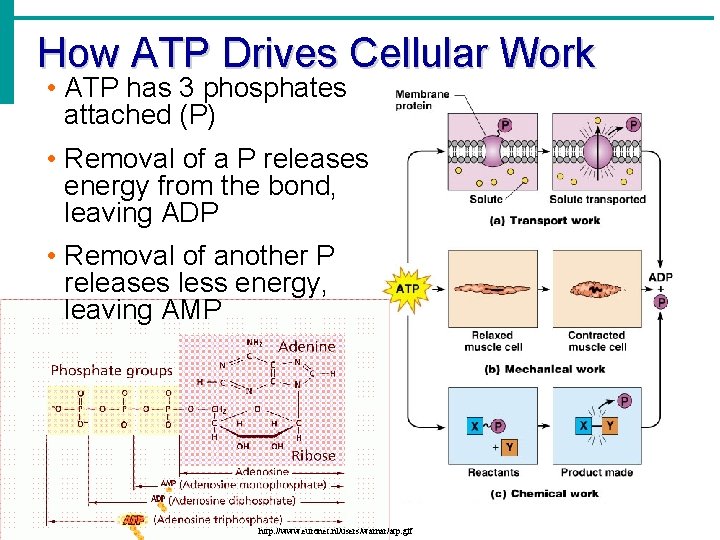
Adenosine Triphosphate (ATP) • Chemical energy used by all cells • Energy is released by breaking high energy phosphate bond • ATP is replenished by oxidation of food fuels Copyright © 2003 Pearson Education, Inc. publishing as Benjamin Cummings Slide 2. 37
How ATP Drives Cellular Work • ATP has 3 phosphates attached (P) • Removal of a P releases energy from the bond, leaving ADP • Removal of another P releases less energy, leaving AMP http: //www. euronet. nl/users/warnar/atp. gif
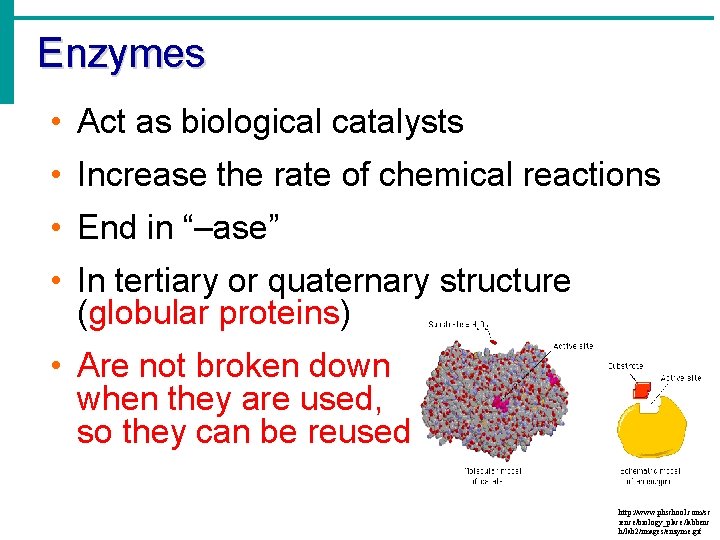
Enzymes • Act as biological catalysts • Increase the rate of chemical reactions • End in “–ase” • In tertiary or quaternary structure (globular proteins) • Are not broken down when they are used, so they can be reused http: //www. phschool. com/sc ience/biology_place/labbenc h/lab 2/images/enzyme. gif
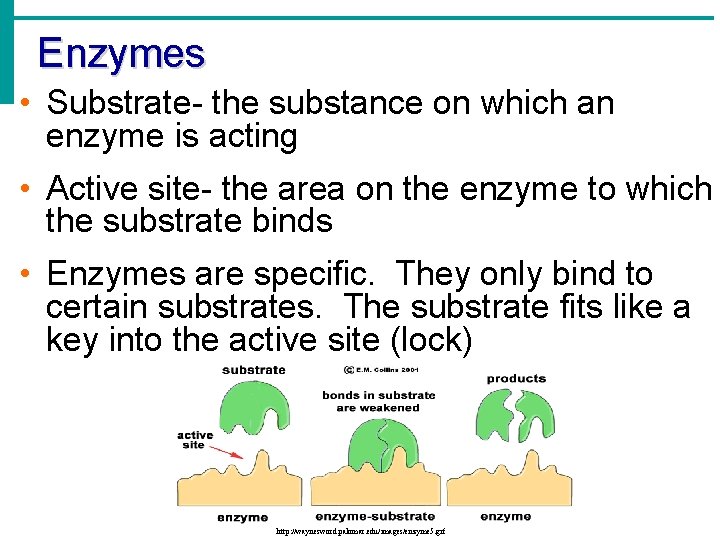
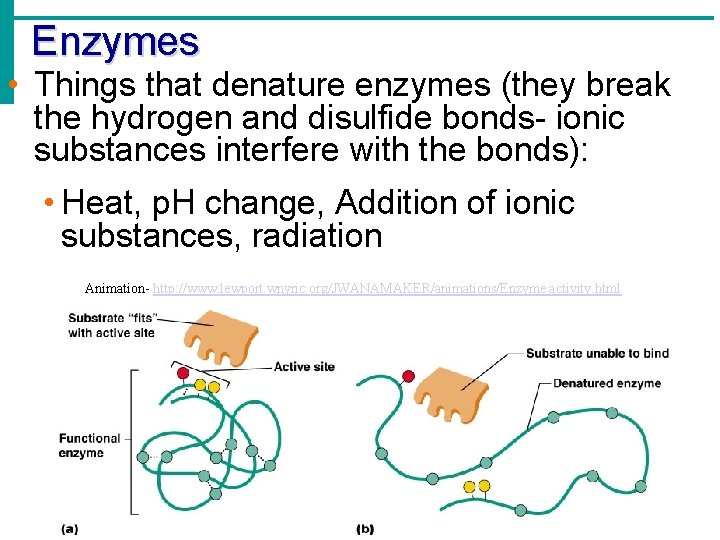
Enzymes • Substrate- the substance on which an enzyme is acting • Active site- the area on the enzyme to which the substrate binds • Enzymes are specific. They only bind to certain substrates. The substrate fits like a key into the active site (lock) http: //waynesword. palomar. edu/images/enzyme 5. gif
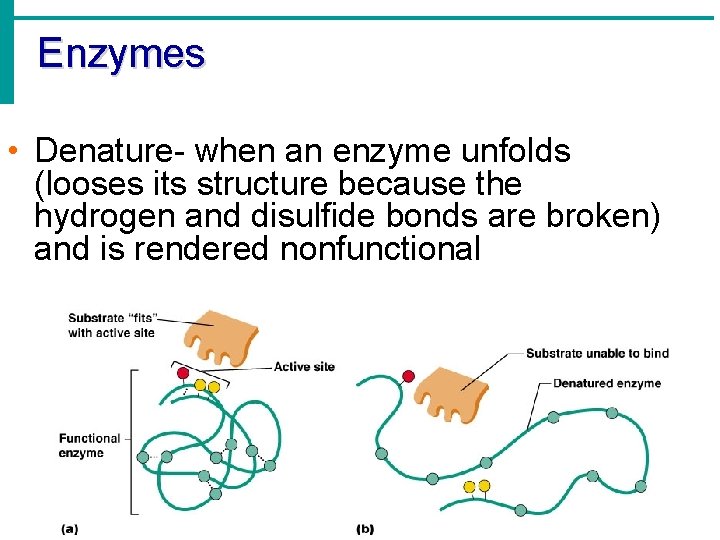
Enzymes • Denature- when an enzyme unfolds (looses its structure because the hydrogen and disulfide bonds are broken) and is rendered nonfunctional
Enzymes • Things that denature enzymes (they break the hydrogen and disulfide bonds- ionic substances interfere with the bonds): • Heat, p. H change, Addition of ionic substances, radiation Animation- http: //www. lewport. wnyric. org/JWANAMAKER/animations/Enzyme activity. html