
Essentials of Sociology Fifth Edition Chapter Four Social
- Slides: 16
Essentials of Sociology Fifth Edition Chapter Four Social Structure & Social Interaction This multimedia product and its contents are protected under copyright law. The following are prohibited by law: any public performance or display, including transmission of any image over a network; preparation of any derivative work, including the extraction, in whole or in part, of any images; any rental, lease, or lending of the program. Copyright © 2004 by Allyn and Bacon 1
The Macrosociological Perspective : Social Structure Copyright © 2004 by Allyn and Bacon 2
The Macrosociological Perspective n n Social structure refers to the typical patterns of a group. q Social structure guides our behavior. Social location, or a person’s location in the social structure, creates the variances. Copyright © 2004 by Allyn and Bacon 3
Culture n Culture is the broadest framework that determines what kind of people we become. Copyright © 2004 by Allyn and Bacon 4
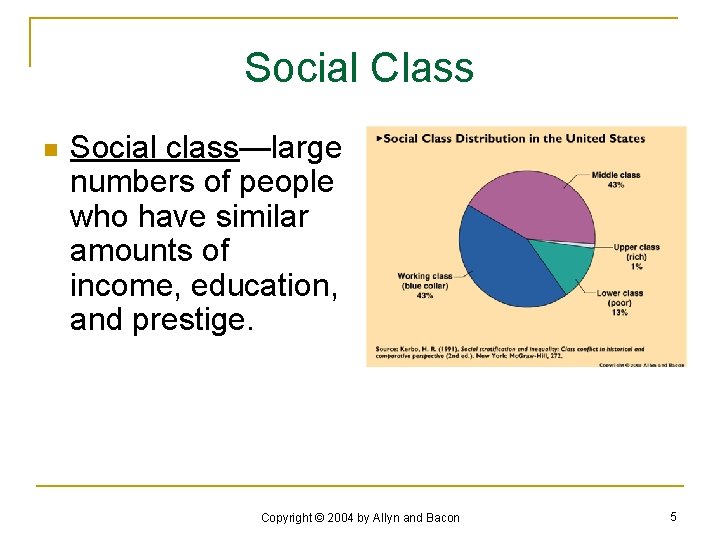
Social Class n Social class—large numbers of people who have similar amounts of income, education, and prestige. Copyright © 2004 by Allyn and Bacon 5
Social Status n Status—the position that an individual occupies. Ascribed Status is involuntary q Achieved Status is earned q Copyright © 2004 by Allyn and Bacon 6
Roles n n Roles—the behaviors, obligations, and privileges attached to a status. The difference between a role and a status: q You occupy a status. q You play a role. Copyright © 2004 by Allyn and Bacon 7
Groups and Institutions n A group—consists of people who regularly and consciously interact with one another. n Social institutions— the means that each society develops to meet its basic needs. Copyright © 2004 by Allyn and Bacon 8
Societies n Society- people who share a culture and a territory. q Your life would vary in each society Copyright © 2004 by Allyn and Bacon 9
The Microsociological Perspective : Social Interaction in Everyday Life Copyright © 2004 by Allyn and Bacon 10
Personal Space n Distance zones q. Intimate q. Personal q. Social q. Public Copyright © 2004 by Allyn and Bacon 11
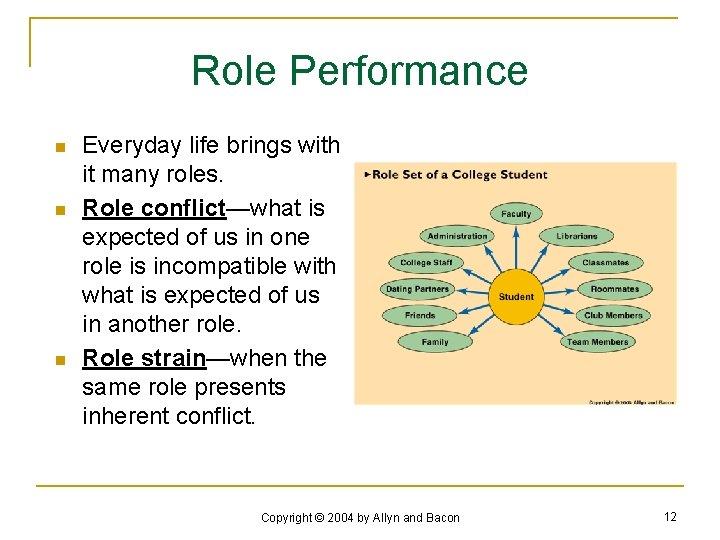
Role Performance n n n Everyday life brings with it many roles. Role conflict—what is expected of us in one role is incompatible with what is expected of us in another role. Role strain—when the same role presents inherent conflict. Copyright © 2004 by Allyn and Bacon 12
Ethnomethodology n Ethnomethodology—the study of how people use commonsense understandings to get through everyday life. n Ethnomethodologists explore background assumptions. q Background assumptions—your ideas about the way life is and the way things ought to work. Copyright © 2004 by Allyn and Bacon 13
The Social Construction of Reality n n Thomas Theorem— “If people define situations as real, they are real in their consequences. ” Our behavior does not depend on the objective existence of something, but on the subjective. n The social construction of reality—society and life experiences define what is real. Copyright © 2004 by Allyn and Bacon 14
The Need For Both Macrosociology & Microsociology Our understanding of behavior would be incomplete without one or the other. Copyright © 2004 by Allyn and Bacon 15
Chambliss Study n Two groups of high school boys studied by sociologist William Chambliss. Both groups attended Hanibal High School. 8 middle-class boys who came from “good” families (Saints) q 6 lower-class boys who were seen as headed down a dead-end road (Roughnecks) q Copyright © 2004 by Allyn and Bacon 16