Environmental Economics Lecture 2 Hendrik Wolff hgwolffu washington




- Slides: 55
Environmental Economics Lecture 2 Hendrik Wolff hgwolff@u. washington. edu
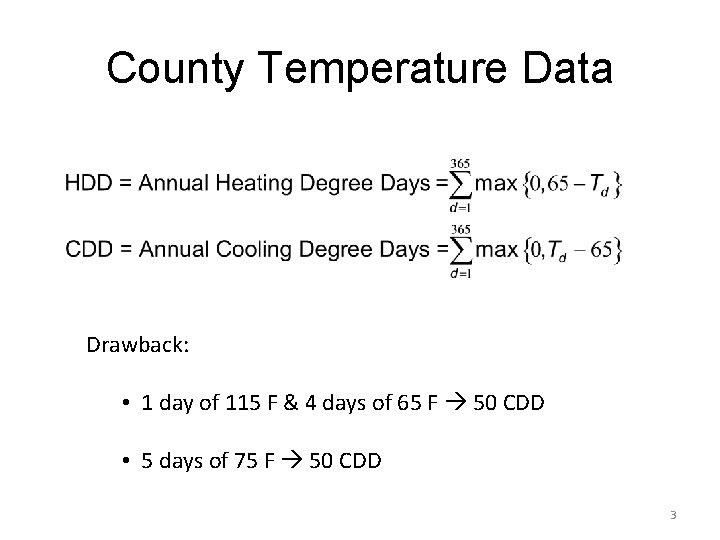
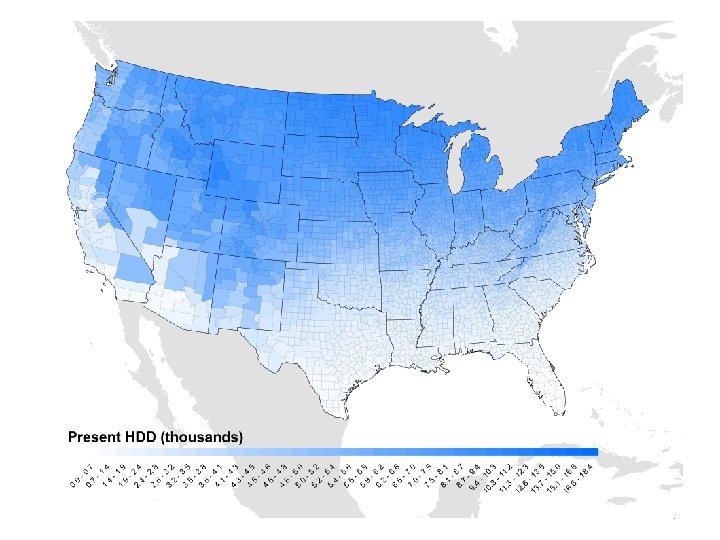
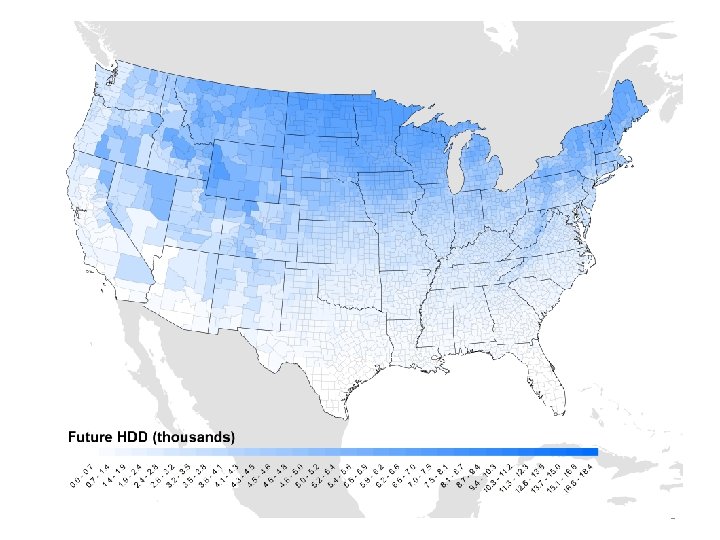
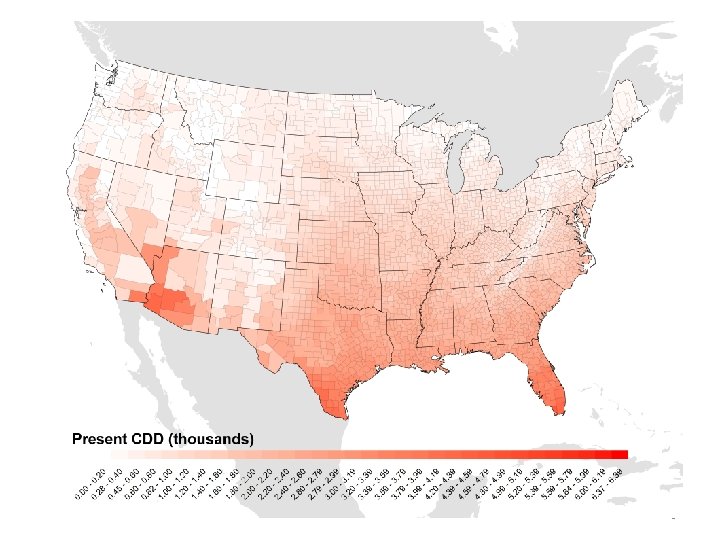
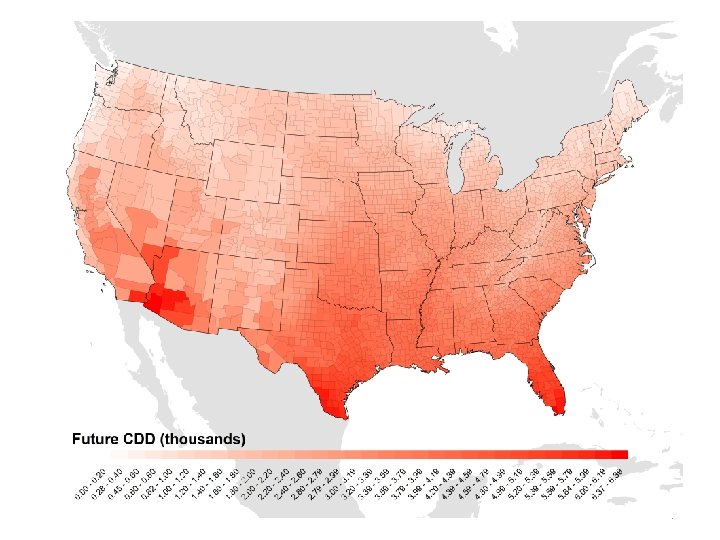
County Temperature Data 2
County Temperature Data Drawback: • 1 day of 115 F & 4 days of 65 F 50 CDD • 5 days of 75 F 50 CDD 3
4
5
6
7
8
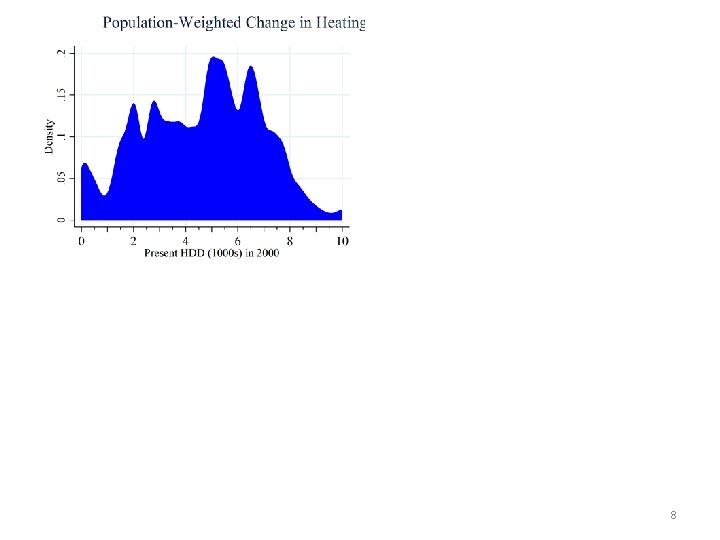
9
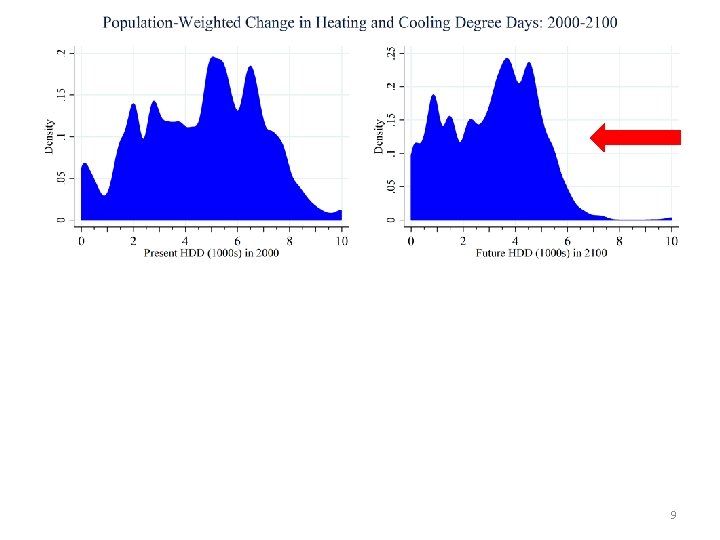
10
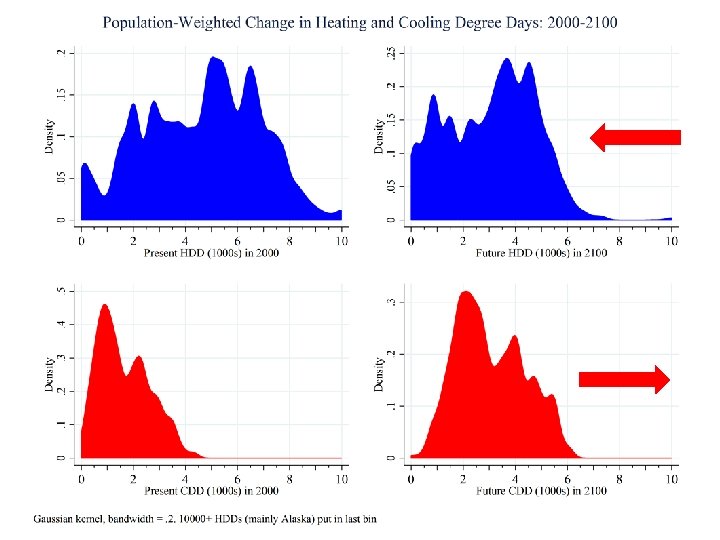
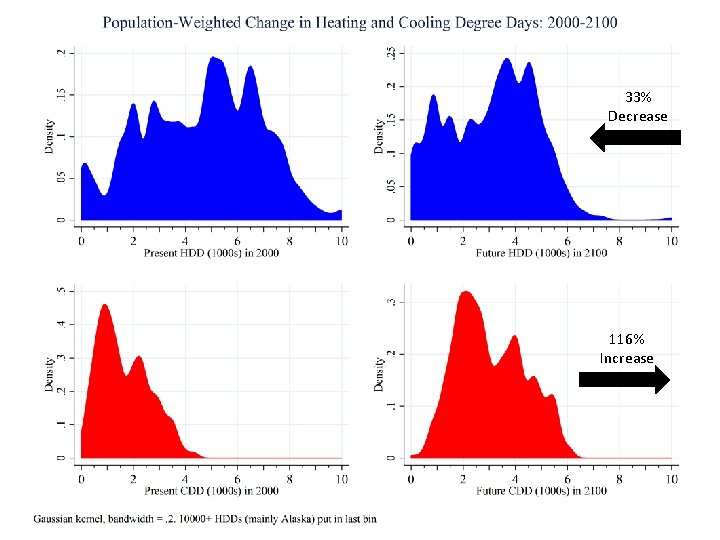
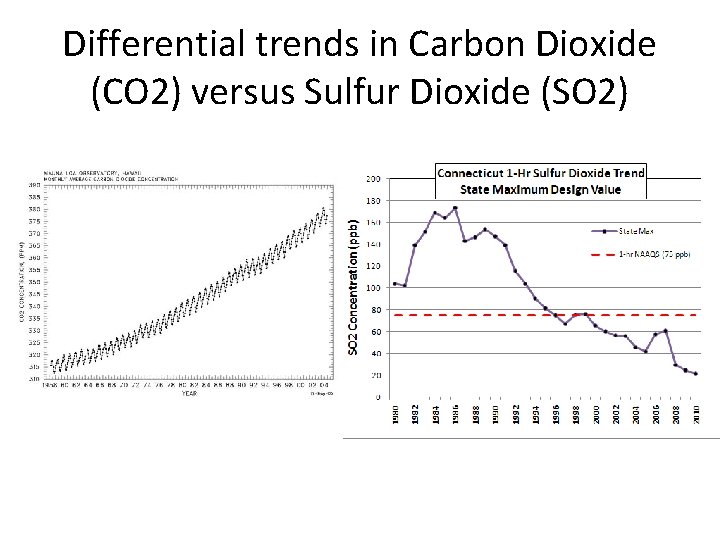
33% Decrease 116% Increase 11
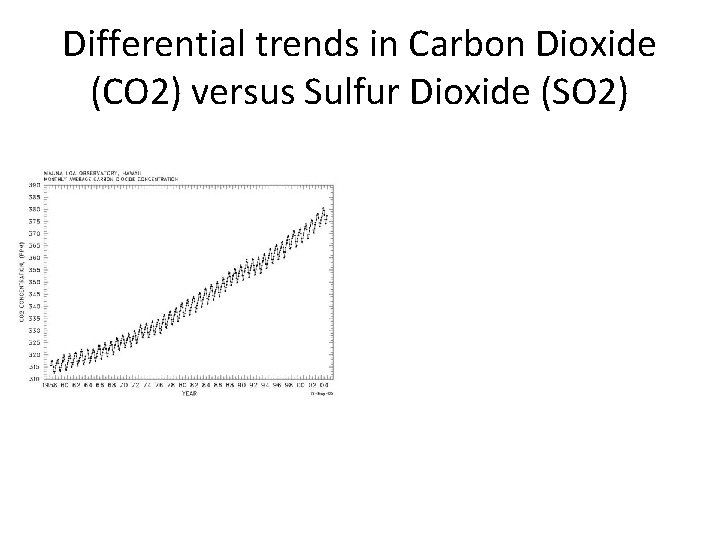
Differential trends in Carbon Dioxide (CO 2) versus Sulfur Dioxide (SO 2)
Differential trends in Carbon Dioxide (CO 2) versus Sulfur Dioxide (SO 2)
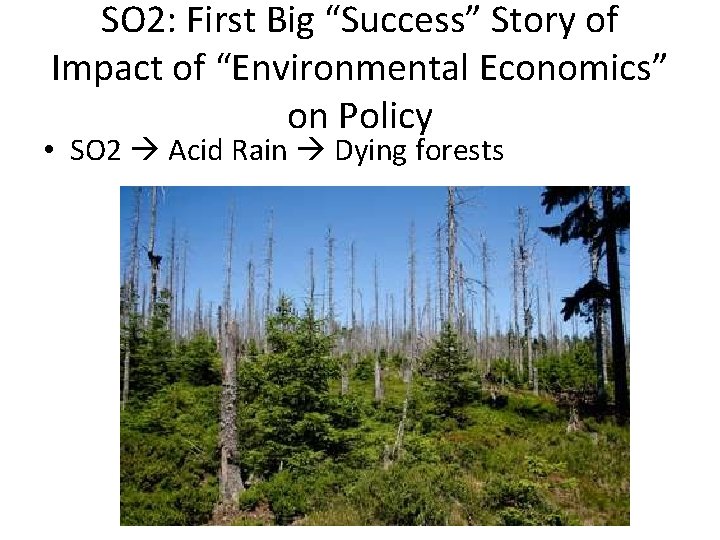
SO 2: First Big “Success” Story of Impact of “Environmental Economics” on Policy • SO 2 Acid Rain Dying forests
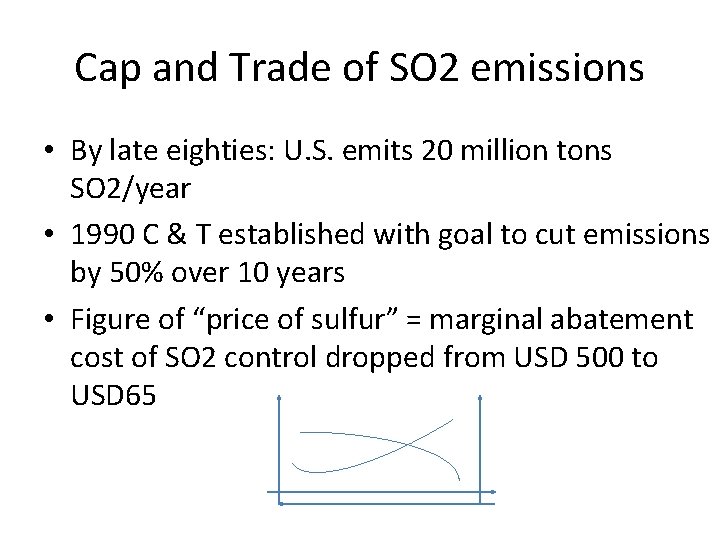
Cap and Trade of SO 2 emissions • By late eighties: U. S. emits 20 million tons SO 2/year • 1990 C & T established with goal to cut emissions by 50% over 10 years
Cap and Trade of SO 2 emissions • By late eighties: U. S. emits 20 million tons SO 2/year • 1990 C & T established with goal to cut emissions by 50% over 10 years • Figure of “price of sulfur” = marginal abatement cost of SO 2 control dropped from USD 500 to USD 65
Ozone Depletion in Stratosphere • Ozone in Stratosphere necessary to decrease ultra violet radiation to hit planet (UV-B skin cancer) • Refrigerants (i. e. CFCs) destroy O 3 molecules • World observes steady magnitude of ozone hole in stratosphere since 1980 • 1986: Montreal Protocol bans (most) CFCs • Ozone hole slowly starting now to decrease BUT global warming cools stratosphere, difficult to predict. . . • http: //www. youtube. com/watch? v=q. Uf. VMog. Idr 8
Ozone Depletion in Stratosphere • Ozone in Stratosphere necessary to decrease ultra violet radiation to hit planet (UV-B skin cancer) • Refrigerants (i. e. CFCs) destroy O 3 molecules • World observes steady magnitude of ozone hole in stratosphere since 1980 • 1986: Montreal Protocol bans (most) CFCs • Ozone hole slowly starting now to decrease BUT global warming cools stratosphere, difficult to predict. . . • http: //www. youtube. com/watch? v=q. Uf. VMog. Idr 8
Which Pollutants Increase/Decrease? • Increase – CO 2 – Illegal oceanic waste dumping – Nuclear contamination – Particulate Matter in Urban Areas (Developing Countries) • Decrease – SO 2 in U. S. – Local Water Pollution Homework
Which Pollutants Increase/Decrease? • Increase – CO 2 – Illegal oceanic waste dumping – Nuclear contamination – Particulate Matter in Urban Areas (Developing Countries) • Decrease – SO 2 in U. S. – CFCs worldwide – Local Water Pollution Homework
Which Pollutants Increase/Decrease? • Increase – CO 2 – Illegal oceanic waste dumping – Nuclear contamination – Particulate Matter in Urban Areas (Developing Countries) • Decrease – SO 2 in U. S. – CFCs worldwide – Local Water Pollution Homework
Introduction • What is Environmental Econ (EE)? • Def. Kolstad, Chapter. 1: – EE is concerned with • the impact of the economy on the environment • the significance of the environment to the economy • The appropriate way of regulating the economic activity so that balance is achieved among environmental, economic and other social goals.
Def. of EE (continued) • “Economics not about profit max. or ‘capitalism’, but ‘how to make best of things’! • ‘Things’ includes – – – Environment (Air, Water, landscape, forests) as well as ‘capital’ ‘human capital’ ‘time’ ‘music in the pedestrian zone’ • Max Welfare s. t. constraints. (virtually all econ models have this set-up)
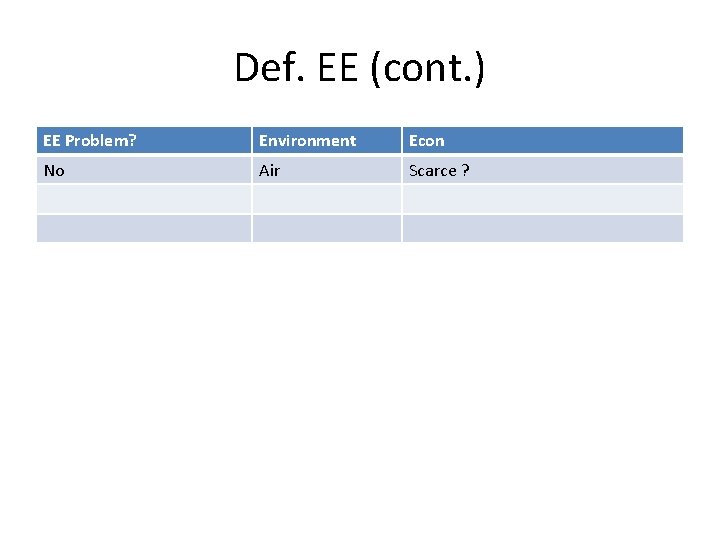
Def. EE (cont. ) EE Problem? Environment Econ No Air Scarce ?
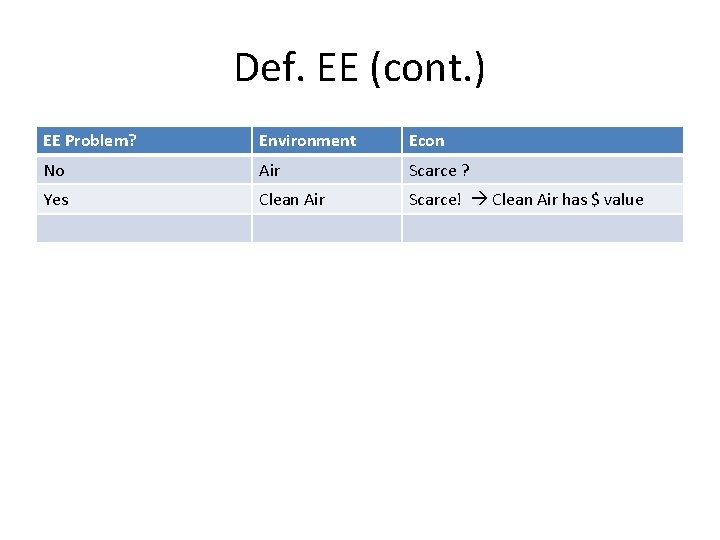
Def. EE (cont. ) EE Problem? Environment Econ No Air Scarce ? Yes Clean Air Scarce! Clean Air has $ value
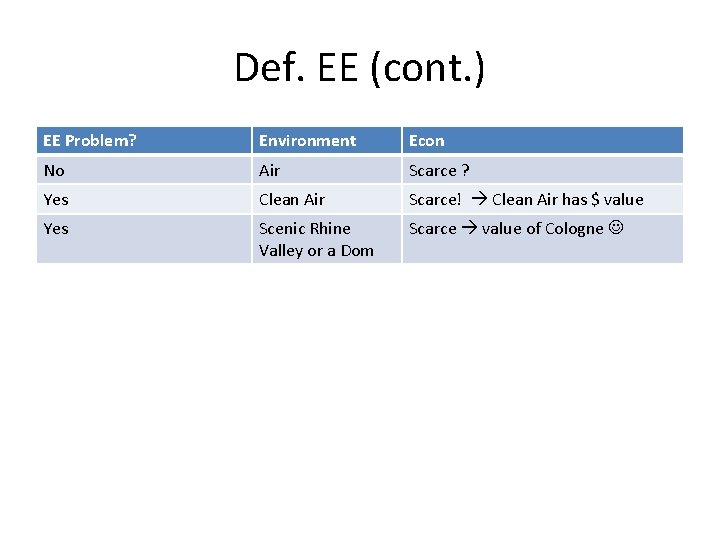
Def. EE (cont. ) EE Problem? Environment Econ No Air Scarce ? Yes Clean Air Scarce! Clean Air has $ value Yes Scenic Rhine Valley or a Dom Scarce value of Cologne
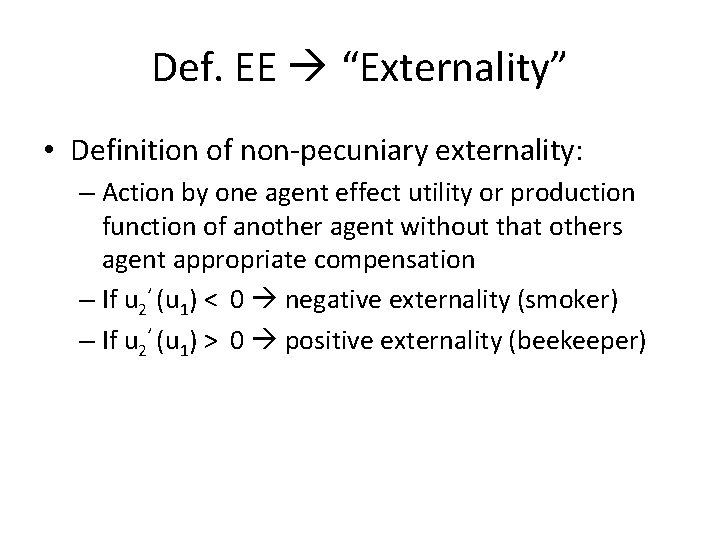
Def. EE “Externality” • Definition of non-pecuniary externality: – Action by one agent effect utility or production function of another agent without that others agent appropriate compensation – If u 2’ (u 1) < 0 negative externality (smoker) – If u 2’ (u 1) > 0 positive externality (beekeeper)
Def. EE “Externality” • Definition of non-pecuniary externality: – Action by one agent effect utility or production function of another agent without that others agent appropriate compensation – If u 2’ (u 1) < 0 negative externality (smoker) – If u 2’ (u 1) > 0 positive externality (beekeeper) • EE not concerned with pecuniary externality
Implications (why is EE important)? (A) Theory and Design of Policy Instruments: GET THE PRICES RIGHT!!! • P= MC but P should equal Marginal Social Cost!!! (B) Policy: • Next 30 years crucial decisions have to be made how we live, commute, produce energy (nuclear, coal, CO 2) • Field of EE 50 -70 growing but mainly by “Birkenstocks” • Today EE conference 2000 participant with over 18 parallel sessions • “Wallmart’ vs. Govt. ‘crowding out’ literature.
Implications (why is EE important)? (A) Theory: GET THE PRICES RIGHT!!! • P= MC but P should equal Marginal Social Cost!!! (B) Policy: • Next 30 years crucial decisions have to be made how we live, commute, produce energy (nuclear, coal, CO 2) • Field of EE 50 -70 growing but mainly by “Birkenstocks” • Today EE conference 2000 participant with over 18 parallel sessions • “Wallmart’ vs. Govt. ‘crowding out’ literature. • Nytimes. com
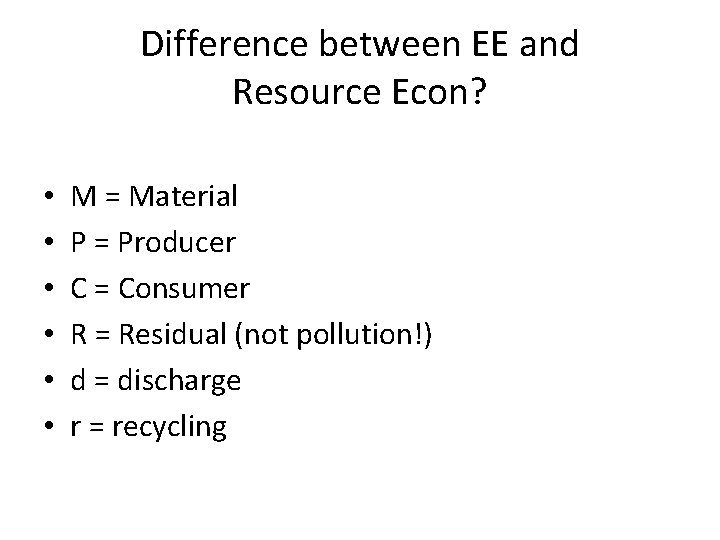
Difference between EE and Resource Econ?
Difference between EE and Resource Econ? • • • M = Material P = Producer C = Consumer R = Residual (not pollution!) d = discharge r = recycling
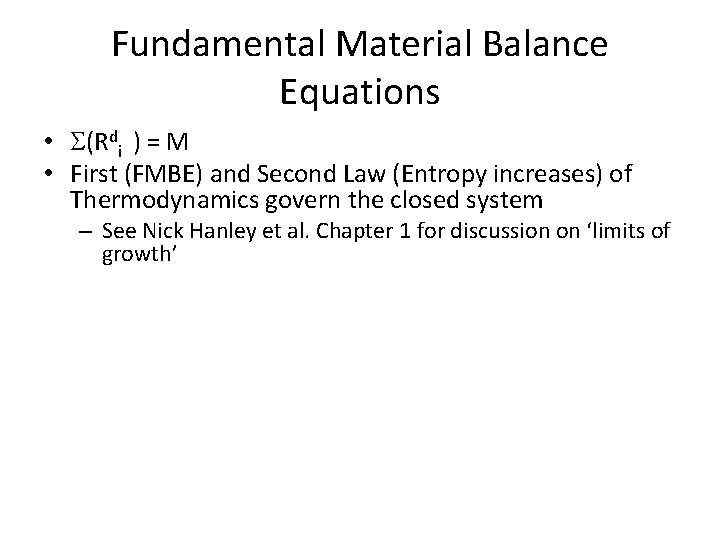
Fundamental Material Balance Equations • (Rdi ) = M • First (FMBE) and Second Law (Entropy increases) of Thermodynamics govern the closed system – See Nick Hanley et al. Chapter 1 for discussion on ‘limits of growth’ • 4 Approaches to manage Environment • M = (Rdi ) = G + RP - (Rri ) – Traditional Approach: (Rdi ) – Moral Approach / Zero Population Growth: G – Technology Innovation: RP r – Recycling (R i )
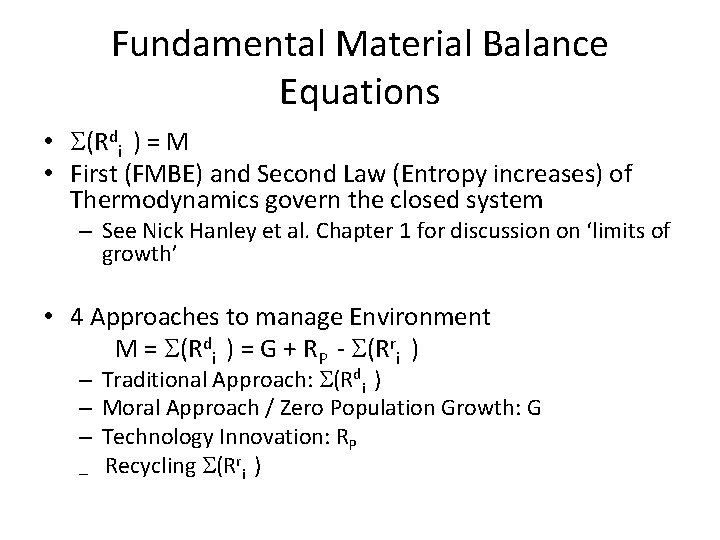
Fundamental Material Balance Equations • (Rdi ) = M • First (FMBE) and Second Law (Entropy increases) of Thermodynamics govern the closed system – See Nick Hanley et al. Chapter 1 for discussion on ‘limits of growth’ • 4 Approaches to manage Environment M = (Rdi ) = G + RP - (Rri ) – Traditional Approach: (Rdi ) – Moral Approach / Zero Population Growth: G – Technology Innovation: RP r – Recycling (R i )
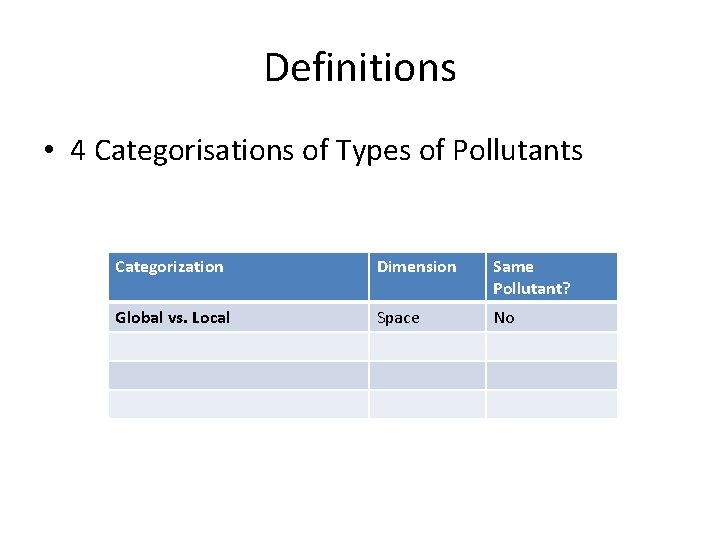
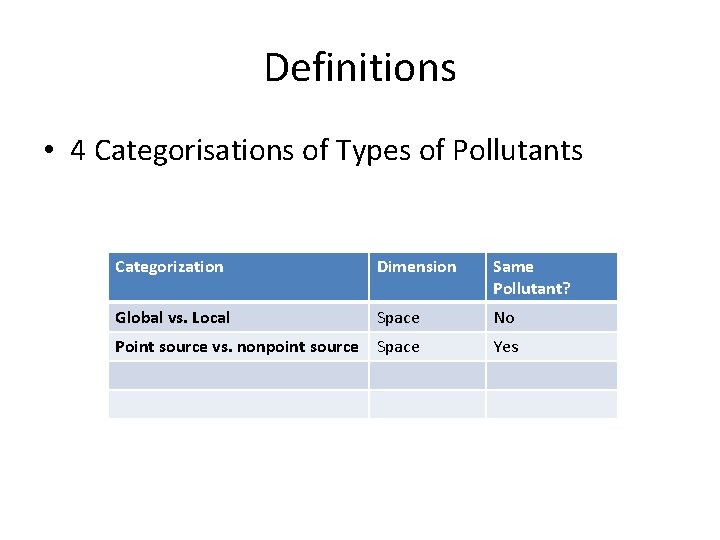
Definitions • 4 Categorisations of Types of Pollutants Categorization Dimension Same Pollutant? Global vs. Local Space No
Definitions • 4 Categorisations of Types of Pollutants Categorization Dimension Same Pollutant? Global vs. Local Space No Point source vs. nonpoint source Space Yes
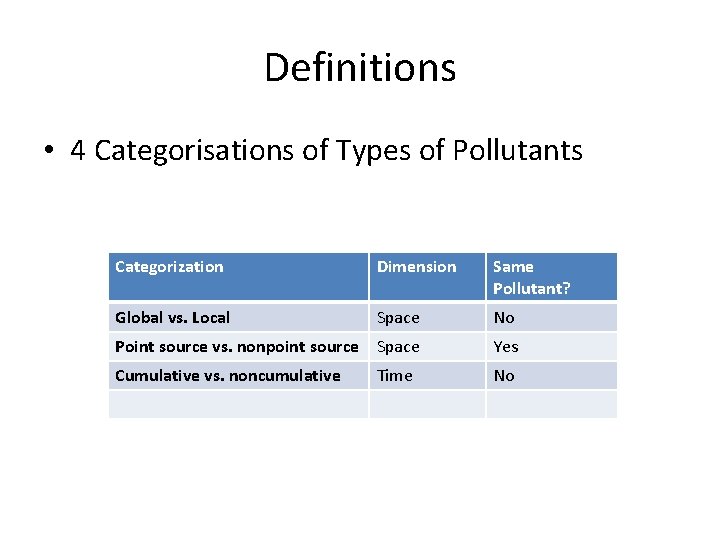
Definitions • 4 Categorisations of Types of Pollutants Categorization Dimension Same Pollutant? Global vs. Local Space No Point source vs. nonpoint source Space Yes Cumulative vs. noncumulative No Time
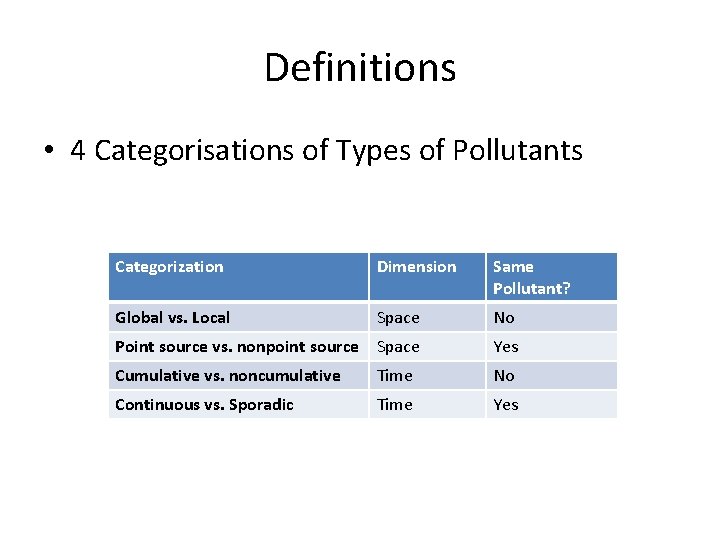
Definitions • 4 Categorisations of Types of Pollutants Categorization Dimension Same Pollutant? Global vs. Local Space No Point source vs. nonpoint source Space Yes Cumulative vs. noncumulative Time No Continuous vs. Sporadic Time Yes
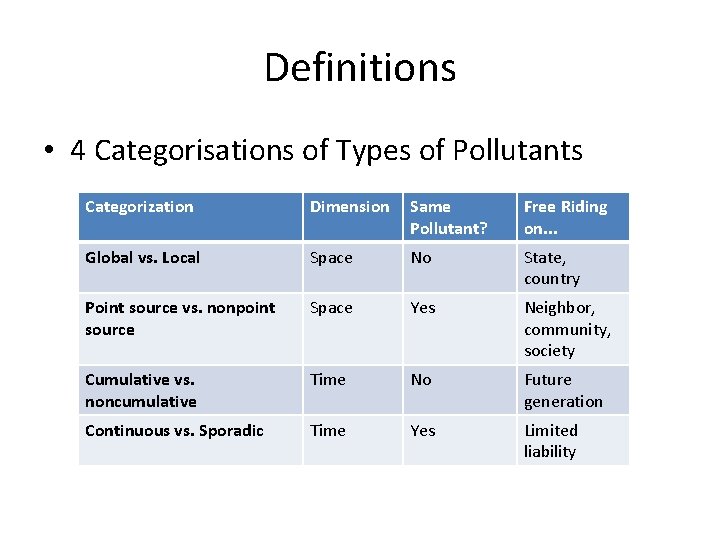
Definitions • 4 Categorisations of Types of Pollutants Categorization Dimension Same Pollutant? Free Riding on. . . Global vs. Local Space No State, country Point source vs. nonpoint source Space Yes Neighbor, community, society Cumulative vs. noncumulative Time No Future generation Continuous vs. Sporadic Time Yes Limited liability
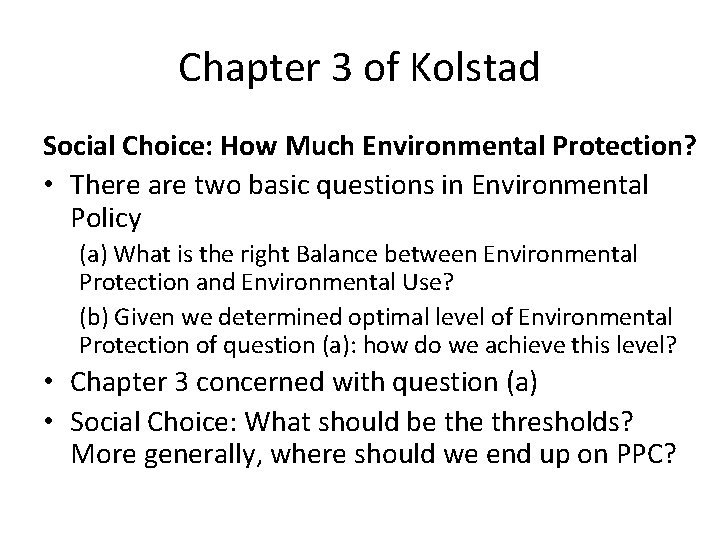
Chapter 3 of Kolstad Social Choice: How Much Environmental Protection? • There are two basic questions in Environmental Policy (a) What is the right Balance between Environmental Protection and Environmental Use? (b) Given we determined optimal level of Environmental Protection of question (a): how do we achieve this level? • Chapter 3 concerned with question (a) • Social Choice: What should be thresholds? More generally, where should we end up on PPC?
Figure: Where should we end up on Production Possibility Frontier (PPC) in GDP – E-Quality space
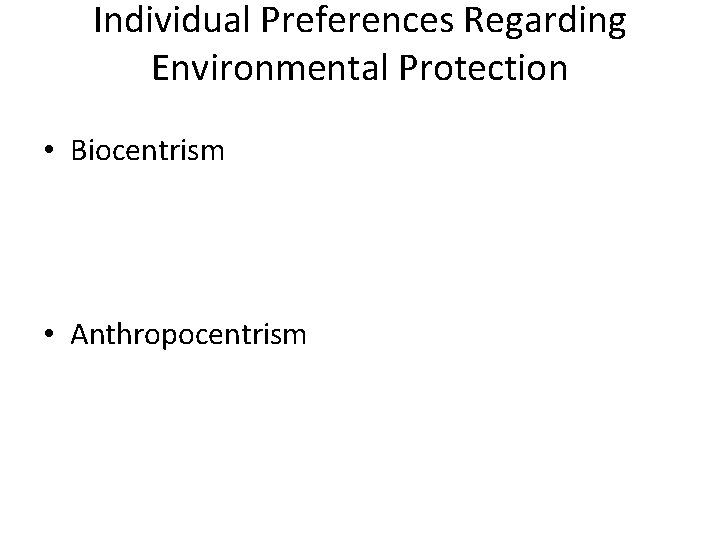
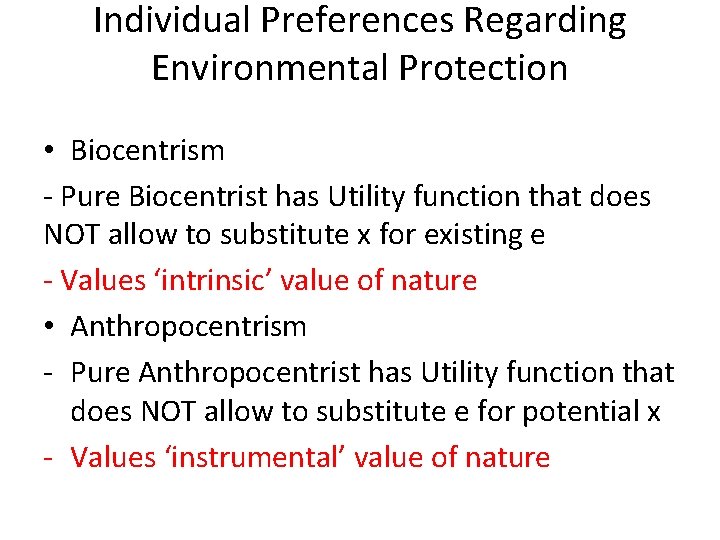
Individual Preferences Regarding Environmental Protection • Biocentrism • Anthropocentrism
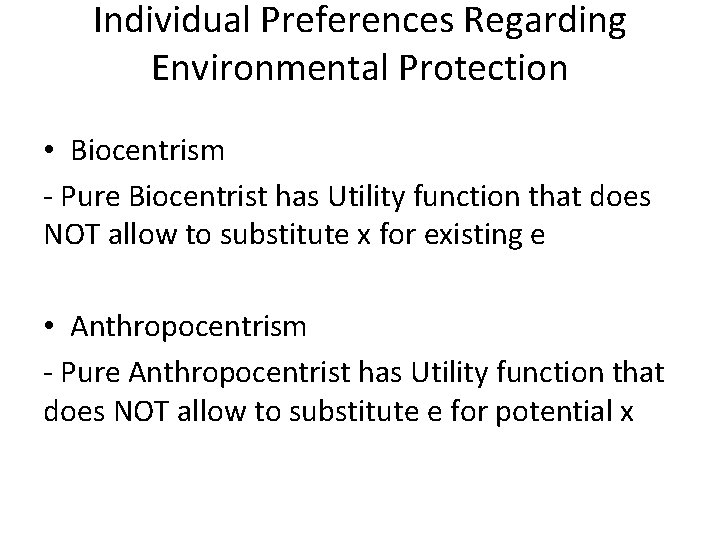
Individual Preferences Regarding Environmental Protection • Biocentrism - Pure Biocentrist has Utility function that does NOT allow to substitute x for existing e • Anthropocentrism - Pure Anthropocentrist has Utility function that does NOT allow to substitute e for potential x
Individual Preferences Regarding Environmental Protection • Biocentrism - Pure Biocentrist has Utility function that does NOT allow to substitute x for existing e - Values ‘intrinsic’ value of nature • Anthropocentrism - Pure Anthropocentrist has Utility function that does NOT allow to substitute e for potential x - Values ‘instrumental’ value of nature
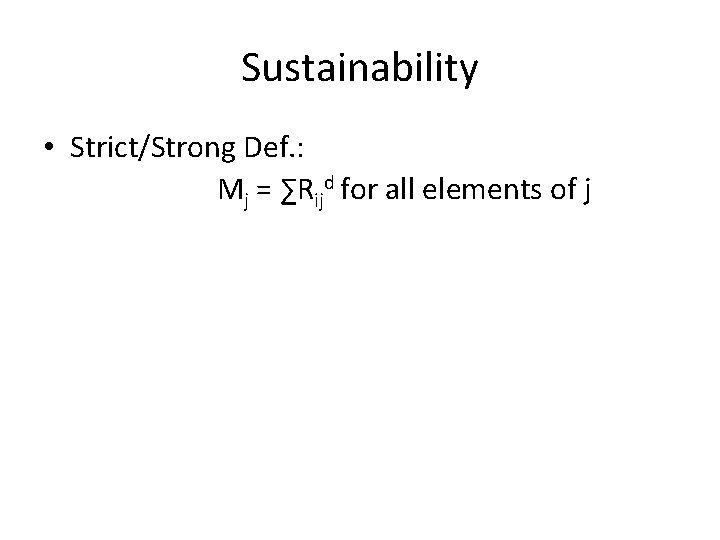
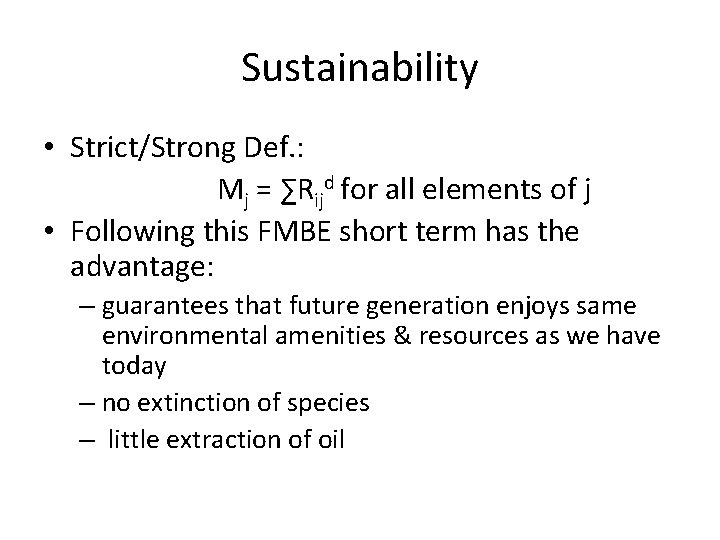
Sustainability • Strict/Strong Def. : Mj = ∑Rijd for all elements of j • Following this FMBE short term has the advantage: – guarantees that future generation enjoys same environmental amenities & resources as we have today – no extinction of species – little extraction of oil
Sustainability • Strict/Strong Def. : Mj = ∑Rijd for all elements of j • Following this FMBE short term has the advantage: – guarantees that future generation enjoys same environmental amenities & resources as we have today – no extinction of species – little extraction of oil
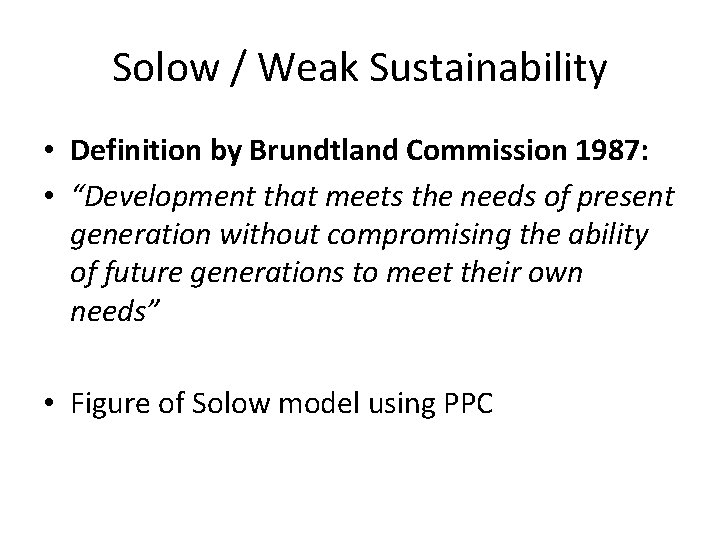
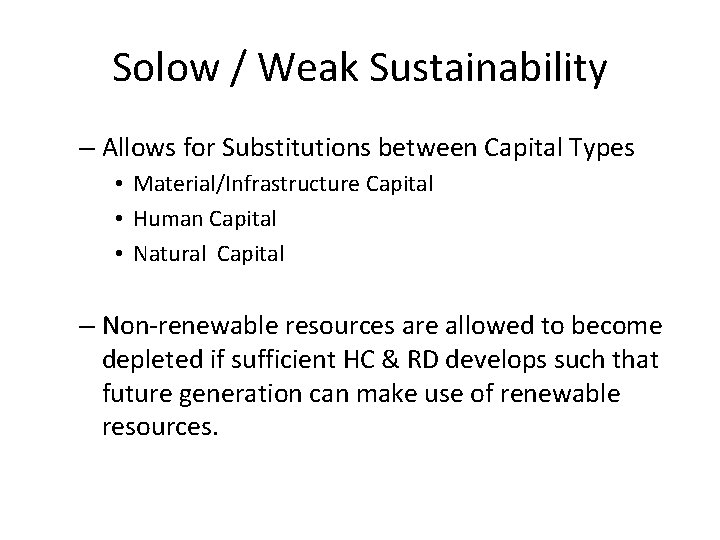
Solow / Weak Sustainability • Definition by Brundtland Commission 1987: • “Development that meets the needs of present generation without compromising the ability of future generations to meet their own needs” • Figure of Solow model using PPC
Solow / Weak Sustainability – Allows for Substitutions between Capital Types • Material/Infrastructure Capital • Human Capital • Natural Capital – Non-renewable resources are allowed to become depleted if sufficient HC & RD develops such that future generation can make use of renewable resources.
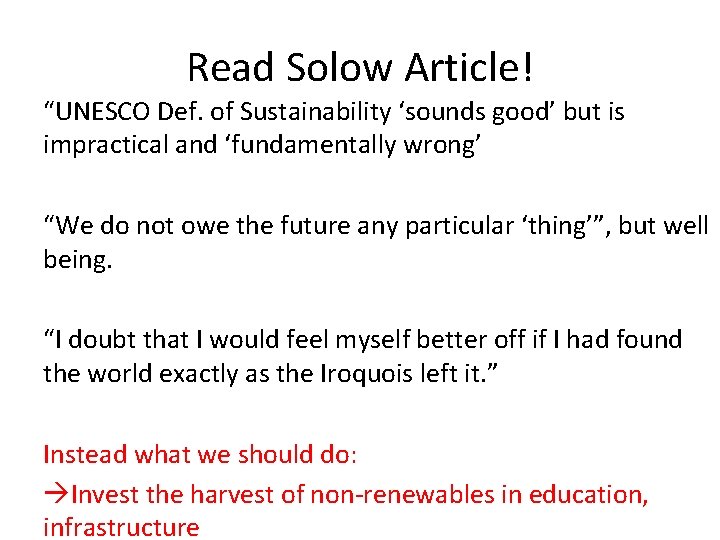
Quotes from Solow Article! “UNESCO Def. of Sustainability ‘sounds good’ but is impractical and ‘fundamentally wrong’ “We do not owe the future any particular ‘thing’”, but well being. “I doubt that I would feel myself better off if I had found the world exactly as the Iroquois left it. ” Instead what we should do: Invest the harvest of non-renewables in education, infrastructure
Read Solow Article! “UNESCO Def. of Sustainability ‘sounds good’ but is impractical and ‘fundamentally wrong’ “We do not owe the future any particular ‘thing’”, but well being. “I doubt that I would feel myself better off if I had found the world exactly as the Iroquois left it. ” Instead what we should do: Invest the harvest of non-renewables in education, infrastructure
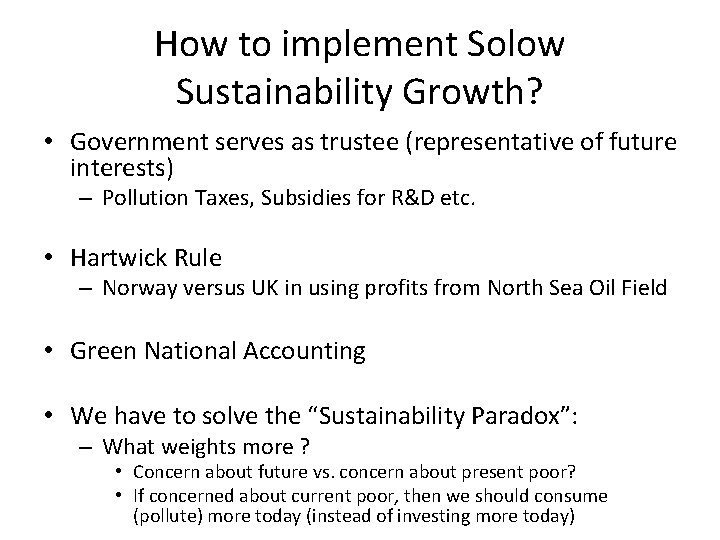
How to implement Solow Sustainability Growth? • Government serves as trustee (representative of future interests) – Pollution Taxes, Subsidies for R&D etc. • Hartwick Rule – Norway versus UK in using profits from North Sea Oil Field • Green National Accounting • We have to solve the “Sustainability Paradox”: – What weights more ? • Concern about future vs. concern about present poor? • If concerned about current poor, then we should consume (pollute) more today (instead of investing more today)
Social Choice from Individual Values Three Social Choice Mechanisms • Pareto Criterion • Compensation Principle (Kaldor Hicks) • Voting
Social Welfare Functions Benthamite Rawlsian Egalitarian
i 1 2 3 4 SWFB 10 10 SWFE SWFR 1 10 10 19 10 10 10 1
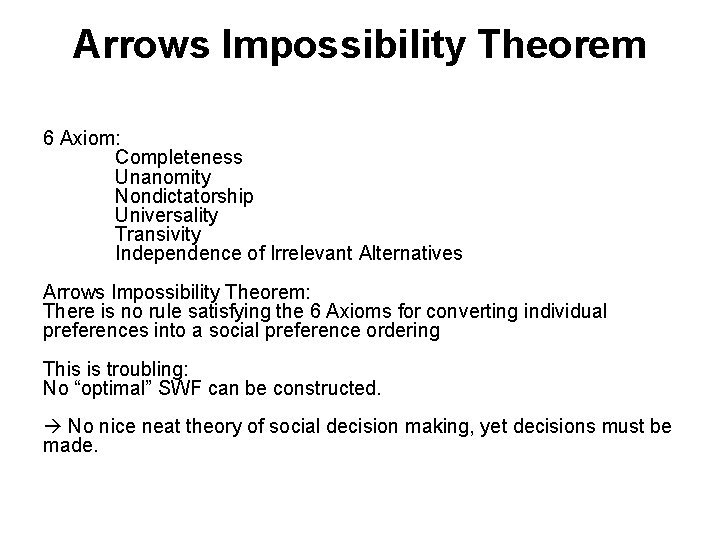
Arrows Impossibility Theorem 6 Axiom: Completeness Unanomity Nondictatorship Universality Transivity Independence of Irrelevant Alternatives Arrows Impossibility Theorem: There is no rule satisfying the 6 Axioms for converting individual preferences into a social preference ordering This is troubling: No “optimal” SWF can be constructed. No nice neat theory of social decision making, yet decisions must be made.