Environmental Science Chapter 2 Economics and Environmental Policy

- Slides: 11
Environmental Science Chapter 2 Economics and Environmental Policy
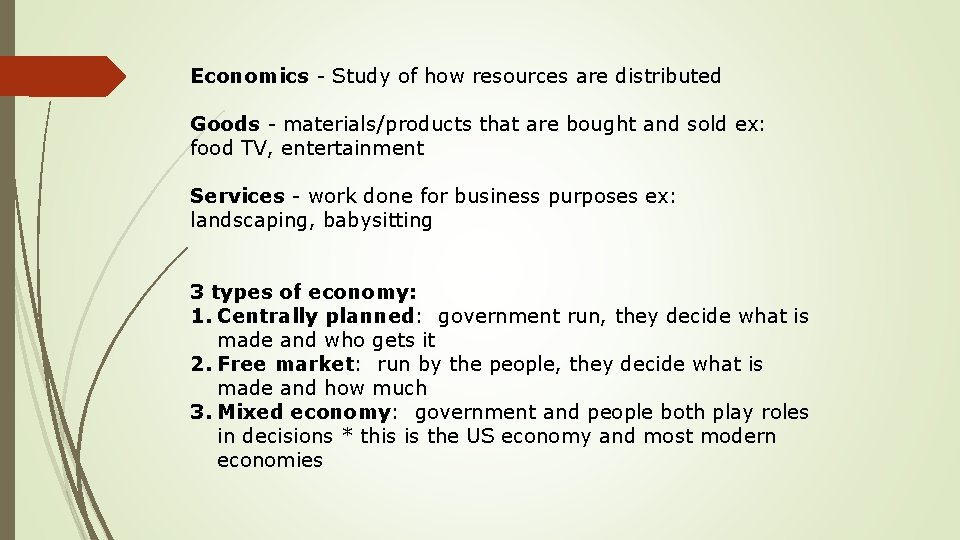
Economics - Study of how resources are distributed Goods - materials/products that are bought and sold ex: food TV, entertainment Services - work done for business purposes ex: landscaping, babysitting 3 types of economy: 1. Centrally planned: government run, they decide what is made and who gets it 2. Free market: run by the people, they decide what is made and how much 3. Mixed economy: government and people both play roles in decisions * this is the US economy and most modern economies
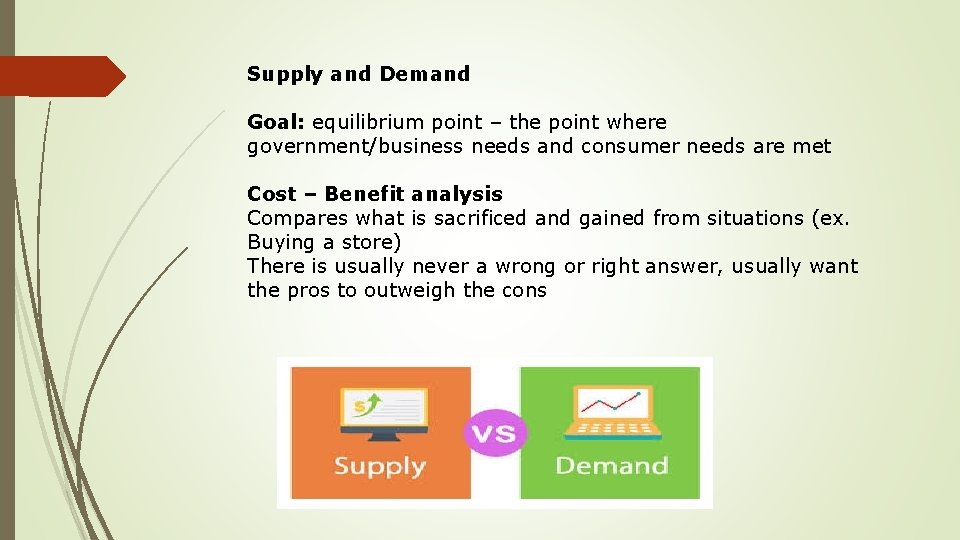
Supply and Demand Goal: equilibrium point – the point where government/business needs and consumer needs are met Cost – Benefit analysis Compares what is sacrificed and gained from situations (ex. Buying a store) There is usually never a wrong or right answer, usually want the pros to outweigh the cons
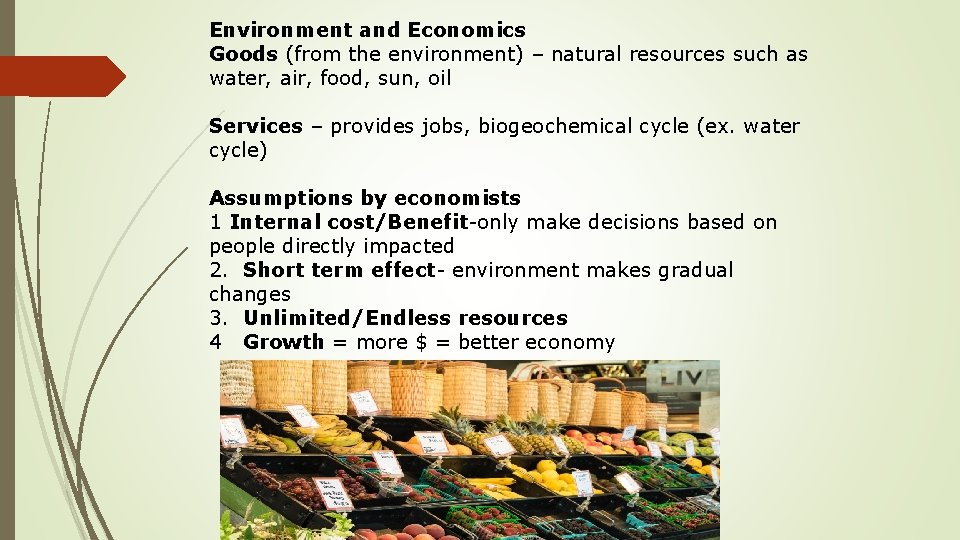
Environment and Economics Goods (from the environment) – natural resources such as water, air, food, sun, oil Services – provides jobs, biogeochemical cycle (ex. water cycle) Assumptions by economists 1 Internal cost/Benefit-only make decisions based on people directly impacted 2. Short term effect- environment makes gradual changes 3. Unlimited/Endless resources 4 Growth = more $ = better economy
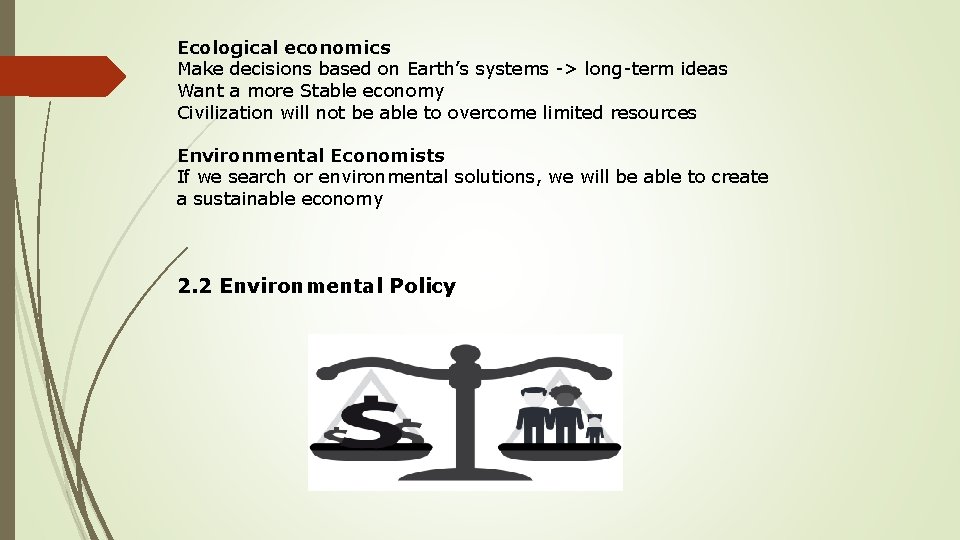
Ecological economics Make decisions based on Earth’s systems -> long-term ideas Want a more Stable economy Civilization will not be able to overcome limited resources Environmental Economists If we search or environmental solutions, we will be able to create a sustainable economy 2. 2 Environmental Policy
Policy Formal set of general plans and principles for addressing problems and guide decision-making Environmental policy Addresses interactions between humans and environment Modern policy Goals: Protect environmental quality Protect natural resources Ensure resources are shared fairly
In making policy Branches of government involved: 1. Legislative (Congress)-debate and pass laws 2. Executive (President and Agencies) enforce laws ex. EPA (Environmental Protection Agency 3. Judicial (Supreme and lower courts) Interpret laws State and Local Can make laws that are more specific than federal laws but cannot violate the Constitution Ex MA, CA, NY are eco-friendly states
Modern Day Policy 1. National Environmental Policy Act (NEPA) 2. (EIS) Environmental Impact Statement research necessary to see consequences of harming and environment must be approved (ex building a bridge) 3. EPA Environmental Protection Agency regulates air, H 2 O, and waste pollution educates the public 4. Clean water Act (1977) puts limits on waste allowed in water protects aquatic wild life Today and the future issues Sustainable resources Renewable energy Global climate change
International Environmental Policy and Approaches Command control approach A way of implementing policy in which a government body sets rules and threatens punishment for violations Subsidy A giveaway of cash or public resources in order to encourage an activity or lower the $ of a product. Green tax A tax imposed upon companies that participate and/or produce products that are harmful to the environment Cap and Trade Polluters receive a permit to emit a portion of the allowed amount of a pollutant into the environment. These permits can be bought, sold, or treaded
Lobbying An effort to influence and elected official to support a specific interest Nations need to work together to solve environmental problems because environmental problems often extend across borders and one nation’s laws do not have authority in other nations The Environmental Policy Process Steps 1. identify the problem 2. identify the cause 3. envision a solution 4. get organized 5. gain access 6. help a solution become policy
International Policy International law needed to solve issues that involve more than 1 country ->Trans-boundary problems Ex – air pollution, water pollution, international companies using resources, migrating animals Helpful Organizations United Nations (UN) – promote peace and help with economic m, social, and humanitarian problems European Union (EU) – 27 nations – collect current environmental data for policy makers World Trade Organization (WTO) – promotes fair trade World Bank – grants to poor nations to increase standards of living Non-Governmental Organizations (NGO’s) – shape policy through research, lobbying, protesting